



Abstract
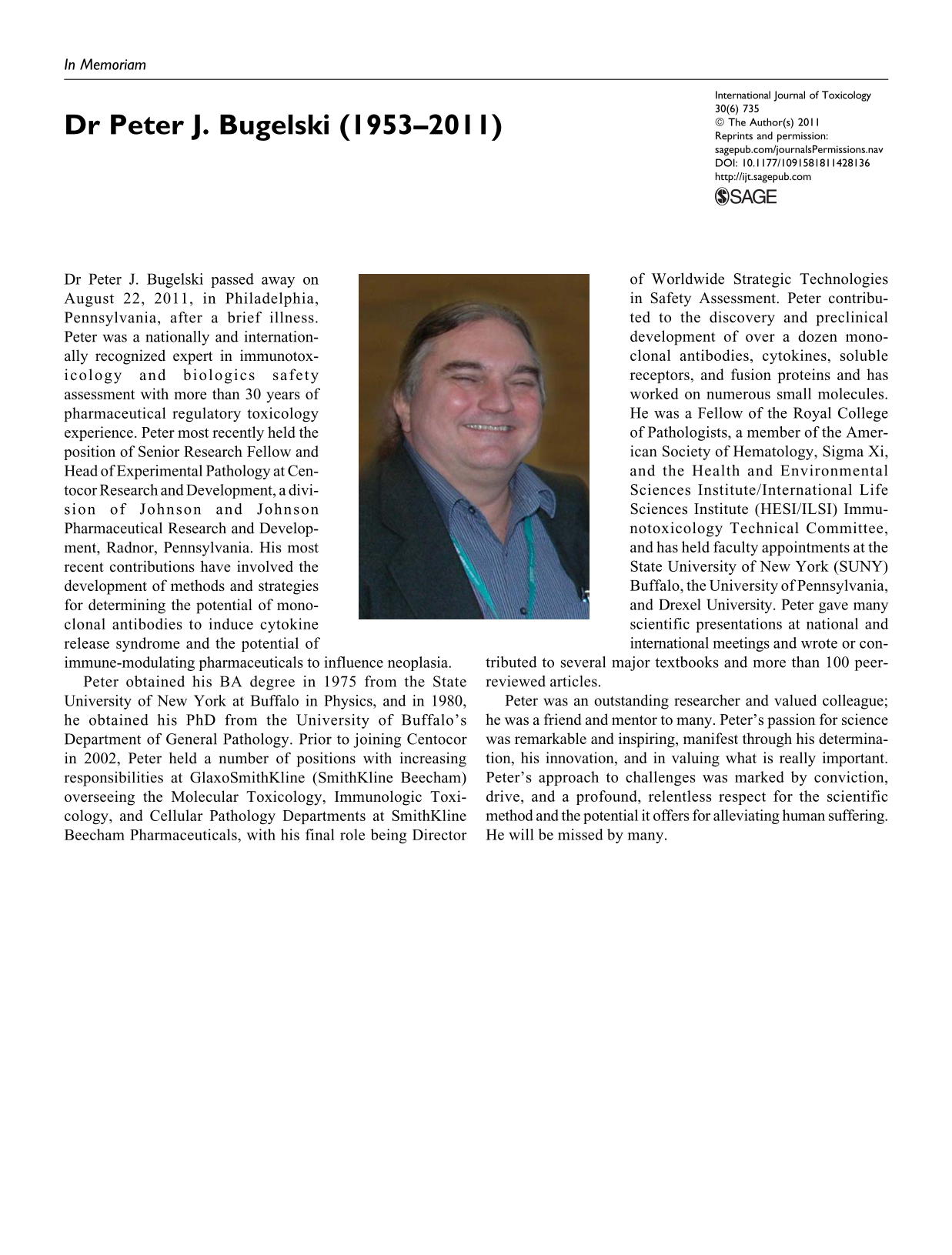
Dr Peter J. Bugelski passed away on August 22, 2011, in Philadelphia, Pennsylvania, after a brief illness. Peter was a nationally and internationally recognized expert in immunotoxicology and biologics safety assessment with more than 30 years of pharmaceutical regulatory toxicology experience. Peter most recently held the position of Senior Research Fellow and Head of Experimental Pathology at Centocor Research and Development, a division of Johnson and Johnson Pharmaceutical Research and Development, Radnor, Pennsylvania. His most recent contributions have involved the development of methods and strategies for determining the potential of monoclonal antibodies to induce cytokine release syndrome and the potential of immune-modulating pharmaceuticals to influence neoplasia.

Peter obtained his BA degree in 1975 from the State University of New York at Buffalo in Physics, and in 1980, he obtained his PhD from the University of Buffalo’s Department of General Pathology. Prior to joining Centocor in 2002, Peter held a number of positions with increasing responsibilities at GlaxoSmithKline (SmithKline Beecham) overseeing the Molecular Toxicology, Immunologic Toxicology, and Cellular Pathology Departments at SmithKline Beecham Pharmaceuticals, with his final role being Director of Worldwide Strategic Technologies in Safety Assessment. Peter contributed to the discovery and preclinical development of over a dozen monoclonal antibodies, cytokines, soluble receptors, and fusion proteins and has worked on numerous small molecules. He was a Fellow of the Royal College of Pathologists, a member of the American Society of Hematology, Sigma Xi, and the Health and Environmental Sciences Institute/International Life Sciences Institute (HESI/ILSI) Immunotoxicology Technical Committee, and has held faculty appointments at the State University of New York (SUNY) Buffalo, the University of Pennsylvania, and Drexel University. Peter gave many scientific presentations at national and international meetings and wrote or contributed to several major textbooks and more than 100 peer-reviewed articles.
Peter was an outstanding researcher and valued colleague; he was a friend and mentor to many. Peter’s passion for science was remarkable and inspiring, manifest through his determination, his innovation, and in valuing what is really important. Peter’s approach to challenges was marked by conviction, drive, and a profound, relentless respect for the scientific method and the potential it offers for alleviating human suffering. He will be missed by many.