




Abstract
Lifestyle medicine, an evidence-based approach to preventing and managing chronic disease through behavior change, remains underrepresented in health professional education. Limited institutional support and funding barriers often prevent students from engaging in experiential learning opportunities that reinforce lifestyle medicine competencies. This study examines how student-led initiatives supported by targeted grant funding can serve as an alternative to promote institutional curricular adoption of lifestyle medicine. Using the American College of Lifestyle Medicine’s (ACLM) project management platform, Asana, and a mixed-methods approach, we analyzed 178 reimbursement forms from the Taste of Lifestyle Medicine (TOLM) grant program. Descriptive analyses summarized the characteristics of Lifestyle Medicine Interest Group (LMIG) and non-LMIG events, while qualitative content analysis of open-ended feedback explored engagement outcomes and perceived value. Between September 2023 and May 2024, 178 funded events reached 6,278 participants across U.S. health professional institutions. More than half of these events were nutrition-focused, integrating plant-predominant meals and culinary demonstrations that generated enthusiasm and community engagement around lifestyle medicine principles. Findings illustrate how combining student advocacy with strategic grant mechanisms can overcome financial and institutional barriers to implementing lifestyle medicine education, especially events such as cooking demonstrations and culinary medicine demos. This case example shows the utilization of the Taba model in which student leadership and external funding drive curricular innovation via increasing student and faculty interest, as well as capacity building in preventive health. This model offers a scalable approach for embedding behavior change and health promotion training within the next generation of health professionals.
Introduction
The adoption of new fields of practice in health professional education is often driven by a combination of student interest, institutional support, and access to resources (Hampshire et al., 2022; Lintvedt et al., 2023; Malik et al., 2022; Reddy et al., 2022; Strange et al., 2018; Wyatt & Oswalt, 2011). Student-led initiatives, particularly those supported by targeted funding mechanisms, have emerged as catalysts for integrating emerging disciplines and/or important health concepts into academic institutions (Chiu et al., 2022; Hampshire et al., 2022; Malik et al., 2022). While medical and health professional schools have traditionally relied on top-down curriculum changes to introduce new health care fields and specialties, grassroots efforts led by students can play a pivotal role in shaping educational priorities and fostering long-term institutional buy-in (Hampshire et al., 2022; Reddy et al., 2022; Strange et al., 2018; Wyatt & Oswalt, 2011).
To explicitly ground how student-led initiatives might influence curricular adoption, we frame this work using the Taba Curriculum Model, an inductive, grassroots approach to curriculum development that begins with the needs of learners, utilizing faculty as the centerpiece to build new content, teaching strategies, and evaluation (Portillo et al., 2020). Originating with Hilda Taba, this model emphasizes bottom-up design and iterative refinement, making it particularly suitable for understanding how student-identified interests and experiential activities can shape formal curriculum structures. In this study, student engagement with the six pillars of lifestyle medicine can thus be viewed through a theoretical lens in which students' needs and interests inform faculty and institutional objectives and learning experiences aligned with a new field of practice, promoting gradual and sustained curricular integration.
This paper examines LMIGs and the TOLM grant as a model for how student-led initiatives can be one of the first steps that lead to the adoption of a new field of practice within educational institutions. Lifestyle medicine (LM) is a rapidly growing medical specialty that uses evidence-based, therapeutic lifestyle interventions to treat, reverse, and prevent chronic diseases, involving six pillars: a whole-food, plant-predominant eating pattern, physical activity, restorative sleep, stress management, positive social connections, and avoidance of risky substances (American College of Lifestyle Medicine, n.d.). LMIGs are a student-led organization designed to promote education and awareness around lifestyle medicine interventions. Since their origin in 2008, LMIGs have grown significantly in the past decade to 165 established LMIG’s as of June 2024 (Vanderpool et al., 2025). The TOLM grant is a funding mechanism distributed by the ACLM that has supported plant-based ingredients for student-led events aimed at engaging peers, faculty, and administrators in this emerging health care discipline.
An important marker of progress in this field is the recent recognition of medical schools that have successfully integrated LM into their curricula. The undergraduate medical education (UME) curriculum certification process evaluates institutions based on the number of training hours, competency achievements, and available enrichment opportunities in lifestyle medicine, including the establishment of an active LMIG at the institution. In April 2024, ACLM announced that the University of South Carolina School of Medicine Greenville (SOMG) and Loma Linda University School of Medicine (LLUSM) had earned the highest “Platinum plus” certification for their exemplary integration of LM, including over 100 hours of required LM education for all medical students. As of June 2025, 9 medical schools have become certified by the ACLM for their incorporation of an LMIG and curricular hours dedicated to teaching lifestyle medicine. Academic pathways to support master’s and doctorate health professional students, such as physician associates, nurses, dietitians, and occupational and physical therapists, in achieving certification in LM upon graduation also exist at health professional institutions and recognize institutions for the incorporation of LM in the curriculum. As of June 2025, health professional academic pathways exist across 97 master’s and doctoral health professional programs. These milestones underscore the impact of both top-down and grassroots approaches in catalyzing curricular change (American College of Lifestyle Medicine Announces First Two Medical Schools to Earn Highest Recognition and Certification for Lifestyle Medicine Curriculum, n.d.; Loma Linda University School of Medicine Earns Top Honors with Platinum Plus Certification in Lifestyle Medicine| News, 2024).
By analyzing patterns of student engagement and funding utilization, this study explores the mechanisms through which student-led events and financial support contribute to the broader adoption of a field of practice. Specifically, this paper will assess the following research questions:
Method
Taste of Lifestyle Medicine (TOLM) Grant Structure and Operation
ACLM distributes the TOLM grant to fund whole-food plant-based (WFPB) ingredients for non-commercial LM events at health professional and health system campuses. As of January 2025, eligible applicants can receive up to $250 for general events, while ACLM-affiliated LMIGs may qualify for up to $500 per event. Applicants must submit a pre-approval application 15 to 90 days before the event date, and if approved, they must provide itemized receipts within 10 days post-event for reimbursement processing. The program allows up to four grants annually per eligible institution, with a limit of one grant per individual event (“Taste of Lifestyle Medicine Micro-Grant,” n.d.).
Data Sources
Data for this study were obtained from TOLM grant applications and reimbursement forms collected through the ACLM project management platform, Asana (n.d.). These documents included both closed-ended questions (e.g., funding requests, reimbursements, and attendance numbers) and open-ended responses such as testimonials and feedback from grant recipients which captured reflections on event success and participant engagement. All data were de-identified prior to analysis; no individual students, event organizers, or applicants were identifiable in the data set. All analyses were conducted on routinely collected program evaluation data.
Data Export
Data from September 1, 2023, to May 17, 2024, time period was exported via direct download from Asana. Data included event type, geographic location, initial funding request, funding reimbursement request, actual funding distributed, LMIG event versus non-LMIG event participation, and audience type.
Data Analysis
Data analysis was conducted in Microsoft Excel and SAS. Microsoft Excel was selected for primary data management and descriptive analysis because of its accessibility and portability across collaborating institutions. Given that the research questions were descriptive and exploratory in their nature, advanced statistical modeling was not required; hence, Excel was considered an appropriate tool for this study. SAS was used to quantify frequencies from coded qualitative data and to ensure reproducibility of summary statistics.
Open-ended responses were reviewed and further coded into specific themes, building upon an existing a priori coding framework. This secondary thematic coding aimed to better understand respondent perspectives on TOLM-funded events and their implications for implementing LM curricula within health professional institutions. Answers to open-text questions of the disbursement form were coded using a qualitative content analysis approach (Content Analysis Method and Examples| Columbia Public Health, 2016). Two researchers independently coded all open-text responses. Discrepancies were discussed between the coders, and any unresolved disagreements were adjudicated by a third team member. This process enhanced the reliability and consistency of thematic categorization. Financial data, event participation metrics, and coded open-text feedback were used to analyze how the TOLM grant was used across institutions and how it was integrated, with particular attention to patterns in student engagement and how these may relate to potential institutional interest in LM.
Because many TOLM-funded events incorporated multiple themes, modes of delivery, key strategies of LM, and audience types, coding was non-mutually exclusive. Each applicable category was recorded for every event instead of forcing a singular classification. As a result, percentages reported in Tables 1 and 2 reflect the proportion of events that included a given category and can sum to more than 100%. Hence, we reported the proportions of events coded as “more than one” category. When the percentage of overlapping events is subtracted from the summed individual categories, the distribution approximates 100%, confirming that totals exceeding 100% are due to intentional overlapping coding rather than analytical error. This study was reviewed by the University of New England Institutional Review Board.
Number of Events, Financial Data, Common Themes, ACLM Key Strategies Representation Data of Reimbursement Forms (n = 178).

Common themes, mode of delivery, and key strategies representation have overlapping coding.
Projected Versus Actual Attendees, Primary Audience, Reimbursement Feedback, Testimonials, and Mode of Delivery in Events Utilizing TOLM Grant.
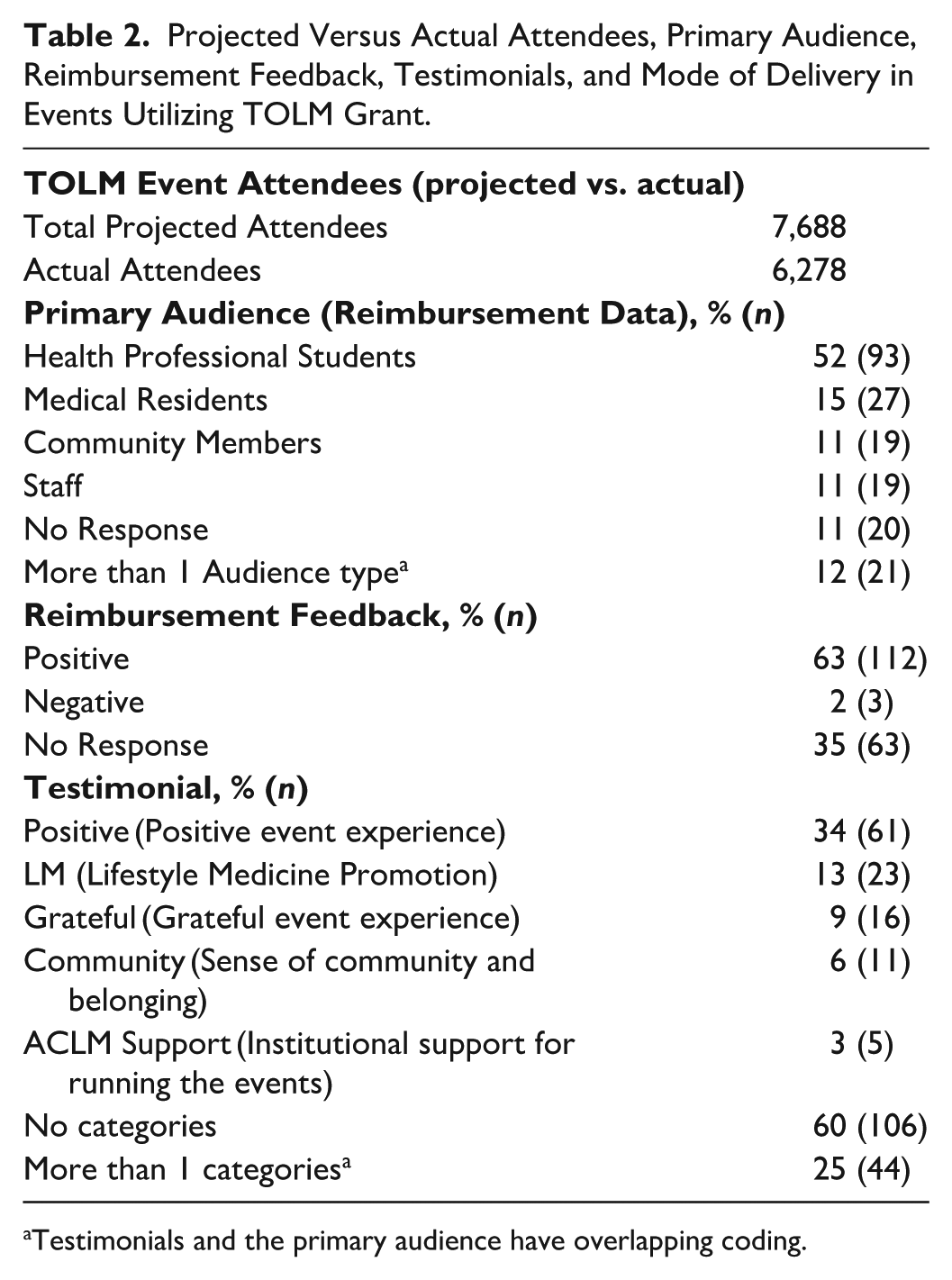
Testimonials and the primary audience have overlapping coding.
Results
Section 1: Key Characteristics of Student-led Initiatives in Health Professional Educational Institutions
To address research question 1, we examined the key characteristics of the TOLM grant. Table 1 presents the breakdown of the number of events, financial data of grant disbursement, common themes, and ACLM key strategies representation data from the reimbursement forms.
Out of the 178 events that utilized the TOLM grant, 102 of them were LMIG events, while 76 of the events were non-LMIG events. Initial funding requests totaled $59,253.62, while the reimbursement requests totaled $47,943.44, and the actual disbursements totaled $47,401.80.
The most common event themes were LM awareness (29%), followed by cooking skills (26%), culinary medicine (11%), recruitment (8%), and research (2%). The most common mode of delivery for student-led events were education (78%) and hands-on activity (31%).
Of the six ACLM key strategies described earlier, nutrition (52%) was the most frequently noted topic among all LMIG TOLM events. The other pillars were less prominently represented, with stress management accounting for (6%) of LMIG events, followed by physical activity (4%), sleep (3%), and social connection (2%). No events during this period addressed the pillar of avoiding the use of risky substances (0%). Some events reported more than 1 pillar in their events (6%), and the rest of the responses were non-responses (32%), which could be attributed to the disbursement survey design having this question as an optional response.
The analysis also showed a geographic breakdown of where events took place. The geographic breakdown of events utilizing the TOLM Grant (Table 2 and Figure 1) showed that California, Pennsylvania, New York, and Texas had over 10 events within the time period, while 12 states had more than 2 events, 21 states had at least 1 event, and 13 states in the United States did not use the TOLM grant within the time frame of this analysis.

Geographical distribution of Taste of Lifestyle Medicine Grant (TOLM) usage.
Student-led events demonstrated high levels of interest, as evidenced by the 6,278 total attendees. The majority were health professionals and medical students (52%), followed by medical residents (15%), community members (11%), staff (11%), and events with multiple audience types (12%). In addition, most student-led events focused on education (78%) and hands-on activities (31%), reinforcing a strong preference for interactive learning.
The major trend across these student-led events was this emphasis on raising awareness for LM via utilizing the funding provided from the TOLM Grant to have events that were mainly catered toward nutrition and cooking demonstrations.
Section 2: Event Engagement
Theme 1: Positive Turnout, Liked the Plant-Based Lunch Served
To address research question 2, we looked at the open-text responses for how student-led events garnered student interest and some of their potential challenges. One key notion often mentioned in the open-text responses was the delicious plant-based lunch that was available due to the grant funding:
“. . .We also had a catered lunch from Krush, a local organic and plant-based restaurant, which was very delicious. Several students came up to us after and said how much they loved the presentation, and many typically meat-eating medical students were shocked by how good the plant-based lunch was and it made them think more about the feasibility of switching to a plant-based diet.”
Analysis of event reimbursement forms showed that 63% of responses contained positive feedback. Factors contributing to success included well-planned logistics, engaging activities, and food incentives. Some events combined multiple ACLM key strategies such as hosting a group exercise activity followed by lunch:
“The 1st year Medical Students really appreciated the plant-based lunch as it was served right after a high intensity interval training workout that they completed. It was fun for them to experience the Plant-based lunch as a group and some students were pleasantly surprised to know how filling the meal was. . .”
Theme 2: Challenges Faced by Student-Led Initiatives
While many events were successful, some faced low turnout and engagement issues due to scheduling conflicts or lack of enthusiasm for the cooking activities:
“. . .We kept pushing the event back because of a lack of participation and moved the deadline Unfortunately, only 4 people participated. In the future, maybe giving participants a whole term to cook a meal would result in better use of funds. . .”
Theme 3: Increasing Student Engagement
With cooking demonstrations being a sizable portion of the events utilizing the TOLM grant, there has been an increase in student interest in WFPB cooking:
“4th year medical students that were in attendance really loved the menu! Favorites from this menu included the Buffalo Cauliflower Taco, the Chipotle Cheez Sauce, and the Chocolate Raspberry Amaranth dessert. The medical students were excited to learn how to make a delicious WFPB lunch menu. The medical students were provided resources on WFPB eating for their personal use and for their patients.”
The grant also allowed students to get exposed to and experiment with cooking without the logistical burden on their end:
“The turnout was very good and it gave an opportunity for the attendees to prepare the ingredients for the veggie spring rolls and assemble their own food. There was also a presentation about the importance of a healthy diet and how it can help patients lead healthier lifestyles and improve healthcare outcomes. Hopefully, this event will encourage medical students to be more conscience towards the benefits of lifestyle and that they will incorporate lifestyle into their practice as future physicians.”
These student engagements have spurred the expansion of LMIGs since their inception in 2008 to 148 active groups, with 97 of them being in U.S. medical schools as of June 2024. This growth has coincided with and driven curriculum changes that led to ACLM certifications, as exemplified by Loma Linda University School of Medicine and the University of South Carolina SOMG earning “Platinum plus” status.
Overall, the student-led events provided a space where students explored a new field of practice; along with potentially garnering the interest of faculty to pursue curricular adoption. While some challenges such as low turnout and interest are present, these events serve as the foundation for curricular adoption.
Section 3: Expanded Capacity Through TOLM Grant
Theme 4: Cooking Demonstrations Relying on Funding
Grant funding plays a critical role in these student-led events, as events like cooking demonstrations rely on the funding from the TOLM grant to purchase food/ingredients for the event:
“Residents really appreciated the event and it was a fun group experience for the residents to assemble the spring rolls by rolling them with the rice paper wrappers. Residents especially liked the Spring Rolls with Peanut Sauce!”
Theme 5: Imbuing Confidence to Practice Lifestyle Medicine
These students led activities garner a lot of interest from the students, empowering them not only with positive experiences but key skills as well for them to take to their own practice:
“We had a great conversation that led to many students showing a lot of interest in how to actually converse with patients about lifestyle change. This will hopefully further our goals of having motivational interviewing workshops in the future.”
The increase in opportunities to learn about the specific skills of LM can lead to increased interest and engagement, which leads to demands for curriculums to adapt and adopt this new field of practice.
Theme 6: Culinary Medicine
One of the curriculums that the ACLM offers is the Culinary Medicine curriculum (n.d.), which focuses on the preparation of healthy and delicious food as a key part in educating healthy professionals to support patients in achieving better health outcomes. (Hauser, 2019; Newman et al., 2023; Staffier et al., 2024) Culinary medicine represents an important approach through which LM may be introduced within health professional institutions. Student-led events utilizing culinary medicine heavily rely on the TOLM grant to fund their events:
“The goal of the event is to expose the residents to culinary medicine which a new field in medicine that combines the art of food and cooking with the science of medicine. This workshop would also equip our residents with the knowledge and tools needed to better support our patient population in attaining healthy lifestyle goals with regards to their diet and overall wellbeing.”
These themes show the importance of funding from the TOLM grant in not only creating access to new educational material, but are also the cornerstone pieces in running certain LMIG events such as cooking demonstrations or culinary medicine events.
Discussion
This study is one of the first studies to systematically examine how student-led initiatives, supported by targeted grant funding, can drive the adoption of an emerging field within health professional education. Traditional top-down curricular reforms often face bureaucratic inertia and slow adoption rates (Cerimagic, 2018). The LMIGs and TOLM grant shows a case example of the Taba model, showcasing how a grassroots approach can lead to institutional change. The findings from this study offer insights for other disciplines seeking to establish themselves within health professional training. This model not only empowers students to take an active role in shaping their educational environment but also offers a potential replicable framework for other emerging disciplines seeking curricular integration.
Thematic analysis of open-text feedback revealed several recurring insights. Positive student engagement was frequently tied to interactive, WFPB activities, particularly lunches and cooking demonstrations, which were consistently cited as both enjoyable and educational. Logistical barriers such as scheduling conflicts and resource limitations were occasionally reported and students emphasized how the TOLM grant enabled event execution by removing financial burdens. Themes also highlighted the role of these events in increasing student confidence in practicing and promoting LM, especially through exposure to culinary medicine and motivational interviewing. Together, these findings suggest that financial support not only enables event feasibility but also enhances educational value and momentum toward larger changes in curricula.
Prior studies have highlighted the role of student-led initiatives in advancing curricular change in medical education. For example, Hampshire et al. (2022) demonstrated how the Planetary Health Report Card, a student-driven project, successfully influenced medical school curricula to incorporate environmental health topics. Similarly, Chiu et al. (2022) explored student-led approaches in medical education during the COVID-19 pandemic, showing how peer-driven curricula can be rapidly adopted when institutional support aligns with student demand. Both studies mentioned how funding was one of the barriers in their implementation of their curriculums. Our findings align with the student advocacy aspect in these studies and also expand upon them by demonstrating how financial support mechanisms like the TOLM grant can enhance engagement, increase event participation, and ultimately contribute to the incorporation of new fields in medical and health professional education.
The success of LMIGs and TOLM-funded events suggests that student interest, when paired with financial support, may lead to faculty interest, resulting in accelerating the adoption of lifestyle medicine within medical schools. The high turnout rates, positive feedback, and engagement from participants indicate that students are eager to immerse themselves in LM principles, particularly through hands-on activities such as cooking demonstrations. These findings are consistent with the role of experiential learning in reinforcing LM concepts and generating student engagement. Within the Taba model framework, student interests and hands-on activities may represent early stages in a bottom-up process of curricular development.
Furthermore, the observed increase in ACLM established LMIGs, certified medical schools, and approved academic pathways for master’s and doctoral health professionals in training coincides with the expansion of LMIG initiatives, suggesting a potential relationship between structured student engagement and broader institutional changes (Lintvedt et al., 2023).
However, given variability across institutions and the absence of longitudinal causal data, these findings should be interpreted as illustrative of a possible pathway toward curricular integration rather than definitive evidence of direct institutional transformation. Future research is needed to test and refine this model to further build on best practices. A potential next step is to conduct a longitudinal study tracking the long-term impact of LMIG activities on medical school curricula and student career choices. Further initiatives could include institutional surveys to assess faculty and administrative perspectives on student-led curricular initiatives, while also exploring the impact of initiatives like the LMIGs and TOLM funding on broader curricular adoption. This would help validate the model’s effectiveness and identify potential barriers to scaling the approach (Melo et al., 2014; Teacher, 2024).
Strengths, Limitations, and Future Implications
A major strength of this study is its integration of quantitative survey data with qualitative free-text responses, allowing for a more nuanced understanding of how TOLM-funded events supported student engagement and contributed to the growth of potential LM curricular change. In addition, the study contributes to the growing body of literature on student-led innovation in medical education (Burk-Rafel et al., 2020; Chiu et al., 2022; Medicine et al., 1995; Price & Regehr, 2022; Strange et al., 2018; Teacher, 2024; Wyatt & Oswalt, 2011). The study also builds upon prior LMIG event analysis conducted in 2023, allowing for comparative insights and continuity across academic years (Vanderpool et al., 2025). Furthermore, the extended data collection period from September 2023 to May 2024 offers a broad, semester-spanning view of event implementation and participation patterns, capturing seasonal academic cycles and institutional variability.
However, limitations include the relatively small sample size and the lack of direct probing into barriers faced by institutions in adopting LM curricula. Non-respondents, specifically in the feedback section (35%), could have different experiences that are not recorded in the survey response, which could lead to non-response bias. The sample of this study is also only on U.S. institutions, limiting the generalizability of these findings for non-U.S. institutions.
Revising the survey with a direct probe to the challenges faced with the events could be beneficial in capturing the whole picture of event turnout (Eysenbach, 2004). Another potential improvement would be the addition of a focused qualitative interview component to deepen understanding of student and faculty perspectives. Future research should focus on structured qualitative interviews along with testing and refining this model across diverse educational settings to further validate its effectiveness and inform best practices for student-driven institutional change.
Conclusion
The proposed model offers a promising framework for integrating emerging fields into health professional education through student-led initiatives and strategic funding. By leveraging grassroots enthusiasm and strategic financial support, this approach demonstrates a viable pathway for curricular innovation at medical and health professional institutions. Continued investigation across a range of educational settings will be essential to further validate and refine this conceptual model, ultimately leading to best practices for a grassroots approach to institutional change.
Footnotes
Acknowledgements
We would like to thank the American College of Lifestyle Medicine (ACLM) for providing access to the Taste of Lifestyle Medicine (TOLM) grant data used in this study. We are also grateful to the student leaders and participants who contributed feedback through event surveys, which have informed the qualitative analysis. Special thanks to the LMIG community, whose grassroots efforts inspired the conceptual model discussed in this manuscript.

Ethical Considerations
Not applicable. This study did not involve human or animal subjects requiring institutional review.
Funding
The authors received no financial support for the research, authorship, and/or publication of this article.
Declaration of Conflicting Interests
The authors declared no potential conflicts of interest with respect to the research, authorship, and/or publication of this article.