




Abstract
Background
To build research capacity for early-career faculty conducting HIV/STI research with minoritized communities and to enhance diversity in the scientific workforce, the University of California, San Francisco (UCSF) Center for AIDS Prevention (CAPS) conducts a training program for visiting professors (VPs), begun in 1996. VPs are in residence at CAPS for three summers, complete a pilot research project, and prepare National Institutes of Health (NIH) grant proposals. Best practices and key elements for successfully training scholars of color, and others who work with minoritized communities, are identified.
Methods
This paper draws on qualitative interviews with 31 VPs and 10 program mentors (VPMs) who participated in the program between 1996 and 2016. All VPs were also invited to participate in an anonymous survey to assess potential differences between study participants and non-participants. Interviews took place between September 2017 and March 2018 and were audio-recorded, transcribed, and thematically coded.
Results
VPs and VPMs described key elements relevant to both human and social capital that contributed to Program success. Paramount among these were the importance of establishing trusting mentorship relationships; sustained collegial engagement over time; and fostering a training environment based on multidisciplinarity, skills-building, scholarly networking, and peer reviews.
Conclusions
Participant voices from this objectively successful training program provide directions for future initiatives to support scholars of color and those working with minoritized groups. An indispensable value of such programs is to intentionally foster trusted scholarly communities to counterbalance systemic inequities in the academy.
Keywords
Introduction
While human immunodeficiency virus (HIV) remains a significant source of morbidity and mortality, (KFF, 2021; UNAIDS, 2021) biomedical prevention and treatment advances have made it manageable. However, due largely to entrenched social, economic, political, geographic, and health care inequities, minoritized racial and ethnic groups are disproportionately affected by HIV/AIDS and other sexually-transmitted infections (STIs; Centers for Disease Control and Prevention, 2007b; Finer & Henshaw, 2006; Mosher et al., 2012). For example, Blacks are 14% of the general population but account for 52% of new HIV/AIDS diagnoses, and Latina/o/xs are 16% of the population but 20% of new diagnoses, whereas Whites are 72% of the population and 28.1% of new diagnoses (Centers for Disease Control and Prevention, 2007b; Finer & Henshaw, 2006; Mosher et al., 2012). Recognizing this disparity, the NIH Office of AIDS Research has identified HIV health disparities and health equity research (heretofore referred to as health disparities research) as a strategic priority (Office of AIDS Research, 2020).
It is crucial to nurture new generations of scientists conducting HIV health disparities research, particularly those who can effectively engage with communities most impacted by the epidemic. Often these same communities are under-resourced and underserved and experience profound barriers that hinder access to and use of biomedical innovations (Reid Ponte et al., 2015). Thus, there is an urgent need for community-engaged research and interventions to address specific factors that generate health disparities (Fullilove, 2006; Gerald & Wright, 2007; Sopher et al., 2015). Adequately addressing these disparities requires a “well-trained and diverse scientific research workforce” (p. 223) (Office of AIDS Research, 2020; Stoff & Cargill, 2016).
Researchers from racial/ethnic groups who are underrepresented in research, and scholars working with and committed to minoritized groups, are well situated to conduct this work (Bouris et al., 2017; Bowleg, 2017; Bowleg et al., 2004; Boyer et al., 2007; Carrillo, 2004; Centers for Disease Control and Prevention, 2007a; De Welde & Laursen, 2008; Ford et al., 2016; Fullilove, 2006; Gerald & Wright, 2007; Grinstead et al., 1999; McGee et al., 2012; National Institutes of Health, 2018; Organista & Kubo, 2005; Sopher et al., 2015; Vermund et al., 2018; Wallace et al., 2017). Nevertheless, disproportionately few scientists of color have been NIH-funded (Ginther et al., 2011; Hoppe et al., 2019; Valantine, 2020). Black and Latina/o/x scientists are significantly less likely to receive R01-level funding than their White counterparts despite equivalent training and publication records, (Ginther et al., 2011; Shavers et al., 2005) with heightened concern about the lack of funded women-of-color researchers (Ginther et al., 2016). Unique challenges confront scholars of color attempting to secure research funding and sustain research programs, including absence or inadequacy of research mentoring and collaboration, heavy teaching and student advising loads, and disproportionate academic labor (e.g., serving on diversity committees; acting as liaisons with marginalized communities; Brewer et al., 2016; Carson et al., 2019; Green et al., 2006; Lewellen-Williams et al., 2006; Marín & Díaz, 2002; Padilla, 1994; Stoff & Cargill, 2016; Waitzkin et al., 2006; Zea & Bowleg, 2016). Moreover, many scholars of color come from institutions with limited resources or capacity to support their research.
CAPS Visiting Professor Program Foundations and Activities
The UCSF Center for AIDS Prevention Studies (CAPS) Visiting Professors (VP) Program was designed and launched in 1996 with these long-standing challenges in mind. Its primary goal is to provide HIV-research mentorship and education to early-career investigators who have not yet secured NIH R01 funding, so they may conceptualize, develop, and submit successful NIH grants to conduct social and behavioral HIV prevention and care research in U.S. health disparities research. In addition, the Program offers VPs ongoing support to revise and resubmit proposals based on NIH reviewers’ comments. By preparing VPs to compete successfully for, and sustain them in, the NIH-funded research pathway, the Program also addresses the dearth of NIH-funded principal investigators (PIs) from minoritized groups. These goals are achieved through interdisciplinary mentoring, collaboration, and ongoing support beyond formal program participation.
The VP Program was originally founded to increase the pool of investigators of color who are underrepresented in NIH-funded research on HIV/AIDS by way of addressing this academic inequity, address the health inequities facing minoritized groups, and broaden the scope and perspective of existing academic centers and funders via their critical thinking and praxis. The program has broadened to include qualified researchers with a demonstrated commitment to addressing HIV-related disparities in minoritized groups. The proportion of minoritized versus White VPMs in the program has fluctuated over the years of its existence and currently includes highly experienced mentors in both groups.
The VP Program uses a developmental network structures (DNS) (Chanland & Murphy, 2018; Sullivan & Ford, 2014) perspective to invest in and increase social and human capital of minoritized scientists and address some of the challenges of building and sustaining research programs in HIV prevention and treatment. Social capital (colloquially, “who you know”) increases through deepening relationships among VPs and between VPs and visiting professors mentors (VPMs) and via VPMs providing focused professional network development through key introductions (Lin, 2001). Human capital (“what you know”) increases through traditional didactic approaches; consultations with content experts; mentoring from established scholars and peers; and Program sponsorships for opportunities VPs may not have had (e.g., serve on NIH committees, publications, and key conference presentations). By raising social and human capital, VPs maximize their capacity to conduct rigorous research by being connected to an enriched scholarly network of scientists who together can deploy expert knowledge and institutional resources to help address health disparities. Detailed descriptions of the Program’s core curriculum have been described elsewhere (Dolcini et al., 2009; Marín & Díaz, 2002); Table 1 broadly describes specific program components the Program employs to increase participants’ social and human capital.
CAPS VP Program Core Curriculum for Building Social and Human Capital.
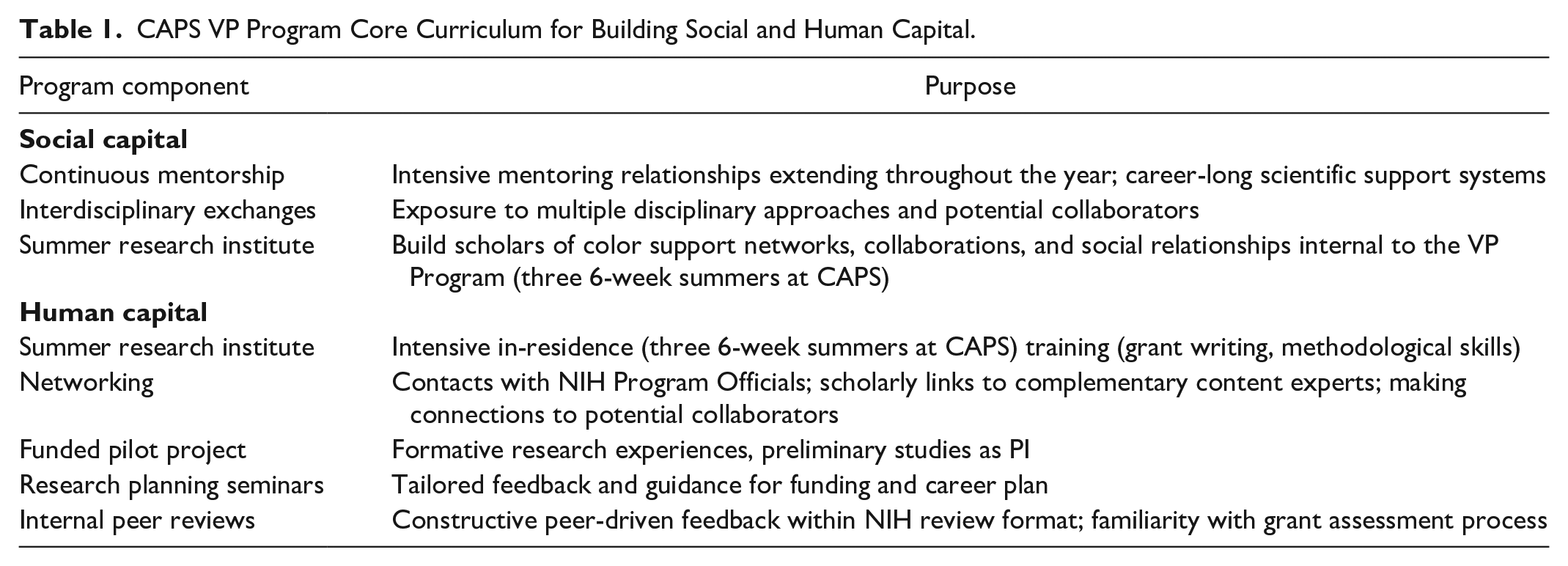
In sum, the VP Program combines multiple program components to augment VPs’ social and human capital that become critical resources for overcoming barriers to career advancement and achieving scientific independence in NIH-funded research that addresses HIV disparities.
Program Outcomes
The VP Program has continuously tracked research independence and funding indicators, providing outcome-driven assessments of its success over more than two decades. Outcome assessments, in which current and former VPs commit to annual ongoing achievement reports, underline the program’s success in fostering research independence among scholars of color and those working with minoritized groups. To date, the Program’s 85 VPs have secured over $238 million to conduct health disparities research, published over 2,200 peer-reviewed articles, and launched innovative HIV/STI-prevention research programs throughout the country. These increases in research capacity have had a national impact, with VPs originating from or conducting research within traditional and historically Black colleges and universities, ranging from “Research 1” to non-research-intensive institutions.
Study Aims
Given multiple indicators of its success and longevity, the VP Program provides a unique opportunity for a holistic mixed-methods assessment of an objectively successful scientific training initiative focused on scholars of color and those working with minoritized groups. Primary aims were to identify effective Program components, from VPs’ and VPMs’ perspectives, that could be used to develop future scientific training initiatives for scholars of color and guide ongoing VP Program refinement.
Methods
Qualitative Interviews
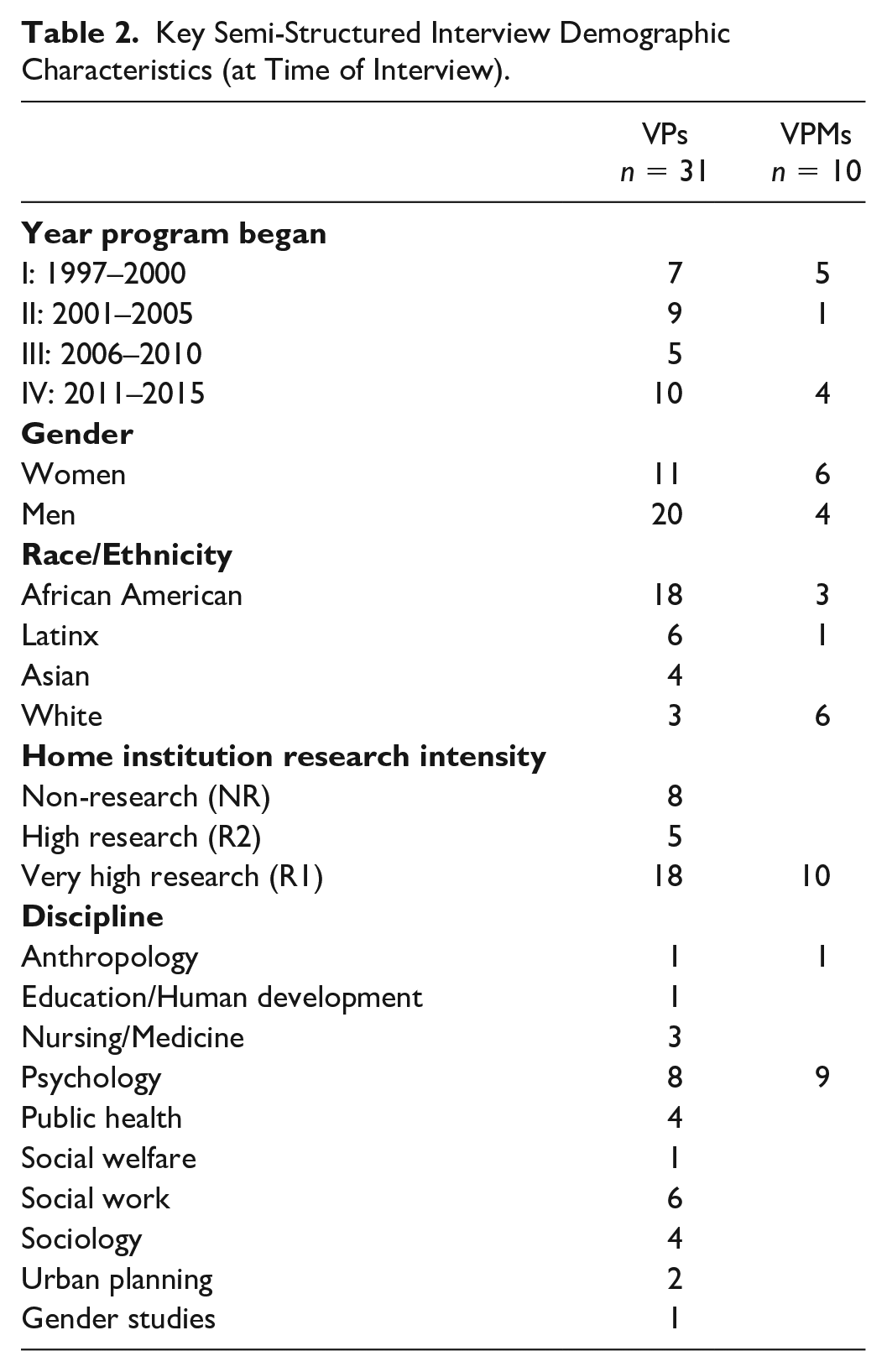
From September 2017 to March 2018, the lead authors (SA and MP) conducted individual, 60- to 90-minute, qualitative interviews with 31 VPs and 10 VPMs who had participated in the Program between 1996 and 2016. This period corresponds with two decades of continuous NIH support to develop and refine the Program and covers a broad range of fellows (see Table 2).
Key Semi-Structured Interview Demographic Characteristics (at Time of Interview).
Individual qualitative interviews were conducted using a semi-structured interview (SSI) guide developed by the lead authors to explore best practices for building research capacity of early-career faculty conducting HIV/STI research in underserved communities and to enhance diversity in the scientific workforce. The guide was informed by life history techniques that invite participants to narrate aspects of their past experiences in an open-ended discussion that progressed roughly chronologically and focused on providing narratively rich context for development of participants’ research careers from when they began conducting health disparities research through the present (Cole & Knowles, 2001). Along the way, interviewers (both VP alumni) minimally prompted interviewees to elaborate on program experiences, and beyond that, they fostered or presented challenges for their research careers. Interviews began with unstructured questions about formative experiences that had been instrumental in shaping participants’ research careers and scholarly independence. When the Program was mentioned (all VPs mentioned the Program), interviewers probed regarding their motives for initially pursuing the Program, role of the Program in their careers, and specific components that were most impactful, with attention to four Program aspects: (a) mentorship experiences; (b) overall Program design; (c) networking; and (d) internal peer review process. Participants were also asked to reflect on Program experiences in relation to other mentorship programs with which they had prior experience, to encourage additional comparative data.
The VP interview guide was adapted to probe experiences of VPMs and their unique perspectives on Program components. As CAPS “insiders,” VPMs could discuss resources needed within their environments for Program implementation and challenges and opportunities it provides to senior investigators.
All former VPs and VPMs through 2015 were contacted via email by a Program coordinator, with up to four email attempts to solicit participation, over a period of 9 months. In addition, interviewers reached out individually to those who had not responded to encourage participation. Ultimately, 31 of 58 VPs (53%; at least 1 VP from each cohort) and 10 VPMs (100%) completed interviews.
Interviews were conducted via Skype or phone, audio-recorded, and transcribed; extensive interview notes were taken within broad categories corresponding to the interview guide. Interview notes also identified “emergent themes” that had not originally been previously considered and which could inform subsequent interviews.
Using thematic analysis, (Miles & Huberman, 1984; Strauss & Corbin, 1990) the first two authors conducted in vivo coding of transcripts and interview notes. As coding proceeded, they identified higher-level themes, focusing primarily on those related to program component impacts on VPs’ HIV-disparities research. During analytic meetings, they refined relationships within and among thematic categories by examining similarities and differences across participants, identifying patterns and variation within the a priori themes, and refining the themes (Dey, 1993; Jones, 1985). In preparation for the final analysis, coded narratives, representing a range of perspectives within themes, were organized to holistically represent VPs’ and VPMs’ perspectives.
Basic participant sociodemographic and academic characteristics are summarized in Table 2. Interviewees were well-distributed across all cohorts of the VP Program over the 20-year period. To protect participants’ anonymity, VPs’ 5-year generational cohort and home institution’s research intensity level (Non-Research [NR], High Research [R2], and Very High Research [R1]) are indicated alongside interview excerpts, and for VPMs, the year they joined the Program.
Brief Quantitative Survey
After completion of qualitative interviews, using the same approach as for the qualitative interviews, all VPs and VPMs were invited to complete an 11-item online survey to (a) explore differences between interview and non-interview participants and (b) offer participants an opportunity to anonymously provide further feedback. Twenty-three VPs and six VPMs completed the survey. Fisher’s exact test of independence was used to test for associations between interview (15 VPs; 6 VPMs) and non-interview participants regarding: program experiences; current academic position; NIH research experience prior to and since the first year of Program participation; submitting a non-NIH grant as PI that was scored, but not funded; and satisfaction with their research careers.
Study procedures were approved by University of California, San Francisco, and Florida International University Institutional Review Boards.
Results
Qualitative Interview Results
Thematic analysis (Miles & Huberman, 1984) focused on narratives regarding the central VP Program features that shaped participants’ experiences and perceived program benefits. These are thematically categorized as they emerged into: Trusting Mentorship, Belonging, and Sustainable Engagement; and Multidisciplinarity, Skills, Networking, and Peer Reviews. As analysis proceeded, investigators noticed how Program components often clustered in participants’ narratives, key Program features tended to reinforce others, and together, they shaped subjective Program experiences. Below are summaries of key thematic categories within two primary thematic clusters that inform the Program’s design: (a) Social Capital and (b) Human Capital.
Social Capital: Trusting mentorship, Belonging, and Sustained Engagement
Trusting Mentorship
Establishing a trusting mentorship relationship, a cornerstone of any training program, was repeatedly described as a key strength of the Program by both VPs and VPMs. Participants noted that establishing trust with mentors was a precondition for the positive effects of other program components. Trust with primary mentors fostered social capital by establishing closer bonds based on mutual collegial respect and collaboration, which often VPs did not experience in other scholarly environments. Importantly, narratives of trust emerged as a dominant theme in our analysis and were often attributed to intentional attempts by the VP Program and/or individual VPMs to “share power” and create a collegial non-hierarchical culture of scholarly peers. Illustrative excerpts from VP interviews of this kind of power sharing in the mentorship approach are shown in Table 3.
Illustrative Narratives of Social Capital by Thematic Categories.
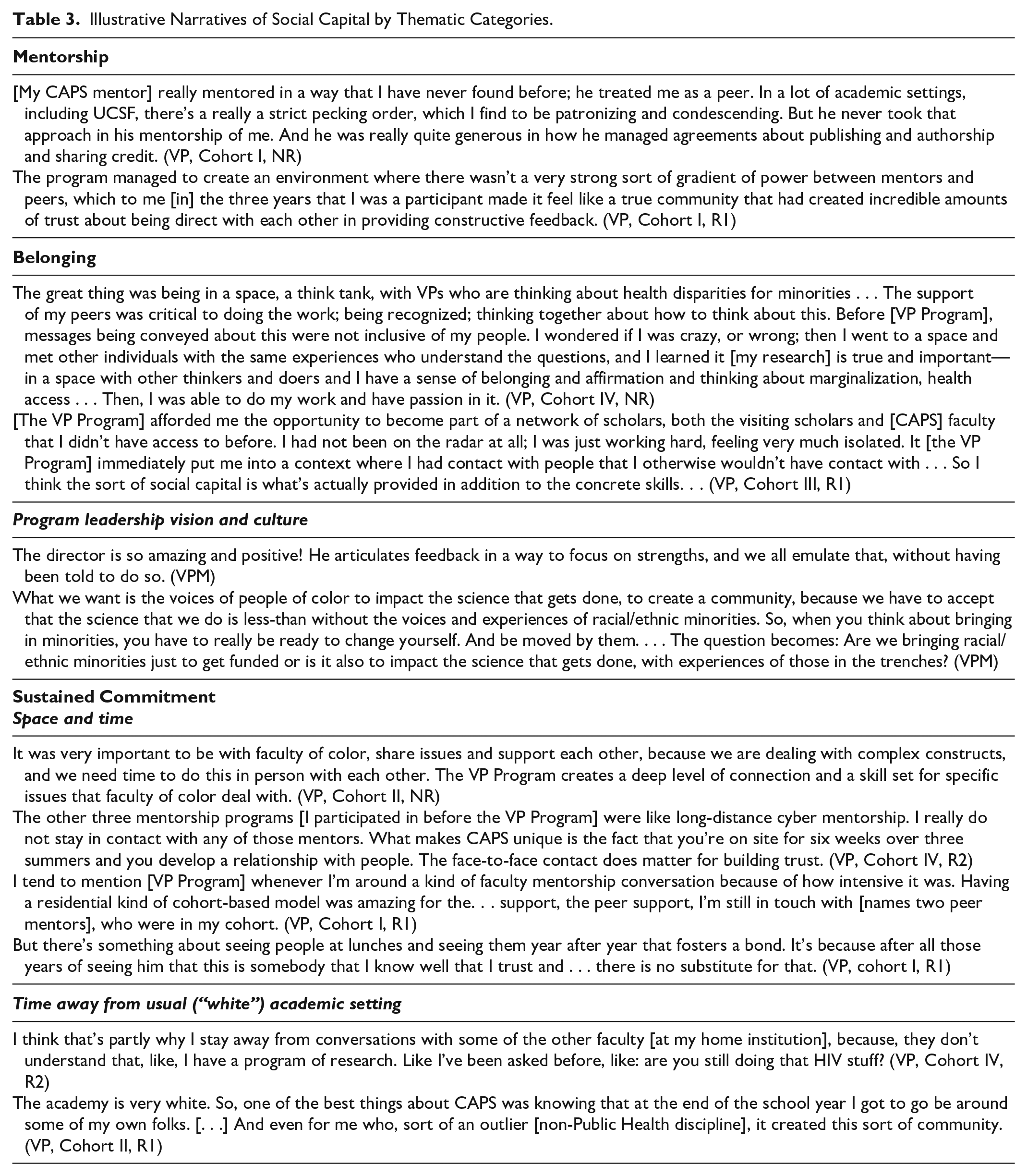
In sum, the core mentorship relationship is a fundamental source of social capital for the Program and is effective because of its intentional efforts to establish trusting collegial collaborations and avoid strict power hierarchies.
Belonging
Interacting with other scholars of color was especially salient for VPs of color, by providing a space that leveraged resources, fostered social capital, and generated critical thinking about issues uniquely relevant to communities that have been “othered” due to, for example, racism, sexism, heterosexism, transprejudice, and their intersections. VPs of color working with marginalized communities often described feeling excluded from established academic and research centers or networks, which often marginalized or disadvantaged them by the sheer institutionalized histories benefiting majority populations in innumerable professional benchmarks. Access to the VP Program’s growing network of scholars of color and those working with marginalized groups affirmed VPs’ own scholarship, revitalizing their commitment to research with communities of color. Importantly, being among like-minded scholars cultivated a sense of belonging. VPs described feeling seen and affirmed as scholars with valuable and unique expertise in health promotion in communities of color, rather than having to explain themselves or defend their scholarship (see narrative examples in Table 3).
Participants also explained that the Program’s communal trust-building was modeled from the highest levels of the Program and was key to feeling they belong. Repeatedly, both VPs and VPMs extoled the Program’s “strength-based” culture involving close peer-to-peer mentorship in a trusting environment. Many VPs and VPMs who participated in the Program in its formative years (1996 to 2005) referenced the Program founders’, Rafael Díaz and Barbara Marín, original vision to create a scholarly space for scholars of color, underrepresented in research, to develop community, create community-centered research agendas, and overcome entrenched academic power hierarchies that often constrain the NIH funding pathway. In this way, VPs had a sense of participation in the research world that goes beyond mere inclusion to one of belonging.
Cultivating belonging, however, requires attention. For example, one participant mentioned he felt he had to defend his research when outside guest mentors conducted peer reviews for the Program. While VPs’ assessments of the Program’s culture were overwhelmingly positive, this provides additional nuance regarding challenges to sustaining a trusted community of peers while providing critical scientific feedback from nationally recognized scholars to support VPs’ research careers.
Sustained Engagement
VPs identified additional Program features that fostered social capital. Collegial relationships with mentors and fellow VPs involved intensive in-residence training that developed over time. The unique structure of three consecutive summers in residence at CAPS contributed to sustained engagement and was repeatedly cited as instrumental to building a community of trusted peers (Table 3).
The residency fostered social capital by enabling VPs to obtain much-needed distance and time from their home institutions. VPs described the Program as a supportive community that buffers against some of the institutional challenges that particularly minoritized investigators face in developing their research careers. Several VPs expressed feelings of isolation at their home institutions, perceiving that their colleagues did not understand their commitment to developing a program of HIV-related research. For minoritized scholars, the VP Program provided the needed space and time to create a community in which issues facing researchers from underrepresented populations were central to a collective project (Table 3).
Human Capital: Multidisciplinarity, Skills, Networking, and Peer Reviews
In addition to the social capital garnered through the VP Program’s mentorship and culture of trust, participants emphasized four key strategies for supporting VPs’ research careers including (a) multidisciplinarity (creating opportunities for substantive exchanges among scholars from a range of disciplinary backgrounds), (b) skills (providing opportunities to gain specific research methods or skills relevant to research funding or project implementation), (c) networking (beyond belonging as described above, connecting VPs to scholars with complimentary expertise and potential collaborators), and (d) peer reviews (establishing a peer-based system for internal reviews of grant drafts and other scholarly works in progress). While presented separately below, they are intertwined in practice.
Multidisciplinarity
VPs observed that the Program provided numerous opportunities for synergy across disciplinary divides, which were often formative and generative of new research ideas and career directions. One VP (VP, Cohort II, R1) noted that when she accepted a role as a high-level university leader, she used her history of collaborative interdisciplinary thinking from the Program to overcome disciplinary silos that were developing at her institution. “CAPS trains you to communicate with people in another way,” she said, emphasizing that the Program provides role models and a space for intellectual creativity and cross-fertilization among differently positioned scholars. “It made me a better [leader].”
This diverse scholarly environment was a central theme across interviews, permitting VPs to develop new perspectives that differed from those typical in their home institutions. For many, the Program’s multidisciplinary environment became a means to deepen community collaborative work through creative exploration of different approaches to community-engaged work in underrepresented communities. For some participants from a humanities background, the Program provided opportunities to learn about health sciences, allowing them to avoid easy stereotypes of the more clinical or applied disciplines, and to ground their critiques in real-world experience with public health and medicine. In several instances, collaborations or lasting collegial relationships were founded initially on the union of complementary disciplinary backgrounds and spurred scholarly innovation and inspiration. For example, one VP described the transformative influence of another VP scholar who brought a fresh perspective to her work (Table 4).
Illustrative Narratives of Human Capital by Thematic Categories.
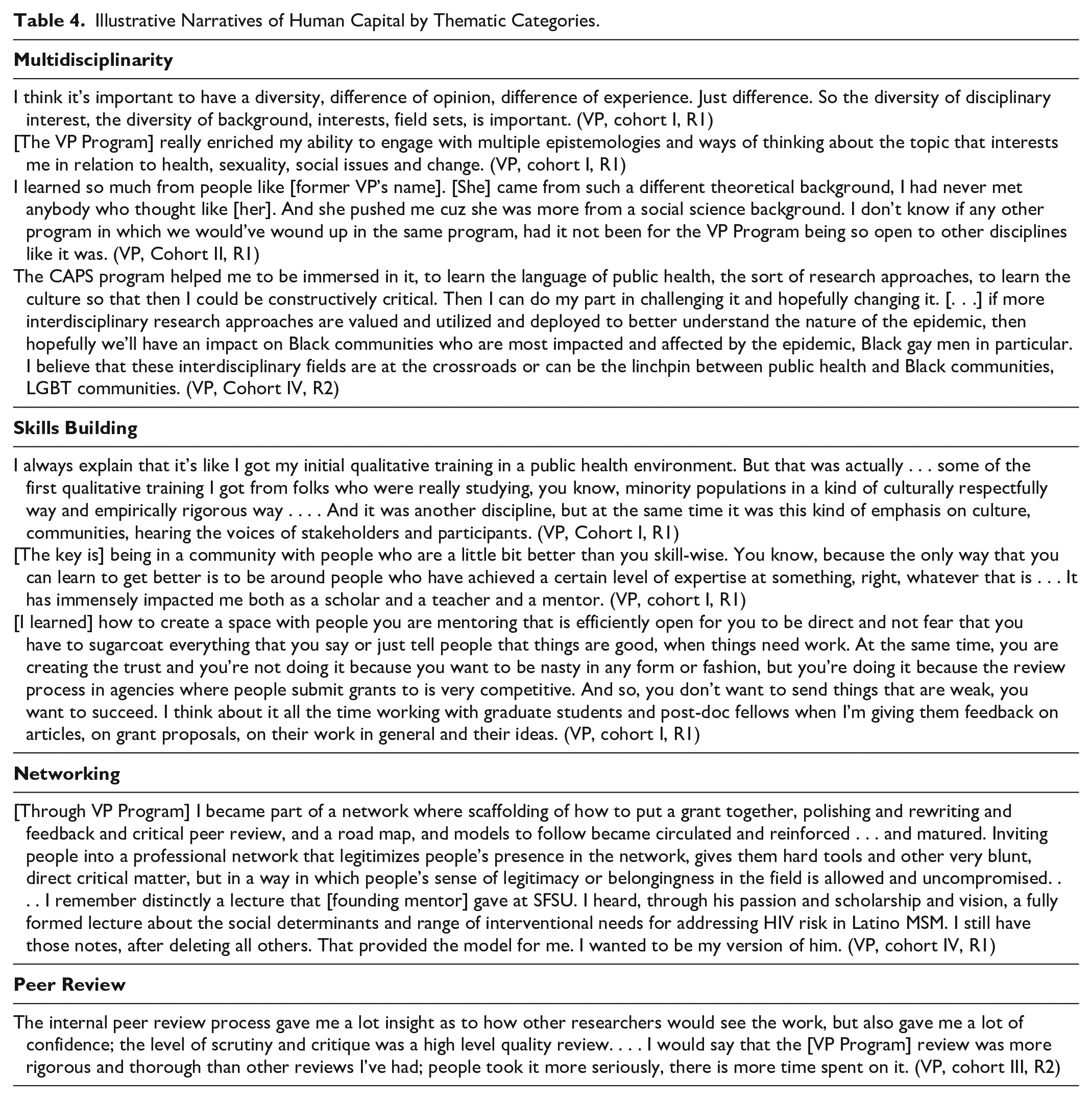
VPMs emphasized that multidisciplinarity also moved beyond unidirectional models of mentorship, enabling a space in which both “mentors” and “mentees” could creatively share ideas across disciplines in which all present could adapt new perspectives to enrich their work.
Skills Building
VPs valued the skills they acquired or strengthened during the Program. While “skills” are presented independently, they were discussed quite broadly by participants, including not only specific research skills (e.g., qualitative analysis or grant writing) but also portable skills that they translated into other domains of their professional lives, such as their own mentor roles. In addition, VPs highlighted the uniqueness of the Program’s emphasis on integrating VPs’ strengths, allowing new skills to be acquired organically through sustained interchanges with a multidisciplinary scholarly network, rather than viewing VPMs as those who exclusively impart wisdom. VPs were bringing skills that would fortify a rigorous and robust scholarly network. One participant illustrated collective skills-building by describing how she gained qualitative research skills by networking with her fellow CAPS VPs (see this and other examples in Table 3).
Participants acquired specific research skills through the Program, ranging from qualitative and quantitative research methods; grant proposal–writing skills (both administrative and narrative organization); grant mechanisms and funding strategies; communication and networking with colleagues and NIH; ethical protocols and requirements; and research program planning and project implementation. Many of these skills coalesced in the centerpiece component of the VP Program, the internal peer review process, discussed in the following section.
Networking
Beyond enhancing social capital, VPMs were also conscious of the importance of networking as a resource for advancing human capital. One VPM highlighted the impact of shared ideas on advancement of research with people of color:
A key unique outcome of VP Program is the creation of a network of scholars supporting each other, where collaborations beyond the mentoring relationships allowed for larger visions through the creation of a web of ideas that could change the research landscape for communities of color. (VPM)
Toward this goal, and to enhance access to resources, most VPMs actively created opportunities to connect VPs to other VPMs and scholars in their geographical area and with common interests, as well as to other training opportunities. VPMs emphasized that personal introductions to connect VPs to experts are critically important for networking.
Peer Review
The peer review component is a key culminating Program event that canalizes many of its distinctive features into a systematic, rigorous review of each VP’s research-related product. VPs described the peer review as simultaneously intensely stress-inducing and the most pragmatically useful and transformative experience of their research careers. During analysis, it became clear that constructive peer reviews depend on all the previously discussed themes.
Many VPs noted that a CAPS peer review strength was its directness—including the “bluntness” (VP, cohort II, R1)—of critical feedback provided by VPMs, VPs, and external peer reviewers, even if intellectually and emotionally challenging. By nearly all accounts, however, the peer review process was highly effective because it relied on the larger culture of trust, rapport, and collaboration that had been established through other dimensions of the Program (e.g., fostering trusting mentorship, creating a sense of belonging, and sustained engagement through the intensive 3-year residency). Participants interpreted the direct critical feedback to be essential to advancing their programs of research by confronting the scientific standards of grant funding head-on prior to submitting their proposals.
It is notable that VPs described the peer review as “frightening,” “intense,” or “hard,” while simultaneously insisting it was crucial to their development (see examples in Table 3). Furthermore, VPs reported engaging in CAPS peer reviews for ongoing grant submissions even after their Program stint had ended, leading one participant to marvel “they never kick you out,” adding “I remember somebody said, ‘Remember you’re always part of the VP Program,’ and I thought, ‘I’m gonna really take that to heart, because I’m never leaving!’” (VP, cohort III, NR).
Peer reviews were the synthesizing moment for the Program’s overall training model, through which grantspersonship strategies were sensitively but directly communicated by experts within a trusted setting. Peer reviews also served as a means for participants to internalize CAPS community feedback, leading many to mention that the so-called “voices in their head” (VP, Cohort IV, NR)—referring to the perspectives of VPs and VPMs who had given them such intensive and meaningful feedback—now permanently informed their conceptualizations of grants and scholarship.
Survey Results
Among survey respondents, there were no significant associations between interview participation and program experiences, academic position, NIH research experience prior to or since VP Program, or satisfaction with their research career and non-NIH research experiences since VP Program participation with the exception of having “submitted a non-NIH grant as PI that was scored, but not funded,” which was more likely among non-interview participants (p = .022).
Discussion
This study included interviews with at least one VP from each cohort of the 20-year study period and all VPMs, providing a unique opportunity to consider essential aspects of a long-term, successful mentorship program oriented toward scholars of color. Participants’ narratives strongly support the program’s focus on increasing social and human capital.
Fundamental to enhancing social capital were trusting mentorship, belonging, and sustained engagement. Consistent with prior research, study findings indicate that mentorship serves an important gatekeeping function to resources (e.g., skills, publications, grants, and job opportunities; Brewer et al., 2016) and networking opportunities (Haynes et al., 2008; Waitzkin et al., 2006). Results also corroborate that high-quality mentorship depends on mutual respect and trust that, as other disciplines have reported, “requires time, trust and creation of a space where the [mentee] can develop a sense of professional belonging and feel safe to learn” (Jefford et al., 2021). These features cross-cut VP Program components, such as the development of grantspersonship skills through peer reviews, by providing a social context for scholars of color to network, create community, and cultivate a separate space that counterbalances experiences of exclusion and othering at home institutions and within academia more generally.
In a context of, and overlapping with, social capital, participants emphasized the complementary function of strengthening human capital through multidisciplinarity, skills, networking, and peer reviews. Multidisciplinarity is increasingly valued in health research for innovation and crossover methods it brings to solving complex real-world problems (Choi & Pak, 2008; Smaldino & O’Connor, 2022). This is especially beneficial for addressing health inequities faced by marginalized groups. Yet, the research focus by scholars of color accounts for 20% of the funding gap for scholars of color (Hoppe et al., 2019). An important reason for increasing human capital in the VP Program is to help develop frameworks that address health disparities of interest to VPs that use formats NIH-reviewers understand. In addition, when VPs and VPMs share their respective disciplinary expertise and associated skills and networks with each other in a sustained fashion over time, they expand personal and collaborative research capacities while advancing nuanced understanding of, and developing culturally relevant interventions for, disenfranchised and structurally vulnerable communities. Although the small sample size limits our ability to generalize, the general lack of quantitative differences between interview participants and non-interview participants across multiple indicators of success further supports study conclusions. Further research could examine experiences among program participants for whom grant submissions is less central to their careers, especially non-NIH grant submissions.
It is critical to develop programs that address multiple sources of disparities in the NIH funding pathway. Academic hierarchies in health disparities research demonstrates that inequalities in grant awards, peer review processes, and editorial decision-making in scholarly journals may lead to ironic re-marginalization of underrepresented researchers who work on health disparities (McFarling, 2021). The VP Program provides a model for how to work toward fostering new generations of scholars conducting health disparities research with marginalized or minoritized communities. While the design of the Program and its components are essential, they also require a particular philosophy of mentorship, belonging, and multidisciplinary training that involve, perhaps most essentially, the creation of a trusted community of scholars.
Identifying the mechanisms that contribute to success is an important step toward replicating these key components. Our findings suggest that building trust and belonging requires an immersive, in-person experience that supports critical thinking and access to grant writing, methods, and content experts. Training programs with these features require significant investments to cover the costs of trainee participation (e.g., cost of living to maintain their home base plus costs associated with residing in a remote location for an extended stay, pilot study funding) and mentors’ in-depth mentoring activities. However, most training and research education grants (e.g., NIH T32 and R25) offer limited resources to support these activities. Future training initiatives will need sustained adequate funding 1 to secure mentors’ and mentees’ time and space away from the myriad competing demands of their home institutions to foster new generations of scholars that can address the health disparities facing the nation.
Finally, the significant proportion of White Program VPMs invites reflection on its impact on inclusion of scholars of color in HIV/AIDS research. While our study did not originally aim to describe reasons for the racial/ethnic configuration of VPMs, and the emergent qualitative data did not permit a direct analysis of this question, minoritized VPs underscored the perceived benefits of belonging to a trusted community of scholars of color, as well as the importance of allied researchers, dedicated to HIV/AIDS research in underserved communities.
Relative to scholars of color, White scholars receive more NIH research funding, which advances their careers and likelihood of becoming mentors (Ginther et al., 2011, 2016). This points to the need to address institutional barriers that restrict the research careers of scholars of color (Reid Ponte et al., 2015). The disproportionately low proportion of faculty of color in academic settings (National Center for Education Statistics, 2024), together with a majority White set of academic mentors (Bowleg, 2021; Walters et al., 2016), result in a restricted pool of mentors of color who share scholars-of-color’s cultural or social backgrounds, identities, values, and/or academic fields (Coe et al., 2020; Zambrana et al., 2015). In addition, scholars of color who conduct research addressing concerns of communities of color cannot rely on the literature and research approaches that support dominant culture research (Fox Tree & Vaid, 2021) nor the networks of investigators who support each other by grandparenting early-career investigators into their grants, publications, and academic networks. Research institutions that rely heavily on grant funding are welcoming to scholars with established or promising research agendas. Thus, the soft money environment is a barrier to attracting and retaining scholars of color whose interests often lie in understanding and developing research from within their communities, rather than adapting existing paradigms based on dominant White cultures. This contributes to a vicious cycle, whereby the pool of scholars of color remains small, research addressing the needs of communities of color is limited, and academic institutions suffer from a narrow range of research foci and approaches.
Indeed, the original vision of the VP Program founders was to overcome some of the barriers confronting minoritized faculty (Marín & Díaz, 2002). To this end, every year since 2016, between one and three VPs from prior cohorts have been invited to serve as guest VPMs in residence. The guest VPM program component began with one guest mentor and has gradually increased to three in summer 2024. In this way, the network of scholars of color grows to include more mentors of color, as does the scholarship and evidence base for research with minoritized communities.
In our findings, VPs stress the importance of “being seen” and validated by mentors and colleagues who share their commitment to minoritized communities. These observations underscore the need for all such training programs to formally evaluate and reflect on which qualities of mentoring relationships, including—but certainly not limited to—shared membership in marginalized communities, may shape the overall success of VPs’ careers. Thus, the depth of experience with disparities research in HIV/AIDS of the entire VP Program community of scholars must be considered in any complete assessment of how specific aspects of mentorship relationships, including peer mentorship, shape the career and research experiences of minoritized scholars in the Program.
Notably, a recent conceptual review on mentoring of underrepresented minority investigators in academic medicine attests to the value of developing and applying an intersectional approach to mentorship (Sevelius et al., 2024). The authors question the “mutual marginality” approach to mentoring relationships—in which “mentor and mentee share similar experiences of intersectional marginalization”(ibid: p. 4)—on the basis of several limitations, including that it (a) presumes that mutual marginality leads transparently to better training outcomes, (b) neglects the highly constrained pool of mentors of color resulting from ongoing disparities in academic career trajectories, (c) overburdens minoritized scholars who are expected to shoulder the burden of mentorship disproportionately, (d) contributes to ongoing academic disparities due to the generally lower esteem institutions grant to mentoring activities, and (e) neglects the broader intersectional dynamics of power in society that are not limited to one or another individual axis of difference. In contrast, “a mentor taking an intersectional approach to mentorship in academic medicine aims to understand, engage with, and transform the ways that interlocking systems of power and privilege impact both their own and their mentees’ experiences, the mentoring needs of their mentees, as well as the mentor-mentee dynamic and relationship” (ibid., p. 5). Such an approach requires reflexivity on the different dimensions of power and positionality of both mentors and mentees, as well as a shared commitment to praxis, or “the practical application of principles of intersectionality through action and advocacy to transform power dynamics in academic culture and institutions” (p. 8). We believe the success of the VP Program may be partly based on the reflexive nature of its broader culture, based on participants’ narratives of mentoring relationships that involved attentiveness to the dynamics of power in supporting VPs in their NIH-funded research careers.
In conclusion, any program attempting to replicate the successes of the VP Program should strongly consider incorporating a praxis-based analysis of the multilevel dimensions of power that operate to constrain research careers, particularly for minoritized groups, and develop strategies to support these individuals based on a nuanced and multilevel analysis of power. This may be more effective in shifting disparities in research for underrepresented investigators than focusing on mutual marginality between mentors and mentees. In addition, toward the goal of attracting, nurturing, and retaining faculty of color, research institutions will need to foster a diversity of ideas and critical thinking. We recommend a return to the VP program’s initial aim to mentor scholars of color who contribute to advancing and invigorating the research landscape with essential insights and novel methods and approaches that address the needs of minoritized communities. This will require mentors to invest in and learn from mentees’ unique framing of problems, solutions, and concomitant research questions and embrace cultural specificity and diversity while practicing intersectional mentoring.
Footnotes
Declaration of Conflicting Interests
The author(s) declared no potential conflicts of interest with respect to the research, authorship, and/or publication of this article.
Funding
The author(s) disclosed receipt of the following financial support for the research, authorship, and/or publication of this article: Research reported in this publication was supported by the National Institute of Mental Health (NIMH) and the National Institute on Drug Abuse (NIDA) of the National Institutes of Health under award numbers R25 MH067127 and R25 DA028567. The content is solely the responsibility of the authors and does not necessarily represent the official views of the National Institutes of Health.
