




Abstract
The U.S. Food and Drug Administration (FDA) developed a public education campaign, The Real Cost, that reduced youth susceptibility to tobacco product use. We sought to identify the mechanisms that may underlie the impact of The Real Cost ads on susceptibility to vaping to inform youth tobacco prevention campaigns. Our online randomized controlled trial (clinicaltrials.gov, identifier NCT04836455) examined a large sample of U.S. adolescents (n = 1,348) who had multiple exposures to Real Cost ads or control videos over a 3-week period in 2021. To examine potential mediating pathways between The Real Cost ads and susceptibility to vaping, we examined theory-based psychosocial and message-related variables. The largest impact of The Real Cost ads on susceptibility was via more negative attitudes toward vaping (βa*βb = −0.16; 95% confidence interval [CI] = [−0.25, −0.06]). Other mediation paths were via improved health harm risk beliefs (βa*βb = −0.08; 95% CI = [−0.13, −0.04]), addiction risk beliefs (βa*βb = −0.04; 95% CI = [−0.06, −0.01]), injunctive norms against vaping (βa*βb = −0.05; 95% CI = [−0.09, −0.02]), negative affect (βa*βb = −0.05; 95% CI = [−0.08, −0.02]), and cognitive elaboration (βa*βb = −0.03; 95% CI = [−0.05, −0.003]). Our findings suggest that ads that target negative attitudes may decrease susceptibility to vaping among youth. Our findings also introduce normative pressure as a novel factor that may be important for vaping prevention messages.
Keywords
Adolescent tobacco use continues to be a major public health concern. While cigarette smoking is at historic lows, with 1.6% of middle and high school students currently smoking (Birdsey, 2023), the use of electronic cigarettes (e-cigarettes), otherwise known as vaping, remains much higher, with 7.7% of middle and high school students reporting past 30-day use (Birdsey, 2023). In addition, nearly one-third of those youths (32.1%) reported using e-cigarettes on 20 or more days in the past month (Birdsey, 2023). Vaping puts youth at risk of nicotine addiction (U.S. Department of Health and Human Services, 2016) and increases their chances of using other harmful tobacco products (Soneji et al., 2017). E-cigarette aerosols also contain toxic chemicals (Goniewicz et al., 2014; U.S. Department of Health and Human Services, 2016) which research suggests may cause lung diseases (Wills et al., 2021; Xie et al., 2022). While completely switching to vaping may benefit adult smokers, tobacco use prevention is vital to promoting adolescent health.
To combat youth smoking, the U.S. Food and Drug Administration (FDA) launched The Real Cost campaign in 2014. The campaign seeks to educate youth, particularly those open to initiating or who have tried tobacco products. The Real Cost cigarette smoking prevention ads have focused on two major campaign themes: addiction and health harms. Dissemination channels for the ads have included television, radio, print magazines, cinematic ads, and online digital media (e.g., social media platforms). Evaluations of The Real Cost cigarette smoking prevention campaign have shown high exposure (Delahanty et al., 2019; Duke et al., 2015; Kowitt et al., 2018). Exposure is associated with lower initiation of cigarette smoking among youth (Duke et al., 2019; Farrelly et al., 2017). Previous studies have established that exposure to The Real Cost type ads is associated with higher risk beliefs about harms targeted by particular ads (Andrews et al., 2018; Duke et al., 2018; Hornik et al., 2019; Kranzler et al., 2017).
To address the rise of vaping among youth, The Real Cost campaign began disseminating messages about the harms of vaping in 2018. Similar to smoking prevention ads, the e-cigarette prevention ads have reached youth with messages about addiction and health harms associated with using e-cigarettes and vaping products (Vereen et al., 2022). Studies of The Real Cost vaping prevention ads suggest that the ads are effective in reducing youth openness to vaping (Noar et al., 2022; Noar, Rohde, Prentice-Dunn, et al., 2020). A logical next question that this study pursues is identifying the theoretical mechanisms by which the ads may have impact. One possible mechanism is suggested by a study showing greater risk beliefs targeted by specific ads (MacMonegle et al., 2024), but theories suggest additional plausible pathways. Understanding the theoretical mechanisms that link ads to reduced openness to vaping can provide important insights for the design of future ads (Liu et al., 2020; Ma et al., 2022).
Theory-Based Mechanisms of Change
The Reasoned Action Approach suggests attitudinal, normative, and self-efficacy constructs may be effective routes to behavior change (Fishbein & Ajzen, 2010). In the case of youth vaping, modifying any of these constructs could explain youth’s vaping-related behaviors. We next discuss each of these constructs in turn.
Attitudes and Beliefs
Attitudes concern favorable or unfavorable predispositions toward a behavior (Fishbein & Ajzen, 2010). Prior experimental studies have demonstrated that exposure to The Real Cost smoking prevention ads can increase negative attitudes toward smoking (Kowitt et al., 2022; Zhao et al., 2016). Similarly, exposure to The Real Cost vaping prevention ads can elicit negative attitudes toward vaping (Kowitt et al., 2022; Noar, Rohde, Prentice-Dunn, et al., 2020).
The attitudinal route also includes risk beliefs. The most studied beliefs for The Real Cost campaign have been those related to negative health consequences associated with vaping (i.e., addiction and health harms). As noted above, studies have shown that The Real Cost smoking and vaping prevention ads are generally successful at changing several health harm and addiction risk beliefs targeted by the ads (Duke et al., 2018; Kranzler et al., 2017; MacMonegle et al., 2022).
Vaping prevention messages for youth may have greater impact if they target vaping attitudes, risk perceptions, and norms, while using message tactics that elicit negative emotion and cognitive elaboration about the harms of vaping.
Studies have not yet examined additional beliefs under the attitudinal route. For instance, The Real Cost ads could plausibly reduce beliefs that vaping is relaxing and stress relieving, given that ads often visually depict the myriad of negative consequences caused by vaping to youth. However, The Real Cost studies to date have yet to examine these affect regulation beliefs (Pokhrel et al., 2014).
Social Influences
The ads may also target behavior change through social influence. For example, The Real Cost ads that depict negative social consequences (e.g., losing friends) could reduce the extent to which youth think vaping will make them appear socially desirable. Currently, few studies have examined whether The Real Cost ads affect such social enhancement beliefs (Pokhrel et al., 2014), even though social influence may be especially salient for teens (Maxwell, 2002).
Another Reasoned Action Approach to behavior change involves modifying social norms, which is often a long-term goal of campaigns (Fishbein & Ajzen, 2010). In particular, The Real Cost ads could change injunctive norms, which are normative beliefs that peers discourage vaping. While The Real Cost ads tend to focus on addiction or health consequences, in doing so many ads depict social consequences to teens, such as disapproval from peers or parents. These ads could change injunctive norms by increasing normative pressure that vaping is not a desirable behavior. To date, no studies that we are aware of have examined social norms mediating the effect of The Real Cost ads on vaping outcomes.
Self-Efficacy
Another route to behavior change is self-efficacy, or confidence that one can change or modify one’s own behavior (Bandura, 2003). In the case of vaping, refusal self-efficacy, or the confidence to refuse vaping in social situations where others are vaping (Navarro et al., 2021), is a construct that The Real Cost ads could improve. By depicting some of the negative consequences of vaping, it is possible that they could do so by increasing teens’ self-efficacy to refuse vaping. To date, The Real Cost studies have not examined this construct.
Message Reactions
The way teens process The Real Cost ads may also play a role in modifying vaping-related outcomes. Specifically, intended message reactions, such as attention, negative affect, cognitive elaboration, and social interactions, could serve as potential mediators of The Real Cost ad impact, as could unintended reactions, such as reactance and avoidance. Although studies have investigated some of these constructs in the context of The Real Cost ads (Hall et al., 2019; Kowitt et al., 2022; Noar et al., 2022; Zhao et al., 2019), little evidence is available about their role as mediators of ad impact.
The Current Study
Previous studies have examined the impact of exposure to The Real Cost campaign ads on targeted beliefs in real-world evaluations (Duke et al., 2018; MacMonegle et al., 2022, 2024). In those studies, risk beliefs have been the focal theoretical mechanism driving smoking or vaping-related behavior change, typically using observational data. What remains unknown is the possible mediational role of psychological mechanisms besides risk beliefs, measured in the context of longitudinal randomized controlled trials (RCTs). In this study, our goal was to identify potential theoretical mechanisms underlying message effects to inform future vaping prevention messages. This study does so by examining whether attitudinal, normative, self-efficacy, or message reactions variables mediate the impact of exposure to The Real Cost campaign ads on susceptibility to vaping. We used data from a previously published RCT. Findings from the main trial publication indicate that vaping prevention advertisements from the FDA Real Cost campaign led to lower adolescent susceptibility to vaping (Noar et al., 2022), but the potential mechanisms by which the ads have these effects have not yet been explored.
Method
Participants
Adolescents aged 13 through 17 years (n = 1,708) living in the United States who were susceptible to e-cigarette use were recruited from online panels administered by Qualtrics (i.e., a convenience sample). Adolescents were considered susceptible if they answered anything other than “definitely not” or “not at all curious” to any of five questions about their openness to vaping from the enhanced susceptibility index (Strong et al., 2015). Among the sample screened, 151 declined to participate and 43 were unable to enroll since the trial quota had been met, resulting in 1,514 responses. The target sample size in this trial was 1,500, accounting for up to 33% of participants dropping out during the trial. Retention at the final data collection point of the study was 91%. With an estimated intraclass correlation of .70, the trial had power to detect an effect size of d = 0.25 or larger between (combined) intervention groups and the control group. The CONSORT diagram was previously published in the main trial publication (Noar et al., 2022).
Procedures
We conducted a trial with three arms and parallel assignment. Adolescents participated in 4 weekly online visits over 3 weeks and completed an online survey at each visit. At Visits 1, 2, and 3, adolescents viewed campaign ads or control videos. In the first week (Visit 1), participants viewed three ads in random order that corresponded to their trial arm: FDA’s The Real Cost vaping prevention health harms ads, FDA’s The Real Cost vaping prevention addiction ads, or control videos. Participants assigned to the health harms arm viewed three ads that emphasized the health harms of vaping, such as toxic substances in e-cigarette vapor and lung damage from vaping. Participants in the addiction arm viewed three ads that focused on the consequences of nicotine addiction from vaping, such as negative effects on mood and loss of autonomy. Ads used in the study can be found in Supplemental Table 1. Finally, participants in the control arm viewed three investigator-created neutral videos about vaping consisting of black text on a white screen with a narrator reading the text. These videos focused on neutral content about e-cigarettes and vaping, including vaping product definitions, farming practices related to nicotine used in vapes, and manufacturing practices of vaping devices adapted from Wikipedia and other sources. Each ad across all three experimental conditions was about 30 seconds long.
Before starting the trial, parents or legal guardians provided consent online, and adolescents provided assent online. The trial was approved by the University of North Carolina at Chapel Hill Institutional Review Board and was registered at clinicaltrials.gov, identifier NCT04836455.
Measures
Surveys assessed tobacco product use at all visits before participants viewed the ads. At Visit 1, after viewing each ad, participants completed measures of susceptibility to vaping, mediators, and demographics. For the subsequent weeks of the trial (Visits 2 and 3), participants completed surveys that included susceptibility to vaping and mediators. At Visit 4, participants completed surveys assessing susceptibility to vaping and mediators, but did not view any ads.
Primary Outcome
The primary outcome for the trial and this study was susceptibility to vaping at Visit 4. We measured susceptibility to vaping with a three-item scale (Pierce et al., 1996). This scale assessed the extent to which adolescents are open to vaping. The questions were “Do you think you might use an e-cigarette or vape soon?”; “Do you think you might use an e-cigarette or vape in the next year?”; and “If one of your best friends were to offer you an e-cigarette or vape, would you use it?.” The 4-point response scale ranged from “Definitely not” (coded as 1) to “Definitely yes” (4). We calculated a susceptibility score for each visit by averaging the three items, with higher scores representing higher susceptibility (α = .95 for Visit 4).
Mediators
Measures of the potential mediating variables (Table 1) were selected based on well-established communication and psychological theories (see Brewer et al., 2019). These variables were also preregistered in clinicaltrials.gov as secondary outcomes, identifier NCT04836455. The reasoned action approach variables (attitudes toward vaping, health harm risk beliefs, addiction risk beliefs, affect regulation beliefs, social enhancement expectancies, injunctive norms, and refusal self-efficacy), mediation analyses used data from Visit 4, which allowed adolescents to have all three exposures to their assigned ads (at Visits 1–3) before measurement of these outcomes. For cognitive elaboration and social interactions, mediation analyses also used data from Visit 4 since these variables were measured by asking participants about the past 7 days. For the message reactions variables (attention, negative affect, avoidance, and reactance), mediation analyses used data from Visit 1 to capture message processing at first exposure to the ads.
Potential Mediators of Behavior Change for The Real Cost Vaping Prevention Ads.

Note. Studies cited are prior smoking or vaping prevention studies on The Real Cost campaign with youth samples.
Demographic Variables
Surveys assessed demographic characteristics, including gender, age, race, ethnicity, sexual orientation, mother’s education, whether the adolescent lived with a tobacco user, and vaping behavior at trial enrollment. The main trial paper describes these items in further detail (Noar et al., 2022).
Data Analysis
Analyses examined data for participants who provided data at both Visits 1 and 4 (n = 1,348). Since the trial’s two intervention arms showed few differences (Noar et al., 2022), we combined them, with those assigned to the control arm in a second group. We used the Hayes PROCESS macro in SAS Version 9.4 (Hayes, 2022) to test our potential mediating variables in the association between exposure to the vaping prevention ads and susceptibility to vaping. We used bootstrapping to assess statistical significance, with a 95% confidence level (CI) and 5,000 repetitions. We obtained p-values using the normal theory test for indirect effects, which does not assume that indirect effects are normally distributed (Hayes, 2009). We hypothesized that each potential mediator (M) would mediate the effect of trial arm (X) on susceptibility to vaping (Y) (Figure 1). We ran 13 mediation models (one for each potential mediator). Because it was not possible to randomize mediating variables, we controlled for gender, age, race, ethnicity, sexual orientation, mother’s education, whether the adolescent lived with a tobacco user, and vaping behavior at trial enrollment. We examined the indirect effect of trial arm on susceptibility to vaping to determine if our mediation hypothesis was supported, and we present effects as standardized regression coefficients (β). Indirect effects were calculated by multiplying the estimated association between trial arm and candidate mediator (a path, denoted as βa) with the estimated association between mediator and susceptibility to vaping (b path, denoted as βb). The indirect effect of a mediator on susceptibility to vaping is denoted as βa*βb (Preacher & Hayes, 2004).
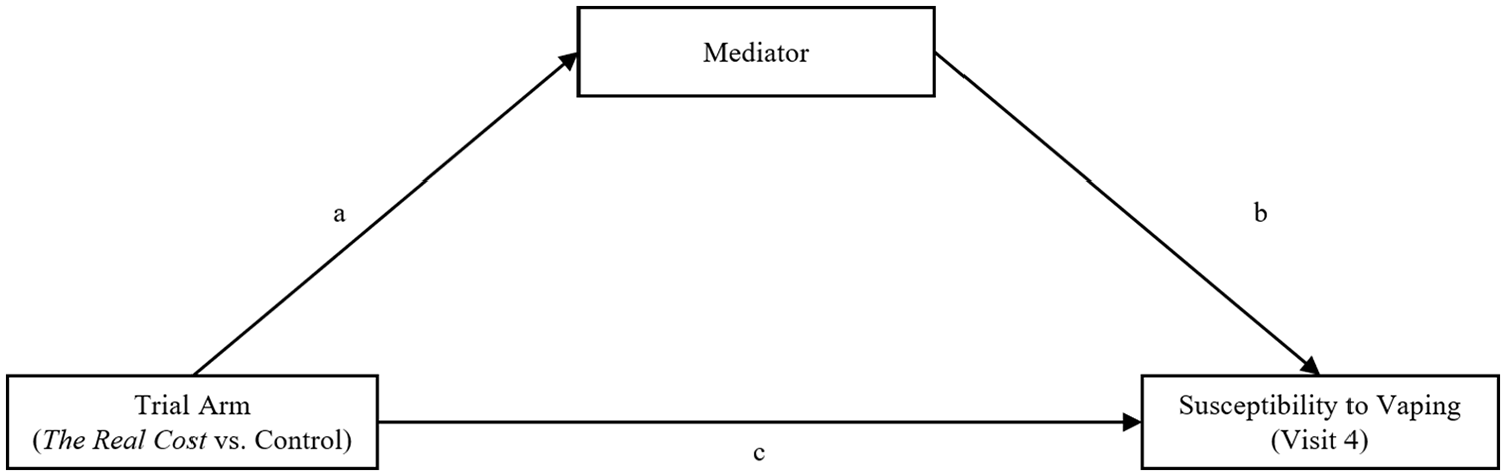
Mediation Analysis Diagram.
Results
The mean age of participants was 15.2 years (Table 2). The majority of participants were male (77%), White (72%), heterosexual (97%), and currently in high school (72%). Tobacco use was common, with 66% vaping, 59% smoking cigarettes, and 63% using other tobacco products in the past 30 days.
Participant Characteristics (n = 1,348).

Note. Data are for participants who filled out surveys at Visit 1 and Visit 4. GED = general educational development credential.
Denotes participants self-reporting race as “other”.
Total Effect
Participants exposed to The Real Cost ads had lower susceptibility to vaping than those exposed to control ads (βc = −0.15, p < .01; 95% CI = [−0.25, −0.05]) (Table 3). Mean susceptibility was 2.25 (SD = 0.03). Total effects, direct effects, and indirect effects are reported in Table 3.
Mediation of The Real Cost ad Effects on Susceptibility to Vaping.

Note. Variables with statistically significant indirect (mediating) effects are bolded. Susceptibility to vaping was assessed at Visit 4. Attention, negative affect, avoidance, and reactance were assessed at Visit 1. All other mediator variables were assessed at Visit 4. All models controlled for gender, age, race, ethnicity, sexual orientation, mother’s education, whether the adolescent lived with a tobacco user, and vaping behavior at trial enrollment. The a path is the association between trial arm and candidate mediator. The b path is the association between candidate mediator and susceptibility to vaping, controlling for the effect of ad exposure on susceptibility to vaping. The c path is the total effect of trial arm on susceptibility to vaping. The c’ path is the direct effect of trial arm on susceptibility to vaping. The βa*βb is the indirect effect of the candidate mediator on susceptibility to vaping. CI = confidence interval.
p < .01. *p < .05.
Direct Effects on Mediator (a Path)
Participants exposed to The Real Cost ads (vs. control videos) had more negative attitudes toward vaping (βa = −0.17, p < .01; 95% CI = [−0.27, −0.071]), higher health harm risk beliefs (βa = 0.20, p < .01; 95% CI = [0.10, 0.31]), and higher addiction risk beliefs (βa = 0.18, p < .01; 95% CI = [0.07, 0.29]) than those exposed to the control videos. Participants exposed to The Real Cost ads also had higher injunctive norms to avoid vaping (βa = 0.18, p < .01; 95% CI = [0.07, 0.28]). For message reactions, participants exposed to The Real Cost ads had greater attention (βa = 0.41, p < .01; 95% CI = [0.90, 0.52]), negative affect (βa = 0.56, p < .01; 95% CI = [0.46, 0.67]), avoidance (βa = 0.16, p < .01; 95% CI = [0.05, 0.28]), and cognitive elaboration (βa = 0.13, p < .05; 95% CI = [0.17, 0.24]) than control.
Indirect Effects (a*b Path)
Six variables mediated some part of the effect of The Real Cost ads on susceptibility to vaping. The largest mediation was via attitudes toward vaping (βa*βb = −0.16, p < .01; 95% CI = [−0.25, −0.06]). Health harm risk beliefs (βa*βb = −0.08, p < .01; 95% CI = [−0.13, −0.04]) and addiction risk beliefs (βa*βb = −0.04, p < .01; 95% CI = [−0.06, −0.01]) also indicated mediation of The Real Cost ads on susceptibility to vaping, as did injunctive norms (βa*βb = −0.05, p < .01; 95% CI = [−0.09, −0.02]). In terms of message reactions, both negative affect (βa*βb = −0.05, p < .01; 95% CI = [−0.08, −0.02]) and cognitive elaboration (βa*βb = −0.03, p < .05; 95% CI = [−0.05, −0.003]) were mediators of the impact of The Real Cost ads on susceptibility to vaping. Affect regulation beliefs, social enhancement expectancies, refusal self-efficacy, attention, avoidance, reactance, and social interactions did not mediate the impact of The Real Cost ads on susceptibility to vaping (all p > .05).
Discussion
The goal of this trial was to better understand the mechanisms underlying the FDA’s The Real Cost ads to inform the design of strong vaping prevention messages. To achieve this goal, we conducted mediation analyses using data from a large trial that examined the impact of The Real Cost ads on youth vaping susceptibility. Our findings indicate that negative affect, cognitive elaboration, attitudes toward vaping, health harm risk beliefs, addiction risk beliefs, and injunctive norms are potential mechanisms that may explain the impact of The Real Cost ads. Our findings reinforce prior work on youth tobacco prevention ads, while also offering novel insights into the potential underlying mechanisms that may contribute to the effectiveness of these ads.
Our trial findings are consistent with the findings of prior studies related to The Real Cost campaign (Kowitt et al., 2022; MacMonegle et al., 2022; Noar, Rohde, Prentice-Dunn, et al., 2020). Previous studies found associations between campaign exposure and some of the mediators examined here (i.e., the a path). Our study builds upon these findings by testing if campaign exposure may influence vaping susceptibility through these potential mediators. Our findings indicated that vaping prevention messages reduced susceptibility to vaping and that possible mechanisms by which they did so include evoking negative emotions, prompting youth to think about the health harms of vaping (i.e., cognitive elaboration), and fostering negative attitudes about vaping and risk beliefs about the health and addiction consequences of vaping. A recent meta-analysis of vaping prevention message experiments also found that such messages increase six specific addiction and health harm risk beliefs about vaping (Ma et al., 2022). This set of mechanisms supports one of the goals of The Real Cost campaign, which is to educate youth about the dangers of e-cigarette use by emphasizing the “The Real Cost” of vaping (i.e., addiction and health harm consequences). Findings from our study support the ability of The Real Cost ads to achieve this goal, and by doing so, they may reduce susceptibility to vaping among the campaign’s target population.
To our knowledge, this is the first study to empirically identify another mechanism—injunctive norms—as a potential mediator of The Real Cost ads’ influence on susceptibility to vaping. Based on this finding, it appears that social influences—injunctive norms in particular—may have an important role to play in vaping prevention messages. The Real Cost campaign includes age-relevant portrayals of the health harms of tobacco use and loss of independence due to tobacco use (Duke et al., 2015). Some ads also depict negative social consequences to youth, such as disapproval from peers due to addiction to nicotine. These messages tap into injunctive norms against vaping and may be a mechanism that the campaign could increasingly leverage to denormalize youth vaping. In the context of The Real Cost ads used in this study, it is worth noting that the disapproval tends to come from peers rather than adults, which may help enhance the impact of the ads. In fact, this is consistent with a recent study that found that exposure to The Real Cost vaping prevention ads was not associated with a greater belief that vaping would “disappoint family” but was associated with a greater belief that vaping would “disappoint others who are important to me” (MacMonegle et al., 2024), which is likely to include peers.
Taken together, findings from our study suggest that the mechanisms by which The Real Cost campaign may have impact are similar to those in the theory of reasoned action (Fishbein & Ajzen, 2010), which focuses on intentions (or as we operationalized it, susceptibility) being centrally influenced by attitudes toward the behavior, beliefs that underlie attitudes (risk beliefs), and injunctive norms. These mechanisms appear to differ from those that underlie the impact of pictorial cigarette warnings for adults. In a study that evaluated potential psychological mechanisms to explain the impact of pictorial warnings on smoking quit attempts, few attitudes and beliefs about smoking harms mediated the impact of warnings on quit attempts, with no role of risk beliefs as a mediator (Brewer et al., 2019). That stands in contrast to the current trial, in which attitudes about vaping were the largest mediator and risk beliefs about health harms and addiction were found to be mediators. Furthermore, reactance was not a mediator in our study, despite the theoretical construct being established as a small (negative) mediator for pictorial cigarette warnings (Andrews et al., 2014; Hall et al., 2018). Thus, while pictorial warnings for adults seem to predominately affect smoking behavior through immediate message reactions (Brewer et al., 2019; Noar, Rohde, Barker, et al., 2020), messages for vaping prevention among youth seem to affect susceptibility through changes in attitudes, risk beliefs, and norms. Our trial did not examine behavior, so that connection to the smoking literature remains to be confirmed.
Strengths of our trial include the randomized design, longitudinal exposure to messages, use of high-quality stimuli from a national campaign, recruitment of a large, at-risk sample, and high retention. Limitations of our trial include “forced exposure” to the vaping prevention ads, which could differ from how adolescents experience the messages in the real world (i.e., incidental exposure which could include social interactions among peers). Another limitation is that our outcome was susceptibility to vaping rather than vaping behavior, although susceptibility is a robust predictor of future vaping behavior (Barrington-Trimis et al., 2019; Bold et al., 2017; Cole et al., 2019). Finally, while we controlled statistically for several potential confounders, we cannot causally conclude definitively that the mediators cause susceptibility to vaping because we did not experimentally manipulate the mediators. In addition, it is possible that we did not measure and control for all possible confounders of the association between the mediators and susceptibility. Future research should continue to advance our understanding of mechanisms of impact for vaping prevention ads and e-cigarette warnings using a variety of study designs, including by manipulating hypothesized mediators (Carter et al., 2021). Future research should also experimentally examine whether specific ads or ad themes in The Real Cost ads affect specific risk beliefs targeted by those ads.
Conclusion
This is the first trial to conduct mediation analyses on a comprehensive set of theory-based mediators of the impact of FDA’s The Real Cost ads on susceptibility to vaping among youth. Our findings indicate that The Real Cost vaping ads may work through several mechanisms, including by eliciting negative attitudes, making youth think about the harms of vaping, and by increasing risk beliefs associated with vaping (e.g., addiction and other health harms). Our findings also indicate that the ads may work by increasing normative pressure to avoid vaping. Overall, these findings suggest that to maximize their impact, future vaping prevention ads should consider targeting vaping attitudes, risk beliefs, negative affect, cognitive elaboration, and normative pressure to avoid vaping.
Supplemental Material
sj-docx-1-heb-10.1177_10901981241278565 – Supplemental material for Understanding Potential Mechanisms of Vaping Prevention Messages: A Mediation Analysis of the Real Cost Campaign Advertisements
Supplemental material, sj-docx-1-heb-10.1177_10901981241278565 for Understanding Potential Mechanisms of Vaping Prevention Messages: A Mediation Analysis of the Real Cost Campaign Advertisements by Talia Kieu, Haijing Ma, Jacob A. Rohde, Nisha Gottfredson O’Shea, Marissa G. Hall, Noel T. Brewer and Seth M. Noar in Health Education & Behavior
Footnotes
Authors’ Note
Haijing Ma is also affiliated to College of Liberal Arts & Social Sciences, University of Houston-Victoria, Victoria, TX, USA.
Declaration of Conflicting Interests
The author(s) declared the following potential conflicts of interest with respect to the research, authorship, and/or publication of this article: S.M.N. has served as a paid expert witness in litigation against tobacco and e-cigarette companies. J.A.R. has served as a paid expert consultant in litigation against tobacco companies. The other authors declared no conflicts of interest.
Funding
The author(s) disclosed receipt of the following financial support for the research, authorship, and/or publication of this article: This project was supported by grant number R01CA246600 from the National Cancer Institute and FDA Center for Tobacco Products (CTP). The content is solely the responsibility of the authors and does not necessarily represent the official views of the NIH or the Food and Drug Administration.

References
Supplementary Material
Please find the following supplemental material available below.
For Open Access articles published under a Creative Commons License, all supplemental material carries the same license as the article it is associated with.
For non-Open Access articles published, all supplemental material carries a non-exclusive license, and permission requests for re-use of supplemental material or any part of supplemental material shall be sent directly to the copyright owner as specified in the copyright notice associated with the article.
