




Abstract
This article discusses Earth’s Rights as an environmental justice mechanism of reparation, protection, and justice for indigenous communities, environmental defenders, and other populations in Latin America. We argue that Earth’s rights encompass and include the right to health and can be integrated into international human rights frameworks to protect all forms of life, responding to colonial legacies of discrimination and violence. We respond to the scarcity of literature discussing Earth’s rights in relation to situations where human rights and Earth’s rights are violated. We ground our argument in the theoretical conceptualization of Latin American proposals of Earth’s rights and its potential for actionable policy approaches that include human health as inevitably interconnected to our planet’s well-being. We address the environmental injustices that affect the right to health and argue that an Earth’s rights framework can support reparations for historically marginalized communities.
Climate change has caused substantial population migration and will continue to do so (EcoWatch, 2020). Climate migration especially affects people marginalized by ethnic, socioeconomic, cultural, and political factors in the Global South (Boas et al., 2019) and is often related to the detriment of people’s health and well-being. We argue that Earth’s Rights, also known as “rights of nature,” contribute to a global governance agenda that supports health equity and the advancement of the Sustainable Development Goals (SDGs) for these populations (United Nations, 2023). We understand Earth’s rights as conceptualized in international agreements like Escazú, the national constitutions of Ecuador (Art. 71 and 72, Constitución Del Ecuador, Constitución Política, & Asamblea Nacional Constituyente, 2008) and Bolivia (Art. 33-34, Bolivian National Assembly, 2009), and laws emerging from tutelas (civil actions) in Colombia that protect ecosystems as subjects of rights (Wilson et al., 2017). In Colombia, this view shifts anthropocentric constitutional principles to legal norms of environmental protection that have their roots in Earth Jurisprudence, Wild Law, and the lifeways of indigenous populations in the Andean region (Velázquez-Gutiérrez, 2014). Our understanding encompasses international legal frameworks that posit: “. . . ecosystems and natural communities are not merely property that can be owned. Rather, they are entities that have an independent and inalienable right to exist and flourish” (International Joint Commission, 2021, p. 1). In this article, we use interchangeably Earth rights and the Rights of Nature.
Earth’s rights consider the planet as inherently deserving of rights that should be protected to safeguard human rights and the rights of all living organisms (United Nations, 2022). Indigenous communities and social movements in Latin America have set forward an approach to the Earth and its rights that protects natural resources and ecosystems (Cura Da Terra, 2020; Nature Rights Watch, 2018). Despite philosophical and legal advancements, indigenous communities and environmental leaders are systematically assassinated, displaced, and threatened (Global Witness, 2020; Scheidel et al., 2020). Latin America is the most violent region against environmental defenders worldwide (Global Witness, 2020).
However, there is scarce literature discussing and reviewing the links between climate change, migration, and health that include these frameworks (Whitmee et al., 2015) and discusses the violation of Earth’s rights and human rights as related phenomena for climate migrants and refugees (Correa-Salazar et al., 2023; Schütte et al., 2018). Earth’s Rights as presented by Bolivia in the World People’s Conference on Climate Change and the Rights of Mother Earth and defended principally by indigenous peoples and environmental leaders in the Latin American region proposes a lens on justice and health that can inform the global governance agenda through concrete legal actions and reparations (Tanyag, 2020).
The Universal Declaration of the Rights of Mother Earth asserts that Earth’s Rights are considered indivisible from any other living being’s rights to life, well-being, and health. Just as human beings have human rights, all other beings also have rights specific to their species and function. These rights are limited by the rights of other beings and any conflict between them must be resolved in a way that maintains the integrity, balance, and health of the Earth (Plurinational State of Bolivia & General Evaluation of Climate Change Negotiations, 2011). The term “being,” in this case, refers to ecosystems, natural communities, species, and all other natural entities that exist as part of the Earth. The Rights of Nature are grounded in the recognition that humankind and Nature have a fundamental and non-anthropocentric relationship, and there is a need for actions that respect this relationship (United Nations, 2022).
Within Earth’s rights, the Declaration includes the right to life and to exist, to be respected, to regenerate, to maintain its identity and integrity as a distinct, self-regulating, and interrelated being, and to have water, clean air, and other sustenance essential for life (Plurinational State of Bolivia & General Evaluation of Climate Change Negotiations, 2011). The Declaration also includes a set of obligations of human beings toward the Earth. Although this has yet to become a legally binding, it sets the basis for important conceptualizations of the Rights of Nature, human obligations to protect it, and the implementation of actions that shift the balance toward a more inclusive environmental justice paradigm beyond the colonial legacies imprinted in the region (Plurinational State of Bolivia & General Evaluation of Climate Change Negotiations, 2011). In addition, it paves the way to think about reparations for environmental damage that populations in the Global South have endured due to climate change and degradation of natural resources.
Climate Change, Migration, and Impacts to Health in Latin America
Climate change has drastically altered planetary conditions (Yadav et al., 2023), threatening access to food, water, clean air, and resources such as housing, jobs, health care, and education (United Nations, 2023). Climate change affects population health via two pathways: (1) directly through extreme weather events (extreme heat, floods, or natural disasters) and social consequences of climate change (displacement, forced migration) and (2) indirectly related to malnutrition and food insecurity, infectious diseases, impacts to mental health, water availability, and social violence (Levy & Patz, 2015; Pradyumna, 2018). These pathways hinder local, institutional, and community capacity to adapt to change and reinforce historical disadvantages for marginalized communities affected by environmental damage (Cerón, 2019).
Causes of climate change, including pollution, environmental degradation, and deforestation, mostly come from high-income countries’ economies (Union of Concerned Scientists, 2020) and over-developed societies (Yadav et al., 2023). Meanwhile, low- and middle-income countries are more vulnerable to catastrophic environmental impacts (Schütte et al., 2018). Central and South American farmers, peasants, indigenous, and Afro communities who are highly dependent on agriculture are affected by industrialized countries’ economic expansion, land grabbing, air and water pollution, toxicant release, over-fishing, expansion of extensive livestock, mono-cropping, and other extractive activities directly impacting ecosystems, making way for violence and population displacement (Global Witness, 2019). Legal and illegal mining in Latin American countries are associated with the assassination of environmental leaders and land appropriation (Pradyumna, 2018), human rights abuses and pollution (Homer-Dixon, 1994), illegal armed actors’ control of native territories (SOSOrinoco, 2020), and increased gender-based violence(Global Witness, 2020).
Agriculture is paramount to the economies of Latin American countries and is highly susceptible to extreme weather conditions such as high temperatures, changes in rain cycles, or dry seasons (SOSOrinoco, 2019). When extreme weather events such as droughts, hurricanes, floods, or heat waves leave communities unprotected and unable to fend for themselves and their families, agriculture-dependent populations are forced to flee, becoming climate-affected communities, climate migrants, and/or refugees impacted through the second pathway (indirectly through climate change’s impacts on population health).
By 2050, the number of climate-related migrants and refugees is estimated to reach 1 billion worldwide due to shoreline erosion, coastal flooding, and agricultural disruption (EcoWatch, 2020). As global temperatures increase, shortages in water and food availability, and resource scarcity will lead to increased migration and conflict in the Global South (Levy & Patz, 2015), where most climate-affected populations live. Gaps in international humanitarian law and protection systems of climate migrants and refugees leave these populations widely unprotected.
Climate migrants are considered people who have been severely affected by the two pathways through which climate change affects human health and have been forced to flee to secure their livelihoods (Schütte et al., 2018). These groups are at increased risk of experiencing environmental violence that severs their relationship to their homes and lifeways (Cerón, 2019) and are disproportionally affected along lines of race, sex, and ethnicity (Brown, 2008; Levy & Patz, 2015). Forced to migrate, women are at increased health risks both during and after migration (Levy & Patz, 2015). Women and girls die at increased rates from extreme weather events such as flooding or natural disasters, both named causes of climate-related migration (WomenWatch, 2010). Gender-based violence inflicted by armed actors, rigid gender norms, and poverty across migration phases heavily affect health and well-being (Correa-Salazar et al., 2021). In addition, in Latin America, violence against indigenous women is used as a social and cultural weapon for land appropriation, cultural shaming, and attack on the social structures that protect the environment (Global Witness, 2019).
Population displacement undermines the provision of health care, and infectious diseases become harder to prevent and treat (Brown, 2008) due to transportation of vectors through migration routes (Doocy et al., 2019). Disparities in health outcomes for already vulnerable populations affected by climate change become direr as environmental violence affects their living conditions and human rights across migration phases (Schütte et al., 2018; World Health Organization [WHO], 2014). However, the “refugee” category does not currently include climate as a motive that necessitates escape or induces fear (UNHCR, 1951). Furthermore, potential reparations for populations and the Earth are not included in international guidelines, law, or human rights treaties.
Violence toward environmental defenders is at its worst in Latin America (Global Witness, 2019). Seven out of the 10 most violent countries toward environmental defenders are in this region (Global Witness, 2020). Prejudice, xenophobia, and stigma toward cultural traditions are used against indigenous communities for economic interests (Nature Rights Watch, 2018). Displacements caused by alterations to native lands and climate change contribute to the increase and proliferation of neglected and vector-borne diseases (VBD) in secluded regions where deforestation and pollution of water resources is common (Stec & Jendrośka, 2019), the loss of cultural traditions, poverty, food and resource scarcity, and the overall increase of social violence (Correa-Salazar et al., 2021). VBD especially affect pregnant women and children, causing increased health and maternal risks (SOSOrinoco, 2019). Mining and influx of male workers in territories around mines increases women’s and girls’ human, sexual, and reproductive rights abuses through sexual exploitation, trafficking, prostitution, and gender-based violence (Albar Díaz et al., 2020).
Consequently, already vulnerable populations’ health due to colonialism, gender, and ethnic/racial disparities is disproportionately affected by climate-related migration and the violation of Earth’s rights in Latin America (United Nations General Assembly, 2019).
Earth’s Rights in Latin America
Health is a human right enshrined in international humanitarian law (Office of the High Commissioner for Human Rights, 2000, p. 14). Earth’s ecosystems and environments are the necessary conditions for human health and should be “subjects of rights” worth protecting beyond the nourishment they provide to human health (Whitmee et al., 2015). Some Latin American national state constitutions understand Earth as a subject of intrinsic rights that all persons should protect as an obligation, pushing for an environmental justice view of life and rights (Bolivian National Assembly, 2009; Constitución Del Ecuador, Constitución Política, & Asamblea Nacional Constituyente, 2008; Constitución Política de Colombia, 1991). This understanding of Earth’s rights presents a pivotal contribution of indigenous people’s vision to protect ecosystems and populations directly affected by climate change and environmental violence in this region.
Art. 71, Chapter VII on The Rights of Nature in Ecuador’s Constitution creates the legal framework for civil actions to protect the Earth without having suffered direct detrimental impacts to personal human health (Constitución Del Ecuador, Constitución Política, & Asamblea Nacional Constituyente, 2008). Article 33-34 in Bolivia’s Constitution recognize Earth as a being entitled to protections and reparations (Bolivian National Assembly, 2009). Bolivia also adopted a law on the rights to climate justice, which aims to protect victims of climate change (Gregor Barié, 2014). This line of legal protections of the environment has expanded with laws in Colombia, where moorlands, the Atrato River, and the Amazon jungle are now subjects of rights (Wilson et al., 2017). In Mexico, the states of Colima and Ciudad de Mexico have nature’s rights in their constitutions, as do the municipalities of Paudalho, Bonito, and Florianópolis in Brazil. These legal mechanisms support accountability mechanisms to protect Earth’s rights using human rights frameworks beyond direct impacts to human health derived from ecosystems degradation. This conceptualization presents all forms of life intertwined, a postcolonial understanding of rights and health.
The Regional Agreement on Access to Information, Public Participation, and Justice in Environmental Matters in Latin America and the Caribbean, also known as the Escazú Agreement, is a critical step toward the implementation of actionable policies and programs to protect Earth’s rights. Escazú is a legally binding agreement that entered into force in April 2021 and aims to guarantee information, participation, and justice regarding environmental issues. It especially considers the impacts of environmental degradation on minoritized people, indigenous communities, and defenders of the environment (United Nations, 2018). One of the innovative features of the Escazú Agreement is the right to a healthy environment and sustainable development on an international level, and the protection of all environmental defenders including individuals, groups, and organizations. It provides the necessary mechanisms to connect human rights frameworks that include the right to health with environmental violence prevention and protection (United Nations, 2018).
Earth’s rights, as understood and practiced by indigenous peoples throughout the Americas (Cura Da Terra, 2020; Fernández-Llamazares & Virtanen, 2020) and conceptualized in Latin American constitutions (Ecuador, Bolivia, Colombia) and treaties (Escazú, tutelas on rivers’ rights), is the next step toward guaranteeing a rights-driven planetary health agenda that provides space for the Earth as a subject of rights independently from human health.
Advancing an Earth’s Rights Agenda
In the 1990s, the concept of “good living” (“buen vivir” in Spanish; Gregor Barié, 2014) emerged in Bolivia and Ecuador as an alternative to Western models of development based on the idea of economic growth (Velázquez-Gutiérrez, 2014). The idea of “good living” was promoted by indigenous movements that aimed to achieve harmony between human life, nature, and society. It refers to using exclusively what is needed so ecosystems can regenerate and promote well-being and good living (Altmann, 2016). It established the need of an intercultural and plurinational State and society, ultimately included in the Ecuadorian Constitution of 2008 as a goal of the State, and a guided principle of the National Development Plan for the period 2013–2017 (Velázquez-Gutiérrez, 2014).
Similarly, “good living” was included in the Bolivian Constitution in 2009 and 2011 when the Bolivian government proposed at the United Nations World’s People Conference on Climate Change that the Earth be considered a living being worthy of rights, installing an accountability system for human actions against the planet (Plurinational State of Bolivia & General Evaluation of Climate Change Negotiations, 2011). Albeit conceptualizations of good living have had detrimental impacts that indigenous and social movements did not originally intend, they represent a key breaking point in the positioning and institutionalization at a national level of a paradigm aligned with Andean indigenous communities’ views on nature’s protection and preservation, the legally enforceable principles necessary to safeguard Earth’s rights (Velázquez-Gutiérrez, 2014).
This ecological view aligns with the SDGs agenda (United Nations, 2023) and can be made into actionable plans to support Earth’s rights in accordance with indigenous views as well as to think about reparations for climate-affected communities. Specifically, the right to water (SDG 6: Clean water and sanitation/ SDG 14: Life below water), to clean air (SDG 15: Life on land), to maintain an identity, to be free, and the right not to have its genetic structure modified or disrupted (SDG 3: Good health and well-being; United Nations, 2014) are all rights recognized for the Earth within this paradigm (United Nations, 2022) and can be made into plans and actions to protect human health and nature.
Even if the SDGs are not legally binding, they represent a common goal and language for countries striving to improve their population’s overall health and well-being in conjunction with the planet’s survival (United Nations, 2022). Common themes across international regulations are necessary tools to increase pressure on governments to comply with environmental goals, impose ecosystem protections and understand the relationship between violence, structural systems of oppression, and environmental degradation (International Joint Commission, 2021).
Earth’s rights are directly related to human life and health, and to the possibility of sustaining future generations of healthy life on the planet. Thus, they are connected to human rights frameworks and Planetary health, as both strive to protect and promote diversity, health, and well-being for all communities (Whitmee et al., 2015). As many countries aim to achieve economic growth, this drive for development harms the ecosystems and natural resources, causing hot spots of air pollution, toxic waste and water contamination, ecosystem degradation, and grave consequences for health and food security for all (SDG 3: Good health and well-being and SDG 2: Zero Hunger for All) if it continues to go unchecked (United Nations, 2014).
Because the climate crisis has a disproportionate impact on population health in the Global South (Yadav et al., 2023), there must be clear accountability mechanisms from States to regulate the international economic corporations that affect the environment and to impose sanctions on State actions against minoritized and structurally vulnerable groups. These sanctions ought not only to be punitive but should be focused on a reparations system where ecosystems, communities, and individuals can be compensated for received harms and their relationship to the land is included. Such a system should not depend on the political and/or economic interests of countries present in the United Nations. A Planetary health system that conceptualizes governance without borders and is based on the right of the planet to be healthy in relation to every other form of life should embrace a paradigm shift similar to the one presented at the Conference on Climate Change (Plurinational State of Bolivia & General Evaluation of Climate Change Negotiations, 2011). A necessary compromise with global sustainability, Earth’s rights, and the integration of so far segregated agendas needs to be based on decolonial, human rights, and environmental social justice pillars (see Figure 1). Table 1 details Human Rights violations related to climate change effects and SDGs alignment. We focus on populations traditionally linked to land, whose productive activities and cultural identities are grounded in their relationship to the Earth, land-caring and land-treating.
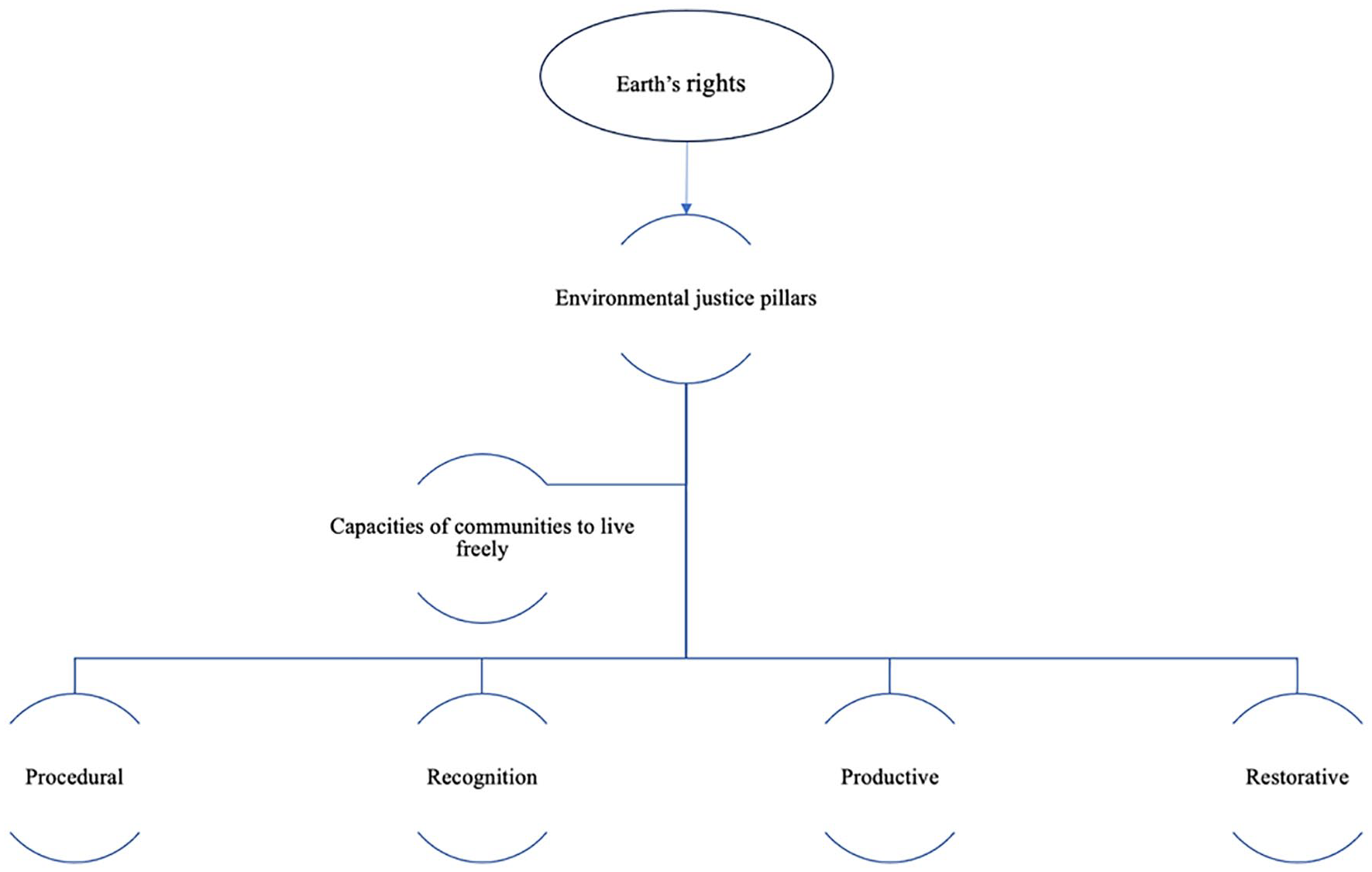
Environmental Justice Pillars for a Global Governance Agenda (Based on Forsyth et al., 2021; Pedersen, 2010; & Schlosberg and Carruthers, 2010).
Human Rights Violations Related to Climate Change Effects and SDGs Alignment.
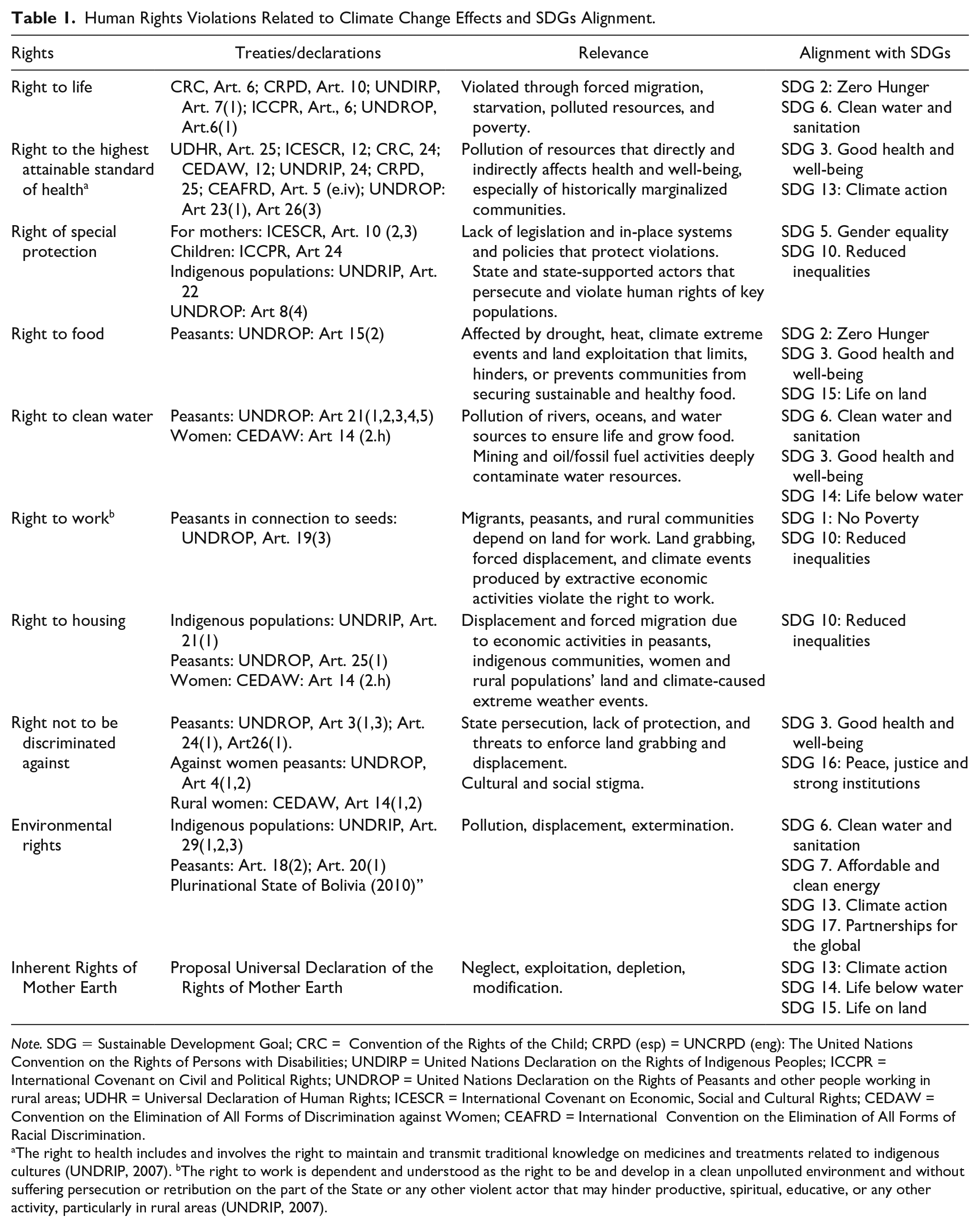
Note. SDG = Sustainable Development Goal; CRC = Convention of the Rights of the Child; CRPD (esp) = UNCRPD (eng): The United Nations Convention on the Rights of Persons with Disabilities; UNDIRP = United Nations Declaration on the Rights of Indigenous Peoples; ICCPR = International Covenant on Civil and Political Rights; UNDROP = United Nations Declaration on the Rights of Peasants and other people working in rural areas; UDHR = Universal Declaration of Human Rights; ICESCR = International Covenant on Economic, Social and Cultural Rights; CEDAW = Convention on the Elimination of All Forms of Discrimination against Women; CEAFRD = International Convention on the Elimination of All Forms of Racial Discrimination.
The right to health includes and involves the right to maintain and transmit traditional knowledge on medicines and treatments related to indigenous cultures (UNDRIP, 2007). bThe right to work is dependent and understood as the right to be and develop in a clean unpolluted environment and without suffering persecution or retribution on the part of the State or any other violent actor that may hinder productive, spiritual, educative, or any other activity, particularly in rural areas (UNDRIP, 2007).
As seen in Table 1, human rights violations connect both to Earth rights and to the health of historically marginalized populations, particularly those with lower economic status and/or social power. The United Nations recognizes that people that depend on agricultural production support harmony with the Earth and are fundamental for natural ecosystems to adapt and regenerate through natural processes and cycles (United Nations General Assembly, 2019). Increasingly, the United Nation’s agenda and some states are starting to recognize: (1) the indivisible nature of human and Earth’s rights (United Nations, 2023) and (2) direct links between protection of health and nature (Özdemir, 2020). Heeding global calls of Planetary health scholars from the Global North and South (Whitmee et al., 2015), activists (Tu’itahi et al., 2019), feminists (Tanyag, 2020), and Latin American environmental defenders (Cura Da Terra, 2020), we argue that to prevent and repair Earth’s rights violations, it is necessary to engage high-, middle-, and low-income countries in a global governance agenda that protects human rights as indivisible from Earth’s rights.
This global agenda should be based on an environmental justice framework coherent with that of communities affected the most by climate change and environmental degradation in the Global South (i.e., indigenous’ conceptualizations of Earth’s rights). Environmental justice has been traditionally defined from a distributional perspective as the “equal distribution of environmental goods and negatives” (Schlosberg & Carruthers, 2010, p. 13). Currently, scholars and activists support environmental justice pillars aligned with the protection of communities, instead of just individuals (Schlosberg & Carruthers, 2010). These pillars are (1) procedural: participation of communities affected by specific environmental issues in key decision-making; (2) recognition of historically marginalized communities; (3) productive or ecological justice for non-anthropocentric beings; and (4) restorative justice: reparation of communities or people affected by environmental issues or crimes (Pedersen, 2010). These principles also support the capacities of populations to live freely (Schlosberg & Carruthers, 2010). We propose to consider these principles within the Earth’s Rights perspective and Planetary health agendas to establish clear pathways of protecting the communities (including indigenous communities), the environment, and the relationships with and life of non-human entities (see Figure 1).
Recommendations and Conclusions
We propose the inclusion of Earth’s rights in formal international treaties and humanitarian law to better address environmental degradation, forced-climate migration, and Earth’s rights violations. There is a current need to establish Earth’s rights in international binding treaties like the Escazú agreement that can help build and enforce international mechanisms to hold states and private actors accountable in high-, middle-, and low-income countries for damages to the Earth. To monitor and sanction actions against the environment, the health of populations disproportionately affected by pollution and climate change in middle- and low-income countries, as well as violence against indigenous communities and environmental defenders, high-income countries should engage actively with policy and programmatic actions enforcing environmental justice views and pillars. A rights-based approach to protecting, respecting, and fulfilling Earth’s rights also contributes to the advancement of human rights protections for disenfranchised, historically minoritized communities, partly repairing colonial legacies of ethnic/race-based discrimination and violence including that inflicted to climate migrants.
A global governance agenda could further facilitate the regulation of extractive economies by installing reparations and accountability systems for low- and middle-income countries that bear the burden of environmental degradation and health impacts on their populations. Reparations in this context include the recognition and exposure of countries and corporations most responsible for the climate crisis of the harms caused. This includes harms inflicted upon previous generations by colonial structures and relationships of power, from which contemporary generations are benefiting from (Shue, 1999). Reparations also entail raising funds and gathering resources from the principal countries and corporations responsible for the climate crisis. These should be distributed to finance adaptation programs and building resilience in low-income countries most affected by the climate crisis (Chapman & Ahmed, 2021). They should also be implemented in the adoption of policies that significantly reduce carbon emissions (Táíwò & Cibralic, 2020) and their respective international accountability mechanisms. In addition, the adoption of fair climate migration policies that include climate migration as a direct consequence of the impact of high-income countries extractive economies ought to be included in international human rights law.
The post-World War II definitions of migration and refugee status need to be updated. We call for a revision of the term “refugee” as it is currently presented in international humanitarian law to include climate migrants, so that more protections can be implemented with an Earth’s rights approach. Special attention should also be paid to environmental leaders’ killings, threats, torture, and forced displacement in Latin America, as well as to detrimental activities against Earth’s rights. Research agendas targeting these actions and knowledge gaps should also include neglected environmental violence in the region and its causes. From an Earth right’s governance agenda, this means not only the adoption of measures to mitigate and dismantle colonial legacies and structures, but also the recognition of other ways to relate to the Earth, to other non-human beings, and to decisions regarding the environment in political, social, and community decision-making. Thus, research and actions should focus on collaborations with indigenous-driven organizations and the co-development of knowledge production.
Finally, we suggest that the international community consider separations for harms done to the Earth and to ecosystems. Reparations could be made by enforcing more equitable land distribution, participatory governance, and disseminating scientific approaches that support local environmental protections. Exemplary sanctions and political control of participation in the United Nations system should also be considered.
Footnotes
Acknowledgements
We would like to acknowledge all environmental defenders and leaders in the Global South who stand against violence and injustice, committing their lives to the defense of the Earth.
Declaration of Conflicting Interests
The author(s) declared no potential conflicts of interest with respect to the research, authorship, and/or publication of this article.
Funding
The author(s) received no financial support for the research, authorship, and/or publication of this article.
