



Abstract
Early childhood educators’ (ECEs) self-efficacy is often predictive of their ability and likelihood of promoting healthy activity behaviors in childcare settings. To date, ECEs’ physical activity and sedentary behavior–related self-efficacy has been measured in a variety of ways in childcare-based research, creating difficulty when comparing across studies. To identify the different approaches ECEs’ self-efficacy is assessed, the current study aimed to compare all existing tools that quantitatively measure physical activity and sedentary behavior–related self-efficacy of pre- and in-service ECEs. Seven online databases were searched for original, peer-reviewed, English-written journal articles. Articles were deemed eligible if they employed a tool which measured physical activity and/or sedentary behavior–related self-efficacy of pre- or in-service ECEs. A total of 16 studies were included in this review, and 13 unique tools were identified. All tools measured task self-efficacy (n = 13), while only 1 tool measured barrier self-efficacy, and approximately half of the tools (n = 7; 54%) reported on the validity and reliability. Great variability existed among the self-efficacy items included in the tools; however, common constructs included: teaching/leading physical activity, fundamental movement skill development, and physical activity programming. Very few tools mentioned sedentary behavior (n = 2) and outdoor/risky play (n = 2). Given the low number of studies that tested validity and reliability of their self-efficacy tools, the lack of consideration for barrier self-efficacy, and the paucity of tools that fully encompassed physical activity, sedentary behavior, and outdoor play considerations for ECEs, future research is needed to validate a new, reliable tool.
Keywords
Early childhood educators (ECEs) are influential role models in the childcare setting who help shape young children’s (<5 years) development of healthy movement behaviors (Henderson et al., 2015; Hesketh et al., 2017). Specifically, their role in supporting children’s engagement in physical activity, and appropriately limiting sedentary behaviors, is highly important (Robinson et al., 2012). Not only does regular physical activity promote proper growth, bone and motor skill development, and the maintenance of a healthy body weight in young children (Carson et al., 2017), it also reduces the risk of developing chronic diseases in later life (Durstine et al., 2013). Furthermore, avoiding long bouts of time spent in sedentary behaviors is equally important for young children, as too much time spent sitting has been acknowledged as a risk factor for poor health (Poitras et al., 2017).
Attending out-of-home childcare is common for many young children, and some spend upwards of 40 hours/week in these settings (Organisation for Educational Cooperation and Development, 2017). As a result, a large portion of their weekdays is spent under the care of ECEs, who are responsible for supporting sufficient physical activity and outdoor play in their programming, and minimizing children’s time spent in sedentary behaviors, among many other curricular demands such as reading and circle time (Robinson et al., 2012). In this respect, ECEs’ daily practices, and perception of their roles, affect children’s physical activity (Sisson et al., 2017; Wilke et al., 2013). Research shows ECEs’ level of engagement in supporting adequate movement opportunities for children often depends on many factors, including their: pre-service education relating to physical activity (Bruijns et al., 2019; Martyniuk & Tucker, 2014); own activity levels (Bruijns, Adamo, et al., 2020); personal values and/or beliefs (Connelly et al., 2018; Copeland, Kendeigh, et al., 2012); and, physical activity and sedentary behavior–related self-efficacy (Bower et al., 2008; Copeland, Kendeigh, et al., 2012). While these factors may result in substantial variability in ECEs’ intentional programming of opportunities for physical activity and breaking up long bouts of sedentary behavior (Connelly et al., 2018), self-efficacy is an important factor to consider, as it often acts as an indicator of behavior (Dyment & Coleman, 2012). Previous studies have suggested that in-depth training be offered to ECEs to increase their self-efficacy to lead sufficient movement opportunities (Goldfield et al., 2012), in addition to their current curriculum which has been noted to sometimes place greater importance on preparing children for school (Copeland, Sherman, et al., 2012).
According to Bandura (1997), self-efficacy is defined as the confidence in one’s ability to complete a task, while barrier self-efficacy is considered the confidence to overcome challenges that influence one’s ability to complete a task. Self-efficacy has been identified by ECEs as an important factor affecting their ability and intentions to promote physical activity in childcare (Chow & Humbert, 2011; Copeland, Kendeigh, et al., 2012). This stands to reason, as Klassen and Tze (2015) reported that self-efficacy was the most powerful psychological predictor of physical education teaching performance (Klassen & Tze, 2014). A number of childcare-based studies have shown that children’s physical activity can be elicited if ECEs provide verbal prompts (Gubbels et al., 2011), use equipment (Lyn et al., 2013), create opportunities for structured and unstructured activities (Brown et al., 2006; Pate et al., 2008), teach fundamental movement skills (Jones et al., 2011), and act as role models by participating in activity alongside children (Vanderloo et al., 2014); however, if ECEs are not self-efficacious to carry out these tasks, it is unlikely that they will (effectively) perform each behavior.
To date, limited research has measured the impact that ECEs’ behaviors/beliefs have on young children’s sedentary time; a systematic review reported on the correlates of preschoolers’ sedentary behavior, but was unable to find any consistent correlates among this population (Pereira et al., 2021). It is imperative that ECEs understand not only their role in promoting physical activity but also learn practical skills that mitigate the occurrence of young children’s (unnecessary or purposeful) sedentary time. This is especially important because sedentary behaviors developed during preschool years have shown to track into adulthood (Janz et al., 2000; Kelly, 2007); thus, mitigating the occurrence of sedentary time may be beneficial for children’s future health.
Previous physical activity and sedentary behavior interventions in childcare have examined: objectively measured movement behaviors of children; correlates of activity levels (e.g., indoor and outdoor space); and, ECEs’ health promoting practices (Bruijns, Truelove, et al., 2020; Tonge et al., 2016; Truelove et al., 2018). However, self-efficacy, as well as other educator-specific outcome measures (e.g., knowledge of physical activity, behavioral intention to promote movement), are often overlooked (Peden et al., 2018). In light of the important role that ECEs play with regard to providing physical activity and outdoor play affordances, and breaking up extended sedentary time, it is necessary that researchers focus on ECE measures that have the potential to influence the success of interventions. Self-efficacy measures may be particularly useful in education-related intervention studies, where ECEs undertake professional learning in physical activity and sedentary behavior, as education can improve one’s self-efficacy (Bruijns et al., 2019). As such, the purpose of this systematic review was to identify and compare available tools for measuring pre- and in-service ECEs’ physical activity and sedentary behavior–related self-efficacy.
Method
This review was registered with the International Prospective Register of Systematic Reviews (PROSPERO; registration no. CRD42020192941) and conforms to the Preferred Reporting Items for Systematic Reviews and Meta-Analyses (PRISMA) statement for systematic reviews (Liberati et al., 2009).
Search Strategy
A comprehensive search strategy was created by the research team, with guidance from a Health Sciences librarian. Seven databases, including Canadian Business and Current Affairs Education, ERIC, Medline, PsycInfo, Scopus, CINAHL, and Physical Education Index were systematically searched using terms related to “early childhood educator,” “self-efficacy,” and “physical activity/sedentary behavior.” All search terms are outlined in Table 1. No date or publication limits were used. The initial search was conducted on June 9, 2020, and was rerun on November 5, 2020, to ensure all relevant literature was captured.
Summary Table of Search Terms Used During Literature Search.
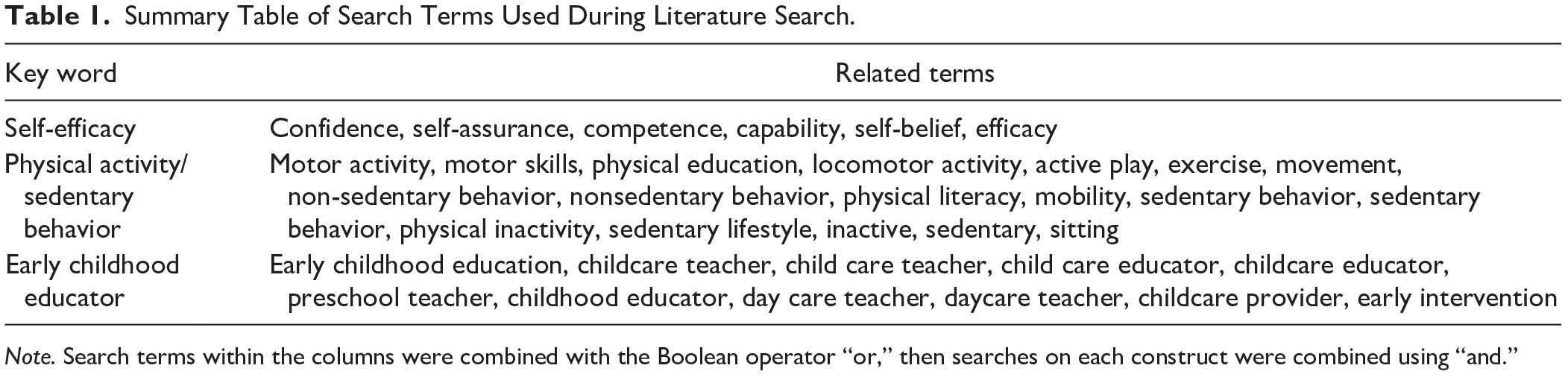
Note. Search terms within the columns were combined with the Boolean operator “or,” then searches on each construct were combined using “and.”
Eligibility Criteria
To be included, studies had to be primary research, published in an English language peer-reviewed journal; focus on pre- and/or in-service ECEs caring for children younger than 5 years of age; and, quantitatively measure ECEs’ physical activity or sedentary behavior–related self-efficacy. Studies of all designs (e.g., cross-sectional, cohort) were deemed eligible due to the low number of primary research articles on the present review topic.
Screening Process
All retrieved articles from each database were exported into independent folders in Mendeley (version 1.19.4) referencing software for screening, and then combined into one common folder for the purpose of removing duplicates. Once compiled, title and abstract screening was performed for all potentially relevant articles by two independent reviewers (MS and a research assistant). All articles deemed eligible based on the initial title and abstract screening were retrieved in full text. The same two reviewers independently screened all full text articles, and a third reviewer was brought in, when necessary, to confirm inclusion or exclusion of articles. Reference lists of all included articles were manually searched. If any articles not captured by the initial database search were identified from reference lists, the articles underwent the same screening process noted above.
Data Extraction
Two researchers (MS and BAB) independently extracted: study characteristics (i.e., authors, country, year published); study design and duration; sample characteristics (i.e., number of ECEs, gender, childcare type); and, characteristics of the self-efficacy tool used (i.e., number/type of items, who created it, delivery method, and validity and/or reliability) from each article. These data were summarized in a standardized extraction form. A second standardized form was used to summarize content areas covered in the items of each self-efficacy tool. Once complete, data extraction forms were compared to ensure agreement, and combined into the final version. Any disagreement that arose during the data extraction phase was resolved by consensus, and if needed, a third independent reviewer (PT) was consulted.
Quality Assessment and Risk of Bias
Two independent reviewers (MS and BAB) assessed the quality and risk of bias of included studies using the Downs and Black checklist (Downs & Black, 1998), and a third reviewer (PT) was consulted in cases of disagreement. For randomized controlled trials (n = 1), all 27 questions of the checklist were used to determine quality (i.e., low = 0–9, medium = 10–18, high = 19–27). For studies employing other designs (n = 15), a modified version of the checklist was used (i.e., questions 1–3, 6, 7, 10–12, 18, and 20), consistent with previous research (Duch et al., 2013; Vanderloo, 2014). Each article was assigned to one of three categories based on its score from the modified checklist (i.e., low = 0–3, medium = 4–6; high = 7–10). All articles that met the inclusion criteria were included in this review regardless of quality due to the novelty of this research field (i.e., limited studies conducted on this specific topic).
Results
Database Searches
A total of 2,661 articles were captured and uploaded into Mendeley. After removing duplicates (n = 483), 2,168 articles underwent title and abstract screening, and 87 articles remained eligible for full-text review. Following the full-text screening, 15 articles met inclusion criteria. One additional article was retrieved after reviewing the reference lists of included studies; thus, 16 articles were included in this review. See Figure 1 (PRISMA flow diagram) for details concerning identification, screening, eligibility, and inclusion process.
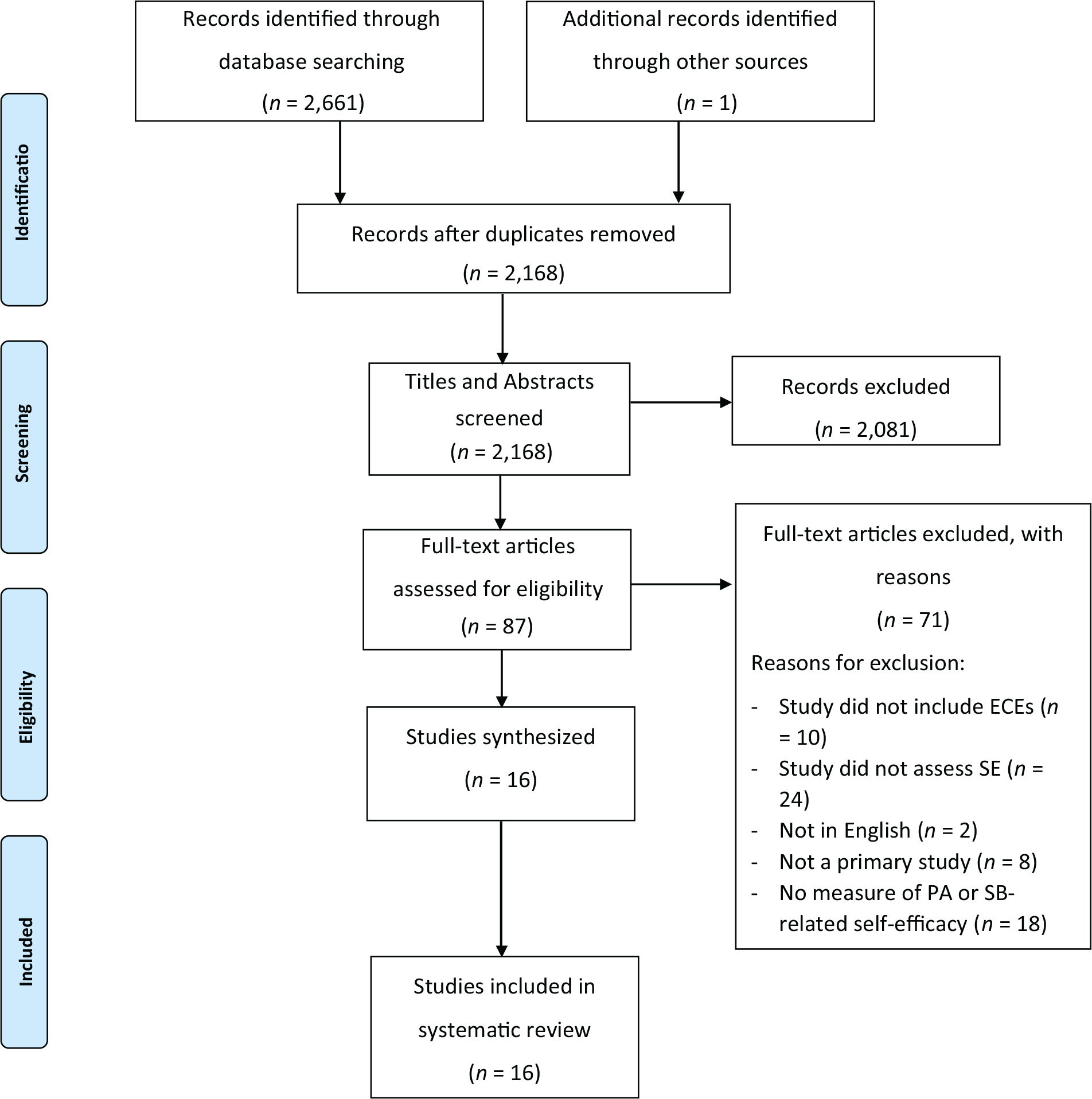
PRISMA flow diagram expressing the identification, screening, eligibility, and included article numbers in this systematic review.
Characteristics and Quality Assessment of Included Articles
Of the 16 studies included in this review, the majority were conducted in the United States (n = 5), followed by Canada (n = 4), Australia (n = 3), Turkey (n = 2), Ireland (n = 1), and Slovenia (n = 1). Publication dates ranged from 2010 to 2020, highlighting the infancy of this field. Study designs included: cross-sectional studies (n = 7); repeated measures (n = 5); validation (n = 1); exploratory case study (n = 1); randomized controlled trial (n = 1); and, quasi-experimental (n = 1). The majority of studies (n = 9) employed their self-efficacy tool for in-service ECEs, five studies employed their tool for pre-service ECEs, and two studies (Buckler & Bredin, 2018; Marinšek et al., 2020) employed their tool for both pre-service and in-service ECEs. The sample size of the studies ranged from 13 ECEs (Cotwright et al., 2017) to 1,819 ECEs (Hassani et al., 2020), with a mean sample size of 403 ECEs. Thirteen of the articles were deemed high quality, while three were scored as medium quality. See Supplemental File 1 and 1b for the full quality assessment of included articles.
Studies by Cotwright et al. (2017), Duff et al. (2019), and Derscheid et al. (2014) employed versions of the same tool (i.e., the Confidence About Activity and Nutrition [CAN] Teach Questionnaire), while studies by Murtha et al. (2020) and Cleland et al. (2018) employed the same tool (i.e., survey created to assess ECEs’ confidence to follow the Get up and Grow! guidelines); therefore, a total of 13 unique tools were identified in this study. All tools measured task self-efficacy (n = 13), while only one tool measured barrier self-efficacy (Bruijns et al., 2019). Five studies administered their surveys via paper, three administered surveys online, and five offered their participants the option to complete either online or paper. The remainder of studies (n = 3; 19%) did not specify how their surveys were distributed to participants (Altunsöz, 2015; Tsuda et al., 2019; Webster et al., 2010). All tools assessed self-efficacy on a Likert-type scale, except for Sevimli-Celik and Johnson (2013) who asked a simple “Yes/No” question regarding participants’ confidence. See Table 2 for detailed study characteristics.
Characteristics of Included Studies (n = 16).
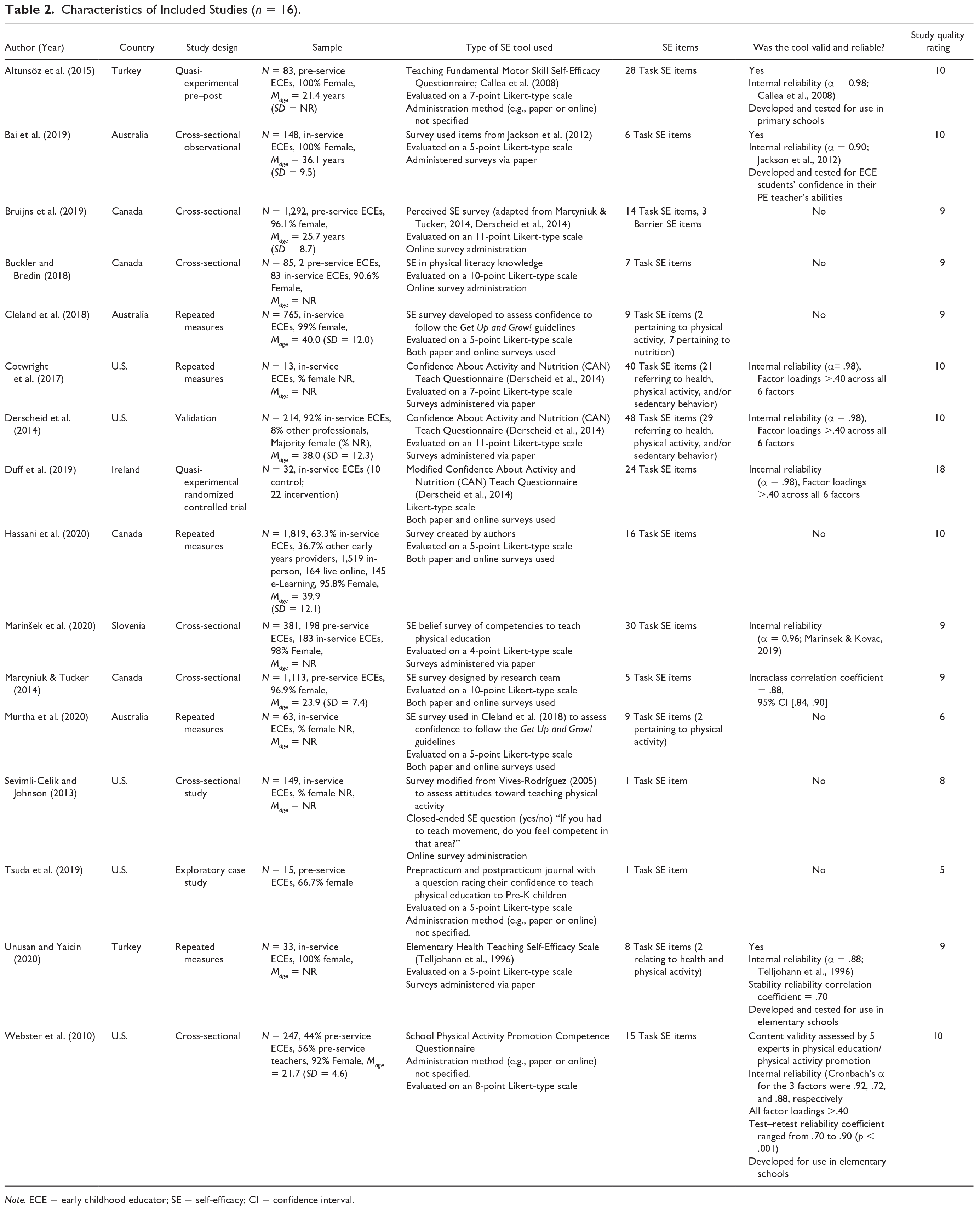
Note. ECE = early childhood educator; SE = self-efficacy; CI = confidence interval.
Validity and Reliability
Approximately half of the tools (n = 7; 54%) reported on the validity and reliability of the tool employed (Altunsöz, 2015; Bai et al., 2020; Derscheid et al., 2014; Marinšek et al., 2020; Martyniuk & Tucker, 2014; Unusan & Yalcin, 2020; Webster et al., 2010). The majority of these tools (n = 5) were validated for use in ECEs, while two tools were validated for use with elementary school teachers (Unusan & Yalcin, 2020; Webster et al., 2020). With respect to reliability, all seven instruments had satisfactory internal consistency; Martyniuk et al. (2014) reported an intraclass correlation coefficient of 0.88 (95% confidence interval [0.843, 0.903]). Cronbach’s alpha were used to report on tool reliability for the remaining six studies, with values ranging from 0.84 (Webster et al., 2010) to 0.98 (Altunsöz, 2015; Derscheid et al., 2014), and a mean Cronbach alpha of 0.92. In addition to reporting on internal consistency, Webster et al. (2010) established content validity for their tool, along with reporting test–retest statistics (reliability coefficient range: 0.70 to 0.90; p < .001). Finally, the CAN Teach Questionnaire (Derscheid et al., 2014) also established content validity, and the internal structure of validity was determined with exploratory factor analysis, with all six factor loadings greater than 0.40.
Tool Content Areas
There was a large degree of variability among the 13 tools regarding the content areas included. The most commonly included content area among all of the self-efficacy tools was teaching and/or leading physical activity, which was covered by all but one tool (n = 12; 92%), followed by physical activity promotion and programming (n = 9; 69%), and fundamental movement skills and physical literacy (n = 6; 46%). Three tools included content regarding using technology (Altunsöz, 2015; Bruijns et al., 2019; Hassani et al., 2020). Finally, physical education and safety (Altunsöz, 2015; Webster et al., 2010), sedentary behavior (Derscheid et al., 2014; Hassani et al., 2020), physical activity enjoyment and/or motivation (Bai et al., 2020; Hassani et al., 2020), developing policies (Derscheid et al., 2014; Hassani et al., 2020), and outdoor and risky play (Bruijns et al., 2019; Derscheid et al., 2014) were only referenced as items in two tools each. See Table 3 for a breakdown of specific content areas of each tool.
Self-Efficacy Questionnaire Physical Activity and Sedentary Behavior–Related Content Areas Covered.
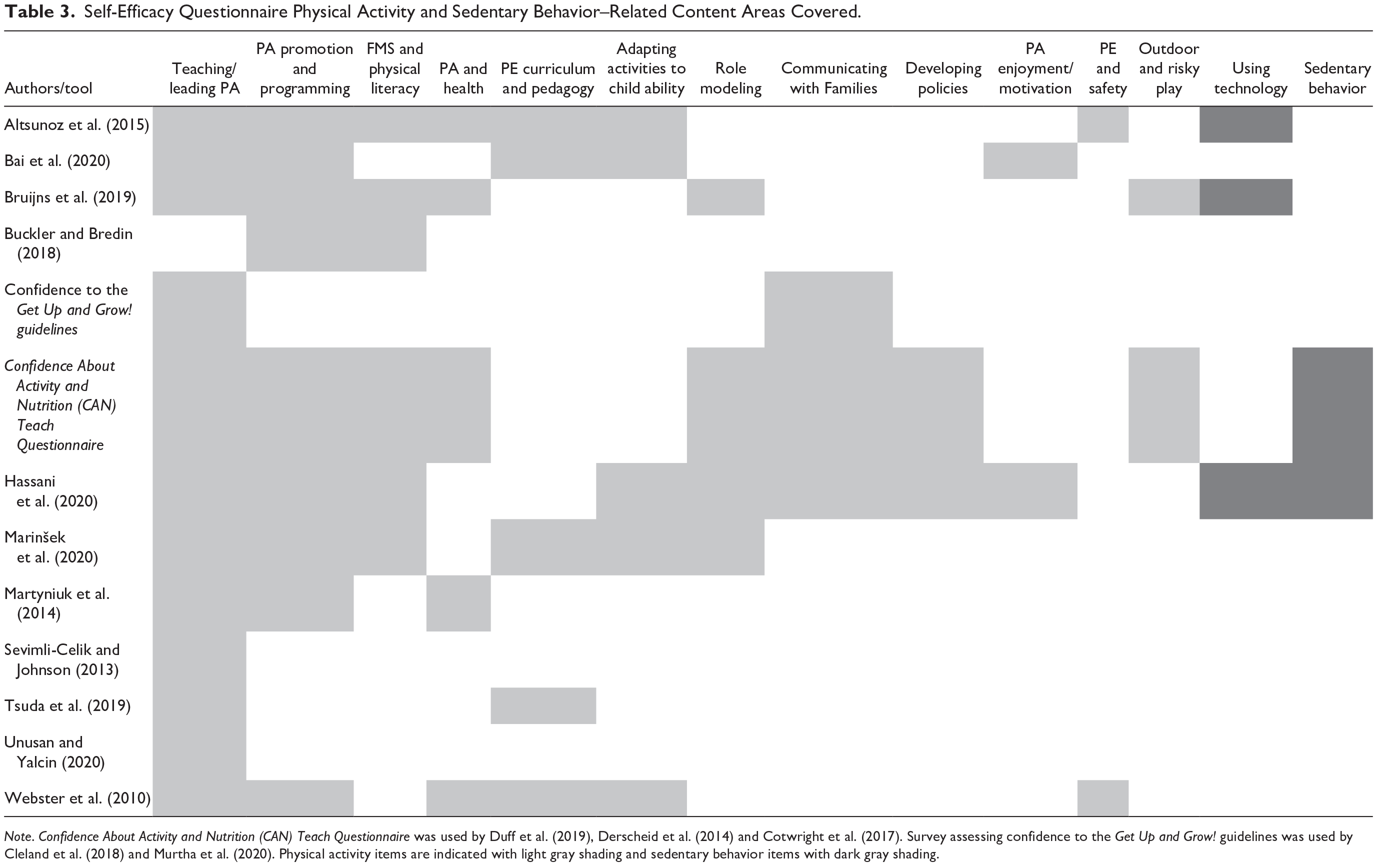
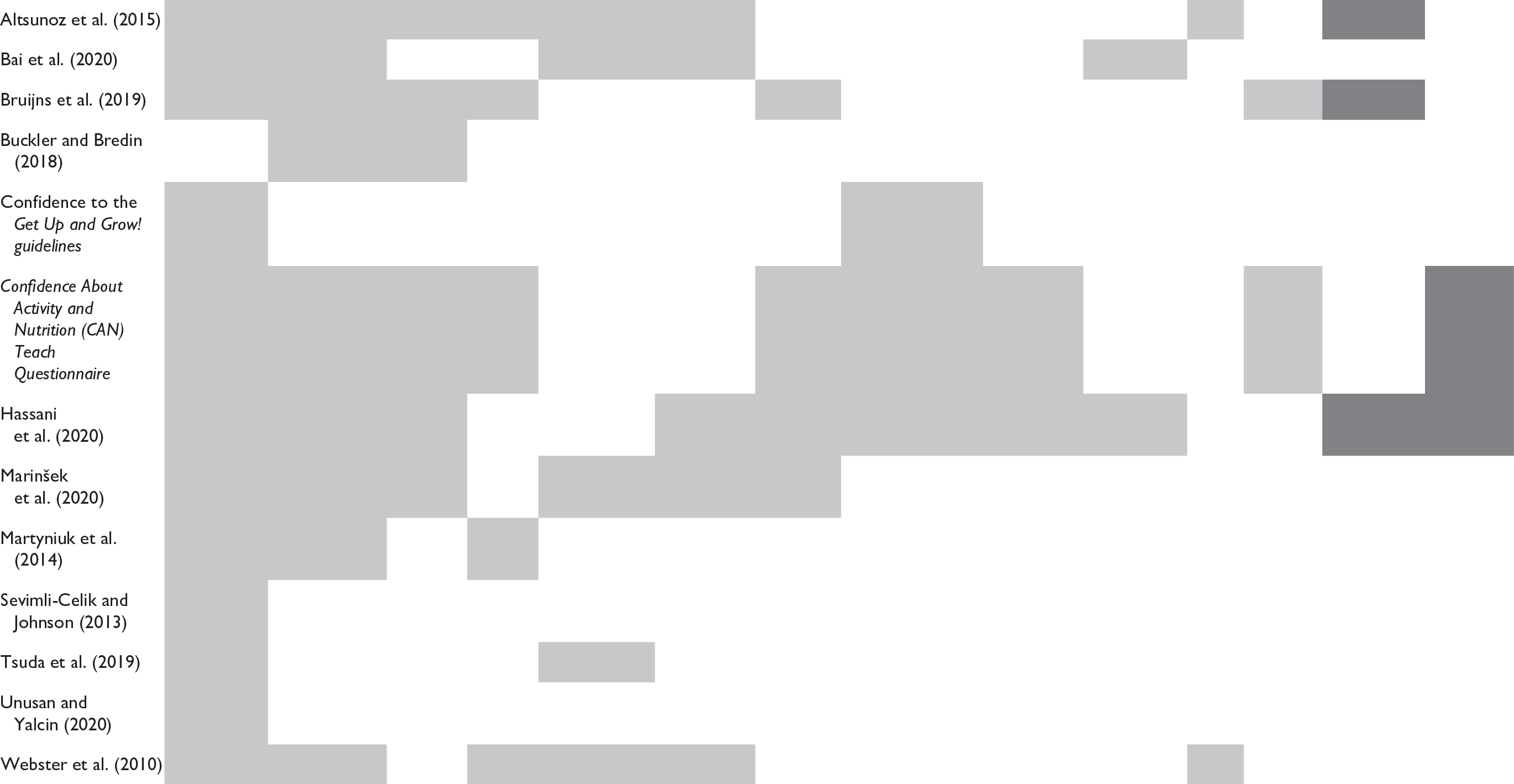
Note. Confidence About Activity and Nutrition (CAN) Teach Questionnaire was used by Duff et al. (2019), Derscheid et al. (2014) and Cotwright et al. (2017). Survey assessing confidence to the Get Up and Grow! guidelines was used by Cleland et al. (2018) and Murtha et al. (2020). Physical activity items are indicated with light gray shading and sedentary behavior items with dark gray shading.
Discussion
ECEs have received considerable attention as individuals who can support positive health behaviors for young children (Connelly et al., 2018; Copeland, Kendeigh, et al., 2012). Therefore, having the ability to properly assess their self-efficacy regarding the delivery of children’s movement opportunities is important. This systematic review explored tools used to measure physical activity and sedentary behavior–related self-efficacy among ECEs. In addition, the content breakdown of identified tools was investigated. A high degree of heterogeneity among the content areas referenced in the self-efficacy tools was found, with many tools including items pertaining to teaching and/or leading physical activity, and limited tools assessing items pertaining to both sedentary behavior and outdoor and risky play. Only half the tools identified in this review reported on validity and/or reliability of the tools employed, with a few of these not specifically validated in the ECE population. Given the prominent role ECEs play in leading and facilitating movement experiences in childcare (Hesketh et al., 2017), and the importance of ECEs’ self-efficacy in determining the quantity and quality of these experiences, a synthesis of the tools used to measure ECEs’ self-efficacy in this context was warranted.
The most common content area found among the 13 tools included items pertaining to teaching and/or leading physical activity. For example, Bruijns et al.’s (2019) tool assessed ECEs self-efficacy to “lead activities to improve children’s fitness development” (p. 8), while Unusan and Yalcin’s (2020) tool assessed ECEs’ self-efficacy to “do a good job teaching students about physical activity” (p. 87). Including such items is important, and the literature shows that ECEs who are confident in teaching and leading movement-based activities can positively influence children’s activity levels (Stacey et al., 2017). In fact, a study by Bell et al. (2015) found that when ECEs provided children with structured activity (e.g., teacher-led) and/or joined in active play alongside the children during childcare, children’s daily step counts increased (Bell et al., 2015). Similar to teaching/leading physical activity, physical activity promotion and programming was also a commonly mentioned content area in self-efficacy tools. This included tactics such as programming time into daily schedules for physical activity and providing children with verbal prompts to be active. These physical activity-promoting behaviors of ECEs are important, as providing children with verbal prompts has proven to be effective in increasing children’s activity levels during childcare (Gubbels et al., 2011). With regard to a typical 8-hour childcare day, it is imperative that ECEs feel capable and know how to promote, lead, and schedule time to provide the children in their care with physical activity opportunities. Given the prominence of these self-efficacy content areas among the identified studies, it is clear that consensus exists regarding their importance for inclusion in self-efficacy tools for ECEs.
Teaching physical literacy and fundamental movement skills was another frequently included content area. Physical literacy is the confidence, competence, knowledge, understanding, and motivation to engage in physical activities for life (Whitehead, 2016), and it is first developed during early childhood when children begin to master fundamental movement skills (Iivonen & Sääkslahti, 2014). Importantly, Bruijns et al. (2019) identified that 92% of pre-service ECEs felt it was their responsibility to teach locomotor skills to the children in their care. While it is encouraging that many tools identified in this review included items pertaining to fundamental movement skill development, very few tools referenced ECEs’ confidence to cultivate children’s physical activity motivation (Bai et al., 2020; Hassani et al., 2020). Motivation is a core component of physical literacy, and if ECEs fail to foster children’s motivation to move, it is unlikely that they will continue to seek out physical activity opportunities as they enter later childhood and adolescence (Copeland, Kendeigh, et al., 2012). As such, ensuring self-efficacy tools for ECEs fully encompass their confidence to support children’s physical literacy development is essential.
While some content areas were frequently included in self-efficacy tools, few studies included items pertaining to outdoor and risky play. In terms of outdoor play, only the CAN Teach Questionnaire (Derscheid et al., 2014) included items that measured ECEs’ confidence to schedule outdoor play. This is important, as children enrolled in childcare are twice as active, and engage in 10 times as much higher intensity physical activity, when they are outdoors compared with indoors (Vanderloo et al., 2013). In order to ensure children’s optimal health, ECEs need self-efficacy to provide sufficient outdoor play, encourage physical activity during outdoor play, and create outdoor environments that are conducive to outdoor play (Tremblay et al., 2015). It is essential to measure ECEs’ self-efficacy with regard to promoting outdoor play, as ECEs have previously communicated their difficulty with getting children outdoors (Driediger et al., 2018), especially in regions where inclement weather is common (Barber et al., 2016; Copeland et al., 2016; van Zandvoort et al., 2010). Similarly, in an extension of simply scheduling outdoor play, Bruijns et al. (2019) assessed ECEs’ confidence to “create opportunities for outdoor risky play” (p. 9). Risky play can generally be defined as thrilling and exciting play where children engage in activities involving risk without certainty of the outcome (Brussoni et al., 2015); not only has it been shown to promote higher levels of physical activity among young children (Little & Sweller, 2015) but it can also increase children’s resilience and social competence (Brussoni et al., 2015). Considering children’s exposure to this type of play is often restricted due to parents’ concerns for child safety (Wyver et al., 2010), and liability concerns of the childcare center (Little et al., 2012), assessing ECEs’ self-efficacy to support outdoor risky play is necessary.
In addition to outdoor risky play, Bruijns et al. (2019) also measured ECEs’ confidence to preserve outdoor playtime even during challenging weather conditions. This was the one of the only items identified in this review which addressed barrier self-efficacy (Bruijns et al., 2019). It is important that ECEs are taught strategies and feel capable regarding getting children outdoors during childcare hours, even if outdoor conditions are not ideal (or other barriers, like lack of time, are present), as outdoor play increases opportunities for higher intensity activity and risky play (Brussoni et al., 2015). Bruijns et al. (2019) also measured ECEs’ barrier self-efficacy concerning their ability to facilitate active play for young children in a limited space, and when they are feeling tired. It is critical that barrier self-efficacy of ECEs is measured in future studies, as ECEs have expressed that they encounter many barriers that affect their daily ability to promote physical activity (e.g., other curricular demands, unsupportive colleagues; van Zandvoort et al., 2010). In fact, Bruijns et al. (2019) showed that ECE candidates exhibited exceptionally low self-efficacy scores for all barrier items, compared to task items (Bruijns et al., 2019). If ECEs’ barrier self-efficacy is measured more broadly across a wide range of constructs, researchers can more easily highlight what types of resources and supports ECEs require to achieve health-related goals for their classroom.
While measuring ECEs’ confidence to promote physical activity in childcare is important, their self-efficacy to minimize children’s prolonged sedentary time is equally essential for proper health (Bruijns et al., 2019). Few tools assessed ECEs’ self-efficacy regarding limiting children’s sedentary behaviors (Derscheid et al., 2014; Hassani et al., 2020), and engagement with screen-based technology (Altunsöz, 2015; Bruijns et al., 2019; Hassani et al., 2020); however, the lack of tools assessing these content areas may be attributed to the infancy of sedentary behavior and screen-viewing-related research in childcare contexts. Self-efficacy regarding sedentary behavior was assessed via task items by Derscheid et al. (2014) and Hassani et al. (2020) to capture ECEs’ confidence to limit prolonged sedentary time of the children in their care, which is an important strategy for ensuring children are sufficiently active throughout the day (Staiano et al., 2018). As such, assessing ECEs’ confidence in their ability to interrupt children’s prolonged sedentary time, properly role model sedentary and screen-viewing behaviors, incorporate active transitions, and avoid the use of screen-based technology, could be valuable self-efficacy items among such tools.
Only half of the tools included were deemed valid and reliable, and even fewer were validated in the population in which the tool was used. It is important that tools are validated to ensure that responses given are reliable, and that they measure the constructs that the researchers intend to measure. Furthermore, employing a validated tool in its validation population ensures that questions are appropriate, and applicable for comparison among other studies. Nearly all of the tools used Cronbach’s alpha to report on internal reliability, and for the most part sufficient scores for this psychometric property were reported; however, Altunsöz (2015) and Derscheid et al. (2014) both reported Cronbach’s alpha values of .98, which demonstrates that items in each of their respective tools may have been too similar. Additionally, few tools assessed content validity (Derscheid et al., 2014; Webster et al., 2010), applied test–retest statistics (Webster et al., 2010), and conducted exploratory factor analysis (Derscheid et al., 2014). Future studies should employ a more robust and transparent validation process and test the tool with their target population to ensure sufficient validity and reliability prior to delivery.
Limitations
This review had a number of strengths, including a comprehensive search strategy approved by a librarian, an update of the original search to include all recent literature, and the comparison of both item content areas and validity/reliability among included tools; however, limitations must also be addressed. This review was restricted to English-written articles; thus, articles exploring self-efficacy of ECEs in other languages may have been missed. Only tools that quantitatively measured self-efficacy were included, possibly excluding important qualitative literature. Furthermore, various definitions of self-efficacy were present among the studies we identified and may have led to the differences in tool content and items. These differences may be attributed to the authors’ field of study, and/or method by which the tool was developed. For example, Buckler and Bredin (2018) defined ECEs’ self-efficacy as confidence and competence to promote children’s physical literacy skill development, whereas authors Derscheid et al. (2014) defined ECEs’ self-efficacy as confidence in addressing physical activity needs of children in their care and executing proper practices. Finally, some tools were designed for other populations (e.g., elementary school teachers, physical education teachers), and therefore, may have not possessed appropriately relevant items for individuals working in the early childhood education settings (e.g., ECEs).
Conclusion
The findings from this review highlight the heterogeneity in existing ECE physical activity and sedentary behavior self-efficacy tools. While many tools comprised items focusing on teaching, leading, and promoting physical activity and fundamental movement skill development, few tools addressed sedentary behavior, physical activity enjoyment and motivation, and outdoor and risky play. Furthermore, the majority of tools neglected to measure barrier self-efficacy, and many tools were not validated in the ECE population. Based on this evidence, future research is needed to develop and validate a new tool that fills these noted gaps. The creation of a validated and comprehensive self-efficacy tool will help to standardize the way ECEs’ self-efficacy is assessed in physical activity and sedentary behavior–related research in childcare, improving the comparability among studies.
Supplemental Material
sj-docx-1-heb-10.1177_10901981211025471 – Supplemental material for Measuring Early Childhood Educators’ Physical Activity and Sedentary Behavior–Related Self-Efficacy: A Systematic Review of Tools
Supplemental material, sj-docx-1-heb-10.1177_10901981211025471 for Measuring Early Childhood Educators’ Physical Activity and Sedentary Behavior–Related Self-Efficacy: A Systematic Review of Tools by Monika Szpunar, Brianne Bruijns and Patricia Tucker in Health Education & Behavior
Supplemental Material
sj-docx-2-heb-10.1177_10901981211025471 – Supplemental material for Measuring Early Childhood Educators’ Physical Activity and Sedentary Behavior–Related Self-Efficacy: A Systematic Review of Tools
Supplemental material, sj-docx-2-heb-10.1177_10901981211025471 for Measuring Early Childhood Educators’ Physical Activity and Sedentary Behavior–Related Self-Efficacy: A Systematic Review of Tools by Monika Szpunar, Brianne Bruijns and Patricia Tucker in Health Education & Behavior
Footnotes
Acknowledgements
The authors thank Roxanne Isard (Research and Instructional Services Librarian, University of Western Ontario) for her assistance in developing the current review’s search strategy, Dr. Stephanie Truelove for her expertise with systematic review processes, and Cole Misic for his assistance with database searching and article screening.
Declaration of Conflicting Interests
The authors declared no potential conflicts of interest with respect to the research, authorship, and/or publication of this article.
Funding
The authors disclosed receipt of the following financial support for the research, authorship, and/or publication of this article: This research did not receive any specific grant from funding agencies in the public, commercial, or non-for-profit sectors. Brianne Bruijns holds a Social Sciences and Humanities Research Council of Canada Graduate Scholarship. Dr. Tucker holds an Early Research Award from the Ministry of Ontario.

References
Supplementary Material
Please find the following supplemental material available below.
For Open Access articles published under a Creative Commons License, all supplemental material carries the same license as the article it is associated with.
For non-Open Access articles published, all supplemental material carries a non-exclusive license, and permission requests for re-use of supplemental material or any part of supplemental material shall be sent directly to the copyright owner as specified in the copyright notice associated with the article.
