



Abstract
Keywords
Key Points
Adolescent ballet dancers require additional support to report, prevent, and manage their dance-related injuries.
Health professionals should increase their dance literacy to improve quality of care and enhance rehabilitation.
High-quality clinical trials are necessary to confirm or negate the validity of proposed injury risks, prevention and management in adolescent ballet dancers.
Introduction
Ballet is a popular dance genre requiring significant physicality and artistry.1-3 An emphasis is placed on “perfection” in movement, timing, and technique.4-6 Ballet dancers subsequently need to be fit, strong, and flexible and have finely-tuned motor control, balance and coordination.3-7 Ballet is undeniably a physically and technically challenging pursuit, with a unique social paradigm that only ballet dancers themselves can fully comprehend.1-7 Dancers typically commence ballet at a young age and increase their training volume and intensity in adolescence as they compete for professional ballet positions.1,8 Adolescents, regardless of their skill level or future ballet aspirations, must commence their ballet training within a pre-professional setting, either within a vocational or recreational ballet program.1,2
Adolescent ballet dancers, however, frequently experience dance-related injuries.2,9 A dance-related injury can be defined as any physical complaint leading to difficulties participating in normal dance class rehearsal or performance. 10 Adolescent pre-professional ballet dancers may experience between 0.76 and 2.73 injuries per 1000 dance hours each year. 9 The higher injury rate represents “all complaints” injuries where the dancer may continue dancing despite injury, whereas the lower rate represents a “time loss” injury where the dancer must cease dancing.9,10 Most dance-related injuries in professional and pre-professional ballet dancers affect the lower limb and/or spine, involve strains, sprains, and inflammation.1-2,9,11
Adolescent ballet dancers may be particularly vulnerable to dance-related injuries because they are still developing physically and psychologically.1,6 Adolescent ballet dancers, for example, may be at increased injury risk with high training loads or when they push past the safe loads of stretching to demonstrate “perfect” technique.1,12 Adolescent ballet dancers also may be at risk of injuries when transitioning to full time training and learning to dance en-pointe.13,14 Adolescents also may be vulnerable to psycho-social pressures to continue dancing when injured which can lead to further injuries and ongoing symptoms.6,8,15
Being unable to dance due to injury can cause considerable distress for professional dancers as dancing is intertwined with their identity and source of income.4-5,16-18 There is also an attached stigma to injuries in dance circles and under-reporting due to fear of judgment and reduced career opportunities.8,15,16 Treatment and support for dance-related injuries may subsequently be insufficient or delayed and dancers may experience worsening injuries and chronic disability. 16 Currently little is known regarding the personal impact of injuries on adolescent ballet dancers who are yet to transition to professional roles.
Several individual risk factors predisposing professional ballet dancers to injury have been reported in the literature—such as being young, hypermobile, having poor psychological coping skills and insufficient fitness, strength, and motor control.18,19 Other risk factors include high dance training loads, undertaking new or difficult choreography, dancing with incorrect technique, wearing ill-fitting pointe shoes, and dancing on inappropriate dance floors.20-23 Currently there are few studies that have proposed and/or rigorously tested injury prevention strategies. One randomized controlled trial, however, has reported an 82% reduction in injury rates with targeted strengthening of abdominal, back, and hip muscles in professional ballet dancers. 24
Treatment of injured ballet dancers is minimally described and evaluated in the literature. Systematic review findings suggest that a range of physiotherapy treatments (eg, manual therapy, exercise, dry needling) may reduce pain, increase range of movement, and physical function following injury. 25 However, additional research is required as primary studies have significant methodological limitations which can influence the credibility of findings. 25 Also, given ballet dancers may try to self-manage injuries before seeking health professional input, future research should explore what therapies dancers find beneficial and barriers and enablers to seeking treatment and support. 26
Currently there is no known qualitative research that has explored the perspectives and experiences of Australian adolescent novice and pre-professional ballet dancers regarding dance-related injuries. Previous qualitative research focused on professional ballet dancers from other countries and/or those aged over 18 years who may have different perceptions and feelings compared to younger pre-professional ballet dancers in Australia.8,17 Hence, this research aimed to explore the perspectives and experiences of Australian adolescent ballet dancers regarding dance-related injuries, their impact, risk factors, prevention, and management. Findings may inform efforts to understand and prevent injuries, and support and treat injured adolescent ballet dancers.
Methods
Study Design
An online survey was undertaken to facilitate ease of distribution and data collection and to reduce geographical barriers to participation. 27 The survey consisted of mainly open questions to allow exploration of participant views and experiences in their own words. 27 Survey design and questions were developed by literature review and identification of evidence gaps, but also by cross-checking design options and topic areas with existing surveys and ensuring it was appropriate for an adolescent population.1,12,13,27 A qualitative survey design was chosen over other qualitative methods (eg, focus group, interview) as participants could answer questions confidentially without external pressure, which was considered important due to the social stigma surrounding injury reporting and the young age of participants.16,27 Quantitative data was also collected to provide context to qualitative responses, and was used in data triangulation in development of themes.1,7,11
Ethics and Consent
Ethical approval to conduct this study was obtained from the Human Research Ethics Committee (H20342). Participants needed to email a completed consent form to researchers to access the survey. For dancers aged under 18 years, consent forms were also obtained from a parent and/or guardian. 28 Participation was voluntary and consent could be withdrawn at any time. Identifying information regarding participants was only used for survey administration. Pseudonyms were used to protect participant identity during data analyses and reporting.
Participant Recruitment
Convenience and snowball sampling were used to recruit participants via email and social media. 28 Australian recreational dance schools who teach a ballet syllabus, and health professionals with expertise in treating dancers, were emailed by the research team and asked to forward study information to relevant dance students/patients and parents/guardians. Contact details for ballet schools and health professionals in each Australian state and territory were sourced from online publicly available directories. National and state dance organizations and dance schools also assisted recruitment by posting study information on their Facebook and Instagram pages.
Selection Criteria
To participate in the survey, participants needed to meet the following criteria:
Be aged between 12 and 19 years (inclusive) to meet the definition of “adolescent” described in the literature. 29
Study ballet at an Australian recreational dance school and have experienced at least one dance-related injury.
Dance ballet more than 50% of the time. Dancers who danced other genres could be included but they needed to predominantly dance ballet.
Participants were also required to be proficient in English language, and have adequate access to an email server and internet to provide consent and access to the survey.
Survey
The online survey was distributed using SurveyMonkey and was estimated to take 45 minutes to complete. 30 Participants could complete the 53-question survey (Appendix A) in a single sitting or multiple sittings within 2 weeks and participants were encouraged to complete the online survey individually, in their own time, to prevent external influence on injury reporting. The survey consisted primarily of open-ended questions to explore dancers’ perspectives and experiences using their own words. Participants were asked to report on self-reported injuries, as well as those diagnosed by licensed health professionals. Multiple choice and closed questions were utilized to collect demographics and quantitative information. Pilot testing using an adolescent population was conducted to reduce design flaws, identify any ambiguity in questioning, and address any issues with survey access and flow. Participants were instructed to contact the primary researcher via email for question clarification if required.
Key terms and definitions were provided at the beginning of the survey. This included the study’s definition of dance-related injuries: Any physical complaint leading to difficulties participating in normal dance class rehearsal or performance. 10 Participants were encouraged to cease the survey if recalling personal injury experiences caused emotional distress, and were asked to confide in their parent/guardian, general practitioner, or other trusted health professional. Crisis support contact details were also supplied to participants.
Data Analysis
Participant demographics and quantitative data were summarized using descriptive statistics. Responses to open-ended survey questions were coded using NVivo 12 software. 31 Qualitative data was analyzed thematically using grounded theory and the step-wise approach described by Braun and Clark. 32 Initial data familiarization and coding was conducted by 2 physiotherapy researchers working on the same survey response, whereas the remaining responses were coded separately and findings compared. Once data saturation was achieved and no new codes were identified, codes were reviewed by both researchers in real-time to identify patterns and generate themes. Any disagreements between researchers were resolved by discussion and reexamination of participant responses.
The rigor of qualitative analyses was facilitated by triangulation of qualitative data with quantitative statistics, and consideration of social identity theory.33,34 Social identity theory proposes that people categorize each other into social groups, identify with and join a social group, and then compare groups—favoring their group (the “in-group”) over others (the “out-group”). 35 This model seemed appropriate to use given ballet dancers have linked dancing to their personal identity (Wainwright et al. 17 ) and adolescents are at an age where they are developing their sense of identity and strongly influenced by social interactions.17,36,37
Results
Participants
Nineteen out of 21 participants completed the survey representing a participation rate of 90.5% (19/21). The 2 participants who did not complete the survey did not respond to reminders. Participant demographics are summarized in Table 1.
Participant Demographics (n = 19).
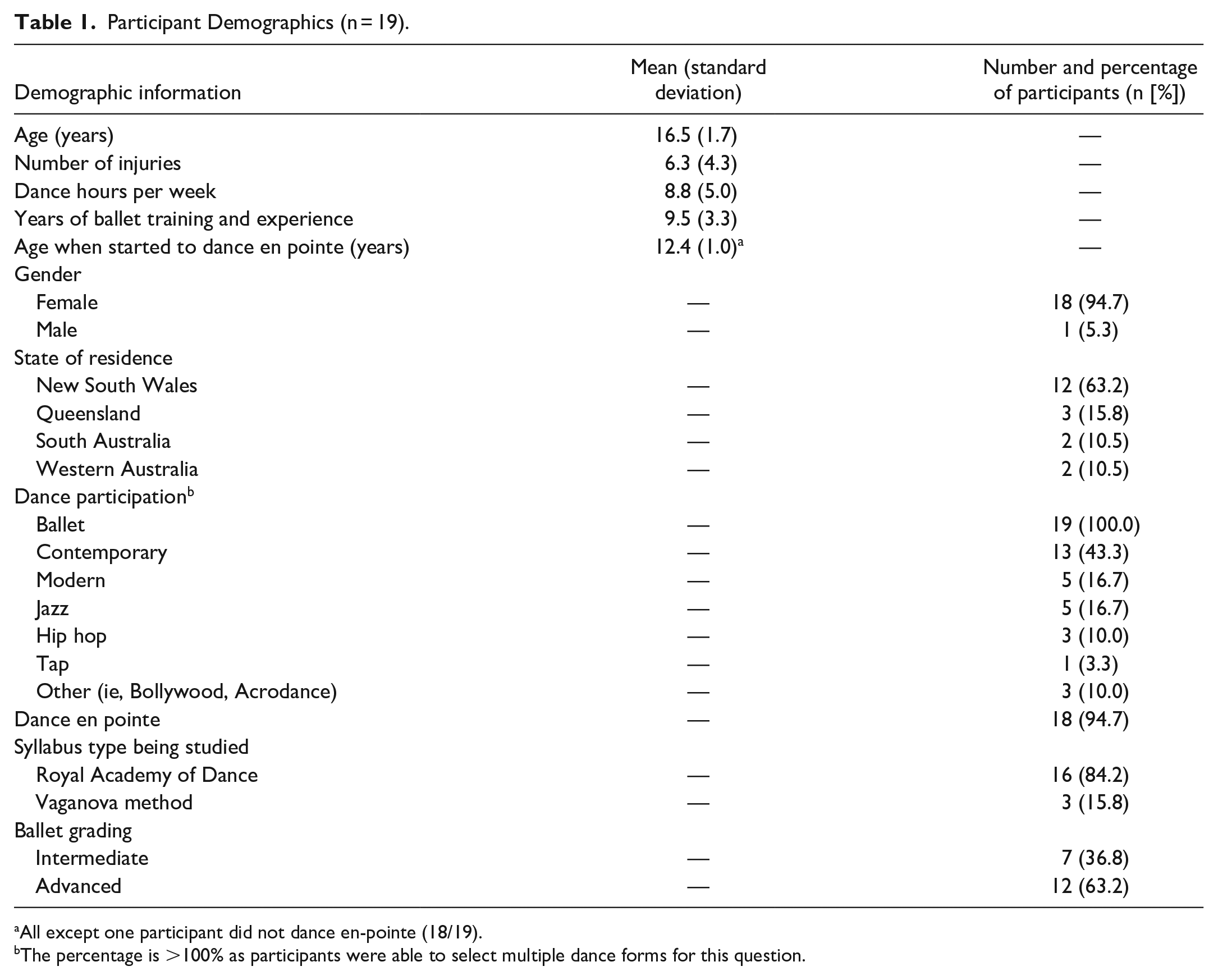
All except one participant did not dance en-pointe (18/19).
The percentage is >100% as participants were able to select multiple dance forms for this question.
Themes
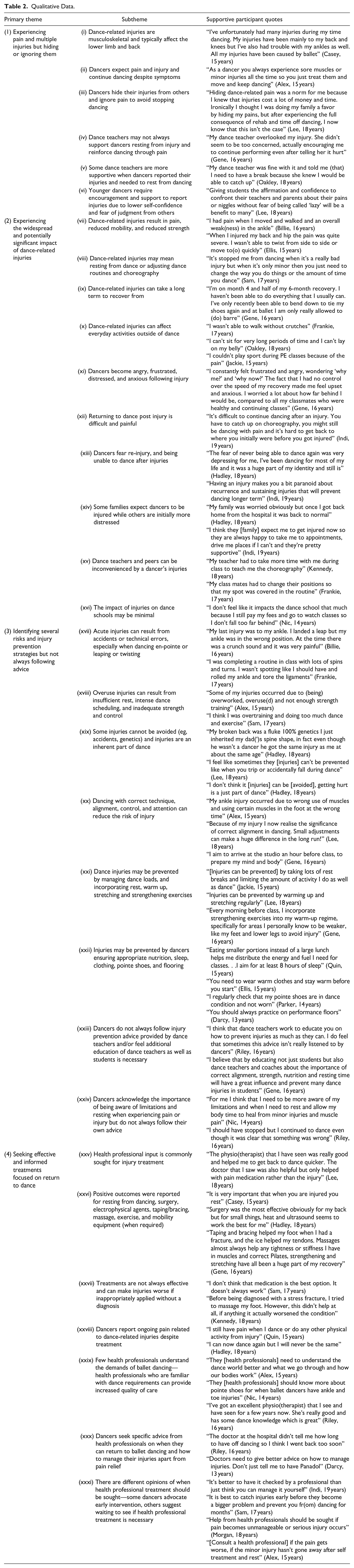
Four themes were identified: (1) Sustaining multiple injuries but hiding or ignoring symptoms; (2) Experiencing the widespread and potentially significant impact of injuries; (3) Identifying risks and injury prevention strategies but not always following advice; (4) Seeking informed and effective treatments focused on return to dance. Themes and subthemes with supportive participant quotes are detailed in Table 2, while complementary quantitative statistics referred to in themes is provided in Table 3.
Qualitative Data.
Dance-Related Injury Characteristics, Impact, Perceived Risk Factor, and Prevention and Treatment Strategies Reported by Participants (n = 19).
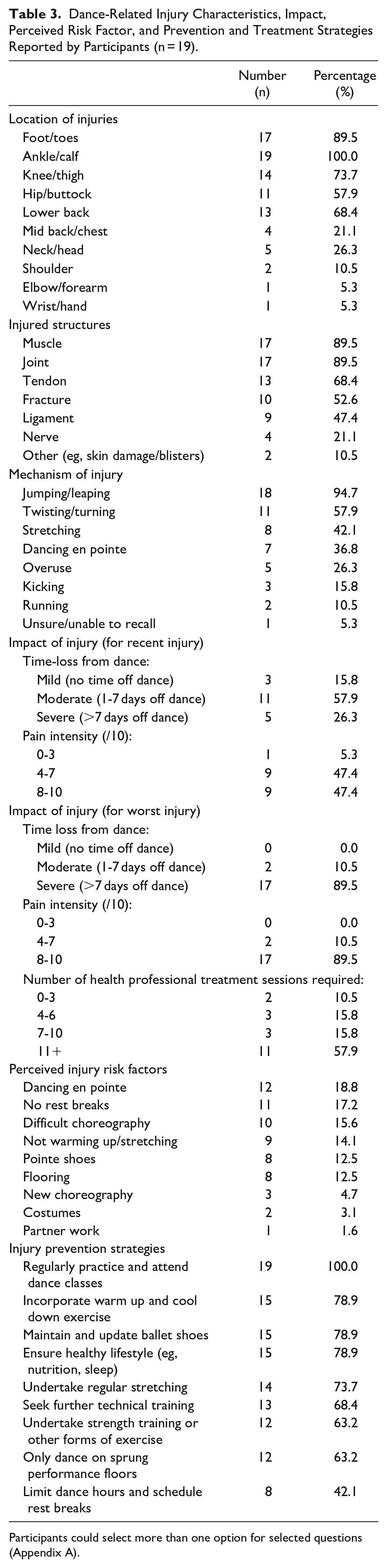
Participants could select more than one option for selected questions (Appendix A).
Theme 1: “I’ve Had So Many Injuries”: Sustaining Multiple Injuries But Hiding or Ignoring Symptoms
Participants reported experiencing multiple injuries (Table 2; i) with most involving moderate to severe lower limb strains, sprains, or fractures (Table 3). Participants reported continuing to dance despite injury as they perceived this to be expected as a ballet dancer (Table 2; ii). Participants also reported hiding injuries as they wanted to continue dancing and not miss out on dance opportunities (Table 2; iii). Some participants did recognize, however, that failing to rest when injured could prolong their recovery (Table 2; xxiv). Most participants did not feel confident in reporting injuries to their dance teacher and felt pressured to continue dancing following injury (Table 2; iii). Other participants reported their dance teacher supported them to rest when injured (Table 2; iv). Several participants suggested that adolescent dancers needed specific encouragement and support to report injuries and rest when indicated so that injuries may be more effectively managed (Table 2; vi).
Theme 2: “It’s Difficult to Continue Dancing After an Injury”: Experiencing the Widespread and Potentially Significant Impact of Injuries
Participants described how injuries resulted in pain and reduced mobility, strength, and function, which affected their ability to dance (Table 3; vii). Some participants also reported difficulties sitting, walking, or bathing, and attending and participating in school due to injury (Table 3; x). If injuries were mild or less painful, participants continued to dance with modifications to scheduling, load, or choreography (Table 3; viii) but if pain and injuries were severe, dancers had to cease dancing (Table 3; viii). Some participants reported being unable to dance for days or weeks due to an injury, while others reported months (Table 3; ix). Participants felt frustrated, angry, and anxious when injuries prevented or restricted their dancing ability (Table 3; xi). Participants described intense fear of being unable to dance again, and depression when they were unable to dance as they felt dancing was part of their identity (Table 3; xiii). Participants also described how returning to dance after injury was painful and how it was difficult to return to their previous performance level (Table 3; xii). Participants also feared re-injury, and felt their dancing was affected by this fear (Table 3; xiii).
Some participants felt their parents were distressed when they were injured, while others felt their parents expected their injuries and had little concern (Table 3; xiv). Participants did recognize, however, that they relied on psychological, physical, and financial support from their family to cope and recover from injuries (Table 3; xiv). Some participants recognized the inconvenience and extra workload for dance teachers who needed to help them catch up and/or change choreography, as well as the need for peers to cover them in rehearsals and performances (Table 3; xv). Other participants felt, however, that the impact of injuries on others was minimal in contrast to the personal ramifications (Table 3; xvi).
Theme 3: “I Overworked Myself and Wasn’t Letting My Body Rest”: Identifying Injury Risks and Injury Prevention Strategies But Not Always Following Advice
Participants perceived most of their dance-related injuries to be caused by accidents or technical errors associated with jumping/leaping, twisting/turning, and dancing en pointe (Tables 2 and 3; xvii). Some participants also described overuse injuries due to insufficient rest breaks, intense dance scheduling, rigorous choreography, and insufficient strength (Tables 2 and 3; xviii). Some participants also perceived that genetics may have predisposed them to injury (Table 3; xix). Several participants felt that not all injuries could be prevented as they were accidental or that injuries were unavoidable due to ballet’s technical requirements (Table 3; xix). However, participants felt injury risk could be reduced by focusing on and improving technique, control, and alignment when dancing (Table 3; xx). Participants did note, though, that “perfect” technique was difficult to achieve as a novice (Table 3; xxii).
To prevent injuries participants recommended incorporating warm up and cool down exercise, stretching, and rest (Tables 2 and 3; xxi). Participants also perceived that a healthy lifestyle (including a balanced diet and quality sleep) and physical conditioning and exercise outside of dance were helpful (Tables 2 and 3; xxii). Other reported injury prevention strategies included arriving early to class to prepare, staying warm with appropriate clothing, maintaining pointe shoes, and dancing on sprung performance floors (Tables 2 and 3; xxii). Participants also suggested that by respecting their physical and mental limitations, injuries may also be prevented or better managed (Table 3; xxiv). Despite this, nearly all participants reported continuing to dance through pain and injury (Table 3; ii-iii). Some participants indicated the dance teacher integrated injury prevention strategies into classes although most participants felt dance teachers had limited understanding regarding injury prevention and/or students did not take injury prevention seriously (Table 3; xxiii).
Theme 4: “Don’t Just Tell Me to Have Panadol”: Seeking Effective and Informed Treatment Focused on Return to Dance
Participants sought injury treatment from a range of health professionals and reported variable outcomes and experiences (Table 3; Theme 4). Positive outcomes were reported in response to ice, heat, ultrasound, massage, joint mobilization, exercise (eg, stretching, strengthening, Pilates), taping, bracing, surgery, and use of crutches (Tables 2 and 3; xxvi). Not all participants, however, found treatments effective (eg, medication, massage, taping) and sometimes treatments made their condition worse (Table 3; xxvii). Several participants also reported ongoing pain related to previous injuries, even though they sought health professional treatment (Table 3; xxviii).
Participants felt their treatment would have been more effective if health professionals had a greater understanding of ballet and associated demands (ie, dancing en pointe, dance loads, psycho-social pressures) (Table 3; xxix). Participants also suggested that having access to dance-specific health professionals may reduce their stress and anxiety related to seeking treatment (Table 3; xxix). Dancers sought specific advice on when to return to dancing and not just symptom management (Table 3; xxx). While some participants suggested seeking health professional treatment as soon as possible to prevent an injury from worsening (Table 3; xxxi), others suggested health professional treatment should be sought only if symptoms are worsening and long-lasting, and the injury does not improve with self-management and rest (Table 3; xxxi).
Relevance of Social Identity Theory
Figure 1 summarizes how themes intersect with social identity theory, whereby participants define the “in-group” as those who dance ballet and the “out-group” as those who do not dance ballet. Participants described hiding and ignoring injuries so they could continue dancing (Theme 1) and prioritized dancing over injury prevention (Theme 3) to stay in the “in-group.” Injuries, meanwhile, that stopped participants from dancing (Theme 2) led to them being categorized as the “out-group” and participants therefore sought treatment to help them to return to dance as soon as possible so they could rejoin the “in-group.”
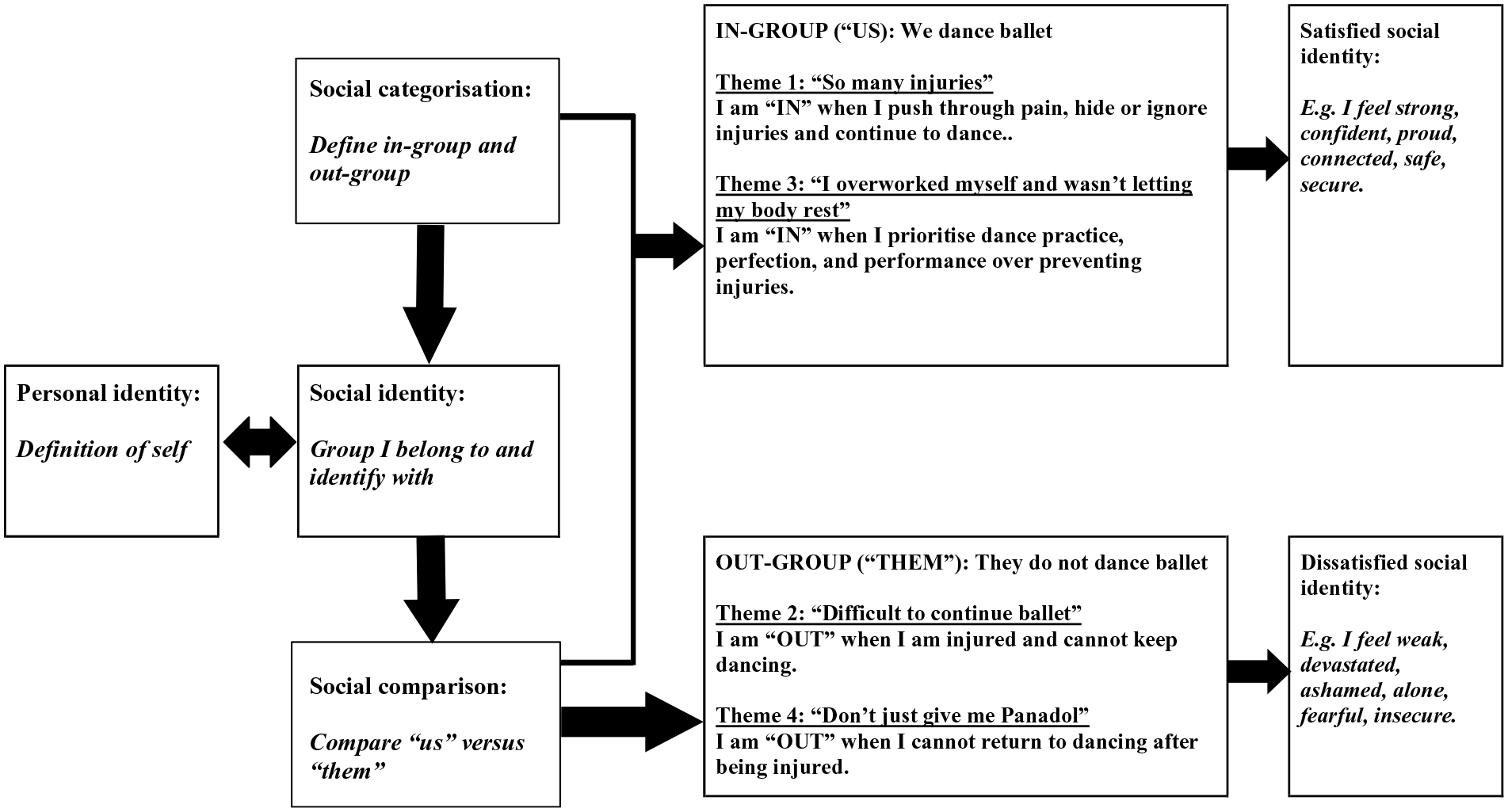
Understanding the social identity of adolescent ballet dancers and impact of injuries*.
Discussion
This survey provides the first known qualitative evidence to explore perspectives and experiences of Australian adolescent ballet dancers in relation to injuries, their impact, risk factors, prevention, and management. Findings suggest adolescent ballet dancers experience multiple musculoskeletal injuries but may ignore or hide injuries to continue dancing. Adolescent ballet dancers are aware of potential injury risks, but do not always engage in injury prevention strategies preferring to focus on their dancing. Adolescent ballet dancers may access treatment from health professionals with support from others, however, their goal is to focus on return to dance and not just symptomatic management of injuries.
Participants reported experiencing multiple dance-related injuries related to ballet (Theme 1, Table 3). The injury rate can be estimated at 0.7 injuries per year using the mean number of injuries and years of experience reported by participants (Table 1) (6.3/9.5). This injury rate is lower than those reported by professional ballet dancers (1.61-6.8 injuries per dancer per year). 13 The injury rate could also be estimated at 1.5 injuries per 1000 dance hours (ie, 0.7 × 1000/(8.8 × 52)) using the mean number of hours per week reported by participants (8.8 hours). This injury rate is similar to that of pre-professional ballet dancers (0.77-3.06 injuries per 1000 dance hours) and suggests that ballet dancers are experiencing injuries even when not undertaking high training loads.1,2 Although the location and type of injuries reported by participants (Table 2) was similar to previous studies, participants reported more injuries to be caused by accidents and technical errors as opposed to overuse and high dance loads.7,11,21 This finding may relate to the small sample size, however, and so findings require confirmation in future research studies.
Participants were reluctant to disclose injuries to others due to fear of judgment or impact on their ability to continue dancing (Theme 1). This finding has also been reported in professional dancers. 16 The reluctance of dancers, then, to report injuries likely relates to the “culture of risk” in ballet whereby pain is normalized and injuries are trivialized. 5 There is therefore an urgent need to correct misunderstandings regarding pain and injury prevention and management in adolescent ballet dancers to ensure timely treatment and support to prevent injury chronicity.25,38 Dance schools, teachers and professional dancers may have the most success in challenging group norms and maladaptive responses to pain and injury in adolescent ballet dancers as they may also be seen as part of the “in-group” (Figure 1).
Participants described anxiety and distress when they were injured as “it was difficult to continue dancing” (Theme 2). Being unable to dance meant participants were demoted to the “out-group” and were therefore dissatisfied with their social identity (Figure 1). Similar feelings have been reported by professional ballet dancers who are unable to dance. 16 It therefore seems vitally important that injured dancers remain connected with their dance colleagues and are supported in dance participation and associated activities as soon as possible. This study also highlights the widespread impact of injuries on an adolescent dancer outside of dancing (eg, school, work, activities of daily living) and their reliance on family, friends, and dance teachers/peers. These aspects therefore need to be considered when supporting adolescent ballet dancers throughout their recovery.
Several injury risk factors identified by participants (Theme 3, Table 2) appear consistent with previous research findings regarding dance-related injuries. 7 Some risks though require further assessment in research studies with a wider age range of adolescent ballet dancers. Prospective longitudinal studies, for example, that track dance injuries as dancers progress to dancing en pointe (between 11 and 13 years of age), and progress to more advanced grades and technical training may be particularly insightful.7,20 It also may be relevant to compare the support and resources of adolescent dancers with that of professional dancers regarding factors that influence injury rates and management (eg, access to health professionals, sprung dance floors, replacement pointe shoes).1,7
Findings also reinforce the importance of progressing from understanding risks to implementing effective injury prevention strategies. For example, participants identified continuing to dance through pain as an injury risk factor, yet they still regularly danced through pain and injury (Theme 3). 16 Adolescent dancers, then, who strongly link their identity to dancing (Figure 1), and who may be particularly susceptible to psycho-social influences are likely to need strong advocacy and support from others to rest from dancing when injured.1,6 Dance teachers, as part of the “in-group” may be in the best position to provide this advice and encouragement to not “push through” pain and injury. This premise is supported by participant views that a supportive teacher can significantly influence their injury experience and recovery (Table 2; v).
Theme 4 highlights the participants’ desire for informed and effective health professional treatments that facilitate their return to dance and return to the “in group” (Figure 1). Health professionals with experience and understanding regarding ballet were perceived to provide a higher treatment quality which has also been reported by professional dancers. 26 Most participants consulted with physiotherapists (Table 2) and found them to provide effective treatment, which aligns with previous research findings.1,24,25 Some participants, however, reported ongoing symptoms and/or mixed results with health professional treatment (Table 2). This study, then, provides further evidence of the need for research studies to identify effective treatment for dance-related injuries in ballet dancers.
Strengths and Limitations
Findings provide perspectives and experiences of adolescent ballet dancers across a large range of topics (eg, impact, prevention, management) and not just injury statistics. Participants were recruited from multiple Australian states and territories, however, there were no responses from Victoria, Tasmania, or Northern Territory. Factors contributing to low response rates may include indirect online recruitment methods, the 2-step process of gaining parent/guardian and participant consent, and the reluctance of dancers to report injuries.16,39 There is potential for volunteer bias, or reporting by dancers who experienced more severe injuries, and potential inaccuracies associated with retrospective injury self-reporting. Limitations in data comparison between this study and prior studies should also be acknowledged; including the use of differing injury definitions, and self-reported injuries versus those diagnosed by licensed medical professionals. The rigor of qualitative analyses was enhanced by triangulation of data across two researchers, qualitative and quantitative data, and consideration of social identity theory.33,34
Conclusion
Findings suggest that adolescent ballet dancers experience multiple dance-related injuries with a potentially significant impact on themselves and others. Adolescent ballet dancers are reluctant to report injuries and rest from injury as dancing is linked to their sense of identity. Adolescent ballet dancers therefore require support and encouragement to undertake injury prevention and seek treatment. Health professionals should increase their understanding of ballet so they can provide dance-specific advice and need to focus treatments on return to dance and not just symptomatic management. Additional research is required to confirm suggested injury patterns and risks and to identify effective injury prevention and treatment strategies.
Footnotes
Appendix
Survey Questions.

| Part | Question | Response type | Response options |
|---|---|---|---|
| Part 1. About you and your dance history | What is your age in years? | Open response | |
| What is your gender? | Multiple choice | Male |
|
| Where do you live in Australia? | Multiple choice | New South Wales |
|
| Do you currently study ballet at a dance school in Australia? | Multiple choice | Yes |
|
| Have you ever sustained an injury due to ballet training? | Multiple choice | Yes |
|
| How often do you dance ballet? | Multiple open response | Hours per day |
|
| Do you dance ballet more than 50% of the time each week? | Multiple choice | Yes |
|
| Which dance forums do you participate in apart from ballet (tick all that apply)? | Multiple choice | Contemporary |
|
| How many years have you been dancing ballet? | Open response | ||
| Does your dance school follow a specific ballet syllabus? | Multiple choice | Yes |
|
| What dance syllabus does your dance school follow (if known)? | Open response | ||
| Please describe your current level or grading of ballet training: | Open response | ||
| Do you dance en pointe (ie, on the tips of your toes)? | Multiple choice | Yes |
|
| How old were you when you started dancing en pointe? | Open response | ||
| Do you identify as a professional, pre-professional, or recreational ballet dancer? | Multiple choice | Professional (ie, paid to dance, train or perform, and/or are a member of a professional dance company) |
|
| Part 2. Dance-related injuries | Do you currently have a dance-related injury related to ballet? | Multiple choice | Yes |
| How many dance-related injuries have you experience related to ballet: | Multiple open responses | In the past 6 months |
|
| At what age did you sustain your first dance-related injury (that you remember)? | Open response | ||
| What type of dance-related injury/injuries have you experienced (tick all that apply)? | Multiple choice | Fractures/stress fractures (ie, broken bone) |
|
| What area of the body have you injured (tick all that apply)? | Multiple choice | Head/neck |
|
| How would you describe your most recent dance-related injury? | Multiple choice | Mild: no days of rest from dancing |
|
| How much pain did you experience at its worst relating to your most recent dance-related injury? | Numerical rating scale | 0 (no pain) − 10 (worst pain imaginable) | |
| How much pain did you experience at its worst relating to your most severe dance-related injury? | Numerical rating scale | 0 (no pain) − 10 (worst pain imaginable) | |
| How would you describe your most severe dance-related injury? | Multiple choice | Mild: no days of rest from dancing |
|
| Part 3. Injury experience and impact | Please describe your experience of dance-related injury/injuries (ie, describe what happened, why it happened, what it meant for you) | Open response | |
| How did you feel when you sustained a dance-related injury/injuries? | Open response | ||
| What has been the impact of dance-related injury/injuries on: | Multiple open responses | You: |
|
| Has a dance-related injury ever stopped you from dancing? | Multiple choice/open response | Yes |
|
| Have you ever continued dancing ballet despite an injury/injuries? | Multiple choice/open response | Yes |
|
| Do you ever worry that you might injure yourself while dancing? | Multiple choice/open response | Yes |
|
| Have you ever hidden a dance-related injury from others? | Multiple choice/open response | Yes |
|
| Part 4. Injury risk factors and prevention | Why do you think you were injured when you were dancing ballet? Please describe in relation to: | Open response | Most recent injury: |
| What were you doing when you were injured dancing (tick all that apply)? | Multiple choice | Jumping |
|
| Do you think any of these aspects contributed to you getting injured (tick all that apply)? | Multiple choice | New choreography |
|
| From your perspective, how can dance-related injuries be prevented in ballet dancers? | Open response | ||
| What do you do to prevent yourself from getting injured when dancing? | Open response | ||
| How do other people (eg, parents, teacher, dance school) try to reduce the risk of injury when you are dancing ballet? | Open response | ||
| Which of the following injury prevention strategies do you use (tick all that apply)? | Multiple choice | Regularly practice and attend dance classes |
|
| Do you have any suggestions for how dance-related injuries can be prevented more effectively for: | Multiple open responses | You: |
|
| Part 5. Treatment and management of dance-related injuries | Have you ever sought treatment from a health professional (eg, doctor, physiotherapist) regarding dance-related injuries? | Multiple choice/open response | Yes |
| What type of health professional have you seen about dance-related injury/injuries (tick all that apply)? | Multiple choice | General practitioner |
|
| In relation to your worst dance-related injury, how many treatment sessions in total have you had with health professionals? | Multiple choice/open response | 0 |
|
| Have you ever tried to self-manage dance-related injuries without seeking health professional treatment? | Multiple choice/open response | Yes |
|
| Which of the following treatment or management approaches have you undertaken to manage dance-related injuries (tick all that apply)? | Multiple choice | Medications |
|
| What has worked well for you in regards to treatment/management of dance-related injuries? Please explain your answer | Open response | ||
| What hasn’t worked well for you in relation to treatment/management of your dance-related injury/injuries? | Open response | ||
| From your experience, how can health professionals provide more effective treatments for dance-related injuries? | Open response | ||
| From your experience, what can dancers do to help in managing their own dance-related injuries? | Open response | ||
| From your experience, when should dancers seek health professional treatments rather than self-manage their dance-related injury/injuries? | Open response | ||
| Do you still have ongoing issues with your dance-related injury/injuries? | Multiple choice/open response | Yes |
|
| Do you have any final thoughts or experiences related to dance-related injuries you would like to share? Please provide these below | Open response |
Declaration of Conflicting Interests
The author(s) declared no potential conflicts of interest with respect to the research, authorship, and/or publication of this article.
Funding
The author(s) received no financial support for the research, authorship, and/or publication of this article.
