




Abstract
Key Points
Young professional ballet dancers have different gait patterns, but similar dynamic gait stability compared to non-dancers during normal overground walking.
Ballet dancers take longer and narrower steps but walk faster with a higher cadence than non-dancers.
These findings provide insight into the mechanisms of dynamic stability control among ballet dancers during gait and expand our understanding of the dynamic balance control of human locomotion.
Introduction
Ballet, as a dance style focusing on full-body coordination, weight transfer, and fluid movement, has been shown to induce health benefits, including muscular strength, flexibility, and postural control improvements, among healthy 1 and pathological populations.2,3 Although interventional studies have revealed promising effects of ballet practice, another perspective to better understand the effects of ballet is to compare the balance and fall risk between dancers and their non-dancer peers. Given that a majority of falls occur during gait, 4 it is meaningful to study gait patterns and dynamic balance of ballet dancers relative to non-dancers.
Few studies have investigated the gait parameters of ballet dancers. A comparative analysis identified differing kinematic patterns between dancers and non-dancers, such as greater peaks in hip extension (in the sagittal plane) and abduction (in the frontal plane) angles, and greater knee flexion and extension angle peaks during the swing phase in dancers. 5 Another study reported larger knee flexion during the swing phase and greater hip abduction in the pre-swing phase in female ballet dancers, as well as greater dorsiflexion during the stance phase in male ballet dancers compared to non-dancers. 6 While this joint kinematic information is useful, it provides little insight into dynamic balance and spatiotemporal gait parameters (such as step width, step length, gait speed, and cadence) in ballet dancers during walking.
Dynamic gait stability has been used to quantify dynamic balance during human gait. 7 It was developed according to a conceptual framework (the Feasible Stability Region theory or FSR, Figure 1), which characterizes the kinematic relationship between the body’s center of mass (COM) and base of support (BOS) necessary to maintain balance during dynamic motor tasks. 8 When the COM motion state is above the lower boundary of the FSR, the stability value is positive, indicating a stable state against backward balance loss. Alternatively, a motion state falling below the FSR lower boundary (a negative stability value) indicates instability that could lead to a backward balance loss because of insufficient forward momentum to carry the COM forward to catch the BOS. Since FSR-based dynamic gait stability considers both the relative position and velocity between the COM and BOS concurrently, it is a more advantageous assessment of body balance than others based on either measurement separately. Dynamic gait stability provides an innovative tool to detect differences in balance control between ballet dancers and non-dancers during gait.
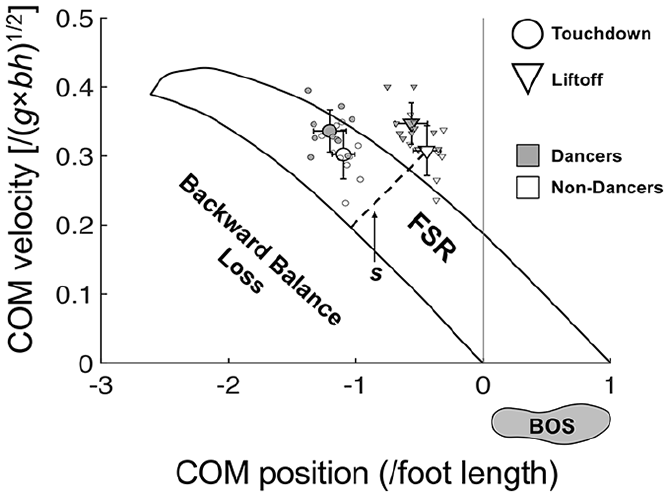
An illustration of the Feasible Stability Region (FSR), which is encircled by 2 boundaries: the thresholds against backward balance loss (the lower limit) and forward balance loss (the upper limit). The x-coordinate represents the center of mass (COM) anteroposterior position, and the y-coordinate indicates its forward velocity relative to the base of support (BOS). The COM motion state is defined as the pair of the relative COM velocity and position with respect to the BOS. The position and velocity of the COM relative to the BOS are dimensionless as a fraction of foot length and
Our recent work investigated the biomechanical reactions of young ballet dancers to 5 repeated unexpected standing-slips.9,10 The dancers took a backward recovery step after the slips. On the first slip, the dancers displayed better dynamic gait stability at the recovery step touchdown and reacted more effectively by taking a faster and longer recovery step and maintaining a more upright trunk than the non-dancers. 9 Following the repeated slips, the dancers showed a larger reactive improvement in stability at recovery step liftoff than non-dancers, which was achieved by initiating the backward recovery step sooner. 10 These prior findings suggest that ballet practice could facilitate motor adaptation to repeated standing-slips, making dancers more resilient to balance losses and falls following a perturbation. However, the differences in dynamic gait stability and gait parameters during unperturbed normal overground walking between ballet dancers and non-dancers remain unreported. This is not a minor issue as it could present an obstacle to the development of ballet-based fall prevention training programs. During unperturbed normal gait, the events of touchdown (TD) and liftoff (LO) indicate the transition from swing to stance phase (for TD) and vice versa (for LO) in the gait cycle, which are the critical moments that could destabilize the body due to the alteration in the BOS. 11 Thus, it is meaningful to examine dynamic gait stability at these 2 transitional events to understand how ballet practice impacts dynamic balance control.
The purpose of this study was to examine dynamic gait stability and spatiotemporal gait parameters among professional ballet dancers during level overground walking relative to non-dancers. Given our previous findings that ballet dancers are more stable than non-dancers following a slip, we hypothesized that ballet dancers would show a more stable gait than non-dancers during overground walking. The findings from this study could provide insight into the control of dynamic balance during walking in ballet dancers.
Methods
Participants
Twenty healthy young adults were recruited: 10 ballet dancers and 10 age/sex-matched non-dancers (Table 1). This sample size was chosen based on the flat sample size rules of thumb. 12 No participants had any known musculoskeletal/neurological diseases or recent major injuries. Ballet dancers were employed by a ballet company and practiced ballet at least 4 days weekly at the time of enrollment. Non-dancers had no previous dance experience. All participants provided written consent approved by the Institutional Review Board before their participation.
Participant Demographic Information (Mean ± Standard Deviation).
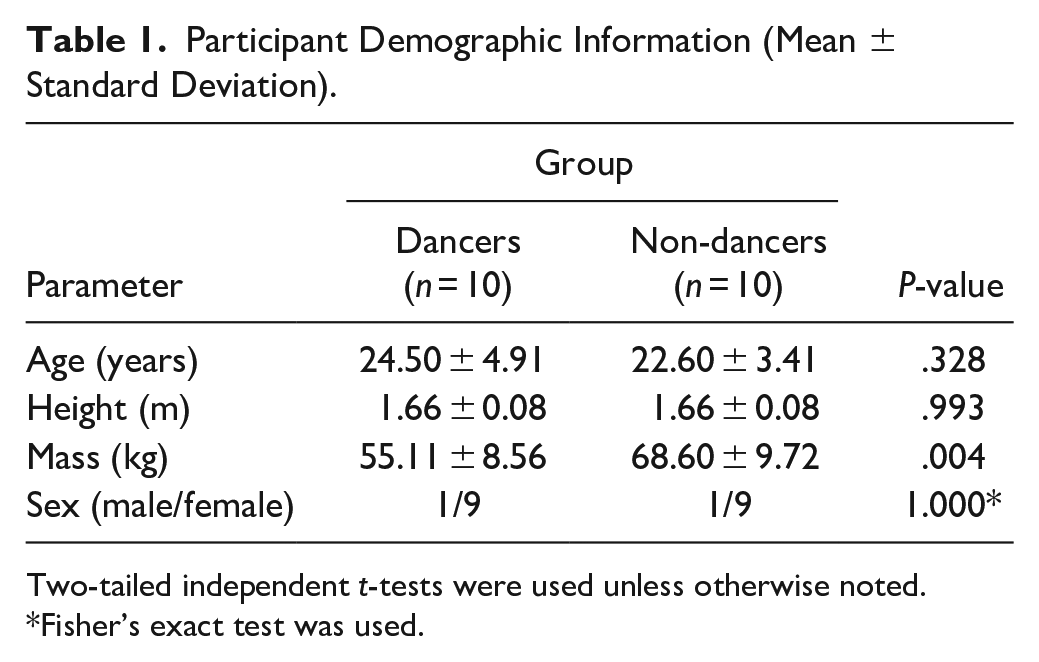
Two-tailed independent t-tests were used unless otherwise noted.
Fisher’s exact test was used.
Experimental Protocol and Data Reduction
Twenty-six reflective markers were applied to participants’ bony landmarks using the Helen-Hayes marker set. 13 Next, participants performed 3 overground walking trials on a 10 m walkway at their preferred speed while barefoot. A 9-camera motion capture system (Vicon, UK) collected full-body kinematics from the reflective markers. The last walking trial was chosen for analysis since participants may have experienced an acclimatization period during earlier walking trials. Fourth-order, zero-lag Butterworth, and low-pass filters filtered the marker paths at marker-specific cutoff frequencies (between 4.5 and 9.0 Hz). 14 Locations of toes, heels, and joint centers were determined from filtered marker positions using transformations based on anthropometric measurements. 15 Two transitional gait events were identified from the foot kinematics and verified against the video file: TD and LO.
The body’s COM kinematics were computed based on joint center data.
16
The COM motion state’s 2 components (velocity and position) were calculated relative to the BOS and normalized by
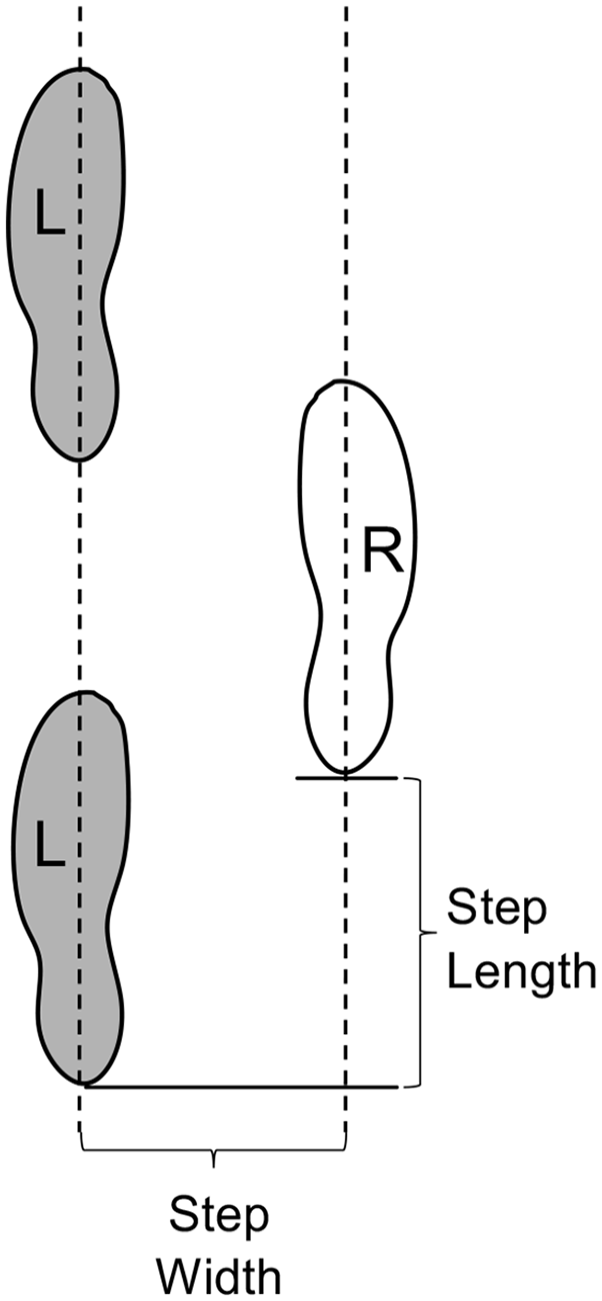
An illustration of the measurement of step length and step width. The gray footprints represent the left (L) foot, and the white footprint represents the right (R) foot during normal overground walking on a 10 m walkway. Step length was calculated as the anteroposterior distance between the heels at their touchdowns and normalized to body height. Step width was calculated as the mediolateral distance between the heels at their touchdowns and normalized to the pelvis width between anterior superior iliac spines.
Statistical Analyses
The homogeneity of variance and normality of all variables were checked by Levene’s and Shapiro-Wilk tests, respectively. Independent t-tests compared normally distributed demographic information (Fisher’s exact test compared sex) and outcome measures between groups. Outcomes with normality violations were analyzed by Mann-Whitney U tests. If a significant imbalance in demographic variables was detected, correlation analyses examined if the respective variable was significantly associated with the outcome measures. When the correlation was significant, the corresponding variable was considered a covariate and the outcome measure was analyzed with a one-way analysis of covariance (ANCOVA). Independent t-test effect sizes were calculated as Cohen’s d. Mann-Whitney effect sizes (r) were computed as
Results
Participant Information
The ballet dancers underwent 14.50 ± 3.44 years of ballet training before their 5.20 ± 3.65 years of professional experience. At the time of participation in this study, they attended ballet classes on 4.9 ± 0.57 days weekly for 88.5 ± 4.74 minutes per day, with an extra 4.1 ± 1.37 hours daily of rehearsals or performances. No significant group-related difference existed for age, sex, and body height (P ≥ .328, Table 1). Dancers were significantly smaller in body mass than non-dancers (P = .004, Table 1). Correlation analysis indicated that the body mass was not statistically correlated with any outcome measures except cadence. Therefore, cadence was analyzed using the ANCOVA model with body mass as a covariate.
Primary and Secondary Outcomes
No significant group differences were found for dynamic gait stability at TD (t18 = −1.543, d = 0.690, P = .140, Figure 3a) or LO (t18 = −0.479, d = 0.214, P = .638, Figure 3b). For secondary outcomes, the COM position was significantly more posterior to the BOS in dancers versus non-dancers at TD (t18 = 2.174, d = 0.972, P = .043, Figure 3c) and LO (t18 = 2.324, d = 1.040, P = .032, Figure 3d) with large effect sizes. Additionally, COM velocity was significantly faster in dancers than non-dancers at TD (t18 = −2.302, d = 1.030, P = .033, Figure 3e) and LO (t18 = −2.639, d = 1.180, P = .020, Figure 3f). Step length was longer (t18 = −2.062, d = 0.922, P = .054, Figure 4a) and step width was narrower (t18 = 2.930, d = 1.311, P = .009, Figure 4b) in dancers than non-dancers. Dancers walked at a significantly higher cadence (F = 5.579, η 2 = 0.396, P = .014, Figure 4c) and marginally faster gait speed (Z = 1.891, r = .423, P = .063, Figure 4d) than their non-dancer peers.
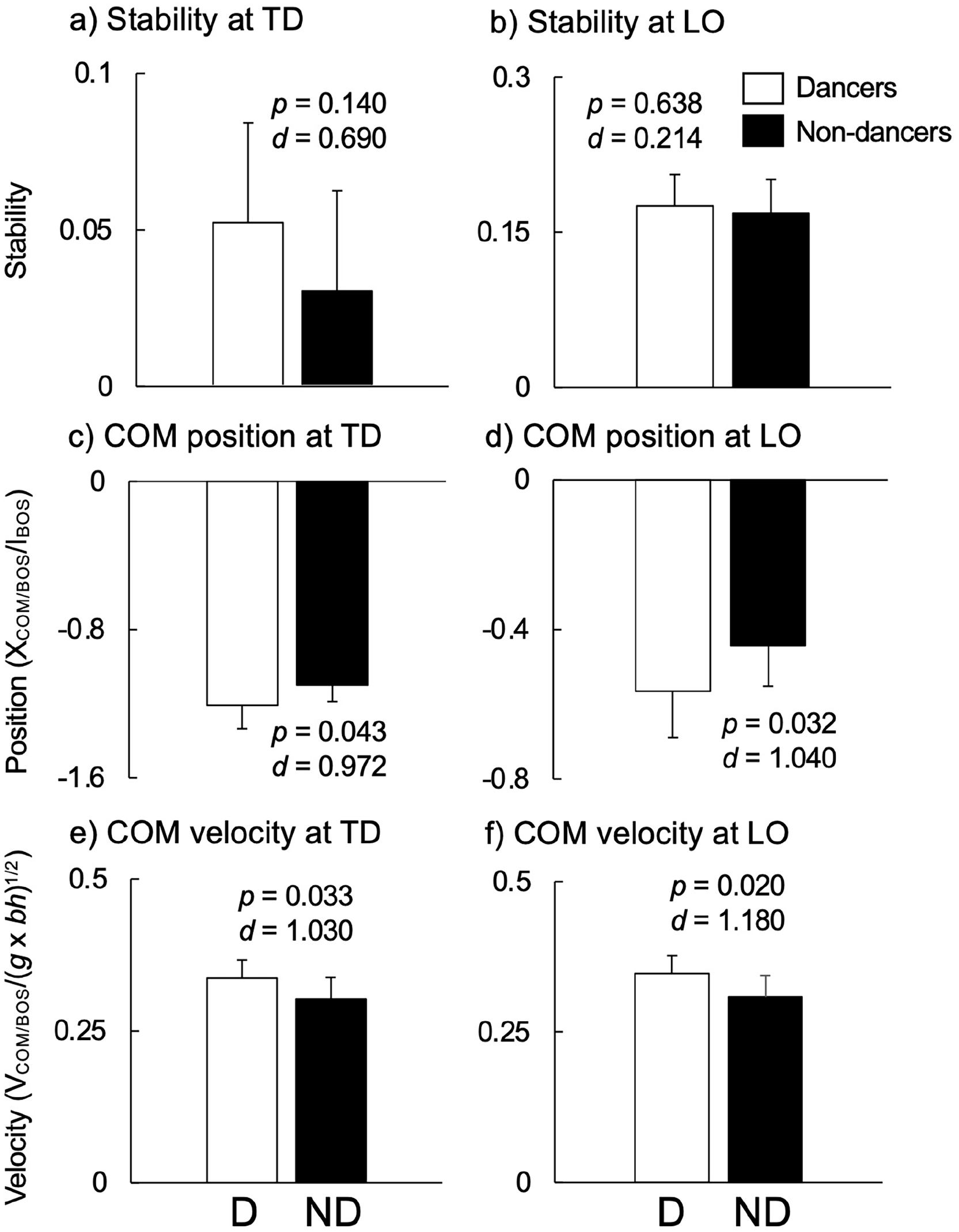
Comparisons between dancers (D) and non-dancers (ND) of the dynamic gait stability at (a) touchdown (TD) and (b) liftoff (LO), the center of mass (COM) position at (c) TD and (d) LO, and the COM velocity at (e) TD, and (f) LO during overground walking. Dynamic gait stability (a dimensionless variable) was calculated as the shortest distance from the COM motion state to the threshold against backward balance loss. Effect sizes (Cohen’s d) are also provided. The column heights and error bars represent the group means and standard deviations, respectively.
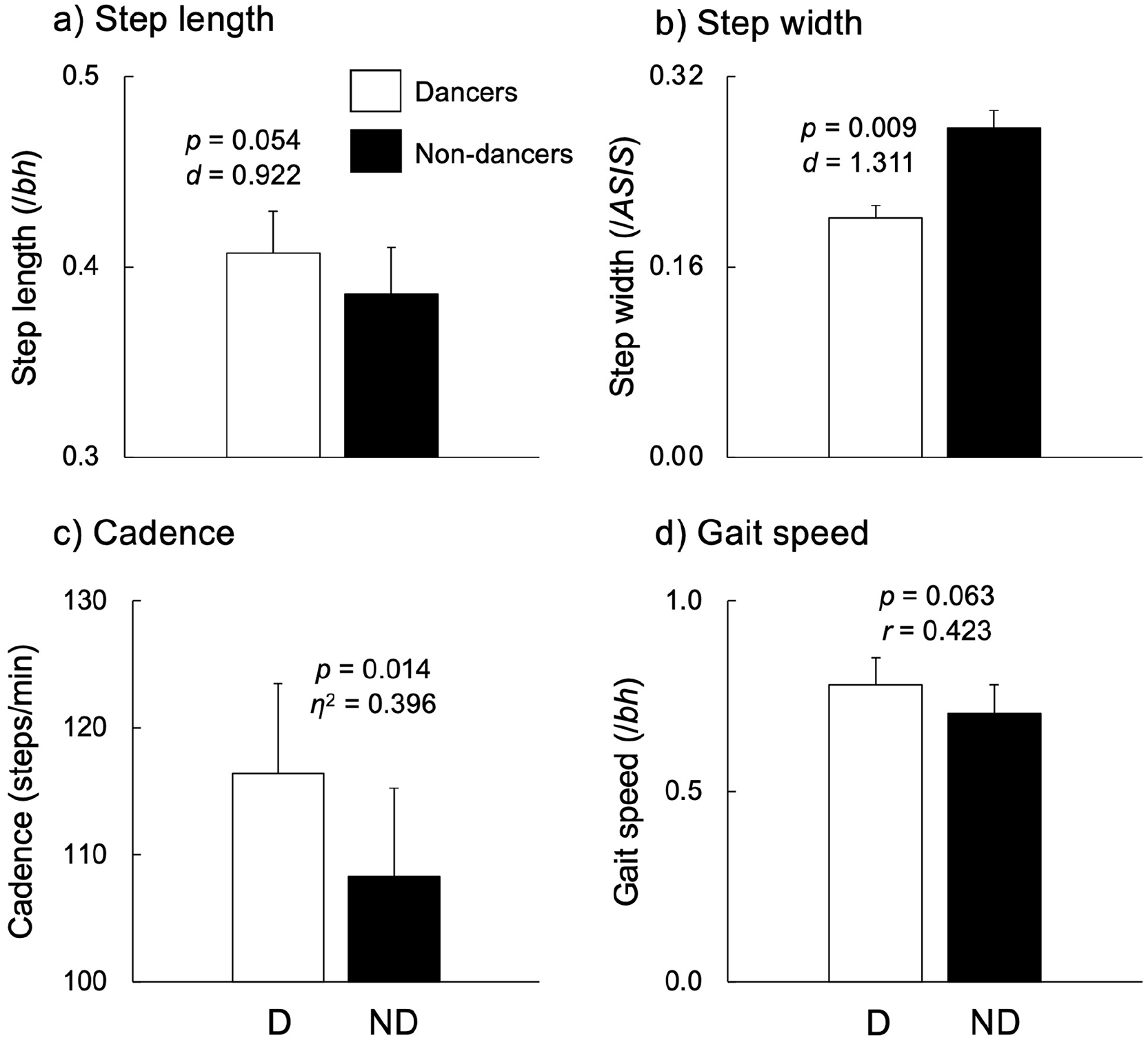
Comparisons between ballet dancers (D) and non-dancers (ND) of the (a) step length, (b) step width, (c) cadence, and (d) gait speed during overground walking. Step length was defined as the anteroposterior distance between the 2 heels at their touchdowns and normalized to body height (bh). Step width was defined as the mediolateral distance between the 2 heels at their touchdowns and normalized to the width of the anterior superior iliac spines (ASIS). Cadence was the number of steps taken per minute. Gait speed was the average value of the instantaneous COM velocity in the middle section of the walking path and was normalized to bh. The effect sizes are also displayed. The column heights and error bars represent the group means and standard deviations, respectively.
Discussion
This study examined dynamic gait stability and spatiotemporal gait parameters among ballet dancers and age- and sex-matched non-dancers during level overground walking at a self-selected speed. The results indicated that ballet dancers walked with a longer and narrower step, higher cadence, and faster gait speed in comparison to their non-dancer counterparts. However, both groups exhibited comparable dynamic gait stability during walking at the 2 critical gait instants of TD and LO. The results reject our hypothesis that young ballet dancers would be more stable than non-dancers during level overground walking.
Despite the similar stability, the 2 essential components of stability (the relative position and velocity of the COM to the BOS) were significantly different between groups. The dancers exhibited a faster relative COM velocity but a more posterior relative COM position than the non-dancers. According to the FSR framework, an increased COM velocity (on the y-axis in Figure 1) has the potential to shift the COM motion state upward and away from the FSR’s lower boundary and improve dynamic gait stability when the COM position remains constant. Moreover, a posteriorly moved COM (on the x-axis in Figure 1) would place the COM motion state leftward and closer to the FSR’s lower boundary and decrease stability while the COM velocity is controlled. In the current study, the increased stability from the faster-moving COM counteracts the reduced stability from the posteriorly-shifted COM for dancers relative to non-dancers.
The higher relative COM velocity of the dancers than non-dancers is the direct result of the dancers’ faster gait speed given that the BOS is stationary at both events (Figures 3e, f, and 4d). Because gait speed is the product of step length and cadence, the dancers’ faster gait speed could be associated with their longer steps and higher cadence than their non-dancer peers (Figure 4a and c). The longer step in dancers than in non-dancers could be attributed to 2 ballet-related techniques. First, in elementary ballet training, ballet students are taught to walk with long steps, a fully extended knee joint, and to lead with the big toe instead of the heel (as in pedestrian walking). 18 This walking technique carries forward into the more advanced training and choreography that professional ballet dancers practice regularly. The long step lengths observed in the dancers could result from their long-term experience with this ballet-specific walking style. Second, previous studies have discovered that professional ballet dancers exhibit a greater hip extension with an increased pelvic rotation than non-dancers during the stance phase. 5 Anatomically, both movements could lengthen the step. 19
The dancers’ lengthened step not only increases their gait speed but alters the relative COM position to the BOS. Specifically, the dancers’ more posterior COM position relative to the BOS is mainly achieved by the longer step length in dancers than in the non-dancers. Previous studies have extensively reported strong correlations between the relative COM position to the BOS and the step length, with correlation coefficients varying between −.717 20 and −.775. 21 A reduced step length shifts the body’s COM anteriorly and closer to the BOS. In contrast, the dancers’ prolonged step would move the COM posteriorly and farther away from the BOS. When the COM is far behind the BOS, more forward momentum will be required to enable the COM to reach the BOS to keep body balance. 22 Therefore, the posteriorly shifted COM will counter the increase in stability resulting from the faster COM velocity among dancers, maintaining the unchanged dynamic gait stability level in comparison to non-dancers.
Overall, our results indicated that dancers attempted to maintain a comparable level of stability as non-dancers by adaptively adjusting their gait parameters through their whole-body coordination. Previous studies comparing dynamic gait stability between different walking surfaces (treadmill vs overground), 23 body corpulence (obese vs non-obese), 24 and load conditions (unloaded vs front-loaded)25,26 among young adults concluded that stability seems to be independent of the walking surface, body type, and load condition. For example, young adults adopted a more cautious gait pattern (eg, slower gait speed, shorter step length) during treadmill walking, allowing them to maintain similar stability to overground walking. 23 Another study comparing overground stability between obese and normal-weighted young adults reported obesity-related gait pattern modifications (eg, slower gait speeds and shorter step lengths) that resulted in comparable stability to their normal-weighted counterparts. 24 Recent work additionally investigated stability during overground 26 and treadmill 25 walking in young adults carrying anterior loads of up to 20% of their body weight. Again, similar stability was found for both walking surfaces for all unloaded and loaded groups. However, these particular participants achieved this comparable stability by leaning their trunks backward instead of the modification of the gait speed or step length.
The current study extends the observation that dynamic gait stability is not sensitive to walking conditions by demonstrating that stability may not be related to ballet training (dancers vs non-dancers). These findings not only provide evidence that dynamic gait stability is a robust measurement of body balance during gait but also indicate that the human body attempts to maintain stability at a similar level regardless of the locomotion condition. Collectively, our current and previous studies imply a “sweet spot” of stability for healthy individuals, which is insensitive to the walking surface, body corpulence, loading condition, or physical training. The insensitivity of stability to walking conditions in terms of the walking surface, body shape, loading situation, and training implies that the motor systems can adjust gait parameters to preserve constant stability across a variety of walking conditions. More studies are needed to investigate the underlying mechanisms for this common stability value.
Our results also illustrated that ballet dancers take a narrower step than non-dancers when walking overground. The dancers’ smaller step width could relate to their ballet practice. In ballet training, when the leg is extended forward, the toes should be aligned with the navel (as opposed to the shoulder or hip in general adults), which assists with maintaining balance while standing on one leg. 18 This leg alignment in combination with the well-controlled trunk movement that is emphasized in ballet practice 27 could account for the narrow step in dancers compared with non-dancers. Long-term ballet training with a narrowed step width, which can be considered a neuromuscular perturbation to the body balance, could potentially lead to the narrow step width in dancers.
The interpretation of the minimized step width related to mediolateral gait stability is still a debated topic. On one hand, the narrowed step among dancers could indicate a better mediolateral dynamic balance control among them than in the non-dancers, as a widened step has been associated with balance deficits. For example, a recent review indicated that older adults walked overground with wider steps than young adults, possibly as a means of adapting to COM movements in the mediolateral direction that occur during normal gait. 28 The observation of the narrowed step width, as an indicator of improved balance, in the present study concurs with a previous one that documented improvements in static balance in the mediolateral direction of 7-year-old children following 3 months of ballet training compared to a control group. 29 Alternatively, it was suggested that the mediolateral balance is insensitive to the step width in young adults. 30 A previous study reported that the central nervous system adjusts the step width to maintain the margin of stability at a constant level, 30 where the construct of the margin of stability is a simplified version of the FSR concept. 31 Given that our participants were healthy young adults, which is unlike the populations (older adults 28 and children 29 ) in the studies that linked the widened step to imbalance, it is rational to postulate that the mediolateral balance is comparable between dancers and non-dancers. However, more work is required to further examine the implication and interpretation of the narrowed step width among dancers relative to non-dancers.
Gait speed is negatively correlated with age, 32 and slower gait speeds in healthy older individuals are associated with an increased risk of falling during walking. 33 Community-dwelling older adults who can walk at a cadence of at least 100 steps/min have a lower mortality risk than those who walk at a slower cadence. 34 Specific to fall risk, other work has reported higher cadence in older adult non-fallers compared with fallers. 35 Concerning young adults, faster gait speeds can also improve fall risk when an unexpected slip perturbation is experienced during treadmill walking. 21 In our study, the young ballet dancers walked overground faster and with a higher cadence than their non-dancer counterparts, suggesting that ballet practice has the potential to improve gait speed and cadence, which could in turn lead to reduced fall risk. Such a notion has been proven among people with Parkinson’s disease 2 and multiple sclerosis. 3 Therefore, ballet practice may help to maintain mobility and improve fall-related gait metrics in a variety of older adult populations. However, it remains unknown if these faster gait speeds and higher cadences in young ballet dancers would be maintained and/or carried over into older adulthood.
Limitations
A few limitations are associated with this study. First, all participants were healthy young adults. It remains unknown how ballet practice affects dynamic gait stability and spatiotemporal gait parameters during overground walking in other populations (eg, older adults and people with movement disorders). Given that the fall risk is high among older adults and people with movement dysfunctions, it could be more clinically meaningful to study how ballet practice would reshape their gait patterns. Second, kinetic data (eg, ground reaction forces, joint moments, etc.) were not reported, preventing an examination of the effects of ballet practice from a kinetic perspective. Ballet-related kinetic measurements could provide more insight into the underlying mechanisms of ballet practice on locomotion functions. Third, this study only examined overground walking. It remains unknown how stability and/or spatiotemporal gait parameters may differ between ballet dancers and non-dancers during other tasks (eg, treadmill walking, sit-to-stand, etc.). Investigating how ballet practice interacts with other motor tasks could lead to an additional understanding of the health benefits of ballet training and inform the design of ballet-based interventional programs. Finally, other unexplored factors (eg, psychological, cognitive, or social factors) may have impacts on the gait speed in addition to the ballet training. All limitations warrant further investigation with large and diverse samples.
Conclusion
Our study suggests that young ballet dancers walk with a longer and narrower step, higher cadence, and faster gait speed in comparison to non-dancers. Despite the substantial differences in gait patterns between dancers and non-dancers, both groups display similar dynamic gait stability during level overground walking. These findings provide insight into the mechanisms of dynamic stability control among young ballet dancers during normal overground locomotion and enrich our understanding of the control of stability of human locomotion across a wide variety of populations and walking conditions.
Footnotes
Acknowledgements
The authors thank Jiyun Ahn and Sangwon Shin for assisting with data collection.
Declaration of Conflicting Interests
The author(s) declared no potential conflicts of interest with respect to the research, authorship, and/or publication of this article.
Funding
The author(s) received no financial support for the research, authorship, and/or publication of this article.
