




Abstract
In this article, we argue that ingroup discrimination represents a salient experience for many racial and ethnic groups, and yet there are considerable theoretical and empirical gaps in research on this topic. We provide a theoretical exposition regarding the psychological mechanisms underlying ingroup discrimination, while also explicating the boundary conditions of these experiences. These boundary conditions include (1) the contexts in which such psychological mechanisms operate, (2) how ingroup discrimination is experienced and perceived through different lenses, (3) the factors that influence ingroup discrimination, (4) the different manifestations of ingroup discrimination, and (5) a model of ingroup discrimination dynamics. We propose a list of manifestations reflecting the intensity of ingroup discrimination, including but not limited to irritation, tension, overt discrimination, marginalization, rejection, hate, and other covert discrimination. We discuss how ingroup dynamics may further influence the intensity of ingroup discrimination. Further, we discuss various ways to apply our models within research across different fields. We emphasize that ingroup discrimination does not negate, but rather complements, the presence of ingroup cohesion or empathy. These two sides of ingroup relations should not be measured on a unidimensional scale and are not necessarily opposing ends of a single continuum.
Keywords
Discrimination is generally assumed to originate from outgroup members or operate across groups. That is, the perpetrator is from one group and the target is from another (e.g., White Americans discriminating against Black Americans, White British against British Indians, ethnic Germans against Turks, or native-born people against immigrants). Across different parts of the world, discrimination research has often emphasized White favoritism and minority disadvantage as the primary drivers of health and social inequities, stemming from racial segregation, immigration policies, and historical events (for reviews, see Ball et al., 2022; Gee & Ford, 2011; Williams & Mohammed, 2009). This body of research and literature has focused primarily on intergroup discrimination from majorities toward minorities and has focused far less on intragroup discrimination between or among minority group individuals (e.g., discrimination originating from U.S.-born Hispanics toward recent Hispanic immigrants). This focus within discrimination research has unintentionally produced a common assumption (within both the scholarly and lay communities) that discrimination primarily originates from outgroups and is targeted toward ingroups, or vice versa.
Much research on personal-level and group-level discrimination (see McAvay & Safi, 2025, for a review of distinctions between these types of discrimination) has focused on intergroup relations, in which people are categorized based on their social group memberships (Charles & Guryan, 2011; Triana et al., 2021). Discrimination is operationalized in this article as a behavioral manifestation of prejudice involving negative, hostile, and potentially injurious treatment or interactions directed at someone or a specific group because of their racial, ethnic or cultural group membership (Thomsen & Rafiqi, 2016; VandenBos, 2007). However, some prior research around the world has alluded to the phenomenon of intra-racial and intra-ethnic discrimination—that is, discrimination where the perpetrator and target are from the same racial or ethnic group (Castillo et al., 2007; Córdova & Cervantes, 2010; Kuldas et al., 2022; Mata-Greve & Torres, 2019; Rosenbloom & Way, 2004).
These forms of intra-racial and intra-ethnic discrimination sometimes manifest as tension, marginalization, or rejection. To illustrate, a U.S.-based study (Rosenbloom & Way, 2004) examined experiences of discrimination within African American, Asian American, and Hispanic adolescents and reported intra-racial tensions around issues of language, immigration, and assimilation. Further, Kuldas et al. (2022) has identified the phenomenon of intra-ethnic bullying in multicultural school settings within Canada, the United States, and several countries in Europe. These articles have suggested that such discriminatory experiences are not adequately captured by the broad racial and ethnic categories used to analyze variations. Indeed, assuming homogeneity and harmony within a minority group may overlook variations or tensions within these broad racial and ethnic categories (Rosenbloom & Way, 2004; Song, 2020). For example, in racially and ethnically diverse countries such as the U.S., Canada, Australia, and many countries in Europe, the category “Asian” includes people of Chinese, Korean, Vietnamese, Japanese, and Filipino descent, among others. However, there is a great deal of heterogeneity within and among these Asian subgroups, and one should not assume that individuals from these subgroups will necessarily enjoy harmonious relationships with one another.
Despite the clear potential for intragroup (hereafter known as ingroup) discrimination to occur, it has received far less theoretical and empirical attention than has outgroup discrimination. The disparity in attention to ingroup versus outgroup discrimination is likely related to at least three factors. Historically, outgroup discrimination has often been more visible and publicly acknowledged, likely due to its direct relevance to social justice issues and its role in creating and perpetuating systemic inequalities. This visibility may elevate the urgency and significance of studying intergroup discrimination, likely leading to greater focus and research. In contrast, ingroup discrimination might be less emphasized because it can be more subtle or internalized, and its effects can sometimes be overlooked in favor of more externally visible intergroup dynamics. Members of other ethnic groups may not understand or perceive discriminatory words or actions that are exchanged between members of a given ethnic group—for example, a Hispanic person may tease another Hispanic person using a Spanish expression, or using an ambiguous gesture that only Hispanic people would know was derogatory. Additionally, social justice frameworks and prevailing narratives have traditionally concentrated on addressing discrimination that impacts marginalized or minority groups externally, rather than exploring complexities within these groups themselves.
Further, ingroup discrimination may occur alongside discrimination from majority group members (Córdova & Cervantes, 2010). Ingroup discrimination may also occur within majority groups such as White Australian-born and White U.S.-born individuals (e.g., White Australian-born individuals discriminating against other White Australians; Leviston et al., 2021). Nonetheless, we know much less about the psychological mechanisms that generate and maintain ingroup discrimination, the situations in which it occurs, and how it manifests in people’s daily lives and interactions. Therefore, it is essential to develop models and theoretical foundations that facilitate greater understanding of ingroup discrimination.
Key Theoretical Principles Underlying Ingroup Discrimination
Ingroup discrimination represents a salient experience for many racial and ethnic groups and likely operates in multiple and complex ways. Ingroup discrimination has not received much theoretical or empirical attention, and as such our goal in the present article is to contribute to theoretical foundations, to develop a model to understand ingroup discrimination, and to help to strengthen the body of theoretical and empirical knowledge involving this set of experiences. Accordingly, the present article provides a theoretical exposition and model regarding the psychological mechanisms underlying ingroup discrimination, while also explicating the boundary conditions of these experiences. These boundary conditions include (1) the contexts in which such psychological mechanisms operate, (2) how these contexts are experienced and perceived through different lenses, (3) factors that influence ingroup discrimination, (4) different manifestations of ingroup discrimination, and (5) a conceptual model of ingroup discrimination dynamics.
We draw on literature in psychology, sociology, public health, and other disciplines—but because the literature on ingroup discrimination is somewhat limited, our goal in this article is to develop a theoretical foundation and model to guide future work rather than conducting a systematic review. We searched the Google Scholar and PsycInfo databases, focusing on keywords such as intragroup marginalization, ingroup tension, and within-group discrimination. We also searched for articles focusing on between-group discrimination and examined whether ingroup discrimination was mentioned. We explicitly specify in many places that more empirical work is needed to examine and substantiate many of the arguments that we advance here.
The remainder of the present article is organized into six general sections. First, we discuss the concept of self-categorization—a concept in social psychology that explains how individuals perceive themselves in relation to different social groups—as a foundational building block to understand ingroup discrimination. Based on this primary building block, we propose a series of hypotheses regarding the mechanism and contexts of ingroup discrimination—that is, when, where, and in what forms, ingroup discrimination is most likely to occur. Second, we conceptualize and describe ingroup discrimination through three lenses—targets, perpetrators, and observers. Adopting such a multi-lens approach allows us to address how ingroup discrimination is experienced, the psychological and group dynamics that produce and maintain it, and how it manifests as specific observable behaviors and interactions. Especially, through the perpetrators’ lens, we specify a set of intrapersonal motivations underlying their ingroup discrimination. Third, we delve into intergroup process models from social psychology to generate an understanding of how groups operate and to generalize these understandings to ingroup discrimination. From that, we propose a series of hypotheses regarding the interpersonal and social factors influencing ingroup discrimination. Fourth, we outline various manifestations and intensities of ingroup discrimination, that is, how ingroup discrimination can manifest, with intensities ranging from irritation to hate. Fifth, we present a model connecting the proposed intrapersonal, interpersonal, and social motivations with ingroup discrimination dynamics, and explicate how specific ingroup dynamics might influence the intensity of ingroup discrimination. Finally, we discuss implications of our theories and model for future research, intervention, and policy.
Understanding Ingroup Discrimination
Self-Categorization as a Foundational Building Blocks on Ingroup Discrimination
Self-categorization is a key psychological process underlying social group identity and discrimination. Self-categorization theory (Turner, 1999) posits that individuals categorize themselves and others into groups, where these groups serve as the basis for social identity and associated behavior (Haslam & Reicher, 2015). The process of self-categorization is dynamic and context-sensitive, allowing individuals to shift between personal and social identities depending on the situation (Turner et al., 1994). In situations where people from different social groups come into contact, people will classify themselves into ingroups - social groups with which one psychologically identifies, and outgroups - social groups with which one does not identify (Everett et al., 2015; Tajfel et al., 1971; Turner et al., 1983).
This ingroup-outgroup distinction can be applied to different types of social groupings such as race, ethnicity, community, nation, gender, religion, political party, sexual orientation, socioeconomic status (SES), peer groups, and so on. Some people may define their ingroups based on similar values, behaviors, or beliefs rather than on demographic characteristics. For example, political conservatives might identify themselves as an ingroup, with liberals as an outgroup—where each group consists of people with varying racial, ethnic, religious, and sexual backgrounds. Ingroup members may then discriminate against outgroups as a way of establishing their membership in the ingroup (belongingness) and of distancing themselves from the outgroup (distinctiveness; Brewer & Pickett, 1999).
In this article, we use the words ingroup and outgroup primarily to refer to social identities related to grouping variables such as race, ethnicity, ethnic community, nationality, and country of origin. In highly diverse countries with long histories of immigration, such as the United States, Canada, Australia, and many countries in Europe, such racial, ethnic, and country-of-origin categories represent widely used markers of social identity. To simplify and expedite our arguments, we focus primarily on such highly diverse countries that are home to many racial, ethnic, and national group identities, as well as to complex intercultural dynamics. These countries have long histories of receiving immigrants from around the world, contributing not only to their racial, ethnic, and origin diversity but also to the development of intersecting cultures and processes of acculturation (McLaren et al., 2021; Schwartz et al., 2010). Within these countries, people from other parts of the world (and their descendants) are likely to bring ingroup-outgroup distinctions with them from their countries or regions of origin—such as Colombians and Venezuelans continuing to view one another as rivals even after arriving in the United States (Darnton, 2014).
Further, among people from different racial groups, people who identify (or are identified) with the same race are often socially categorized as a racial group, and perceived as a group, by members of other racial and ethnic backgrounds, even if these people would not necessarily classify themselves into a single group. Koreans and Vietnamese, for instance, are labeled as “Asian” in the United States and Canada but do not necessarily identify one another as members of a common ingroup. However, the extent to which Korean and Vietnamese people would identify with one another might depend on the circumstances—if both groups were experiencing discrimination from Whites, they might choose to identify with one another. In other instances, people from the same ingroup might not identify with one another. A second-generation Korean American who speaks primarily English might not identify with a recent Korean immigrant whose English is heavily accented, or with a recent Korean immigrant with low levels of education. Key questions include when and why people from the same group would—or would not—choose to identify with one another.
Mechanism and Contexts of Ingroup Discrimination in Highly Diverse Countries
One possible mechanism that may explain instances of ingroup discrimination involves self-verification theory (Swann Jr., 2012). This theory holds that, when one claims membership in a given social group, that membership is most secure when other members of the group validate one’s claim. This theory may explain instances of ingroup discrimination: individuals strive to maintain congruence between their self-views and group stereotypes, potentially leading to the verification of negative aspects of their ingroup identity (Gómez et al., 2009). For example, a U.S.-born Korean American may identify strongly as American (perhaps in addition to identifying as being of Korean or Asian descent). This person’s claim to “being American” would be most secure if the dominant group of “Americans”—in this case White Americans—accept and validate the Korean American person’s American identity. The Korean American person may believe, perhaps implicitly, that attaining such validation requires rejecting, or disidentifying with, Korean immigrants who would not qualify or be accepted as American. Indeed, the concept of disidentification involves more than simply “not identifying” with a group or with a person who belongs to that group (Becker & Tausch, 2014; Jasinskaja-Lahti et al., 2009). Rather, it involves actively rejecting that person or group, often as a way of gaining favor with a desired ingroup (in this case White Americans). As a result, the Korean American person may seek to “prove” her American-ness by disidentifying with Korean immigrants—at least in some social situations.
In terms of between-group discrimination, the rejection-disidentification model (Jasinskaja-Lahti et al., 2009) suggests that individuals who experience discrimination may actively reject and stay away from the group from which the discrimination originated. For example, a Mexican immigrant who experienced ostracism from U.S. host nationals might then withdraw from “mainstream” U.S. society and interact primarily within the Mexican immigrant community. This disidentification may allow the Mexican immigrant to recover some of the self-esteem damaged by the discriminatory experience by drawing on Mexican values, identifications, and customs. However, such options may be less available to the target individuals of ingroup discrimination, because the perpetrators and the targets are both part of the same broad ingroup. Indeed, in the case of ingroup discrimination, the perpetrator might be disidentifying with the target and with what the target represents (e.g., Korean Americans who seek acceptance from White Americans nationals rejecting new Korean immigrants who are extremely culturally different from White American nationals). It may be difficult for the target to disidentify with the ingroup—suggesting that the experience of ingroup discrimination may be even more painful and dehumanizing compared to discrimination originating from other groups (Mata-Greve, 2016). In some cases, the target may then identify with outgroup members (Wiley, 2013), although there is no guarantee that outgroup members will not also discriminate against the target. Indeed, Wiley found a moderate positive correlation between ingroup and outgroup rejection-based experiences.
The social cues operating in a specific situation likely dictate when such disidentification is most likely to take place. That same Korean American individual might not disidentify with her family at home where White Americans are absent—but she may do so in public situations. Akhtar (2011) uses the example of a Pakistani American young man who was ashamed of the traditional attire his mother wore to parent-teacher conferences—because it marked him as “not American” and, at least in his mind, may have led his peers to exclude him. He may not have held these same attitudes with his family when no “outgroup” members are present.
Considering contexts outside the United States, Germany has experienced a new wave of migration from Turkey in recent years, predominantly comprised of highly educated individuals such as academics (Türkmen, 2019). Unlike earlier migration waves, which were largely composed of working-class “guest workers” recruited for blue-collar jobs, this new generation of migrants tends to hold upper-middle-class status and higher educational qualifications. However, this shift in the socioeconomic profile has also given rise to tensions within the Turkish diaspora. This is an example of SES serving as a marker for ingroup discrimination.
Specifically, members of this new migration wave often harbor discriminatory attitudes toward second-, third-, or even fourth-generation Turkish Germans who are descendants of the original guest workers. These earlier generations of Turkish Germans are frequently perceived as being part of the working class, with lower levels of educational attainment and limited upward mobility. A qualitative study by Türkmen (2024) highlights how some recently arrived, highly skilled migrants from Turkey inadvertently reinforce existing ethnic hierarchies in Germany, where individuals of Turkish origin are positioned at the lower end. To navigate this “ethnic disadvantage,” they leverage their “class advantage” to differentiate themselves from other members of the Turkish diaspora and to align more closely with native Germans.
This interplay between self-verification and disidentification processes appears parallel to what French sociologist Bourdieu has labeled as habitus (see Reay, 2015, for an extended discussion). Broadly, habitus refers to how people experience their environments and adjust to new or changing contexts. In her article, Reay references a young boy who is trying to reconcile his working-class background with his classmates’ privileged lifestyles. A version of this process of reconciliation may also occur when established or second-generation migrants encounter newly arrived individuals and must place themselves in intergroup space in relation to these new arrivals. Bourdieu argues that inequalities in society often force people to decide how they fit into such inequalities—in other words, to determine “which side of the fence they are on” with regard to racial, economic, national, and other hierarchies and divisions within society. It is not difficult to imagine how this concept of habitus can be invoked to understand how people who are “in between” dominant and subordinate groups—such as highly educated Turkish Germans who seek to be regarded as Germans rather than associated with working-class Turks. Paralleling Bourdieu, ingroup discrimination may represent an effort to position oneself (or one’s group) as closely to the dominant social group as possible to invite verification from that group, while disidentifying with groups that would interfere with such favorable positioning.
In our search for literature on ingroup discrimination, the vast majority of studies we found focused on contexts in the United States, with a few conducted in Canada, Australia, and European countries such as Germany. The predominance of U.S.-based work is not surprising given most research in psychology and other social sciences comes from the United States (Arnett, 2008; IJzerman et al., 2021). We should note that there are many other culturally diverse nations where ingroup discrimination may occur—such as New Zealand, Russia, Chile, Mexico, or Saudi Arabia. Because interactions involving members of culturally diverse groups may differ depending on the groups in question (Sam & Berry, 2010), ingroup discrimination may adopt different forms depending on the national context in which it occurs, and the minority or migrant groups who are present in that context. It is imperative that more empirical work on ingroup discrimination be conducted within and across culturally diverse nations in various parts of the world.
Next, it is also vital to consider how ingroup discrimination is perceived by the actors involved—targets, perpetrators, and observers. The target of ingroup discrimination—in this case the Korean immigrant who is not accepted by the Korean American or the working-class Turkish German whose family has been in Germany for three generations—likely perceive the interaction quite differently from the perpetrator, and observers watching the interaction may hold a still different view. We examine these multiple lenses in the next section.
Ingroup Discrimination Through Multiple Lenses
To help readers relate to the phenomenon of ingroup discrimination, we provide accounts of ingroup discrimination through multiple lenses: targets, perpetrators, and observers (see circles in Figure 1). The target individuals are those marginalized or discriminated against by their own ingroup, whereas perpetrators are those who discriminate against fellow ingroup member(s). Observers may include other ingroup members, outgroup members, or neutral third parties. Each of these roles will experience the discriminatory interaction in different ways (see arrows in Figure 1). Examining ingroup discrimination through these different lenses is critical for both scholars and the general public to gain an in-depth understanding of the experience and dynamics of ingroup discrimination. We propose a model of core lenses involved in ingroup discrimination, which we hope will guide future research as well as the development of interventions and policies. Core lenses for ingroup discrimination.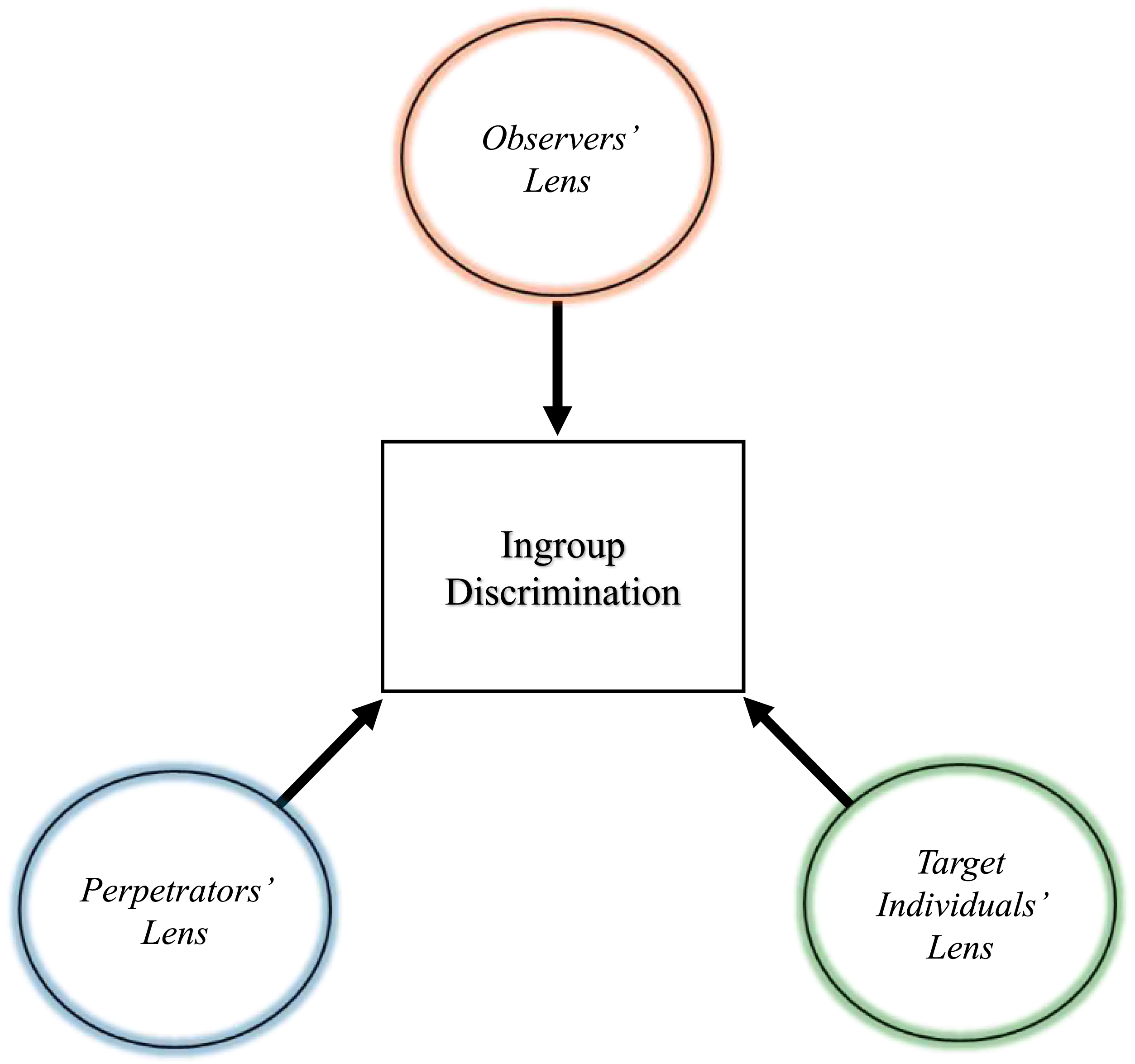
Target Individuals’ Lens
Target individuals experience the discrimination or marginalization by their own ingroup members or community. These target individuals may be newly arrived migrants who are marginalized or rejected by more established migrants (Clark-Ginsberg et al., 2024), foreign-born youth who are discriminated against by U.S.-born youth (Córdova & Cervantes, 2010), or long-term working-class Turkish immigrants who are discriminated against by the new highly educated Turkish immigrants in Germany (Türkmen, 2024). In general, newly arrived migrants tend to seek connections with the established migrant community sharing the same ethnicity or country of origin, as these communities can provide essential support and facilitate integration into the destination society. For example, new Chinese immigrants may look for local Chinese and Asian grocery markets (Yi et al., 2021). Puerto Rican migrants may attend local churches or religious places that serve Puerto Rican and other Spanish-speaking communities (Hodges et al., 2024). Vietnamese migrants may seek employment within established Vietnamese communities, where they can speak Vietnamese at work and connect with Vietnamese people who have been in the United States for longer amounts of time (Liu et al., 2024).
As migrants navigate their new life in the destination country, it is reasonable for them to seek propinquity—social connection and support from people within their ethnic and country of origin community. Similarly, in racially and ethnically diverse countries, racial or ethnic minority group members might feel more connected with others from the same racial, linguistic, ethnic or national background—and they would likely expect to be accepted and treated well by these fellow ingroup members. Given this expectation of positive treatment from one’s ingroup community, experiencing ingroup discrimination, marginalization, or rejection should generally be unexpected and more distressing to target individuals (Mata-Greve, 2016). This expectation aligns with findings suggesting that ingroup marginalization and discrimination experiences have been found to negatively impact mental health among minority group members such as Hispanics (Mata-Greve & Torres, 2019). Similarly, experiences of discrimination and rejection from ingroup members may have more severe effects on one’s mental health and well-being compared to experiences from outgroup members. For instance, Caribbean migrants in Britain navigate complex social hierarchies and cultural stereotypes between “established” and “newcomer” groups, challenging the notion of automatic integration into existing communities (Reynolds, 2012). We therefore suspect that experiencing discrimination and rejection from one’s ingroup members and community could produce more negative effects to target individuals’ mental health and well-being than would experiencing it from the outgroup—likely because of a sense of betrayal or of not belonging to what one perceives as a natural ingroup.
The effect of ingroup versus outgroup discrimination might be influenced by positive versus negative expectancies (Zhou et al., 2022). If individuals anticipate support from their own group (positive expectancy), ingroup discrimination could be more painful due to the perceived betrayal and disappointment. Conversely, if individuals expect negative treatment (negative expectancy), they may have already developed defenses, potentially lessening the emotional impact. This idea suggests that the emotional severity of discrimination could be shaped by the alignment or misalignment of expectations with experiences. Further investigation into the potential effects of ingroup tension and discrimination on social integration and mental health—including constructs such as self-esteem, depression, and social isolation—could yield valuable insights.
Another important example involves return migration, the process where individuals return to their home countries after living abroad. Return migration is a complex phenomenon with implications for acculturation and reintegration. These migrants may have adapted to new cultural norms while away, or their home cultural context may have evolved during their absence. As a result, return migrants may encounter difficulties in both social and economic assimilation. As a case in point, Matsumoto (2002) provides an account of considerable cultural change in Japan—away from a primarily collectivist value system and toward a more Westernized, individualistic value system. Someone who had left Japan during the 1980s and returned in the 2010s would find a dramatically different cultural context and may experience difficulties adapting back to the modern Japanese setting. Other Japanese people might marginalize or reject this return migrant because of the migrant’s lack of understanding of the “new” Japanese cultural context. For another example, a Korean person who migrated to the United States and lived there for many years might lose some proficiency in Korean, develop an “American” accent when speaking Korean, or acquire mannerisms that are not prototypically Korean. Upon returning to Korea, this person might experience some degree of marginalization and might even be treated as a “black sheep”—in effect, the person is ethnically Korean but does not behave in typical Korean ways. It stands to reason, then, that ingroup discrimination might be targeted toward returning migrants.
Noteworthily, who is most likely to be discriminated against by their ingroup? According to Grigoryan et al. (2022), people never belong to just one identity group, but always to several. Although this article focuses on racial and ethnic identity, these ingroup discrimination processes likely extend to other minority groups. As a possible result, individuals who hold multiple stigmatized identities may be most likely to experience the most severe ingroup discrimination from multiple sources. For example, Black men may experience discrimination based on race. What about a gay Black man? What about a gay conservative Black man? In this case, the gay conservative Black man may experience racial discrimination within the community of his gender and sexual identity; he may, in another case, experience sexual orientation discrimination within his ethnic or racial community. Therefore, ingroup discrimination might be just as salient within other groups outside of race and ethnicity. In future examinations of ingroup discrimination and individual’s experience with it, it is essential to specify the ingroup identity (such as race/ethnicity, SES, sexual orientation, gender, political party, immigrant status, etc.) to precisely locate the potential sources of ingroup discrimination that one may experience.
Perpetrators’ Lens
In this section, we describe ingroup discrimination through the lens of the perpetrators who discriminate against their ingroup member(s), whether intentionally or not. That is, we seek to describe the possible motivations and dynamics underlying this behavior. Why would someone discriminate against another person from the same race, ethnicity, or country of origin? When this discrimination occurs, do the perpetrators consider the target individuals their ingroup members (e.g., does the U.S.-born Korean American view the recent Korean immigrant as a fellow ingroup member)? If yes, what motivates the perpetrator to discriminate against their ingroup? If no, why would the perpetrator categorize someone from the same racial, ethnic, or cultural background as an outsider?
In the example of established immigrants, some members of this community may view themselves not only as immigrants but also as aspiring “host nationals”—people who have resided in the destination country or region long enough to be able to associate comfortably with host-national friends, partners, and associates (Martinovic et al., 2009). In essence, the new and established migrants belong to the same ingroup to some extent—but in some extent they do not. The ingroup category of “Vietnamese immigrants,” for example, includes anyone who was born in Vietnam and now resides in the United States, Australia, or France. However, this ingroup may be further subdivided into “new Vietnamese immigrants” and “more established Vietnamese immigrants.” In some cases, the subdivision may occur along SES lines (e.g., “poorer Vietnamese immigrants” vs. “wealthier Vietnamese immigrants”). Ingroup projection theory (Wenzel et al., 2007), for example, holds that certain members of an ingroup may believe that they are prototypical of the ingroup—and by extension, that other members are less so. In the Vietnamese example, established Vietnamese immigrants in a particular U.S., Australian, or French city may view themselves as prototypical of the Vietnamese community, such that new immigrants (some of whom likely do not speak English/French well or understand host-national cultural behaviors extensively) may be viewed as less prototypical of the Vietnamese American, Vietnamese Australian, or Vietnamese French community.
This prototypicality serves, at least in part, as a system justification response that implicitly signals to host nationals that a migrant or minority community is invested in being part of the larger group called, for example, “Americans” or “people who endorse U.S. cultural norms and behaviors” (Pérez et al., 2024). However, as noted above, this ingroup projection effect also serves to marginalize new immigrants and to label them as “outsiders” within what they are likely to perceive as their own community. All of these reasons presuppose that perpetrators are, at least to some extent, “dual identifiers” (Levy et al., 2017)—that is, people who belong (or wish to belong) to multiple ingroups.
Intrapersonal Motivations Underlying Ingroup Discrimination
We hypothesize a set of psychological reasons influencing perpetrators’ discriminatory actions against members of their own group. Drawing from these self-categorization and social identity theory principles, perpetrators may discriminate against some ingroup members for a number of reasons including, but not limited to (1) threat of being represented negatively in the eyes of outgroup members, or motivation to protect the sense of self (self-preservation) or a positive social identity image for the purpose of self-verification; (2) desire to feel superior within one’s own group, and perhaps to “curry favor” with members of the dominant cultural group; and (3) differences in heritage cultural retention or destination cultural endorsement between perpetrators and targets, especially for more stigmatized migrant or minority groups.
To illustrate, perpetrators may reject or discriminate against their ingroup members to project a “positive image” of their social identity. Belonging to a social group (e.g., an ethnic group) provides members with a sense of social identity that prescribes appropriate behaviors for an individual’s membership, and in turn, individuals strive to maintain a positive social identity as a way of enhancing the status of their ingroup in comparison to outgroups (Tajfel & Turner, 1979, 2004). As a result, people may reject or discriminate against some ingroup members with low or unfavorable status, or who are related to a recent social stigmatized event, as a way of protecting their positive social identity. Through such self-preservation, perpetrators may intentionally discriminate against or reject some unfavorable group members as a way of protecting their group’s positive image, both in their own eyes and in the eyes of members of other groups. This intra-ethnic distancing also highlights the diversity within the Asian American community and the varying experiences of discrimination faced by different subgroups. Although the media and some public discourses have homogenized Asian Americans, the reality is that this group encompasses a wide range of ethnicities with distinct cultural, historical, and phenotypical characteristics (Kurien & Purkayastha, 2024). Just as children and adolescents may bully lower-status youth as a way of increasing their own social status (Garandeau et al., 2014; Salmivalli et al., 2021), individuals from migrant or minority groups may discriminate against what they perceive as “lower status” group members as a way of avoiding discrimination from majority group members. This phenomenon appears to represent a combination of self-verification, optimal distinctiveness, and ingroup projection dynamics. Perpetrators with dual identities may seek to verify their positions within other groups to which they view themselves as belonging; they may seek to distance themselves from lower-status ingroup members as part of this self-verification process; and they may gravitate toward the segments of their ingroups that are perceived as prototypical.
Next, perpetrators may discriminate against others to feel superior within their own group. For example, lighter-skinned Asian Americans may discriminate against darker-skinned Asian Americans even within the same ethnic or national-origin group (Rondilla & Spickard, 2007). This effect of skin-color prejudice on ingroup racial discrimination, or “colorism” (discrimination based on skin tone), also applies to Black and Hispanic American populations, in which lighter skin color is regarded as more favorable than dark skin (Berry, 1988; Chavez-Dueñas et al., 2014). This phenomenon may also apply to other populations of color in majority White countries, such as Turkish Germans or French people of North African descent. Lighter-skinned people are often perceived as being of higher social status (e.g., wealthier, more educated, more beautiful, more decent), whereas darker skin people are often perceived as being of lower social-economic status (Hunter, 2007). Lighter-skinned African Americans discriminating against their darker-skinned compatriots, or people in African and Asian countries bleaching their skin to look more similar to Whites (Berry, 1988; Rondilla & Spickard, 2007), represent examples of this variant of ingroup discrimination.
For another example, in English-speaking countries, some immigrants who are more proficient in spoken English may comment derisively on other ingroup members’ more heavily accented or less proficient English. As an anecdote, the first author, a Vietnamese immigrant, has been teased about her accented English by other Vietnamese people, but never by a White person. In contexts where people often feel historically inferior to or marginalized by the dominant cultural group (especially applied to minorities and migrants), some individuals may seek to feel superior to some others (e.g., “I am not at the bottom of the barrel”; “I am better than some others”; “I am the best among my people”). For another example, within non-White migrant groups in White-majority countries, foreign accents associated with certain parts of the world may be viewed as a sign of lower status, and people who speak the destination language without an accent may discriminate against their fellow ingroup members who speak with foreign accents (Barrett et al., 2022; de Souza et al., 2016). Some people with milder accents may discriminate against people with more noticeable accents, largely for the same reason.
Next, issues of group mobility and permeability (movement between groups; Armenta et al., 2017), whether through changes in membership or shifts in status, represent crucial factors in shaping intragroup dynamics and may often contribute to problematic or conflictual relations between or among members of an ingroup. For example, Zeledon et al. (2023) found that U.S. Hispanic adolescents often perceived discrimination from other Hispanic youth for being either “too Hispanic” or “not Hispanic enough.” As applied to the argument we advance here, Hispanic youth in Zeledon et al.’s study who preferred to speak Spanish, and whose English was less proficient than that of their peers, might be viewed as outgroup members by Hispanic peers who were more Americanized. The opposite may also apply—Hispanic individuals who did not speak Spanish well may also be viewed as outgroup members by others who are immersed in the language. Depending on the criteria used to differentiate these ingroup and outgroup memberships within the larger Hispanic (in this case) ingroup, group boundaries may be more or less permeable. Youth who do not speak Spanish well may be able to switch groups by improving their Spanish, for example, but if the group boundaries are based on skin tone or on ancestry (e.g., European, African, or indigenous heritage among Hispanic people), these boundaries may be largely impermeable.
Further, cultural groups differ in terms of their tightness and tolerance for deviance (Gelfand et al., 2011). Some groups maintain strict rules for behavior, self-presentation, and other markers of group identity, such that people who do not adhere to these rules are considered as deviants or “black sheep.” The black sheep effect (Rullo et al., 2017) specifies that a “deviant” ingroup member will be viewed as a much greater threat than an outgroup member with similar characteristics—such that groups establish systems of penalties for members who deviate from the group’s general understanding of itself. Individuals who move from one group to another (such as longer-term immigrants who associate, or wish to associate, with host nationals) may view individuals from their former group as black sheep and treat them accordingly. Individuals who wish to “pass” as a member of another group, such as lighter-skinned members of some groups of color or people whose ethnic group membership is ambiguous, may also treat darker or less ambiguous members of their ingroup as deviants (Essien et al., 2020).
For another example, some highly religious Jewish, Christian, and Muslim sects mandate specific routines for prayer, work, and interactions between women and men—such that other ingroup members who do not adhere to these rules are likely to be viewed as deviants (Bramlett, 2012). Some Asian countries maintain (or have maintained until recently) caste systems where members of different castes are discouraged from interacting closely with one another. Within many Latin American countries, European-descent people may discriminate against African- or indigenous-descent people, and individuals of European descent are more likely to have higher educational and income levels (see J. Charles, 2021 for a review). All of these variations—religiosity, caste, and skin color—can serve as markers along which ingroup discrimination may occur.
Observers’ Lens
Public observers (or outsiders) often perceive someone’s social identity based on their appearance, language, race, ethnicity, and assumed country of origin, and subjectively assign that person’s group membership based on these characteristics. In a social setting, those public observers or outsiders could be ingroup or outgroup members but are neither the target individuals nor the perpetrators vis-à-vis ingroup discrimination. For example, if a non-Spanish speaker hears a group of people speaking Spanish, the most likely assumption will be that all the Spanish speakers are from the same country (even if they are not). For another example, many Westerners have difficulty distinguishing among various East and Southeast Asian faces such as Chinese, Japanese, Korean, and Vietnamese (Walker, 2012). Indeed, some White Americans may assume that anyone who looks East, Central, or Southeast Asian is Chinese.
Whereas observers from outside the ingroup may perceive someone’s group membership based on appearance, spoken languages, or origins, ingroup members might have a different perspective on group membership, influenced by subtler cues and personal preferences, such as shared values, beliefs, or physical similarities (Katsumi & Dolcos, 2018). To illustrate, imagine that a group of people are from the same ethnicity or country of origin, and they all can speak the same first language in addition to the destination country’s language. The outsiders may perceive them as belonging to the same group, but the insiders may not consider each other as fellow ingroup members (e.g., some Asians may assume that Hispanics belong to the same ingroup merely because they speak Spanish; however, people from Argentina may not consider themselves to be in the same group as Central Americans). As a result, some ethnic minorities may speak or behave to differentiate themselves from other minorities to establish their distinctiveness in front of the public (Lluch, 2019).
Indeed, the ingroup projection model (Robbins & Krueger, 2005) proposes that ingroup members may divide the ingroup into smaller groups, where some ingroup members will then be placed into an outgroup (at least in the minds of ingroup discrimination perpetrators). For example, the U.S.-born Korean American may mentally classify herself, and other Korean Americans born in the United States, into an ingroup defined as “Korean descent people who speak English fluently and without an accent.” The recently arrived Korean migrant might then be classified into an outgroup within the larger Korean (or Asian) ingroup. The ingroup projection model suggests that the dominant group within any superordinate ingroup is likely to define itself as representing the ingroup as a whole (Bianchi et al., 2010). For example, White Americans or White Australians might frame themselves as the prototypical Americans or Australians. As a consequence, Americans or Australians from other ethnic groups essentially become outgroup members within the larger American or Australian ingroup. Indeed, using implicit methods (e.g., asking people to respond as quickly as possible and without stopping to think), Devos and Heng (2009) found that U.S. participants rated Asian faces as less American compared to White faces—even when the Asian faces were U.S.-born and the White faces were not. As applied to migrant or ethnic minority ingroups, the ingroup projection model suggests that individuals with greater destination-country language proficiency, those with lighter skin, or those with higher incomes may classify themselves as emblematic of the ingroup as a whole. As a result, individuals who speak the destination language with an accent, whose skin is darker, or who have fewer economic resources may be marginalized from the “primary” ingroup.
Examples of ingroup projection manifesting as ingroup discrimination, within public settings, might include ignoring the target individual(s) or speaking only the destination language and refusing to speak to the target individuals in their native language. These behaviors communicate the implicit message that only some ingroup members are worthy of recognition and acknowledgment. It stands to reason that such behavior may be most likely to occur when ingroup projection and self-verification processes co-occur with system justification (a desire to validate or work within the dominant cultural system rather than challenging it; van der Toorn & Jost, 2014). That is, more advantaged members of a migrant or minority ingroup seek verification as members of the larger national ingroup—and as part of this effort, they restrict their “true” ingroup membership to include only who they perceive as the most “desirable” members of their group. In this case, the most desirable members are likely to be those who can claim the greatest degree of similarity to the dominant cultural group. Such similarity can include physical features, clothing, language proficiency, level of acculturation (cultural assimilation), income, or other characteristics.
Interpersonal and Social Factors Influencing Ingroup Discrimination
Ingroup discrimination could originate from historical events or prejudice within the group. Indeed, after the U.S.-Vietnam war ended in 1975, discrimination and tension between different regions in Vietnam became more intense, and some of this friction still occurs (Maresca, 2015; Spector, 2025). Historical events may also influence the frequency and intensity of within-group discrimination. Some studies (e.g., Ahn et al., 2022) have focused on internalized racism, where Asian-descent individuals become ashamed of their ethnicity because of discriminatory experiences. In turn, internalized racism may then predict ingroup discrimination against “less desirable” group members (David et al., 2018). This example exemplifies the need for more research to directly connect historical events with ingroup discrimination.
Next, as we described earlier, people from the same racial group may experience silent tension with each other in a diverse public setting. Black, Hispanic, and Asian people might often be perceived as single groups by others, even if they are from different cultural or national backgrounds. For example, in the United States, the category “Black” is comprised of African Americans, Caribbean Blacks, and African Blacks—and these groups sometimes experience tension with one another. In cities such as Miami, New York, Atlanta, and Washington DC where multiple Black subgroups are represented in large numbers, they often live in different neighborhoods (Waters, 1994) and there is at least mild tension between and among these subgroups. African and Caribbean Black parents may socialize their children to avoid affiliating with African Americans, for instance (Thelamour & George Mwangi, 2021). Being grouped with “people who look like me but are not actually my people” may cause them to feel irritation and may result in discriminatory behaviors to differentiate their social category. Said differently, the assumption of singular group membership can trigger discriminatory behaviors between subgroups within a racial or ethnic group. Optimal distinctiveness theory (Brewer, 1991; Leonardelli et al., 2010) may help to explain this phenomenon—people strive to belong to groups but also to distinguish themselves from others within their group. Vignoles (2011) expands on these concepts by specifying distinctiveness as one of the primary motives within his theory. This motive helps to explain why people of Japanese, Korean, and Vietnamese descent are likely to react negatively to being called “Chinese” because of their East/Southeast Asian appearance (Kiyama & Mistry, 2021).
Another interpersonal factor influencing the frequency and severity of ingroup discrimination may involve the quality of ingroup members’ direct or indirect interpersonal experience with other ingroup members. Duque et al. (2024) found that positive and negative emotions, as a function of prior intergroup contact, may exert an indirect effect on how host nationals react to the presence of migrants in their countries and communities. Similarly, the quality of interpersonal contact among members of racial, ethnic, or cultural groups could affect the extent to which ingroup discrimination is likely to occur. In California and Texas, for example, Mexican immigrants and later-generation Mexican Americans may experience some tension with one another. In his book Ask a Mexican, Arellano (2008) defines the word “pocho” (meaning “sellout”) as a derisive term that some Mexican immigrants use to refer to later-generation Mexican Americans. Similar terms likely exist in other Hispanic groups, as well as in the Black (e.g., Oreo) and Asian (e.g., Twinkie) communities.
A further demarcation within a given ingroup may involve socioeconomic status. In many cases, wealthier and more highly educated members of a group may discriminate against—or otherwise exclude—poorer and less educated members. Returning to the example of Cubans in Miami may serve as an example (see Stepick et al., 2003, for a more in-depth discussion). The earliest Cuban migrants in Miami were wealthy and middle-class exiles who arrived in the late 1950s and early 1960s, shortly after Fidel Castro’s regime assumed power. The 1980 Mariel Boatlift brought thousands of working-class Cubans to Miami, resulting in discriminatory behavior from the earlier exiles toward the newly arrived migrants. Further, as Pérez et al. (2024) found, some Hispanic voters have supported the Trump administration’s immigration polices because they wanted to stop new migrants from taking resources away from established U.S. residents (including established Hispanic residents). Threat processes can therefore operate within an ethnic or cultural group as well as between such groups.
Therefore, the interpersonal and social factors underlying ingroup discrimination may include, but are not limited, to (1) conflict based on historical events or prejudice, (2) inaccurate group membership attributions from the public or outsiders, (3) quality of interpersonal experiences, and (4) socioeconomic gaps and threats. Further, in some cases, individuals may internalize the emotional valence of an intergroup discriminatory interaction and may then project that valence onto other members of the group to which that perpetrator belongs (Barsade, 2002; James, 2022). For example, a Vietnamese immigrant to Australia may initially view a Vietnamese Australian as a potential ally and friend. However, if the Vietnamese Australian rejects or discriminates against the Vietnamese immigrant, the immigrant may develop a sense of mistrust toward Vietnamese Australian and project that distrust—along with some negative emotional valence—toward other Vietnamese Australians they encounter. In this way, the discriminatory dynamics, and the valence they carry, may be “volleyed” back and forth between subsets of a given cultural ingroup.
Manifestation and Intensity of Ingroup Discrimination
Drawing from prior studies and from our above discussion, there are likely different manifestations and intensities of ingroup discrimination. We propose a list of manifestations reflecting the intensities of ingroup discrimination, which can be expressed by perpetrators or experienced by target individuals. These manifestations could potentially oscillate anywhere among irritation, tension, overt discrimination, marginalization, rejection, and hate. The intensity of these specific discriminatory manifestations may be influenced by the discussed intrapersonal, interpersonal, and social reasons. In this section, we provide brief examples of when these various reasons of ingroup discrimination may lead to certain levels of discriminatory intensity. Note that the ingroup emotions that underlie discrimination against other ingroup members would generally be negative—such as embarrassment, anger, fear, or disgust (see Mackie et al., 2008, for an in-depth review of group-level emotions).
As noted in previous sections, intrapersonal factors underlying ingroup discrimination include (1) a desire to protect a distinct positive social identity image or sense of self, or to avoid being represented negatively in the eyes of outgroup members (especially the dominant group); (2) a desire to feel superior to other members within one’s own group; and (3) differences in cultural endorsement between perpetrators and targets. To connect the intrapersonal factors with specific levels of intensity, for example, perpetrators may marginalize or reject some low-status ingroup members to protect their perceived high-status social identity (O’Brien et al., 2012). In other situations, individuals who are more oriented toward the dominant cultural group may feel irritated or embarrassed by some members who communicate or behave in a cultural style that is not viewed as appropriate in the destination country (see Demes & Geeraert, 2014, for further discussion of sociocultural adaptation as an indicator of understanding what is appropriate in a given cultural context). In these situations, people may experience irritation with each other due to the threat of being poorly represented as a group member.
Next, as described earlier, interpersonal and social factors influencing ingroup discrimination include (1) conflict based on historical events or prejudice, (2) inaccurate group membership attributions from the public or outsiders, (3) quality of interpersonal experiences, and (4) socioeconomic gaps and threats. To illustrate, some historical events and conflicts have resulted in long-term tension or even hate among people of the same ethnicity (e.g., North vs. South Korea). Although North and South Koreans are similar in appearance, there are strong intergroup boundaries between them, which were rooted in political and social differences that have been reinforced over decades of separation (Lee, 2020). In Rwanda, Hutus and Tutsis were from similar ethnic and racial origins and often distinguished one another based on social class, occupation, and level of education (Elias & Helbig, 1991)—all of which are often used as markers for ingroup discrimination. In the 1990s, the Hutus engaged in genocidal behavior against the Tutsis in what has been labeled one of the most violent incidents of (ingroup) ethnic cleansing in recent African history. The Hutu-Tutsi conflict in Rwanda represents an instance of ingroup hatred.
Perpetrators may also engage in “covert” forms of discrimination such as ignoring, excluding, or keeping distance from the targets. In some cases, perpetrators may engage in these behaviors to feel superior to other ingroup members (e.g., Vietnamese Australians who speak fluent and unaccented English are more desirable than Vietnamese immigrants who do not speak English well or who speak with an accent). In these cases, outright rejection or marginalization—especially if done explicitly (such as using inflammatory words or physically aggressive behavior) might represent a more intense form of ingroup discrimination than would feeling embarrassed or irritated (but not taking overt actions) by another ingroup member’s behavior. Covert discrimination likely falls between irritation and outright rejection, in that the perpetrator is engaging in behaviors to exclude the target but is not verbally or physically attacking the target. In these cases, the intensity of discrimination would be inferred from the behaviors undertaken (or not undertaken) by the perpetrator, because the perpetrator’s thoughts and feelings are not known unless they are verbalized or acted upon. It is essential for future research to develop scales and other measurement techniques (including implicit tests and experimental tasks) to tap into various manifestations and intensities of ingroup discrimination.
Model of Ingroup Discrimination Dynamics
We delineate a conceptual model of ingroup discrimination that connects intrapersonal, interpersonal, and social motivations with ingroup discrimination dynamics. Ingroup discrimination is dynamic, manifesting in many different negative forms, including irritation, tension, overt discrimination, marginalization, rejection, hate, or other “covert” forms such as ignoring, excluding, or keeping distance, with varying degrees of intensity. Intrapersonal, interpersonal, and social factors can directly influence one’s likelihood of engaging in (or experiencing) ingroup discrimination and determine the intensity of these negative manifestations. Further, the ways in which perpetrators behave toward target individuals may also influence how target individuals behave in return. Therefore, we propose ingroup discrimination as more than a one-way expression or experience. It involves a circular process, which generates reciprocal effects between perpetrators and target individuals. In this dynamic, individuals who are initially targeted might become secondary perpetrators, and those who are targeted by secondary perpetrators may continue the cycle. For example, after experiencing discrimination, marginalization, or rejection from perpetrators, target individuals (or a group of such marginalized individuals) may gradually experience irritation, tension, or hate toward the perpetrators, and may express these emotions verbally or behaviorally. The example of the Vietnamese immigrant interacting with the Vietnamese Australian may be instructive here—the Vietnamese immigrant may feel surprised and betrayed by the Vietnamese Australian’s cold or dismissive reaction, and the immigrant may become hostile toward Vietnamese Australians as a group. Upon experiencing that hostility, other Vietnamese Australians may then discriminate against or reject the Vietnamese immigrant—and the cycle will continue. Figure 2 illustrates these dynamics. Factors influencing ingroup discrimination dynamics.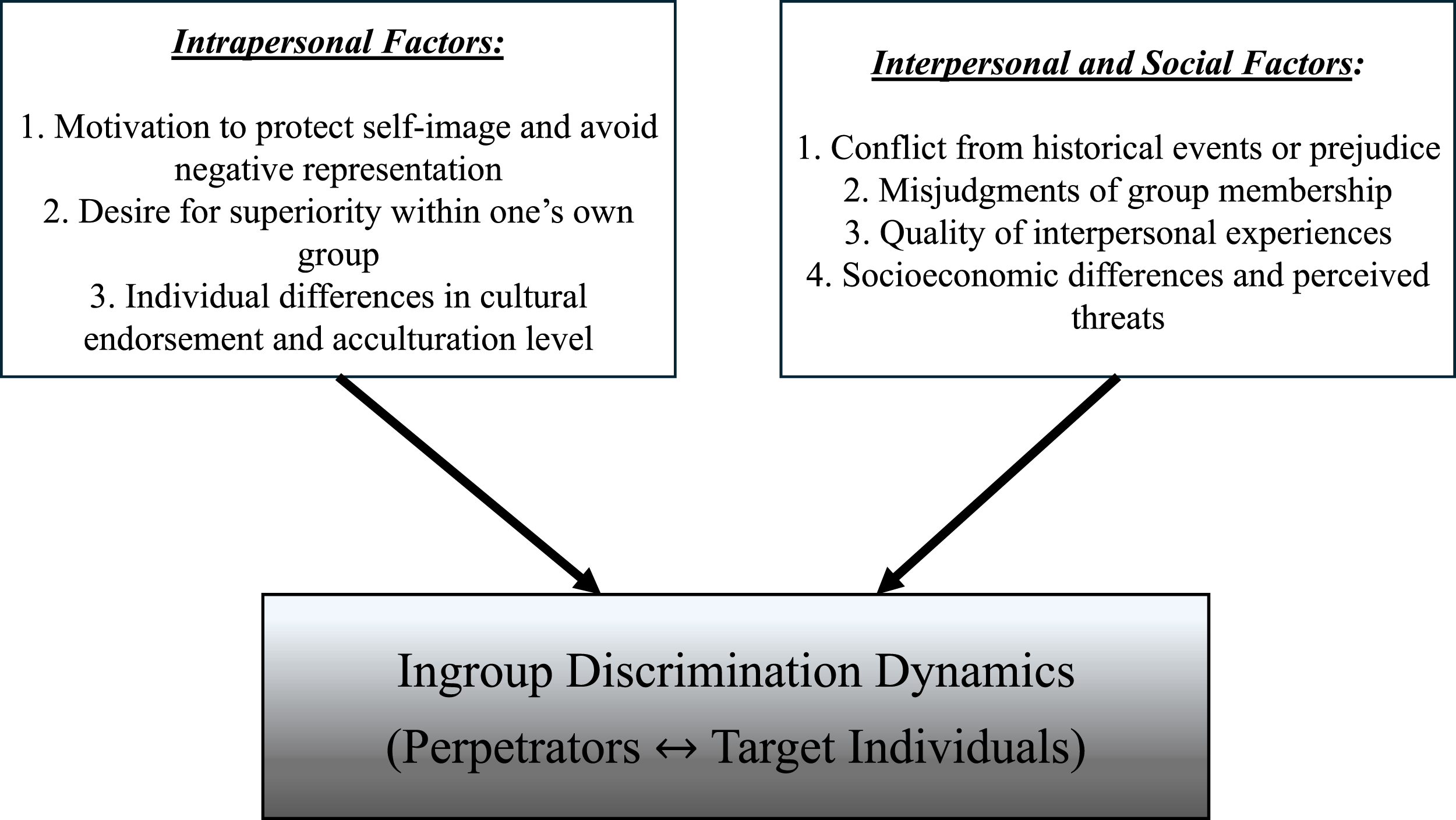
Of note, we should specify that proposing a model of ingroup tension and discrimination does not negate the possibility of ingroup cohesion or empathy. These two sides of within-group relations should not be measured on a unidimensional scale and are not necessarily opposing ends of a single continuum. Positive and negative ingroup emotions can coexist with one another—indeed, Duque et al. (2024) found that, in a nine-country study of host nationals’ views toward migrants, positive (hope, sympathy, happiness) and negative (anger, fear, disgust) intergroup emotions were largely uncorrelated with one another. Ingroup competition and discrimination may coexist with empathy and cooperation. As one example, Clark-Ginsberg et al. (2024) found that Puerto Rican Hurricane Maria survivors in Central Florida perceived earlier Puerto Rican arrivals in the area as sources of both support and rejection. As another example, Asian immigrants from different countries of origin (e.g., Chinese, Koreans, and Vietnamese) may experience tension with each other due to historical events occurring between their heritage countries, but they may still provide support and empathy for each other as a result of sharing the same immigration challenges in the destination country. Although our focus here is on tension and discrimination, we also acknowledge the potential for positive ingroup interactions. Of course, the specific ingroup dynamics occurring in a given context or situation likely dictate the extent of cooperation and discrimination that are likely to occur.
Implications for Future Research, Limitations, and Conclusion
Our theoretical exposition and model of ingroup discrimination provides valuable insights with significant implications for future research and policy. Conceptually, our theory and model deepen the understanding of social identity dynamics related to race, ethnicity, ethnic enclaves, and country of origin, particularly in highly diverse nations with extensive histories of immigration and intricate intercultural experiences. In this article, we integrate literature from various fields, including psychology, sociology, public health, history, and other disciplines, to extend the understanding of the psychological mechanisms underlying ingroup discrimination. This integration from multiple disciplines enhances our theoretical framework and model by offering insights into the social, cultural, and historical factors that shape ingroup behavior. By combining these diverse perspectives, we provide a more nuanced and interdisciplinary understanding of ingroup discrimination. This multidisciplinary approach not only advances psychological research and theories by incorporating broader contextual factors but also extends this article’s implications for research in those fields, such as sociology and public health, where issues of intragroup relations and migration are studied.
Given that the manifestations of ingroup discrimination can vary significantly depending on the diversity of a setting—including irritation, tension, overt discrimination, marginalization, rejection, hate, or other covert forms—we urge scholars to move beyond a monolithic view of ingroup membership. We advocate for a more nuanced framework that can capture these experiences through different lenses delineated in this article, namely, target individuals, perpetrators, and observers. Further research is warranted in at least three key directions.
First, future work aimed at establishing the value, benefits, and disadvantages of ingroup discrimination research would benefit from developing and validating multidimensional measures of ingroup discrimination across the three lenses mentioned above and in diverse cultural settings. Additionally, examining the prevalence of ingroup discrimination within specific groups, the epidemiological profiles of the target individuals and the perpetrators, and their interrelations with mental health, ethnic identity, social integration and adaptation, and other relevant outcomes might provide valuable insights. These findings would further support efforts to accurately evaluate the merits and weaknesses of ingroup discrimination.
Second, as we discussed the mechanisms and processes through which ingroup discrimination emerge, it would be insightful to investigate (a) potential psychological, social, and structural obstacles that may hinder social integration and social adaptation across intra-ethnic subgroups, (b) the many and diverse faces of ingroup discrimination, and (c) the multilevel nature of its effects and geographical variations in prejudice. Such a body of research would be greatly enhanced by incorporating macro-level variables such as political instances (e.g., political climate, social dominance orientation, ideology, populism), policy considerations (e.g., immigration and social policies), and local and global historical events (e.g., conflict, war, mass migration, economic downturn). This future scholarly work would be a necessary step for the design and implementation of evidence-based interventions aimed at improving interpersonal and intragroup relations and promoting social integration and adaptation.
Third, on the empirical front, in addition to the importance of developing and validating multidimensional measures of ingroup discrimination, future research should prioritize multilevel, longitudinal, and experimental designs necessary to offer robust and nuanced insights into the relationships and long-term effects of ingroup discrimination across different groups and cultural settings. These methodologies will enable researchers to identify patterns and changes over time, assess the effectiveness of interventions, and ultimately advance this emerging field of research in ingroup discrimination.
Although we focus here on ingroup discrimination within race, ethnicity, national background, and migration status, future research should investigate ingroup discrimination within other social categories such as SES, gender, sexual orientation, religion, or political affiliation. Additionally, we should note that some non-English-speaking countries, such as Germany, Russia, and Spanish- and Arabic-speaking nations with large immigrant populations, may have published their own research on the migration topic in their respective languages. This non-English literature was not reviewed and included in the arguments of our article, and further examination of these sources could provide additional insights. Further, although our article focusses on highly diverse national contexts, ingroup discrimination might be salient to study in homogenous nations and societies. Additional theoretical and empirical work is needed in this direction.
Footnotes
Declaration of Conflicting Interests
The author(s) declared no potential conflicts of interest with respect to the research, authorship, and/or publication of this article.
Funding
The author(s) received no financial support for the research, authorship, and/or publication of this article.
