




Abstract
Against the backdrop of the increasing depletion of the planet’s ecological ‘resources’ and endemic environmental problems, the view of creativity as servicing the ideal of infinite economic growth has become problematic. We need, instead, to explore how creativity can contribute to grounding our intentions and actions within an ongoing and mutually shaping engagement and cohabitation between people and things-in-the-world. To explore this issue, we introduce the creative preservation framework. It allows to study practices which have received little attention in the literature to date, despite ensuring continuity, preventing deterioration, and valuing what already exists. Our working definition of creative preservation refers to practices of creation that prevent the decay of existing materials and ideas by updating and adapting them, or re-expressing them in another way through the exploration of their affordances. We examine four practices that reflect non-exhaustive forms of creative preservation practices: upcycling, bricolage, low-tech, and craft. The article opens with an ethos of creative preservation in the context of degrowth. It marks a first step towards creative practices that, rather than viewing us as occupants of the world, make us inhabitants of it, thereby contributing to reimagining new modes of relationality.
Introduction
Economic growth has long been regarded as a key engine of societal progress (Borowy & Schmelzer, 2017). Guilford (1950) did not provide much justification for his axiology when he launched creativity research in psychology. As he recognised the ‘enormous economic value of new ideas’, he provided a clear agenda for creativity researchers – to ‘develop an economic order… [which] would require creative thinking of an unusual order and speed’ (ibid., p. 446). The current socio-economic system is, however, tied to industrialised processes that consume a significant amount of fossil fuels to keep them running (Nyberg et al., 2022, p. 7). As a result, the pursuit of economic growth has greatly contributed to damaging our ecosystem through climate change, biomass extinction, acid rain, highly polluted air and oceans, and increasingly restricted access to good quality water (Wright & Nyberg, 2017). This system approaches ‘Nature’ both as a tap for production’s inputs and as a sink for its disposable waste (Fraser, 2023, p. 82). It assumes a disconnection between human and their milieu (Ingold, 2000).
This axiology now appears problematic as it presupposes the untenable view of an infinite growth in a finite world (Kallis et al., 2018). Today, perpetual growth is coming up against the ecological limitations of an increasing scarcity of ‘natural resources’ (D’Alisa et al., 2014; Latouche, 2010; Parrique, 2019). To organise things differently in a world that will lack the necessary resources for maintaining its modus operandi, a new field has emerged over the past 15 years: research on degrowth (Kallis et al., 2018; Latouche, 2010; Parrique, 2023). Degrowth refers to current movements that aim to radically reorganise political, social, and economic functioning to arrive at a post-growth society which can function on reduced energy and resources (Kallis et al., 2018). This is a transdisciplinary endeavour that asks questions such as ‘How can both economies and communities function without economic growth’? ‘What technologies are appropriate to thrive without growth’? ‘What is well-being in the context of degrowth’? These questions are intended to prompt a imagining of how one might contribute to a reshaping of society. This is an opportunity to question fundamental assumptions and to fundamentally change perspective – it is an opportunity to be creative about creativity (Runco, 2015). We need to contribute to imagining new ways of relating to materiality within our ecosystem.
Since the seminal work by Guilford (1950), creativity researchers have sought to identify the factors that contribute to creative thinking and the resulting creative products. Historically, economic competition and industrial application have justified efforts to implement creative thinking methods such as brainstorming (Osborn, 1942). Until recently, considerable research into creativity has focused on how individuals and groups generate original ideas to serve innovation within organisations (Bellard & Delobbe, 2023; Edmondson & Harvey, 2018). However, researchers who justify their need to study the generation of disruptive innovation as a means of tackling environmental and societal challenges (de Rooij, 2023, p. 1) or to promote economic growth (Montag-Smit & Keith, 2023, p. 1; Sternberg & Karami, 2022, p. 1) miss a crucial point. When novelty is used to promote technological innovation and organisational competitiveness, it is usually counterproductive in tackling these problems (Illich, 1973; Stiegler, 2012). It can even contribute to worsening ecological damage, because innovators are incentivised to innovate using as many free natural resources as possible to minimise cost and maximise profits (Parrique et al., 2019, p. 49).
In this article, we elaborate on the statement made in Albert Camus’s speech at the Nobel Banquet at the City Hall in Stockholm on December 10, 1957, in which he stated: ‘Each generation doubtless feels called upon to reform the world. Mine knows that it will not reform it, but its task is perhaps even greater. It consists in preventing the world from falling apart’ (Camus, 2019). 1
Camus’s suggestion outlined a form of thinking that is axiologically different from traditional progressist views. A form that emphasises the creative and innovative value of building on old ideas and what has already been created, rejecting the hegemony of disruptive novelty when it does not meet our needs (Tanggaard & Wegener, 2016). What if the greatest way for thinking about how to improve the future was, in fact, thinking about preservation and renewal? That is the question we pursue in this paper.
Creativity for a Post-growth Society
Against this backdrop, we position this article as a proposal to think of creativity outside the practices that contribute to the logics of perpetual growth, which are often pushed by logics of radical creativity. Gilson and Madjar (2011) theorised radical creativity as involving practices that substantially differ from existing ones, and incremental creativity as comprising practices that induce changes and modification to existing practices and products. In their view, radical creativity practices explore new avenues and products, whereas incremental creativity practices exploit existing ones. Their findings suggested that radical creativity was associated with intrinsic motivation, abstract theory-related ideas, and problem-driven creativity. Meanwhile, incremental creativity was linked with extrinsic motivation and concrete practice as the source of ideas and is based on a need to exhibit creative outputs to others. This view of incremental creativity has attracted twofold criticism. First, it is value-laden in proposing that incremental creativity is an ‘exploitative’ endeavour, rather than, for instance, an ethics of ‘caring’ for what we already have. Second, and as we show in this article, there is evidence that some practices are intrinsically motivated by exploring what exists, and sometimes by defending societal values and ideas that are abstract and theoretical. These include aspects that would define radical creativity as Gilson and Madjar (2011) do, but which are nonetheless incremental in some respects (Wegener, 2016). We call practices that engage in this approach Creative Preservation practices.
The creative preservation framework we introduce in this article is an attempt to contribute to what Ingold (2000, p. 27) called a ‘genuine ecology’, that is ‘one that would ground human intention and action within the context of an ongoing and mutually constitutive engagement between people and their environment’. The creative preservation framework brings together practices that help to create a harmonious and sustainable cohabitation between humans and the things-in-the-world (Himley et al., 2021, p. 2). This cohabitation can be made possible by exploring forms of creation that link the past, the present and the future, thus ensuring the continuity of objects and ideas in a world of perpetual change (Glăveanu, 2012a, 2012b; Tanggaard & Wegener, 2016).
The term ‘preservation’ entails ‘the activity or process of keeping something valued alive, intact, or free from damage or decay’ (Merriam-Webster, 2024a). This contrasts with the standard approach to innovation which mostly considers that the passage of time diminishes the worth of things, provokes their obsolescence, and their outdatedness. Creative destruction, indeed, does not consider keeping something valuable alive, because its objective is to generate market value and economic growth by replacing previously implemented creations that have become uncompetitive (Schumpeter, 1962). We distinguish the term ‘preservation’ from a reactionary or conservative vision, where one utterly opposes to change for the maintaining of a traditional status quo (Merriam-Webster, 2024b; 2024c). Creative destruction is strongly focused on the future to the detriment of the past, while conservation is tied to some values and tradition of the past to be maintained in the present (Glăveanu, 2012a). Our working definition of creative preservation refers to practices of creation that prevent the decay of existing materials and ideas by updating and adapting them, or re-expressing them in another way through the exploration of their affordances.
In discussing creative preservation practices, we criticise the excessive emphasis on novelty by drawing on non-exhaustive examples from upcycling, bricolage, low-tech, and craftivism. We show that these practices provide different views on the humans’ relationships with earth’s resources and the environment, and that they ultimately mean following new paths towards a more convivial society – one which humiliates no-one and enhances everyone’s autonomy (Illich, 1973; Samerski, 2018). We discuss how these practices take continuity into account, while bringing novelty to the process of continuity. We propose an axiology based on valuing within-item difference rather than externally marked novelty (Glăveanu, 2012b, 2013). We propose intentionality and reflexivity as two important aspects of creative preservation practice, which embed us both in the preservation of our ecological and social habitat. We consider this to be a work in progress. Accordingly, the following overview of four key creative preservation practices is intended as providing possible ‘entry points’ to encourage further dialogue about creative preservation and related terms.
Creative Preservation Practices: Upcycling, Bricolage, Low-Tech, and Craft
Upcycling
In their critiques of the emphasis placed on novelty in both research and policy, Wegener (2023) and Wegener and Aakjær (2016) discussed the term ‘upcycling’. Upcycling is a neologism made up of two elements: ‘upgrading’ (i.e. adding value) and ‘recycling’ (i.e. reusing). It is defined as the practice of noticing, transforming, and giving new value to disposed items, objects, or materials. The main idea behind upcycling is to re-vitalise and revalidate old artefacts, ideas, or practices by combining them in a new way, using them in a new manner, and/or transporting or translating them into new contexts. Upcycling involves the reuse of functional elements, for example, by dismantling and reorganising architectural features (De Castro Mazarro et al., 2023). Other examples of upcycling include making new clothes from existing materials that can have multiple iterations, rather than using newly extracted textile materials (because extraction processes often have a major negative impact on resources and the environment; Fletcher & Grose, 2012). Upcycling differs from recycling, which consists of breaking down an element to reintroduce it into a new production cycle; for example, reducing paper to cellulose fibres before recomposing it into a new sheet of paper (McKinney, 1994). Upcycling is a movement that aims to promote frugality: a mindset of low material consumption, simplicity, and minimalism, with the central objective of enhancing the longevity in and of things (Bradley, 2018; Singh & Arora, 2021).
Upcycling practices have a close relationship with materials and resources. In order to discuss this particularity (which is shared by the other creative preservation practices we discuss below) it is first necessary to specify what we mean by the word ‘resource’. We understand ‘resources’ in line with Feldman and Worline’s (2011) Resourcing Theory, which considers the ampliative cycle of resources, viewing resourcing as a process of enlarging conceptions of what is already known. Resources are usually defined as tangible or intangible assets that can be possessed or owned. They are ‘specific physical (e.g. specialised equipment, geographic location), human (e.g. expertise in chemistry), and organisational (e.g. superior sales force) assets that can be used to implement value creating strategies’ (Eisenhardt & Martin, 2000, p. 1107). However, Feldman and Worline (2011 p. 3) take a different perspective, defining a resource as something which can be taken up and used as an asset by someone in a way that allows them to pursue an activity that aligns with what they wish to make happen in the world. In other words, resources refer to a mutable source of energy that allows someone to enact a schema (Feldman, 2004). This stance is a departure from the naïve realist view that things are resources in themselves: rather, resources are constructed by individuals.
Resourcing Theory, therefore, sees things as resources when they are used in a specific context. Water, trees, and minerals only become resources when they are used to serve a purpose defined by individuals. Furthermore, Resourcing Theory posits that the way we use a potential resource determines what type of resource it becomes (Feldman & Worline, 2011). This theory allows us to think about continuity in a degrowth context, where the dominant axiology on growth imposes the idea of disruption, or of managing to function properly in settings that are constantly disrupted (Feldman et al., 2022).
Upcycling aims to reduce the problems posed by intensive resources use and consumption with the dual goals of both extending and slowing cycles of consumption. Bridgens et al. (2018) discussed how waste and discarded items could be used to live, support life, and build communities around them, such as in Brazil’s favelas, and how they could be used for artistic purposes, such as creating necklaces from computer chips. Shi et al. (2022) also documented various upcycling practices. For example, perceiving the value of an object encourages people to transform it into something else, such as the computer chip that becomes a pendant, the ring pull boxes that become ornaments, or the plastic bottles that become stethoscopes. These practices do not solve any waste management problems per se, but they can be seen as political and artistic statements. They demonstrate and provoke an upcycling mindset that considers the inter-relationship between past, present, and future by interweaving the ‘old' and the ‘new’ (Tanggaard & Wegener, 2016).
This approach runs counter to both historical and current trends in creativity research, which are argued to ‘overrate’ novelty and are almost exclusively concerned with new products in terms of their exogenous, market-driven value (Tanggaard & Wegener, 2016). In upcycling, value depends on creative interactions with artefacts, ideas, practices, or even groups of people (Wegener & Aakjaer, 2016; Wegener, 2023). By experimenting with different perspectives and usages of artefacts, symbols, and relationships between people and objects, upcycling is effectively a creative socio-cultural act (Glăveanu, 2015). One of the imperatives for societies to move towards degrowth is the reimagining of social structures so that they are not exclusively focused on the logic of the infinite extraction of resources to continually increase gross domestic product. Instead, value involves sobriety and attention to the materials already extracted (Andreucci & Engel-Di Mauro, 2019; Kallis et al., 2018; Samerski, 2018). As a practice that implies creative thinking and considers care for resources, upcycling contributes to the re-assessment of value in disposed-of materials.
Bricolage
To advance towards degrowth, it is necessary to revisit the common instrumental logic that ‘the end determines the means’. This logic has become untenable in a global context where the aim is to increase gross domestic product, and the means involve extracting resources much faster than the ecosystem can replenish them (D’Alisa et al., 2014; Parrique et al., 2019). Duymedjian and Rüling (2010) contrasted this logic, which they associate with that of the Engineer, with a counter-logic: that of the Bricoleur. For the Bricoleur, the resulting arrangement is a co-definition (or co-production) of the means available and an approximate, vaguely defined objective that can be adjusted (whereas the engineer sticks to the ideal/optimal plan). The ideal-type of the Bricoleur is characterised by the creation of a ‘stock' of heterogeneous means that have been collected over time in a contingent manner, that is, without specifically planning how to collect the resources. 2 These resources might range from routines to fragments of myths and stories, concepts, materials, and devices, and from contacts in social networks to recordings and pieces of information, among other things (Baker & Nelson, 2005; Lévi-Strauss, 1966).
Duymedjian and Rüling (2010) proposed that the act of bricolage involves a sense of familiarity with one’s stock. It is a process of adjusting the uses and functions of the elements that make up that stock to produce an arrangement/outcome that meets one’s needs and goals. The Bricoleur builds up this stock of elements and gains familiarity with it by visiting and revisiting those means. In that sense, bricolage is an ontological way of both inhabiting the world and interacting with it (Ingold, 2000). It is a practice that creates a sense of care in the process of evaluating materials for their potential value and future (undetermined) utility. It also considers the way those means are reintegrated into the Bricoleur’s stock after use.
Bricolage bears a relational aspect as an analogy to describe the way in which pre-modern societies engaged with their environment, that is, with ‘whatever was at hand’ (Lévi-Strauss, 1966, p. 17). According to Lévi-Strauss in his book La Pensée Sauvage (‘the Savage Mind’), bricolage involves experimenting with arrangements of things and beings, and exploring whether they can (or cannot) fit together. Thus, bricolage highlights the interplay between the individual and their stock, and how they can make new functions emerge in a specific context, by breaking them up, and recombining them (Baker & Nelson, 2005; Duymedjian & Rüling, 2010) when necessary. Claude Lévi-Strauss (1966 p. 19) describes a particular way for the bricoleur to make use of whatever constraints are imposed by social structures, and explore their affordance within these constraints: “…the engineer is always trying to make [their] way out of and go beyond the constraints imposed by a particular state of civilization while the ‘bricoleur’ by inclination or necessity always remains within them” (ibid, p.19, emphasis added).
Affordance, a concept related to Guilford’s (1967) alternative use task, refers to how many things can be done with a material (Gibson, 1986). Glăveanu (2016) discusses affordance as a situated and cultural action which is dependent both on context and constraints, and on objectivity and subjectivity. Individuals are not regarded as passive recipients, but as active reorganisers of what others have created or proposed as ideas. According to Glăveanu, affordance is a dynamic action that involves a tension between the salience of the material to be used, connected, and reorganised, and the material itself. The individuals and groups who create are in a constant flux of composition with aspects of intentionality (how they intend to act), materiality (what can be done effectively), and normativity (how society constructs conventional practices). Bricolage outlines this approach to the preservation of resources through the creation of a stock of materials that are used and reused in different contexts at a later time, thereby allowing exploration of the affordance of a given piece of material.
Ingold (2007) advocated for practices of exploration that tie relations to the world and which contribute to inhabiting it. He defended an approach to life akin to meshwork; that is, an engagement with ‘an ongoing process of [self]-growth and development, or self-renewal’ (Ingold, 2007, p. 76). This practice is about the exploration of multiple threads of connections rather than accumulating more of a thing without exploring it. Ingold called the former stance ‘inhabiting’ the world, and the latter, ‘occupying' it (Ingold, 2007, pp. 89–90). To inhabit the world in a meshwork approach is to go along things (rather than moving from one point to another). For Ingold, this means to live in the ramifications of what we know, based on the pieces of information we have in our stock. This is precisely the practice of the Bricoleur (Duymedjian & Rüling, 2010; Lévi-Strauss, 1966).
The Bricoleur has a respectful relationship with their stock, in that, unlike upcyclers, they often use materials without altering their structure; instead, they mainly assemble elements of the stock at hand, and eventually divert their function (Duymedjian & Rüling, 2010; Lévi-Strauss, 1966). Gisquet and Duymedjian (2022), for example, showed that staff at the Fukushima Daiichi nuclear power plant were forced to practise bricolage after the accident caused by the earthquake in Japan on 11 March 2011. In order to try to mitigate the effects of the accident, the plant’s operators working in Reactor 1 engaged in multiple acts of bricolage, diverting the functions of whatever was at hand to address the situation. For instance, as their monitoring system had ceased to function, they diagnosed the state of the reactor using sounds, and the colour of steam, as this was their only option. Likewise, as the water pipes inside the nuclear plant were no longer working, they had to change the function of a diesel pump so that it would pump water directly into the reactor. These practices show that, unlike upcycling, bricolage considers the longevity and flexibility of what is at hand by diverting the current use of materials, rather than by drastically modifying them.
Low-Tech
Degrowth follows a logic of downscaling based on reducing energy and resource flows to reach collective sufficiency and resolve the tension between our needs and wants (Kallis et al., 2018; Latouche, 2010). To advance towards a post-growth era, creativity researchers need to think about how individuals, groups, and society can flourish without economic growth, through achieving frugal abundance, conviviality, care, and open re-localisation (Banerjee et al., 2021). Banerjee et al. (2021) pointed out that today’s key questions concern how we can create a regenerative world and break away from the logic of the hegemony of growth. They highlighted the need to reach a state of sufficiency in relation to our individual needs, and to reduce our dependency on the production of new material products.
The issue with modern tools lies in our lack of understanding of the complex technological artefacts that we are unable to create ourselves, or to repair. This aspect was discussed by Illich (1973 p. 39) through what he called non-convivial tools, that is, tools that increase regimentation, dependence, exploitation, and impotence. The central criticism Illich (1973) makes is that the axiology of perpetual technological innovation is inverted in its finality – tools are not designed to help us do; they are designed to make us have. In this sense, modern tools (including our smartphones, the internet, and social networks) foster dependence, beyond the satisfaction of our needs (Samerski, 2018). In contrast, convivial tools are those that can easily be adapted, and can fit many different purposes (e.g. they have high affordance that need to be explored and constructed; Glăveanu, 2016). They also support the re-localisation of production and distribution from distal to proximal places, the valuing of quality over quantity, and raise a sense of ‘taking care of’. This sense of caring, according to Chertkovskaya and Paulsson (2021), should be the goal of most organisations, with the aim of moving from an accumulation environment that encourages corporate violence, to a place of regeneration that takes care of social relationships. Convivial relationships, within and outside organisations, can foster a sense of shared commitment to civil togetherness characterised by care, compassion, multivocality, and multiculturality (Parry, 2020).
Bobulescu and Fritscheova (2021) provided evidence of the convivial creativity process in four sustainable communities, showing that their members were motivated by values of austerity, ascetism, and a sustainable lifestyle. These values, indeed, motivated them to build structures out of traditional natural resources such as mud, thatch, and raw tree trunks, following the logic of pasture re-vitalisation. These groups were also creating ‘low-tech’ devices facilitating food storage, solar water heating, and rainwater recovery; a roof vegetation system for water capture; and organised local grocery stores relying on a proximal link between farmers and customers. ‘Low-tech’ defines practices with low research and development intensity and that, according to Hirsch-Kreinsen (2008, pp. 25–26), are ‘characterised by the continuous further development of given products… [and whose] product components are improved and changed regarding their material, their function and their quality but the structure and the technological principles of the products remain unchanged’ or which imply the ‘rearrangement of almost unchanged product components’.
Tanguy et al. (2023) recently conducted a literature review and gathered data via qualitative interviews with actors in low-tech communities. Based on these actors’ practices, they proposed a low-tech framework that underlines how this practice of the repair and reuse of technical objects is the opposite of ‘green growth’. The actors reported different convivial aspects of low-tech in line with both upcycling and bricolage. Low-tech is concerned with decreasing the consumption of resources and non-renewable energy, and aims to promote extended service lives, or new types of usage. These practices, again according to Tanguy et al.’s (2023) findings, consist of re-considering what is essential as far as our needs, and perceptions of satisfying those needs, go.
Low-tech practices foster autonomy and a lower dependency on distal high-tech fabric and rare minerals and resources, and create a collective network (which involves sharing practices, educational resources, and providing training) that can learn techniques, and how to design, build, and operate these technical objects. As a participant in Tanguy et al.’s study reported, low-tech implies a practice of bricolage insofar as ‘when we want to do something low-tech, with things we have at hand, it is often tailor-made’ (ibid, p.9, emphasis added). These practices offer a vision which is in opposition to products designed with deliberate obsolescence, dependency, and perpetual consumption in mind. In this sense, low-tech practices can help us to move towards more convivial types of creative behaviour that, like upcycling and bricolage, focus on longevity and taking care of ‘waste’, and used materials.
Low-tech, like other creative preservation practices, is rooted in the motivation to care for others and about preserving resources, and to contribute to the community. Consider, for instance, Alfredo Moser (2013). People living in Brazil’s favelas often have no electricity for daily life. Moser, who lived there, therefore invented a simple, user-friendly technique for lighting homes: an empty water bottle, some corrugated iron, and bleach to mix with the water. The simple process involves refracting sunlight through the plastic bottle to produce a 40–60 watt lamp. Consider further the Foldscope, a $1 microscope which was produced based on data that some people live on $1 a day, that has a 2000x lens and can be folded like a piece of paper. The Foldscope is designed based on the principles of Origami, and was made to quickly detect malaria cells. It is composed of a ball lens, a button-cell battery, a surface-mounted LED, a switch, copper tape, and polymeric filters (Cybulski et al., 2014).
Mansukh Prajapati provides another example of low-tech, in the form of the Mitticool, a type of clay-made refrigerator that can keep food at 15–20° lower than the outside temperature. Designed to help Indians become more resilient in an increasingly warming climate, Mitticool functions on the principle of evaporative cooling, and works without electricity (Patel et al., 2021). All these low-tech examples are convivial and inclusive practices that, at their core, think about caring for others. Like upcycling and bricolage, low-tech focuses on low resource usage. Although the ways in which resources are used in low-tech are grounded in more technical aspects than the previous practices described in this document, low-tech is an additional practice that aims to preserve resources, and to care for what is already at hand.
Craft
Schaefer and Hallonsten (2023) argued against the notion of using creativity to service the growth imperative of fast and short cycles of production and consumption: what they call instrumental creativity. These authors posited that instrumental creativity disregards long-term thinking and is unsustainable because it prioritises profit from innovation as an end in itself. As an alternative, they proposed a focus on craft to create away from the logic of production and consumption. Craft can revisit and develop traditional manual practices and processes, with initiatives seeking to extend the longevity of an object through repair and fostering a sense of care for artefacts and people alike (Bell et al., 2021).
Craftsmanship is a way of connecting people (Tapper et al., 2011), whether through collective practices of creating traditional objects (Glăveanu, 2010; 2012b), or via ‘craftivism’ that brings together local communities, using craftsmanship as a means of democratic and participatory expression (Greer, 2011). Craftivism is a term that refers to ‘creativity plus activism. Or crafty activism… about using what you can to express your feelings outward in a visual manner… channelling that anger in a productive and even loving way’ (Greer, 2011, p. 183). Craftivism often integrates bricolage logics by reusing whatever materials are at hand, and often promotes values that explicitly renounce intensive consumption and production (Garber, 2013).
Clarke (2016) explored craftivism through studying two communities, the Knitting Nannas Against Gas (KNAG), who protested against the mining of coal seam gas in Australia, and Casey Jenkins’s performance art piece ‘Casting Off My Womb’, which used public knitting as a feminist protest action. Clarke (2016) argued that this latter act echoed Les Tricoteuses of the French Revolution, who protested in silence in front of the guillotine to demonstrate their exclusion from political participation, and the Revolutionary Knitting Circle in Canada, who knitted to protest against capitalism and global policies leading to eco-destruction.
Clarke (2016) thus specifically highlighted how women intentionally used craftivist practices involving craft and knitting, two traditional practices, to creatively re-arrange them to create new meaning in a given social context. Casey Jenkin’s ‘Casting Off My Womb’ consisted of knitting a ball of yarn inserted in her vagina over a period of 28 days as a performance artwork. The performance provoked negative reactions and disgust, and was used by the artist to protest against patriarchal diktats, and the pressure and expectations placed on the female body. In other words, by using craft as a means of opposing patriarchal domination, Jenkin actually celebrated opposing values, and celebrated a potential social alternative: one that integrated values around inclusivity, self-expression, freedom, and self-determination, along with more peaceful, tolerant, and caring human relationships in general, and between women and men in particular. This example shows how craft can be used as a means of highlighting something which needs to be dignified; a sort of will for an amplified dignity of something society does not value. It highlights similar aspects to those discussed in relation to upcycling, bricolage, and low-tech: an act that thinks preservation of the material. These four domains together represent what we call creative preservation practices.
A Framework to Explore Creative Preservation Practices
Creative preservation practices imply a sense of reflexivity about the action at hand, rather than it simply being automatic and mindless (Glăveanu, 2013). They all encompass aspects of the reflexivity of an individual who attaches importance to the protection of resources and materials, either by valuing the potential for multiple lives of an asset or by expressing their own values through their practice, or both. Values, in terms of defining what is perceived as good and worthy, are pivotal factors in the process of yielding change in people (Sagiv et al., 2017). They can change how individuals relate to themselves, others, resources, and their milieu. When Shi et al. (2022) interviewed 34 practitioners of upcycling, these people explained that their behaviour was motivated by values centred around the frugality of resources, a benevolent view involving contributing to societal good, and increased environmental awareness and sensitivity. They also associated this practice with pride and joy, thus showing that frugality can indeed be joyful.
So far, researchers who have focused on the values that may foster a post-growth society have mostly proposed conceptual and theoretical ideas. Biermann et al. (2012), for instance, proposed to shift values from profit generation to public goods and environmental goods; however, they did so without proposing how to achieve this goal. Ford and Kuetting (2020) elaborated and theorised on acting on values in relation to resources relations (attention to resources), accumulation strategies, the finite aspect of things, decoupling money from happiness, equitable social relations, reduced materiality and material throughput, and values of sobriety. Nesterova (2021) proposed a focus on value shifts in business, and argued that in order to promote a post-growth society, a focus on values relating to three aspects is needed: relation to the environment (values of respectful human-nature relations, sufficiency, and non-anthropocentrism), relation to others (values of community and belonging), and relation to oneself (values of reflexivity, interconnectedness, and spirituality). More recently, Savini (2023) highlighted the need to emphasise that resources have higher socio-ecological values by valorising what we often dispose of as ‘waste’. As we propose, creative preservation practices can both represent, and be used as an entry point, to re-valorise our relationship with ‘waste’ and the continuity of whatever is perceived as a ‘resource’.
Figure 1 presents our framework of Creative Preservation. This visual representation proposes that the act of creation (1), which can be an idea, a product, or a behaviour, is then re-arranged (2) at a later time. This re-arrangement depends on the past, in the same way that the upcycled necklace depends on the computer chip from which it is made (Bridgens et al., 2018), or that Alfredo Moser’s lamp depends upon the repurposed water bottle (Moser, 2013). Yet at the same time, the act of re-exploring the affordance of these past objects extends their longevity and their perceived value. This increase in value perception means that the object is not ‘waste’ – but a resource (Feldman, 2004). In the case of bricolage, for instance, the ‘object’ is a syncretic arrangement of means that can bear, in itself, a future ‘pool’ of means that can be disassembled and reused separately. Then, the comparison (3) between the first state of the idea, artefact, or behaviour (1) and the second state (2) allows the individual, group of individuals, or observers of those who created this re-arrangement to engage in a state of reflexivity (4). This reflexivity fosters a better understanding of what was done before through what has been re-arranged now. This act of reflexivity then allows the creator(s) or the audience to better understand their actions, and/or their motivations, and/or their effects on themselves, both on others and on the world. Finally, this process of reflexivity enables us to understand (5) how we may frame our intentions regarding our future relationships with ourselves, others, artefacts, and our milieu. Thus, future creation follows a logic of re-arrangement of the past based on reflexivity on our practice. The creative preservation framework.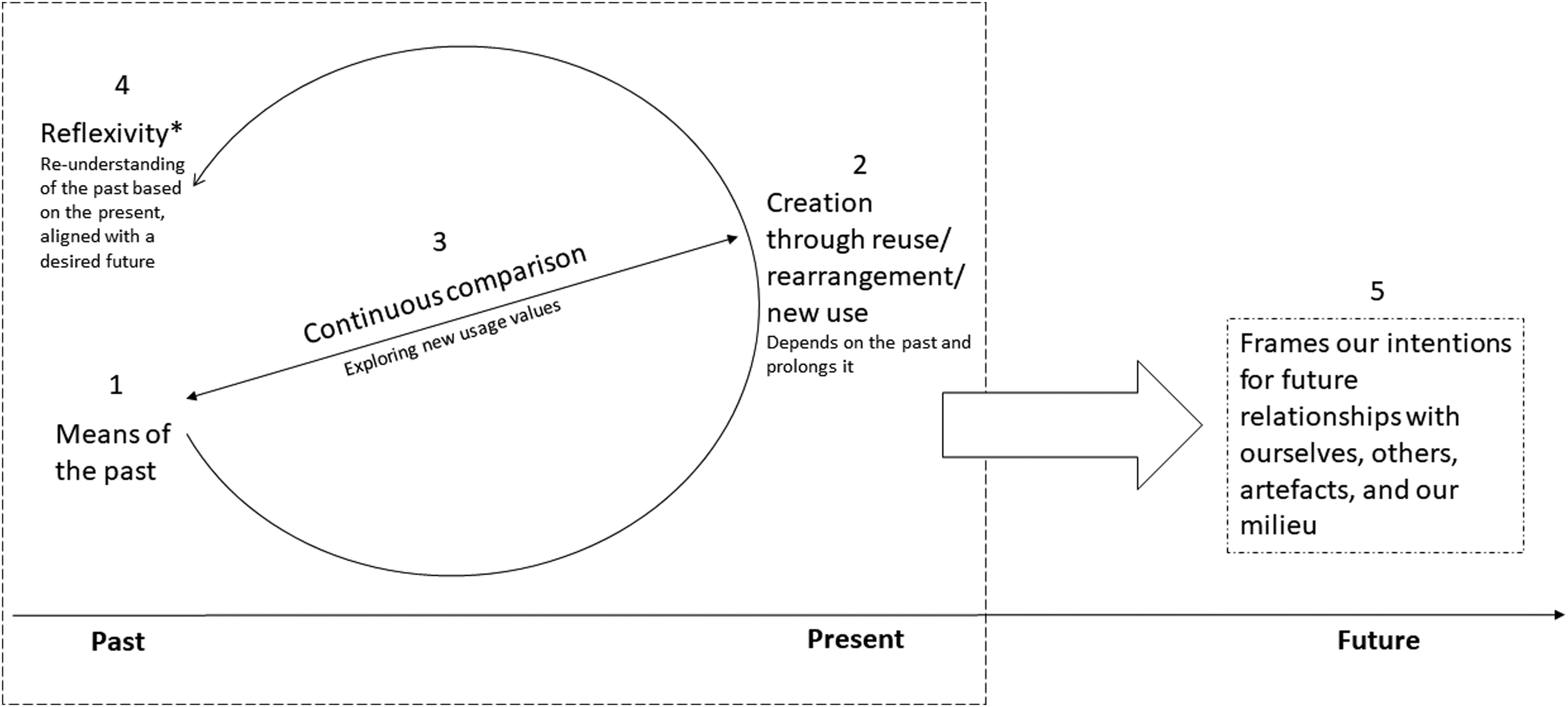
Upcycling, bricolage, low-tech, and craftivism engage creative thinking and creative practice as means to elaborate an idea, an artefact, or a behaviour to create new patterns which have continuity with previous ones. These practices re-assess, elaborate, re-arrange, or recontextualise previously used materials, ideas, behaviour, and artefacts. This idea is not a new one, either. Guilford (1967, p. 8) proposed that ‘the other potential source of creative talents [besides divergent thinking] is in the category of “transformation” abilities, which pertain to revising what one experiences or knows, thereby producing new forms, and patterns’. A similar proposition can be found in descriptions by Rhodes (1961) and Mednick (1962) of associative thinking as a form of re-arranging knowledge. This view refers to the very definition of the word ‘preservation’: the activity or process of keeping something which is valued alive, intact, or free from damage or decay. Indeed, one way of keeping something of value alive and well is precisely the production of new forms, patterns, connections, and re-arrangement of the given idea, behaviour, or artefact. As has been proposed in the recent socio-cultural manifesto of creativity, ‘old literature should be revisited… not abandoned’ (Glăveanu et al., 2020, p. 744). Upcycling, bricolage, low-tech, and craftivism show how creative preservation is precisely this ability to re-vitalise and re-arrange known concepts, both inside and outside one’s field.
Creative preservation is about the continuity of what is already there, and variations of the modality of expression of this ‘old’ idea, behaviour, or artefact. Examples have been drawn from field observations of Easter egg decorators in Romanian culture, who not only engage in a mastery of habits and continuity of tradition on a broader level, but also introduce within-habit variations that highlight creativity in continuity with cultural practices (Glăveanu, 2010). This kind of practice contributes to maintaining a continuity based on habits, and according to Glăveanu (2012a), the decorators’ practices constitute forms of habitual creativity: an expression of creativity that relies on habits and the integration of habitual practices. Yet, because the world changes and modifies us, creators need to adapt both themselves and their practices, while also ensuring cultural continuity. When they face disruption in their act of continuity, they can improvise on the basis of their habits to pursue that continuity; alternatively, they can deliberately and intentionally choose to innovate and create a novel response, idea, or product.
The Ethos of Creative Preservation
A fundamental question in the context of degrowth is what motivates us to preserve what we preserve, and not to preserve what we do not preserve? What deserves to be preserved, who decides, and based on what criteria? Consider, for instance, some unethical usages of creativity, like finding new ways of cheating, abusing, and hurting people (Cropley & Cropley, 2019). Should creative preservation practices re-arrange new devices which can be used for those malevolent purposes? We propose that creative preservation without reflexivity may be condemned to reproducing undesirable and anti-social objectives which directly contradict the objectives that creativity researchers have defined in their recent manifesto (Glăveanu et al., 2020).
Recent theorising in creativity research has proposed the palette of creativity ethos, which can help to foster understanding of creative preservation practices, which seem to be intrinsically benevolent (Kaufman & Glăveanu, 2023). According to Magrini (2017, p. 2), the term ‘ethos’ means one’s intimate space of “dwelling, of abode, with others.” To dwell is to create intimacy with a space of some sort. Hence, when Kaufman and Glăveanu (2023) recently approached the idea of a creativity ‘ethos’, it was possible to understand this word through the act of relationality and dwelling. Their proposition is that a creative endeavour can contribute to an ‘ethos’ around flexibility, openness, perspective taking, compassion, and inspiration. Creative preservation practices contribute to this ethos of creative dwelling through their exploration of multiple material affordances that increase the value, worth, and respect for the relationality of things.
The many examples set out in this article show how these practices relate to values of caring about others and the wider environment. Research into creativity can have an impact on the evolution of our societies towards a global system that values longevity and caring for things, animals, plants, humans, and the milieu in which we all live – and on which we all depend. Creative preservation practices demonstrate that certain groups and individuals can contribute to rethinking and reimagining ways of flourishing in terms of resources, sobriety, and care, by exploring and re-combining the possibilities inherent in what already exists.
The four creative preservation practices outlined in this article are collective creative practices that can prompt reflexivity about how an individual creative act can contribute to a desirable collective future. Drawing again on Illich’s (1973) view of convivial societies, these practices are characterised by values of respect for materials and people. They may involve individual reflexivity about whether the creative preservation practice in question enhances the autonomy of people and things, rather than generating coercion, exploitation, and submission through technocratic tools (Arendt, 1969; Chertkovskaya & Paulsson, 2021; Samerski, 2018). In other words, the reflexivity of individual creative preservers is often embedded in a wider collective group, asking how their practice contributes to the socio-ecological milieu (Bobulescu & Fritscheova, 2021; Bradley, 2018; Parry, 2020). As presented in Figure 1 (5), these practices can contribute to incremental advances towards a more convivial future, offering a democratic space for discussing how practices are aligned with the value, care, and respect for (and conservation or minimal use of) resources. Creative preservation practices are reflexive and can facilitate the advance towards a desirable and attainable future based on collective reflexivity on one’s practice in relation to the past.
Bricolage, upcycling or low-tech, and craft are all practices that collect heterogenous means, outdated tech, or traditional practices to create new arrangements in new circumstances and for new purposes, thereby multiplying the number of possible uses, both in terms of function and economic value (Gisquet & Duymedjian, 2022; Glăveanu, 2016; Tanggaard & Wegener, 2016; Tanguy et al., 2023). In that sense, creative preservation practices amplify the value of things beyond their nominal use. They increase the use value of materials and resources and the respect they command, which can be defined as ‘considered worthy of high regard’ (Merriam-Webster, 2023). This is the basic premise of upcycling as a practice – that it aims to increase the value of materials through finding new usages (Wegener, 2023). Creative preservation, therefore, shifts the focus from disposal to worthiness. As such, it contributes to highlighting the axiology underpinning the question of ‘resources’. As Critical Resource Geography specifies, ‘[r]emoving something from its existing relations in order to incorporate it as a resource into a new set of relations requires thought and action…[and] raises questions about who is making these value judgments, in what context these valuations make sense and become dominant, and how systems of resource-making affect different constituencies’ (Himley et al., 2021, p. 1). Hence, the concept of creative preservation contributes to opening up the field of creativity research to the pivotal question of the axiology of what is done with resources, and for what purposes.
As Figure 2 shows, creative preservation is a process that increases the value of things through exploring new uses, thereby amplifying the dignity of things, and thus our respect for them. The discovery of new affordances and possibilities for a given material enhances individuals’ perceptions of the worthiness of the object which, instead of simply becoming disposable waste, is transformed into something new and useful, thus reinforcing the rationale for preserving the given material. This concept can be found in Bridgens et al. (2018), who reported how participants used an ex-computer chip to create a necklace: rather than disposing of the chip, they preferred to upcycle it for aesthetic purposes, thereby exploring an entirely new functional value (a necklace rather than a computer component) going beyond its market-defined economic value. However, upcycling is not just a design approach; it is storytelling that counters a linear logic of progression from new to old. The upcycled product tells a story about the interrelation between old and new, and even about dissolving ‘old’ and ‘new’ as distinct categories of a value hierarchy in which old is bad and new is good (Wegener, 2016). Upcycling, in this regard, integrates the past in the present and points to desired futures. Creative preservation as a process to increase value of and respect for resources.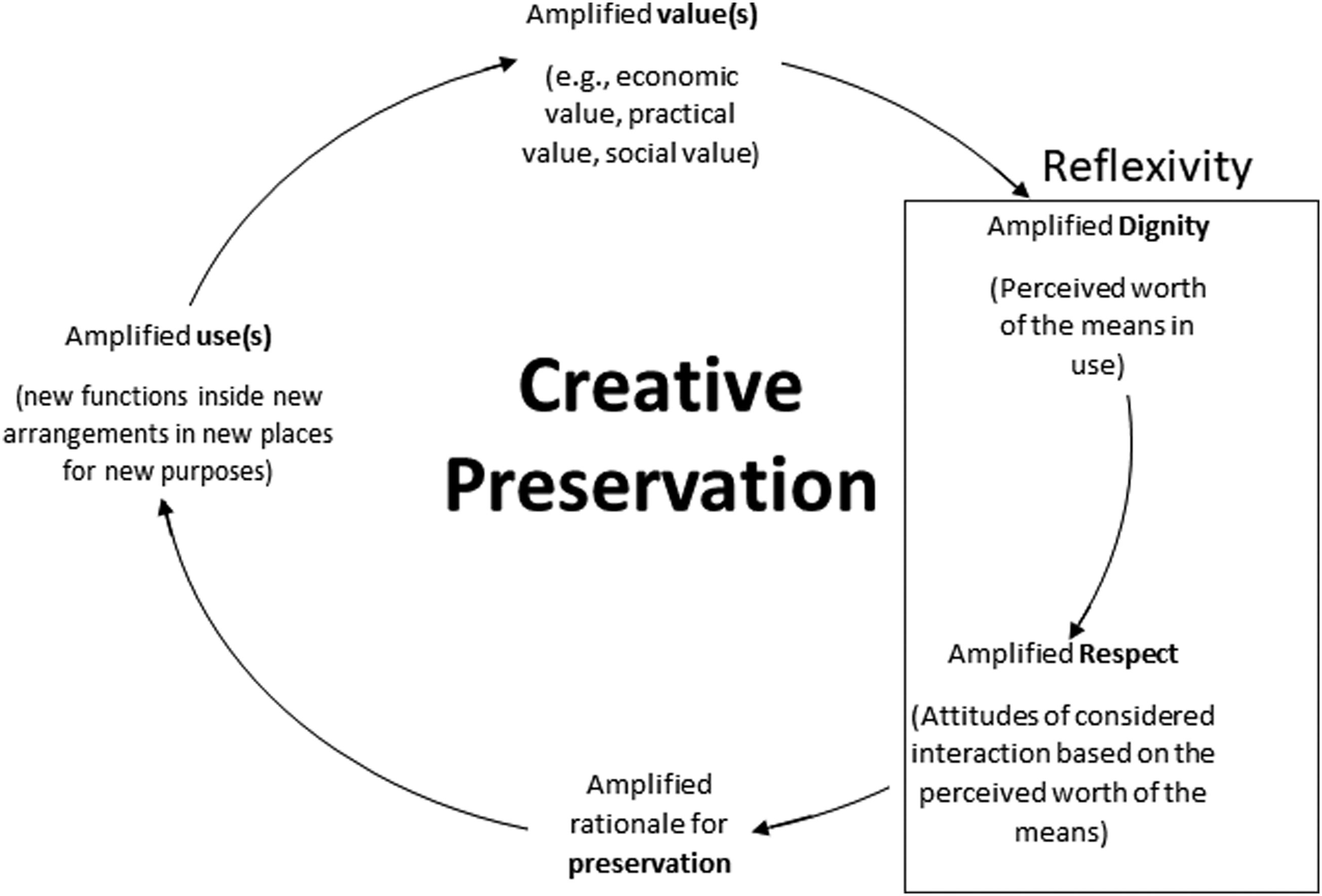
Furthermore, creative practices explore and create new usage values of materials, while at the same time opening the door to future modifications and different future uses. The Bricoleur, for example, collects their stock of resources based on the premise that the collected means ‘may come in handy’ one day (Lévi-Strauss (1966, p. 13), without determining ‘when’ or ‘for what purpose’ the item may be used. This indeterminacy postulates that all things can have value, thereby increasing their perceived dignity (that is, their worth), and thus our respect for them, establishing a rationale for preserving what others see as disposable. This process is also found in low-tech, which likewise implies a logic of bricolage and technology creation with minimal resources usage via everyday items (Bobulescu & Fritscheova, 2021; Tanguy et al., 2023). Crafts and craftivism similarly engage in logics of respect for tradition and values (Glăveanu, 2010, 2012b), and have been known to make use of traditional practices in different contexts to protest against social injustice, defending respect and dignity for human rights in doing so (Clarke, 2016; Greer, 2011). These are all practices that amplify the worth of things. They contribute to creating ways of inhabiting in and with the things-of-the-world.
We propose to answer the question ‘how can we know what needs to be preserved through creative practices’? by drawing on how our actions contribute to making us inhabitant of the world in which we maintain caring, and attentive relationships with things, humains, and other-than-humains (Ingold, 2000, 2007). The notion of reflexivity in creative preservation practices (see Figure 1) addresses this question by highlighting the notion of agency in the creative act. Creators have an ethical obligation towards their creative outputs (Moran et al., 2014). Any creative act – that is, any generation of meaningful novelty – must be assessed in relation to how it contributes to societal good (Canina et al., 2023; Kaufman & Glăveanu, 2023; Noonan & Gardner, 2014; Sternberg, 2021; Verger & Glăveanu, 2024). In light of the current ecological crisis, the concept of creation cannot be fully grasped without recognising the negative impact of perceiving the world as a mere stockpile of resources. This perspective affects our relationships with the things-in-the-world (Ingold, 2000). The challenge of fostering and sustaining lasting relationships is crucial, both in terms of the outputs we generate and the means we employ to create these outputs.
Perspectives
This article has proposed the grouped analysis of upcycling, bricolage, low-tech, and craft as four domains that together constitute what we call creative preservation practices within a wider degrowth framework. These practices can further orient our attitudes towards ourselves, others, objects, and our milieu as we engage in reflexivity about the difference between an old creation and the re-arrangement of this creation. Creative preservation makes us value material that is already here, longevity, care for what others may see as ‘waste’, conviviality, belonging, and human relations. Through this framework, we highlight the pressing need for creativity and innovation researchers to explore areas which lie outside of innovation and creativity in the service of a logic of perpetual economic growth. Creative preservation practices themselves provide evidence that creativity research needs to more deeply understand the motivations and values that encourage ‘creative preservers’ to engage in practices like upcycling, bricolage, low-tech, and craft, that fundamentally engage in the prolongation, elaboration, and maintained value of things. Creative preservation implies an ethics of care for all the things we already have at hand, which we often discard too easily.
Creativity researchers have a societal responsibility in terms of the way they shed light on practices that can contribute to a reimagining of new modes of relations with our material world. Most creativity researchers aim to contribute to good outcomes, and seek to provide meaningful data that can make a transformational difference in the world (Cropley, 2024; Glăveanu et al., 2020; Kaufman & Glăveanu, 2023; Sternberg, 2021). And indeed, research on creativity is not entirely tied to the initial axiology that Guilford (1950) promoted when he launched the field to promote economic growth. For instance, creativity can contribute to helping people to connect, find meaning in life, heal, and express themselves (Kaufman & Glăveanu, 2023). However, while the field increasingly engages in the study of the transformational effect of creativity on society, the creative practices that can contribute to a post-growth society are yet to be explored by creativity research.
There is extensive work to do to change perspective. We need to reimagine the meaningfulness of our creation not in terms of exogenous product-based criteria, but based on how it can contribute to a creative experience that makes us inhabit the materiality of, and the relations with, the world. At the same time, there is a need to investigate the delicate processes of collecting means and how these are integrated into creative outputs. More recent theorisations are moving in the direction of a process approach to creation that moves away from viewing creativity as tied to the products created (Glăveanu & Beghetto, 2021; Green et al., 2023; Verger et al., 2024; Verger & Duymedjian, 2020; Walia, 2019). We need to continue to pursue these efforts and contribute to what critical management studies call ‘craft imaginaries’ to organise a post-growth society (Bell et al., 2021; Rennstam & Paulsson, 2024). Creative preservation can do justice to forms of creation that contribute to this necessary collective endeavour.
Creative preservation crucially integrates the notion of the materials in idea generation and idea implementation, driven by values and explorations of the possible. This process could contribute to enable individuals and groups to inhabit the world rather than just to occupy it (Ingold, 2007). Ingold critiqued the modern way of segmenting things, which creates static networks. This stance suggests that when resources are removed from their context, the importance of those relationships and the violence inherent in the extraction process are often overlooked. In contrast, a relational approach would acknowledge the harmful effects of the production process, emphasising that extracting something from its environment impacts the entire milieu. Ingold (2007) defended an ontology and epistemology of meshwork, which he defined as the ‘multiple and interlaced strands of movement’ where the mesh gives rise to ‘interweaving lines rather than a continuous surface’ (ibid., p. 75). For Ingold (2007 p.75) to inhabit the world is to go along in a phenomenological way, tracing paths as one goes rather than quickly going across things. Or, as ecology philosopher Baptiste Morizot (2023) claimed, this means to build inhabitable slowness against uninhabitable speed.
The question of how creative preservation is built from, and contribute to building, this inhabitable slowness is a promising perspective for future research on creative relationality. In this sense, creative preservation can contribute to exploring the multiple ‘clues’ of materiality. These, according to Ingold (2000, p. 22), are the keys that unlock ‘the doors of perception, and the more keys you hold, the more doors you can unlock, and the more the world opens up to you’. It is through experimentation with the affordances of these clues that individuals can shape how they perceive, and therefore engage with, the world.
At first glance, creative preservation integrates the palette of the creativity ethos proposed by Kaufman and Glăveanu (2023). For instance, Shi et al. (2022) showed that upcyclers have benevolent motivations of contributing to their vision of a common good. Likewise, Clarke (2016) found craftivism to be driven by vision of a more just society, similar to that which is defended by the low-tech movement (Cybulski et al., 2014; Patel et al., 2021). However, more empirical research is needed to explore the values, vision of a common good, and psychological processes implied in such practices. An important question is the extent to which creative preservation practices constitute forms of transformational creativity that can contribute either to a global or local common good (Sternberg & Karami, 2024). Likewise, the extent to which creative preservation connects to the 4-C model of creativity (from personal insights to everyday creativity to professional creativity, to eminent creativity; see Kaufman & Beghetto, 2009) also needs to be addressed. While we position the creative preservation framework to address forms of creativity that can contribute to exploring the values, usages, worth of things and respect for them in contributing to a degrowth society, future research should explore how this concept relates to the established creativity literature. There is a need to envision how creativity can contribute to a reimagining of new modes of dignifying relations, in finding ways to cohabit with the complexity of the material and living world. We need to move towards a creative relationality that creates links between humans and other-than-humans, in order to preserve the ecosystem in which we live and call ‘home’.
Footnotes
Declaration of Conflicting Interests
The author(s) declared no potential conflicts of interest with respect to the research, authorship, and/or publication of this article.
Funding
The author(s) received no financial support for the research, authorship, and/or publication of this article.
