




Abstract
The aim of this paper is to advance psychological theory and research on attitudes and behavior towards low status minority groups by discussing group-level indispensability as an important yet largely unexplored factor in intergroup dynamics. Drawing on theory and international research from psychology and the social sciences, the distinction between functional indispensability and identity indispensability is first discussed. Subsequently various positive intergroup implications of perceived indispensability are considered, and for giving a balanced account possible negative outcomes are also discussed. Then, the minority perspective is considered and the question of when positive or negative intergroup implications of perceived indispensability are less or more likely. The paper concludes with future directions for theoretical and empirical development of the notion of group-level indispensability and its intergroup consequences in a range of settings and contexts.
There is a very large literature on prejudicial attitudes in which low status minority outgroups and newcomers (i.e., immigrants) are perceived as being different, not fitting in, not to belong, a burden, competitors, or threatening and dangerous. The alleged nature of the minority outgroup and their perceived negative impact on “us” is an important driver of prejudicial attitudes and forms of biased behavior in a range of intergroup settings (see Tileagă et al., 2022). In contrast to this work, there is very little psychological research that focuses on people’s attitudes in relation to the perceived benefits and contributions to society that minority groups and newcomers make (Graf et al., 2023; Tartakovsky & Walsh, 2016). However, a minority group or newcomers can be considered as being indispensable for the functioning of society and also for its overarching identity, and it is likely that perceived outgroup indispensability is related to more positive outgroup attitudes and behaviors. Yet, there is little theoretical and empirical research on this notion, especially in research on intergroup relations. Although the anthropologist Malinowski introduced the concept of indispensability in the social sciences already in the 1920s and it has been used, for example, for understanding motivational gains in work groups and organizational settings (e.g., Hertel et al., 2000) and in cooperative learning (Johnson & Johnson, 2009), it is fairly recently proposed in intergroup research (Ng Tseung-Wong & Verkuyten, 2010).
The aim of this paper is to advance psychological theory and research on attitudes and behavior towards minority groups by discussing perceived group-level indispensability as an important yet largely unexplored factor in intergroup research. Drawing on international research, the concept of indispensability is discussed and a distinction between functional indispensability and identity indispensability is made. This is followed by a discussion of the various positive intergroup implications of perceived indispensability and some mechanisms for these implications that have been examined empirically. For giving a balanced account, possible negative outcomes for intergroup relations will then be considered by discussing relative ingroup indispensability, outgroup threat, and minority separatism. Subsequently, the focus is on the minority perspective and on the question of when positive or negative intergroup implications of perceived group indispensability are less or more likely. The paper concludes with future directions for theoretical and empirical development in the hope of stimulating more systematic research on the notion of group indispensability and its intergroup consequences in a range of settings and contexts.
The Concept of Indispensability
The notion of indispensability is used in many different situations and for thinking about a range of issues: for understanding human development and functioning, in social and political debates about societal issues, in the business world and organizational contexts, in interpersonal and intergroup contexts, and in international relations. For example, various nutrients are indispensable for a healthy physical body; care, support, and learning are indispensable for positive human development; good interpersonal relations are considered indispensable for a happy and fulfilling life; and motivation, effort, and talent are indispensable for achieving complex goals. Furthermore, governments can have a list of so-called crucial professional groups that are considered indispensable for keeping society going, especially during a crisis such as COVID-19; political parties and freedom of speech are considered to be indispensable for liberal democracies (Lipset, 2000); the European Union is considered indispensable to the preservation of peace in Europe, and the United Nations for addressing international tensions and global questions. Additionally, organizations and companies increasingly emphasize the indispensability of diversity and inclusion to communicate their corporate identity (Jonsen et al., 2021), natural sites and places are protected because these are considered integral and indispensable parts of indigenous religious practices and identity (Brown, 2004), all ethnic and racial groups can be considered indispensable parts of rainbow nations such as South Africa and Mauritius, 1 and immigrant newcomers can be considered indispensable for the national workforce. 2
According to dictionary meanings, something that is dispensable is something one can get rid of without serious implications. In contrast, indispensability is the quality possessed by something or someone that one cannot possibly do without: a “must have” that is absolutely necessary, essential, impossible to be omitted, irreplaceable, or of basic importance, such as food for the functioning of your body, hours of practice for learning to play the violin, a piece in a jigsaw puzzle, the colors in a rainbow, team mates for playing a game of soccer, and co-workers on an assembly line. These examples indicate that “things” can be indispensable in different ways and for different reasons. Something can be indispensable to a person or to a group, for the functioning of society, for achieving an objective, or for the meaning of a particular object or concept. In all those cases it is impossible, or at least very difficult, to exist without, achieve without, or function without an “ingredient” that is considered vital, impossible to omit, and irreplaceable.
Distinguishing Functional and Identity Group-Based Indispensability.
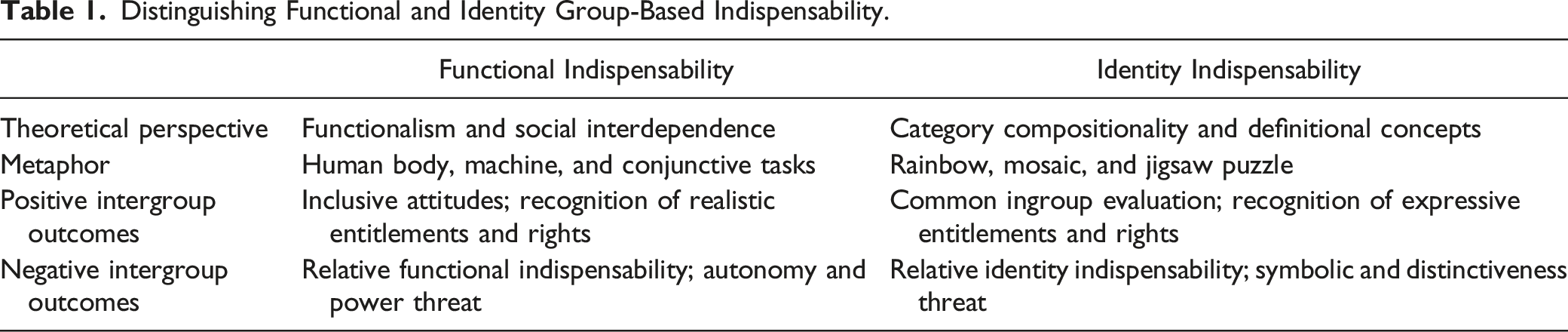
Functional Indispensability
In sociology, functionalist analyses view a social system as being made up of interrelated and interacting parts whereby the parts have consequences for the whole system or some other parts of it (Durkheim, 1933; Merton, 1957; Parsons, 1952). The focus is on the contribution that a social practice, group, or institution makes to the working of the community or society as a whole. For example, the sociologist Durkheim (1933) uses the term organic solidarity to refer to a society in which individuals need each other’s services: a society in which there is a relatively strong division of labor, with individuals functioning much like the differentiated and indispensable organs of a living body.
Society is seen as a set of differentiated and indispensable parts which together form an organized whole and this corresponds to social psychological research on functional relations between groups and social relations of interdependence (Johnson & Johnson, 2005; Van Lange & Balliet, 2015). There is substantial psychological literature on theories of social interdependence that were originally developed by Deutsch (1949) and Thibaut and Kelly (1959) based upon the work of Gestalt Psychologists and Kurt Lewin (1948) who proposed that the essence of a group is the interdependence of its members. The concept of interdependence is very broad and includes many topics related to social interaction. In general, social interdependence exists when the goals, tasks, or outcomes of individuals are affected by each other’s actions which can either promote or obstruct goal achievement (Johnson & Johnson, 2005). There are different ways in which individuals affect each other’s actions and thus different types of social interdependence, and not all imply functional indispensability. Yet, in some situations people necessarily need each other to do things and achieve goals that matter. An example is conjunctive tasks in which the efforts of all individuals are indispensable, and the contribution of the “weakest link” determines group success (e.g., Larson et al., 2018). Further, in educational contexts cooperative peer learning procedures seek to create situations in which students are dependent on one another for providing specific information and learning the material.
Social interdependence theories focus on interpersonal relations and intragroup dynamics and are widely applied in education (forms of cooperative learning) and business and industry (e.g., team-based organization). Yet, members of different groups (intergroup) can also be fully dependent on each other for achieving a jointly desired organizational, institutional, or societal objective. Real innovations can be considered to depend on having an organization with different teams working together (Van Knippenberg, 2017), successful organizational integration (mergers and joint ventures) depends on the integration partners being seen as making an indispensable contribution to the integrated organization (Wermser et al., 2018), common-goal interdependence contributes to intergroup contact that reduces outgroup prejudice (Allport, 1954; Pettigrew & Tropp, 2011), and important decisions in the EU or other international bodies require that all countries or parties agree.
Additionally, the notion of indispensability is not only used in the context of intergroup contact and intergroup interdependence but also in a broader functional sense. For example, people can have a general belief in the instrumental value of cultural diversity (e.g., “A society that is diverse functions better than one that is not diverse”) which is associated with more positive outgroup attitudes and lower perceived outgroup threat (Kauff et al., 2021). Further, some actions, things, or groups might be considered functional indispensable for reaching an objective or doing a task without necessarily involving a situation of social contact and interdependency. Immigrants and minority groups can be perceived as being indispensable for the functioning and prosperity of society by doing particular jobs in separate sectors of the economy. In historical Japan, for example, the Burakumin or “untouchables” used to live in segregated and marginalized communities made up of laborers working in occupations that were considered impure or related to death, such as slaughterhouse workers, executioners, and undertakers. Although the work that they did was indispensable for the functioning of Japanese society, they faced severe forms of ostracism. Other examples are Blacks during slavery, Black South Africans during apartheid, and the so-called untouchables in India.
Identity Indispensability
Categories can be understood in different ways, such as in terms of necessary defining features, family resemblance, a graded category structure, and complementarity and compositionality (e.g., Kamp & Partee, 1995; Rips & Collins, 1993; Rosch & Lloyd, 1978). For example, following the work of Rosch (1978) on category fuzziness, Self-Categorization Theory (Turner et al., 1987) argues that categories have an internally graded structure and that “objects,” people, or subgroups differ in the extent to which they are perceived to be representative, or prototypical, of a category: a robin is considered to exemplify the category of birds better than a penguin. A prototype defines the nature of the category best, like a figurative painting in which the figure expresses or embodies the meaning of the picture.
However, categories are not just prototypes and category features tend to form multidimensional structures contributing to compositional meanings (Del Pinal, 2016; Del Pinal & Spaulding, 2018). Categories can be conceptualized as cognitive dependency networks in which the category meaning is not only determined by the degree of typicality or centrality of a particular feature but also by the way in which the various features depend on each other. Categories can form collections of complementary parts, and complementarity is a constitutive aspect of compositional categories that are more like abstract paintings in which all parts are necessary and therefore indispensable because it is their relationship that determines the meaning of the whole. Here, category membership is not so much determined by prototypical similarity or “best exemplar” resemblance but rather by compositional indispensability. In cognitive psychology, the notion of compositionality states that the meaning of the whole is always a function of the meanings of its parts (Fodor & Lepore, 1996; Osherson & Smith, 1981; Prinz, 2002). A category representation is compositional if the content of a compound representation depends on the contents of its complementary parts, like the separate words that make up a phrase. Similarly, social category members may be considered as combinable into the composition of a larger unit, like a “team-type” category (Sacks, 1972). This is the case with the players composing a soccer team, or with members of a family, as well as with social categories that can be metaphorically represented as a mosaic, fruit salad, or jigsaw puzzle. In these representations, some pieces might be more prototypical than others but when one piece is missing the picture is incomplete, like a missing piece in a jigsaw puzzle. Thus, all the different pieces are indispensable for defining the identity of the compositional whole. In contrast to organic solidarity, Durkheim (1933) distinguishes mechanical solidarity in which members of a society have common values, beliefs, and roles, similar to physical molecules that cohere in a solid whole (see also Haslam, 2004).
The metaphor of a jigsaw puzzle, fruit salad, or a mosaic is also applied to superordinate unions and multicultural societies when these are considered to be made up of different but complementary groups. In this case, some groups might be considered more prototypical, but none of the groups represents the picture in its entirety, and therefore all groups are considered an indispensable part of society. For example, the European Action Week Against Racism (March 15–23, 2014) had an information package which showed Europe as a big unfinished jigsaw puzzle and it was explained that “Combining all different pieces we show that we do fit together.” The metaphor of a jigsaw puzzle was used to emphasize that Europe and the European nations are made up of different but complementary cultural groups that all are indispensable defining parts of the community.
Furthermore, a study in Mauritius demonstrated that all ethnic groups are considered to be indispensable for making up the “fruit salad” or “rainbow nation” of Mauritius (Ng Tseung-Wong & Verkuyten, 2010). Likewise, the late Desmund Tutu coined the term “rainbow nation” to describe post-apartheid South Africa of which all racial and ethnic groups are an intrinsic part. Further, research has shown that although Maori’s in New Zealand are viewed as less prototypical New Zealanders by dominant group standards, it is not denied that they are an intrinsic and indispensable part of New Zealand. Without them, New Zealand would no longer be the same (Sibley & Liu, 2007).
Positive Implications for Intergroup Relations
In an interview study (Verkuyten, 1997) one of the Dutch interviewees said in relation to migrant laborers: “we might need them to do the cleaning and so on, but that doesn’t make them one of us, that doesn’t make them Dutch.” This illustrates that perceived functional indispensability and identity indispensability can differ from each other. The situation of the Burakumin in Japan, Blacks during slavery, and the negative stereotypes about economically indispensable immigrants are further telling examples (Wagner et al., 2010). One might acknowledge immigrants’ indispensable functional contributions, but without considering them full citizens of the nation. Conversely, one might admit that all ethnic groups make up the rainbow nation, yet still consider some groups as being more indispensable for the national economy and prosperity. Similarly, one might consider a specific department indispensable for the functioning of a business enterprise, but less so for the corporate identity, and vice versa.
The level of perceived indispensability describes the degree to which particular groups are considered necessary for the functioning or for the identity of the overarching whole. Perceived indispensability is shaped by the nature of the intergroup context, similar to the content of social stereotypes (Cuddy et al., 2008). Research in the context of Portugal (Guerra et al., 2015) indicated that immigrant groups with a colonial past (Brazil and African countries) were consider more indispensable for defining the national identity than Ukrainian immigrants. Furthermore, for the former groups, higher perceived identity indispensability was related to lower social distance towards these groups, whereas higher functional indispensability was associated with reduced social distance towards Ukrainians. In another research, measures for perceived functional indispensability and identity indispensability were developed and tested in the context of the United States (Guerra et al., 2016). Although positively related, both forms of indispensability were found to be empirically distinct and African Americans were perceived as having higher identity (vs. functional) indispensability, whereas Asian Americans were considered to have greater functional (than identity) indispensability.
Higher perceived minority group indispensability (“we need them”) is related to more positive outgroup attitudes and higher support for minority rights. Findings from different national contexts such as the Netherlands (Verkuyten et al., 2014), the United States (Guerra et al., 2016), Malaysia (Verkuyten & Khan, 2012), and Portugal (Guerra et al., 2015) demonstrate that majority members’ stronger perceptions of minorities being indispensable for the identity or the functioning of the nation go together with lower outgroup negativity and a stronger support of minority entitlements and rights.
Majority members can realize and recognize that the success and thriving of their ingroup, or society as a whole, is intertwined with the contributions of minority groups. This might reshape intergroup power dynamics and stimulate a willingness for compromise and higher support for equality and inclusion of minority groups. In addition to reasons of collective self-interest (functional indispensability) and collective self-continuity (identity indispensability), there may be several other reasons for the positive outgroup findings. Here, I will briefly discuss three of these reasons that have been examined empirically as additional underlying mechanisms. The first two correspond with the information package and unfinished jigsaw puzzle of the European Action Week Against Racism in which it was explained that recognizing diversity implies a sense of common belonging and that “diversity means seeing your surroundings from different perspectives.”
Common Belonging
A first reason is that perceived indispensability stimulates the sense of belonging to a shared compound. According to the common ingroup identity model, (former) outgroup members will be evaluated more positively when they are seen as part of a shared superordinate category through processes that involve pro-ingroup bias (Gaertner & Dovidio, 2000). For example, research has found that common group identity among majority members increases support for economic, political, and judicial measures to include immigrants, and social actions favoring minority members (Kunst et al., 2015). The common ingroup identity model identifies various antecedents of categorization into a shared category. Specifically, it is argued that different types of functional relationships and intergroup interdependence influence individual’s cognitive representations of the superordinate category. For example, a sense of common belonging can be achieved by intergroup cooperation, interaction, and by perceptions of shared fate, similarity, and entitativity (Dovidio et al., 2007). Perceived indispensability of a particular subgroup for the superordinate category can also be expected to lead to a stronger sense of common belonging. In line with this reasoning, research has found that higher perceived identity indispensability of immigrants is associated with a stronger sense of common belonging which, in turn, is associated with higher acceptance of immigrants’ rights (Verkuyten et al., 2014).
Deprovincialization
A second reason for why perceived indispensability is related to reduced outgroup prejudice is that the perception of indispensability stimulates outgroup understanding (Fiske, 2000) as well as a critical reflection on the ingroup. When minority groups are considered indispensable this can heighten majority members motivation to understand these groups and to develop a less ingroup centric worldview (Pettigrew, 1997). Relative to members of ethnic minorities, majority group members are generally less inclined to show an interest in outgroups and to reflect on their ingroup’s privileged position and worldview, and to consider the social world from different perspectives (Doane, 1997). The perception of indispensability of minority groups and newcomers may be associated with more knowledge and appreciation of group differences, and with a heightened awareness of the normative status of one’s ingroup. It might broaden people’s horizon by acknowledging and recognizing the value of other perspectives and contributions, and thereby put the taken-for-granted own normative standards into perspective. This reappraisal of the ingroup has been described as interactive pluralist multiculturalism in sociology (Hartmann & Gerteis, 2005) and as deprovincialization in social psychology (Pettigrew, 1997). Higher perceived outgroup indispensability has been found to be positively related to deprovincialization and, via deprovincialization, to the acceptance of minorities’ cultural expressive rights (Verkuyten et al., 2022).
Collective Ownership
Perceived outgroup indispensability might also lead to more positive intergroup relations because of a weaker sense of ingroup psychological ownership. Collective ownership involves the feeling that something is “ours” which goes together with a sense of exclusive control over what is (perceived to be) owned and the right to determine what happens with it (Pierce & Jussila, 2011; Verkuyten & Martinovic, 2017). Ownership structures social situations and defines social relationships in terms of who does, and who does not, have the right to use, change, give away, exploit, or sell the things that are owned (Blumenthal, 2010). A stronger sense of psychological ingroup ownership goes together with more negative outgroup attitudes and the exclusion of outsiders and newcomers (see Martinovic & Verkuyten, 2023). Yet, there is also the possibility of perceived shared ownership which has been found to be associated with, and to experimentally cause, greater willingness to reconcile intergroup conflict and higher support for joint political decision-making in which parties work together to resolve issues of conflict (e.g., Storz et al., 2022). Perceived outgroup indispensability can lead to lower exclusive ingroup ownership and stronger shared ownership: when a minority outgroup is considered indispensable for the functioning or identity of the overarching category, majority members may feel a lower sense of exclusive ingroup control and entitlement. In a study among native Dutch participants, it was found that higher perceived functional indispensability and perceived identity indispensability of ethnic minority groups were both independently associated with a lower sense of ingroup ownership of the country, which, in turn, was related to more positive minority outgroup attitudes (Verkuyten, 2022). Further, in organizational contexts it has been found that perceived functional indispensability of a team increases feelings of shared ownership which, in turn, is positively associated with team members engagement in promotive behaviors (Alves, 2020).
Negative Implications for Intergroup Relations
Social interdependence can not only be positive in promoting the achievement of joint goals but also negative when individual actions obstruct the achievement of these goals (Johnson & Johnson, 2005). Social interdependency can lead, for example, to social comparisons with oppositional feelings and actions (Deutsch, 1949). Further, empirical research on cooperative peer learning procedures shows mixed results on students’ achievements, interests, relatedness, and social attitudes (e.g., Roseth et al., 2019). Among other things, these mixed findings have to do with the different motives that are triggered by the type of interdependence. For example, making students interdependent in terms of desired outcomes has more enduring and positive implications than making them resource interdependent (Johnson & Johnson, 2009). The latter situation tends to increase the likelihood of normative social comparisons and competition and can motivate students to try to obtain what they need from others while minimizing their own contributions. Hence, for giving a balanced and nuanced account, possible negative implications of perceived group indispensability should also be considered. Here I discuss the topics of relative ingroup indispensability, threats, and minority separatism.
Relative Ingroup Indispensability
People can not only perceive an outgroup as less or more indispensable for the identity and functioning of the overarching whole but also consider their ingroup’s indispensability. The degree to which the ingroup and the outgroup are considered indispensable is likely to differ in an ingroup favoring way. After all, perceiving the ingroup as relatively more indispensable for society compared to an outgroup implies a favorable ingroup differentiation that contributes to a positive social identity (Tajfel & Turner, 1979). For example, people can consider their ingroup as relatively more indispensable than the outgroup for the economy and prosperity of society, and this perception might go together with intergroup biases, claiming more ingroup entitlements, and justifying intergroup inequalities and inequities, similar as with prototypicality perceptions (Wenzel, 2004; Wenzel et al., 2016).
Empirically, the importance of relative indispensability for intergroup relations has been mainly examined in relation to identity indispensability. The ingroup projection model that is based on self-categorization theory (Wenzel et al., 2007) proposes that members of a subgroup can define a superordinate category in an ethnocentric way with their own subgroup being considered more representative of the common category than other subgroups. This perceived relative ingroup to outgroup prototypicality has been found to be related to, and to cause, more negative attitudes towards other subgroups (Wenzel et al., 2016).
Membership in compositional categories is not only, or less likely, determined by prototypical similarity but also by indispensability of its diverse and dissimilar components. This means that in addition to perceived relative prototypicality, relative indispensability might play a role in intergroup relations. Research in Mauritius (Ng Tseung-Wong & Verkuyten, 2010), Malaysia (Verkuyten & Khan, 2012), and the Netherlands (Verkuyten & Martinovic, 2016) revealed that relative ingroup prototypicality and relative ingroup indispensability are empirically distinct constructs that are both related to more negative outgroup attitudes among majority as well as minority group members. Additionally, ingroup identification was found to be related to higher relative ingroup indispensability. Thus, whereas perception of outgroup indispensability relates to more inclusive representations and positive outgroup attitudes, the perception of higher relative ingroup indispensability is reason for claiming more ingroup entitlements and demonstrating intergroup biases, especially among higher ingroup identifiers.
Outgroup Threats
There is large literature on the perception of realistic, symbolic, and other forms of outgroup threats and how these drive negative attitudes and discriminatory behaviors towards minority groups and immigrants (Riek et al., 2006). Many studies on outgroup threat have been conducted and demonstrate its critical role in intergroup relations. Additionally, there is also research on the benefits of (minority) diversity for organizations and society (e.g., Page, 2014; Van Dijk et al., 2012), and research showing that specific immigrant groups can be perceived as being relatively less or more beneficial for the receiving society which relates to weaker or stronger support for immigrant rights (Tartakovsky & Walsh, 2016, 2020).
However, perceived benefits do not have to imply perceived indispensability in which there is outgroup dependency. In some situations, majority members might react more negatively towards more indispensable minority groups because indispensability means that minorities are needed and can more easily demand equality and justice. For majority members perceived outgroup indispensability with the related minority entitlements might be threatening to their power position and the existing group-based social hierarchy. Furthermore, minorities and immigrants who assimilate to the majority culture might become an indispensable part of the national identity, but the related blurring of intergroup boundaries can pose a distinctiveness threat to a clear and strong majority identity (Guimond et al., 2010; Thomsen et al., 2008). Additionally, higher perceived outgroup indispensability implies higher dependency on the minority outgroup which for majority members might reduce a sense of collective autonomy and collective ownership and heighten a feeling of ingroup vulnerability (Kachanoff et al., 2022; Nijs et al., 2022). Research shows that increasing diversity due to immigration can lead majority group members (e.g., White Americans) to experience that their claim to represent the national identity is reduced which leads, for example, to stronger resistance to diversity and stronger support for nativist policies and political candidates (e.g., Bai & Federico, 2021; Danbold & Huo, 2022). Thus, having outcomes contingent on a minority group can not only lead to a more positive outgroup orientation but might also have backfiring effects. The more indispensable a minority outgroup is perceived to be, the more threatening that group might be, with the related negative implications for intergroup relations. Future research should systematically examine whether and when these possible backfiring effects occur.
Minority Separatism
Minority outgroups do not always try to be part of society (like, immigrants) and consider themselves to belong to the nation (like, ethnic minorities) but might also strive for greater autonomy and independence (e.g., separatist movements). From the perspective of a subgroup, there can be a situation of negative interdependence (Deutsch, 1949) in which the subgroup can only realize its goal (i.e., autonomy) when the majority fails to obtain theirs (i.e., centralized power and unity). Thus, there are intergroup situations where, for example, regional minorities strive for more autonomy or even separation from the nation-state or a superordinate category (e.g., Brexit) rather than strengthening their entitlements and rights within its boundaries (Welhengama, 1999). For example, regional groups with aspirations for greater autonomy and independence (e.g., Quebec, Catalonia, Basque country, and Scotland) are likely to strategically emphasize a lack of shared identity and downplay their interdependence to justify and support their aim of secession (Sindic & Reicher, 2009).
Subgroup separation might not be viewed as a negative intergroup outcome by some minority groups, but it can create intergroup tensions and conflicts with regional groups wanting more independence and the majority being opposed to it with trying to prevent separation from happening (Gurr, 2000). For the majority, it is difficult to let a subgroup go if it is considered indispensable for the common identity or the functioning of society (“we need them”). A minority subgroup that is considered indispensable and that wants to “break away” forms a threat to the meaning and continuity of the common identity and collective self-interests. From the perspective of many Spaniards, Catalonia is a renegade region that is an indispensable component of the national identity, for many British people Scotland is an intrinsic part of the United Kingdom, Russians can perceive Crimea and the Donbass region as belonging to Russia, and mainland Chinese consider Taiwan an intrinsic and indispensable part of communist China. Furthermore, a subgroup can be considered indispensable for functional, economic reasons with separation causing economic losses.
Majority members can be expected to express dissatisfaction with the subgroup’s separation wish for wanting to maintain a well-functioning economy and unified society (Shamir & Sagiv-Schifter, 2006). Thus, higher perceived functional indispensability and identity indispensability of the minority subgroup can be expected to be related to stronger dissatisfaction with and more opposition to subgroup separation. People who are dissatisfied with the possible separation of an indispensable subgroup can be expected to be more likely to protest against the separation and thereby try to prevent it from actually taking place (Green & Seher, 2003).
Examining these possible implications of perceived indispensability, Fluit and colleagues (2023) found that Han Chinese’ perceptions of identity indispensability and functional indispensability of Tibetans and Uyghurs were associated with greater dissatisfaction and higher willingness to engage in political action against these groups’ separatist movements. This finding was replicated among diverse samples of Dutch participants and their perceptions of the UK’s departure from the European Union (“Brexit”) and experimentally in relation to a possible “Frexit” (France leaving the EU). Thus, higher perceived outgroup indispensability can make people more willing to act against minority separatist movements leading to intergroup tensions and conflicts.
Minority Group Perspective
When people work together within a group, they are quite sensitive as to whether or not their efforts are important for the group outcome. The so-called Köhler effect (Kerr & Hertel, 2011) refers to the robust finding of motivation gains of participants working on a simple weight-lifting task in dyadic, compared to individual trials. The dyadic task has a conjunctive structure in which the outcome is determined by the least capable team member. This indicates that the motivation gains observed are mainly the result of this member’s effort and contribution (Stroebe et al., 1996). Systematic replications of Köhler’s seminal work (Hertel et al., 2000; Kerr & Hertel, 2011) demonstrate motivation gains of less capable group members when the task structure made their input instrumental for group outcomes (see Weber & Hertel, 2007). One explanation of this effect is that the least capable group members feel particularly functionally indispensable for group success and this feeling affects their task motivation, independently of their group identification (Gockel et al., 2008). A sense of functional indispensability leads to motivational gains, also in task groups in which social cohesion and group identification are low (Hertel et al., 2003; Wittchen et al., 2007). In contrast, research on social loafing and free-riding suggests that these phenomena depend on members’ contributions being unidentifiable and considered dispensable, such as in disjunctive and additive tasks (e.g., Kerr & Bruun, 1983). This work is mainly about intragroup processes and individual team members, but perceptions of indispensability also exist at the intergroup level.
Minority groups and newcomers can develop understandings about the functioning of society and the overarching (national) category and can consider the indispensability of their minority ingroup. When minority members feel indispensable and attach some value to the shared (national) category and its outcomes, they are likely to have a relatively strong sense of belonging, commitment, and responsibility. Being indispensable often means being recognized, appreciated, and valued, and that others are dependent on you which makes social responsibility norms salient (“they need us”). Thus, the perception of minority ingroup indispensability might affect minority members orientation to the broader society, with high perceived minority ingroup indispensability being reason for social participation and integration and low ingroup indispensability for distancing from society. A sense of being indispensable makes it more likely that minority members develop a feeling of shared national belonging and commitment and prefer social integration. Evidence for these associations has been found in research in Mauritius, Malaysia, and the Netherlands (Ng Tseung-Wong & Verkuyten, 2010; Verkuyten, 2022; Verkuyten & Khan, 2012). For example, higher perceived indispensability of the minority ingroup for the Dutch national category was associated with stronger dual identification (e.g., Turkish Dutch) and stronger endorsement of shared national belonging (Verkuyten & Martinovic, 2016). And among minority groups in Malaysia, higher identity indispensability was positively associated with a stronger sense of national belonging and stronger endorsement of an inclusive national representation (Verkuyten & Khan, 2012). Similarly, in the context of mergers which often implies lay-offs and the termination of redundant positions, functional indispensability of low-status subgroups might be a source of job security making these groups feel more represented in a post-merger category and demonstrating higher post-merger identification. Additionally, functional indispensability might act as a protection against fear of reprises in mergers leading to higher change commitment, the expression of ideas, opinions, and suggestions about work-related issues, and improved organizational performance (e.g., Rosa et al., 2020). Perceived indispensability can go together with organizational citizenship in which there is a sense of responsibility for the organization and constructive input to managers is given.
In addition to perceived ingroup indispensability, low status minority members can also develop an understanding of whether the high status outgroup considers them indispensable for the functioning and identity of society. Recognition of their indispensability by the high status group is likely to lead to more positive outgroup feelings and attitudes. South Africa is a democratic republic representative of its Black population (∼80%) but economically and socially divided along racial lines. For example, the average annual household income for Black South Africans is about a sixth of the average annual income among white households. 3 Black resentment at continuing white economic privilege and contentious social and policy debates over issues such as racism, and cultural and economic group rights, and affirmative action are important aspects of South African society. In an experimental research among Black South Africans, it was found that the perception of White South Africans recognition of the indispensability of their Black ingroup (both functional and identity) led to more positive self-emotions (glad, proud, and happy) and more positive stereotypes and lower social distance towards Whites, whereas non-recognition of ingroup indispensability led to more negative self-emotions (upset, angry, annoyed), and more negative outgroup stereotypes and higher social distance (Martinovic et al., 2023).
Possible Tensions
Being recognized as indispensable implies that minority members can feel valued and appreciated which elicits positive emotions that go together with more positive intergroup relations. However, indispensability might also fuel intergroup tensions because it can lead to stronger minority group claim making and collective action: if “they need us” then we are in a position to make demands. The term “indispensability politics” is sometimes used in disadvantaged communities as an alternative to the politics and culture of “disposability.” 4 For low status groups that value social and political inclusion, perceived indispensability to the national identity or to the functioning of the society is likely to be associated with stronger endorsement of ingroup entitlements and demands for equal rights. In the experimental study among Black South Africans, participants were also asked how strongly they supported policies that improve their ingroups’ cultural and economic rights (e.g., “Black culture needs to receive more formal recognition in South Africa” and “There should be more Black people occupying higher positions in the South African society”). In the condition of high (functional and identity) indispensability recognition by the White high status group, participants reported more positive self-emotions which in turn led to stronger support for policies improving their rights. 5 Furthermore, among three ethnic minority groups in the Netherlands it was found that stronger ingroup identity indispensability was associated with stronger endorsement of minority expressive rights, and for Muslim minorities also with stronger support for a Muslim voice in societal and political affairs, similar to that of other religious groups (Verkuyten, 2022). Being indispensable not only makes disadvantaged group members responsible and motivated to make a contribution but also as wanting to be acknowledged, recognized, valued, and treated in an equitable way. Thus, among low status minority members higher perceived ingroup indispensability can stimulate minority claim making and normative forms of political action for achieving equal rights.
However, a possible drawback of perceived low status ingroup indispensability is more negative inter-minority relations. Perceived relative ingroup indispensability can exist among minority groups in comparison to other minorities. Relations between (immigrant) minority groups are increasingly prevalent and important in many social contexts (Craig & Richeson, 2016). For establishing positive intergroup differentiation, low status group members might perceive their minority ingroup as more indispensable for the national category than other minority groups and this may have negative consequences for their attitudes towards these other minority groups. In a research among three ethnic minority groups in the Netherlands (of Surinamese, Turkish, and Moroccan origin), it was found that participants of all three groups considered their ingroup as more indispensable for the national category than the other two minority groups (Verkuyten & Martinovic, 2016). This was strongest for the ex-colonial group of Surinamese, followed by the Turks and then the Moroccans that both have a history of labor migration. Furthermore, perceived ingroup indispensability relative to the other minority groups was associated with more negative inter-minority attitudes.
Superordinate Representations
Majority groups can more easily claim relative ingroup indispensability than minority groups, and minorities might agree. Among ethnic minority groups in the Netherlands, it was found that participants of all three groups saw their minority ingroup as less indispensable for the nation than the majority Dutch (Verkuyten & Martinovic, 2016). In non-settler European nations with their large and dominant native majority populations, it is quite difficult for minorities and newcomers to perceive themselves as equally indispensable nationals. The fact that these minority groups have a relatively short history in the country of settlement together with their small size and lower status and power presents reality constraints for indispensability perceptions, similar as for prototypicality perceptions (Waldzus et al., 2004). For the identity of the country and the functioning of society, ethnic Dutch or ethnic Germans are considered more indispensable than various minority groups. However, there are also country differences that have to do with the way in which the nation is predominantly represented and understood.
In general, the degree to which groups are perceived to be indispensable for the nation, or any other superordinate category, is likely to depend on how the nation, or common category, is understood. For example, it has been found that stronger endorsement of a civic conception of the Portuguese nation goes together with higher perceived indispensability of immigrant groups and also strengthens the relation between indispensability and positive attitudes towards African and Ukrainian (but not Brazilian) immigrants (Guerra et al., 2015). Furthermore, in a study among a national sample of the native Dutch it was found that the endorsement of civic citizenship is related to stronger support for immigrants’ rights because of a higher sense of minority functional indispensability and of identity indispensability. In contrast, the endorsement of ethnic citizenship was associated with lower acceptance of immigrant rights because of a weaker sense of functional and of identity indispensability of newcomers (Mepham & Verkuyten, 2017). In a civic conception, citizenship depends on living within the territory, following societal rules and laws, and participating actively in society. This is a more inclusive understanding than an ethnic conceptualization in which the emphasis is on native ancestry and common blood ties. A civic conception implies that all citizens are considered “one of us” and that the contributions of all citizens to society are emphasized. This makes it understandable that a stronger endorsement of civic nationhood is associated with higher perceived identity and functional indispensability of immigrants.
Relatedly, the superordinate category can be understood in a rather simple, homogenous way (“American = white” ;Devos & Banaji, 2005; Devos & Banaji, 2005; Huynh et al., 2015) or rather in a more complex and diverse way (rainbow nation; New Zealand = bicultural; Sibley & Liu, 2007). A more complex understanding makes perceived indispensability of minority groups more likely and even mandatory. When the nation, or any other superordinate category, is meaningfully represented as a constellation of differences, then all groups are necessary for the functioning of society and complementary towards the shared identity (see also Waldzus et al., 2004). Superordinate complexity might make both majority and minority members to consider the majority group as relatively less indispensable and minority groups as being relatively more indispensable with more positive intergroup relations as a result.
Discussion and Future Research
It is understandable that research predominantly focuses on understanding and reducing forms of stereotyping, prejudice, racism, and discrimination. These forms of outgroup negativity have various negative implications for social relations, for diversity and inclusion initiatives, and contribute to polarization and societal conflicts (Tileagă et al., 2022). However, there are also important factors and processes that can result in more positive intergroup outcomes, such as pro-social norms (e.g., Nook et al., 2016; Paluck, 2009), a sense of shared humanity (e.g., McFarland et al., 2012; Nickerson & Louis, 2008), and intergroup contact (Pettigrew & Tropp, 2011). Additionally, the current paper has tried to provide a theoretical perspective of the understudied construct of perceived group indispensability and how it is useful for understanding intergroup dynamics. In doing so, the focus was mainly on low status groups and newcomers in society but the notion of indispensability is potentially important in many intergroup settings, including in working teams, organizations, institutions, intergroup mergers, local communities, and superordinate unions (e.g., Hertel et al., 2000; Rosa et al., 2020; Wermser et al., 2018). For example, the notion that all subgroups are indispensable for defining a common merger identity might prove to be a critical factor in the process of company takeovers and the merging of departments. And successfully addressing climate change might require that all countries see themselves and others as being indispensable for achieving this goal. Climate change is a global issue and addressing it can be perceived as a kind of conjunctive task which depends on the efforts and contributions of all states, societies, and individuals. In contrast, the perception that one’s own contribution to addressing this global challenge is no more than a drop in the ocean and thus dispensable might lead to forms of free riding. Future research could examine whether indispensability perceptions do indeed contribute to the motivation and willingness to adopt policies and behaviors that reduce climate change.
Groups can be considered indispensable for both the functioning of the larger whole and for the definition of the common identity, and different groups can be perceived as being indispensable in different ways and to different degrees. I have discussed the emerging research on group indispensability, and future research should increase our understanding of the cultural and structural conditions and the psychological processes involved in perceptions of functional and identity indispensability. For example, it is possible that perceptions of group indispensability are less common in individualist societies in which people tend to see themselves as unique beings who make their own choices, compared to more collectivist societies in which there is the tendency to think about oneself as being socially interdependent and embedded in social networks (Henrich, 2020). Perceptions of indispensability might also differ between majority subgroups with different structural positions in society such as between those with a lower and higher socioeconomic position. People with low socioeconomic position tend to perceive more ethnic competition over scarce resources and values (e.g., Scheepers et al., 2002) and therefore might consider ethnic minorities and immigrants less as functional and identity indispensable leading to more negative outgroup attitudes. Furthermore, research could examine whether perceived outgroup indispensability improves intergroup relations in part because of changes in outgroup emotions and the content of outgroup stereotypes (Cuddy et al., 2008), in addition to the roles of common belonging, deprovincialization, and feelings of ownership.
Future research should also further examine when and why perceived indispensability has more positive or rather negative effects on intergroup feelings and behaviors. The perception of outgroup indispensability can stimulate a willingness to cooperate and compromise but might also give rise to feelings of outgroup dependency and threat. And research could examine whether and how individual difference variables such as social dominance orientation, right-wing authoritarianism, and group identification play a role in group indispensability perceptions and their intergroup implications. For example, stronger ingroup identification implies a stronger focus on the ingroup that is favored, which might make it more difficult to recognize outgroup indispensability. And for majority members with a strong social dominance orientation, minority outgroup indispensability might be threatening to their power position and the existing group-based social hierarchy.
Much remains to be learned about the meaning and role of group indispensability: about how, when, and why this construct shapes intergroup relations and how it relates to other constructs (e.g., prototypicality and interdependence) and to various theoretical approaches (e.g., social interdependence theory). For instance, perceptions of indispensability and of prototypicality do not have to be parallel processes but might be related to each other in various ways, depending on the nature of the groups and the intergroup context. Among lower status merger groups, for example, functional indispensability might stimulate relative prototypicality (representativeness) claims because of the contribution to the superordinate goals and identity (Rosa et al., 2020).
Furthermore, it is important to examine the conditions and factors that contribute to the perception of functional and identity indispensability of minority groups and whether these differ for the two forms of indispensability. It could also be examined whether perceptions of functional and identity indispensability have in part different causes, and whether and when these perceptions have independent, additive, or interactive effects on intergroup relations. For example, it might be that perceptions of functional group indispensability are more prominent in times of economic concerns, and perceptions of identity indispensability are more important for group relations when considerations of national identity dominate. Furthermore, (experimental) research could examine whether specific combinations of the two types of indispensability have a distinct impact on intergroup results, for example, the combination of high functional and high identity indispensability leading to the most positive outgroup attitudes. Additionally, it could be examined how the distinction between functional and identity indispensability differs from and relates to other relationship distinctions, such as the communal-exchange distinction that is based on different rules for giving and receiving benefits (Clark & Mills, 1993), and positive (e.g., cooperation) versus negative (e.g., competition) interdependence (Deutsch, 1949; Johnson & Johnson, 2005).
A focus on perceived indispensable contributions to society that minorities and newcomers make provides a useful addition to the large literature on the different threats that these groups are considered to pose. Such a focus can also provide novel suggestions and guidelines for strategic interventions to improve the acceptance of minority and immigrant groups. For example, many Western societies require the so-called replacement migration to offset population aging and population decline resulting from relatively low fertility rates which makes it possible to argue for the functional indispensability of immigrants. And many societies are increasingly plural which makes it possible to try to redefine society and its character in terms of its diversity in which all groups are indispensable for the national identity. Continuing demographic changes might mean that minorities and newcomers are not only discussed from the perspective of competition and threats but increasingly also form the perspective of contributions and benefits (Graf et al., 2023; Tartakovsky & Walsh, 2020). The perceptions that “we need them” and that “they need us” are likely to be important for the ways in which groups relate to each other. Hence, making the crucial contributions of minority groups identifiable and stressing and confirming their indispensability for the greater good might lead to minority recognition and more positive intergroup relations.
However, it is important to acknowledge and consider possible backlashes and negative intergroup implications that can occur. Relative ingroup indispensability in which the own group is perceived as being more indispensable than an outgroup can lead to intergroup biases. Minorities and immigrants who assimilate to the majority culture might become an indispensable part of the national identity, but the related blurring of intergroup boundaries can pose a distinctiveness threat to a clear and strong majority group identity. And minorities and immigrants that make indispensable contributions to society can be considered threatening to the group-based social hierarchy in which majority members are on the top. Thus, the notion of outgroup indispensability can contribute to a backlash against minority groups and newcomers because majority members might perceive it as threatening to their ingroup’s position and identity. These sorts of backlashes are similar to what has been found for cultural diversity ideologies (e.g., multiculturalism), but this does not mean that these ideologies cannot contribute to more positive intergroup relations (Whitley & Webster, 2019). Rather it poses the question why and when positive or rather negative outcomes are more likely, and this should be systematically examined for perceived functional and identity indispensability.
In conclusion, the current paper has tried to argue that the notion of group indispensability is theoretically important and empirically useful for understanding and improving intergroup relations in our increasingly diverse societies. This notion is potentially important in many intergroup settings, and future research should be able to increase our understanding of the processes involved in perceptions of indispensability and the reasons and conditions for its positive or negative effects on intergroup relations in a range of contexts.
Footnotes
Declaration of Conflicting Interests
The author(s) declared no potential conflicts of interest with respect to the research, authorship, and/or publication of this article.
Funding
The author(s) received no financial support for the research, authorship, and/or publication of this article.
