




Abstract
Psychology is as diverse as it is divided: For many research questions asked, different and competing theories will often exist to answer them. Despite the value of diversity, this lack of theoretical common ground has resulted in major empirical fragmentation in psychological research (e.g., a “confetti factory” of empirical trivia), but also to a lack of attention within the research process itself to theory selection (i.e., which theory to use and why?) and theoretical integration (i.e., how can one “connect the dots”?). This article aims to offer practical guidance to researchers in psychology about how to make informed decisions on theory selection and theoretical integration. To this end, I outline the ACES (Analyzing, Comparing, Evaluating, and Synthesizing) guide, which offers a process-oriented guide toward such informed decision-making. Through its four-step structure and each step’s engaging and critical lead questions, researchers actively engage in a dialog in which they systematically question and explore which theories to select (and why), and whether a synthesis of different theories is possible and appropriate. As such, the ACES guide offers a practical, theory-focused tool for researchers in psychology.
Psychology is wonderfully diverse: It hosts various philosophies of science that underlie a dazzling number of theories (Slife & Williams, 1995). Psychology is also wonderfully divided, as it lacks strong overarching theories with an agreed-upon set of common assumptions about human nature. 1 This pluralistic state of affairs has resulted in major fragmentation (Derksen, 2005; Phaf, 2020; Yanchar & Slife, 1997; Van Zomeren, 2016b) featuring a predominant reliance on empiricism in the absence of overarching theories (e.g., Ellemers, 2013; Kruglanski, 2001; Muthukrishna & Henrich, 2019; Van Lange, 2013). Indeed, Henriques’ (2019) cogently observed that “academic psychologists generally eschew philosophy and big picture thinking […], and instead focus on data gathering and experimentation” (p. 210). Others have also observed a lack of teaching on how researchers can make informed decisions about theory selection and integration (e.g., Gigerenzer, 2010; Kruglanski, 2001; Van Lange, 2013), which coincides with a focus of research-oriented curricula on teaching methods and statistics, rather than on teaching how to analyze, compare, evaluate, and possibly integrate different theories.
Is such divided diversity a problem? According to some, it certainly is. Eronen and Bringmann (2021), for example, declared a theory crisis in psychology, claiming that “psychological theories are in general of poor quality and that the focus in psychology should shift more toward developing better theories instead of (just) improving statistical techniques and practices and performing more replication studies” (p. 779). Another problem is that a fragmented state of affairs obstructs scientific progress by failing to “connect the dots” (Henriques, 2003; 2013; Meehl, 1978; 1990; Wilson, 1998; Yanchar & Slife, 1997; see Balietti et al., 2015). The argument here is that without overarching theories to interpret the fragmented output of the empirical “confetti factory,” psychological science may be nothing more than a very large storage container of empirical trivia (Muthukrishna & Henrich, 2019; Van Zomeren, 2016b)—a container divided into so many different (sub)sections 2 that one may spend a lifetime counting or easily lose count. Finally, and most relevant for current purposes, fragmentation creates practical problems for researchers. This is because the practice of research always requires an interpretative structure (i.e., both before and after researchers collect and analyze their data), and thus always—implicitly or explicitly—requires the use of theories (i.e., Slife & Williams, 1995; Yanchar & Slife, 2004). Given the observed lack of teaching in theorizing, a practical challenge for researchers trying to answer their research questions through empirical research is how to deal with the divided diversity in their field: How can one make informed decisions about which theory or theories to select, and, when possible and appropriate, how can one “connect the dots” between them?
The main aim of this article is to offer practical guidance on these questions for researchers in psychology. As such, this article does not aim or claim to directly contribute to the extant literature on fragmentation and theoretical integration (e.g., Laudan & Laudan, 1989; Matthews, 2020; Zittoun et al., 2009). Instead, I refer the interested reader to cogent reflections on the broader problems associated with fragmentation (e.g., an overabundance of studies without theory, problems with applying fragmented theories, and unbridgeable differences between theories; e.g., Ellis & Stam, 2015; Salvatore et al., 2022; Valsiner, 1999, 2006), and on potential solutions (e.g., Henriques, 2019; Teo, 2018; Valsiner, 2017; Zittoun & Cabra, 2022). My core assumption here is that, for the practice of psychological research, researchers can benefit from guidance toward informed decision-making about theory selection and theoretical integration (e.g., Ellemers, 2013; Kruglanski, 2001; Van Lange, 2013). This is because researchers’ stronger attention to and consideration of the theories they use in the research process will improve the decisions made in the research process and, for that reason, improve the quality of the research and its outcomes, including better and sometimes also more integrative theories. 3
To this end, I offer a practical tool developed to stimulate researchers to critically question and explore the theories behind their research through analyzing, comparing, evaluating, and potentially synthesizing different theories. In line with critical thinking approaches that seek to encourage researchers to critically question and explore what is behind their research (e.g., theories including implicit assumptions; Slife & Williams, 1995; Yanchar & Slife, 2004), the ACES guide is designed to help researchers to deal systematically with different theories relevant to their research questions, more specifically to make informed decisions about which theory or theories to select and why, and whether and how theoretical integration 4 is possible and appropriate. The guide offers a systematic four-step structure with engaging and critical lead questions for each step. By following this structure (individually, in dyads, or in small groups) and by critically engaging with the lead questions and exploring new questions, researchers enter a dialog in which they systematically and critically analyze, compare, evaluate, and possibly synthesize different theories. Engaging in this process helps researchers in psychology to make informed decisions about which theory to select, and to better understand the different theories and consider any common assumptions that may facilitate synthesis. 5 Against the backdrop of problems associated with a fragmented academic psychology, the ACES guide reflects a practical tool to help researchers in psychology make informed decisions about how to select theories, and/or “connect the dots” between otherwise separate theories (Ellemers, 2013).
Theoretical Integration as a Practical Pathway to Progress?
Theoretical psychologists have debated whether theoretical integration reflects a pathway to scientific progress, and whether psychology is a discipline that can be unified at a grander level (e.g., Goertzen, 2006; 2008; Henriques, 2003; 2013). Even here one can see considerable diversity and division: Some show ways through which the discipline can be unified (Henriques, 2003; 2013), whereas others observe a theory crisis that blocks scientific progress (Eronen & Bringmann, 2021). Some view psychology as a mere collection of psychological studies, rather than a cumulative, interpretative science (Koch, 1993), for instance, because of a lack of concrete and testable formulation of psychological theories (Meehl, 1978; 1990). Others suspect any theoretically integrative step to reflect, in reality, a choice between mutually exclusive theories (for a discussion, see Slife & Williams, 1995), and yet other others have argued for ways to make productive use of pluralism in psychology (Derksen, 2005). From a practical research perspective, I suggest that informed decision-making about theory selection and the potential for theoretical integration reflects a long-term pathway to reducing practical problems associated with fragmentation. Indeed, a typical catchphrase is that if you ask 10 psychologists the same question, you will get 10 different answers. Through encouraging informed decision-making about theoretical integration in the research process, a healthier outcome would be if those 10 psychologists would give, say, five rather than 10 different answers to the same question. A practical pathway toward getting to this healthier state of affairs may be to focus researchers’ attention on the importance of higher-quality and integrative theorizing (Gigerenzer, 2010; Kruglanski, 2001). Indeed, it is precisely because such focused attention seems largely missing in the field that it is essential to develop tools to foster informed decision-making about theoretical integration within the practice of psychological research.
The broader problem of fragmentation is well-illustrated (see Skitka et al., 2011; Van Zomeren, 2016b) by the John Godfrey Saxe poem about the six blind men of Indostan, each of whom had to identify which object was in front of all of them (an elephant). Each blind man, however, came to a different conclusion, depending on what part of the elephant he was examining (e.g., one examined its trunk and concluded this must be a snake; another examined the top of a tusk and concluded the animal must be a spear). Psychologists, one might argue are often perhaps not quite unlike these blind men: Divided by their different theories and conclusions, and often failing to identify the elephant in the room. 6
Such divided diversity is common within psychology, which is unsurprising given the diversity in philosophies of science involved, ranging from strong structuralism to situationism, and from strong determinism to strong constructionism (Slife & Williams, 1995). One can as easily encounter a psychologist who believes that the human brain is the engine of individual behavior and social organization, as one can encounter a psychologist who believes that social structures define and restrict how networks of actors humbly co-create their shared reality. One can also find Freudians, behaviorists, and humanists, as easily as you can find those who believe that the human mind—or the brain—is just like a computer that processes information. In the absence of overarching theories and agreed-upon common assumptions (e.g., about human nature), researchers often implicitly make different meta-theoretical assumptions that form the basis of very different theories (Slife & Williams, 1995).
There is also profound disagreement about how different philosophies of science relate to the empirical enterprise itself (e.g., Kellert et al., 2006; Slife & Williams, 1995). A case in point is the often-asked question of whether researchers should use quantitative or qualitative methods in research, but this division is not just about what the best set of methods is to acquire knowledge—the underlying philosophies of science are different in terms of ontology (i.e., claims about reality) and epistemology (i.e., frames for what constitutes knowledge) as well. 7 Psychology is a particularly interesting case in this respect because, despite its divided diversity and positioning between the natural sciences and the humanities, in many subdisciplines there seems to be a preference for empiricism: The belief that science works in a bottom-up fashion, from the data gathered somewhere “down there on the ground” to the insights, ideas, models, and theories built “somewhere up there in the clouds.” One likely reason for this dominant belief and preference may, ironically, be the absence of bigger-picture theories (e.g., Kruglanski, 2001). After all, if psychologists cannot agree on the conceptual basics of the scientific study of people, they are left with an awful lot of scattered data. Put differently, researchers contribute to a vast body of many tiny bits of knowledge yet without consensus on how to organize and understand this body as a whole. As a consequence, fragmentation abounds and—more often than not—empiricism rules.
I sometimes imagine fragmentation and empiricism as partners in a sobering dance, because they follow, feed, and reinforce one another. Fragmentation brings along a lack of theorizing and thus breeds a stronger predominant focus on empiricism—without strong a priori theories, there is only a posteriori data to rely on. A predominant focus on empiricism, on the other hand, brings even more data to the table, and without the skills and know how to deal with more and more diverse data, more data simply equals more fragmentation. As such, their dance is a sobering one that makes psychology even more diverse, and even more divided. In fact, they make most psychological researchers waltz on within the confines and comforts of our specific research fields and subdisciplines—the very opposite of theoretical integration. 8
The ACES Guide as a Practical Tool for Researchers in Psychology
In the practical context of doing research, a common scientific knee-jerk response within a fragmented field is to vehemently defend one’s own theory, 9 while retreating to empiricism to evaluate other theories on the basis of the methods and minutiae of the data involved. The latter is not necessarily problematic, but without necessarily really understanding other theories (i.e., as a result of systematic analysis, comparison, and evaluation), the likely outcome is that one’s own methods and data always look better than those of others that we are less familiar with. This is why critical thinking is a particularly helpful skill to learn, teach and apply to the practical research process (e.g., Yanchar & Slife, 2004)—it helps researchers to increase their understanding of different theories, and helps them to make informed decisions rather than decisions based on knee-jerk responses. This is precisely the type of critical, dialog-based process that the ACES guide seeks to facilitate through its systematic four-step structure, and through each step’s lead questions that make researchers think more deeply about which theory to select, and whether theoretical integration is possible and appropriate.
The ACES guide itself is not located in a vacuum but is embedded in the practical context of a researcher in psychology who seeks to answer research questions through empirical research. Roughly speaking, this point of departure is located at the right-hand side of Henriques’ (2019) helpful meta-physical to empirical continuum (see Figure 1). I use this continuum here to illustrate the bigger picture behind a theory used in research: When researchers, in practice, use a theory in their empirical research, they often understand it as a predictive or explanatory framework of variables and relationships between those variables, which research can then proceed to test or explore. Henriques’ continuum invites researchers to also understand the broader theoretical universe behind the theory (which corresponds, roughly speaking, to the left-hand side of the continuum). This includes assumptions about the paradigm in which the theory operates, and meta-theoretical assumptions about, for example, what people and the world are like (e.g., are people capable of altruism and free will? Does the social structure determine individual behavior?), thus stretching out into a philosophical realm that researchers in psychology are often not trained in or comfortable with (e.g., Kruglanski, 2001; Van Lange, 2013). “Unhiding” implicit assumptions behind a theory (Slife & Williams, 1995; Yanchar & Slife, 2004) is absolutely pivotal, however, for understanding the broader story behind the theory, including assumptions about what people and the world are like. The ACES guide invites, encourages and challenges researchers in psychology to discover this broader story behind their theory, as to be able to make informed decisions about which theory to select, or which theories to synthesize. Henriques’ (2019) meta-physical to empirical dimension of analysis. Reprinted with permission.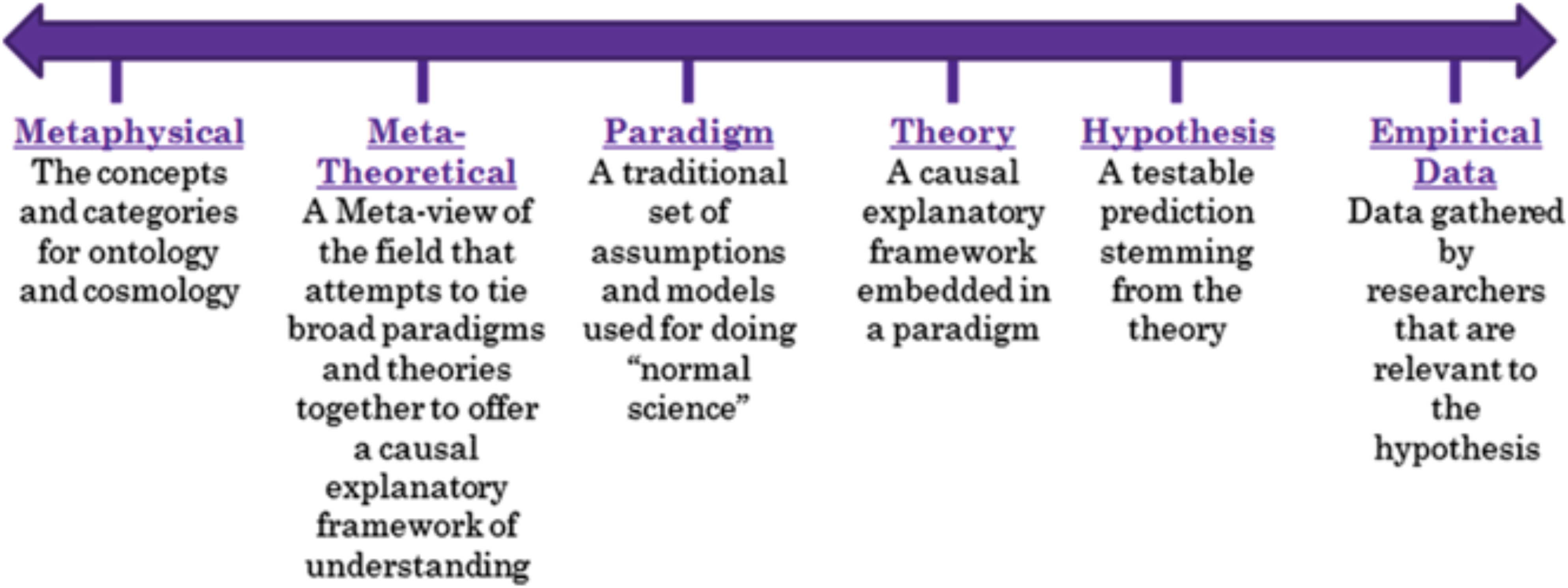
The broader story behind a theory can be questioned and explored through identifying specific assumptions found in different schools of thought that offer, for example, behaviorist, cognitivist, or Freudian views on human nature (Slife & Williams, 1995), but also broader meta-theoretical questions (e.g., is there a common meta-theory behind both theories, such as the theory of evolution?) and what Henriques calls meta-physical questions (e.g., about ontology). 10 Given the practical focus on the research process (which is contextualized and focused on answering a specific research question), the ACES guide can be helpful for improving informed decision-making toward the empirical side of the continuum, precisely because it invites and encourages researchers to ask broader questions as to gain a better understanding of a theory to be potentially used or synthesized in one’s research (see Yanchar & Slife, 2004).
Figure 2 outlines the four steps of the ACES guide, each of which offers critical yet engaging lead questions that are important to ask and answer through dialog. Using the ACES guide as a structure for dialog helps to increase researchers’ understanding of different theories, and to facilitate informed decision-making about theory selection and theoretical integration. Indeed, the Analyzing and Comparing steps facilitate a thorough understanding of the different theories involved, whereas the Evaluating and Synthesizing steps relate to decision-making informed by this understanding. I elaborate on each step and its lead questions below, assuming a practical situation in which the researcher has a research question to be answered through empirical research, and different theories are available to inform such potential answers (see also Henriques, 2019; Van Lange, 2013; Yanchar & Slife, 2004; for a direct application of the ACES guide, see Van Zomeren, 2021). ACES guide as a practical tool for researchers in psychology.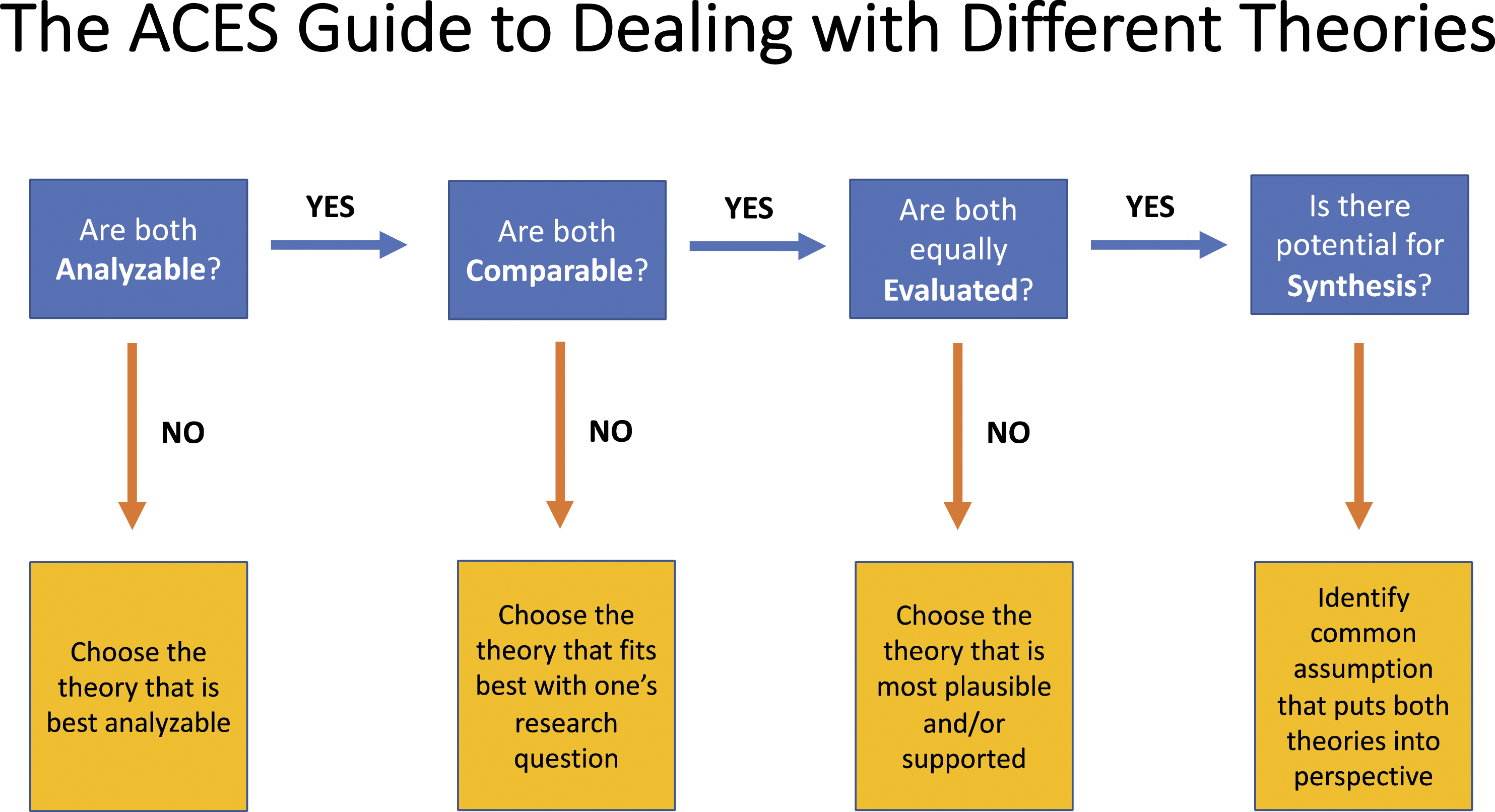
Step 1: Analyzing
Analyzing questions.
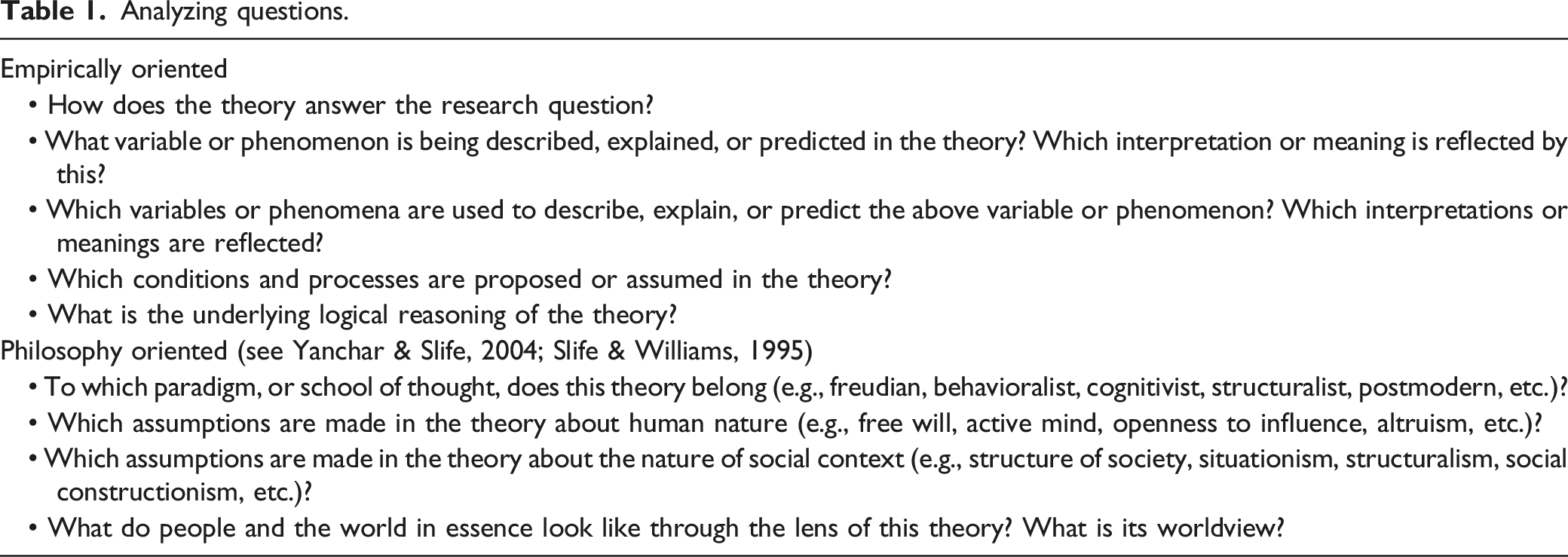
As a practical recommendation, visualizing each theory (in terms of flowcharts, boxes and arrows, or tables) helps to answer the empirically oriented questions in the Analyzing table. For example, drawing and tabling key predictions and explanations of the different theories may help understand the core of each theory and how it relates to what one wants to predict or explain. To illustrate, Van Zomeren (2021) focused on three theories of positive emotions to better understand which theory(s) would help to better understand the psychology of political action (e.g., voting and social protest; see also Van Zomeren, 2016a). To this end, these theories were visualized in figures and their content summarized in tables, which facilitated their analysis. However, if this would not have been possible to do for the theories involved, there would have been little point in considering the different theories together, and one would have to choose the theory that could be best analyzed.
Moreover, the broader stories behind the theories also require thorough understanding. In Van Zomeren’s (2021) comparison of three theories of positive emotions, one (theory of affective intelligence, see Marcus et al., 2000) took a neuroscientific point of departure, linking positive emotion in the brain to political action (e.g., political candidate support and voting). This was based in the assumption of the theory about affective primacy—the principle that basic affective processes influence cognitive information-processing that in turn influences people’s behavior (e.g., Lazarus, 1984; Zajonc, 2001). However, two other theories (appraisal theories of emotion, see Scherer et al., 2001; and broaden-and-build theory of positive emotions, see Fredrickson, 2013) conceptualized positive emotions on the basis of cognitive primacy—the principle that specific positive emotions are experienced as a function of people’s general and specific cognitive appraisals of the world around them (e.g., Lazarus, 1984; Zajonc, 2001). This helped explain why the former theory focused on only one positive emotion (i.e., enthusiasm influencing cognitive processing), whereas the others differentiated a variety of specific, and more cognitively complex, positive emotions.
Furthermore, Van Zomeren (2021) analyzed the two cognitive-primacy-minded theories in terms of their broader worldview (i.e., what do people and the social world look like through the lens of this theory?). One theory conceptualized a multitude of positive emotions but generally assumed that their experience functions simply to maintain individual well-being in the short run (i.e., a hedonic function). The other theory, however, proposed different functions for a multitude of positive emotions, their experience serving to broaden one’s cognitive repertoire (e.g., sparking creativity) and build social networks in the long run. This paints very different pictures of people in their social world, suggesting that what people emotionally experience is either essentially self-interested, or in the service of broader social networks and communities. As can be seen in Table 1, this picture can be further explored and enhanced by asking questions about whether people are assumed to have free will in experiencing those emotions, whether these are assumed to be passively or actively minded responses, and what the power and role of the social context is assumed to in the process (see Yanchar & Slife, 2004). Such critical thinking questions are very important to consider in the Analyzing phase—indeed, this formed the basis for Van Zomeren’s (2021) integrative theorizing in the context of research into positive emotions and political action.
Identifying core assumptions of each theory is pivotal in the first step of the ACES guide because, when taken together, they reflect a pattern that refers to the “worldview” of the theory (i.e., the left-hand side of Henriques’ continuum in Figure 1). This is important because Slife and Williams (1995) observe that such assumptions have clear implications once a researcher starts using a theory. For example, health interventions targeting behavior change will only help if one’s theory assumes people can change their behavior; or alternatively, one’s theory may not make this assumption but instead assume that public health can only be improved by top-down changes in social structure, which implies that psychological interventions are useless without broader structural changes; see Michie et al., 2014). Analyzing a theory will thus benefit from considering both philosophically- and empirically-oriented questions and paves the road for comparing them—the second step of the ACES guide.
Step 2: Comparing
Comparing questions.
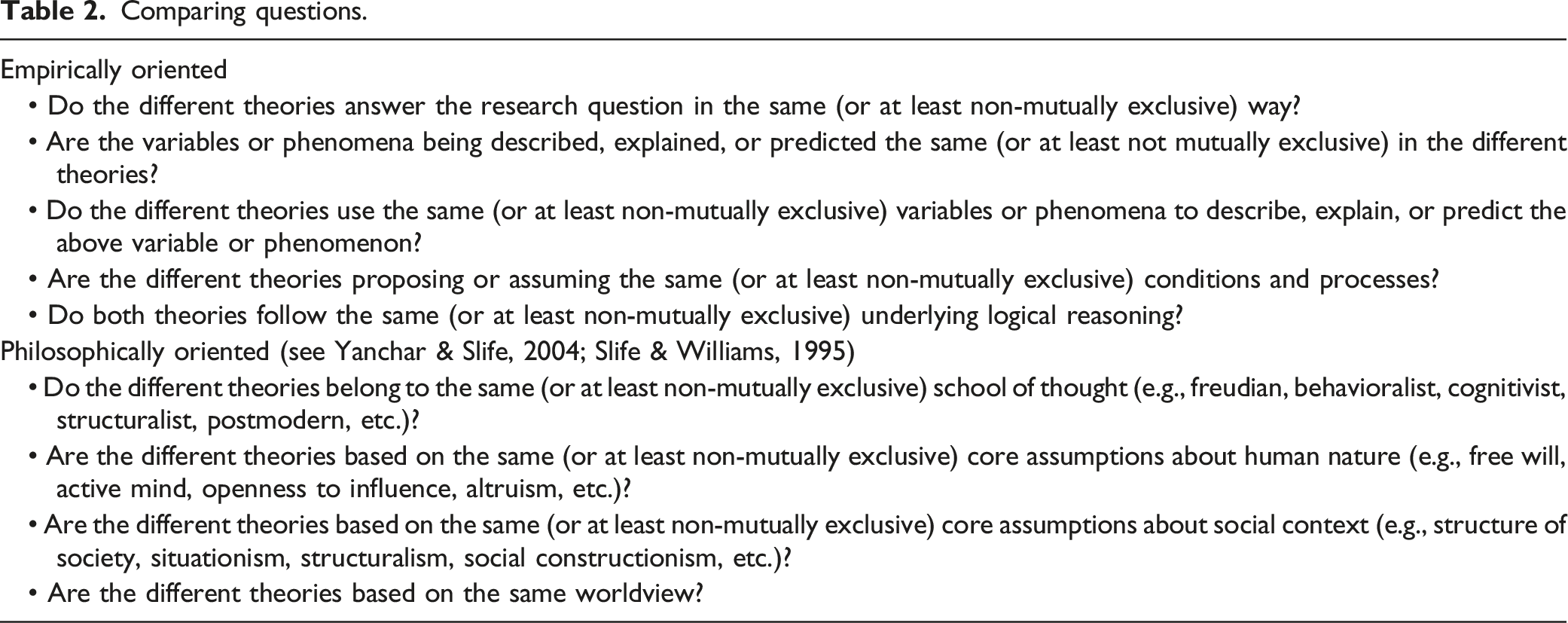
For example, combining a theory that requires altruism to explain human cooperation with another theory that denies the very existence of altruism will turn out to be a fruitless combination. Theories with such opposite assumptions operate in mutually exclusive theoretical universes. However, a theory on cooperation that assumes that people only cooperate when it is in their individual self-interest may be comparable with a theory on the role of institutions on cooperation, for instance when both theories share the same assumption that the actors involved are self-interested creatures. To illustrate, Corcoran and colleagues (2011) focused on the role of human agency in political behavior and found, in the context of the specific link between efficacy beliefs 11 and participation in collective action (e.g., signing a petition), that “efficacy increases collective action, that certain political institutions increase efficacy, and that the effect of efficacy on collective action is partly conditional on the inclusiveness of a country’s political institutions” (p. 575). This is a good example of how quite different theories (motivational and institutional) turn out to be comparable (and thus usable in conjunction) because the underlying ideas about a specific motivation (i.e., efficacy beliefs) fit with underlying assumptions about how institutions affect people’s political behavior. As such, comparability means identifying a common basis that connects the different theories.
However, in the event that this is not possible, researchers need to select the theory that fits best with the research question they pose. For example, in Van Zomeren’s (2021) comparison of three theories of positive emotions, sufficient common ground was established to proceed with two out of the three theories, as a core difference was identified between them a the third (i.e., one theory assuming affective primacy, and others assuming cognitive primacy; Lazarus, 1984; Zajonc, 2001). Such a different assumption implies having to make an informed decision about which theory or theories to select. Moreover, the analysis also offered sufficient input to compare these two theories on their key difference—their assumptions about the forms (i.e., number) and functions (i.e., hedonic and/or broaden-and/build) of positive emotions, which Van Zomeren (2021) used in the Evaluating and Synthesizing steps of the ACES guide.
Step 3: Evaluating
Evaluating questions
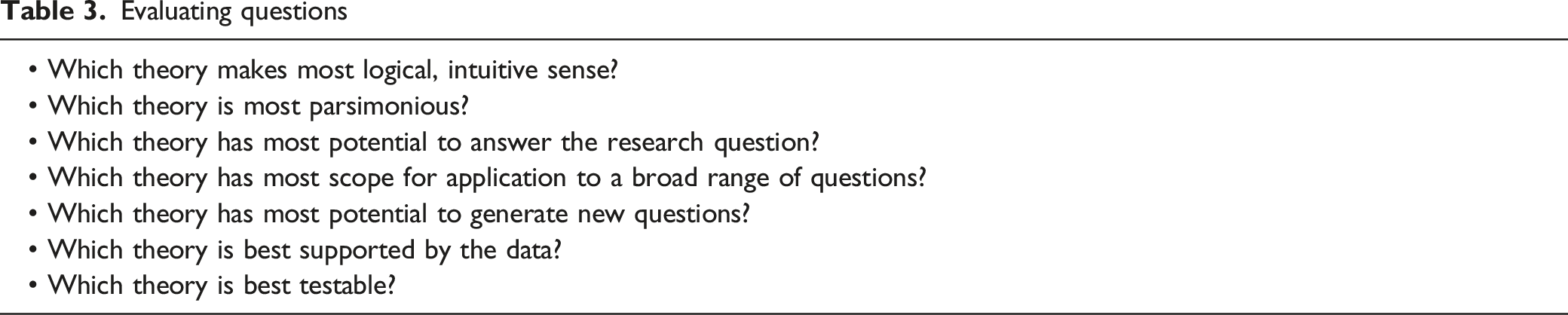
The evaluation questions thus imply taking a stance on which theory is to be preferred. 12 However, please note that the ACES guide invites reflection among researchers on which criteria are relevant for evaluating different theories on the topic. For instance, in Van Zomeren’s (2021) evaluation of three theories on positive emotions, the conclusion was that although all theories were each considered plausible and empirically supported, the theory with the most generative potential for future research (i.e., offering new hypotheses for the field) was to be preferred over the other theories. Indeed, this was the broaden-and-build theory (e.g., Fredrickson, 2013), as this theory was able to generate the most specific predictions in terms of which specific positive emotions should motivate political action because of which broaden-and-build function.
Nevertheless, quite different scenarios are imaginable with regards to the status of different theories. For example, imagine a situation in which one theory is to be preferred on both aspects (i.e., plausibility and evidentiality). In this scenario, the practical decision to make is probably to stick with this more plausible and supported theory, and critically ask what the other theory may add to it, despite its lack of plausibility and support. One important question here will be which aspect is actually more important for the researcher’s purposes—the risky opportunity to discover something implausible, or the less risky option of gathering more data to provide more support for an already plausible theory. 13 It is important to make such decisions in an informed way, before committing to and investing in the research.
A different scenario is when two theories seem equally plausible, yet have not amassed convincing support. In this scenario, it may be important to focus on designing new research that allows both theories to be tested in conjunction (and in equal fairness to either theory). This is sometimes known as a critical test strategy, where researchers seek to set up studies in which two theories duke it out. As easy and straightforward as this sounds, there are many reasons why designing such critical tests are the very opposite of easy and straightforward. For one, critical test designs need to be near-perfect in their ability to empirically compare and evaluate the predictions of the different theories, which assumes the theories themselves have been analyzed and compared at a near-perfect level. Given these assumptions, it may not be uncommon for critical tests to be difficult to design and conduct in practice.
A very interesting scenario occurs when different theories seem equally plausible and supported. This means that researchers have at their disposal two different theories that can be analyzed, compared, and evaluated to a similar extent—two theories that, to allow me this pun just only once, have ACEd it. In this scenario, where there is both difference and common ground, this is where the potential for theoretical integration lies. This final Synthesizing step of the ACES guide, however, can only be undertaken when it is believed to be possible and appropriate.
Step 4: Synthesizing
The fourth lead question is about whether each theory shares with the other a common assumption that enables theoretical synthesis. Synthesis refers to the identification of a common assumption that in essence structures and organizes the different theories, thus making them less different at their core (e.g., Finkel, 2015; Van Zomeren et al., 2012). For instance, if one theory claims that democratic institutions increase political participation by offering citizens opportunities to participate, then it may fit with other theories that share the assumption that offering such opportunities is in line with individuals’ motivation to make use of those opportunities—for instance, through a shared assumption of self-interest.
Synthesizing questions

Van Zomeren (2021), for example, suggested that a common assumption for different theories of positive emotions was that they assume a motivational functionality of experiencing distinct positive emotions including but also moving beyond mere hedonism—people feel positive emotions not just because they feel good, but because they also help build social and psychological resources over time (e.g., Fredrickson, 2013). On this form-follows-function basis, Van Zomeren (2021) generated new hypotheses for a number of specific positive emotions to motivate political action, and others to demotivate or be irrelevant to such action.
Another example of theoretical integration is how psychological theories of group identity and emotion were synthesized by identifying a common assumption—that of perceived self-relevance. Indeed, both theories assume that people become motivated to care about group-related issues if the group is self-relevant to them (i.e., when they identify with the group, or self-categorize as a group member; e.g., Goldenberg et al., 2016; Smith et al., 2007). This is important because perceived self-relevance is a necessary part of any emotional experience—without an event being self-relevant, there is no emotion to experience (e.g., Scherer et al., 2001). Through identifying this common assumption despite their otherwise different foci (on groups or emotions), through their synthesis we can now better understand why people can feel strong emotions about events that impact their group, even if these events do not directly implicate their own individual behavior (e.g., young Germans feeling group-based guilt about Nazi war crimes).
Similarly, Kawakami and Dion (1995) observed that a theory about how people develop their group identity (e.g., what it means to be a woman) and a theory about how people respond to the injustices suffered by their group (e.g., gender discrimination) were both based in social comparisons—the core tendency among humans to compare themselves to others (to better understand their situation, or to feel better about themselves). Reasoning from that core assumption about human nature, they differentiated two types of social comparison (i.e., social comparisons within the group, and between groups) to develop a model predicting when people would perceive and feel group-based injustice most or least. This explains, for instance, why individuals may not recognize a gender pay gap—they will only perceive it if they compare what men and women earn for the same position (and this does not happen when men compare their salaries with other men, and many women compare their salaries with other women). These theoretically integrative efforts generated new hypotheses and invited further theoretically integrative efforts (e.g., Mummendey et al., 1999; Smith et al., 2007).
Another example is how researchers interested in why people engage in social protest used ideas about stress and coping (e.g., Lazarus & Folkman, 1984) to understand different findings in their own literature (Van Zomeren et al., 2012). Specifically, they found that individuals’ group-based anger predicts their participation in protest, but also their belief in the efficacy of the group to achieve its goals (i.e., whether they thought protest would be effective). They integrated these observations theoretically by proposing that both variables (group-based anger and efficacy) reflected emotion- and problem-focused ways of coping with the stress evoked by the issue they protested against (e.g., unfair treatment). As such, they used an overarching theory, based on the common assumption that people can deal with stress in different ways (by focusing on regulating emotions, or on solving the problem), leading to the motivational metaphor of protesters as “passionate economists” (Van Zomeren et al., 2012)—those passionately care about social justice yet also take their efficacy beliefs into account.
However, despite the above examples, it is important to note that theoretical integration in and of itself is not necessarily desirable. One may argue that a focus on one common assumption to synthesize two theories may come at the expense of other assumptions that, as a consequence, become less important. For example, if evolutionary theory is used to synthesize theories (Wilson, 1998) and findings about, say, gender differences in human mating behavior, then some may be uncomfortable with the priority given to this particular theory (e.g., Eagly & Wood, 1999), for example, because it comes with strong assumptions about functional differences between males and females (evolved mating strategies; e.g., Buss, 2013). One may also argue that integrative theorizing may often be more broadly applicable (a positive according to one evaluation criterion), but also less specific in its predictions (a negative according to another evaluation criterion). If the latter is more important for one’s research question, however, then theoretical integration may not be advisable. The ACES guide thus outlines a pathway toward potential theoretical synthesis but does not assume that this is always possible or appropriate in a given research context.
Implications of Using the ACES Guide in the Practice of Psychological Research
Making informed decisions about theory selection and theoretical integration in the research process helps to improve the quality of psychological theories and, through integrative efforts, to pave a pathway toward less fragmentation in psychology (Ellemers, 2013; Kruglanski, 2001; Van Zomeren, 2016b). Focusing the attention of researchers on whether, why, and how to engage in such efforts when relevant and appropriate can thus be assumed to be fruitful, particularly when considered against the backdrop of major empirical fragmentation in the field (e.g., Derksen, 2005; Eronen & Bringmann, 2021; Henriques, 2019; Phaf, 2020; Yanchar & Slife, 1997) and the lack of teaching theoretical integration in research-oriented psychology curricula that predominantly focus on methods and statistics (e.g., Gigerenzer, 2010; Kruglanski, 2001). The ACES guide offers a practical, research-focused approach toward fostering informed decision-making about theories and theoretical integration, while assuming that less fragmentation in psychology is a healthy development as long as diversity is preserved. Indeed, less fragmentation should give researchers a better shared sense of the elephant in the room and help organize the large storage container of empirical confetti snippets, so that the 10 psychologists answering the same question may come up with, say, five rather than 10 different answers. 14
Against this practical backdrop, the ACES guide offers a four-step structure with engaging and critical lead questions to offer a systematic way to stimulate dialog and avoid knee-jerk responses to dealing with different theories. For example, if the different theories cannot be analyzed and/or compared, then it will be difficult to meaningfully use them together in the same research process—a situation where two theories cannot be connected, and hence one will need to choose the one that fits best with one’s research question. If the different theories can be analyzed and compared, however, the question becomes whether one is to be preferred than the other. This is why answering the evaluating question is important, because the theories may differ in, for example, how plausible they are (a priori), and/or in how well-supported they are empirically (a posteriori).
For instance, if one theory is clearly more plausible and enjoys greater empirical support, then one can wonder what the added value of the other theory is, and on these grounds favor one over the other. If both theories are plausible but not yet have been convincingly supported, the next step would seem to be to design empirical research that offers “critical tests” of both theories. Things get even more interesting when both theories are, roughly speaking, equally plausible and supported: In this scenario, answering the question of whether the theories share a common assumption that can integrate them becomes pivotal. Indeed, theoretical integration only is a viable option when all four questions in the ACES guide are answered affirmatively, and hence the guide offers a road map toward identifying whether and when theoretically integrative efforts are possible and appropriate.
There are four other potential usages of the ACES guide that I want to mention here. For one, the ACES guide can be used to help write theory articles. In fact, Van Zomeren (2021) explicitly used the ACES structure to synthesize three theories on positive emotions and political action, which offer distinct yet mixed ideas about the form and function of positive emotions and their motivational potential for political action. Guided directly by the ACES steps, Van Zomeren (2021) offered an integrative model of distinct positive emotions and political action, which generated new hypotheses, new questions, and hence a theoretical and research agenda for this field to ponder. This reflects at least some proof-of-concept that the ACES guide offers a practical structure that may be helpful when writing theory articles.
Second, the ACES guide can be, and currently is, used as a teaching tool in research-oriented curricula. 15 The guide offers a structure around which teachers and students can start a research-focused process through dialog and exploration of questions, criteria and making informed decisions. A specific use of the guide, for example, is for students to write an essay in which students’ document and reflect on the process and outcome of theory selection and/or integration by going through the analysis, comparison, evaluate and/or synthesis steps. As students, particularly those at the master and PhD level, reflect the next generation of researchers in psychology, they will benefit from more training about theory selection and theoretical integration (see also Kruglanski, 2001; Van Lange, 2013). The ACES guide offers a resource to assist such training efforts.
Third, the guide may be relevant to use in the practice of interdisciplinary research. In fact, the animal in the room full of (blind) scientists from different disciplines is more likely a mammoth than an elephant. This is because interdisciplinary research projects face similar and likely even greater barriers and obstacles related to how to deal with different theories and the broader stories behind them. At the same time, in these cases the mammoth may be more visible to start with and “connecting the dots” seems extremely fruitful when successful. According to the logic of the ACES guide, then, in order to make interdisciplinary research more likely to succeed, one first needs to establish some form of theoretical common ground between the disciplines involved (e.g., common assumptions), either as the primary goal of the interdisciplinary research itself, or, once found, as a starting point on which to design empirical studies. This implies that researchers from different disciplines need not fall into the trap of the blind men of Indostan, as long as they go through a systematic process that enables them to make informed decisions about the different theories involved, and the potential for their synthesis. However, this requires that researchers both make and take the time needed for systematic, step-by-step dialog about each theory involved in the project.
Finally, the ACES guide may be of use in the specific process of adversarial collaboration (e.g., Cowan et al., 2020; Finkel, 2015). In this process, different researchers and research teams seek to explain why their research efforts produce opposite or otherwise different findings that often support different theories. Rather than going with the knee-jerk response to defend one’s theory, the ACES guide offers a structure around which to organize this process of exploring each theory’s potential, and helps ensure a fair and thorough understanding of each of the theories involved before making decisions. Such adversarial collaboration implies that informed decisions can be made jointly during the evaluation step, leading to new lines of joint research (e.g., Cowan et al., 2020), or even to theoretical integration that puts seemingly different theories and findings into perspective (e.g., Finkel, 2015).
Conclusion
Psychology is so wonderfully diverse and divided that it may be limiting its own progress through a lack of attention for theory selection and theoretical integration in the practice of research. To foster informed decision-making about theory selection and theoretical synthesis when possible and appropriate, this article offers a practical guide for researchers in psychology. Through its practical, systematic focus on the research process and its reliance on critical thinking as a path toward informed decision-making, the ACES guide helps psychological researchers to better understand different theories and the broader story behind them, and to make informed decisions about which theory to use. Moreover, the guide helps them to explore whether theories can be integrated. Step by step, then, and in a practical and bottom-up fashion, this process may serve to reduce the gap between the practice of psychological research and theoretical psychology, and help psychology to become less divided without becoming less diverse.
Footnotes
Acknowledgments
I would like to thank all my colleagues and students who have kindly offered their valuable feedback on this article, and particularly the students of the Theorizing Change course who used the ACES guide for writing their essays and offered valuable feedback on the practical use of the guide, and hence on its development.
Declaration of Conflicting Interests
The author(s) declared no potential conflicts of interest with respect to the research, authorship, and/or publication of this article.
Funding
The author(s) received no financial support for the research, authorship, and/or publication of this article.
