




Abstract
This paper aims at establishing a dialogue between philosophy and psychology about the conditions and the process through which humans build epistemic relationships during ontogenetic development. By the latter term, we mean any form of interaction which is aimed at producing a belief about some relevant aspects of the world, present or absent, past or future and at assessing its degree of epistemic trustworthiness. The paper is built as a dialogue between a philosopher and a psychologist, who present different faces of the problem of epistemic legitimation respectively and discuss the possible ways in which the dialogue can lead to theoretical advancement in understanding the development of the human epistemic subject. The chapter is divided into four sections: in the first section, we outline how we develop ontogenetically as epistemic subjects, and the sense that our epistemic life depends on other people’s words or testimony; in the second section, we deal with the notion of epistemic injustice and epistemic silencing; in the third section, we discuss strategies to counter epistemic silencing and; in the fourth part, we try to elaborate a synthesis and suggest a new beginning.
Opening Remarks
Human societies progressed because of the ability to cooperate epistemically. Individuals share their beliefs, transmit reliable information, and contribute to the establishment of a collective knowledge network. This collective knowledge allows each individual to come into contact with parts and aspects of the world that would otherwise be inaccessible to them. Similarly, from the perspective of individual psychological development, contact with this network of epistemic cooperation allows each person to learn a language, master techniques, form abstract thoughts and participate in social dynamics. Of course, human collective action is also led by unreliable or purposefully deceiving communication (Austin, 1975). Moreover, what is unspoken is important as well what is said: collective life is full of unspoken speech acts (Kim, 2020). Nevertheless, human activity priorities epistemic cooperation, except particular limina times—such a war or sometimes elections—in which everyday values and ethical norms are put in parenthesis.
However, the network of epistemic cooperation is affected by social obstacles. One such obstacle is social and epistemic injustice. In this case, individuals or social groups are deprived of their status as reliable epistemic agents because of their ethnicity, gender, religion, or economic status. Epistemic injustice breaks the cooperative chain and harms society and individuals in equal measure. Society is harmed because the social body ceases to have access to relevant information, while the individual is harmed because they lose their legitimate right as a subject of knowledge. What, therefore, is the relationship between epistemic injustice (Kidd et al., 2017) and psychological development (Baumtrog & Peach, 2019; Burroughs & Tollefsen, 2016; Fowzer, 2018; Klyve, 2019; Schües, 2016)? To explore this question, this paper adopts the unusual strategy of presenting a text aimed at fostering dialogue between the fields of philosophy and psychology. To this end, the text is written in the form of a dialogue, with two layers that overlap and integrate, suggesting to the reader a movement of friction, interaction, and co-construction.
We discuss the conditions and processes through which humans build epistemic relationships during ontogenetic development. By this, we mean any form of interaction aimed at producing a belief about certain relevant aspects of the world, present or absent, past or future, and at assessing the belief’s degree of epistemic trustworthiness. The paper is built as a dialogue between a philosopher (xA) and a psychologist (xB), who present different facets of the problem of epistemic legitimation and discuss the possible ways in which dialogue can lead to the theoretical advancement of our understanding of the development of the human epistemic subject.
The chapter is divided into four sections: in the first section, we outline how we develop ontogenetically as epistemic subjects, and the notion that our epistemic life depends on other people’s words or testimony; in the second section, we deal with the concepts of epistemic injustice and epistemic silencing; in the third, we discuss strategies to counter epistemic silencing; and in the fourth, we attempt to synthesize these ideas and suggest a new beginning.
The reader can choose one of two reading strategies. They either can follow the text as dialogue, reading the paragraphs as two sides of a conversation, or they can read first all the A and then all the B arguments and arrive at the joint conclusions.
1A. One of the decisive elements in the dynamics of human development is the acquisition of skills and competencies to find out about the world and share beliefs, habits, information, and knowledge. In this process, we receive from others a good portion of the ingredients that constitute our development when we learn language, when we access the memories of other generations, when we enter the world’s symbolic structure, and, of course, when we share experiences and interact with other people.
In this paper, we address this epistemic aspect of development within the context of social inequality. We start with the assumption that social inequality, as one of the features that characterize contemporary societies, not only causes people to have unequal access to social goods and resources, but may also cause another category of inequality, epistemic inequality: when people are not treated equally as agents of knowledge. One of the pathologies of epistemic inequality is epistemic injustice (Fricker, 2007). While epistemic inequality may refer to how much more (or less) one individual knows than another, because of their human and educational background, or because of their profession (e.g., as a doctor, engineer, farmer, etc.), epistemic injustice has to do with the structural conditions under which, because of their social position and ethno-racial or gender identity, certain people and groups do not enjoy the legitimate right to be recognized as epistemic agents, that is, as people who are carriers of true beliefs and, at the same time, authoritative and reliable speakers.
1B. Psychology has studied the development of individuals as epistemic subjects, looking at the way they acquire the cognitive structures that enable them to get to know the world from an early age. The most important aspect here is the attempt to understand the processes that enable the formation of a structure, and the transition from one structure to a new one. Scholars have provided various explanations of the mechanisms through which humans acquire the ability to know.
According to classical psychology, this goes hand in hand with the subject’s acquisition of autonomy. We need to progressively create distance between ourselves as knowers and the world as the object of knowledge. This process takes place through the mediation of language and social interaction. However, the weight scholars place on the role language plays in epistemic development varies. For instance, Baldwin (1915/1976) and Piaget (2013) would say that language alone cannot explain the development of cognitive structures. While scholars such as Vygotsky (1962) or Werner & Kaplan (1963) place more emphasis on symbolic mediation, principally through language, in the development of cognitive structures. Clearly, while none of these authors would deny the importance of other aspects in the acquisition of the ability to know, they place varying emphasis on the role of social interactions and the social-historical context in which the subject develops.
A developmental perspective in psychology would stress the fact that human epistemic development in ontogenesis is characterized by qualitative change in organismic continuity. According to Heinz Werner’s developmental theory, in every stage of development, something new emerges out of the old (Werner, 1919): “every state A the potential for the next qualitative transformation (non-A) is open for emergence. While classical logic enforces a binary distinction by the ‘law of excluded middle’—A or non-A, nothing ‘in between’,— development happens always ‘in-between’ of A (as already emerged) and some not yet emerged (non-A). Development entails movement towards horizons—creating novelty during that movement.” (Valsiner, 2016, p. 28)
This line of thinking is akin to an ecological and holistic perspective. In this case, the individual is always understood as part of a dynamic totality—a Ganzheit in Werner’s term—which is itself in a developmental process: “every type of wholeness, be it the wholeness of a nation [Volk], an ethnic group or the wholeness of objective goods, such as language, religion, or customs, has to be understood as an organically grown and operating totality.” (Werner, 1926, p. 7). If we take this idea seriously, it undermines the Global Northern 1 epistemology, which is based, according to de Sousa Santos (2018), on the idea of deep (structural) unity and of superficial diversity. The production of knowledge thus occurs through reductio ad unum, finding the deep unique principle beyond the apparent diversity. This is basically the Cartesian epistemology of colonialism and capitalism, which tends to identify a single universal normative principle (e.g., individual freedom) so self-evident to be unquestionable, on which basis every phenomenon must be assessed (Bhargava, 2020).
2A. The issue of the social grounding of epistemic legitimation has great practical importance. Epistemic inequality in general and epistemic injustice in particular (especially epistemic silencing), lead to the disintegration of broad epistemic communities by breaking the collaborative chain between agents and between groups. We speak of epistemic silencing when an individual’s legitimate right to speak about relevant issues is not recognized because of their social, ethnic, or gender status (Tanesini, 2016).
From a decolonial perspective, it is important to highlight that epistemic injustice and epistemic silencing is directly associated with forms of cultural domination (Mbembe, 2001; Santos, 2014; Brain, 2016; Botha et al., 2021).
2B. Until recently, psychology was interested in the way we form epistemic structures, regardless of the nature of the knowledge we create. As a mainly bourgeoise science historically emerged in the colonialist Europe, and then developed in the Global North, psychology has had a clear idea about the hierarchy of knowledge. Abstract thinking sits at the top, while emotions remain at the bottom, closer to the body, often interfering with the acquisition of knowledge and representing bias in psychological functioning. Formal logic has been the gold standard against which all cognitive functions have been assessed. As a consequence, in terms of the forms of knowledge, an asymmetry has been assumed and a hierarchy established between the various forms of cognitive development.
It is only in recent times, since the 1990s, that psychologists have acknowledged the legitimacy of the multiple forms of epistemology that characterize human cultures (Cole & Packer, 2016) and the fact that these play a functional role in relation to the environment. For a long time, assessing local epistemologies against hegemonic standards of Global North led to the undervaluing of indigenous forms of knowledge and education. The colonizer’s psychology played a functional role in the colonizing project. It took a surprisingly long time for decolonizing epistemology to be introduced into psychology (Adams, Kurtiş, Salter & Anderson, 2012).
Why Trust the Word of Others?
3A. We are epistemic agents when we employ our intellectual abilities, such as perception, memory, and reasoning, in order to satisfactorily produce ideas, beliefs, thoughts, etc. about the things around us. If we rummage through drawers looking for our keys, if we start tests in our laboratories, if we strive to understand a social problem, if we ask a pedestrian for directions, in all these cases we are epistemic agents. Our efforts here are not aimed at moral, political, or aesthetic goals; they are aimed at achieving goals such as finding the keys, getting to the “truth,” achieving an “understanding,” producing an “explanation,” acquiring “knowledge,” clearing up an issue, achieving “wisdom,” and so on—in short, they are aimed at epistemic goods.
We are epistemic agents because, on the one hand, we are reliable shapers and bearers of true beliefs, knowledge, and other epistemic goods while, on the other, we are reliable transmitters of beliefs and knowledge to other people who, in turn, are able to recognize that we are epistemic agents. These capacities and abilities apply equally to individuals and to social groups.
3B. As epistemic agents, we do not only use rational thinking, make inductive or deductive inferences, or exchange ideas with others in order to form our beliefs. We also rely on the way we are affected by others and by events, how we feel and what we desire. Since Aristotle, Western civilizations make a clear-cut distinction between knowledge and emotions, the former are the products of higher functions and the latter represent the animal aspects of human beings. Thus, all the qualities that relate to rational knowledge characterize the subject as superior, while the qualities that relate to affectivity, characterize them as inferior. Patriarchal societies have therefore used the attribution of these qualities as a means of social distinction: children, women and “savages” are characterized by the prevalence of emotionality and are therefore somehow inferior.
This represents one of the main themata in the history of Global Northern science (van Holthoon & Olson, 1987), to the extent that Miranda Fricker (2007) begins her conceptualization of epistemic injustice precisely from the point of prejudice about women being too emotional to be legitimate epistemic subjects.
4A. Moreover, the notion “epistemic,” like the notions “reasonable,” “fair,” and “beautiful,” is a normative concept that does not describe an object or an action, but rather a judgment, an evaluation, an expectation—what could be, what ought to be. From a normative point of view, the key word in our argument is reliability: meaning that we speak of reliable means to achieve epistemic goals, reliable processes of belief production, reliable agents capable of holding, and producing true beliefs. Importantly, from this normative point of view, we cannot exclude the possibility of error or epistemic failure.
Just as we trust and give credibility to our own perceptions, memories and inferences (even if these sometimes fail), we must also offer credibility and trust to other people. We have a legitimate right to believe, based on the words of others (even if they fail).
4B. Psychology developed as a science to describe the conditions for “correct” mental functioning and deviation. The normative nature of psychology is manifest in the orthodontics of mind (Tateo, 2016), an assortment of concepts such as biases, bounds, deficiencies, heuristics, and stereotypes to account for the simple fact that we do not comply with the normative view of “correct” thinking. When it comes to the development of the person as epistemic subject, we encounter a number of prescriptions about how a person ought to develop and what they should or should not do. In this sense, every educational process in human civilization is an intervention for the individual, in order to make them a legitimate subject according to a local system of values. In education, we assume that the learner must change in a specific direction. It is only when the change is socially legitimized, that we acknowledge the person as an epistemic subject. Yet, we cannot talk about “development” as a single process. There are rather different “developments” or “developing” as configurations of situated events during the life course. Cultural psychology is not interested in pure concepts, but rather in the socio-historical forms of subjective systems of beliefs, affects, and values, and how these lead to the recognition of or discrimination against the subject as epistemic agent.
5A. The Epistemology of Testimony is a field of Social Epistemology that deals with the epistemic value of other people’s words as a source of knowledge without discussing the disputes between rival testimony theories. There is an important debate to be had on this topic, but we are not interested in exploring the various arguments here. 2 For our purposes, we will only consider this aspect from the perspective of the hearer of the testimony, taking the other's word as true is granting the other person the rationality and credibility required for them to be considered an epistemic agent. Moreover, conferring authority and credibility on someone’s words is conferring cognitive conditions on them similar to our own. Thus, considering the other as someone capable of transmitting knowledge is what guarantees that we ourselves will enjoy this same legitimate right.
In order to understand this thesis about witnessing, we need to discuss how language operates as an instrument and arena for epistemic interactions. The thesis that language is a social phenomenon is a truism—there is not much controversy about it. Nevertheless, philosophers, linguists, and psychologists disagree about the nature of this phenomenon and about the necessary conditions for meaningful performance. Many claim that the idea of convention (Lewis 1969) or following a rule (Kripke 1982) is a fundamental condition of language; it is also held that speakers must master the concept of language and its associated terms, such as predicate, phrase, reference, etc.
Davidson, (1992) opens his essay “The Second Person” with an unexpected question: “How many competent speakers of a language must there be if anyone can be said to speak or understand a language?” Soon after, he resumes: “...how many speakers or interpreters of a language must there be for there to be one speaker?” (Davidson, 1992, 255-56). Addressing these questions seriously means radically changing our inquiry into the nature of language, rationality, and the conditions of signification: instead of inquiring about the abstract concept of a language or the general conditions for the use of that language, Davidson observes an empirical phenomenon and tries to understand what people are doing when they are performing meaningful acts. When we do this, when we observe the behavior of a person who performs a meaningful act, our first finding is that an act is only an act if it is meaningful to someone. Let’s call this the second-person point of view: a person expresses something meaningfully to another person with the intention that the second person will understand or interpret what they say; likewise, this second person interprets the other person’s sentences and statements because they conceive that the speaker has the intention that, as the interpreter, they will understand what the speaker says. The normative and social feature of language is revealed in this seemingly trivial fact.
On this point, from the interpreter’s point of view, it is assumed that the speaker’s beliefs, at least in the most fundamental cases, must, for the most part, be in agreement with the listener’s beliefs and must, to a large extent, be true. The only guarantee of the success of this act is that the speakers function in interaction. In this meaningful interaction, what matters is that each is in the position of speaker and can therefore provide the other person with something comprehensible and have their position recognized by the listener. This intention moves the speakers, but does not presuppose that they follow shared rules or conventions (Davidson, 1992). Speaking a language does not involve a norm that assumes the speakers are following the same linguistic rules, it simply requires each speaker to make themselves intentionally interpretable to the other (Davidson, 1992). Only those who behave in this way can communicate and enter into agreements and disagreements. But to do so, they must abide by the elementary requirements of interaction. Rather than an empirical event in which two people exchange sentences, “conversation” is therefore a model of social knowledge production.
As a normative-abstract concept, “conversion” is a concept that must be confronted with ordinary practices in human communities. In Franz Fanon (1994) and Achille Mbembe (2001; 2020), cultural colonialism has, in its assumptions, the idea that people in the colonies were morally and epistemically unreliable (they were ignorant, brutes, savages). With this, the possibility of a “conversational interaction” outside the North-North axis is broken. Thus, the maxim that “everyone is an epistemically reliable agent” and that, consequently, “everyone can participate in the conversation” applies, on a global scale, only to the colonizers.
5B. We can imagine our lifeworld as a bubble that surrounds us. When we try to form a belief about a state of affairs, we can achieve a certain degree of certainty based on our way of knowing. If we could know everything about our environment with the same degree of total certainty, from a god’s perspective, our lifeworld would assume the shape of a perfect bubble. In each direction we look, we would have full certainty about our beliefs. Instead, from experience, we know that there are some beliefs we can be completely sure about, for instance belief about our first name, and certain other beliefs we cannot 100% subscribe to, for instance, that my partner is 100% faithful. From this, we can see that the shape of our lifeworld is somehow irregular, with some regions full of certainty and others less so.
When we walk around a familiar neighborhood, we may have a 100% founded belief that our house is around that corner. When a new, unfamiliar, object enters our lifeworld, this requires us to form a new belief. This was the focus of Piaget’s epistemology: how do we ontogenetically come to shape the cognitive structures that enable us to form knowledge of the world. We may be able to do it by ourselves—when walking in an unfamiliar area or a new town we try to form a mental map of the territory. Yet, if we want to form a more solid belief, we need to validate our speculations against a different source. The first thing we might do is imagine what we might find or what the unfamiliar neighborhood might look like. Thus, imagination is the primary individual way of exploring our system of beliefs. However, this is still individual, and we cannot, indeed, reach 100% certainty, as we know from Pascal or Descartes. The most common way to do this, therefore, is by asking someone else: in an unfamiliar town we may ask a local bystander for directions.
A social reference is one of the most common forms of belief validation that human beings learn to use very early in their ontogenetic development. In this sense, the coordinated gazing at a common object seen in mother-infant interactions represents a form of knowing the world. From another perspective, we reach a higher degree of certainty about our beliefs, and the shape of our lifeworld changes once again. It is no longer an irregularly shaped bubble, but rather an ellipse in which I and the other person represent the foci.
6A. Testimony should be understood as an act of communication: communicable content refers to a proposition that expresses a speaker’s thought and is capable of being understood and interpreted by listeners (Lackey and Sosa, 2006). Testimony is a genuine source of belief or knowledge, however, the question of the reliability of certain testimonies and the possibility of offering non-testimonial reasons in certain cases remains open. Speakers of testimony should have the intention of conveying informative content while listeners, on the other hand, may consider something to be testimony, regardless of the intentions of the speaker who wants to communicate something to them.
6B. On the one hand, we must partially rely on the other’s testimony in order to build our own way of knowing. On the other, we need a method to assess the other person’s reliability before considering their testimony. When we realize how much we depend on others to form our own beliefs, we understand the need to cooperate. One solution to the question of how other people are involved in the construction of our epistemic structures is so-called socio-constructivism. Its main tenet is that we construct knowledge of the world through social interactions. There is no direct correspondence between the perception and formation of beliefs about the world. Our reality is constructed through the mediation of social interactions.
According to the General Genetic Law of Cultural Development, formulated by Vygotsky (1997), higher mental functions originate during the course of child development as forms of collective and social activity, that is, as inter-psychic functions. Through participation in social interactions with people who have more expertise (e.g., adults, or more expert peers) the child internalizes the higher-level functions that then become internal properties of the child’s thinking, that is, intra-psychic functions. Thus, depending on the nature and quality of our social relationships, the way we form beliefs about the world will vary. It is intuitive to imagine that we could learn to play football through the mediation of someone who is already able to play and by participating in football games.
It is less intuitive to think that children are able to form concepts by internalizing social interactions with someone who is already able to use such concepts. Immediately, the question arises about who is considered a more competent partner in this interaction and in relation to which domain. One might be a competent partner in football but not an expert in philosophy or in how to use language. Besides the obvious stereotype about football players, the question is that competence is a situated concept, hence, the importance of diversifying the nature of social interactions in order to develop higher mental functions.
7A. How can we objectively differentiate between speakers who are reliable or unreliable, between good informants and bad ones? Edward Craig (1990) and Bernard Williams (2002) have attempted to answer this question. Instead of starting from the necessary and sufficient conditions for the concept of knowledge, and only then identifying the particular cases in which we can say that people have knowledge, they propose to reverse this order—starting from the cases in which we intuitively attribute knowledge to other people and then establishing which conditions are necessary and sufficient for the intuitive use of the concept of knowledge.
For Craig (1990) the state of nature should include, in the most comprehensive way, the conditions that allow us to explain why the concept of knowledge is virtually omnipresent in all epistemic communities. The state of nature is the necessary condition for individuals to organize themselves collectively in order to ensure their survival, by sharing basic needs and cooperating. In the state of nature, some of these basic needs are epistemic, that is, the need to share true beliefs (and avoid false beliefs) is a survival mechanism (Botha et al., 2021).
The need to share truths and avoid falsehoods is the first of the three collective needs that Craig and Williams suggest as pillars for the construction of the epistemic life of members of a community in a state of nature. The next two needs are: (2) the need to participate in an epistemic practice in which information is shared, that is, the need for community members to be communicatively open (primarily, to be sincere) in what they say to others. The third need varies according to Williams’ and Craig’s different approaches. In Williams’ approach, the third need (3) is the need for speakers to be precise and sincere in sharing or pooling knowledge. Finally, the need presented by Craig (3′) is the need for listeners to recognize telltale properties in speakers, that is, listeners must possess the ability to properly distinguish good informants from bad ones.
Finally, we may conclude that, as solitary beings, we know very little about the world around us, and when we are members of a group, we depend on the kind of moral, political, and epistemic relationships we are able to establish in order to participate in epistemic practices.
7B. Reasoning about what other people believe is often essential for interpreting human action. How do we learn to assess others’ epistemic capabilities during our ontogenetic development? A wealth of research in developmental psychology has investigated children’s appreciation of the fact that people can hold false beliefs and that the mind can misrepresent reality. (Birch & Bloom, 2007). False-belief tasks are used to test the Theory of Mind that is the human ability to attribute mental states to other agents (Bolander, 2014). Most research on children’s false-belief reasoning has utilized some variant of the displacement task (Baron-Cohen, Leslie, & Frith, 1985), for example, the Sally–Anne task (Wimmer & Perner, 1983) in Figure 1. Sally–Anne false belief task (Wimmer & Perner, 1983).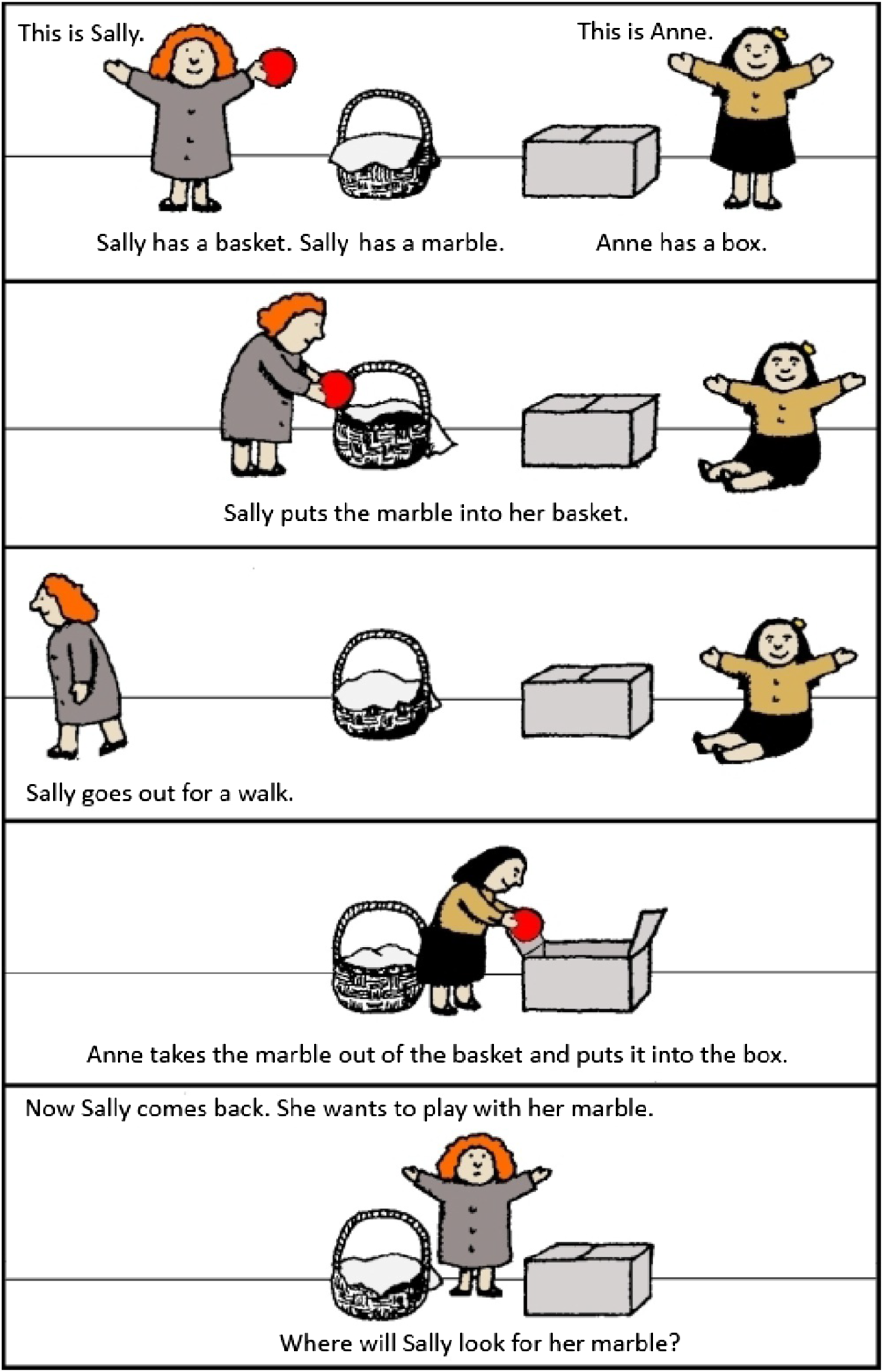
The Sally–Anne task is based on a five-step story with two characters, Sally and Anne, as seen in the five pictures in Figure 1: 0. Sally and Anne are in a room. Sally has a marble. There is a basket and a box in the room. 1. Sally puts the marble into the basket. 2. Sally leaves the room. 3. Anne transfers the marble to the box. 4. Sally comes back.
When she returns, where will Sally look for her marble? The correct answer to pass the test is “in the basket.” Since Sally didn’t see Anne transferring the marble from the basket to the box, she holds the false belief that the marble is still in the basket. If the child answers “in the box,” where in fact the marble is, the child has failed the test. Children under the age of four are unable to pass the Sally–Anne test, and the same is true for some autistic children.
By entering the mental space of the other, four-year-old children tend to do fairly well at such tasks. This means that from an early age, humans are capable of separating reality from belief. We have, then, a Theory of Mind that corresponds to the ability to attribute mental states, beliefs, intentions, etc. to oneself and to others, and to understand that others might have mental states that are different from one’s own. We are epistemic subjects capable of handling both false and true beliefs at the same time and we are ontologically social epistemic subjects, since we can do this within a complex social plot. These are foundational principals for any epistemic discourse that addresses the way in which we come to know the world.
8A. When it comes to other people’s words, it is obvious that most of the time we aren’t able to test the veracity of what they tell us or to accurately assess their credibility about the target subject—the one they are making assertions about. However, even if we are not certain of our judgment of the other person, denying beforehand what others tell us, on the pretext that we cannot have direct access to the evidence, constitutes an obstacle in the life of an epistemic community and puts all its agents at risk.
It is also common for us to distrust the veracity of other people’s words when we have a relevant reason to do so, when we have evidence that the person is involved in a logical inconsistency or a reasoning error, when they do not demonstrate possession of the basic requirements for this subject. Often, personal history can be an indication of someone’s diminished or lost credibility, such as the fact that they have been repeatedly caught lying and or have a personal interest in having their story confirmed, and so on. In general, a community shares the credibility labels that determine the circumstances under which it is not reasonable to believe someone in order to avoid the acquisition of false beliefs. However, credibility labels are subject to mismatches and inaccuracies.
In a community’s cultural history, certain linguistic uses arise from social practices that could create epistemological obstacles and distrust in relation to the credibility of certain agents. For example, considering indigenous people to be “savages” or “primitive” could establish relations that belittle or diminish the value of native peoples’ knowledge and their social organization (Mills, 2007, p. 426), while associating a person’s skin color or ethnic origin with criminal practices could mean that the statements of emigrants and blacks are afforded little value in a court of law (Fricker, 2007, p. 23). When taken not as isolated cases, but as persistent practices that endure over time and resist counterevidence, the exclusion of the voices of specific groups of people creates contexts in which a significant and important portion of a society is epistemically silenced.
Considering the decolonial perspective, we must examine the fact that historically the concept of “knowledge” is embedded in forms of domination, especially colonial domination. And with that, the cognitive-epistemic practices of the South are defined as less reliable and, in many cases, as mere belief rather than knowledge (Brain, 2016; Mbembe, 2020; Kumalo, 2021).
8B. If the development of the epistemic subject largely depends on the variety of social activities they are involved in and the type of competent partners they have, then whoever chooses the type of activities and the type of partners has the power to guide the development of the person themselves. Each culture has certain rules, based on a local system of values, to regulate children’s participation in collective activities (Rogoff, 1990). At a certain point, therefore, the Theory of Mind may be affected by the formation of distinctions between the different categories of “others.” From an early age, one can observe a progressive differentiation of the type of interactions depending, for instance, on gender. Boys and girls participate in different activities with different partners, they are partially segregated and the competences of their adult partners are different. Each culture suggests the type of knowledge, the part of the world and the type of partners appropriate to a certain gender. As a result, we learn that knowledge and beliefs are gendered: men know certain things better than women and vice versa. Thus, genders differ in their degree of competence about matters of the world. It happens that patriarchal cultures attribute forms of rational knowledge to men and emotional competence to women.
We are born in a culture that shares a set of beliefs about social relationships. From our very early days, we learn that communication is based on a form of cooperation between speakers. If we can’t assume that the other person is willing to interact cooperatively, it is impossible to start any conversation (Grice, 1975; Rommetveit, 1976). Yet we also learn, very early on, of the need to lie in social relationships (Talwar & Crossman, 2011): we learn that a society in which everybody always tells the truth would soon disintegrate. We are thus caught in the paradox of granting trustworthiness while, at the same time, assuming that the other person doesn’t always tell the truth, and nor do we. In order to solve this paradox, we may resort to various means. We may learn how to detect lies or we may use emotional and empathic competence to decide on the reliability of our interlocutor. Or we may rely upon collectively shared beliefs about the trustworthiness of certain categories of people. “Never trust car dealers and politicians!” is an example of this kind. Usually, we use a combination of the two methods: we try to assess other people’s reliability without being completely aware of the influence of shared beliefs. We are therefore surprised when we find an honest politician, a female philosopher or a foreigner who is competent in our native language, simply because we are not aware that our estimation of the probability that our partner is competent in a certain knowledge domain is actually biased by social stereotypes.
9A. Epistemic injustice describes what happens when people or groups of people lose epistemic trustworthiness because of their race, ethnicity, gender, and/or position in the social and economic hierarchy. The philosophical perspective of epistemic injustice addresses how unfair credence attribution and a monopoly on collective hermeneutic resources damage the capacity of certain agents as knowers and reliable informants. Epistemic injustice practices tend to generate active ignorance, identity bias, and intellectual arrogance which, in turn, can be the cause of failures in epistemic exchanges.
When someone loses their legitimate right to be recognized as a reliable epistemic agent they are silenced, and this causes epistemic damage that affects not only the victims of silencing, but the entire human community.
9B. It may seem as if acts of epistemic injustice are caused by our natural biases in the way we form beliefs about the other. It is of course true that the way cognitive structures are ontogenetically and sociogenetically formed leads us to erroneously attribute trustworthiness to our interlocutor on the basis of prejudice (Giffin, 1967; Sherman & Goguen, 2019). 4 Nevertheless, we have a moral responsibility to our partner in interaction which forces us to make all the effort required to make a fair assessment of the other person’s epistemic status.
10A. In relation to silencing as an epistemological problem and to the effects of epistemic injustice, Miranda Fricker (2007) describes two types of silencing generated by epistemic dysfunctions, namely, preemptive testimonial injustice and epistemic objectification.
In the former, hearers do not solicit an individual’s testimony in advance, because they mistakenly attribute deflated credibility to the authority of a speaker or group in relation to a particular topic. When they are not asked about issues that are within their epistemic domain, that individual or group is deprived of the opportunity to contribute their views to the collective understanding (Fricker, 2007, 131). We can illustrate this through the example of a sexist society. To the extent that women are excluded from participating in the collective deliberations of such a community, their voices are ignored, in advance, as sources of information, and they are, therefore, silenced.
In the second type of silencing, rather than seeing an epistemic agent as an informant (an agent who transmits information), they are merely seen as a source of information. There is an important difference between these two variations: on the one hand, an information source passively transmits in response to whatever the inquirer asks, exclusively responding to the inquirer’s interest. On the other, an informant has a sympathetic understanding of the investigator’s situation which allows them to be actively helpful (Fricker, 2007, 132).
10B. When we hold to a shared prejudice in our assessments of the other’s epistemic status, we act on the basis of a system of values we have internalized through social development, one which is deeply rooted in language (Vygotsky, 1962). In the same way that we do not think about grammar rules when we speak to others, we do not constantly question our system of values when we produce a statement. There are cases in which we deny granting a fair epistemic status to the other person with the best of intentions. For instance, we honestly believe that children cannot think for themselves and need us to tell them what to do. Education assumes that children are not fully legitimated epistemic agents. However, one can see that this attribution is based on a historical system of values, to the extent that the age of maturity has constantly changed across epochs and cultures. Every culture establishes its own parameters to assess the epistemic status of the individual over their life course. The same can be observed with elders. In different cultures and times, older people have had a range of epistemic statuses: they may be acknowledged as wise people or as losing their epistemic agency. Acts of epistemic injustice can occur to people within the healthcare system. Kidd & Carel (2019) discuss the loss of epistemic agency of someone entering a health service: once inside a hospital, the ill person’s voice may be silenced, dismissed, or ignored.
11A. When we are considered to be epistemic agents, we are distinguished from non-testimonial sources of knowledge precisely because of our ability to participate in epistemic exchanges and disputes about beliefs and dialogic reason. Although an individual may be treated as a source of information without being harmed by this—for instance, by informing a stranger of the time—being exclusively treated as a source of information is a way of restricting an individual’s epistemic capacities. As informants, we can also provide answers, calibrate our positions, and challenge our interlocutors. A socially guaranteed structure therefore needs to exist for the dynamics of dialogue to occur. Treating a subject exclusively as a source of information and ignoring their role as an agent capable of disputing reason is one way of turning them into a mere object.
The epistemic dysfunctions that produce silencing are caused by identity prejudice and interpretive gaps between participants in epistemic exchanges (Fricker, 2007). In fact, a social imaginary based on stereotypes, and a lack of resources capable of interpreting other people’s experiences, severely damage a hearers’ interpretive capacity. The beliefs acquired from the social environment, which stem from a collective imaginary that reiterates prejudices and supports biased thinking (e.g., when the fact that a defendant is black prevents a jury from considering evidence that supports their innocence), expose the crucial role played by motivations and cognitive biases in identifying the epistemic status of a person or group.
11B. It seems that our assessment of the other’s epistemic status begins before the actual interaction. Cognitive psychology’s main tenet is that our cognitive resources are limited, and we cannot process all the information we obtain from the environment at once. We must therefore rely on certain shortcuts, such as stereotypes and habits, in order to reduce process overload and knowledge fatigue. The idea of maximizing the use and minimizing the costs of cognitive resources is based on an economic view of the human mind that helps to objectify the other as a mere source of information. The socio-constructivist perspective supports the idea that our knowledge of the world occurs through social interaction in the form of dialogue (Markova, 2003). We do not merely extract information from a source, rather, we actively engage in dialogue with the other person in order to develop a shared understanding of events.
Epistemic competence can therefore be conceptualized as the capacity to contribute to dialogue, on the one hand, and to act as a good dialogical partner creating the space for mutual contributions, on the other. We are therefore reciprocally held accountable, not only for assessing the other’s epistemic competence, but also for creating the cooperative space in which the other can freely express their competence, without fear of retaliation, for example.
12A. From another perspective, in her approach to epistemic violence, Dotson (2011; 2014) distinguishes two types of silencing practices that arise from the non-reciprocity of listeners vis-à-vis speakers, namely, testimonial quietude and testimonial stifling.
Before defining these two types of silencing, we need to remember that epistemic violence is directed at a specific social group or set of individuals within a broader social whole; a group and individuals about whom there exists prejudiced, discriminatory discourse, and social practices inspired by false beliefs. According to Dotson (2011; 2014), the regularity and predictability of epistemic violence leads to epistemological systems that are harmful to particular individuals and social groups. These types of harmful epistemological systems produce what she calls epistemic oppression. Epistemic oppression refers to systems of thought (imbued with pernicious ignorance) that persistently exclude certain people or groups from contributing to knowledge production. Once excluded or marginalized, the voices of these groups are more likely to be silenced.
12B. Every time we do not actively support the creation of an arena for the expression of another person’s epistemic agency, we perform an act of epistemic arrogance. This arrogance may be based on our prejudice against their epistemic competence, but it may also arise from the social practices we usually perform. For instance, when a teacher questions their students, they may ask the type of question that implies that the correct answer is the one they are expecting.
Asking something only to ensure that the other provides the answer we desire is a form of epistemic arrogance. However, a teacher may act in this way, not because they have bad intentions, but simply because this is the usual way of acting within the school context. Questions are not posed in order to create a space for the dialogical construction of knowledge, but rather to assess whether the other has memorized the information received. When this habitual form of school practice is combined with a teacher’s prejudice against a specific social group, for example, indigenous or low-income children, it may produce the further phenomena of silencing or oppression. The teacher may treat the child as incapable of contributing to knowledge production or diminish whatever they say due to prejudice.
13A. There is more than one mechanism through which epistemic silencing takes place. Through these mechanisms, we find that members of marginalized groups may be silenced during epistemic exchanges because: (1) their testimonies are pre-emptively excluded: because they are judged by the hegemonic group to be stupid or incompetent, members of marginalized groups are not asked to participate in collective information-gathering practices (pre-emptive testimonial injustice); (2) their epistemic agency is limited: the assertions of marginalized groups are only considered valid if they come under the control of the hegemonic group, for example, by answering their questions, if the testimonies coincide with their hypotheses, etc. In this case, any attempt by members of marginalized groups to interpolate or refute them is obstructed by the hegemonic group (epistemic objectification); (3) their words are misinterpreted: knowing that they can be misinterpreted by the hegemonic group’s listeners (and may be harmed by them), members of marginalized groups choose what they share with their interlocutors and omit some of the content of their discourse (testimonial smothering); (4) their testimonies are scorned or ignored: (a) having been repeatedly associated with pernicious stereotypes or controlled images, members of marginalized groups are forced to remain quiet in epistemic exchanges with hegemonic group members (testimonial quietude); (b) arrogant individuals, who feel superior to their interlocutors, do not believe that the testimonies of those they deem inferior can contribute to knowledge, or that they themselves need to respond to possible questioning or be accountable for what they say (shyness and intellectual servility).
When, due to a distorted perception, an audience persistently fails to reciprocally respond to a speaker’s testimony, the intellectual and cultural value of these groups is undermined, causing them to remain silent. When an audience does not provide the basic conditions for speakers to be heard in their testimony, the speaker remains testimonially quiet, and their voice is prevented from being socially accepted for knowledge production, dissemination, and/or maintenance. For example, it is possible that, if a woman tries to report an irregularity in her job or aggression in the home, the authorities will not believe that she is being honest in her report.
In contrast, testimonial stifling occurs when the speaker perceives that their audience is unwilling or unable to provide the acceptance appropriate to their testimony. Aware of the state of their audience, the speaker suppresses certain information in order to ensure that their testimony only contains content for which the audience demonstrates testimonial competence, openness to dialogue, testimonial sensitivity and commitment to understanding other experiences, etc. (Dotson, 2014).
13B. Acts of epistemic violence fueled by prejudice do not occur in isolation. Over their lifetime, a person may be exposed to repeated acts of silencing, misunderstanding, and marginalization. Children of non-dominant groups can learn throughout their school years that their voice is not relevant, that their traditional knowledge is considered mere superstition, that black people are lazy and less intelligent, that women are not good at science, etc. How long will it take for them to start believing that such judgments about their epistemic competence are actually true? How long will it take for them to learn helplessness (Fincham & Cain, 1986), to learn that there is nothing they can do to avoid failure or marginalization until it becomes part of their identity?
Breaking Silencing and Psychological Development: Epistemic Agents in Democratic Settings
14A. In order to reverse silencing practices, it is necessary to undo the mechanisms through which they operate. As discussed above, active ignorance is responsible for distorting the perception of members of the hegemonic group and creating the conditions for marginalized groups to be silenced. Moreover, in the process of analyzing epistemic silencing, it is important to distinguish a hegemonic group from a marginalized one, since this serves to identify how epistemic power has been distributed within a given society’s “historical development” and “the patterns established by its social relations” (Medina, 2012, 15). In this sense, efforts to reverse silencing must consider (1) the dysfunctional properties of interpersonal interactions, that is, the flaws in epistemic transactions between individuals and (2) the “global properties of a system of rules that govern transactions and impose restrictions on the allowed rules with the aim of controlling the cumulative effects of individual transactions that may be innocent from a local point of view.” (Anderson, 2012, 164).
Including different actors in public discussions on an equal basis enables the knowledge content of different social experiences to become accessible to everyone. However, this does not mean that prejudices can be undone by the right to free speech alone. Speaking one’s mind is not sufficient for the promotion of epistemic justice (there can be false, biased, pernicious discourses, etc.), rather, clear criteria must be established for open discussions to take place and for questions to be posed that the knowers must answer, so that epistemic dysfunction may be avoided, for example, listening carefully, speaking respectfully, responding to others' contributions, showing critical self-reflection, using non-fallacious reasoning. (Catala, 2015, 436).
14B. Psychology as science and practice has been criticized for its ethnocentric and colonialist ideology. The monological discourse of psychology has served its purpose of devaluing non-Western civilizations as primitive and underdeveloped. Cross-cultural psychology still maintains a monological perspective that compares “other” cultures against the standard of Global North (basically North American) culture. The same occurred within cultures of the Global North, to the extent that sections of the population have been labeled “abnormal” or insufficient. Through the instrument of “diagnosis,” epistemic injustice has dehumanized and deprived the subject of their legitimate status of epistemic agent. In this sense, unfortunately, psychology has often functioned within authoritarian social projects to silence and marginalize certain categories on the basis of their supposed cognitive or behavioral inadequacy. As with education, psychology primarily assumes that it is the patient who needs to change, not the institution.
15A. In the deliberative democracy Catala proposes as a solution to epistemic injustice, for such epistemic justice to exist the following criteria must be met: (1) the distribution, (2) limit, and (3) control of epistemic power. (1) Distribution confers epistemic power equally among groups (everyone has the right to the status of knower); (2) limit assesses which knowledge is legitimate (through specialization, credentials, epistemic privilege, etc.); finally, (3) control forces individuals to be accountable about what they say, that is, it requires transparent reasoning in response to contestation (Catala, 2015, p.436) and the real motives and evidence that support their positions must be made public.
Similar to this position, Elizabeth Anderson (2006; 2012) advocates an epistemic democracy based on John Dewey’s experiential model. According to this model, the criteria that should be established are those of (1) diversity, (2) deliberation, and (3) dynamism (opinions). (1) diversity mandates the universal inclusion of diverse citizens (Anderson, 2012), that is, democratic decision-making requires that everyone has the right to share their concerns about how things should function in the social world; (2) deliberation concerns a kind of “mind experiment” under which solutions to questions are speculated on by trying to predict what the (favorable or unfavorable) consequences of adopting such solutions would be (Anderson, 2006, 13) and; (3) after deliberations have been put into practice, they should have the capacity to alter practices by responding to control mechanisms, such as through “periodic elections, a free press that is skeptical of state power, petitions to the government, public opinion polls, protests, public opinion about the regulations proposed by administrative agencies” (Anderson, 2006, 14). The model of democracy proposed by Dewey focuses on universal inclusion and the practical use of social intelligence as a criterion to legitimize the public interest and to allow for corrective attitudes following deliberations.
15B. We experience many situations in the course of human ontogenetic development in which we are required to assess epistemic competence, or have our own competence assessed. We soon learn to rely on the assumptions shared by our cultural community. One can empirically observe how prejudices and stereotypes are progressively internalized by children both in the family and at school.
Starting with play activities, gender stereotypes are soon made available to children in the form of modes of conduct, stories, clothes, explicit discourse about “boy” and “girl” things. Adults are genuinely concerned about children’s well-being and education. They do not think they are teaching their offspring “prejudice.” They probably just want to teach them how to be a good boy or girl and how to behave in society. However, like the family or school, all institutions set a range of acceptability/unacceptability criteria for certain forms of human development, based on the local value system. People act to guide development within this “window of acceptability.”
The parameters of what boys and girls should become, what they should know and at what age, are socio-historically determined, meaning that any given society promotes a limited range of developmental trajectories. However, no society is an internally homogeneous system. There is no single system of values and no single form of development. Hence the question: who has the power to decide what is more or less acceptable? Who is entitled to speak on behalf of whom, for a specific group or even for the entire society? Fricker’s (2007) arguments imply that every time a question like this is posed, we are in the presence of an act of epistemic injustice. Indeed, the dialogical nature of epistemic relationships implies that all partners cooperate and sincerely engage in enabling the arena for expression. Dialogue, of course, does not necessarily mean agreement. Nevertheless, no conditions, whether temporary or permanent, justify the violation of the subject’s right to be recognized as a legitimate epistemic agent.
A Synthesis and a New Beginning
16. We have taken two steps in this paper: (a) we have sought to construct the idea of epistemic inequality and injustice with an emphasis on epistemic silencing and; (b) we have exposed this problem in light of the notion of development. We have done so in the form of two layers, rather than of open dialogue. For us, this approach cannot ignore the most challenging target: how to promote epistemic justice?
The first step to answering this challenge is to find ways to expose the system of prejudices that leads to acts of epistemic injustice, whether these are conscious or not.
We have built a dialogue between philosophy and psychology in order to discuss the concept of epistemic injustice, its characteristics and how individuals internalize it during the ontogenetic process for the formation of the epistemic agent. The formation of beliefs is not an individual process but occurs in interaction with others. Not only are beliefs produced out of the relationship with another epistemic agent, but the actual cognitive structures that make knowledge possible are developed sociogenetically. Since social relationships also involve power asymmetries and boundaries, one could question the extent to which the prejudice that causes acts of epistemic injustice is a product of the way we learn to think. The case of gender differences is one example of how early in human development we may internalize prejudices based on the local system of values. We don’t even need to think about unfairly attributing a lower epistemic status to a certain gender, this is naturalized through the socially accepted discourse that women are emotionally competent (Fricker, 2007). This discourse, in itself, does not come about because of bad intentions, but it leads unreflectively to false judgments about gendered epistemic competence.
17. Philosophers and psychologists cannot promote social change because of their theories, speculations, or interpretations. However, as public intellectuals, they must work, on the one hand, to combat all forms of oppression, prejudice, and injustice in their everyday practices and in the arenas of universities and research centers. On the other hand, they must bring the issue of injustice and oppression into their research, studies, and social interventions, and they must make these issues public, demonstrate their relevance, and motivate debates with and the training of young researchers.
The new beginning is a modest but necessary one. First, the academic community must assume the multi-referential character of the urgent issues of human experience. Psychologists, philosophers, social scientists must collaborate more, dialogue more, and move through the “temperature of the human world,” the tensions of the world. Second, scholars must understand that “epistemic injustice” and “epistemic silencing” are not problems peculiar to one intellectual field. They affect everyone in all continents, urban communities and traditional indigenous communities. Injustice and silencing have a long history and are strongly linked to colonial, racist, and sexist practices. According to de Sousa Santos (2020), we need a new understanding of diversity: “we have the right to be equal when difference makes us inferior, and we have the right to be different when equality decharacterizes us.” (2020, p. 41). We need to rethink the Global North reductionist and absolutistic epistemology that still grounds social sciences and intervention in education, inclusion, therapy etc., to embrace diversity for real.
Footnotes
Declaration of Conflicting Interests
The author(s) declared no potential conflicts of interest with respect to the research, authorship, and/or publication of this article.
Funding
The author(s) disclosed receipt of the following financial support for the research, authorship, and/or publication of this article: Waldomiro J. Silva Filho would like to thank the Coordination for the Improvement of Higher Education Personnel, Brazil (Coordenação de Aperfeiçoamento de Pessoal de Nível Superior—Brasil: CAPES-PRINT)—Funding code 001 (process no. 88887.568338/2020–00) and the National Council for Technological and Scientific Development (Conselho Nacional de Desenvolvimento Científico e Tecnológico: CNPq) (process no. 311816/2019–3). Maria Virgínia Dazzani acknowledges the financial support from CNPq Brazil Grant MCTIC/CNPq no. 28/2018/process 435602/2018–7 and CAPES-PRINT Funding Code 001 (process no. 88887.568332/2020–00). Rodrigo Gottschalk Sukerman Barreto acknowledges the financial support from CAPES. Giuseppina Marsico and Luca Tateo thank the International Visiting Professor Programme of the Federal University of Bahia (Universidade Federal da Bahia: UFBA) and the financial support of the project “Under the sign of poverty: psychosocial and educational dynamics of people in economical disadvantaged social groups in the perspective of cultural semiotic psychology” funded by CNPq, Chamada Universal—MCTI/CNPq N. 28/2018.
Data Availability Statement
Data sharing is not applicable to this article as no new data were created or analyzed in this study.
