




Abstract
Our world is in a state of critical transition demanding new, creative, ecosystemically fit and sustainable responses to complex challenges. We need both new types of knowledge and new modes of knowledge production. Interdisciplinarity and Transdisciplinarity have the potential to support more congruently complex forms of knowledge (differentiated, integrated, recursive, emergent, ecosystemically fit). Their success is dependent on a deeper understanding of their own organizational complexity. In this paper, I highlight key knowledge gaps and research questions for the development of a richer knowledge base to guide the intentional management and facilitation of Interdisciplinarity and Transdisciplinary Relations toward creative and abductive outcomes. I defend the investigation of creativity and abduction, as hallmarks of the complexity of Interdisciplinarity and Transdisciplinarity, from a process, relational and complexity-informed perspective, mobilizing contributions from Psychology. I discuss Psychology’s modes of engagement with Interdisciplinarity and Transdisciplinarity in addressing complex challenges. In this context, I introduce the notion of “dissolution” as an Interdisciplinary and Transdisciplinary relational process supporting the theoretical, methodological and pragmatic enrichment or transformation and increased complexity of different disciplines, bodies of knowledge or modes of knowing. Finally, I propose a new domain for research and practice: a (“Dissolved”) Psychology of Interdisciplinary and Transdisciplinary Relations.
Keywords
There has been a growing recognition that the world as we know it is in a state of critical transition leading to unpredictable and potentially drastic changes. A number of critical global challenges (e.g., climate change; structural inequalities; global health issues; poverty; conflicts; and violence) defy our collective capacities, as humans, to build positive and flourishing futures for all (humans and non-humans) on Earth. A new type of Science 1 is required, one that is capable of embracing complexity (Boulton et al., 2015) both in the global challenges we face and within its own organization. A Science with intentional management of its own internal complexity, sustained in dynamic networks of internal and external relations, toward performing creative (Boden, 2004) and abductive 2 leaps (Magnani, 2011, 2017; Shook & Paavola, 2021) is necessary for building new theoretical frameworks, methodological approaches, interventions and educational strategies that are congruent with the complexity of the world (Melo, 2020).
Traditionally, Science has framed the problems of the world through the narrow windows of its traditional academic disciplines, which provide limiting linear and reductionist views (Capra & Luisi, 2014) and that are restricted by the hegemonic (and often oppressive) perspectives and modes of thinking of the Global North (Santos, 2018). Mainstream Psychology, as with other disciplines, has been victim of a “blind intelligence” (Morin, 1990, 2005), ignorant of its own limitations and its progressive theoretical and methodological impoverishment (Toomela, 2014). New modes of thinking, researching, and acting are required, enriched in their dialogue with a diversity of existing theoretical and methodological positions and methods, as well as other practices and modes of thinking, both within and outside the academic world (Pickren & Teo, 2020; Malich & Rehmann-Sutter, 2022; Valsiner, 2017).
Psychology, like other disciplines and Science in general, needs to be capable of evolving toward greater complexity by: increasing its own methodological and theoretical differentiation and integration; allowing for (internal and external) recursive and relational movements in order to facilitate emergence (e.g., new ideas; modes of thinking; frameworks, practices); and increasing the congruence of its contributions with the nature of the ecosystemic processes sustaining complex problems (Caves & Melo, 2018). Over the last few decades, in many domains, there were important movements toward increasing the complexity of scientific modes of knowledge production through Interdisciplinarity and Transdisciplinarity.
In this paper, I reflect on the development and current state of research on Inter and Transdisciplinarity (ID/TD) and on the complexity of interdisciplinary and transdisciplinary relations, highlighting key knowledge gaps and their implications. I establish a parallel between the development of research on ID/TD and that of change process research in psychotherapy, pointing to the need for more complex and process-focused designs in researching ID/TD. I suggest that Psychology can build upon established process-focused research approaches and enrich them with other perspectives, namely, from research on complex systems, and that it should investigate the relational conditions (i.e., contexts and processes) underlying positive, creative and abductive ID/TD. Considering the emergent nature of creativity and abduction, they can be seen as hallmarks and prime outcomes of the complexity of Inter and Transdisciplinary systems deserving of special attention, from theory, research and practice. My proposal presses for investigating creativity and abduction in these contexts, from a complexity-informed, relational and process-focused perspective.
In this paper, I describe three different modes of engagement of Psychology with ID/TD, defending that, in each of these modes, Psychology will make more meaningful and effective contributions if it adopts an Inter and Transdisciplinary stance and practices to enrich its theoretical, methodological and pragmatic capacity. I propose the need for constructing a Psychology capable of “Dissolving” itself in other disciplines, modes of knowing and practices, and of performing cyclical or recursive movements between complementary processes of “Dissolution” (which can also be internal) and “Precipitation” (Integration) within a domain and into the whole discipline.
The relevance of Psychology’s contributions to addressing the most complex and pressing global challenges may be dependent on: (i) ways in which it engages with ID/TD through different direct modes of engagement; (ii) the extent to which those engagements are performed from a more or less “mainstream” position (Toomela, 2014) or enriched through a “Dissolution” into other disciplines and modes of knowing; and (iii) its indirect contributions to ID/TD, through researching and facilitating key relational processes underlying creative, abductive and ecosystemically fit outcomes that are congruent with the complexity of the problems at hand. In this context, I propose a new domain for research and practice in Psychology: a (“Dissolved”) (Inter and Transdisciplinary) Psychology of Inter and Transdisciplinary Relations.
The Complexity of Inter and Transdisciplinarity
Inter and Transdisciplinarity: Defining the Landscapes
Although there is a lack of generalized agreement on definitions of Interdisciplinarity (von Wehrden et al., 2019), some typologies offer the possibility of a common understanding (Klein, 2017). A basic distinction is often made between Multidisciplinarity (MD), Interdisciplinarity (ID), and Transdisciplinarity (TD) (Klein, 2017). Interdisciplinarity and Cross-Disciplinarity are sometimes used, in a generic sense, as “conceptual umbrellas” to refer to an array of possibilities of interaction between different academic disciplines, while Transdisciplinarity tends to be more associated with interactions between academia and other sectors of society (Gibbons et al., 1994). Klein details different typologies within two of the broad categories defined by Organisation for Economic Co-operation and Development (OECD) in the early seventies, namely, MD and ID, distinguishing them in terms of characteristics and the degree of integration of different types (Klein, 2017). Boden had previously distinguished different types of ID, most of which could be situated within the MD typology. The same author pointed to “Integrated Interdisciplinarity” as the “only true interdisciplinarity” (Boden, 1999), defining it as “an enterprise in which some of the concepts and insights of one discipline contribute to the problems and theories of another—preferably in both directions” (Boden, 1999, p. 20). MD interactions tend to be additive and involve the juxtaposition of different bodies of knowledge, methods, or worldviews while ID promotes deeper interactions and perturbations (Klein, 2017; Bruun et al., 2015), which feedback on each other generating “synergistic outcomes” that “are more than the sum of the parts” (Lyall et al., 2011b, p. 14). In ID, the target issues are “approached from a range of disciplinary perspectives, and the contributions of the various disciplines are acknowledged and integrated to provide a holistic or systemic outcome” (Lyall et al., 2011b, p. 14).
ID projects will vary in scope and in the nature of their goals but they tend to imply some degree of integration of knowledge (Bruun et al., 2015). This integration will also vary in terms of what is integrated, how, and why (Huutoniemi et al., 2010).
TD implies processes and outcomes that “transcend” individual disciplines, and that, at the same time, “transgress them,” taking critical positions on traditional models of knowledge production (Klein, 2017; Lyall et al., 2011a). TD may also dilute the borders of academia by involving non-academic stakeholders in those processes (Gibbons et al.,1994; Nowotny, Scott & Gibbons, 2013). It also presents a more rhizomatic, hybrid, and reflexive mode of organization (Bruun et al., 2015), where the responsibility is shared in a process of co-production (Polk, 2015). According to Pohl and Hirsch, TD aims to “(a) to grasp the relevant complexity of a problem, (b) to take into account the diversity of life-world and scientific perceptions of problems, (c) to link abstract and case-specific knowledge, and (d) develop knowledge and practices that promote what is perceived to be the common good” (Pohl and Hirsch, cit. in Hadorn et al., 2008, p. 4).
The pressing need to find adequate responses to complex and “wicked” problems (Churchman, 1967) and the necessity to make the best possible decisions in conditions of considerable uncertainty and uncontrollability have, to some extent, brought ID/TD endeavors to the forefront of Science. They capitalize on the complexity of human relations and groups but also expand it, involving a multiplicity of interactions between concepts, methods, practices, worldviews, and epistemic cultures, shaped by the constraints of particular micro and macro socio-cultural environments, while also shaping them. Despite all the obstacles and pitfalls, Interdisciplinarity (Frodeman, Klein & Paycheck, 2017) and Transdisciplinarity (Hadorn et al., 2008), can make contributions to re-shape science, enhancing its capacity to make more meaningful contributions to “real-world” complex challenges. Having the potential to generate emergent (“other than” and beyond the “sum of its parts”) higher-order knowledge and theoretical, methodological and pragmatic innovations, they may also have “top-down” transformative effects over its participants (individuals and disciplines enacted by individuals). In that sense, the engagement in Inter and Transdisciplinary projects is also a route and an opportunity for the enrichment of the individual disciplines and to increase their individual capacity to contribute to addressing complex problems.
The Complexity of Inter and Transdisciplinary Relations
This paper is inscribed under a paradigm of complexity (Morin, 2005). However, defining complexity is a difficult task since there is no generally agreed definition. The literature on complexity sciences and theories presents various perspectives associated with a multiplicity of definitions and associated languages (Érdi, 2008; Mitchell, 2009; Wells, 2013). Determining the best definition may depend on the domain one is operating (Manson, 2001) and on the nature of the inquiry that frames the question of complexity.
For the purpose of this paper, I approach complexity as dependent on the relation between an observer and the world and as a concept that can be used to describe both the observer, the world, and their relation (Melo, 2020). I assume that complexity is not an absolute concept but something that is always relative to a perspective of a given observer, in a particular context and time (Melo, 2020). Moreover, I adopt a perspective of organizational (Morin, 1999) or aggregate complexity (Manson, 2001), which focuses on the relationships between different elements of a system and on the synergies emerging from their interaction. In this sense, the notion of complexity is intrinsically related to the idea of system and organization (Morin, 1992) and to the dynamic interaction between a multiplicity of elements implicated properties or functions that cannot not be explained simply by the parts of the system, nor their addition (i.e., they are emergent) (Goldstein, 1999; Wells, 2013).
From this perspective, I assume a notion of complexity that refers to a way of describing a target system that affords distinctions in terms of: (i) the differentiation or variety of its component elements; (ii) the degree of integration or relationality in such a system; (iii) the recursivity of the interactions between the different parts of the system as well as the parts of the whole, underlying (iv) the self-organizing dynamics and (v) the emergence of new levels of organization, patterns, properties or functions not reducible to the level of the components nor merely their interactions (Melo, 2020).
The link between complexity and Interdisciplinarity (ID) and Transdisciplinarity (TD) has many nuances and facets (Klein, 2004). It expresses changes in a wide culture of knowledge production systems toward embracing complexity in its many facets (Montuori, 2013) and the movement toward complex modes of knowing (differentiated, integrated, recursive, emergent, and congruent with the natural organization of complex systems) (Morin, 2005; Melo, 2020).
Inter and Transdisciplinarity are sustained in a variety of configurations of relations between and within their different levels of organization (e.g., individuals, teams, organizations, society), processes (e.g., cognitive, emotional, interactional), contents (e.g., concepts, worldviews, methods, tools), timescales, and contexts (Melo & Caves, 2020). Their outcomes depend on the nature and complexity of their relations. While organized around human interpersonal systems, Inter and Transdisciplinary systems involve more than human relations. The interactions involve not only a variety of individuals per se, which can be quite diverse (as may happen in other teams) but also individuals acting as representatives of different organizations, disciplines, and epistemic cultures. With different degrees of disciplinary allegiance, closure, and openness to their own and other’s domain, individuals will “enact” a variety of different types of information, including concepts and frameworks, methods and tools, worldviews, and modes of thinking and communicating, in the context of particular socio-cultural and political norms and pragmatic constraints, that present specific challenges to coordination at a group level (Melo & Caves, 2020).
Different types of configurations of relations are likely to lead to different types of outcomes, under particular conditions. However, this complexity, albeit at least partially recognized (Lotrecchiano & Misra, 2018; Lotrecchiano, 2013), has not yet been fully embraced by research on ID/TD. One could say that the potential of ID/TD to tackle complex challenges is dependent on the extent to which they are capable of harvesting and managing their own internal complexity, sustained in the nature, structure, and dynamics of their internal relations. ID/TD has been associated with metaphors of knowledge formation involving complex relational configurations and dynamics, such as networks, rhizomes, or fractals (Bruun et al., 2005; Deleuze & Guattari, 1987; Klein, 2004). However, as Klein states, “knowledge, simply put, cannot be depicted in a single metaphor” (Klein, 2000, p. 9). Klein (ib.) refers to a proposal of William Bechtel identifying 5 patterns of disciplinary relations in ID, involving the interaction of methods and concepts which may involve: changing perspectives, creating new categories or levels of organization of knowledge, transferring solutions and techniques, expanding theories to be applied in another domain, or building new frameworks that may integrate different domains. There are many ways by which concepts/theories and methods/tools can interact with each other, within and between disciplines and/or modes of knowing (Melo & Caves, 2020). Nevertheless, the complexity of ID/TD interactions is not simply reducible to any one of these types of interactions, as there is a diversity of interacting dimensions at play, leading to emergence.
Each individual presents different personal as well as disciplinary perspectives that require coordination (Miller & Mansilla, 2004) and that, at the same time, influence their own dynamics. ID/TD capitalizes on the potential of human relations and diversity in teams but also on the potential of different configurations of relational processes involved in the interactions within and between its multiple dimensions. Some authors have addressed (some of) this complexity by recognizing, on the one hand, the existence of emergent and shared relational spaces which, with particular properties, will constrain the behaviors of the individuals and their coordination dynamics and, on the other hand, the multidimensionality implicated in these interactions. Mansilla, Lamont, and Sato (2016), in particular, have coined the expression “Shared Cognitive, Emotional and Interactive Platforms” to refer to “a collaboratively constructed and shared ‘platform’ that serves both as a space in which researchers practically engage one another to work on a common problem and as a basis that organizes their behaviors and activities (…) what they create constitutes a basis that shapes how they collaborate with each other” (Mansilla et al., 2016. p., 573). This concept highlights, on the one hand, the multidimensional nature of ID/TD and the role of cognitive, emotional, and interactional processes, and, on the other, the complex circular topology of the causal processes involving both bottom-up (leading to the emergence of a collective entity and outcomes) and top-down dynamics (the whole constraining and shaping the parts and their interactions). Research in ID/TD needs to be able to consider the interaction relations within and between its different levels and dimensions and to grasp the complexity of the relations of the target systems. The complexity of human relations, in ID/TD systems, is enhanced by the fact that the interactions take place within and between a number of dimensions, namely: (i) Levels (e.g., individuals, teams, disciplines, organizations, wider physical and socio-cultural environments) (ii) Practices/Processes (e.g., sensorimotor, emotional, cognitive, behavioral, interactional dynamics) (iii) Contents (e.g., personal/interpersonal information, concepts, theoretical frameworks, methodologies, worldviews) (iv) Mediating tools and objects (e.g., methods, protocols, heuristics, techniques, instruments) (v) Timescales (e.g., (mili)seconds, hours, days, months, years; individual, team, project, organizational, historical time); (vi) Contexts (e.g., material, natural, organizational, socio-cultural).
There is a vast space of combinatorial possibilities and different relational configurations and dynamics sustaining the potential for different types of theoretical, methodological, and pragmatic (problem-solving) emergent outcomes. Conceptualizing Inter and Transdisciplinarity as complex systems will bring forth new possibilities for investigating key relational processes and the synergistic interactions between its different components.
As complex systems (Holland, 2014), ID/TD systems have the potential to generate knowledge and solutions that could not be anticipated and foreseen from the perspective of any of their individual participants or their disciplines. Results will emerge, to some extent, unexpectedly, from the non-linearity of their interactions while feeding back and potentially transforming the individual components of the system.
While systems and ecological perspectives on understanding ID/TD offer relevant insight into the multiple levels of organization of ID/TD systems (and the need to consider contextual relations as well as relations within and between levels), a complex systems framework may shed new light on the conditions for change and transformation in these systems, attending to properties such as non-linearity, recursiveness, self-organization and emergence, and path-dependency, namely, in relation to creativity (Poutanen, 2013). A complex thinking framework could also be informative in guiding the management of the interactions and the collective thinking processes so that they enact key principles of complex systems and support the emergence of more outcomes that are congruent with the nature of the problems and challenges addressed [blinded for review]. Embracing the complexity of Inter and Transdisciplinarity requires the continuous integration of new knowledge about inter and transdisciplinary processes into multidimensional frameworks and enriched methodologies which may have to be created, themselves, through Inter and Transdisciplinary processes.
Complexity-informed methods, such as case-based configurational methodologies (Byrne, 2005; Byrne & Ragin, 2009) which have been used with success in a variety of domains, can support the investigation of the relational structure and dynamics underlying ID/TD. To our knowledge, this kind of approach has not yet been adopted for the investigation of ID/TD.
Creativity and Abduction: Hallmarks and Prime Outcomes of the Complexity of Inter and Transdisciplinarity
The (likely) non-linear nature of the coupling processes between the dimensions implicated in ID/TD will shape the complexity of its outcomes (e.g., differentiation, integration, emergence) and the nature (e.g., variation; transformation) and intensity of their effects, namely, the top-down influences of its emergent outcomes on the parts (e.g., individuals, teams, disciplines). The mutual perturbation across these dimensions and their coupling might result in the emergence of synergies (Lyall, et al., 2011) and outcomes such as creativity (Boden, 2004; Darbellay et al., 2017) and abduction (Magnani, 2011, 2017) which are not reducible to the sum of their individual contributions.
Some authors have noted that the value of ID and TD might lie mostly in their potential for innovation (Weingart, 2000): “Interdisciplinarity is not the promise of ultimate unity, but of innovation and surprise by ways of recombining of different parts of knowledge, no matter which” (Weingart, 2000, p. 41). Creativity and abduction can be tied to surprise, a characteristic theme in complex systems (McDaniel & Driebe, 2005). I propose that (different types and degrees of) creativity and abduction, considered as hallmarks of the complexity of ID and TD, should become targets of intentional facilitation in Inter and Transdisciplinary projects.
In considering creativity in the face of the complexity of ID and TD relations, it is clear that there is a rich space of possibilities sustained in the different configurations and dynamics of relations implicated in these systems. These configurations of relations hold the potential for different forms of creativity, for example, exploratory, combinatorial and transformational (Boden, 2004), or, using another terminology, to produce different types of variation, innovation, or transformation (emergence) (Stepney, 2021). These concepts apply both to the disciplinary and other landscapes of knowledge coming into a relation under an Inter and Transdisciplinary initiative as well as to the new spaces generated by their interactions. Here, we adopt Boden’s definition of creativity as implying the emergence of “ideas or artifacts that are new, surprising and valuable” (Boden, 2004, p. 1). We consider creativity as an expression of the complexity of ID and TD systems and of human cognition, particularly when it corresponds to true emergence. In ID and TD systems, creativity can have many types of expressions, namely, theoretical, methodological, or pragmatic/problem-solving, associated with different types of innovation.
Abduction can be considered a fundamental aspect of scientific creativity (Magnani, 2017) and, hence, needs to be investigated in ID/TD, especially when the challenges or problems targeted by ID/TD require novel modes of thinking and novel explanations. Abduction, usually associated with the work of Charles Sanders Peirce has received increased attention in the last decades not only within Philosophy but also as a topic in the interdisciplinary domain of Cognitive Sciences (Shook & Paavola, 2021). As proposed by Peirce, abduction truly constitutes a logic of discovery, grounded in surprise (Nubiola, 2005); it is an ampliative mode of reasoning, associated with the emergence of new hypotheses and explanations. It becomes a fundamental part of cycles of knowledge production, along with deduction and induction (Magnani, 2011). For a long time, abduction remained largely unacknowledged in the mainstream scientific discourse. However, it lies at the core of the most significant scientific discoveries (Rozemboom, 1997), constituting a key driver of scientific innovation.
We propose that the investigation and facilitation of Creative and Abductive Inter and Transdisciplinarity (CAID/CAIT) should constitute a core research theme of ID/TD. The systemic, social, and cultural foundations of creativity have already been recognized, and creativity has been approached as a property of groups and not just individuals, thereby moving the notion away from the myth of the lone creator (Hennesey, 2017; Montuori & Purser, 1997; Glăveanu, 2010; Paulus & Nijstad, 2003; Tang, 2019). Nevertheless, empirical research on creativity and, even more, on abduction, as collective Inter and Transdisciplinary processes is scarce. Additionally, I have no knowledge of empirical research that has targeted the complexity of the collective thinking that is built during interdisciplinary and transdisciplinary initiatives and the processes underlying the construction of modes of thinking more congruent with the organization of complex systems (Melo, 2020; Caves & Melo, 2018). I propose that these are key areas of research for a new Psychology of Inter and Transdisciplinary Relations. I will further elaborate on the contours, target themes and proposed methodological approaches for this new domain in the following sections.
Inter and Transdisciplinarity: Evolving Research Landscapes
Not only have ID and TD have gained recognition as fundamental modes of knowledge production when addressing complex challenges, they have also increasingly become research themes in themselves. This may be seen as aligning with a type of research-on-research or “meta-research” approach (Ionnidis, 2018), which aims at making Science more accountable to society, guiding scientists how to “best train, work, collaborate and contribute to scientific and broader communities” (Ionnidis, 2018, p.3). At least in some areas, funding has increased for large interdisciplinary teams to tackle complex problems, contributing to an increased interest in investigating the conditions for their success (Syme, 2008; Hall et al., 2008). The landscape of academic production and research on ID/TD has changed significantly in the last decades, spanning different domains. Significant progress has been made regarding the differentiation of modes of ID and TD and the identification of constraints and conditions for success. Nevertheless, there are still significant knowledge gaps, with direct implications for practice.
The discourses and practices around ID and TD are, in many instances, paradoxical and contradictory (Klein, 2004; Weingart, 2000). While widely incentivized, the implementation of ID/TD projects is nevertheless shaped by multiple obstacles and challenges arising from traditional scientific practices and institutional constraints (The British Academy, 2016; Strang & McLeish, 2015). A variety of studies have focused on characterizing ID and TD as modes of research, exploring the conditions, dimensions, indicators, constraints, and modes of evaluating their processes and outputs (Bammer, 2012; Bruun et al., 2005; Lyall et al., 2011; Lyall & King, 2013; The British Academy, 2016; Strang & McLeish, 2015). Many, particularly within the emergent domain of the Science of Team Science, have relied on large collaborative—themselves ID—efforts, reviewing the current state of the art, and signposting routes toward promoting positive outcomes (Hall et al. 2018; Hall et al. 2019; Stokols et al., 2008a).
The initial debates and discussions focused on the epistemological foundations and justification of ID and TD (Morin, 1990) as well as on definitional and boundary issues (Boden, 1999). An important body of literature has attempted to develop typologies that distinguish different modes of interactions between academic disciplines (Klein, 2017). Some contributions have focused on identifying key markers and indicators of the success of ID and TD (Huutoniemi et al., 2010; Mansilla et al., 2016). Others have explored the challenges and obstacles to ID and TD, namely, in relation to the organizational cultures, the constraints posed by funding schemes, and the specific challenges for the evaluation of ID and TD (Mansilla, Feller & Gardner, 2006; Strang & McLeish, 2015). These contributions have affirmed the legitimacy and relevance of ID/TD while pointing to the tasks and challenges ahead. A significant transformation in the research landscape of ID and TD was introduced by a focus on the identification of factors and conditions for success (Hall et al., 2018; Marzano, Carss & Bell, 2006). Many significant contributions were published under the umbrella of the Science of Team Science, namely, some recognizing the ecological and multisystemic nature of ID/TD (Börner et al., 2010; Stokols et al., 2008b. Despite its very important contributions, the Science of Team Science has been conducted mostly from a mainstream, “science-driven” and “science-focused” position, targeting Science-led teams. There are, therefore, some limitations and potential critiques to be made to this kind of research, namely, regarding the need for it to be accompanied by a reflection and acknowledgment of the potential dangers and limitations of the hegemonic positions and colonialist postures of Science in relation to other modes of knowing (Santos, 2008). New perspectives may be needed to complement more “mainstream” research, including new focuses and methodological approaches, particularly regarding TD where the confrontation of different worldviews, values and modes of thinking may be even more salient than in ID (Gibbons et al.,1994; Nowotny et al., 2013; Ravetz, 1994; 2006). There is also a need to investigate collective processes of knowledge formation in different contexts, including outside of science-led initiatives.
The growing body of research on ID and TD in general and the Science of Team Science in particular, has touched the borders of Psychology and integrated contributions from Psychology-driven research (Hall et al., 2018), for example, on groups and team processes, mostly conducted under a more or less mainstream approach. In fact, many traditional themes and contents of psychological research can easily be identified as potentially relevant for the understanding of science teams (e.g., group and team dynamics; creativity; interpersonal relations; conflict resolution). Nevertheless, they are insufficient per se to address the complexity of ID/TD, especially if considered separately from each other, and even more if not integrated with dimensions specific to Inter and Transdisciplinary teams (e.g., bridging worldviews, multi-level interactions involving disciplines, modes of thinking, frameworks, tools, language barriers, divergent values and perspectives across stakeholders, integration of knowledge). Albeit with some exceptions (Tang, 2019), Psychology has not specifically and fully embraced the domain of ID and TD as its own “proper” domain for research and practice.
Although a significant body of research has been produced and mobilized within the Science of Team Science, there is a pressing need for studies conducted with a process and relational focus that target the complexity of Inter and Trandisciplinary relations and that focus on understanding the structure and dynamics of the relations that (within and between levels, processes, contents, timescales and contexts implicated in ID and TD) are associated with particular outcomes. Hence, new research is needed that considers the complexity of Inter and Transdisciplinarity in relation to different types of outcomes and indicators of success considered along several dimensions (e.g., degree of integration achieved, type of creativity or nature of the abductive leap, degree of efficacy, ecological and social fitness). In considering different types of outcomes, which always need to be evaluated in relation to the specific goals and aims of a particular collaboration (Miller & Mansilla, 2004), it is fundamental to acknowledge the role of surprise, as a fundamental expression of Inter and Transdisciplinarity as complex systems and a key propeller of discovery (Nubiola, 2005).
Moving from factors to processes
There is an interesting comparison to be made between the development of research on ID/TD and the development of research on individual and family psychotherapies, a well-established research domain within Psychology. The psychotherapy research field underwent major changes as a result of moving from a focus on efficacy (based on randomized control trial standards), to the identification of “helpful factors,” and from these to even more sophisticated multi-level and process-focused approaches aimed at grasping the complexity of the change process (Elliot, 2010, 2012). Similar to what happened in the first stages of research in the psychotherapy domain, the current knowledge base on ID and TD provides useful pointers for practice such as identifying conditions and constraints upon which successful ID/TD can be built. However, it is still insufficient to inform the intentional management and facilitation of the complexity of relational processes underlying ID and TD, in order to steer them toward particular types of outcomes. The facilitation of ID and TD (as with psychological interventions) is where theory, research, and practice come together. In this context, we refer to facilitation as an intervention led by a professional, based on the implementation of a set of techniques and strategies aimed to activate and steer key relational processes toward particular types of outcomes. These processes include interpersonal processes but also the interactions of ideas, concepts, tools, methods, worldviews and other dimensions implicated in Inter and Transdisciplinarity, as they take place in groups or teams realizing Inter and Transdisciplinary activities and projects.
This is a nascent area (Palmer et al., 2016; von Wehrden et al., 2019) that requires both more theorization as well as empirical studies integrating practical experiments and action-oriented case studies, including the development and evaluation of new facilitation techniques and skills.
For the facilitation process to be able to optimize the results of Inter and Transdisciplinary initiates it requires a deeper understanding of the complexity of Inter and Trans relations, for example, identifying which configurations of relations (between and within levels, processes, contents, timescales and contexts) lead to particular types of outcomes. This knowledge is critical for an intentional management of the processes leading to different types of outcomes. Seminal contributions have been made in terms of the development of training and preparation for ID (Lyall et al., 2011) and some techniques have been adapted to facilitate ID/TD (Witteman et al., 2013; McKenzie, 2006). Nevertheless, there are still significant gaps in knowledge, particularly concerning the nature, structure, and dynamics of the relational configurations involved in ID and TD, and the processes involved in the interaction within and between their levels of organization, processes, contents, timescales and contexts.
Psychotherapy research has aimed to address a set of questions focused on questions of How and Why (Elliot, 2010, 2012). I here suggest an adaptation of these questions to include specific dimensions of the complexity of Inter and Transdisciplinary relations. This adaptation results in a (set of) key question(s) that remains to be addressed such as: How, Why, and Which configurations of (What kind of) relations and interactions, within and between levels (e.g., individuals, teams, organizations), processes (e.g., cognitive, emotional, interactional), contents (e.g., concepts, methods, worldviews, tools), dynamics/timescales (continuous/intermittent, immediate/fast; slow/long;) and contexts (institutional/informal, natural/artificial, individual/collective), under which conditions, leads to the emergence of different types of outcomes in ID and TD, namely, to creative, abductive (e.g., bringing about novel explanations) and ecosystemically fit outcomes, in relation to complex and pressing real-world problems?
A set of complementary issues needs to be considered in addressing these questions, such as issues of power (im)balances or conditions for equality and cognitive justice (Santos, 2008; Visvanathan, 2009), particularly in Transdisciplinary initiatives that involve academic and non-academic actors with different ontological, epistemological, ethical, and political frames with different degrees of overlap that need to be fully acknowledged (Ludwig & El-Hani, 2020).
The type of knowledge that is needed to propel practice and address the challenges of ID and TD requires more complex research designs and theoretical frameworks than those currently being used in research on Inter and Transdisciplinary teams. To a certain extent, the field of psychotherapy faced similar issues, at least in terms of grasping the complexity of the processes underlying positive outcomes. Change process research came to the fore in the late 1980s with the aim of investigating the processes that bring about therapeutic change (Elliot, 2010). It opened up new ways of conducting research, adding depth and an explanatory dimension to the findings from experimental research designs. Often guided by a discovery-oriented methodological approach (Mahrer & Boulet, 1999), change process research moved from identifying successful treatments to addressing questions of How and Why (Elliot, 2012), aiming to produce information that could clearly guide practice and inform the tailoring of treatments to particular clients.
Just as an individual client contributes to the success of therapy through a specific set of characteristics, developmental history, context, goals and concerns, so the individual ID researcher or TD participant brings unique contributions, which will come into (some kind of) coordination with those of others (as in therapies involving systems with multiple individuals). The nature of such coordination processes needs to be understood, in relation to the more proximal and wider contexts in which they unfold. Research on ID and TD has already moved toward what, in psychotherapy research, has been called a Helpful Aspects approach (Elliot, 2012), identifying individual, team, and contextual factors that tend to be present in the most successful collaborations. This research provides valuable information that can feed into more systematic single case, developmental studies. However, as in therapeutic contexts, it also presents limitations, such as the risk of overestimating the capacity of the Inter and Transdisciplinary researchers to identify more subtle processes and conditions that lead to particular types of outcomes (Elliot, 2010). This kind of research needs to be complemented by studies adopting more complex research designs and a stronger process and sequential orientation (Elliot, 2010) exploring questions such as, “What type of processes are triggered by particular strategies and under which conditions do they lead to particular outcomes?” (Elliot, 2010, 2012).
Within the borders of Psychology, different types of research designs have been developed (e.g., significant events approaches, comprehensive process analysis) to address process-focused questions of the type of “How” and “Why” that can be adapted to ID and TD research (Elliot, 2010; 2012). These designs can be further enriched through interdisciplinary interactions with methods and theories from other domains, including Complexity Sciences. The integration of a complex systems perspective, of complexity-informed case-based configurational approaches (Byrne & Ragin, 2009) or dynamical methods (Hollenstein, 2012; Valsiner et al., 2009) may strengthen research designs in order to produce knowledge that is relevant to guide the intentional facilitation of ID and TD interactions toward more positive outcomes. Research on Inter and Transdisciplinarity needs to target questions related to (1) what factors (helpful factors approach), and which configurations of relations between them (case-based, complexity-informed approaches), bring about particular types of outcomes; (2) Which processes may be facilitated, and how, by particular strategies or techniques, either self-managed or externally facilitated (sequential process research and other exploratory dynamic approaches), under which conditions (case-based complexity-informed approaches) (3) What happens in critical moments leading to more significant (typologies of) outcomes (significant events approach) (Elliot, 2012).
In sum, research on ID and TD needs to move toward more explanatory approaches adopting discovery-oriented and abductive research methodologies from which new hypotheses may emerge and be tested (Mahrer & Boulet, 1999; Tavory & Timmermans, 2014). This movement must acknowledge and target the complexity of Inter and Transdisciplinary relations with frameworks that take in consideration the social, cultural and political dimensions underlying ID and TD in order to maintain a critical social stance (Santos, 2008). While other disciplines can make contributions, I propose that Psychology could embrace these challenges in the context of a new domain of research focused on Inter and Transdisciplinary Relations. This domain would need to adopt enriched process and relational focused methodologies as well as contributions from methods, theoretical frameworks, worldviews from a diversity of other disciplines and domains of knowing. This proposal implies a new type of Psychology that embraces Inter and Transdisciplinary practices in its own modes of organization and identity. The following sections will consider Psychology in the context of different types of engagements with ID/TD, advocating for a “Dissolved” discipline and a new domain of research targeting the complexity of Inter and Transdisciplinary Relations.
Psychology and Inter and Transdisciplinarity: Toward a “Dissolved” Discipline
While different taxonomies could be described, I here identify three (complementary) modes of engagement of Psychology with ID/TD, which create different contexts for research and practice for addressing complex “real-world” problems. These modes position ID/TD, as: (1) Contexts of Application: where Psychology operates as an Applied Discipline, conducting Psychology-driven research which may include research focused on Inter and Transdisciplinary issues; (2) Contexts of Partnership: where Psychology operates as a Partner Discipline in Inter and Transdisciplinary initiatives; (3) Contexts for Facilitation: where Psychology operates as a Facilitator of Inter and Transdisciplinary processes and outcomes.
While mainstream Psychology can make relevant contributions in all of these roles, I propose that its performance can be significantly strengthened and enriched through its “Dissolution” in other disciplines, modes of knowing, and practices. A process of “Dissolution” connotes a type of Inter and Transdisciplinary interaction whereby a discipline (enacted by an individual researcher or by a team): (i) embeds itself deeply in “real-world” contexts of applications or in the domains and contexts of other disciplines, (ii) in an exploratory way, allowing those contexts to generate new perspectives and to shed new light on the discipline’s own internal organization, namely, in terms of its assumptions, tenets, and practices, (iii) “loosening” its internal structure to create conditions for discovery (Abbot, 2004; Tavory & Timmermans, 2014) (e.g., exploring its blind spots, fragilities, inconsistencies, limits, and limitations) and new points of interaction and perturbation, (iv) actively experiments with different types of interactions between its own assumptions, concepts, theories, methods, and practices and those of other disciplines, contexts of practice and modes of knowing. The process of “Dissolution” may support exploratory, combinatorial as well as transformational forms of creativity (Boden, 2005), where processes of what we might call (Integrative) “Precipitation,” which follow the perturbations created in those interactions and coupling processes, underlie the generation of new wholes. The process of (Integrative) “Precipitation” involves the (re)construction of some degree of coherence in creating new integrated wholes and it will be guided and shaped by different types of intentionalities, the nature of the questions being raised and the drives or needs regarding action.
This “Dissolution” can be seen as a part of a broader process of Interdisciplinary Abducting (IA) (Melo et al., 2018). IA was previously defined as a meta-methodological practice encompassing: (i) abduction as an ampliative and generative form of reasoning, as first explored by Charles Sanders Peirce and further explored by others; (ii) a basic inquisitive and curious stance supporting exploration; and (iii) a set of strategies and ways of relating fostering rich and creative interpersonal as well as interdisciplinary interactions (blinded for review, 2018). It was also defined as a set of practices involving innovative ways of relating to: ideas; oneself to one’s discipline, other disciplines and the world; and to others. The process of “Dissolution” is presented as a set of exploratory modes of relating as part of such a meta-methodological practice supporting creative and abductive processes (e.g., new hypotheses, frameworks, ideas, solutions).
A process of “Dissolution” can be contrasted with an extractivist or filtering strategy where particular components of other disciplines are selectively extracted and imported to another discipline, with less attention to the (ontological, epistemic, socio-cultural, conceptual) contexts in which they were created and where they are used; “Dissolution” adopts modes of interaction that are “slow” (Stengers, 2018), in keeping with its exploratory nature, in contrast to interactions that are more directed, taking place under strong pressures to find quick solutions. Modes of “Dissolution” require the time and space for the construction of “deep” relations and for engagement in free “play-like” type of interactions, allowing conditions that foster serendipity as a key process in creativity and abduction (Darbellay, Moody & Sedooka, 2014). Modes of “Dissolution” use the context in which they dissolve to challenge, question or explore new perspectives on its own assumptions, tenets and practices. It is a process of building deeper relations supporting creative explorations at and beyond the borders and limits of the discipline (Boden, 2004).
I assert the need for a Psychology that adopts an Inter and Transdisciplinary stance, engaging in recursive cycles of “Dissolution” and “Integrative Precipitation” as a way of enriching itself. This process is useful not only to enrich “traditional” Psychology-driven research but also as a means of Psychology enhancing its capacity to contribute to addressing complex problems, either as a partner in ID/TD initiatives, as a facilitator of Inter and Transdisciplinarity, or as an Applied Discipline with a focus on Inter and Transdisciplinary Relations. The process of “Dissolution” is here presented as a core Inter and Transdisciplinary process and a requisite condition for a more complex Psychology and for deep Inter and Transdisciplinarity, in general. However, it requires further research producing critical process and relational focused knowledge capable of informing its operationalization and management, through active facilitation. This research needs to investigate the nature of the relations and the type of interactions and strategies that can be used to bring about richer and more creative outcomes. I propose this should be the core focus of a new (itself “Dissolved”) Psychology of Inter and Transdisciplinary Relations, as an Applied research domain as well as a domain for the practice of Facilitation of ID/TD. Figure 1 presents an illustration of this process of “Dissolution” and how an enriched Psychology can make more meaningful contributions through different types of roles and engagements with Inter and Transdisciplinarity. Illustration of the process of external “Dissolution” in relation to different roles and engagements of Psychology with Inter and Transdisciplinarity.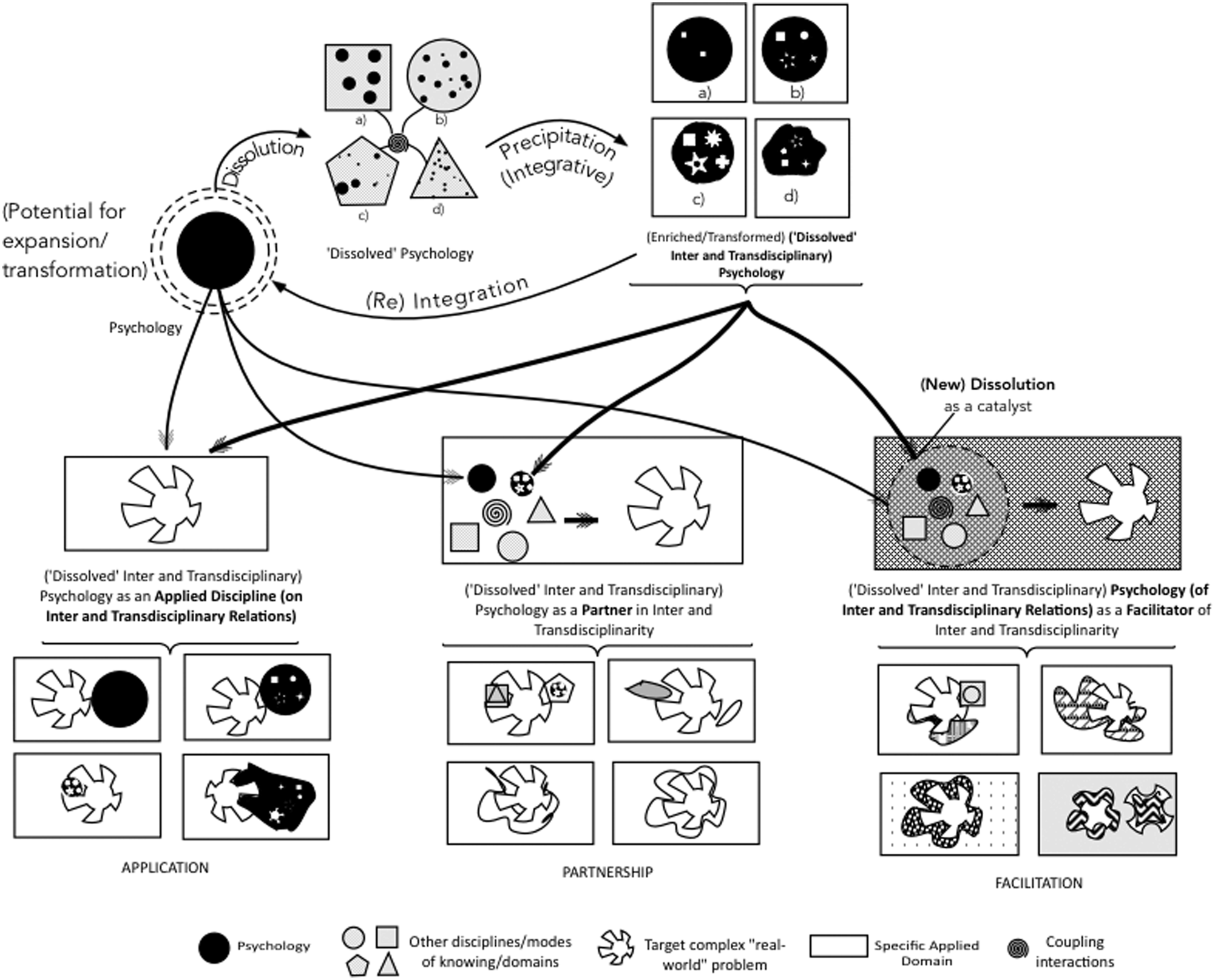
In Figure 1, Psychology, as a whole discipline, is illustrated by a round black circle. The dotted lines around the first circle represent Psychology’s own “Zone of Proximal Development” (Vygotsky and Cole, 1978) or its potential for expansion, enrichment and transformation. To the right, the figure section shows Psychology “Dissolved,” to different degrees and modes of interaction, in other disciplines, domains of knowing and practices. The spiral represents the coupling processes that take place during a process of “Dissolution” as well as the interactions between different experiences. The nature of these coupling processes and the type of strategies that may facilitate them require future investigation.
The top right part of the figure illustrates different states of the discipline after the “Dissolution” and (Integrative) “Precipitation.” Image a) shows a relatively unaltered Psychology that may have, eventually, integrated some new tools, concepts and methods but without significant changes, while image b) shows a significantly more enriched Psychology, containing new elements. The sections c) and d) represent deeper states of transformation. In c), the discipline has not only been enriched as its boundaries have become more permeable and capable of sustaining new exchanges while in d) the discipline has gained enough flexibility to continue changing, adapting itself (in theories, methods, practices) more strongly to different types of target phenomena, through engaging in a variety of new processes of “Dissolution.”
In a state of “Dissolution”, Psychology might operate in relatively invisible ways, immersed in contexts where it couples its own components and processes with those of other disciplines, modes of knowing and practices, allowing them to interact in a variety of ways. As we mentioned before there is a core knowledge gap regarding the understanding the nature of the relational processes, of the interactions and of the strategies that support them, which lead to different types of outcomes in Inter and Transdisciplinary interactions. These coupling processes are represented by the spiral symbol in Figure 1. The intentional management of the processes of Dissolution is dependent on deepening this knowledge.
The process of “Dissolution” can take place at the level of the work of the individual researcher or practitioner and through their deep embedding in other epistemic or practice contexts. It can also occur at the level of collective units (e.g., working groups, research projects). More widely, this “Dissolution” can take place at the level of the whole discipline, when it integrates, in its own organization, core methodologies & training processes for a continual enrichment of the discipline in close dialogue and coupling with other disciplines, knowledge production systems, and, ultimately, with the “real-world” and its most pressing challenges.
We can identify two types of “Dissolution”: Internal and External. Figure 1 illustrates the process of External Dissolution and its relation to the three modes of engagement of Psychology in Interdisciplinarity. As shown in the top middle region of Figure 1, the Dissolution can be more or less coarse or fine-grained. Psychology can dissolve as a relatively inert observer or it may have a more active presence, intentionally experimenting with changing its own states and processes to experience a variety of interactions and perturbations which may generate novel information supporting its transformation. Depending on the type of interaction, the perturbation may affect the domain where it is dissolved.
I assume that the greater the degree of “Dissolution,” the greater the creative potential of these interactions. The impact of the “dissolution” will also be more noticeable after a complementary process of (Integrative) “Precipitation” as the complementary pair (Kelso & Engström, 2006) of “Dissolution.” Recursive cycles of “Dissolution” and “Integration” may add flexibility to our structures of knowledge formation and its outputs, avoiding their reification and crystallization and increasing their capacity to adapt to the demands of the world and its particular contexts. The recursive cycles of “Dissolution” and (Integrative) “Precipitation” may allow the disciplines enough flexibility to adapt and change themselves (in whatever form) in response to the demands of the world in ways that are congruent with its complexity.
The bottom part of Figure 1, shows Psychology’s engagement with complex problems through three different modes of participation in ID/TD. The figure also shows the different types of results that depend on the extent to which Psychology, as a discipline, adopts an Inter and Transdisciplinary stance and enriches itself through its “Dissolution.”
An (Inter and Transdisciplinary “Dissolved”) Applied Psychology
In the first modality of engagement, represented in the bottom-left part of Figure 1, Psychology contributes to approaching a particular complex problem from the perspective(s) of the discipline (its theories, concepts, methods, practices). Different sub-disciplines in Psychology may offer different contributions to a particular problem and enter, to different degrees, into dialogue with each other. In general, in this mode of engagement, the discipline is likely to remain relatively unaltered when it is performed from a traditional siloed disciplinary stance and when, internally, contributions from different sub-disciplines are simply juxtaposed or sequentially arranged. However, this engagement can also be conducted by an Applied discipline that has already been transformed through Inter and Transdisciplinary “Dissolution.” For example, in tackling climate change, a traditional Psychology could adopt some mainstream theoretical model to investigate people’s attitudes toward their natural environments and their relation to behavioral change. An enriched “Dissolved” Psychology, however, could take the same approach conceptually and methodologically through its “Dissolution,” for example, in Anthropological or Cultural Studies from which new ontological perspectives could have been constructed leading to new different ways of conceptualizing and investigating people’s attitudes and behaviors, for example, from a relational worldview. The bottom-left part of Figure 1 shows how the coupling or fitness of the relation between the discipline and the target problem increases as it becomes more enriched, flexible and capable of adapting and changing itself.
In this modality, the context of application can be Inter and Transdisciplinarity itself. For example, Psychology may research Inter and Transdisciplinary teams exploring individual attitudes or behaviors, investigating creativity at the level of the individuals or focusing on communication patterns and team dynamism through its mainstream lenses and methods. As an applied “Dissolved” discipline, this approach will be enriched which may result in new lenses, focuses and approaches. For example, through a theoretical engagement with Philosophy, the study of creativity may be expanded to empirically investigate the processes supporting abduction as a creative mode of thinking in driving scientific discoveries. Through a “Dissolution” in domains of complex systems, Psychology may develop new ways of conceptualizing coupling and change processes, for example, exploring bifurcations and phase transitions associated with the creative emergence. But new and even more integrative approaches may emerge that cannot be anticipated from the onset. I propose a domain of a (“Dissolved”) Psychology of Inter and Transdisciplinary Relations that targets creativity and abduction and the construction of complex collective modes of thinking for tackling complex issues.
An (Inter and Transdisciplinary “Dissolved”) Psychology as a Partner in Inter and Transdisciplinarity
The second mode of interaction with ID/TD is illustrated in the middle bottom region of Figure 1. In this case, Psychology may participate as a domain expert and partner in Inter and Transdisciplinary projects and initiatives, which may be more or less theoretically or pragmatically focused and driven by “real-world” complex challenges. Depending on the dynamics of the teams and projects there will be different degrees of interpenetration and perturbation between disciplines. They will contribute to tackling a complex problem through their synergies and the emergent products of their interactions in ways that would not be accessible or possible by any individual discipline alone. These interactions, as well as their emergent products, will feedback on the individual disciplines creating opportunities for their enrichment and potential transformation. In this case, the challenges to, and constraints on the performance of the discipline are those that apply to Inter and Transdisciplinary initiatives in general and that have been well documented in the literature (Börner, et al., 2010; Lyall et al., 2011a, 2011b; Hall et al., 2018, 2019). What remains to be addressed, as we mentioned in the previous sections, is the question of what is the nature of the interactions, their underlying processes and supporting strategies that are associated with different types of outcomes, not only between the partners of an Inter and Transdisciplinary initiative but also regarding their collective coupling with the target problem? (Melo, 2020). Once more, we stress that this could be the core focus of a new “Dissolved” Applied Psychology of Inter and Transdisciplinary Relations. We may assume that the more enriched the disciplines and the more congruent the complexity of their collective modes of thinking and practices, the more likely they will achieve positive and sustainable outcomes. The two top panels of the bottom middle region of Figure 1 show more limited degrees of fitness between the outcomes of Inter and Transdisciplinary initiates and the target problem, with the first square on the left showing results that are still very much framed by the individual disciplines. The bottom rectangles show solutions that perform better in embracing or matching the complexity of the problems and that are more likely to result from “deep” ID/TD. Creative and innovative solutions are sustained in the relational processes involved in these processes of “Dissolution.” A deeper understanding of these processes is required to support their intentional management toward more positive outcomes. There is still much to be investigated regarding the processes underlying positive, innovative and ecosystemically fit and sustainable outcomes and solutions in ID and TD. These are privileged arenas for investigating, practicing, and “boosting” (Darbellay, Moody & Steffen, 2014) individual and collective human creativity (Darbellay, Moody & Lubart, 2017; Tang, 2019), particularly scientific creativity, considered from a systemic, social, and even cultural perspective (Hennesey, 2017; Montuori & Purser, 1997; Glăveanu, 2010; Paulus & Nijstad, 2003).
In the previous sections, we have identified key gaps in our knowledge about Inter and Transdisciplinary processes and the need to address them in theory, research and practice. It is in relation to these gaps that we affirm the relevance of a new Inter and Transdisciplinary Applied “Dissolved” Psychology of Inter and Transdisciplinary Relations could flourish contributing to strengthening the knowledge of an interdisciplinary Science of Team Science but also extrapolating it. On the one hand, we propose that this enriched approach is capable of integrating different contributions into more complex theoretical frameworks that attend to the multiple nuances and the social, cultural and political dimensions of the processes of knowledge formation involved in ID/TD On the other hand, this new domain, goes beyond the Science of Team Science, which has its core focus on the “Science” part of Inter and Transdisciplinary initiatives, having a broader scope. It should target a diversity of processes involved in knowledge formation, integration, mobilization and application and the nature and effects of different types of “ecologies of knowledges” (Santos, 2018). These target initiatives may be less science-driven and more, for example, policy or community-driven (with and without the participation of scientists) or more or less focused on traditional (e.g., indigenous) community practices of knowing.
Psychology as a (Inter and Transdisciplinary “Dissolved”) Facilitator of Inter and Transdisciplinarity
The bottom right part of Figure 1, shows Psychology in a third type of engagement with ID/TD in the role of Facilitator of key relational processes. In this modality, there is another type of “Dissolution” whereby Psychology operates in the space between other disciplines, modes of knowing and individuals to catalyze their interactions. In this case, Psychology remains relatively invisible in relation to the target focus of the Inter and Transdisciplinary initiatives (although it may also operate as a partner discipline). It operates in the background of processes sustaining Inter and Transdisciplinary relations as well as their relations with the target system of interest. The facilitation of ID/TD is an area calling for urgent developments.
Practitioners and researchers working in different areas of Psychology are familiar with the facilitation of groups and the development and implementation of interventions focused on relational processes (Salas et al., 2020; Sexton & Lebow, 2016). The facilitation of ID/TD is “a scientific field where a lot of experimentation is yet to be done” (von Wehrden et al., 2019, p. 885) and where “the sustained development of strategies to help researchers understand how to collaborate effectively and integrate soundly across different domains remains a key research gap” (Lyall et al., 2011, p. 1). Recently, von Wehrden et al. concluded that “insufficient recognition within academia has been attributed to the role of the facilitator of inter-transdisciplinarity” (von Wehrden et al., 2019, p. 885). Facilitation strategies need to be differentiated (Palmer et al., 2016) considering the different stages of development of a group, a topic that deserves research attention per se. These interventions might be more or less universal, promoting basic general processes, or have a more “therapeutic,” reparative, and a solution-oriented focus. Interventions can be conducted “on-demand” (Melo & Caves, 2020), integrating specific assessments and evaluations to help groups unblock or facilitate specific processes.
I propose that the role of facilitation can be embraced as the practice branch of an Applied (“Dissolved”) Psychology of Inter and Transdisciplinary Relations. Many traditional sub-disciplines or domains of Psychology have developed theories, methods and practices which have relevance for the facilitation of ID/TD. At its different levels of organization, from individuals, to groups and teams to whole organizations and even to the level of inter-organizational relations, there are many dimensions of Inter and Transdisciplinary work in relation to which contributions from traditional sub-disciplines or domains of Psychology could be suitable (e.g., team processes, creativity, interpersonal communication and relations, leadership and organizational dynamics, well-being).
It is important to note that facilitators from other disciplines, with the appropriate background, have also operated in this space. However, the challenges, as well as the potentialities of ID/TD, go beyond these separate domains, lying at the intersection of levels, processes, timescales, contents, and contexts. While attempting to address the core set of questions of “How,” “Why,” and “Which,” identified above, a Psychology of Inter and Transdisciplinary Relations should also conduct action-based (Reason & Bradbury, 2008) and evaluation research (Patton, 2011) that targets the identification, development, and evaluation of strategies and tools that may support the facilitation of these processes and guide practice.
In this role of Facilitator, Psychology can make contributions through its traditional sub-disciplines. For example, facilitation can be informed by group and team psychology in stimulating creativity (e.g., Tang, 2019). However, as we discussed, the complexity of ID/TD surpasses those of other teams, involving much more than the management of interpersonal relations. Hence, the management of the complexity of ID/TD requires more complex (differentiated, integrated and emergent) forms of knowledge leading to novel insights, new integrative or transdisciplinary frameworks and practices capable of augmenting and harvesting the creative potential of this multi-level system of relations of relations. More complex Inter and Transdisciplinary approaches are required that guide the practices of facilitation in effectively catalyzing creative and abductive processes that are also sufficiently and commensurately complex to meet the complexity of the challenges at hand (Blinded for review, 2018, 2020).
This is an area where we could assist in the creation of new training programs for the practice of Psychology in the role of Facilitator of Inter and Transdisciplinarity. This facilitation can also be indirect through the training of ID/TD teams for the intentional management of their internal relational processes. Such training could be offered as specialized advanced training courses or modules integrated into disciplinary-based or interdisciplinary academic programs. This is a critical area for future innovation.
On the bottom right side of Figure 1, there is an illustration of the process of “Dissolution” involved in the facilitation of ID/TD where Psychology acts as a catalyst for the relations between the partners as well as between them and the target system of interest. The top left example shows an Inter and Transdisciplinary initiative that has achieved a reasonably integrated coupling, represented by the pattern below the complex problem. In this example, there are still very salient elements of individual disciplines that were not integrated and which reveal a poorer fit with the problem. The image on the top right shows a high degree of integration and fitness, while the ones below represent cases where the fitness is higher still, resulting in the emergence of novel knowledge or practices (represented by the different patterns around the target problem) and in the reconceptualization of the domain of action or even of the problem (on the bottom right example), which requires a higher-order integration or transformation of knowledge. This kind of outcome is more likely to require careful and intentional management of the processes of knowledge formation and of the multiple relations involved. In order to enhance its potential contribution for facilitation of ID/TD, Psychology needs to undergo its own transformations, generating and integrating new insights through its “Dissolution” in other disciplines and domains.
Internal “Dissolution”
So far we have been pointing to the necessity of an external “Dissolution” of Psychology involving contexts, entities and processes outside the limits of the discipline’s borders and, eventually, into real-world contexts of application. Another type of “Dissolution” can be envisaged that occurs within Psychology, in relation to its sub-domains and specialties. In order to fully address the challenges of ID/TD as “proper” domains of theory, research and practice, a new Psychology of Inter and Transdisciplinary Relations needs to dissolve its own internal boundaries and compartmentalization toward building integrative approaches more capable of grasping the complex multidimensionality and relationality of ID/TD. It needs to be able to build practices that allow for the building of coherence in the coupling with the complexity of ID/TD initiatives and, likewise, to support such coherence in the coupling between these initiatives and the target systems of interest, through an active process of facilitation. This congruence might be a requisite for the facilitation processes to be able to catalyze positive, sustainable, effective and ecosystemically fit outcomes (Blinded for review, 2018, 2020).
Psychology’s own internal richness has been somehow lost in the extreme specialization of the discipline and in the lack of dialogue and bridging between domains. On the other hand, the growing tendency for atheoretical research in Psychology (Toomela, 2010) weakens the capacity of the discipline to make contributions to the reading of complex “real-world” problems and for designing approaches that fit them (e.g., interventions toward collective social change).
Figure 2 illustrates the process of internal “Dissolution.” Different areas, previously compartmentalized, establish new coupling relations and are allowed to interact in novel and non-linear ways to generate perturbations. In this process, new bridges, synergies, and complementarities are explored and conditions may be created for novelty to emerge, under the constraints and pressures posed by the particular context of problems and challenges. This process could lead to a reconfiguration of the relations between existing internal elements, and a (re)integration of the new elements into the discipline, weaving new patterns and possibilities into a more complex structure; this structure is then subject to new cycles of internal and external dissolution, in a recursive manner Illustration of the process of internal “Dissolution.”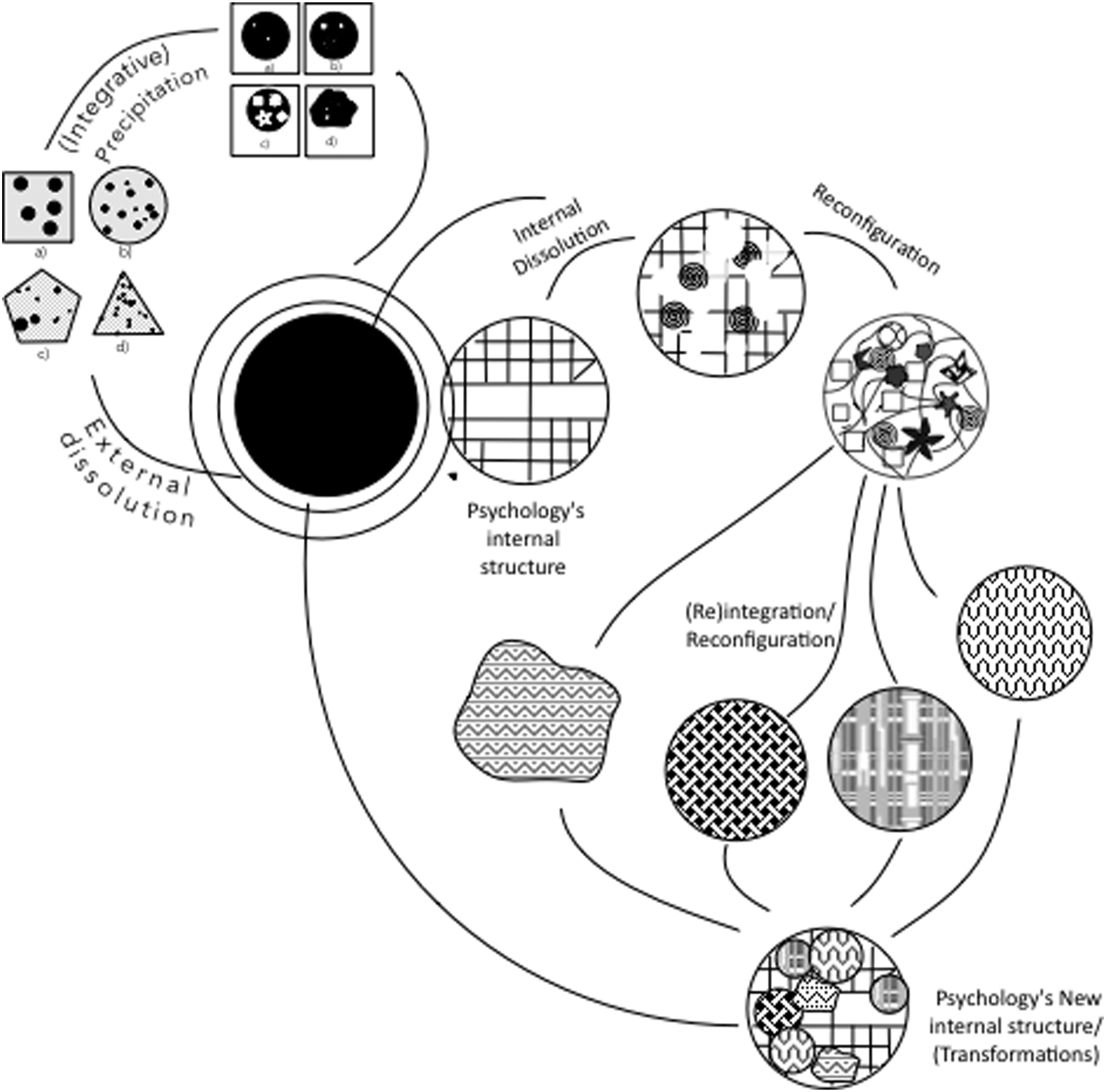
The success of a new Psychology of Inter and Transdisciplinary Relations is also dependent on the challenge of Internal “Dissolution” which is dependent on a first mapping of the discipline for the identification of the sub-domains and disciplines which may be more relevant to consider (Wieczorek, Unger, Riebling, Erhard, Koß & Heiberger, 2021). This mapping can build on methodologies that have already been used and constituted, itself, as an Interdisciplinary exercise (e.g., Trujillo & Long, 2018; Melo, Caves, Dewitt, Clutton, Macpherson & Garnett, 2020; Wagner, Roessner, Bobb, Klein, Boyack, Keyton, Rafolds & Börner, 2011).
Complementarity of the internal and external modes of “Dissolution” and their roles
There is an important complementarity between the movements of internal and external “Dissolution” and between these and the movement of (Re)Integration, which may lead to Transformation. It is in these recursive cycles, that the disciple will gain adaptability and increase its complexity through its interwoven processes of differentiation and integration. It is through the promotion of recursive and non-linear interactions between its internal elements and with those of other disciplines, that the conditions for the emergence of novelty may be created.
Psychology’s different roles in ID/TD can be adopted in isolation or they may interact and complement each other, in parallel, sequentially or in a recursive manner. For example, both as a partner discipline and in the role of a facilitator, Psychology’s contributions can be strengthened by an Inter and Transdisciplinary stance and an Applied focus that considers Inter and Transdisciplinary Relations as its primary consideration. Under certain conditions, other roles may be more difficult to integrate within the same project, or performed by the same entities. For example, while Psychology may operate both as a partner discipline and as a facilitator in Inter and Transdisciplinary initiatives, when the teams are not fully mature and when they have not yet overcome traditional obstacles to positive Inter and Transdisciplinary collaborations (e.g., power imbalances), the co-existence of these different roles, when performed by the same people within the same initiative, may aggravate some difficulties that generate imbalances between the disciplines. However, with more mature, experienced teams, and with a high degree of readiness for Inter and Transdisciplinary collaboration (Hall et al., 2008) these roles might co-exist and complement each other with fewer tensions.
Steps Toward a new “Dissolved” Psychology of Inter and Transdisciplinary Relations
In this paper, I make a proposal for a “Dissolved” Psychology of Inter and Transdisciplinary Relations as new Inter and Transdisciplinary domain, in its own right.
Figure 3 illustrates the argument presented in this proposal which builds the foundations for this proposal. Synthesis of the main points and relations implicated in the argument toward the development of a “Dissolved” Psychology of Inter and Transdisciplinary Relations.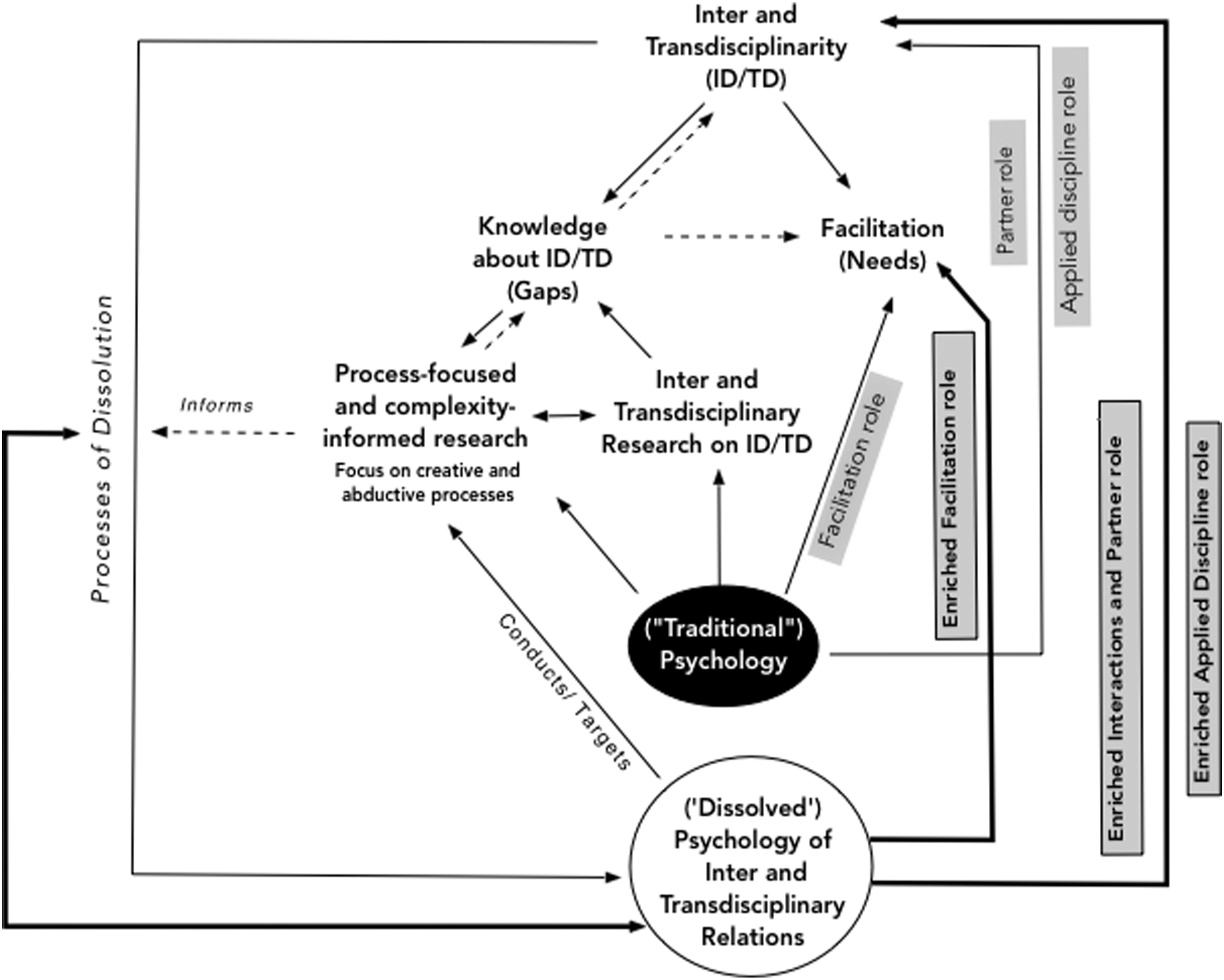
I have briefly reviewed research on Inter and Trandisciplinarity and highlighted key knowledge gaps and the need for facilitation. I have stressed how effective facilitation is dependent on knowledge about the processes underlying positive Inter and Transdisciplinarity and have defended the need to focus on creative and abductive processes and collective forms of complex thinking. I state that research on ID/TD needs to target these dimensions and that, while traditional Psychology can make relevant contributions a new domain of Psychology, itself Inter and Transdisciplinary and enriched through processes of Dissolution could be in a better position to address key knowledge gaps and to perform the role of facilitator of Inter and Transdisciplinarity. I state that other roles will be equally enriched and that the knowledge of this new domain will not only inform the facilitation of Inter and Transdisciplinary interactions in general but also, in a recursive way, the processes of Dissolution upon which this new domain is built.
The emergence of this new domain will be, to a large extent, something that is self-organized. This new domain will emerge with an expansion of Psychology research and practice aimed at supporting Inter and Transdisciplinary initiatives, thereby producing the knowledge and know-how to self-organize as an evolving, flexible domain, enriched through recursive processes of internal and external “Dissolutions” and (re)integrative “Precipitations.” This will increase the capacity of this new domain, and thus the discipline overall, to produce theories, research and practices which augment the potential of Inter and Transdisciplinary initiatives to embrace and tackle complex “real-world” challenges.
This paper aims to launch a call for collective efforts to build this new domain. Some of the first steps in this direction may involve: (i) Mapping the internal structure and dynamics of Psychology in order to identify the sub-disciplines, type of studies, and methodologies that are more likely to have a meaningful contribution to ID/TD in relation to creative, abductive and complex outcomes, as well as ways in which they may relate to other disciplines and potential synergies; (ii) Building upon existing and new literature reviews to systematize the existing knowledge on ID/TD in order to identify key relational processes to be further investigated, and leverage points for interventions; (iii) Conducting Inter and Transdisciplinary studies aiming at building richer conceptions on the nature of relations, addressing questions related to their ontological and epistemological status, properties, expressions, capacities, effects as well as the nature of the interactions or of other processes or elements entering their constitution and transformation. These studies should aim at building pragmatic maps and meta-languages to support the mapping and management of the complexity of Inter and Transdisciplinary Relations. They might imply a mutual “Dissolution” of different domains holding different conceptions, worldviews as well as tools and strategies that pertain to (different types of) relations; (iv) Identifying sub-domains in Psychology and other disciplines, as well as other practices of knowing, that are likely to make some type of contribution to the understanding and facilitation of Inter and Transdisciplinary Relations, the promotion of creativity and abduction as well as complex and collective modes of thinking; Exploring synergies and the development of more integrated approaches; (v) Creating formal and informal contexts (e.g., laboratories; residential camps or retreats; groups anchored in dialogical and reflexive dialogues) and activities (e.g., events; supporting materials and resources) supporting practices of “Dissolution” between disciplines, as well as other modes of knowing accompanied by exploratory, yet systematic, investigations of relational practices, tools and strategies leading to creative and abductive interactions. These initiatives can also explore the role of a framework for complex thinking (Melo, 2020) in building more complex collective modes of thinking (Melo & Campos, 2022). These would be privileged context for development and evaluation of new facilitation technologies; (vi) Develop specialized training and research programs with a focus on the facilitation of ID/TD.
This is a tentative proposal toward creating conditions for building a domain of Psychology focused on Inter and Transdiciplinary Relations, but also for a wider practice of “Dissolution” between different disciplines, modes and traditions of knowledge. It is also a call for collaboration toward building practices of knowing and of being together, as communities of scientists, citizens, practitioners, and policy-makers that will allow us to better grasp and embrace complexity, while “performing complexity” ourselves toward creatively building new and more promising (e.g., fair, equal, sustainable, loving, peaceful, healthy) futures for all beings on Earth.
Discussion
Worldwide, societies are faced with drastic changes in their natural, social and economic environments and a vast number of pressing problems calling for urgent and effective actions both at global and local levels. The complexity of these challenges requires more complex modes of thinking and ecosystemically fit solutions, congruent with their complexity [blinded for review]. Societies need to perform changes at the multiple levels of their organization and coordinate these changes toward more positive and sustainable outcomes. Psychology has been adapting to societal calls through new specialized areas of action, focused on particular challenges (e.g., Environmental Psychology; Psychology of Human Rights) and by engaging in ID/TD initiatives, as a partner discipline. In this paper, I revise different types of roles or modes of engagement of Psychology with ID/TD. I propose another route through which Psychology can contribute to the most pressing challenges through “Dissolving” itself in other disciplines and operating in the relational fabrics of ID and TD, facilitating and steering key relational processes in order to potentiate their creative and abductive potential toward more effective outcomes.
This requires a Psychology capable of embracing a new type of identity, itself Inter and Transdisciplinary that allows it to integrate and draw together a variety of bodies of knowledge and intervention technologies, currently dispersed across areas both within and outside its borders. Psychology can play a pivotal role in transforming the lives of individuals, communities, organizations, and nations, by assisting Science and Society to build and manage more complex configurations of relations that are more likely to generate creative adaptive responses. Paradoxically, Psychology’s unique contribution in these challenging times may be realized through its dissolved action. In this process, it will benefit from embracing a complexity-informed perspective to explore and operate in the rich matrix of relations implicated in ID/TD, targeting creative and abductive processes. Additionally, Psychology is called upon to both participate, build and facilitate new spaces for active experimentation of different modes of “Dissolution,” as well as to create and investigate resources and strategies supporting creative modes of relating.
This paper opens a call for the constitution of working groups, task forces, and research and training programs to consolidate a new domain of research and practice under the umbrella of a “Dissolved” Psychology of Inter/Transdisciplinary Relations.
Footnotes
Author’s Note
A preliminary version of this paper was presented as an oral communication titled “Dissolving Psychology: Psychology of Inter/Transdisciplinarity and an Interdisciplinary identity” at the International Conference of Psychology 2020+.
Declaration of Conflicting Interests
The author(s) declared no potential conflicts of interest with respect to the research, authorship, and/or publication of this article.
Funding
The author(s) disclosed receipt of the following financial support for the research, authorship, and/or publication of this article: The author was funded by the Portuguese Foundation for Science and Technology through the Transition Norm [DL57/ 2016/ CP1341/ CT0011]
