



Abstract
Diversity-focused research can provide important insights about gender/sex and sexual diversity, including in relation to oppression and privilege. To do so, it needs to critically engage with power and include minoritized and majoritized participants. But, the critical methods guiding this are typically aimed at empowering marginalized groups and may “overempower” majority participants. Here, we discuss three diversity-focused research projects about gender/sex and sexual diversity where our use of critical methods overempowered majority participants in ways that reinforced their privilege. We detail how diversity-focused research approaches thus need to be “majority-situating”: attending to and managing the privilege and power that majority participants carry to research. Yet, we also lay out how diversity-focused research still needs to be “minority-inclusive”: validating, welcoming, and empowering to people from marginalized social locations. We discuss these approaches working synergistically; minority-inclusive methods can also be majority-situating, providing majorities with opportunities for growth, learning, and seeing that they—and not just “others”—are socially situated. We conclude by laying out what a diversity-focused research program might look like that includes both majority-situating and minority-inclusive approaches, to work towards a more just and empirical scholarship that does not lead to majorities who are even more overempowered.
Introduction
Diversity-focused research has radical potential, especially for understanding gender/sex 1 and sexuality. At its best, diversity-focused research 1 engages with disparate social locations, including centers (majorities) and margins (minorities) 1 (hooks, 2000), with resulting insights about oppression and privilege. It may not be used to focus specifically on power, but insights about power are one of its outcomes. For example, gender/sex/ual 1 diversity research can be used to redress and move beyond regressive politics that attempt to fix gender to a binary bodily sex (Ainsworth, 2015; Hyde et al., 2018; Olson, 2017), acting as a key intervention to heteronormativity, cisnormativity, and binary normativity, in addition to helping build understandings of the world that are more empirical and just (van Anders, 2015). But, can researchers transfer the critical methods to majorities typically used to empower minorities? Doing so could introduce a host of issues given that majorities are already privileged and empowered; might using these critical methods actually overempower majority participants?
Minoritization and Majorities in Research
Focused attention on minorities and minoritization is crucial. Oppression is a key experience of large swathes of the world’s population given the concentration of wealth and power in a small percentage of people (Niño-Zarazúa et al., 2017; Roope et al., 2018). Understanding the lived experiences of marginalized individuals and communities can help to provide more just knowledge, ameliorating epistemic injustice—that is, unjust absences of knowledge that exist because of marginalization and contribute to it (Dotson, 2011, 2012; Fricker, 2007; Medina, 2017).
Research that addresses epistemic injustice via research on/with minorities, minoritization, and power might be called “minority-focused” 1 (Fricker, 2007; Solórzano & Yosso, 2002). Minority-focused research uses critical methods and methodologies for engaging with power that have largely been built with insights from the margins (Aydarova, 2019; Campbell & Wasco, 2000; Hurtado & Stewart, 2004; Sohl, 2018). This includes aiming to counter research practices that disempower marginalized groups and, instead, provide welcoming, empowering, and/or validating experiences (Campbell & Wasco, 2000; Hurtado & Stewart, 2004; Sohl, 2018). These methods can, in theory at least, be used in research on other topics and participants to make studies more welcoming and inclusive; we might describe research that uses these methods as “minority-inclusive” 1 when it is not minority-focused in question, goal, or participants.
Minority-inclusive methods can thus be applied to critical research generally, including beyond minority-focused research. Issues of power include people on the margins as well as at the center, like those who experience privilege and perpetrate oppression. Accordingly, critical scholars have pointed out that research about minoritization is crucial and researchers need to “study up” (Nader, 1972).
Studying up focuses on research participants who sit “higher up” in social hierarchies, experience privilege, and are in a position to perpetrate oppression (Nader, 1972). Studying up might focus on majority-only participants or might be “diversity-focused”, 1 including majorities and minorities to understand issues of power or how power is implicated in other topics. Yet, what methods to use for diversity-focused research? Minority-inclusive methods are largely drawn from minority-focused research, with few critical methods built specifically for studying up and the majority participants this research involves (Gailey & Prohaska, 2011). Scholars writing about research on majoritarian social locations and power have poignantly detailed how the combination of minority-inclusive methods with majority participants can introduce challenges, even explosive ones (e.g., Archer, 2002; Becker & Aiello, 2013; Cabrera, 2016; Hunter, 2005; Hurtado & Stewart, 2004; Pacholok, 2012) even as they sometimes explicitly recommend these approaches (e.g., Aydarova, 2019).
Indeed, people at the center—majority individuals—already are empowered and already see their views as valid. Minority-inclusive methods—critical methods from the margins—applied to majority participants might actually overempower participants by granting even more space to people who already occupy the center, including by conscious, oppressive means.
One could also ask why study majority participants at all, given the risk that minority-inclusive methods might, and mainstream methods do, reify their privilege. After all, minorities are more likely to understand the dynamics of power that oppress them because they bear the costs of it and have more reason to make sense of their unjust situations (Collins, 2000; Haraway, 1988; Harding, 2004; Mahalingam, 2007). However, studying majorities—studying up—has multiple radical and important implications, including putting power under the microscope and denaturalizing it. It can illuminate aspects of majoritarian social locations and structures that are reserved to privileged spaces (Hunter, 2005). For example, Cabrera (2019) and Feagin (2009) describe how the majority of university students’ racist jokes largely occur only when racially minoritized students are absent. Diversity-focused research is clearly important, despite the absence or paucity of critical methods for it.
Theoretical Frameworks for Thinking Through Diversity-Focused Research
“Diversity” language and rhetoric is often used to sidestep calls for social justice, as politically progressive scholars and activists have critiqued (Ahmed, 2012; Bell & Hartmann, 2007). These critiques point to people in power using the language of diversity to focus on having “lots of different kinds of people” rather than on inequities, power, oppression, or minoritized communities. On the flipside to this, people in power often use “diversity” synonymously with and/or euphemistically to mean “minorities.” This can other minorities against an unarticulated normative backdrop of majorities (van Anders, 2015). And, mainstream diversity research often uses a “difference” approach that positions majorities as the aspirational norm by focusing on how minorities differ from majorities (van Anders, 2015). This tends to essentialize minorities and majorities as mutually exclusive and fixed groups that are dichotomous and homogenous. Grounding diversity-focused research in theory can avoid the pitfalls of the malappropriations of diversity while furthering its radical potential.
There are a number of potential approaches to grounding diversity-focused research in theory. One is sexual configurations theory 1 (SCT: van Anders, 2015), a theory and model of gender/sex/ual diversity built with insights from the margins where people can locate their gender/sex/ualities in multifaceted ways. SCT’s approach to diversity differs from mainstream approaches. It offers a “sexual diversity lens” 1 that recognizes that there are multiple ways to attend to social locations related to gender/sex/uality beyond othering or difference. It also recognizes that there are multiple ways of grouping people based on their commonalities and heterogeneities, as well as how groups are related to one another (including via power). It allows for minority and majority social locations that are dynamic, shifting, and interchanging. And, it facilitates dynamic groupings while making clear there is no one natural way to group or that grouping itself is natural or necessary. SCT specifically calls for attention to power dynamics within the gender/sex/ualities studied, including the ways researchers choose whom to study and how. It makes sense, then, that a foundational aspect of SCT’s sexual diversity lens is intersectionality (Collins, 2000; Crenshaw, 1991).
Intersectionality scholars and/or activitists make clear that we do not exist along separate, singular axes within hierarchies of oppression, with a particular focus on and origin in how Black women in the US are subject to a unique set of oppressive circumstances that cannot be encapsulated or changed by an additive model of anti-Black plus anti-women oppression (e.g., Bowleg, 2008; Crenshaw, 1991; Collins, 2000). Scholars have also discussed how identities and oppressions exist in context (Bowleg, 2008; Cole, 2009; McCormick-Huhn et al., 2019). This can mean that certain axes of power might be more salient against some backdrops, depending on shifting power dynamics, which might be seen by some as at cross-purposes to intersectionality or as part of it (e.g., Petsko & Bodenhausen, 2020; Shih et al., 1999).
These shifting power dynamics matter because many people are located within axes that include oppression and privilege, which we might call “minority-majority” 1 positions. For example, cisgender women are minoritized on the basis of being women but carry and can wield power on the basis of being cisgender. And, cisgender women can weaponize this particular intersection to add the gravitas of their oppression to their attempts to restrict the rights of others, for example, transgender women (Bettcher, 2017; McKinnon, 2018; Vincent et al., 2020; Williams, 2020). SCT’s sexual diversity lens facilitates intersectional analysis by allowing researchers to dynamically attend to minoritized and/or privileged aspects of groups and individuals and analyze gender/sex/ualities as their saliencies shift across backdrops. This is especially useful to theorizing diversity-focused research and its participants with their dynamic arrays within power hierarchies.
This Article and Our Aims
We have experienced some of the challenges of working with gender/sex/ual majority participants in our research on gender/sex/ual diversity (Abed et al., 2019; Beischel et al., 2021a; Schudson et al., 2019). In this article, we describe this, focusing on three separate projects, and the ways this nexus of minority-inclusive research practices meets gender/sex/ual majority participants led to overempowerment. But, it also sometimes led to growth and more just knowledge in majority individuals, and we discuss that too.
The first project we discuss recruited participants broadly by gender/sex/uality for online research about gender/sex language terms (Schudson et al., 2019). A group of gender/sex majorities worked within the structure of our study to disrupt and pushback against its minority-inclusiveness. They did not challenge the research itself, but participated in what we term an “avalanche” approach to dominate the data we collected. The second project we discuss (Beischel et al., 2021a), also recruited broadly by gender/sex/uality for an online survey, this time about people’s experiences of locating their own gender/sex/ual diversity in a model from SCT (van Anders, 2015). Gender/sex/ual majorities’ comments and feedback sometimes showed their resistance to a framework that centered diversity, but also sometimes showed their learning and growth, including about minorities. The third and final project we discuss (Abed et al., 2019) similarly asked people to locate their gender/sex/ualities in SCT, but this time only included gender/sex/ual majorities and used in-person interviews. Our minority-inclusive methods clashed with studying up in this setting, leading to concerns for researcher discomfort and safety as well as about majority overempowerment.
We discuss the methods for each study and then the “results,” that is, relevant insights we gained for thinking about diversity-focused research and overempowerment. We then highlight the need for diversity-focused research to be minority-inclusive, as it often is, avoiding adding to the marginalization of participants from marginalized groups and gaining insights from lived experiences of minoritized folks. And, we discuss the ways that diversity-focused research also needs to be “majority-situating,” avoiding adding to the overempowerment of majoritized groups and providing growth and learning for majorities. As such, we argue that diversity-focused research, when done with these considerations in mind, can present innovative and exciting opportunities to destabilize and shift centers and margins.
Methodological Overview of Studies
In this section, we describe the methods and considerations of the three gender/sex/ual diversity-focused studies of focus from our lab: Definitions—an online survey on gender/sex category definitions, SCT Online—an online survey examining gender/sex diversity through SCT diagrams, and SCT In-Person—an in-person interview study using SCT with gender/sex/ual majorities. Following this, we discuss some of the outcomes of these studies in light of majority-situating and minority-inclusive considerations and the overempowerment we saw.
The Definitions Study (Schudson et al., 2019)
In the Definitions study, we explored individual variation in people’s definitions of gender/sex categories in an online survey (Schudson et al., 2019). Specifically, we asked participants to define woman, man, feminine, masculine, female, and male. People involved in Facebook discussion groups that centered trans-exclusionary radical feminism (TERF 2 ; see Goldberg, 2014; Vincent et al., 2020; Watson, 2016) participated en masse in our study, despite the fact that we did not solicit participation from these groups specifically or through Facebook more generally. TERF ideology holds that transgender individuals should be classified as the gender/sex associated with their sex assigned at birth rather than their actual gender/sex. Frequently, individuals who subscribe to TERF ideology argue that transgender women are not really women and therefore not the proper subjects of feminism (Bettcher, 2017; Vincent et al., 2020).
The subsample of participants from Facebook TERF discussion groups (henceforth, “FB participants”) comprised nearly one-third (n = 170) of the total number of people (N = 516) that interacted with our survey at all. The total number of participants who completed the survey was 307, including 120 FB participants. We were able to determine this because we examined embedded survey data indicating where participants found the link to the study to determine which participants came from Facebook. And, some FB participants shared details in responses to open-ended questions that allowed us to determine where the study link had been posted, which allowed us to read the groups’ publicly accessible descriptions. But, because we could not individually verify whether each participant came from a TERF discussion group, only Facebook in general, we refer to them as “FB participants.”
Although the FB sample intended to disrupt our research (see Results and Insights from Studies), they largely completed the survey with usable data. Most, but not all, responded in appropriate ways to each question rather than with jokes, insults, or other unusable data. The survey asked participants to provide their own definitions of six gender/sex terms—woman, man, feminine, masculine, female, and male—without consulting a dictionary or other source. Most FB participants defined woman and man as “adult human female” and “adult human male,” respectively, in accordance with the most common dictionary definitions, and provided a range of definitions for the other terms. Therefore, although FB participants’ participation was unsolicited and evinced their resistance to the framing of our study, their data were still usable.
In this article, we analyze how and why FB participants flooded our study with their responses and the implications of our experience with these participants for understanding overempowered majority resistance to minority-inclusive research methods more broadly. We focus our analysis on FB participants’ comments in open-ended items at the end of the survey (for analysis of how FB participants defined gender/sex categories, see Schudson et al., 2019).
The SCT Online Study (Beischel et al., 2021a)
In the SCT Online study, we developed an online survey utilizing diagrams from SCT to better understand and measure diverse gender/sexes (van Anders, 2015). SCT adopts a sexual diversity lens in its representation of gender/sex (see Figure 1) and the SCT Online study did as well. As such, we included gender/sex majorities in this study, which led to both overempowerment and learning opportunities. Stages to the diversity lens. In the (a) first stage, minorities are studied as the “other” to be understood against an unstated background of majority identity and experience. In the (b) second stage, minorities are positioned in relation to majorities to examine differences between groups. In the (c) final diversity stage, commonalities and differences are recognized between and among categories, with contextual groupings based upon various criteria. Adapted from van Anders (2015).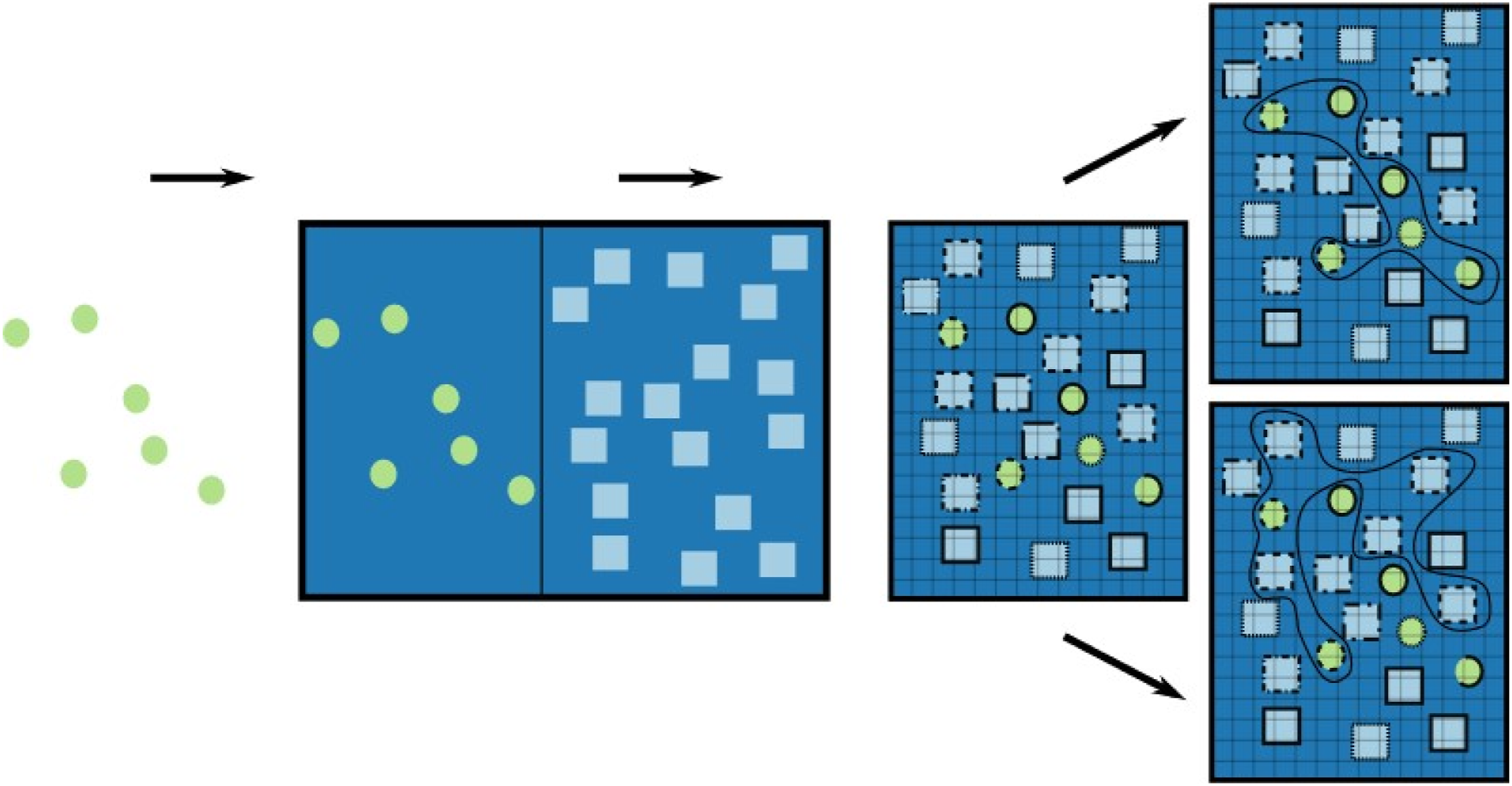
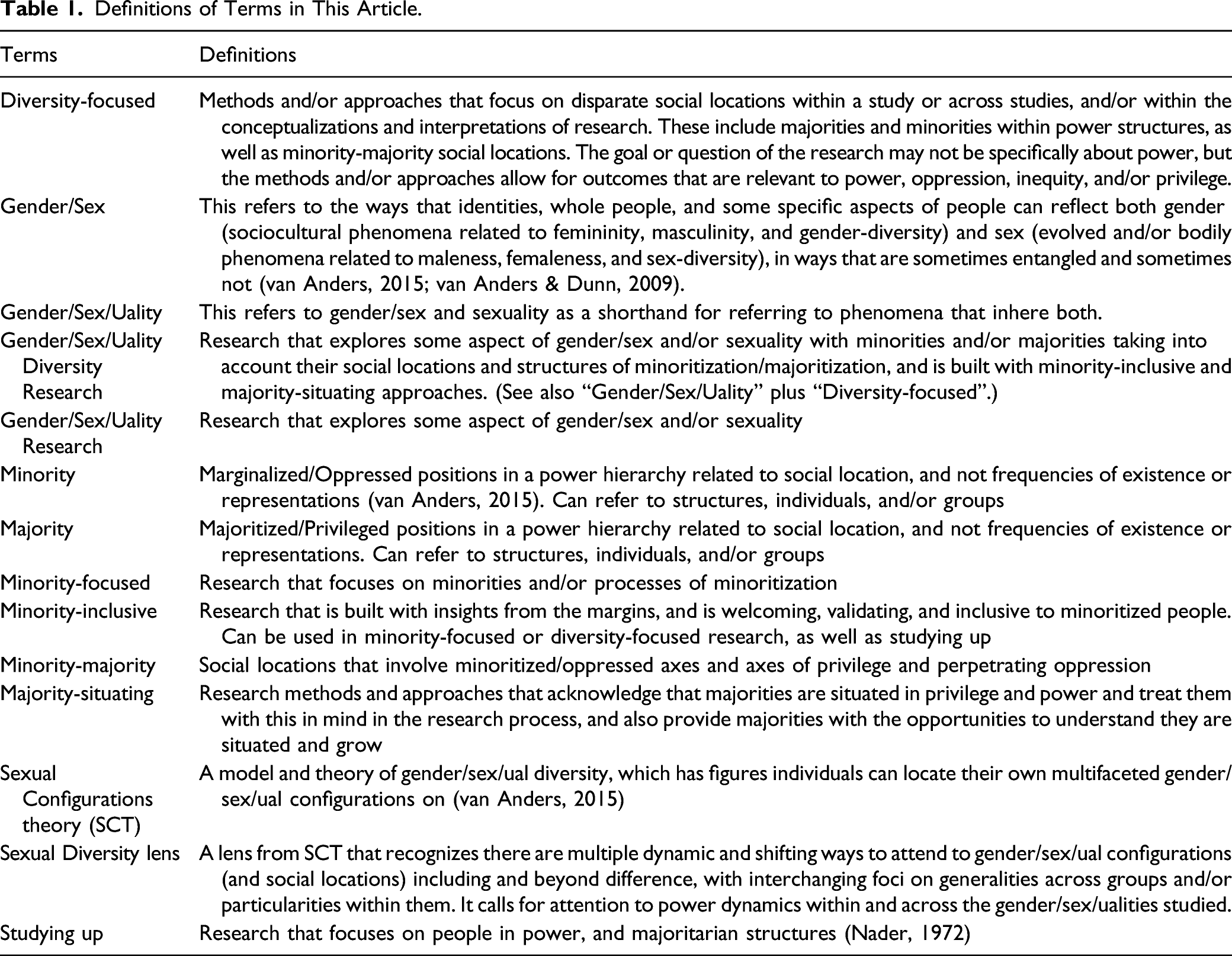
In line with its diversity lens, SCT’s diagrams are relevant to people of all gender/sexes. They contain space for configurations both within and outside of gender/sex binaries, make space for contextual and temporal specificity, highlight relations to cultural norms, and assess rather than assume how important gender/sex is to participants’ senses of selves (see Figure 2; also see van Anders, 2015 for more detailed descriptions of the diagrams). Participants could mark and write on the diagrams in whatever manner they wished to locate their gender, sex, and gender/sex (see Table 1) among a potentially unlimited array of possibilities (Beischel et al., 2021b). We administered this survey to participants with a wide range of gender/sexes (N = 242) to understand how those with both majority and minority identities might productively engage with SCT. This included cisgender women (n = 79) and cisgender men (n = 41), as well as transgender women (n = 34), transgender men (n = 34), cisgender nonbinary (n = 4), and nonbinary participants (n = 50). Individual G/SCT gender/sex diagram adapted from van Anders (2015). Components include the (a) binary ring, (b) nonbinary area, (c) specificity lines, and the strength dimension shown in (d) the complete diagram. Gender and sex diagrams are similar with relevant changes in labels (e.g., “feminine” and “masculine” for gender and “male” and “female” for sex). Definitions of Terms in This Article.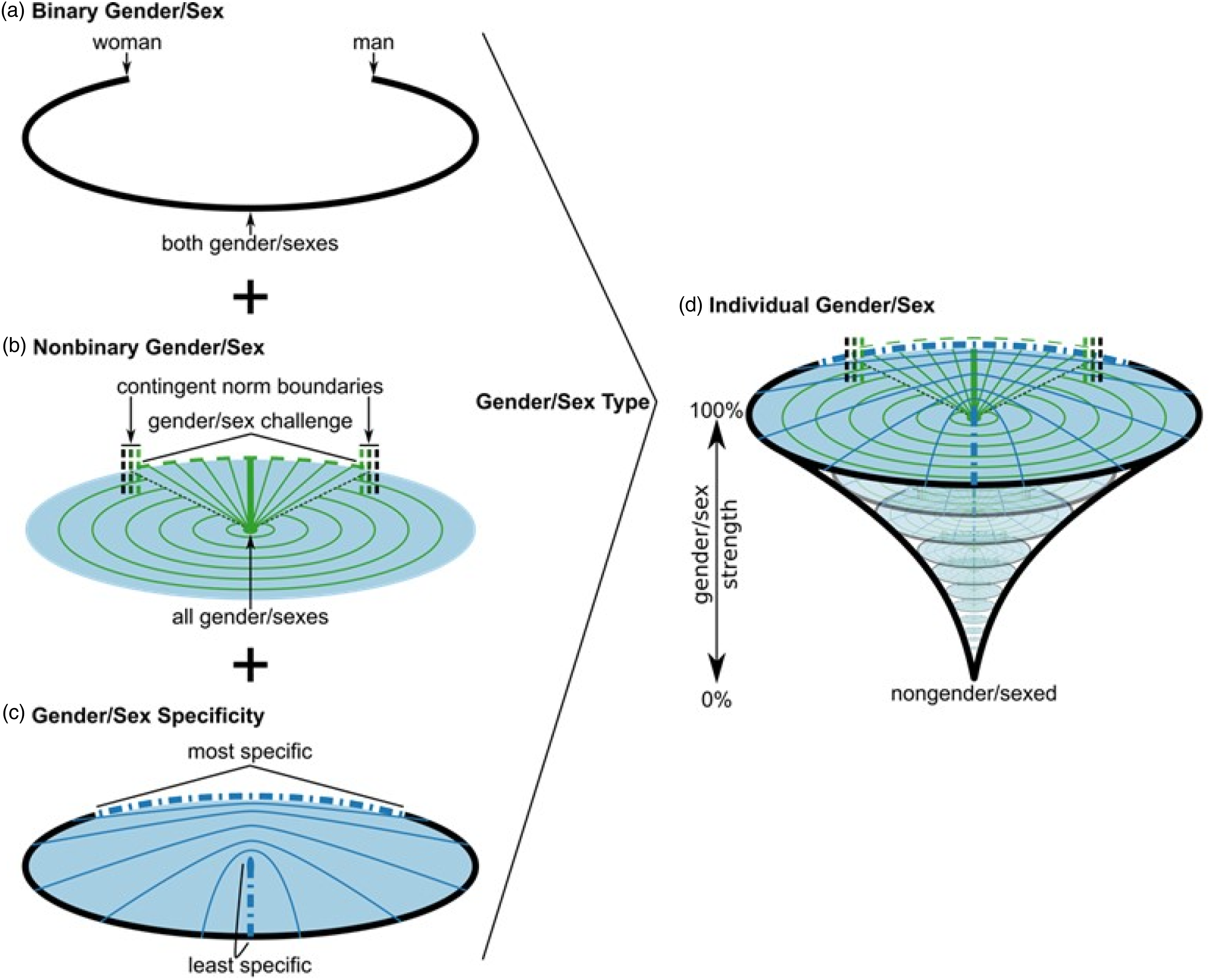
The methods in this study centered gender/sex diversity, and we worked for them to be comprehensible to majorities, which resulted in various reactions to the survey. To explain the diagrams, we had created a 12-minutes instructional cartoon video using fictional characters to illustrate how one might use these diagrams (Beischel et al., 2021c, 2021a, 2021b). These described terms and concepts like gender, sex, and gender/sex, and also the structure of the diagrams. This video included transgender and/or nonbinary characters whose identities may be unfamiliar or unexpected for cisgender individuals. It also placed cisgender identities as just one possibility among a diverse landscape of gender/sexes, which may constitute an unfamiliar decentering to majorities (see video at SCT & Individual Gender/Sex, 2019, https://youtu.be/qOCxIMP6VGo). In part to understand participants’ reactions to these features and to the diagrams, we asked a series of open-ended follow-up questions, including how much they had thought about their gender/sex before the survey, how difficult they found the diagrams, their understanding of the concepts, and any changes in their thinking or how they were able to describe themselves.
The cisgender participants’ responses were illuminating about majority social locations and evidenced both overempowerment and instances of learning and growth, as we discuss in the Results section. The data reviewed here include all cisgender participants’ responses across the seven open-ended questions. We carefully read through these responses and inductively generated two major themes: challenges and opportunities. We then organized responses further within each of these themes to understand the general patterns of cisgender participants’ reactions to the survey. Finally, we read through all responses again to ensure that the themes and subthemes captured the breadth of the data.
The SCT In-Person Study (Abed et al., 2019)
In the SCT In-Person study, we conducted extensive in-person qualitative interviews with 26 gender/sex/ual majority individuals to explore how they might make sense of themselves using SCT (Abed et al., 2019; van Anders, 2015). Our interviewers—a young, white, cisgender, sexual minority woman; a young, white, cisgender sexual majority woman; and a young, Asian-American, cisgender, sexual majority man—experienced challenges in some cases where our participants held multiple majority identities that set off power differentials amplified by our research methods.
Many of our participants occupied positions of greater power than our interviewers on axes of age, gender/sex, sexuality, and/or race/ethnicity. And, we interviewed them about those axes, that is, the very factors that made them part of a social majority. We refer to this as “interviewing up,” as in “studying up,” which was first coined by Nader (1972). Participants discussed words they use to describe their partnered sexualities and individual gender/sexes, and then marked their specific interests and identifications on eleven open-ended SCT diagrams in a paper workbook. We used interview techniques and strategies that were developed for empowering minority participants, but experienced challenges when applying these strategies with a majority sample. The data that we discuss here are drawn from the interview transcripts and diagrams from our interviews with white, gender/sex/ual majority participants. We carefully read through these transcripts and inductively generated themes tied to the challenges we faced when “interviewing up,” which we describe in the Results section.
Results and Insights from Studies
In this section, we discuss four key ways our research with minority-inclusive methods overempowered our gender/sex/ual majority participants but also provided some majority situatedness: overempowered majority avalanches in participant recruitment, overempowered resistance to diversity-focused research participation, overempowerment in power (im)balances, and positive outcomes of diversity-focused research with majorities, like growth and learning. Like most critical research, we did not set out to overempower our majority participants, and we also did not consciously set out to facilitate their growth and learning. But, a critical approach to research that includes both reflexive and diffractive lenses attends to heterogeneous “outcomes” of research and their meanings, which we describe here.
Overempowered Majority Avalanches in Participant Recruitment
Recruitment of participants signals the topic of the research and potential eligibility, but also some of the framings of the study including whether it supports the status quo or is diversity-focused or minority-inclusive. Any given research study communicates its ideological positioning to participants, whether implicitly or explicitly or with researchers’ awareness or not, because all research is ideologically positioned. For those who disagree with minority-inclusive research, recruitment can open up doors to backlash. For example, in the Definitions study, we saw an organized attempt to disrupt the research process from the FB participants (those from TERF discussion groups on Facebook). This demonstrates some of the challenges that can accompany recruitment for diversity-focused research, perhaps especially in online contexts.
We discovered the FB participants in our Definitions study sample because they shared in free-response items that their decision to participate was motivated by ideological opposition to our research. For example, one person wrote, “[I participated in this survey because a] friend shared it with me on facebook [sic] because she wanted me to present my anti-gender viewpoints despite the survey being biased to an ideological belief in gender.” Some participants also responded to an item asking them to describe how they arrived at the study by sharing that they came from a “radical feminist,” “radfem,” or “gender-critical” Facebook group (n = 9). However, most FB participants listed the source simply as “Facebook.” Not all of these terms are synonymous with TERF, but all are commonly used to denote TERF beliefs. Based on these responses and survey metadata (e.g., the source of the referring link participants clicked to access the survey), we determined that FB participants were sharing our study link with their groups to encourage participation as a form of collective (re)action. Had we encouraged participants to share the study link with their personal networks, this would simply constitute the common method of respondent-driven sampling (also known as “snowball sampling”). However, because this practice of sharing the study on Facebook was unsolicited, rapid, and had disruptive effects on the study, it can be understood not as respondent-driven but rather an overempowered, respondent-controlled form of sampling—or, what we refer to as an “avalanche sample.”
The avalanche sample did not fully derail our research, but it did have certain disruptive effects. For example, we were interested in people from different social locations (i.e., gender/sex/ual minority or majority status) differed in the types of features they mentioned in their gender/sex category definitions. However, FB participants varied systematically from other groups in their social group composition. Among these who provided demographic information, participants were mostly women (n = 98) with only a few men (n = 6). They identified as lesbian/gay (n = 44), heterosexual (n = 39), bisexual (n = 18), used another label (n = 8), used multiple labels (n = 3), or provided a detailed explanation of their sexualities (n = 3). While those who subscribe to TERF ideology can be of any gender/sex or sexual identity, they are most commonly women and/or sexual minorities 3 (Goldberg, 2014), and this was reflected in the FB group in our study. Importantly, the converse is not true: there is no evidence to suggest that a significant proportion of women and/or sexual minorities endorse TERF ideology. Therefore, including FB participants in analyses comparing women and men, or sexual minorities and sexual majorities, would likely be misleading and over-represent TERF ideology. We decided to include the FB group in analyses separately from the rest of the sample for exploratory purposes, which allowed us to still conduct the group comparisons we had originally planned.
Why did the FB participants organize themselves into an avalanche sample? Some FB participants’ comments to free-response items at the end of the survey clarified the emotions underlying their decision. One FB participant wrote, “Losing sex segregated spaces and legislating personal identity as law is very scary for me. We want our granddaughters to be allowed to choose if they want to allow males [sic] into their showers, social events and academic institutions.” Importantly, our survey did not have any items related to legislation or sex-segregated spaces and institutions. Regardless, the questions we did ask (e.g., personal definitions of gender/sex categories) were sufficient to cue this participant to express their fears about how acceptance of gender/sex diversity might change their social world.
Other participants brought up concerns about “the removal of the category female as a discrete sex class” or fears about having to use gender-neutral language they dislike (e.g., “people with vaginas”). Some wrote clearly negative or angry comments that suggested they viewed us as gender/sex diversity advocates trying and failing to conceal our bias (e.g., “By offering gender/sex as a unified concept your bias is showing. Big time”). So it was clear in comments like these that some FB participants perceived us, the researchers, as their political adversaries—but it was unclear from other comments whether some instead perceived us as potential allies. Regardless, the strong feelings of anger evinced in the FB sample’s comments can help motivate collective action (Carver & Harmon-Jones, 2009; van Zomeren et al., 2004), given its role as an approach-related emotion (e.g., toward confrontation, problem solving). And, in our research, majorities’ anger at our minority-inclusive methods and/or diversity-focused topic (i.e., individual variation in definitions of gender/sex terms) was sufficient to motivate efforts to disrupt our research by flooding it with TERF perspectives.
Our experience with avalanche samples in gender/sex diversity research is not unique as others studying gender/sex diversity and transgender identity/experience have shared similar experiences with us. For example, the US Trans Survey had similar issues with avalanche samples of TERFs (A. Flores, personal communication, Aug 1, 2017). It remains unclear whether avalanche samples in diversity-focused research are a strategy specific to TERFs, or if other organized majority groups also use this strategy (e.g., white supremacists disrupting research on racial/ethnic diversity). There certainly is evidence of other reactionary social movement online communities performing similar disruptive actions including in the “manosphere” (e.g., men’s rights activists) and white supremacists (Caren et al., 2012; Heikkilä, 2017; Marwick & Caplan, 2018). These include e-mail bombs (van Laer & van Aelst, 2010), in which participants flood a target email server to show the magnitude of opposition to a specific policy, action, individual, etc., and brigades (Heikkilä, 2017), in which group members collectively perform a disruptive action such as leaving comments on articles, attempting to sway opinion polls, or harassing individuals.
Notably, tactics such as e-mail bombs, brigades, and avalanche samples might be used for achieving reactionary goals—or progressive ones. Our study was disrupted by reactionary groups opposed to the expansion of gender-based protections for gender/sex minorities, but social movement online communities that include and/or center gender/sex minorities could organize to disrupt research that is linked to restricting rights for gender/sex minorities. Fundamentally, an avalanche sample is a form of digital, research-based protest, and protest can be used to promote social progress or pushback against it. In other words, an avalanche sample is disruptive, but disruption is not inherently problematic; people might rightfully choose to disrupt research that functions to uphold an inequitable status quo or seeks to introduce one. Yet, it remains an empirical question whether avalanche sampling is ever used to protect social progress rather than restrict it. In the case of our avalanche sample, the FB participants were overempowered gender/sex majorities who perceived the minority-inclusive gender/sex diversity framing of our study as threatening and were thus motivated to disrupt it and gender/sex diversity itself.
Overempowered Resistance to Diversity-Focused Research Participation
Study materials, like measures and communications, can communicate whether the research is diversity-focused or supports the status quo, in even more in-depth ways than recruitment materials. In our studies using SCT—SCT In-Person and SCT Online—participants had various reactions to it, including rejection, disapproval, and defensiveness. For example, some majority participants rejected the utility of the diagrams for describing themselves even though they could locate themselves within it. One woman in the SCT Online study commented, “I don't think the ‘message’ the study is trying to get across really applies to me,” and another woman said, “I don't need crazy charts to help me know who I am.” These and other responses verged on frustration or even hostility towards space for others that majorities did not need for themselves.
Other participants used the diagrams to emphasize their status as majorities. For example, one participant elected to mark 120% on a “strength” measure (i.e., significance or personal centrality of their markings) out of a possible 100% for nearly every diagram in the SCT In-Person study, making clear that he could not overemphasize enough his heterosexuality, masculinity, manness, or maleness. Interviewers made it clear that participants could use the elements of the diagrams however made most sense to them and their experience, so there was nothing “incorrect” or objectionable about the strength or locations he chose to mark in and of themselves. At the same time, it is worth noting that none of the gender/sex/ual minority participants in prior research marked above 100%; arguably, this participant seemed to want to specifically maximize the distance between his majority location and the “other” possibilities the diagrams presented.
Majority participants sometimes rejected gender/sex diversity altogether. For example, our instructional video in the SCT Online study included a bigender person who said they sometimes felt like a man and sometimes felt like a woman. One woman seemed to reject this, writing (unprompted), “For me you are who you are. You can not one day be female and the next day be male.” Comments like these largely came from majority participants, who commented as if they could speak on behalf of others’ realities and existences (including those of the research team’s). Instead of communicating that the elasticity of SCT was irrelevant to themselves, they asserted that the static nature of their gender/sex was the right or only way to experience gender/sex.
In a related form of reaction, a participant in the SCT In-Person study responded directly to the research framing, correctly identifying it as feminist. When asked about how his gender/sex might change based on context, he instead expressed disdain for the university’s feminist students: “On campus… you see a lot of feminists and they’re all female and then, they become like feminazis.” By targeting the research, this participant also targeted the researcher with curt, antagonistic comments. This kind of anti-feminist language is frequent among majorities who harass or enact other violence against feminists online and in-person. Accordingly, utterances like this not only address the ideological position of diversity-focused research but are attempts to put contain or push back against diversity and those who employ it.
Clearly, majority participants felt empowered to communicate their (majority) gender/sex/ual configurations via SCT, contrary to much framing about how diversity-focused and minority-inclusive frameworks exclude or censor majorities. However, by providing space for participants to comment so extensively, they also felt overempowered to communicate their resistance to and pushback against the very diversity-focused frameworks they could locate themselves within and the researchers who communicated them.
Overempowerment in Power (Im)Balances
Some majorities responded to our diversity-focused research and the ways they decenter majority privilege by strategizing to rebalance power. We repeatedly encountered tensions between our minority-inclusive methods in the context of interviewing majority individuals in our SCT In-Person study. Interviewers, for example, focused on active listening and asking specific but open-ended follow-up questions, both to affirm our interest in learning about our participants’ experiences and also to avoid positioning us, the interviewers, as experts or authorities (our training materials for interviewers included Braun & Clarke, 2013; Campbell, 2001; DeVault & Gross, 2006; Rubin & Rubin, 1995).
The minority-inclusive methods were necessary and validating for the gender/sex/ual minority participants in our previous research (Schudson et al., 2017). However, in this study with majorities, these methods seemed to overempower a number of our participants who held multiple majority identities (white, heterosexual, cisgender men). In particular, they would over-disclose information that unsettled our interviewers and, in some cases, seemed designed to do so. For example, we asked participants for feedback on the interview process as is common with minority-inclusive approaches; one older participant used this as an opportunity to describe with excitement memories of his school crushes being paddled in class as punishment, now an erotic fantasy he had “actually NEVER confessed, not even to [his] wife.” After sharing, he ended the interview by telling the interviewer, “You put me at ease.” But, of course, this did not put the young woman interviewer at ease, and whose ease mattered was made clear.
But, when our interviewer and interviewee shared identities, this also raised issues. We paired men participants with our man interviewer based on their shared identity in the SCT In-Person study, which can be a helpful strategy for interviewing minority or lower-power individuals (see Broom et al., 2009; Padfield & Procter, 1996). But, this shared identity seemed to lead some majority men to overshare in disruptive ways. One majority participant in particular spent several minutes describing his neighbor in sexually explicit and unequivocally denigrating terms: “She’s wearing that skimpy dress that’s just covering her ass… she’s not very attractive in the face but I could do her doggy style, that kinda chick.” Comments like this or with this tone were not present in the study with gender/sex/ual minorities or when interviewers were not matched on identity. The participant continued to clarify that nothing other than his neighbor’s physical attributes mattered to him despite the interviewer’s attempts to steer him back to the diagrams. The participant clearly felt more than sufficiently empowered to share his views (again, contrary to notions that diversity-focused frameworks “silence” majorities) and overempowered to share despite pushback from the person ostensibly in a position of authority, that is, the researcher.
These experiences raised difficulties for the interviewers. This included hearing a participant describe a woman in an especially degrading and objectifying way, as well as feeling like the participant did so to invite the man interviewer to participate in the homosocial dynamic of creating intimacy through the shared objectification and sexualization of women (Flood, 2008; Sedgwick, 1985). The interviewer was aware of the problematic implications of the participant’s actions but felt that, to maintain a comfortable environment, the most he could do was gently steer the participant back towards the diagrams. This gentle steering was not successful, leaving the interviewer feeling powerless and like a co-conspirator in the participant’s objectifying description. Some scholars have suggested asking more questions about what the participants reported to interrogate the privilege they invoke (Cabrera, 2016), and managing men participants’ efforts to produce a sexist, homosocial dynamic between might require less gentle approaches.
In addition to over-disclosures from overempowered participants, we encountered further challenges when we asked participants about how their social location in hierarchies of oppression and privilege (specifically, “class, race, ability, religion, or age, etc.") may have influenced how they marked the diagrams. Some of our participants interpreted this question as if we were asking about the preferences they had for the race, class, or religion of a partner, and seemed to have no frame for considering how their identities might matter for partnered sexuality and/or individual gender/sex. This resulted in a number of alarmingly racist comments, despite interviewers explicitly clarifying that we were “interested in how your identities and culture might influence your markings, rather than your preferences for a partner’s class, race, ability, religion, age, etc.” One participant told his interviewer, who was Asian, seemingly trading on their shared identity as men, “I hope you don’t take offense… I do have an affinity for Asian women… I’ve heard that Asian women make wonderful wives cause they’re so helpful.” A different participant said to the same interviewer, “I would never wanna go out with a Black chick, have no desire to do it.” This stood in stark contrast to prior research with gender/sex/ual minority participants, who always answered about the ways their own social locations mattered for their gender/sex/ual configurations (Schudson et al., 2017).
These disruptions and racist comments were emotionally difficult for interviewers to manage, both during and after the interviews themselves. Others have reported similar dynamics, where white, heterosexual, cisgender men participants did not hide racism during interviews with other men, even racial/ethnic minoritized men, but actively offered it (Cabrera, 2016). Again, these experiences are stark contradictions to claims that diversity-focused spaces restrict majority voices and, instead, the focus on participant voices seemed to clearly overempower participants.
Throughout SCT In-Person, we found that our minority-inclusive methods often did not serve us well with majority participants. In some cases, they evoked sexual racism, sexism, and unwarranted discomfort for our interviewers. Even our attempts to rebalance power—sometimes based on established guidelines for qualitative research (e.g., identity matching)—just shifted the challenges we faced with overempowerment, rather than resolving them.
Positive Outcomes of Situating Majorities via Diversity-Focused Research
Despite the challenges we faced studying gender/sex/ual majority individuals, we observed a number of unique benefits with important implications for scholarship that did not reflect overempowerment. In SCT In-Person, we found that “interviewing up” using a minority framework with white gender/sex/ual majority men allowed our participants to express more nuance and complexity than is typical. Our participants shared in complex, novel ways using SCT that overlapped with many themes with our minority participants.
Working through the diagrams also gave some of our participants a space to self-reflect that might not have occurred otherwise. Majority individuals tend not to reflect critically on their majority social identities to the same extent that minoritized individuals do, likely because majority identities are seen as the “default” and are more socially invisible (Case et al., 2012; Kolber, 2017; Pratto & Stewart, 2012). One of our majority participants in SCT In-Person said, “People don’t normally talk about this stuff… I opened up a little bit.” Indeed, many of our participants expressed that participating in our study was the first time they had discussed their own gender/sex and partnered sexuality in depth. Many also said that our interview study was a learning opportunity for them, in that the diagrams functioned as exposure to sexual diversity they had not encountered or understood before, and that inspired and empowered them to learn more.
Opportunities to learn and grow stemmed from participating in the SCT Online study. Some majority participants reported learning about the various components of gender/sex. For example, one man expressed that his worldview has shifted to now accommodate nonbinary identities, noting “I have always thought of gender as binary. It was eye-opening to see the new, more complex diagram to identify a person's gender or sex.” Similarly, one woman said, “I have so much more to learn. This is mind expanding,” and a man said, “The diagram gave me a fresh [visual] means of considering the gender/sex spectrum. It might reframe my thinking in the future.” Thus, some saw participating in this study as an arguably empowering educational experience, one that may even have lasting effects on their worldviews, even though we did not design this study to change people’s minds but to explore their own gender/sex configurations.
Participants also frequently communicated learning more about the larger landscape of gender/sex and their place within it in the SCT Online study. For example, one woman noted “I enjoyed the three-dimensional diagram. It allowed me to think about everyone's gender expression in the same space as opposed to separate entities.” This quote highlights the move from a “difference” to “diversity” perspective as per SCT’s sexual diversity lens (which we did not explicitly share). And, these kinds of considerations seemed to even lead to attitude change, as one man noted: “I now understand there is more complexity in how people identify themselves, and it is important to learn about this to more compassionately treat others.” While knowledge alone does not necessarily amount to compassion for minoritized folks, it clearly functioned as such for this participant.
These instances demonstrate that minority-inclusive methods did not always overempower majority participants and even sometimes had positive outcomes, such as greater understanding of and compassion for gender/sex/ual minorities. As such, the challenges that we encountered in doing this work do not negate its value. The potential for growth, learning, social justice is thus a possible, and even likely, result of utilizing diversity-focused methodologies with majorities, at least sometimes.
Discussion
In this article, we discussed how diversity-focused research on gender/sex/uality can “overempower” majority participants. That our research processes can reify, buttress, or even instantiate privilege and/or supremacy in our participants does and should give us pause (Becker & Aiello, 2013; Hurtado & Stewart, 2004; Pacholok, 2012). Majorities certainly pushed back against our minority-inclusive methods in a variety of ways. This included participants reasserting their majoritarian privilege as per Cabrera (2019) and Feagin (2020), countering claims that diversity-focused research and minority-inclusive methods restrict, censor, or silence majority individuals’ voices, including explicitly offensive ones.
Though majorities resisted our minority-inclusive methods, this was not the only outcome. Many majorities reported learning more about themselves and coming to reject the simple narrative they had previously held about their gender/sex/uality. Others reported learning more about gender/sex itself and gender/sex diversity in general, even if their understandings of their own gender/sex/uality did not change. Some explicitly mentioned that this research helped them understand a broader set of social locations than the ones they inhabited, or that they had not had (or found or created) opportunities to critically engage with these issues about themselves before. Because epistemic injustice relies on majorities’ (often willful) ignorance about their own situatedness and that of others (Fricker & Jenkins, 2017), these results have hopeful and important implications for social justice.
But, how can we bring together these considerations of majority pushback with opportunities for advancing social justice to develop a more considered approach about how to meet important calls to study up for understanding majoritarian structures and privilege (Nader, 1972); to conduct diversity-focused research that provides the crucial insights that result from focusing on the dynamic nature of margins and center; to do research that is minority-inclusive, welcoming and validating; and to conduct research that can lead to majority growth but not overempower those in already privileged positions?
In writing this article about overempowered majority participants, we came to recognize that diversity-focused work needs minority-inclusive and what we call majority-situating approaches. This is therefore a starting point for thinking through what a socially just diversity-focused research program would involve when considering the ways our studies themselves are world-making sites. And, it is a call for scholars to consider and contribute to what majority-situating strategies for a diversity-focused research project could look like, and not a guide. Accordingly, we next delineate insights from our research that can help us envision stronger approaches to diversity-focused research more broadly.
Naming Power and Identifying Backlash in Diversity-Focused Research is Multifaceted
Research on or with diversity is often not built to consider issues of power, just like many research projects with minorities are not built with insights from or consideration for marginalized groups. However, research with minorities that succeeds as minority-focused research arguably does so because it uses consciously built, critical, and progressive methods. Similarly, the project of diversity-focused research cannot succeed without a meaningful method. Otherwise, it is just research with “different kinds of people,” perhaps a step up from ignoring minorities and minoritization, but also an approach that reifies and condones power differentials by ignoring them and failing to name or disrupt them.
The importance of diversity-focused research, and notions of minority–majority positions, was clear for the cisgender women, largely sexual minority ones, who pushed back against the progressive minority-inclusive research methods we used by coming together in an avalanche sample in Definitions. They articulated their grievances through appeals to the rights of (cisgender) women and/or sexual minorities, demonstrating how minority–majority social locations can trouble research on power and make instances of majoritarian backlash more difficult for researchers to identify. In this way, cisgender sexual minority women—who certainly experience oppression on the basis of being women, being sexual minorities, and their intersection—also perpetrate oppression from a cisgender majoritarian social location (Cava, 2016; Schudson et al., 2019; Watson, 2016). Accordingly, even the “simple” act of categorizing people as minority or majority for our diversity-focused research—or anyone’s—is fraught and attendant on the power dynamics at hand.
The majority of the avalanche participants were not only cisgender but also white, which may be at play. Whiteness can be a social location that is pro-scientific authority, in large part because science has been a tool widely used towards white supremacy (Brandon et al., 2005; Kevles, 1995; Mumford, 2012). Accordingly, racial/ethnic majorities might be more likely to try to distort and shape science because it has typically buttressed their privilege and others’ marginalization and they see its value insodoing. But, the avalanche sample might reflect the complexity of their minority-majority status and their experiences as women and/or sexual minorities. As people who are marginalized for their gender/sexes and/or sexual orientations, they might be wary of the negative impact science can have on minoritized groups and fear for their own groups at the expense of others (i.e., gender/sex minorities). Simultaneously, as white people, they might see science as an inherently good enterprise in need of their stewardship and protection from biased researchers. Seeing equity as a zero-sum game where the advancement of gender/sex diversity comes at the cost of other gender rights is arguably countered by gender/sex diversity research even as it can clearly be a lightning rod for these concerns.
What does this all mean for diversity-focused research? How do we attend to multiple social locations that have shifting minority–majority power dynamics and that are subject to intersecting axes of oppression? We argue that SCT’s sexual diversity lens provides one model of a way to do so, because it locates people without homogenizing, essentializing, or boxing in those locations (van Anders, 2015). In the sections that follow, we argue that diversity-focused research benefits from a (sexual) diversity lens and, moreover, needs to be rooted in minority-inclusive methodologies as well as what we call majority-situating ones.
Minority-Inclusive Methods are Critical for Diversity-Focused Research, But Not Enough
Our diversity-focused research was intended to in part explore majority experiences. To do so, like others, we used critical methods that are minority-inclusive (Campbell & Wasco, 2000; Hurtado & Stewart, 2004; Sohl, 2018). These methods can clearly be used to study up—we used them in our research with majority participants and others generally do as well. But, while they are built with considerations of power and minoritization, they are not built to check majority privilege or power. Majorities clearly use them to restabilize power as we and others describe (e.g., Aydarova, 2019).
Our minority-inclusive methods reflected our models of the world and who is in it, as do all methods (e.g., Clough, 2015; Fujimura, 2006; Haraway, 1988; Harding, 2004; Longino, 2002; Roy, 2004; Subramaniam, 2001, 2009). This is the case whether models are progressive or regressive, and both minoritized and majoritarian participants can recognize this. They are an important way for minoritized participants to be welcomed, validated, and see that research takes their realities into account, so that participating becomes and feels worthwhile. In our studies, minoritized participants reported feeling excited about our models and seeing themselves in them (Beischel et al., 2021c, 2021a, 2021b; Schudson et al., 2017). They also have appreciated the ability to articulate their own views of gender/sex rather than to work within majority-centered frameworks set forth by researchers (e.g., a participant who liked being able to indicate her gender/sex was trans woman and her sex was female; Schudson et al., 2017).
We identified a number of minority-inclusive methods that majorities pushed back against: for example, minority-inclusive language, empathetic listening, minority-inclusive models and theories of gender/sex/ual diversity, space for participant engagement, and identity matching. Majorities seemed to have varying intertwined motivations for this, including disrupting the decentering of power, pushing back against perceived threats to privilege, (re)instantiating dominance, sidelining diversity and minority lives, and being racist or sexist. This was especially the case when researchers, otherwise in de facto “positions of power,” were lower-power people or shared dominant identities. Majorities even rejected models in which they could self-locate to avoid legitimizing diversity in general, paralelling how some white people will reject policies that help them if those policies also help minoritized people (Metzl, 2019). Power is not ceded so easily!
Of course this destabilization and/or jettisoning of centers can be troubling. It obviously challenges majority privilege and sense of (centered, universal) self—but this can be important and valuable. Minority-inclusive models of the world and its methods can also push majority participants forward, with opportunities for learning and growth. And, minority-inclusive models and methods are critical for diversity-focused research, since they also invite and welcome in minoritized participants. Minority-inclusive approaches can themselves ameliorate epistemic injustice and help majorities understand the larger landscape of gender/sex/ual diversity and where they exist within that. It is clear that studying up contributes to knowledge about power, from studying majorities as well as minorities, and that doing so benefits from minority-inclusive methods—and also requires more. Accordingly, we argue the answer to the mismatch between minority-inclusive methods and diversity-focused research is not to subtract minority-inclusive methods but to add “majority-situating” ones.
Diversity-Focused Research also Needs to be Grounded in Majority-Situating Methods
In this section, we introduce and use the term “majority-situating” 1 for research and methods. We do so as a complement to “minority-inclusive”, but one that recognizes that a different though entangled politic is necessary as the underlying motivation for the terms given exists along different locations of power hierarchies. By majority-situating, we mean at least two things: (1) acknowledging that majorities are situated in privilege and power and treating them with this in mind in the research process, and (2) providing majorities with the opportunities to grow and to understand they are situated.
First, majority-situating research needs to treat majorities as situated in power structures, holding privilege and empowered to oppress if not actually actively oppressing. In the same way that minority-inclusive methods attend to marginalized social locations themselves and how these social locations matter for research—and how research will matter for marginalization and to marginalized groups—majority-situating methods need to attend to the social locations of majorities. That means recognizing, ahead of time (as we did not), that majorities bring with them privilege, expectations of being centered, and often the will, resources, and ability to dominate. Yet, many recommendations for research with majorities replicate minority-focused or -inclusive methods without doing this (Aydarova, 2019). In the same way that research with minorities that ignored their marginalization would be incomplete scholarship and contribute to marginalization, research with majorities that ignores their majoritization is incomplete as scholarship and buttresses majoritarian power structures.
Second, majority-situating research needs to provide majorities with opportunities to understand they are situated, and to grow accordingly. This markedly differentiates diversity-focused research from the theory and methods in studying up (Nader, 1972). Studying up is focused on understanding the role that majorities play in upholding oppressive power structures; diversity-focused research with majorities can do this too. But, the majority-situating lens we are proposing also provides benefits to majorities themselves and, indirectly, to minorities by addressing epistemic injustice.
The resistances some majority participants voiced remind us that educational work is often necessary when doing diversity research with majorities. Majorities are not expected to account for themselves and have been able to navigate a culture that was built for them and not to exclude them. Many do not have to seek out resources to help them understand their and others’ identities, as their identities are the default. Diversity researchers must then be that resource for them if the goal is a shared understanding between participants and researchers.
There are cogent and compelling arguments that social justice needs to be rooted in the needs of minorities and not center majoritarian perspectives (e.g., Combahee River Collective, 1983; Piepzna-Samarasinha, 2019), and research that does not help majorities see themselves as situated actively contributes to injustice by not pushing forward beyond the status quo—and thus reifying it. Majorities who come out of research experiences thinking the world exists as they previously thought it did are being taught—by researchers, even power-conscious ones—that the world does exist in ways that align with majoritarian thought. For example, in our research described in SCT Online, the locations of “women” and “men” were small points in a universe of possible locations, and majority participants were able to see how minute and localized their existences were relative to empirical reality. And, many majority participants in SCT In-Person were explicitly asked to consider how their experiences of gender/sex/uality reflected intersections with other lived experiences and, even when they pushed back against this, were able to see that gender/sex/uality could reflect multiple inputs or axes of power.
One of the trickiest aspects of majority-situating research is how to do it in ethical ways that have the maximum likelihood of majority growth. Because majorities will often resist any decentering of their experiences, attempts to check or manage privilege, much less to shift centers and margins, can be met with backlash. This can include majorities rejecting the research (or researchers), asserting majority privilege and power, or inserting their experiences over others. And, all the educational work and majority-situated methods cannot prevent this from ever happening or ensure majority growth and situating.
Yet, backlash from majority participants, or even “feel-bad” moments from them (e.g., via feelings of shame, etc.), can count as something to avoid when possible not because we want to center majority feelings or because we want to prioritize access to majorities as some do, but for social justice reasons: these moments can further entrench majority participants into regressive beliefs (Morrison & Ybarra, 2008; Morton et al., 2009; Vandello & Bosson, 2013). Accordingly, this is not a call to center majorities but a call to center social justice. Researchers involving majorities in research need to consider how to best maximize social justice outcomes given that they are including majorities in research and given what is known about practical approaches to maximize the possibility of majority growth versus retrenchment. How might this work?
Promising insights might come from teaching methods. Many instructors have vast experience with teaching about privilege to those with it and oppression to those who (could or do) perpetrate it. There are scholars teaching about racial justice, liberatory perspectives on gender/sex/uality, class emancipation, and more, who have developed thoughtful practices that decenter and de-universalize majoritarian structures (e.g., Good & Moss-Racusin, 2010; Hegarty, 2010; Puchner & Roseboro, 2011). Obviously, some of these may not transfer or generalize to majority-situating methods in research, and some of them might require considerable translation or adjustment. But, there may be many that are applicable and/or generative and, as a bonus, this overturns the usual head-over-hand hierarchy (i.e., pervasive assumptions that research is intellectual and thus valuable “head” labor, whereas teaching is doing or caring and thus less valuable “hand” or “heart” labor; see Rose, 1983) which dictates that research influences teaching and not vice-versa.
The research experiences and reflections we detailed in this article lead us to some possibilities as well. One approach to majority-situating research could include thinking through the dynamics of minority-inclusive research practices that are handed down and shared as best practices in a universalized (though often unstated) sense, and focusing on which might be best practices for specific situations. Identity-matching is one example, often highlighted within minority-inclusive methods as best practice and important for our minoritized participants.
While considering identity-matching for SCT In-Person, we questioned which axes and intersections we would need to match on and found fewer answers than we hoped (Broom et al., 2009; Padfield & Procter, 1996). When we planned our research, we initially decided to not match given those considerations. Not matching on identity (e.g., woman interviewer-man participant) is sometimes recommended as a minority-inclusive method because it can reduce the pressure to present masculinity that some men participants might read into a man interviewer, and men can share more narrative information or speak more carefully when interviewed by women (Archer, 2002; Cabrera, 2016; Manderson et al., 2006; Oliffe & Mróz, 2005; Sallee & Harris, 2011). Yet, not matching on identity was used by majorities as a way to shore up majority privilege and power. Other women researchers who have interviewed higher-power men about topics related to masculinity report their participants speaking sexually or condescendingly toward them, making physical advances, or disclosing personal stories more easily because they viewed their interviewer as a caretaker or nurturer (Arendell, 1997; Gailey & Prohaska, 2011; Pini, 2005).
Given this, we went on to match by gender/sex (e.g., man interviewer-man participant), not realizing the potential for new avenues of dominance via identity matching. But, majority participants also used identity-matching as a jumping off point for reinforcing a presumptive shared majority privilege.
Considering identity-matching and -mismatching within the context of overempowerment leads to the recognition that each kind of interviewer will help to produce context-specific but valuable insights about power (Archer, 2002). Accordingly, rather than trying to eliminate power imbalances or the presence of privilege, developing research methods that attend to dynamics of power and oppression that might appear with majority and minority participants would be useful (Broom et al., 2009; Manderson et al., 2006; Sallee & Harris, 2011; Williams & Heikes, 1993).
In this way, understanding that majority men can find ways to use any research situation to buttress privilege can help researchers develop methods in advance. These might simply be guidance or coping methods, like a “difficult interview guide” we developed, and ensuring that researchers know the boundaries of what is reasonable, safe, tolerable, and so on when normally participants would be the focus of this (Becker & Aiello, 2013; Pacholok, 2012).
But, instead of a “difficult” interview guide that focuses on what to do in/with the aftermath of privilege, we can imagine creating a “privileged” interview guide. It could instruct researchers on the dynamics they might expect with majority locations and how best to prevent them when possible. The introduction of a study to participants might look radically different knowing that majority men in an interview about their gender/sex/ual location might overshare, answering questions that were not asked to discomfort women interviewers. It might give specific examples of what is appropriate and what will be considered out of the bounds of the interview such that it will stop. Knowing that majority men participants might try to “bro-bond” with men researchers by minoritizing absent others (Flood, 2008; Sedgwick, 1985), men interviewers might look at strategies for hearing but not agreeing with the participants’ contributions or even hearing and disagreeing, verbally, with gestures, or in other communicative forms.
Another approach to hearing but disrupting participants’ privilege might lie in asking further questions or even presenting information that counter stereotypical utterances, as Cabrera (2019) describes in his research on the social justice beliefs of “white guys on campus.” Some have called for explicitly speaking to power, for example by naming the racism and/or disavowing it in the moment that participants are enacting it (Hurtado & Stewart, 2004) or to otherwise interrogate it (Cabrera, 2016). The benefit of this approach is that it does more of the anti-racist work that anti-racism researchers are committed to. As challenging or tense as it might be, it also could feel good because it aligns with one’s values. It also has downsides; intervening or pushing back could limit the very speech and beliefs researchers might aim to study. Asking questions seemed like an effective approach that could allow participants to reflect and reconsider—potentiating growth—while ensuring that participants did not leave the research experience thinking their problematic and/or incorrect beliefs were supported, condoned, or agreed with.
Providing opportunities for majorities to literally situate or locate themselves, even when they do so in problematic ways, can be another avenue of majority-situating methods. For example, by asking participants how they came to our studies, FB participants in the Definitions study told us they came to disrupt our minority-inclusive approach. They, thus, are forced to consider that motivation to shape research outcomes is something they have articulated explicitly about themselves and not just something researchers or minoritized participants might want to do. Understanding that any participant can and does impact data, and thus impacts “facts,” is quite radical as well, and might lay a foundation for disrupting scientism however ironically (Fujimura & Holmes, 2019). And, sometimes, of course, participants learned to situate in progressive ways, as when participants come to a study never having heard the term “cisgender” but leave it having applied it to themselves.
Indeed, we were surprised that—and how much—majority growth and learning occurred in our research, with some reporting inspiring moments of self-discovery. Not only can minority-inclusive research increase what Nicholas (2019) calls “diversity-literacy,” wherein majorities become more well-versed in thinking beyond binaries and considering unfamiliar gendered experiences, it can also help turn the critical lens inwards. It can illuminate commonalities and social alliances where none seemed obvious before (van Anders, 2015), potentially encouraging majorities to deconstruct their own majoritarian power.
Moreover, majority participants were able to engage with terminologies and models from SCT that some might think implausible (van Anders & Schudson, 2017). This included majority participants who reported appreciating or liking the model and those who did not. Because so many majorities do not find, create, or have opportunities to engage in sustained (even for the 30 minutes or an hour our studies took!) critical self-reflection within expert frameworks (Abed et al., 2019), many left our research having new understandings of themselves, gender/sex/ual minorities, and gender/sex/ual diversity itself. In the same ways that viewing a star-lit sky leads people to situate their discrete location among so much breadth as grounded and connected in an expansive way rather than little in a detractive way, some majority participants seemed to find the localizing of (their) majority locations to be eye-opening and expansive. Being accurately decentered is not inherently negative and indeed many participants’ reports included a sense of opening up for themselves, others, and the world.
Leaving a research study with a new understanding of gender/sex/ual diversity and the ways one and others fit into it, with new language, and potentially with new confidence about one’s ability to self-reflect and engage with others could be a valuable aspect of majority-situating methods within diversity-focused research, including in its contributions to epistemic justice. Full explanations of terms can be useful; while participants minoritized on the basis of gender/sex will largely know the terms “cisgender” and “nonbinary”, majority participants likely will have either never heard those terms or have shaky, partial understandings (Schudson et al., 2019). Majority-situating research can thus inculcate new skills and models of the world.
And, because of minority–majority locations, we found that using and fully explaining these terms—whether old hat to some or new to others—could lead to new knowledge for even minorities, as with a transgender participant who explained that they had not understood nonbinary locations, or sexual minority participants who better understood gender/sex diversity beyond sexual orientation/identity. Finally, potentiating shared understandings of experiences and oppression can have far-reaching consequences as this is an important precursor to collective action (Cohen, 1997).
Conclusion
Diversity-focused research with minority-inclusive and majority-situating methods has far-reaching potential, including implications for epistemic injustice. By decentering majority experiences as well as managing majority privilege, diversity-focused research can educate and trouble majority participants while increasing our understandings of power and privilege. Querying majority experiences shifts majorities from being assumed to be normative and thus unremarkable backdrops—for both researchers and participants. And, this research can shift majoritarian understandings of gender/sex/ual diversity in ways that actually reflect and thus benefit gender/sex/ual minorities by broadening the understandings of those in power-holding situations to be more reflective of an empirical reality that contains minorities and minoritization. We present this article to help ourselves and others consider the value of diversity-focused research with minorities and majorities that uses minority-inclusive and majority-situating approaches and to start a discussion of majority-situating methods that are effective and contribute to social justice rather than overempowerment. Ultimately, we believe that studies can not only create knowledge that leads to social change, but also be sites of social change themselves.
Footnotes
Acknowledgments
This research was undertaken, in part, thanks to funding from the Canada 150 Research Chairs program to SMvA.
Declaration of Conflicting Interests
The author(s) declared no potential conflicts of interest with respect to the research, authorship, and/or publication of this article.
Funding
The author(s) disclosed receipt of the following financial support for the research, authorship, and/or publication of this article: This work was supported by Canada 150 Research Chair.
