




Abstract
Coinciding with the recent psychological attention paid to the broad topic of wisdom, interest in the intellectual virtue of phronesis or practical wisdom has been burgeoning within pockets of psychology, philosophy, professional ethics, and education. However, these discourses are undercut by frequently unrecognized tensions, lacunae, ambivalences, misapplications, and paradoxes. While a recent attempt at conceptualizing the phronesis construct for the purpose of psychological measurement offers promise, little is known about how phronesis develops psychologically, what motivates it, or how it can be cultivated. Many psychologists aspire to make sense of wise thinking without the contextual, affective, and holistic/integrative resources of phronesis. This article explores some such attempts, in particular, a new “common model” of wisdom. We argue for the incremental value of the phronesis construct beyond available wisdom accounts because phronesis explains how mature decision-making is motivated and shaped by substantive moral aspirations and cognitively guided moral emotions. We go on to argue that, in the context of bridging the gap between moral knowledge and action, phronesis carries more motivational potency than wisdom in the “common model.” The phronesis construct, thus, embodies some unique features that psychologists studying wise decision-making ignore at their peril.
The capacity to make wise decisions about weighty and moral matters has always been valuable, but it has seldom been as necessary as in 2020–2021, with its global pandemic and vocal protests about inequality. Life-altering and life-ending decisions have been required of government officials, health-care workers, police officers, and ordinary citizens. Although there is a great deal of disagreement about which decisions are best, the outcomes of these decisions can be stark. For example, death rates have varied widely between countries and over time during the pandemic. Wise decision-making is not only necessary in extreme life-and-death situations, however. It is vital in ubiquitous and prosaic settings as well, such as education, child-rearing, business, and government. The price of folly can be high, and balancing all these important considerations is clearly necessary. Therefore, few topics seem more urgent than formulating an understanding of how wisdom develops, what motivates it, and how it can be enhanced so as to inform apt actions. 1
Accordingly, wisdom research in psychology has soared in recent years, culminating in a new “common [consensual] wisdom model” (Grossmann, Weststrate, Ardelt, et al., 2020) that has brought the discourse to a new level of precision and nuance. We discuss their model thoroughly below; it suffices here to note that their short definition of wisdom is the “morally-grounded application of metacognition to reasoning and problem-solving” (p. 103). Although the new model (hereafter, CWM) aims successfully at integrating “common denominators” (Glück, 2020) of the wisdom construct from previously diverging theorists, various skeptical and heterodox voices remain among wisdom researchers, as witnessed by nine critical commentaries published alongside the CWM and responded to by the original authors (Grossmann, Weststrate, Ferrari, & Brienza, 2020) and the fact that the authors themselves deem it necessary to report on subtle “divergences” within their own conceptualization (Grossmann, Weststrate, Kara-Yakoubian, & Dong, 2020). The two primary threads of disagreement with the CWM and divergences among the authors seem to be (a) its neglect of emotionality, and (b) the vagueness of its depiction of the morality inherent in wisdom (see responses in Grossmann, Weststrate, Ferrari, & Brienza, 2020). This degree of disagreement is unsurprising, given that wisdom research is in its infancy and that it is a very complicated domain. This disagreement does show that the CWM is just a first step and that more conceptual work is needed. In what follows, we argue that the neo-Aristotelian concept of phronesis or practical wisdom (Aristotle, 1985) may be well suited to ameliorate these lacunae. 2
From an historical and philosophical perspective, previous conceptual work in psychology has been hampered by attempts to reconcile (at best) or elide (at worst) a standard distinction between three discrete historical concepts of wisdom (Aristotle, 1985; Curnow, 2011): sophia (theoretical wisdom), phronesis (practical wisdom), and deinotes (instrumental wisdom or “cleverness”). The new CWM comes in many ways close to phronesis (Jeste et al., 2020). Pitched as unifying perspectival metacognition (PMC) and moral aspirations (qua “morally-grounded PMC”; Grossmann, Weststrate, Ardelt, et al., 2020, p. 122), the CWM seems to align with the phronesis construct, which, since Aristotle, has been understood as a meta-virtue shaped by moral motivations (Darnell et al., 2019). This potential rapprochement, however, opens up various thorny questions—theoretical (conceptual) as well as practical—about a potential competition, or at least division of labor, between wisdom, as understood in the CWM, and phronesis. Does the new CWM make phronesis theoretically redundant? Or, given that the two main criticisms of the CWM mentioned above focus on elements that the phronesis construct has traditionally aimed to account for (emotionality and moral grounding), is it perhaps time for a rehabilitation of phronesis into psychological research? Notice in this context that even the first author of the CWM acknowledges that “the notion of moral grounding/aspirational motive” in the model is “underspecified” (Grossmann, Weststrate, Kara-Yakoubian, & Dong, 2020).
The present article is written by an interdisciplinary team of psychologists and philosophers who have been studying phronesis by developing a precise conceptualization, multicomponent measurement, and psychological/educational interventions (Darnell et al., 2019, 2021). Although our model of phronesis is quite similar to Aristotle’s views, we are appropriating his concept and elaborating it in a way that renders it relevant to contemporary concerns and amenable to available approaches to psychological research. This is in full accordance with Aristotle’s own method of ethical naturalism, according to which all ethical theorizing must be answerable to the latest empirical findings. Our aim with this article is threefold. One is to introduce traditional and contemporary work on phronesis to a psychological audience. The second is to contrast a neo-Aristotelian phronesis model (hereafter, APM) with the new CWM, to explore the relative merits of each model as explanatory constructs accounting for mature decision-making and the motivation of wise actions. To anticipate, our conclusion will be that the APM carries potential explanatory power qua theoretical construct above and beyond the CWM. Third, the additional explanatory power of phronesis makes it a construct that offers potentially greater heuristic value for practically minded wisdom researchers in psychology than the CWM.
To develop this argument, a brisk tour of various interconnected conceptual terrains is in order. We begin, in the first main section, with an overview of efforts that are afoot to revive phronesis as a construct and how those relate to work on the new CWM. In the second main section, we briefly rehearse some essentials of Aristotle’s original concept of phronesis and how that has been developed into the APM. We also expose some common misrepresentations of phronesis in psychology, education, and professional ethics. In the third main section, we explore the new CWM in detail, and also the objections that have already been lodged against it. We explain how the APM overcomes some of those objections and offers more direct action-guidance than does the CWM. We end, in the fourth main section, by exploring briefly how the suggested incremental explanatory value of the APM can be tested and how educational interventions, built on the APM, may be designed.
Although much of our discussion is couched in terms of comparisons between the CWM and the APM, the ultimate aim of this article is not to consign either model to the niche of oblivion. Instead, we are interested in exploring the two models to illuminate what matters in the end for practical psychological research—which is not how historically eminent or theoretically clever the conceptualization of a construct is, but rather how well suited it is to make sense of and, in some contexts, predict human emotions and actions, and facilitate fruitful interventions. It may well be that neither the CWM nor the APM is fit to account for wise decision-making and that yet another conceptualization of wise choices is required, transcending current discourses. In default of such a conceptualization, however, the first logical step is to look at the relative strengths and weaknesses of the two “competing” models under scrutiny here. In a sense, then, this article constitutes but an interim report on current interdisciplinary work on (practical) wisdom and moral motivations for action.
First Section: Phronesis Redux and the New Model of Wisdom
Phronesis was first elaborated upon systematically by Aristotle (1985) and is still considered to be (as he did) an intellectual meta-virtue of holistic, integrative, contextual, practical reflection and adjudication about moral issues, leading to moral action. It seems obvious that frequent crucial moral decisions are made by parents, teachers, public officials, corporate leaders, and the police, to name but a few. These decisions are inextricably moral because they affect the welfare of many people. When an important decision is required, one can decide well or poorly about how to act. A perspicacious description of good decision-making about crucial moral issues, therefore, seems vital. As a “virtue,” phronesis refers to excellence in such decision-making. As a “meta-virtue,” it includes metacognitive considerations of the injunctions of different moral virtues, especially when those conflict, to reach a measured decision (Darnell et al., 2019; Russell, 2009; Schwartz & Sharpe, 2010). Phronesis is metacognitive in that the phronimos (person endowed with phronesis) reflects on and evaluates their cognitions, emotions, and actions in terms of their wisdom, desirability, and harmony. As we discuss in Main Sections 2 and 3, the integration and harmonization of the virtues is a key function of phronesis. This can only be accomplished metacognitively.
People spend considerable time in their waking hours reflecting upon and discussing moral dilemmas they face with their significant others and society at large (Narvaez, 2010). In many cases, that deliberation focuses on how to deal with conflicting considerations: for example, about how to respond to clashing demands of honesty and loyalty to friends (Thoma et al., 2019). The importance of deliberation clarifies why phronesis has historically attracted attention. However, this interest gradually faded in Enlightenment and post-Enlightenment theorizing, with phronesis being brushed off as both too moralistic and indeterminate as a decision procedure, and indeed as part of a naïve “bag-of-virtues” conception of moral life, according to Kohlberg (1981). The decline of interest in phronesis developed in tandem with the erosion of virtue ethics as a paradigm in moral philosophy (MacIntyre, 1981) and the replacement of “character” with a “devaluated” conception of human “personality” in psychology (Allport, 1937). Phronesis, with its emphasis on making wise moral decisions based on the specifics of a context, cannot be formulated via the kind of law-like generalizations about decision-making typically favored by post-Enlightenment thought.
As a decision process, phronesis became replaced by top-down procedures that fit the post-Enlightenment thought better. There are many historical influences on psychology cast in the mold of that thought, including an instrumentalist cost-benefit analysis of the utilitarian kind (Mill, 1972; Weber, 1949), a formalistic deontological procedure emphasizing purely rational arbitration of decision-making (Kant, 2002; Kohlberg, 1981), a sentimentalist philosophy that views desires and emotions (not reason) as the sources of decision-making (Haidt, 2001), and a logical positivist philosophy of science that eschews values and ethics in science (Richardson et al., 1999). These influences on psychology can be parsed many ways, but they were all unfriendly to the concept of phronesis. In the flow and ebb of intellectual opinion, these Enlightenment positions have come under heavy criticism for their uncritical bifurcation of facts and values (Anscombe, 1958; Fowers, 2005; Sayer, 2011). At the same time, the rationalistic approach in early moral psychology (Kohlberg, 1981) also suffered a major setback when it transpired that correlations between developmental stages of moral reasoning and actual moral action were low (Blasi, 1980). To cut a long story short, after centuries of neglect, phronesis has been undergoing something of an academic revival of late, not only in resurrected forms of philosophical virtue ethics (Annas, 2011; MacIntyre, 1981; Russell, 2009), but also in education (Kristjánsson, 2015a), professional ethics within fields such as medicine (Kaldjian, 2014), nursing (Flaming, 2001), and business (Alzola et al., 2020), in general social-science theory (Flyvbjerg, 2001), and most importantly for present purposes, psychology (Fowers, 2005; Schwartz & Sharpe, 2010).
It must be said, however, that the newly developing discourses on phronesis are neither homogeneous nor harmonious. Rather, they are characterized by frequently unrecognized internal and external tensions (e.g., between Aristotelian phronesis and a MacIntyrean conception that tends to prevail in professional ethics; see Kristjánsson, 2015b; MacIntyre, 1981b); lacunae (e.g., a lack of any underlying developmental psychology; see Swanton, 2016); ambivalences (e.g., on whether phronesis is a “skill” or not, see Stichter, 2018); misapplications (e.g., with phronesis being reduced to a kind of intuitionist artistry, see Dunne, 1993); paradoxes (such as Peters’, 1981, “paradox of moral education,” on how early uncritical moral habituation can develop into critical thinking); and underdeveloped conceptual distinctions (e.g., on exactly how phronesis relates to various psychological constructs; cf. Grossmann, Weststrate, Ardelt, et al., 2020, on terminological “jingle-jangle fallacies” in wisdom research). We return to some of those issues in the next main section. However, our primary focus remains on the current and potential psychological uptake of phronesis and the feasibility of its practical applications.
The recent resurgence of interest in phronesis goes hand in hand with a latter-day retrieval of character-and-virtue research in psychology (Fowers et al., 2021; McGrath & Brown, 2020; Narvaez, 2010; Ng & Tay, 2020; Wright et al., 2021). That retrieval, often referred to as a new “science of virtue” (Fowers et al., 2021), has been encouraged by the advent of positive psychology in general and, in particular, its research into universal character strengths, virtues, and the flourishing life (McGrath, 2019; Peterson & Seligman, 2004; Seligman, 2011). Briefly, a neo-Aristotelian perspective suggests that virtues are the habitual actions that make it possible to live a good or eudaimonic life, and phronesis is the wisdom an individual recruits to recognize what virtues are appropriate to a specific situation so that action conduces to that good life. Phronesis is central because eudaimonia has typically been considered to include the actualization of virtues of character and the correct balancing of those virtues within a well-rounded life. (For more extensive accounts, see Haybron, 2016; Kristjánsson, 2020).
Unfortunately, recent developments in the “science of virtue” have not led to any single conceptual model of virtue. Under threat from decades of psychological research indicating situational malleability of character traits (Doris, 2002) and, more recently, from the revival of a social intuitionist model that reduces the role of reason in moral decision-making to post hoc rationalizations (Haidt, 2001), the new character scientists in psychology have tried out various models that are meant to circumvent those misgivings, such as the recent STRIVE-4 model, according to which virtues are Scalar Traits that are Role-sensitive, include situation-by-trait Interactions and are related to important Values that help constitute Eudaimonia (Fowers et al., 2021). All the variables in this model require empirical evaluation, however, even within the general virtue-science camp, suggesting that the current state of virtue research is a “patchwork” that lacks a generally agreed-upon “framework” (Fowers et al., 2021; Kristjánsson, 2018a). For example, some theorists emphasize cross-situational consistency as evidenced by “density distributions” of virtue-relevant actions (Jayawickreme & Fleeson, 2017), while others insist on within-situation-type consistency only (Ng & Tay, 2020).
The debt owed to positive psychology for putting character and virtues back on psychological agendas notwithstanding, positive psychologists have also been criticized for their lack of attention to phronesis or, indeed, to any intellectual meta-virtue for the integration and adjudication of character virtues (Kristjánsson, 2013). Departing from the standard architectonic of virtue as a “golden mean” between the extremes of excess and deficiency (Aristotle, 1985), positive psychologists normally take it for granted that “more is better” and that a chain of virtues is as strong as its strongest links (criticized, for example, by Grant & Schwartz, 2011; Ng & Tay, 2020). Phronesis does not appear in the 24 proposed universal character strengths and virtues, and wisdom is just one virtue among many, without any discrete “meta” (integrative) or “master” (overridingness) function (Peterson & Seligman, 2004). The typical rationale given for those omissions is that psychologists would be abandoning their scientific credentials by positing a meta-virtue, because there is no universal consensus on the arbitration of virtue conflicts in the same way as there is, arguably, regarding the value of individual virtues, for which Peterson and Seligman (2004) claimed to have found universal endorsement.
Wisdom Pre-CWM, the New Game-Changer, and the Threat of Redundancy
Until the recent juncture at which wisdom researchers began to relate their work more directly to developments in the science of virtue (Grossmann, 2017; Grossmann, Weststrate, Ardelt, et al., 2020)—and with the wisdom construct consequently edging closer to that of phronesis—wisdom research in psychology mostly followed its own distinct path, parallel to research trajectories in both positive psychology and philosophy but without significant interactions. Near the end of the 20th century, a number of psychologists studying human development had come to the conclusion that adding the concept of wisdom to psychological inquiry would be “a worthwhile challenge” (Baltes & Staudinger, 2000, p. 132). Sternberg (1998) was among the first (and most recent, Sternberg & Karami, 2021) psychologist to propose an overarching theory of wisdom: his “balance theory.” He characterized wisdom as a meta-skill in applying tacit knowledge, mediated by values, to the integrative task of achieving the common good—balancing intrapersonal, interpersonal, and extrapersonal interests and adapting these to environmental contexts. More recently, Sternberg and Karami proposed a framework for organizing wisdom theories.
The so-called Berlin Model, developed at the Max Planck Institute for Human Development, presents another psychological paradigm on wisdom (Baltes & Staudinger, 2000). It defines wisdom as an individual’s overall expert system—a motivational meta-heuristic—on the fundamental pragmatics of life, relating to persons’ conduct and construction of meaning in their development toward excellence. The expertise in question is then measured with five criteria: the richness of relevant factual knowledge, the richness of relevant procedural knowledge, the extent of life-span contextualism and perspective, relativism of values and life priorities producing toleration of difference, and the recognition and management of uncertainty (Staudinger & Glück, 2011).
Partly disillusioned with the methodological intricacy of the Berlin Model (especially its reliance on qualitative interviews with fairly cumbersome analyses), partly motivated by theoretical misgivings about the focus on wisdom qua knowledge rather than wisdom as embodied in wise persons, and a lack of attention to the necessary wisdom component of moral affect, Ardelt (2004) developed a Likert-type scale for a self-report questionnaire whereby people are asked to agree or disagree with certain statements about themselves. The statements fall into three main categories: cognitive (measuring deep understanding of human life), reflective (measuring insightful perception of events from multiple perspectives), and affective (measuring sympathetic and compassionate love for others). In the last 10–15 years, various other new wisdom research methods and models have arrived on the scene (see Grossmann, Weststrate, Ardelt, et al., 2020, for a comprehensive overview). However, characterizing most of those—as the previously mentioned ones—has been a focus on a fairly broad and undifferentiated conception of wisdom, often in the context of exploring what sets apart the mature thinking of experienced people in general, or in the context of adult developmental psychology in particular. Relying, in turn, on conceptions of wisdom derived from experts or from folk psychology, this discursive tradition has not paid special attention to what motivates wisdom cultivation to allow deliberation about ethical quandaries, leading to moral action. The lack of a motivational account of wisdom and the absence of a connection between deliberation and action have been highlighted by the phronesis discourses in philosophy and moral education (Darnell et al., 2019; Kristjánsson, 2021), which have gradually been sedimenting around the proverbial post-Kohlbergian question of what bridges the gap between moral cognition and moral action (Blasi, 1980).
Perched somewhere between the standard wisdom and phronesis discourses is yet another and even more general psychological discourse about the nature and development of mature “contextual integrative thinking” (Kallio, 2020, p. 21). Encompassing the constructs both of wisdom (in the psychological tradition pre-Grossmann, 2017) and phronesis (Tynjälä et al., 2020), this discourse—comprehensively covered in a recent edited volume by Kallio (2020)—also makes use of various other psychological constructs, invoked in the context of exploring Wittgensteinian “family resemblances” (Tynjälä et al., 2020, p. 180), such as “tacit knowledge,” “professional expertise,” “executive functions,” and “self-reflection.” This discourse also draws on Perry’s (1970) developmental scheme of thinking stages, in which the sort of contextual integrative thinking highlighted, from different angles, in both the standard wisdom and phronesis discourses is uniquely linked to the final and most mature stage. Although this discourse on contextual integrative thinking may build a helpful bridge between the two traditional discourses, as well as to the new CWM—preventing the participants in those discourses from becoming trapped in narrow subdisciplinary silos—space prevents us from discussing it in more depth here.
This briskly paced conceptual and historical overview has now brought us back to where we began in the introduction, namely, to the CWM by Grossmann, Weststrate, Ardelt, et al. (2020). As the third main section of this article explores the nature of the CWM and its pros and cons in considerable detail, let us simply highlight here the extent to which it can be seen as a game-changer in the wisdom discourse. Its definition of wisdom as “morally-grounded excellence in certain aspects of meta-cognition” (Grossmann, Weststrate, Ardelt, et al., 2020, p. 108) may not seem world-shaking. However, the uniqueness of the CWM is multi-faceted. The CWM (a) synthesizes the conceptualizations of many of the most eminent researchers in the field, making it seem less fragmented and divisive than before; (b) is more accommodating than most previous conceptualizations of philosophical and theoretical insights; (c) attempts to do justice, in a way that most of its predecessors have not, to the moral function of wisdom; and (d) begins to build bridges between wisdom as a psychological concept and phronesis.
However, there are still questions that remain unanswered. For example, while the CWM remains “solidly within the phronesis tradition” (Aldwin et al., 2020 p. 151), and the authors cite the recent conceptualization of phronesis repeatedly (Darnell et al., 2019; see also Grossmann’s approving Foreword in Kristjánsson et al., 2020), they refrain from asking the question of whether they consider the CWM sufficient for taking over all the functions normally attributed to phronesis.
Other psychologists are more forthcoming, however. Lapsley (2019), thus, explicitly questions the usefulness of phronesis as a psychological construct (as potentially revanchist) and suggests that its functions be explained by other psychological constructs. Although Lapsley’s comments preceded the CWM, and he had other constructs in mind as eliminating the need for phronesis than wisdom, we can envisage a similar argument being made about the wisdom literature rendering the concept of phronesis unnecessary and, indeed, now with greater force than would have been possible before the CWM. Philosophers might want to turn this putative argument on its head and ask about the need for the CWM as we already have a venerable academic history of analyzing phronesis. However, such an argument would be cheeky, at best, impertinent, at worst, because philosophers have mostly failed at the task of coming up with a conceptualization of phronesis that would satisfy psychological standards for evaluations and applications. Moreover, it is not only that philosophical analyses of phronesis have mostly been confined to one camp of Aristotle-inspired virtue ethicists, even within that fairly narrow camp, there are various theorists who flirt with the idea of ditching phronesis altogether as a meta-virtue, for a number of different theoretical reasons (e.g., Miller, 2021). However, we argue in the third main section for the necessary inclusion of elements of moral motivation that have been missing in previous attempts to obviate phronesis and are also missing in the CWM.
Second Section: Some Aristotelian Essentials and the APM
We have argued before that the natural starting point for a precise conceptualization of phronesis is to distill as much information as possible from the original source, namely, Aristotle. Given our previous account of the Aristotelian essentials (Darnell et al., 2019), we will focus here only on issues relevant to a comparison between phronesis and the new CWM.
Although Aristotle is not the only ancient philosopher to discuss intellectual virtues, the distinctions he made between different modes of thinking and the respective intellectual virtues have proven so durable that they have served as the starting point of almost all historical accounts of intellectual virtues. Aristotle (1985) analyzes various modes of thinking, but we focus on the three main categories. One is contemplation (theoria) about abstract and unchanging things, such as god (in Aristotle’s deistic sense) and the laws of physics. The intellectual virtue representing excellence in this area is theoretical wisdom (sophia), which operates mostly at the vantage point of secure distance from practical concerns. It speculates about issues that would nowadays be referred to as “metaphysical.”
Diametrically opposed to theoria is poiesis: thinking and acting in the area of production. The intellectual virtue in this area is techné: excellence or refined practical skill in making things. While expertise in techné is often straightforward and codifiable (you just follow a predetermined plan to succeed, for example, producing a standard crème brûlée), some areas of techné are contingently (if not necessarily) uncodifiable, for example, the skills of a ship captain, an army general, or a teacher (Kristjánsson, 2007, chap. 11). In that sense—and indeed some others—techné is closer to practical wisdom (phronesis) than sophia is. Nevertheless, techné need not worry us in the present context of conceptualizing wisdom in psychology, because the term “wisdom” in current English is normatively loaded such that no one has, to the best of our knowledge, suggested that technical skills form part of it. For example, it would be distinctively odd to talk about the “wisdom” of the car mechanic (qua skillful mechanic).
Placed in between sophia and techné, but significantly closer to the latter, is the virtue of practical wisdom (phronesis), operating in the sphere of praxis: of (thinking about) action, that is, about “doing” as distinct from “making.” Although Aristotle likes to compare phronesis to a skill, such as playing the flute, in particular regarding how it is picked up (namely, experientially) and internalized (through repeated practice), he remains clear on the distinctions between the two. One key difference is that the excellence of techné lies in the product or outcome of actions, but the excellence of phronesis lies in the process of thinking and acting.
To complicate matters, Aristotle describes phronesis as a subspecies of a more general cognitive capacity that he calls “cleverness” or “calculation” (deinotes): the intellectual virtue of being able to figure out the proper actions “that tend to promote whatever goal is assumed and to achieve it. If, then, the goal is fine, cleverness is praiseworthy, and if the goal is base, cleverness is unscrupulousness; hence both [phronetic] and unscrupulous people are called clever” (Aristotle, 1985, p. 169 [1144a23–28]). As distinct from general deinotes, phronesis only concerns issues that fall under the moral sphere, which for Aristotle (who did not have a modern concept of “the moral”) meant the sphere of ethical character.
There are obviously huge literatures on practical wisdom in general (e.g., Russell, 2009) and the Aristotelian concept in particular (e.g., Curzer, 2012). However, most of those literatures are either exegetical or purely philosophical in orientation, and hence outside of our immediate interests. What matters for present purposes is that in philosophy, there has gradually evolved what Miller (2021) calls a neo-Aristotelian “standard model of phronesis” that carries independent interest, whatever one may think of some of Aristotle’s own controversial claims. Although the various representatives and detractors of the “standard model” may not always agree about the details of this model, we elaborate in what follows on certain aspects of it. Our discussion is highly selective as before; we only foreground aspects that we consider relevant to the development of the APM (Darnell et al., 2019, 2021) and its subsequent comparisons and contrasts with the CWM in the third main section of this article.
Some Relevant Elaborations on the “Standard Model” of Phronesis
Functions and components
In the standard neo-Aristotelian model, phronesis is an intellectual meta-virtue, adjudicating the courses of action recommended by various moral virtues through integrative, holistic, critical metacognition. The task of phronesis is complex (Tiberius & Swartwood, 2011), and the standard suggestion is that it has at least three components. First, in the constitutive function of single-virtue-application, phronesis helps the (budding) phronimos (person endowed with phronesis) to spot situations where those virtues are required and how to execute them. For example, courage is the virtue that is appropriate to situations involving risk. Second, the integrative function of conflicting-virtues arbitration allows the phronimos to integrate different virtues that seem to come into conflict in the same situation, such as being courageously generous. This arbitration can also lead to enacting one virtue that is a higher priority and in unresolvable conflict with a second virtue (e.g., mercy vs. justice). Third, the function of emotion regulation builds on emotional dispositions cultivated through early-years habituation in that the phronimos re-evaluates those early dispositions critically, allowing them to truly “share in reason,” and providing the agent with proper justifications for them (Curzer, 2017). Others have added, fourth, the function of “deep understanding” (Tiberius & Swartwood, 2011) of the human condition to this mix: more specifically, understanding of what constitutes human flourishing as an irreducibly moral activity. We have followed that lead and refined it in our detailed APM, explained later. 3 The overall function of phronesis can be summarized as enabling the individual to “deliberate finely” about the relative weight of competing values, actions, and emotions in the context of “what promotes living well in general.”
Ideal or scalar phronesis
His academic patricide on Plato notwithstanding, Aristotle picked up his mentor’s penchant for defining concepts with respect to their most fully realized instances (Cooper, 1977). Hence, Aristotle’s own idealistic specification of what counts as phronesis would make the group of actual phronimoi vanishingly small, a fact that understandably turns psychologists off the concept (Lapsley, 2019; McGrath & Brown, 2020). We, however, understand phronesis, similar to the moral virtues, as a “scalar concept,” namely, as referring to a set of individual differences whose actualization varies over time, domain, and context (Fowers et al., 2021). No phronesis at all and perfect phronesis will then be seen as statistical outliers on a scale of actualization that can be assessed with qualitative or quantitative methods.
Context-specificity and individualization
There seems to be general consensus among psychologists that wisdom is context-sensitive and perspectival (e.g., Grossmann, Weststrate, Ardelt, et al., 2020). Here, the explanatory power of the standard model of phronesis is particularly strong, given Aristotle’s own emphasis on the individualization and context-dependence of all virtue as relative to individual constitutions, social roles, and developmental levels. We focus on the individualization of virtue and on the dialectic between the specifics of a situation and a general understanding of how to live well because the contextualization of virtue is already widely recognized.
The following four examples illustrate individualization in Aristotle. Following role models is a virtue for young people whereas adults do not need to emulate role models. Large-scale generosity and magnanimity (megalopsychia) are virtues for people blessed with unusually abundant material resources but not for ordinary folks. Temperance in eating is not the same for a professional athlete as for a novice. And, from an educational perspective, a sports coach will not impose the same training regime on all trainees (Aristotle, 1985). There is, thus, no one best way across individuals to be, say, virtuously generous as opposed to be being stingy or wasteful. It all depends on one’s individual circumstance and the specific context. This does not apply only to representations of individual virtues. How different virtues cluster and gain greater expression and dominance in each individual’s life—yet being constrained by the phronimos’ overarching arbitration of the virtues—depends on the individuality of the virtuous person.
This emphasis on the particularities of individuals and situations fits well with current psychological models of characterological development (Lerner, 2019). Yet, animating the Aristotelian context-dependence thesis is the view that all individual moral judgments need to be passed in the light of an objective generalist theory of the good life (Kristjánsson, 2007). That is, the phronimos’ decisions are guided by a general understanding of how to live well and by the need to make those decisions appropriate to the given circumstances. Any potential resemblance to a dual-process social intuitionist model of moral decision-making (Haidt, 2001) is also illusory. While phronetic decision-making will wind up being automatic to a large extent in a mature person encountering familiar situations, this is not because reason has been circumvented by irrational, intuitive emotional thrusts, but rather because the phronimos has, through precedents and prospection, anticipated (most often unconsciously) the proper reactions to future scenarios (Railton, 2016).
Moral motivation
The immediate motivation toward moral decision-making and moral action is derived from the motivation inherent in the respective moral virtues, via their emotional components. For instance, justice as a virtue motivates to just action through its emotional component of affective desires for deservingness. However, there are two relevant complications that need elaboration here as they become crucial later when we compare the APM with the CWM. The first is that one of the components of phronesis, the “deep-understanding” of the good life (referred to below as the “blueprint” component), is a more general background motivation to engage in flourishing-constitutive actions. That is, an understanding of the good life is itself a motivator of actions that help to instantiate a good way of living. This internal motivation is important because it animates actions that help to constitute one’s life as a flourishing one.
Second, the idea that the phronimos is also motivated by their view of flourishing (beyond the motivation derived from the emotional component of the individual moral virtues) is important to distinguish the Aristotelian approach from a Humean approach to motivation that has exerted a deep influence on social science, contributing to psychology’s overarching instrumentalism (Fowers, 2010). This “Humean” approach includes two theses: first, that reason alone (independent of desires) does not motivate, and second, that reason is irrelevant to the choice of ultimate ends, which is based on non-deliberative desires (usually in contemporary psychology understood primarily as subjective desires or preferences). It is easy to elicit the first thesis from the standard model of phronesis. The second thesis may also seem consistent with Aristotle’s (1985) claims about phronesis only constituting reasoning about means to ends. Yet Aristotle elaborates and corrects the notion that phronetic reasoning is concerned with means only. His considered view is that non-intellectual habituation of virtues picked up uncritically from the environment is insufficient for full virtue, but that full virtue requires a decision to choose virtue for itself, and that decision requires phronesis. So, although a virtuous person grasps the right ends because they have the right desires, those desires require phronesis for their development precisely to count as the right desires in the first place (Aristotle, 1985). In other words, the transition from habituated virtue to phronesis-guided virtue is one of essence: The previously non-intellectually founded desires become deliberative desires, and they are no longer the same desires as before, simply given a fancier intellectual description, but rather new desires, reformulated by phronesis. Hence, Aristotle cannot be categorized as a Humean with respect to Hume’s second thesis: that all practical thought depends on non-deliberative desires (Irwin, 1975). 4 Phronesis is, thus, a dynamic motivational concept: a synthesizing one in a constructivist (creating a new motivation) rather than just a coherentist (integrating existing motivations) sense.
Emotion regulation
A phronimos engages in reason-responsive decision-making by infusing emotional experience with reason. The emotional motivations phronesis feeds on from the moral virtues may lead in conflicting directions (e.g., the pain of pity may clash with pleasure of satisfied indignation when an evildoer receives comeuppance), or the relevant emotions may be disproportionate to a holistic assessment of the situation. Because “emotion regulation” in psychology is often seen as equivalent to “emotional control,” or more specifically to the cognitive policing of wayward non-cognitive emotions, it is easy to understand why this function of phronesis may be misunderstood by some psychologists to involve emotional suppression (Jeste et al., 2020), or to invoke an outdated reason–emotion dichotomy (Lapsley, 2019). Nothing is further from the truth, however, as Aristotelians understand emotion regulation in terms of reason-infusion rather than suppression by reason. Those considerations matter, and we will return to them once we begin to compare the APM with the CWM, regarding the role of emotion regulation, in the third main section.
Action-guidance, not behavioral control
Individuals engage phronesis to guide their moral action, not “behavior,” as the latter term is typically used in behavioral science (Ng & Tay, 2020). By “moral action,” we mean here behavior under a certain characterological description, or a behavior-motivation combination (say, giving money to show off, giving money out of generosity, not giving money because of thrift). This is also why equating “moral action” with “prosocial action” is misleading, because “prosocial” is a term derived from behavioral science and has to do with mere behavior that happens to benefit the agent’s socio-moral environment, whether or not it was chosen for the right (phronesis-guided) reasons. 5
Developing the APM to Facilitate Psychological Research
Phronesis, in the standard model, is quite a complex concept. Not only does it include cognition, affect, motivation, and behavioral components, it is also a “thick” moral concept—meaning inter alia that it cannot be boiled down to a formalistic algorithmic procedure. Its philosophical salience notwithstanding, it must be readily admitted that the standard model of phronesis has not, until recently, been rendered amenable to empirical investigation, including instrument development and intervention testing. Various qualitative studies of phronesis exist (e.g., Small & Metler, 2020), but they serve as explorations of phronesis rather than systematic assessments of a model or theory. So, it is unfortunately true that phronesis has not generated quantitative psychological research to date that satisfies normal criteria of methodological rigor (Fowers et al., 2021), although McGrath’s (2019) claim that “we have no empirical evidence to suggest practical wisdom” (p. 43) is too sweeping (Railton, 2016).
Mindful of Kurt Lewin’s (1943) aphorism that “there is nothing as practical as a good theory,” we decided that, for practical purposes of measurement and intervention, a two-level effort would be needed. First, the standard model of phronesis would have to be elaborated upon and populated with sufficient specificity to constitute a psychological model (Darnell et al., 2019), which we here call a neo-Aristotelian phronesis model (APM). Second, instruments would have to be found or designed to measure the various components of the model (Darnell et al., 2021). We decided on a four-component model of phronesis with the following functions, which Wright et al. (2021) subsequently endorsed in all essentials.
Constitutive function
Phronesis involves the cognitive ability to perceive the ethically salient aspects of a situation and to appreciate these as calling for specific kinds of responses. This ability can be cultivated and amounts to the capacity to “read” a situation by seeing what is most important or central (Russell, 2009). We also refer to this function as moral sensitivity.
Integrative function
Through phronesis, an individual integrates different components of a good life, via a process of checks and balances, especially in circumstances where different ethically salient considerations, or different kinds of virtues or values, appear to be in conflict and agents need to negotiate dilemmatic space. In some cases, integration may call for a “blended” or “synchronized” virtuous response, such as being compassionately honest or honestly compassionate; in other cases, a virtue may have to be put on hold completely in a given situation in light of the overriding requirement of a conflicting virtue, such as in a case of a compassionate white lie. Therefore, this function allows the person to engage in the adjudication of moral matters when conflicting desiderata arise.
Blueprint function
The integrative work of phronesis operates in conjunction with the agent’s overall understanding of the kinds of things that matter for a flourishing life: the agent’s own ethical identity, aims, and aspirations, their understanding of what it takes to live and act well, and their need to live up to the standards that shape and are shaped by their understanding and experience of what matters in life. This amounts to a blueprint of flourishing.
Emotional regulative function
Individuals foster their emotional well-being through phronesis by bringing their emotional responses into line with their understandings of the ethically salient aspects of their situation, their judgment, and their recognition of what is at stake in the moment. For example, a phronimos might recognize that their appraisal of the situation is problematic, giving rise to an emotional response that is inappropriate to the situation. The emotional regulative function can then help them adjust their appraisal and emotion by, for instance, giving themself an inner “talking to” or asking themself questions about what is prompting the ill-fitting emotional response. For this reason, we can also refer to this function as infusing emotion with reason.
The last three functions clearly involve metacognition in (a) harmonizing the requirements of a set of virtues, (b) evaluating cognition, emotion, and action in view of the agent’s understanding of how to live well, and (c) infusing emotion with reason. We recognize that metacognition is a very important topic (see Dinsmore et al., 2008; and Ohtani & Hisasaka, 2018, for reviews). Thorough investigations (conceptual and empirical) of the relationships between phronesis and metacognition will be important but including a conceptual discussion of those relationships here is beyond the scope of this article.
Figure 1 illustrates our overall conceptualization of phronesis. Notice that we try to couch the components there in a language that will be more familiar to psychologists (entirely capitalized words) than the names of the four “functions.” Notice also the central role accorded to the blueprint component, to which we return in the fourth main section.
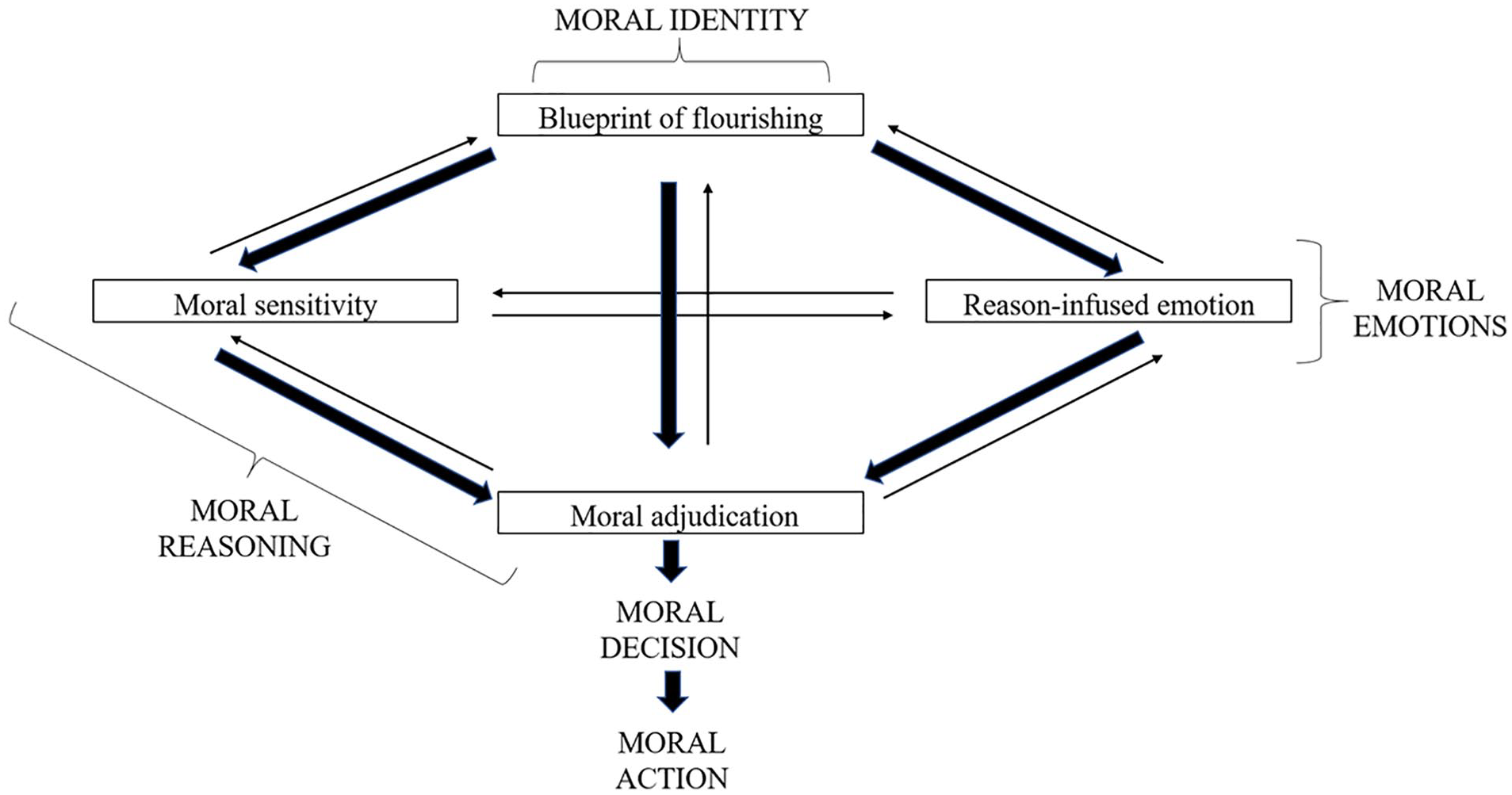
A neo-Aristotelian model of wise (phronetic) moral decision-making.
In our previous conceptual work (Darnell et al., 2019), we pointed out that the closest cousin of the APM in psychology would be the neo-Kohlbergian Four-Component Model of Moral Functioning (Narvaez & Rest, 1995), although the latter model was originally grounded in a Kantian deontological conception of morality, rather than a virtue ethical one (Krettenauer, 2019). McGrath (2019; McGrath & Brown, 2020) have, however, recently suggested another alternative to our APM, grounded in the Values-in-Action (VIA) classification of character strengths and virtues (Peterson & Seligman, 2004). This alternative is not only psychologically relevant but also dovetails with certain misgivings in philosophy about the proposed comprehensive, integrative nature of phronesis. If there are so many functions ascribed to phronesis, why think that they would all be carried out by a single character trait? Miller (2021) calls this “the unity concern” about practical wisdom. Approaching this same concern from a psychological perspective, McGrath suggests that the role we ascribe to phronesis can be played collectively by three of the 24 VIA character strengths: prudence (for the emotional regulative function), judgment (for the constitutive function), and perspective (for the integrative function). Although we applaud McGrath’s efforts in trying to find space for the functions that we attribute to phronesis within the conceptual repertoire of positive psychology, we harbor two main worries about his proposal. One is that the central role of the blueprint component is missing—although McGrath and Brown (2020) venture that this role may, in some unspecified way, be satisfied by the focus of perspective on moral issues and the “big picture.” Second, and more significantly, we worry about the lack of an intellectual meta-virtue in the positive psychological system (cf. Schwartz & Sharpe, 2006). If the metacognitive role we ascribe to phronesis is to be taken over by three discrete virtues at the same epistemological and characterological level, how will conflicts between the requirements of judgment, perspective, and prudence be adjudicated? Which of the virtues calls the shots—and why? If the idea is that the virtues function more like a jazz group than a symphony orchestra, without the need for a conductor (Gulliford, 2017), it is incumbent on the proposers to provide a psychological account of how this coordination takes place, without invoking an arbitrator, and without ending up with an explanatory vicious regress—or moral paralysis.
Third Section: The CWM—and the Offerings of the APM in Comparison
It is now time to discuss the CWM, a formidable new alternative to the APM, at least insofar as it builds partly upon the “Aristotelian idea of practical wisdom” (Grossmann, Weststrate, Ardelt, et al., 2020, p. 113). Disillusioned with the continued controversies among wisdom researchers in psychology on the definition of wisdom (Grossmann, 2017), a “Wisdom Task Force” gathered in 2019 to try to carve out a “consensus position” (Grossmann, Weststrate, Ardelt, et al., 2020, p. 104). Furthermore, a mixed-methods survey of expert conceptualizations of wisdom was conducted. As noted earlier, the Task Force eventually came up with the CWM, incorporating perspectival metacognition and moral aspirations as its two main pillars. Qua intellectual virtue, the CWM depicts wisdom, therefore, as “morally grounded excellence in [a certain kind of] social-cognitive processing” (Grossmann, Weststrate, Ardelt, et al., 2020, p. 103). The target article introducing the CWM (Grossmann, Weststrate, Ardelt, et al., 2020) constitutes a tour de force of psychological scholarship, characterized by a deft handling of voluminous bodies of literature and a no-nonsense conciliatory spirit that is rare in academia. Despite the consensus position reached among a large group of both eminent and junior wisdom researchers, the CWM has already experienced considerable blowback, as seen by the critical commentaries in the same journal issue. Some divisions also remain among the co-authors of the target article themselves, especially on the “moral aspiration” pillar (Grossmann, Weststrate, Kara-Yakoubian, & Dong, 2020), as we explain presently.
The most significant departures from previous psychological conceptualizations of wisdom—and, at the same time, a turn toward Aristotelian phronesis—lie in the deliberate omission of any traces of sophia (intellectual or abstract wisdom), and in the severing of links to religious and spiritual foundations or understandings (Jeste et al., 2020), hence, a significant narrowing of the typical folk conceptualizations of wisdom that previous wisdom researchers have been keen to capture. This move toward conceptual parsimony is motivated by the practical orientation of the authors and their skepticism of the possibility of conceptualizing and measuring the “metaphysical or divine” (Grossmann, Weststrate, Ferrari, & Brienza, 2020, p. 187). Keltner and Piff (2020) worry that this disenchanted conceptualization may miss the role of the self-transcendent emotion of awe as a moral grounding of wisdom. However, that worry is, in our view, misdirected. Proponents of the CWM could point out that there are two kinds of self-transcendence, vertical (pointing the self toward higher abstract ideals) and horizontal (pointing the self toward other people and the world around you). There are also different kinds of awe: intellectual elevation vis-à-vis abstract entities and moral elevation vis-à-vis exemplary people. Cutting the ties of wisdom to vertical self-transcendence and intellectual elevation still leaves scope for horizontal self-transcendence and awe as moral elevation. That said, those who have an appetite for higher and more enchanted understandings of wisdom are not likely to take much comfort in the parsimony of the CWM, but rather consider it to tell only “half the story” (Aldwin et al., 2020, p. 151). We do not share those worries, in the specific context of the APM, and will not elaborate further on them here. 6
Emotions and Wisdom
In the second main section, we explained the meaning of emotional regulation in Aristotelian theory and how it refers to the infusion of emotion with reason rather than to the policing of emotion by reason. Aristotle was, in fact, the first known cognitivist about emotions, believing that every emotion has a cognitive (reason-responsive, educable) appraisal component to it. He argued that emotional dispositions can be experienced “at the right times, about the right things, towards the right people, for the right end and in the right way” (Aristotle, 1985, p. 44 [1106b17–35]), meaning that they can be evaluated for their level of reasonableness (or proper reason-infusion). If a relevant emotion is “too intense or slack” for its present object, we are badly off in relation to it, but if it is fitting to the object, we are “well off” (Aristotle, 1985, p. 41 [1105b26–28]). And persons can be fully virtuous only if they are regularly disposed to experience emotions in this reason-infused way. This perspective on emotion ties in with Aristotle’s teleological view of psychosocial equilibrium, wherein emotion, cognition, and action are attuned to the various social situations in which individuals will find themselves, inter alia, by appropriately appraising situations, leading to emotional states that are fitting to those situations. The capacity of phronesis is key to that psychosocial equilibrium, as we explained earlier when introducing the component of emotional regulation as fulfilling one of its necessary functions. Because some social scientists are unfamiliar with well-sourced Aristotelian interpretations of practical wisdom and have erroneously claimed that this viewpoint has not “taken the emotional sphere of human life into account” (Tynjälä et al., 2020, p. 170; cf. Glück, 2020), it is important to emphasize the critical role of emotion in phronesis.
Yet it is possible to go even further than Aristotle by not only considering the capacity for emotion regulation, but the actual content of certain emotions themselves, as constitutive of phronesis. Some previous wisdom researchers have gone down a similar lane, most notably Ardelt (2004), who includes compassion or “compassionate love” in her definition of wisdom. The problem with this maneuver is that the account is undermotivated in the sense that Ardelt does not explain why she singles out this particular emotion rather than some others, say, a healthy sense of pride at accomplishments, or a sense of righteous indignation when encountering injustice. The worry here is about a possible slippery slope. If one includes one discrete emotion (rather than a more general capacity for managing emotions), why not more or perhaps all reasonably experienced emotions? However, that invites uncontrolled conceptual proliferation and threatens to turn “wisdom” into a synonym for the whole of proper psycho-moral functioning; its uniqueness as a meta-construct is lost. Moreover, if one emotion, such as compassion, is given a privileged place as part of wisdom, as distinct from being regulated by wisdom, does that mean it automatically trumps other emotions and is exempt from the integrative role of wisdom? Or is compassion somehow meant to regulate and integrate itself?
Ardelt could possibly retort that this objection is a case of the pot calling the kettle black, for Aristotle is often taken to uphold a “unity-of-virtue” thesis, according to which the person who has (full) phronesis has all the moral virtues as well (including virtuous emotions such as compassion). However, when Aristotle (1985) makes his famous remark about the essential unity of the virtues, arguing that when one has phronesis, one has “all the [moral] virtues as well” (p. 171 [1145a1–3]), he is most charitably understood to be saying that the phronimos is able to make use of the whole virtue repertoire and regulate it synergistically, not that the virtues entail each other painlessly (which would be a recognizably un-Aristotelian position), nor that the moral virtues have thereby somehow become parts of phronesis itself. Nevertheless, we agree with Lees and Young’s (2020) critique that wisdom requires a general capacity to understand other people’s (negatively or positively valanced) emotions, and they cite the concept of “theory of mind.” Indeed, we take understanding others’ emotions to be part of the emotional regulation function of the APM because individuals frequently call upon phronesis in deciding how to respond to other people or coordinating one’s actions with those of others.
Although a concept of wisdom may become too bloated by an overpopulation of its emotional elements, it can also be crippled by underpopulation. This is what we worry has happened with the CWM. Grossmann, Weststrate, Ferrari, and Brienza (2020) and Grossmann, Weststrate, Ardelt, et al. (2020) use considerable space explaining why they do not include emotional regulation (or what they call “emotional intelligence”), let alone individual emotions, in their CWM. 7 In their target article, Grossmann, Weststrate, Ardelt, et al. (2020) reason mainly methodologically: None of the wisdom researchers they surveyed took “emotional intelligence” (p. 112) to be sufficient for wisdom and only a few considered it necessary. However, it was typically considered a correlate of wisdom. In their response to critics, they give more substantive reasons. They accuse their critical commentators of not being clear on exactly what “emotional aspects” are missing from the CWM. If it is “emotion regulation,” then that function is essentially subsumed under “perspectival metacognition”; if it is “empathy,” then that is more or less synonymous with “perspective-taking,” which is already part of the CWM (Grossmann, Weststrate, Ferrari, & Brienza, 2020, p. 188).
Grossmann and colleagues can be condoned for exploiting a common vagueness in claims about “emotional aspects” of wisdom. Seen in that light, the CWM is at least no more vague or ill-equipped on emotion than some of the earlier wisdom models. However, seen from the perspective of the APM, the responses by Grossmann and colleagues do not parry the main concerns expressed, for instance, by Glück (2020). She points out a well-known fact about wisdom research, namely, that people tend to make wiser choices on behalf of others than themselves, and that the most likely reason for this is that they are led astray by unregulated emotions directed at themselves. “Perspectival metacognition” and “perspective-taking” are significant elements of what we called above the constitutive and integrative components of phronesis. However, perspective-taking alone can only give us an indication of how others see things, not necessarily what is the most appropriate way to see things. The ability to construe matters properly is one of the key ways in which the wise person ensures that their emotions are infused with the right kind of reason, so that they can serviceably be added to the balancing acts that the capacity of phronesis makes possible. As we have emphasized repeatedly, this is not a case of cognition controlling emotion, for emotion is also cognitive. Rather, it is a case of a psychological process of emotion regulation, on which the APM offers a more explicit and unambiguous take than does the CWM.
Wisdom and Moral Aspirations
We explained in the second main section how the APM charts the moral motivations animating wise choices; indeed, the provision of action-guidance is arguably the greatest strength of the model. On one hand, the phronetic capacity acts as a conduit and a filter for discrete moral motivations emanating from the individual moral virtues via their emotional components. Phronetic choice requires not only that agents comply with the demands of the most immediate virtue relevant to the given situation—say, honesty—but it also takes account of claims proper to other ethical virtues—say, compassion—to help us reach a measured decision (Müller, 2004). On the other hand, the blueprint component of phronesis provides its own additional (phronesis-internal) moral motivation, through the overarching deep understanding of the ultimate goal of leading a well-rounded eudaimonic or flourishing life.
As described in the CWM, perspectival metacognition is inert, unmotivated, and unmotivating. In the CWM, perspective-taking has a dry, disengaged intellectuality about it that appears to be detached from decision-making and action. The CWM, thus, does not explain how perspectival metacognition guides wise action, arguably, the central function of wisdom. But is this lacuna then filled with the other main pillar of the CWM, moral aspirations? From a neo-Aristotelian perspective, the fact that the CWM posits “moral aspirations,” alongside perspectival metacognition, as one of the two main pillars of wisdom, counts as an extremely positive development. It is reassuring, from that perspective, to see the word “moral” appear almost 100 times in the target article on the CWM (Grossmann, Weststrate, Ardelt, et al., 2020), especially because academic psychologists have historically, since the days of Weber (1949) and Allport (1937), exhibited a great deal of nervousness about adopting a language of morality in general and virtue in particular. “Dichotomizers” (psychologists who insist on a strict Humean dichotomy between facts and values) are still in the majority, although we now see an increasing number of psychologists becoming willing to discuss moral elements of psychology more directly, at varying levels of commitment (Kristjánsson, 2018a). Even positive psychologists Peterson and Seligman (2004), who did so much to “reclaim the study of character and virtue as legitimate topics of psychological inquiry” (p. 3), chose to engage in virtue-talk in an “inverted-comma,” arm’s-length sense, reporting on people’s subjective evaluations of a world of description, rather than acknowledging values as descriptions of an objective world of evaluation. Given this background, Grossmann, Weststrate, Ferrari, and Brienza (2020) and Grossmann, Weststrate, Ardelt, et al. (2020) must be applauded for wanting to steer clear of the amoral instrumentalism permeating so much of psychological theorizing on anything moral (Fowers, 2010)—and thereby, in Aristotelian language, working to distinguish wisdom from mere calculated cleverness (deinotes).
What is not reassuring, however, is the remaining divergence of opinion among members of the “Wisdom Task Force” themselves on the referents and precise value of the “moral aspirations.” The first difficulty is that although peace has officially been declared, the debates on the place of morality in wisdom theory have not been resolved. The commentaries of the Wisdom Task Force members indicate some of these debates: Ardelt does not think the moral aspirations in the model cut deep enough and wants to add a more distinct focus on “compassionate love”; Brienza remains doubtful “whether wisdom requires moral grounding, even in theory”; and Grossmann carves out a middle-ground position between the two by acknowledging that the “moral grounding” factor in the CWM “remains underspecified and requires further theoretical development” (Grossmann, Weststrate, Kara-Yakoubian, & Dong, 2020). Expressing the same sentiment as Grossmann, we are tempted to use words such as thin and bloodless about the current specification of “moral aspirations” (qua moral grounder) in the model. We, unfortunately, have to agree with Lees and Young (2020) that the “lack of clarity regarding the moral aspirations–PMC relationship is compounded by the vague definition provided for moral aspirations” (p. 168).
At the beginning of their target article, Grossmann, Weststrate, Ardelt, et al. (2020) specify moral aspirations in terms of aspirational goals that aim for a balance of self-and-other interests and an orientation toward a shared humanity. The second difficulty with their account of moral aspirations is that these are basically empty referents that cry out for elucidation. Instead of providing such an elucidation, the remainder of their article (Grossmann, Weststrate, Ardelt, et al., 2020) and the rejoinder (Grossmann, Weststrate, Ferrari, & Brienza, 2020) simply refer back to this specification without deepening it. Later (Grossmann, Weststrate, Ardelt, et al., 2020, p. 107), the word “prosociality” is added to the mix, but as we explained earlier in this article, “prosocial” is not the same as “moral,” or an elucidation of it. “Prosocial” is a behavioral descriptor, and behavior can be prosocial without being moral (e.g., uncritically and unreflectively following another person’s lead to do a good thing) and moral without being prosocial (e.g., showing justified anger that happens to upset and alienate the persons who transgressed in a way that gave rise to the anger). “Orientation toward a shared humanity” and a “balance of self-and-other interests” can also mean several different things with radically different moral ramifications. For example, balancing interests could be pursued through a phronesis-guided virtue of justice, through an amoral group-centric ethos, through formal legal rights and duties, or through brute social exchange practices. Each of those is different in the gestalt and in the details of what one means by “balance,” and how one pursues it.
The core of the problem, as we see it, is the lack of commitment in the CWM to any clear ontology, epistemology, or methodology of the science of morality, which leaves their description of moral aspirations empty or merely procedural. The emptiness of their version of moral aspirations can be filled in substantively in many different ways, meaning that it is seriously underspecified. For instance, does the talk about “moral grounding” refer to a realist ontology of morality, as being about objective facts, or an anti-realist one, which sees all “moral facts” as subjective or relative? Like most virtue ethicists, we favor moral realism. The fact that Grossmann, Weststrate, Ferrari, and Brienza (2020) express a preference for a virtue ethical take on morality and wisdom, as opposed to a deontological (rule-based) or a consequentialist (utilitarian) one (p. 189), may indicate an implicit commitment to moral realism. However, that is not explicitly born out in anything they happen to say about moral aspirations. For example, when they state that “PMC appears to uniquely fulfill the chief mandate of practical wisdom which involves deeper understanding of how to live well” (Grossmann, Weststrate, Ardelt, et al., 2020, p. 111), we are puzzled about how perspectival metacognition can fulfill this mandate on its own, without substantive moral aspirations. If moral aspirations are meant to be included in PMC, why do the authors neglect to spell out a realist account of a virtue-based conception of “living well”? Why, more generally speaking, do they become so vague here?
Turning from ontology to epistemology, the main contenders tend to be moral rationalism and moral sentimentalism. Rationalists believe that moral facts exist independently of our emotions, and that those facts can be tracked by human reason. Sentimentalists believe either that no moral facts exist at all or, alternatively, that moral facts are created by our emotions and exist in our minds (Kristjánsson, 2018b). Given that emotions are largely neglected in the CWM (see earlier), one might deduce that the model assumes some sort of a rationalist epistemology. However, if that were the case, we remain uninformed about what that epistemology is, both because no such epistemology is elicited in the explanation of the CWM and because no prior ontology (explaining what sort of moral facts reason can track) is being offered as a prelude. As we have indicated throughout the article, we endorse a third epistemological alternative (sometimes referred to as “soft rationalism”) in which emotions can be infused with reasons.
Our interpretation of the emptiness of Grossman et al.’s account of moral aspirations is that they are expressing ambivalence (whether collectively or individually) about biting the evaluative bullet (Fowers et al., 2021; Kristjánsson, 2018a) by providing substantive meaning to their moral terms. They are in good company among psychologists in this reluctance to make moral commitments explicit. There are two common ways that psychologists avoid these commitments. The first is euphemizing the commitments with terms such as health, functionality, maturity, or adaptiveness. This veneer of neutrality is punctured, however, as soon as one asks what is specifically meant by any of these terms. When one asks, for instance, what is meant by maturity or adaptiveness, the specifications reveal what the scholar values (e.g., ability to postpone gratification, or flexibly responding to difficulties). The second is to assume that moral substance is provided subjectively, meaning that the investigator can remain neutral about what is specifically considered moral while describing what the participants in the investigation see as moral. This subjectification of morality seems to give the scholar an arm’s-length relation to those moral commitments until one recognizes that assigning morality to subjective choice is part of the widespread and often implicit assumption of the value of individual autonomy in psychology (Richardson et al., 1999). As we have discussed, the APM explicitly adopts moral commitments that help explain how a phronimos deliberates, decides, and is motivated to act in accordance with wisdom. In contrast, Grossman et al.’s (2020a) avoidance of substantive moral commitments leaves wisdom unmotivated and inert.
Finally, regarding methods and measurement, whereas the APM is clearly meant to highlight overt moral performance rather than self-views, Grossmann, Weststrate, Ardelt, et al. (2020) remain extremely flexible about which methodological approach they prefer. This is perhaps understandable, given that psychological researchers may obviously be interested in various aspects and correlates of wisdom, including people’s self-reports about how wise they take themselves to be. Yet, in view of the practical nature of the CWM and its explicit departure from sophia toward phronesis, one would have expected the main focus of the CWM to be on how it explains and predicts actual wise actions rather than on what it tells us about the nature of wise thinking abstracted from actual performance, or about people’s varyingly transparent conceptions of themselves as wise agents. The relationship between cognition and behavior is perennially interesting to psychologists, and phronesis appears to be a promising way to bridge the well-known gap between moral judgment and moral action (Blasi, 1980; Darnell et al., 2019). Because the APM is more focused on the behavioral performance of phronesis, it is better positioned to assist in this work than is the CWM.
Summarizing the Comparisons Between the CWM and the APM
The APM offers a philosophically grounded, psychologically practicable model of wise (phronetic) decision-making that conceives of morality in realist terms and sees moral considerations as reason informed. It explicates two main sources of moral motivation, one emerging from specific virtues and one that emerges from the blueprint function of phronesis, how those motivations are synergistically integrated, and how the blueprint function is gradually refined in the light of experiential knowledge. It also provides a nuanced account of the balancing of reason and emotion.
The CWM makes significant progress on previous conceptualizations of wisdom in psychology by circumscribing the sort of wisdom under scrutiny (as practical, non-abstract), and by foregrounding the role of moral aspirations as grounding the perspectival metacognition at work in (this kind of) wisdom. In the stylistic context of divisive academic exchanges, it is difficult to express our admiration for the work done by Grossmann and his colleagues without sounding like partisans or our critique of it without sounding churlish. We repeat our earlier characterization of their target article as a tour de force of wisdom scholarship: a clear benchmark for any future work in the area. However, we cannot avoid the impression that the authors’ venture into the moral realm goes awry by lacking vital substantive content. They express sympathy and preference for an Aristotelian understanding of practical wisdom, and a virtue ethical take on morality, but they hesitate to make the ontological, epistemological, or methodological commitments that would come with a neo-Aristotelian approach. That said, we appreciate the difficulties in fully committing to an Aristotelian approach, as the aim was for a “common denominator model” (Grossmann, Weststrate, Ferrari, & Brienza, 2020, p. 186), and we sympathize with Grossmann, Weststrate, Kara-Yakoubian, and Dong’s (2020) own comment about the need for “further theoretical development.”
In our neo-Aristotelian view, wisdom is about making good choices and helping others do the same in virtue of a deep moral understanding of complex human problems, an understanding arrived at through reflection and experience (Tiberius & Swartwood, 2011). As Grossmann, Weststrate, Ferrari, and Brienza (2020) acknowledge, the CWM is not primarily about behaviors or actions but rather about wise thinking in a context (cf. Grossmann, 2017). Nevertheless, the APM offers a more detailed and overt take on a number of variables that also play a role in the CWM; and, at least in the context of wise moral decision-making, it seems to carry potential explanatory power qua theoretical construct above and beyond the CWM. This is why we maintain that the APM embodies some unique features (substantive moral motivation, emotional regulation, behavioral relevance) that psychologists studying wisdom ignore at their peril.
At the close of this comparison, the scorecard roughly looks like this. Grossmann, Weststrate, Ardelt, et al. (2020) have displayed virtuous expansiveness in developing a consensual new model of wisdom, the CWM. They have thereby tried to end a fairly fruitless but turbulent factional strife among wisdom researchers, based partly on “jingle-jangle fallacies” (Grossmann, Weststrate, Ardelt, et al., 2020, p. 123), namely, on the same term being used to convey different concepts or different terms to convey the same concept. At the same time, they have assuaged worries sometimes expressed by philosophers that social scientists too often use imprecise definitions and uninformative linguistic descriptions of their concepts (Wittgenstein, 1973). In addition, they have narrowed the concept of wisdom down to avoid the common mix-up of sophia and phronesis elements, arguing persuasively that the concept of wisdom that lends itself best to psychological inquiry, measurement, and intervention, is that of practical wisdom.
Given the quality and topicality of the new CWM, it would be odd to produce another wisdom model without juxtaposing it with the CWM. For the sake of comparisons and contrasts, therefore, we have presented the APM and argued that it ameliorates certain gaps in the CWM, especially having to do with emotional regulation and moral motivation. The relative value of the APM and CWM depends on the investigator’s aims. If one’s research interest is in moral cognition, the CWM offers substantial resources. If one’s research interest is in morally motivated action, then the APM offers greater explanatory possibility. Ultimately, the place and value of these two models must be subjected to empirical evaluation, with a demonstrated capacity to guide moral decision-making and action as the key criterion, at least from a neo-Aristotelian perspective. We suggest some directions for future research in the next section.
Fourth Section: Future Research on Phronesis
Because no instrument to measure phronesis existed, we piloted a new instrument, making use of a battery of available scales and some modified measures, to test our hypotheses in a structural equation model study (Darnell et al., 2021). 8 Our study included latent variables that reflect the four functions of phronesis (moral sensitivity, moral adjudication, reason-infused emotion, and a flourishing blueprint). Our results were encouraging in that the predicted latent components (including both self-report and performance measures) were consistent with predictions, and the latent components were found to be structurally related to an anticipated second-order latent phronesis variable (Darnell et al., 2021). The phronesis variable, in turn, was related to a separate assessment of prosociality as a proxy for moral behavior. There are several ways the incremental explanatory value of the APM can be further tested. For one thing, replicating the pilot results is necessary. Second, the APM can be tested for incremental validity vis-à-vis existing wisdom measures in predicting moral behavior. We would expect the APM to predict moral behaviors better than wisdom measures that tend to rely primarily on the subjective perception of wisdom or are limited to moral reasoning. We also envision this research to include person-centered measurement over time to assess the ongoing relationship of wisdom and moral behaviors. In addition, any model of wisdom must demonstrate its practical value in guiding the design and implementation of interventions designed to enhance wisdom.
It is also important to allay the concern that APM research may be subject to a vicious circle of explaining fully motivated (observable) moral action by an assessment of fully motivated moral action (defined as phronesis). To break that circle, we recommend assessing simple moral behavior without attention to its motives and reasoning as an outcome. Moreover, these assessments of moral behavior can be made from several points of view (respondent, researcher observations, and intervention outcomes) to avoid reliance on the respondent’s perceptions alone.
Given the enormous potential practical value of phronesis, research is also called for on the efficacy of interventions to improve phronesis among those who have not developed it. As there is insufficient space here to detail possible wisdom interventions, we offer only brief comments about the (fairly dire) state of the current educational literature. It is not only that interventions to cultivate wisdom are much rarer than interventions to build many other character strengths and virtues (e.g., gratitude or forgiveness), the educational literature is even more eclectic than the general psychological literature on wisdom (e.g., by drawing more commonly on religious perspectives), and it is often difficult to see what various scholars have in common (Ferrari & Potworowski, 2010). Attempts to give an overview of this literature are also few and far between. It says a lot about the current state of play that the fairly brisk overview by Grossmann, Weststrate, Ardelt, et al. (2020) is probably the best place to begin for researchers wanting to gain a comprehensive view of what has been done in this area (see also Huynh & Grossmann, 2020).
Our survey of the relevant background literature suggests that the diffusion characteristic of extant wisdom interventions lies in the fact that most interventions do not take any distinct model of wisdom, such as the CWM or the APM, as their starting point and that they almost invariably work on just one, or maximum two, components of wisdom or phronesis, rather than the virtue as a whole. Wright et al. (2021) also noted the lack of theoretical grounding in wisdom research. For example, a project on social reasoning, based on dialogical and collaborative methods (Lin et al., 2019), is good at developing the constitutive and integrative functions of phronesis, but has little to do with the blueprint function or the emotional regulative one. As Jeste and colleagues (2020) remind us, however, enhancing individual components of wisdom is not the same as increasing overall wisdom. The fact that various relevant, if overly narrow (for wisdom-education purposes), interventions exist means that new interventions will not need to be constructed de novo; the key will lie in combining them together correctly under the guidance of holistic models like the APM or the CWM (Kristjánsson, 2021). Moreover, it is promising that almost all wisdom scientists view wisdom as malleable and educable (Grossmann, Weststrate, Ardelt, et al., 2020).
Concluding Remarks
This article has articulated and defended a neo-Aristotelian phronesis model. We have strived to present this model not as the last gasps of an antiquated Aristotelian psychology, but rather as a neo-Aristotelian model that draws on recent research in moral philosophy and psychology and is, essentially, constructed to answer a certain question haunting the landscape of post-Kohlbergian moral psychological theory about what bridges the gap between moral cognition and action. Far from being made redundant by the new CWM, we consider the APM to add force and vitality to at least some of the issues that the CWM is meant to tackle. However, this is not tantamount to claiming that the APM makes the CWM redundant. Despite its liberation from “metaphysical” elements, the CWM is “practical” in a somewhat different sense from the APM, as we showed in the third main section, by focusing on wise, morally motivated thinking rather than wise moral decision-making. There could, therefore, be theoretical need and space for both models.
Insofar as the CWM and APM are meant to answer the same questions, we consider the APM to carry a certain advantage. Insofar as the models are directed at different aspects of wisdom, they are best seen as complementary rather than competing. However, neither model gives explicit guidance as to how practical wisdom develops and how it is best educated. On that issue, much further psychological and educational research is needed.
Footnotes
Declaration of Conflicting Interests
The author(s) declared no potential conflicts of interest with respect to the research, authorship, and/or publication of this article.
Funding
The author(s) received no financial support for the research, authorship, and/or publication of this article.
