




Abstract
Developing a widely accepted theory of behavior causation has been hampered by the lack of a rigorous approach to understanding the kinds of determinants at work. Interest in behavior change is also burgeoning, and requires a profound understanding of how personal and environmental determinants interact dynamically to predict changed behavioral outcomes. Behavior settings theory, a powerful naturalistic theory with a huge empirical underpinning, has long been available for describing the recurrent, everyday behavioral episodes in which many social and psychological scientists are interested. In this article, I review settings theory and update it in the light of a number of recent contributions from various quarters. I argue that this syncretic model should be seen as defining the proximate causal network surrounding these common behavioral episodes, which I call “situations.” I further propose that “contexts” should be thought of as the more distal, second-order causes circumscribing situations. I argue that these situational and contextual “spheres” of causation are a powerful way to understand behavior determination. I conclude by introducing a quasi-computational model of situations that is worthy of the further development necessary to make psychology a predictive science of behavioral causation and change.
Keywords
Introduction
Behavior can be considered an interaction between an embodied agent and its environment (Lewin, 1936/2015). Examples include an insect searching for food, a person playing a video game, or a drone robot carrying a package to its destination. An understanding of behavior determination therefore requires attention to the nature of the agent’s embodiment (its competencies), its objective (often captured as psychological motivation), and the resources available in its current “local” environment.
It behooves agents to be able to recognize when a particular kind of situation is possible in the present environmental circumstances, and to evaluate how well those circumstances enable the achievement of particular objectives, so as to make appropriate behavioral choices (e.g., as to when and where to enter into a potential situation). This fact has led most contemporary approaches to describing situations in psychology to see them as essentially a perceptual problem (Funder, 2016; Guillaume et al., 2016; Rauthmann & Sherman, 2019). However, this ignores the fact that agents typically are trying to achieve objectives that provide physical or social rewards, and that receiving those rewards depends on the physical and social resources available at that time and place. Consideration of these “external” characteristics of situations should be made explicit to understand how agents make decisions. That is, the expected value of entering into a situation will depend on the likelihood of acquiring resources from activity, which is in turn a function of present circumstances “external” to the agent (Clark, 2015). For example, driving requires that a car and road transport infrastructure are available; someone doing the job of driving; and a host of socially defined rules, such as following speed limits, and conventions, such as flashing ones’ headlights as a “thank you” to other drivers (Welch, 2016). The dynamics of everyday behavior thus involve routines that are held in place by specific aspects of the social, biological, and physical environment, but which provide psychological rewards that are important drivers of that behavior.
Any experimental science typically wants a way to isolate what is happening “locally” (and which might therefore be controllable) from broader considerations (Kirk, 2007). This is largely the reason for taking experiments “inside” into labs, where such control can be exercised more precisely. Certainly, many applied fields rely upon a distinction between “local” causation and more distal factors. In public health, for example, it is important to distinguish between “internal” causes associated with behavioral interventions and “external” causes or “context” that is considered to consist of factors external to the intervention but which might interfere with assessment of the effectiveness of the intervention by interacting with the outcomes being measured (Bonell et al., 2012; Murray et al., 2010). Without a rigorous notion of the kinds of influences that can impact on behavior, both behavioral description and modification remain difficult. More philosophical implications arise as well: Is moral culpability reduced when strong situational forces are at work (e.g., “accidental” manslaughter)? Behavioral science thus needs a good understanding of situations (as real phenomena) and their broader context to be more predictive and useful (e.g., for behavior change).
But what are the specific components of a situation? Appropriately categorizing the environmental, embodied, and psychological characteristics of situations has befuddled scholars for some time (Fleeson, 2004; Funder et al., 2000; Sharer & Traxler, 2006). This is essentially a problem of identifying the “natural kinds” of categories underlying these generalized circumstances (Boyd, 1991; LaPorte, 2004). The lack of a well-recognized theory operating across the relevant fields of ecology, physiology, and psychology has precluded agreement on this matter (Lahlou, 2018).
In this article, I will use consensus-building to arrive at a model of the components of situations. I argue that this syncretic situation concept, properly characterized, can constitute the foundation of an ecologically realistic approach to the definition, description, and measurement of both personal and environmental influences on behavior. My contribution is to propose a crisp way of doing this, beginning by rigorously sorting proximal causes of behavior from more distal ones, with more causally distant influences on behavior being categorized as “context.” In discussion, I suggest a strategy to realize a more sophisticated model of situations that can be validated through future work.
A Syncretic Model of Situations
Although it is widely recognized that behavior is influenced by conditions in the environment and internal to the individual, psychology has yet to find a way to rigorously characterize the nature of these forces. How should the kinds of “stimuli” to which an individual is “responding” be defined? The idea of a “situation” has long been mooted as a solution to this problem, but this concept remains poorly defined, and largely unmeasured, despite many years of attention (Cooper & Withey, 2009; Endler, 1993; Funder, 2009; Kenny et al., 2001).
The ecological psychologist Roger Barker went a considerable distance toward making the situation concept more tractable in the 1950s and 1960s by investing in the collection of a huge amount of data on real-world behavior. In fact, he accumulated records for the entire population of a town over the period of a year, twice. When he did this, what leapt out was that a large proportion of all behavior is structured into regularly repeated patterns—for example, morning hygiene routines, traveling to work, food preparation, a bank transaction, or attending a baseball game. He called these recurrent episodes “behavior settings” (Barker, 1968). A behavior setting can be defined as “a small-scale social system composed of people interacting with one another and with inanimate objects to carry out a regularly occurring, prescribed behavioural sequence, or program, within specifiable time and place boundaries” (Wicker, 1987). According to Barker, settings have structural components in the form of participants or inhabitants (e.g., visitors to a gift shop), interacting with crucial objects from the physical environment (till, display shelving, supplies of bags) to produce dynamic standing patterns of behavior (e.g., greeting customers, providing information about items in stock, making change, bagging purchases), that regularly arise due to self-regulating mechanisms (e.g., “maintenance and program circuits”) at work to ensure satisfactory outcomes. This all takes place in a physical and social milieu (e.g., shop) that delimits the scene of action. Settings are self-regulating systems with strongly interacting components. Indeed, the components are designed to interact (what Barker calls being “synomorphic”) so that they are more tightly linked to one another than to other elements of the environment (at least for the duration of a performance), which lends settings a degree of causal independence from its circumstances. Particular components are necessary only at a functional level (e.g., people can be interchanged in particular roles without seriously affecting the setting). However, standing patterns (the sequence of events occurring within a setting) typically cannot be radically changed without changing a setting’s nature fundamentally (e.g., a shop must sell items to persist). Among the behavior settings, Barker established empirically: waiting at bus stops, staff meetings at school, church services, going to the cinema, bridge club meetings, and so on.
The understanding of such behavioral “chunks” or episodes has not stood still in the intervening decades since Barker. Additional insights about the situational nature of behavior have appeared from several different academic disciplines (see Table 1), each of which pursued its own agenda largely independent of the others. First, from what can be dubbed “dramaturgical sociology,” we take Goffman’s notion of a “frame” (Goffman, 1974) to provide an overall perspective. This concept is notoriously obscure and amorphous (Davis, 1975; Gamson, 1975; Scheff, 2006), but can be related to settings. Goffman believed that people must classify experience if they are to grasp its significance, and so suggested that one’s understanding of social life is built up through frames. Frames enable people to make sense of events by permitting them to dissect experience into easily manageable wholes. Goffman considered frames to be culturally shared mental models for understanding and organizing experience. They allow people to efficiently adopt appropriate roles, follow scripts, and permit actors to help “repair” settings if someone else’s actions go astray (Goffman, 1974). Furthermore, the “dramaturgical analogy” of Goffman’s earlier work about the presentation of self (Goffman, 1959) is vibrant and suggestive, so I will use it to help bring the situation concept to life.
Primary intellectual sources of the situation concept.
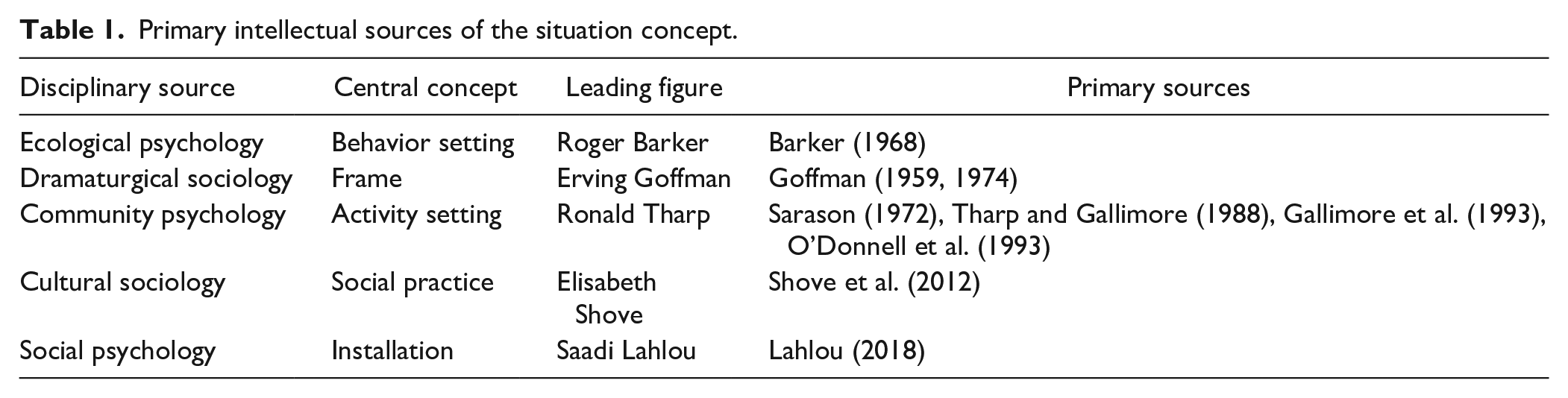
Second, Ronald Tharp and colleagues, in the disciplines of educational and community psychology, developed “activity setting” theory. Tharp specified that settings have a “who” (the individuals present), a “what” (the tasks that are performed and scripts that guide this conduct), a “when” and “where” (the time patterns and the places of their occurrence), and a “why” (the motivations of the members, their emotional experiences and the cultural value or meaning attached to the activities by the participants; O’Donnell et al., 1993; Tharp & Gallimore, 1988). One new element added by this perspective is explicit recognition of actor motivations. Tharp also argues a script is needed—that actors in a setting have a memory of a prototypical sequence that serves as a psychological guide, directing their actions. The cultural value or meaning concept is also novel. Meanings are acquired through the intersubjectivity of shared experiences while collaborating in activity settings—causing shared values, thoughts, emotions, and interpretations (O’Donnell & Tharp, 2012).
Third, from cultural sociology comes the idea of a “social practice.” This concept is also typically vague (Nicolini, 2012), although in some scholars’ works, it is close conceptually to Barker’s behavior setting—perhaps because it is grounded in numerous empirical studies, much like Barker’s theory arose from voluminous behavioral data. Also, there is an emphasis on the practice itself as the unit of analysis, much like the behavior setting notion in Barker’s work, where practices are super-individual and not purely psychological. Furthermore, the emphasis is on everyday behaviors (anything you can describe in a word ending with “ing,” like skateboarding, showering, cooking, etc.).
The social practice concept has been operationalized, to an extent, by Shove and colleagues. They argue that practices can be considered activities with three specific “elements”: materials (the tangible entities—technological and otherwise—which form part of the practice), competencies (the skills, knowledge and abilities required to enact the practice), and meanings (the shared cognitive associations, values and feelings among practitioners about the practice; Shove et al., 2012). As competencies were not in Barker’s original formulation, we will add that aspect to the model.
Shove and colleagues also make the same ontological distinction as Barker between instances of a practice (i.e., a particular performance) and types of practices, in the form of a conjoined suite of factors that enable them to be recurrent (i.e., the competencies, meanings and materials). Like Barker, they are advocates of observation rather than lab-based investigations (Shove et al., 2012). They also discuss the problem of recruitment into practices and how they become popular (perhaps only for a short time). So, practices can have “careers” (Warde, 2005).
Finally, Installation Theory is a recent entrant into this arena from social psychology (Lahlou, 2018). An “installation” is a specific setting in which people are expected to behave in a certain way. It is composed of material affordances, embodied competencies and social regulators, operating as a bundle that in turn constrain what is physically possible, thinkable (according to the participant’s mental representations and competencies) and socially allowable. (This tripartite division resembles that of Shove’s conceptualization of social practices.) These elements coalesce at the moment of instantiation. People perceive installations as a “tunnel” of constraints and possibilities through which they can pass to achieve their goal. Installations thus funnel or channel the activities of their participants. Within this general conceptualization, Lahlou allows that there can be scripts, motives, and affordances (Lahlou, 2018).
Lahlou also distinguishes between objects and more complex physical entities such as systems, where objects are those things “which move as a unitary whole” and systems are coherent functional units. (Lahlou, 2015) Why separate the physical components within Goffman’s stage into two kinds of techno-physical entities? Because we interact with them differently in behavioral terms: A prop achieves its agency through manipulation by another agent; infrastructure simply via its structure (perhaps in interaction with other aspects of the environment; Aunger, 2010). 1 For example, a hammer has no functionality without being handled appropriately, while a building provides shelter simply as a barrier to rain and cold, thanks to its material and shape. Props and infrastructure are designed over time to “afford” specific “extra” agency to a situation (Gibson, 1977). For example, the hammer has a handle that fits well in the human hand, while buildings are made of durable materials impervious to the elements.
Adopting the additional features from these various sources, combined into a syncretic concept, means that a situation (my name for this composite) can be said to include the following components (brushing one’s teeth is used as a minimal example; Table 2).
Situation components.
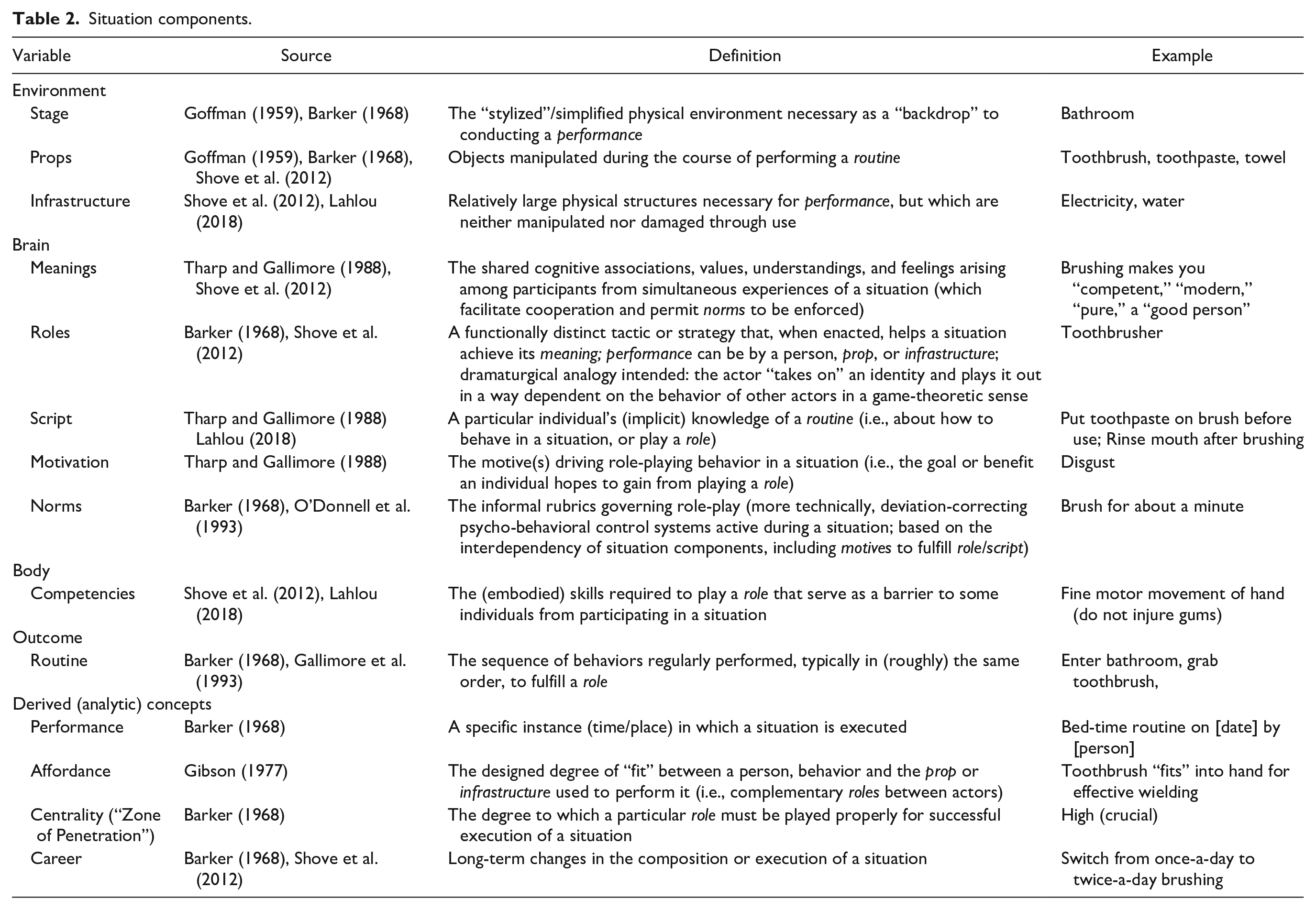
This kind of approach to understanding behavior is distinct in a number of ways from those characteristic of standard behavioral science. First, a situation is a meso-level rather than individual level concept. That is, it includes components that exist between the individual and population levels, such as meanings and centrality. Second, it specifies a system of physical, social, and psychological elements, where most behavioral models derive from psychology or biology, and as a consequence are either strictly psychological or environmental in nature. However, it is necessary to include environmental, psychological, and bodily components together as they come together in time and space at the point of behavior, and so are all proximate causes of it (even though these different kinds of factors are usually dealt with by separate disciplines). Situations are also epistemologically complex: the physical components are realist, the embodied competencies are phenomenalist, while the social regulators are constructionist (Lahlou, 2018). Third, a situation is an objective, naturally occurring phenomenon with a specific time-and-space locus, so it cannot be empirically investigated by simply collecting survey data on psychological constructs. Instead, ecologically valid information about situational and environmental factors should also be collected, presumably through fieldwork in, or remote monitoring of, the relevant circumstances.
I suggest that a situation is this set of active factors and their “local” causes surrounding some actor (or group of actors) engaged in goal pursuit. The emphasis on “local” causes is meant to draw a boundary around the descriptive or explanatory domain, as cause–effect chains can be infinite in length. The basic idea is that an important form of causal explanation should be limited to factors present in the “here-and-now.” Due to lack of “action at a distance,” this implies the causal sources must be present in time and space to have influence—what might be called “zero degrees of separation.” Furthermore, I argue that a situation is this localized explanatory domain, as it makes that concept rigorously delimited so that it can serve as the foundation for scientific advance. Whether a particular factor is in fact situational depends on the case. A factor can be present, but is only situational if its lack or status produces a different behavioral outcome. That is, situational factors are a subset of all possible local causes—that is, those with actual influence over behavior. A situation can be thought of as a “shell” or “sphere” of necessary and sufficient proximate causes to explain behavior.
Calling this concept a situation has several advantages over the terms used by the various originators (“behavior setting,” “social practice,” “installation”): it is a shorter, more ordinary term. Using this term also makes it obvious that a claim is being made to fill a particular theoretical lacuna in the social sciences—a rigorous definition of a situation (e.g., for use in the “person–situation debate”; Funder et al., 2012; Mischel, 1977). Terms like “setting” are often confused with place, which is too general an association, while “installation” sounds technological and artificial when situations are a long-term, fully natural feature of human sociality. It is also necessary to make it clear that the syncretic concept of a situation developed here is not ontologically consistent with Barker’s original presumptions, which tended toward physicalism, being biased toward admitting only observable characteristics into the behavior setting concept. 2
Next, it is necessary to make some additional claims about the environmental causes that arise as a consequence of adopting this new perspective: in particular an ability to distinguish levels and types of environmental causation.
Defining Context
Looking at the causes of behavior “close up” is one focus of analysis. Others seek to know about the “big picture,” or what might be called “context.” Various criteria have previously been used to define context: some consider any environmental factors to be contextual (Kimberly & Evanisko, 1981), others only the exogenous ones (Kompier & Kristensen, 2001), or any ones operating at levels of organization above those under explicit consideration (Cappelli & Sherer, 1991; Diez-Roux, 1998; Mowday & Sutton, 1993). Others simply think that any factor that was omitted from analysis is contextual (Ashenfelter & Greenstone, 2004). Each of these simple distinctions has its uses. But a primary reason to study context is to know how generalizable and transferable situational explanations are from some circumstance to another (Johns, 2006; Saini & Shlonsky, 2012; Wang et al., 2006). This is especially the case when trying to change behavior in common situations. Not considering context in public health is sometimes found to significantly bias the interpretation of outcomes (Blamey & Mackenzie, 2016).
Here, I suggest it is most useful to divide behavioral determinants into spheres of causation—those which are “local” and therefore easily observable or controllable (i.e., situational), and those which are not (i.e., contextual). Because situations can easily be identified and studied, the influence of causal forces outside of this “circle of influence” become the primary object of analytic interest with respect to generalizability. This is certainly the sense in which the context concept is used within public health (Diez-Roux, 1998).
From this perspective, context becomes those things which are outside the focal explanatory domain, but which can intrude into this domain from “outside” (i.e., through “nonlocal” sources). Context can operate at various levels, from individual to community to country; contextual factors are just causally “once removed,” or “one degree of separation” from those factors which are proximate to the behavioral outcome. What the current proposal adds is theoretical strength to the distinction between the situation one is studying or within which one intervenes, and its larger context.
In fact, contextual factors come in two types: those which are distal to the immediate causal envelope, but which can have an impact on behavior by working through situational factors as “secondary” causes (such as the electricity utility that supplies power to the computer someone in the situation is using). Again, due to lack of “action at a distance,” the influence of this kind of contextual factor must be mediated through a situational factor. In support of this distinction, there is some evidence that distal normative influences on a situation are weaker than, and mediated through, proximal sources (Alaybek et al., 2017).
But second are those factors which are normally held constant and not considered explicitly, such as gravity, oxygen, social structures, economic conditions, and earthquakes (what epidemiologists call “control variables”), which, if changed, would have an impact (a phenomenon epidemiologists call “confounding”). As noted previously, these factors are in fact present at a situation, but are not “focal” or relevant to analysis because they are unchangeable and typically general across many situations; they are invisible or implicit, “background” conditions. Only in unusual cases do they change state and become part of the explanation of a situation by intruding in a way that produces novel outcomes.
Situations do not occur in isolation. Behavior occurs all the time, and is hierarchically structured (both within and between situations), suggesting that interactions between situations must happen (Wicker, 1987). In fact, a collection of situations will often share elements, cluster in time and place, and have an overall goal or mission that links them functionally (e.g., household, company, school). Such a set of co-located and functionally unified situations will be called an institution (O’Donnell & Tharp, 1990; Shove et al., 2012). So, the context for one situation may be related situations associated with the same institution. The same individual can often be required to participate in multiple situations as a function of being aligned with an institution. This extended, multisituation role-playing will be said to be occupying a position within the institution. Furthermore, institutions can also define rules, or explicit standards for the performance of positions. These rules are an extension of a situation’s informal norms, about belonging to an institution and performing its activities. Rules make responsibility for performance more “official,” allowing representatives of the institution to potentially take punitive actions or to reward actions taken in accordance with a position’s requirements (e.g., being fired from a job, or getting a bonus). Institutions thus constitute an especially organized kind of context for behavior in a given situation.
More generally, I will argue that contextual (or nonlocal) factors become relevant when a description of the consequences of some force acting on a situation requires reference to factors outside the set of components that comprise the focal situation. In effect, the source of the causal chain goes outside the components of a situation and their normal web of causal interaction (e.g., self-regulating mechanisms). Examples of contextual causes include a break in a water main that causes flooding of the basement of a nearby home where family members normally watch TV (situation); a loss of electric power to a business, which forces the CEO to cancel a staff meeting (a situation); a change in national tax policy that causes the government (an institution), to hold a meeting (a situation) to draft a notice to be sent out all its citizens; and declaration of a “national day of mourning” for a dead political figure can cause closure of a school (institution) and by extension all of its classes (situations).
This approach sees context as “largely exogenous,” such that causal influence primarily moves from context to situation, rather than the reverse (Fridrich et al., 2015). That is, situations are considered to have relatively minor impact on contextual factors, whereas context can “set the scene” for the enactment of a situation, constraining what can happen without being proximally causal. Contextual explanations add an additional richness and “dimension” to the causal story, but are not independent of situational explanations.
In conclusion, I have distinguished two types of explanatory factors: situational (where causes reside strictly within focal components and their interaction), and contextual (in which the mentioned factors normally have causal origin outside the situation). 3 Hopefully, these distinctions give each of the concepts a more precise definition through contrast with the other.
Toward a Generative Model of Situations
Thus far, I have managed to develop a list of factor-types that potentially contribute to an account of situations. This conceptual model operates at a descriptive level. One outcome of this conceptual model would be something like a classification of the range of structured behavior patterns observed in a population, much as ethologists seek to elaborate a species “ethogram,” accounting for the various patterns of behavior exhibited by members of that species from an external observer (“objective”) point of view (Schleidt, 1985; Tinbergen, 1963). So, the syncretic situation model developed here can identify types of situations that differ in the types of props used, competencies required, meanings attached, or goals achieved. This is an advance over current approaches, because it ranges through physical, embodied, and psychological characteristics.
However, the kinds of analysis that can be performed using this sort of descriptive model are limited. For example, an important issue for behavior change concerns the “strength” of a situation. This question arose from an even larger, unresolved literature on the “person–situation debate,” which concerned the question of whether the “subjective” or “objective” aspects of a situation more powerfully control behavioral outcomes (roughly equivalent to Lewin’s person or environment as sources of variation in behavior). Obviously, if there are few means for modifying situational outcomes because the components are very tightly interwoven causally (i.e., very “strong”), this bodes ill for change efforts.
By the 1990s, after several earlier rounds of debate had failed to settle the matter, scholars began to argue for a resolution of the “person–situation debate” through various forms of compromise. The net result has been that a middle-of-the-road position has prevailed: everyone is now an “interactionist” (Fleeson & Noftle, 2009; Funder, 2006; Zimbardo, 2007). This position suggests that consistent traits (i.e., personality) play some role in determining behavior, while situational factors play an independent role, and that interaction effects between traits and situations are often the most significant determinant. But this vague theoretical compromise, in which all possible associations among internal and external forces are allowed, implies that the original question—whether psychology or environment is more important in a given situation—remains largely unresolved (Cooper & Withey, 2009). 4
Basically, this question cannot be answered definitively as long as the situation model remains a list of characteristics, rather than a structured, dynamic model of behavior sequence determination. In particular, the lack of ability to address time explicitly and thus provide a picture of how time pressure can impact on the behavior of those playing various roles and positions means that outcomes like work-arounds (to avoid the complexities of official behavioral standards) or multitasking (or participating in multiple situations simultaneously) cannot be predicted a priori, strictly from a consideration of the components of a situation.
Another way in which the situation and context concepts fall short is in an explicit recognition of spatial structure. Many types of behavior vary as a function of how resources are arranged in space—most obviously feeding strategies and sheltering, but also social interactions (Forman, 1995). In essence, the concept is not yet truly dynamic, nor embedded properly into its institutional backdrop, which it needs to be if it is to be truly explanatory.
Remember, too, that a situation is a complex set of interactions between components. For this reason, the causes of behavior cannot be encapsulated in a single algorithm or equation. This means that without a more explicit statement of how the components interact, the model of a situation cannot predict outcomes from changes to the system with certainty. So, a simple algorithmic model that relates variables measuring aspects of the environment and attributes of the individual to probabilities of different types of behavior is not the form a proper theory of situations is going to take they are rather too complex for that. A descriptive or discriminative model is able to account for differences in outcome types, but is not necessarily able to reproduce the different types through the operation of some guided process.
The next important step, then, is to develop a generative theory of situations, which requires the ability to account for how the causes of behavior interact. Basically, descriptive versus generative are two different styles for modeling that have been applied to problems ranging from agents in computer games (Smith et al., 2011), to understanding sentence production in linguistics (James, 1980), to getting machines to learn complex patterns in data (Nasrabadi, 2007). Generative models introduce hidden variables, representing interactions which are assumed to be the underlying causes producing the observed pattern of outputs. So, while the role concept can account for the tendency to observe an actor engaging in certain strategies, it does not explain why people adopt roles (in real time, as behavioral choices); that requires reference to motivation and goal pursuit. (Admittedly, our conceptual model includes motivation, but it is not explicit about how levels of motivation interact, for example, with environmental barriers to achieving a goal, and hence remains silent about under what combination of circumstances someone will actually take on a role to satisfy some motive.)
What would a predictive model of situations look like? At minimum, we will need some way of formally representing the set of rules and inter-relationships between situation components, and between situations and other structures (such as context). Prediction within such a complex, formally described situation would best be achieved through generative means. As such, this approach would sit within the relatively recent tradition of “computational social science” (Gilbert, 2010), which is based in the iterative execution of multiple algorithms rather than the solution of single mathematical formulae. Such a computational social science is not predictive in the traditional sense of making certain point predictions, but rather results in more probabilistic claims (e.g., a range of possible outcomes from different sets of initial parameter values).
A quasi-dynamic model of situations can be derived from its list of elements and what we know about how those elements interact. This is readily achieved primarily by recognizing the various kinds of agency (or lack of) associated with each element, and how they interact with the environment, contextualized by the stage in which everything takes place. In a similar spirit to Activity Theory (Engeström, 1987), technological objects are considered to have some of the features of agents.
Essentially, situations can be said to occur when agents take certain actions governed by specific rules of interaction (pictured as causal arrows of various kinds, depending on the kind of causal impact expected). Which actions are allowed depends on the spatial relations and characteristics of the elements interacting. For example, people can manipulate props to achieve the goals associated with their role. The model output is a behavioral sequence of actions by each agent (called their routine), which, when aggregated across all agents, becomes the outcome sequence, the set of all behaviors enacted (in temporal order) by any agent over the course of the setting performance. Agents use reinforcement learning to optimize their routines based on rewarding experiences from prior action sequences. See Figure 1 for the resulting (generic) representation. Examples of how to use this model are presented in the next section. Greater spatial specificity can be added by turning the diagram into a map.
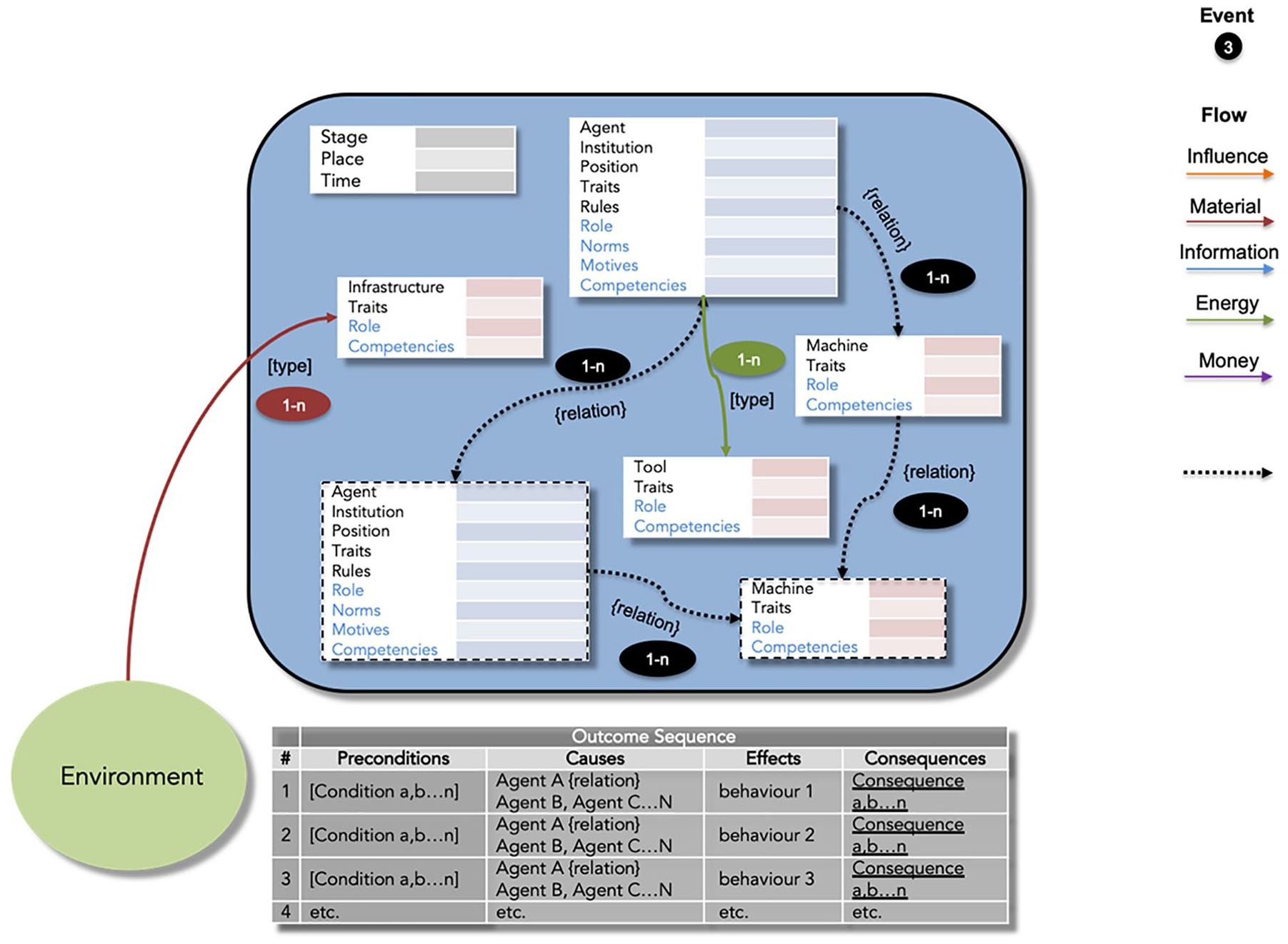
The generic situation diagram.
Having found a way to represent the ontological elements of a situation, my next task is to find a way to describe the event sequences associated with a situation. The folk notion of an event is of “something that happened.” This implies a cause–effect language would be appropriate for describing events. I therefore adopt a situational calculus approach, which sees situations as a sequence of events involving actions by agents (Levesque & Lakemeyer, 2007; Reiter, 2001). I propose that a generic ontological description of situated events involves the following:
Preconditions,
Causes,
Effects, and
Consequences.
A linguistic representation of events then works as follows:
[Element: Precondition 1,2,3. . .n] Agent A (in configuration to) Agent B, Agent C. . .N →
where → implies causation of behavioral effects as the outcome of the causal confluence and predicate conditions. A series of linguistic statements of this form should suffice to describe an entire situation (i.e., all related events/activities). 5
Preconditions for the enactment of a situation (the “states of nature” that must hold prior to causation becoming possible) consist largely of agent competencies and environmental states. They can be associated with the situation’s stage, but also states outside the situation-at-hand (i.e., from its broader context). Preconditions are typically specific to an event. Preconditions associated with the first event in a situation influence whether it can start. Knowledge of these preconditions by those playing particular roles is often required for a situation to play itself out smoothly, and for events to occur in their normal order. 6 What sorts of knowledge agents have about the qualities and competencies of other agents, or the objects in their environment, can be incomplete. 7 Preconditions can also refer to simultaneous states or conditions such as the actions or competencies of other agents (e.g., when there needs to be cooperative effort to achieve the desired effect, as when a sofa can only be moved effectively by two people; Kovacs, 2012). Preconditions will thus often help determine sequence order, because one action cannot occur until another one has occurred previously, modifying some environmental state that is a precondition for the next action.
Agents are the obvious proximate locus of causation in a situation. Because they are able to produce changes in the world, Agents have competencies (as defined earlier). As mentioned above, a competency can be a precondition to an event.
Causes can also involve configurations of interaction between components as they produce effects/outcomes. Configurations are defined by the nature of the relationship between the involved components. 8 For example, people can use objects to enact more powerful behaviors, such as pounding nails into wood with a hammer. If an object is acting as a quasi-agent (via manipulation by a human), then it is considered part of a causal configuration. Thus, in a configuration, the related entities become (at least potential) agents which are together able to engage interactively in producing effects (i.e., behavior). Configurations can be uni- or bidirectional (A bidirectional example is mutual use or holding, during cooperative acts.). 9 These configurations must be means, not ends-in-themselves. (Configurations are represented in the figure by dotted arrows, with a label.)
To capture all aspects of causation, we need to also recognize that during events different kinds of transfers or flows can occur between agents and these functional/structural components. These flows can involve the following:
Material: movement of ecological resources;
Energy: transfer of a capability or capacity to engage in activity (i.e., potential energy);
Information: the transmission of data;
Money: transfer of economic value; and
Influence: transmission of behavioral bias.
This situation model could be made truly dynamic or predictive, and very naturally, by being captured in an agent-based model (ABM; Jędrzejewski & Sznajd-Weron, 2017; Mõttus et al., 2017). ABMs are generative models (J. M. Epstein, 1999). These computer models explicitly deal with time and can populate a spatial landscape with agents that have all the characteristics requisite of a situation. Institutional context could also be modeled as sets of interacting situations of various types. Running the model would produce generations of routine (event) outcomes that should narrow in on the kinds actually observed through selection of the most efficient routines. Certainly, this seems a powerful way forward to increase the realism and utility of the situation model. Operationalizing this perspective will require instantiation in a computer program, setting up prototypical situational parameters, and observing whether outcomes in silico match those from some ecologically valid comparative database (presumably measuring actual human responses). Such work remains to be done. Hopefully, the present discussion provides sufficient detail and rigor to allow the required efforts to begin.
Using the Situation Model
I now turn to a brief demonstration of how the situation model can be used to elucidate the nature of local causation for regularized behavior sequences. Quite often use of the model will be not just for descriptive purposes, but normative ones—that is, by researchers or practitioners with a desire to change some aspect of the situation, presumably to improve human flourishing within them. Such is the case with architects (who implicitly design situations within their buildings), organization designers (who seek to optimize social functioning within an organization), and public health workers (who seek to reduce disease prevalence).
I take an example from public health, where such understanding is crucial to the ability to exchange undesirable behaviors for healthier ones. The situation chosen for this example may seem trivial—washing hands with soap—but is actually instrumental to reducing a wide variety of diseases that are major causes of mortality in less developed countries, from diarrhea to helminth infection, and respiratory illnesses—including controlling the viruses that cause some pandemics (Freeman et al., 2014, 2016).
One widespread context where current handwashing practice is low is rural and peri-urban sub-Saharan Africa. Generally, the most important time to wash hands with soap is after possible contact with feces—that is, after using the toilet. A major problem in this context is that both soap and water have to be brought to this location, which is typically some distance from the house, normally on the occasion itself. If handwashing is left until later, using water and soap kept in the house, then it typically does not happen at all, as people forget, or find it too time-consuming, or just begin going about other business. If soap is left just outside the toilet, it is often stolen, or eaten by animals. So, ideally this behavior should happen inside the toilet, where the situation is very clear, providing consistent cues to trigger the habit. But soap left in a toilet is seen as contaminated. The problem is thus one of overcoming the logistical and psychological problems of staying inside the toilet to “get clean.”
A recent project looked at modifying the props necessary to handwash with soap in this situation. As water can be left in the toilet without problem, and is often used for anal cleansing in any case, the problem is essentially one of getting access to “clean” soap inside the toilet. A design process that made use of this situation model explicitly came up with a simple solution: embedding a small amount of soap into a single-use substrate that can be carried around, ready for use whenever and wherever necessary. After use, the substrate is simply discarded, either down the toilet or into a receptacle. (Making the substrate biodegradable can eliminate this need as well.) This removes a significant step from the handwash routine—having to first go to a place where soap is kept—and ensures that uncontaminated soap is available inside the toilet, because it is carried in the person’s clothing on entry and only used by that person once, on-the-spot. This simplification of the routine, and removal of psychological barriers to using soap in such a situation, eliminates the significant mental and physical barriers to the behavior (see Figure 2).
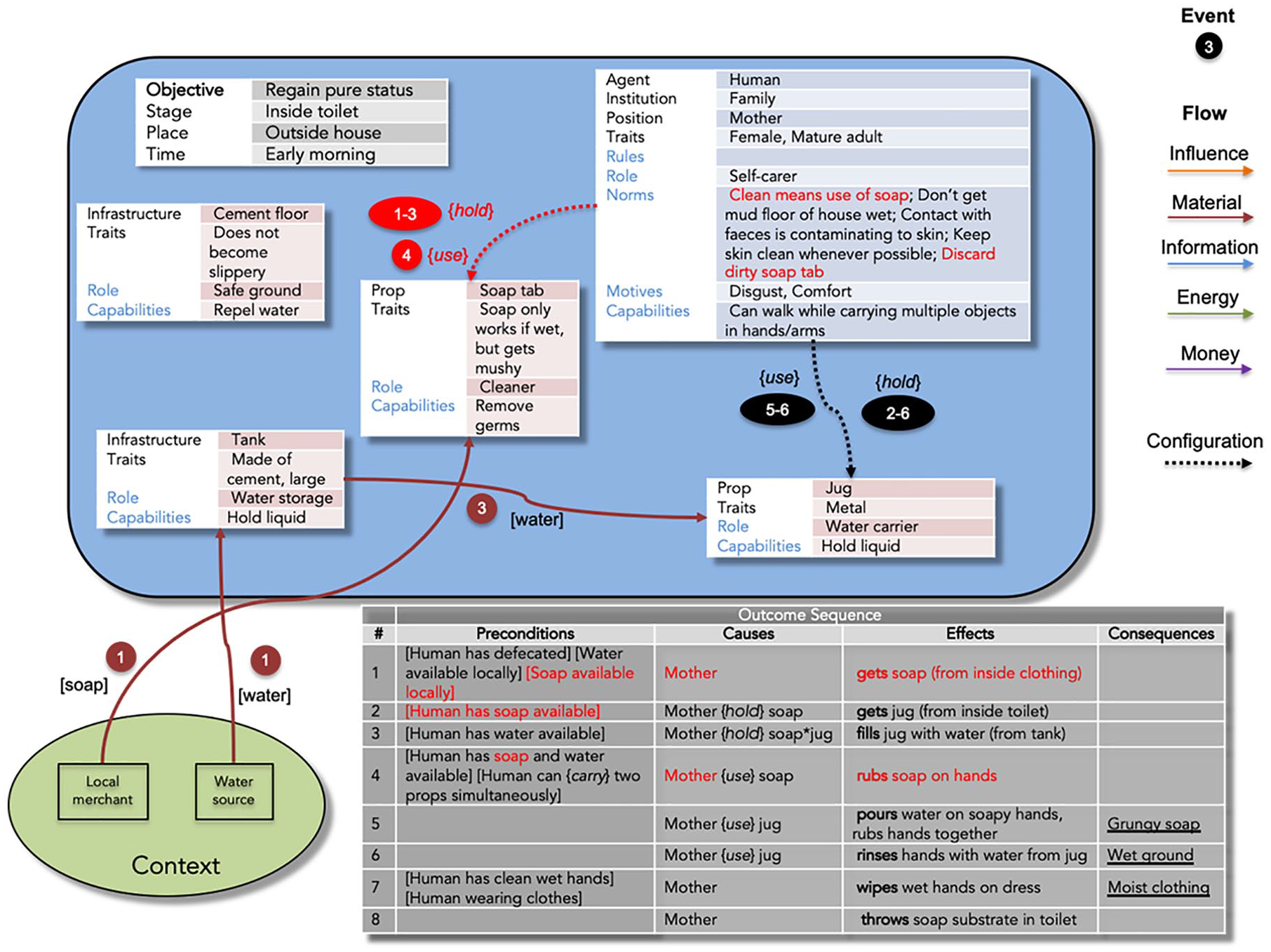
Example situation: Handwashing with soap after toilet use.
Note that the situation model not only precisely identifies the temporal, physical, and physiological constraints on behavior; it can also indicate exactly which variables have been modified when behavior has changed, and at which point in the typical sequence of behaviors, resulting in a shortening of the sequence itself (see elements highlighted in red). Basically, the previous behavior, of washing one’s bottom (and implicitly hand) has new components of explicit handwashing added, but without requiring a trip to the house. This situation model has also been used to investigate the utility of introducing novel sources of water for use in a variety of everyday situations, such as bathing, laundry, and dishwashing (Curtis et al., 2019).
A major virtue of the situation concept is that it contains components which should be readily measurable. Many aspects of the model are physically observable—props and infrastructure, flows of money, role-players—and so should be readily measurable. Describing the events making up a situation is again a matter of observation. Most of the preconditions can be logically inferred.
Of course, the model as developed here also includes psychological components not present in Barker’s original description, such as motivation and capabilities, which might be thought difficult to operationalize. However, while levels of motivation fluctuate, and are hard to measure, the situation model only requires that the type of motivation required to perform a role be identified (e.g., being a care-giver should trigger a nurture motive, while public speaking would require a desire for increased status). Identifying which motives apply to a role can be quite logical, as in the cases just mentioned, but can also be investigated empirically, through use of qualitative research tools (e.g., which place an informant in the setting, at least figuratively, and question which motives could apply to such a case). Such tools have been used in a number of situational studies (Greenland et al., 2016; Sands & Aunger, 2020; Tidwell et al., 2019). It is sometimes believed that norms are difficult to measure as they are only social constructs; however, considerable work has been done on this by Bicchieri and colleagues, using both behavioral observation and standardized questionnaires since, in her conception, norms are systems with both psychological and behavioral components (Bicchieri, 2016). I recommend her approach for this purpose.
Situations can also be classified. Many everyday situations are about “just getting through it” as efficiently as possible, and so take similar forms everywhere in the world, such as personal hygiene, house cleaning, getting to work, or teaching a class. The primary consideration is minimization of expenditures—in terms of time spent in the situation, and physical or mental energy consumed. Other situations are just the opposite: about demonstrating one’s ability to expend energy or intellect (e.g., exercise, romantic dates; G. Miller, 2000). These situations can take a long time and involve various forms of “display”—which are designed to demonstrate skills or physiological capacity. In evolutionary biology, such situations arise when the goal is to impress a potential mate or social competitor, but which in humans is extended to impressing others who might be able to provide social aid (Maynard Smith & Harper, 2003). Yet, other situations are more “cultural” in the sense of being intrinsically about communicating particular messages to on-lookers or other situation participants, as in religious ceremonies, and so can be highly individualized in terms of what actually transpires.
These different classes of situations can therefore be expected to exhibit specific kinds of traits, such as efficiency, profligacy, or eccentricity. This in turn suggests that efforts to modify efficiency situations should be about decreasing some form of expenditure—making it quicker, easier, or simpler to execute. The recommendations for the other types of situation differ, but for display situations, can involve criteria such as maximum energy expenditure, or the innovativeness of display. For purely cultural situations, strict adherence to the potentially arbitrary norms can be crucial as a means of demonstrating skill in role-play.
The Generality of Situations
A final question concerns how much of human behavior the situation concept covers. It may seem as if seldom-occurring behaviors—such as getting married or buying a house—do not get regularized in the way that the situation concept requires. However, even these seldom-practiced behaviors are surrounded by specialized procedures: proposing marriage is expected to occur in a particular kind of situation (the latest fashion is to do it at a very public event, such as a sports stadium), and of course, the marriage ceremony itself is highly encrusted with religious and civil requirements. Similarly, buying a house involves touring homes for sale with a real estate agent, which occurs in a particular, professionalized way, as does the exchange of contracts via legal representatives. So, not just everyday routines are covered by the situation concept; one-off life transitions, important decisions, and so on seem to be covered as well, perhaps to reduce the competencies required to perform these seldom-performed actions.
But what about nonsocial moments like sitting at a computer browsing the internet? What roles and norms cover that sort of event, which can seemingly occur anywhere, anytime (and in which people nowadays spend many waking hours)? Are there web-surfing norms? Regular internet routines? Yes, there are. People do their email, look at news, and conduct their social networking in regularly recurring, homogeneous sessions (Kumar & Tomkins, 2010). Furthermore, the dispersion of attention across websites and the intensity of attention within sites is highly stable for a given social media user (Boik et al., 2016). People seem to invent informal routines for themselves to organize their nonsocial lives as well, even when it is unlikely that there are prescriptive norms for such behavior. So, it seems that there are few moments of life—or at any rate few moments of interest—which are not appropriately addressed by the situation concept.
In sum, situations include various kinds of factors, and are an omnibus concept, in that physical, social, embodied, and psychological elements are all included. However, situation theory (as developed here) is still relatively parsimonious in nature and provides explicit clues as to what to include in a model of behavior determination. Furthermore, we already know empirically that role often trumps any kind of psychological consideration (e.g., eccentric motivational urges) in determining an individual’s behavioral choices when in a situation, presumably due to the strict norms associated with role-play (Barker & Schoggen, 1973; Livert & Hughes, 2002). Measurable notions like centrality (what Barker called a “zone of penetration,” but which mirrors the social network-based notion of how “central” an individual is to a group’s functioning) also imply that certain roles are more important in determining outcomes than others. Typically, only a few props and infrastructural components are necessary to perform a situation successfully as well. So, situations can be used as the foundation for work on intervention design (Lahlou, 2018; Wicker, 2011). We already have significant knowledge about where to look and what to expect. It is precise predictions from situation disruptions that continue to elude us, and which would allow us to more effectively intervene in everyday situations.
Conclusion
Despite long attention to the problem of understanding how behavior arises from interactions between people and their environments, there has been little progress in developing theory that can cut up environments into causally relevant factors, or predict which personal factors will play an important role in a given circumstance. The large literature relating situations to behavior has not yielded insights about what aspects of situations are important for determining which behaviors, or how they do it (Endler, 1993; Kenny et al., 2001). Funder (2001) points out that “little is empirically known or even theorized about how situations influence behavior, or what the basic kinds of situations are (or, alternatively, what variables are useful for comparing one situation with another)” (p. 211). Instead, as a general conclusion, we are left with the oft-repeated observation that situations matter (Ross & Nisbett, 1991). In the face of this confusion, common practice assigns the “situation” responsibility for any variance in behavior not accounted for by personality traits, without specifying what aspects of the environment have psychological salience (Funder, 2009). In recognition of this state of affairs, Reis (2008), in his address as President of the Society for Personality and Social Psychology, called for situations to once again become a focus of research by social psychologists. To the extent that psychology is the “science of behavior,” this lacuna remains debilitating. Here, I have developed a sophisticated approach to understanding the nature of situated behavioral causes.
First, I have argued that behavior takes place within localized situations. I have defined a situation as the set of proximate causal factors having influence over “what happens.” Due to lack of “action at a distance,” this implies the causal source must be “present” in time and space to have influence: these factors have “zero degrees of separation” from the outcome. The situation model is a composite of what a variety of theorists have believed might be causally relevant in this way. Of course, not every factor that has bearing on behavior need be considered. Gravity and oxygen are present, and have some impact on behavior, but this is universally true, and therefore not salient to an explanation of a particular situation. We restrict actual descriptions to those factors which differentiate one situation from another.
Other influences on behavior—external to this set of determinants, but which can nevertheless intrude into a complete explanation of behavior—I call “contextual” influences. The influence of a contextual factor must be mediated through a situational factor, or be one of the “background” conditions (like stable ground underfoot) that becomes relevant by disrupting a situation in some unusual fashion (e.g., in the form of an earthquake).
Previously, workers in ecological psychology devised ways of measuring a large number of analytic features of situations—most importantly how to identify their limits rigorously (by establishing a constellation of factors operating relatively independently of others in the environment). These tactics could be modified and elaborated through future work. But without a fully formal model—most likely in the form of a computerized agent-based model—it is not presently possible to definitively predict or explain behavior. We suggest this kind of implementation and parameterization should be on the agenda of those seeking to understand situations and their context. Taken together, these claims and research program should help our understanding of small-scale behavioral interactions and so allow us to move toward a predictive science of human behavior.
Footnotes
Acknowledgements
The author thanks Val Curtis for making important contributions to the framing and direction of this paper, and Ben Tidwell and Nigel Shardlow for reading an earlier version.
Declaration of Conflicting Interests
The author(s) declared no potential conflicts of interest with respect to the research, authorship, and/or publication of this article.
Funding
The author(s) received no financial support for the research, authorship, and/or publication of this article.
