



Abstract
Academic Abstract
Gender differences in sexuality are often attributed to evolved biological differences organized before adolescence or experiential ones learned afterward—neglecting learning that endures because it is evolutionarily expected, and we are biologically sensitized to it. Here, we present the Biodevelopmental Learning Opportunities and Outcomes Model (BLOOM) of gender differences in sexuality, arguing women’s lower interest in sex originates not from unequal capacities to want/desire it, but unequal opportunities to like/enjoy sex when biospsychosocially primed to learn from it. We synthesize evidence indicating sex is least equal in adolescence, offering the greatest costs and fewest rewards to women/girls who debut with men/boys (WDM). Concomitantly, it is most teachable in adolescence, when a window of opportunity for sexual incentive learning may open, particularly among individuals with heightened sexual plasticity/learning aptitude (i.e., women/girls). Implications for distinguishing gender differences in sexuality from experience-contingent similarities, and realizing equal sexual rights, education, and health are discussed.
Public Abstract
Gender differences in sexual enjoyment are among the largest in psychology and have remained so over decades despite other advances in gender equality. The gender gap in sexual pleasure, for example, has gained widespread attention and is increasingly discussed as an explanation for gender differences in sexuality. Here, we spotlight the largest, but least discussed, gender gap in sexual enjoyment: the developmental gap. We review evidence that adolescence is not simply a vulnerable period for sexual health, but a window of opportunity for learning to have healthy, enjoyable, and desirable sex—and one wherein equal opportunity is lacking. We propose women get the least equitable sex during this window, when they are primed to learn from it, and this learning informs sexual interest thereafter, generating acquired differences that are often mistaken for inborn ones. We close with recommendations for ensuring equal opportunities for healthy sex and sexual health across genders.
Keywords
“It is an infantile superstition of the human spirit that virginity would be thought a virtue and not the barrier that separates ignorance from knowledge.”
The sexual desire discrepancy between genders 1 has been a staple of headlines, punchlines, and party conversations for decades, and study of it stretches back to the 1970s (Oliver & Hyde, 1993)—with more than 500 tests published in the past 25 years alone (Frankenbach et al., 2022). When operationalized as behaviors, cognitions, and feelings that indicate a need or “drive” to seek sex out, this gender difference is moderate to large in size (Frankenbach et al., 2022), and larger than most effect sizes in social and personality psychology (Gignac & Szodorai, 2016; Richard et al., 2003), such that about three in four women exhibit less interest in sex than men. Indeed, the “libido gap” between genders is as sizable as the difference in weight (Meyer et al., 2001), not to mention as sizable as some of the largest and most reliably documented gender differences in behavior (e.g., spatial cognition, physical aggression; Hines, 2020), and its origins have sparked decades long debate (Hyde & Durik, 2000).
Owing, perhaps in part, to its size and stability, some have attributed women’s lower interest in sex to evolved biological differences (Baumeister & Vohs, 2004; Buss & Schmitt, 2017; Leiblum, 2002), failing to account for variability across women (e.g., highly sexual women, Winters et al., 2010; women who have sex with women, Persson et al., 2016) and within women (e.g., across stimulus exposures, Goldey & van Anders, 2012; relationships, Murray & Milhausen, 2012; major life events, Wignall et al., 2021). Others have offered contextual explanations for the gender-mismatch in sexual desire (Baumeister & Twenge, 2002; Hyde & Durik, 2000; Schwartz & Rutter, 1998), failing to explain its persistence across cultures and birth cohorts (Frankenbach et al., 2022; Lippa, 2009). Still others have dubbed the sexual desire gap a methodological artifact (e.g., of socially desirable self-report; Crawford & Popp, 2003) or methodologically inflated (e.g., by trait-level assessment; Dawson & Chivers, 2014). In attempting to explain women’s lower interest in sex, however, most models have overlooked another, more profound difference between genders: the qualitatively worse sex women get than men.
More sizable and reliable than gender differences in sexual interest (McElroy & Perry, 2024), the gender gap in sexual enjoyment has remained large over decades despite other advances in gender equality, and has featured in explanations for the differing sexual response patterns (Chivers, 2017), strategies (Laan et al., 2021), and difficulties of women and men (van Anders et al., 2022). This gender gap has also begun to feature in frameworks of normative differences in sexual desire, with some suggesting the “libido gap” between genders might reflect different opportunities to like and enjoy sex rather than different capacities to want and desire it (Conley & Klein, 2022). This proposal is a timely one given the shift away from conceptualizing sexual motivation as an “appetite,” like hunger or thirst, that originates internally and emerges spontaneously, irrespective of experience. Indeed, early models of sexual response placed desire as a cause, not a consequence, of sexual experience (Kaplan, 1974; Masters & Johnson, 1966). In contrast, current models posit circular, reinforcing connections between these components, framing sexual desire as dynamic and responsive to experience (Basson, 2000; Both et al., 2007; Toates, 2009).
Despite their timeliness, quality-of-sex perspectives on the gender gap in sexual interest share the same limitations as other contextual ones, failing to explain women’s lower interest across cultures and birth cohorts (Frankenbach et al., 2022; Lippa, 2009), over which the quality of sex they get varies considerably (e.g., Durex, 2012; Kontula & Miettinen, 2016). Furthermore, for all their focus on the sexual pleasure gap between genders, these explanations have neglected what is arguably the largest and most reliable sexual pleasure gap on record: the developmental one in adolescence. Here, we propose the Biodevelopmental Learning Opportunities and Outcomes Model (BLOOM) of gender differences in sexuality. This model applies a developmentally informed life-course approach to gender differences in sexual interest, bridging biological and sociocultural considerations in an integrative framework. First, we review ample evidence that sex comes at the greatest cost, and offers the fewest rewards, to women in adolescence
Women Get Worse Sex, But They Get the Worst Sex to Start With
Like female sexual pleasure at any age, sexual activity in the context of adolescence has historically been cast as dangerous, unhealthy, or insignificant because procreation does not depend on it—at least not in its culturally sanctioned form that calls for the capacity to rear progeny. Accordingly, sex has been largely neglected in developmental models of adolescence (Suleiman et al., 2017), and when studied, is often framed through the lens of risk management (Harden, 2014). Yet the transition to sex is a normative developmental task and a hallmark of adolescence (Fortenberry, 2013)—whether one adopts a traditional definition of adolescence (10–18 years of age) or a more contemporary, expanded definition (10–24 years of age; Sawyer et al., 2018). Most population data place the onset of first sex squarely within this window. By 18 to 19, roughly two thirds of women in the United States have had sex (65%–74%; Martinez & Abma, 2020), and the median age of first sex in high-income countries typically ranging from 17 to 18 years of age (Tomori et al., 2022). Globally, the range extends from ages 15 to 24 years (Wellings et al., 2006), missing early adolescence (10–14 years of age), but falling squarely within both late adolescence (15–19 years of age) and what some have termed “extended adolescence” or “emerging adulthood” (19–24 years; Sawyer et al., 2018). It is during this period of sexual preparation, which begins with the physical capacity for procreative sex and ends with social permission to engage in it, that most women get the worst sex of their lives.
Punishing Exposures Over Sexual Development
Because adolescent sex has often been studied from a public health perspective that emphasizes adverse outcomes and concomitant risks, its potential to inflict punishment is well established. Just as it looms larger for women than men (Grady et al., 1999), the prospect of pregnancy also looms large for girls, such that they attribute more costs to sex than boys do (Deptula et al., 2006), and experience more pregnancy-related worries at first sex, whether in high school or college (Vasilenko et al., 2022). Pregnancy may also be more salient, and more costly, for girls than for women. The potential for unplanned pregnancy is greater in adolescence (12%–41% of pregnancies planned) than for women in older age brackets (58%–69% of pregnancies planned; Finer & Zolna, 2016; Wellings et al., 2013). Also elevated during this period is the risk of miscarriage, and other adverse outcomes (e.g., 34% of adolescent pregnancies end in miscarriage vs. 11%–15% of adult pregnancies; Smith et al., 2003). In fact, pregnancy—and by extension (hetero)sex—is the leading killer of adolescent girls globally (World Health Organization, 2019), with the risk of death during pregnancy or childbirth being up to twice as high between ages 15 and 19 years than at older ages (Blanc et al., 2013). Women are also uniquely prone to sexually transmitted infection in adolescence and emerging adulthood (Centers for Disease Control and Prevention, 2019), and tend to have higher case rates than men (e.g., up to 3,730 chlamydia cases per 100,000 women vs. 1,627 chlamydia cases per 100,000 men); however, this difference is diminished at older ages (e.g., up to 1,548 chlamydia cases per 100,000 women vs. 988 chlamydia cases per 100,000 men; Centers for Disease Control and Prevention, 2019) and may even be reversed (Fu et al., 2022). Thus, when its costs are conceptualized narrowly, in terms of those that affect public health, sex is more punishing for women than men, and especially so prior to adulthood.
When its personal costs are considered in addition to its public health ones, the sex women have at early ages would seem more punishing still. For starters, girls are more likely to be victims of sexual abuse than boys (Assink et al., 2019). Furthermore, rates of partner victimization more broadly (i.e., rape, physical violence or stalking; Breiding et al., 2014), as well as sexual harassment and assault (Schapansky et al., 2021), are elevated in adolescence and emerging adulthood—and more elevated among young women than men (Schapansky et al., 2021). First sex, for example, is more often forced for women than men (4%–7% of women vs. up to 1% of men; Else-Quest et al., 2005; Higgins et al., 2010) and generates stronger feelings of fear (Guggino & Ponzetti, 1997; Schwartz & Coffield, 2020). When willing, this milestone is more likely to be pressured (e.g., Darling et al., 1992; Walsh et al., 2011; Wight et al., 2008), and this disparity is twice as great at first sex (19% of women vs. 10% of men) than recent sex (8% of women vs. 7% of men at last sexual intercourse; Wight et al., 2008). In fact, a gender gap in partner pressure is found when first sex occurs in adolescence, but not when first sex occurs afterward (Walsh et al., 2011).
Even when willing and wanted, women’s first exposure to sex is more likely to be painful than men’s (33%–69% of women experience pain or discomfort vs. 0%–8% of men; Tsui & Nicoladis, 2004; Vasilenko et al., 2022; Walsh et al., 2011). However, this difference is diminished at recent sex (30% of women experience pain vs. 7% of men at most recent penile-vaginal intercourse; Herbenick et al., 2015). Indeed, younger women of reproductive age are more likely to report pain during sex than older ones (Laumann et al., 1999; Richters et al., 2003, 2022), but the reverse is true of men (Herbenick et al., 2010a). Younger women are also more likely than older ones to experience rough treatment during sex (e.g., choking, slapping), but the same does not hold for younger men (Herbenick et al., 2020). Thus, in addition to pregnancy and disease, the sex women get at early ages comes with the greatest potential for trauma and injury. In light of this disparity, it is perhaps not surprising that more women (52%) than men (34%) use a negative word to describe their sexual debut (e.g., “horrifying”; Sawyer & Smith, 1996) and have experienced “scary sex” by adulthood (71% of women vs. 30% of men; Herbenick, Bartelt, et al., 2019), which itself takes on gendered meanings. While the scary sexual experiences recounted by men include forgetting to use protection or having sex with someone who is promiscuous or menstruating, those described by women include being raped, choked, threatened, held down, and made to have painful or unprotected sex despite their protests (Herbenick, Bartelt, et al., 2019).
Several precipitating factors might make sex more punishing for women even when sex does not descend into scary or unsafe territory, and many such factors emerge or are intensified in adolescence. First, and perhaps most obvious, the physical changes of puberty bring about differences in size and strength that disempower girls in intimate encounters with boys. These changes might lend to greater sexual compliance among girls, as well as greater feelings of being used (Donald et al., 1995) and exploited when they first have sex (Barnett et al., 2016; Schwartz & Coffield, 2020). The same could be said of gender differences in sexual expertise, which peak during the adolescent years—when fewer girls have practice with masturbation than boys (Fortenberry et al., 2010; Herbenick et al., 2010b), and this disparity is wider than it is in either childhood (Leitenberg et al., 1993; Sandnabba et al., 2003) or adulthood (Herbenick et al., 2010b). Indeed, anxiety about sexual performance is greatest for women in adolescence and declines over the life course, whereas the reverse is true for men (Richters et al., 2022). Moreover, the physical changes of puberty bring boys closer to the muscular ideal for males, but they often take girls further from the female ideal of thinness (Stice, 2003) at a time when physical appearance is highly salient (Markey, 2010) and highly valued (Agthe et al., 2013). Consequently, if women first disrobe for sex in adolescence, they do so when body image is at a lifetime low (Lacroix et al., 2023) and body image-related pathology (e.g., disordered eating, low body satisfaction) is at a lifetime high (Brown et al., 2020; Voelker et al., 2015)—which might explain their greater embarrassment at first sex than men (Barnett et al., 2016; Guggino & Ponzetti, 1997; Schwartz & Coffield, 2020). Even at recent sex (i.e., over the past 12 months), younger people are more likely to report body image concerns than older people, but this trend is more pronounced for women than men (Richters et al., 2003). Relatedly, adolescents are more prone to gender-based generalizations and discrimination than adults (Lobel et al., 2004) and older children (Klaczynski et al., 2020), and these tendencies might extend to the sexual domain—including to enforcing sexual double standards that reward men and punish women for their part in non-procreative sex. Consistent with this double standard, girls tend to lose friendships as they gain sexual experience in adolescence, but boys do not suffer similar losses (Kreager et al., 2024). In addition, in emerging adulthood, young women face more disapproval from peers and parents for engaging in sex than young men (Moore & Rosenthal, 1991) and experience more parent-related worries when they first have it (Vasilenko et al., 2022). They may also face greater disapproval for disclosing sex that was compromising or disappointing (e.g., lacking in orgasm)—not just because having sex violates sexual scripts for young women, but because failing to have an orgasm during sex is perceived as a greater empathic and relational failure for women than men, with greater potential to jeopardize a partner’s feelings and the relationship (Salisbury & Fisher, 2014).
Owing, perhaps in part, to the greater stigma, censure, and rejection sex brings them at early ages, more women than men experience feelings of guilt at first sex (56% of women vs. 41% of men; Darling et al., 1992; Higgins et al., 2010), and to a stronger degree (Guggino & Ponzetti, 1997; Higgins et al., 2010; Schwartz & Coffield, 2020; Sprecher, 2014; Sprecher et al., 1995; but see Barnett et al., 2016; Vasilenko et al., 2022), but no such difference is seen at recent sex, in either guilt (45% of women vs. 40% of men at current intercourse; Darling et al., 1992) or negative affect more generally (3% of women vs. 3% of men at latest sexual intercourse; Häggström-Nordin et al., 2005). Thus, whether its consequences are personal or interpersonal, sex comes at the greatest cost for women in the earliest parts of sexual life (for a depiction of experienced costs and expected risks of sex over women’s reproductive life course as postulated by BLOOM, see Figure 1).
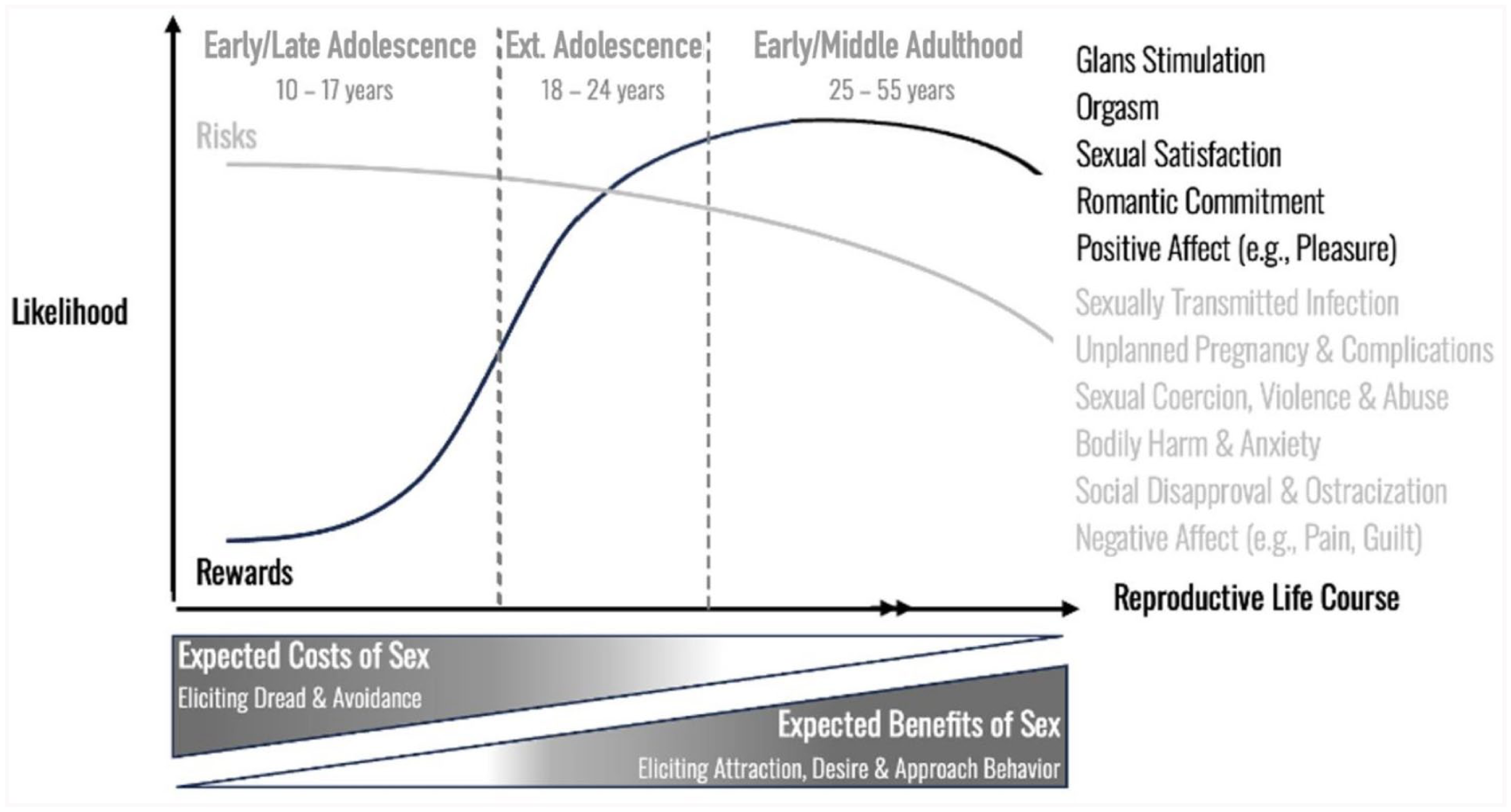
Quality of Sex Over the Reproductive Life Course of WDM in the BLOOM Framework, as Illustrated by Trajectories of Sexual Risk/Reward-and Corresponding Shifts in the Expected Costs/Benefits of Sex.
Rewarding Opportunities Over Sexual Development
In describing the worse sex women get than men, more emphasis is often placed on women’s greater risk of punishing, non-normative experiences than on their lower odds of rewarding ones (e.g., Conley & Klein, 2022). However, frustrating sexual experiences are more common than ones that are overtly punishing—and may be punishing in and of themselves. In addition to being more pervasive than sex that is harmful or costly, sex that is lacking in rewards may be more gendered—and this discrepancy may be larger for those with less sexual experience. At first sex, for example, the gender gap in positive affective experience is significant (Barnett et al., 2016; Eriksson & Humphreys, 2014; Rind, 2023; Schwartz & Coffield, 2020; Vasilenko et al., 2022), and more sizable than the gender gap in negative affective experience (Barnett et al., 2016; Eriksson & Humphreys, 2014; Schwartz & Coffield, 2020; c.f. Rind, 2023). This gender gap may also be more reliable, as negative reactions to first sex vary cross-culturally for women, but positive reactions (or their lack) do not vary (Schwartz, 1993)—or vary less (Rind, 2023). Beyond being large and stable across cultures, gender differences in positive affect at first sex have changed little over time, even as sexual encounters have become more gratifying for women in middle and late adulthood (e.g., 41%–50% of women experiencing orgasm at last penile-vaginal intercourse in the 1970s vs. 61%–66% of women in the 2010s; Kontula & Miettinen, 2016). The gender difference in pleasure at first sex, for instance, has remained stable across three decades (d = 1.1), and more stable than differences in guilt (d = 0.6) or anxiety (d = 0.5; Sprecher, 2014). In fact, this pleasure gap far exceeds established exceptions to the Gender Similarities Hypothesis (e.g., masturbation and attitudes toward casual sex; d = 0.5), which posits that men and women are similar in most psychological and sexuality variables, despite stereotypes to the contrary (Hyde, 2005). Indeed, affective experience of first sex has been argued to constitute an exception in itself (Sprecher, 2014). Thus, the continued persistence of gender differences in sexuality may not just stem from early, rather than adult, experience with sex, but from gendered opportunities for sexual reward rather than simply punishment.
In characterizing the gender gap in sexual pleasure, much attention has centered on reaching orgasm in partnered contexts, which is less common for women than men (McElroy & Perry, 2024). Comparatively little attention has been paid to the size of this gender gap at younger ages, when sex is most likely to result in orgasm for male people, but least likely to do so for female ones (Herbenick et al., 2010a; Richters et al., 2022). That this “orgasm gap” is widest at sexual debut has been all but absent from explanations for the “libido gap” between women and men, even though the orgasm gap is five times larger at first sex (6%–12% of women vs. 62%–84% of men experience orgasm; (Reissing et al., 2012; Sawyer & Smith, 1996; Schwartz & Coffield, 2020; Sprecher et al., 1995; Tsui & Nicoladis, 2004) than at recent sex (63%–65% of women vs. 85%–98% of men experience orgasm during partnered sexual behavior over the past 12 months or at their most recent heterosexual encounter; Garcia et al., 2014; Richters et al., 2006). Moreover, fewer than half of adolescent girls report liking how their body felt when they last had sex and only a quarter describe their initial experience of sex in terms of pleasure (Thompson, 1990). That the gender gap in pleasure at first sex is large (Barnett et al., 2016; Eriksson & Humphreys, 2014; Schwartz & Coffield, 2020; Walsh et al., 2011), but no longer apparent when first sex occurs after 18 years of age is noteworthy as well (Walsh et al., 2011), and adds to a growing body of evidence that women get the least pleasurable sex in the context of adolescence.
It is important to stress that women may not differ from men in their capacity for orgasm, but they receive fewer opportunities to achieve it in partnered contexts (McElroy & Perry, 2024), and no fewer perhaps than during their first exposure to sex. Glans stimulation, for example, is central to sexual arousal (R. J. Levin, 2020), orgasm (Herbenick et al., 2018), and satisfaction across genders (Dienberg, Oschatz, Kosman, & Klein, 2023), and is as much a staple of solitary sexual activity for women as for men (Towne, 2019). This stimulation may, however, be scarce for women at early ages because those with the least sexual experience tend to define sex the most narrowly (Bersamin et al., 2007; Byers et al., 2009; Sanders & Reinisch, 1999), and more often in a way that includes glans stimulation for men (i.e., penetration and thrusting that directly stimulate the glans penis) but not for women (i.e., oral or manual genital contact that directly stimulates the glans clitoris). That is, those who have never had sex are most likely to define sex as penis-in-vagina sex. They are also more likely to enact this “coital imperative.” Peragine et al. (2023) showed, for instance, that receipt of glans stimulation is an all but universal experience for men at sexual debut, but a minority occurrence for women, and considerably rarer for women at first sex (40.6% experience glans stimulation) than recent sex (78% experience glans stimulation at their most recent heterosexual encounter; Richters et al., 2006). The beginner’s sexual script thus bears a striking resemblance to the traditional sexual script (Barnett et al., 2017; Byers et al., 2009; Hans & Kimberly, 2011; Hite, 1976, 1982) and still casts women as supporting actors in sex, including in their own sexual debuts.
That women are not less able to achieve orgasm when they first embark on sex, but less enabled to achieve it by their partners, is suggested by studies of women who partner with women. While orgasm and activities that directly stimulate the glans clitoris rarely feature in the sexual debut narratives of heterosexual women, they are not uncommon in the stories of sexual minority women (Carpenter, 2005; Kinsey et al., 1953; Masters & Johnson, 1966; Thompson, 1995). Indeed, Peragine et al. (2023) demonstrated that women are twice as likely to receive glans stimulation when they debut with women—and five times as likely to achieve orgasm. They further found that women are more physically satisfied at first sex when they debut with women, and do not differ in this respect from men who do the same. Perhaps most notably, they showed that experience gaps between women are large in a partnered sexual debut context, but non-existent in an unpartnered one (first masturbation), implicating the partner, rather than the actor, in enjoyment at first sex. Indeed, others have shown that first sex is sometimes lacking in pleasure (Kubicek et al., 2010) and physical satisfaction when young men debut with men, particularly when their partner adopts an insertive role (Arrington-Sanders et al., 2016) as women’s typically do. Accordingly, WDM’s lesser enjoyment at first sex may not reflect a gender difference after all, but instead, a gender similarity that is contingent on the gender of one’s partner.
Because pleasure is relatively scarce in women’s earliest sexual encounters, perhaps they come not to expect it from sex, nor even to consider its absence a deprivation (Laumann et al., 1994). Indeed, by the time they reach adulthood, women may match or surpass men in their satisfaction with sex (e.g., Holmberg & Blair, 2009; Oliver & Hyde, 1993; Peixoto, 2022), but they differ in their threshold for it. That is, men often include pleasure and orgasm in their definitions of satisfying sex (McClelland, 2010). Yet, women define satisfying sex merely as sex that is free of pain and degradation (McClelland, 2010). Precisely when women develop a lower standard for satisfying sex remains understudied, and undertheorized. However, the “satisfaction gap” at first sex is a large one (ds = 0.5 to 1.0; Barnett et al., 2016; Eriksson & Humphreys, 2014; Guggino & Ponzetti, 1997; Ruiz-Muñoz et al., 2013; Schwartz & Coffield, 2020), and even when women match men in satisfaction at recent sex (operationalized as current intercourse or sexual intercourse over the previous 12 months), they still report being less satisfied at first sex (Darling et al., 1992; Ruiz-Muñoz et al., 2013). This would seem to suggest two possibilities. First, women might get worse sex than men to start, but this gender gap is an anomalous one that narrows over time—and may even be reversed for sexually experienced adults (Holmberg & Blair, 2009; Peixoto, 2022). Alternatively, women might lower their standard for satisfying sex each time sex fails to please, such that the worse sex they get becomes less visible over time—both to themselves and to sexologists. Should this be the case, the satisfaction gap at first sex may not just be the largest one on record, but the one least biased by repeated and cumulative experience of orgasm inequality. Indeed, if the standard for satisfying sex diverges for women and men as gendered experience of orgasm accumulates, satisfaction at first sex may offer a relatively clean developmental snapshot: a moment when satisfaction reflects felt sexual pleasure for each gender rather than deeply engrained pleasure disparities, and gendered expectations for achieving it. For this reason, satisfaction at sexual debut may offer the most interpretable and equitable metric of sexual satisfaction that can be compared across genders.
Like the gender gap in pleasure at first sex, the gender gap in physical satisfaction is large (ds = 0.8 to 1.1; Darling et al., 1992; Higgins et al., 2010; Marván et al., 2018; Peragine et al., 2023; Sawyer & Smith, 1996; Smith & Shaffer, 2013; Tsui & Nicoladis, 2004) and long documented (e.g., Eastman, 1972)—reflecting an appraisal of both positive (e.g., pleasure) and negative (e.g., pain) aspects of physical sexual experience. So, too, is the gender gap in emotional satisfaction (Darling et al., 1992; Higgins et al., 2010; Peragine et al., 2023). On this note, sex may be emotionally fulfilling for men at younger ages, even when lacking in physical rewards. Because boys are more likely than girls to frame virginity as a stigma (Carpenter, 2002), they may be delighted to have shed it, even when doing so was not physically enjoyable. Furthermore, boys are said to become men at first sex, and it is likely to be an affirming experience even in the absence of pleasure. The same does not hold for girls, who are said to become women at menarche, and at best, receive relationship affirmation, not self-affirmation, from first sex (Holland et al., 2010). Indeed, girls are more likely than boys to frame virginity loss as a gift exchange with future relationship returns (Carpenter, 2005), but these may be scarce in adolescence, when romantic relationships are less intimate, committed, and enduring than adult ones (Ahmetoglu et al., 2010; Bühler et al., 2021; Sumter et al., 2013). Other interpersonal returns on sex, like popularity, may be better for adolescents than adults. However, these are typically restricted to boys, who are more likely than girls to gain friends as they gain sexual partners (Kreager et al., 2024) and to report having sex enhanced their reputation (Vasilenko et al., 2022). Thus, whether its personal or interpersonal returns are considered, sex would seem to offer the fewest rewards to women when they first embark on it (for a depiction of experienced rewards and expected benefits of sex over women’s reproductive life course as postulated by BLOOM, see Figure 1). Taken together, one could argue that deprivation of positive, enjoyable, and rewarding sexual opportunities is a normative feature of sexual development for women, and one that might set the stage for their lower interest in sex relative to men, which is not limited to women with histories of sexual abuse, disease, pain, unplanned pregnancy, or exposures to sex that are otherwise punishing.
Women Get the Worst Sex When It May Be the Most Formative
In explaining women’s lower interest in sex, others have highlighted gender differences across two phases of the sexual pleasure cycle: wanting, which encompasses desire and/or mental arousal during anticipation of sexual activity, and liking, which encompasses physical arousal and/or orgasm during the sexual act itself (Georgiadis & Kringelbach, 2012). However, the phase that connects them—learning—has been largely overlooked. It is during this third phase of the sexual pleasure cycle that associations and expectations are formed based on prior sexual experience, either following orgasm and the resolution of sexual desire/arousal, or following incomplete pleasure cycles that do not culminate in orgasm (Georgiadis & Kringelbach, 2012). This is a small but significant omission, because women tend to get the worst sex precisely when it may have the most learning potential.
Contextual learning models that attempt to explain how gendered sexual experience gives rise to gender differences in sexuality are conceptually diverse, differing in either the dimension of experience emphasized (e.g., type, dose; Conley & Klein, 2022; Laan et al., 2021; van Anders et al., 2022) or in the moderating role of individual-level traits (e.g., Baumeister, 2000). They do, however, share one core assumption: that sexual learning is experience-dependent, relying on mechanisms that support learning across the lifespan, unconstrained by developmental timing. Yet, in the broader developmental literature, experience-dependent mechanisms are generally used to model learning from exposures that are not shared by all members of a species—and thus are not evolutionarily expected (Gabard-Durnam & McLaughlin, 2020). For exposures that are expected and all but ubiquitous—such as sexual activity in adolescence—experience-expectant learning mechanisms have often been invoked instead.
Unlike experience-dependent learning, which is displayed across the life course, experience-expectant learning is limited to developmentally constrained windows of heightened neuroplasticity—most of which are clustered early in life (Nelson & Gabard-Durnam, 2020). During these windows of development, organisms are biologically prepared to encounter (and adapt to) particular experiences—and the developing brain is primed to organize neural circuits in response to specific inputs. That is, particular brain systems develop with the expectation of particular types of experiential input, either during one well-defined window (critical period) or with some residual malleability (sensitive periods), and their structure and function are shaped accordingly. If these expected experiences are absent, aversive, or otherwise disrupted, developmental trajectories can be altered in enduring ways (McLaughlin et al., 2014).
We propose that sexual learning in adolescence engages these experience-expectant systems, and that such learning plays a formative role in establishing adult patterns of sexual desire and behavior. In contexts where adolescents encounter greater sexual adversity, whether through atypical (e.g., punishing) exposures or deprivation of expected (e.g., rewarding) ones, they may experience profound and enduring consequences across the neuropsychological systems governing sexual interest. These adaptations may reconfigure sexual expectations and recalibrate sexual decision-making, with lasting (and potentially lifelong) implications for pursuing sexual experience. While research on experience-expectant periods for sexual learning has largely focused on early childhood (e.g., Bressan, 2020; Valentova et al., 2017), adolescence bears many hallmarks of such a period and may play an equal (if not larger) role in organizing sexual motivation. Much as brain development in infancy is shaped by expected environmental input, like exposure to language (Zauche et al., 2016) and responsive attachment figures (Gee, 2020), so too is it shaped in adolescence by risk and opportunity in the expanding non-natal environment (Sisk & Gee, 2022), and sex-related risk and opportunity is unlikely to pose an exception (Suleiman et al., 2017).
In addition to being highly plastic (Telzer et al., 2023), the brain is more responsive to threat (Gerhard et al., 2021) and reward in adolescence than in childhood or adulthood (Towner et al., 2023), and more sensitive still in the presence of peers (e.g., Chein et al., 2011). Indeed, adolescence is a time of social reorientation (Nelson et al., 2016), when young people must individuate from caregivers, forge peer attachments, and compete for mating opportunities—all while adopting new social roles and developing new attitudes and identities. Consequently, adolescents are particularly susceptible to peer influence (Molleman et al., 2022) and to social conditioning generally (Blakemore & Mills, 2014; Hofmans & van den Bos, 2022). There is also some evidence adolescents show stronger conditioning from reward (e.g., peer approval: Jones et al., 2014; monetary gain: Raab & Hartley, 2020; point gain, Hämmerer et al., 2011; positive performance feedback: Davidow et al., 2016) and punishment (Pattwell et al., 2012; Towner et al., 2023) than either children or adults (especially under unfamiliar/unpredictable conditions; Topel et al., 2023), and are more prone to developing addiction (Chambers et al., 2003; Dayan et al., 2010) and anxiety problems (Haller et al., 2015; Xie et al., 2021). In fact, adolescence has been dubbed a vulnerable period for incentive-motivational development (Luciana & Collins, 2021) when non-normative experiences might set the stage for these problems–and the same has been suggested for problems with sex (Suleiman et al., 2017). Adolescence is, however, also a period when experimenting with sex is normative from a contemporary (Bongaarts et al., 2017; Bozon & Kontula, 2022) and historical sociocultural perspective (Frayser, 1985), and expected from an evolutionary one (Hemmer, 2007; Howell, 2017; Kramer & Lancaster, 2010), such that enriching sexual experiences may be highly formative. Indeed, the same pubertal changes that ready the body for procreation would seem to prime the brain to experience sex as pleasurable. Should these changes also prime the brain to experience sex as desirable (e.g., by sensitizing arousal, reward, and incentive-motivational circuits that govern sexual responsiveness; Werner et al., 2023), adolescence may not just be a vulnerable period for sexual problems, but a window of opportunity for cultivating sexual interest—and one in which equal opportunity is often lacking.
Punishing Exposures Over Sexual Development and Associated Outcomes
That sexuality is especially malleable—and especially vulnerable—in adolescence is suggested by a large body of evidence connecting early sexual victimization to adult sexual problems. Much of this work has employed aggregate measures of sexual functioning that combine appetitive components preceding sexual activity (e.g., desire, arousal) and consummatory ones during sexual activity (e.g., orgasm, pain), making conclusions about sexual desire difficult to draw. Even so, a recent review of the literature found that women subjected to sexual abuse prior to adulthood have higher rates of sexual dysfunction than their non-abused peers, and that difficulties with sexual desire and arousal are among their most common complaints (Pulverman et al., 2018). While men have often been neglected in the sexual victimization literature, they also appear to suffer decrements in sexual functioning when abused prior to adulthood (Wang et al., 2023). Somewhat surprisingly, Pulverman et al. (2018) found little evidence to suggest that negative emotions about sexuality explain associations between women’s early sexual victimization and later sexual difficulties. Rather, an absence of positive emotions appeared to do so. Thus, more than instilling dread, sexual victimization prior to adulthood might instill the expectation that sex is not rewarding—and not worth desiring.
It is important to acknowledge that work on early sexual victimization and adult sexual problems has rarely parsed sexual victimization in childhood from its occurrence in adolescence, and has often employed age-based cut-offs for these periods that vary across studies and do not account for the advent of puberty. The one study to account for its onset, to our knowledge, revealed that sexual victimization after menarche but before first consensual sex was associated with worse sexual functioning and more conservative-embarrassed sexual self-schemas than its onset before or after this window (Kilimnik & Meston, 2018). Indeed, there was no indication that women victimized prior to menarche differed from their non-abused peers in any respect. While preliminary, these findings lend support to claims that puberty opens a period of plasticity in sexual development, when sexual schemas, desires, and self-narratives are readily formed (Fortenberry, 2013; Suleiman et al., 2017; Tolman et al., 2002), and adverse sexual experience is particularly disruptive.
Rewarding Opportunities Over Sexual Development and Associated Outcomes
Compared with sex that is pressured, forced, or traumatic, the consensual sexual experiences of adolescents—and the lessons they instill—have received little attention. That they, too, shape interest in sex is suggested by research on sexual debut and its aftermath. In one daily diary study of adolescent girls, there was no increase in positive mood or feelings of love on the day of sexual debut—nor did sexual interest on the day of sexual debut differ from the day before (Tanner et al., 2010). There was, however, a drop in sexual interest the day after—which could conceivably reflect fulfilled desires. However, this drop is also consistent with diminished ones following an experience that failed, as the authors suggested, to fully meet expectations. Others have failed to show that negative feelings about sex, like sexual avoidance and repulsion, relate to enjoyment at sexual debut (Rapsey, 2014; Reissing et al., 2012). They have, however, demonstrated a link with negative affect at this event (e.g., Koch, 1988; Rapsey, 2014). Still others have explored a relationship between satisfaction at sexual debut and sexual preoccupation, in which sexual desire is excessive. While not necessarily favorable, this outcome reportedly tracks with physical satisfaction at first sex (Smith & Shaffer, 2013).
To our knowledge, only two studies have explored a link between enjoyment at sexual debut and sexual desire in adulthood. The first showed that women with worse sexual debuts—rated from “disastrous” to “terrific/fantastic”—had more sexual interest concerns as adults (Koch, 1988). The second extended these findings, linking sexual desire in adulthood to enjoyment at sexual debut in both a partnered context and a solitary one (Peragine et al., 2022a). Whether absent from first sex or first masturbation, those lacking experience of orgasm at sexual debut had less interest in sex and masturbation as adults, and engaged in these activities less frequently. Likewise, when satisfaction was lacking at sexual debut, sexual desire was lacking in adulthood, but only for activities that failed to satisfy at first (i.e., sex or masturbation). While both studies relied on retrospective accounts of sexual debut, findings nevertheless align with reports that frustrating sexual experiences diminish future sexual responding (Hoffmann et al., 2012) and corroborate claims that a sensitive window for sexual learning forms not just around adolescence, but around an individual’s first exposure to sex (Pfaus et al., 2012).
A last line of evidence that sexual enjoyment in early life might establish positive associations with sex, and interest in sex in adulthood, comes from the literature on its delay. Research on the transition to first sex has typically focused on the risks posed by an early sexual debut (Hawes et al., 2010; Heywood et al., 2015). However, this work also provides a window into its benefits and, by extension, the risks associated with its deprivation until emerging adulthood, including less frequent sex (Rapsey, 2014; Woo & Brotto, 2008), more sexual avoidance (Woo & Brotto, 2008), and stronger feelings of sexual aversion (Reissing et al., 2012). Consistent with these findings, Peragine et al. (2022b) demonstrated that those with later exposure to penetrative sex were more sexually inhibited as adults. Oddly, but just as importantly, these individuals were not less prone to sexual excitation. Instead, those with later exposure to pleasurable genital stimulation were less sexually excitable, and the same was true of those with later experience of orgasm. In fact, delay of orgasm was the sole predictor of sexual desire difficulties even when other sexual debuts were taken into account, including delay of sexual intercourse (first penetrative sex with a partner), delay of sexual contact (first partnered sex with or without penetration), and delay of sexual stimulation (first sex act with or without a partner). These findings shed light on unsuccessful attempts to connect the timing of first sex to sexual desire in adulthood (Koch, 1988) and suggest that mere exposure to sex in adolescence is perhaps not sufficiently reinforcing to afford it incentive salience. Although these findings were retrospective, and those with less interest in sex may simply elect to postpone sexual activity, other research has shown that men and women deprived of oral genital stimulation before 18 years of age do not engage in less oral sex as adults. Only those deprived of orgasmic oral genital stimulation do (Woods et al., 2018). Together, these studies point to a reinforcing role of experience in the development of sexual desire and raise the possibility that delay of rewarding sex disrupts this process, not merely delay of sex itself.
Biopsychosocial Mechanisms Linking Developmental Opportunities and Outcomes
Whether sex instills lasting lessons in adolescence is a potentially paradigm-shifting question for the science of gender and sexuality, but why these lessons might endure is a worthy question as well. To begin to address it, one must first consider the developmental backdrop on which this learning occurs. In addition to elevated brain plasticity (Fuhrmann et al., 2015), adolescence is a time of gains in causal reasoning that support the formation of a coherent self-narrative (Habermas & Reese, 2015) and sense of identity (Branje et al., 2021), including an identity as a sexual being (Suleiman et al., 2017). Because these are being actively constructed by adolescents, their sexual experiences might be more identity-defining than those of children or adults. Adolescence is also a time when autobiographical memory advances from encoding factual information about events to evaluative information as well (Pasupathi & Wainryb, 2010), which presumably includes the quality of sexual events. Last, and most notably, puberty opens a window of brain development when socioemotional circuits mature faster than the cognitive control circuits that inhibit them (Shulman et al., 2016), which might endow pleasant events with special hedonic value, as well as special persistence in memory. Indeed, the films (Janssen et al., 2007; Sehulster, 1996), books (Janssen et al., 2007), music (Jakubowski et al., 2020; Janssen et al., 2007), and life events that are best-liked at older ages are often discovered in adolescence and early adulthood (Glück & Bluck, 2007; Janssen et al., 2007; Tekcan et al., 2017). So, too, are those that are best remembered (Glück & Bluck, 2007; Jakubowski et al., 2020; Munawar et al., 2018). Should this “reminiscence bump” extend to other sources of pleasure, the sex people have as adolescents may be the most memorable of a lifetime, informing liking for sex going forward—and wanting in turn.
Another possibility is that “firsts last”—and first exposures to sex are no exception, even when they fall outside of adolescence. Recall of their timing, for example, is reliable from adolescence (Hearn et al., 2003; Hornberger et al., 1995) through to adulthood (Dunne et al., 1997; Goldberg et al., 2014; Kinsey et al., 1948, 1953), and more reliable than reporting on other sexual behaviors (e.g., number of sexual encounters; Schrimshaw et al., 2006). Thus, just as novel events trigger synaptic plasticity in the hippocampus (Otmakhova et al., 2013) and are better encoded in long-term memory than familiar ones (Duszkiewicz et al., 2019), initial exposures to sex may be more memorable—and more motivating—in the long-term than those that follow. Notably, in addition to being a novel experience, first sex is a socially transformative experience that marks a rite of passage into intimacy, maturity, and identity as a sexual being (Carpenter, 2005; Holland et al., 2010), ranking in the top 25 most important events of a lifetime (Rubin et al., 2009). Because sex is rarely so meaningful, it may seldom be so memorable. In line with this possibility, recall for other sexual milestones (e.g., first hug, first kiss, first fondling) is less reliable than for first sex (Hearn et al., 2003; Kinsey et al., 1948). Whether a sensitive window for sexual learning forms around initial experiences with sex (Pfaus et al., 2012), adolescent experiences with peers (Foulkes & Blakemore, 2016), or peripubertal experiences with punishment and reward (Gerhard et al., 2021; Luciana & Collins, 2021), one thing seems certain: sex has the worst returns for women when they are biopsychosocially primed to learn from it (for an illustration of alignment between the capacity to learn from sex and gender disparities in quality of sex as postulated by BLOOM, see Figure 2).
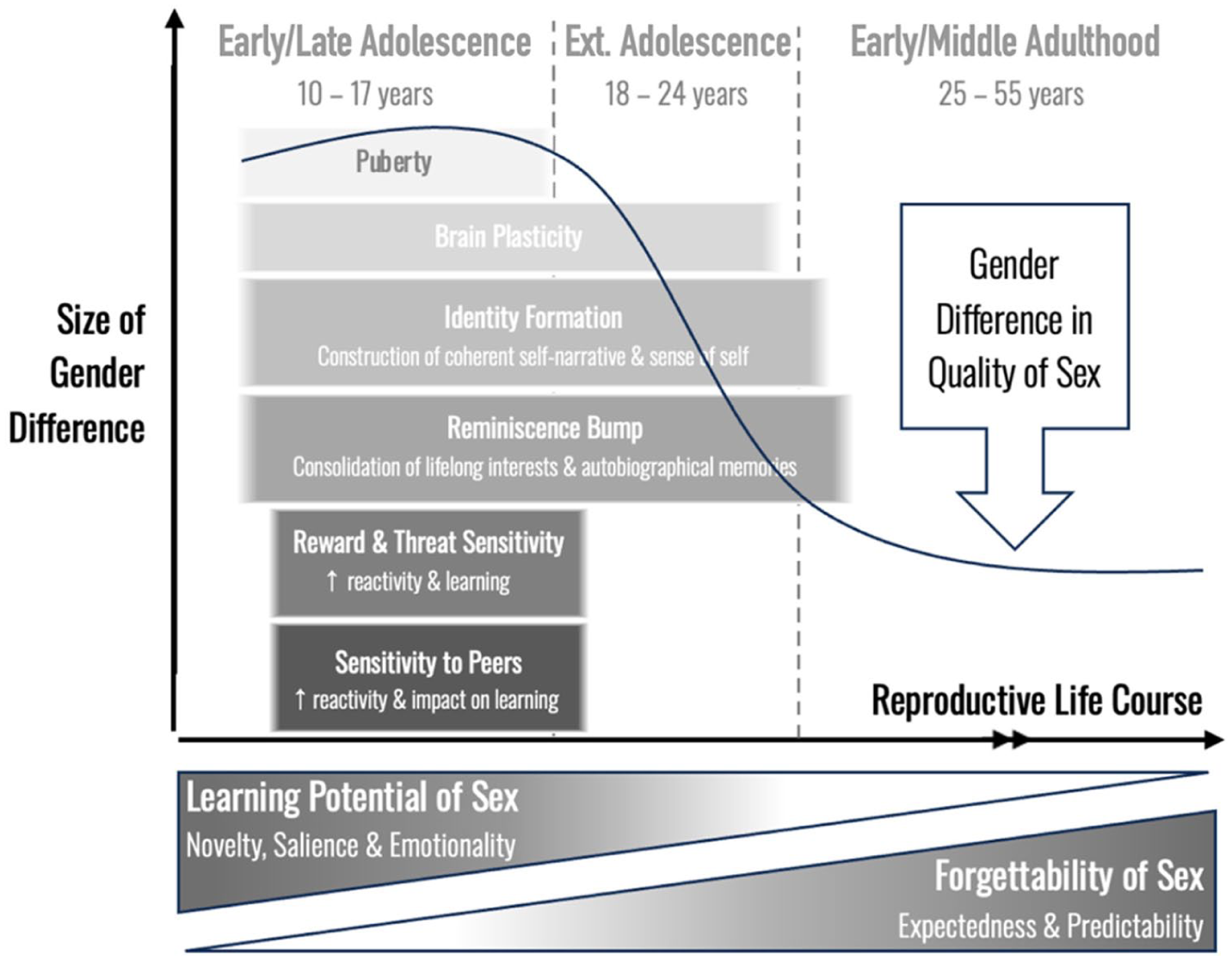
Alignment in the BLOOM Framework Between Capacity to Learn From Sex and Gender Disparities in Its Quality Over the Reproductive Life Course.
Women Get Worse Sex But May Be Better Positioned to Learn From It
We have reviewed evidence that opportunities for pleasure may be scarcer for women over the course of sexual development. However, equally important is bearing in mind that women match or exceed men in their capacity to achieve pleasure (Conley & Klein, 2022), and we argue, to learn from it. Contemporary models of sexual response (Both et al., 2007; Dewitte, 2016; Toates, 2009), along with theories of sexual plasticity (Baumeister et al., 2001) and fluidity (Diamond, 2008), hold, that women’s sexual desire is more responsive to experience than men’s, and comparisons across genders confirm this advantage in sexual learning aptitude. Women show more marked shifts in sexual desire over the course of adulthood (e.g., Harris et al., 2023), as well as across relationships (e.g., McNulty et al., 2019; Murray & Milhausen, 2012), major life events (e.g., Wignall et al., 2021), and exposures to sexual stimuli (Goldey & van Anders, 2012) than men. They also demonstrate stronger conditioning of sexual approach behavior in the field (Hoffmann, 2024) and laboratory (Brom et al., 2015, 2016). Therefore, the worse sex women get may represent an overlooked moderator of gender differences in sexual interest (i.e., effect of gender on sexual desire is variable, depending on the quality of sexual experience)—rather than a mediator, as others have suggested (i.e., effect of gender on sexual desire is indirect, operating through the quality of sexual experience; Conley & Klein, 2022; for a depiction of possible pathways to gender differences in sexuality as postulated by biological, contextual, and biopsychosocial-developmental frameworks, see Figure 3).
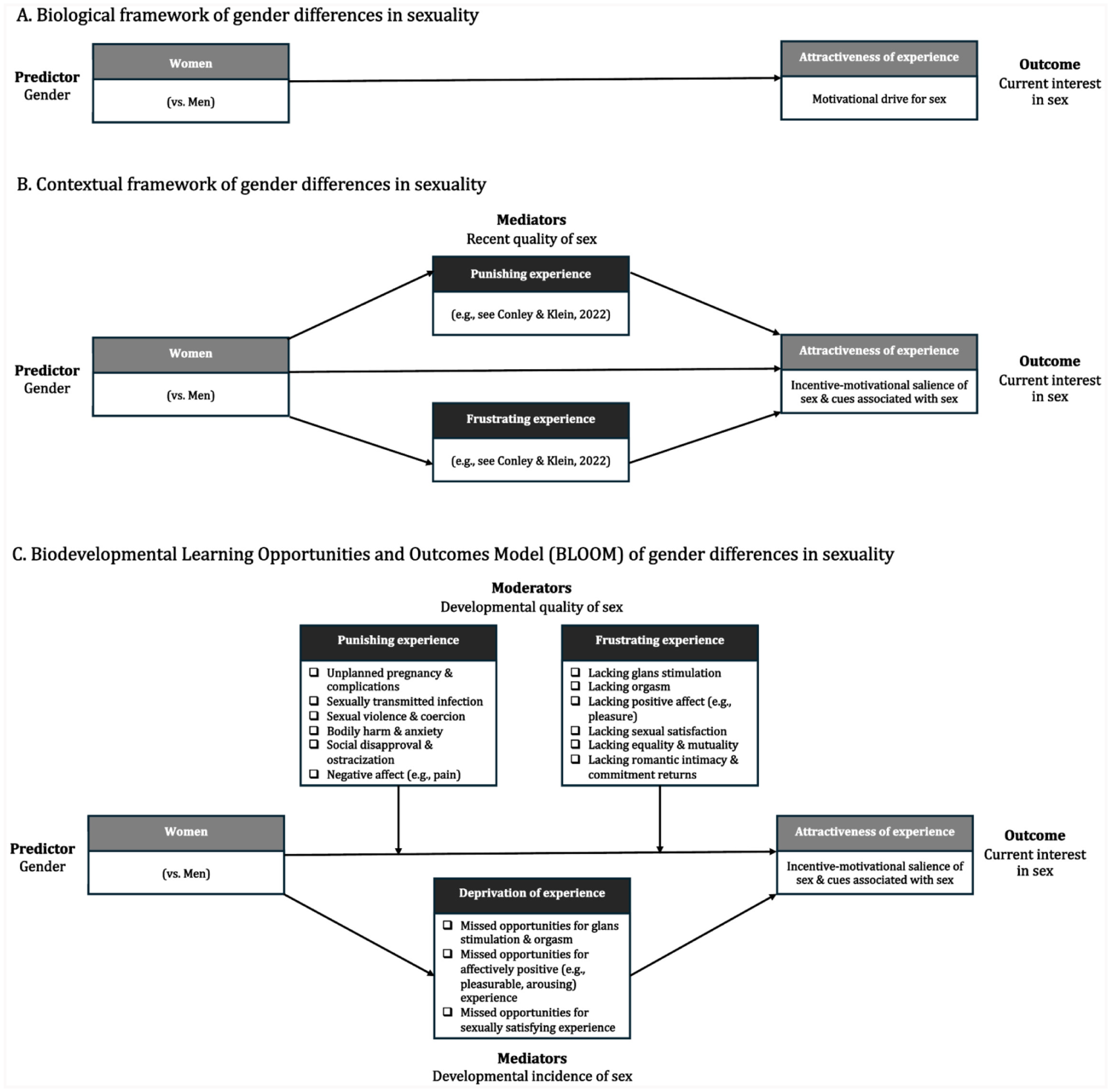
Biological, Contextual, and Biopsychosocial-Developmental Pathways to Gender Differences in Sexuality.
A small but growing body of evidence suggests the gender gap in sexual learning aptitude is not limited to adults. Current sexual difficulties, for example, have been linked to sexual victimization prior to adulthood for people of each gender, but this link tends to be stronger for women than men (Wang et al., 2023). Likewise, several reports have shown that women and men have worse sexual functioning when they recall worse sexual debuts (Else-Quest et al., 2005; Rapsey, 2014; Reissing et al., 2012), yet only women with worse sexual debuts seek treatment for sexual problems (Heiman et al., 1986). Beyond this broader work on sexual functioning, a handful of studies suggest that early sexual encounters shape later sexual desire, and women are more sensitive to their influence. In qualitative interviews with adolescents, many girls who describe a dull or painful sexual debut insist they will never have sex again, or they might “but it won’t be soon” (Thompson, 1990, p. 349), suggesting unmet expectations and diminished sexual interest, at least temporarily. Adolescent boys sometimes describe disappointing sexual debuts as well (Carpenter, 2002), but there is no evidence to suggest they may forego or delay future sexual experiences as a result. Quantitative comparisons have yielded similar results. In one study of college students, an affectively positive sexual debut gave rise to positive change in sexual thoughts and feelings across genders, but an orgasmic one did so for women only (Reissing et al., 2012). Others have shown that women’s sexual interest concerns vary with the quality of first sex, yet the same does not hold for men (Koch, 1988). In a recent extension of these findings, Peragine et al. (2022a) found that dyadic and solitary sexual desires over the past month were predicted by experience of orgasm at first sex even when orgasmic consistency was held constant, and its effects were largely driven by women. In fact, women differed from men in dyadic sexual desire only when orgasm was lacking at first sex. Rather than speaking to a fixed gender difference in sexual desire, these findings raise the possibility that a (hetero)sexual debut lacking orgasm is a common part of sexual socialization for WDM, wherein sexual activity may be deincentivized, and sexual desire differentiated accordingly.
Biopsychosocial Mechanisms for the Gender Gap in Sexual Learning Aptitude
While women’s interest in sex would seem to be more plastic and amenable to learning than men’s, the underlying cause of this difference remains debated. Some have attributed this difference to sex having more variable outcomes for women than men (e.g., Laan et al., 2021), which might support stronger learning (Raviv et al., 2022), especially among adolescents (Topel et al., 2023). Pleasure, for example, is almost invariably associated with sex for men, and more closely associated with sex in adolescence than adulthood, when half as many men report difficulties with pleasure (Richters et al., 2003). Because the reverse appears to be true for women, pleasure may be a less expected and familiar part of sex during adolescence, and also might be more memorable and teachable than in adulthood. In this regard, we note that more men than women have experienced glans stimulation and orgasm by the time they first have sex (Peragine et al., 2022b; Schwartz & Coffield, 2022). These experiences may thus lack novelty at this event and produce weaker learning in turn—both in comparison to that demonstrated by women, and to learning at first masturbation. Indeed, experience of orgasm at first masturbation predicts solitary sexual desire for men and women alike, but its occurrence at first sex does so for women only (Peragine et al., 2022a).
Notably, the transition to sex carries less practical and symbolic significance for men than women, and so may be less memorable. That is, efforts to test (Crosby et al., 2020), certify (Juth & Lynöe, 2014), restore (Juth & Lynöe, 2014), and reward virginity (Chisale & Byrne, 2018) are focused on young women, and the same is true of virginity’s etymology (VIRGO, or maiden)—not to mention slang for its loss (e.g., cherry-popping, or hymen-breaking). In line with its greater significance for women, recall of first sex tends to be more reliable for women than men (Liang & Chikritzhs, 2013; Upchurch et al., 2002), suggesting that sex might not just be worse for women to begin with, but better committed to memory.
An alternate explanation for the gender gap in sexual learning aptitude is that women’s lower testosterone levels (i.e., 10–20x less testosterone than men, expressed in absolute levels; Wang et al., 2014) endow them with a weaker and more malleable sex drive (Baumeister et al., 2001), and this gender difference, too, may be enhanced in adolescence. Compared with older women, younger women are more likely to use short-acting reversible hormonal contraception (Daniels & Abma, 2020), including combined oral contraceptives that suppress testosterone levels by up to 50% (Burrows et al., 2012; Zimmerman et al., 2014) and have also been linked to reductions in sexual interest (Pastor et al., 2013). In the United States, for example, the pill is the leading form of contraception among girls and women aged 15 to 19 years, with more than half of sexually experienced young women (56%) receiving prescriptions during this window of development (Ott et al., 2014). 2 As for Americans (Hales et al., 2018), hormonal contraceptives are the most commonly prescribed medication for Canadian girls and women aged 12 to 19, followed by antidepressants (Servais et al., 2021), but research on their implications for sexual learning and motivation has largely been conducted in adults. Antidepressants, too, have been linked to reductions in testosterone (Pavlidi et al., 2021), and are widely reported to decrease sexual desire (Clayton et al., 2015). Yet, beginning in adolescence, twice as many women are placed on them as men (Jack et al., 2020). Whether through direct action on brain reward systems (Bijlsma et al., 2014) or indirect action on endocrine ones, at least one group has linked antidepressant treatment prior to age 16 with lower interest in solitary sexual activity among women (Lorenz, 2020), but not men. Given the rise in adolescent prescriptions over the past half-century (Bachmann et al., 2016; Jack et al., 2020), one could argue that testosterone suppression has become a normative part of female sexual development, and one that begins when the brain is most sensitive to its effects postnatally (Schulz et al., 2009; Vigil et al., 2016). Its implications for learning about sex—and desiring sex in adulthood—are of growing importance to increasing numbers of young, women yet have gone virtually unexplored.
In addition to drug complications seen in adults, off-target toxicologic effects on testosterone may raise unique problems for adolescents. The rise in testosterone levels over the course of adolescence is linked to a number of socially motivated, goal-oriented behaviors (Duke et al., 2014; Peper & Dahl, 2013), including the transition to sex (Halpern et al., 1997, 1998). Suppressing these behaviors may not just affect learning about sex, but could cause young people to delay having it, depriving them of learning opportunities when the brain expects them, and is primed for pleasure. Delay of orgasm, for example, is associated with lower levels of sexual excitation and desire in adulthood (Peragine et al., 2022b), and these effects, too, may be gendered—not because they are worse for women than men (Peragine et al., 2022b), but because they are more widespread. Indeed, Peragine et al. (2022b) have shown that orgasm occurs an average of 2 years later for women (14 years of age) than men (12 years of age; d = 0.7), surpassing the gender gap in the onset of masturbation (d = 0.2), and bypassing adolescence entirely for one in three women. They further found that onset of orgasm and masturbation were strongly positively correlated across genders, and that women’s later age at both mediated their lower sexual excitation relative to men, but only delay of orgasm explained their lower sexual desire. Because women are more likely to be deprived of orgasm as adolescents, and more sensitive to sexual victimization and frustration in early life, the sex they get to begin with may not just be worse than it is for men, but more detrimental to their sexual development.
Summary and Explanatory Advantages of the BLOOM
Drawing upon biological and contextual frameworks, we provide a developmentally informed life-course account of gender differences in sexuality, offering an integrative explanation for women’s lower interest in sex. We argue that gender differences in the capacity to want and desire sex arise from unequal opportunities to like and enjoy it, but that the most sizable and reliable enjoyment gap emerges in adolescence, when sex comes at the greatest cost and offers the fewest rewards to women as compared with men. During this window, the projected costs of sex surpass its benefits by a large margin, and many women get the worst sex of their lives, whether its physical, mental, or interpersonal returns are considered (see Figure 1).
The BLOOM framework proposes that adolescence is not only when sex is least equal, but also when sex is most teachable—and most likely to instill lasting lessons. Unlike models that attribute women’s sexual interest solely to evolved biological differences or to experience-dependent learning across the life course, BLOOM emphasizes the formative impact of experience during evolutionarily canalized windows of development when particular experiences are expected—and we may be biologically primed to learn from them. Because of the unique neurohormonal and psychosocial backdrop of puberty (see Figure 2)—including elevated brain plasticity, nonlinear changes in reward and threat reactivity, and consolidation of identity and memory—sexual experiences in adolescence carry unique salience and emotional weight. Sex may thus be particularly meaningful, motivating, and memorable precisely when it is particularly inequitable. We therefore propose that adolescence is not merely a vulnerable point for sexual problems, but also a window of opportunity for cultivating sexual desire, and an inflection point for the emergence of gender differences in sexuality.
Last, BLOOM highlights that women’s sexuality may be more amenable to learning than men’s, and that this difference in sexual learning aptitude extends beyond adulthood—to women’s earliest, and least equitable, sexual encounters in adolescence. During this window of development, poor-quality sexual experiences are not only more likely for women than men, but more likely to reconfigure sexual expectations, restructure sexual motivation, and inform later sexual decision-making. Accordingly, the model treats the quality of sex women get developmentally as a moderator of gender differences in sexual desire, and emphasizes that deprivation of expected (i.e., rewarding) exposures during this window plays a key role in shaping these disparities (see Figure 3).
The BLOOM framework does not seek to substitute past work on gender differences in sexuality, but rather to supplement this work by offering explanations that existing theoretical models leave unresolved. Evolutionary accounts that attribute women’s lower interest in sex to biological differences (Baumeister & Vohs, 2004; Buss & Schmitt, 2017; Leiblum, 2010) cannot account for variability between women, and contextual explanations cannot account for the stability of gender gaps across cultures and birth cohorts (Frankenbach et al., 2022; Lippa, 2009). Yet, both are plausibly explained by the BLOOM, which proposes that differences in sexual desire between women derive from differing sexual experiences that predate adulthood—when they are typically probed. Similarly, the persistence of gender gaps in sexual desire across cultures and cohorts may reflect the persistently poor, but often overlooked sex women get before it becomes socially permissible, despite evidence that the sexual enjoyment gap narrows by adulthood, and more in some cultural contexts than others (e.g., Durex, 2012). Together, these insights illustrate how BLOOM advances a fuller account of gender differences in sexuality.
Testing the Proposed Model
Our model frames gender differences in sexual interest in terms of early adversity and opportunity, their unequal distribution, and their developmental impact. From this perspective, three major directions for future research emerge. First, scholars should examine the magnitude of gender gaps in sexual enjoyment across the life course, testing whether gender differences in quality of sex are larger and more consistent during adolescence than in adulthood. Second, consideration should be given to the quality of early sexual experience as a predictor of later interest in pursuing it, assessing whether sexual enjoyment in adolescence (or its lack) accounts for women’s lower sexual desire both in adolescence and across the life course. Third, research should focus on disentangling sexual desire from pleasure, ensuring that indicators of sexual interest are not conflated with those of enjoyment across self-report, behavioral, attentional, and physiological measures. Together, these directions chart a programmatic agenda for testing and refining the BLOOM framework.
Characterizing the Developmental Gender Gap in Sexual Enjoyment
Differences in the quality of sex available to each gender should be greater during adolescence than adulthood, whether operationalized in terms of differently distributed risks or rewards. That is, women are more likely than men to accumulate distressing, dangerous, and costly sexual experiences, and fewer opportunities for sexual gratification and fulfillment, before adulthood—making adolescent gaps in sexual enjoyment more pronounced and consistent. For example, orgasm disparities are typically larger at first sex than at recent sex, and should remain more stable across cohorts and cultures. These propositions can be tested by mining existing datasets that assess recalled or current adolescent sexual experiences, or that follow individuals across the transition to adulthood. In this respect, gender-differentiated datasets that cut across age cohorts, cultures, and life stages will be particularly valuable, as well as those that capture both rewarding and punishing experiences across physical, social, and interpersonal domains. Acquiring prospective longitudinal data on the developmental gender gap in sexual enjoyment will be an important next step, not just to replicate cross-sectional findings, but to map trajectories of sexual risk and reward from adolescence into adulthood, as well developmental shifts in the expected costs and benefits of sex.
Bridging Gender Gaps in Sexual Enjoyment and Interest Across Development
Beyond their size and reliability, developmental gender disparities in sexual experience should explain gender differences in sexual desire—both during adolescence and later in life, with women driving these effects. More specifically, sexual enjoyment in adolescence should predict sexual interest more strongly for women than men, and this association should persist across situations, relationships, and life stages, even after controlling for the quality of recent sexual experience. Thus, gender differences in sexual desire observed across the reproductive life course should be reduced or eliminated once adolescent sexual enjoyment is accounted for. For instance, consistency of orgasm in adolescence should relate to current sexual desire for women and help explain women’s lower sexual desire relative to men, even when recent orgasmic consistency is accounted for.
To test these propositions, existing datasets that assess the sexual experiences and functioning of adolescents, and track both into adulthood, could be mined for indices of sexual enjoyment and desire. Because sexual desire is measured variably across studies and the size of gender differences varies with it (Dawson & Chivers, 2014; Peragine et al., 2022a), datasets that include behavioral (e.g., frequency of sexual activity), affective (e.g., frequency/intensity of felt desire) and cognitive (e.g., importance of fulfilling desires) measures will be particularly valuable. Of equal importance will be datasets capturing both rewarding and punishing aspects of sexual experience across different dimensions, life stages, and contexts. Finally, and most crucially, prospective longitudinal data should be gathered to chart trajectories of sexual enjoyment (or lack thereof) from adolescence through adulthood, along with corresponding shifts in sexual desire.
Disentangling Sexual Interest and Enjoyment
To further test these relations in a controlled setting, without reliance on subjective measures of sexual interest, quasi-experimental laboratory studies should also assess objective interest in sexual stimuli, and whether it differs for those with differing histories of sexual enjoyment in adolescence. Because responses to sexual stimuli can be parsed into proceptive ones that reflect the incentive-motivational salience of rewards (i.e., wanting/expectation phase of the sexual pleasure cycle) and receptive ones that reflect their hedonic impact (i.e., liking/consummation phase of the sexual pleasure cycle), special care should be taken to disentangle these. To avoid mistaking unequal enjoyment of sexual stimuli with unequal interest in them across genders, indicators of interest should be parsed from indicators of enjoyment at all levels of measurement, including self-report (e.g., desire vs. pleasure), goal-directed behavior (e.g., effortful/key-press dependent viewing time vs. passive viewing time), voluntary attention (e.g., gaze capture vs. gaze maintenance), and physiological response (e.g., spontaneous blink rate vs. pupil dilation).
Implications for Research, Policy, and Practice
Research Applications and Recommendations
Despite the documented linkage between the developmental gender gap in sexual enjoyment and women’s lower interest in sex thereafter, much remains unknown. Using the BLOOM as a starting point for developing avenues for future study, this section raises a number of intriguing questions and gaps in our knowledge about women’s lower interest in sex, and its connection to unequal developmental opportunity, in the hope of facilitating programmatic research on the topic.
Scholars now widely recognize that sexual interest follows from sexual enjoyment (Basson, 2000; Both et al., 2007; Toates, 2009) and does not merely precede it (Kaplan, 1974; Masters & Johnson, 1966). Yet, the incentive motivation model of sexual response (Toates, 2009) has rarely been applied across developmental stages, connecting sexual desire in adulthood to enjoyment in the earliest, and potentially most formative, stages of sexual life. A life course extension of this model would be consistent with several theories that implicate early experience in sexual development (Baumeister et al., 2001; Diamond, 2008; Fine & McClelland, 2006), and the work we have reviewed suggests one may be tenable, particularly for women.
The theory and evidence reviewed here is also at odds with the view that human sexual conditioning is relatively weak and short-lived—a holdover from tests of it in-laboratory that have employed sexual arousal as a reinforcer instead of orgasm and been limited to sexually experienced adults. On the contrary, sexual conditioning may be pronounced for sexually naïve individuals, and still apparent years later, provided that real-life exposures to potent reinforcers are examined. This view has been a cornerstone of the nonhuman animal literature on sexual conditioning, which is perhaps better described as a literature on conditioning from sexual debut—and we view a human literature on this topic as long overdue. Not just to complement the seven decade-long animal one (e.g., Beach, 1947), but to understand how lived experiences of sexuality, and the very meaning of sex, are shaped by our earliest exposures to it—and to do so outside of a heterosexual courtship model. Disentangling outcomes of initial versus adolescent opportunities for sexual enjoyment will also be essential, as will clarifying whether their influence extends from interest in particular activities to interest in particular targets. If partner preferences are affected by either, they are perhaps not modeled only on caregivers (e.g., Bressan, 2020; Valentova et al., 2017), but on first sexual partners as well—and tests of sexual imprinting may need to expand their scope, from a focus on childhood to pre-adulthood as a whole.
Given our framework’s assumptions about gendered opportunities for sexual enjoyment and its outcomes, we reiterate the calls of contextual theorists to move from a discourse of gender differences in sexual desire to one of similarities, and to account for the quality of sex available to women and men when making comparisons across genders (Conley & Klein, 2022; Dawson & Chivers, 2014; Laan et al., 2021). In this respect, we caution that similar exposures to glans stimulation and orgasm may have greater explanatory power than subjective reports of pleasure or satisfaction, which are amenable to learning themselves (e.g., recall of previous sexual satisfaction varies with present sexual satisfaction; Rapsey, 2014; Smith & Shaffer, 2013), and likely to be gendered (McClelland, 2010, 2014). Indeed, recall of orgasm at first sex appears to explain women’s lower interest in having sex as adults, but the same does not hold for recall of satisfaction (Peragine et al., 2022a). It bears repeating that, for every gender difference in (hetero)sexuality, there is an equal (but often unspoken) partner gender difference, and the enjoyment gap between genders is no exception to this rule (Garcia et al., 2014; Peragine et al., 2023). Gender differences in enjoyment at first sex may be among the largest in sexuality research (d = 1.08; Sprecher, 2014), yet the largest one by far is not what women and men like in bed, but who they like in bed (d > 6.0; Hines, 2020), and the opportunities for sexual gratification that come with it. We thus echo calls to examine sexual interest and enjoyment outside the bounds of heterosexuality (e.g., Conley & Klein, 2022), but further call for examinations outside the bounds of adulthood—disentangling effects of actor gender from those of partner gender in real-time, as sexual development unfolds.
It is worth highlighting that monosexual women who partner with women get more enjoyable sex than heterosexual women (Flynn et al., 2017; McElroy & Perry, 2024; Peragine et al., 2023), and express greater interest in having it (Lippa, 2006), but the same cannot be said of bisexual women. Although bisexual women often express greater interest in sex than monosexuals (Flynn et al., 2017; Lippa, 2006; Lorenz, 2019; Semenyna et al., 2018), they tend to find sex just as unenjoyable, or even less enjoyable, than heterosexual women (Coston, 2021; Frederick et al., 2018; Lorenz, 2019). This discrepancy poses a challenge to incentive models of sexual motivation that lack a developmental focus—and is of mounting interest given that bisexual women comprise the largest and fastest-growing sexual minority demographic group (Copen et al., 2016; Jones, 2024), while also reporting the highest rates of sexual difficulties (Flynn et al., 2017; Lorenz, 2019) and the largest gaps between their sexual interests and experiences (Fu et al., 2022).
Our framework is well-positioned to address this challenge, holding that bisexual women retain high interest in sex because their early exposures were highly enjoyable. In line with this possibility, some evidence indicates that bisexual women experience orgasm at an earlier age (13 years) than both heterosexual (15 years) and lesbian women (14 years; Træen et al., 2016), more closely aligning with pubertal onset. An alternate possibility is that bisexuality may emerge developmentally as a form of adaptive flexibility in response to limited (hetero)sexual enjoyment—redirecting desire away from men. Women’s later age of “coming out” as sexual minorities (Katz-Wise et al., 2017; Martos et al., 2015), higher likelihood of having a heterosexual debut (Katz-Wise et al., 2017), and less gender-specific sexual response patterns (Chivers, 2017) all support this view. Together, these lines of evidence suggest that sexual diversity among women may partially reflect experience-based incentive learning: as women accrue more sexual experience with men that fails to meet expectations, they may leverage their broader bandwidth of sexual responding to adaptively reorient sexual interest away from men—or embrace more fluid identities (Diamond, 2016; Katz-Wise, 2015). Gender differences in asexual and pansexual identification that emerge over the course of adolescence (Gower et al., 2024; Hammack et al., 2022) further point to a window when women’s sexual attractions become oriented away from men (or from gender entirely)–suggesting not just the strength, but direction, of women’s sexual interests may be shaped by early experience.
It is important to stress that a gender similarities approach to the study of sexual interest is advisable over an approach that presupposes gender differences in desire as a starting point. However, we do not call for a gender-blind one. While women may equal men in their ability to like sex (Barnett & Melugin, 2016; Paterson et al., 2014; Peragine et al., 2023), and are just as capable of wanting sex (Dawson & Chivers, 2014; Goldey & van Anders, 2012; Holmberg & Blair, 2009; Peragine et al., 2022a), they may differ in their ability to learn from sex—and seem to surpass men in this respect. We thus do not deny the existence of gender differences across the sexual pleasure cycle. Instead, we argue researchers have looked for them in the wrong place. To find a difference between genders that cannot be explained by experience, future studies might pivot from probing a sexual desire gap that favors men to a sexual learning gap that favors women. They might also bear this learning gap in mind when testing experiential accounts of women’s lower interest in sex. If women’s lower interest is moderated by the worse sex they get, as the BLOOM framework postulates, similarities between genders may be missed when mediation is tested instead.
While we theorize that gender differences in sexual interest are better understood as experiential than inborn, we do not argue that biology is irrelevant to them. Far from it, we suspect that women’s earliest—and least enjoyable—sexual encounters are uniquely powerful, memorable, and motivating precisely because of their proximity to puberty, as well as the neurohormonal backdrop on which they occur. Should sexual learning be potentiated in adolescence, determining whether sexual reward is an experience the adolescent brain is merely sensitized to, with some residual malleability thereafter as reports of adult sexual conditioning suggest (Hoffmann, 2017, 2024), or whether sexual reward represents a time-sensitive learning experience that may be critical to acquire a certain level of sexual desire, will be important to address. A biopsychosocial framework of sexual learning and development will be essential for identifying when such learning is most enhanced (whether during initial exposures to sex, peripubertal exposures, adolescent exposures, or any encounters that occur before the transition to pregnancy and parenting), by what mechanisms this learning is enhanced, and whether those mechanisms differ by gender. There is evidence to suggest, for example, that the biologically mediated effects of pubertal hormones predict the transition to sex for women (Halpern et al., 1997), but the socially mediated effects of bodily change do so for men (Halpern et al., 1998). Research has also established that several brain systems involved in sexual behavior are reorganized during the pubertal transition (Suleiman et al., 2017), but we know remarkably little about the biopsychosocial feedback loops involved in this process in humans (e.g., from neurobehavioral disinhibition to heightened sexual responding, early sexual initiation, and back again), and how these shifts are shaped by normative sexual experiences—let alone gendered ones.
Less still is known about how sexual learning in adolescence is constrained by the onset and progression of puberty—which is itself gendered. In the West, for example, puberty begins earlier for girls (8–13 years) than boys (9–14 years; Farello et al., 2019), and its age of onset is declining faster (Euling et al., 2008; Parent et al., 2003). This disparity is even larger when outwardly visible signs of puberty, like breast and muscle development, are considered instead of the onset of reproductive capacity (Sørensen et al., 2012), which are declining faster for girls than the age of menarche (Euling et al., 2008). If adolescence is a window of opportunity for learning that sex can be rewarding and incentivizing, this window may open earlier, and close earlier, for girls than for boys—making it easier to miss. This window may also become easier for girls to miss with each passing year, as gender differences in pubertal timing continue to grow.
Again, sexual debut is typically operationalized in narrow, heteronormative terms (e.g., first penile-vaginal or “heterosexual” intercourse), and much of the research reviewed to this point operationalizes sexual debut similarly. Such a focus often obscures the diversity of early sexual experiences—particularly solitary or non-penetrative ones—that are common in adolescence and may be predictive of later sexual desire. This focus also reflects a long-standing tendency to cast young people as nonsexual prior to adulthood, except when framed through lenses of risk or deviance. Our aim is not to reinforce this privileging of partnered sex, but to call attention to the historical dominance of partnered sex in the literature—and to complicate this approach. In recent decades, the sexual trajectories of young people have changed considerably, to the point most college students report having engaged in masturbation or oral sex prior to penile-vaginal sex (Schwartz & Coffield, 2022). These earlier, more common forms of sexual debut may be just as predictive—if not more—of later sexual desire. Indeed, first penile-vaginal sex might lack the novelty and learning potential of sexual firsts that often set the stage for it, and are more accessible to single and sexual minority individuals. Moreover, first penile-vaginal sex is often characterized by a lack of pleasure for women, which may blunt its incentivizing effects. In contrast, sexual debuts that tend to be more pleasurable, and less risky (such as first masturbation), might exert a stronger and more enduring influence on the incentive salience of sexual activity, and interest in pursuing it—particularly when they predate the transition to penile-vaginal sex.
While some research has failed to demonstrate a link between the timing of first masturbation (i.e., pre-coital or pre-adult) and later sexual desire (e.g., Leitenberg et al., 1993), this work has not distinguished between solitary and dyadic sexual desire, nor has it attended to the quality of solitary sexual debut (e.g., presence of orgasm, satisfaction). When these factors are accounted for, desire for solitary sexual activity scales with experience of orgasm at solitary (but not dyadic) sexual debut (Peragine et al., 2022). It also scales with satisfaction at solitary sexual debut, raising the possibility that solitary sexual desire is uniquely attuned to early experience—perhaps because it is less constrained by present circumstances, such as partner availability and interest, than dyadic sexual desire. In line with this possibility, there is some evidence to suggest that women’s solitary sexual desire is more sensitive than their dyadic sexual desire to initial (Peragine et al., 2022), adolescent (Lorenz, 2020), and recent experiences—and so might provide a better index of sexual learning, adaptation, and differentiation as sexual development unfolds.
Charting the development of sexual desire across multiple dimensions—and across multiple types of sexual debut—will be crucial to gain a multifaceted understanding of gender differences in sexuality. The smaller gender gap in solitary (vs. dyadic) sexual desire (Kagerer et al., 2014; Peragine et al., 2022; Peixoto et al., 2020; Winters et al., 2010), for example, maps onto a smaller enjoyment gap at solitary (vs. dyadic) sexual debut (Peragine et al., 2022), suggesting that pleasure—rather than punishment—may be a key player in sexual desire development, and the primary force driving its differentiation. Indeed, the very existence of this second libido gap suggests that a lower likelihood of orgasm at dyadic sexual debut, even in the absence of higher risk, may be sufficient to de-incentivize sexual activity, and diminish women’s interest in it. Future research should pinpoint when the gender difference in solitary sexual desire emerges, and whether this desire gap develops independently of dyadic sexual experience (supporting distinct developmental trajectories of solitary and dyadic sexual desire), in compensation for unsatisfying partnered sex (supporting compensatory trajectories), or in tandem with such experience (supporting complementary trajectories). Each of these possibilities would offer unique insights into how early sexual experiences—both solitary and dyadic—shape adult sexual desires, and the ways they come to be gendered. Yet, the latter possibility seems particularly tenable, given evidence that women tend to view solitary and dyadic sex as complementary but distinct sexual outlets, while men are more likely to view them as compensatory and interchangeable (Regnerus et al., 2017). The role of gendered experience in differentiating these cognitive frameworks is not currently known, but the discordant sexual debuts of women (rewarding solitary debut; punishing dyadic debut), as compared with men (rewarding solitary debut; rewarding dyadic debut), may promote distinctive encoding of solitary and dyadic sex—such that women with sexual firsts of similar quality develop less distinctive frameworks for these activities, and come to be less discouraged by deprivation of pleasure in any one domain.
It is also possible that other aspects of sexual encoding are shaped by gendered experience as sexual development unfolds. Incentive motivation models posit stimuli must be imbued with both sexual meaning (relevance) and incentive salience (competence) to activate the sexual response cycle and elicit sexual desire (Werner et al., 2023). Yet how these affordances develop before adulthood has gone unexplored. Some stimuli (e.g., stroking) may be inherently sexual and incentivizing, but less explicit and reinforcing stimuli (e.g., flirting) may gain relevance and competence only through learned associations with sexual reward. Still others may become associated with its absence or with punishment, generating diminished sexual interest or aversion over time. As a result, the quantity and quality of competent sexual cues may become gendered over time, with fewer opportunities for sexual reward, greater exposure to sexual punishment, or both, limiting the number and strength of sexual incentives available to women. In line with this possibility, the features that render stimuli competent and able to elicit sexual response differ for men and women by adulthood, with gender cues being sufficiently incentivizing for heterosexual men, but not for heterosexual women (Chivers, 2017). Whether this reflects an inherent lack of stimulus competence and relevance for women, or depotentiation after disappointing sexual experiences with their preferred gender, is not known. Longitudinal psychophysiological research that tracks responsivity to gendered stimuli across puberty and adolescence is needed to ascertain when and how these gender difference emerge—including whether they are widened (or created) by gendered experience at (hetero)sexual debut. This research is overdue, not just because it may help explain women’s lower sexual desire, but because there can be no sexual gratification without sexual motivation. If fewer opportunities for sexual gratification cause fewer stimuli to be coded as sexual and desirable, women may not recognize—and pursue—future opportunities for it.
In light of our model’s focus on early stages of adolescence, we acknowledge that developmental research on sexual liking, wanting, and learning is not without its challenges. Parents, community groups, and ethics review boards will likely have concerns about minors being surveyed on their sexual histories, not to mention their feelings of pleasure and desire. Traditionalists may object to sex being framed as a normative part of adolescence, while progressives may object to its framing as a normative part of life, which is not the reality for all (i.e., asexuals). Adolescents are also less likely to conform to stable sexual (Srivastava et al., 2022) and gender identity categories than adults (Diamond, 2020), and this could complicate efforts to disentangle effects of actor gender and partner gender on sexual development, as well as to account for effects of partner-linked traits like sexual orientation. Furthermore, much as the meaning of sex varies with one’s experience of it (Bersamin et al., 2007; Byers et al., 2009; Sanders & Reinisch, 1999), interpretations of pleasurable and satisfying sex may do the same, making it difficult to compare the quality of sex on offer to women in adolescence versus adulthood. Indeed, most sexuality-related measures were developed and validated with legal adults (Milhausen et al., 2019), and measures of pleasure (Gérard & Courtois, 2023) and satisfaction are no exception. If these measures lack sensitivity for younger populations, obtaining accurate data on the quality of sex available to minors may be more challenging than for those of legal age, and might lead to disparities in measurement across development. At the same time, any such disparities could be argued to reflect sexual learning, and worth examining in and of themselves. Sexual satisfaction, for example, is well-studied in adulthood, and its dimensions appear to be gendered, much like the threshold for satisfying sex (McClelland, 2010, 2014). Yet, we know relatively little about what sexual satisfaction means to minors–let alone if the bar for it differs for girl and boys. Prospective longitudinal studies that track standards for sexual satisfaction across key developmental transitions—such as the onset of sexual activity and the shift to adulthood—may help identify when and why women develop a lower standard for satisfying sex than men. Alternatively, these studies may show that the gender gap in sexual satisfaction narrows by adulthood because of changes in men, who may become more skilled at and more motivated to bring women to orgasm (e.g., viewing this undertaking as a test of masculinity; Chadwick & van Anders, 2017), or more committed to their partners (Sumter et al., 2013), more concerned with their well-being, and more attentive to their sexual needs (Muise et al., 2013). Longitudinal research on adolescents may also pinpoint when the bar for pleasurable sex begins to diverge for queer and heterosexual women (Goldey et al., 2016). We, therefore, propose a developmental extension to the intimate justice framework for sexual satisfaction research (McClelland, 2010), which holds that those deprived of pleasure learn to expect less from sex and are satisfied with less in turn. For all its emphasis on the socio-political antecedents of satisfaction ratings, and the gendered expectations to which they give rise, this framework has focused on adult ones, neglecting the earliest and most gendered antecedents known.
It is important to add that the unspoken question in every satisfaction query, “How much did you expect?” (McClelland, 2010), is just as implicit to every desire rating. Thus, along with a developmentally informed framework for sexual satisfaction research, an intimate justice approach to sexual desire research seems overdue. If women expect, for example, that sex will bring them to orgasm, and their working definition of sex includes having one, they might report more desire for sex than women without such expectations—and no less desire than men. Indeed, gender differences in sexual desire are narrowed when interest in a specific activity is probed, particularly when that activity happens to be one with a smaller orgasm gap between genders. Ratings of solitary sexual desire, for instance, are sometimes less gendered than those for dyadic sexual desire (Peragine et al., 2022a; Winters et al., 2010 but see van Anders, 2012). So, too, are ratings of partner-focused desires when compared with extradyadic ones (Frankenbach et al., 2022; Moyano et al., 2017; Vallejo-Medina et al., 2020). In fact, the largest sexual desire gap between genders is interest in casual sex (d = 0.73; England & Bearak, 2014; Rodrigues & Lopes, 2017), an act that demonstrates the largest orgasm gap in the literature (32% of women orgasm vs. 82% of men; Piemonte et al., 2019)—with the exception of first sex. Consequently, when women’s sexual desire ratings are compared with those of men, tempered expectations may be mistaken for an inherent lack of interest.
To make the measurement of sexual interest more comparable across genders, we recommend defining the object of desire precisely so as to leave little room for systematic differences in interpretation (e.g., as desire for orgasmic sexual activity rather than desire for sexual activity). We also recommend accounting for the origins of desire ratings, collecting them alongside other dimensions of sexual experience, like its expected circumstances (e.g., receiving glans stimulation) and outcomes (e.g., achieving orgasm). To this point, mapping sexual expectations and motivations across adolescence will be imperative, not just to contextualize desire ratings, but to capture shrinking aspirations among women, and to identify the timing and types of scaffolding needed to ensure their earliest sexual experiences are positive ones. It will be critical to consider, as well, that deprivation of sexual pleasure may constrain the acquisition of desire for it, but a motivational shift from the physical to social rewards of sex (e.g., intimacy, power) might also reflect intentional, self-protective, or relationally-attuned choices that support well-being within the confines of a pleasure-impoverished environment. Indeed, if early experiences provide a “weather forecast” for adult ones, and shape sexual trajectories to meet expected environmental challenges (Bogin et al., 2007), deprioritizing pleasure and repressing sexual desire should be understood as an adaptation, not a failure of positive development. We also challenge researchers to reconsider their reliance on undergraduate research pools for tests of gender differences in adult sexuality. Because these pools are comprised of college-aged individuals who recently were (or still are) adolescents, many women may freshly remember (or still be having) the worst sex of their lives, and find it less desirable than women with more extensive sexual experience. Indeed, the gender gap in sexual desire is large during the first decade of adult life, when we typically test for it, but it is narrowed by the second one (Schmitt et al., 2001; Wieczorek et al., 2022). To fully understand the gender gap in sexual desire, we urge researchers to look beyond the college years, both to the sex women get before this window and their interest in it afterward.
Clinical Applications and Recommendations
We have focused, to this point, on the worse sex women get and its role in differentiating healthy sexual functioning. However, its implications may be farther reaching. In addition to reporting lower sexual desire than men in the community (Frankenbach et al., 2022), women report higher rates of sexual desire difficulties in clinical contexts (Mitchell et al., 2016; Moreira et al., 2005). Low or absent sexual desire is, by far, the most common (Polland et al., 2019) and distressing (Shifren et al., 2008) sexual complaint among women, with up to 55% experiencing it at a given time (McCabe et al., 2016). Biomedical models of care have long been favored for these complaints (Chivers & Brotto, 2017), but clinicians increasingly consider the perpetuating events that trigger them, as well as predisposing and precipitating ones, adopting a longitudinal approach to case formulation and treatment (Brotto & Laan, 2015).
In line with this approach, sexual debut’s quality has sometimes been a target in assessment when treating sexual dysfunction (Kaplan, 1974; Maurice, 1999). The quality of this experience reportedly distinguishes healthy women from those with sexual function concerns (Heiman et al., 1986), but a link to sexual desire concerns has rarely been explored. The one group to test an association, to our knowledge, found that women with better sexual debuts reported fewer such concerns (Koch, 1988). Although not enjoyment per se, sexual competence, or preparedness, at sexual debut has also been linked to women’s sexual desire difficulties, with its lack at first sex predicting a lack of interest in sex over the previous 6 months (Mitchell et al., 2009). Notably, adults who recall more physically satisfying sexual debuts also score higher on sexual preoccupation (Smith & Shaffer, 2013), suggesting effects on the full spectrum of sexual desire difficulties, including ones that primarily affect men (Långström & Hanson, 2006; Winters et al., 2010). Though limited, these findings shed light on the high rates of sexual desire difficulties among women, which are so high as to be considered an epidemic, but also too high to reflect individual biological pathologies within women’s bodies. 3 Indeed, they raise the possibility that the sexual desire difficulties faced by women can be traced to an all-too-common occurrence of a frustrating sexual debut—and reinforce the call for a developmental perspective on female sexuality to extend the new view of women’s sexual problems (Tolman, 2014).
While the long-term outcomes of women’s worse sexual debuts have received little attention from sexual health researchers, even less has been paid to their short-term ones. In part, this may be owing to our different bar for sexual health in adolescence than adulthood. Over the past half-century, sexual health has evolved from an absence of disease, injury, and unplanned pregnancy into a broad and holistic construct that includes the capacity for functional (World Health Organization, 2010) and pleasurable sex (Ford et al., 2021; Gruskin & Kismödi, 2020). Yet, contemporary definitions still lack a developmental focus, and frequently exclude adolescents, even when they include the capacity for healthy sex (Fortenberry, 2014). Consequently, so long as it is safe and consensual, the sex women get in adolescence is often labeled deviant, but it is seldom labeled a health problem—even when it would not be deemed “healthy” in the adult sense. There is nevertheless substantial overlap between the normative sexual experiences of adolescent girls and experiences that are labeled sexual dysfunction for adult women. Indeed, others have noted that every single reason for women’s sexual problems can be found in the sex lives of adolescent girls, and the pleasure and satisfaction that is often missing from their accounts of sex, could easily qualify as a sexual dysfunction—even if never diagnosed as such (Tolman, 2014). Were frameworks of sexual dysfunction inclusive of all who have sex, including the majority of adolescents, we might come to appreciate that, beyond posing a sexual health risk in the long-term, the worse sex women get as adolescents is itself a sexual health problem, and one of the earliest health disparities between genders. For all our efforts to close the gender gap in adolescent mental health (e.g., Campbell et al., 2021; Dalsgaard et al., 2020), we have ignored the gender gap in sexual health that emerges with it.
Educational Applications and Recommendations
Even if there were sex therapists for girls to turn to in adolescence, when they are having the worst sex of their lives, early intervention would be preferable to later remediation. At present, school-based interventions focus more on preventing adverse public health outcomes than promoting positive ones that are inconsequential for public health, but foundational for sexual health. Most sex education programs teach, for example, that sex without contraception is a health risk, but the same is not true of sex without pleasure. Nor do most programs cover the benefits of pleasurable and satisfying sex (Sulz et al., 2024; Sundaram & Sauntson, 2016). On the contrary, abstinence approaches to sex education teach that no sexuality is healthy sexuality for adolescents, and this lesson remains a common one in American classrooms, with up to 100 million dollars of federal funding going toward such education annually in the last decade (Fox et al., 2019; Santelli et al., 2017). In recent years, abstinence education has been rebranded to sexual risk avoidance education (Boyer, 2018), but still tends to frame sex as immoral, abnormal, and harmful for adolescents. Sexual debut, in particular, is framed as a sexual health risk that every effort should be made to delay, but this lesson could use refining. The need for refinement arises not only because abstinence education is associated with little improvement on indices of sexual health (Fox et al., 2019), but also because early life appears to be more than a vulnerable period for sexual problems. If early life also represents a window of opportunity for sexual incentive learning, as emerging evidence suggests, abstinence education may itself pose a risk to sexual heath. Indeed, it may amount to sexual deprivation education—and might deprive more women than men of formative exposures, given their greater reliance on school as a source of knowledge about sex (Ballard & Morris, 1998; Donaldson et al., 2013; Sprecher et al., 2008).
To begin narrowing the sexual pleasure gap between adolescents, and the sexual desire gap between adults, sex education should strive to equip young people not just for sexual health, but for healthy sex (i.e., sex that is positive, pleasurable, and desirable, above and beyond being protected from illness, injury, disease, unintended pregnancy, and coercive pressure; Fortenberry, 2014). Healthy sexual debuts, in particular, might hinge upon a missing curriculum of sexual pleasure that highlights gender differences in opportunities for pleasure, as well as gender similarities in the capacity and mechanisms for it. With respect to the pleasure gap at sexual debut, findings reviewed here point to the sociocultural script for sex as a likely source (Hite, 1976, 1982); Efforts have been made to update this script to include glans stimulation and orgasm for women, but its most common reading still restricts these to men (Barnett et al., 2017; Byers et al., 2009; Hans & Kimberly, 2011). In fact, readings that neglect clitoral stimulation appear to be becoming more, not less, common, and still cast women as supporting actors in heterosexual sex, including their own sexual debuts (Hans et al., 2010).
To promote healthy sexual development in the holistic sense, young people should be encouraged to explore their sexual likes (and dislikes) prior to first sex, and to go off-script when they cross this milestone, transcending the limits of penile-vaginal sex. Sex education has long equated fertility with sexuality, and defined sex as the penile-vaginal sort—but sex for pleasure need not resemble sex for reproduction. A truly comprehensive sex education curriculum would cover both types of sex, define the nonreproductive sort as any act that involves shared opportunities for glans stimulation and orgasm, and endorse sex that is mutual rather than merely autonomous. Without this clarification, young people may assume the sex we rely on to procreate can also be relied on to please our partners—which is unlikely to be true for half of them.
Despite documented benefits (Santelli et al., 2018; Zaneva et al., 2022), some consider pleasure-based sex education irrelevant to sexual health, if not detrimental to it (e.g., Bialystok & Wright, 2019; Cameron-Lewis & Allen, 2013). What they fail to consider is that pleasure is already included in most sex education curricula—albeit only for a privileged few. Lessons on puberty frequently touch on wet dreams, erections, and ejaculation for boys, but center on menstruation for girls—reinforcing the narrative that sexual pleasure is a male domain. Likewise, lessons on procreation necessarily include the role of the male sexual pleasure organ in orgasm, but spotlight the birth canal instead of the female sexual pleasure organ, ignoring the erectile and vasocongestive properties shared with the glans penis, as well as their common embryological origin. Should it be surprising that young people prioritize vaginas over vulvas during sex when sex educators do the same during lessons? Even comprehensive curricula tend to include pleasure as an optional add-on, and often only if students ask (e.g., Ontario Ministry of Education, 2019)—but this approach may exclude pleasure in all but name. How might young people ask about sexual pleasure, or think to question its absence, if they never hear of its importance—or learn that its lack precludes healthy sex? We are not the first to argue that pleasure be prioritized in sex education (e.g., Allen & Carmody, 2012; Wood et al., 2019), but it bears adding that, even when not prioritized, its mere inclusion for female people would be an improvement. If anything, sexual pleasure appears to be more pressing to cover for female people, given their greater risk of being deprived of it in adolescence (Peragine et al., 2022b) and their greater sensitivity to its absence at first sex (Peragine et al., 2022a). Pleasure would also seem more pressing to cover at younger ages, given that puberty begins and ends earlier for girls, and may represent a finishing school for sexual behavior. Even when female sexual pleasure is missing from the curriculum, its omission serves as a lesson in its own right—ensuring divisions of pleasure in the classroom are reproduced in the bedroom. It also serves as a reminder that fair and equal access to education is still lacking for female people, even in the contemporary West.
It is worth nothing that without pleasure on the agenda, the sex education girls receive amounts to anti-victimization education at best, and should at minimum reduce gender differences in the costs of sex. However, sex-positive, pleasure-inclusive programs are associated with less risky sexual behavior among girls (e.g., condom use; Zaneva et al., 2022), and confer the lowest risk of sexual victimization to women (Santelli et al., 2018)—possibly because they are of greater interest to students (van Clief & Anemaat, 2020) and provide better coverage of sexual risks (D. S. Levin & Hammock, 2020). An alternate possibility is that programs focused on sexual risk cast women as victims or mitigators in sex and guide them toward positions of sexual passivity, predisposing them to sexual compliance (Stoner et al., 2008) and victimization (Söchting et al., 2004). Because sexual passivity is counterproductive to safe sex, as well as to sex that is functional and satisfying (Kiefer & Sanchez, 2007), this approach may not only worsen gender disparities in the costs of sex, but constrain female opportunities for pleasure. To release girls from positions of receptivity, and recognize them as subjects in sex, not just negotiators but initiators (and more active ones than boys where enjoyment is concerned), educators should strike a balance between promoting pleasure and preventing harm. Prioritizing pleasure in sexual health lessons, and teaching girls to prioritize their own (as well as to pursue pleasure via sexual assertiveness training; Reis et al., 2021), could be considered a preventive effort, if doing so prevents disparities of pleasure and desire from forming. Indeed, women who prioritize their own sexual pleasure (at least as much as that of their partner) are more likely to be brought to orgasm by sex and to express interest in having sex (Rubin et al., 2019). They are also less likely to engage in sex that is painful (Carter et al., 2019) or unwanted (Kettrey, 2018), suggesting preventive benefits to sexual health, even when limited to avoidance of harm.
In addition to broad curricular recommendations, the BLOOM framework offers concrete guidance for adolescent sexual health education. Existing curricula often focus on the risks of sex lacking in contraception and/or consent (e.g., sixth to eighth grades; Ontario Ministry of Education, 2019), but should also address the risks of having sex that is safe and consensual yet unwanted or unpleasurable—including the social normalization of sex lacking in these domains. When reasons to delay (hetero)sex are presented (e.g., seventh grade; Ontario Ministry of Education, 2019), curricula should also acknowledge the benefits of building sexual knowledge and competence through less risky, and more rewarding means—such as solitary or same-gender sexual activity. Indeed, without first learning to recognize and value their own sexual likes—often through solitary sexual experiences—many girls may embark on partnered sex without knowing their sexual wants, or how to communicate them. Without the sexual self-reflection, self-efficacy, and entitlement to pleasure gained at solitary sexual debut, adolescents may not be equipped for a satisfying dyadic one (Horne & Zimmer-Gembeck, 2005). For these reasons, sexual readiness acquired through solitary sexual activity should be counted among the physical, emotional, social, and psychological factors adolescents are urged to consider when making sexual health decisions (e.g., seventh grade; Ontario Ministry of Education, 2019)—including the decision to delay sex.
Likewise, where curricula cover reasons for postponing sex, they should also present healthy reasons for initiating it—such as seeking pleasure or intimacy—alongside less healthy ones, such as avoiding discomfort or preventing a breakup. Many young women report, for example, that reaching orgasm is an important reason for having sex—not for their own sexual enjoyment, but to avoid hurting their partner’s ego or jeopardizing their relationship (Salisbury & Fisher, 2014), leading them to fake pleasure or silence their own sexual needs (Harris et al., 2019; Herbenick, Eastman-Mueller, et al., 2019). These motivations, and the risks they pose to achieving sexual pleasure, acquiring sexual desire, and developing healthy sexual functioning, should be addressed early on. Just as communication surrounding consent and contraception is taught before first sex (e.g., seventh and eighth grades; Ontario Ministry of Education, 2019), so too should communication about pleasure. Teaching girls how to request clitoral stimulation, correct technique, or advocate for their needs—and emphasizing that most young men welcome this (Salisbury & Fisher, 2014)—can foster confidence and connection, not just protection.
As imbalanced as education on sexual pleasure is at present, and as disadvantaged as girls may be by existing curricula, they cannot be the sole targets of reform. Women may amass more knowledge about the clitoris and orgasm than men (Dienberg, Oschatz, Piemonte, & Klein, 2023), but this knowledge only translates into greater odds of orgasm during masturbation (Wade et al., 2005). In heterosexual contexts, women face barriers that impede them from applying this knowledge, suggesting a need for this knowledge to be mutual. To foster cliteracy across genders, the clitoral glans should be named along with the penile glans when genitalia and other body parts are first identified by sexual health curricula (e.g., first grade; Ontario Ministry of Education, 2019) and their shared anatomy, erectile properties, and role in sexual pleasure should be revisited around middle school, when the reproductive system is covered in greater depth (e.g., sixth grade; Ontario Ministry of Education, 2019). In addition, lessons on building personal relationships that are respectful to the self and others should be extended, ending not with seeking and providing consent in the service of autonomy (e.g., seventh and eighth grades; Ontario Ministry of Education, 2019), but with seeking and providing pleasure for the sake of mutuality.
Beyond the risk it poses to women’s sexual health and well-being, the sexual pleasure gap reinforces broader patterns of inequality in women’s relationships with men. As such, sex education on the drawbacks of sexual intimacy (e.g., eighth grade; Ontario Ministry of Education, 2019) should highlight the size of this pleasure gap, the interpersonal and developmental contexts in which this gap is largest, and the attitudes and practices that sustain it. Certainly, young people should be taught that some sexual difficulties are a normal, and expected, part of learning to be sexual due to limited skills in sexual communication (Abel & Fitzgerald, 2006; Halpern-Felsher et al., 2004) and a shorter history of sexual experiences on which to draw during their earliest sexual encounters. At the same time, sex education should convey that sexual experiences in adolescence lay the foundation for sexuality in adulthood (Fortenberry, 2014; Suleiman et al., 2017), and striving for mutual, desirable, and pleasurable ones may be critical for cultivating healthy sexual functioning—and broader sexual health—particularly for women.
With growing evidence for experiential shifts in sexual desire, there is a growing need to expand our concept of sex education, such that it stretches beyond the instruction young people receive about sex—to their experience of it. Experiential lessons about its outcomes may be equally, if not more, important than instructional ones—particularly after sexual debut, when young people name personal experience more than formal education as their greatest source of information about sex (Barrett, 1980). There is ample evidence that this “lived curriculum” less often includes pleasure for girls (Herbenick et al., 2010b; Peragine et al., 2022b; Richters et al., 2022; Tolman et al., 2002). However, the lessons this curriculum instills, and the role it plays in differentiating sexual desire, have rarely been tested. We begin to connect them here, raising the possibility that the sex women get developmentally may not just reflect a missing curriculum of pleasure, but a hidden curriculum of punishment and frustration that guides them away from sexual desire.
When researchers, educators, and health practitioners inquire about the quality of adolescent sex, they tend to ask whether sex is safe and consensual; however, that is a minimum criterion for healthy sex, and one well below the standard for adults. Sex without infection, injury, or unplanned pregnancy is the floor—not the ceiling—for ethical sex (Lamb & Gable, 2022), and there is no reason that women’s earliest, and most formative, experiences of sex should be held to a lower standard. If sexual pleasure is essential to promoting sexual health (Gruskin et al., 2019), then addressing disparities between genders must be made a public health priority, including a priority for girls, who face the largest such disparities—with the gravest implications for healthy sexual development. Likewise, if sexual pleasure is a human right (World Association for Sexual Health, 2015; see Supplementary Appendix II), sex research and education must strive toward full and equal realization of this right, including equal opportunities for enjoyable and desirable sex. Until the least equitable sex women get is addressed, they will learn to resist gender inequality in their public lives but expect it in their sexual ones, and their aspirations for each will reflect this lesson.
Constraints on Generality, Positionality, and Citations
Before concluding, we consider constraints on generality and limitations of the work cited in this article. While a breadth of citations were reviewed, our framework is primarily built on sexual (Ågmo & Laan, 2022; Toates, 2009) and developmental (Luciana & Collins, 2021) extensions of incentive-motivation theory (Bindra, 1969; Toates, 1986)—all of which emerged in Western contexts. Likewise, while our literature review includes studies from a diversity of countries and continents, including global assessments of sexual opportunities (e.g., Durex, 2012) and outcomes (e.g., World Health Organization, 2019), studies from non-Western contexts are scarce. We thus welcome and look forward to researchers from more diverse contexts joining the conversation about outcomes of normative and healthy sex in adolescence to develop a comprehensive and global picture of gender differences in sexuality. We acknowledge that today’s adolescents may face an elongated period between physical and psychosocial readiness for reproduction (given an earlier transition to puberty), and this period continues to elongate across the globe (given a later transition to independence). In some contexts (e.g., sub-Saharan Africa and Central America; Guttmacher Institute and International Planned Parenthood Federation, 2010), the elongational of this period has only just begun. Thus, irrespective of its quality, the very meaning of sex between adolescents could be argued to vary cross-culturally. Adolescent sex in the global West, for example, may qualify as sex between adults elsewhere, including sex between adults who have already passed through the biopsychosocial-developmental life transition after puberty (pregnancy/parenting). Because few spheres of life after puberty are as important to so many as sexuality, evaluating the applicability of BLOOM’s principles across populations is paramount.
As with research on adult sexuality, research on adolescent sexuality has largely focused on heterosexuals—and this limitation extends to the present review. Women/girls who debut with women/girls (WDW) have often been unacknowledged (i.e., combined with heterosexual women; Darling et al., 1992; Eriksson & Humphreys, 2014; Guggino & Ponzetti, 1997; Sawyer & Smith, 1996) or excluded—either directly (Barnett et al., 2016; Higgins et al., 2010; Schwartz & Coffield, 2020; Smith & Shaffer, 2013) or indirectly (Marván et al., 2018; Tsui & Nicoladis, 2004; Walsh et al., 2011). Indeed, researchers increasingly define sexual debut broadly and inclusively (e.g., as first vaginal or anal penetration with a partner; Peragine et al., 2023; Tsuyuki et al., 2019; Vancour & Fallon, 2017), but the construct has traditionally been operationalized in narrow and hetero-exclusive terms (e.g., as first penile-vaginal intercourse of first “heterosexual” intercourse). Considering this, we have endeavored to spotlight relevant research from sexual minority populations, and to include comparisons of WDW and WDM as a central consideration in developing BLOOM. Yet, even this research has primarily sampled white college-aged individuals with some post-secondary education who presumably occupy several other majoritarian social locations (e.g., allosexual, able-bodied, middle-class), especially where healthy sex, rather than sexual health in the traditional sense, has been examined. Indeed, sexuality is perhaps the one area of developmental psychology where women and minorities are well-represented, and they are arguably over-represented in studies of adolescent sexual experiences, but only in studies of adverse ones that pose a threat to public health. It is thus unclear how gendered trajectories of sexual opportunity in adolescence are shaped by race, class, social status, and other axes of disadvantage, particularly with respect to opportunities for rewarding sexual activity and its outcomes. Moreover, much of the research reviewed comes from gender-congruent samples that may differ in key ways from gender diverse ones—who themselves challenge a WDM versus WDW dichotomy. Future research should characterize sexual debut experience beyond the gender binary (as well as at sexual “re-debut” following gender transition) and clarify whether the enjoyment gap at this milestone extends to transgender and non-binary individuals.
Finally, while we have made efforts to review evidence from a variety of research designs, much of the literature on initial or adolescent sex and its outcomes has relied on cross-sectional, retrospective self-reports, which preclude causation and rely on accurate recall of respondents. We cannot rule out that accounts of first sex are less reliable than those of recent sex, and may be colored by recall errors, subsequent experiences (e.g., break-ups) with sexual debut partners, the current sexual lives of participants, and unwillingness to disclose behaviors that violate virginity scripts. Nor can we rule out that women who experience more enjoyable sex in adolescence had higher sexual desire prior, differ on other traits that could conceivably promote future sexual desire (e.g., sexual assertiveness, self-efficacy, arousability, subjectivity), or that ratings of early sexual enjoyment are shaped by later sexual learning. If, for example, adolescent exposure to orgasm does contribute to greater sexual interest, as we suggest, researchers could fruitfully explore whether this effect occurs because of overlap with sensitive periods for processing and integrating sexual rewards, for integrating the sensorimotor mechanics of sexual activity, or because early exposure provides more time for practice, leading to better sexual performance and better expectations in turn.
Some caution is warranted, as well, due to reliance on single-shot measures of sexual interest in the adolescent literature, which can misconstrue dips across the menstrual cycle as low sexual desire (e.g., van Stein et al., 2019). To this point, if incentives in the environment “pull” an individual toward sexual activity—but require a backdrop of hormonal “push” factors to sensitize an individual to sexual information (Ågmo & Laan, 2022), few, if any, studies of adolescents have controlled for their influence at testing. Nor has their influence been controlled for at sexual debut. Yet, the hormonal milieu at first exposure to sexual stimuli in the laboratory appears to predict women’s interest in them months later (Wallen & Rupp, 2010), with exposures during the periovulatory phase predicting the greatest interest. Given that, from a life course perspective, the ovarian milieu in adolescence resembles that of the periovulatory phase (i.e., lower ratio of circulating progesterone to estradiol), future investigations might extend this line of questioning, accounting not just for hormonal milieu at testing, but at first exposure to sex. They might also extend this line of questioning even further, applying it to windows of estrogen dominance beyond adolescence (e.g., perimenopause), as well as to other windows of neurohormonal change (e.g., pregnancy and postpartum; Servin-Barthet et al., 2023). Such windows could conceivably constitute cascading sensitive periods for sexual learning, offering “continuing education” opportunities for rewiring sexual systems, recalibrating sexual expectations, and refining sexual behavior in the face of new reproductive demands.
While we cannot comment definitively on all authors and samples given the current article cites more than 250 works, it is clear that, in line with the common trend in psychology, the majority of empirical papers and theoretical models that our framework draws upon come from Caucasian scholars across North America and Europe, and thus from contexts that are not representative of the global population. While we have endeavored to include work from a wide range of scholars, we acknowledge that the diversity of authorship is skewed. The authorship of this article is similarly skewed but nevertheless represents a blend of distinct experiences and academic traditions. We are an author team that is Caucasian, based and socialized in Canada and the United States, with a diversity of partner preferences and sexual histories. The first author is a gender-nonconforming, sexually minoritized second-generation Canadian of Italian descent. The second author is a first-generation Canadian in an intercultural relationship, having immigrated to Canada for a faculty position. The third author is a multiethnic second-generation Canadian who over the past two decades conducted extensive field research in Japan, Samoa, and Thailand. We acknowledge as well that all members of the author team hold PhDs and are privileged as such. Although our experiences provide personal perspectives on early sexual opportunities and their outcomes, we lack firsthand understanding of the challenges faced by adolescents from disadvantaged backgrounds.
Our academic backgrounds also bring unique biases and insights. Two of us were trained in developmental psychology, among other subdisciplines (e.g., cross-cultural psychology, psychoneuroendocrinology), with nonhuman animal research backgrounds in evolutionary psychology and behavioral neuroscience, respectively. The other was trained in social/personality psychology with a background in studying sexuality in the context of long-term romantic relationships, and a particular emphasis on the positive aspects of sexuality. Although we have endeavored to be as impartial as possible, we may be biased toward classical learning paradigms that prioritize sexual debut experience, as well as sex-positive frameworks of sexual health (and healthy sexual development), as a result. We recognize that our favored frameworks and personal experiences shaped the outcome of our collaboration, but we view our disparate backgrounds and viewpoints as an opportunity to offer a comprehensive and integrative review.
Conclusion
Historian G.M. Young once said that, to understand a man, one must ask “what was happening in the world when he was twenty?” This question, along with a growing literature on foundational periods for incentive-motivational development (Luciana & Collins, 2021), captures the importance of adolescent experience in shaping who we are, what we want, and how we live our adult lives. Experience in the world of sex and intimacy may be particularly formative at this time, given that interest in sex comes online during adolescence, years after interest in other fundamental pleasures (Georgiadis & Kringelbach, 2012). It is during this window of opportunity, when women are best equipped to learn from it, that they experience the least enjoyable sex of their lives. And yet, the developmental gender gap in sexual liking is absent from decades of theorizing on the gender gap in sexual wanting, with most frameworks attributing it to biological differences established before adolescence or contextual differences acquired afterward. The result is a largely segregated literature that prioritizes the biology of gender differences in sexuality over their ecology—or fails to integrate the two (cf. Tolman & Diamond, 2001)—ignoring experiences that may endure precisely because we are biologically primed to learn from them. By bridging these perspectives, BLOOM enhances theoretical understanding of gender differences in sexuality while offering novel tools to address unchallenged forms of inequality. Indeed, pleasure has long been political for women (Vance, 1984), but remains largely unspeakable for girls. Recognizing and accounting for its unequal distribution among adolescents has the potential to distinguish gender differences in sexual interest from experience-contingent similarities, as well as the potential to expose, and close, the largest and longest-standing sexual rights gap between genders.
Footnotes

Funding
The authors disclosed receipt of the following financial support for the research, authorship, and/or publication of this article: This work was supported by an Insight Development Grant from the Social Sciences and Humanities Research Council of Canada (SSHRC) to DPV (435-2020-0647), an Insight Development Grant from SSHRC to EAI (435-2020-0038), and a doctoral fellowship from the National Sciences and Engineering Research Council of Canada (NSERC) to DEP.
Declaration of Conflicting Interests
The authors declared no potential conflicts of interest with respect to the research, authorship, and/or publication of this article.