




Abstract
Academic Abstract
Traditionally, theoretical and empirical accounts have considered relationship evaluations along one single dimension ranging from positive to negative. However, in this theoretical work, we stress the importance of using a bi-dimensional conceptualization of relationship evaluations in which positive and negative dimensions can vary independently. In doing so, we describe the four evaluative quadrants experienced in relationships and outline their unique interpersonal processes and outcomes, both from the perspective of the person experiencing them (i.e., actor effects) and from the perspective of the recipient of such evaluations (i.e., partner effects) and considering both explicit (i.e., deliberative) and implicit (i.e., automatic) processes. We also provide a framework that predicts how relationship properties are likely to influence relationships evaluations, and we introduce the Trajectories of Relationship Evaluation Model (TREM) that describes changes in evaluations over time and the factors that influence such changes.
Public Abstract
The way we evaluate other people has important implications for how we relate to others and for our psychological and physical health. However, previous research has mostly focused on positive or negative evaluations in relationships. But there are two other types of evaluations that people commonly experience in relationships: ambivalence and indifference. In this work, we argue that it is important to study all four different evaluative types in relationships (i.e., mostly positive, mostly negative, ambivalence, and indifference) because they each uniquely predict certain relationship dynamics and processes. We discuss the consequences of these different types of evaluations for the person who holds the evaluation and for the person who is the target of such evaluation, and we discuss how these evaluations affect both deliberative and automatic processes. Finally, we propose a model (TREM) of how relationship evaluations evolve over time and of the factors that influence the changes in evaluations.
Traditional theories and models of relationship functioning across various relationship types (e.g., romantic, parental, professional) have considered relationship quality and satisfaction as the most important evaluative outcomes to study (Graen, Uhl-Bien, 1995; Karney & Bradbury, 1995; Kelley & Thibaut, 1978). However, in such traditional approaches, relationship quality and satisfaction have been mostly conceptualized, and measured, along one single dimension, ranging from negative to positive. For example, interdependence theory states that relationship satisfaction is the result of the rewards that people experience in their relationship minus the costs (Kelley & Thibaut, 1978). Similarly, many relationship quality indexes are derived by calculating scores that subtract negative aspects from positive ones or by requiring people to place themselves as either satisfied or dissatisfied along one single evaluative dimension (e.g., Funk & Rogge, 2007; Gerard, 1994; Liden & Maslyn, 1998; Spanier, 1976). Thus, for decades, it has been assumed that when people feel more positive in their relationship, they will automatically experience less negativity, and vice versa, assuming that satisfaction and dissatisfaction operate in a zero-sum game.
However, positive and negative evaluations are not mutually exclusive, and they are not always the opposite sides on a continuum (Cacioppo et al., 1997; Larsen et al., 2001; Rogge et al., 2017). In fact, according to the Evaluative Space Model, evaluations are characterized by two independent dimensions, positive and negative, forming a bivariate space in which it is possible to describe different combinations of evaluations according to their intensity (i.e., high and low) and valence (positive and negative; Cacioppo et al., 1997, 1999). This conceptualization yields four evaluative quadrants of how people evaluate the world around them and the people in it (see Figure 1; Holt-Lunstad & Uchino, 2019; Methot et al., 2017; Uchino et al., 2001): People can have (a) high positive and low negative evaluations toward another person; (b) high negative and low positive; (c) high positive and high negative at the same time (i.e., ambivalence; Holt-Lunstad & Uchino, 2019; Rothman et al., 2017; Zoppolat et al., 2023); or (d) low positive and low negative (i.e., indifference or neutrality; Gasper & Danube, 2016; Schneider & Mattes, 2021). This framework is also consistent with relational models that view positive and negative dimensions as independent, such as social threat is independent of social reward (e.g., Gere et al., 2013), approach motivation is independent from avoidance, and promotion is independent from prevention (Righetti, Đurić, et al., 2022).
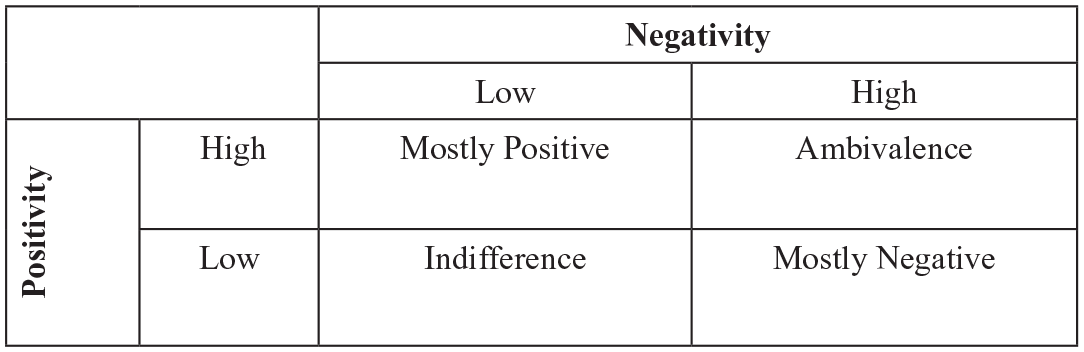
The Four Evaluative Quadrants in Relationships.
When reviewing these evaluative quadrants, it becomes clear that traditional unidimensional conceptualizations, and assessments, of relationship satisfaction fall short in describing the full range of possible evaluative states. This becomes especially obvious when considering how unidimensional conceptualizations attempt to capture people’s evaluations on scales ranging from positive to negative. When people are mostly positive or negative, evaluations are easy, and people score high or low on the scale. However, someone who is high in both positive and negative evaluations (i.e., ambivalent) will probably score somewhere in the middle of a unidimensional scale, similar to someone who is low in both evaluations (i.e., indifferent) and to someone who has a medium level of positive evaluations and no negative evaluations. Thus, unidimensional assessment of relationship quality masks the different possible configurations of evaluations that one can experience, obfuscating their distinct profiles. This is problematic because each of these affective patterns is related to distinctive relationship processes and outcomes that cannot be captured by unidimensional conceptualizations (and assessments) of relationship quality and satisfaction (e.g., Fincham & Linfield, 1997; Rogge et al., 2017). Thus, we argue that, to understand relationship dynamics, these four different evaluative quadrants need to be considered separately. In fact, recent research has shown that in many relationships, it is quite common to feel ambivalence (Fingerman et al., 2004; Zayas & Shoda, 2015). Furthermore, many relationships are also characterized by low positive and negative evaluations (i.e., indifference), but research on this evaluative pattern has been almost completely neglected. Yet, both ambivalence and indifference can be experienced in various types of relationships (including close relationships; Barry & Lawrence, 2013; Hsieh & Hawkley, 2018).
This article has four major goals that together provide a new theoretical framework to guide future research on the four evaluative patterns that are experienced in relationships. The first goal is to introduce the four evaluative quadrants experienced in relationships and discuss their unique interpersonal processes and outcomes from both the perspective of the person experiencing them (i.e., actor effects) and from the perspective of the recipient of such evaluations (i.e., partner effects). Importantly, although for simplicity, evaluations are described in a categorical manner and divided into four distinct quadrants, it is clear that relationship evaluations vary in a continuous manner over a two-dimensional space, and we urge researchers to measure evaluations in a continuous manner (e.g., to what extent are there positive evaluations? To what extent are there negative evaluations?). The second goal is to discuss how explicit (i.e., deliberative) vs. implicit (i.e., automatic) processes influence the link between the four evaluative quadrants and their corresponding behaviors/outcomes. The third goal is to provide a framework to understand which types of relationships are most likely to be characterized by which evaluation through the lens of Interdependence Theory (Kelley & Thibaut, 1978). The fourth goal is to introduce the Trajectories of Relationship Evaluation Model (TREM) that describes the changes in evaluations over time. Finally, we will conclude by describing the implications of considering the four different types of evaluations and their changes when studying relationship processes.
Relationships can be described as a pattern of repeated interactions between two individuals (Sandstrom & Dunn, 2014) and can vary on their level of interdependence (close relationship/strong ties vs. non-close relationship/weak ties; Granovetter, 1983; Wieselquist et al., 1999) and on whether they are chosen (e.g., romantic partners and friends) or forged by situational factors (e.g., family, work colleagues, neighbors, etc.). Importantly, the ideas proposed in this work apply to all types of relationships (e.g., ambivalence is likely to trigger similar processes in all types of relationships; changes in evaluations over time follow similar patterns in all types of relationships). Finally, we should acknowledge that although we believe that many of the processes that we describe are inherent to all types of relationships, most of our theorizing is based on the theoretical and empirical work that has been done by relationships scholars in the context of Western, Educated, Industrialized, Rich, and Democratic (WEIRD) samples (Henrich et al., 2010). As such, there may be constraints to the generality of the ideas proposed by this work to different cultures and samples, which we will also discuss in the Implications section.
The Four Evaluative Quadrants
In this section, we describe the four evaluative quadrants of relationships: mostly positive, mostly negative, ambivalent, and indifferent (see also Holt-Lunstad & Uchino, 2019; Methot et al., 2017; Uchino et al., 2001). We then make predictions regarding their specific outcomes and processes in relationships, with a particular focus on the two quadrants that have been mostly neglected in the literature (i.e., ambivalence and indifference). For each of the quadrants, we first discuss the processes involved for the person who holds that evaluation (i.e., actor effects), and afterwards, we discuss the dyadic processes, that is, the effects for the recipient of such evaluations (i.e., partner effects). We consider as partner effects both what occurs when the partner reports how they think that the actor is evaluating them (i.e., the partner’s perception of the actor’s feelings toward them) and when the actor has certain evaluations of the partner as reported by the actor (i.e., the actor’s reports of their actual feelings toward the partner). Although actual actor’s reports and partner’s reports tend to correlate, meaning that there is a certain level of accuracy between the partners’ estimates and the actors’ evaluations, there is often not a perfect correspondence between the two (e.g., Kenny & Acitelli, 2001). Importantly, partners are typically more affected by their own perception of how the actor is evaluating them rather than by what the actor is actually thinking and feeling (e.g., Eastwick et al., 2023; Joel et al., 2020).
Mostly Positive
Actor Effects
People experience mostly positive relationships to the extent that their relationship is characterized by high positive and low negative evaluations. The evaluations of these types of relationships are easily captured by unidimensional measures of relationship quality, where people score high on relationship satisfaction. From an Interdependence Theory perspective, these relationships tend to be characterized by high rewards and low costs (Kelley & Thibaut, 1978). People in these relationships tend to experience positive affect and many positive emotions toward the other person, such as strong liking, companionate and passionate love, gratitude, admiration, and so on (Sels et al., 2021; Sternberg, 1987). When people have high positive and low negative evaluations toward the other person, many positive processes occur in the relationship. For example, people typically feel safe in the relationship and want to connect with the other person (Bowlby, 1979; Mikulincer et al., 2003; Murray et al., 2006). When they value and esteem another person, people tend to have an approach orientation toward them and seek to establish and maintain the relationship (Murray et al., 2006; Sels et al., 2021). Not surprisingly, these types of relationships are often accompanied by high levels of commitment, closeness, trust, intimacy, support, responsiveness, and so on (Joel et al., 2020; (Righetti, Faure, et al., 2022; Wieselquist, 2007). Furthermore, not only do relationships tend to flourish under these circumstances, but individuals do too. Numerous studies have found that people who experience positive and rewarding relationships with others also experience higher personal well-being and have better physical and mental health (Amati et al., 2018; Cohen, 2004; Froiland et al., 2019; Holt-Lunstad et al., 2010; Robles et al., 2014). Because typical unidimensional assessments of relationship quality are able to detect the processes that occur in this evaluative quadrant, the positive consequences of these types of relationships are well-documented in the literature (for a review, see Fincham & Beach, 2006).
Partner Effects
Individuals thrive to the extent that they perceive that others positively evaluate them as this fulfills one of the most fundamental needs (Baumeister & Leary, 1995; Deci & Ryan, 2000; Demir & Özdemir, 2010). When people feel that they are valued by someone else, they feel safe in the relationship (Mikulincer & Shaver, 2007), and they want to connect with the other, rather than self-protect (Murray et al., 2006). Similarly, perceiving care, understanding, and being valued by another person is one of the most important predictors of relationship quality (e.g., Reis & Gable, 2015). This is not surprising because people who feel valued by another person are more likely to behave in constructive and connecting ways, such as they are more likely to behave in responsive ways themselves (Canevello & Crocker, 2010), and they are more likely to sacrifice their own self-interest for the other (Visserman et al., 2022). These processes are not only occurring during positive and cooperative interactions, but feeling valued enables people to behave constructively even when facing challenging relationship situations, like conflicts (e.g., Simpson & Rholes, 2017). Furthermore, recent research has shown that even for people who do not feel chronically valued by others (e.g., because of low self-esteem or an anxious attachment style; Arriaga et al., 2018; Murray et al., 2002), the fact that the other person values them is sufficient to buffer against negative feelings and make interactions more constructive (Alonso-Ferres et al., 2021; Overall et al., 2022; Sasaki et al., 2023). Similarly, people are also better at coping with external stressors in their lives if they think that their close others value them (e.g., Balzarini et al., 2023; Bowes et al., 2010; Gass et al., 2007; Slatcher & Selcuk, 2017), and they experience better well-being and health outcomes overall (e.g., Heaphy & Dutton, 2008; Slatcher et al., 2015; Stanton et al., 2019).
Mostly Negative
Actor Effects
People experience mostly negative relationships to the extent that their relationship is characterized by mostly negative and low positive evaluations. These types of evaluations are also easily captured by unidimensional measures of relationship quality, and people will score on the lower extreme of relationship satisfaction. From an Interdependence Theory perspective, these relationships tend to be characterized by high costs and little rewards (Kelley & Thibaut, 1978). People experience many negative emotions in these types of relationships, such as anger, frustration, disappointment, anxiety, contempt, resentment, and so on (Baumeister et al., 1993; Brodie et al., 2019; Sommer et al., 2019). The other person is strongly devalued, and many negative processes are likely to occur. In these types of relationships, people typically do not feel safe (Bowlby, 1979; Mikulincer et al., 2003), and they prioritize self-protection over connectedness goals (Murray et al., 2006). The behavioral response to these types of evaluations can vary between avoidance (Bartholomew, 1990; Tjosvold & Sun, 2002) and hostility/aggression (Birkley & Eckhardt, 2015; Miller & McCaw, 2019) depending on a variety of personality and situational factors (e.g., Brodie et al., 2019; Finkel, 2014; Noller & Feeney, 2002). These types of relationships tend to be particularly costly for the individual because they are likely to increase stress and loneliness and worsen physical and psychological health (Brooks & Dunkel Schetter, 2011; Farrell et al., 2018; Offer, 2020). Similar to relationships characterized by mostly positive evaluations, the effects of relationships evaluated mostly negatively have also been widely studied (e.g., Feeney & Karantzas, 2017; Luecken et al., 2009; McGrath & Van Bergen, 2015; Morrison, 2008).
Partner Effects
To the extent that people perceive another person to have a negative evaluation of them, and not positive, a series of negative interpersonal processes are activated. The recipients of such evaluations do not feel safe in the relationship and tend to be very concerned about protecting themselves from being hurt and rejected (e.g., Murray et al., 2006; Simpson & Rholes, 2017). In fact, when people feel that others do not value them, they are more likely to misperceive threatening interpersonal situations (such as conflicts or little interpersonal transgressions) as very hurtful, and they are more likely to be negatively affected by them (Murray et al., 2003). Consequently, they are more likely to generate a series of defensive and destructive behaviors, such as derogating the other person, displaying greater anger and hostility, or treating the other person in cold, critical, and hurtful ways (e.g., Murray et al., 2003; Simpson & Rholes, 2017). Similarly, positive processes are also inhibited. For example, when people do not feel valued by others, they are also less likely to express their feelings (Ruan et al., 2020), to display behavioral gestures of intimacy (Jolink et al., 2022), and to forgive (Pansera & La Guardia, 2012). Finally, being devalued by others does not only hurt the relationship (e.g., Murray, 2023) but also is related to detrimental psychological and physical health outcomes (Lee & Szinovacz, 2016; Link & Phelan, 2006; Meyer, 2003; Slatcher & Selcuk, 2017).
Ambivalence
Actor Effects
People experience ambivalence to the extent that their relationship is characterized by both high positive and high negative evaluations (e.g., Holt-Lunstad & Uchino, 2019; Uchino et al., 2012; Zoppolat et al., 2023). For individuals who experience ambivalence, it would be problematic to fill in a typical relationship satisfaction scale because they feel both satisfied and dissatisfied about their relationship at the same time. Thus, they will probably report to be in the middle of the scale (e.g., Anvari et al., 2023; Schneider et al., 2016; Thompson et al., 1995), or they will report to be at the extremities of the scale depending on which information is salient at a particular time point (in one moment, they may report to be extremely satisfied, while in another moment, they may report to be extremely dissatisfied; Zoppolat et al., 2023). Ambivalence is frequently experienced in close relationships (e.g., Fingerman et al., 2004; van Gaalen et al., 2010; Zayas & Shoda, 2015); for example, anxiously attached individuals are notorious for having ambivalent evaluations of others (Joel et al., 2011; Mikulincer et al., 2010). However, ambivalence can also occur in non-close relationship contexts, for example, toward co-workers (e.g., Melwani & Rothman, 2022; Rothman et al., 2017; Suurd Ralph & Barling, 2023). Despite the pervasiveness of this evaluative experience, empirical work on the interpersonal dynamics of ambivalence in relationships is only at its infancy (e.g., Joel et al., 2018; Melwani & Rothman, 2022; Zoppolat et al., 2023).
The literature on ambivalence has distinguished between two different types of ambivalence: objective and subjective. Objective ambivalence, also referred to as potential ambivalence, represents the extent to which people hold both positive and negative evaluation toward an attitude object and, as such, reflects the structure of the attitude (Armitage & Arden, 2007; Kaplan, 1972). It is typically measured by asking people to separately report their positive evaluation (e.g., “To which extent do you have positive feelings/thoughts toward your partner?”) and their negative evaluation (e.g., “To which extent do you have negative feelings/thoughts toward your partner?”). An index of objective ambivalence can be computed by inputting positive and negative evaluations into a formula that takes into account the similarity and strength of each (Thompson et al., 1995). Subjective ambivalence, which is also referred as felt ambivalence, represents the extent to which people report feeling conflicted, or torn, between positive and negative evaluations and is typically measured by directly asking people to which extent they have mixed feelings/thoughts (toward a partner for example; Newby-Clark et al., 2002; Priester & Petty, 1996). When assessed toward various attitude objects, the correlation between these two forms of ambivalence tends to vary from weak to moderate (Armitage & Arden, 2007; Snyder & Tormala, 2017) and varies with the salience of evaluations, importance of judgment, and individual differences. A weak correlation may occur because sometimes ambivalence is present at the level of evaluations but is not actively considered in someone’s mind, and therefore, people do not explicitly feel conflicted (van Harreveld et al., 2015). For example, people may be very ambivalent toward legalization of marihuana or immigration policies, but because they do not think about these topics so much, they may not necessarily report to be mixed and conflicted. However, when it comes to ambivalence toward one’s romantic partner, a recent study has shown that the correlation between objective and subjective ambivalence is in the medium range (Zoppolat et al., 2023). This highlights the fact that it is difficult for people to ignore the co-presence of positive and negative evaluations, and not feel mixed, when it regards an attitude object that is central to people’s lives (as many close relationships are). Thus, it is also likely that objective and subjective ambivalence may be more weakly correlated in non-close relationships, although this assumption still needs empirical attention.
In general, the literature has shown that feeling ambivalent is a stressful experience when it regards any attitude object, for example, being ambivalent toward racism or toward a stranger about whom people receive both positive and negative information (e.g., Has et al., 1992; Rydell et al., 2008; van Harreveld, Rutjens, et al., 2009). Experiencing ambivalence is especially stressful in relation to how people evaluate close others (e.g., Birmingham et al., 2019; Zoppolat et al., 2023). In fact, people who experience ambivalence toward their close others report lower levels of both personal (e.g., poorer health outcomes, higher stress, higher guilt, lower life satisfaction; (Herr et al., 2022; Holt-Lunstad & Uchino, 2019; Kalmijn, 2020; Uchino et al., 2012; Zoppolat et al., 2023) and relationship well-being (higher thoughts of breakup, higher relationship difficulties; Joel et al., 2021; Righetti et al., 2020; Zoppolat et al., 2023). Importantly, these effects are not simply driven by the mere presence of negative evaluations toward someone. In fact, when examining the unique effects of ambivalence in relationships, it is important to ensure that the effects are driven by the co-presence, and a unique combination, of high positive and high negative evaluations, above and beyond the simple presence of negativity in the relationship (e.g., Surjadi et al., 2023; Uchino et al., 2014; Zoppolat et al., 2023). It is noteworthy that while most of the existing work on ambivalence has examined only one type of ambivalence at a time, a recent paper has revealed that both objective and subjective ambivalence toward one’s own romantic partner are negatively associated with personal and relationship well-being, with each type of ambivalence explaining unique variance in the outcome variables (Zoppolat et al., 2023). However, the associations between ambivalence and romantic relationship well-being are stronger for subjective, rather than objective, ambivalence, indicating that subjective ambivalence is likely more consequential for interpersonal processes (Zoppolat et al., 2023).
Although research on ambivalence in relationships is still emerging, research on ambivalence in other domains suggest that this evaluative pattern may give rise to a series of cognitive and behavioral processes that are very consequential in relationships and very specific to this evaluative pattern. Building on the broader literature on ambivalence, we propose that because ambivalence is an aversive state, people are motivated to solve their ambivalence (or even avoid feeling of ambivalence altogether) and adopt a mostly univalent evaluative state (either positive or negative) (van Harreveld et al., 2015). Consistent with this idea, ambivalence has been shown to lead to greater information processing of any ambivalent attitude object (van Harreveld et al., 2004, 2015). When another person is the target of ambivalence, this means that people may start to more attentively process information about this other person to understand whether they are safe to approach or whether they should rather be avoided. Thus, ambivalence is likely to be an engaging evaluative pattern, in which people care, monitor, and possibly ruminate about the relationship in an attempt to determine whether the other person is safe and the bond can be strengthened or whether the relationship is threatening and self-protection should be prioritized (Murray et al., 2006). Consistently, ambivalence has been linked to rumination and enhanced cognition (both constructive and destructive) about one’s own romantic relationship (Zoppolat et al., 2023).
Furthermore, because ambivalence contains high levels of both positive and negative evaluations, it should lead to both constructive and destructive behavioral responses depending on which information is salient in a specific moment and which affective response is activated (Melwani & Rothman, 2022). Specifically, we expect that people in the ambivalent pattern will enact particularly strong behavioral responses for at least two reasons. First, because the intensity of the evaluation is high (either positive or negative), the behavioral response is also likely to be of high intensity (Conner et al., 2022; Fazio & Williams, 1986). Second, ambivalence has been shown to generate what is called “response amplification,” that is, in an attempt to reduce ambivalence, people are likely to give more extreme responses (Bell & Esses, 2002). Thus, ambivalent individuals may be extremely loving, supportive, and responsive when the relationship situation/context is positive but also quickly exhibits destructive and interpersonally harmful behavior when the situation/context is negative. In sum, ambivalence should elicit high-intensity constructive and destructive relationship behaviors, likely fluctuating between the two depending on contextual factors. In support of this idea, previous research has shown that ambivalence is associated with greater daily fluctuations in commitment and breakup and that ambivalent individuals felt more motivated to stay in the relationship on days with greater positivity in their relationship but more motivated to leave on days with greater negativity (Joel et al., 2021). Furthermore, a recent paper has shown that ambivalence is related to fluctuations in both constructive (or approach) and destructive (or avoidance) behaviors in romantic relationships (Zoppolat et al., 2023).
Ambivalence has also been linked to greater creativity (Fong, 2006; Zhang et al., 2022), greater receptivity to alternative perspectives when making decisions that help ambivalent individuals to be more accurate (Rees et al., 2013), and less cognitive bias (Hohnsbehn et al., 2022; Schneider et al., 2021). These skills may also influence interpersonal processes by enabling ambivalent individuals to be more accurate in person perception, by, for example, having greater perspective taking and empathic accuracy skills. They may also be more accurate perceivers of people’s characters and less likely to fall into both positive biases (e.g., positive illusions in romantic relationships; Murray et al., 1996) and negative biases (e.g., stereotypes; Hilton & von Hippel, 1996). Furthermore, their broadened cognitive focus may also induce ambivalent individuals to think “out of the box” to solve interpersonal problems. Finally, because of their enhanced creativity and open-mindedness, ambivalent individuals may provide different perspectives and propose different (and diverse) activities in relationships. As such, they can help other people broaden their horizons by learning new perspectives and having novel experiences (Muise et al., 2019), although these new perspectives may not always be very welcomed by others. For example, an ambivalent individual may be more likely to suggest to “open” the relationship to solve sexual problems or to start a new activity together with their romantic partner (e.g., a salsa dance course) that is supposed to help the relationship. In fact, ambivalent individuals have both the motivation to think about these alternative solutions (they are still very engaged in the relationship) and the ability to do so (enhanced creativity and openness to different perspectives).
Partner Effects
Studying ambivalence is important not only because of the specific relationships dynamics and outcomes that are likely to arise in the ambivalent individuals but also because of the specific consequences that are likely to affect the recipient (or target) of such ambivalence. First of all, it is important to note that people can detect another person’s ambivalence. For example, one study showed that people distinguish nonverbal expression of ambivalence from nonverbal expression of other univalent emotions, such as sadness, anger, or happiness (Rothman, 2011) and differentiate between faces of ambivalent individuals and non-ambivalent individuals (Han et al., 2023). Furthermore, a study of romantic relationships found correlations in the range of .30 to .40 between the individual’s ambivalence toward their partner as reported by the individual and their partner’s perception of such ambivalence, suggesting that people have insights into their partner’s ambivalent feelings toward them (Đurić et al., 2024). A high degree of correspondence was also shown in parent-child relationships (Fingerman et al., 2008) and in non-familial relationships (Humphries & Korfmacher, 2012).
More remarkably, being the recipient of such ambivalence is likely to negatively affect people for several reasons. First, especially in the context of close relationships, it should be distressing to know that the other person holds some doubts and negative evaluations. Second, and more specific to ambivalence, the ambivalent individuals are likely to behave in an inconsistent manner, oscillating between constructive and destructive behaviors, creating concerns over the predictability and the reliability of their behavior. Thus, recipients of ambivalence may not always be able to understand and anticipate how the ambivalent individual is going to react, and they are likely not to feel safe in the relationship. In fact, previous research has shown that perceiving fluctuations in partner’s commitment, for example, is associated with higher likelihood of relationship dissolution (Arriaga et al., 2006). Furthermore, fluctuations in support received by a partner have also been shown to lower relationship satisfaction over time (Eller et al., 2023). In relation to ambivalence, a recent empirical investigation has indeed found that individuals whose romantic partner is ambivalent toward them experience lower trust, understanding, and security in the relationship with detrimental consequences for their personal and relationship well-being (Đurić et al., 2024). Consistently, individuals who express ambivalent feelings are also perceived as less moral and less trustworthy (Belkin & Rothman, 2017). Furthermore, research has shown that when fathers reported greater ambivalence, offspring reported lower physical health (Fingerman et al., 2008). Similar negative physical effects were found between ambivalent grown children and their mothers (Fingerman et al., 2008). And, in an organizational context, research has found that ambivalent supervisors are seen as unpredictable, which is in turn linked to expecting higher stress at work and poorer work performance, especially if the supervisor’s ambivalence is specifically targeted at oneself rather than at another person (Lim et al., 2021).
In sum, ambivalence in relationships should not be ignored because it has significant consequences. People do hold both positive and negative evaluation toward others, and as we have illustrated, this affective pattern has unique properties that are conducive to unique interpersonal processes that cannot be captured by unidimensional models of evaluations in relationships.
Indifference
Actor Effects
People experience indifference to the extent that their relationship is characterized by low positive and negative evaluations. Indifferent individuals will also have difficulty reporting relationship quality (satisfaction) on unidimensional assessments because their lack of positive or negative evaluations renders them neutral, and thus neither satisfied nor dissatisfied. Similar to ambivalent individuals, they may position themselves in the middle of a unidimensional scale. Alternatively, because they are not satisfied, they may report to be low in satisfaction, like mostly negative individuals. However, ambivalence and mostly negative evaluations are qualitatively different from indifference, with vastly different underpinnings and consequences.
Interestingly, indifference as an evaluative pattern has not been studied much by previous research, although some work exists on the consequences of this evaluative pattern for voting behavior (Ryan, 2017; Thornton, 2014; Yoo, 2010), intergroup relations (e.g., Passini, 2017, 2019), environmental attitudes (Lyons & Breakwell, 1994), violence against elderly (Radkiewicz & Korzeniowski, 2017), and existential indifference (Schnell, 2010). Certainly, very little attention has been devoted to this evaluative pattern in relationships. Obviously, people are more likely to experience indifference toward others with whom they do not frequently interact, such as acquaintances and weak ties (e.g., Campo et al., 2009; Uchino et al., 2004). However, indifference can also be experienced in close relationships, for example, toward one’s own romantic partner (e.g., Abbasi & Alghamdi, 2017).
Previous research has indeed discussed the concepts of romantic disengagement (Barry et al., 2008) and marital disaffection (Kayser, 1996) to describe a state of indifference toward one’s own partner accompanied by a decline in love and care. Similarly, previous research has investigated relationship boredom as a state of lack of positivity in the relationship (Harasymchuk & Fehr, 2013). Although these concepts appear similar to indifference, at the empirical level, assessments of these constructs do not clearly distinguish indifference from negative evaluations or a general lack of care (Barry et al., 2008; Harasymchuk & Fehr, 2012; Kayser, 1996). Indeed, scales assessing disengagement and disaffection contain items that explicitly refer to the presence of negative affect, negative behavioral tendencies, and a general lack of care. While lack of care and withdrawal tendencies may be a likely consequence of indifference, they are not part of the construct per se. Specifically, indifference refers to the structure of the evaluation, characterized by low negative (and positive) evaluations, and can, theoretically, be independent from lack of care. In fact, at times, indifference in evaluations could also exist when people care about the other person’s well-being (e.g., when someone is indifferent toward another person but they are high in social value orientation or altruism and still care about the other person’s well-being; or when someone is indifferent toward their romantic partner at the evaluative level but still care about the partner’s well-being because the partner is important for their shared children). Thus, we urge researchers to devote more attention to indifference and its interpersonal consequences while ensuring that the effects are driven by this specific evaluative pattern and not by the presence of any negative behavioral/motivational consequences. This is especially relevant because indifference is a specific evaluative pattern characterized by its own psychological signature. First, different from ambivalence or mostly negative evaluations, indifference, because of its low activation profile, should not be a particularly aversive or stressful state: negative evaluations are low, and there is no salient conflict between different types of evaluations. Consequently, when a relationship is characterized by indifference, people should not necessarily have a strong drive to change this evaluative pattern, and they should not experience strong negative consequences on their physical and psychological health (Carlisle et al., 2012; Uchino et al., 2013). However, some mild distress might occur when positive evaluations are a strong norm, and people feel pressure, to feel positive evaluations (e.g., toward close others) (Hsieh & Hawkley, 2018).
Second, indifference is a low arousal state (as the intensity of the evaluations is low; Anvari et al., 2023; Cacioppo et al., 1997; Schneider et al., 2016) and has been considered a weak attitude (Conner et al., 2021). Thus, the motivational output of such pattern is low. Potentially, because of this lack of inner drive, behaviors are likely to be more determined by contextual factors and by norms (Fazio, 1990). In an interpersonal context, this means that if the context is positive (e.g., a cooperative situation), people are likely to behave constructively and be helpful, also in line with what is considered normative in that situation. However, if the context is negative (e.g., conflictual situation), people are likely to behave in oppositional manners. In this regard, indifference is similar to ambivalence because both states are sensitive to contexts, and behavioral fluctuations from positive to negative are likely to occur. However, a key difference between the two is that ambivalence will result in high-intensity behaviors (because of the underlying high-intensity affect and because of the response amplification effect), while indifference will result in low-intensity behaviors (e.g., people will be mildly supportive but won’t sacrifice, people will be mildly oppositional but won’t aggress). Similarly, another key difference between these two affective patterns is that ambivalence induces people to be engaged with the other person in an attempt to solve their conflicting feelings, while indifference is characterized by low-engagement and low-intensity behavior. In close relationships, this is likely to translate into low involvement in the other person’s life and low levels of intimacy.
Finally, indifference conveys important information about the relationship. One key signal is that there is no need to attend to the environment because there is nothing particularly valuable in it (Gasper et al., 2019). It also signals that expectations have not been violated, as violations from expectations are also likely to trigger emotional reactions (Gasper et al., 2019). In a relationship context, this means that the relationship does not involve any particular threat or reward (Murray et al., 2006) and that expectations have not been consistently violated in either a positive or negative manner. A key consequence of indifference in relationships is therefore inattention to the other person with a cascade of interpersonal consequences.
Indifferent individuals will be less likely to be responsive and supportive to others, less likely to accurately read other people’s emotions and engage in perspective taking, and less likely to seek to understand the other person and the relationship. As such, while ambivalence induces people to engage in greater information processing about the relationship, indifference reduces it. On the contrary, individuals are likely to devote their attention to alternative relationships that are more consequential for them, because they represent a threat, a reward, or both. They will also be more likely to direct their attention to other domains, such as work and hobbies. For example, married individuals who exhibit high level of indifference may be more likely to succumb to the allure of attractive alternatives (e.g., engage in infidelity) or may become overinvolved with their career (Robinson et al., 2006).
In sum, indifference is a specific affective pattern characterized by unique properties and unique outcomes in the relationship. Although indifference does not seem very harmful for the person experiencing it, there are circumstances where indifference may be very hurtful for the target (e.g., for the romantic partner, the child, the subordinate, etc.), as we will describe in the following paragraph.
Partner Effects
Just like for ambivalence, there is evidence showing that people can detect another person’s indifference. For example, participants can discriminate expressions of neutrality from expressions of happiness, anger, or ambivalence (Belkin & Rothman, 2017). Furthermore, recent empirical data from romantic couples show that the correlation between the actor’s actual feelings of indifference toward their partner and their partner’s perception of those feelings is around .40 (Đurić et al., 2024), showing some accuracy in detecting a romantic partner’s indifference.
At first glance, being the recipient of indifference should not be very consequential if the indifferent feelings are reciprocal or if the recipient of indifference is not dependent on the other to achieve good outcomes. However, generally speaking, people tend to dislike others that retain an indifferent attitude, and this should be even more likely if people are the recipients of such attitude. For example, research has shown that people who are indifferent toward political issues and decide not to take sides are liked and trusted less (Silver & Shaw, 2022). Similarly, previous work has shown that friends who decide to remain neutral and not support either side in an interpersonal dispute are evaluated negatively (Shaw et al., 2017). These effects are even more pronounced when people are the target of indifference. For example, a series of studies showed that college students were similarly negatively affected when they received a recommendation letter with neutral adjectives and a letter with negative adjectives, as compared to a letter with positive adjectives (Leary et al., 1998). These findings are consistent with research that shows that people respond to neutral feedback similar to how they respond to negative feedback (Holroyd et al., 2006).
The negative interpersonal consequences of being the target of indifference are even more likely to emerge when people are interdependent with each other (i.e., each person’s outcomes are affected by the other’s actions), and when people hope to obtain rewarding interpersonal interactions. For example, in a negotiation context, expressions of indifference were experienced as aversive and reduced cooperation (Cohen-Chen et al., 2022). In a romantic relationship context, a recent line of research found that perceiving a partner being indifferent significantly lowered people’s personal and relationship well-being (Đurić et al., 2024). Importantly, these effects hold when controlling for the participant’s own indifference and the perceived unidimensional partner evaluations, underscoring the specific detrimental consequences of being the recipient of this specific evaluative pattern. When people are the target of indifference, they are more likely to feel ignored and ostracized if the other person does not show concern for their welfare, with detrimental consequences for their well-being. In fact, perceiving to be ignored by others is a distressing experience that increases negative emotions such as anger and sadness and thwarts people’s most fundamental needs (the need to belong, control, for meaningful experience, and it lowers people’s self-esteem; Williams, 2009; Williams & Nida, 2022). Similarly, when others are indifferent, they are more likely not to be attentive and caring. Thus, people may not feel safe in the relationship and are instead likely to prioritize self-protection over connectedness goals (Bartholomew, 1990; Murray, 2023).
Explicit and Implicit Processes
For decades, psychologists have heavily relied on explicit (i.e., self-report) measures to assess relationship evaluations and affect. Consequently, the study of relationship evaluations has centered on deliberative processes, that is, on cognition and feelings that people are able, and willing, to report when answering direct questions about their relationship (Gawronski & Bodenhausen, 2006). While deliberative processes are important and, at times, predictive of relationship dynamics and outcomes (Joel et al., 2020; Righetti, Faure, et al., 2022), recent research has also highlighted the importance of measuring implicit evaluations, through the use of implicit measures (Faure et al., 2020). In fact, implicit measures (often assessed through reaction times tasks) can assess people’s automatic affective reactions, or “gut-feelings,” toward another person and have been shown to be reliable predictors of relationship outcomes overtime (LeBel & Campbell, 2009; Lee et al., 2010), even when explicit evaluations fail to do so (McNulty et al., 2013). This is because implicit evaluations can help understand certain relationship processes that may not be predictable by explicit evaluations. In fact, according to the Motivation and Opportunity as DEterminants (MODE) model (Fazio, 1990), implicit evaluations become automatically activated when people encounter the target of their evaluation (i.e., another person) and are likely to determine attention, cognition, and behavior in an automatic manner unless people have the motivation and the ability to override these automatic tendencies to engage in more deliberative and controlled responses. Thus, while explicit evaluations guide behavior in situations that favor deliberative responses (i.e., high motivation and opportunity), implicit evaluations are more predictive of behavior in situations that favor automatic responses (i.e., low motivation and opportunity; Faure et al., 2020; Fazio, 1990; Friese et al., 2008; Hicks et al., 2021; Hicks & McNulty, 2019; Hofmann et al., 2008). For example, implicit evaluations have been shown to be predictive of non-verbal behaviors in dyadic interactions (which is a very automatic behavior), while explicit evaluations did not (Faure et al., 2018).
While psychologists are acknowledging more and more the need to study implicit evaluations in a relationship context (Faure et al., 2020; Hicks & McNulty, 2019; Righetti, Faure et al., 2022), implicit measures suffer from the same shortcomings as explicit measures: they have also been predominantly used as an unidimensional assessment. In fact, typical implicit measures that are used to study implicit partner evaluations (such as the evaluative priming task or the single category Implicit Association Task (IAT); Fazio et al., 1995; Karpinski & Steinman, 2006; McNulty et al., 2013) create an overall score that subtract negative reactions from positive ones, leaving no space to (a) understand which outcomes are actually predicted by merely positive implicit evaluations vs. negative ones and (b) detect ambivalence or indifference.
It is instead important to understand whether the longitudinal outcomes that are predicted by implicit partner evaluations (e.g., relationship satisfaction, conflict, thoughts of breakup) are more strongly influenced by the presence of positive implicit evaluations, by the presence of negative ones, or whether a special combination of both has additional explanatory power. In fact, implicit evaluations are likely to predict automatic, non-controlled, behavior (Fazio, 1990), but it is likely that positive implicit evaluations especially predict certain relationship dynamics, while negative implicit evaluations may more strongly predict a different class of behaviors. However, until now, research has been completely mute in this regard, with one notable exception (Lee et al., 2010). Similarly, it is also important to distinguish ambivalence and indifference at the implicit level because they are likely to have distinct cognitive and behavioral signatures.
Ambivalence can manifest at the implicit level in two forms: (a) explicit/implicit ambivalence, which represents the discrepancy between people’s explicit and implicit evaluations (when both evaluations are typically assessed using a unidimensional scale; Petty & Briñol, 2008; Briñol et al., 2006), and (b) implicit ambivalence, which occurs when implicit positive and negative affect are measured separately and people have high scores on both (de Liver et al., 2007; Zayas & Shoda, 2015). While the literature on attitudes and social cognition has investigated these different forms of ambivalence toward other attitude objects (Petty & Briñol, 2008), there is almost no research on how these two forms of ambivalence affect relationship dynamics and outcomes. We posit that a crucial distinction between explicit and implicit forms of ambivalence is that people may be not necessarily aware of their implicit ambivalence (Zoppolat et al., 2023). Thus, contrary to subjective ambivalence, implicit forms of ambivalence should not be experienced as an aversive state that people need to reconcile. As such, implicit forms of ambivalence in relationships are unlikely to be stressful and to lower people’s well-being. Consistent with this idea, a recent paper has examined how the four different types of ambivalence (two explicit forms, i.e., objective and subjective ambivalence, and two implicit forms, i.e., explicit/implicit and implicit ambivalence) affect personal and relationship well-being outcomes (Zoppolat et al., 2023). This work found that only explicit forms of ambivalence were associated with (negative) well-being outcomes, while implicit forms of ambivalence were not. While these findings are consistent with the idea that implicit forms of ambivalence are not distressing for the individuals because people do not have opposing evaluations to reconcile, we are reluctant to conclude that implicit forms of ambivalence do not affect interpersonal processes at all. This is because in the study by Zoppolat et al. (2023), relationship well-being outcomes were assessed at the explicit level. Instead, it is likely that any effects of implicit ambivalence will be observable in circumstances where automaticity predominates (e.g., in terms of the MODE model, in situations of low motivation and low opportunity). To illustrate, someone that is explicitly/implicitly ambivalent is likely to display a specific behavioral pattern in social interactions, by showing discrepant automatic/controlled behaviors or by providing inconsistent behavioral cues depending on whether they are more influenced by their implicit or explicit evaluations. For example, when communicating to another person for whom they feel explicit/implicit ambivalence, individuals may exhibit discrepant verbal/non-verbal behavior. In fact, because implicit evaluations are likely to predict nonverbal behavior (Faure et al., 2018), while explicit evaluations are likely to predict deliberate behavior, such as verbal behavior (e.g., Friese et al., 2008; Perugini, 2005), an explicitly/implicitly ambivalent individual will send mixed signals to their interlocutor. Furthermore, an implicitly ambivalent individual will likely fluctuate in their automatic behavior depending on whether the positive vs. negative automatic evaluations are activated by the context. Thus, rather than being inconsequential, we posit that implicit ambivalence exerts an influence on relationship dynamics and outcomes under certain conditions (Fazio, 1990), with potential consequences for the vitality and quality of the relationship over time (Faure et al., 2022). Consistent with this idea, one study that focused on the longitudinal outcomes of implicit ambivalence toward one’s romantic partner found that implicit ambivalence can motivate change and improve relationship well-being over time (Faure et al., 2022).
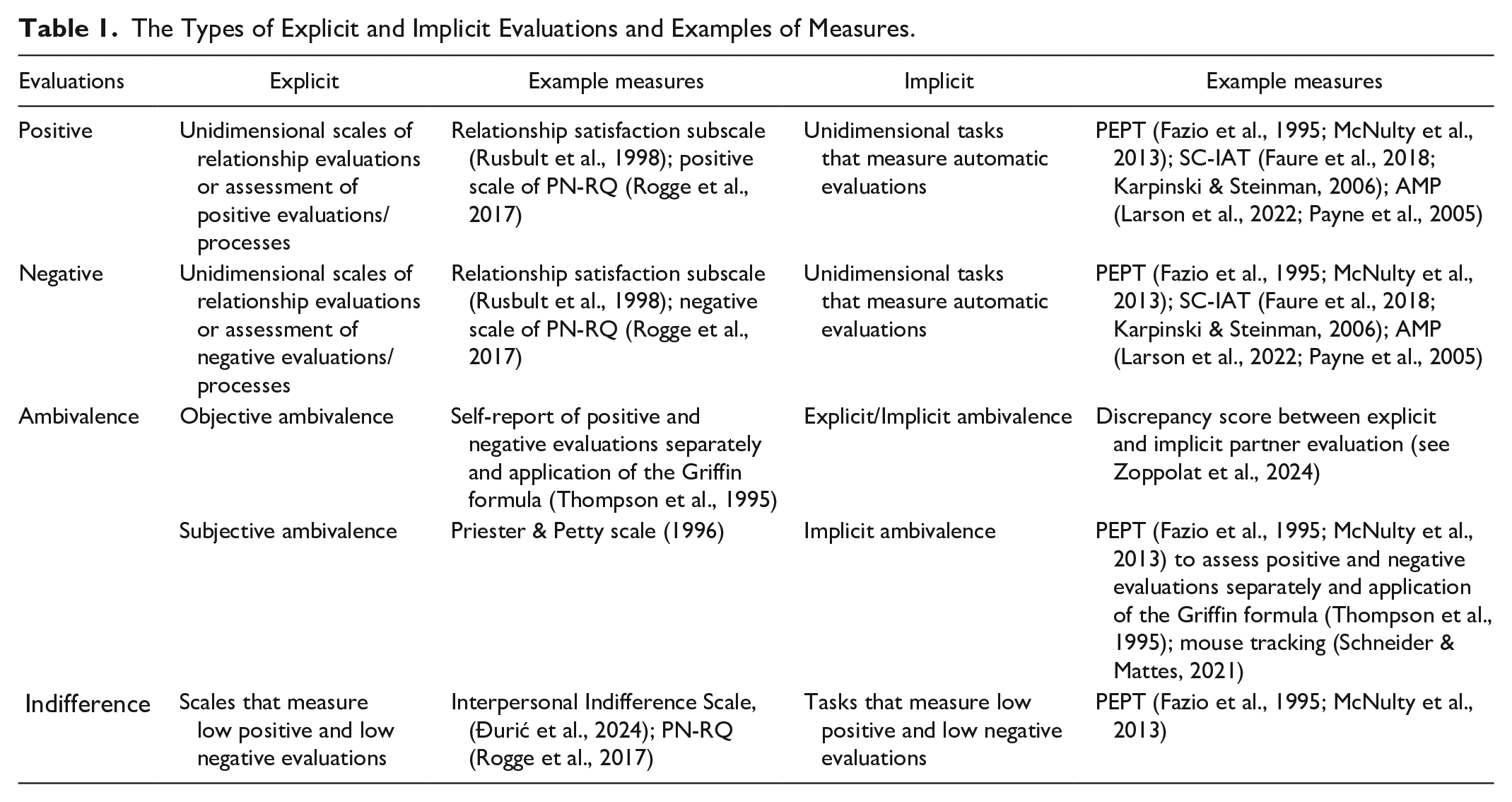
Finally, there is no work assessing implicit forms of indifference. When people do not experience positive or negative outcomes in a relationship for a prolonged amount of time, the automatic associations that they have toward someone could become indifferent (low in positivity and in negativity). However, implicit and explicit forms of indifference could differ. For example, at the explicit level, people may not be willing to admit that they feel indifferent (e.g., because they have become indifferent toward their romantic partner over time, but it is normative and desirable to feel positively) or they may not be necessarily aware of their automatic indifference (e.g., because they used to like someone and they may still self-report positive affect toward that person, but at the automatic level, there is not much positivity left anymore). Alternatively, it is also possible that people may report indifference at the explicit level in a self-report measure because they want to believe that they are disengaged and indifferent toward someone, but at the automatic level, an implicit measure could actually detect the presence of positive and/or negative affect. We posit that when people have implicit indifference, their behavior will be likely influenced by their explicit evaluations if they are valenced (positive, negative, or both) or by norms and situational demands. Conversely, if people are explicitly indifferent, their behavior will be more strongly influenced by their implicit evaluations if they are valenced or, again, by norms and situational demands. Although these assertions have not yet received empirical support in a relationship context, previous work has, for example, shown that implicit evaluations are especially predictive of voting behaviors for people who report high levels of explicit indifference (Ryan, 2017). Similarly, someone who reports in a questionnaire to be indifferent toward another person may still behave in a strongly evaluative manner if their implicit evaluations are different. Thus, while relationship science has predominantly examined explicit evaluations and neglected implicit ones, it is important to study relationship evaluations at both explicit and implicit levels because explicit evaluations cannot predict the full range of behaviors and outcomes that we observe in dyadic interactions. In Table 1, we present all the different types of evaluations at the explicit and implicit levels with examples of how they can be measured.
The Types of Explicit and Implicit Evaluations and Examples of Measures.
The Link Between Features of Interdependence and the Evaluative Quadrants
So far, we have discussed that both close and non-close relationships can be characterized by any evaluative pattern. However, we argue that the extent to which an individual would evaluate another as mostly positive, negative, ambivalent, or indifferent may depend on the features of the relationship. Which types of relationships are more likely to generate which evaluation? To address this question, we take an Interdependence Theory perspective (Kelley & Thibaut, 1978) and propose that there is a link between the dimensions of interdependence that characterize relationships (Holmes, 2004; Kelley & Thibaut, 1978; Rusbult & Van Lange, 2008) and how individuals evaluate others.
Per definition, all relationships involve a certain degree of interdependence, that is, each person’s actions influence the other person’s outcomes. According to Interdependence Theory, six dimensions characterize relationships (Columbus et al., 2021; Gerpott et al., 2018; Kelley et al., 2003), although recent empirical evidence seems to suggest that people are only able to classify situations and relationships along five of them (Columbus et al., 2021; Gerpott et al., 2018; Matej Hrkalovic et al., 2024): mutual dependence, conflict of interest, power, information certainty, and anticipated interdependence. In the following sections, we use an Interdependence Theory lens to forward predictions on how each of the dimensions might affect the intensity and the valence of evaluations that people experience toward each other.
Mutual dependence describes to which extent each person’s behavior in the relationship affects the other person’s outcomes. When relationships are high in mutual dependence, people are heavily dependent on each other and strongly affected by each other’s behavior. These types of relationships are also considered close relationships, or strong ties (Granovetter, 1983; Matej Hrkalovic et al., 2024; Wieselquist et al., 1999). To the extent that relationships are characterized by high mutual dependence, evaluations are also more likely to have high intensity (as high positive, high negative, or both). In fact, to develop strong positive and negative evaluations, relationships should matter for the individual, as people’s outcomes (positive or negative) should be strongly dependent of the other person’ action (e.g., Fitzsimons et al., 2015). In contrast, when relationships are low in mutual dependence, people are relatively independent from each other, and there is little influence on each other’s outcomes. Such relationships are also considered non-close relationships or weak ties (Granovetter, 1983; Matej Hrkalovic et al., 2024; Wieselquist et al., 1999). Because people are not much affected by each other’s actions (i.e., low mutual dependency), evaluations are likely low in intensity, and people are more likely to be indifferent toward each other (Gasper et al., 2019).
Conflict of interest describes the extent to which the best outcome for one person corresponds to the worst outcome for the other person. In relationships characterized by high conflict of interest, people have different preferences and goals that do not necessarily align. Such relationships are more likely to occur in competitive settings. Having high conflicts of interests in relationships is likely to trigger negative affect and evaluations (e.g., La Valley & Guerrero, 2012; Righetti et al., 2016). On the contrary, in relationships characterized by low conflict of interests, people desire the same outcome, and these relationships are more likely to occur in cooperative settings (Aktipis et al., 2018; Matej Hrkalovic et al., 2024). When people’s interests correspond, people are better at cooperating, and they are more likely to form positive evaluations of each other (e.g., Kuwabara, 2011). Furthermore, to the extent that people recurrently encounter both conflicting and cooperative interactions, ambivalence should be more likely to arise. Consistent with this idea, it has been proposed that relationships in the work place in which people have different relationships roles (e.g., professional and personal) may cause ambivalence (Methot et al., 2017; Rothman et al., 2017) because people may encounter conflict of interests in one domain (e.g., in professional interactions) but not in the other (e.g., in personal interactions). For example, research has found that managers are more likely to see their colleague-friends also as competitors if they work in the same unit and share the same social rank (Zou & Ingram, 2013). Similarly, if people have conflicting demands and roles at work, they may encounter both cooperative and competitive types of interactions, resulting in higher levels of ambivalence (Rothman et al., 2017).
Power describes to which extent one individual in the relationship can unilaterally determine outcomes, for both themselves and for the other person. In relationships characterized by high power, one individual has a great deal of influence over what happens to them and to the other person, while the other does not (i.e., relative social power; Agnew & Harman, 2019; Kelley & Thibaut, 1978; VanderDrift et al., 2019). This is for example the case in vertical relationships, such as a parent-child or boss-subordinate relationship (Hartup, 1989). Often, having high power means that the powerholder is not strongly affected by the other’s actions because the powerless is not likely to grant rewards and punishments. Consequently, the powerholder is more likely to devote their attention elsewhere and not have a strong evaluative consideration for the powerless, that is, they are more likely to experience indifference. In fact, research has shown that, in general, high power increases social distance (Magee, 2020) and reduces emotional involvement with a partner (Sprecher & Felmlee, 1997). However, in some cases, powerholders can also experience high-intensity evaluations toward others (either positive or negative or both), as when people care and feel responsible for another person’s welfare (e.g., parents toward their children or a responsible CEO toward their employees). For example, powerholders can experience ambivalence when they are responsible for others whom they value, but this responsibility also comes at great costs and with conflicting expectations. Indeed, research has shown that parents can experience ambivalence toward their children and parenting (e.g., Kiecolt et al., 2011; Wethington & Kamp Dush, 2007), and that adults can experience ambivalence when they act as caregivers to their parents or relatives (e.g., Losada et al., 2018; Willson et al., 2003). Being the powerless is also likely to be linked to high-intensity evaluations because powerless individuals are highly dependent on the powerholder to receive both rewards and punishments. And, to the extent that they receive both positive and negative outcomes from the powerholder, powerless individuals can experience ambivalence. Indeed, research has shown that feelings of ambivalence toward one’s leader are relatively common, and consequential (Herr et al., 2019).
Information certainty represents the extent to which individuals have knowledge about each other’s goals, preferences, and how each individual’s behavior affects the other’s outcomes. In relationships characterized by high information certainty, individuals understand each other. Typically, positive evaluations are likely to grow when people understand each other’s needs and preferences (e.g., Finkenauer & Righetti, 2011; Sened et al., 2017) and have the possibility to act in line with them. In fact, feeling understood (i.e., responsiveness; Reis & Gable, 2015) is one of the most important predictors of thriving relationships (e.g., Joel et al., 2020). On the contrary, in relationships characterized by low information certainty, individuals do not know and understand each other well, and this can increase the chances of developing negative interpersonal evaluations (Solomon & Knobloch, 2004). Indeed, feeling misunderstood is related to lower trust and satisfaction (e.g., Reis et al., 2017; Tucker & Anders, 1999). Furthermore, “noise” in social interactions (i.e., the discrepancy between the intended and the perceived outcomes) undermines the development of positive cooperative relationships (e.g., Van Lange et al., 2002).
Finally, anticipated interdependence represents the expectation of future interdependence, beyond the current state of interdependence. In relationships high in future interdependence, people believe that the interdependence in their relationship will last for a very long time, for example, because they are committed to the relationship (e.g., Rusbult et al., 1998) or because of situational demands (e.g., colleagues working in the same company who do not anticipate leaving their jobs). Typically, the belief that relationships will remain in the future should have a positive impact people’s evaluations. For example, commitment has been shown to predict pro-relationship behavior and to be positively associated with relationship quality (e.g., Wieselquist et al., 1999). Similarly, cooperative processes in interactions are most likely to occur when people expect to interact with each other over and over again (Rand & Nowak, 2013; Van Lange et al., 2011). On the contrary, in relationships low in future interdependence, people are aware that their mutual dependency is bound to end soon. As we will also argue in the sections on the dynamics of relationship evaluations, it is most likely that to the extent that people have mostly negative or indifferent evaluations, they will expect to decrease their interdependence over time (low anticipated interdependence), although this is not always possible (e.g., in situations where people cannot choose to leave the relationship, such as in the work place).
The Trajectories of Relationship Evaluation Model
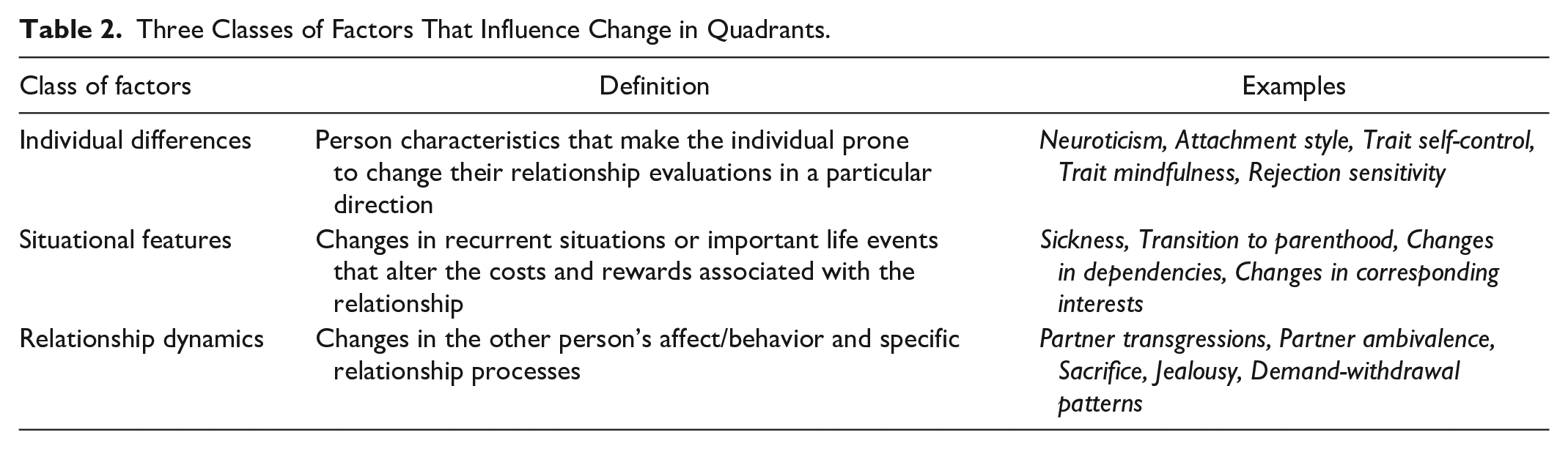
Not only can the features of interdependence shape relationship evaluations at a given time, but it is also important to consider that these evaluations are likely to change according to the history and interactions that people have together over time. Here we introduce the TREM that describes how evaluations are likely to evolve longitudinally in relationships. We propose that changes in evaluations over time are likely influenced by three classes of factors (see Table 2): (a) Individual differences that induce people to change their relationship evaluations in a particular direction; (b) changes in situational features and life events that challenge the relationship or make it thrive; and (c) changes in relationship dynamics (i.e., other person’s affect/behavior and relationship processes) that lead people to have rewarding vs. costly interactions. In what follows, we outline the dynamics of the evaluative characteristics of relationships depending on these factors.
Three Classes of Factors That Influence Change in Quadrants.
To understand the initial stage of relationship evaluations, it is important to make a distinction between chosen (e.g., romantic partners, friends) and non-chosen relationships (e.g., family members, colleagues, neighbors, etc.). Obviously, when relationships are not established yet and people have almost no interdependence with each other, they tend to be rather indifferent toward each other. However, in chosen relationships, as interactions become rewarding, people are motivated to strengthen the bond with the other person, and positive evaluations arise (or possibly ambivalent evaluations if rewarding interactions are also accompanied by negative ones). Conversely, when the context induces people to form relationships, rather than people choosing each other (such as at work, being born into a family, or being part of the same community), the initial evaluation may be different. In fact, when relationships are determined by contextual factors, people could start by having all sorts of possible interdependence patterns and different initial evaluations are possible (positive, negative, ambivalent, or indifferent). Importantly, we argue that, independent of what the initial evaluation is, the trajectories of the evaluations, and the factors that promote change, may be very similar in chosen and non-chosen relationships.
The TREM describes how the three classes of factors affect changes in evaluations over time. TREM represents how relationship evaluations change most commonly (see black arrows in Figure 2), although, obviously, some relationship may deviate from this typical pattern. 1 Importantly, relationships do not have to experience all four evaluation patterns but could loop between some of them repeatedly (e.g., positive to ambivalence to positive, etc.) or could perpetuate in one (e.g., people could be “stuck” in ambivalence or “stuck” in negativity).
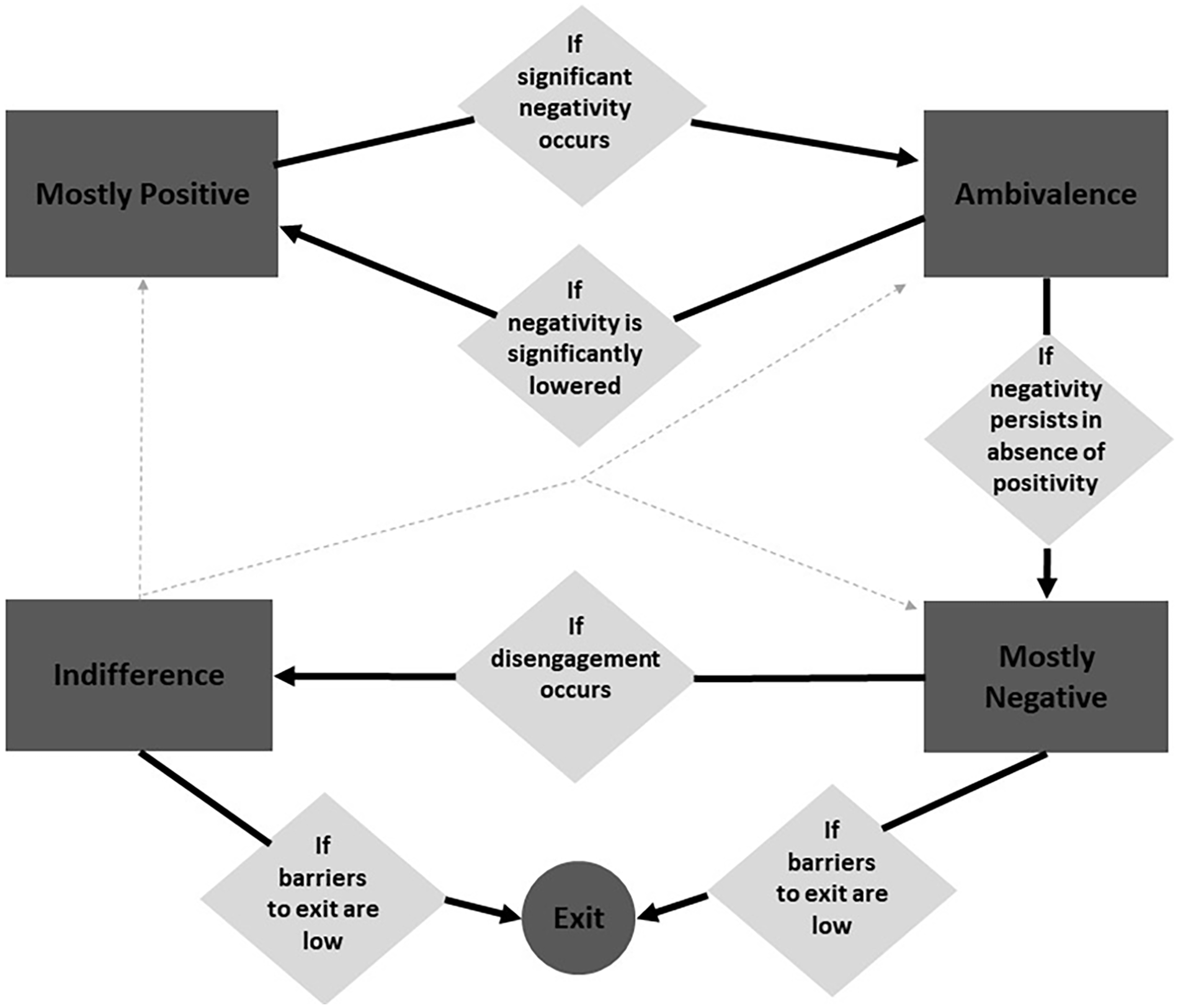
Trajectories of Relationship Evaluation Model (TREM).
From Mostly Positive to Ambivalence
When interdependence develops in contexts where people choose each other (such as romantic relationships and friendships), relationships are likely characterized by mostly positive evaluations. In fact, with repeated rewarding interactions, people are likely to increase interdependence and develop positive evaluations toward each other (Eastwick et al., 2019; Kelley & Thibaut, 1978; Rusbult & Van Lange, 2008). Indeed, the early stage of a romantic relationship is characterized by strong feelings of infatuation and passionate feelings, which are hypothesized to develop to motivate people to dedicate time and energy to the relationship for the emergence of an attachment bond (Fletcher et al., 2015; Hazan & Diamond, 2000). Feelings of attraction drive people to become closer to another person, both psychologically and physically (in case of sexual partners) (Eastwick et al., 2019; Reis & Aron, 2008).
As we have mentioned before, although some relationships can remain mostly positive for a substantial amount of time, or even for the entire duration of the relationship, most relationships are bound to be characterized (at least temporarily) by more, or less, ambivalence. In fact, while positive evaluations and interactions that are linked to a history of rewarding exchanges are unlikely to suddenly dissipate, over time, relationships negativity is likely to arise (Eastwick et al., 2019; Proulx et al., 2017; Righetti, Faure, et al., 2022). We posit that the presence of such negativity in light of stable positivity is likely to evoke ambivalence (Righetti et al., 2020).
According to TREM, three classes of factors are likely to stimulate this increase in negativity. The first factor is individual differences: negativity is more likely to arise if people have dispositional tendencies that threaten their connections with others, such as people with insecure attachment (Candel & Turliuc, 2019), low self-esteem (Murray et al., 2002), high neuroticism (Malouff et al., 2010; Schwind & Albert, 2022), or high rejection sensitivity (Mishra & Allen, 2023). In fact, over time, these individuals are more likely to perceive interactions in a more negative way and react in a destructive manner. The second factor is external circumstances: over time, relationships are bound to encounter difficult interpersonal situations (e.g., situations with strong conflicts of interests), from which negative interactions are likely to emerge. For example, challenging life events notoriously put strain on relationships (e.g., sickness, unemployment, transition to parenthood, organizational changes; Righetti, Faure, et al., 2022; Rothman et al., 2017). Situations that strain the relationship can also involve changes in dependency and power dynamics (e.g., if one person moves to a higher position in the hierarchy in a work setting or if one person becomes the caregiver of the other due to illness). Finally, the third factor is relationship dynamics and effects driven by the other person: while people may wish to be their best relational self at all times in their relationship, such consistency is unlikely. Over time, others may, even if inadvertently, engage in hurtful behavior and commit interpersonal transgressions, and these transgressions are not always easy to forgive (Karremans & Van Lange, 2008). Thus, over time, negative sentiment and negative interactions are likely to occur. When the intensity, or the frequency, of such negative interactions is high enough, people are likely to develop stable negative evaluations of the other person while also maintaining positive evaluations (either because there are still many rewarding aspects in the relationships or because of the recent history of such rewarding interactions).
Furthermore, there are also certain relationship dynamics that are bound to occur in relationships and have been shown to increase both positive and negative evaluations of the other person simultaneously (i.e., ambivalence). For example, it is likely that over time, ambivalence increases because people need to make sacrifices for each other (Righetti et al., 2020), because people meet an attractive alternative partner for whom they experience attraction and desire (Zoppolat et al., 2022), because feelings of romantic jealousy arise (Đurić et al., 2024), or because relationships require making an important choice (e.g., moving in together, borrowing a substantial amount of money, and so on; van Harreveld, van der Pligt et al., 2009). Finally, people may be more likely to become ambivalent themselves if the other person is ambivalent and displays a mix of constructive and destructive behaviors (Zoppolat et al., 2023). While the idea that relationships are likely to change from having mostly positive evaluation to having both high positive and high negative evaluations (i.e., ambivalence) over time has never been empirically tested (because of the lack of research on ambivalence), there is ample support for the idea that negativity increases over time in relationships (Eastwick et al., 2019; Proulx et al., 2017; Righetti, Faure, et al., 2022). TREM posits that people holding mostly positive evaluations will initially hold ambivalent evaluations when negativity starts occurring because the memory of the strong positive affect and evaluations will not suddenly dissipate.
Solving (or Not Solving) Ambivalence
As we have argued before, ambivalence is likely to make people engaged with the relationship and motivated to solve this evaluative conflict. How do people solve their ambivalence? One possibility is that the intensity of their negative and positive evaluations is not completely symmetrical, but that one evaluation (the positive or the negative) is stronger. The predominant evaluation might guide information processing in a confirmative manner (Nordgren et al., 2006) and allow individuals to solve their ambivalence accordingly. However, negative reactions generally carry more psychological weight than positive reactions (Baumeister et al., 2001), and the meta-cognitive experience of ambivalence itself is aversive (van Harreveld et al., 2015; van Harreveld, Rutjens, et al., 2009). Therefore, negative evaluations may exert a greater influence on information processing when both positive and negative evaluations are experienced to a similar degree (Nohlen et al., 2019). Consistent with this idea, longitudinal studies show that ambivalence is conducive to thoughts of breakup and actual breakup over time (Righetti et al., 2020; Surjadi et al., 2023).
That said, negative evaluations can be resolved in many ambivalent relationships (Schenk & Dykstra, 2012). The three classes of factors proposed by TREM can influence this change. First, a reduction in negativity is most likely to occur when individuals have personal dispositions that enable them to react constructively when facing interpersonal threats and challenges and, therefore, diminish a pattern of negative interactions. For example, individuals high in trait self-control (e.g., Karremans et al., 2015), secure attachment (e.g., Gaines et al., 1997), agreeableness (e.g., Perunovic & Holmes, 2008), or mindfulness (e.g., Karremans et al., 2020) are more likely to accommodate, rather than retaliate, in difficult interpersonal situations and bring back a positive cycle of interactions. Second, the repeated occurrence of rewarding interpersonal situations (e.g., situations of corresponding interests where cooperation is smooth), without the presence of difficult situations (e.g., situations of conflict of interests), is likely to re-establish the positive evaluations that were present in the relationship before ambivalence soared. Finally, some relationship dynamics can also buffer against the negativity and help relationships to reduce negativity while increasing positive evaluations. For example, people who are motivated to make the relationship work, for instance, because they are highly committed to it, or because they cannot easily avoid the other person, are more likely to accommodate, rather than retaliate, in difficult interpersonal situations (e.g., Bushman & Holt-Lunstad, 2009; Tran & Simpson, 2009). Similarly, people who trust their partner, or who perceive their partner to be responsive, are also likely to behave constructively, rather than destructively, in challenging interpersonal situations (e.g., Sasaki & Overall, 2023; Shallcross & Simpson, 2012). Having a partner who feels valued or enacts buffering strategies when facing interpersonal threats can also help restore safety and positive evaluations (e.g., Sasaki et al., 2023). Finally, relationship therapy may be very useful in this stage. In fact, while people need high positive and low negative evaluations for relationships to thrive, ambivalent relationships may have a higher chance of success in therapy because there is still a high level of positivity in the relationship to capitalize on. Thus, when working with couples who are experiencing ambivalence, therapists might need to predominantly focus on strategies to reduce the negativity, rather than having to intervene on both a reduction in negativity and an increase in positivity, which is harder to achieve (Bradbury & Bodenmann, 2020; Doss et al., 2016).
When people solve their ambivalence and evaluations are again characterized by high positivity, it is possible that, over time, they will encounter factors (e.g., stressful situations) that will increase negative evaluations again. Thus, people might, from time to time, develop ambivalence, possibly repeating this loop (from positive to ambivalent to positive again) many times. Furthermore, although a change to positivity is possible as described, certain relationships will continue to be characterized by ambivalence. This is more likely to occur when situational and relationship factors sustain both positive and negative types of interactions. Furthermore, there are also certain personality traits that make individuals prone to remain in the ambivalence stage. For example, some individuals are just more prone to experience ambivalence toward any attitude object (Schneider et al., 2021), such as people high in dialectical thinking (Hui et al., 2009), low in mindfulness (Dummel, 2018; Haddock et al., 2017), and high in openness/intellect (Barford et al., 2020). Others are especially likely to have permanent ambivalent relationships, such as individuals high in attachment anxiety (Mikulincer et al., 2010).
Finally, as mentioned before, some individuals will solve their ambivalence in a negative manner, changing their evaluations to high negative and low positive. This is likely to occur when many of the factors that provoked a rise in negativity (individual, situational, or relationship factors) persist in the absence of a substantial amount of buffering positive effects. It is unlikely, however, that relationship dissolution will occur when relationships are ambivalent. In fact, ambivalent relationships still contain high levels of positivity, so people may still have hope that things will get better (Bushman & Holt-Lunstad, 2009), and people have a preference for staying over leaving even when relationships are facing difficulties (Joel & MacDonald, 2021). Furthermore, ambivalence is associated with delay in decision-making (Schneider & Mattes, 2021; Schneider et al., 2015), procrastination, and behavioral paralysis (Rothman et al., 2017; van Harreveld et al., 2015). Indeed, although people are often occupied trying to solve their ambivalence at the cognitive/affective level, they are less likely to take concrete actions that would signal a resignation to the positive vs. negative side (van Harreveld et al., 2015; van Harreveld, van der Pligt, et al., 2009). In support of this idea, most people have a relatively large number of ambivalent relationships in one’s network (Campo et al., 2009; Uchino et al., 2004, 2012), suggesting that people are reluctant to end them (see also Bushman, Holt-Lunstad, 2009).
From Negative to Indifference
When negative evaluations become predominant, positive experiences such as liking and love have severely declined while negative feelings, such as anger, frustration, and feeling hurt become predominant (Barry et al., 2008; Kersten, 1990). When people have mostly negative evaluations, it is difficult for relationships to change to mostly positive again, and an end to the relationship becomes more likely (Amato & Previti, 2003; Kayser, 1996), which is reflected by the relatively low number of aversive ties found in social network analyses (Campo et al., 2009; Uchino et al., 2004, 2012) Yet, still some relationships persist even if people have mostly negative evaluations toward the other person. In fact, when people have mostly negative evaluations, they may still be engaged with the relationships, and their anger and negative affect may underlie a desire to change the other (Fischer & Roseman, 2007). Furthermore, even if people could leave the relationship, there are several different reasons (called “barriers to exit”) for why they would decide to maintain it (Rusbult, 1980; Rusbult et al., 1998; Scinta & Gable, 2007). For example, according to the Investment Model (Rusbult, 1980; Rusbult et al., 1998), people may decide to stay in a mostly negative relationship if they have important shared resources with the other person that would be lost (or damaged) if the relationship were to end (e.g., children, a common group of friends, a good professional position), if they are strongly (inter)dependent with the other (financially or professionally), or if they do not have alternative relationships that can satisfy their needs.
When people do not end mostly negative relationships because of high barriers to exit or simply because they cannot (as in some non-chosen relationships), two outcomes can occur. Either people will maintain a perpetually negative relationship suffering the consequences (Brooks & Dunkel Schetter, 2011; Farrell et al., 2018; Ibarra-Rovillard & Kuiper, 2011), or they may cope by emotionally disengaging and withdrawing (Barry et al., 2008), thereby decreasing negativity (and increasing indifference). Some individual differences make this change to indifference more likely. For example, avoidantly attached individuals are more likely to develop dismissive tendencies (e.g., Barry & Lawrence, 2013; Callaci et al., 2020; Gillath et al., 2017), and people who are prone to depressive symptoms are also more likely to become disengaged in their relationship (e.g., Barry et al., 2019; Proudfit et al., 2015). Furthermore, changes in situational features can also facilitate indifference toward certain relationships, such as when people become less mutually dependent on each other. This can occur when one does not need to rely on the other person to satisfy their needs anymore because those needs can be satisfied in alternative relationships or other activities/domains (Kelley & Thibaut, 1978; Rusbult & Van Lange, 2008). Finally, certain relationships dynamics are also likely to trigger indifference over time, such as when people demand change from the other person, but they are repeatedly disappointed and develop learned helplessness (Carver & Scheier, 2005; Klinger, 1975), or when the other person becomes indifferent themselves and starts withdrawing from the relationship and decreasing interdependence.
Indifferent evaluations often accompany the last stage of relationships before dissolution. For example, feeling indifferent toward one’s romantic partner is indeed one of the most cited reasons to file for divorce (Amato & Previti, 2003). It is also one of the most difficult states to treat in therapy as people have already become disengaged in the relationship, and they lack a strong motivation to repair and keep the bond between them (Whisman et al., 1997). Nevertheless, if the barriers to exit the relationship are high, people may stay predominantly indifferent for prolonged periods of time because indifference is less stressful and has less negative intrapersonal consequences than having mostly negative evaluations. That said, if the barriers to exit are low, people are likely to end the relationship even if they are not particularly distressed by it. In fact, for opportunity-costs reasons, people may avoid investing energy and resources in relationships that are not rewarding and, instead, seek others that can provide those benefits. Importantly, when indifference is not the result of disengagement from strong negative evaluations, but it is the starting point of a non-chosen relationship, indifference can also be very malleable, and evaluations can easily experience an increase in positivity, negativity, or both according to the three classes of factors discussed earlier (see gray lines in Figure 2).
Implications and Conclusion
Relying on unidimensional conceptualizations and assessments of relationship evaluations ranging from positive to negative restricts our understanding of relationship functioning because two important evaluative patterns that have specific and unique consequences on relationship processes are missing: ambivalence and indifference. We hope that our framework will inspire and guide future research in several ways. First, it emphasizes the need to conceptualize and measure relationship evaluations across all four quadrants (Fincham & Rogge, 2010; Rogge et al., 2017). While there are established measures to assess positive and negative evaluations separately (e.g., Rogge et al., 2017), as well as different forms of ambivalence at the explicit and implicit levels (Fazio et al., 1995; McNulty et al., 2013; Priester & Petty, 1996; Thompson et al., 1995), there remains a need for future research to develop reliable methods for assessing interpersonal indifference, both explicitly and implicitly. Second, this paper can guide researchers into understanding what are the unique interpersonal processes that are related to ambivalence and indifference, as these evaluations have been neglected in empirical research compared to mostly positive and mostly negative evaluations. Third, future research could test our assertions on which types of interdependence patterns are likely to give rise to which evaluative patterns. Finally, while we know that relationship satisfaction steadily declines over time, at least in romantic relationships (Eastwick et al., 2019; Proulx et al., 2017; Righetti et al., 2022), it is crucial to understand how relationship evaluations change over time also in other different types of relationships and which factors influence these changes. Future research could benefit from using TREM as a framework to study these changes.
It is also important to note that the different configurations of relationship evaluations not only uniquely influence relationship processes and well-being, as previously discussed, but also have significant implications for individuals’ psychological and physical health. Indeed, previous research has shown that high levels of positive evaluations in relationships contribute to better health outcomes, while high levels of negative evaluations can be detrimental (Holt-Lunstad & Uchino, 2019; Robles et al., 2014). Future research should extend these findings by investigating how ambivalence and indifference impact people’s well-being. Indifference, for example, may not be a very distressing experience because negativity is low (Cacioppo et al., 1999; Uchino et al., 2001). Yet, people seem to have an aversive reaction to indifference (e.g., Cohen-Chen et al., 2022), perhaps because positive evaluations are more common and normative (Cacioppo et al., 1999; Unkelbach et al., 2008), especially toward close others.
Ambivalence, instead, has been shown to have negative consequences on psychological and physical health (Holt-Lunstad & Uchino, 2019; Zoppolat et al., 2023), yet it is still not entirely clear whether ambivalence is more (or less) detrimental than mostly negative evaluations. If, on the one hand, ambivalence still contains some positivity that may buffer against the negativity, it is also true that ambivalence may be especially stressful because people are still very engaged in the relationship and may feel a great discomfort by the presence of negativity. In fact, it may be easier to psychologically cope with a predictable negative relationship than with a relationship that is unpredictably good and bad (Holt-Lunstad & Uchino, 2019; Zoppolat et al., 2023), as this state may especially undermine feelings of control (Leotti et al., 2010).
However, it is also important to note some constraints on generality of the proposed ideas. In fact, while previous research has shown that ambivalence induces distress and discomfort in WEIRD samples (Holt-Lunstad & Uchino, 2019; Zoppolat et al., 2023), and in people who experience it as a chronic property of the relationship (e.g., anxiously attached individuals; Mikulincer et al., 2010), ambivalence does not necessarily need to be experienced as an aversive state. In fact, it has been argued that the detrimental consequences of ambivalence may be context-dependent (van Harreveld et al., 2015). For example, Western and Eastern cultures differ in dialectical thinking, which is the tolerance for holding apparently contradictory thoughts and emotions (Peng & Nisbett, 1999). Research suggests that ambivalence leads to distress and discomfort in Western cultures (e.g., Has et al., 1992; Rydell et al., 2008; Uchino et al., 2014) because Westerners perceive positive and negative as mutually exclusive and as states that cannot co-exist (Spencer-Rodgers et al., 2010). However, the same might not be true in East Asian cultures, which are influenced by Buddhist, Taoist, and Confucian philosophies and may adopt a more holistic vision that does not perceive the presence of positive and negative reactions as contradictory (Spencer-Rodgers et al., 2010; van Harreveld et al., 2015). It is therefore crucial to investigate the consequences of the four evaluative quadrants in different cultures, as the effects may be different in different contexts.
Importantly, cultural factors may not only affect how relationship evaluations affect personal well-being and relationship dynamics, but they may also affect the frequency of the different evaluations in relationships. For example, ambivalence in relationships may be more frequent in cultures high in dialectical thinking as people are less motivated to solve this state because they do not experience discomfort with it (Spencer-Rodgers et al., 2010). Furthermore, mostly negative evaluations and indifference in relationships may be more frequent in collectivistic cultures (i.e., cultures that emphasize interdependence with others and individuals are committed to group goals; Markus & Kitayama, 1991) and in cultures with low social mobility (i.e., the freedom and flexibility a society affords individuals to choose interpersonal relationships based on their own preferences; Oishi, 2014) because relationship dissolution is less likely in these cultures and, therefore, relationships characterized by high levels of negativity or indifference may be more likely maintained.
Moreover, when studying longitudinal changes in evaluations, future research should test the assertions proposed by TREM while also devoting attention to the dyadic nature of such changes. In fact, it is highly likely that relationship evaluations evolve in concert between people and that there is a relationship evaluation contagion effect, such that one person’s change in relationship evaluations will be followed by a similar change in the other. Finally, we think that it is crucial to understand the temporal dynamics of relationship evaluations for two reasons. First, by understanding the factors that promote changes from one evaluation to another, we can gain knowledge regarding which interventions would be more successful in creating high positivity/low negativity in relationships (or, in some circumstances, to promote indifference). Second, it is pivotal to understand which evaluations are most malleable and when interventions are most fruitful. For example, it seems likely that interventions aiming at having mostly positive evaluations in relationships should be especially effective when people are ambivalent toward each other, rather than mostly negative or indifferent. In fact, when people hold high positive and high negative evaluations, they likely still care very much about the relationships and are willing to exert the effort to engage in constructive behaviors to improve it. Furthermore, because they still have high positive evaluations toward each other, interventions should primarily focus on diminishing the negative by, for example, teaching de-escalation of conflict and accommodation strategies. Unfortunately, some studies on romantic couples show that people may seek help from therapy quite late (Doherty et al., 2021; Jarnecke et al., 2020), perhaps when they already have predominantly negative evaluations (e.g., Whisman et al., 1997).
When people hold primarily negative evaluations, achieving success in interventions is more difficult by needing to work on both increasing the positivity and decreasing the negativity (e.g., Bradbury & Bodenmann, 2020). However, increasing positivity is challenging because, when negative evaluations are predominant and there is low positivity, it is likely that interactions are perceived through a negative lens, and a spiral of reciprocal negativity between people is likely to rise. According to TREM, it is difficult to increase positive evaluations again in this evaluative pattern and, perhaps counterintuitively, interventions should aim at reducing negativity while moving people toward a temporary state of indifference. Thus, when relationships are characterized by mostly negative evaluations, interventions should not make people engage with each other as much (given the danger of spirals of destructive interactions), but they should first aim at diminishing their interdependence. Using this intensity-reduction strategy, people might be able to “cool down,” reduce negativity, and become more indifferent toward each other. Only once this is achieved, and both negativity and positivity are rather low, then interventions could re-establish some levels of interdependence and work on increasing positivity. The paradoxical effect of this, of course, might be that people may not be willing to exert the effort to establish a positive relationship when they are mostly indifferent toward each other (and not all relationships are indeed worth this effort). Thus, future research should test the conditions under which these types of interventions are most effective and should test which interventions are most useful depending on which predominant evaluations people have toward each other at a given time.
Positionality and Citation Statement
Background and positionality may influence the content of the article and bias the interpretation of certain findings and their relative emphasis. To allow readers to contextualize this work, information on the authors might be helpful. All authors of the present article are female, Caucasian, and European. All hold a master’s degree, and two hold a PhD in social psychology. Importantly, two out of three authors are romantic relationship researchers, and their expertise may have impacted the content of this work, in that romantic relationships may be represented more than other types of relationships—such as friendships or non-chosen relationships. Such bias is also present in the scientific literature as many relationship processes are especially studied in the context of romantic relationships. One author is an ambivalence researcher. Furthermore, although personal information on the background and ethnicity of the authors of the work cited in this review is not available, there is reason to assume that the majority of the authors come from a Western background and that the empirical findings mostly rely on samples collected in WEIRD populations. We therefore urge researchers to test which of the proposed ideas in this manuscript are consistent across cultures, which are context specific, and which do not generalize to all types of relationships.
Conclusion
Although a simplification of relationships into positive vs. negative may be, at a first glance, appealing and intuitive, the complexity of people’s relational landscape cannot be neglected. The presence of ambivalence and indifference in relationships is undeniable, and unraveling the interpersonal consequences of these two additional evaluative patterns is likely to help our understanding of how people relate to each other in a more comprehensive way. This is even more important because these evaluations are often not immutable, but they tend to evolve and change over time. In this work, we have (a) elucidated the specific interpersonal processes (individual and dyadic, explicit and implicit) that characterize evaluative patterns; (b) described which relationships are likely to be associated with which patterns of evaluations at any given time; and (c) introduced TREM which describes how relationship evaluations change over time according to three factors (i.e., individual differences, situational features, and relationship dynamics). Moving forward, we hope that our work will encourage scientists to pay more attention to all four patterns of evaluations given their unique effects on how people relate to each other. We believe it is crucial to understand how these four relationship evaluations evolve over time and how we can intervene to restore positivity. This is much-needed knowledge given the tremendous impact that relationship quality has on many aspects of society, ranging from people’s health, work productivity, and child development.
Footnotes
Declaration of Conflicting Interests
The author(s) declared no potential conflicts of interest with respect to the research, authorship, and/or publication of this article.
Funding
The author(s) disclosed receipt of the following financial support for the research, authorship, and/or publication of this article: This research was supported by a Vidi grant from the Netherlands Organization for Scientific Research (NWO) allocated to Francesca Righetti (VI.Vidi.195.010).
