



Abstract
Academic Abstract
Despite increased popular and academic interest, there is conceptual ambiguity about what allyship is and the forms it takes. Viewing allyship as a practice, we introduce the typology of allyship action which organizes the diversity of ways that advantaged individuals seek to support those who are disadvantaged. We characterize allyship actions as reactive (addressing bias when it occurs) and proactive (fostering positive outcomes such as feelings of inclusion, respect, and capacity), both of which can vary in level of analysis (i.e., targeting oneself, one or a few other individuals, or institutions). We use this framework to profile six productive yet largely independent bodies of social psychological literature on social action and directly compare relative benefits and constraints of different actions. We suggest several future directions for empirical research, using the typology of allyship to understand when, where, and how different forms of allyship might succeed.
Public Abstract
Despite increased popular and academic interest in the word, people differ in what they believe allyship is and the forms it takes. Viewing allyship as a practice, we introduce a new way (the typology of allyship action) to describe how advantaged individuals seek to support those who are disadvantaged. We characterize allyship actions as reactive (addressing bias when it occurs) and proactive (increasing positive outcomes such as feelings of inclusion, respect, and capacity), both of which can vary in level (i.e., targeting oneself, one or a few other individuals, or institutions). We use this framework to profile six large yet mostly separate areas of social psychological research on social action and directly compare the relative benefits and limitations of different actions. We suggest several future directions for how the typology of allyship action can help us understand when, where, and how different forms of allyship might succeed.
Social inequities and exclusion are persistent problems but have received renewed attention and public conversation in recent years. Examples of these conversations range from the lack of diverse representation in the cultural sphere (#OscarsSoWhite) to challenging the ubiquity of sexual abuse and harassment (#MeToo). One of the largest dialogues has centered around the legacy and prevalence of racism in the United States. Black Lives Matter (gaining new momentum in late May 2020) sparked nationwide conversations about the importance of taking concrete action beyond solely expressing support. Notably, these conversations have involved not just those who are marginalized by social prejudice and inequities but also members of advantaged groups—those who enjoy positions of power and privilege.
As evidence that this might be a new phenomenon in need of greater conceptual clarity, Dictionary.com (2021) named the word “allyship” its word of the year in 2021. Further demonstrating public interest in the concept of allyship, Google Trends (n.d.) shows that internet searches of the question “What is allyship?” grew rapidly in late May 2020, reaching its peak in the subsequent summer.
Paralleling increased public interest in understanding allyship, academics have sought to describe what allyship is conceptually and in practice. Although the question “what is allyship” may appear straightforward, social psychological papers on this topic are diverse and fragmented. First, scholars diverge in how they define allyship as a concept. Second, there are several bodies of literature describing actions that constitute allyship, but they remain largely distinct from one another. Only a few articles discuss multiple actions at once (e.g., Brown & Ostrove, 2013; Cheng et al., 2018, 2019; Gonzalez et al., 2015; Ostrove & Brown, 2018) and make indirect attempts to integrate multiple literatures under one framework. For these reasons, the allyship literature is vast but wanting in structure and difficult to navigate. Our goal is to provide this structure, an overarching theoretical typology to compare multiple forms of allyship action.
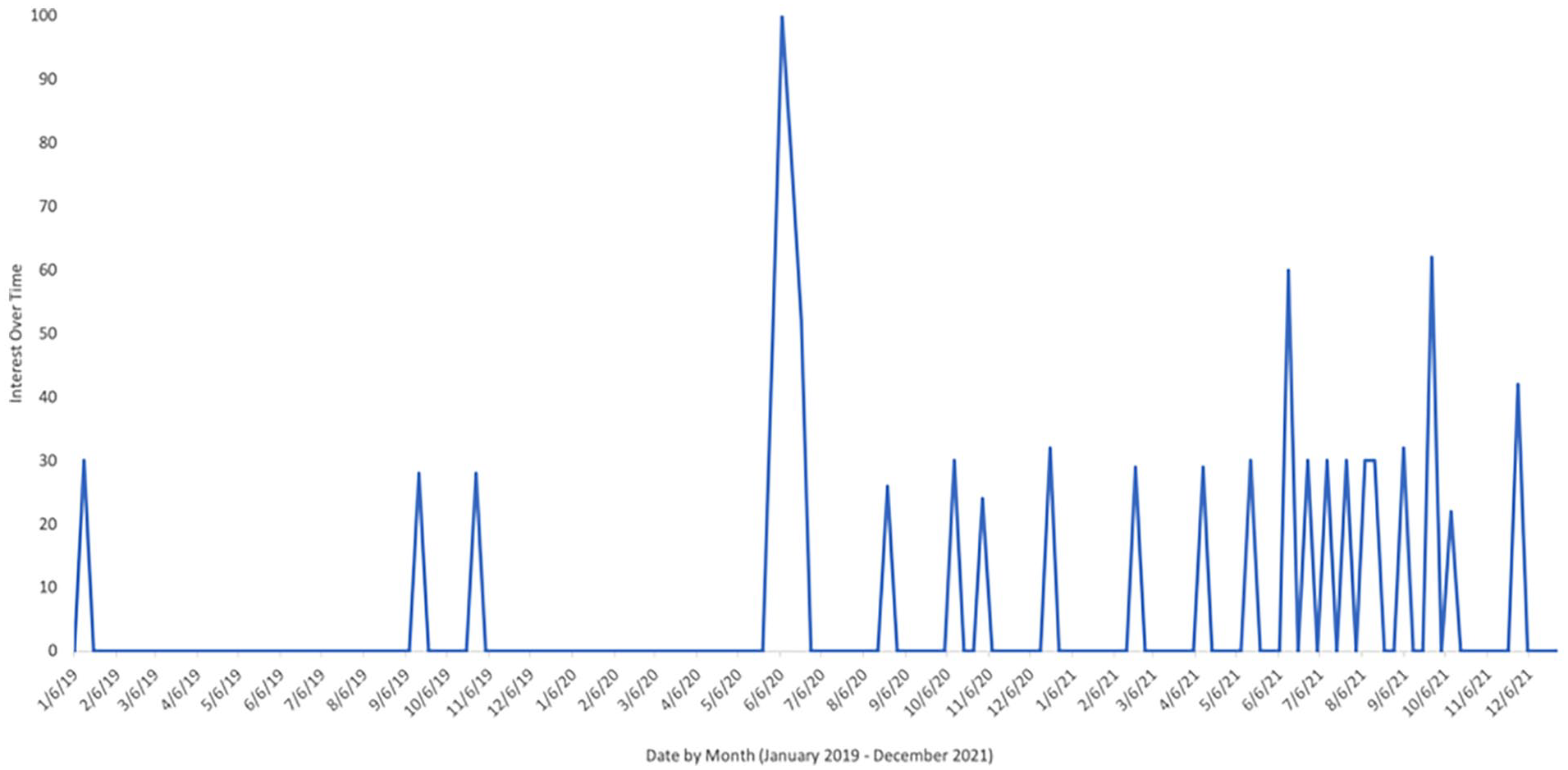
Google Trends (n.d.). “What is Allyship”. Retrieved Februrary 4, 2022, from https://trends.google.com/trends/explore?date=2019-01-01%202021-12-31&q=what%20is%20allyship&hl=en.
Noting Our Positionality and Generality of Our Work
Before presenting our description of and approach to understanding allyship, it is important to acknowledge the lenses through which we engage in this topic. We, the two authors of this article, received doctoral training in social psychology and presently research the intersections of social identity, bias and stereotyping, and social/cultural norms from a critical realist position. Both authors are U.S. American scholars currently residing in a major Canadian city. The first author identifies as a Black-American multiethnic cis-gender woman. The second author identifies as a European American cis-gender woman. The advantage of our positionalities, both in terms of research expertise and social identity group memberships, is that they provided familiarity (scholarly and lived) with allyship. We also expanded our considerations of allyship by seeking out and integrating feedback on this theoretical work, from other social psychologists (in North America and Western Europe, and from departments in psychology, sociology, and organizational behavior) uninvolved in this project.
Regarding generality, we recognize that the scope of our theorizing is constrained to the level of the individual acting within a social context. Although we center on what people do as individuals to address systemic issues, we acknowledge that our framework might not generalize to all discussions of social action. For example, social action at the group level such as coalition building and organizing is and has always been crucial for social change. We also recognize that attunement to single actors reflects a more individualistic orientation toward social change efforts. Finally, given that most of the social psychological research we review was conducted in North America (or Western Europe), we recognize that discussion of individuals’ actions skews toward Western contexts and norms. Nevertheless, we see our typology as applicable across cultural contexts and cite research from non-Western populations where possible. Applicability does not imply that culture is irrelevant; as described below, cultural context can shape the importance of social issues, salience of identities, and outcomes of allyship actions.
Defining Allyship
Reflecting on “allyship” as the 2021 word of the year, Sheree Atcheson (2021) emphasized, “To recognize allyship now in this way is notably powerful- it brings the word into a more mainstream, accessible platform, perhaps meaning that real change can be potentially affected.” Atcheson (2018, 2021) nevertheless cautions against allyship as simply a buzzword, stressing that allyship is an action-oriented practice that should not depend on being forced to do so when issues arise. In line with Atcheson’s conceptions of allyship, we likewise stress that allyship is an ongoing practice of actions that expand beyond calls to action.
Who Practices Allyship?
In our definition, allyship is centered on actions taken by individuals who belong to an advantaged group (i.e., members of identity groups that hold relatively higher societal status, relevant to the social issue at hand, compared to the groups they seek to support). This is not to suggest that people who share similar group status or identities do not take meaningful action. However, we distinguish support where there is unequal status (allyship) from where there is shared status (perhaps better defined as solidarity, e.g., Burson & Godfrey, 2020; Craig et al., 2020). For example, we perceive a Black and White American person challenging anti-Asian-American bias as qualitatively different. In the former case, a Black American person is “stigmatized within the same dimension of identity” (Craig et al., 2020, p. 43), sharing similar experiences of race-based inequities. In contrast, a White American person likely does not share experiences of racial inequities, given their membership in an advantaged racial group.
Recognizing that identities are multifaceted and valuing considerations of intersectionality, we do not suggest that people who identify with certain advantaged groups are never in solidarity with others (e.g., a person may hold more power in some ways and less power in other ways due to their social group memberships). We also recognize that there is cross-cultural variation in how advantaged versus disadvantaged group categorizations are construed and which social issues are most psychologically relevant to groups (van Zomeren, 2019). For this reason, we emphasize the importance of context; whether an agent’s action reflects allyship or solidarity is dependent on the social justice issue(s), salient identities, and power dynamics between the agent and the person(s) they seek to support. Moreover, our emphasis on individual actors, rather than groups acting, does not imply that these actions are irrelevant to larger social group dynamics. Allyship in our view involves individuals whose advantaged or disadvantaged status is not due to their individual identities but rather is tied to their belonging to groups that hold system-level differences in power and status. In addition, allyship is driven by the actor’s recognition of unequal and illegitimate intergroup relations. Taken together, individuals and their interactions with others are related to and embedded in larger cultural/societal structures and are often determined by the place of their own and other groups within that larger cultural/societal structure (Bronfenbrenner, 1977; Pettigrew, 1997, 2018). Nevertheless, we believe there is a meaningful distinction between advantaged group members taking action on their own (allyship) versus taking action together as a group (e.g., coalitions).
Allyship as Practice Rather Than Identity-Oriented
Despite its new prevalence as a term, definitions of allyship vary. Variation in how allyship is conceptualized is not necessarily a problem; multiple perspectives allow for a nuanced discussion of what allyship is. Nevertheless, the concept remains difficult to pin down without an explicit discussion of how it is studied. Below we enter this discussion, describing two common orientations toward allyship, and subsequently provide our stance on what allyship is/is not.
Several conceptualizations of allyship within the social psychological literature are identity-oriented, defining allies as “[people who are members] of the ‘dominant’ or ‘majority’ group who work to end oppression in his or her personal and professional life through support of, and as an advocate with and for, the oppressed population” (Washington & Evans, 1991, p. 195). Allies are those who are able and willing to be involved in social justice efforts, an identity that emerges from attitudes and experiences (e.g., education, interracial relationships; Broido, 2000; Reason & Broido, 2005; Reason et al., 2005 also see B. J. Drury & Kaiser, 2014). For people of color, allies are those who are high in affirmation (e.g., respectful and caring) and informed action (willing to be active in their support; Brown & Ostrove, 2013; Ostrove & Brown, 2018; see also Jones et al., 2014 and Park et al., 2022 for similar discussion). Radke and colleagues (2020) note that members of advantaged groups who take action to rebuild or repair their own group’s threatened status or tarnished image or seek to meet their own personal needs do not meet the criteria for being an ally (allies are instead genuinely motivated to improve the status of disadvantaged groups). Similarly, Craig et al. (2020) find evidence that dominant-group allies are both highly identified with their in-group but also cognizant of their group’s power and thus aim to dismantle the systems of power that privilege them. In sum, the social psychological literature has often defined allyship as an identity, emphasizing that certain behaviors and motivations designate certain people as allies.
Although scholarship using an identity-oriented perspective provides insight into the motivations of the advantaged group member and the desires of the group being supported, we challenge the concept of ally-as-identity with a practice-oriented perspective. Allyship from this perspective is not a title or stable identity, but a chronic practice of actions that must be recognized by those they seek to support (Atcheson, 2018, 2021; The Anti-Oppression Network, n.d.; Pierce, 2015). Put simply, people are not allies; people do allyship. This perspective is not entirely in conflict with more identity-oriented definitions (they both emphasize the importance of behavior and egalitarian motivation), but it does set a higher standard for what allyship is. The importance of chronic practice appears in research on disadvantaged group members’ perceptions of allyship; Cheng and colleagues (2019) found that among working women, “Although single actions certainly had the power to be effective and remained salient in women’s minds, continual actions tended to be described as more effective on the whole” (p. 47).
We define allyship as a custom (a) comprised of several actions rather than one action alone taken by advantaged group individuals, which are (b) motivated by egalitarian goals to support outgroups that are disadvantaged and are (c) recognized as supportive by those they seek to support. First, because systemic social-identity-based issues materialize in various ways, it follows that allyship, as a practice to address these issues, must also vary. Second, we emphasize the importance of egalitarian goals because advantaged group members whose motivations are in-group or self-focused are likely to take public but not private action, provide dependency-oriented help, and/or deprioritize the needs of those they seek to support (Radke et al., 2020; Shnabel et al., 2016; perceived as “allyship missteps” by members of disadvantaged groups; Collier-Spruel & Ryan, 2022). In contrast, egalitarian-motivated actions (compared to alternative motivations such as paternalism) are more likely to empower those who advantaged individuals seek to support (Estevan-Reina et al., 2021). Supporting our argument that egalitarian motivations are important to the definition of allyship, those who are higher in social dominance orientation (supporting group-based hierarchies and inequalities, Pratto et al., 1994) are less willing to enact allyship (Fletcher & Marvell, 2022). Third, and finally, actions taken as part of an allyship practice must be perceived as supportive or empowering by the person or people they seek to serve. Actions are aligned with the purpose of allyship to support and empower only when they center on what disadvantaged group members desire or need.
Although this practice-oriented approach makes allyship more challenging to do, it also moves the concept of allyship from a buzzword to a more concrete and meaningful tool for addressing social issues. Moving away from an allyship-as-identity perspective toward a practice-oriented approach also helps us identify and avoid allyship missteps by self-described “allies,” whose well-intentioned actions can be misinformed and harmful to members of disadvantaged groups (Collier-Spruel & Ryan, 2022). However, our practice-oriented definition of allyship need not diminish the impact of singular actions that people take in support of disadvantaged groups. Instead, we believe that it is important to differentiate between allyship as a sustained practice and the singular behaviors that aspire to constitute this practice. We call these singular behaviors allyship actions.
Allyship Actions
An allyship action is any singular behavior taken to support disadvantaged groups. Thus, within the broader domain of allyship as a practice, people can carry out specific allyship actions. Importantly, however, no single allyship action meets the criteria to constitute an allyship practice, just as no single health behavior constitutes a healthy lifestyle (Short & Mollborn, 2015).
The social psychological literature is rich with exemplars of allyship actions and their impact. For example, confrontation is an effective way to curb prejudice, particularly when the confronter is not from the group targeted by the prejudice (Czopp & Monteith, 2003; Eliezer & Major, 2012; Rasinski & Czopp, 2010). Seeking interactions with out-group individuals can reduce prejudicial attitudes by fostering positive connections with people one does not commonly interact with (Pettigrew & Tropp, 2000, 2006). Further research has examined how and what individuals from advantaged groups can do to be supportive of social change initiatives (Droogendyk, Louis, & Wright, 2016; Droogendyk, Wright, et al., 2016; Louis et al., 2019). As these bodies of literature have traditionally focused on in-person contexts, we predominately discuss offline action. However, allyship actions can and do occur in virtual contexts. Given the ubiquity of the internet, there has been increased attention to online action; for example, researchers have elucidated the impact of online collective action efforts (Greijdanus et al., 2020) and the amplification of marginalized voices through social media (Clark, 2019). We consider allyship actions in virtual spaces in our discussion of emerging research questions.
Again, our typology adds to a still small but growing range of papers on what we call allyship actions (e.g., Brown & Ostrove, 2013; Chen et al., 2023; Cheng et al., 2019; Collier-Spruel & Ryan, 2022; Gonzalez et al., 2015; Ostrove & Brown, 2018; Sue et al., 2019). The novel impact of our work is providing a broader framework to organize the diversity of actions that constitute allyship; we call this framework the Typology of Allyship Action.
Overview
We first introduce the Typology of Allyship which includes two core conceptual distinctions. We propose that allyship actions can be evaluated as reactive or proactive behaviors by examining three characteristics: timing, aim, and focus. We then explain how these actions can be described by their intended scope: is the action aimed at addressing bias and inclusion at the individual, interpersonal, or institutional level? Second, to demonstrate how reactive and proactive actions occur at three levels of scope, we review and incorporate several prolific areas of research on different forms of allyship actions (i.e., bias regulation, confrontation, support for collective action, interpersonal contact, inclusive leadership) into our typology of allyship action. A tool for directly comparing various allyship actions, we use our typology to compare the unique benefits of and hurdles to taking one type of allyship action versus another. Similarly, we consider how context distinctly constrains or motivates actions of different kinds. In this way, we see this typology not just as a theoretical contribution to the literature but as a practical framework to motivate the creation of measures, inspire research questions, and provide a useful guide to the types of allyship action individuals can take with intentions for allyship.
Two Qualitatively Different Types of Allyship Action: Reactive and Proactive 1
Despite claims of progress toward equality, group-based bias still exists. According to a Pew Research survey (Parker & Funk, 2017) of working professionals, women are approximately three times more likely than men to experience repeated, gender-based slights at work and sexual harassment. In a national survey on racism in Canada, 54% of Black and 53% of Indigenous people report experiencing racial or ethnic discrimination from time to time, if not regularly (Neuman, 2019). From these statistics on race and gender alone, it is clear that many members of marginalized and minoritized identity groups in North America experience harassment and unfair treatment as well as more subtle forms of bias, which can have detrimental outcomes both personally and professionally (Murrar et al., 2017; Pascoe & Richman, 2009). For example, women in male-dominated fields who experience gender bias or a lack of inclusion subsequently experience social identity threat (awareness of being judged through the lens of a devalued identity), which in turn predicts psychological burnout, poorer performance, and exit from societally valuable domains (W. M. Hall et al., 2015; Logel et al., 2009; Moss-Racusin et al., 2018). Similarly, LGBTQ+ STEM (science, technology, engineering, and mathematics) employees who face harassment and devaluation in their workplaces more frequently experience health difficulties and have stronger intentions to leave the field (Cech & Waidzunas, 2021).
Given the harmful outcomes of bias, it is unsurprising that a major form of allyship action discussed in social justice literature is to speak out against oppression (reflected in the popularity of bystander intervention research; for review see, Labhardt et al., 2017 and Nelson et al., 2011). We describe these types of allyship action as reactive: behaviors aimed at decreasing or counteracting bias when it occurs (De Souza & Schmader, 2022). In the context of goals for equity, inclusion, and diversity (EDI), reactive action strives to foster EDI through decreasing or countering threats to these goals.
Although addressing bias when one sees it is important, it is not the only way to support members of marginalized groups. Research demonstrates that members of marginalized groups often find themselves in situations where they report feeling a general lack of belonging (Cheryan et al., 2009; Walton & Cohen, 2007), an inability to be themselves (Cheryan & Markus, 2020; Schmader & Sedikides, 2018), or a chilly climate that is not always attributable to explicit negative treatment (W. Hall et al., 2019). For example, one nationally representative survey revealed that U.S. professionals from minoritized ethnic/racial groups experienced less belonging (e.g., feeling seen for their contributions, connected to coworkers and supported in their daily work and career development) in their workplaces than their White counterparts (Kennedy & Jain-Link, 2021). Feeling as if one does not belong or cannot be oneself could certainly be due to active exclusion and disrespect; however, these feelings can also be attributed to not fitting cultural defaults (Cheryan & Markus, 2020; Schmader & Sedikides, 2018). Although not necessarily attributable to biased events, interactions, or policies, social identity and belonging threat are nonetheless harmful to well-being, performance, and health (Major & Schmader, 2018; Spencer et al., 2016). For example, the social identity threat literature demonstrates that detecting the potential for identity-based devaluation can hinder performance and increase disengagement in the setting (Steele, 1997; Steele et al., 2002).
Given the prevalence of belongingness threat, people can support members of marginalized groups not only by reacting to bias when it occurs, but also anticipating inequity, exclusion, and a lack of diversity. From the very start of an interaction, people can communicate respect for, invite equal participation from, and foster inclusion of marginalized people to promote personal growth, positive experiences, and inclusive spaces. We describe these forms of behavior as proactive allyship actions.
Distinguishing Reactive From Proactive Allyship Action: Timing, Aim, and Focus
With these definitions of reactive and proactive action, we can identify three features that distinguish them from one another: (a) timing (when the allyship action occurs in relation to bias occurring), (b) aim (the immediate goal of the allyship action), and (c) focus (who or what the allyship action is focused on addressing). As we expand upon below, timing, aim, and focus refer to the proximal context rather than a distal context (broader circumstances). We discuss each of these features in turn (see Figure 2 for overview). We recognize that actions are nuanced; it is not the case that an allyship action must include all three features to be considered reactive or proactive. Instead, we suggest that while timing is a definitional distinction, aim and focus are correlates that naturally follow distinctions in time and assist in holistically differentiating a reactive from proactive allyship action. Distinguishing between reactive and proactive action in these ways broadens the scope of language and improves our understanding of what constitutes allyship.
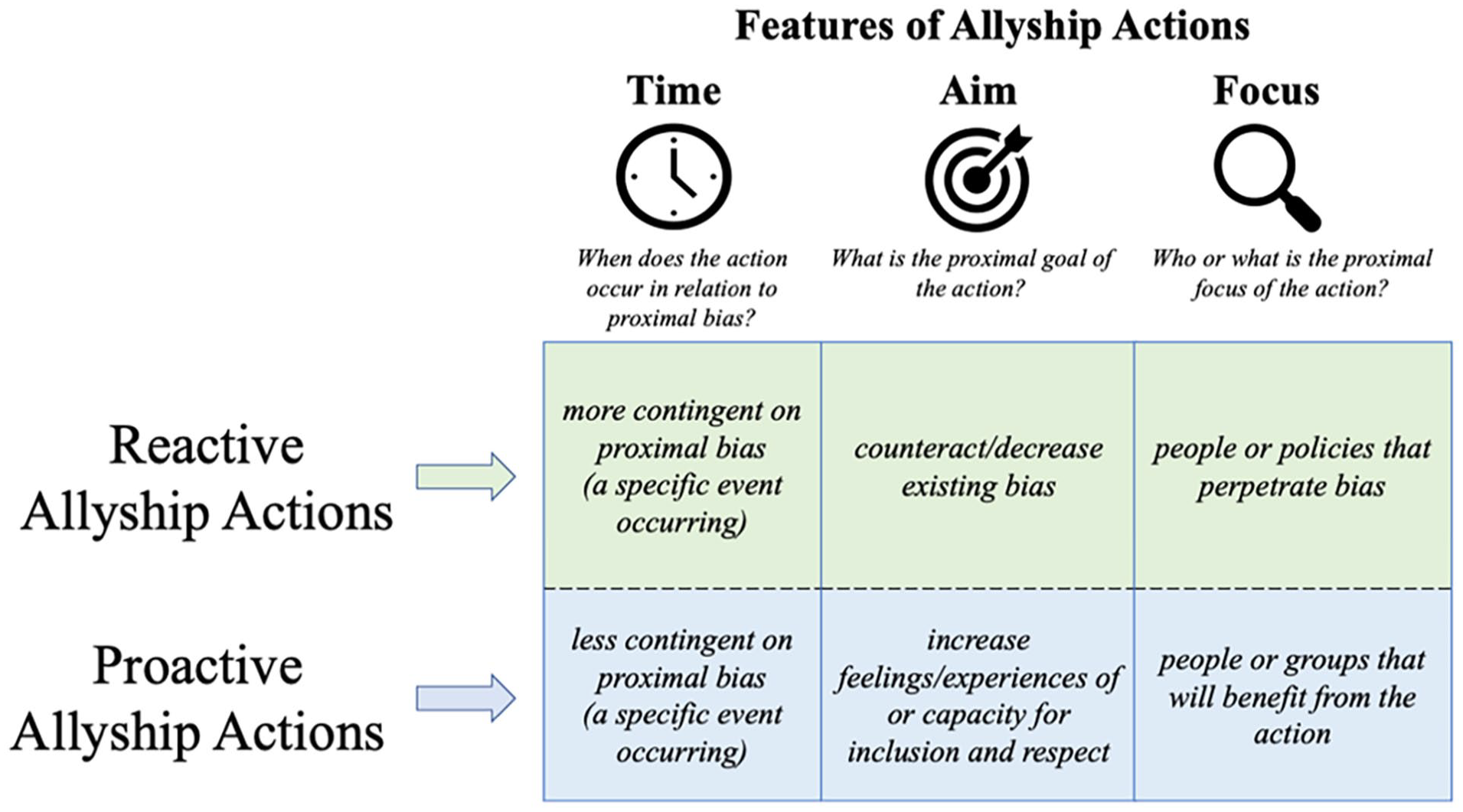
Distinguishing Reactive From Proactive Allyship Action
Timing: When Does the Allyship Action Occur in Relation to a Specific Event?
By definition, reactive and proactive actions differ in timing. Reactive actions are triggered by or contingent on a specific event (i.e., the presence of bias). Because social inequities are often systemic, one might argue that any form of action is a secondary, or reactive, intervention. Philosophically, we agree with this point; all actions in support of marginalized people are in response to the group’s marginalization. Nevertheless, reactive actions are unique in that there is a specific and proximal cue to bias that is observed and consequentially addressed. For example, for men to confront sexism (we categorize confrontation as reactive action), men must see or hear sexist comments, jokes, or behavior. Although similarly intending to foster EDI goals, proactive action differs from reactive action in that it is less contingent on a specific event occurring. In other words, people are not time constrained in taking proactive action because they do not need to wait to see a biased event happen. For example, without seeing bias, people can take measures to ensure that marginalized racial/ethnic groups’ voices are centered in the discussion, create job and educational opportunities for recent immigrant or refugee groups, or offer mentorship to early career women in male-dominated fields.
Some forms of allyship action are necessarily contingent on a negative event and therefore reactive (e.g., confrontation). We nevertheless note that context, specifically whether there is an event cueing bias, can shift whether an action is relatively more reactive or proactive. Consider someone offering mentorship to early-career women in male-dominated fields. Mentorship is most typically offered without a specific negative cue to do so and therefore we generally categorize it as a proactive action. However, if mentorship is offered after someone sees women being actively excluded, this same action becomes a more reactive measure to mitigate the impact of active exclusion. The timing of when actions occur in relation to proximal bias is the primary distinction between reactive and proactive action. Nevertheless, it is important to consider allyship action features that accompany timing as they have additional implications for comparing outcomes of reactive and proactive allyship actions.
Aim: What Is the Proximal Goal of the Allyship Action?
A second feature distinguishing reactive from proactive action is the behavior’s intended aim. Is the goal of the allyship action to address and reduce negative experiences or to foster and encourage positive experiences? We argue that for reactive actions, the proximal goal is to mitigate and/or counteract bias. For example, speaking up against a classist remark has the proximate goal of diminishing the legitimacy of the statement and/or attenuating the impact that the comment has on targeted people. In other words, reactive actions aim to decrease negative experiences (by reducing bias itself as well as its immediate negative consequences). In contrast, proactive actions aim to increase feelings of, experiences of, and/or capacity for inclusion and respect. For example, including women socially and professionally in male-dominated workplaces (aiming to increase inclusion), recruiting people of color for higher-ranked positions (aiming to increase representation), and educating oneself on how to support people with disabilities (aiming to increase self-efficacy) are all proactive actions.
We again recognize that allyship actions can have both reactive and proactive qualities in aim. Intentions to decrease the negative and increase the positive can coexist for a particular action, but it is nonetheless conceptually valuable to categorize actions by their predominant and proximal intention. It is possible that reactive actions are also aimed at increasing the positive, such as increasing feelings of inclusion by making it clear that expressions of prejudice will not be accepted in an organization. However, we suspect that here, the resulting feelings of inclusion are more of a distal aim than an immediate one. Reactive actions are first and foremost aimed at decreasing the bias that can create disparities for people who are marginalized; it is only through decreasing the negative that reactive action aims to increase the positive.
Similarly, proactive actions might, in the long run, decrease the negative (i.e., the expression of biases), for example, by raising awareness of racism and creating powerful norms for how to challenge it. Here, a long-term goal to decrease the negative might be accomplished from shorter-term goals to increase positive outcomes. By increasing positive outcomes, such as feelings of psychological safety for another person or self-efficacy in recognizing what bias could look like, proactive action might also build resilience against or capacity to address negative events in the future. Again, there is room for nuance; efforts to promote psychological safety might themselves be reactive if they come in response to a specific incident of exclusion.
Focus: Who or What Is the Allyship Action Focused on?
The third feature that distinguishes reactive and proactive allyship action is whether the focus of the action is on the perpetrator as the causal source of bias or on the individuals who stand to immediately benefit from the action. When reactive action is aimed at decreasing the negative, the proximal focus of the action (i.e., who or what does the action intend to affect) is on the perpetrators of the observed incident of bias. Perpetrators are not limited to another individual; they can be groups of people, oneself, or institutional policies, practices, and norms. Imagine a man works in an office where women and non-binary colleagues are actively excluded. If this man intends to decrease the alienation felt by his female and non-binary colleagues, he will focus his attention on the source of this exclusion: confronting other men when they make problematic jokes, speaking out against exclusionary institutional norms, and apologizing for his own behaviors when he realizes he has been exclusionary. Paralleling our conception of aim, the distal focus of the action may be those who are potentially affected by bias; in speaking out against sexist behaviors and practices, a man may certainly have women and non-binary people’s feelings of inclusion in mind. However, the proximal focus of the allyship action is the perpetrator, rather than those the action consequentially affects.
As proactive action is aimed at increasing positive outcomes, it is more likely to center foremost on people and groups that will benefit from the action. Proactive actions often concern members of groups that are marginalized in society, ensuring that those who could be potentially silenced and ignored are given equitable opportunities and resources. However, those who are not systemically marginalized can likewise be the focus of proactive action. For example, members of non-marginalized groups can educate people in their in-group about social issues. Education in this case benefits the majority group members, centered on their learning and perhaps reducing their expressions of bias in the future. As with time and aim, we recognize that similar actions can have differing foci across contexts. For example, if a majority group member acts (e.g., educating others) because problematic behaviors have recently occurred, this action becomes a more reactive measure focused on proximal perpetrators.
In sum, our typology distinguishes between two different types of action: those that are reactive to distinct episodes of bias when they occur and those that proactively aim to foster inclusion among those with the potential to feel marginalized. Although not always mutually exclusive, proactive and reactive actions are generally distinguished by differences in their proximal timing, aim, and focus. Beyond the conceptual benefits of these distinctions, considering timing, aim, and focus can also be beneficial in practice. For someone striving to practice effective allyship, reflecting on timing, aim, and focus allows for a deliberate decision on what actions might be most impactful in their specific contexts. 2
Next, we consider how, orthogonal to this distinction, allyship action can also differ by level or the scope of the issue addressed. Both reactive and proactive actions can be directed at oneself (intrapersonal), at another (interpersonal), or at institutional practices and policies.
Considering Level: Allyship Actions Addressing Intrapersonal, Interpersonal, and Institutional Issues
A core assumption underlying our approach is that people’s experiences of bias and inclusion occur within a localized cultural context whereby attitudes, beliefs, behavioral norms, and policies are mutually constituted at different levels of analysis (Markus & Kitayama, 2010; Stephens et al., 2021). Institutional policies and practices can foster cultural practices systemically through rules, procedures, and incentive structures. Those systemic cultural signals can then shape the nature of people’s interpersonal interactions, which in turn have consequences for individuals’ own experiences. But individuals’ own attitudes and beliefs can also shape how they interact with one another and the degree to which they support changes to systemic structures in that organization. When members of the advantaged group (those of the cultural default) engage in reactive or proactive action, they might do so with the hope of enacting a change in their local culture at any of these levels of analysis (Dang & Joshi, 2022; Schmader et al., 2020; Sue et al., 2019). This multilevel understanding of what culture is suggests that allyship actions in one’s local culture could be targeted at any of these three different entry points (Schmader et al., 2020). For example, at two levels of analysis, Sue and colleagues (2019) distinguish between individuals’ actions (micro-interventions) that address micro-aggressions (individual perpetrators’ behaviors) and macro-aggressions (changing institutional practices and social policies). However, in the existing literature, scholars have tended to propose and test theories for only one type of action at one level of analysis.
In our review, we seek to demonstrate that reactive and proactive actions occur at each of these three levels. We do this by organizing some of the most prominent bodies of social psychological literature into a two (Type of Action: Reactive, Proactive) by three (Level of Action: Intrapersonal, Interpersonal, Institutional) typology (see Figure 3 for overview). As emphasized in our definition of allyship above, we always refer below to an individual acting, although the individual’s action targets intrapersonal, interpersonal, or institutional level issues. Although we acknowledge that this typology might not cover the entirety of research on possible action, we believe it provides a coherent conceptual framework by which traditionally separate literature can be integrated and compared. In addition, our goal is not to provide an exhaustive review of research in each category but rather to highlight the broader conceptual distinctions among them.
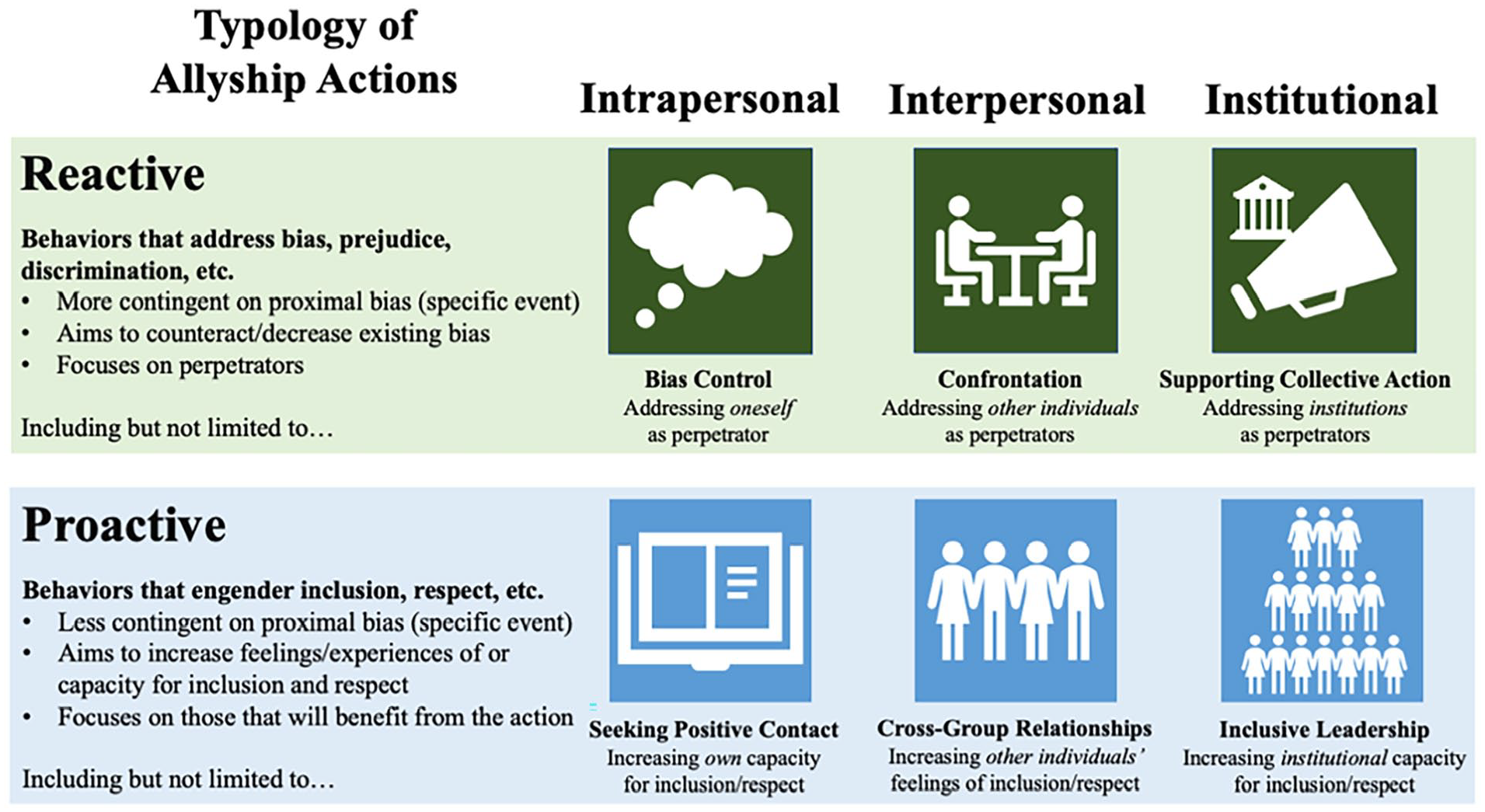
Reactive and Proactive Allyship Action at Three Levels
Reactive Allyship Action at the Intrapersonal Level: Bias Control
Where do intergroup biases come from and how do we address them? Seeking answers to these questions, social psychologists have long attended to the prejudicial attitudes, stereotyped beliefs, and discriminatory behaviors of individuals as the main arena for change (Grzanka & Cole, 2021). When framed as individual-level allyship action, efforts to change one’s own prejudicial attitudes, stereotypes, and/or discriminatory behavior can be labeled intrapersonal reactive action. In other words, these are actions evoked when people recognize that their own beliefs and behavior are mismatched with their egalitarian values, setting in motion efforts to actively control, inhibit, or address those negative thoughts, feelings, or behaviors. For example, one might actively reflect on assumptions they have about out-groups, apologize for problematic behaviors, and/or make efforts to avoid repeating them.
Encompassing some of these examples, one area of literature that best exemplifies intrapersonal reactive action is bias control, where individuals work to actively downregulate or suppress their own negative intergroup attitudes or stereotypes (for review see Monteith et al., 2016). We center on bias control from people who actively strive to be egalitarian (i.e., those internally motivated to respond without prejudice; Amodio et al., 2008, 2003; Devine et al., 2002; Klonis et al., 2005). This is not to suggest that people who are primarily externally motivated do not engage in self-regulation (e.g., Blanchard et al., 1991; Monteith et al., 1996). However, only bias control from those who are internally motivated fits our definition of allyship action as they are acting for the purpose of supporting disadvantaged groups.
Research on bias control assumes that those who aim to support members of marginalized groups are egalitarian in their beliefs. However, distinct from their explicitly reported beliefs and values, these same egalitarian-minded people can hold implicit attitudes and stereotypes (Devine, 1989; Greenwald & Banaji, 1995; also see Payne & Gawronski, 2010), associating members of certain social groups (e.g., Black-Americans) with negative feelings or thoughts (e.g., aggression) that can be automatically activated. When these cognitions or affective responses are activated, they may engender biased behavior (e.g., evaluating Black Americans as more hostile in ambiguous situations; Devine, 1989; Devine & Monteith, 1999; Dovidio et al., 1997, 2002; Dovidio & Gaertner, 1993).
Timing
Although some have proposed that these automatic processes are beyond one’s control (Bargh, 1999), most research suggests that people can engage in controlled processes to diminish the expressions and consequences of bias (Blair et al., 2002; Cunningham et al., 2004; Devine, 1989). Such control assumes that people catch themselves thinking or behaving in biased ways, are motivated to downregulate these reactions, and have the cognitive capacity to do this effectively. In this way, and in the context of our time feature, bias control strategies are typically reactive actions because they are executed in the presence or in response to (one’s own actual or potential for) bias. As a concrete example, research has examined how bias control can be facilitated by implementation intentions: “If-Then” plans that allow for people to act against their own biased thoughts or behavior (Gollwitzer, 1999; Mendoza et al., 2010). A person identifies an “if” situation relevant to their biases (e.g., If I realize I am making assumptions about a woman’s expertise) and develops a “then” plan to counter it (e.g., . . .then I will take a moment to reflect on where that thought is coming from and how it is incorrect). Another well-discussed form of bias control is to replace automatically activated stereotypes by reflecting on counter-stereotypic exemplars (Blair & Banaji, 1996; Blair et al., 2001; Joy-Gaba & Nosek, 2010).
We reemphasize that there is room for nuance in describing actions through our typology. Planning an “If-Then” strategy or reflecting on counterstereotypes without a specific cue may be considered more proactive, as doing so is not contingent on bias or stereotypes occurring, and decreases bias/stereotypes through increasing one’s knowledge of what is (not) biased or stereotypical. However, the actual implementation of an If-Then plan or counter-stereotyping as a bias control strategy can be considered a reactive action as it occurs only in the presence of bias (and is centered on mitigating the specific problematic thought or behavior).
Aim
Research on the impact of bias control reveals that these strategies fit the aim feature of reactive action: bias control successfully diminishes individuals’ problematic thought and behavior patterns. Monteith’s (1993) self-regulation of prejudice model suggests how bias control strategies meet the aim to reduce bias: after thinking or behaving in a biased way (reflecting bias control’s contingency on bias occurring), people experience incongruity between their values and their behavior. This in turn increases negative affect and reflection on one’s behaviors (e.g., guilt; Amodio et al., 2007; Monteith et al., 2002; Monteith & Mark, 2005). Activating the behavioral inhibition system, this experience subsequently creates cues for control: People become conscious of the cues to their bias and can better avoid having the same response in future, similar contexts (Monteith, 1993; Monteith & Mark, 2005). In line with Monteith’s self-regulation model, research on specific bias control strategies demonstrates their success in reducing bias. For instance, implementation intentions reduce stereotyping, specifically by changing one’s automatic processes (Stewart & Payne, 2008). Challenging one’s biases with counterstereotypes decreases stereotyping (Blair & Banaji, 1996; Blair et al., 2001; Dasgupta & Asgari, 2004; Joy-Gaba, & Nosek, 2010; although see Hugenberg et al., 2010).
Focus
With an aim to identify and reduce the specific biases that individuals hold, the direct focus on bias control is on the self as a perpetrator of bias. Bias control is effective in helping perpetrators of bias increase their awareness of and challenge their beliefs and behaviors, both in the shorter and the longer term (e.g., Devine et al., 2012). Moreover, self-regulation strategies can also increase perpetrators’ concern for discrimination generally (Devine et al., 2012, 2017; although these interventions also include proactive strategies such as perspective-taking and intergroup contact, reviewed below).
Intrapersonal reactive action identifies and mitigates bias, focusing on oneself as the perpetrator (e.g., actions described in the bias control literature). Nevertheless, not all actions at the intrapersonal level necessarily involve addressing negative thoughts and behaviors; intrapersonal proactive action can be taken without the presence of bias.
Proactive Allyship Action at the Intrapersonal Level: Seeking Positive Contact
Like intrapersonal reactive action, intrapersonal proactive actions are behaviors focused inward on the self. However, intrapersonal proactive actions differ in that the aim is not to mitigate one’s own problematic biases but rather to expand one’s capacity to support members of marginalized groups by actively increasing more positive attitudes and beliefs about out-groups. People who take intrapersonal proactive action might strive to become more conscientious about social issues, seek opportunities to learn about other groups, or preemptively develop skills to confront bias. For example, in The Nature of Prejudice, Gordon Allport (1954) suggests that people must be open to new experiences with other groups to become more fair-minded. Thus, one example of intrapersonal proactive action is when members of an advantaged group seek out positive contact as a strategy to broaden their own understanding of the out-group.
It might seem counterintuitive to categorize seeking positive contact as an intrapersonal strategy, given the interpersonal nature of contact. We differentiate intrapersonal from interpersonal level actions by examining who the action is first and foremost oriented toward (i.e., is it for the benefit of oneself or another individual). In this way, we argue that positive contact can vary in scope depending on the primary objective of the action. Seeking positive contact as a method for self-expansion, as often described in the intergroup contact literature (for further discussion, see Wright & Lubensky, 2009), is more oriented toward the advantaged group members themselves. We view seeking positive contact in this way as qualitatively different from engaging in mutually beneficial relationships (i.e., where both groups directly benefit from the interaction; see our interpersonal proactive section below). Although advantaged group members hope to gain knowledge about out-group members, they might often still be focused on broadening one’s own perspective rather than benefiting out-group members per se.
We acknowledge that beyond taking action to seek out positive contact, beneficial aspects of that contact likely do move toward the interpersonal level. Beginning with Gordon Allport (1954) and reformulated by Thomas Pettigrew (1998), intergroup contact theory suggests that cross-group interactions are effective in reducing prejudice, specifically when they allow for learning about the outgroup, adopting new behaviors, creating affective ties, reappraising one’s in-group, and providing an opportunity for cross-group friendships (Pettigrew, 1998; for empirical support of intergroup contact theory, see Lemmer & Wagner, 2015; Pettigrew & Tropp, 2000, 2006). When positive contact results in these friendships, there is a potential for allyship action at the interpersonal level, which we will discuss in more detail below. First, we further justify why the act of seeking out intergroup contact is an intrapersonal proactive action.
Aim
Although prejudice reduction is a downstream consequence of intergroup contact, we believe that the more immediate aim of intergroup contact is not a reactive effort to reduce one’s own prejudice but the proactive aim to foster positive experiences. Allport (1954)’s original contact hypothesis suggests that prejudice reduction is a direct outcome of intergroup contact, only possible under certain conditions (equal status, common goals, cooperation, and support of authority). However, recent theorists frame Allport and Pettigrew’s conditions for successful intergroup contact not as prerequisites but as social psychological processes driving attitude change (Wright, 2009a; Wright et al., 2008; Wright & Van Der Zande, 1999). We believe these mediating processes are often immediate aims of contact and are proactive in nature.
For example, intergroup contact engenders perspective-taking that subsequently promotes positive feelings and empathy toward out-groups (Batson et al., 1997, 2003; Dovidio et al., 2010; Finlay & Stephan, 2000; Pagotto et al., 2010; Pettigrew & Tropp, 2008; Stephan & Finlay, 1999; Vescio et al., 2003). Moreover, intergroup contact can motivate people to support reconciliation between groups and promote future positive contact (for a review of this empirical work, see Tropp et al., 2017). These positive outcomes of intergroup contact are found cross-culturally; for instance, intergroup contact predicted stronger awareness of discrimination toward transgender people in Hong Kong (King et al., 2009) and greater perspective-taking and trust toward ethnic minority members in Northern Cyprus, Romania, and Israel (Çakal et al., 2021).
Beyond affective experiences, intergroup contact can catalyze cognitive processes such as stereotype disconfirmation and enhancing knowledge of the out-group (Davies, Wright, et al., 2011; Pettigrew, 1998; Pettigrew & Tropp, 2008; Stephan & Stephan, 1985; Tausch & Hewstone, 2010; Wright et al., 2004). Taken together, intergroup contact is most impactful in giving rise to positive, capacity-building experiences for advantaged group members (although it can also buffer people from negative experiences, specifically anxiety and threat; Barlow et al., 2009; Binder et al., 2009; Blascovich et al., 2001; Islam & Hewstone, 1993; Levin et al., 2003; Page-Gould et al., 2008; Pagotto et al., 2010; Paolini et al., 2004; Pettigrew & Tropp, 2000, 2008; Stephan et al., 2002; Stephan & Stephan, 1985; Tropp & Barlow, 2018; Voci & Hewstone, 2003; see Techakesari et al., 2015 in the context of Hong Kong and Thailand; also see Stephan, 2014 for review). Thus, seeking out positive contact might typically be aimed at promoting personal growth first, not reducing one’s own biases.
Focus
Seeking out intergroup contact (as a form of allyship action) is most proximally aimed at engendering these positive outcomes rather than challenging bias. It follows then that it is a proactive action focused on the individual (i.e., the advantaged group member) most directly affected by the action (i.e., experiencing a change in attitudes, perspective, or outlook). This is not to imply that intergroup contact is never focused on outcomes for disadvantaged group members (which we discuss in our section on interpersonal proactive action), but it is important to differentiate seeking intergroup contact to change one’s own attitudes from having the sort of contact that builds mutually beneficial relationships.
Time
Finally, considering the time feature, seeking out intergroup contact falls within the proactive category as making efforts to diversify one’s own perspectives and social networks is not contingent on the presence of bias. A motivation to seek out diversity in one’s life for self-expansion (e.g., Dys-Steenbergen et al., 2016; Paolini et al., 2016), learning (e.g., Migacheva & Tropp, 2012), or because one values diversity (e.g., Tropp & Bianchi, 2006) can inspire interest in interpersonal contact (also see Paolini et al., 2018), without needing a biased cue to do so.
In sum, intrapersonal proactive actions are focused on increasing individuals’ understanding of and capacity for supporting those from marginalized groups. Seeking out positive contact involves engagement with disadvantaged group members; however, if the goal is centered on the personal growth of the advantaged group member, the action is intrapersonal rather than interpersonal in nature. In the next section, we describe how actions can expand beyond the individual and center on one or multiple others.
Reactive Allyship Action at the Interpersonal Level: Confrontation
Interpersonal reactive actions are behaviors targeted toward another or several other individuals to directly address bias. With this definition in mind, confrontation is the most prototypical form of interpersonal reactive action (although there are certainly other behaviors that would fall under this classification, e.g., educating people who express biased beliefs, and identifying problematic assumptions in others’ arguments; Sue et al., 2019). Confrontation is broadly defined as “expressing one’s dissatisfaction with prejudicial and discriminatory treatment to the person who is responsible for the remark or behavior” (Shelton et al., 2006, p. 3).
Time
Although confrontation behaviors are all characterized by an expression of dissatisfaction, these expressions can take various forms (Chaney & Sanchez, 2021; Woodzicka & Good, 2020): verbal or non-verbal (e.g., frowning, looking away, eye-rolling; Saucier et al., 2020), direct or indirect signals of condemnation (e.g., comments of inappropriateness versus low stakes prodding, questioning, sarcasm/humor, and grumbling; Swim & Hyers, 1999; Woodzicka et al., 2020; Woodzicka & Good, 2020; see Czopp & Ashburn-Nardo, 2012 for further review), and high or low threat (e.g., accusatory/calling a person bigoted versus expressing disapproval of prejudice without threatening a person’s self-conception as a “good person”; Becker & Barreto, 2014; Chaney & Sanchez, 2021; Czopp et al., 2006). Regardless of form, however, all confrontation behaviors fall under the reactive category because of their timing. By definition, confrontation requires something to challenge. In our context, interpersonal confrontation involves responding to specific cues to bias perpetuated by one or several individuals.
Focus
In addition, interpersonal confrontation is focused on perpetrators of action. Interpersonal confrontation can certainly benefit those who are potentially impacted by bias; confrontation can buffer targeted group members from lowered self-confidence, self-stereotyping, decreased task performance (Cihangir et al., 2014) and protect identity-safety (specifically when confrontations are affirmed by bystanders; Hildebrand et al., 2020). However, the direct focus of the action is not on the people who are potentially affected but on addressing the person or a few people who are responsible for harm.
Aim
With a focus on the source of bias, the aim of interpersonal confrontation is to mitigate its presence and future occurrence. Research demonstrates that confrontation is effective in this aim; when confronted, perpetrators experience negative affect (e.g., guilt, rumination), which in turn promotes behavioral change. For example, the confronted subsequently find problematic jokes less funny, use fewer stereotypes, and become better at detecting problematic behavior in the future (Chaney & Sanchez, 2018; Czopp & Monteith, 2003; Czopp et al., 2006; Mallett & Wagner, 2011). In other words, interpersonal confrontation is most proximally directed at reducing or changing the prejudiced thoughts or behaviors of others.
Interpersonal reactive actions, best exemplified by confrontation, occur in response to bias. These actions are focused on perpetrators, as one or several other individuals, with the goal to raise awareness of, punish, and/or reduce social biases. As is the case with intrapersonal actions; however, interpersonal actions are not always in response to negative biased events. Below, we discuss how interpersonal actions can likewise be proactive.
Proactive Allyship Action at the Interpersonal Level: Positive Cross-Group Relationships
Like interpersonal reactive actions, interpersonal proactive actions are externally focused. However, as our model suggests, interpersonal proactive actions are explicitly aimed at improving the experiences of one or a few individual members of minoritized groups. The focus is not on addressing perpetrators or broadening one’s own perspective as an advantaged group member (although the latter may still happen as an outcome) but on supporting those who are at risk of feeling or being excluded based on their social identity. People can take interpersonal proactive action to support members of disadvantaged groups in various ways, including but not limited to providing resources and opportunities to one or a few individuals, supporting their endeavors, and conveying respect for their perspectives, contributions, and experiences.
Above, we alluded to how seeking out positive contact can be an intrapersonal proactive allyship action if done for one’s own benefit. However, when intergroup contact is a mutually beneficial relationship, it can be a powerful strategy for improving outcomes for disadvantaged group members. For this reason, we consider intergroup contact that takes the specific form of longer-lasting, mutual relationships as a form of interpersonal proactive action. Below, we draw from research on the impact of positive contact that focuses on chronic and reciprocated relationships specifically (e.g., colleague interactions, cross-group friendships).
Timing
Unlike confrontation, which includes actions that directly address perpetrators of bias, proactive interpersonal actions are not responsive to bias. Rather, they seek to foster inclusion in those at risk of feeling marginalized before or without a specific biased event occurring. Through positive contact, advantaged group members have a privileged opportunity to signal inclusion in environments where disadvantaged group members may be attentive to potential identity-based judgments (Dwertmann et al., 2018). Demonstrating the impact of positive contact independent from the presence of bias, W. Hall and colleagues (2018, 2019) found that positive workplace conversations with men in their organization most strongly predicted identity safety for women in STEM. The same benefits were not observed for having similarly supportive interactions with women. Moreover, women’s negative experiences of identity threat and burnout were predicted by the absence of interpersonal support, not by the presence of hostility or conflict. Such findings support our claim that actions from advantaged group members can be uniquely beneficial and need not be reactions to bias.
Focus
Positive contact as interpersonal action is similar to positive contact as intrapersonal action in that the focus is on the beneficiaries of the action. As with intrapersonal positive contact, advantaged group members can benefit from relationships with members of disadvantaged groups. However, positive contact at the interpersonal level expands beyond the advantaged individual by also focusing on supporting or improving the experiences of disadvantaged group members. Although our conception of focus is oriented toward beneficiaries, this distinction parallels that of Trawalter and Richeson’s (2006) prevention versus promotion approaches, where the focus is on positive interaction with a disadvantaged group member rather than one’s own biases. Through establishing mutual relationships, members of advantaged groups are not only addressing their desires to become more knowledgeable and supportive people but also benefiting those they engage with. This reflects an interpersonal proactive aim.
Aim
The immediate aim of positive contact in meaningful relationships is to increase positive outcomes for members of disadvantaged as well as advantaged groups (thus it is interpersonal, rather than intrapersonal. In general, intergroup contact that develops into longer-lasting cross-group relationships promotes friendship, closeness, and self-expansion which subsequently cultivates positive attitudes toward outgroup members [Davies, Tropp, et al., 2011; Davies, Wright, et al., 2011; Herek & Capitanio, 1996; Tropp et al., 2017; Wright, 2009a; Wright et al., 2004, 2005). For example, cross-group dialogue has been found to increase capacity for perspective-taking among both Israeli-Jewish and Arab-Palestinian adolescents, leading to decreased tension and increased empathy in interactions (Influs et al., 2019). In addition to these general benefits for everyone, cross-group friendships have been found to increase feelings of belonging and satisfaction among disadvantaged group members who are susceptible to feeling excluded (Mendoza-Denton et al., 2006; Mendoza-Denton & Page-Gould, 2008). Moreover, positive cross-group ties can increase individuals from disadvantaged group’s resilience against the psychological harm of exclusion (both anticipated and actual, e.g., Marinucci et al., 2021; Page-Gould et al., 2008, 2014).
In sum, intergroup contact as relationships exemplifies how interpersonal proactive actions can be taken at any time (they are not dependent on witnessing bias) and aim to increase positive outcomes for one or multiple others. Nevertheless, both proactive and reactive action is not and should not be limited to interactions between individuals. Biases do not only manifest in interpersonal actions or judgments; they are also often embedded in institutional systems. We next highlight actions that seek to engender equity, diversity, and inclusion at institutional levels.
Reactive Allyship Action at the Institutional Level: Supporting Collective Action Efforts
As described in our reviews above, the social psychological literature has traditionally centered on individuals and the interactions between them as the source of bias. Nevertheless, researchers over the past several decades have also considered the ways in which people address social inequities rooted in institutional practices. We define this type of action as institutional reactive: behaviors that challenge biased policies, practices, and norms that systematically disadvantage specific groups of people. These behaviors address issues embedded in structures, larger than single individuals or the interactions between them. We emphasize that individuals can be agents of institutional reactive action, but the target of the action expands beyond problematic individuals. For example, individuals can protest institutional practices and systemic biases that harm disadvantaged groups and speak out against oppressive norms (Sue et al., 2019).
In the social psychological literature, research on support for collective action best represents this institutional reactive action, as it is focused on improving the status or influence of an entire disadvantaged group in society (Becker, 2012; van Zomeren & Iyer, 2009; Wright et al., 1990). Although collection action, by definition, occurs at the level of groups, not individuals, collective action research often assesses individuals acting as representatives of a disadvantaged group to participate in or support a group-performed action such as signing a petition or joining a demonstration (Becker, 2012; van Zomeren & Iyer, 2009). 3 In addition, collective action can take both normative (e.g., political participation, peaceful demonstrations, petitions) and non-normative (e.g., violence, civil disobedience) forms (Becker & Tausch, 2015; Shuman et al., 2020; Tausch et al., 2011), although we review research on the former.
Although collective action research has attended to systematically disadvantaged groups participating in struggles for power and/or justice (Simon & Klandermans, 2001; Wright & Lubensky, 2009), advantaged group members can and do participate in movements. Joining movements and banding with disadvantaged group members around shared opinions promotes support and participation for advantaged groups (McGarty et al., 2009; Thomas & McGarty, 2009). Advantaged group members can be particularly impactful in speaking up against and changing sources of systemic biases at the institutional level as they are often more likely to have the power and resources to persuade others or enact change directly (Iyer & Leach, 2009).
It is crucial however to highlight an alternative perspective of how advantaged group members should take institutional reactive action. Collective action is often described specifically as action without direct participation from dominant outgroups (J. Drury et al., 2015) which is necessary to motivate an empowered front among the disadvantaged group (Dixon et al., 2012; Droogendyk, Wright, et al., 2016; J. Drury et al., 2015; Iyer & Achia, 2021; Nadler et al., 2009; Nadler & Halabi, 2006; Radke et al., 2016; Wright & Lubensky, 2009; Wright & Tropp, 2002). As an alternative, scholars suggest that advantaged groups should engage in supportive contact (Droogendyk, Louis, &Wright, 2016; Droogendyk, Wright, et al., 2016). Supportive contact is likewise an institutional reactive action, in which advantaged group members explicitly challenge injustice and support disadvantaged groups’ collective action efforts (but do not take leading roles within them; Droogendyk, Louis, &Wright, 2016; Droogendyk, Wright, et al., 2016). As collective action and supportive action efforts are similar in terms of our typology, we discuss them simultaneously (as collective and supportive actions), nevertheless recognizing that the nature of advantaged group members’ participation differs between them.
Timing
Collective and supportive actions both fall under the reactive category given their temporal relationship to inequities. Perceiving institutional policies or beliefs as biased evokes outrage and consequentially motivation and participation in collective action against the issue (e.g., in the case of disadvantaged groups: Becker & Wright, 2011; van Zomeren et al., 2004 also see Dixon et al., 2016; Spring et al., 2018). For advantaged group members, perceiving their group-based advantage as immoral can elicit guilt and anger, which in turn motivates support for political action (Iyer et al., 2003; Leach et al., 2006). For example, group-based anger predicts Hong Kong Chinese people’s willingness to address discrimination against people from Mainland China (e.g., signing petitions and participating in demonstrations; van Zomeren et al., 2011). In this way, collective and supportive actions are a reaction to specific inequities.
Focus
In addition, it is important to recognize that the specific inequities that collective and supportive actions respond to are not incidental. Collective and supportive actions hold institutions responsible for inequities and focus on organizational-level structures as perpetrators of these unfair outcomes. We note that although the inequities that collective and supportive actions strive to address expand beyond individuals and their interactions, they are no less concrete. On a larger scale, people identify specific issues as present and specific perpetrators to be held accountable. For example, individuals participating in the Black Lives Matter movement have responded to and organized against racist practices, policies, and norms carried out by the state as an institution (Black Lives Matter, n.d.; Howard University School of Law, 2022).
Aim
Furthermore, the aim of collective and supportive actions is to bring about institutional change that reduces bias. Collective and supportive actions aim to demolish and/or transform the institutional structures that advantage certain groups over others (most successfully through identifying the issue to others and influencing public opinion; Burstein, 2003; Shuman et al., 2020; Simon & Klandermans, 2001; Thomas & Louis, 2013, 2014; Wright, 2009b).
Taken together, institutional actions such as engaging in collective movements are powerful responses to large-scale issues. Institutional reactive action involves both demanding and carrying out efforts to reduce society-level bias. While institutional reactive actions involve dismantling inequitable policies, practices, and norms, proactive actions at this level can create practices and norms that are equitable.
Proactive Allyship Action at the Institutional Level: Inclusive Leadership
Institutional proactive actions establish and maintain policies, practices, and norms that are beneficial to disadvantaged groups. Although these actions are targeted toward larger institutions (e.g., working toward inclusive organizations), they are often taken by individuals. For example, individuals can create or advocate for equitable practices, support programs that seek to empower communities that are structurally underprivileged or vote in favor of people or policies that attend to the interests of disadvantaged groups (Sue et al., 2019).
Another example of institutional action is inclusive leadership, popularly discussed in organizational psychology scholarship. Precise definitions of inclusive leadership vary, but predominately center on how individuals,’ particularly those in positions of power, can embrace and value different perspectives (e.g., Nembhard & Edmondson, 2006; Nishii & Mayer, 2009; Randel et al., 2018; Shore et al., 2011). The literature on inclusive leadership describes how these individuals work at both intrapersonal (e.g., seeking feedback on their leadership from people from diverse groups) and interpersonal levels (e.g., mentoring others; see Ferdman, 2014 and Gallegos, 2013). However, we review inclusive leadership as an action that those in positions of power can use to influence the larger cultural norms of an institution (Douglas et al., 2003). For example, leaders can signal norms for how people in the group behave through role modeling certain behaviors (Randel et al., 2018). Inclusive leaders also directly create policies and procedures that take place at an institutional level (Ferdman, 2014). Moreover, we recognize that leaders who strive for inclusivity can take institutional reactive action through addressing, challenging, and changing problematic aspects of their organization. However, by inclusive leadership here we specifically refer to leaders’ proactive creation and maintenance of policies, practices, and norms that foster equity, diversity, and inclusion.
Timing
Why is inclusive leadership proactive, if an active intention to be inclusive could be considered a response to systematic underrepresentation and devaluing of certain identity groups within organizations? As explained in the introduction, efforts to make an organization inclusive could be considered reactive in a distal sense in that they are responding to a general concern for exclusion. However, in this context, inclusive leadership actions are often proactive in a proximal sense. Inclusive leadership actions are not taken in response to observed biases in existing policies and practices (i.e., its timing is not contingent on there being a specific issue at hand), rather they are the policies and procedures put in place to foster a diverse and inclusive organization. For example, leaders can take measures to ensure that practices (how the organization functions) and norms (how their team members are expected to interact with one another) are oriented toward valuing diverse perspectives and backgrounds from the very beginning of the organization (not only after experiences of exclusion have occurred).
Focus
Inclusive leadership as a form of institutional proactive action is focused on supporting and empowering those who are led (although leaders can certainly engage in institutional reactive action by challenging and changing problematic policies and norms). As described by Randel and colleagues (2018), the objective of inclusive leadership is to satisfy the needs for belonging and individuality for those within the group. More generally, inclusive leadership is targeted toward “[benefiting] diverse teams through its focus on accepting women and minorities while simultaneously valuing all members for their unique attributes, perspectives, and contributions, ultimately leading to higher performance” (Randel et al., 2018, p. 191). In this way, both disadvantaged and advantaged group members can benefit from inclusive leadership. However, one could argue that members of disadvantaged groups benefit more: Without inclusive leadership, disadvantaged groups members are at more risk of feeling excluded than those who identify with the organization’s cultural default.
Aim
As inclusive leadership is focused on supporting those who are led, it follows that its proximal aim is proactive. First, the initiatives that inclusive leaders endorse can increase positive outcomes for members of disadvantaged groups in an organization. For example, leaders who successfully institute diversity initiatives (increasing numerical representation of different groups) can increase their team members’ ability to share, consider, and accept dissimilar opinions (Antonio et al., 2004; Lount & Phillips, 2007; Phillips, 2003; Phillips et al., 2004, 2006, 2011; Phillips, Liljenquist, & Neale, 2006; Phillips, Rothbard, & Dumas, 2009; Phillips & Loyd, 2006; Sommers, 2006).
Second, inclusive leaders themselves can increase positive outcomes for those that they lead. For example, leaders who listen to and value diverse perspectives can increase psychological safety (e.g., Carmeli et al., 2010; Edmondson, 2004; Hirak et al., 2012; Javed et al., 2017; Nembhard & Edmondson, 2006), trust (Huo et al., 2005), and engagement (e.g., Mitchell et al., 2015; Sabharwal, 2014) among their group members. In the context of ethnic and cultural diversity, leaders who promote multicultural values are more successful in attracting and retaining people from diverse backgrounds (see Hebl & Avery, 2013) and can increase feelings of identity safety for members of disadvantaged groups (Chaney et al., 2016; Dover et al., 2016; Purdie-Vaughns et al., 2008). For instance, inclusive leadership positively predicted organizational citizenship behaviors (e.g., willingness to participate in the life of the organization, and helping colleagues) among employees in Vietnam (Hanh Tran & Choi, 2019).
In conclusion, institutional proactive actions establish and/or maintain policies, practices, and norms that engender equity, diversity, and inclusion for disadvantaged groups. Although occurring on a larger scale than intrapersonal and interpersonal level actions, individuals can be impactful in carrying out these changes (as demonstrated in the inclusive leadership literature).
Comparing the Unique Benefits and Constraints of Reactive and Proactive Allyship Action Broadly
Thus far, we have summarized how several distinct bodies of literature can be organized and integrated into a typology of action characterized by whether the action is reactive or proactive and is directed at influencing oneself, others, or the institutions where biases can and do occur. Each of these literature provides some evidence that members of advantaged groups can be effective in addressing bias using these various actions. Below we return to broader conceptions of reactive versus proactive forms of action to highlight points of commonality and difference in terms of costs and benefits across the different levels.
Common Benefits and Constraints of Reactive Allyship Action
Identifying and addressing bias when it occurs can be powerful in enacting change at all three levels of scope. Although discussions of reactive allyship most commonly conjure images of countering bias at the interpersonal level (in which confrontation evokes negative affect and motivates change), we have demonstrated that reactive action can also be framed as decreasing or counteracting one’s own problematic beliefs and associations toward marginalized groups and challenging inequitable institutional policies, practices, and ideologies.
The literature we reviewed reveal several benefits of reactive action. Most significantly, reactive action successfully creates change. Reactive action can successfully disrupt problematic patterns for individuals (e.g., Blair & Banaji, 1996; Blair et al., 2001; Dasgupta & Asgari, 2004; Monteith, 1993; Monteith & Mark, 2005; Stewart & Payne, 2008), discourage problematic behaviors from others (e.g., Chaney & Sanchez, 2018; Czopp et al., 2006; Czopp & Monteith, 2003; Mallett & Wagner, 2011), and put pressure on those in power to change inequitable, institutional conditions (e.g., Burstein, 2003; Louis, 2009; Shuman et al., 2020; Simon & Klandermans, 2001; Thomas & Louis, 2013; Wright, 2009b). In this way, reactive action is a powerful tool for addressing systemic oppressions that impact certain identity groups. Another way in which reactive action is impactful is the unique impact advantaged group members have in comparison to disadvantaged group members. Advantaged group members can confront bias with less risk of being viewed as overreactive complainers (Czopp & Monteith, 2003; Kaiser & Miller, 2001, 2003; Rasinski & Czopp, 2010). Moreover, advantaged compared with disadvantaged group members are often more influential in their reactive actions because they are perceived as less self-interested (Czopp & Monteith, 2003; B. J. Drury & Kaiser, 2014; Rasinski & Czopp, 2010).
Although impactful, reactive action does have constraints. Most notably, people hesitate to be confrontational (e.g., Ayres et al., 2009; Brinkman et al., 2011; Crosby & Wilson, 2015; Dickter, 2012; Dickter & Newton, 2013; Kawakami et al., 2009; Rasinski et al., 2013; Swim & Hyers, 1999; Woodzicka & LaFrance, 2001) because it risks penalization. People generally are motivated to uphold the status quo (Jost & Banaji, 1994; Jost & Hunyady, 2002) and therefore might punish those who are oppositional. For example, Czopp and colleagues (2006) found that confronters of expressions of prejudice are liked less than non-confronters. In light of the risk of backlash, merely anticipating risk can inhibit people’s reactive action (Ashburn-Nardo et al., 2008). People are less likely to confront others’ expressions of prejudice if they believe they will be disliked, anger the confronted, or lose professional opportunities (Good et al., 2012; Shelton & Stewart, 2004). In addition, because social belonging is important (Baumeister & Leary, 1995) and people are ostracized for breaking social norms (Schachter, 1951), advantaged group members may avoid confrontation to fit in with their own group. Breaking these social norms can lead one to become an outsider to their identity group (e.g., Cadieux & Chasteen, 2015). Nonetheless, these constraints of reactive action vary across contexts. In some situations, people are not penalized for reactive action and are sometimes even liked for speaking out against bias (e.g., Dickter et al., 2012; Woodzicka et al., 2015). Therefore, an advantaged group member who believes that their in-group members see bias as problematic may be more inclined to take reactive action (De Souza & Schmader, 2022).
Another constraint to reactive action involves timing. As described in Ashburn-Nardo and colleagues’ (2008) Confronting Prejudice Responses (CPR) model, people must be able to detect issues to address them and they are not always aware of what constitutes bias (even in themselves). Although bias might be clear when it is overt, people have difficulty identifying it when it is more subtle (Devine, 1989). Moreover, some forms of bias may be more difficult to detect than others; although people are able to detect prototypical forms of bias such as racism and sexism well, they struggle with detecting less prototypical forms, such as ageism and sizeism (Marti et al., 2000). Although centered on interpersonal confrontation, this first hurdle in the CPR model is applicable to reactive action generally. For example, Monteith and colleagues (2009) address this limitation in the context of intrapersonal action (specifically bias control), “. . .individuals need to recognize the potential for bias in the first place. . .” (p. 219). At the institutional level, collective and supportive action involves getting advantaged group members to recognize that an institutional practice or norm is illegitimate (Thomas & Louis, 2014). With these limitations of reactive action in mind, it is important to consider proactive actions as additional, alternative strategies that are not impeded by the need to successfully identify bias.
Common Benefits and Constraints of Proactive Allyship Action
Proactive action’s benefits are distinct from those of reactive action: In a world where the potential for bias always exists, proactive actions buffer targeted groups from these experiences and prevent nontargeted groups from perpetuating them. One benefit to proactive action is that, as a primary intervention rather than a damage control strategy, it might be more effective in signaling identity safety for members of disadvantaged groups. In part, proactive action’s greater impact on identity safety might be because reactive action always involves a negative event. However, proactive action may also be more conducive to identity safety because increasing one’s capacity to be supportive, developing relationships, and instituting equitable policy without being prompted by a negative event signals that disadvantaged group members’ experiences and outcomes are a priority rather than an afterthought. This comparative benefit however remains an empirical question.
A second key benefit of proactive action is that it may carry less risk of penalty. Compared with reactive action, proactive action is less confrontational, punitive, and avoidance-based and more centered on approach, growth, and inclusion. Proactive action’s aim and focus on fostering equity, diversity, or inclusion for members of marginalized groups (rather than reducing bias in perpetrating individuals or institutions) means that there could be less risk of backlash. Instead, people who engage in proactive action may incur more personal benefits than costs, especially given the current interest in diversity, equity, and inclusion initiatives. The potential for smaller costs and larger benefits of proactive action might explain why people more strongly intend to enact proactive over reactive action (at least in the case of sexism in the workplace; Authors, 2022). Finally, because people do not have to wait to see bias to act, proactive action is more accessible in terms of its timing. People may also feel more self-efficacious in taking proactive action because they do not need to decide when something is or not bias (i.e., there is no obstacle to detection). For example, research demonstrates that having a regulatory focus (Higgins, 1998, 2012); that is promotion-oriented (e.g., focus on having positive interracial interactions) is less cognitively depleting than attempting to control one’s own biases (Richeson & Shelton, 2007; Richeson & Trawalter, 2005; Trawalter & Richeson, 2006).
Although there are many benefits of proactive action, there are also constraints. Below we suggest three that revolve around how good intentions can backfire and/or decenter disadvantage group members’ desires. Highlighting these three constraints is not to suggest that proactive efforts are inherently harmful to disadvantaged groups (we have exemplified multiple ways they are beneficial above) or that disadvantaged group members do not desire them at all (in fact, they are central to disadvantage groups’ perceptions of “allies”; e.g., Brown & Ostrove, 2013; Cheng et al., 2019). Rather, we stress that proactive actions’ accessibility, flexibility, and presumed lower risk (to agents) should not imply that they can be taken haphazardly.
First, although we argue above that proactive action may be less risky than reactive action in theory, it may not be less risky in practice. Some institutional proactive actions have engendered newsworthy backlash. For instance, right-wing politicians within the United States have actively attacked equity, inclusion, and diversity programs within schools by prohibiting spending on EDI initiatives and banning critical race and gender studies in curricula (Bump, 2023; Kumar, 2023; Meckler & Natanson, 2021). Brannon and colleagues (2018) suggest that backlash against EDI initiatives may reflect perceptions of restricted autonomy (e.g., concerns for “free speech”), preference for the status quo or colorblindness, or beliefs that society is equitable or that inequities are justified (also see Devine & Ash, 2022 for similar discussion on the limitations of diversity training initiatives). Taken together, although proactive actions aim for positive outcomes, they do not necessarily elicit positive responses.
Another constraint is that proactive actions could be unsuccessful if they are not taken carefully. For example, at the intrapersonal level, perspective-taking can increase stereotyping when the information about the outgroup member is limited and stereotype-consistent (Skorinko & Sinclair, 2013). At the interpersonal level, inclusion efforts can become tokenism: a symbolic gesture where a single member of a disadvantaged group is included to signal benevolent intentions (American Psychological Society, n.d.). People who are tokenized (or solo status) can experience stereotype threat (Steele, 1997; Steele & Aronson, 1995) which hinders performance, increases the anticipation of being stereotypically evaluated and decreases engagement (e.g., Cohen & Swim, 1995; Roberson et al., 2003; Sekaquaptewa et al., 2007; Sekaquaptewa & Thompson, 2002; Thompson & Sekaquaptewa, 2002). In addition, advantaged group members’ intentions to become more conscientious through cross-group interactions can be uncomfortable for disadvantaged group members. For example, Vorauer et al. (2009) found that Indigenous individuals were less happy with White, lower-prejudice interaction partners when they attempted to perspective take rather than take a more objective orientation (on topics such as social issues, relationships, academic, and social experiences). Moreover, engagement with disadvantaged group members (relevant to both intergroup contact and collective action) might increase social harmony but also undermine conflict between groups that is necessary for recognizing, challenging, and reducing systemic inequalities and injustices (Saguy & Chernyak-Hai, 2012; Saguy et al., 2009; Wright & Lubensky, 2009).
Finally, advantaged group members must be careful that their efforts align with the desires of those they wish to support. For example, although there are positive outcomes of intergroup friendships, members of disadvantaged groups may sometimes be more interested in establishing relationships with people from their own identity group. For instance, Black/African American university students report having more self-disclosure, intimacy, and close relationships with other Black students (Levin et al., 2003; Shelton et al., 2010). Paralleled in the mentorship literature, women and people of color see having an in-group mentor as important, more comfortable, and satisfying (Allen et al., 2005; Blake-Beard et al., 2011; Bowman et al., 1999; Frierson et al., 1994; Gonzáles-Figueroa & Young, 2005; Ortiz-Walters & Gilson, 2005; Patton, 2009; Syed et al., 2011).
In sum, a constraint of proactive action is that well-intended efforts to include, respect, and empower can elicit reactance or backfire if misaligned with disadvantaged group members’ needs. Proactive actions might be flexible and accessible but must be enacted conscientiously.
Emerging Research Questions
As we have emphasized, the goal of our typology is to bridge different bodies of research to make direct comparisons of the different types of action we have identified. As these direct comparisons have not yet been tested in the social psychological literature, this typology allows for several novel avenues to understand the perceptions and outcomes of action. Below we discuss a few possible areas for new research, specifically comparing effectiveness across contexts, motivation, and advantaged and disadvantaged groups’ perceptions and outcomes.
Effectiveness Across Contexts
Our review demonstrates how allyship actions have an impact but vary in their specific outcomes. Recognizing this variation in outcome, research could investigate when and where certain actions are most useful for certain equity, inclusion, and diversity goals. For example, one might be interested in what forms of action are most effective in increasing feelings of community in an organization with a diverse membership. As proactive action can increase feelings of belonging and psychological safety, proactive action (particularly institutional proactive action, given the organizational context) may be a better strategy than other forms of action. However, if one strives to stop others’ problematic behaviors (e.g., put an end to a friend’s ableist jokes), it is likely that reactive action (specifically interpersonal reactive action) will more effectively dissuade people from repeating them compared with other actions. These hypotheses seem intuitive; however, explicit comparisons of what actions are most helpful for certain goals are largely untested. Investigating how actions compare in effectiveness (operationalized based on goals and context) is important not only for research but also in a practical sense. As described in our introduction, there is popular interest in what people can and should do to support disadvantaged groups. This research could provide an answer to these questions, with attention to what is most helpful when.
As described earlier, allyship actions can take place both offline and online. Research demonstrates that online allyship actions share similar benefits as offline allyship actions. Online activism such as expressing one’s support for disadvantaged group members or writing posts challenging a social issue (which we would categorize as institutional proactive and reactive actions, respectively) can effectively spread information about social issues, encourage others to act, and motivate agents to take their actions offline (Greijdanus et al., 2020; also see Wilkins et al., 2019). In some ways, allyship actions may be more beneficial online than offline. In offline contexts, proactive actions that involve intergroup contact may be challenging for advantaged group members who live in less diverse areas. Online contexts, however, allow advantaged group members to meet and learn from those they do not regularly engage with and consequently develop capacity for other allyship actions both virtually and in-person (e.g., educating others and confronting problematic comments; Clark, 2019). Nevertheless, online allyship actions have been critiqued for performativity and “slacktivism,” successful in branding and satisfying impression-management motives, but not substantially advancing social causes (Kristofferson et al., 2014; Wellman, 2022; although see Lane & Dal Cin, 2018). Online actions, particularly institutional reactive efforts to challenge institutional bias, also risk increased surveillance and suppression (especially under non-democratic, repressive regimes; Greijdanus et al., 2020). Although existing research considers the effectiveness of online versus offline action, our typology can nuance this comparison: Are certain allyship actions better suited to online versus online contexts? Using the typology of allyship actions, researchers might expand their discussion what actions are effective or risk less backlash online versus offline.
Motivation
If actions vary in their effectiveness across contexts, it follows that different forms of allyship action are (potentially) uniquely necessary for certain goals. Therefore, people should theoretically take whatever action will be most impactful when needed. In practice, however, people are arguably unlikely to take all actions equally, whenever they are called for. Motivation (or lack thereof) is therefore another area of research worth exploring: To what extent do people feel motivated or inhibited to take certain forms of action when they are needed? Our own research demonstrates the significance of the reactive/proactive distinction in motivation to take action; men and women report being more likely to take proactive action compared with reactive action (both in the context of supporting women in workplaces, but each in distinct scenarios where the respective action is most appropriate; De Souza & Schmader, 2022). Future research should consider how context shapes differences in motivation. For example, our research demonstrates that public versus private contexts influence the extent to which people take reactive versus proactive action (De Souza & Schmader, 2022).
In addition, future research should continue to investigate allyship motivation through an intersectional lens. Which social issues and identities are salient influences which actions are preferable (e.g., Case et al., 2020; Erskine & Bilimoria, 2019; Szekeres & Čabarkapa, 2023). For example, while White men may hesitate to enact proactive action toward Black women in the workplace (fearing accusations of inappropriate behavior), White women may hesitate to take reactive actions against bias toward Black women (fearing endangering their own success; Erskine & Bilimoria, 2019). Providing tools to directly compare different forms of action, the typology of allyship action is well-suited to extend the literature on what forms of allyship are preferable to whom, based on their different relations to power.
Future research should also consider what increases motivation for taking reactive versus proactive action across levels. Given that the risks are different, we might expect that there are distinct methods to assuage perceived penalties and increased motivation to take reactive versus proactive action. We might also expect that increasing self-efficacy will likewise increase motivation to take certain forms of action. For instance, people might feel less efficacious to take institutional reactive action, because they believe it is difficult to dismantle established procedures, change norms, or challenge societal practices. Relatedly, advantaged group members may be more motivated to take interpersonal forms of action, “staying out of the way” (p. 364) of disadvantaged group members’ institutional efforts (Sumerau et al., 2021). Researchers might explore strategies for addressing risk, self-efficacy, and responsibility concerns specific to the six forms of action.
Beyond individual concerns, researchers may also explore how individuals’ ideologies play a role in motivation. Our definition of allyship applies only when advantaged group members are motivated by egalitarianism. However, recognizing that people can hold multiple ideologies, researchers might explore if other beliefs predict allyship intentions or preference for some forms of action over overs. For example, people who identify as politically liberal report stronger intentions to engage in allyship actions in the workplace (Dang & Joshi, 2022). In addition, men who endorse the concept of male privilege report stronger helping behaviors in their workplaces (Yoon et al., 2023). In contrast, men who endorsed zero-sum beliefs were less likely to support institutional efforts to address gender violence (e.g., signing petitions) compared with interpersonal efforts (e.g., sponsoring women to attend self-defense classes; Radke et al., 2018, 2020); In the context of ethnic conflict (Turkish-Kurdish relations), majority group members who more strongly endorsed pro-minority conflict narratives more strongly supported pro-minority policies (Uluğ & Uysal, 2023). Extending this work, researchers can use the typology of allyship action to make more direct comparisons of how ideologies (including but certainly not limited to the examples above) shape different allyship intentions. Taken together, by investigating predictors of motivation, research can inform practical strategies for encouraging allyship actions of all forms.
Comparing Advantaged and Disadvantaged Groups’ Perceptions and Outcomes of Allyship Action
The bodies of literature reviewed earlier have centered on members of advantaged groups taking action with intentions and goals to support members of marginalized groups. Although we have demonstrated the positive impact of these allyship actions, it is crucial to consider how advantaged group members’ actions must be mutually desired. Allyship actions risk being on behalf of but without the assent of those that they seek to support. As ineffective allyship can be harmful to members of disadvantaged groups (e.g., decreasing psychological safety and increasing anxiety; Collier-Spruel & Ryan, 2022), attention must be given to their perceptions of advantaged groups’ reactive and proactive strategies across levels.
Generally, research has increasingly attended to perceptions of action from minoritized groups’ perspectives. For example, studies demonstrate that women and people of color perceive qualities we see as proactive (e.g., showing care and respect, advocacy, mentorship) and actions we see as reactive (e.g., activism, confrontation) as important for (what the authors characterize as) allies (Brown & Ostrove, 2018; Cheng et al., 2018; Ostrove & Brown, 2018). Nevertheless, research has not directly compared how members of disadvantaged groups perceive reactive versus proactive actions at different levels. Several, yet-to-be-tested hypotheses emerge from this research question. Given the potential for suspicion of non-targeted groups’ egalitarian motivations (Kunstman et al., 2016; LaCosse et al., 2015; Major et al., 2016), are there cases in which one allyship action is perceived as more suspicious and performative than another? Examining performativity is an important research direction, given its psychological consequences for disadvantaged group members (see Kutlaca & Radke, 2023 for review) and the importance of trustworthiness (from the perspective of disadvantaged group activists; Park et al., 2022). Given potential limitations of advantaged groups’ action in certain domains (e.g., undermining and pulling attention away from collective action efforts, being less desired as mentors, making minoritized group members feel tokenized), to what extent or in what circumstances is it better for advantaged group members to instead empower disadvantaged group members act and/or follow their lead?
In addition to comparing groups’ perceptions of action, research should continue to explore differences in outcomes when advantaged versus disadvantaged group members take action. Distinct bodies of research suggest when advantaged groups (e.g., confrontation) and disadvantaged groups (e.g., collective action) might be better suited for specific forms of action. Our typology can extend this research by offering a broader framework for comparison; rather than comparing advantaged versus disadvantaged groups’ effectiveness in taking very specific actions, researchers can use our typology to compare effectiveness for the broader umbrella categories that these specific actions fall under. Alternatively, our typology allows for specific actions under one umbrella category to be compared. Previous literature certainly provides insight into the impact of advantaged versus disadvantaged groups, but our typology allows for a comparison that encompasses several different forms at once.
Conclusion
As interest in taking action to reduce inequality continues to grow, so does the social psychological literature. From our various examples above, the diversity of research on these topics is diverse but contains several common themes. We believe that with expansion comes the need to organize and connect these themes. The proposed typology of allyship action can provide researchers with one method of doing so, informing new research questions about action in a broader sense. At the same time, this typology can also provide a guidebook for how laypeople can expand and diversify their ongoing practice of allyship to bring about social change and inclusion.
Footnotes
Acknowledgements
We thank Dr. Stephen Wright, Dr. Soledad de Lemus Martín, and Dr. Jennifer Berdahl for their feedback on this manuscript.
Declaration of Conflicting Interests
The author(s) declared no potential conflicts of interest with respect to the research, authorship, and/or publication of this article.
Funding
The author(s) disclosed receipt of the following financial support for the research, authorship, and/or publication of this article: This work was partially supported by Grant #895-2017-1025 awarded to the second author by the Social Sciences and Humanities Research Council of Canada.
