




Abstract
Scientific Abstract
We review social-psychological evidence for a theoretically integrative and dynamic model of intergroup conflict escalation within democratic societies. Viewing individuals as social regulators who protect their social embeddedness (e.g., in their group or in society), the intergroup value protection model (IVPM) integrates key insights and concepts from moral and group psychology (e.g., group identification, outrage, moralization, protest) into a functional intergroup value protection process. The model assumes that social regulators are continuously looking for information diagnostic of the outgroup’s intentions to terminate the relationship with the ingroup, and that their specific cognitive interpretations of an outgroup’s action (i.e., as a violation of ingroup or shared values) trigger this process. The visible value-protective responses of one group can trigger the other group’s value-protective responses, thus dynamically increasing chances of conflict escalation. We discuss scientific implications of integrating moral and group psychology and practical challenges for managing intergroup conflict within democratic societies.
Public Abstract
The 2021 Capitol Hill attack exemplifies a major “trigger event” for different groups to protect their values within a democratic society. Which specific perceptions generate such a triggering event, which value-protective responses does it trigger, and do such responses escalate intergroup conflict? We offer the intergroup value protection model to analyze the moral and group psychology of intergroup conflict escalation in democratic societies. It predicts that when group members cognitively interpret another group’s actions as violating ingroup or shared values, this triggers the intergroup value protection process (e.g., increased ingroup identification, outrage, moralization, social protest). When such value-protective responses are visible to the outgroup, this can in turn constitute a trigger event for them to protect their values, thus increasing chances of intergroup conflict escalation. We discuss scientific implications and practical challenges for managing intergroup value conflict in democratic societies, including fears of societal breakdown and scope for social change.
Keywords
The 2021 U.S. Capitol Hill attack (e.g., Reeves et al., 2021) is an ominous example not only of how intergroup conflict within a democratic society evokes outrage and protests but also of how conflict escalates to such a polarized point where members of one group start fearing that an outgroup is intentionally tearing apart the social fabric. Similar examples can be found in the United Kingdom’s polarized discourse surrounding Brexit in 2016 (including a fatal attack on lawmaker Jo Cox; e.g., Caesar, 2016), the French struggle between secularism and religious extremism (e.g., after the 2015 Charlie Hebdo attack; e.g., Withnall & Lichfield, 2015), the 2022 Chilean mass demonstrations for (and against) a new constitution for the country (e.g., Schmidt, 2022), and the 2023 mass protests in Israel against reforms perceived as anti-democratic (e.g., Shimoni, 2023). Such polarized intergroup conflicts can put enormous pressure on groups’ ability to live together in democratic societies, as opinion and value differences between groups fuel outrage and protests, and may spark broader fears of societal breakdown. What is it specifically, then, that triggers, polarizes, and even moralizes such intergroup conflict? And what is it specifically that holds different groups together within democratic society despite their differences fueling intergroup conflict?
To answer these scientifically and societally relevant questions, we synthesize insights and concepts from moral and group psychology into the intergroup value protection model (IVPM). This theoretically integrative model pieces together the psychological anatomy of the intergroup value protection process and identifies what specifically triggers this functional process. In doing so, the IVPM generates a more comprehensive understanding of (a) what psychologically constitutes a trigger event that motivates people to protect their group values (i.e., guiding principles in life that define who “we” are and what “we” stand for; van Zomeren et al., 2018) in response to outgroup actions (such as the above-mentioned examples), and (b) what specifically constitutes this psychological value-protective process (e.g., increased ingroup identification, outrage, protest, moralization; Pauls et al., 2022). Both questions are important to answer because this helps to explain why similar outgroup actions (e.g., occupying a building) will sometimes trigger severe value-protective responses, and at other times do not cause as much as a stir. Furthermore, the IVPM helps to better understand (c) the dynamic aspect of this process as it can be applied to both groups involved in the conflict. Indeed, when the value-protective responses of one group are visible to the other group, this may constitute a trigger event for them to protect who they are and what they stand for, which increases the likelihood of conflict escalation (e.g., Drury & Reicher, 2009). This dynamic aspect and application of the IVPM also enables the development of different scenarios of when and how conflict (de)escalation is likely to unfold within a given context, adding to its societal and applied relevance.
The IVPM’s theoretical synthesis is grounded in insights about relationship regulation (Rai & Fiske, 2011) that we summarize in the notion of individuals as social regulators (Rai & Fiske, 2011; van Zomeren, 2016). Social regulators are assumed to be strongly motivated to protect their social embeddedness (both in their group and in the society in which their group is embedded). They are assumed to be continuously looking for information diagnostic of the outgroup’s intention to terminate the intergroup relationship, as this constitutes a serious threat to their social embeddedness that needs to be regulated. 1 In the context of intergroup conflict in democratic societies (i.e., a context structure in which different groups are part of an overarching group, thus reflecting mutual positive interdependence), we further assume that group members’ values are embedded in their social relationships with their group (i.e., ingroup values) but also with the society they and their group are part of (i.e., shared values). Social regulators will, therefore, interpret violations of who “we” are and what “we” stand for as threats to their social embeddedness that require an active, value-protective response that we will refer to as the intergroup value protection process. 2 Specifically, when social regulators perceive information diagnostic of the outgroup seeking to terminate the relationship, they will be more likely to see evil in the actions of the outgroup (defined, building on Burris, 2022; Rai & Fiske, 2011), as others perpetrating unjustifiable intentional harm to the relationship), which makes it seem impossible to live together with “them” in the same society. This triggers the intergroup value protection process and can also spark broader fears of societal breakdown (or pending doom; Alford, 1997).
As visualized in Figure 1, the IVPM synthesizes comprehensive knowledge about what specifically constitutes such a trigger event for the functional intergroup value protection process, and about its psychological anatomy. The lower part of Figure 1 visualizes the components of this process (i.e., increased group identification, negative moral emotions such as outrage, desire for punishment, attitude moralization, and/or collective actions such as social protest), for which we will review the available empirical evidence in this article. The upper part of Figure 1 visualizes how specific cognitive interpretations of the situation (e.g., perceiving dyadic harm in outgroup actions, which here refers to harm intentionally caused by the outgroup; e.g., D’Amore et al., 2022) and of the social structure (e.g., perceiving polarization in democratic society; e.g., Koudenburg & Kashima, 2022) offer diagnostic information to the social regulator toward seeing evil in outgroup actions (e.g., the former President Trump withdrawing the United States from the Paris Climate Accords; Pauls et al., 2022), which makes these specific interpretations key to understanding whether and when the intergroup value protection process is triggered.
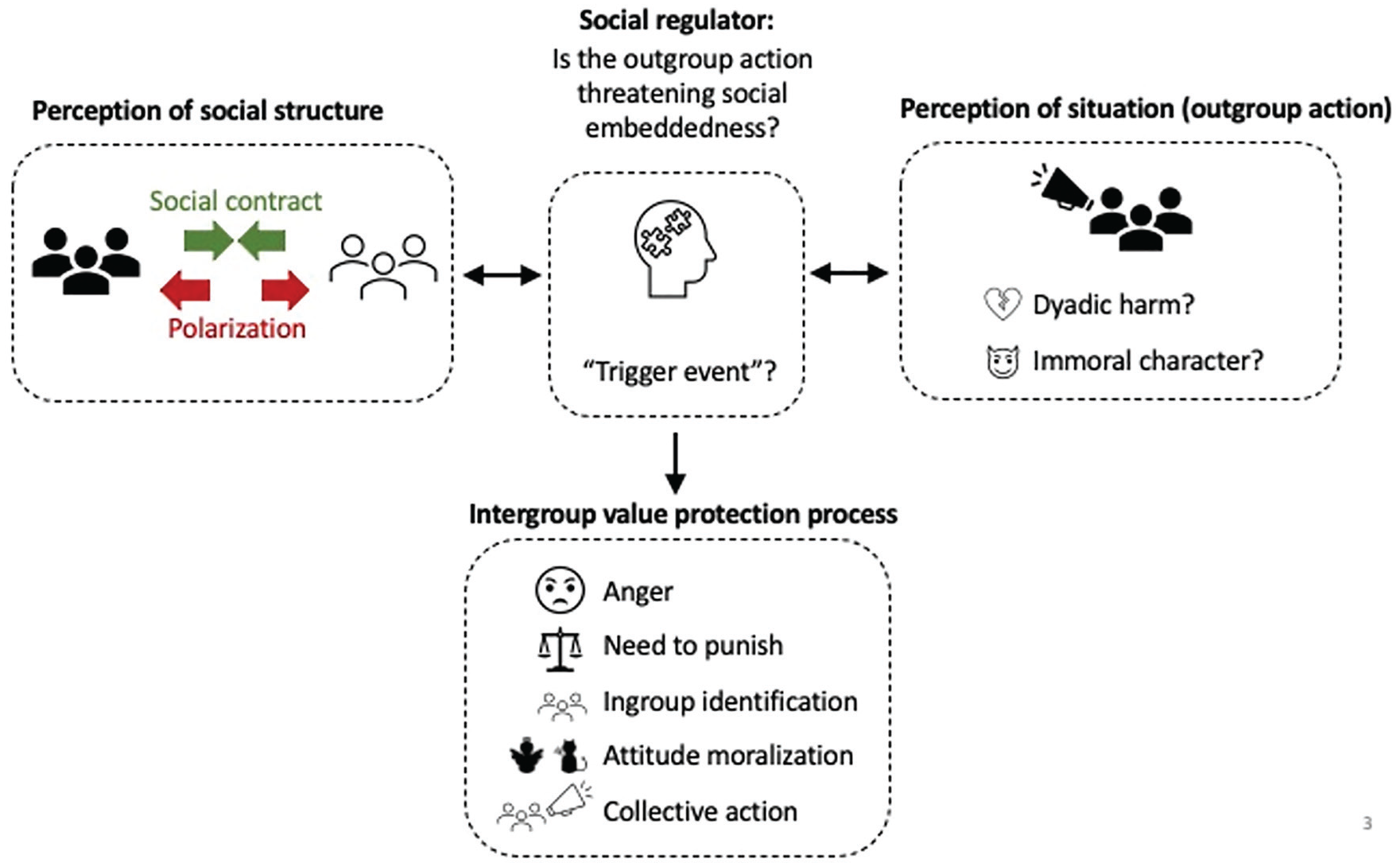
Visualization of the IVPM.
The IVPM moves beyond previous work through its synthesis of concepts and insights from moral and group psychology based in the view of individuals as social regulators. Indeed, there currently is no theoretically integrative model to specifically understand when, why, and how ingroup members will protect their values when confronted with outgroup actions amid intergroup conflict in democratic societies, nor is there an integrative approach that enables a dynamic view to understand when and how intergroup conflict may escalate until, or even beyond, the breaking point. In the remainder of this article, we therefore (a) outline the IVPM’s assumptions and claims in more detail below, (b) review and integrate the fragmented empirical evidence to evaluate its status, and (c) discuss the scientific implications of synthesizing group and moral psychology, and the practical implications for managing intergroup conflict within democratic societies. Indeed, we believe that the IVPM can serve as a useful analytical tool to better understand and explain how groups can express conflicting views in democratic society without their conflict spiraling out of control.
A Theoretically Integrative and Dynamic Approach to Intergroup Conflict Escalation
In this section, we make explicit meta-theoretical assumptions of the IVPM (e.g., Rai & Fiske, 2011; van Zomeren, 2016), reflect on key constraints on generality and our own positionality (Jamieson et al., 2023; Simons et al., 2017), and outline the IVPM’s claims and predictions in more detail, while explicating how this model effectively integrates insights and concepts from moral and group psychology (e.g., Agostini & van Zomeren, 2021; Brambilla & Leach, 2014; Ellemers, 2017; Schein & Gray, 2018; Tetlock et al., 2000).
Meta-Theoretical Assumptions
The IVPM is explicitly focused on explaining conflict between structural groups (i.e., those based on existing social categories such as race, gender, or ethnicity; van Zomeren et al., 2008) or opinion-based groups (i.e., those revolving around shared opinion, values, or ideology, such as pro-life or pro-choice groups, political parties, or social movements; McGarty et al., 2009), as embedded in the broader context of democratic societies. This embeddedness implies a context structure in which different groups are part of an overarching group (i.e., society), thus reflecting positive interdependence. We refer to societies as democratic when they explicitly allow for expressing values that indicate commonalities but also differences between groups. 3 This is because values are key motivators of individuals’ behavior (e.g., Bouman et al., 2021). Defined as “desirable trans-situational goals, varying in importance, that serve as guiding principles in the life of a person or other social entity” (Schwartz, 1994, p. 21), when applied to groups within democratic society these guiding-principled goals offer individuals’ a profound sense of who “we” are and what “we” stand for (i.e., social identity, defined as “those aspects of an individual’s self-image that derive from the social categories to which he/she belongs, as well as the emotional and evaluative consequences of this group membership”; Hornsey, 2008, p. 206). We, thus, assume group members in democratic societies to perceive group membership as part of their social identity and thus to be motivated to protect ingroup or shared values. Indeed, in addition to a relevant ingroup identity, the IVPM assumes the implicit or explicit presence of a broader shared identity (e.g., what it means to be “American”; Dovidio et al., 2008) and democratic values (e.g., due process; Rubin et al., 2023). In fact, the IVPM moves beyond previous work (e.g., Skitka et al., 2004; Tetlock et al., 2000) by contextualizing the intergroup value protection process within intergroup conflict in a democratic society in this particular way (such that individuals are relationally bound and obligated to the group and society they live in together, despite differences in who they are and what they stand for; Oyserman et al., 2002; see also Agostini & van Zomeren, 2021; Dovidio et al., 2008).
Against this backdrop, the IVPM assigns a major role to ingroup members’ perception of outgroup actions violating ingroup or shared values (e.g., acts of police brutality such as in the 2014 U.S. cases of Eric Garner and Michael Brown; Shuman et al., 2022). This is important as it assumes that not all outgroup actions will psychologically constitute a trigger event for the intergroup value protection process. For one, ingroup members may perceive that the outgroup does not violate a group value but a group norm. Norms are defined as “the accepted or implied rules of how group members should and do behave” (J. R. Smith & Louis, 2009, p. 21) but do not necessarily indicate what group members stand for, and hence do not reflect a threat to social embeddedness. As a consequence, ingroup members may frown upon outgroup actions that violate ingroup norms but may not perceive their group or shared values to be in need of active protection. One example of this is when members of one profession are confronted with union strikes that are aimed at increasing wages for a different profession. However, when the very same group and action would be perceived to violate ingroup values (e.g., when the same strikes cause others physical harm), the IVPM predicts that the intergroup value protection process will be triggered.
We note that the IVPM is a contextualized model as it does not presuppose the precise content of the relevant group identities and values in a given context (which are better understood through historical, cultural, and political analyses). For shared values, these are assumed in the IVPM to be democratic values (e.g., never resort to violence; Pauls et al., 2022). This is not to say that democratic societies ensure through such shared values that societies are fair and equal, as shared values can also pertain to, for example, prioritizing hierarchy over equality (e.g., preferential treatment for some groups; Rai & Fiske, 2011). Nevertheless, democratic societies at least allow for the expression of values and thus for some level of value conflict and some level of negotiation about which values are shared. Such contextualization offers a scope for social change in democratic societies that may arguably be less likely to be present in non-democratic societies.
Against this backdrop of intergroup conflict in democratic society, the IVPM assumes individuals to be social regulators who seek to maintain and protect their social embeddedness (i.e., the social fabric that one can rely on, as provided in this case by groups but also by society as a whole; Rai & Fiske, 2011; van Zomeren, 2016). To this end, social regulators are continuously and specifically looking for information diagnostic of evil others that seek to terminate the relationship and thus threaten their social embeddedness (see Figure 1). Therefore, the IVPM assumes that ingroup members will actively interpret the actions of outgroups in society, and a major factor in this cognitive interpretative process is whether they perceive indications of evil (Brambilla & Leach, 2014; Schein & Gray, 2018) in the outgroup’s action, for example when they perceive the action as causing dyadic harm (i.e., intentional suffering of innocent victims; Schein & Gray, 2018), or the outgroup as having immoral character (Brambilla & Leach, 2014). Indeed, the more strongly ingroup members perceive that the outgroup’s action yields information diagnostic of evil, the more likely they will interpret it as a violation of ingroup or shared values, which makes the functional intergroup value protection process more likely to be triggered.
Importantly, the IVPM assumes that social regulators want to be embedded not only in their group but also in society. The IVPM, therefore, proposes that the very same outgroup action can be perceived by ingroup members as a violation of ingroup values, but also of what we refer to as a violation of social contract: the shared values (e.g., equality) and associated principles of relationship regulation (e.g., never use violence) that enable individuals from different groups to live together in society. Thus, whereas ingroup values define the ingroup’s identity and differentiate it from the relevant outgroup (e.g., Ellemers & van den Bos, 2012; Leach et al., 2007), social contract is what holds these otherwise divided groups together within society (i.e., an overarching sense of “us,” including shared values and relationship regulation principles about how to deal with conflict). In democratic societies, we assume these shared values to be democratic values and regulatory principles. This is important because if an outgroup’s action is interpreted as not only violating ingroup values but also violating social contract, ingroup members will experience a need to protect both. In this case, the IVPM assigns a unique motivational role to perceiving the outgroup to violate social contract, as this should trigger the strongest form of intergroup value protection (e.g., fueling moralization and protest) and also spark broader fears of termination of the social contract.
In this way, the IVPM uniquely uses assumptions about individuals as social regulators to integrate key insights and concepts from moral and group psychology. These two literatures have been observed to live rather separate lives despite a clear yet unrealized potential for offering a more comprehensive understanding of phenomena such as intergroup conflict and social change (e.g., Agostini & van Zomeren, 2021; Ellemers, 2017). The IVPM, thus, moves beyond a sole focus on group psychology, which offers key insights into how individuals’ subjective identification with groups motivates them to protect their identity (i.e., who “we” are) amid intergroup conflict (e.g., Dovidio et al., 2008; Goldenberg et al., 2016; Sani, 2008; Tajfel & Turner, 1979). In a similar vein, the IVPM moves beyond a sole focus on moral psychology, which offers key insights into values (i.e., “what I stand for”) and the powerful motivation among individuals to protect them when violated (e.g., Haidt, 2012; Schein & Gray, 2018; Skitka, 2010; Tetlock et al., 2000). Indeed, the metaphor of the social regulator effectively synthesizes the metaphors of the identity manager (often assumed in group psychology; see van Zomeren & Spears, 2009) and the value protector (often assumed in moral psychology; Tetlock et al., 2000) through assuming that social regulators amid intergroup conflict in democratic societies to continuously scan for threats to their social embeddedness, represented by those who threaten who “we” are and what “we” stand for.
Integrated Constraints on Generality, Positionality, and Citation Statement
The IVPM features a number of important constraints on generality that are important to make explicit here (Simons et al., 2017). First, the model makes specific claims about whether and how ingroup members will respond to outgroup actions within democratic societies. Although this is not to say that the IVPM cannot apply to non-dyadic intergroup relationships (e.g., third groups, or groups involved in more complex intergroup relations than assumed) or to non-democratic societies, this is not claimed in the model. One reason to mention this explicitly is that many of the studies we cite, review, and use as support for the claims of the IVPM are embedded in such intergroup contexts (featuring structural or opinion-based groups) within democratic societies.
Second, the IVPM assumes that the same claims apply to both groups embedded within a democratic society, despite their conflict being about or based on, for example, different cultural and political values. It is possible that this is too strong a claim and that not all groups are comparable in this respect, particularly if there is a clear power imbalance (e.g., Saguy et al., 2009). Similarly, most studies we cite and review are based in research, researchers and research participants from so-called WEIRD countries (those described as Western, Educated, Industrialized, Rich, Democratic; Henrich et al., 2010) such as the United States, the United Kingdom, Germany, and the Netherlands. One may, therefore, argue that the scope of the IVPM is thus limited to WEIRD societies. However, given that we integrate literatures that have been observed to feature an increasingly diverse set of research contexts and samples (e.g., Agostini & van Zomeren, 2021), and also review studies from countries such as, for example, Chile, we see these claims as reasonable and, with an eye to the future, very much testable.
Third, the dynamic aspect of the IVPM offers scope for what we call realistic nuance, as not all outgroup actions will trigger the intergroup value protection process, and not all intergroup value-protective efforts will lead to intergroup conflict escalation. Although this may explain to some extent why democratic societies often do not fall apart despite intergroup conflict, we are fully aware that our analysis only focuses on the social (or more specifically: relational, moral, and group) psychology of intergroup conflict in democratic societies. Insights from, for instance, sociology and political science about the power of institutions to hold democratic societies together are clearly important (Walter, 2022), but fall outside the scope of our approach.
Finally, we offer an explicit positionality and citation statement (see Jamieson et al., 2023). We, as authors of this paper, have a background of specific sociodemographic characteristics and values that likely influenced the interpretation of previous research and the conceptualization of the IVPM. We are an author team that is Caucasian, based and socialized in Western Europe or the United States, 26 to 44 years old, consisting of three cis-women and 2 cis-men, and all authors have a PhD in Social Psychology or are in the process of obtaining one. All of us are interested in how polarized democratic societies deal with intergroup conflict and what holds them together despite increased polarization—a very real phenomenon in every democratic society that each of us currently lives in. Although this may allow us to draw from relevant experiences, it is also true that we are in privileged positions. We further acknowledge that most of our theorizing and citations are based on theories that have been proposed by male, Caucasian authors from WEIRD regions. It is, therefore, possible that applying the model and its reasoning to democratic societies that reflect different cultural or political realities may run into unanticipated problems. And although the literature on which our model is built includes fields like group and moral psychology that have certainly included cultural and political differences in their theorizing and empirical work, it is also fair to say that this has not always been their central focus. The same can be said of the IVPM. We, thus, consider the scope and focus of the IVPM to reflect work in progress that can generate further theorizing and hypotheses that stimulate researching such important differences.
The IVPM: Overview, Process, Triggers, and Dynamic Application
Overview
The psychological intergroup value protection process refers to ingroup members’ functional responses to an outgroup’s action, motivated by the need to protect ingroup or shared values. In line with the view of individuals as social regulators who seek to maintain their social embeddedness, the function of this process is to bind and obligate individuals to the group and society, as to be better able to protect its values (e.g., Agostini & van Zomeren, 2021; Tetlock et al., 2000; van Zomeren et al., 2018). Figure 1 (bottom) visualizes how this process is psychologically indicated by group-based, emotional, and behavioral responses to outgroup actions (i.e., increased group identification, negative moral emotions, desire for punishment, attitude moralization, and collective action). Figure 1 (top) visualizes how the IVPM grounds this functional process into a contextualized view on human sociality and morality (Fiske, 1992; Pettigrew, 2018; Rai & Fiske, 2011 van Zomeren, 2014, 2016) that emphasizes the diagnostic information offered by perceptions of the situation and of the social structure to explain what constitutes a trigger event for the intergroup value protection process. Below, we first discuss the components of this process in more detail, and then the specific perceptions of an outgroup action that trigger it.
The Functional Intergroup Value Protection Process
The IVPM conceptualizes intergroup value protection as a functional psychological process. Its components are derived from group psychology (e.g., Agostini & van Zomeren, 2021; Goldenberg et al., 2016; Mackie & Smith, 2018) and moral psychology (e.g., Haidt, 2012; Skitka, 2010; Tetlock et al., 2000). First, the intergroup value protection process has a strong social identity component. Ingroup identification reflects the psychological ties between the individual and the ingroup that lead them to perceive themselves more strongly as ingroup group members who feel motivated to protect ingroup values (e.g., Leach et al., 2008). Protecting who “we” are thus involves increased group identification, and in particular when this concerns what “we” stand for—the moral content of social identity (e.g., Turner-Zwinkels et al., 2017). For example, research showed that when the former President Trump announced a restriction on travel for specific groups (i.e., the so-called Muslim travel ban), liberal participants’ identification with the opinion-based group that opposed this restriction increased (Pauls et al., 2022).
The intergroup value protection process also has a strong emotional component, based in perceiving an outgroup action as violating ingroup values (van Zomeren et al., 2018). Although different literatures use different labels for specific emotions of interest, most converge around a family of negative moral emotions. This includes emotion labels such as anger and outrage, but sometimes also disgust, contempt and even hatred. In both group and moral psychology, the experience of such negative moral emotions is considered an important and functional response (e.g., Haidt, 2012). 4 A good illustration of this is the name of the anti-austerity movement in Spain, often referred to as the Indignados (the outraged; van Zomeren et al., 2012).
A third component of the intergroup value protection process is individuals’ desire for punishment of the violator (i.e., retributive justice). This is relevant because individuals feel such a desire more strongly when they perceive their values to be violated (e.g., van Prooijen, 2017), and also features prominently as a way to pressure deviants into conformity to the group (e.g., Otten & Gordijn, 2014). Indeed, a desire for punishment of violators can be viewed as coordinating and regulating social life through social control (e.g., Marques et al., 1998). This is in line with our focus on understanding how ingroup members cognitively interpret outgroup actions with respect to who “they” are and what “they” stand for (and thus on looking for signals of evil that threaten social embeddedness), and fits with a motivation to stop and punish those who threaten social embeddedness (e.g., Haidt, 2012; Rai & Fiske, 2011). An ominous example of this was the gallows brought to the Capitol Hill attack, presumably intended for someone perceived to have betrayed the ingroup.
Fourth, the intergroup value protection process includes a behavioral component, namely collective action. This type of behavior, which is often manifested in joining demonstrations, strikes, riots, or other forms of social protest, has been defined recently as any action that individuals undertake as psychological group members to improve the position of a relevant disadvantaged group as a whole, and/or to protect their group’s values, moral principles, or ideology (e.g., Agostini & van Zomeren, 2021, p. 685; emphasis added). This fits nicely with an emphasis in both moral and group psychology on the behavioral expression of individuals’ protection of their values and social identities (e.g., Turner-Zwinkels & van Zomeren, 2021).
The fifth indicator of intergroup value protection is attitude moralization. This is a pivotal variable in the IVPM because key insights from moral psychology suggest that when individuals start grounding a specific attitude in their values, they become more motivated to protect them (sometimes even by any means necessary; Pauls et al., 2022; Rhee et al., 2019; Skitka et al., 2021). This moralization component, often defined as a transformation of a strong attitude into a moral conviction (Skitka et al., 2021), uniquely infuses or amplifies moral meaning into intergroup conflict, 5 which makes escalation more likely.
The five components of the intergroup value protection process can all co-occur, but this is not required. The IVPM conceptualizes the identity, emotional, and punishment components as the three more easily-evoked, more short-term value-protective responses, with the moralization and behavioral responses being less easy to evoke, yet having more powerful consequences for conflict escalation once experienced and enacted (e.g., Skitka et al., 2021). This distinction offers scope for realistic nuance in the model, as it offers a reason for why not all intergroup value protection responses of one group will trigger the outgroup to respond in kind.
Furthermore, the IVPM’s process view of intergroup value protection allows for, but does not require, specific theorizing about the causal links between the components (e.g., group identification as predictor of collective action). In fact, the IVPM does not currently assume a particular causal chain. This is mainly because research has documented reverse causal effects (e.g., identification predicting collective action and collective action predicting group identification; Leal, van Zomeren, González, et al., 2023). As such, the main aim of identifying the intergroup value protection process is to offer a bird’s eye view on the functionality of this broader psychological process, rather than on restricting our analysis to one particular causal direction between specific components.
Triggers: Perceptions of the Situation
The IVPM holds that there are three key perceptions of the situation that make it more likely that ingroup members see evil and thus interpret the outgroup action as a violation of ingroup values (see Figure 1, top right). These are (a) the perceived intentionality behind the outgroup’s action (Schein & Gray, 2018), (b) the perceived immoral character of the outgroup (Brambilla & Leach, 2014), and (c) the perceived suffering of innocent victims as the result of the outgroup’s action (Schein & Gray, 2018). The IVPM conceptualizes these perceptions 6 additively, such that when ingroup members’ stronger perceptions offer them information diagnostic of evil, the more strongly the likelihood of intergroup value protection.
In this way, the IVPM effectively integrates theory and research on dyadic harm (based on the cognitive dyadic harm template; Gray et al., 2022; Schein & Gray, 2018) and on perceptions of immoral outgroups (based on cognitive social categorization processes; Brambilla & Leach, 2014). The theory of dyadic morality (Schein & Gray, 2018) suggests that people interpret actions as immoral when they recognize a “dyad” of an innocent suffering victim harmed intentionally by a perpetrator. That is, dyadic harm is defined as the subjective perception of an intentional agent causing damage to a vulnerable patient (Schein & Gray, 2018, p. 32). Through this cognitive template for recognizing good and evil, it follows that if an outgroup action is perceived as perpetrated by an intentional agent, people will perceive this through a moral lens that makes it more likely that ingroup members interpret “their” action as evil. Similarly, the more ingroup members interpret the outgroup action as causing the suffering of innocent victims, the more likely it is that ingroup members perceive evil; 7 and finally, perceiving the outgroup as having immoral character makes it more likely that they will see evil in the outgroup and hence in their actions. 8
This additive conceptualization reflects that the IVPM does not make strong assumptions about the relative strength of these perceptions (i.e., which perception is more or most diagnostic of seeing evil). This is also unnecessary because the theory of dyadic morality holds that individuals may not necessarily require information on, for example, the suffering of a victim if they see a clearly evil action—they often automatically complete the moral dyad in their minds (Schein & Gray, 2018). Similarly, the IVPM suggests that the more strongly people believe the outgroup to have an immoral character, the more likely it is that they will see evil in their actions, even if their intent and the outcomes are ambiguous or unclear. This is precisely why all three perceptions of the situation considered in the IVPM offer diagnostic information about the potential evil of who “they” are and what “they” stand for—information that individuals, being social regulators, are continuously and actively looking for to guard against threats to their social embeddedness.
Importantly, the IVPM allows for the possibility that ingroup members interpret the outgroup action as a violation of social contract. Although there is no research on social contract as we define it in the IVPM, there is indirect evidence that stronger identification with common ingroups makes it easier to deal with subgroup differences (Hornsey, 2008). Furthermore, when intergroup conflict is about common values, the common identity itself is threatened, which invites schisms (Sani, 2008). The IVPM generates new theorizing by predicting that when ingroup members perceive the outgroup action to violate social contract, ingroup members will not only experience the strongest form of intergroup value protection but also broader fears of societal breakdown. Because such fears are directly tied to the fear of the social regulator of outgroups seeking to terminate the relationship and thus threaten social embeddedness, 9 the IVPM predicts that perceiving a violation of social contract goes hand in hand with strong perceptions of the outgroup’s immoral character, perpetrator intent, and victim suffering—that is, precisely those specific perceptions that signal that evil actors have perpetrated unjustified intentional harm to the relationship (Burris, 2022; Rai & Fiske, 2011), which makes it seemingly impossible to live with “them” within the same society. The IVPM thus holds that perceived social contract violation triggers the strongest intergroup value protection responses but also unique and broader fears that increase the motivation of social regulators to protect the social fabric from being torn apart. 10
Triggers: Perceptions of the Social Structure
The IVPM further specifies what makes a trigger event more likely to occur by identifying specific perceptions of the social structure that are more diagnostic of evil when an outgroup’s action occurs. The model identifies two key perceptions of the social structure, which relate to perceiving stronger polarization in society, and to perceiving a stronger social contract between the groups (see Figure 1, top left). This is important because perceiving stronger intergroup conflict more generally (i.e., stronger polarization, weaker social contract) makes it easier for ingroup members to see evil in the outgroup’s action when it occurs. By contrast, perceiving weaker intergroup conflict more generally (i.e., weaker polarization, stronger social contract) makes this more difficult. As such, these specific perceptions of the social structure can make it more or less likely that an actual trigger event occurs. However, by definition, the IVPM assumes that perceptions of the situation are required for constituting a trigger event, whereas perceptions of the social structure are not required but can make this more likely.
The IVPM identifies perceived polarization in society as a key indicator of intergroup conflict in society, as it refers to the extent to which people believe that different groups in society stand in direct opposition of one another (e.g., with respect to their political viewpoints or values; Koudenburg & Kashima, 2022; see also Crimston et al., 2022; D’Amore et al., 2022). Stronger perceptions of polarization between groups in society indicate perceiving stronger tension between the groups and hence put pressure on conflicting values. This is why perceived polarization offers the type of information that is diagnostic for ingroup members to interpret an outgroup’s actions as evil. Indeed, perceiving stronger polarization in society makes it more likely that ingroup members will interpret an outgroup action as motivated by stronger immoral outgroup character, perceived perpetrator intent, and/or innocent victim suffering, and hence that this action is interpreted as an ingroup value violation.
By contrast, perceiving a stronger social contract helps to explain why groups manage to live together in society despite their differences fueling intergroup value protection. The IVPM holds that this is possible because group members feel bound and obligated to others to relate and live together through adhering to the social contract (Rai & Fiske, 2011; van Zomeren, 2016). Consistent with theory and research suggesting that people have a motive to justify and defend the broader society because of relational or identity motives (e.g., Jost, 2020; Owuamalam et al., 2019; Rubin et al., 2023), individuals can feel bounded and obligated to their ingroup but also to the broader society in which they are embedded (Agostini & van Zomeren, 2021; Oyserman et al., 2002; van Zomeren et al., 2016). Whereas social identity binds and obligates individuals to the ingroup, social contract binds and obligates the groups to society (and hence related to perceived collectivism; Oyserman et al., 2002).
Indeed, because the values perceived to be in the social contract are also those that one expects the outgroup to hold or at least conform to in case of disagreements, the IVPM holds that perceiving a stronger social contract offers ingroup members diagnostic information that the outgroup can be relied on 11 to share or conform to key values or principles, and is not seeking to terminate the relationship. This buffers against any broader fears that the outgroup is tearing apart the social fabric and a threat to social embeddedness, and thus perceiving a stronger social contract makes it less likely that ingroup members interpret an outgroup action as flowing from stronger immoral outgroup character, perceived harmful intent, and/or innocent victim suffering, and hence that this action is interpreted as an ingroup value violation.
Again, the IVPM conceptualizes these two key perceptions of the social structure in an additive way. Each offers different but relevant diagnostic information to the social regulator, and hence can, but do not have to, occur together. According to the IVPM, then, one reason for heavily polarized societies not falling apart may be that individuals perceive a sufficiently strong social contract that binds and obligates people to the social contract (e.g., “in our country, there is a peaceful transfer of power”), despite pressures put onto it through intergroup conflict. Similarly, there may be the most potential for intergroup conflict escalation, according to the IVPM, when individuals perceive strong polarization within a democratic society while perceiving a weak social contract to keep society together. However, again it is important to note that these perceptions in and of themselves do not trigger the intergroup value protection process but increase the likelihood that an outgroup action can become a trigger event. This is in line, for example, with Sani and Reicher’s (1998) intriguing analysis of schisms in the Italian Communist party, which revealed that conflicting political groups’ perception of a lack of common identity amid intergroup value conflict was related to accepting schism within, and thus break-up of, the broader group.
Dynamic Application
For the dynamic application of the IVPM to both groups, it is important to know whether (components of) the intergroup value protection process is visible to the outgroup. Although the component of collective action, given its often public nature, has the most potential for being visible to the outgroup, other components such as group identity and negative moral emotions, can of course also be expressed in public (e.g., through tweets or other social or traditional media messages; Brady et al., 2020; Goldenberg & Gross, 2020). The IVPM holds that it is possible, therefore, for ingroup members to experience a value-protective response without this response being visible to the outgroup (e.g., Drury & Reicher, 2009; Reicher et al., 1995). However, in such a scenario, there would not be a trigger for the outgroup to respond to. In the scenario where such a response is visible to the outgroup, the IVPM outlines which specific perceptions make this a trigger event for the outgroup, with their intergroup value protection responses in turn contributing to an increased potential for intergroup conflict escalation.
Evaluating Empirical Evidence for the IVPM
Based in a view of individuals as social regulators, the IVPM offers a theoretical synthesis of moral and group psychology in terms of a functional psychological process (i.e., intergroup value protection), and specific perceptions of the situation and the social structure that explain when this process is triggered. Although parts of the model derive from these literatures and hence are supported by empirical findings from those literatures (e.g., Agostini & van Zomeren, 2021; Gray et al., 2022; Schein & Gray, 2018; Skitka et al., 2021), most research focuses on fragments of the proposed process (rather than on the process as a whole; for exceptions, see e.g., D’Amore et al., 2022; Pauls et al., 2022). Furthermore, there is little research yet on the triggering function of specific perceptions of the situation and the social structure, and in particular on perceptions of social contract and its violation. Against this backdrop, the IVPM should have a relatively strong empirical basis for specific parts of the model (each supported within a specific niche, field or literature), but should not yet have such a basis for the broader parts that we generated from our theoretical synthesis. Unsurprisingly, there is no specific research yet on the dynamic application of the IVPM.
As the IVPM includes a wide array of citations because it seeks to integrate key insights from different literatures (i.e., group and moral psychology), we acknowledge that many of these references come from WEIRD regions. Although group and moral psychology seem to have somewhat different core bases (in Europe and the United States, respectively), both the theoretical perspectives developed and the empirical research conducted are embedded in WEIRD countries. Given the IVPM’s focus on democratic societies (i.e., the D in WEIRD), we note that our literature review includes studies from a diverse set of democratic societies such as Italy, Spain, Germany, Israel, the United States, and the Netherlands. Studies embedded in democratic societies in Africa, Asia as well as Central and South America, seem scarce (e.g., Chile). Against this backdrop, we evaluate the IVPM below by reviewing its empirical status, starting with the intergroup value protection process, and followed by the specific perceptions of the situation and the social structure in the model that help trigger this process.
A Functional Intergroup Value Protection Process
Is there empirical evidence for the five different components that the IVPM assumes to reflect a functional intergroup value protection process? Below we review the evidence for these five components and, indicative of a broader process, for their inter-relationships.
Group Identification
There is considerable evidence to support the claim that increased ingroup identification is an important component of the intergroup value protection process. Most evidence is found in group, rather than moral, psychology, because of its direct link with the dominant theoretical perspective in that literature (i.e., social identity theory; Tajfel & Turner, 1979). Nevertheless, it is also visible in moral psychology at times. Skitka et al. (2004), for example, found that, in a representative survey of U.S. citizens after and about 9/11, people self-reported increases in their positive feelings about ingroups (Americans, politicians, police, and firefighters). Similarly, Moskalenko et al. (2006) reported similar findings among college students.
Group identification has also been found to increase in response to outgroup attack in less dramatic contexts. Jetten et al. (2001), for instance, found that, among those with body piercings, perceiving discrimination in society from the “mainstream” led to an increase in their group identification. Similarly, international students who perceive stronger discrimination and rejection in society increased their group identification over time (Ramos et al., 2012). This is consistent with the idea that increased ingroup identification is an important and context-sensitive response to perceived outgroup attack, although it is unclear from these studies whether ingroup members were protecting ingroup values.
Fortunately, there is more specific research on how outgroup actions affect group identification. Pauls et al. (2022), for example, found evidence for increased group identification in response to the U.S. president’s decision to leave the Paris climate accord in June 2017. Specifically, their experimental findings showed that liberal U.S. participants increased their identification with an opinion-based group that shared the threatened value. Moreover, Kutlaca et al. (2019) found that individuals’ identification with a local Dutch movement against fracking was predicted by their perceived value violation by the government. Similarly, Mazzoni et al. (2015) found that individuals’ identification with an Italian movement to protect clean water was uniquely predicted by the perceived violation of the human right to water by the government. These findings support the IVPM’s claim that increased group identification is a key component of intergroup value protection in response to outgroup actions.
We note that stronger group identification can sometimes also mean a stronger identification with a more specific group, such as with a political party, social movement or opinion-based group that revolves around a specific value (e.g., Leave or Remain in case of the United Kingdom’s Brexit referendum). For example, Turner-Zwinkels et al. (2017) found that those individuals who showed identity politicization during a U.S. election campaign were also the ones who changed the content of their identity to contain stronger moral aspects. This is consistent with other research findings that the content of a group identity—that is, what it means to be “us”—shapes our behavior as in-group members toward out-groups (e.g., Becker & Wagner, 2009; Livingstone & Haslam, 2008).
Finally, ingroup discussions of perceived outgroup actions can further increase group identification. For example, Thomas et al. (2009) showed that when prompted to discuss the morally outraging aspects of an issue (i.e., the right to water), group members formed stronger identification around the issue. In a more extreme example, analysis of the tweets of Twitter users who became more supportive of ISIS over time exhibited increased discussion of shared grievances and increased first person plural usage (i.e., “we” and “us”), indicating increased group identification (L. G. Smith et al., 2020). This further supports the idea that increased group identification can serve to protect ingroup values—to protect who “we” are and what “we” stand for against who “they” are and what “they” stand for.
Negative Moral Emotions
An established body of literature from both moral and group psychology supports the claim that negative moral emotions reflect an important component of the intergroup value protection process (Haidt, 2012; see also Brady et al., 2020; Goldenberg et al., 2016; Halevy et al., 2015). However, both literatures differ in their specific conceptualizations of these emotions. For example, moral psychologists have focused on discrete emotions such as contempt, anger, and disgust (Haidt, 2012; Landmann & Hess, 2018; Pizarro et al., 2011; Rozin et al., 1999) as responses to value violations. Other work focused on moral outrage (e.g., Tetlock et al., 2000) and even hatred (Hoover et al., 2019). We note that most of this work has conceptualized the individual as the subject of distinct emotional experience (e.g., Goldenberg et al., 2016)—the group seems to play little role in its experience, or if so, only by proxy.
By contrasts, group psychologists tend to focus mostly on anger felt on behalf of the group (i.e., as a group member; Iyer & Leach, 2008; Mackie & Smith, 2018; van Zomeren et al., 2018). Such group-based anger has been found to increase after perceived mistreatment by the outgroup and to motivate confrontational behavior toward the outgroup (e.g., van Zomeren et al., 2012). Empirical studies yield evidence for this claim. For example, anger has been found to be directed at the perceived wrongdoing of a target (Halperin, 2015). This is in line with other findings from moral psychology: Skitka et al. (2006) showed that anger is associated with moral convictions and aggressive tendencies toward the outgroup. Similarly, Skitka et al. (2004) found in the context of responses to 09/11 that U.S. individuals’ anger predicted their support for the use of nuclear weapons against the perpetrators. 12 This supports the claim that negative moral emotions can serve an intergroup value-protective function.
We note that although emotions such as anger, contempt, and hatred theoretically differ in their specific appraisal pattern and associated action tendencies (Halperin, 2008), the IVPM only differentiates them when their more specific form clearly follows a more specific function. At a more general level of analysis, these emotions all fall under the family of negative moral emotions that serve a general value-protective function and hence can be validly analyzed as such. 13 Nevertheless, the IVPM is open to more specific functions served by more specific negative moral emotions. For example, hatred may be an intriguing example, as hatred is uniquely accompanied by the appraisal that the target is fundamentally evil (Halperin, 2008). As a result, hatred should be a particularly apt indicator of an intergroup value protection response that makes it more likely that the conflict will escalate.
Desire for Punishment
A considerable body of literature from both moral and group psychology supports the claim that a desire for punishment (or retributive justice; see Carlsmith & Darley, 2008) is an important component of the intergroup value protection process. First, studies from moral psychology often conceptualize a desire for punishment as motivated by negative moral emotions (Haidt, 2012; van Prooijen, 2017; van Zomeren & Lodewijkx, 2005). For example, Tetlock et al. (2000) found that people who were confronted with relevant “taboo trade-offs” (e.g., contemplating selling your baby) or “heretic counterfactuals” (e.g., considering that Biblical stories did not happen in reality) showed a great desire to punish those who made them consider such unthinkable thoughts.
Similarly, group researchers have studied the desire to punish from the angle of social control within groups. “Black sheep,” for example, tend to evoke a stronger desire to be punished among ingroup members than outgroup members (Otten & Gordijn, 2014). However, when outgroup members violate ingroup values, the desire to punish becomes much stronger, including Skitka et al.’s (2004) findings that, in responding to a survey about the 09/11 attacks, participants strongly indicated their desire to punish those responsible, even to the point of wanting to “nuke them.” Such findings support the claim that a desire for punishment can serve a value-protective function.
Collective Action
An established body of literature from mostly group psychology supports the claim that collective action is an important behavioral component of the intergroup value protection process. As this type of action is thought to be fueled by individuals’ group identification and values (i.e., the “beating heart” of the protester; Agostini & van Zomeren, 2021), this makes it an important behavioral and publicly visible aspect of intergroup value protection. Moreover, this already signals that increased group identification, for example, may not be an isolated response in this context, but indicative of a broader value-protective process that consists of different yet related components.
In fact, many studies showed positive correlations between specific moral motivations and collective actions such as social protest and political behavior (e.g., Sabucedo et al., 2018; van Zomeren et al., 2012). van Stekelenburg et al. (2009), for example, directly linked a moral motivation to express values to participation in a protest organized by a value-based movement that mobilized thousands of people in the Netherlands. Kutlaca et al. (2019) found that a perceived value violation predicted individuals’ participation in social protest against fracking. Mazzoni et al. (2015) found that the perceived violation of the human right to water predicted social movement participation. van Zomeren et al. (2011) found that those with strong moral convictions about inequality wanted to engage in collective action despite being from the advantaged group and hence going against their group interests. Pauls et al. (2022) found that outgroup actions directly predicted willingness to engage in collective action, and even dismissed concerns for the normativity of such actions (although, interestingly, the line was drawn at violence). And outside of group psychology, Skitka and Bauman (2008) found that moral conviction predicted political participation in the 2004 U.S. elections. All these findings support the claim that collective action is an important behavioral component of the intergroup value protection process. This is not trivial because collective action also reflects a publicly visible expression that may psychologically constitute a trigger event for the outgroup.
Attitude Moralization
An emerging body of literature from mostly moral psychology supports the claim that attitude moralization is an important component of the intergroup value protection process. This is important because attitudes are often a specific yet central aspect of intergroup conflict (e.g., abortion, wearing face masks, blackfacing) that can be easily connected to ingroup values (e.g., political groups or social movements). If the intergroup value protection indeed entails a stronger sense of “us” (i.e., who “we” are) and particularly offers the potential for infusing morality into the content of what it means to be “us” (i.e., what “we” stand for), then individuals’ attitude on a specific issue relevant to the intergroup conflict can become more grounded in ingroup values to protect ingroup or shared values, and as such turn polarized intergroup conflict into a moralized one (D’Amore et al., 2022). In this way, it is possible for otherwise relatively neutral issues (e.g., wearing of face masks, number of seats on the Supreme Court) to become not only politicized but also moralized.
This line of thought is consistent with the idea that when people witness the violation of their values, it leads them to reaffirm their commitment to these values. Tetlock et al. (2000), for example, argued that when people are exposed to a violation of a “sacred” value (whether by themselves or others), they are motivated to reaffirm, or recommit themselves to, the values under threat. Furthermore, Wisneski and Skitka (2017) found that exposure to images depicting emotion-inducing images of value violations (i.e., attitudinally-relevant moral shocks) increased moralization of attitudes related to that value (see also Feinberg et al., 2019; Rhee et al., 2019). This fits with the IVPM such that in intergroup contexts where ingroup members interpret the actions of an outgroup, this motivates ingroup members to reaffirm, commit, and protect their group values. Pauls et al. (2022) indeed found that after being exposed to an outgroup’s violation of ingroup values (e.g., the withdrawal of the United States from the Paris Climate Accords), participants increased their moralization of their specific attitude on the topic. As such, these findings support the claim that attitude moralization is an important component of the intergroup value protection process.
Positive Relationships Between the Components
If the five components are indicators of a broader intergroup value protection process, then studies that include multiple components should yield mostly positive correlations between them. This claim is supported by a number of studies. At a meta-level, Agostini and van Zomeren (2021) found positive, medium-sized meta-analytic correlations between moral, identity, injustice, and collective action variables among a large number of collective action studies. This means that, across the board, these motivations for acting collectively are likely to co-occur. Moreover, Turner-Zwinkels et al. (2018) found in a longitudinal study that those who became more involved in the 2012 U.S. election politicized their identity in a way that left moralized traces in their identity content. In perhaps the most direct experimental test so far of this approach, Pauls et al. (2022) experimentally manipulated a stronger or weaker outgroup’s violation of ingroup values, and found that participants in the stronger violation condition showed relatively stronger moral convictions, opinion-based group identification, anger, and collective action intentions. These findings directly support the idea that this trigger event (i.e., a threat to who “we” are and what “we” stand for) increased multiple components of intergroup value protection, which supports the idea that these indeed reflect components of a broader and possibly functional process.
Evidence for Triggers: Perceptions of the Situation
Is there empirical evidence for the three specific perceptions of the situation that make it more likely that ingroup members will see evil in outgroup actions? Below we review the relatively few relevant studies to empirically evaluate this claim.
Perceiving Harmful Intent and Victim Suffering
A number of studies support the claim that perceiving dyadic harm (i.e., perpetrator intent causing victim suffering; Schein & Gray, 2018) in outgroup actions makes ingroup members see evil in it. This is important because the IVPM holds that this perception makes it more likely that an outgroup action is perceived as an ingroup value violation and hence triggers the intergroup value protection process. Indeed, the more an outgroup action is perceived as involving intentional harm against ingroup members, for example, the more strongly this signals that ingroup values need to be protected.
Evidence for this claim comes from D’Amore et al. (2022), who experimentally manipulated perceptions of dyadic harm in a series of experiments. In the strong dyadic harm condition, an activist group expressed their willingness to use violence against ingroup members to achieve their goal (i.e., to change a blackface tradition in a Dutch children’s annual festivity), while in the weak dyadic harm condition, the same activist group expressed their willingness to strengthen harmony and tolerance with ingroup members to achieve the very same goal. The results showed that when this outgroup’s action was perceived as involving perceived stronger (compared with weaker) dyadic harm, this triggered stronger negative moral emotions, a desire for outgroup punishment, and moralization of individuals’ attitudes on this specific topic (i.e., blackface). This is consistent with the IVPM.
Moreover, longitudinal research in the polarized and heated context of the 2020 U.S. elections further supported this claim (D’Amore et al., 2023). This research found that as individuals’ perceptions of dyadic harm in the statements made by the outgroup’s presidential candidate strengthened over time, this led them to strengthen their moralization of relevant attitudes (e.g., about climate change, the Supreme Court, and mask-wearing), both among a sample of Biden Supporters and a sample of Trump supporters (i.e., across both sides of the political divide). Moreover, the stronger Trump supporters perceived dyadic harm in these statements (e.g., about the Democrats’ vote to impeach the sitting Republican president), the stronger they expressed support for the aims of the Capitol Hill Riot, which is consistent with the idea that attitude moralization motivates the protection of values by all means necessary (Pauls et al., 2022), and thus also often materializes into something visible to the outgroup (and thus creating a potential trigger event for the outgroup).
Perceiving the Outgroup as Having Immoral Character
Perceiving the outgroup as having immoral character should be diagnostic for ingroup members (Leach et al., 2007; Molenberghs et al., 2016) to see evil in outgroup actions amid intergroup conflict in democratic societies. Indeed, ingroup members rely on such information to manage the relationship with the outgroup (Leach et al., 2007), which makes specific perceptions of the outgroup’s immoral character key to interpreting an outgroup’s action as an ingroup value or social contract violation (as this helps ingroup members make inferences about evil; see also (Brambilla et al., 2011, 2012). Indeed, such a violation can be experienced or construed as an intentional and malevolent attack on the ingroup and a threat to ingroup values (Nadler & McDonnell, 2011; Schein & Gray, 2018). Moreover, such violations require ingroup members to protect their values, even if this jeopardizes the relationship between ingroup and outgroup. Importantly, when immoral outgroups commit such a violation, people are more motivated to make harsher attributions of blame and intentionality to the violators (Nadler & McDonnell, 2011). This is in line with the value-protective function assumed in the IVPM.
This should be particularly important because perceiving the outgroup as an immoral agent will affect how people interpret their actions. In fact, Leal, van Zomeren, Gordijn, et al. (2023) found across a variety of intergroup conflicts in the Netherlands and the United States that when ingroup members were confronted with the actions of an outgroup perceived as having immoral character, this triggered moralization of relevant attitudes (e.g., about sexism, climate change, and cultural appropriation). In line with the IVPM, similar effects were found across the studies for negative moral emotions and the willingness to punish the violators.
Furthermore, in longitudinal work, Leal, van Zomeren, González, et al. (2023) studied how Chilean social movement members engaged in collective action against the backdrop of perceiving the Chilean government as having immoral character. This 2-year, 5-wave longitudinal study, thus, featured a strong ingroup fighting against an outgroup perceived as immoral (Wright, 2009; see also Cohen-Chen et al., 2014; Simon & Klandermans, 2001). Ingroup members’ collective action can thus be understood as a value-protective ingroup response to outgroup violations of ingroup values—with ingroup members being motivated to protect their values by fighting together for what they (will not) stand for (van Zomeren et al., 2018). In line with the IVPM, participation in collective action predicted attitude moralization over time through increased group identification and anger toward the government. This is in line with the IVPM’s claim that perceiving the outgroup as having immoral character increases intergroup value protection in response to their actions.
Evidence for Triggers: Perceptions of the Social Structure
The IVPM holds that, given an outgroup action for the social regulator to interpret, perceived polarization should increase chances of intergroup value protection, while perceived social contract should decrease it. Is there evidence from primary studies for these perceptions of the social structure? Below we discuss the scarce evidence available for perceived polarization and social contract.
Perceived Polarization
Some evidence indicates that perceived polarization in society affects people’s beliefs of and feelings toward the outgroup in intergroup contexts. Miller and Conover (2015) found that as respondents’ electoral contexts became more competitive (i.e., polarized along the partisan divide), their immorality perception of the outgroup strengthened. In a similar vein, Koudenburg and Kashima (2022) found that stronger perceived polarization between groups in society related to stronger relational threat toward opponents. Furthermore, Crimston et al. (2022) found that perceived moral polarization (i.e., when people believe two groups in society have fundamentally different values) predicted perceived anomie (i.e., breakdown of society) and support for strong leaders who are willing to protect their values. These findings support the idea that perceived polarization is a key perception of social structure diagnostic for seeing evil in outgroup actions, once they occur.
Indeed, perceived polarization in society may affect whether people see dyadic harm (i.e., perpetrator intent causing victim suffering) in outgroup actions. If so, then perceived polarization should increase perceptions of dyadic harm in these actions, which makes intergroup value protection more likely. D’Amore et al. (2023) indeed found support for this mechanism in their longitudinal study of the U.S. 2020 elections. Specifically, among both Trump and Biden supporters, they found that increased perceptions of polarization in society (without reference to any specific topic) predicted increased perceptions of dyadic harm, negative moral emotions, and attitude moralization about and across specific topics (e.g., mask-wearing mandate) over time.
Furthermore, if stronger perceptions of polarization strengthen value-protective responses to (actions by) the outgroup, then one important route to weakening those value-protective responses should be interventions that weaken perceptions of polarization. This prediction was supported by the findings of a recent large-scale study, which tested the effects of a video intervention that learned participants how much more Democrats and Republicans actually agree on U.S. political issues than they expected (Voelkel et al., 2022). It was found that compared with the control group, this intervention led to significant reductions in two outcomes indicative of conflict escalation, namely, support for non-democratic practices (such as not accepting the election outcome in case of losing) and support for partisan violence. In line with the psychological variables central to the IVPM, those effects were partly driven by reduced anger (and increased empathy) toward the outgroup, and reduced perceptions of the outgroup as posing a threat to the country (Voelkel et al., 2022).
Perceived Social Contract
Given the novelty of the notion of social contract (as presently defined), research on how it might affect seeing evil in outgroup action (once it occurs) is scarce. However, important insights on the role of perceived social contract are provided by research tapping into either of the two core elements of social contract (i.e., shared values or identity, and relationship regulation principles about how to resolve disagreement). For example, weaker perceptions of a shared identity were found to be related to stronger intergroup threat and negative outgroup attitudes (Riek et al., 2010). Furthermore, people who perceived stronger outgroup willingness to violate democratic principles also showed stronger willingness to violate those principles themselves (Braley et al., 2021). Further support comes from a recent large-scale intervention study by Voelkel and colleagues (2022), which showed that an intervention strengthening shared identity as well as an intervention reducing perceived outgroup willingness to violate democratic principles led to reductions in support for undemocratic practices and support for partisan violence. Thus, although there is no research directly studying the notion of perceived social contract, these are promising pointers that indeed support it.
More generally, the notion of perceiving social contract may be implicit in research on the perception of collectivism in society (e.g., R. Fischer et al., 2009; Heu et al., 2019). Compatible with a view of individuals as social regulators, in this literature, individuals are viewed as cultural beings who seek to understand and deal with the group situations they face on the basis of broader shared understandings and norms (Oyserman et al., 2002; see also Oyserman & Lauffer, 2002). As perceiving collectivism in society is directly about who “we” are and what “we” stand for, both as an ingroup and as a society, it entails the motivation to protect ingroup and society’s values, and thus also social contract. In fact, in a recent meta-analysis of the collective action literature (Agostini & van Zomeren, 2021), nation-level collectivism was found to moderate the identity-action link such that stronger collectivism decreased this positive effect (i.e., made collective action a somewhat less likely response as group identification increases). This is consistent with van Zomeren et al. (2016)’s findings at the psychological level from two studies in the (collectivist and hierarchical) Indonesian societal context, which found that discriminated ethnic minority group members’ identification with their group was unrelated to undertaking collective action. This dovetails with the idea that perceiving collectivism makes individuals feel bound to their ingroup and the broader system, and hence feel bound to protect them both (which in this case meant the motivation to protect social contract overpowered the group identification that would otherwise motivate individuals’ collective action 14 ).
Evaluation of the IVPM’s Empirical Status
Our empirical review revealed support for key claims of the IVPM, but, as expected, not all parts of the model were supported on the basis of an equally sizable literature. First and foremost, most (yet fragmented) support was found for the five components of the intergroup value protection process. Both primary and meta-analytic research also supported the claim that these components are likely to be interrelated, which is in line with the conceptualized intergroup value protection process. However, our review offered a much smaller basis of empirical evidence to support the specific perceptions of the situation and the social structure (particularly for perceived social contract) as affecting whether ingroup members see evil in outgroup actions amid intergroup conflict in democratic societies. Nevertheless, the scarce evidence we did find consistently supported these factors, hence offering initial but promising evidence in this newly generated direction.
Implications of the IVPM
From our synthesis of moral and group psychology (e.g., Agostini & van Zomeren, 2021; Dovidio et al., 2008; Ellemers, 2017; Gray et al., 2022; Haidt, 2012; Sani, 2008; Schein & Gray, 2018; Skitka, 2020; Tajfel & Turner, 1979; Tetlock et al., 2000), we developed the IVPM as a theoretically integrative and dynamic model of intergroup conflict escalation in democratic societies. Set within an intergroup context that is embedded in an overarching democratic society, the model explains when, why, and how ingroup members respond to outgroup actions to protect ingroup or shared values. Based on a view of individuals as social regulators who seek to maintain their social embeddedness (Rai & Fiske, 2011; van Zomeren, 2016), the IVPM identifies five components of this functional process and integrates this with specific perceptions of the situation and of the social structure. Indeed, these specific perceptions are key to triggering the intergroup value protection process, because these offer information diagnostic of seeing evil and hence threatens social regulators’ social embeddedness, which they are motivated to protect.
More specifically, such indications of evil make it more likely that ingroup members will interpret an outgroup action as a violation of ingroup or shared values—of who “we” are and what “we” stand for (van Zomeren et al., 2018). Indeed, the IVPM predicts that the strongest intergroup value protection responses should occur, including also broader fears of societal breakdown, when ingroup members perceive the outgroup’s action as violating social contract (which includes shared values but also relationship regulation principles to regulate disagreements). Furthermore, the dynamic application of the IVPM holds that the value-protective responses that are visible to the outgroup can constitute a trigger event for them to protect their values, which increases conflict escalation potential. Below we discuss the theoretical and practical implications of the IVPM, including the added value of integrating insights and concepts from moral and group psychology, and its dynamic application to both groups in order to inform and manage different conflict escalation scenarios.
Toward an Integrated Psychology of Intergroup Value Protection
The IVPM has important implications for theorizing about how exactly ingroup members will respond to outgroup actions (i.e., the psychological anatomy of the functional process). Its focus on a functional intergroup value protection process reflects a theoretical synthesis of individual value protection models (e.g., Tetlock et al., 2000) and social identity models of collective action (e.g., van Zomeren et al., 2008), which builds on previous integrative work exploring the connections between moral and group psychology (e.g., Agostini & van Zomeren, 2021; Ellemers, 2017). Indeed, through the current synthesis, the functional psychological process model is embedded in a social-relational and contextualized view of human sociality, morality, and identity (e.g., Fiske, 1992; Rai & Fiske, 2011; van Zomeren, 2016). The IVPM, thus, assumes that ingroup members are regulating relationships when they engage in intergroup value protection, namely by protecting who “we” are and what “we” stand for (reflecting either ingroup or shared values). Against this backdrop, the IVPM uniquely zooms in on the specific perceptions that make it more likely that the outgroup’s action psychologically constitutes a trigger event for intergroup value protection, effectively integrating concepts and insights from moral and group psychology (e.g., perceived dyadic harm, perceived polarization).
The functional process account assumes that there is a functional psychological anatomy of related variables (e.g., group identification, negative moral emotions, desire for punishment) that social regulators can experience and express in response to outgroup actions amid intergroup conflict in democratic societies. The empirical support for these components across different contexts and populations suggests a large potential for its applicability to intergroup conflict. The IVPM shares similarities in this regard to Tetlock et al.’s (2000) sacred value protection model, although that model assumes a generic arousal, evoked by a “sacred” value transgression, to translate into specific ways of coping (e.g., reaffirmation of values, blaming and attacking the outgroup). The IVPM does not make such traditional assumptions about arousal and coping, as it is rooted in a view of individuals as social regulators that are actively and cognitively interpreting the actions of the outgroup to protect their social embeddedness, and thus are particularly sensitive to indications of evil.
We want to explicitly clarify the meaning of the term “functional,” because some manifestations of intergroup value protection may not always seem functional at first glance or from the outside (e.g., when strong value-protective responses succeed in protecting ingroup values but at the same time destroy the relationship with the outgroup). For the IVPM, the intergroup value protection process serves to protect ingroup values when the outgroup is perceived to violate these values, and to protect the social contract when the outgroup is perceived to violate social contract (and broader fears of societal breakdown are evoked). This is why intergroup value protection can both sustain and risk terminating intergroup relationships, although the most fundamental assumption of a social regulator perspective is that individuals want to maintain and protect their social embeddedness (Fiske, 1992; van Zomeren, 2016). This can perhaps be directly applied to the example of the Capitol Hill riots, which could have resulted in severe intergroup conflict escalation, if not worse. The point is that it did not, and that the IVPM explains such de-escalation through this motivation for ingroup members to protect and maintain the social contract.
Furthermore, one can wonder about the functionality of the intergroup value protection process as dynamically applied to both groups. For the IVPM, it is possible that intergroup value protection breeds intergroup value protection, and thus fosters a vicious cycle of increased polarization and conflict escalation beyond the breaking point. However, this is not a simple prediction of the IVPM, as it allows ample room for realistic nuance. For one, the IVPM does not predict that all outgroup actions will trigger the intergroup value protection process—this is only the case when specific perceptions constitute a trigger event. Similarly, it does not predict that all intergroup value protection will escalate intergroup conflict—this is only the case when the value-protective responses of one group are visible to the other group, and when they perceive this in a way that it becomes a trigger event. Such realistic nuance points, in our view, to the broader social function of the intergroup value protection process to bind and obligate individuals and groups to society (Agostini & van Zomeren, 2021).
Furthermore, the IVPM suggests that the most escalating form of intergroup value protection is likely the result of perceiving an outgroup action as violating social contract, which also includes broader fears of societal breakdown (or pending doom; Alford, 1997). The IVPM suggests both processes to occur, but one can wonder in this case about whether the net effect will be conflict escalation beyond the breaking point (leading to schism or even civil war; e.g., Sani, 2008; Walter, 2022), or de-escalation of the conflict to protect the social embeddedness of both groups involved. As such, the IVPM generates an intriguing and novel question and set of hypotheses that awaits future testing.
Indeed, one intriguing implication of this line of thought is that perceiving social contract to be violated by the outgroup’s actions effectively opens up a way to negotiate (aspects of) social contract itself. Indeed, this is where the relationship regulation principles part of the social contract becomes key, as this offers a road to negotiate which values are shared, based on adherence to the same regulatory principles (e.g., unity; Rai & Fiske, 2011), thus protecting the social contract by negotiating which values are shared. For example, the 2023 protests in Israel against reforms perceived as threatening democracy increased in size and intensity for over 2 months, after which the prime minister decided to not push through these reforms, but install a pause, citing the need for unity. Similarly, the Chilean protests mentioned earlier in this article resulted in the proposal for a new constitution (i.e., a formalized social contract). Both examples nicely illustrate the importance of intergroup value protection and also the consequences it may have beyond the individuals who experience it. Moreover, they show how the IVPM can be used to understand how intergroup value protection can reflect an important road through which social change is achieved in the context of democratic societies (e.g., through negotiating a switch from a social contract based on more conservative values to one that is based in more liberal values, or vice versa). We, therefore, need a better understanding of the nature and contents of social contracts in democratic societies.
Toward Studying Trigger Events for Intergroup Value Protection
The IVPM has at least three implications for theory and research on specific perceptions of the situation and of the social structure when interpreting outgroup actions. First, the model suggests that the most diagnostic perceptions for social regulators are those that signal whether there is evil in outgroup actions, and specifies three perceptions of the situation. In doing so, the IVPM builds on the theory of dyadic morality (e.g., Gray et al., 2022; Schein & Gray, 2018) to identify perceptions of perpetrator intent and victim suffering (i.e., dyadic harm) as key to a cognitive template that makes them see evil in outgroup actions. In addition, it builds on key insights from group psychology (e.g., Brambilla & Leach, 2014) to identify the situational perception of immoral character of the outgroup as key to seeing evil in their actions. This focus on how people cognitively and actively interpret outgroup actions uniquely enables explaining variance in how they will respond to them, 15 which also makes it a pivotal point for potential interventions. Indeed, the IVPM implies that communicating specific diagnostic information about the situation to individuals may change how people perceive, and whether they are triggered by, the very same outgroup action.
This is important because such diagnostic information may vary in how clearly it is available to the perceiver in a given situation. For one, the perceived outgroup’s immoral character may often be already available in the perceiver’s mind through existing stereotypes or previous experience with this outgroup (e.g., neo-nazis). Similarly, the IVPM suggests that the perceived harmful intent and suffering caused by the action may sometimes leave little room for subjective interpretation, for example when an outgroup’s action leads to fatalities (e.g., the police brutality cases related to Black Lives Matter). Thus, the IVPM suggests that in all cases that the specific perception of the situation matters, but that the actual event often offers important reality constraints on those perceptions.
Second, the IVPM generates novel hypotheses about how specific perceptions of the social structure feed into these perceptions of the situation, once the situation occurs. For one, the model identifies perceived polarization as increasing chances of seeing evil in outgroup actions when they occur, whereas perceived social contract decreases such chances. In doing so, the IVPM broadens the scope of which specific perceptions are key to understanding what makes a trigger event a trigger event. For example, perceiving a stronger social contract should buffer against any effects of perceiving stronger polarization on seeing evil in outgroup actions—another new hypothesis to be tested in future research. Furthermore, given its heavy focus on cognitive interpretation, the IVPM emphasizes the importance of one’s social environment in perceiving polarization and/or social contract. For example, perceived ingroup homogeneity may be important as perceiving one’s network to be more like a “bubble” of similar-minded others (cf. “echo chambers”) may have comparable effects as perceiving more polarization between groups in society, and hence make it more likely to see evil in outgroup actions (D’Amore et al., 2023), when they occur. Importantly, however, for the IVPM, the specific perceptions of the social structure are neither necessary nor sufficient for triggering the intergroup value protection process, but can feed (in case of perceived polarization) or extinguish (in case of perceived social contract) the flame, once sparked by outgroup actions amid intergroup conflict in democratic societies.
A third implication is that moral and group psychology seems to have increasingly more in common than meets the eye (Agostini & van Zomeren, 2021; Ellemers, 2017), particularly when taking a view of individuals as social regulators. The notion of a cognitive dyadic harm template that makes us see good and evil in others’ actions may be quite compatible with the notion of cognitive social categorization processes that makes us see and differentially evaluate ingroups and outgroups (Tajfel & Turner, 1979; Turner et al., 1987). In line with the IVPM, both assume a strongly cognitive foundation that implies that such mechanisms are “hardwired” yet sensitive to contextual input and changes, thus serving important functions for individuals’ embeddedness in groups and in society. Both also assume a strong form of contextualism, such that the specific content of those moral and social categories emanates mostly from the social world (e.g., Haidt, 2012; Schein & Gray, 2018; van Zomeren, 2016). The IVPM even moves one step further through the view of individuals as social regulators, which connects both the identity manager and value protector with the motivation to maintain and protect social embeddedness. This includes both the importance of social life as intrinsically moral and the importance of viewing intergroup conflict as a form of relationship regulation (Fiske, 1992; van Zomeren, 2016). Indeed, the IVPM’s combination of a cognitive template for recognizing good and evil, with a cognitive mechanism for categorizing the self into ingroups (vs. outgroups) offers a rather potent explanation of why “we” so often end up, in our own minds, as the good people, and “they” as the bad ones, and illustrates the need for further integrating of insights and concepts from moral and group psychology from a social regulator perspective.
Toward Dynamic Application to Both Groups: Scenarios for Intergroup Conflict Escalation
When dynamically applied to both groups, the IVPM offers a set of different scenarios for “what might happen next,” given a particular intergroup conflict within a particular democratic society (e.g., the protests against anti-democratic reform in Israel, or the struggle for a new constitution in Chile). The IVPM generally not only predicts stronger chances for intergroup conflict escalation when the intergroup value protection response is stronger but also includes scope for realistic nuance. In fact, this is precisely where we can differentiate between scenarios. Indeed, the dynamic aspect of the IVPM implies that the intergroup value protection by the ingroup can (but does not have to) trigger intergroup value protection by the outgroup, and that there can (but does not have to) be a point where the conflict escalates such that the social contract is perceived to be violated—the potentially ominous point where ingroup members’ experience broader fears that the outgroup wants to terminate the social contract, and societies are confronted with the risk of schism and breakdown of the social fabric.
In a first scenario, ingroup members do not respond to outgroup actions with intergroup value protection. This is, according to the IVPM, because they do not see evil in these violations, and hence do not interpret the outgroup action as an ingroup value or social contract violation (e.g., as merely a norm violation). For example, a protest group may protest peacefully against poverty in society. In a second scenario, ingroup members are more likely to experience intergroup value protection as they see some indications of evil and interpret these violations as violating their ingroup values—but they do not yet express them in a visible way toward the outgroup. For example, one group may communicate its agenda in public (e.g., lower taxes for the rich), leading members of another group to respond privately, or within their group, with outrage, but do not express this publicly (e.g., because they see no good reason or opportunity for it). A good example may be a group of conspiracy believers who share their views online with each other in non-public chatrooms (e.g., QAnon), without being visible directly to the first group.
The third scenario is that ingroup members both experience and visibly express stronger value-protective responses, for example through engagement in collective action (e.g., demonstrations, strikes, occupation of buildings). They do this, according to the IVPM, when they see clearer signs of evil and interpret the outgroup’s action as violating ingroup values. In this scenario, the ingroup’s value-protective responses constitute a potential trigger event for the outgroup, as specified by the IVPM. This scenario holds some danger of escalation of the conflict because the value-protective response of one group may breed the value-protective response of the other group. An example of this is protests by Black Lives Matter, followed by counterprotests by the outgroup (e.g., All Lives Matter).
The fourth scenario is when ingroup members perceive the outgroup action to violate the social contract. This is in fact when the IVPM predicts the strongest intergroup value protection responses to occur and be visibly expressed, complemented by broader fears of societal breakdown. As such, this is the scenario where intergroup conflict escalation is most likely. Fitting examples to this scenario are the 2021 Capitol Hill riots and the 2023 protests in Israel.
A final scenario is speculative, but still within the scope of the IVPM. This concerns the scenario where ingroup members interpret the outgroup action as violating social contract (i.e., Scenario 4) yet actively decide against expressing their outrage and other ingroup-value-protective responses to look for ways to protect the social contract and thus protect both groups’ embeddedness in society. This possibility is speculative because it is mainly backed up by anecdotal evidence, such as the appeals among both Democratic and Republican leaders to the former president Trump to communicate to the Capitol Hill rioters to stop their actions, and the speech emphasizing unity by the same prime minister of Israel who wanted to instate anti-democratic reforms. This is in fact where we suspect the social contract’s relationship regulation principles (i.e., about how to deal with disagreement, such as non-violence) serves a pivotal function of allowing some negotiation about the content of the social contract. In this scenario, even in the face of perceiving the social contract to be violated by the outgroup, the response is to foster de-escalation, thus averting broader fears of societal breakdown. Although speculative at this point, this scenario is quite a hopeful one and offers a good example of the importance of the social regulator metaphor we use in this article to integrate insights and concepts from moral and group psychology: At the end of the day, social regulators are motivated to maintain their social embeddedness, and perhaps particularly so when it is threatened most. More research is needed, however, to substantiate these intriguing ideas, and to better understand when the very same situation does not lead to de-escalation but to escalation, schisms and civil war. Similarly, research is needed to determine the (exceptional) conditions under which social regulators might accept that the intergroup relationship needs to be terminated.
Practical Implications
The IVPM offers a number of practical implications that are relevant to a better understanding and management of intergroup conflict in democratic societies. First, if one’s goal would be to reduce the likelihood of intergroup conflict and its escalation, the main recommendation from the IVPM would be to prevent intergroup value protection from occurring. To effectively do so, one needs to lower chances that ingroup members will see evil in the outgroup’s action. The IVPM holds that this is more likely the case when weaker polarization and a stronger social contract are perceived by ingroup members, and when the outgroup action can be perceived as being less intentional, based less in immoral character, and as causing less victim suffering. Such recommendations may be helpful in contemplating how to frame an outgroup action to ingroup members, for example on social media, in policy communication, or during conversations with ingroup members. Indeed, the IVPM essentially holds that to defuse intergroup conflict and its escalation after an outgroup action has occurred, ingroup members need to psychologically demoralize the situation. For example, in the context of labor union strikes, one can make clear that the aims are to raise the salaries for a particular profession, rather than claiming that values or moral principles are at stake.
However, some may argue with good reason that intergroup conflict may not always be bad or undesirable, and that seeking to defuse conflict where conflict nonetheless exists may amount to maintenance of the status quo (rather than improving the situation for those involved). Indeed, some have argued that some level of conflict or disruption may be needed for the process of social change (e.g., Shuman et al., 2022; Shuman, Saguy, et al., 2021). If one’s aim would be to foster such change, then applying the IVPM suggests that it might help for one group to increase intergroup conflict after an outgroup action by psychologically moralizing the situation. In terms of framing the outgroup’s action to ingroup members, the IVPM would suggest to increase chances that ingroup members will see evil in the outgroup’s action. This is more likely the case when stronger polarization and a weaker social contract are perceived by ingroup members, and when the outgroup action can be perceived as being more intentional, based more strongly in immoral character, and as causing more victim suffering. A good example of this is how climate change actions have changed over the last decade from targeting individuals’ private behaviors without evoking “evil outgroups” (e.g., recycling) to more clearly evoking this image through angry social protests (e.g., Fridays for Future, Extinction Rebellion).
Some may wonder whether we should not be very cautious in taking the latter recommendation to heart. Indeed, increasing intergroup conflict by infusing it with moral meaning can have rather dramatic and undesirable consequences, as illustrated well by the Capitol Hill Riot example. At its most extreme, the IVPM holds that to moralize intergroup conflict is also to risk and raise broader fears about schism and civil war, particularly when perceiving only a weak social contract to exist between the groups. Nevertheless, increasing intergroup conflict can also help to achieve desired social change, but may backfire when certain lines are crossed that should not be crossed (e.g., violence; Shuman et al., 2022). This raises the question whether there is a Goldilocks zone to be identified, for which there is just enough conflict between the groups and just enough social embeddedness to bring about desired change within, rather than of, the system. Put differently, it raises the question what kind of intergroup value protection is needed to achieve social change without tearing down the social fabric.
To illustrate this point, consider the Dutch tradition of Sinterklaas, in which children, each year on 5 December, receive gifts from an elderly, saintly figure (e.g., McDonald-Gibson, 2020). For some years now, this tradition has sparked annual and fierce societal debate because the ritual involves the blackfacing of the assistants of the white Sinterklaas figure (see D’Amore et al., 2022; Ton et al., 2022). For many years before, this racist element was not perceived or recognized as problematic in Dutch society; if someone would question its appropriateness, the response might have been indifference or mild surprise at most. This changed, however, when anti-racism groups started to publicly protest against the blackfacing before and even during the children’s fest (which is broadcasted live each year on national television), demanding angrily that the ritual be changed. In response, new action groups emerged that engaged in public counterprotests to equally angrily demand that the anti-racism protesters should be punished for disturbing not only an innocent children’s fest but also a national tradition. This was followed by more intense, moralized and sometimes even violent exchanges between these groups, which sparked a broader debate in society about the moral connotations and implications of the ritual for Dutch identity (e.g., whether if one celebrated this event one was a racist; and whether if one wanted to change the tradition one was no longer truly “Dutch”). Interestingly enough, over time this has resulted in a considerable decrease in the use of blackface in this fest throughout the country.
The IVPM explains this sequence of events by suggesting that stronger perceptions of polarization in society facilitated the perception of violated ingroup values by the outgroup actions, triggering value-protective responses that led the outgroup to perceive a violation of their values. This led to escalation of the conflict when the outgroup was perceived by the ingroup to violate social contract (e.g., the use of violence, causing dyadic harm), which resulted in anger and protest, but also in broader fears of social breakdown. The social change that occurred as a consequence may be akin to the notion of a Goldilocks zone, where there was just enough intergroup conflict to bring about change in society, and just enough social embeddedness to keep society together. In fact, recent research explains this process more scientifically through the notion of constructive disruption (Shuman et al., 2021, 2022). This reflects the perception that an outgroup is disrupting society yet still has constructive intentions for doing so (i.e., they do not seek to terminate the intergroup relationship). Intriguingly, Shuman et al. (2021, 2022) found across experimental, longitudinal, and case-study research (i.e., Black Lives Matter protests) that protest actions that signal constructive disruption were found to be most effective in lowering the resistance of those who oppose change. Indeed, perceiving constructive intentions without disruption would not have captured people’s attention, and perceiving disruption without constructive intentions would have led to strong intergroup value protection responses. As such, the notion of constructive disruption may help to identify a Goldilocks zone that explains at least part of the social change that occurred in the Sinterklaas example without causing national schism.
Limitations and Future Research
Although the IVPM combines empirically supported findings from different fields and literatures with newly generated integrative theorizing and hypotheses, it is not without its limitations. Being necessarily incomplete with respect to empirical support, it follows that more research is needed to substantiate and further develop the model as a whole. Below we identify four specific directions toward a better understanding to inform the management of intergroup conflict in democratic society.
First, to better understand when, why, and how ingroup members engage in intergroup value protection, future research should consider benefiting from key insights and concepts from both moral and group psychology, particularly when viewed from a view of individuals as social regulators (Rai & Fiske, 2011; van Zomeren, 2016). It will be fruitful to mobilize both perspectives to this end theoretically (e.g., Agostini & van Zomeren, 2021; Ellemers, 2017; Gray et al., 2022; Haidt, 2012; Schein & Gray, 2018; van Zomeren et al., 2018), but also empirically. Theoretically, an intriguing next step would be to differentiate conceptually between intergroup relationships grounded in different relational models (pertaining to communal, hierarchical, equality, and market relationships; Rai & Fiske, 2011). The IVPM assumes that social regulators are motivated to regulate the intergroup relationship, but such theorizing on different types of relationship may help further integrate moral and group psychology and generate new predictions. Empirically, a next step would be to measuring the (moral) content of identity when studying intergroup value protection (Turner-Zwinkels et al., 2017; van Zomeren et al., 2018). Moral psychology offers a number of promising theories about specific values that may help in this regard (e.g., (Haidt, 2012; Schwartz, 1994). Similarly, particularly with an eye to understanding moralization and the escalation of intergroup conflict, it seems important to measure actual collective action in empirical studies (rather than intentions; Agostini & van Zomeren, 2021). A multi-measure approach may also fit best with the assumption of a functional psychological process (rather than of separate outcomes). Finally, we also recommend longitudinal studies that test the IVPM’s theorized process over time in real life among different ideological groups in different democratic societies, measuring all variables currently included in the model.
Second, future research should further examine and expand the psychological anatomy of the functional intergroup value protection process. For example, one could seek to identify other components of this process or develop a better understanding of their interrelationships (particularly with respect to the perhaps more- and less-easily evoked components). Furthermore, one could try to differentiate more within a given component (e.g., differentiate anger and hate, or peaceful and violent forms of collective action). It is also important to understand the specific experience of a perceived social contract violation better, presumably including both anger at the outgroup but also broader fears of societal breakdown. Researching such extensions of the IVPM will help to further develop and substantiate the psychological anatomy of the functional intergroup value protection process.
Another line of future research can zoom in on preconditions for or amplifiers of the experience of the intergroup value protection process. For example, a certain sense of “who we are and what we stand for” may be needed for ingroup members to become triggered in the first place. Similarly, a very strong sense of this may lead ingroup members to respond strongly to even the weakest potential trigger with intergroup value protection. Moreover, future work can examine whether psychological variables that make the “we” more complex (e.g., identity complexity; Levy et al., 2019) and exaggerated meta-perceptions (Landry et al., 2023) play specific roles in this process. Finally, it would be interesting to examine whether individuals’ pre-existing broader fears of societal breakdown make them more sensitive to specific perceptions toward seeing evil, while at the same time making them more wary of escalation. These different options illustrate the generative nature of the IVPM with respect to future research.
Third, future research can examine key antecedents of the specific perceptions of the situation and of the social structure identified by the IVPM as key to triggering the intergroup value protection process, as well as the relationships between those perceptions. This will increase our understanding of what it specifically is that ingroup members respond to when they respond to an outgroup’s action by protecting their values. For example, future research can include measures of system justification (e.g., Jost, 2020), perceived collectivism (e.g., Heu et al., 2019) 16 and the perceived socio-structural factors from social identity theory (Tajfel & Turner, 1979; van Zomeren et al., 2016). Such research will be instrumental toward achieving a more integrative understanding of which specific perceptions promote seeing evil in outgroup actions and hence help trigger the intergroup value protection process.
Last but not least, our theorizing breaks new ground by signaling a need for research on how people perceive social contract. Group and moral psychology each tend to focus quite a lot on conflict, polarization, immorality, and evil—yet this focus misses the pivotal point that modern democratic societies tend to be surprisingly stable despite polarization and conflict (Walter, 2022). A view of individuals as social regulators raises the need for a concept that explains why ingroup members seek to bind and obligate themselves to their ingroups as well as the society in which they are embedded, and what they are motivated to do when the two are in conflict. We, thus, need to much better understand what social contracts psychologically look like (i.e., in the minds of individuals), and develop a psychology of what it means psychologically to perceive and emotionally experience a violation of social contract, including the rather unique experience of fearing societal breakdown.
Conclusion
In closing, we believe that the unique added value of the IVPM lies in the theoretically integrative lens it offers, including key insights and concepts from moral and group psychology, through which we can better understand when, why, and how ingroup members respond to outgroup actions amid intergroup conflict in democratic societies, and what the dynamic implications are for the escalation of intergroup conflict. We hope that future theorizing and research will help further develop and apply the IVPM, test the new hypotheses generated by the model, and generate the integrative and dynamic knowledge needed to scientifically understand and practically inform a better management of intergroup conflict in democratic society—especially in times of increasing polarization, moralization and social protest within democratic societies across the world.
Supplemental Material
sj-docx-1-psr-10.1177_10888683231192120 – Supplemental material for The Intergroup Value Protection Model: A Theoretically Integrative and Dynamic Approach to Intergroup Conflict Escalation in Democratic Societies
Supplemental material, sj-docx-1-psr-10.1177_10888683231192120 for The Intergroup Value Protection Model: A Theoretically Integrative and Dynamic Approach to Intergroup Conflict Escalation in Democratic Societies by Martijn van Zomeren, Chantal d’Amore, Inga Lisa Pauls, Eric Shuman and Ana Leal in Personality and Social Psychology Review
Footnotes
Declaration of Conflicting Interests
The author(s) declared no potential conflicts of interest with respect to the research, authorship, and/or publication of this article.
Funding
The author(s) received no financial support for the research, authorship, and/or publication of this article.

Supplemental Material
Supplemental material for this article is available online.
Notes
References
Supplementary Material
Please find the following supplemental material available below.
For Open Access articles published under a Creative Commons License, all supplemental material carries the same license as the article it is associated with.
For non-Open Access articles published, all supplemental material carries a non-exclusive license, and permission requests for re-use of supplemental material or any part of supplemental material shall be sent directly to the copyright owner as specified in the copyright notice associated with the article.
