




Abstract
Social and ecological crises require people to act together, for instance, against climate change or social injustice. Psychological scholarship suggests that human agency, in terms of individuals’ self-efficacy and collective efficacy, plays a crucial role in motivating people to act for a better world. However, progress in this field and hence the utilization of its accumulated knowledge is hindered by manifold conceptualizations and operationalizations. We therefore identify key problems in how the concept of self-efficacy has evolved and been used in the domain of environmental protection and then present a conceptual solution: the triple-A framework. This framework organizes and integrates theoretical insights by differentiating which agents, actions, and aims are involved in assessments of efficacy. We then illustrate the framework’s broader application and highlight recommendations for improved measurement of self-efficacy beliefs. We further offer a research agenda on how human agency can be utilized to promote social and ecological aims.
Public Abstract
Many people do not act together against climate change or social inequalities because they feel they or their group cannot make a difference. Understanding how people come to feel that they can achieve something (a perception of self-efficacy) is therefore crucial for motivating people to act together for a better world. However, it is difficult to summarize already existing self-efficacy research because previous studies have used many different ways of naming and measuring it. In this article, we uncover the problems that this raises and propose the triple-A framework as a solution. This new framework shows which agents, actions, and aims are important for understanding self-efficacy. By offering specific recommendations for measuring self-efficacy, the triple-A framework creates a basis for mobilizing human agency in the context of climate change and social injustice.
Keywords
Introduction
The modern scientific understanding of global threats points to a strong and urgent need to collectively pursue large-scale social and ecological aims (Intergovernmental Panel on Climate Change [IPCC], 2019, 2021; UNESCO, 2017). Climate protection, biodiversity conservation, social justice, gender equality, and peaceful international relationships are some of the many examples of such collective social and ecological aims (see Hasan-Aslih et al., 2019; Intergovernmental Science-Policy Platform on Biodiversity and Ecosystem Services [IPBES], 2019; Loy et al., 2021; Raworth, 2017; Rockström et al., 2009; Steffen et al., 2015). In 1997, Albert Bandura already described a collective sense of powerlessness in an increasingly interdependent world and claimed that there is a growing need for not just individual but also collective agents in the face of multiple crises (p. 520).
This need has not diminished. In fact, psychological theorizing and research showed that human agency plays a crucial role in motivating people to act for collective social and ecological aims (Bandura, 1997, 2018; IPCC, 2019; van Zomeren et al., 2008). Bandura (1997) assumed that such agency heavily revolves around individuals’ self-efficacy beliefs, defined as the “belief in one’s capabilities to organize and execute the courses of action required to produce given attainments” (Bandura, 1997, p. 3). 1 Efficacy beliefs have been of long-standing interest among psychologists from diverse backgrounds (Bandura, 1997; Deci & Ryan, 2000b; Snyder, 2002). Unfortunately, however, this broad field is characterized by various conceptualizations (i.e., definitions and labels) and operationalizations (i.e., measures) of self-efficacy, resulting from insufficient integrative theorizing. Indeed, the field lacks a comprehensive framework that can be utilized to mobilize human agency in major social and ecological crises (Bostrom et al., 2019; Ernst et al., 2017; Koletsou & Mancy, 2011). Consequently, it is challenging to summarize the state of the field, to respond to pressing and impactful research questions, and to articulate, both to academics and non-academics, how individuals and collectives can experience more self-efficacy and act together against social and ecological crises.
To address this shortcoming, we concur with Rappaport’s (1987) comment that “without theory a field cannot long survive as a scientific enterprise. Without theory the applications of a field must become increasingly cut off from the sharp edge of scientific critique” (p. 122, see also Van Valkengoed et al., 2021). Theory development in self-efficacy research is especially important as self-efficacy comprises many aspects that might have divergent relevance for the pursuit of collective social and ecological aims. When facing urgent global challenges such as climate change, one can easily doubt whether individual agents can make any difference at all, which type of action may or may not contribute to the larger aim, and whether the aim 2 to mitigate climate change is realistic or not. In the remainder of this article, we will address these aspects by first diagnosing the key problems with the current state of theoretical and empirical affairs through a literature review and then offering a fitting solution: The triple-A (agent-action-aim) framework.
The Present Approach
Our main goals are to (a) identify how the concept of self-efficacy has evolved, been used, and caused difficulties in research on collective social and ecological aims and to (b) present a conceptual solution that organizes and integrates self-efficacy concepts. To achieve these goals, we first revisit self-efficacy theory (Bandura, 1997) and present four observations from the area of environmental protection research that guide our approach. Prime among them is the observation that efficacy beliefs are featured in many environmental psychology theories. Yet there also is an overabundance of efficacy labels and implicit or explicit deviations from Bandura’s theorizing. Our approach to this state of affairs is that extant work can nevertheless be integrated and organized along the lines of different agents, actions, and aims. To this end, we then present the triple-A framework that differentiates which agents, actions, and aims are involved in assessments of efficacy. After arguing why such a framework is needed, we show that our observations also apply to the broader field of collective action against social injustice. We show the framework’s integrative and applied potential and highlight its recommendations for more specific and improved measurement of self-efficacy beliefs. We further discuss how the framework stimulates the development of psychological theories featuring efficacy and offer a research agenda on how human agency can be utilized to target social and ecological crises. Indeed, the triple-A framework offers an integrative basis for answering one of the most pressing questions of our time: How can (collective) human agency be built, maintained, and utilized to motivate joint action against social and ecological crises?
Departing From Self-Efficacy Theory
Our approach departs from Bandura’s (1977) self-efficacy theory. Developed in a time in which B. F. Skinner’s (1971, 1974) behaviorist approach was prominent in core assumptions about motivation, self-efficacy theory arose as a critique of deterministic conceptualizations of human nature (Bandura, 2019). Bandura argued that individual action and environmental influences cause each other in a reciprocal manner. He thereby advocated a more cognitive understanding of people as agentic architects of their own worlds and futures (Bandura, 2000). Indeed, the broader idea of his social cognitive theory is that the human faculties of forethought, self-regulation, self-reflection, and intentionality help individuals to move beyond reactive forms of motivation, which are often based on drives, instincts, and emotions (Bandura, 1997, p. 8, 2006b, 2018; van Zomeren, 2016). Through the ability to think about and anticipate the future, people can afford proactive forms of motivation to achieve short- and longer-term goals. From the perspective of self-efficacy theory, peoples’ motivations thus largely depend on their beliefs rather than on objective circumstances (Bandura, 1995). This pro-active understanding of human agency is highly relevant for social and ecological crises as it implies that crises such as climate change or systemic injustices do not per se make people hopeless victims but can be taken on as challenges toward progress.
There is plenty of empirical support for assuming such a hopeful and agentic approach. Sitzmann and Yeo (2013) even emphasized that self-efficacy has become “the most frequently studied construct in the self-regulation domain” (p. 531, adapted from Vancouver, 2008; Vancouver & Day, 2005). An abundance of work on self-efficacy in diverse domains of human functioning such as health, sports, organizations, communities, and education has shown that the stronger one’s self-efficacy, the more one is likely to act and achieve one’s goals (for a summary, see Bandura, 1997, 2000). It is thus pivotal to integrate self-efficacy theory with research on collective social and ecological aims and human agency.
Figure 1 depicts a main assumption of self-efficacy theory: Efficacy beliefs arise in the interplay of beliefs about a person, their behavior, and a specific outcome. Indeed, in self-efficacy theory, agency represents an intentional act that is rooted in the individuals’ mind and by which individuals proactively influence social systems (Bandura, 2000). Agency is influenced by four cognitive motivators: causal attributions, outcome expectancies, cognized goals, and self-efficacy (Bandura, 1995, 1997, p. 3, 2012, 2018). Of those motivators, self-efficacy is the center of Bandura’s social-cognitive theory (Bandura, 1997, p. 2, 2000). In his 1997 book, Bandura outlined self-efficacy conceptualizations, predictors and outcomes, and initial research in various domains of human life that laid the foundation for systematic research on self-efficacy. Self-efficacy integrates a person’s beliefs about their capability to act to achieve certain goals with the person’s self-concept. It influences the way people think, feel, behave, and motivate themselves, especially in the face of difficulties (Bandura, 1995, 1997, p. 3). Self-efficacy is characterized by its strength, and the difficulty and generalizability of its corresponding action (Bandura, 1997, pp. 42–43). It is action-bound, multidimensional, pulled by anticipated outcomes, and contextualized. Or as Bandura (1997) put it, it is “linked to distinct realms of functioning” (p. 36). Thus, Bandura distinguished self-efficacy from concepts such as generalized locus of control, self-concept, self-esteem, effectance motive, self-determined motivation, or perceived competence (Bandura, 1977, 1997, pp. 10–33; Deci & Ryan, 1985; Landry et al., 2018; Rotter, 1966; White, 1959).
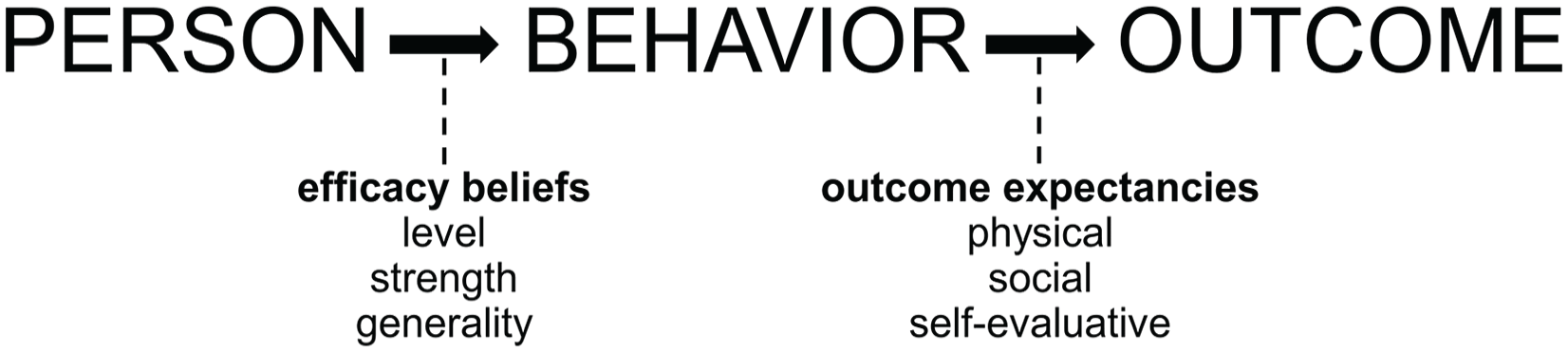
Understanding of Efficacy Beliefs and Outcome Expectancies in Self-Efficacy Theory (Bandura, 1997, p. 22).
Relevant to measuring the concept, Bandura (2006a) formulated a guide for constructing self-efficacy scales. He operationalized self-efficacy as beliefs that a person can produce certain behaviors even in the face of difficulties—specifying them as beliefs about a person-behavior relation. An innovative idea at that time, he strictly separated self-efficacy from outcome expectancies. Rather, he understood those as behavior-outcome links (i.e., “beliefs about whether actions affect outcomes,” Bandura, 1977, 1997, pp. 20–21) that earlier strands of research investigated (Bolles, 1975; Irwin, 1971; Rotter, 1966; Seligman, 1975; as cited in Bandura, 1997, p. 19). He also highlighted their joint relevance for determining whether someone gets stuck in a state of apathy or proactively pursues their aspirations. In focusing on this dichotomous distinction of self-efficacy and outcome expectancy, self-efficacy theory (Bandura, 1997, pp. 26–29) discarded Ellen Skinner’s (1991, 1996) concept of control beliefs as a person-outcome link. This link is missing in Bandura’s depiction because self-efficacy theory assumes that a person-outcome link would embody wishful thinking and would arise as a product of self-efficacy and outcome expectancy.
While self-efficacy may be central to taking individual action, major societal transitions also require joint or collective actions that are carried out by groups rather than individuals alone (Bandura, 1997, p. 2; Bongiorno et al., 2016; Fritsche et al., 2018; van Zomeren et al., 2010). Therefore, Bandura (1997) introduced collective efficacy as “a group’s shared belief in its conjoint capabilities to organize and execute the courses of action required to produce given levels of attainment” (p. 477). Thus, he viewed it as a group-level property (Bandura, 1995, 2000). However, research on what motivates people to engage in collective actions developed a more individual-level understanding of group efficacy beliefs as an individual’s belief of “being able to solve their group-related problems by unified effort” (Mummendey et al., 1999, p. 232).
Differentiating self-efficacy from outcome expectancy and from collective efficacy may be key to understanding what motivates people to engage in individual and collective action for collective social and ecological aims. Indeed, these are two among many other branches in different literatures that led to a diverse but also fragmented broad research field around the concept of self-efficacy. In earlier days of self-efficacy theory, Ellen Skinner (1996) already observed that very diverse labels were used to describe efficacy-related constructs and pointed at adverse consequences for theoretical integration and practical implications (Palenzuela, 1987; see also Rodin, 1990; Thompson & Spacapan, 1991, as cited in Skinner, 1996). Nearly three decades later, our review shows that, unfortunately, this problem is still with us, as various conceptualizations and operationalizations abound (Scafuto et al., 2018). This is both a scientific and practical problem because such conceptual and empirical confusion blurs answers to the question of how to understand and utilize self-efficacy, given the need for agentic and proactive responses to social and ecological crises. Below, we therefore outline key observations from a literature review that underlie this diagnosis and suggest a comprehensive integrative framework that remedies the current state of affairs.
Four Key Observations About the Current State of Efficacy Research
We conducted a literature review of research on environmental protection as a core domain of collective ecological and social aims. Environmental protection is a suitable topic as environmental problems are associated with numerous personal and collective actions (e.g., dietary behaviors, mobility choices, as well as petitions and protests), leading researchers to combine various personal and collective approaches to motivation. Our literature search in the context of environmental protection yielded N = 183 studies that included efficacy-related constructs and displayed their items. This search was based on the screening process for a meta-analysis on the relation of pro-environmental behavior and efficacy beliefs that include an aim (Hamann et al., 2019). This process resulted in four key observations: (a) Efficacy constructs feature in central environmental psychological theories; (b) in environmental protection research, there is an overabundance of efficacy labels; (c) clear guidelines are missing on how to operationalize self-efficacy in the context of collective social and ecological aims; and (d) yet, research in the field of efficacy beliefs can be integrated and organized along the lines of different agents, actions, and aims. We discuss each of these observations in turn.
Observation 1: Efficacy Constructs Feature in Central Environmental Psychological Theories
We first reviewed how central environmental psychology models integrate efficacy beliefs theoretically. Several theories featured individual-focused notions of self-efficacy. For one, the theory of planned behavior (Ajzen, 1991) explains how attitudes, subjective norms, and perceived behavioral control guide people’s behavior (e.g., behavior pushing for environmental protection; Bamberg & Möser, 2007; Fischer & Karl, 2022; Hines et al., 1986/1987). Therein, perceived behavioral control is very similar to Bandura’s notion of self-efficacy as an action-related concept (Fishbein & Ajzen, 2010, pp. 161–162; see also Ajzen, 2002). Protection motivation theory (Rogers, 1975, 1983) focuses on how people protect themselves in the face of social and ecological crises (Rainear & Christensen, 2017; Van Valkengoed & Steg, 2019; G. Zhao et al., 2016). This theory includes self-efficacy and response efficacy as coping appraisals that determine action tendencies. They reflect the concepts of self-efficacy and outcome expectancies from self-efficacy theory (Rogers, 1983, p. 169; see also Maddux & Rogers, 1983).
Furthermore, the norm activation model by Schwartz (1977) assumes that pro-social and pro-environmental actions are to a large degree driven by one’s personal norms (for empirical evidence, see, for example, De Groot & Steg, 2009; Schwartz & Howard, 1981; Steg & De Groot, 2010; Steg et al., 2012; Van der Werff et al., 2019). Personal norms are in turn influenced by subjective norms, awareness of consequences, ascription of responsibility, and perceived behavioral control (see also Klöckner, 2013). While perceived behavioral control is similar to self-efficacy, awareness of consequences is also sometimes operationalized as an efficacy-related concept (e.g., “My travel mode choice can be a contribution to the protection of the environment”; Hunecke et al., 2001, p. 849).
In addition, self-determination theory (Deci & Ryan, 1985, 2000a, 2000b; Ryan & Deci, 2017) is an organismic-dialectic theory of human motivation proposing that the satisfaction of three basic psychological needs (competence, autonomy, and relatedness) is a prerequisite for intrinsic motivation, for example, in the ecological domain (Cooke et al., 2016; Pelletier et al., 1998; Wullenkord, 2020). Here, the need for competence closely resembles self-efficacy and outcome expectancy constructs.
With respect to more collective notions of efficacy beliefs, the social identity model of collective action (SIMCA) by van Zomeren et al. (2008) emphasizes groups as collective agents (e.g., activists) undertaking collective action (e.g., protests) to pursue collective aims (e.g., promoting environmental justice). It is based on a meta-analysis in which social identity, group-based emotions, and (mostly collective) efficacy beliefs predicted collective action for social and ecological causes (see also Agostini & van Zomeren, 2021; Bamberg et al., 2015; Fritsche et al., 2018; Klandermans, 1997). Later research extended the SIMCA with participative efficacy as a conceptual link between personal and collective efficacy beliefs. Participative efficacy is defined as the “belief that one can make a difference through one’s own contribution to the collective efforts aimed at achieving group goals” (van Zomeren et al., 2013, p. 619). Under certain circumstances, strong collective efficacy might lead to inaction and free-riding because a group is already perceived to be effective without one’s contribution (Olson, 1968). Participative efficacy explains why people would keep engaging in a collective endeavor anyway. Next to the SIMCA, we observe a trend that researchers extend individual action models by collective efficacy, such as the theory of planned behavior (Babcicky & Seebauer, 2020; X. Wang, 2018), thus bringing individual and collective fields of research closer together (van Zomeren, 2014).
Other theories and models also incorporated efficacy constructs, such as the value-belief-norm theory (Stern, 2000), the encapsulated model of social identification and collective action (Thomas et al., 2009), the social identity model of pro-environmental action (Fritsche et al., 2018), different strands of empowerment theory (Drury & Reicher, 1999; Zimmerman, 1990), integrative models like the comprehensive action determination model (Klöckner & Blöbaum, 2010), the stage model of self-regulated behavioral change (Bamberg, 2013), research strands on political efficacy (Stenner-Day & Fischle, 1992), internal and external locus of control (Cleveland & Kalamas, 2014), or perceived consumer effectiveness (Kinnear et al., 1974). Although it is beyond the scope of his article to discuss them all here, this confirms our observation that efficacy constructs feature in central environmental psychological theories.
Observation 2: There is an Overabundance of Efficacy Labels
To gain an overview of how efficacy beliefs are handled empirically, we observed which label was used to describe efficacy beliefs in previous environmental protection research (i.e., in the method sections of the reviewed articles). Researchers’ seemingly unsystematic treatment of efficacy beliefs and outcome expectancies becomes apparent when looking at 183 studies that use a total of 49 different labels for efficacy-related constructs. Table 1 displays a rough categorization of labels that describe constructs with an efficacy-associated operationalization (i.e., items), according to our understanding. While most of the labels intuitively fit the efficacy construct, some labels do not (e.g., awareness of consequences), although the underlying study uses an efficacy-related operationalization (“I could contribute to a better environment by using an e-bike,” Simsekoglu & Klöckner, 2018). We largely found labels like self-efficacy, efficacy, effectiveness, (perceived behavioral) control, appraisal or evaluation, participative efficacy, collective efficacy, or group efficacy. Collective efficacy labels sometimes included a linkage to another efficacy label (e.g., collective response efficacy, or collective self-efficacy).
Overview of Labels That Have Been Used to Denote Efficacy-Related Constructs.
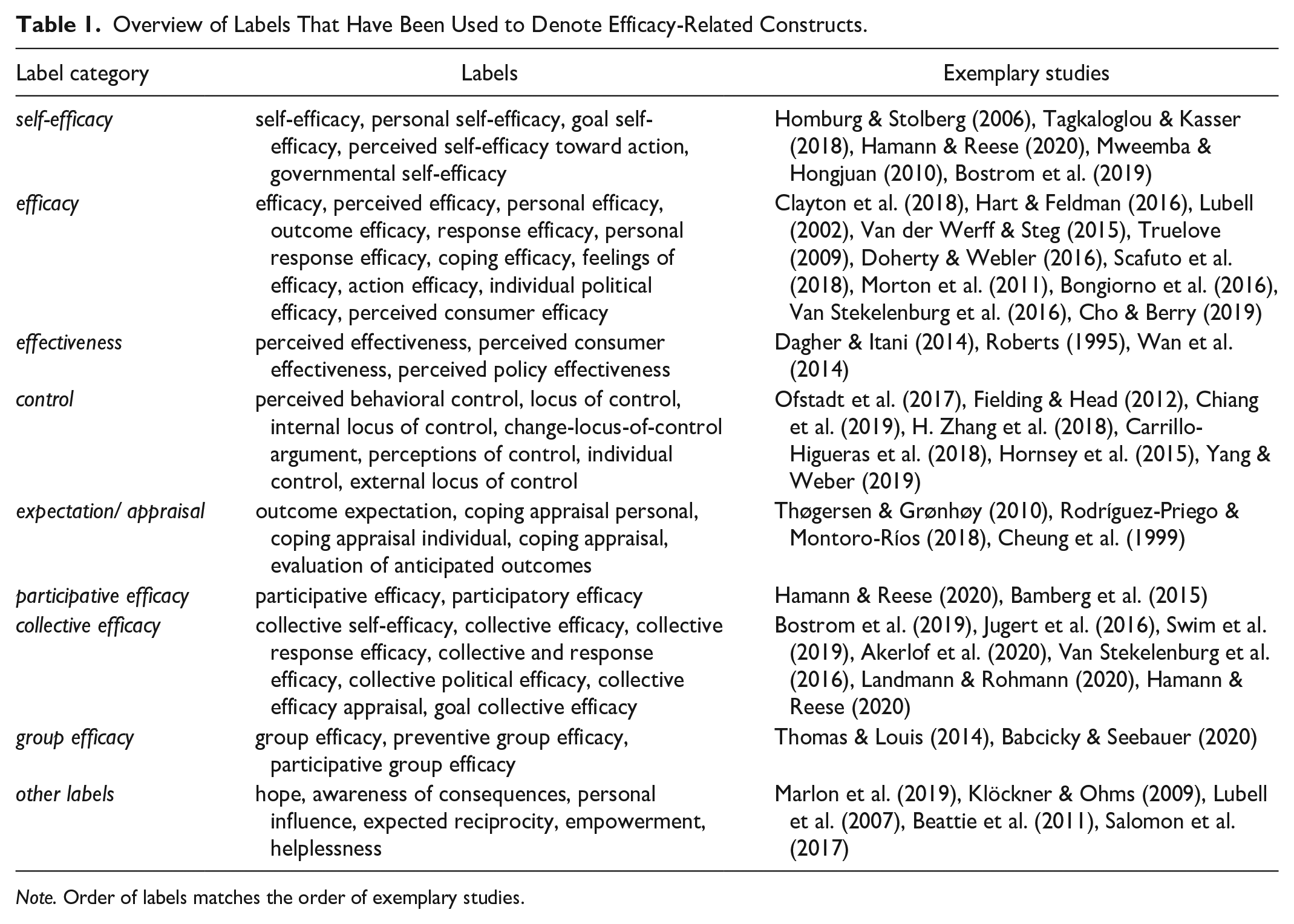
Note. Order of labels matches the order of exemplary studies.
Depending on the theoretical background, certain labels are applied rather congruently: for example, perceived behavioral control in the area of the theory of planned behavior (Ajzen, 1991), response efficacy or coping appraisal in protection motivation theory (Rogers, 1983), collective efficacy in literature referring to the SIMCA (van Zomeren et al., 2008), or perceived consumer effectiveness in consumer research (Hanss & Doran, 2020; Kinnear et al., 1974). Therefore, labels partially indicate their strand of research. However, many labels are introduced only with reference to Bandura (1997) or few reference studies (e.g., Hart & Feldman, 2016; Wan et al., 2014). Many studies use various labels interchangeably throughout the whole article (e.g., Clayton et al., 2018; Scafuto et al., 2018). As such, our second observation confirms that Ellen Skinner’s (1996) concerns about the use of very diverse labels describing efficacy-related constructs are still alive and kicking.
Observation 3: Clear Guidelines Are Missing on How to Operationalize Self-Efficacy in the Context of Collective Social and Ecological Aims
We further observed that in many studies, it was unclear how the decision to operationalize an efficacy construct was made. Many studies only cited groundwork by Bandura (1997) without connecting their findings to Bandura’s research or other topic-specific empirical research. Some did not at all reference self-efficacy theory although their studied concepts largely overlapped (e.g., Dong et al., 2021). Only some studies used Bandura’s (1997) action-bound conceptualization of self-efficacy. Instead, many studies diverged from Bandura’s understanding in that they included aims in their conceptualization of self-efficacy (e.g., Abraham et al., 2015; Heath & Gifford, 2006; Jugert et al., 2016).
Our review further revealed that almost none of the studies operationalized self-efficacy by including behavioral barriers as suggested by Bandura (2006a, 2015). When focusing on an action-bound efficacy concept, it was more likely that studies applied the perceived behavioral control label and operationalization of the theory of planned behavior, for which there are many guidelines for scale construction (Ajzen, 1991; Fishbein & Ajzen, 2010). This may be the case because Bandura’s (2006a) guide for constructing self-efficacy scales suggests to operationalize self-efficacy as a comprehensive measure. It is comprehensive as it includes further psychological variables as barriers (e.g., social norms that are present when asking how confident someone is that they can get themself to perform their exercise routine regularly “without support from my family or friends,” Bandura, 2006a, p. 321). Yet, this makes it difficult to integrate Bandura’s (2006a) operationalization of self-efficacy into psychological models featuring these psychological variables as separate constructs (e.g., social norms). As Bandura’s guide is—in our view—less suitable to be integrated into preexisting social and ecological models, researchers were missing a guide to base their labeling and operationalization decision on.
In its extreme form, this led to studies that seem to lack construct validity in our view (see Eronen & Bringmann, 2021)—their efficacy construct included items that were clearly not efficacy beliefs. For example, we found scales containing items that are not efficacy beliefs but intentions (e.g., self-efficacy operationalized as “I will take steps to participate in behaviors that help prevent global climate change, even if it causes daily inconveniences,” S. Kim et al., 2013, p. 176; see also Al Mamun, Mohamad et al., 2018; González et al., 2015; Ming et al., 2015; Nguyen et al., 2019; Vieira et al., 2019; Webster, 1975; Wells et al., 2015), subjective knowledge (e.g., self-efficacy as “I think now I have relevant knowledge on sustainability concepts,” Shahzalal & Hassan, 2019, p. 9; see also Feldman et al., 2017; Klöckner & Nayum, 2017; Y. Li & Zhong, 2017; Taylor & Todd, 1997; for a critique see Bandura, 1997, p. 483), perceived responsibility (e.g., personal efficacy as “Human beings are responsible for global warming and climate change,” Kellstedt et al., 2008, p. 118; see also Bozorgparvar et al., 2018; Cheng et al., 2018; Goldman et al., 2013; Hanss & Böhm, 2010; Milfont, 2012), climate change denial (e.g., low collective efficacy as “Global warming isn’t happening,” Roser-Renouf et al., 2014, p. 168), or social norms (e.g., outcome expectancy as “Most of those important to me think I should buy green aquatic products,” Y. Li & Zhong, 2017, p. 1449; see also Park & Yang, 2012; H. Zhang et al., 2018). Some operationalized self-efficacy as perceived difficulty (e.g., self-efficacy as “For me, using biofuels is difficult,” Bakhtiyaria et al., 2017, p. 344; Lam & Chen, 2006), although Fishbein and Ajzen (2010, p. 165) warned against this understanding of self-efficacy/ perceived behavioral control because of its potential overlap with attitudes.
Then again, some items clearly do represent efficacy beliefs or outcome expectations, although their label does not necessarily suggest it (e.g., awareness of consequences, personal influence, empowerment, and expected reciprocity; see Table 1). For example, awareness of consequences includes the item “I could contribute to a better environment by using an e-bike” (Simsekoglu & Klöckner, 2018), empowerment is captured by the item “The UK can make a difference in the fight against climate change” (Beattie et al., 2011). The item “My actions to reduce the effects of global warming and climate change in my community encourage others to reduce the effects of global warming through their own actions” is labeled expected reciprocity (Lubell et al., 2007). This observation confirms our assumption that currently, the potential for self-efficacy theory to be applied to contexts of collective social and ecological aims is hindered as the concept often seems lost in (operational) translation.
Observation 4: Research in the Field of Efficacy Beliefs Can Be Integrated and Organized Along the Lines of Different Agents, Actions, and Aims
The fragmentation observed earlier can be organized along the lines of different agents, actions, and aims involved in human agency. As part of our review, we engaged in a structuring process in which we looked for key characteristics that distinguish specific operationalizations of efficacy beliefs in all included studies. We started by looking at different efficacy agents.
Many researchers such as Bandura (1997) highlighted a distinction between personal self-efficacy and collective efficacy (Hamann & Reese, 2020; Jugert et al., 2016). We therefore first zoomed in on different efficacy agents. In a first step, we divided the set of studies into the ones featuring personal agents (i.e., “I,” “a person”), collective agents (i.e., “we,” social groups), or no agents (e.g., “recycling promotes environmental protection”). Looking at the studies from the perspective of social identity theory (Tajfel & Turner, 1986), we noticed that the collective efficacy agents diverged in how much study participants identified with them. In a second step, we therefore further distinguished ingroup agents (i.e., a group that the individual is part of) from external agents and cases in which a distinction was not clear (i.e., a group that the individual is not directly part of, e.g., “the government”). External agents are often included in political psychology studies measuring external efficacy or external locus of control (Esaiasson et al., 2015; Yang & Weber, 2019). Recent debates in control restoration theory substantiate our decision. These debates distinguish control restoration through ingroups from control restoration through external groups (Fritsche, 2022).
In a third step, we utilized Bandura’s (1997, pp. 38–40) critique of studies that did not explicate their efficacy agent. Scanning through the studies, it became apparent that while some studies referenced explicit agents (“I,” “Americans”), other studies obscured agents and remained vague and anonymous (“a person,” generic “we” without a reference group). Thus, we distinguished studies mentioning an anonymous agent from those that explicated agents. Combining all coding decisions yielded six types of agents: personal self, ingroup, no agent, anonymous individual, anonymous collective, external/unclear whether ingroup or outgroup (see Table 2).
Overview of Coding Scheme Regarding Efficacy Agents, Efficacy Targets, and Efficacy Links.
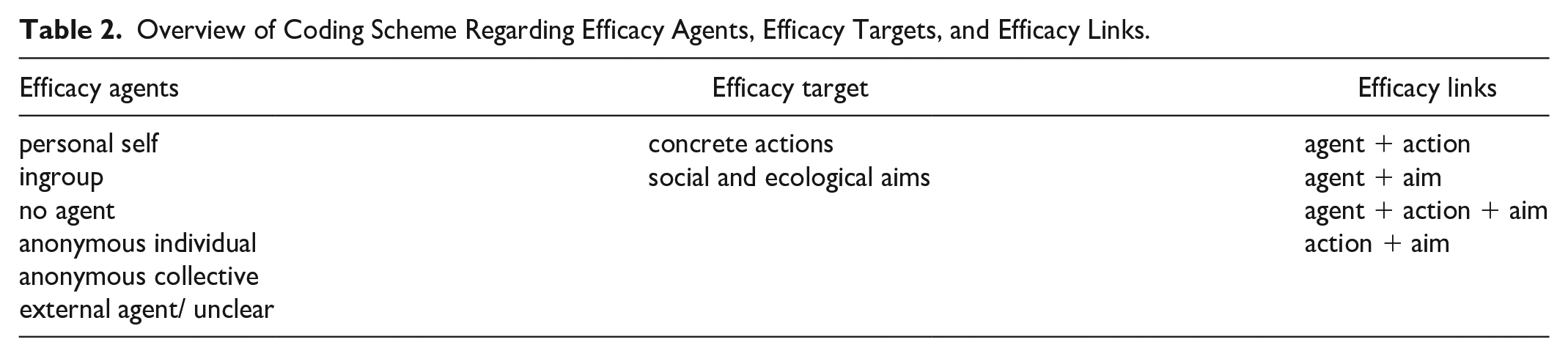
A fourth step aimed at clarifying the efficacy target by making distinctions between actions and aims clearer. Grounded in the theory of planned behavior (Fishbein & Ajzen, 2010, p. 31), both actions and aims can be organized according to their level of abstractness from very concrete actions to more abstract domains (see also Fishbach & Ferguson, 2007; Skinner, 1996). Correspondingly, we distinguished efficacy beliefs referring to concrete actions from those capturing collective social and ecological aims. This step made it possible to examine links between the three core features of efficacy beliefs—agents, actions, and aims.
We based our final step on Bandura’s (1997) illustration (see Figure 1) and Ellen Skinner’s (1996) extended perspective on it. The three core features of efficacy beliefs can be linked in four possible ways: We can draw a link between (a) agent and action (i.e., an agent can perform an action), (b) action and aim (i.e., an action can lead to an aim), (c) agent and aim (i.e., an agent can achieve an aim), and (d) agent, action, and aim (i.e., an agent can achieve an aim through an action). Thus, for all abovementioned efficacy agents, we differentiated precisely which link they were referring to. Table 3 displays all studies that we matched to a specific efficacy agent and link, based on their operationalization (example items are shown in Supplementary Table A1). It demonstrates that researchers have operationalized efficacy beliefs in manifold ways, and that it is possible to organize this body of research by clarifying which efficacy agents and efficacy links studies refer to.
Application of Coding Scheme to Studies in Environmental Protection Research.
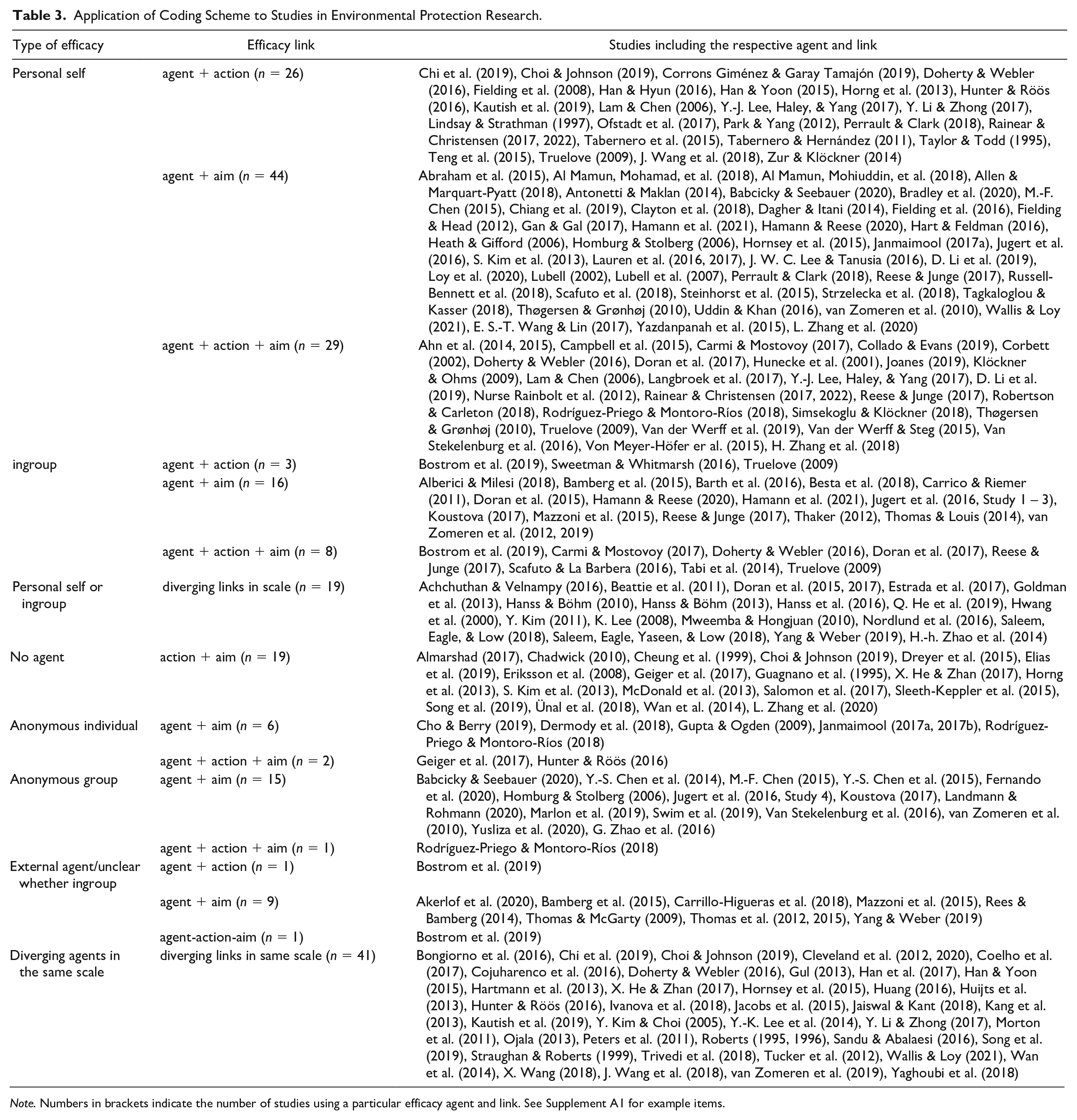
Note. Numbers in brackets indicate the number of studies using a particular efficacy agent and link. See Supplement A1 for example items.
We concluded that researchers (including ourselves) have inconsistently labeled and operationalized efficacy beliefs in diverse ways that do not necessarily conform to self-efficacy theory. Although researchers presumably did so with good reason, it impedes theoretical and empirical integration across studies. Our observation is that this fragmentation is not random but can be meaningfully organized along the lines of different agents, actions, and aims. This confirms our assumption that an integrative framework is not only needed but also possible to generate. In the following section, we will present the triple-A framework that builds on this Agent-Action-Aim structure.
The Triple-A Framework
With the triple-A framework, we present a structure that helps organize the rather unsystematic field of self-efficacy research regarding collective social and ecological aims, thereby providing a stronger basis for targeting social and ecological crises. The triple-A framework (a) defines self-efficacy as a self-categorized efficacy belief (to be defined below), (b) describes the different actions and aims involved, and (c) distinguishes three agent-action-aim links. In this understanding, self-efficacy is the belief that a self-categorized agent can perform an intentional action, achieve a desirable aim, or achieve a desirable aim by performing an intentional action (see Figure 2).
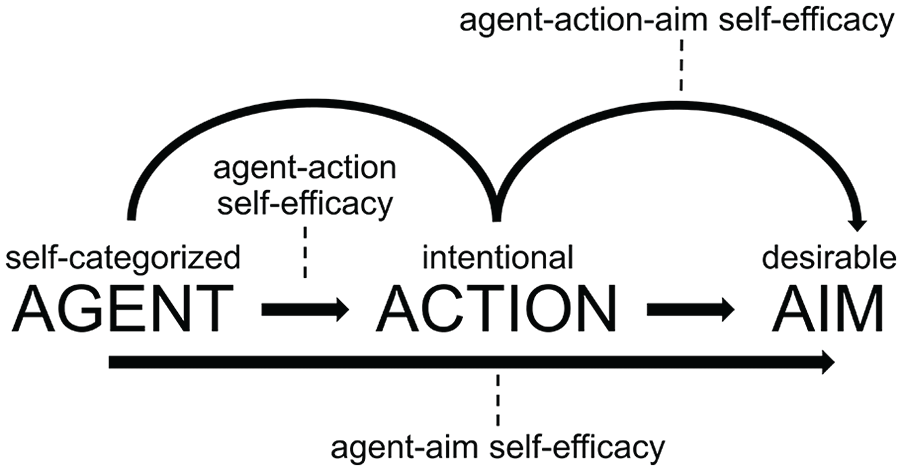
The Triple-A (Agent-Action-Aim) Framework of Self-Efficacy Beliefs in the Context of Collective Social and Ecological Aims.
The triple-A framework is conceptually based not only on Ellen Skinner’s (1996) framework of agents, means, and ends of control but also self-categorization theory (Turner et al., 1987). We apply the framework to the context of collective social and ecological aims, for which we observed a need for self-efficacy theory (Bandura, 1997) to be extended and developed further to be utilized in practice. Moreover, we contrast the triple-A framework of self-efficacy as depicted in Figure 2 with the notion of outcome expectancies. Although outcome expectancies can be organized in the same agent-action-aim structure, they do not fulfill the criteria of self-efficacy as they do not include a self-categorized agent but refer to an external or anonymized agent or no agent at all (see Supplement A2 for further thoughts on this). Below we present the core aspects of the framework.
First A: Self-Categorized Agent
Based on the social identity perspective, a self-categorized agent is either the personal self (“I”) or an ingroup (i.e., a group that is part of the person’s self-concept due to social and emotional group membership, Tajfel, 1978, p. 63; see also Skinner, 1996). We borrowed the term agent from self-efficacy theory itself (Bandura, 1997, p. 3), and chose it because it signals the possibility of being able to affect changes—both personally and collectively (see also Preston & Wegner, 2005). In the triple-A framework, a person can thus perceive personal and collective self-efficacy. Therein, collective efficacy explicitly refers to an ingroup (e.g., an activist group). Put differently, the different agents to which self-efficacy can apply in our framework are the individual (i.e., personal self-efficacy) and the group (i.e., collective self-efficacy), and each agent is connected to different aspects of the self-concept that are salient in different contexts. By flexibly shifting from one self-categorization to the other, a person can also shift in their self’s efficacy. This view enables integration of personal and collective action research into one framework. However, the term collective self-efficacy is very uncommon (see Bostrom et al., 2019). We will therefore use the term “collective efficacy” when referring to a collective efficacy agent irrespective of self-categorization, and use the term “ingroup efficacy” for denoting self-categorized collective agents (see Y.-S. Chen et al., 2014).
Second A: Intentional Action
In self-efficacy theory, the agency is an intentional act. Accordingly, we explicate that self-efficacy should also involve an intentional action (i.e., one that is not accidental). The view of humans intentionally creating and altering the world around them seems fitting to the context of collective social and ecological aims. In the triple-A framework, we define an action as any behavior that is time- and space-bound, measurable or observable, and ready to be performed intentionally (e.g., “drinking water from the tab” or “joining a protest,” see definition by Johnston & Pennypacker, 1993, as cited in Fishbein & Ajzen, 2010, p. 39; Kruglanski et al., 2018). We deliberately chose the term action as it signals that self-efficacy is intentional and directed toward an aim, while a behavior can be intentional or unintentional. Intentionality in this definition can represent actual intentionality or imagined intentionality, for example, marked by the words “if I want to” (Williams & Rhodes, 2014). Intentional actions can be characterized by their level of self-determination, abstraction, and their content. The action component of self-efficacy further connects to the definition of collective action as any coordinated (and thus intentional) action that individuals undertake as ingroup members with the purpose of achieving a desirable collective aim (Agostini & van Zomeren, 2021; Brunsting & Postmes, 2002; Landmann & Rohmann, 2020; Louis, Amiot, et al., 2016; van Zomeren, 2016; Wright et al., 1990).
Third A: Desirable Aim
An aim is a cognitive representation of a desired personal or collective outcome (Fishbach & Ferguson, 2007). Rather long-term, abstract, and purpose-driven aims can be distinguished from rather short-term, concrete, and achievement-driven goals (see Locke & Latham, 2002). Similar to self-efficacy, aims direct people’s attention, produce motivational energy, create persistence, and foster skill development (Locke & Latham, 2002). Self-efficacy and aims influence each other in complex bidirectional ways. For example, efficacy perceptions determine which aims people pursue (Bandura, 1997, p. 8). Then again, people’s aims influence how they construct and maintain corresponding efficacy perceptions. In the triple-A framework, we explicate what has already been suggested in self-efficacy theory (Bandura, 1997, p. 513) and by other researchers (Koletsou & Mancy, 2011; Maddux & Stanley, 1986): The self-efficacy concept must include a desirable aim.
By highlighting the role of aims for self-efficacy, the triple-A framework lays the foundation for discussions about aims in the broader field of efficacy-expectancy research. Therein, it is important to consider the level of abstraction, content, and many other dimensions like the quality of the aim (Deci & Ryan, 2000b), short- or long-term nature, action stage (e.g., action, maintenance, or recovery self-efficacy, C.-Q. Zhang et al., 2019), or benchmarks of aim achievement (Bandura, 1997, p. 485; Williams, 2010; for more characteristics see also Skinner, 1996).
Linking the Three As
Previous research has oftentimes mixed different types of self-efficacy. At the same time, these efficacy types have rarely been investigated from one concise theoretical perspective. Our framework suggests that it is worth distinguishing three self-efficacy links, namely, self-efficacy focused on the link between agent-action, agent-action-aim, and agent-aim while placing them into a comprehensive framework. A distinction between the three self-efficacy links might appear similar to Bandura’s (1997) and Ellen Skinner’s (1991, 1996) proposed self-efficacy versus outcome expectancy versus control belief distinction, but it is not. In the triple-A framework, the agent-aim and agent-action-aim links are not separate from but regarded as types of self-efficacy as long as they include a self-categorized agent (see also Fishbein & Ajzen, 2010, pp. 165–177). Table 4 shows labels, definitions, and personal and collective examples for each efficacy type. Reflected in our definitions and examples is the idea that self-efficacy theory is a theory of beliefs about self-regulated action and aim achievement (Schwarzer & Schmitz, 1999, as cited in Homburg & Wagner, 2007). This is incorporated by the marker word “can,” combined with a self-categorized agent, an intentional action, and a desirable aim.
Overview of Self-Efficacy Types, Definitions, and Personal and Collective Examples.
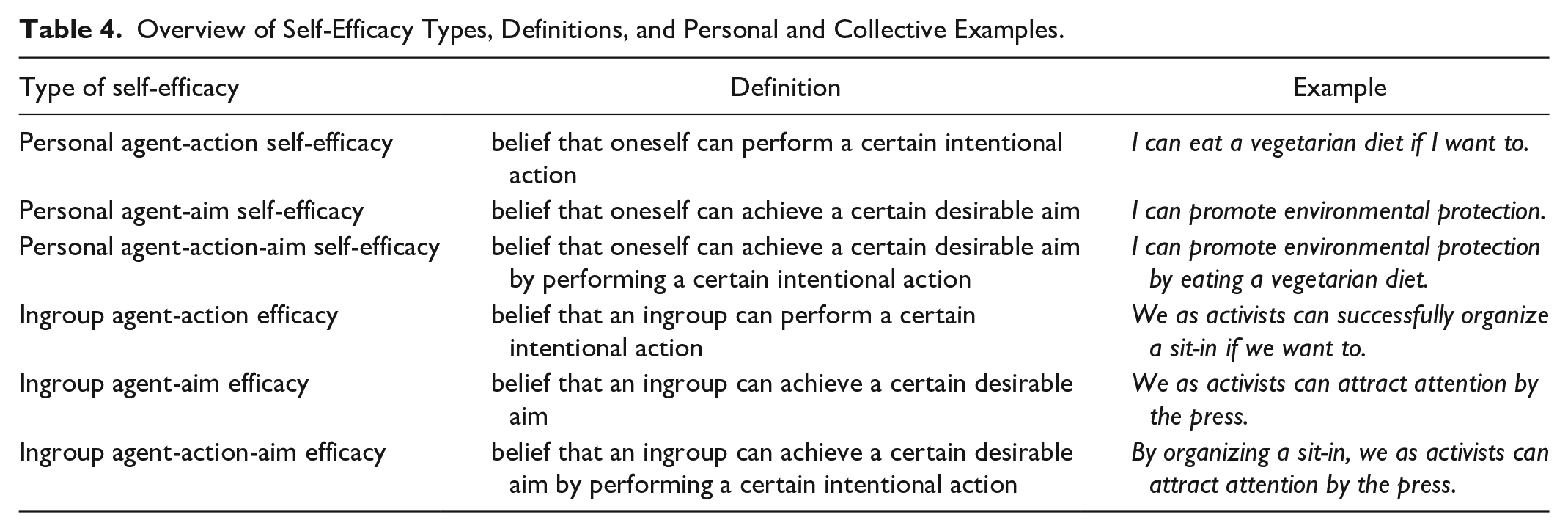
From theoretical, empirical, and practical points of view, it is important to both distinguish and integrate all three links. In theory, a person might believe that they can write a letter to a governmental official (high personal agent-action self-efficacy) but does not believe that their writing mitigates climate change (low personal agent-action-aim self-efficacy). Then again, they might think that they can indeed mitigate climate change (high personal agent-aim self-efficacy), but not by writing a letter, but by many other actions like volunteering for an environmental organization. Another person might believe that their local Greenpeace group can go to a protest (high agent-action ingroup efficacy), but they may not believe that they can convince government officials to pass a particular environmental law by joining exactly this protest (low agent-action-aim ingroup efficacy). They might also believe that they as a Greenpeace group are unable to influence government officials at all (low agent-aim ingroup efficacy) and by no means. In another example, a person might think that they are not capable of following a strict vegan diet (low personal agent-action self-efficacy), although they think that their vegan diet would promote animal welfare (high personal agent-action-aim self-efficacy). However, when thinking about it in general, they may not think that they can really promote animal welfare (low personal agent-aim self-efficacy). Thus, agent-action, agent-aim, and agent-action-aim self-efficacy can diverge or align depending on the contexts of interest. From a theoretical perspective, an integrative framework that leaves room for more fine-grained distinctions would therefore be suitable for studying self-efficacy (see also theorizing by Hanss & Böhm, 2010).
We also expected to find a distinction between the efficacy links in an empirical sense. To look for initial empirical support for this assumption, we re-examined the 183 publications included in our review and searched for publications that captured more than one self-efficacy link in one study. Due to the small number of studies, relationships of efficacy links were only observed within but not between studies. We were guided by the operationalizations applied by researchers, as organized in Table 3. To increase our hit rate, we also considered studies that used mixed scales including self-identified and anonymous/ no agents (see “Diverging agents in the same scale” in Table 3). Specifically, we examined initial hints for discriminant and predictive validities (see Fishbein & Ajzen, 2010, pp. 164–165). For determining discriminant validity, we examined the correlations between diverging efficacy links in the same study. Low correlations would signify empirically separate constructs, while high correlations would signify that they could be regarded as the same construct. We considered predictive validity by examining whether both efficacy links predicted (intentions for) pro-environmental behavior when tested simultaneously, or whether one efficacy link canceled out the other. To do so, we considered diverse statistical models (i.e., regression analyses, path analyses, and structural equation modeling). Studies were included when they reported a correlation and/ or model including both efficacy links. For example, we identified the study by Choi and Johnson (2019) that featured self-efficacies with an agent-action link (“I have complete control over the number of green products that I will buy for personal use over the next three months”) and an agent-action-aim link (“My consumption will affect the environment and other consumers”). We then included the reported correlation between the concepts and the results from the regression analysis in our narrative review.
We found 12 studies capturing more than one self-efficacy link. Regarding discriminative validity, we observed that correlations between self-efficacies with an agent-action and an agent-action-aim link ranged from low- to medium-sized (Choi & Johnson, 2019; Han & Yoon, 2015; Kautish et al., 2019; Y.-J. Lee, Haley, & Yang, 2017; D. Li et al., 2019; Perrault & Clark, 2018; Truelove, 2009). Higher correlations occurred when considering ingroup efficacy (Truelove, 2009), while correlations were lower if the scale also included some anonymous agent items (Choi & Johnson, 2019; Han & Yoon, 2015; Kautish et al., 2019). We only found one study measuring both self-efficacy with an agent-aim and an agent-action-aim link for both personal and ingroup agents, reporting very high correlations between efficacy links on both levels (Reese & Junge, 2017).
Regarding their predictive power for behavior and behavioral intentions, most studies find that self-efficacy with an agent-action link and an agent-action-aim link have independent predictive power (Doherty & Webler, 2016; Hunter & Röös, 2016; Y.-J. Lee, Haley, & Yang, 2017; Y. Li & Zhong, 2017; Truelove, 2009). One study also found both self-efficacy with an agent-action and agent-aim link to predict behavioral intentions (Perrault & Clark, 2018). However, there were also two studies showing that only agent-action self-efficacy and not agent-action-aim self-efficacy (Lam & Chen, 2006) or only agent-action-aim self-efficacy but not agent-action self-efficacy (Kautish et al., 2019) continued to be a significant predictor when entered into models simultaneously. One study indicated that none of the efficacy links was predictive of behavioral intention when other variables such as subjective norms were included (Choi & Johnson, 2019).
Interestingly, we found no study reporting agent-aim and agent-action-aim self-efficacy as different predictors in one model. Yet, the study by Reese and Junge (2017) suggests that correlations with behavior might be very similar and might depend on the level of abstraction, with agent-action-aim self-efficacy potentially being a little more predictive of concrete (plastic consumption) intentions, and more general agent-aim self-efficacy being more predictive of a more general intention. In sum, our review of discriminant and predictive validity indicates that agent-action self-efficacy is distinguishable from agent-aim and agent-action aim self-efficacy. Yet, some inconsistent findings suggest that the results are not conclusive either. As only one study allowed us to make an agent-aim and agent-action-aim comparison, we cannot yet draw conclusions about their empirical distinctiveness nor can we know which characteristics of agents, actions, and aims led to stronger or weaker interdependence between these links. However, based on this initial evidence, we will, in the following, refer to action-focused self-efficacy when referring to the agent-action link and use the summarizing label of aim-focused self-efficacy for efficacy links that target an aim (i.e., agent-aim and agent-action aim link).
Three Advantages of the Triple-A Framework
There are at least three advantages of the triple-A framework over previously used conceptualizations: (a) It conceptualizes self-efficacy as a self-categorized efficacy belief; (b) it clarifies that self-efficacy includes intentional actions and desirable aims, thus laying the ground for categorizing aim content; and (c) it conceptually considers aim-focused self-efficacy as part of the self-efficacy construct. These advantages are based on an analysis of which labels are typically used for which operationalizations (see Table 5 and Supplement A3).
Labels That Are Used for Agent-Action-Aim Links of Various Types of Agents.
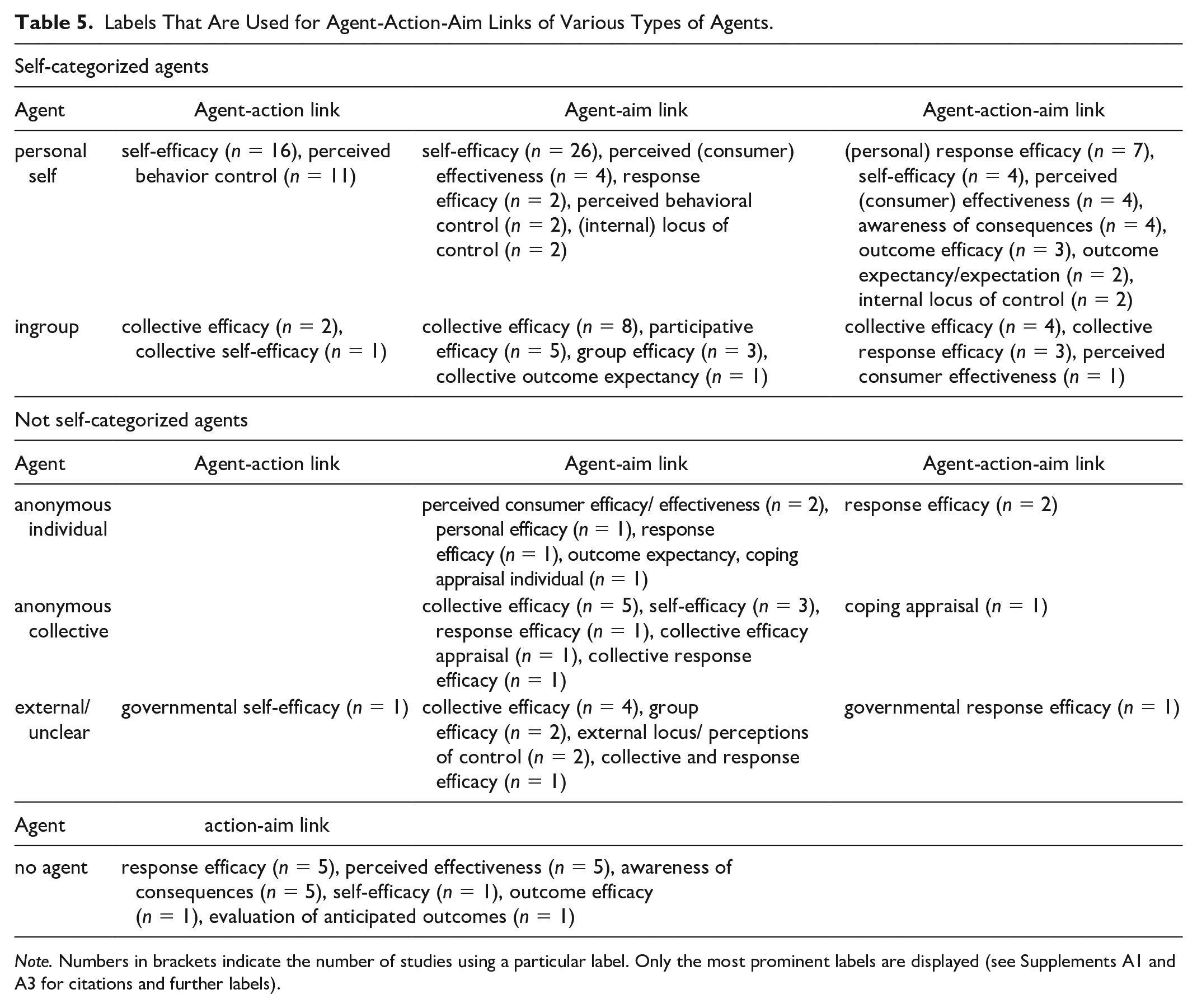
Note. Numbers in brackets indicate the number of studies using a particular label. Only the most prominent labels are displayed (see Supplements A1 and A3 for citations and further labels).
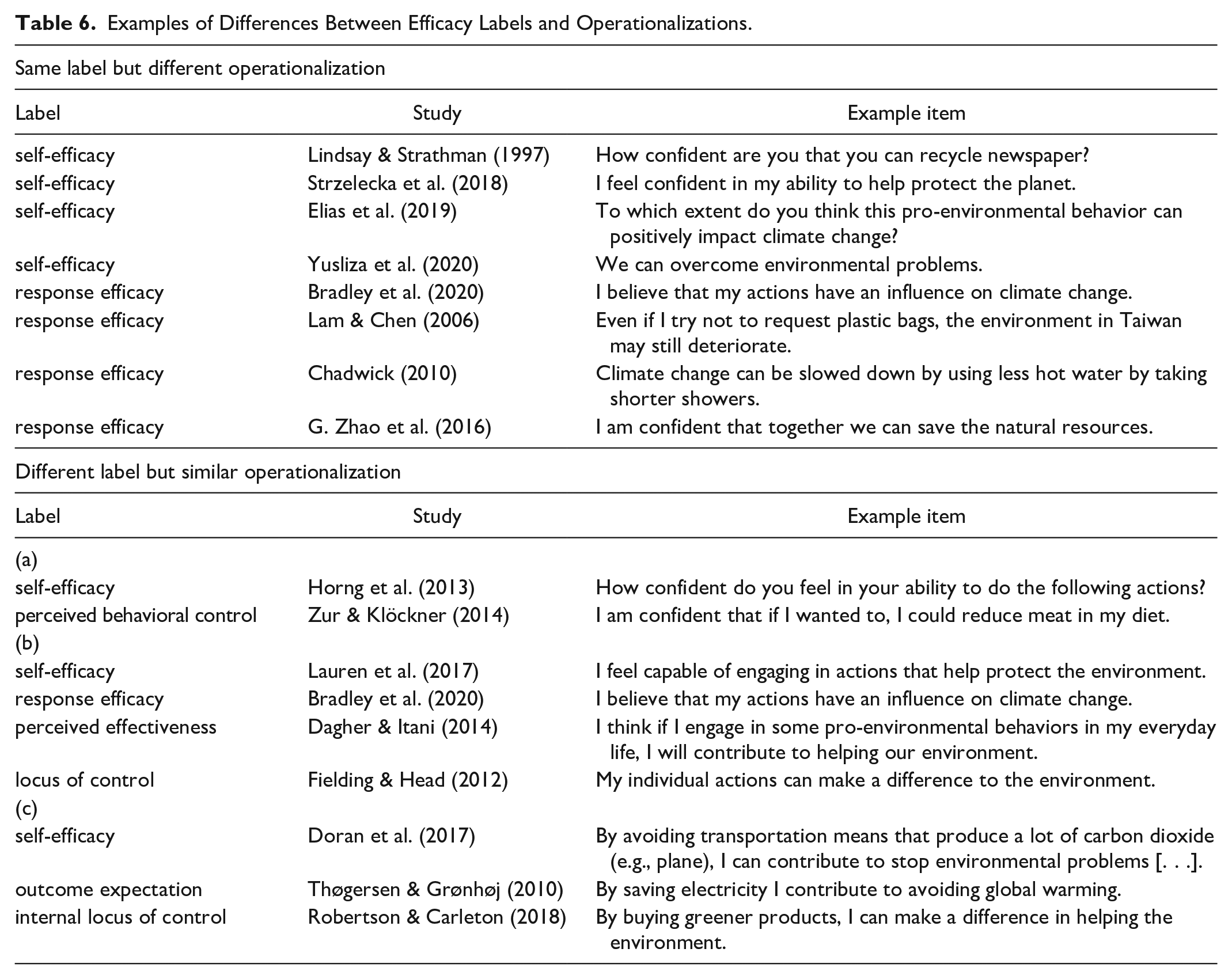
For both personal and collective agents, it was oftentimes impossible to deduce the specific agent or the particular agent-action-aim link from the label. For example, the label self-efficacy is used for all agent-action-aim links referring to the personal self (i.e., “I”) as an agent. The labels response efficacy and collective efficacy are present in almost all possible agent-action-aim links for diverse agents. In Table 6, we display some extreme examples of instances in which labels and operationalization did not match. It becomes clear that neither Bandura’s (2006a) operationalization nor his action-focused conceptualization reflects the current understanding of self-efficacy in this research domain. In the following, we will present three advantages of the triple-A framework that illuminate why it is conceptually more suitable for the context of collective social and ecological aims.
Examples of Differences Between Efficacy Labels and Operationalizations.
Advantage 1: The Triple-A Framework Conceptualizes Self-Efficacy as a Self-Categorized Efficacy Belief
Looking at Table 5, a consistent pattern emerges in which the label “self-efficacy” is almost exclusively used when referring to the personal self as an agent, in all possible links. Only a few studies use this label when referring to other types of efficacy-related constructs, for example, when describing a collective agent (e.g., Bostrom et al., 2019). However, this consistency only works one way. Many other labels were also common for labeling efficacy beliefs with the personal self as an agent, such as response efficacy, perceived effectiveness, behavioral control, or outcome efficacy. Overall, it remains ambiguous which agent the “self” in self-efficacy refers to.
We suppose that the ambiguous use of the label “self-efficacy” stems from three dualities that are typically connected to the self-efficacy construct. In previous literature, self-efficacy has been used (a) synonymous with “action-focused self-efficacy” as opposed to outcome expectancy (Bandura, 1997), (b) synonym with “personal efficacy” as opposed to collective efficacy (Hornsey et al., 2021), and (c) synonymous with an “aim-focused self-efficacy” as opposed to action-focused perceived behavioral control (Hanss & Böhm, 2010). This complexity is partially rooted in self-efficacy theory’s lack of clarity in how constructs around self-efficacy and outcome expectancy should be labeled. Moreover, the self-efficacy theory does not explicate how self-efficacy and collective efficacy relate. Indeed, Drury and Reicher (2005) criticized it for conceptualizing the self as mainly a personal self without acknowledging that collective identities can also be part of the self.
We aim to avoid these dualities and define self-efficacy within a framework that builds on integrating self-efficacy theory with a social identity perspective as it is present in, for example, the SIMCA (van Zomeren et al., 2008). Just like self-efficacy is linked to the (personal) self-concept, ingroup efficacy is linked to that part of the self-concept that is relevant to the group—one’s social identity (Fritsche et al., 2016; Turner et al., 1987). Thus, a group can be viewed as a potential self-efficacy agent. This assumption is based on a self-categorization perspective of self and identity, which suggests that individuals can flexibly shift from categorizing themselves as individuals (as “I” or ”me”) to categorizing themselves as members of groups (as “us” or “we”; Cocking & Drury, 2004; Fritsche et al., 2018; Tajfel & Turner, 1986).
Conceptualizing the “self” in self-efficacy as a personal as well as a social self presents a basis for a clearer framework (Fritsche & Masson, 2021), especially in the face of many studies not distinguishing or clarifying if their participants identify with the possibly agentic group at all (e.g., Bamberg et al., 2015; Mazzoni et al., 2015; Rees & Bamberg, 2014; Thomas et al., 2015; Thomas & McGarty, 2009). We, therefore, propose a new social identity conception of self-efficacy as any efficacy belief about a self-categorized agent (i.e., “I” or an ingroup such as “we as the transition town group”) as opposed to an outgroup or external agent (“the government,” “my neighbor”) or an anonymous agent (i.e., “a person” or generic “we”).
Advantage 2: The Triple-A Framework Clarifies That Self-Efficacy Includes Intentional Actions and Desirable Aims, Thus Laying the Ground for Categorizing Aim Content
To make studies comparable and integrable, it is relevant to review the content of efficacy actions and aims, or as Bandura and Locke (2003) put it: Researchers need to consider how “self-efficacy beliefs operate in concert with goal systems” (p. 87). As can be seen in Table 7, aim content can be very diverse, and needs to receive more attention. This becomes clear in a study by Homburg and Stolberg (2006) and its later replication by M.-F. Chen (2015). They were one of the first to introduce collective efficacy to the domain of environmental protection and advanced this field of research in a promising way. In their studies, they contrasted personal self-efficacy concerning a climate adaptation aim (e.g., “I know how to take precautions against pollution in everyday life”) with a collective efficacy regarding climate protection (e.g., “We can come up with creative ideas to solve environmental problems effectively, even if the external conditions are unfavorable”). They found that collective efficacy was a better predictor of pro-environmental behavior than self-efficacy. In our view, these results make perfect sense because there is a match of the climate mitigation aim of collective efficacy and the outcome, while the self-efficacy aim has a slightly different emphasis on climate adaptation.
Self-Efficacy Actions and Aims With Examples.
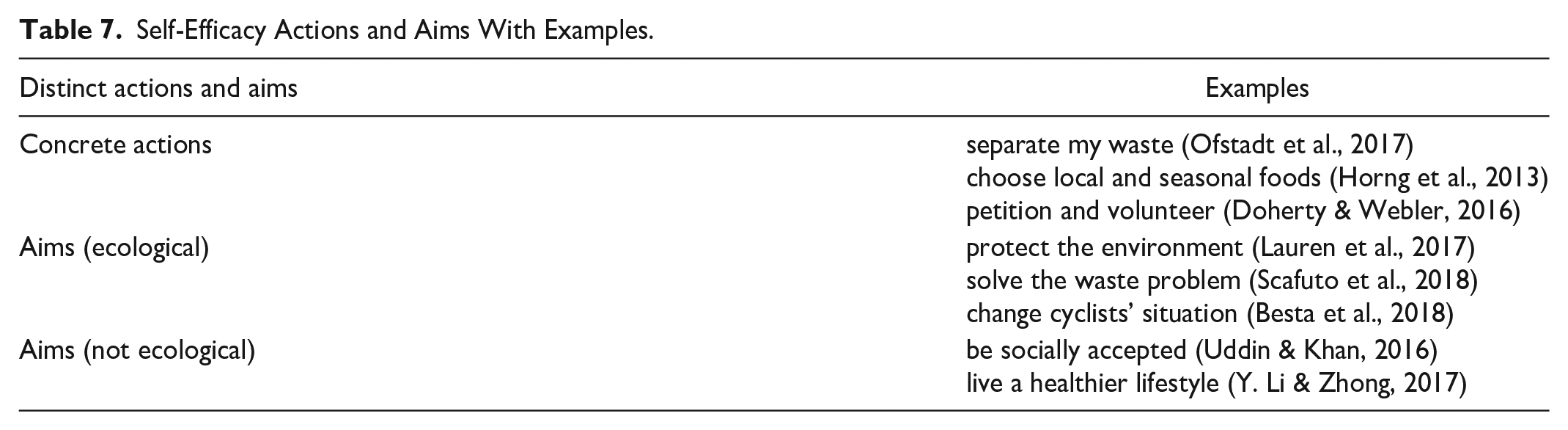
Adding to this, Hornsey et al. (2006) found that, depending on aim content, members and non-members of a protest group differed in how self-efficacy predicted their action intentions. Several studies included aims in their efficacy measures that were not directly targeting social or environmental issues (e.g., saving money or being healthy, see Table 7). Ignoring the different natures of the aim contents might lead to seemingly incoherent findings and mask the driving principles (Koletsou & Mancy, 2011).
In our view, there is one specific aim content that is implied in the self-efficacy construct but hardly ever made explicit: its desirability. According to Fishbach and Ferguson (2007), an aim is characterized by its desirability (see also Kruglanski et al., 2002). In the same vein, self-efficacy can be viewed as bound to a desirable aim (Koletsou & Mancy, 2011; Maddux & Stanley, 1986). People differ in what they find desirable and depending on the desirability of an action, people are more or less likely to pursue a given action (see goal contents theory, Deci & Ryan, 1985, 1995, 2000b; Kasser & Ryan, 1996; Ryan & Deci, 2017; Ryan et al., 1996). Ideas underlying the norm activation model (Schwartz, 1977) highlight that especially social and ecological contexts are full of conflicting values and aims.
Yet, researchers oftentimes assume that an aim like environmental protection is desirable for their sample per se and that they are therefore exclusively measuring the self-efficacy regarding a specific aim. If studies do not reflect on the desirability of an aim (which is not a common research practice) or target a group in which it can be assumed to be desirable (e.g., environmental activists), self-efficacy measures could be confounded (Williams et al., 2020; Williams & Rhodes, 2014). If an aim is not desirable but rejected, a self-efficacy measure may trigger defensiveness and capture only the value of the aim (see also Castiglione, 2021). According to Value × Expectancy assumptions, the expectancy to achieve an aim should not result in behavior if the aim is not simultaneously valued (Koletsou & Mancy, 2011; Lubell, 2002).
For example, a climate denier might reject the statement “I can protect the environment by using a bike instead of a car” because the aim of protecting the environment triggers their rejection. Nevertheless, this person might think that their mobility decision would have an influence on environmental protection and that they would be capable to perform the given action. With the same statement, a person that feels indifferent regarding climate protection aims might focus their evaluation on the effectiveness of biking for environmental protection, without revealing anything about their agentic motivation.
We, therefore, argue that self-efficacy interacts with the desirability of the aim that it incorporates. Self-determination theory similarly suggests that efficacy always interacts with autonomy to predict action (i.e., when peoples’ needs for both competence/efficacy and autonomy are satisfied, they are autonomously motivated to act, Deci & Ryan, 2000b). By highlighting the need for desirable efficacy aims, we create a basis for discussing the (autonomous) motivation behind those aims (Deci & Ryan, 1985, 2000b; Núñez & León, 2015; Ryan & Deci, 2017; Slemp et al., 2018).
The reasoning around desirable aims can also be applied to actions. If someone does not have the intention to eat a vegetarian diet and is asked about their self-efficacy beliefs regarding their eating habit, answers are likely influenced by the intention itself. Therefore, according to Williams and Rhodes (2014), it might be necessary to add the component “if you want to” to action-focused self-efficacy items to make sure that participants are thinking about an intentional action and as a way to avoid predicting behavioral intentions with another construct capturing intention.
Advantage 3: The Triple-A Framework Conceptually Considers Aim-Focused Self-Efficacy as Part of the Self-Efficacy Construct
In Table 5, it becomes apparent that while self-efficacy theory discarded aim-focused versions of self-efficacy (Bandura, 1997, pp. 26–29), self-efficacy research on environmental protection has not. Instead, it has produced an abundance of studies that investigate agent-aim and agent-action-aim links with self-categorized personal and ingroup agents (see also Vaughan-Johnston & Jacobson, 2020), mostly when applying protection motivation theory and the SIMCA (Hamann et al., 2021; Reese & Junge, 2017; van Zomeren et al., 2010, 2013; Wallis & Loy, 2021). We found that the agent-action link referring to the personal self was consistently labeled either self-efficacy or perceived behavioral control, reflecting Fishbein and Ajzen’s (2010) reasoning that those constructs are theoretically interchangeable (pp. 161–162; see also Ajzen, 2002). Yet, researchers do not have a framework to base their labeling decision on regarding agent-aim and agent-action-aim links.
This has resulted in diverse labels for these links such as self-efficacy, response efficacy, outcome efficacy, perceived effectiveness, or internal locus of control. Numerous studies, particularly in the field of consumer research (Roberts, 1995), integrated both agent-action-aim and agent-aim self-efficacy in one scale, raising the question whether there is one aim-focused efficacy concept or two empirically distinguishable subfacets. Yet, we found only three studies that included both action-focused items (agent-action) and aim-focused items (agent-aim or agent-action-aim) in one scale (Estrada et al., 2017; Q. He et al., 2019; Mweemba & Hongjuan, 2010).
A major reason why the field continued to investigate aim-focused self-efficacy as proposed by Ellen Skinner (1996) is that, although Bandura’s (2006a) operationalizations were quite precise, Bandura published definitions that seem to include aims (e.g., self-efficacy defined as the “beliefs in one’s capabilities to organize and execute the courses of action required to produce given attainments”; Bandura, 1997, p. 3). Yet, self-efficacy theory discarded agent-aim links of self-efficacy. Already in its early days, self-efficacy theory had been criticized for lacking conceptual clarity because the self-efficacy construct contained outcome elements and because outcome expectancies should have a similarly prominent role as self-efficacy for motivation (Eastman & Marzillier, 1984; Maddux & Stanley, 1986). Bandura probably discarded agent-aim links so easily because it was not very important in the context of his own research on private-sphere, performance-oriented personal actions, and proximal aims (e.g., building up muscles; Bandura, 1997, pp. 20–24, 134). Given certain external freedoms, in those contexts actions and aim achievement are rather under one’s own control (“I can decide how much I work out”), barriers rather lie inside the individual and their self-regulatory capacities, feedback is rather easily and proximally perceivable, and action-aim contingencies can be very strong (“if I work out, I will probably gain muscle mass”; Bandura, 1995; see also van Zomeren, 2016).
We suspect that the field of collective social and ecological aims is especially prone to an aim-focused understanding of self-efficacy because it fits the complex nature of collective crises (van Zomeren et al., 2019). For collective aims, the hardest part is not performing an action as such (e.g., going to a protest) but creating social change with this action. Individuals only have a very limited amount of control over collective outcomes (Hornsey et al., 2021; Jugert et al., 2016). Moreover, many barriers lie outside of the individual and are informed by the actions of powerful others; feedback is much more difficult to receive as aims are rather distal (e.g., the impact of an awareness campaign on people’s opinions is difficult to detect; Hornsey et al., 2021). 3
Social and ecological contexts also encompass looser action-aim contingencies. While there is a limited number of actions that can be done to gain muscle mass, there is an abundance of actions relevant for the social and ecological crises (e.g., using public transport, lower heating, voting for green parties, joining protests). In collective contexts, many actions can promote one specific aim, and one specific action can promote (or counteract) many aims (see the concepts equifinality and multifinality in goal setting theory by Kruglanski et al., 2002, 2015; see Supplement A4). By using agent-aim links, researchers avoid having to restrict their own research to a specific set of actions that—even in its sum—could never be representative of a collective aim. Bluntly speaking, we suggest that the belief that one is able to eat a vegetarian diet/use public transport/vote for a green party/join protests/and so on (i.e., agent-action link), and the expectation that those actions promote social and ecological aims (i.e., action-aim link) might add up to the belief that one can promote social and ecological aims with these actions (i.e., agent-action-aim link). Yet, this does not fully grasp the idea of the belief that one can promote social and ecological aims in general (i.e., agent-aim link) as suggested by self-efficacy theory (Bandura, 1997). Consequently, the innate characteristics of collective contexts suggest that researchers need to conceptualize aim links in self-efficacy theory as proposed by Ellen Skinner (1991, 1996). Aim-focused self-efficacy should be distinct from action-focused self-efficacy.
In sum, we presented three advantages of the triple-A framework of self-categorized agents, intentional actions, and desirable aims that clarify why it is suitable for the study of collective social and ecological aims. We believe that through these advantages, the triple-A framework has the potential to organize and integrate the field of efficacy research around social and ecological aims. So far, however, our review has focused on environmental protection as an exemplary context. While Ellen Skinner (1996) previously indicated similar problems in the broader self-efficacy field, we wanted to examine whether we can observe similar problems, and propose a similar conceptual solution for other fields of efficacy research.
Applying the Triple-A Framework to Collective Action Research on Social Injustice
This section examines whether the key observations from environmental protection research are applicable to the area of social injustice. By reviewing studies from a recent meta-analysis (Agostini & van Zomeren, 2021), we show that although social injustice research (a) uses fewer labels and operationalizations than environmental protection research, it (b) would benefit from the triple-A framework to successfully distinguish different agents, actions, aims, and their links. The meta-analysis that provided the basis for our review covered topics such as racial discrimination (Tausch et al., 2011), gender discrimination (Guizzo et al., 2017), student protests (Becker et al., 2011), and national sovereignty (Klavina & van Zomeren, 2020; see Agostini & van Zomeren, 2021). Of the 211 studies available to us, 99 met our inclusion criteria as they measured efficacy beliefs, reported items in a usable way, were published in English, and did not include concepts other than efficacy in their measure. Of these, 17 studies were already included in our review on the topic of collective environmental aims. This left N = 82 studies that were eligible for inclusion in our review. Similar to our review on environmental protection studies, we report labels mentioned in the studies’ methods section and base our conclusions on the (sometimes incomplete) list of items reported by the authors. Interested readers can get a better overview referring to Supplement A5, which shows all included studies, their labels, and example items.
Application 1: Social Injustice Research Uses Fewer Labels and Operationalizations Than Environmental Protection Research
The most commonly used labels were group efficacy (e.g., Kutlaca et al., 2016), collective efficacy (e.g., F. L. F. Lee, 2010), political efficacy (e.g., Saab, 2011), and external efficacy (e.g., F. L. F. Lee, 2010). These labels correspond to two often-cited strands of research on group and collective efficacy (e.g., van Zomeren et al., 2004), and internal and external political efficacy (e.g., Caprara et al., 2009). Only few studies used other labels such as perceived efficacy or simply efficacy, which might be due to the fact that these labels were mentioned in the SIMCA meta-analysis (van Zomeren et al., 2008). Compared with the environmental protection domain, we found a much smaller variety of labels (compare Table 1).
In terms of operationalization, we found that the way in which efficacy items were conceptualized was less diverse than in the environmental protection domain. Most studies referred to agent-aim ingroup efficacy (e.g., Kende et al., 2017; Kutlaca et al., 2016; Turner-Zwinkels et al., 2016). In scanning the studies, it became clear that social injustice research focuses on agent-aim efficacy beliefs. We did not find any studies that we would classify as operationalizing an agent-action link. Only few studies operationalized an agent-action-aim link, and most of these referred to a specific “protest,” which we considered to make both a group and action salient (e.g., Cichocka et al., 2018). We found only one study that tested the perceived efficacy of different actions performed by a particular group—agent-action-aim ingroup efficacy (Hasan-Aslih et al., 2019). Other than in the environmental protection domain, anonymous personal agents were rarely applied (e.g., Osborne et al., 2019), while anonymous collective agents were commonly used (e.g., Jiménez-Moya et al., 2017).
Similar to the environmental protection domain, we found a number of studies where it is debatable whether they actually measured efficacy beliefs. For example, studies on internal (political) efficacy often focused on perceived skills such as “I have enough knowledge to participate in politics and community affairs” (p. 461, F. L. F. Lee, Chen, & Chan, 2017; see also Groenendyk & Banks, 2014; F. L. F. Lee, 2010; Perilla, 2012; Varnali & Gorgulu, 2015). These skill-based measures of efficacy were applied because the authors argue that “in an electorate of many millions of voters, no single citizen can be expected to believe her participation will have a discernible effect on government policy” (p. 371, Groenendyk & Banks, 2014). As other studies show, however, it is possible to study this kind of personal self-efficacy with regard to collective aims, although part of it may be motivated cognition. Moreover, we found studies that mixed efficacy beliefs with intentions (Antonetti & Manika, 2017), combined it with values as part of an instrumentality motive (Blackwood et al., 2015; Giguère & Lalonde, 2010; Stürmer & Simon, 2009; see Klandermans, 1984), and combined individual and collective notions of efficacy into one scale (Blackwood & Louis, 2012; Cohen-Chen et al., 2014).
While some debates about what efficacy beliefs should entail are present in both environmental protection and social justice research, the latter seems to use fewer labels and focus on a narrower range of efficacy beliefs. This may be because Bandura’s (1997) concept of self-efficacy has not found its way into this research area, possibly because in research on social injustice the conceptualization of the self (i.e., in terms of self-categorization) is grounded in the group self, rather than in the individual self (Drury & Reicher, 2005). In the rare cases in which studies used the label self-efficacy, they typically referred to general decontextualized self-efficacy (e.g., Osborne et al., 2015). We found only one study that used the self-efficacy label for a context-specific operationalization as suggested by Bandura (2006a; Jones & Brewster, 2017). Overall, the field of social injustice research might seem more structured due to fewer labels and operationalizations. Yet, by applying the triple-A framework, we show that clear guidelines for labeling and operationalizing efficacy beliefs are also lacking in the domain of social injustice.
Application 2: Social Injustice Research Would Benefit From the Triple-A Framework to Successfully Distinguish Different Agents, Actions, Aims, and Their Link
It was possible to successfully take the structure of the triple-A framework developed in the context of environmental protection and apply it to the domain of social injustice (Supplementary Table 5). This structure made it possible to observe which labels were used for which operationalizations and to examine whether the field of social injustice research was more structured than environmental protection research. Given that research on social injustice has predominantly centered on agent-aim links, an exploration of the labels employed to denote particular links seems unnecessary. Instead, we examined which labels were commonly used to describe each of these efficacy agents: personal agents, ingroup agents, no agents, anonymous agents, and external agents.
Considering personal self-efficacy, we found that studies used diverse labels, for example, self-efficacy (Jones & Brewster, 2017), perceived efficacy (Morgan, 2012), political efficacy (Stewart et al., 2016), or individual efficacy beliefs (van Zomeren et al., 2013). Some studies also used the label participative efficacy when no specific group was in focus (i.e., “I have the ability to contribute to a collective action that influences the government”; Chan, 2017, p. 671). The latter indicates the need to clarify whether participative efficacy is simply a personal self-efficacy with a collective action focus, or an efficacy referring to a specific group.
When measuring ingroup agents, most studies used a group efficacy label (e.g., Kutlaca et al., 2016) or a collective efficacy label (e.g., Simon & Grabow, 2010). Two studies even explicated that they were referring to an ingroup (Hasan-Aslih et al., 2019; Klavina & van Zomeren, 2020). Yet, we also found other labels such as collective political efficacy (Chayinska et al., 2017) or efficacy beliefs (e.g., Greenaway et al., 2016). Interestingly, the political efficacy and group efficacy labels were often used for similar political issues/conflicts, questioning their distinctiveness (e.g., collective political efficacy as “I think that people in Ukraine can defend their rights over Crimea,” Chayinska et al., 2017, and ingroup efficacy beliefs as “I think Latvians as a group can maintain and protect their nation’s sovereignty,” Klavina & van Zomeren, 2020).
We found a number of studies comparing the effectiveness of various actions presenting no efficacy agent (i.e., action-aim outcome expectancy). Notably, the labels used for this efficacy type remain very similar to studies using an ingroup agent: group efficacy (Miller et al., 2009), collective efficacy (e.g., Swank & Fahs, 2011), perceived efficacy (e.g., Saab, 2011), political efficacy (e.g., Kunst et al., 2018), response efficacy (e.g., Becker et al., 2011), or effectiveness (e.g., Zlobina & Gonzalez Vazquez, 2018). The same applied to studies operationalizing anonymous group agents. These similarly used the labels group efficacy (e.g., Jiménez-Moya et al., 2017), collective efficacy (e.g., Klandermans et al., 2008), efficacy (Stewart & Tran, 2018), and external political efficacy (e.g., Varnali & Gorgulu, 2015). Thus, by looking at the label, we could not deduce which efficacy agent and efficacy link was addressed. However, this information can be important for interpreting the results. For example, although the relationship between efficacy beliefs and collective action is medium-sized on average (Agostini & van Zomeren, 2021), three studies addressing an anonymous group (e.g., “people”) found that efficacy beliefs were not predictive of collective action tendencies when taking into account other motivations (e.g., Klandermans et al., 2008; Stewart & Tran, 2018; van Stekelenburg et al., 2013).
External agents have been well studied in social injustice research and are used with the precise labels external efficacy (F. L. F. Lee, 2010), or external political efficacy (Cichocka et al., 2018). Individual studies also refer to perceived efficacy (Orazani & Leidner, 2019), collective efficacy (Swank, 2012), or clarify that they speak of outgroup efficacy beliefs (Klavina & van Zomeren, 2020). The distinction between self-categorized and external agents—that is explicated in the triple-A framework—seems to be a common practice in social injustice research. Such a distinction is very useful in the light of previous findings. For example, Gulevich et al. (2017) found that a strong internal political efficacy predicts non-violent collective action, whereas weak external political efficacy promotes violent collective action. Another study indicated that outgroup efficacy was not relevant for predicting collective action (Saeri et al., 2015). However, concepts of external efficacy diverge in that some studies conceptualize it as governmental responsiveness to citizens (e.g., F. L. F. Lee, 2010), while others investigate the governments’ ability to achieve its aims (Saeri et al., 2015). This raises the questions of who the focal agent is when measuring these types of external efficacy—citizens (ingroup agent) or the government (external agent).
In sum, we observed that social injustice research uses fewer labels and operationalizations than environmental protection research. As Bandura’s (1997) concept of self-efficacy has rarely been used in the context of social injustice, the ambiguities within the concept have never negatively affected social injustice research. Instead, we found a field with a strong emphasis on agent-aim links and group/collective efficacy labels. However, by applying the triple-A framework to social injustice research, we showed that this field also lacks a framework that can expose differences in the operationalization of efficacy agents, actions, and aims. Often, it was not clear from the labels whether studies used a self-categorized agent or not or whether an agent-aim or action-aim link was applied. Moreover, the triple-A structure uncovered which types of efficacy beliefs might be overlooked in social injustice research.
Seemingly, the more theories/ research traditions concur, the greater the need for a unifying framework. In the domain of environmental protection, research traditions on self-efficacy (Bandura, 1997), group efficacy (van Zomeren et al., 2008), the theory of planned behavior (Ajzen, 1991), and protection motivation theory (Rogers, 1983) led to confusion about labeling and operationalization decisions. In the domain of collective action against social injustice, research on group efficacy (van Zomeren et al., 2008) and political efficacy (e.g., Caprara et al., 2009) often overlapped in their operationalization but not in their labeling. Previous studies attempted to integrate the two by distinguishing internal (personal/collective) efficacy from external efficacy (Gulevich et al., 2017), or internal from collective from external efficacy (Cichocka et al., 2018). We believe that the triple-A framework can provide a unifying and guiding structure for future research across fields. Therefore, in the next section, we present implications of the triple-A framework for measuring self-efficacy with regard to collective social and ecological aims, such as environmental protection and social injustice.
Implications for Operationalizing Self-Efficacy
In addition to its theoretical advantages, the triple-A framework offers guidelines for operationalizing the self-efficacy construct in terms of the three As. To this end, in Table 8, we present template and example items that capture self-efficacy according to the triple-A framework. Suggestions are based on operationalizations that have been used in previous studies (see Supplement A1). Please note that this proposal does not have the aim of creating a uniform scale for self-efficacy. For such an endeavor, the research field on collective social and ecological aims is too diverse and self-efficacy too context-dependent (but see research on generalized self-efficacy, Schwarzer & Jerusalem, 1995). Rather, it offers a framework for thinking about how to specify one’s measures (in terms of the three As). Moreover, if done intentionally, social and environmental psychology can greatly benefit from diverse theoretical and empirical approaches that take multiple perspectives on the concept into account. Future research could even test other (culturally based) understandings of self-efficacy and contrast them with the following suggestions for operationalizing self-efficacy. Nevertheless, we believe that it would be helpful if researchers with diverse backgrounds had guidelines on how to make clearer and more strategic choices of agents, actions, and aims for their self-efficacy construct. By doing so, studies would become more comparable and potential pitfalls could already be detected in early stages of study design.
Templates and Example Items For Self-Efficacy Constructs in the Triple-A Framework of Collective Social and Ecological Aims.
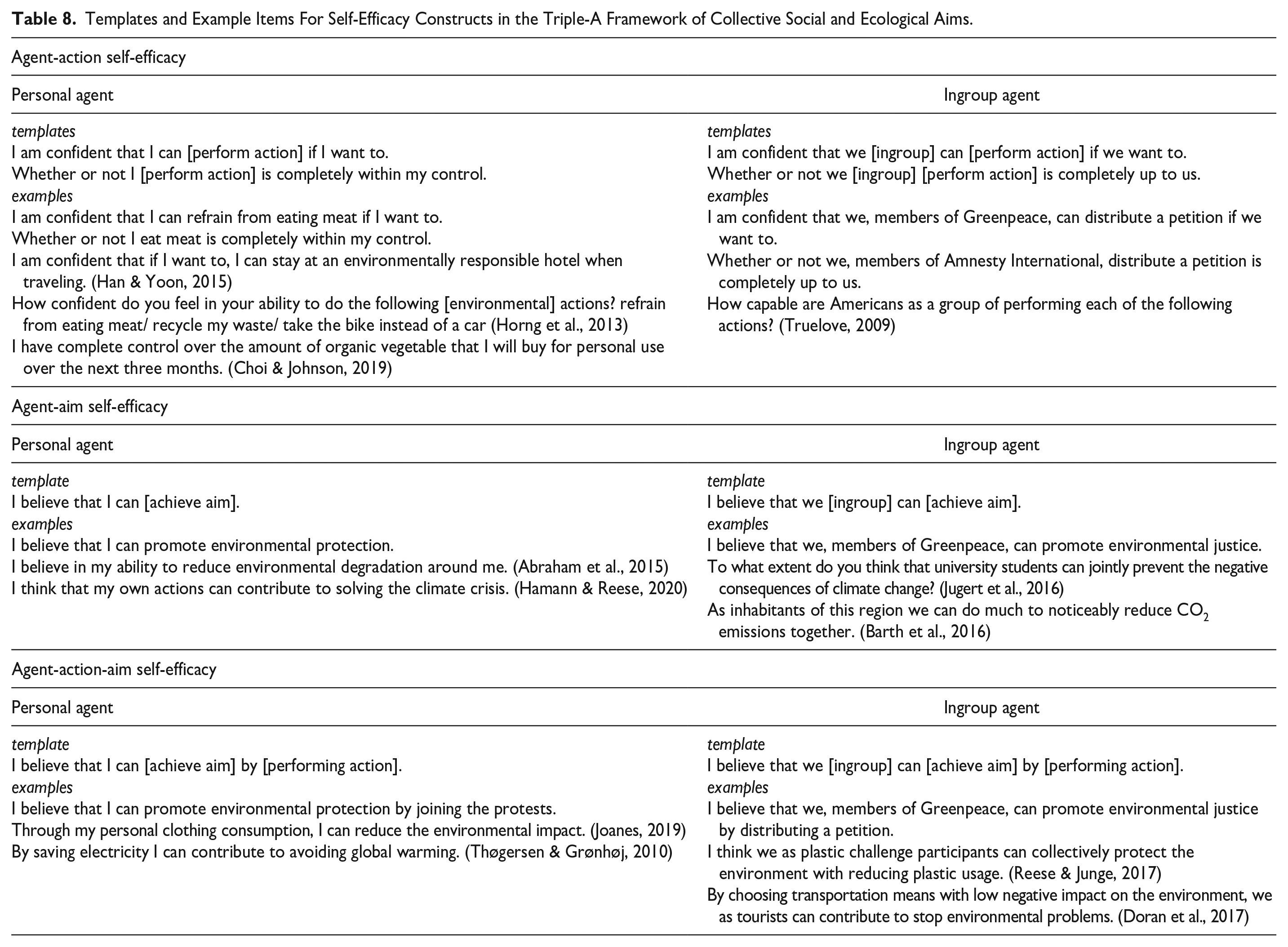
Operationalizing a Self-Categorized Agent
Context will most likely determine which kind of agent researchers focus on in their studies. Researchers are likely to choose the personal or collective identity that is most salient (i.e., accessible) for their participants, and a potential source of efficacy (Tajfel & Turner, 1986). As self-efficacy focuses on a self-categorized agent like the participant themself or an ingroup, we suggest using the terms “I as an individual” and “we as a group” as indicators of this self-categorization. While it is easy to specify “I,” it might be rather difficult to specify “we” as an ingroup, especially in the absence of knowledge about which social identities are most relevant to the participants. If it is not possible to apply a “we,” and the researcher thinks that some participants would not feel comfortable with the statement, they might have to question if their agent is really an ingroup. Even if the term “we” was applicable, researchers may carefully consider which group they want to refer to and whether participants understand this “we” as the ingroup the researcher is referring to. Bandura (1997, p. 40) argues in favor of precise efficacy agents. For example, when referring to “the government,” one should specify if it is the state, federal, or regional government.
If researchers want to capture the self-efficacy construct according to the triple-A framework, it is crucial that they do not implement an anonymous agent. Although Bandura (1997, pp. 38–40) criticized an agentless view of self-efficacy, many studies applied anonymous agents (see Table 3). However, this could pose problems. If the anonymous agent is “a person” (e.g., “Every single person can make a difference for climate change protection”), researchers do not know if the participant is thinking about themselves, their friend, Greta Thunberg, a typical citizen of their country, a prime minister of a specific country, or their representation of certain groups, such as the population at large. This implies that the participant could think about a self-categorized or not self-categorized agent, making interpretations of this construct difficult. If the anonymous agent is indicated by only using a generic “we” (e.g., “With our collective effort, we can prevent climate change”), the participant most likely thinks about an ingroup. However, it remains unknown which of their various social identities they consider (e.g., their country, their neighborhood, their activist group, their family).
Depending on which agent(s) other items focus on, the participant is likely to imagine the agent they have been primed with. For example, if two items contain the agent “I” but other items do not, as is usually the practice in literature on perceived consumer effectiveness (Roberts, 1995), the self-categorized agent will probably have an influence on all items. Yet, researchers do not know for certain. Therefore, we advise to specify a meaningful self-categorized agent in all self-efficacy items. This means that we recommend to focus on self-efficacy beliefs as defined in the triple-A framework, and to study outcome expectancies only where research questions immediately suggest a focus on an external agent, outgroup, or no agent at all (e.g., when comparing the perceived instrumentality of strategies for achieving a certain aim without a specific group in mind, Kruglanski et al., 2002, 2015). Yet, in any other case, we invite researchers to elaborate on which (ingroup) agent might fit best, rather than leaving out the agent. To check the actual effect of an ingroup efficacy agent, we advise to measure social identification as a potential moderator (e.g., identification with Fridays4Future; Tajfel & Turner, 1986; Thomas et al., 2009; Turner-Zwinkels et al., 2015; Wallis & Loy, 2021).
Operationalizing an Intended Action
Like the agent, the action that a researcher focuses on in self-efficacy items should be derived from theory and fit the context of the study. An intended action should be selected so that it serves the desirable aim in a way that is suitable for the self-categorized agent. For example, taking protest as a means for achieving climate justice might be suitable for a Greenpeace group but not for an environmental educator collective. Actions should refer to capability in the present moment so that people do not judge their future abilities as represented by conditional or future tense (Bandura, 1997, p. 44). We suggest considering how behavioral outcomes in the particular research domain are usually measured and draw on existing items. In the environmental protection domain, one could review items from validated pro-environmental behavior scales, for example, the general ecological behavior scale (Kaiser et al., 2010) or the environmental action scale (Alisat & Riemer, 2015). Generally, we invite researchers to consider impactful actions that are especially relevant for collective social and ecological aims (Hanss & Doran, 2020; Nielsen et al., 2021).
Operationalizing a Desirable Aim
As with agents and actions, aims should fit the research context and self-categorized agent and be derived from theory (Bandura, 2012). For example, in the collective action domain, one might read qualitative research to gain inspiration about which aims are present in the study’s target group (e.g., influencing decision makers or building a long-term oppositional movement as collective aims, Barr & Drury, 2009) or consider pilot studies to test one’s assumptions. We also recommend choosing aims that researchers believe will be clear for participants. For example, some studies used the aims “change the situation” or “achieve a group’s goals” which do not imply a direction of change or a specific aim content (e.g., Orazani & Leidner, 2019).
There are instances in which research only refers to one aim, using few items that hardly vary in their phrasing (e.g., Fielding & Head, 2012; van Zomeren et al., 2010; Wallis & Loy, 2021). In these cases, the authors try to grasp a very narrow latent construct that might even be captured using a single-item measure (Postmes et al., 2013). Yet, if questionnaire length allows it, we suggest including more than one aim in the efficacy scale (e.g., protecting the environment, receiving media attention, building a movement) to get a more profound understanding of self-efficacy in this context (see also Alberici & Milesi, 2018; Hanss & Böhm, 2010; Hornsey et al., 2006; Locke et al., 1986).
In the face of global crises with global solutions, it seems natural that research has focused mainly on larger collective social and environmental aims. Other non-ecological aims as detected in our review (see Table 7) can also be worthwhile to investigate. However, they should be explicitly treated as a separate construct from more social and ecological aims because they are typically pursued as a means to an end, not because of their intrinsic value (see goal contents theory for a discussion of the quality of different aims, Bradshaw et al., 2021; Kasser & Ryan, 1996; Ryan et al., 1996). To check the actual effect of self-efficacy, we advise to measure aim desirability as a potential moderator (e.g., by using environmental self-identity or values as indicator, Castiglione, 2021; Maddux & Stanley, 1986; Van der Werff et al., 2013; Williams & Rhodes, 2014). This way, researchers can ensure that the effect of self-efficacy on an outcome is not only attributable to the fact that their participants strongly agree with the aim and “want to” achieve it, but that they actually think they “can” achieve it.
Operationalizing the Links Between the Three As
For all agent-action-aim links, we recommend to include the word “can,” as it is the most often used marker of self-efficacy (see Supplement A1). In our review, the capability-marker “can” was usually directed at an action in agent-action self-efficacy and directed at an aim in agent-aim and agent-action-aim self-efficacy (i.e., “I can achieve an aim by performing an action” instead of “I can perform an action leading to an aim”). Therein, agent-action-aim self-efficacy included the phrasing “by” or “through.”
We advise researchers to maintain those traditions, and keep in mind to also include the phrase “if I want to” in agent-action self-efficacy items, based on recommendations by Williams and Rhodes (2014). They showed that a self-efficacy construct using only a can framing captures intention to a large degree. Applying such a self-efficacy measure could thus lead to explaining intention with intention (see also Williams et al., 2020). Including “if I want to” ensures that an action is evaluated as an intentional action and that researchers are not accidentally measuring the intention to perform this action. Dunn and Szymanski (2018) also use this phrase in an aim-focused efficacy: “If I choose to do so, I am capable of influencing others to promote fairness and equality” (p. 22). Other capability phrases like “being able to” or “having the capabilities for” can also be considered as self-efficacy markers.
Knowledge- or skill-related phrases like “having the skills to” or “having enough knowledge to” fit in the context of agent-action self-efficacy but might not be suitable for agent-aim or agent-action-aim self-efficacy as they imply that a single person’s action would suffice to solve collective problems. Self-efficacy to perform an action (“I can read the book”) should not be confused with perceived knowledge or capability (“I know the book”; Bandura, 1997, pp. 36–37, 2012; Skinner, 1996).
Similarly, we do not recommend difficulty phrases (e.g., “how easy/hard is it for you to . . .”) due to Fishbein and Ajzen’s (2010, pp. 160–165) strong points concerning construct validity and the potential stronger link between ease ratings and attitude constructs. According to self-efficacy theory, self-efficacy is developed in the face of difficulty (Bandura, 1995). Therefore, difficulty statements would not be a good indicator of self-efficacy. For example, the statement “There are simple things that I can do that will have a meaningful effect to alleviate the negative effects of global climate change” (Heath & Gifford, 2006) might be negated by a very self-efficacious activist because they think that difficult actions are necessary.
Control-related phrases (e.g., “is entirely up to me” or “having complete control over”) that are usually used to measure perceived behavioral control could also be implemented in a self-efficacy scale. Fishbein and Ajzen (2010, pp. 165–177) report that competence-related (“I can act”) and autonomy-related phrases (“a behavior is in my control”) are empirically distinguishable factors (see also Ajzen, 2002; Deci & Ryan, 2000b; Sweet et al., 2012, 2014). Thus, it would be useful to include both in scales assessing agent-action self-efficacy. We do not recommend this wording for aim-focused self-efficacy due to the largely uncontrollable nature of collective crises (see Advantage 3). Effectiveness-related phrasings that we found in the literature review (e.g., “has an impact,” “is effective,” “is worthwhile”) usually relate more to outcome expectancies than to self-efficacy.
Words representing an incremental effect like “contribute,” “help,” or “make a difference” were oftentimes used in former studies. These additions might make items more plausible and thus more suitable for a non-activist sample. In an activist sample, though, such phrasing could produce ceiling effects. Furthermore, we advise against the use of future tense (e.g., “will”) or conditional phrasing (e.g., “could,” “would,” or “if-then”) because of its close connection to intention and associated ease to answer in socially desired ways. 4
Selecting the Relevant As for Predicting Behavior
Drawing on the triple-A framework, we make three assumptions about which types of self-efficacy in which combination are most useful for behavioral predictions. First, we assume that if a social identity is central to the context of the study, it is useful to include self-efficacy with both personal and ingroup agents. Only then can researchers understand the motivational power of self-efficacy and interactions among diverse types of self-efficacy. Social identities seem particularly central when researchers want to predict public and activist behavior. Nevertheless, private behavior can also be largely influenced by collective motivation (Fritsche et al., 2018; Stern, 2000). Items assessing personal and ingroup agents should be aligned to detect the agents’ effect. It is likely that personal self-efficacy will relate more strongly to private action, while ingroup-related efficacy is more strongly associated with activism (Hamann & Reese, 2020). Participative efficacy as a bridge between personal and ingroup agents seems to be an especially relevant type of self-efficacy in collective action research that should be considered as an additional source of motivation (Hamann & Reese, 2020; van Zomeren et al., 2013).
Second, we assume that actions and aims should be adapted to outcome variables. In the words of self-efficacy theory: “measures of personal efficacy must be tailored to domains of functioning” (Bandura, 1997, p. 42). If a study focuses on a specific action as an outcome variable (e.g., recycling), it is useful to focus on this specific action in self-efficacy items (Hanss & Doran, 2020), measured by agent-action and agent-action-aim self-efficacy. Low explanatory value of self-efficacy measures might be attributable to a misfit between self-efficacy and outcome measures. However, some researchers might want to investigate which self-efficacy aims can predict a variety of behaviors. In this case, we recommend to include agent-aim self-efficacy or a representative variety of actions and aims with graduating (item) difficulty to get a good grasp of the underlying construct (Bandura, 1997, pp. 42/491, 2006a, 2012; Fishbein & Ajzen, 2010, p. 33).
Third, social and ecological (collective) actions are best predicted by including action-focused links (agent-action self-efficacy) and aim-focused links (agent-aim or agent-action-aim self-efficacy). This assumption is based on the triple-A framework and our literature review, according to which action-focused self-efficacy should be theoretically and empirically distinguishable from aim-focused self-efficacy. Actions and aims are likely to produce optimal additive predictive power if they are maximally distinct. This is why we suggest combining actions that are very concrete (e.g., “eat a vegetarian diet for a month” instead of “behave environmentally friendly”; see also Bandura, 1997, p. 40) with very abstract collective aims (e.g., “promoting environmental protection” instead of “reducing your CO2 footprint”). In the context of ingroup agents, it might not always be suitable to investigate agent-action links. For example, “We as protesters can eat a vegetarian diet” might be more connected to descriptive norms (Cialdini et al., 1990). Studies trying to capture agent-action collective efficacy have found it to be rather ineffective (Bonniface & Henley, 2008; Doherty & Webler, 2016). However, in cases of small groups performing a collective action that depends on ability and skills, this link could have additional value (e.g., “We as an environmental initiative can build up an information stand”).
On the basis of those three assumptions, we offer a decision matrix for deciding on which self-efficacy researchers should focus on when wanting to predict behavior (see Figure 3). It is based on the three abovementioned assumptions, and results in four quadrants with either personal agent or personal and ingroup agent, and either one specific action or many actions representing an underlying aim.
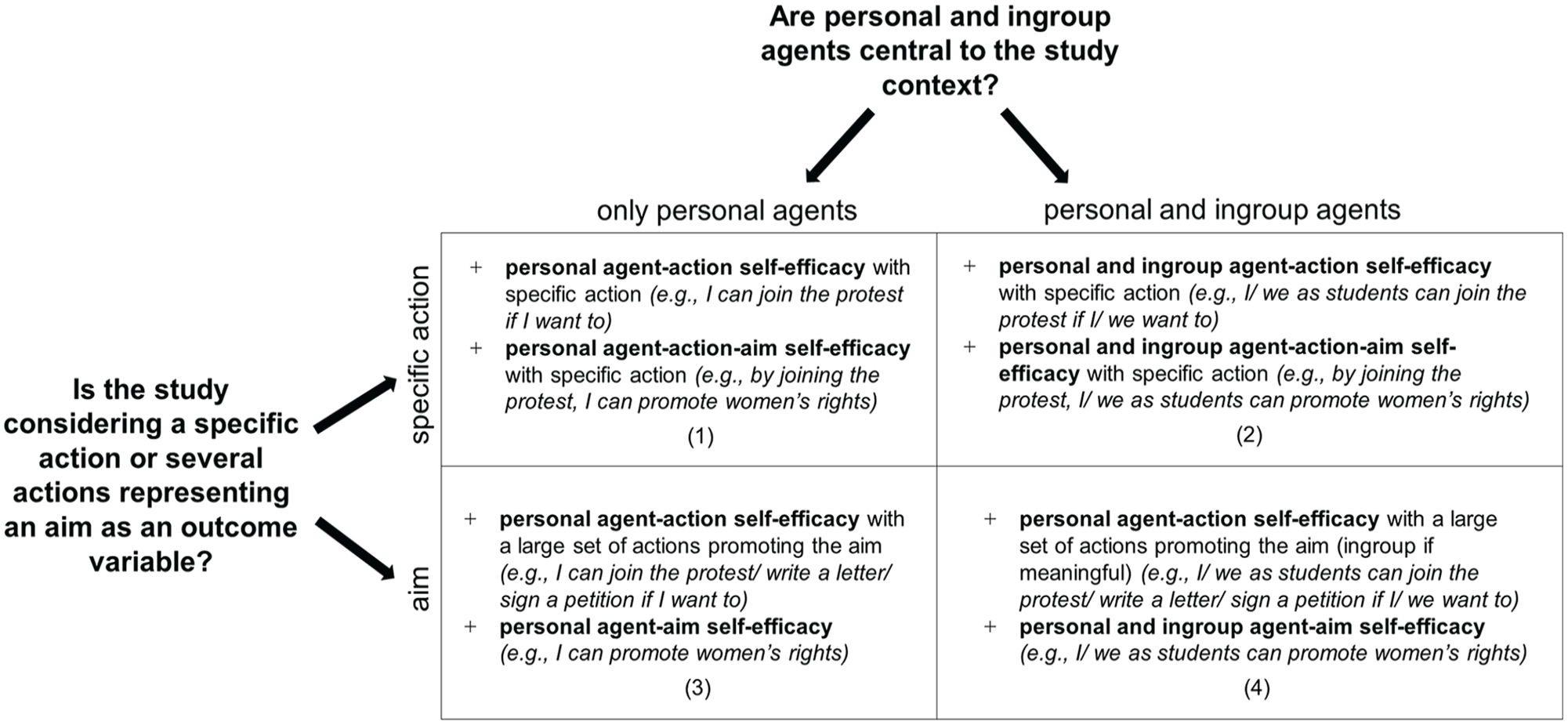
Decision matrix for making choices about self-efficacy types in the prediction of behaviors connected to collective social and ecological aims.
General Discussion
In this article, we revisited Bandura’s self-efficacy theory and elaborated on problems with applicability to human agency motivating action in the context of collective social and ecological aims. Based on a literature review of studies on self-efficacy regarding environmental protection, we made four observations: (a) Efficacy constructs feature in central theories in environmental psychology; (b) In environmental protection research, there is an overabundance of efficacy labels; (c) Clear guidelines are missing on how to operationalize self-efficacy in the context of collective social and ecological aims; and yet, (d) research in the field of efficacy beliefs can be organized along the lines of different agents, actions, and aims.
On the basis of this diagnosis of the state of affairs, we presented a solution—the triple-A framework on agents, actions, and aims—as a clarification and reconceptualization of self-efficacy theory (Bandura, 1997) applied to the context of collective social and ecological aims. This framework defines self-efficacy as the belief that a self-categorized agent can perform an intentional action, achieve a desirable aim, or achieve a desirable aim by performing an intentional action. It distinguishes several agents, actions, and aims to generate more specific predictions. We then described three advantages of the triple-A framework that show why this framework is more suitable for the context of collective social and ecological aims than self-efficacy theory. To extend and apply our claims, we reviewed relevant studies on social injustice included in a recent meta-analysis (Agostini & van Zomeren, 2021) and showed that the triple-A framework could be successfully applied. Although fewer labels and operationalizations were used than in the environmental protection domain, research in the field of social injustice equally needed a framework to distinguish agents, action, aims, and their links. We then outlined implications for the measurement of self-efficacy beliefs. Table 9 gives an overview of key recommendations that are based on the triple-A framework and further considerations. Below, we discuss broader limitations of our approach as well as recommendations for integration and directions for future research.
Key Recommendations Based on the Triple-A Framework and Further Considerations.
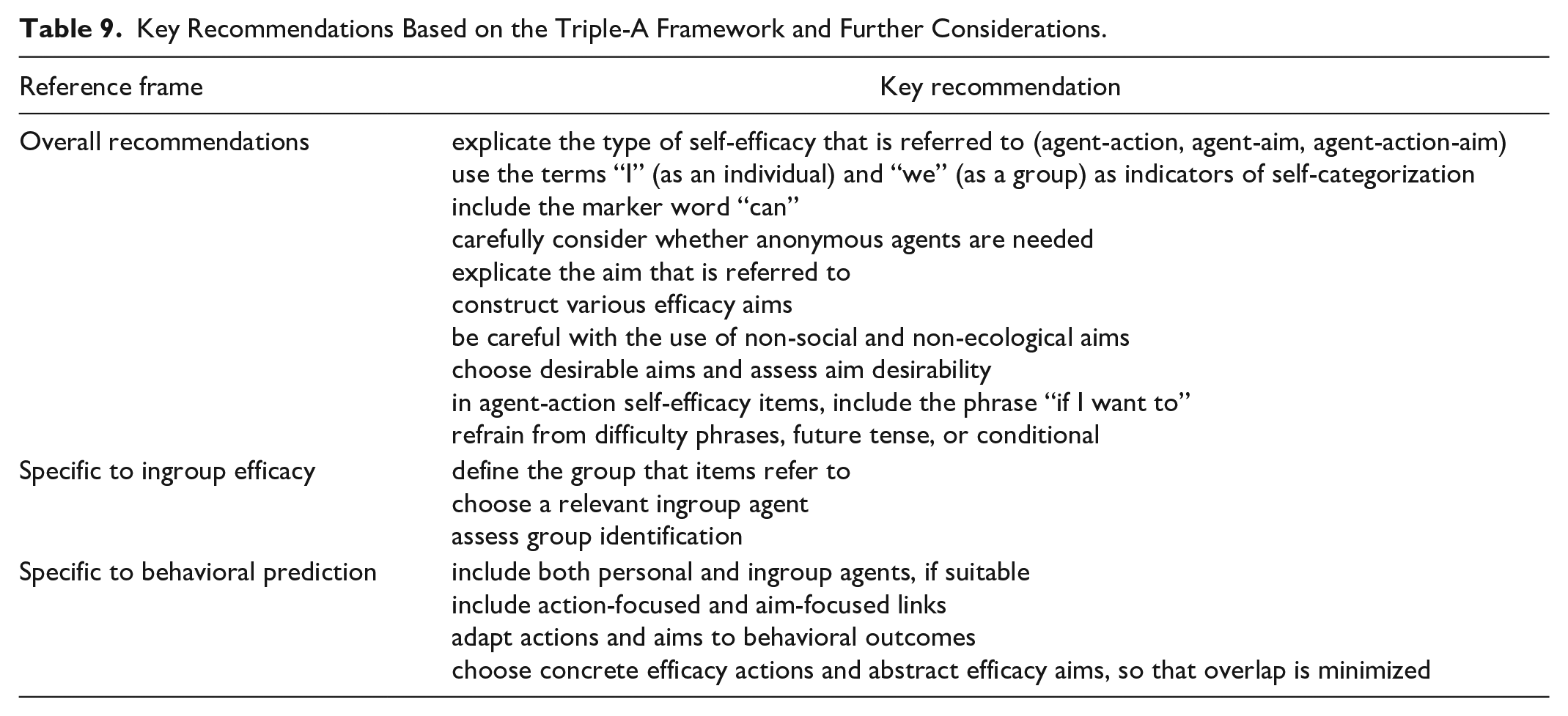
Limitations of the Literature Review and the Triple-A Framework
We decided to start with acknowledging limitations, because in our research process for this review we found ourselves faced with difficult decisions. Accordingly, our categorization in Table 3 contains many (pragmatic) assumptions that are open for discussion. For example, a number of studies mentioned the word “actions” in their items (e.g., “I think that my own actions can contribute to solving the climate crisis”; Hamann & Reese, 2020). In such instances in which the action was not specified, we categorized them as using agent-aim links, as we applied an understanding of actions as concrete intentional behaviors (see Fishbein & Ajzen, 2010). Then again, studies mentioned specific protests (e.g., “the protests can change the situation”) that could be interpreted as either an action or a group performing an action. We chose to treat it as an agent-action-aim link when a specific protest was mentioned and an action-aim link when items referred to protests in general. Overall, we see our categorizations as a first proposal to stimulate further discussions in social and environmental psychology. It helped us reflect on and better understand this field of research, and we hope that it fulfills the same purpose for other researchers.
Furthermore, we propose the distinction of three efficacy links (agent-action, agent-aim, agent-action-aim) based on operationalizations and labeling decisions. However, strong empirical evidence for such a distinction and possible moderators of the relation between various efficacy links is still missing. It remains a task for future research to investigate how interdependent these facets of self-efficacy actually are under which circumstances. Therefore, the triple-A framework should be understood as a theoretical proposition that conceptually fleshes out what is already practiced, highlights previously overlooked research questions, and helps researchers make more strategic decisions in the study of efficacy beliefs. For example, if a researcher finds that their efficacy construct is not predictive of the outcome variable as indicated in other studies, the triple-A framework offers clear suggestions for why this might be the case.
Moreover, we do not know yet to what extent the framework is restricted to ecological and social aims or if it may also feed into a more general theory of self-efficacy, such as self-efficacy theory (Bandura, 1997). Future research is needed to evaluate the need and feasibility of extending the triple-A framework to human agency regarding, for instance, educational, sports, and health contexts. We believe that there is potential for such an application, as in all of these contexts, efficacy beliefs may cater to different agents, aims, and actions.
Constraints to generality
It is also important to acknowledge that, while this article included a breadth of citations, it is strongly based on self-efficacy theory, the theory of planned behavior, and the SIMCA—all of which emerged in countries of the Global North. Our literature review includes studies from a diverse set of countries, for example, Romania, Lebanon, India, and China. Yet, studies from Africa as well as Central and South America are scarce. Moreover, studies from Asia mostly focused on perceived consumer effectiveness, thus only covering a certain version of the self-efficacy concept. There is a clear lack of environmental studies on collective efficacy in countries of the Global South. In addition, it might be possible that research on this topic exists in further cultural contexts under labels that we did not consider, or in languages that are not accessible to us. We look forward to researchers with more diverse backgrounds joining the discussion to develop a comprehensive and global picture of self-efficacy beliefs when collective social and ecological aims are focal.
Finally, the authors of this article have a background of specific sociodemographic characteristics and values that most likely influenced the interpretation of past research and conceptualization of the triple-A framework. We are an author team that is Caucasian, based and socialized in Europe, 30–50 years old, half female, half male, and all authors have a PhD. We are therefore privileged both compared to people from the Global South and to average citizens in the Global North. In addition, most of our theorizing is based in theories that have been proposed by male, Caucasian authors from the Global North. It is therefore possible that people will face unanticipated difficulties when transferring the triple-A framework and our reasoning to other cultural and social contexts.
We would also like to acknowledge that it is a privilege to perceive efficacy in the first place. Studies find that people tend to have stronger efficacy beliefs if they have a higher socioeconomic status, are male (Fernandez-Ballesteros et al., 2002), and if they live in a political system with a higher GDP and more female political representation (Corcoran et al., 2011). People living in cultures with generally lower efficacy beliefs, in which they potentially face violence when joining social and ecological causes, might place another importance on specific qualities of the concept, thus arriving at different conclusions. These elaborations show that the research community needs to acknowledge, listen to, and promote more researchers from the Global South to promote a comprehensive understanding of efficacy beliefs, as our reasoning might not be generalizable to all contexts. Still, we believe that a simple theoretical basis like the triple-A framework will allow people from diverse backgrounds to discuss and integrate ideas.
Next to this, the main author of this article is involved in the environmental and social justice movement herself, taking part in collective action, volunteering, interviewing people on their own self-efficacy, and spreading practical knowledge on environmental and social psychology to activist groups, city councils, and beyond. These experiences, her own struggle with self-efficacy, and the one she observed in others shaped her understanding of the concept profoundly. Accordingly, underlying the triple-A framework are several assumptions typically found in socio-economically privileged Caucasian Westerners: People can be agentic creators of their own circumstances. Self-efficacy is something people should be endowed with as it comes along with action motivation, positive feelings, and good health. More social and ecological justice is needed and—at best—self-efficacy in people can contribute to it. The activist work of the main author might have given her a stronger need for consistency and rapid research integration to communicate practically relevant knowledge on the topic, while a plurality of theories and conceptualization can also have certain scientific advantages. A similar positionality reasoning also applies for two of the co-authors.
Directions for Integration and for Future Research
With the help of the triple-A framework, researchers can integrate self-efficacy theory into existing theories around collective social and ecological aims. A number of ideas for developing traditional theories of environmental psychology emerge. For example, the explanatory power of the theory of planned behavior (Ajzen, 1991) could benefit from considering agent-aim efficacy beliefs, as in a study by Bamberg et al. (2015, see also Huijts et al., 2013). As the theory of planned behavior typically focuses on a precise behavioral outcome, an agent-action-aim efficacy may be most appropriate according to the triple-A framework. Protection motivation theory (Rogers, 1975) could promote the use of a self-categorized agent with the marker “I” or “my” for agent-aim self-efficacy, as done by Rainear and Christensen (2017). The norm activation model (Schwartz, 1977) would benefit from clarifying the role of self-efficacy as an addition to problem awareness and perceived responsibility, as Doherty and Webler (2016) have done (see also Matthies, 2005). All these theories could, according to our operationalization guide, benefit from adopting a social identity perspective and from considering ingroup efficacy as an additional predictor (see, e.g., Doherty & Webler, 2016). We advise researchers from a SIMCA and collective action tradition to consider a personal agent in their studies, as it may predict collective action above and beyond collective forms of self-efficacy (Hamann & Reese, 2020; van Zomeren, 2016). In particular, the study of an agent-action link might be interesting, as results are inconclusive about the conditions under which this link is relevant to collective action (Fielding et al., 2008; Park & Yang, 2012; see Supplement A6 for suggestions for further theories). Following the depicted suggestions will make diverse perspectives—especially individual and collective action research—more comparable and facilitate research evaluation and integration (van Zomeren, in press). It will further strengthen an understanding of which kinds of self-efficacy are more or less relevant in which contexts and for which social groups.
Considering Efficacy Agents
Systematic research on self-efficacy will benefit from systematic differentiation of agents, actions, and aims (Homburg & Wagner, 2007). First, future research could explore the differences between personal self-efficacy, ingroup efficacy, and participative efficacy. In the environmental domain, there are inconsistent results regarding the predictive value of these efficacy types for pro-environmental behavior. While correlational studies typically find that self-efficacy predicts private behaviors and participative efficacy predicts activist behaviors (Hamann & Reese, 2020; Morton et al., 2011), experimental studies suggest that ingroup efficacy interventions outperform personal self-efficacy interventions in influencing actions (e.g., Jugert et al., 2016). Causal investigations of their relations are needed for both theorizing and drawing practical conclusions. These investigations could, for example, test whether the path from collective to individual self-efficacy to private behavior, as proposed by Jugert et al. (2016), is causally replicable (see also Cocking & Drury, 2004; Reese & Junge, 2017). Moreover, the question remains what participative efficacy exactly represents. Can it be regarded as ingroup efficacy, as we preliminarily decided in our structuring process, or is it conceptually closer to personal self-efficacy?
Studies could also examine whether and under which conditions people project their individual self-efficacy onto a group (see Bandura, 1997, p. 480; Fernandez-Ballesteros et al., 2002; Fritsche & Masson, 2021). In the triple-A framework, we make the assumption that self-categorization lies at the heart of self-efficacy. It would therefore be relevant to test whether processes such as self-projection indeed lead to a clear distinction between self-efficacy and outcome expectancies or whether self-projection mechanisms are similarly present when thinking about outcome expectancies (e.g., that focus on an external agent, an anonymous agent, or no agent at all in action-aim links). Moreover, self-projection might cause personal self-efficacy and ingroup efficacy scales to overlap strongly. It could be valuable to test under which conditions our assumption holds that behavior is better predicted when including both personal and collective agents. Next to the consequences of personal self-efficacy and ingroup efficacy, research could investigate their predictors. Self-efficacy theory proposes that personal self-efficacy and collective efficacy have the same main predictors (Bandura, 1997), whereas other authors question this assumption (see Chen & Bliese, 2002; Tasa et al., 2007). Research including both efficacy agents as recommended in our guidelines could shed light on this question.
Second, research could focus on which ingroup efficacy agents are more or less important in specific social and ecological crises. Social identity theory (Tajfel, 1978) provides a basis for characterizing and systemizing various ingroup efficacy agents. Therein, ingroup norms and group size might (interactively) influence the effects of self-efficacy. For example, the group of all humanity (McFarland et al., 2019) is very large while conveying unsustainable ingroup norms. Ingroup efficacy of all humanity might therefore be predestined for free rider effects. However, if people believe that all humanity can promote environmental protection, it might also create an optimistic mindset and make people want to join in (but see Hamann & Reese, 2020). Former research has mostly considered social groups. Another open question is if certain self-identities (e.g., “I as an environmentally friendly person can . . .”; Van der Werff et al., 2013) or opinion-based groups can be seen as anonymous groups, reflecting our structuring decision, or if people can also perceive them as efficacy-relevant self-categorized agents (Thomas & McGarty, 2009). Moreover, ingroup identification and cultural context should be considered as potential moderators of self-efficacy effects. People might interpret and answer ingroup efficacy items differently, depending on how committed they feel to a group (Fritsche et al., 2018), and which culture they compare them to (Heine et al., 2002). By acknowledging that self-efficacy beliefs strongly depend on the included agent, the triple-A framework creates a basis for finding the most relevant self-efficacy agents in specific social and environmental areas.
Investigating Actions and Aims
In addition to agents, the triple-A framework suggests that efficacy actions and aims might be strategically varied to find out which ones are most relevant in which contexts. Studies could test whether our assumption is valid that actions and aims are most predictive of behavior when adapted to their level of abstractness. It might be especially interesting to investigate in which contexts cross-level predictions can be observed. For example, it is possible that there are certain self-efficacy beliefs about high-impact actions (such as public and activist behaviors) that could be more closely related to abstract outcome measures.
The theory of planned behavior (Ajzen, 1991) is a promising foundation for distinguishing action characteristics. Researchers could investigate whether self-efficacy is more strongly related to behavior if efficacy actions are concrete (vs. abstract), located in the public sphere (vs. private sphere), single-time behaviors (vs. routines), and if action-aim contingencies are strong (vs. weak, Bandura, 1997, p. 134). We would also like to stimulate research on efficacy aims. Qualitative studies suggest that people involved in the same collective action can have diverging aims and that these can change over time as reactions to success or failure (Barr & Drury, 2009; Drury & Reicher, 2005). Thus, specific efficacy aims should be more or less associated with long-term collective action tendencies. Unfortunately, this interesting research angle is oftentimes obscured by researchers applying one-dimensional self-efficacy constructs focusing on only one aim.
By investigating diverse aim contents, researchers can gain a more profound understanding of the sources from which people actually draw their own self-efficacy (Hornsey et al., 2006). It could be tested whether efficacy beliefs were associated more strongly with behavior if efficacy aims were self-determined (vs. controlled), concrete (vs. abstract), short-termed (vs. long-termed), diverse (vs. narrow), hierarchically organized (vs. independent), or if they targeted an aim directly (vs. indirectly). For example, recent research investigated the indirect self-efficacy of encouraging others for pro-environmental action and found it to be especially predictive of private and activist behavior (Hamann & Reese, 2020; Hanss & Böhm, 2010). Other research investigated the distinction of efficacy with regard to political change aims or identity consolidation within the ingroup (Chayinska et al., 2017; Saab, 2011). In a previous version of this article, we further distinguished aims that can be achieved by personal effort (e.g., promoting gender equality when hiring new employees) from aims that can only be achieved by joint effort (e.g., promoting gender equality in general), to gain an overview. The latter typically reflect core values and morals. We later discarded of this heuristic as a clear-cut distinction was impossible. However, it is still an interesting question for future investigation whether self-efficacy with aims regarding personal (vs. joint) effort is more closely related to specific types of behavior. The triple-A framework suggests to elaborate on the various characteristics self-efficacy actions and aims can have.
The triple-A framework could also be used for reconsidering agents, actions, and aims to build and maintain a sense of self-efficacy in practical work for social and ecological causes. For example, if someone feels personally helpless, they can reconsider their current group memberships and look for agentic groups that help them regain self-efficacy (Fritsche et al., 2018). When faced with collective action failure, activists might reconsider their aims so that they can maintain a sense of agency (e.g., “The action failed but we managed to build a network”; Barr & Drury, 2009). Another option would be reconsidering their actions, and possibly choosing another type of collective action in the future (e.g., non-normative action when confronted with corruption; Thomas & Louis, 2014). This way, the triple-A framework can also serve as a practical framework of (re)evaluating collective action from a psychological perspective.
Distinguishing Links Between the As
The triple-A framework lays the foundation for investigating various agent-action-aim links of self-efficacy beliefs. As underlined by our literature review, action-focused self-efficacy seems to be empirically distinguishable from aim-focused self-efficacy. Yet, indicators of discriminant and predictive validity also varied. In addition, few studies have so far investigated whether agent-aim and agent-action-aim self-efficacy can indeed be distinguished. Distinctions between the efficacy links should be tested using various methods.
First, correlational studies could test discriminant and predictive validity by means of factor analysis and further statistical analyses. Thereby, they could investigate whether our assumption that behavior is best predicted when considering both action- and aim-focused self-efficacy is correct. For example, it might be possible that an action-focused self-efficacy has oftentimes not been considered as a predictor of public and activist behavior because it is indeed less predictive of these outcomes.
Furthermore, experimental studies could vary messages portraying the different efficacy links (see Feldman & Hart, 2016). For example, they could compare messages revealing past ingroup efficacy regarding an agent-action link (we as the young generation protested), agent-aim link (we as the young generation contributed to a change in people’s awareness), agent-action-aim link (by protesting, we as the young generation contributed to a change in people’s awareness), and action-aim outcome expectancy (protests contributed to a change in people’s awareness). For future theorizing, it could be useful to apply qualitative methods and investigate what people actually think of when answering agent-aim self-efficacy items. Do they think of the most powerful actions, many, few or none at all? Do they perceive and see the difference when asked explicitly about the various links? Across methods, we propose that adding agent-action and action-aim links should amount to agent-action-aim self-efficacy. However, we assume that the agent-aim link has even further properties. Besides, future research could investigate which characteristics determine whether action- and aim-focused self-efficacy are more or less related (e.g., the difficulty or abstractness of an action), and what their predominant causal direction is (Bandura, 1997, pp. 126–127; Williams, 2010).
Similarly, the question arises whether these types of efficacy beliefs share the same relation to other constructs (predictors, outcomes, or moderators of relationships). We hypothesize that agent-action self-efficacy might be more connected to actual behavioral costs, socioeconomic circumstances, and impactful behavior, whereas agent-aim self-efficacy might be more closely related to attitudes, goals, visions, and intentional behavior (see Bain et al., 2013; Bamberg & Rees, 2015). As perceived behavioral control in the theory of planned behavior (Ajzen, 1991) predicts intention but also moderates intention-outcome relations, we suspect that the same might be true for action-focused self-efficacy. Action-focused self-efficacy is therefore likely to capture actual constraints such as time, money, or social resources that may prevent a person from following through on their intention. However, aim-focused self-efficacy is less related to these constraints and more involved in the formation of an intention. Thus, a key difference between action- and aim-focused self-efficacy may be that the former moderates intention-behavior relations while the latter does not. Connected to this, future research could also explore whether aim-focused self-efficacy is based on less rational thought and more emotional reaction than action-focused self-efficacy, which would explain why analytic interventions have been rather unsuccessful in manipulating it (see Hornsey et al., 2021).
Another area of research examined efficacy beliefs as a moderator of the effects of fear appeals on behavior, indicating that fear appeals increase problem-focused behavior when efficacy is high (see Jugert et al., 2016; Tannenbaum et al., 2015; Witte & Allen, 2000) and decrease it when efficacy is low as part of a defensive response (Witte & Allen, 2000). Indeed, a recent meta-analysis by Bigsby and Albarracín (2022) found that it is response efficacy rather than self-efficacy that moderate the relationship between fear appeals and behavior/ behavioral intentions. Future studies should test these moderating effects from the perspective of the triple-A framework, distinguishing efficacy agents, actions, and aims (e.g., studies on fear appeals and efficacy in the environmental domain often operationalized anonymized or external efficacy agents, which may have influenced their findings, e.g., M.-F. Chen, 2016; Hornsey et al., 2015).
Finally, we believe that distinguishing efficacy is also relevant from a more practical perspective. Distinguishing links between agents, actions, and aims enables better predictions about which characteristics of self-efficacy make it more or less predictive of relevant social and environmental outcome variables. Such detailed knowledge is needed, for example, in campaign design, political decisions, and team building in groups working against social and ecological injustice. Then again, in our own practical work with environmental and social rights activists (e.g., in workshops, lectures, counseling), we noticed that it is not intuitive for practitioners to make the above-mentioned distinctions. Responding to this, researchers could use the triple-A framework to practically integrate self-efficacy links into one overarching framework that simultaneously allows for a more nuanced research overview when it comes to practical counseling and advice.
Agency in the Context of Collective Social and Ecological Aims
By explicating the relevance of action and aim content, the triple-A framework also seeks to make self-efficacy theory more extensible. Our understanding of agency differs slightly from self-efficacy theory (Bandura, 1989) and is partially based on self-determination theory (Deci & Ryan, 1985). While self-efficacy theory strongly focuses on the need for efficacy (competence), self-determination theory ascribes equal importance to all basic psychological needs (i.e., competence, autonomy, and relatedness), assumes that meeting these needs is intrinsically satisfying (Elliot et al., 2001), and emphasizes the important role of autonomy for human agency (Chirkov et al., 2011). Rather than looking at aim strength, self-determination theory distinguishes different qualities of motivation (e.g., Ryan & Deci, 2017). Based on this, we define perceived agency as the belief that a self-categorized agent can perform a self-determined action toward an autonomous aim. In this understanding, perceived agency comprises both self-efficacy and an autonomous motivation (i.e., an intrinsic, integrated, or identified desire to perform; Deci & Ryan, 1985, 2000b; Ryan & Deci, 2017). In other words, a person can and wants to (a) perform an action and (b) achieve an aim. Likewise, perceived collective agency entails group-based autonomous motivation (see Fritsche & Masson, 2021). Given the complexity that arises when attempting to integrate different schools of thought, we suggest that this integration should be the topic of future research on human agency in the context of social and ecological crises (see first steps in integrating self-efficacy and self-determination theory by Sweet et al., 2012, 2014). Such research should explicitly emphasize concepts such as autonomy, self-determination, and volition to paint a more complete picture of human agency. Moreover, studies could test whether autonomous motivation mediates the influence of self-efficacy on behavior.
Yet, agency research does not have to stop here. Empowerment research challenges scientists to not only consider relations of self-efficacy and self-reported outcomes but to emphasize shifts in actual power (Cattaneo & Chapman, 2010; Cattaneo et al., 2014; Drury et al., 2005; Zimmerman, 1995). Thereby, it raises the question of where actual agency for collective social and ecological aims is situated (Louis, La Macchia, et al., 2016). At this point, our reasoning reaches the boundaries of self-efficacy theory and the triple-A framework and enters the realm of actual (and not only perceived) agency that we believe Bandura (1997) also wanted to call attention to. In terms of the triple-A framework, agency thus would not only include agent-action-aim perceptions but embrace actual agent-action-outcome influences. To measure those influences, aggregate scores of self-reported ingroup efficacy as proposed by Bandura (1997, p. 478) might gain new momentum when trying to explain collective action outcomes at the group level (Hamann et al., 2021; see also Cattaneo et al., 2014). To understand actual agency, future psychological research should join interdisciplinary discourses, and investigate how the sociocultural context shapes and is shaped by self-efficacy (Wullenkord & Hamann, 2021).
Conclusion
We believe that current crises in social and ecological systems demand a theory of agentic self-efficacy that is suitable for positive social and ecological visions. This includes personal self-efficacy and ingroup efficacy as crucial components of any motivation for social and ecological aims. To foster an ecologically and socially just society, researchers need an understanding of self-efficacy, its nature, its prerequisites, and its consequences, as it influences whether people live in line with their attitudes and values (Axelrod & Lehman, 1993). The proposed triple-A framework offers an adapted and extended conceptualization of self-efficacy theory (Bandura, 1997) that allows for systematic conclusions that are urgently needed to inform societal change and its change agents.
Supplemental Material
sj-pdf-1-psr-10.1177_10888683231178056 – Supplemental material for Believing That We Can Change Our World for the Better: A Triple-A (Agent-Action-Aim) Framework of Self-Efficacy Beliefs in the Context of Collective Social and Ecological Aims
Supplemental material, sj-pdf-1-psr-10.1177_10888683231178056 for Believing That We Can Change Our World for the Better: A Triple-A (Agent-Action-Aim) Framework of Self-Efficacy Beliefs in the Context of Collective Social and Ecological Aims by Karen R. S. Hamann, Marlis C. Wullenkord, Gerhard Reese and Martijn van Zomeren in Personality and Social Psychology Review
Footnotes
Acknowledgements
We would like to thank Andreas Homburg and Daniel Hanss for feedback on a presentation of this article, and Alisa Scheuermann for her support in collecting efficacy items.
Author Contributions
Karen Hamann: Conceptualizing, methodology, writing of original draft, editing, reviewing, visualization, project administration; Marlis Wullenkord: Writing parts on self-determination theory and agency, reviewing; Gerhard Reese: Reviewing, supervision; Martijn van Zomeren: Conceptualizing, editing, reviewing, supervision.
Declaration of Conflicting Interests
The author(s) declared no potential conflicts of interest with respect to the research, authorship, and/or publication of this article.
Funding
The author(s) disclosed receipt of the following financial support for the research, authorship, and/or publication of this article: Karen Hamann’s contribution was supported by a PhD-scholarship by the German Federal Environmental Foundation (Deutsche Bundesstiftung Umwelt, DBU). The DBU had no involvement in conceptualizing, methods, writing, and in the decision to submit the article. This research did not receive any specific grant from funding agencies in the public, commercial, or not-for-profit sectors.

Supplemental Material
Supplemental material for this article is available online.
Notes
References
Supplementary Material
Please find the following supplemental material available below.
For Open Access articles published under a Creative Commons License, all supplemental material carries the same license as the article it is associated with.
For non-Open Access articles published, all supplemental material carries a non-exclusive license, and permission requests for re-use of supplemental material or any part of supplemental material shall be sent directly to the copyright owner as specified in the copyright notice associated with the article.
