




Abstract
According to the CDC, the rate of firearm-involved homicides for US men over age 50 increased 87% between 2010 and 2021. Despite this trend, little is known about these homicides as few studies examine homicide against older adults and even fewer focus on older men. This study seeks to identify the characteristics of firearm-involved homicides against older men and how they might vary across older men of different ages. To explore situational contexts of these incidents, this study uses a domain-centered framework. This study takes a mixed-methods approach that uses quantitative data from the 2022 and 2023 National Incident-Based Reporting System and qualitative data from the 2023 Gun Violence Archive. Clear distinctions are found between victims in their 50s and 60s as compared to those over 70 in terms of victim and offender demographics, relationships, and incident characteristics. By using a domain-centered framework to interpret the findings, this study emphasizes a need to expand prior home-focused explanations to account for active lifestyles including continued participation in the workforce and leisure activities among older men especially those in their 50s and 60s. This study provides the foundational knowledge necessary for future work on risk factors and tailored prevention strategies for this victim group.
Introduction
Between 2010 and 2021, the rate of homicides involving firearms for US men over age 50 increased 87% (Centers for Disease Control and Prevention, National Center for Injury Prevention and Control, 2025). This increase is greater than the overall homicide rate for older men, which increased 43% during the same time (Centers for Disease Control and Prevention, National Center for Injury Prevention and Control, 2025). Despite these trends, little is known about the older men who are killed, characteristics of their homicides, or risks they face. Few studies examine homicide against older adults and even fewer focus on older men. When older victims are considered, little attention is given to differences across age subgroups of older adults (e.g., Abrams et al., 2007; Collins & Presnell, 2006; Krienert & Walsh, 2010). This practice implies that older adults face similar risks whether they are in their 50s or 80s. This assumption is reinforced when researchers propose explanations that rely on stereotypes characterizing these “elderly” victims as homebound, frail and isolated (Abrams et al., 2007; Burgess et al., 2005; Collins & Presnell, 2006; Shields et al., 2004). Such overgeneralizations are likely of limited applicability to explain homicides of victims in their 50s and 60s. Similarly, current crime prevention efforts for older adults tend to emphasize home-based strategies and do not account for age variations (e.g., National Sheriffs’ Association, n.d.).
Research is needed that not only identifies the characteristics of homicides against older men but also considers how these characteristics might vary across older men of different ages. Generating this information could support future work to identify risk factors and develop tailored prevention strategies. Particular attention is needed to update assumptions about older adult lifestyles and incorporate them into explanations for homicide risk. Recent statistics indicate that today’s older adults are more likely to continue to engage in active lifestyles including work and social activities than prior generations (Clendening & Phue, 2025; Johnson & Parnell, 2016). Currently more US adults over 65 participate in the workforce as compared to previous decades (Fry & Braga, 2023). Those over 75 make up the fastest growing age group in the workforce (Fry & Braga, 2023). Older adults also are increasingly interested in remaining engaged in their communities and social networks outside the home (Johnson & Parnell, 2016). These trends are consistent with data indicating the improving health of older adults in the US and their ability to continue living independently (Freedman et al., 2021; Mather & Scommegna, 2024). Taken as a whole, these patterns highlight the need for research on older victims that consider how active lifestyles might affect explanations for their homicide victimization and exposure to risk.
Our current study is motivated by the increased rate of firearm-involved homicides against older men and the dearth of research about these victims. Specifically, we seek to contribute to the current literature by identifying the characteristics of firearm-involved homicides against older men and how they might vary across older men of different ages. To offer explanations for these homicides, we are also interested in exploring the domains and situational contexts of the incidents. Our work represents a key first step to generate the knowledge needed to support future research on risk factors and prevention strategies. This study is organized in the following way. We first review what is known about homicides of older men and firearm homicides involving older adults as well as present the domain-centered framework that guides our study. We then describe the two types of homicide data that form the basis of our mixed methods approach to examining firearm-involved homicides against older men. Finally, we discuss our findings and their implications for future work.
Background
Review of Relevant Literature
Given that young men have the highest homicide rates in the United States (Strassle et al., 2025), it is not surprising that research focuses on them and that homicide against older men garners little attention. Even in research on homicide against older adults, older men are largely ignored as a focus of study. This pattern occurs despite older men making up the majority of older homicide victims (Logan et al., 2019). Instead, research considers homicide against older adults where older men and women are not directly compared (e.g., B. Kennedy et al., 2023; A. Roberts & Willits, 2013; but see Krienert & Walsh, 2010) or is limited to homicide victims who are older women (e.g., MacPherson et al., 2020; Safarik et al., 2002). Prior studies of older adult homicides are mainly descriptive and find that victims tend to be male, white, killed by intimate partners or family members, killed in their residences, and with firearms (Krienert & Walsh, 2010; Logan et al., 2019; Rogers & Storey, 2019; Shawon et al., 2021). Other studies suggest that homicides against older adults may be more likely to involve felony-murders where the killing occurs alongside another crime as compared to younger adults (e.g., Nelsen & Huff-Corzine, 1998; A. Roberts & Willits, 2013; Safarik et al., 2002; Weaver et al., 2004). While studies of homicide against older adults provide important initial insights, they offer little specific information about older male victims.
Only one study has considered firearm-involved homicides against older adults, and none focus on older men. Shawon et al. (2021) compared firearm and non-firearm homicides against older adults who they defined as over age 60. Since their study combined older male and female victims, the only information provided for older men is that they constituted almost two-thirds of the firearm homicide victims in the sample. Shawon et al. (2021) found older adult victims of firearm homicide tend to be white (66%) with an average age of 69. Offenders who committed firearm homicides are mostly male (89%) with an average age of 50 and are known to the victim (88%). Most firearm homicides occur in the victim’s home (66%). Common contexts for firearm homicides are that they involve another crime (29%), intimate partner violence (27%), and an argument (23%).
In addition to the lack of research focusing on homicides against older men, the literature is limited in terms of how older adults are measured. There is no consensus as to what age should be used to define older adults, which makes it challenging to compare findings across studies (Addington, 2025). Three common demarcations are 50 (e.g., Durfee & Goodmark, 2021; Hand et al., 2025; Karch & Nunn, 2011), 60 (e.g., Block, 2013; Rogers & Storey, 2019; Shawon et al., 2021), and 65 (e.g., Abrams et al., 2007; Addington, 2013; Collins & Presnell, 2006). Each has its justification. Support for age 50 includes its use to define abuse in later life via legislation such as the Violence Against Women Act (Congressional Research Service, 2023). Age 60 is associated with eligibility for services under the Older Americans Act and Elder Justice Act (Freed et al., 2025). Age 65 is regularly used by Census Bureau reports (e.g., A. W. Roberts et al., 2018). No matter what age demarcation is used, researchers tend to view older adults as a single age group and do not explore age differences. As a result, little is known about how homicide characteristics might vary across older adults of different ages. The few studies that consider patterns across age groups of older homicide victims indicate that key differences are lost when victims are examined as one age group (Addington, 2013; Block, 2013; Krienert & Walsh, 2010). These differences include variation by victim demographics, location, circumstances, and victim-offender relationship as well as distinctions between “younger” older adults and the oldest groups (Addington, 2013; Block, 2013). As is the case for what age defines older adults, there is no consensus on how to measure these age subgroups (Addington, 2025).
Not only does the use of a single age category mask differences across older adult victims, but it encourages adopting explanations that emphasize assumptions about the oldest ages. As part of their systematic review of homicides against older adults, Rogers and Storey (2019) include a summary of risk factors. One of their initial findings is that most studies fail to discuss risk factors or explanations for older adult homicides. Studies that did offer an explanation suggest that social isolation, frailty or limited mobility increased risk based on characteristics of homicides against older adults occurring at home by strangers or perpetrators known to the victim (Rogers & Storey, 2019). These characterizations likely have limited applicability for older adults in their 50s or 60s. It is also unclear how valid these proffered explanations are for the oldest age groups as no subsequent research has investigated them.
Domain-Centered Theoretical Framework
The limited research on homicides against older men provides little insight on relevant theoretical frameworks for our study. Given our interest in the characteristics and situational contexts of these homicides, we opted to use a domain-centered framework to guide our research design and interpretation of the findings. Lynch (1987) developed a domain-specific approach as a means to refine explanations offered by routine activity and lifestyle theories. He viewed the concept of domains as a device for organizing the wide variation of victim behaviors and lifestyle choices used by routine activity and lifestyle theories to explain victimization risk. Domains create overarching categories by combining daily activities and the common places where they occur. The four original domains are work, school, home, and leisure outside the home (Lynch, 1987). Incorporating domains also encourages accounting for the attributes of individual activities as well as the places where these activities occur when explaining crime incidents and victimization risk. For example, Lynch (1987) used a domain-specific model to explore victimizations at work. This approach helped identify an important component of victimization risk in the work domain is attributable to both the nature of the victim’s work activities (such as contact with public, handling large amounts of money) and attributes of the workplace (such as open or limited access by the public to the victim’s workspace).
Subsequent scholars have used this domain-centered framework to compare victimization risks of men and women across home, leisure and work domains (Mustaine, 1997) and to examine specific activities and risk within a particular domain such as leisure (Mustaine & Tewksbury, 1998) or work (Mustaine & Tewksbury, 1997; Wooldredge et al., 1992). These studies illustrate the value of Lynch’s framework to highlight risk patterns that might be missed by considering activities without situating them in the context of a domain.
Our study continues in this tradition and takes a domain-centered approach to guide our research design and interpretation of the findings. This approach is particularly helpful to our study as it provides a structure for organizing the characteristics of homicide incidents as well as supporting the consideration of work and leisure domains to expand the home-centered explanations emphasized by prior research.
Research Questions
The literature review highlights a need for research that examines firearm-involved homicides against older men, the characteristics of their homicides, and variation across older age subgroups. Given the limited research in this area, our study is exploratory in nature and seeks to contribute foundational knowledge of homicides of older men by addressing the following questions: (1) what are the characteristics of firearm-involved homicides against older men and how might these vary across older age subgroups, and (2) what are the domains and common situational contexts for firearm-involved homicides against older men and how might these vary across older age subgroups?
Methodology
Data
To answer the research questions posed, our study takes a mixed-methods approach to analyze homicide data from the Federal Bureau of Investigation (FBI)’s National Incident-Based Reporting System (NIBRS) and the Gun Violence Archive (GVA). NIBRS provides the quantitative data that identify the characteristics of homicides against older men and the initial domains and situational contexts for these cases. The GVA contributes qualitative data that provide the necessary details to identify the domains and specific situational contexts for these cases. This study does not seek to merge these datasets together or match cases. Instead, we take a complementarity approach employed by other studies (e.g., Lynch & Addington, 2007) and use the two data sources in a holistic way to capitalize on the strengths of each one to answer the research questions posed. Each data source and their analysis are described separately below.
Case Selection Criteria
To be included in this study, an incident needed to be a firearm-involved homicide with one male victim aged 50 or older and one offender of any age and sex. For firearm-involved homicides, NIBRS cases are selected if they are murders or non-negligent homicides where any firearm is listed for the weapon used. As all GVA cases involve firearms, GVA cases are selected if they involve a homicide. Age 50 is used to define older men as it is most inclusive of the age demarcations used in previous studies. We opted to use single victim-single offender cases as the majority of cases involved a single victim and single offender. This decision is also consistent with previous studies (e.g., Addington & Perumean-Chaney, 2014; Krienert & Walsh, 2010) and ensures statistical independence (Regoeczi et al., 2008).
NIBRS Data and Quantitative Analyses
NIBRS Data
This study uses two recent years (2022–23) of the NIBRS Incident-Level Extract Files data for the quantitative analyses (United States Bureau of Justice Statistics, 2023, 2024). Applying this study’s case selection criteria results in 1,504 NIBRS firearm-involved homicides against men over 50. NIBRS is one of the two official national sources of US crime data and is based on law enforcement crime data collected by the FBI (Congressional Research Service, 2025). The incident-level details collected by NIBRS make it well-suited for this study that seeks to explore homicide characteristics such as victim and offender demographics, co-occurring crimes, and arrests. NIBRS data provide an important source for studying homicide against older men, but one caveat about its coverage is important to note. While all states were certified to submit NIBRS data during the years included in the present study, not all law enforcement agencies within those states submitted data. For example, approximately 73% of US law enforcement reported their crime data via NIBRS in 2023 (Congressional Research Service, 2025). As our goal is to explore the patterns and contexts of homicides of older men, as opposed to estimating the prevalence of these homicides, we viewed the benefits of NIBRS as outweighing the coverage limitation for our study.
Quantitative Variables
Given the lack of research on firearm-involved homicides against older men, the selection of variables for this study relies on previous work on homicides against older adults. It is also guided by the domain-centered framework.
Victim Demographics
Victim demographic variables are age groups and race. Victim age groups are measured using age decades (50s, 60s, 70s and over 80) to identify patterns of homicide characteristics. Victim race is coded as white, Black, other race, and missing. “Other” race combines American Indian/Alaska Native, Asian, and Native Hawaiian/Other Pacific Islander due to their small numbers in this study. Hispanic ethnicity is not included in this study, which follows the practice of federal NIBRS reports that exclude ethnicity due to inconsistent reporting by law enforcement (Remrey, 2025). In our study, nearly one-quarter (23%) of victims were missing Hispanic ethnicity information.
Offender Demographics
The three offender demographic variables are offender sex, offender age and offender race. For this study, offender sex is coded as male, female, or missing as NIBRS only collects binary (male/female) sex information. Offender age is coded as under age 50, by decade age groups for offenders over age 50, or missing. Offender race is coded as white, Black, other race, or missing. As with victim race, the other race category is used due to the small number of offenders reported as being American Indian/Alaska Native, Asian, and Native Hawaiian/Other Pacific Islander.
Victim-Offender Relationship
The present study measures victim-offender relationship based on previous studies of homicides against older adults that indicate intimate partners and family members are common relationships in these incidents (Rogers & Storey, 2019; Shawon et al., 2021). Our study builds on this work and considers victim-offender relationships of intimate partner, family, friend/acquaintance, otherwise known, stranger, and missing/unknown. Intimate partners include current and former spouses and dating partners. Family members include all non-spousal family relationships captured by NIBRS. 1 Otherwise known includes all known categories 2 other than friends/acquaintances, which are included in a separate category. The stranger category captures relationships specified as strangers.
Incident Characteristics
This study considers additional incident characteristics of location, co-occurring crimes, argument circumstance, and arrest. Location is selected based on previous studies of older adult homicides that identify these homicides as primarily occurring at home (Krienert & Walsh, 2010; Rogers & Storey, 2019; Shawon et al., 2021). Location also is relevant to our domain-centered approach. The location variable codes the 42 NIBRS location types into five categories of home, open space, commercial, road/transit, and other. These categories were selected to capture the commonly reported locations and to explore domains outside of the home. Home captures the NIBRS home location type. Open space includes fields and parks. Commercial includes all store locations as well as banks, office buildings, gas stations, farms, industrial sites and construction sites. Road/transit includes streets, parking areas, and transit terminals. The other category captures all the remaining categories. 3 Co-occurring crimes are selected based on prior findings that suggest the vulnerability of older adults to homicides occurring with another crime (adults (e.g., A. Roberts & Willits, 2013). The co-occurring crime variable is dichotomous and identifies incidents whether an additional crime occurred with the homicide or not. This study opted to include argument circumstances based on prior work suggesting that arguments may precede older adult homicides (Shawon et al., 2021). Argument circumstances are measured using the NIBRS circumstance code that indicates whether the homicide was related to an argument and is coded as a dichotomous variable (argument related or not). Arrests are also included to consider whether criminal justice response varies by age group for these homicides. The arrest variable indicates whether any arrest was made. This is coded as a dichotomous variable (arrest or not).
Quantitative Analyses
To answer the exploratory research questions, the analyses are descriptive in nature. They focus on bivariate contingency tables that compare the incident variables by victim age groups to identify common homicide characteristics. The data were analyzed using IBM SPSS Statistics (Version 27).
GVA Data and Quantitative Analyses
GVA Data
The qualitative component of our mixed-methods approach uses information from the GVA to provide greater details about the situational contexts of firearm-involved homicides than could be gleaned from NIBRS alone. The GVA is a searchable, online database of fatal and non-fatal firearm-involved violence incidents in the US since 2013 (Gun Violence Archive, n.d.). The GVA database was created using information from news media, law enforcement, and government sources (Gun Violence Archive, n.d.). For each incident, the GVA provides information about the victim, offender and certain circumstances as well as the original publicly available source documents.
We used a 4-month sample of 2023 GVA cases for our study. We selected the months of January, April, August, and December to minimize possible seasonality effects. We opted to use a sample of cases for two main reasons. One was our complementarity approach which sought to use the GVA to provide context for the NIBRS findings. The other was to address certain challenges of working with the GVA. The GVA does not generate a user-friendly analytical file. Limited case information is available for export to an Excel file. An analytical file with relevant details about the victim (including specific age) and incident needed to be created via hand coding. Another challenge was the GVA search tool. The GVA database query helped to identify homicides against men over 50 that involved one victim and one offender. The search tool could not exclude certain non-applicable cases, which most often involved murder-suicides where an older man committed the murder and died by suicide. As a result, we needed to review individually each case identified by the initial query results (n = 570) to remove the non-applicable cases and arrive at our final GVA sample of 314 cases.
GVA Qualitative Analyses
For our qualitative analyses, we started by generating an analytical file 4 with the GVA case number, the age of the victim, and summary of the GVA supporting documents associated with each case. The documents were primarily news articles associated with the murder. The summaries focused on identifying the location and describing the victim’s activities at the time of the homicide. The summaries served the basis for our qualitative analyses. To identify domains and activity themes for the situational contexts, we borrowed traditional qualitative techniques of inductive coding based on an immersive reading of our incident summaries (Berg, 2008). This type of analysis is useful for exploratory research like our current study that seeks to identify patterns and categorize the information.
For the domains, we started with the four domains of home, work, leisure and school identified by Lynch (1987) to categorize the cases. Based on our immersive reading of the cases, we made a few adjustments to these categories. The school domain was removed as no homicides against older men occurred while they were attending school. We added two domain categories to address themes that arose in our coding. One is an “unknown” domain to identify cases where nothing could be determined about the domain from the GVA case record. Unknown domains typically occurred in cases where the source documents only listed the address block where the murder occurred and no additional context (such as whether the address was a home or store). Since it could not be determined what the domain was, we coded these as “unknown.” Unknown domains also include a small number of cases where the victim was found in a location different from where he was killed and no information was given on the location where he was killed. The second addition was a “crime-related” domain to capture cases where the victim was involved in illegal activity (typically drug dealing) prior to the homicide. We debated considering these cases “work” since the activity arguably generates income. Ultimately, we decided to create a separate category to capture the inherently risky nature of this activity that was not originally envisioned in domain-centered models. One final coding note concerns the small number of cases that involved unhoused older men who were killed in locations that appeared to be where they lived (such as a homeless encampment). For these cases, we coded the domain as home. Once we established these domain coding categories, we used them to classify all the sampled cases.
For the victim’s activity and situational contexts, we did not start with any set categories. From our immersive reading, certain themes emerged about the victim’s activities prior to the murder. These themes largely corresponded to concepts that could be organized into domains. We confirmed our classifications and themes by using two independent coders. For this coding, interrater reliability was not formally tested due to the nearly consistent application of the classification codes. The small number of discrepancies that arose were reconciled by regular meetings with the coders.
Findings
Quantitative Findings
The number of firearm-involved homicides varies across age groups with 940 (62.5%) involving men in their 50s, 440 (29.3%) for men in their 60s, 91 (6.1%) for men in their 70s, and 33 (2.2%) for men over 80. This overall pattern is comparable to previous studies (Krienert & Walsh, 2010; Logan et al., 2019). These age groups are compared across victim and offender demographics, victim-offender relationship, and incident characteristics.
Table 1 reports the findings for victim race by victim age group. The majority of victims in their 50s are Black (52.7%) with white (43.4%) being the next most common racial group. Few victims are other races (2.1%) or missing race information (1.8%). For victims in their 60s, Black (48.9%) and white (47.3%) are the most common racial groups. The majority of victims in their 70s and 80s are white (63.7% and 66.7%, respectively) with Black victims being the next most common racial group (30.8% and 27.3%, respectively).
Victim Race by Victim Age Groups, 2022–23 NIBRS Extract File Incident Firearm-Involved Homicides.
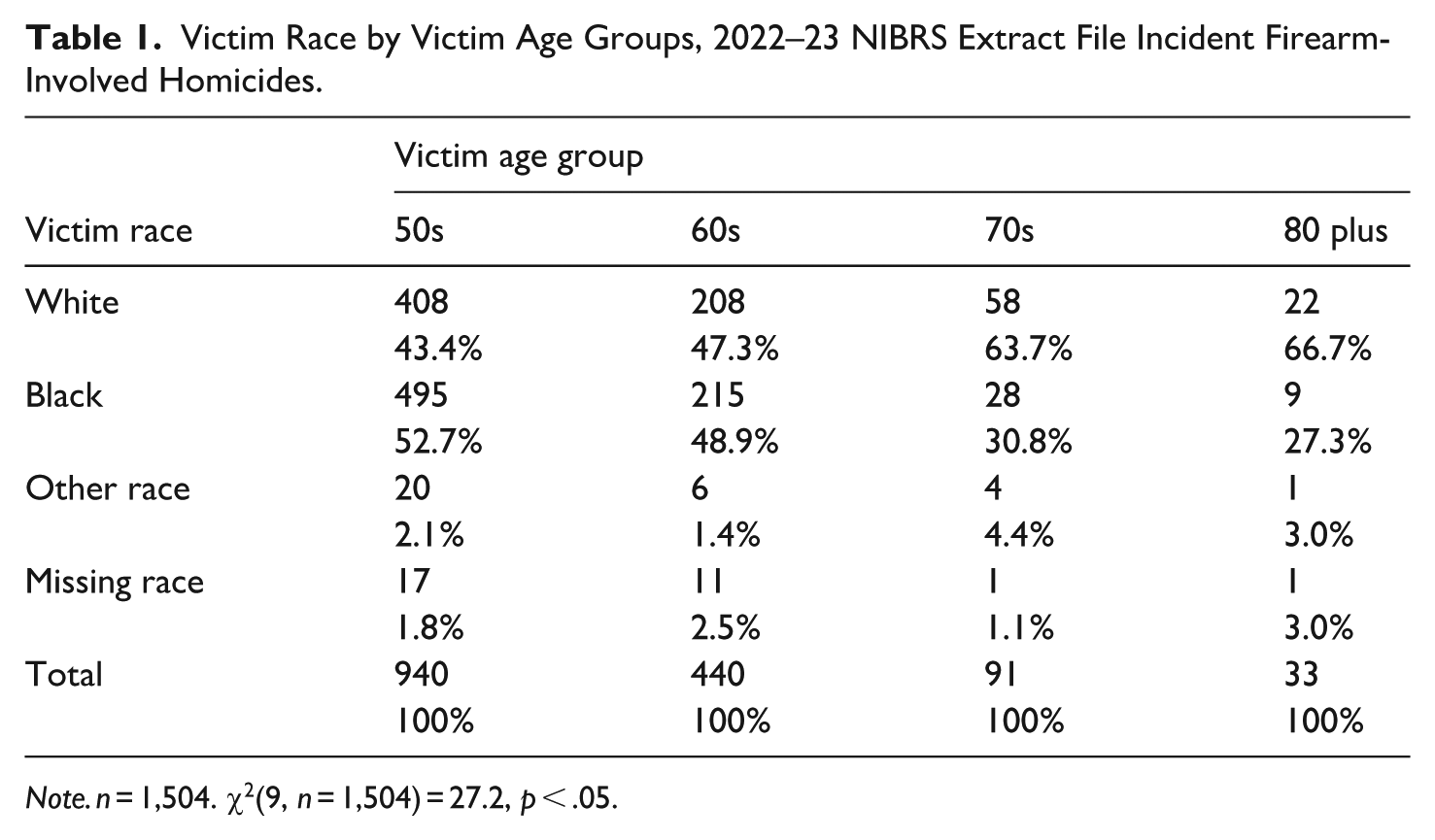
Note. n = 1,504. χ2(9, n = 1,504) = 27.2, p < .05.
For offender demographics, one initial pattern is the amount of missing data for all offender demographics (Table 2). While this pattern appears across all victim age groups, the proportion of missing data varies by victim age. The highest percentage of cases with offender missing data is observed for victims in their 50s and 60s (36.2% and 29.1% respectively). In contrast, victims in their 70s and 80s have the lowest percentage of missing data (20.9% and 24.2%, respectively). For offender sex, the majority of offenders are males across all victim ages. The proportion of male offenders increases with victim age going from 56.9% for victims in their 50s to 63.6% for victims over 80. In terms of offender age, offenders under 50 are the most common age category across all victims ranging from 46% for victims in their 50s to 39.4% for victims over 80. Offenders in their 50s are the second most common offender age for victims in their 50s (11.1%), 60s (10%) and those over 80 (12.1%). For victims in their 70s, offenders who are in their 50s and 70s (both 9.9%) were the second most common offender age groups. For offender race, the proportion of white offenders increases with victim age groups, going from 28.5% for victims in their 50s to 51.5% for those over 80. Similarly, a smaller proportion of Black offenders are reported for victims in their 70s (22%) and over 80 (24.2%) as compared to those in their 50s (31.5%) and 60s (34.5%).
Offender Demographics (Sex, Age and Race) by Victim Age Groups, 2022-23 NIBRS Extract File Incident Firearm-Involved Homicides.
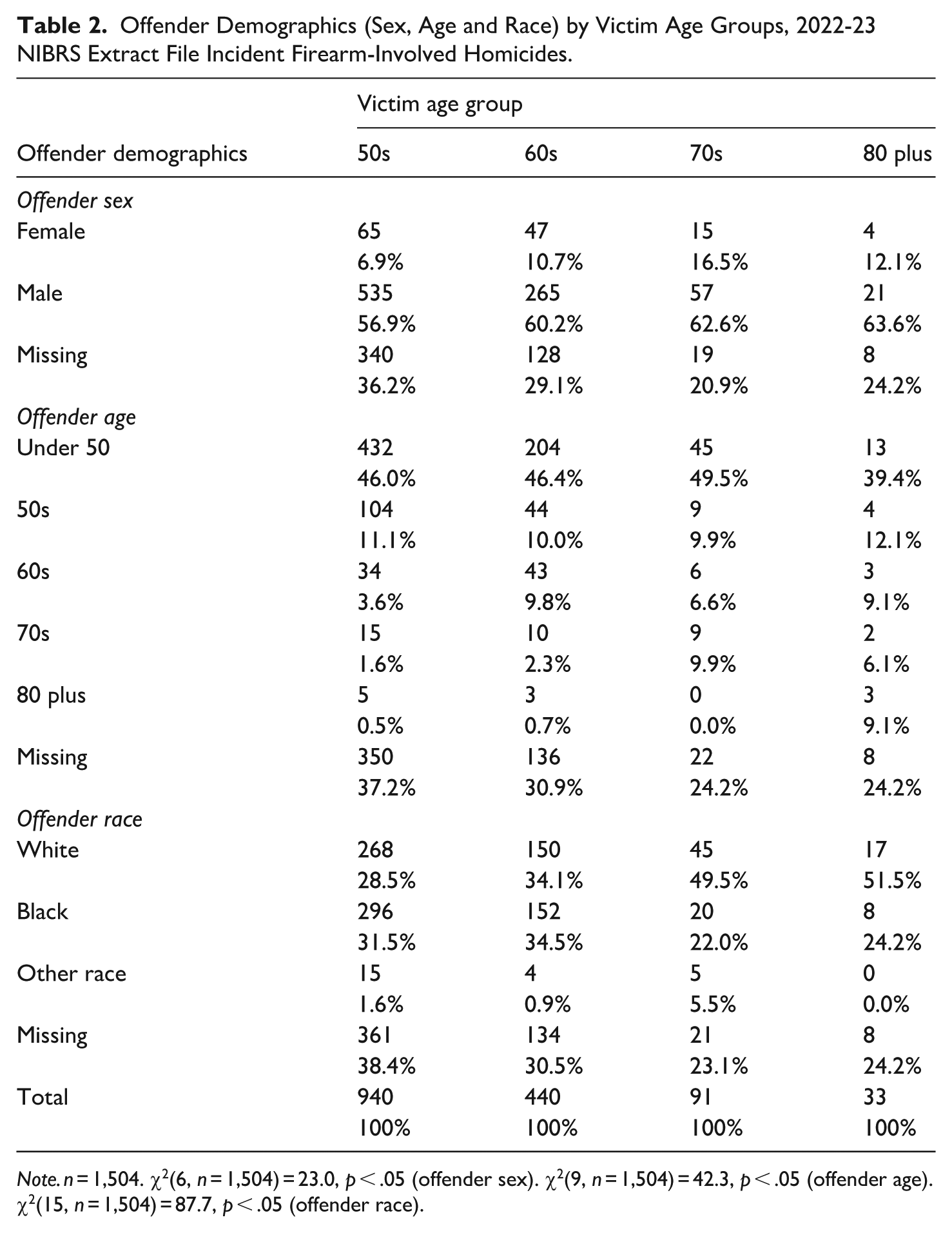
Note. n = 1,504. χ2(6, n = 1,504) = 23.0, p < .05 (offender sex). χ2(9, n = 1,504) = 42.3, p < .05 (offender age). χ2(15, n = 1,504) = 87.7, p < .05 (offender race).
Table 3 reports the victim-offender relationship patterns across victim age groups. For victims in their 50s, the majority of relationships are unknown or missing (55.4%). Friends and acquaintances make up the largest proportion of known relationships (13.6%) with family (10.9%) and strangers (8%) being the next most common categories. For victims in their 60s, unknown or missing relationships are also the most common category (46.8%). Family (16.1%), friends and acquaintances (15%), and otherwise known (9.1%) are the next most common categories. For victims in their 70s, missing and unknown relationships again are the most common category (40.7%). Offenders who are family (27.5%) and friends/acquaintances (14.3%) are the most common known relationships. Victims over 80 are the only age group where a known relationship group is the most common. Family members make up 45.5% of offenders and intimate partners make up 9.1%. About one-third of victims over 80 are missing victim-offender relationship information.
Select Incident Characteristics by Victim Age Groups, 2022-23 NIBRS Extract File Incident Firearm-Involved Homicides.
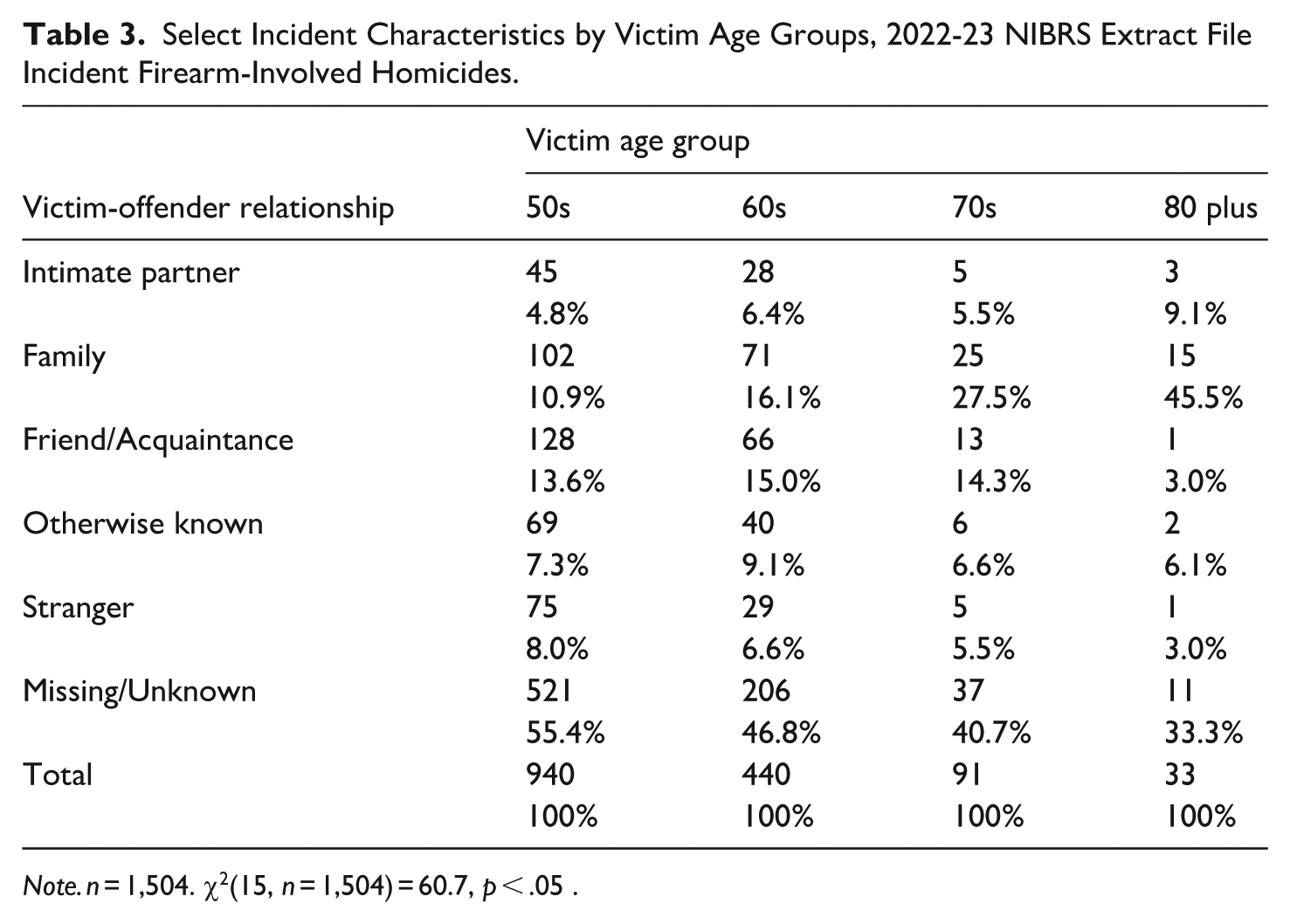
Note. n = 1,504. χ2(15, n = 1,504) = 60.7, p < .05 .
While home is an important location across all victim age groups (Table 4), the percentage of firearm-involved homicides at home steadily increases with victim age. Home accounts for less than half (48.9%) of locations for victims in their 50s as compared to nearly three-quarters of those in their 70s (71.4%) and nearly 85% of victims over 80. In contrast, locations related to streets and transit are more common for victims in their 50s and 60s (35.1% and 26.1%, respectively) than victims over 80 (6.1%). Commercial locations constitute a small percentage of locations for firearm-involved homicides with a greatest proportion involving victims in their 50s and 60s. Open spaces and other locations also account for a small percentage of locations across all age groups.
Incident Location by Victim Age Groups, 2022-23 NIBRS Extract File Incident Firearm-Involved Homicides.
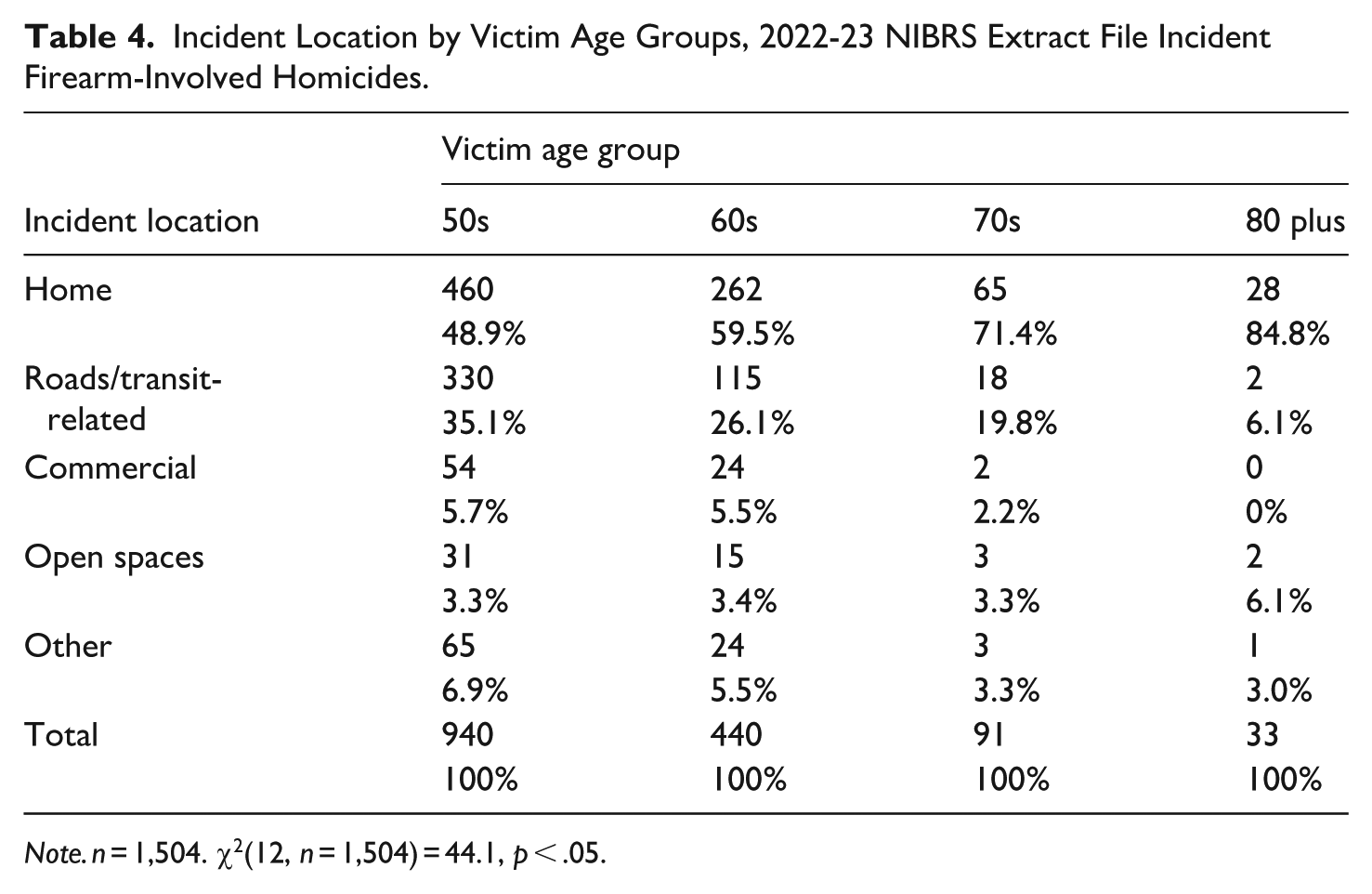
Note. n = 1,504. χ2(12, n = 1,504) = 44.1, p < .05.
Table 5 reports the additional incident characteristics of argument-related, co-occurring crimes, and arrest. For these characteristics, no statistically significant differences are reported. Less than quarter of firearm-involved homicides against older men are prompted by an argument with a slightly higher percentage occurring with victims in their 50s (24.6%) than those over 70 (around 18%). Less than one-fifth of the cases involve another crime with the percentages ranging from 18.2% (victims over 80) to 12.1% (victims in their 70s). The percentage of arrests ranges from 41.4% for victims in their 50s to over half (54.5%) for victims over 80.
Select Incident Characteristics by Victim Age Groups, 2022-23 NIBRS Extract File Incident Firearm-Involved Homicides.
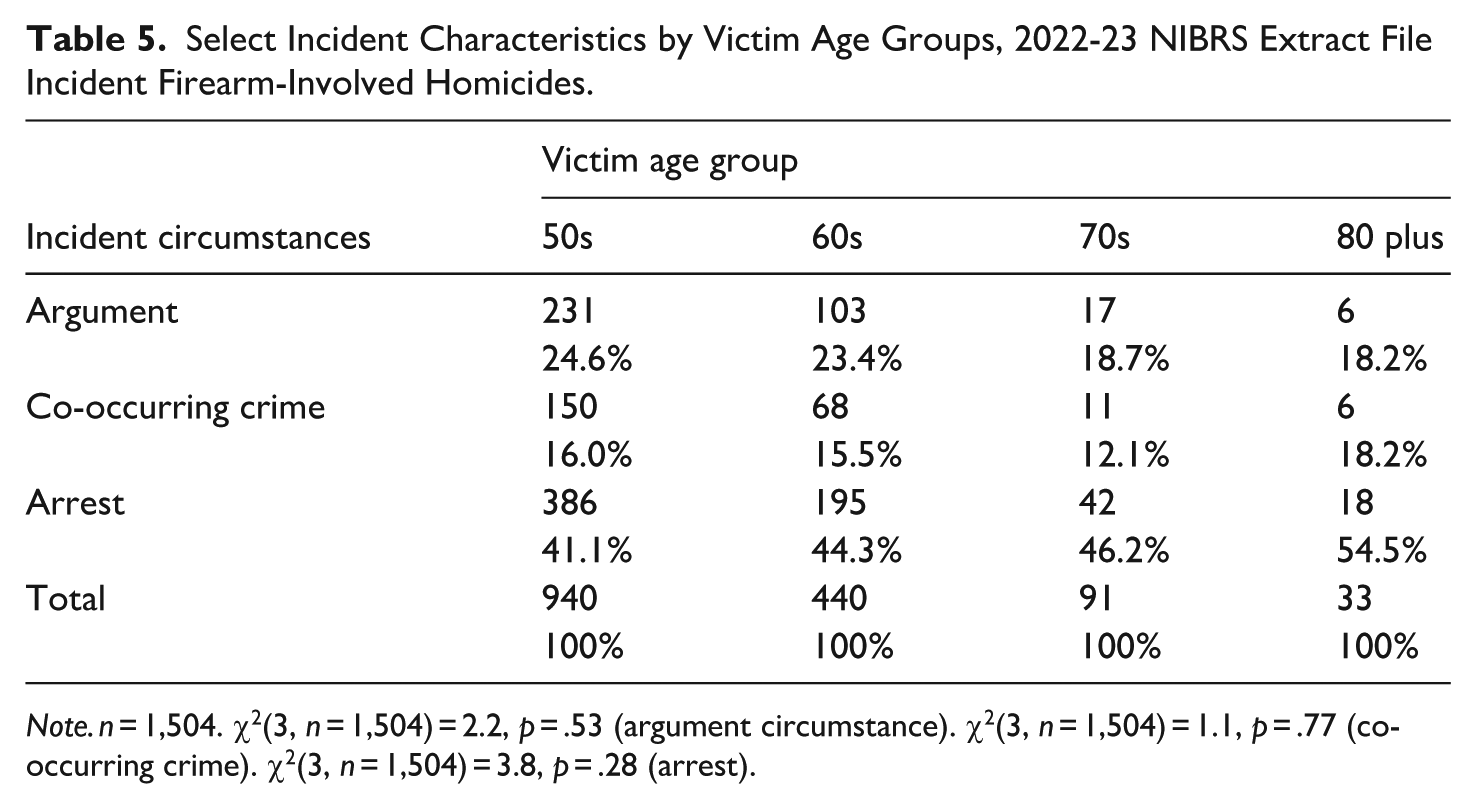
Note. n = 1,504. χ2(3, n = 1,504) = 2.2, p = .53 (argument circumstance). χ2(3, n = 1,504) = 1.1, p = .77 (co-occurring crime). χ2(3, n = 1,504) = 3.8, p = .28 (arrest).
Themes From the GVA Findings
Coding the GVA case summaries identifies domain and situational characteristics for each incident. As noted in the methods section, our study did not seek to merge the datasets or match cases. Instead, we take a complementarity approach and use the sample of GVA cases to provide details not collected by NIBRS that help to clarify domains and situational contexts.
The GVA qualitative codes identify the domain for each incident. Table 6 summarizes the domains by victim age group for the GVA sample. For victims in their 50s, the domain is unknown in almost half the cases. Home (28.4%) and leisure (14.2%) are the next most common domains. For victims in their 60s and 70s, the most common domain is home (43.7% and 57.9%, respectively). Unknown domains are the second most common. Leisure is the third most common domain (16.1% for those in their 60s and 10.5% for those in their 70s). For the victims over 80, three-quarters involve a home domain. Although the work domain constitutes a small proportion of domains across all age groups, the GVA data highlight the relevance of this domain in association with firearm-involved homicides for older men of all age groups.
GVA Coding: Firearm-Involved Homicide Domains by Victim Age Group.
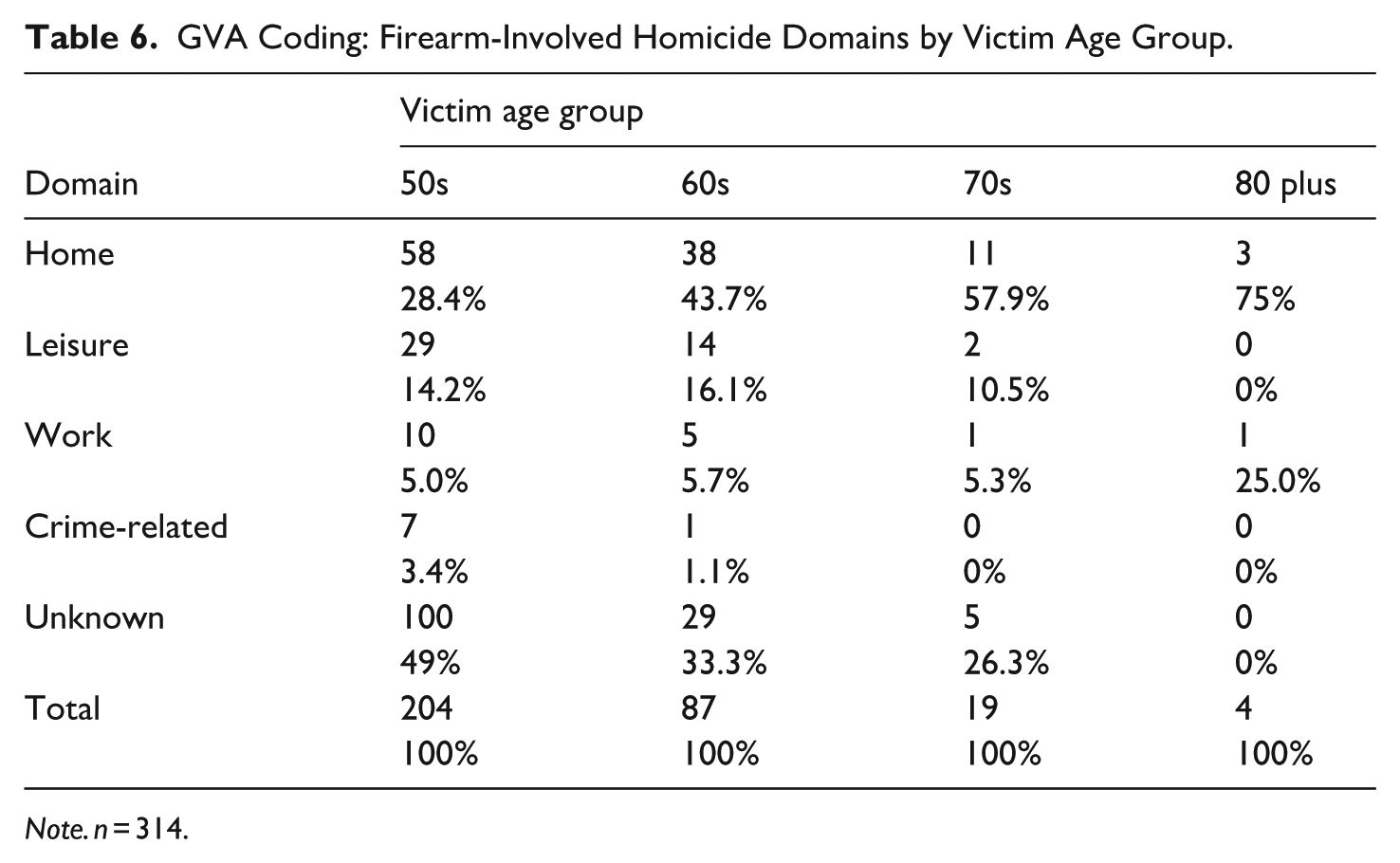
Note. n = 314.
The domain-centered approach also provides a useful framework for categorizing the situational themes that emerged from our immersive reading of the incident summaries to identify victim activities that preceded these homicides. Table 7 summarizes the activity themes associated with each domain across the age groups. These themes are not a quantitative count but an illustration of the range of activities occurring in each domain. Table 7 also helps highlight how firearm-involved homicides against victims in their 50s and 60s arise from a variety of activities within each domain as compared to victims over 70.
Themes of Victim Activities Associated with Each Domain by Victim Age Group, GVA 2023 Sample.
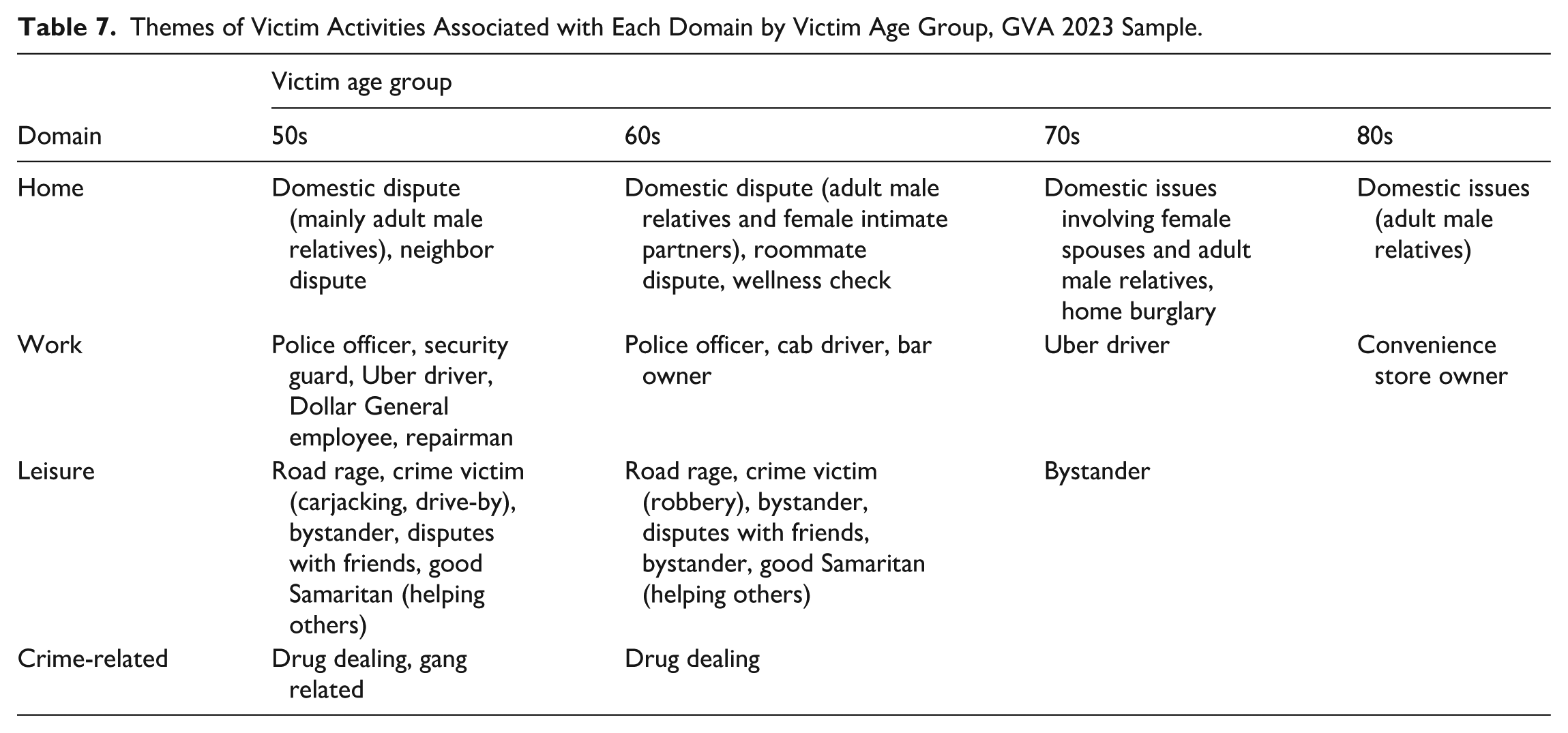
Given the similarities of their activities, victims in their 50s and 60s are discussed together here. For homicides occurring in the home domain, the victim activity themes included domestic arguments often with adult male family members (particularly sons) as well as female intimate partners (particularly for victims in their 60s). Ongoing neighbor disputes constitute another common activity in the home domain. The GVA data provided unique insights regarding the nature of these disputes that were prompted by initial verbal arguments over issues like parking spots, noise, or property lines and escalated into deadly confrontations with the presence of a firearm. In some cases, the perpetrator would leave the argument only to return with the firearm. Leisure domains involve activities that occur in public spaces that are not work-related (Lynch, 1987). For victims in their 50s and 60s, leisure activity themes highlight the diverse nature of the situational contexts that precede firearm-involved homicides (Table 7). One way that activities in public spaces result in homicides is through exposing victims to other violent crimes (such as robberies or carjackings) that turn deadly as well as drive-by shootings. The leisure activity of driving appeared to expose victims via angry disputes that escalated into road rage incidents. Leisure activities that involve socializing in public spaces also present risks as illustrated by case examples where older men intervened to help someone else who was being harassed in a bar or victimized on the street. Work activity themes for victims in their 50s and 60s emphasize the risk inherent with particular jobs such as police officers, security guards and Uber or cab drivers. Robberies targeting businesses also accounted for homicides in cases where the victim was an owner or employee. While accounting for a small number of cases, the crime-related domain is the most common for victims in their 50s and 60s (especially those in their 50s) as compared to the older age groups. Activities involving drug dealing and gang activity reiterate the victim-offender overlap as a potential risk factor that continues in later life.
Only a small number of cases from our GVA sample involve victims in their 70s and 80s. Most of the homicides are in the home domain and the victim activity themes reflect situations arising from domestic issues and home-based crime. As with victims in their 50s and 60s, domestic themes for victims over 70 continue to involve disputes with adult male relatives (particularly sons) but also include wives. The contexts of intimate partner incidents appear to be different from those involving victims in their 50s or 60s where domestic homicides arise out of arguments. In one situation, a wife murdered her 77-year-old husband who was dying in a hospital. Work remains a relevant domain and includes jobs like Uber drivers and convenience store owners that expose older men to violent crimes such as robbery.
Discussion
Our exploratory study sought to contribute to the limited literature addressing firearm-involved homicide against older men. In particular, it posed two research questions about the characteristics of these homicides and how they might vary across older age groups as well as common domains and situational contexts and how they might differ across older age groups.
The NIBRS analyses address the first research question by identifying the characteristics of firearm-involved homicides against older men and their variation across victim age group. One overarching finding is the importance of disaggregating homicide characteristics by age group. Our study identifies distinct homicide patterns between men in their 50s and 60s and those in their 70s and 80s. One example is with victim demographics. Victims in their 50s and 60s are more frequently Black as compared to victims who are 70 and older. Conversely, victims over 70 are more likely to be white than those in their 50s and 60s. This pattern refines previous studies of older adult homicides that found most victims were white (Rogers & Storey, 2019). These previous studies did not disaggregate by victim sex or age subgroup.
In terms of offender demographics, firearm-involved homicides against older men across all age groups are mainly committed by men and offenders under ag 50. For victims in their 50s and 60s, offenders tend to be Black as compared to those over 70 whose perpetrators are mainly white. Our findings for offender sex and age are similar to those obtained in previous studies of older adult homicide (Shawon et al., 2021). Our findings provide distinct patterns for offender race not identified by prior studies that did not disaggregate by victim sex or age subgroup.
Our findings regarding the victim-offender relationships also vary by victim age groups. The proportion of victims killed by a family member increases with age. In addition, homicides of victims over 80 involve the largest proportion of intimate partners as compared to all age groups. In contrast, homicides against victims in their 50s and 60s tend to involve friends and acquaintances. In addition, a larger proportion of victim-offender relationships are unknown for victims in their 50s and 60s as compared to those over 70. Victims in their 50s also have the largest proportion of stranger relationships across all age groups. Previous studies have focused on patterns of known offenders, especially intimate partners and family members (e.g., Shawon et al., 2021). Given the variation in relationships based on victim age group, our findings identify patterns not obtained by previous studies that did not focus on male victims or disaggregate by victim age subgroups.
The location for these homicides also varied across victim age groups. While home is the most common location across all age groups, the proportion of firearm-involved homicides occurring in homes steadily increases with age. Our findings also highlight the importance of considering locations beyond the home, especially for the victims in their 50s and 60s as their homicides occur in a greater variety of locations including roads and transit areas as well as commercial spaces in comparison to victims over 70.
Unlike the other homicide characteristics considered by this study, the attributes of argument-related, co-occurring crimes, and arrest do not appear to vary by victim age group. Around a quarter of these homicides appear to arise from an argument. Less than a fifth involve another crime. Our findings for argument-related homicides and those occurring with other crimes are consistent with Shawon et al.’s (2021) study of firearm-related homicides against older adults. Around half result in an arrest. The arrest findings provide new insights as no prior studies have considered arrest in connection with homicides against older men.
The NIBRS findings address our first research question and contribute to the current literature by identifying the characteristics of firearm-involved homicides against older men and highlighting how these vary across age groups. These findings offer only limited insights into answering our second research question regarding domains and situational contexts of these homicides and how they might vary by age group. Home domain could be approximated by using victim-offender relationship (family and intimate partner) and location (home) variables. In contrast, identifying work and leisure domains is challenging with NIBRS data as information is not captured that indicates the victim’s activity at the time of the incident. Location variables are of limited guidance as many can serve various roles. For example, a commercial location like a convenience store could be a work domain (such as the store manager) or leisure (the customer).
Our second research question concerned identifying the domains and common situational contexts for firearm-involved homicides against older men and how might these vary across age groups. A key contribution of the GVA details is information not included in the NIBRS dataset that helps to address this research question. Our review of the GVA summaries highlights different patterns across age groups not only in terms of the domains where these homicides occur but also the activities that precede the homicides. Home is a common domain across all age groups and is the most common domain for victims over 60. The activities occurring in the home domain vary by age group. Home activities for victims in their 50s and 60s involve escalating disputes with male family members and neighbors. In contrast, home activities for victims over 70 involve domestic issues that can include spouses as well as home-based crimes such as burglary.
Our review of the GVA summaries also emphasizes the need to include work and leisure domains when considering explanations for homicides against older men, especially for victims in their 50s and 60s. The summaries also highlight the range of activities that may precede firearm-involved homicides in the leisure domain. One theme is the number of cases that appear to arise from provocations such as road rage incidents and assisting others who are being harassed or victimized. Activities in public spaces also can result in exposure to other crimes that can turn deadly such as robberies, car-jackings and drive-by shootings.
The work domain also is relevant but here the risk appears to be associated more with risky attributes of the job (such as police officer or Uber driver) than the victim. This pattern is consistent with Lynch’s (1987) study on work victimizations. The GVA summaries also identified victimization patterns not identified in previous studies or with the original domain-centered models but that are likely related to risk of victimization. One is the criminal behavior of the victim. This activity was observed with victims in their 50s and 60s. Another is homelessness, which also was observed with victims in their 50s and 60s.
Using NIBRS and the GVA together generate insights into the characteristics of firearm-involved homicides that neither one alone could offer. The NIBRS data provide a uniform collection of homicide details from law enforcement agencies. These details identify incident characteristics and how these characteristics vary by victim age group. While NIBRS can identify that a homicide was, for example, argument-related or occurred during a robbery at a convenience store, these data cannot provide details regarding whether the argument stemmed from a long-standing dispute or whether the victim was an employee at the store or a customer. The GVA summaries can contribute these details. In particular, the GVA cases provide relevant situational contexts not apparent in NIBRS such as escalation of an argument, road rage incidents, good Samaritan situations, and illegal activity by the victim. Using the two sources together in a complementary way provides nuanced insights into these homicides that can support future work to explain the risk patterns for these homicides and prevention strategies.
These findings along with our domain-centered framework offer a foundation for future work to consider victimization risk and prevention strategies. Our findings also challenge the explanations offered by previous studies that focused on older adults as being homebound and isolated. One example arises from the continued relevance of leisure and work domains for older men (especially those in their 50s and 60s). Not only are older men engaged in these domains but their work- and leisure-related activities appear to expose them to a range of risks for victimization. Another example is the need for a more nuanced view of the home domain. While home is a common domain across all age groups, home-based activities associated with firearm-involved homicides differ by age. These differences suggest not only that risk factors likely differ by age but prevention strategies should consider incorporating these differences as well. To continue with the home domain example, our findings indicate that long-standing neighbor disputes and arguments with adult male relatives often precede homicides for victims in their 50s and 60s. Prevention strategies for these situations would likely differ from domestic situations involving victims over 70. For victims over 70, current prevention efforts may be more applicable to address homicides that arise from home-based crimes such as burglaries. These examples illustrate a few of the opportunities for future work. A more detailed exploration of potential risks and prevention efforts is beyond the scope of this study.
Limitations
While our study provides important initial insights into firearm-involved homicides against older men, a few limitations affect the generalizability of our findings and should be considered in extending its findings. Both the NIBRS and GVA data sources have limitations. As noted in the methods section, NIBRS does not have full participation of all law enforcement agencies, and it is possible some biases could be introduced by non-participation patterns. The GVA database is dependent upon cases being reported by the sources they review. Studies suggest the GVA may have a slight bias toward incidents involving multiple shootings and victims who are women and children (Gobaud et al., 2023). For cases that are included in the GVA, we encountered a substantial amount of missing information needed for coding domain and situational contexts. Some missingness is likely due to the nature of the incident where nothing is known as well as possible bias in reporting these incidents. In addition to these data limitations, our case selection criteria also suggest interpreting our findings with caution as we opted to use incidents that involved one victim and one offender. Additional work should consider whether patterns differ for incidents involving multiple victims and offenders.
Conclusion
Despite the increased rate of firearm-involved homicides against older men in recent years, little is known about these homicides. What is known tends to focus on older adults overall and rarely distinguishes across age subgroups for older victims. These prior studies also treat weapon as an independent variable, preventing an exploration of patterns and risk factors for firearm homicides specifically. As a result, little is known about differences in firearm homicides across age groups of older men, which hinders understanding their victimization risk and tailoring prevention strategies.
Our study identifies the characteristics of firearm-involved homicides against older men and highlights the variations across victim age groups. By examining variation in the characteristics and situational contexts of firearm homicides involving older men of different age groups, we identify patterns and themes that are missed when older adults are treated as a homogenous age category. Our findings indicate clear distinctions between victims in their 50s and 60s as compared to those over 70. By using a domain-centered framework to interpret our findings, our study emphasizes the need to account for active lifestyles for older men including participation in the workforce and leisure outside the home. In particular, murders of men in their 50s and 60s involve more incidents outside the home by offenders who are not related to the victim arising from escalating disputes as compared to victims over 70. Future discussions to reduce lethal violence against older men need to consider possible variation in homicide risk between older men of different age groups and tailor prevention efforts.
Footnotes
Acknowledgements
We are grateful for the research support of Kylee Ellis who assisted with coding the qualitative summaries.
Ethical Considerations
This study uses secondary data that are exempt from Institutional Review Board review.
Funding
The authors received no financial support for the research, authorship, and/or publication of this article.
Declaration of Conflicting Interests
The authors declared no potential conflicts of interest with respect to the research, authorship, and/or publication of this article.
Data Availability Statement
Both data sources are publicly available. The NIBRS data are available here via https://doi.org/10.3886/ICPSR38925.v1 and https://doi.org/10.3886/ICPSR39270.v1. The GVA data are available here:  .
.