



Abstract
This study explores a range of victim and offense characteristics to identify which are associated with significantly higher or lower likelihood of homicide clearance in England and Wales. Data relating to 6,299 currently recorded homicides from the Home Office Homicide Index over an 11-year period (ending March 2022) were analyzed using binary logistic regression to assess the factors which influence the likelihood of clearance. Results indicated greater odds of clearance if the victim was female or if the victim was living with the suspect. Additionally, results indicated lower odds of clearance if the victim was older than 46 years, if the victim was intoxicated with drugs and alcohol, if the method of offense was hitting or kicking without a weapon, poisoning, exposure or negligence, if the main circumstance of the offense was a reckless act, or if the offense was gang-related. We discuss the implications of these findings for future research on homicide clearance, and implications for policy and practice.
Homicide is generally considered to be the most severe criminal offense due to its devastating impact on victims and the enduring impact on their family, friends, and local communities (Brookman, 2022). Police invest considerable resources in the investigation of homicide and their success in solving these fatal events is often taken as a general barometer of their effectiveness (Brookman & Innes, 2013; Wellford et al., 1999). Nevertheless, clearance rates vary considerably across countries and over time.
In many countries, a homicide is considered to be cleared or solved 1 through one of two routes. The first and most prevalent route is clearance by arrest, whereby a suspect has been identified, arrested, and charged (Federal Bureau of Investigation [FBI], 2018). The second route, clearance by exception, refers to cases where a suspect has been identified, but factors beyond police control prevent charges from being laid, such as the death of the suspect or where the suspect has fled to another country, but extradition is denied (FBI, 2018). Many quantitative studies of homicide clearance in the United States include both clearance by arrest and clearance by exception (e.g., Avdija et al., 2022; Braga & Dusseault, 2018; Liem et al., 2019; Pastia et al., 2017). Similarly, the few quantitative studies that have analyzed homicide clearance rates in England and Wales have included both kinds of clearance (Morgan et al., 2020; Riggs et al., 2019). Accordingly, to allow for comparison with other studies, we include both clearance by arrest and clearance by exception when referring to solved cases.
There are many factors that impact the likelihood of police solving homicide cases and various frameworks have been suggested for categorizing these. For example, Maguire et al. (2010) suggest the broad distinction between environmental factors (i.e., case and community characteristics) and organizational factors (i.e., police practice and procedure). 2 Brookman and Pike (2024) also highlight the importance of a third factor, police-community relations, while Brookman et al. (2019) suggest that there are complex interrelations between these different factors. In this paper, we focus almost exclusively upon case characteristics simply because the quantitative data that are currently available in England and Wales (and that we rely upon) do not contain details of the police investigation or the communities where homicides occur (an issue that we return to in the discussion). 3
Existing literature indicates that certain case characteristics associated with homicides render them more or less solvable, often referred to as ‘solvability factors’ (Akwada, 2022, p.1118). These factors have been studied extensively by scholars, usually adopting a quantitative approach, and include the socio-demographic characteristics of offenders and victims (e.g., age, ethnicity, and sex), lifestyle factors (e.g., drug or gang involvement) and event characteristics (e.g., location of event and weapon/method used). This body of knowledge is dominated by studies from the United States (Brookman et al., 2019) and, more recently, parts of Western Europe (e.g., Liem et al., 2019). To our knowledge, the only quantitative studies that have examined homicide clearance rates in England and Wales have either explored broad trends (Morgan et al., 2020) or have focused their analysis on one police force (Riggs et al., 2019).
The aim of this paper is to contribute to the international clearance literature by examining some of the case characteristics that influence homicide case outcomes in England and Wales. Specifically, we explore some of the victim and offense-related factors that impact homicide clearance, drawing upon analysis of data from the Home Office Homicide Index for an 11-year period ending March 2022. The quantitative findings reported in this paper are the first of their kind for this jurisdiction.
We begin by summarizing the extent and nature of homicide in England and Wales, highlighting notable similarities and differences between other countries, before providing a brief overview of how homicides are investigated. This is followed by a review of homicide clearance theories and an overview of previous studies in order to place our study in context. We then detail the data source and analytical methods used in the present study, before presenting and discussing our findings.
Homicide in England and Wales
Compared with some countries in the Americas or Africa, homicide is a relatively low-volume offense in England and Wales with a rate of 1.15 per 100,000 population in 2021, compared to 42.40 in South Africa, 21.26 in Brazil and 6.81 in the United States of America, although the rate in Canada is only slightly higher at 2.09 (United Nations Office on Drugs and Crime [UNODC], 2023b). While the homicide rate in England and Wales is slightly lower than the average for Europe (2.19), very low rates are found in Switzerland (0.48), Norway (0.55) and Italy (0.55). Elsewhere, the rate for Australia and New Zealand is 0.83, and as low as 0.12 in Singapore and 0.23 in Japan (UNODC, 2023b).
As in most other parts of the world (UNODC, 2023a), males account for over 90% of homicide offenders in England and Wales (Brookman, 2022). Though less stark, males are also over-represented as victims, comprising more than two thirds of victims in homicide cases in England and Wales, with almost 60% of homicides in England and Wales being male-on-male (Brookman, 2022, p.26). Concurrent with data from the United States (Schober et al., 2021), homicide victimization in England and Wales is generally highest for Black citizens (Morgan et al., 2020; Office for National Statistics [ONS], 2024). Regarding victim age, in the US, ‘teens and young adults’ consistently have the highest victimization rates (Robinson & Maxwell, 2017, p.371). Interestingly, in England and Wales, while young people aged 20 to 29 face the highest risk of victimization compared to other 10-year age groupings (Brookman, 2022), children aged under one have the highest homicide rate per million population in England and Wales (Brookman, 2022; Morgan et al., 2020).
The majority of homicides recorded in England and Wales between 2008 and 2019 were committed by someone known to the victim (Brookman, 2022). Consequently, stranger homicides are relatively rare in England and Wales with a rate of 0.14 per 100,000 population in 2021, compared to a rate of 1.28 in the United States (UNODC, 2023b). Knives or other sharp instruments are the most common type of weapon used in homicide offenses in England and Wales (Morgan et al., 2020). For example, between 2008 and 2019, 38% of homicides recorded in England and Wales involved a sharp instrument (Brookman, 2022, p.36). Firearms-related homicides remain relatively rare in England and Wales, with a rate of 0.05 per 100,000 population in 2021, in stark contrast to a rate of 5.53 in the United States (UNODC, 2023b).
The Organization of Homicide Investigation in England and Wales
In England and Wales, as in many other countries of the world, the investigation of homicide attracts considerable resources and is given high priority by police across each of the 43 police forces that serve these jurisdictions. Investigations are led by an experienced Senior Investigating Officer (SIO), who, alongside a deputy SIO, develops and implements the investigative strategy, manages resources and is accountable for the conduct of the investigation. The SIO relies upon many people in order to progress the investigation including detectives and civilian staff members of Major Crime or Homicide Investigation Teams (each police service has one or other of these teams).
When an investigation commences, staff are assigned to the investigation and a Major Incident Room (MIR) is established that becomes the core hub of the investigation. From here, all relevant information is collated and probed, and new investigative actions emanate. Detectives, under direction from the SIO, form the Enquiry Team who search for, and investigate, people, events and objects which are thought to be of relevance to the enquiry (Brookman, 2022, p.201). The Enquiry Team are often supported by covert policing and intelligence cells, whose role is to collate, evaluate and disseminate information about victims, suspects and witnesses (T. Cook, 2019). Additionally, crime scene investigators, forensic scientists and digital forensic practitioners collect and prioritize for analysis (in collaboration with the SIO) physical and digital traces from crime scenes whilst other specialists may be called upon to assist with particular kinds of analysis (e.g., pathologists, ballistic, blood, fiber or fingerprint experts). In recent years, digital forensics has featured prominently in British homicide investigations, most notably through CCTV and mobile phone enquiries (see Brookman & Jones, 2021; H. Jones & Brookman, 2024; Wilson-Kovacs et al., 2024).
Operating under the Anglo-American adversarial model of criminal justice, detectives and those with whom they work, are guided by a plethora of legislation in their search for ‘proof’ (see Brookman, 2022, chapter 11). In a substantial proportion of homicide cases, suspects are identified during the initial response phase of the investigation. For example, Brookman and Jones (2019) found that almost 60% of the British homicide cases that they studied were solved in the first 48 hours. At the other end of the spectrum, ‘difficult-to-detect’ or ‘whodunit’ cases pose major challenges for detectives – usually because there are no clear leads to identify a suspect or there are major obstacles to building a case against a suspect (see Innes & Brookman, 2023). In the following section, we summarize the key theoretical perspectives that underpin homicide clearance literature.
Theoretical Perspectives of Homicide Clearance
There are broadly three theoretical perspectives that scholars draw upon to explain why certain factors influence case outcomes. One prominent perspective is victim devaluation (also known as the discretionary perspective). This perspective is rooted in Black’s (1976) theory of law, which suggests that victim characteristics such as ethnicity, age, sex, and social status affect how much investigative effort the police will exert in homicide investigations. In contrast, the non-discretionary perspective (also known as the solvability perspective) asserts that all homicides are investigated thoroughly (Riedel, 2008), and that case outcomes are dependent on the intrinsic challenges of certain cases, such as the availability of evidence or witnesses, rather than on the socioeconomic characteristics of the victim. Lastly, the victim lifestyle perspective highlights how both victim devaluation and non-discretionary theories may be relevant. To illustrate, it posits that homicide cases involving victims with deviant lifestyles, such as gang membership or criminal backgrounds, are particularly challenging to solve due to both victim devaluation and the presence of clearance-inhibiting case characteristics, for example, firearms (Rydberg & Pizarro, 2014). We consider the relevance of these theories in the next section, where we summarize previous studies of homicide clearance, and in the discussion, where we reflect on our findings.
Previous Research
As indicated earlier, there are a wide range of factors that impact homicide clearance rates, including those at the organizational level, for example, police resources and investigative methods (see Pizarro et al., 2020), community factors and case characteristics. However, here we focus upon studies that examine victim and offense related characteristics (e.g., victim age, gender, gang involvement, weapon use and homicide location). Due to a paucity of relevant studies in the UK, we draw upon international literature, which has predominantly been undertaken in the United States, utilizing quantitative research methods.
Victim Sociodemographic Characteristics
One of the most contended sociodemographic characteristics in homicide clearance research relates to the impact of victim race and ethnicity. Some studies from the United States have reported that homicides involving Black and Hispanic victims are less likely to be solved than those with White victims (Braga & Dusseault, 2018; Roberts & Lyons, 2011). This may be indicative of victim devaluation, as in accordance with this perspective police investigators respond less vigorously to cases involving victims from weaker social positions (Roberts, 2007). However, there are exceptions. For example, also in the United States, Jiao (2007) reported no victim ethnicity effect in their study when other factors, such as the volume of homicide in a police area, were included in their model. This suggests that other characteristics may overshadow any effect of victim race and ethnicity on homicide clearance. For example, in their study of predictive factors of homicide clearance in Chicago, Alderden and Lavery (2007) argue that poor relations between minority communities and police, as well as language barriers, may explain victim race and ethnicity effects. These studies reveal that the combined effects of offense characteristics, alongside the nature and extent of information that enters an investigation, are important in understanding clearance rates.
Research exploring the effect of victim sex on case clearance has also produced mixed results. For example, findings from the United States (Ferrandino, 2021), the Netherlands, and Sweden (Liem et al., 2019) reveal a quicker and higher probability of case clearance for female victims than male victims. While such findings appear to support the non-discretionary perspective, they may be attributable to the higher likelihood of women being killed in the home or by a family member, both of which are closely associated with high clearance rates (Liem et al., 2019). Put another way, the impact of victim characteristics, such as sex, may be contingent on other highly salient offense characteristics such as victim-offender relationship or location of offense. In Canada, Pastia et al. (2017) found that sex effects became non-significant when offense variables, such as cause of death, were included in their model. Offense characteristics may, therefore, overshadow sex effects.
It is widely reported that the age of the victim also affects case outcomes. Often cited in literature is that young victims are subject to increased clearance (Prince et al., 2021), though categorization of ages differs between studies with increased clearance reported for victims under 10 years (Regoeczi et al., 2008) under 12 years (Roberts & Lyons, 2009), and 17 and under (Braga et al., 2019). Child homicides may be more likely to be witnessed than other kinds of homicide because children are seldom alone (Riedel, 2008), or these kinds of homicides may be easier to investigate as there is often an existing relationship between the perpetrator and victim (Regoeczi et al., 2008). Interestingly, in the United States, Braga et al. (2019, p.354) found a ‘U-shaped’ curvilinear relationship between case clearance and victim age, suggesting that the probability of clearance was higher for the youngest and oldest victims than for those in the middle of the age range. This pattern may be explained by the discretionary perspective. For instance, research from the United States found that police consistently assign ‘true victim’ status to children and elderly victims in homicide cases (Hawk & Dabney, 2014, p.1135), which leads to increased investigative effort by police and higher likelihood of case clearance (Pastia et al., 2017). However, in contrast to the higher clearance of older victims reported by Braga et al. (2019) studies from the United States (see review by Prince et al., 2021) have reported that homicides involving elderly victims are associated with lower clearance rates. It is unclear why these homicides might be more challenging to investigate, although it is suggested that elderly people experience a disproportionate number of robbery homicides perpetrated by strangers (Bänziger & Killias, 2014; Litwin, 2004; Regoeczi et al., 2000). Given that stranger robbery homicides are associated with lower clearance rates (Roberts, 2007), it is possible that lower clearance rates associated with elderly victims owe more to the nature of the offense than the age of the victim. Next, we examine victim-offender relationships and lifestyle factors.
Victim-Offender Relationships and Lifestyle Factors
The relationship between victims and offenders is another important factor that has been studied in the homicide clearance literature. Research from the United States suggests that homicides committed by someone known to the victim, particularly family members (Roberts, 2007), are more likely to be solved than stranger homicides (Rydberg & Pizarro, 2014). Broadly, the less social distance between the victim and offender, the more likely cases are to be cleared (Trussler, 2010). This may also help to explain why domestic homicides often have high clearance rates (Roberts & Lyons, 2011).
Victim-offender relationships may also be influenced by the victim’s lifestyle, specifically whether they are involved in gangs and/or drug markets, both of which have been found to reduce the likelihood of homicide case clearance in the United States and Canada (e.g., Braga et al., 2019; Pastia et al., 2017; Roberts, 2007). From a discretionary perspective, lower clearance rates may arise because police exert less effort in cases where the victim has known involvement with gangs or drug markets. Certainly, qualitative findings from the United States reveal how investigators are heavily influenced by personal perceptions of victim deservedness, prioritizing cases involving ‘true’ victims over those who participate in risky behaviors (Hawk & Dabney, 2014, p.1135). Alternatively, gang-related homicides may be linked with lower clearance rates because of a range of non-discretionary factors such as less physical evidence at the initial crime scene in comparison to other kinds of homicide, the involvement of multiple offenders (which creates a larger pool of suspects to investigate), and a lack of witness engagement, as found in the United States (Braga et al., 2019), Trinidad and Tobago (Maguire et al., 2010), and the UK (Mozova, 2019).
Offense Characteristics
Offense characteristics have also been widely researched, with findings broadly supporting the non-discretionary perspective. Numerous studies from the United States have found that homicides involving firearms are less likely to be solved than those involving other weapons, or no weapon, such as hitting and kicking (Granath & Sturup, 2018; Regoeczi et al., 2020). While this pattern is particularly salient in the United States, it is supported in studies undertaken in the Netherlands (Liem et al., 2019), Canada (Pastia et al., 2017), and Trinidad and Tobago (Maguire et al., 2010). Pastia et al. (2017) suggest that homicides involving firearms may be less likely to be cleared than those involving a knife or no weapon because there is less contact between the offender and victim and, in turn, less trace evidence.
The location of the homicide has also been found to impact case clearance. To illustrate, studies from Switzerland (Bänziger & Killias, 2014) and the United States (Jarvis et al., 2017) found that homicides committed outdoors have lower clearance rates than those committed indoors. This difference may arise because forensic evidence is more likely to be preserved when homicides are committed indoors, where physical evidence is shielded from the (potentially) degrading effects of the elements. In contrast, outdoor sites may be subject to contamination or tampering by the time they are located, and before any available physical evidence is collected and processed (Chapman et al., 2022; Ferguson & Pooley, 2019). Additionally, in some cases, the body recovery site may be distinct from the location where the homicide was committed. Where, when and whether a victim’s body is discovered impacts case clearance outcomes, although studies have focused predominantly on serial or sexual homicide cases. In sexual homicides, higher clearance rates are associated with bodies having been recovered from an indoor location shortly after the offense has taken place (Bitzer et al., 2022). In some instances, the victim’s body is not recovered at all, making the case more difficult to solve (DiBiase, 2023; Ferguson & Pooley, 2019).
The Present Research
The preceding literature reveals several victim and case-related factors which appear to impact case clearance, demonstrating varying support for the victim devaluation, non-discretionary, and victim lifestyle theories. However, much of this research emanates from the United States. Whether and to what extent the findings from these studies are reflected in other parts of the world, such as in England and Wales, is largely unknown. It is clear, however, that while some features of homicide are shared across many nations - such as the over-representation of young males as both victims and perpetrators, and the disproportionate number of females killed by intimate partners (UNODC, 2023a) - there are many notable differences. For example, the volume of homicide, the extent and nature of gang-related killings, and the weapons used by offenders differ substantially between the United States and England and Wales (Brookman, 2022). These differences may impact solvability in distinct ways.
This study examines the effects of both victim and offense characteristics on homicide clearance in England and Wales. By analyzing a bespoke dataset, drawn from the Home Office Homicide Index, we identify what kinds of homicide are more or less likely to be cleared and explore which victim and offense characteristics are associated with higher or lower clearance rates. This study helps to address the paucity of quantitative homicide clearance studies in the United Kingdom and provides novel insights that help us to understand which factors influence clearance rates in England and Wales. In the next section, we detail the data and analytical methods used in the study.
Data and Methodology
This paper draws on data extracted from the Home Office Homicide Index, a database that contains detailed information of homicides recorded by all 43 police services across England and Wales since 1977. Police are required to submit data to the Home Office within 30 days of recording a homicide, detailing offense characteristics such as method, location, and circumstance of killing, alongside victim demographic information such as sex, age, ethnicity, and relationship to suspect (ONS, 2023). The data, including suspect details, should be updated by police as the investigation progresses. Although the database is not in the public domain, the ONS compile and publish extracts and reports, and the Home Office sometimes provide researchers with comprehensive datasets.
For the purposes of this study, all recorded homicides were extracted by the Home Office on 6th December 2022, covering an 11-year period from April 2011 to March 2022. The dataset included information relating to victims, offenses and, where known, suspects. Suspect data were limited because they were only provided in cases where suspects had been convicted of a homicide or in cases where the suspect had died or committed suicide prior to trial. Consequently, suspect data are not included in our analysis. Additionally, we were unable to include victim-offender relationship in the model because all cases containing values on this variable were cleared. We also excluded all cases no longer recorded as homicide, as well as corporate homicides and mass homicides. 4 Analysis was conducted on 6,299 rows of victim-level data.
Ethical approval for the research was granted in March 2023 by the University of South Wales Research Ethics Committee. The research was conducted in accordance with the British Society of Criminology Statement of Ethics (2015), with particular attention to confidentiality and stringent data management protocols.
Dependent Variable
The dependent variable (DV) is a dichotomous variable with two possible outcomes – whether a case was cleared or not cleared (0 = Not Cleared, 1 = Cleared). For the purposes of this study, all recorded homicides with a suspect final outcome other than ‘no suspect charged’ were classified as cleared, including, for example, cases where suspects had been found guilty of murder, manslaughter or infanticide, or where the suspect was unfit to plea, or was under the age of criminal responsibility. In total, there were 5,239 cleared cases and 1,060 uncleared cases.
Independent Variables
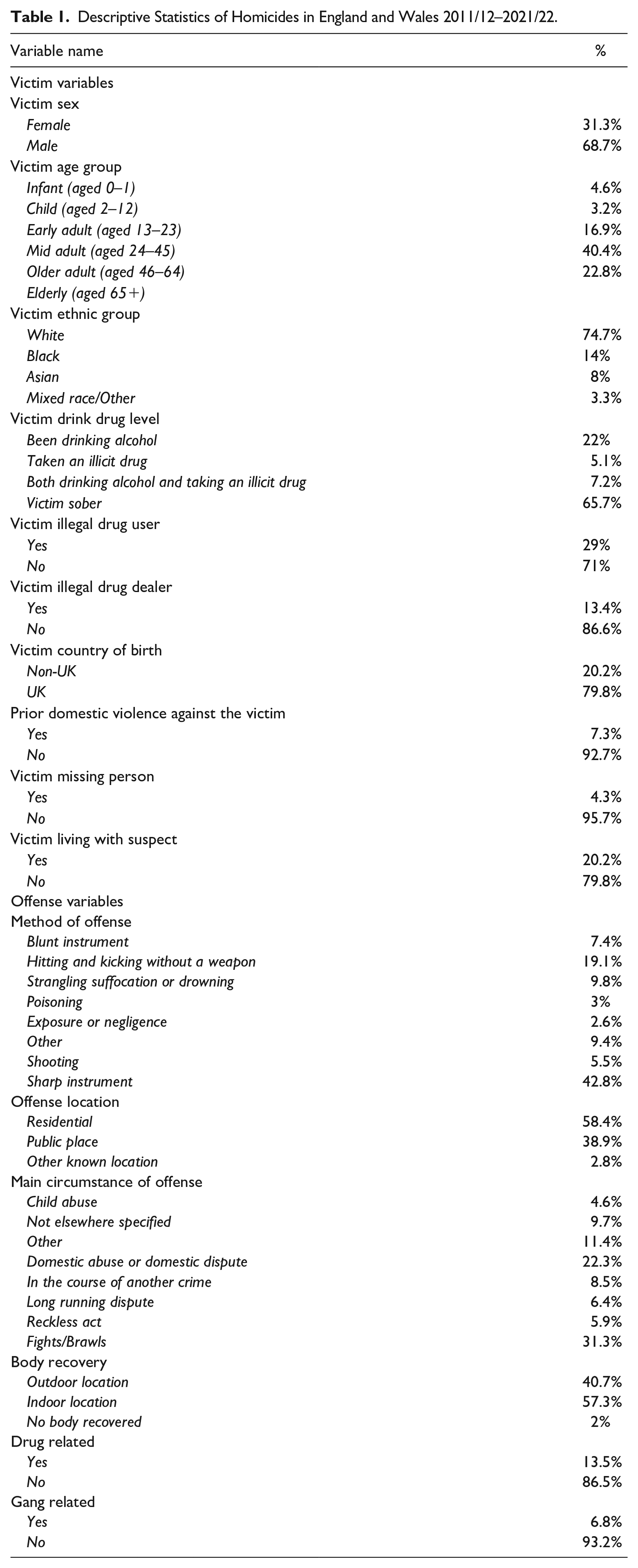
There were 38 independent variables (IVs) included in this analysis. These were categorized into two groups relating to victim characteristics and offense characteristics, as detailed below. Descriptive statistics of the variables are presented in Table 1.
Descriptive Statistics of Homicides in England and Wales 2011/12–2021/22.
Victim Characteristics
Eighteen variables related to victim characteristics. These included sex (31.3% = Female), country of birth (20.2% = Non-UK), whether they were an illegal drug user (29.0% = Yes), illegal drug dealer (13.4% = Yes), a missing person (4.3% = Yes), living with the suspect (20.2% = Yes), and if there had been prior domestic violence against the victim (7.3% = Yes). Ethnicity was measured using three dichotomous variables: Black (14.0%), Asian (8.0%), and Mixed Race/Other (3.3%), with White (77.3%) omitted as the reference category. Victim age was measured using five dichotomous variables: infant aged 0 to 1 (4.6%), child aged 2 to 12 (3.2%), early adult aged 13 to 23 (16.9%), older adult aged 46 to 64 (22.8%), and elderly aged 65 + (12.1%). Mid adult aged 24 to 45 (40.4%) was omitted as the reference category. Data were grouped in this way to distinguish between infanticide and child victims of homicide because data from England and Wales reveal that infants under 1 year have the highest homicide victimization rate of any age group (Brookman & Nolan, 2006; ONS, 2024). The final variable related to drug and alcohol use prior to death and was measured using three dichotomous variables: victim had been drinking alcohol (22.0%), victim had taken an illicit drug (5.1%), and victim had been drinking alcohol and taken an illicit drug (7.2%). The reference category was victim sober (65.7%).
Offense Characteristics
Twenty variables related to offense characteristics. These included whether the homicide was gang-related (6.8% = Yes) and drug-related (13.5% = Yes). Method of offense was measured using seven dichotomous variables: hitting and kicking without a weapon (19.1%), strangling, suffocation or drowning (9.8%), blunt instrument (7.4%), shooting (5.5%), poisoning (3.0%), exposure or negligence (2.6%), and other 5 (9.4%), with sharp instrument (42.8%) as the reference category. Offense location was measured by two dichotomous variables: public place (38.9%) or other known location (2.8%), with residential (58.4%) as the reference category. The main circumstance of the offense was measured using seven dichotomous variables: domestic abuse or dispute (22.3%), in the course of another crime (8.5%), long running dispute (6.4%), reckless act (5.9%), child abuse (4.6%), other known circumstance (11.4%), and unspecified circumstance (9.7%), with fights/brawls (31.3%) as the reference category. Body recovery was measured using two dichotomous variables: outdoor location (40.7%) and no body recovered (2.0%), with indoor location (57.3%) as the reference category.
Analytical Strategy
Data were analyzed using binary logistic regression models with a threshold of p ≤ .05 used to draw inferences about statistically significant effects. This method is commonly used to test the relationship between a dichotomous DV and multiple IVs, estimating the likelihood of an event happening, such as whether a case is cleared (Mood, 2010). The primary objective of this analysis was to identify the variables most significantly associated with case clearance outcomes and to determine the contribution of each variable.
After excluding ineligible cases, approximately 31.7% of cases in the Homicide Index were missing one or more of the variables used in the multivariate model tested below. 6 Research clearly demonstrates that under such circumstances, it is usually inappropriate to proceed with the analysis without taking advantage of statistical methods designed to address missing data concerns (Schafer & Graham, 2002). In this study, missing data were addressed using multiple imputation techniques. Multiple imputation leverages the observed data to estimate imputed values for each missing value, creating new complete datasets with no missing values (Little & Rubin, 2002; Rubin, 1987). Simulation research shows that multiple imputation results in more accurate parameter estimates, increased statistical power, and reduced bias relative to listwise deletion, which involves excluding cases with missing data from the analysis (Dong & Peng, 2013; King et al., 2001). This method is widely used in criminological research on violence (e.g., Kuhl et al., 2015; Riedel & Regoeczi, 2004). We used multiple imputation to create five complete datasets containing imputed values for all variables included in the model. We then estimated separate logistic regression models using each dataset and combined the five sets of estimates using Rubin’s (1987) rules. The combined estimates from these models are reported in the following section.
Results
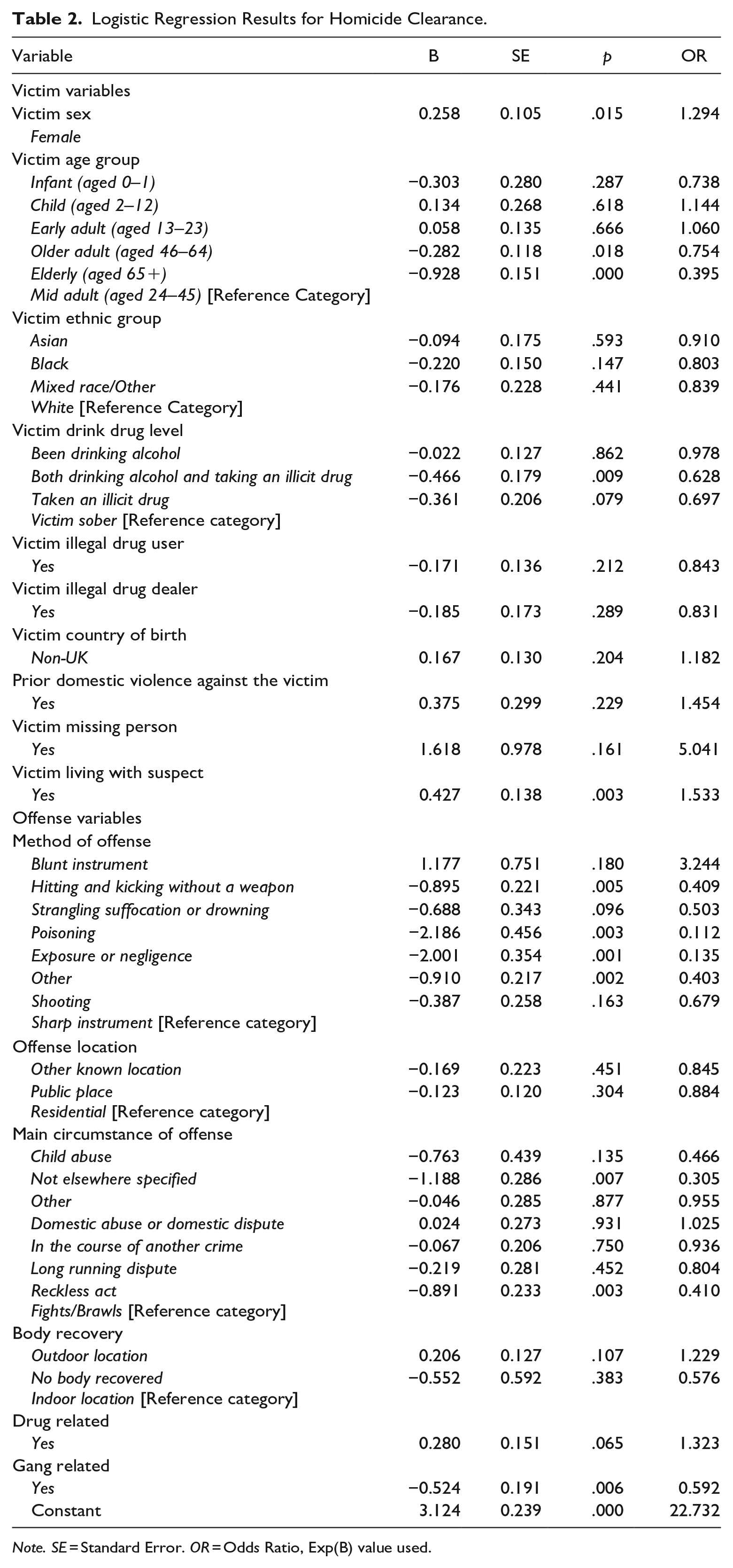
We began the analysis by testing for multicollinearity to ensure that we could obtain estimates of the unique effects of the IVs included in the model. Regression diagnostics indicated that the largest variance inflation factor was 3.1, suggesting that multicollinearity was not problematic (Belsley et al., 2004). We then estimated a single binary logistic regression model to examine the relationship between the DV (case clearance) and the 38 IVs described earlier. The results from this analysis are presented in Table 2. 7
Logistic Regression Results for Homicide Clearance.
Note. SE = Standard Error. OR = Odds Ratio, Exp(B) value used.
Regarding victim characteristics, the odds of clearance were 1.29 times higher for female victims than male victims, and 1.53 times greater if the victim was living with the suspect. Only two of the five age contrasts had a statistically significant effect on homicide clearances. Relative to victims aged 24 to 45, those aged 46 to 64 had 25% lower odds of clearance (odds ratio = 0.754), and those aged 65 + had 60.5% lower odds of clearance (odds ratio = 0.395). These results suggest that there is a nonlinear relationship between victim age and case clearance. When compared to the reference group of sober victims, odds of clearance were 0.62 times lower when the victim had been both drinking and taking drugs. There was no significant difference in the odds of clearance based on the victim’s ethnicity, country of birth, prior incidents of domestic violence against the victim, or whether they were a missing person, a drug user or drug dealer. 8
Turning to offense characteristics, four of the seven method of offense variables had significant effects on case clearance relative to the reference group (use of sharp instrument). Odds of clearance were 0.40 times lower when the method of offense was hitting and kicking without a weapon, 0.11 times lower for poisoning, 0.13 times lower for exposure or negligence, and 0.40 times lower for other methods. Of the seven variables related to the main homicide circumstance, two circumstances had a significant negative effect on case clearance when compared to the reference group of fights or brawls. Odds of clearance were 0.30 times lower for unspecified circumstances, and 0.41 times lower when the circumstance was a reckless act. Finally, gang-related homicides had a negative effect on case clearance, reducing odds by 0.59. 9 There was no significant effect of offense location, body recovery, or whether the homicide was drug-related.
We now turn to a discussion of these results and consider their implications for understanding the factors that influence the ‘success’ of homicide investigations (Brookman & Innes, 2013). We highlight whether our findings are consistent with or diverge from previous research. We conclude by discussing the implications of our findings for future theory and research on homicide and its investigation.
Discussion
This study has identified which victim and offense characteristics are associated with significantly higher or lower odds of homicide clearance in England and Wales and offers unique contributions to the clearance literature. First, while several studies have explored the role of victim and offense characteristics on case clearance in the United States, Canada, and some Western European countries, this study provides a novel contribution, focusing on England and Wales. Second, whereas previous research undertaken in England and Wales has examined data pertaining to only one police force (Riggs et al., 2019), this study is the first to examine homicide clearance data for all police forces in England and Wales. Using victim-level data from the Homicide Index covering an 11-year period, we used binary logistic regression to test the effects of each independent variable on the odds of clearance while controlling for the effects of the other independent variables in the model. The results revealed that several independent variables had significant effects on clearance. We discuss each in turn, examining victim characteristics and then offense characteristics.
Our findings revealed that odds of clearance were higher for female victims than male victims, corroborating findings from studies undertaken in the United States (Avdija et al., 2022; Ferrandino, 2021), Switzerland, and the Netherlands (Bänziger & Killias, 2014), Sweden (Liem et al., 2019) and Canada (Regoeczi et al., 2000). These findings all appear to contradict Black’s (1976) theory of law which predicts that female victims will receive less ‘law’ than males (Rydberg & Pizarro, 2014, p.345). Instead, several scholars attribute the higher clearance rate of female-victim homicide to the preponderance of domestic cases, which are often easier to solve than other kinds of homicide due to the existing relationship between victim and offender (Lee, 2005; Prince et al., 2021; Roberts & Lyons, 2011). Although we were unable to examine victim-offender relationship (see ‘Data and Methodology’), previous analysis of the Homicide Index reveals that approximately 45% of female victims are killed by a current or former partner, compared to 4% of male victims (Brookman, 2022, p.33).
Our results indicate that cases were more likely to be solved when the victim was living with the suspect, supporting Trussler’s (2010) assertion that chances of solving the case improve when the social distance between the victim and suspect decreases. Our cases include both domestic and non-familial multiple occupancy houses. However, it is not possible to distinguish between the two from the available data. While homicides in a domestic setting have received much scholarly attention (e.g., Chantler et al., 2020; Kim & Merlo, 2023), few have studied violence in houses of multiple occupancy, wherein unrelated adults share a bathroom, kitchen and, sometimes, bedroom space. As an exception, Bowden and Barnes (2015, p.61) small study of an English town indicated how such premises ‘are potentially generators of violent crime’. More recently, there have been several media reports of homicides committed in houses of multiple occupancy in England and Wales (e.g., Uyal, 2023). This finding highlights how social proximity can impact investigative outcomes in England and Wales though further research is needed to consider the underexplored factor of non-familial cohabitation.
Turning to lower odds of homicide clearance, cases were less likely to be solved when victims were aged 46 to 64, and this effect is even more significant for those aged 65 and above, in comparison to victims aged 24 to 45. However, there is a paucity of literature which explores the ‘older-adult’ age group of 46 to 64 making it hard to draw comparisons to previous literature. Our finding that ‘elderly adult’ victims (aged 65 and over) have lower odds of clearance supports the majority of other studies (e.g., Prince et al., 2021), including those conducted in the United States (Lee, 2005; Litwin, 2004) and Canada (Mouzos & Muller, 2001; Regoeczi et al., 2000). One possible explanation of this finding, based on a study conducted in the United States, is that older victims have fewer remaining family members in the community to pressure the police to ‘investigate aggressively’ (Lee, 2005, p.532). Alternatively, despite the best efforts of police, lower clearance rates among elderly victims may be associated with an increased risk of victimization of home invasion/burglary homicides perpetrated by strangers (e.g., Regoeczi et al., 2008; Titterington & Reyes, 2010). However, these studies are predominantly undertaken in the United States and this kind of homicide rarely occurs in England and Wales. 10 Moreover, our analysis controlled for the effects of concomitant offenses. It is possible that our finding may have arisen because of complexities in determining the mode of death for elderly victims, compared with those aged 24 to 45. For example, D. Jones (2016, p.147) suggests that elderly people living in care institutions are more susceptible to being victims of undiagnosed homicide than younger people. Although outside of the timeframe for this study, the most prolific serial killer in England and Wales, Harold Shipman, who killed over 200 of his patients by lethal injection, successfully evaded capture for over 20 years in part because he was able to pass off the deaths of his (mostly female and elderly) victims as natural (Brookman, 2022). While our findings are suggestive of unique challenges associated with successfully investigating elderly homicide cases, further research is needed to examine more closely ‘older adult’, and elderly homicide victim cases and the factors that contribute to investigative outcomes.
Cases where the victim had consumed both alcohol and drugs were less likely to be cleared than those where the victim was sober. Surprisingly, there was no significant effect when the victim had consumed only alcohol or only drugs. There is a dearth of homicide clearance literature exploring victim alcohol and drug levels with which to compare our findings. Nevertheless, we suggest that homicides involving both alcohol and drug consumption may be more chaotic and spontaneous in nature, than those when either alcohol or drugs are consumed, or when victims are sober. This finding could also be attributed to the victim lifestyle perspective (Rydberg & Pizarro, 2014). For example, some victims may be devalued due to illegal drug use, and eyewitness accounts may be considered less reliable if witnesses were also intoxicated at the time of the offense (Martin & Monds, 2023).
We now turn to offense characteristics. We found lower odds of clearance where the main circumstance was a reckless act, which included among others, the unlawful administration of drugs, and offenses relating to motor vehicles. Similarly, others have identified low clearance rates associated with drug-related homicides (Braga et al., 2019) and with homicides committed by ‘other’ methods including motor vehicles (Liem et al., 2019). We suggest that the characteristics of these kinds of homicide may make it more difficult to determine that a homicide has been committed. For example, Beety (2019, p.19) suggests that drug-related homicides may be more difficult to solve because of the ‘problem of proof’. To elaborate, in drug-related homicides, there are difficulties in both determining who administered the drug (the victim or someone else) and identifying which drug led to death in cases where multiple drugs are present in the victim’s blood. Similarly, given the paucity of literature which examines motor vehicle related homicides, we can only suggest that there may be complexities proving intent and/or that the incident was a homicide rather than an accident. Both case characteristics are supportive of the non-discretionary perspective as the lower odds of clearance may owe more to the availability of evidence, or the ‘problem of proof’. We also found significantly lower odds of clearance for unspecified circumstances which is supportive of findings from the United States (Regoeczi et al., 2008). Though, unfortunately, it is not possible to identify from the available data the details of these circumstances.
In terms of method of offense, the results showed lower odds of clearance for four methods when compared to sharp instrument use, these included homicides committed by hitting and kicking without a weapon, poisoning, exposure or neglect, and other methods (including arson, explosion, motor vehicle, and non-specific methods such as shaking babies). There is little literature which has examined methods of offense in this level of detail, with which to compare our findings. Nevertheless, we suggest that non-discretionary theory may help to explain our findings. With the exception of firearms, the use and recovery of weapons are often linked to higher clearance rates due to increased forensic opportunity (McEwen & Regoeczi, 2015; Riedel, 2008). However, except for using a motor vehicle (classified under other methods), none of the methods listed above involved a weapon, which may have reduced forensic opportunities.
The lower odds observed for clearing hitting and kicking homicides could, we speculate, be linked to how these investigations commenced. It is possible that a higher percentage of hitting/kicking cases do not result in the immediate death of the victim (as compared to those that involve lethal weapons). In turn, these cases may be initially investigated as serious assaults, attracting less resources than homicide incidents, during the vital ‘golden hours’ of investigation. The Homicide Index does not record information relating to evidence recovery, time of death, or if the offense was initially recorded as something other than a homicide, and so we are unable to do more than speculate on this possible link.
Most of the ‘other methods’ in our sample related to ‘non-specific methods’, which the Homicide Index describes as shaking. The majority of victims murdered using this method of offense were those aged under 1 year with the main circumstance of child abuse. Our findings suggest that there may be particular complexities associated with investigating infanticide (where the victim is less than 12 months old), which can be especially hard to detect, investigate, and clear. Infant homicides can be difficult to distinguish from non-suspicious deaths, such as sudden infant death syndrome (Hunnicutt & LaFree, 2008), leading to delays in initiating a homicide investigation. Consequently, crucial evidence may be lost. Furthermore, when dealing with infant victims, there may be fewer opportunities to gather digital evidence, such as CCTV footage or mobile phone data, which are used frequently in homicide investigations to identify and charge suspects (Brookman, Jones et al., 2022). To appraise these explanations, further research is needed on the nature and investigation of infanticide cases.
Also included in the ‘other’ methods of offense were homicides committed by arson, explosion, and motor vehicles. Very few studies explore the clearance rates of homicides committed using these methods. One study from the United States found higher clearance rates for arson homicides - attributed to increased resources due to the combined investigative efforts of both specialist fire and police investigators (Drake & Block, 2003). Arson-related homicides would also be subject to joint fire and police investigations in England and Wales. Nevertheless, we found lower odds of clearance for these cases. It is possible that arson and explosion attacks pose particular investigative challenges due to the destructive effect of fire and the loss of forensic evidence. As Ferguson et al. (2015) note, fire at the crime scene has the potential to destroy evidence, decreasing the likelihood of clearance. However, it is not possible to distinguish which, if any, of the ‘other’ methods contributed most significantly to the lower odds of clearance. What our findings highlight, nevertheless, is the importance of probing further into arson, explosion and motor vehicle homicides in order to understand how and why they pose investigative challenges.
Finally, another notable contribution of this study relates to our finding that gang-related homicides were less likely to be solved than those where victims were not connected to gangs. While similar findings have been documented in other nations with much higher homicide rates (e.g., Maguire et al., 2010), our results are the first to illuminate the lower likelihood of clearance of gang-related homicides within the unique socio-cultural context of England and Wales. There are several explanations for this that transcend existing theoretical perspectives and are likely influenced by organizational and community factors as well as characteristics of these cases (see Brookman & Pike, 2024). For example, in some instances, police may exert less investigative effort in solving gang-related cases (in line with the victim devaluation theory). However, these cases are likely more challenging to solve due to vital information being less readily available or accessible to police (Brookman & Pike, 2024). Notably witnesses may be unwilling to assist police due to the no-snitching culture often associated with gangs (Clampet-Lundquist et al., 2015), because they are fearful of retaliation from gang members in their community, or due to mistrust of police. Challenges associated with investigating multiple offenders, and concomitant offenses that characterize some gang-related homicides, may also hinder these investigations (Pastia et al., 2017).
By addressing a gap in literature, our findings provide novel insights into some of the victim and offense related factors that influence homicide case clearance in England and Wales and highlight avenues for further research. However, our findings also underscore the complexities of unraveling precisely how or why these factors influence homicide clearance rates and highlight limitations in available data and quantitative methodologies, to which we now turn.
Study Limitations
Our analysis was informed by the FBI (2018) definition of homicide clearance (in keeping with many prior studies, e.g., Aziani & Persurich, 2023; Liem et al., 2019; Vaughn, 2020. However, a small proportion (approximately 5%) of cases that were included as ‘cleared’ in our study resulted in suspects being acquitted at court. We suggest that such cases should not be considered cleared. Others have raised similar concerns (e.g., P. J. Cook & Mancik, 2024). Instead, future studies could combine acquitted cases with unsolved cases or analyze them separately, as a distinct category. This is certainly feasible in England and Wales, given that this level of detail is recorded on the Homicide Index.
Our study was also limited because we were unable to access the case files for the incidents represented in the dataset. As a result, certain coding decisions had already been made prior to our analysis of the data. Furthermore, there are many other factors linked with homicide clearance (see Brookman et al., 2019) that were not explored within this analysis because they were not captured on the Homicide Index. In particular, detective experience, staffing and resource allocation, police-community cohesion, and the use of forensic and digital evidence have been identified as influencing homicide clearance in both England and Wales, and the United States.
Finally, quantitative research of this kind provides important pointers and clues to the kinds of socio-demographic or case related factors that can impact homicide clearance. However, understanding precisely how and why these factors make a difference requires detailed insights from qualitative research. So, whilst our findings are novel, they are a stepping stone that we hope will lead to some focused qualitative work.
Implications for Practice and Policy
As noted above, one key limitation of this research was the inability to include in the statistical modeling, any quantitative data pertaining to the police investigation of homicide (such as the use of forensic and digital evidence and the availability of witnesses). Whilst qualitative studies have been conducted in the UK detailing the links between homicide investigation and outcome (Brookman et al., 2019; Brookman & Innes, 2013), and between forensic science evidence and homicide outcomes (H. Jones & Brookman, 2022), the findings from these studies have yet to be incorporated into national databases, such as the Homicide Index. Consequently, important information about investigations and their potential impact on case outcomes is yet to be collated in England and Wales. We recommend the inclusion of new variables to the Homicide Index and/or the development of a new database (‘The Homicide Investigation Index’) that could capture, at a national level for each recorded homicide, information such as (i) what forensic and digital evidence was uncovered and whether it led to the identification and charge of suspects, (ii) the use and value of intelligence sources and witnesses, (iii) the case ‘survival time’ (Regoeczi et al., 2008, p.10) and (iv) investigative challenges. This information could be analyzed, in conjunction with the Homicide Index, to better understand the range of intersected variables that impact homicide case clearance and elucidate where policy changes are needed.
Conclusion
This study examined the factors associated with homicide case clearances in England and Wales. Our analysis detected a significant increase in the odds of homicide case clearance if the victim was female or if the victim was living with the suspect. Additionally, our findings indicated significantly lower odds of clearance if the victim was aged older than 46 years, and if the victim was intoxicated with drugs and alcohol. Regarding offense characteristics, our analysis revealed lower odds of clearance if the method of offense was hitting or kicking without a weapon, poisoning, exposure or negligence, or ‘other’. Additionally, results indicated lower odds of clearance if the main circumstance was unspecified, or was a reckless act, or if the offense was gang-related. While the quantitative study of homicide case clearance is common in certain nations, particularly the United States, it is rare in the UK, where most scholars have utilized qualitative research methods. This study fills a gap in the literature relating to factors influencing homicide clearance in England and Wales and provides novel insights that could inform improvements to the national homicide database (Home Office Homicide Index). In sum, this study’s unique contributions extend beyond the statistical findings by addressing a gap in homicide clearance literature in England and Wales and recommending actionable changes which may improve future research on homicide clearance in England and Wales.
Footnotes
Declaration of Conflicting Interests
The author(s) declared no potential conflicts of interest with respect to the research, authorship, and/or publication of this article.
Funding
The author(s) received no financial support for the research, authorship, and/or publication of this article.
