



Abstract
Homicide crime scene staging (HCSS) involves purposefully altering the death scene to obstruct the criminal justice process by concealing the true nature of a crime. It is one of the most perplexing and intriguing homicidal behaviors and one of the least systematically studied, particularly in non-Western societies. As the first systematic study of HCSS in a non-Western society, this paper contributes to the ethnocultural understanding of HCSS by analyzing nation-based data regarding 56 HCSS events in Israel (excluding the West Bank and Gaza) during a 40-year period (1980–2019). Descriptive statistics demonstrate HCSS in Israel differs from that reported by studies in Western societies regarding weapon of choice and the death scene scenario offenders tend to stage. Comparative analysis of the two main ethnic groups in Israel, Jewish and Arab, demonstrates ethnic diversity in HCSS frequency, killing motive, victim characteristics, and victim–offender relations.
Introduction
Some homicides have elusive criminological characteristics due to the staging of the crime scene by the offender. Homicides may be staged to appear as natural deaths, accidental deaths, suicides, or criminal acts committed by someone other than the offender. The epidemiological literature is divided as to the prevalence of murder staging, with some studies estimating it to be as high as about 8% of all homicide crime scenes and others as low as 0.1% (Hazelwood & Napier, 2004; Keppel & Weis, 2004; Schlesinger et al., 2014). This phenomenon is on the rise, particularly due to the media, internet, and crime documentary and TV series divulging forensic techniques (Geberth, 2006; Hazelwood & Napier, 2004; Petherick & Ferguson, 2015a), as well as increased public access to homicide investigations through news, true crime books, television, and movies (Ferguson, 2014; Geberth, 1996).
Homicide crime scene staging (HCSS) has substantial implications for society’s ability to identify homicide (Pettler, 2016), because staging is a way of purposefully obstructing the criminal justice process by concealing the true nature of a crime (Cobin, 2009; Hazelwood & Napier, 2004). Despite its detrimental effects on victims and society, this phenomenon remains one of the least-studied aspects of crime scene analysis (Pettler, 2016). Moreover, according to Pettler (2016), until the past two decades, the phenomenon of crime scene staging received little attention from the criminological or law enforcement community.
Indeed, despite the fact that staged crime scenes are not uncommon (Geberth, 1996; Schlesinger et al., 2014; Turvey, 2000), with the exception of Lupariello et al. (2018) and Adair and Dobersen (1999), published literature devoted to studying them forensically is lacking (Douglas & Munn, 1992; Geberth, 1996; Turvey, 2000). Petherick and Ferguson (2015a) identified only four published studies on staged crime scenes (Ferguson, 2014; Hazelwood & Napier, 2004; Schlesinger et al., 2014; Turvey, 2000). Controversies over empirical and theoretical observations prevail. Furthermore, because most studies were conducted in Western societies (mostly the United States), their generalizability to non-Western societies is questionable. Therefore, research on HCSS requires contextual fine tuning, because although homicide transcends geographic locations, cultures, and groups, its manifestations—just as any other criminal phenomenon (Landau, 1984; Landau, 1998, p. 82)—are diverse based on the sociocultural context.
For example, Bodó (2002) described the nature of many killings of men committed by women from 1911 to 1929 in a small village, Tiszakurt, about 140 km from Budapest. Describing the peculiar characteristics of these killings—arsenic poisoning of family men (often the killer’s husband)—Bodó (2002) argued that both the traditional separation of gender and the traditional elements of peasant culture set the stage for the poisonings and their coverup (pp. 42, 47). These killings and their concealment were enabled by peasant women expected to fulfill gendered social roles to cook, feed their family, nurse sick family members, and prepare corpses (wash and dress) for burial. By examining the sociocultural context and gendered role in which these village women operated, Bodó’s (2002) study shows the sociocultural aspects of HCSS, describing how these women had sole mastery over and access to the crime scene. This enabled them to both execute killings and cover them up by framing them as deaths that stemmed from an unexpected sickness.
Given the current empirical and theoretical need to understand this understudied phenomenon and its non-Western diverse manifestations, this study aimed to contribute to the understanding of HCSS and its sociocultural aspects and possible diversity. Reporting on the first systematic nation-based study in a non-Western society, the paper begins with a literature review of HCSS, followed by the study’s methodology, its results, and a discussion of the research findings. The paper ends with conclusions emphasizing the main theoretical implications of the study’s empirical observations and points to future research directions.
Homicide Crime Scene Staging
According to Douglas and Munn (1992), HCSS occurs when someone purposefully alters a crime scene prior to the arrival of the police to either redirect the investigation away from the most logical suspect or protect the victim or the victim’s family. Precautionary acts are one type of crime scene behavior, and staging behaviors are specific types of precautionary acts (Ferguson & Petherick, 2016). In other words, every staging is also a precautionary act, but not all precautionary acts are staging. Only precautionary acts that suggest an alternative death scenario are HCSS. Staging means that an offender tries to make the scene look a certain way so that investigators will not think that the victim died at the hands of the stager. Staging is achieved by altering physical evidence at the scene before, during, or after the homicide to present a misleading appearance of the crime scene. Precautionary acts, on the other hand, mean that an offender takes precautions before, during, and after the killing (Turvey, 2000).
Scholars have disagreed about the definition of HCSS. For example, some scholars consider setting the victim and the scene on fire to be staging (Geberth, 2006), whereas others view this as a precautionary act that removes DNA and incriminatory evidence from the crime scene (Ferguson, 2015; Pettler, 2016). Another argument has to do with family members altering the scene with the aim of protecting the dignity of the deceased victim (covering the body, closing the eyes, removing evidence of sexual activity, etc.). Whereas Douglas and Douglas (2006) and Chancellor and Graham (2017) considered this to be scene staging, other scholars such as Pettler (2016) argued that such staging lacks criminal intent and therefore, should not be categorized as such.
A homicide scene is staged according to the death scenario the offender wants to present. This staged death scenario may simulate a legitimate noncriminal death, a nondeath, or a criminal death that alters the identity of the suspected offender (Chisum & Turvey, 2011; Pettler, 2016). Under a nondeath scenario, the scene is staged as if the victim is a missing person. In a noncriminal death scenario, the scene might be staged as an accident, car accident, fall from height, electrocution, fire, drug overdose, terminal illness, natural death (e.g., old age), or suicide. Under a criminal death scenario, the murder scene is staged to alter the offender’s identity; for example, staging a death to appear as if it occurred by someone else; during a burglary, break-in, or sexual crime; or in self-defense.
A review of empirical and theoretical observations reveals that scholars agree that staging is less frequent in killings related to organized crime, group rivalry-related murders (Douglas & Douglas, 2006), and street crime killings (Pettler, 2016). In addition, scholars agree that sexual homicide staging is probably the least common staging scenario (Ferguson, 2015; Geberth, 2006; Schlesinger et al., 2014), because offenders are less likely to stage a scene exhibiting sexual components.
Several typical characteristics of HCSS suggest its close affinity with a subtype of domestic homicide, that of femicide: the killing of women (Bitton & Dayan, 2019). To begin, the typical gender of most HCSS victims is female (Pettler, 2016), with stagers more often being men than women (Hazelwood & Napier, 2004; Keppel & Weis, 2004). An additional affinity of HCSS to femicide relates to scholars’ observations of the victim–offender relationship typically being domestic in nature (Petherick & Ferguson, 2015b; Pettler, 2016), with an intimate partner relationship, just as in femicide, being the most common (Douglas & Douglas, 2006; Eke, 2007; Pettler, 2016). HCSS also resembles femicide in the killing motive and crime scene. Just as in femicide cases, HCSS is often related to the female intimate partner’s wish to separate from the stager (Eke, 2007; Ferguson, 2015; Pettler, 2016), and the victim’s home is the most common scene for staging (Bitton & Dayan, 2019; Eke, 2007; Pettler, 2016).
Experts disagree about the common types of staging. Although some scholars have indicated that a homicide staged to seem like suicide is the most prevalent (Geberth, 1996; Hazelwood & Napier, 2004), Schlesinger et al. (2014) and Adair and Dobersen (1999) argued that homicide is rarely staged as suicide. Adding to the controversy are Eke’s (2007) observations, which suggest that the most common staging scenario is that of a missing victim, whereas Turvey (2000) and Petherick and Ferguson (2015a) argued that the most commonly staged death scenario relates to burglaries and break-ins. Schlesinger et al. (2014) maintained that the most common staging scenario relates to arson (25%).
Because most studies on HCSS were conducted in Western societies, primarily the United States (Ferguson, 2015; Pettler, 2016; Schlesinger et al., 2014; Turvey, 2000), the generalizability of common narratives and other HCSS characteristics to non-Western societies is questionable. For example, scholars’ observations regarding a gun being the most common weapon of choice may correlate with rather lenient gun policies in the United States. The Second Amendment to the U.S. Constitution guarantees that Americans have the right to keep and bear arms, leading to the centrality of guns in American life (Vizzard, 2015). This right to own guns seems to set the United States apart from most other countries, and it has the most guns in private hands of any country (Ellison et al., 2021). Although this rather lenient gun policy may be conducive to the use of a gun as the weapon of choice for killings, this may not be the situation in non-Western societies. For example, Israel has relatively strict gun regulations that include an assault weapons ban and a requirement to register gun ownership with the government. Such regulations include the requirement of an identifying mark for gun tracing and limitations on which citizens may apply for a permit. Such limitations involve the applicant’s residence, occupation, and role in national defense, and permits are denied for applicants who are on psychotropic drugs or have been arrested (even if not convicted) for drug abuse or domestic violence (Rosenbaum, 2012). Such gun policy regulations may affect the tendency of stagers to opt for guns as their weapon of choice.
Aiming to shed light on a uniquely intriguing and perplexing homicidal phenomenon, this paper explores the sociocultural aspects and possible diverse forms of HCSS. Specifically, as the first systematic study of HCSS in a non-Western society, the research analyzed the extent to which this homicide form resembles or differs from aspects reported by studies in Western societies. Situating the empirical study in Israel enabled a unique opportunity to explore HCSS’s diversity along the social dimension of ethnicity, given Israel’s population primarily is composed of two ethnic groups: Jews and Arabs. Extrapolating observations from a comparative analysis across Israel’s two main ethnic groups further contributed to the understanding of social dimensions related to HCSS diversity.
Method
Research Population
The population of Israel (excluding the West Bank and Gaza) at the end of 2013 totaled 8.14 million people (Israel Central Bureau of Statistics [CBS], 2018). The main social division in Israel is between the Jewish majority (80% of the total population; CBS, 2014) and the non-Jewish minority, mostly Arab Muslims (20% of the total population; CBS, 2014). Two trends—high-level education and the growth of the Israeli high-tech industry—have led to the positioning of Jews in the mid-upper sociodemographic stratum of Israeli society (CBS, 2014; Israel Ministry of Foreign Affairs, 2013).
In addition to the Jewish population, about 1.3 million persons are of Arab descent (CBS, 2014). Several cultural characteristics are common to major Arab social groups: family and clan as the central unit of society, a collective identity, a patriarchal and patrilineal social structure, and notions of family honor and female-related honor (Landau, 1993, 2016). According to Al-Haj (2012), Arab society in Israel has undergone significant changes in different areas, of which the level of education is probably the most salient. The illiteracy rate among Arabs has decreased rapidly, along with a steady increase in tertiary education, yet the education level of Israeli Arabs remains lower than that of the Jewish population (Al-Haj, 2012). The livelihood of Muslim Arabs underwent a radical change from agriculture to predominantly wage labor, yet the Arab worker is still often situated at the bottom of the labor force ladder, mainly employed in the service and construction sectors in addition to manual jobs in industry (Al-Haj, 2012). Thus, despite the relative upward mobility of Muslim Arabs in the Israeli labor market, the socioeconomic gap between them and the Jewish population remains stable (Al-Haj, 2012; Landau, 2016).
This study adopted the definition of HCSS put forth by Ferguson and Petherick (2016)—namely, “the deliberate alteration of physical evidence at an alleged crime scene in an effort to simulate events or offences that did not occur, with the intent is to re-direct an investigation” (p. 4). To this definition, this study added the requirement of an alternative death scenario promoted by the stager via evidence in the staged death scene. In other words, the HCSS positively offered evidence of an alternative death narrative or scenario to counter a possible murder scenario or suspect that may stem from the scene. This refers to the physical staging of the crime scene like relocating the body, weapon, or other items; changing the injury pattern; conducting self-injury; or using a different death method than the one verbally presented. For example, the study included two HCSS cases of two older female homicide victims, staged as natural deaths (due to the victims’ old age). Court rulings found that forensic evidence proved that these killings were perpetrated by the two defendants, through asphyxia, and that the victims’ bodies were relocated after death to look as if they died while sleeping.
The study covered nation-based empirical data, offering empirical observations on HCSS in Israel. The cases collected were perpetrated between 1980 and 2019 in Israel (excluding Gaza and the West Bank). The wide geographical scope and time of the research were dictated by the need for a sufficiently large database of a relatively rare homicide type. Overall, the study is based on cases of completed homicide (excluding attempts) that were unsuccessfully staged—that is, at some point, they were suspected, detected, and confirmed as such by police, court, or defendant’s confession. Cases were included if they were officially concluded by police as HCSS (as in cases of homicide–suicide where no criminal procedure occurred against a defendant who committed suicide) or a court ruling that the homicide involved staging the crime scene. HCSS cases were excluded if the staging was an alteration of the scene by the deceased person (e.g., disguising a suicide as a homicide or accident for insurance fraud or revenge) or if the scene staging and alteration lacked criminal intent (Pettler, 2016), such as cases where the victim was covered or relocated by family members out of respect. In addition, following the research definition, the study excluded cases where staging was solely based on an alternative verbally narrated scenario without corroborating forensic evidence of the scene’s physical alteration by the killer. For example, cases solely based on verbal staging—such as claims of having killed someone during a violent fight (with the killer’s narrative alleging self-defense)—were included only if the court ruled based on forensic evidence presented by police forces that the defendant altered evidence at the crime scene to support a self-defense narrative (such as committing self-injury or relocating items such as placing the fatal weapon in the victim’s hands).
Due to unavailability of official data on HCSS in Israel, the cases and their various relevant factors were collected case by case through a lengthy collection and screening procedure. To collect an initial list of possible HCSS cases, four high-ranking investigative police officers with experience in homicide cases were approached as students in an academic course conducted with high-ranking police officers. The officers were asked by the researcher to list all homicide cases that they would classify as possible HCSS, following the research definition presented to them. They identified 73 cases. In the second phase, all case data were collected by the researcher and police officers from open legal databases. Data from two cases that were unavailable in legal databases were requested by the researcher from the relevant court where defendants were trialed. Two additional cases that were unavailable in legal databases were extracted from detailed press releases on each trial (media surveillance methodology is considered a reliable homicide research method; Adinkrah, 2014; Warren-Gordon et al., 2010).
The third phase consisted of a case-by-case examination by the researcher and police officers based on the research definition, followed by the screening of all listed cases to exclude cases that did not involve HCSS according to the definition. Cases that did not match the research definition were excluded. Only if the defendant staged an alternative scenario regarding the death was a case included. For example, cases where defendant buried the victim in an unknown place were classified as precautionary act cases, unless the defendant reported to family or police that the victim was a missing person. In such cases, in addition to verbal staging, offenders altered evidence at the crime scene by burying victims in an unknown place. Similarly, cases where the defendant removed or relocated body or weapon or items from the crime scene were classified as precautionary act cases and included in this research only if defendants moved weapon or items to suggest an alternative, nonincriminating death scenario that was latter refuted by forensic evidence, a court ruling, or the defendant’s confession. This included, for example, cases where defendants removed the pillow they used to suffocate the victim and added large quantities of sleeping pills next to the victim’s body to stage a suicide scenario. In another case, the body of young woman was relocated from the car seat where she was strangled to death and hanged with a rope around her neck on a nearby tree to stage a suicide scenario. Also, cases with no physical forensic evidence yet the defendant confessed to having killed the victim and staged an alternative death scenario were included in this study. For example, two cases where the victim’s body was buried by the defendant and reported as missing were included in the research, despite unavailability of physical forensic evidence. Upon the defendant’s plea bargain confession of having staged the homicide, they revealed the victim’s burial place. Seventeen cases that were not conclusively classified by the court, police, or defendant as HCSS were excluded from this research. For example, in one case, a woman’s death was suspected by her family members as a cyanide poisoning by her intimate partner, who claimed that the victim died of terminal cancer (a narrative not supported by the victim’s autopsy). This was excluded from this research because police forces did not charge the defendant due to insufficient incriminating forensic evidence. Overall, of the 17 excluded cases, seven were similar to this case (i.e., suspected by police forces as HCSS yet lacking the forensic evidence required for criminal prosecution). Five cases were excluded from this study because the defendants’ criminal conviction by the district criminal court was turned down by the supreme criminal court on grounds of reasonable doubt. Five other cases wherein police officers and the researcher disagreed on their proper classification (and had no concrete court ruling or defendant’s confession on staging) were excluded from this research. Altogether, of the 73 cases listed in the initial phase, 17 cases were excluded after the case-by-case analysis, leaving only cases deemed HCSS by forensic evidence, defendant’s confession, or a court ruling that was not voided after the defendants’ appeal. This left 56 cases in the final sample.
Each HCSS case file, which was the unit of analysis, was reviewed and coded by a research assistant (RA). The RA, a PhD student in criminology, received training and guidance on HCSS and its various possible criminological categories from this study’s researcher. Using data abstraction Excel tables, variables defined in advance were extracted and coded for each case for analysis. In cases where the RA was unsure of the correct coding, the RA consulted with the researcher. Uncertainties regarding suitable coding were resolved by coding the relevant information as a missing value.
Ten sociodemographic variables were extracted and coded regarding the victim and offender, of which seven sociodemographic variables related to the victim: gender, age, ethnicity, marital status, victim had children, substance abuse, and pregnancy status. Three variables related to the offender: gender, age, and ethnicity (see Table 1). Sixteen variables were extracted and coded regarding the homicide: identity of stager, number of offenders, number of victims, whether the offender previously staged the killing of an additional victim, who suspected the death was staged, type of relationship between victim and offender (current or ex intimate partners, extended family members, acquaintances, or strangers), whether the offender actively assisted the police investigation, whether the offender had a firearm license, any financial agreements benefiting the offender with respect to the homicide, prior violence toward the victim inflicted by the offender, whether the offender was the last person to see the victim, who reported the victim’s death, killing motive, killing weapon, killing scene, staging narrative, or scenario (see Table 2). Altogether, 26 variables describing the victim, offender, and homicide characteristics were extracted from the raw data.
Sociodemographic Characteristics.
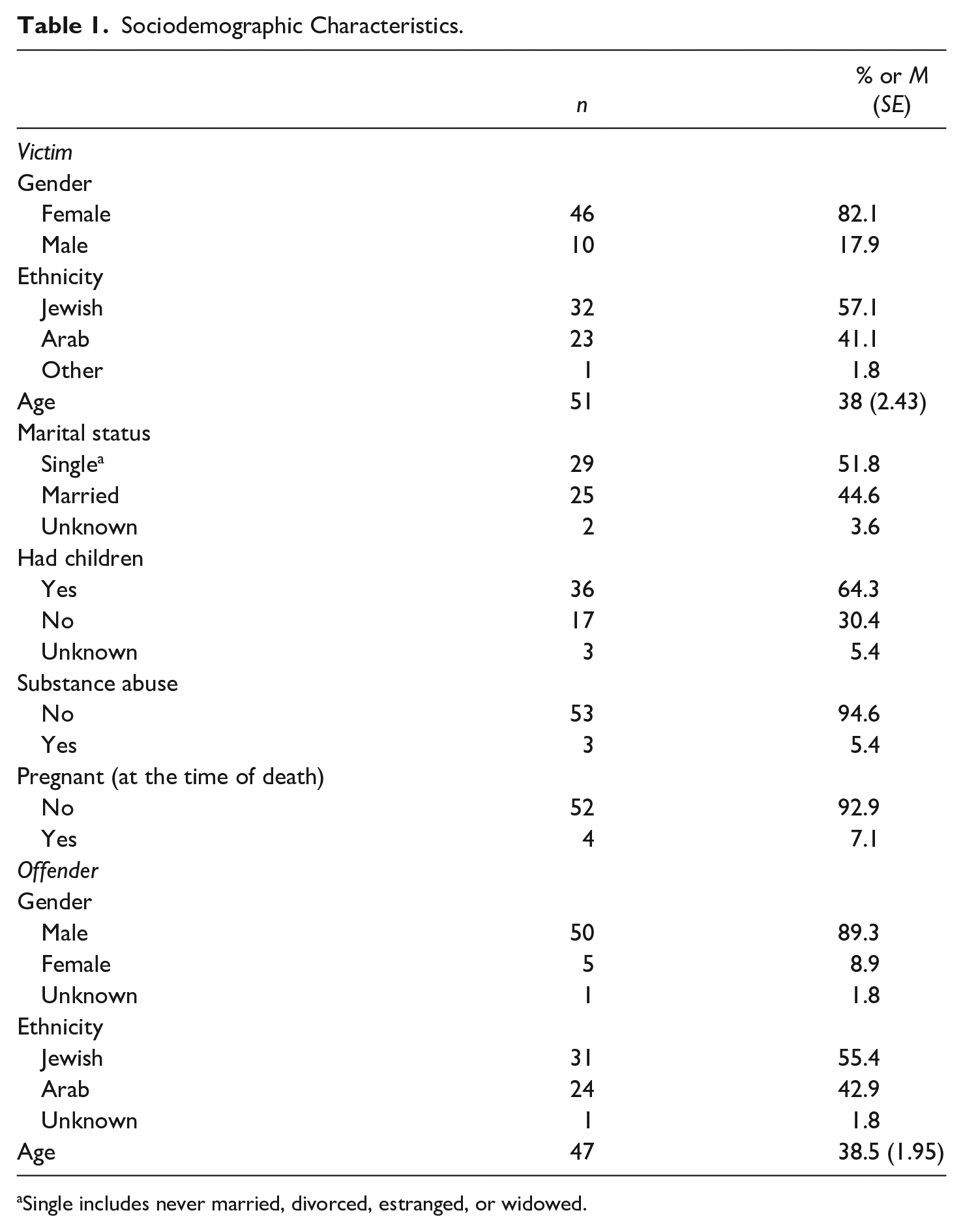
Single includes never married, divorced, estranged, or widowed.
Criminological Characteristics.
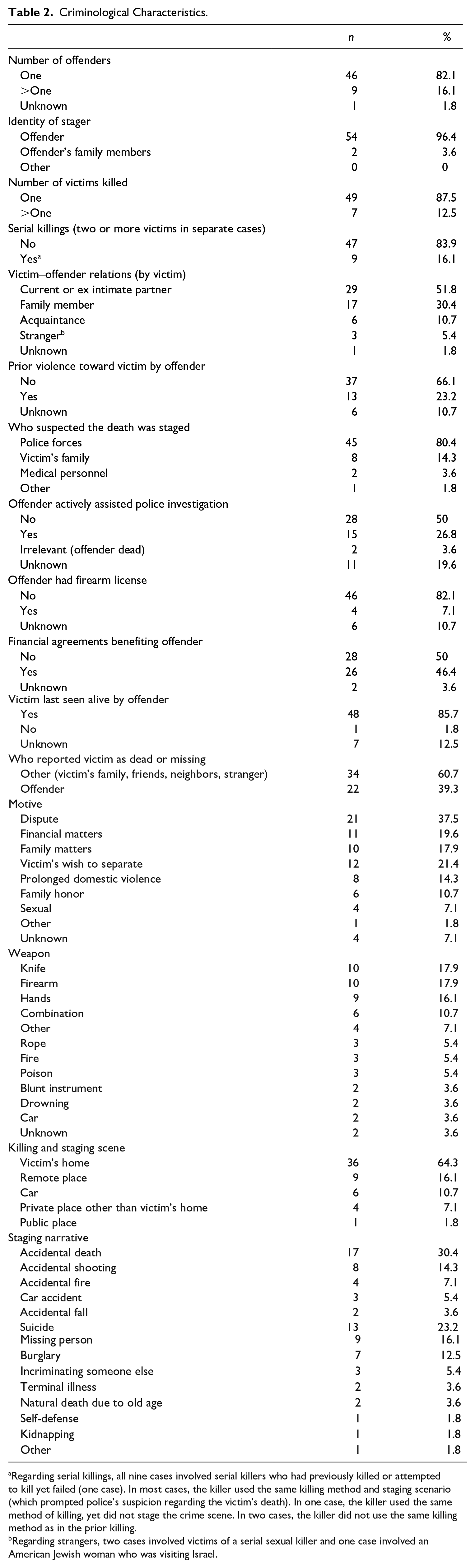
Regarding serial killings, all nine cases involved serial killers who had previously killed or attempted to kill yet failed (one case). In most cases, the killer used the same killing method and staging scenario (which prompted police’s suspicion regarding the victim’s death). In one case, the killer used the same method of killing, yet did not stage the crime scene. In two cases, the killer did not use the same killing method as in the prior killing.
Regarding strangers, two cases involved victims of a serial sexual killer and one case involved an American Jewish woman who was visiting Israel.
All analyses—descriptive, binomial tests, and cross-tabulation—were conducted using IBM SPSS 24.0 software. Exact binomial tests were conducted only regarding the representation of the two main ethnic groups in Israel, Jews and Arabs, among offenders and victims using relevant Israel Central Bureau of Statistics data. In addition, a cross-tabulation analysis using chi-square tests was conducted regarding possible ethnic differences between Jewish and Arab HCSS with a significance level of p < .05.
Findings
Sociodemographic Characteristics of HCSS
In the 56 cases in this study, most HCSS victims were women (82.1%, n = 46) and most offenders were men (89.3%, n = 50). Most victims were Jewish (57.1%, n = 32), as were most offenders (55.4%, n = 31). The mean age of victims and offenders was similar, with victims being slightly younger: 38.0 (SD = 2.43) and 38.5 (SD = 1.95), respectively. Most victims were single (never married, divorced, estranged, or widowed; 51.8%, n = 29), and most had children (64.3%, n = 36). Most victims did not engage in substance abuse (94.6%, n = 53) and were not pregnant when they were killed (92.9%, n = 52).
Criminological Characteristics of HCSS
Most offenders acted alone in the killing (82.1%, n = 46), and most killings were staged by the killer (96.4%, n = 54). In most cases, only one victim was killed (87.5%, n = 49). Some cases involved serial killers who had previously killed at least one other victim (16.1%, n = 9). In 51.8% (n = 29) of the cases, the offender was the victim’s current or former intimate partner. The second most common victim–offender relation was that of a family member, accounting for about a third (30.4%, n = 17) of all cases.
In almost all cases (85.7%, n = 48), the offender was the last person to see the victim alive, and in more than a third of the cases (39.3%, n = 22), the offender was also the person who reported the victim’s death. Most cases were suspected as HCSS by the police (80.4%, n = 45). In about third of the cases (26.8%, n = 15), the offender actively assisted the police investigation, and half of the offenders had financial agreements that benefited them in the event of the victim’s death (50%, n = 28).
Most offenders (82.1%, n = 46) did not have a firearm license, and a firearm was used in 17.9% (n = 10) of the cases (mainly by Jewish offenders), similar to the use of knives (17.9%, n = 10) and hands (16.1%, n = 9) as the killing weapon. Various weapons were used in the remaining cases (rope, fire, poison, blunt instrument, drowning, car), albeit not at high frequencies (ranging between 3.6%, n = 2 and 7.1%, n = 4). Most killings were perpetrated in the victim’s home (64.3%, n = 36); less frequent scenes were a remote place (16.1%, n = 9), a car (10.7%, n = 6), a private place other than the victim’s home (7.1%, n = 4), and a public place (1.8%, n = 1).
The most common homicide motive related to disputes (37.5%, n = 21), of which about half pertained to victim–offender financial matters (19.6%, n = 11) and half pertained to extended family matters (such as mutual visitation, relations between victim or offender and in-laws; 17.9%, n = 10), followed by the victim’s wish to separate from the offender (21.4%, n = 12). The least common motives were continued prolonged violence toward the victim by the offender (14.3%, n = 9), family honor (10.7%, n = 6), and the killer’s personal desire for sexual gratification (7.1%, n = 4).
The most common staging narrative was accidental death (30.4%, n = 17), followed by suicide (23.2%, n = 13), missing person (16.1%, n = 9), and burglary (12.5%, n = 7). The least common staging narratives were incriminating someone else (5.4%, n = 3), terminal illness (3.6%, n = 2), natural death due to old age (3.6%, n = 2), and killing in self-defense or death while being kidnaped (1.8%, n = 1 each).
Ethnocultural Diversity in HCSS
As shown in Table 3, an exact binomial sign test indicated that Arab HCSS cases were significantly more frequent. Specifically, this ethnic group was overrepresented among HCSS cases, reflecting 41.1% of the victims and 42.9% of the offenders, yet comprising 20% of the population in Israel (p < .001; CBS, 2014). Accordingly, the Jewish ethnic group was underrepresented, consisting of 57.1% of the victims and 55.4% of the offenders, yet comprising 78% of the population in Israel (CBS, 2014).
Cross-Tabulation: Ethnocultural Diversity (Excluding Missing Data).
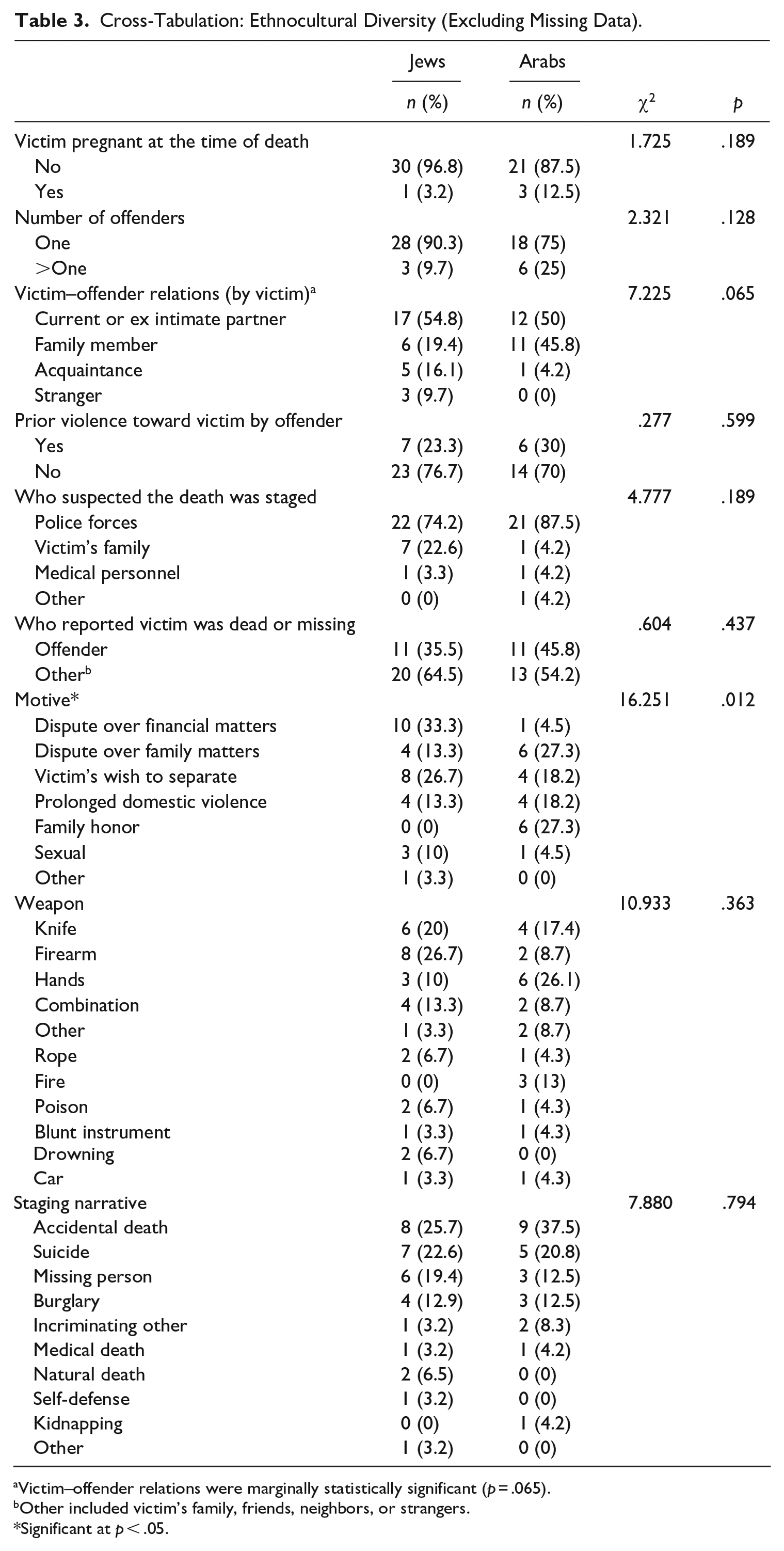
Victim–offender relations were marginally statistically significant (p = .065).
Other included victim’s family, friends, neighbors, or strangers.
Significant at p < .05.
A cross-tabulation analysis using Pearson’s chi-square test of independence was conducted to determine any statistically significant associations between the selected variables and the victim’s or offender’s ethnicity.
A statistically significant difference, χ2(6) = 16.25, p = .012, was found in the motives for perpetrating HCSS. Whereas the most common motives in Jewish HCSS cases were financial disputes between victim and offender (33.3%, n = 10) and the victim’s wish to separate from the offender (26.7%, n = 8), the two most salient motives in Arab HCSS cases were family related: disputes among extended family members (27.3%, n = 6) and family honor (27.3%, n = 6). A marginally statistically significant difference was noted also regarding the victim–offender relationship, χ2(3) = 7.23, p = .065. Although in both social groups, the most common victim–offender relationship was that of a former or current intimate partner, they differed in the distribution of other relationships. In Arab HCSS cases, they were split between two main relationship types: a former or current intimate relationship (50.0%, n = 12) or a familial relationship (extended family) (45.8%, n = 11). In Jewish HCSS cases, greater variance was found in victim–offender relationships other than former or current intimate partnership (54.8%, n = 17): familial (19.4%, n = 6), acquaintances (16.1%, n = 5), or strangers (9.7%, n = 3).
Discussion
As the first systematic study of HCSS in a non-Western society, this paper contributes to our ethnocultural understanding by analyzing nation-based data regarding HCSS events in Israel. Two main ethnocultural aspects of HCSS warrant discussion. The first ethnocultural aspect relates to possible diversity between Western and non-Western societies, exemplified here by comparing findings on HCSS in Israel and findings of prior studies in Western societies. The second ethnocultural aspect relates to possible diversity in HCSS between the two main ethnocultural groups in Israel: Arabs and Jews.
Israel versus Western HCSS
Prior findings from studies in Western societies seem to match these findings in Israel. Comparing HCSS in Israel and its characteristics to those reported in previous studies in Western societies suggests that many characteristics apply across sociocultural boundaries. HCSS victims and offenders were usually involved in some sort of relationship. Most cases involved a domestic relationship (Petherick & Ferguson, 2015b; Pettler, 2016); most victims were female and most offenders were male (Bitton & Dayan, 2019; Hazelwood & Napier, 2004; Keppel & Weis, 2004; Pettler, 2016); an intimate partner relationship was the most common victim–offender relationship (Douglas & Douglas, 2006; Eke, 2007; Pettler, 2016); most killings were committed during the end of a relationship (Bitton & Dayan, 2019; Eke, 2007; Ferguson, 2015; Pettler, 2016); and most killings were staged at home, better facilitating HCSS, which requires the offender to have unobstructed time at the crime scene (Eke, 2007; Pettler, 2016).
These observations imply that overall, HCSS in Israel and Western societies seems similar to the gendered phenomenon of femicide. Like femicide, HCSS in Israel seems to be largely gendered homicide committed by men, either intimate partners or extended family members, against a woman (Campbell et al., 2003, 2007). A further observation regarding this form of femicide relates to ethnicity, with evidence suggesting two clusters of femicide HCSS based on ethnicity.
Arab versus Jewish HCSS
Compared to Arab HCSS, Jewish HCSS killers’ motives did not tend to be related to family honor and the victim and offender were less likely to be members of the same extended family. Such characteristics of Jewish HCSS are exemplified in Siboni’s case (Criminal Action [Jerusalem] 3002/00 The State of Israel v. Siboni), involving the staging of an accidental firearm death. This case demonstrates that similar to femicide, the killing of the female victim was perpetrated by the male intimate partner (Dayan, 2020). The victim–offender relation in this case differed from femicide among Arab groups, which tends to involve extended family members (with a female family member as the victim and the father, brother, or uncle being the offender; Chesler, 2010; Dayan, 2021). Also like femicide, the victim in this case was killed due to efforts to separate from an intimate relationship (Dayan, 2020). Such killing motive differs from common femicide motives among Arab communities, which tend to involve allegations of the victim’s social or sexual behavior that breached “family honor” (Chesler, 2010; Dayan, 2021). Instead, the female victim was killed by her husband during their separation because he wanted to keep their shared financial assets by killing his wife and staging her killing as an accident.
In this HCSS case, Siboni was married to his wife, Mendy, for 15 years. One early morning in September 1999, Siboni took their young kids to kindergarten and notified the housemaid that she didn’t need to perform her cleaning chores that day because Mendy, as he described it, was not feeling well. Upon “finding” Mendy dead of a gunshot at close range to her head, Siboni called the authorities and asked them to help him revive his wife. Upon arrival at the couple’s house, the rescue team was let in by a neighbor because Siboni was still with Mendy in their bedroom, holding her bleeding head with a towel. A physician with the rescue team determined Mendy was dead. Police investigators at the scene documented Siboni’s claim that his wife shot herself mistakenly. Siboni claimed that Mendy took the gun he legally owned, left it on their bed, and went to take a shower. He went downstairs to drink his morning cup of coffee. When he got back to their room, he found Mendy still wearing her bathrobe, holding the gun to her head, stating that she was “looking for dirt” in the barrel. Siboni claimed that realizing the danger of the situation, he reached for the gun, trying to get it out of her hand, when the gun discharged a bullet into her forehead. Siboni claimed that in his efforts to revive Mendy after the shooting, he moved the gun away from her, which explained his fingerprints. When the police arrived, he described his intimate relationship with Mendy as ideal, despite being on the verge of divorce, given the couple had reached a divorce settlement, Siboni had a lover for more than a year, and he was scheduled to leave the house that day but with no planned accommodations.
Arab femicide HCSS, on the other hand, seems to be bear a more collective, familial nature both in the killing motive being related to family honor and the difference noted regarding the offender–victim relationship. Compared to Jewish HCSS, where victims and offenders tend to be intimate partners, offenders and victims in Arab HCSS are typically members of the same extended family, such as parents and siblings. Such characteristics are exemplified in Hasson’s case (Criminal Action [Haifa], 2068/05 The State of Israel v. Hasson Saad and others] involving the staging of a suicide. In this Arab HCSS femicide case, rather than the offender being the victim’s male intimate partner as common in Western femicide (Dayan, 2020), the offenders were the female victim’s father and uncles. Furthermore, and aligned with the phenomenon of femicide in Western societies, the killing in this case was not related to the female victim’s wish to separate from her intimate partner (Dayan, 2020). Instead, the killing was related to the cultural concept of “family honor,” which in Arab groups refers to a concern for the reputation of one’s family. Such family honor often pertains to the sexual and social behavior of a sister, daughter, wife or mother, and may even include loud speech, bearing, appearing in public places, and being single or divorced (Abu-Rabia, 2011; Van Osch et al., 2013). In this case, the offenders alleged that the victim had breached family honor by wishing to continue to date her chosen boyfriend (Chesler, 2010; Dayan, 2021). To avoid detection by police forces, offenders in this case killed the victim and staged the crime scene as a suicide scenario.
In this case, Samar Hasson’s body, aged 23, was found hanging from a tree in an olive tree plantation near I’billin, the village where her boyfriend lived, on October 23, 2005. Forensic examinations concluded Samar did not commit suicide but rather had been killed a day earlier. Many previous police reports recorded domestic violence toward Samar for having dated a Muslim boy outside her Druze Arab ethnic group. For example, 3 weeks before her death, on October 2, 2005, Samar started a police file against two of her uncles, who threatened to kill her for her dating and wishing to marry her Muslim boyfriend. Right after saying her uncles’ names, Samar withdrew her police report, stating she feared it would only make things worse because she was already in great and tangible danger from her family members. A day later, on October 3, 2005, she was again attacked by her family members for being adamant about marrying her boyfriend, yet she refused the police’s advice to evacuate to a women’s shelter. Samar had reported similar domestic violence to the police a month earlier, on September 4, 2005, when she stated that her family members had gathered at her home and threatened her life if she did not leave her boyfriend. Three weeks later, she was held captive in her home’s lower-level storeroom, only to be rescued by police, who needed additional forces to ensure her safe evacuation from captivity. A day later, Samar’s mother filed a police report against Samar, stating Samar’s insanity required forced psychiatric hospitalization. Following legal discussions in the court, Samar’s mother withdrew her complaint, admitting that it was her husband, Samar’s father, who forced her file this fake complaint against Samar.
On the night of her killing, Samar asked one of her family members whom she trusted to fetch a package her mother had left for her at the village pharmacy (with money she desperately needed) and drive her to I’billin to meet her boyfriend. Her family member did so, but not before having revealed Samar’s secret plan to her father. As Samar arrived in I’billin, driven by her trusted family member, she was kidnaped by her father, who was waiting for her. Samar’s father drove her to a nearby cemetery, with two of her uncles joining him in a matter of minutes to assist in her killing. Samar’s father looped a rope around Samar’s neck and began strangling her, while one of the uncles leaned the car seat back to strengthen the rope’s strangulation effect. The three then drove with Samar’s body to an olive tree plantation and hanged her with the same rope in an attempt to frame the death as a suicide. Upon admitting to killing her, Samar’s father shared his recollection of events while framing Samar’s behavior as an inconceivable, serious breach of family honor that had led to the spread of shameful rumors in neighboring Arab towns and villages, tainting the family’s honor.
In addition to the noted gendered aspect of HCSS, findings suggest notable observations regarding HCSS’s sociocultural and ethnic diversity. Three HCSS characteristics seem to imply sociocultural diversity in this crime: killing weapon, victim–offender relations, and staged death scenario. Two seem to be socially related: killing weapon and staging scenario. Although previous reports, particularly from HCSS cases in the United States and Canada (Petherick & Ferguson, 2015a; Pettler, 2016), noted firearms as the weapon of choice, the killings in HCSS cases in Israel do not tend to involve only firearms, but rather both firearms and knives. This difference is not related to ethnicity, because killings in both Jewish and Arab HCSS cases typically involved both weapons. It is possible that this diversity in criminal behavior is not culturally driven, given the relatively different governmental firearm policies resulting in more availability of firearms in Western countries, particularly the United States (Ellison et al., 2021; Vizzard, 2015), compared to Israel (Rosenbaum, 2012).
Additional diversity found in this research relates to the most common type of staging scenario, which seems to contrast with Western studies. Notwithstanding the disagreement among prior studies regarding the most common type of staging selected by offenders—suicide (Geberth, 1996; Hazelwood & Napier, 2004), missing person (Eke, 2007), burglary (Petherick & Ferguson, 2015a; Turvey, 2000), and arson (Schlesinger et al., 2014)—the most common type of staging in Israel differs, with accidental death scenarios most often chosen by offenders in Israel.
This sociocultural diversity persists even when comparing HCSS by ethnicity; both Jews and Arabs seem to prefer staging an accidental death scenario, albeit with unique narratives for each ethnic group. Jews were likely to use accidental shooting (n = 5), whereas among Arabs, accidental shooting (n = 3) and accidental fire (n = 3) were the most common types of staged accidental death. This diversity noted among both Jews and Arabs may speak to the non-Western sociocultural aspects of Israel. Indeed, several scholars have linked staged accidental death scenarios to non-Western societies—for example, kitchen fire scenarios in India (Hassan, 2006; Oldenburg, 2002) and female honor killings in Arab societies (Al-Adili et al., 2008; Hasan, 2002; Hasisi & Bernstein, 2019; Shalhoub-Kevorkian, 2002). According to Kressel et al. (1981), staging methods used to disguise killings related to family honor were developed alongside the conflicting demands of restoring family honor and not being caught by Israeli police authorities. Kressel et al. (1981) further maintained that the tendency to disguise honor killings was possibly exacerbated by the criminal system’s harsh approach in Israel toward honor killings, which led to a shift toward killing methods that can easily be disguised as accidents. It is also possible that the tendency to opt for accidental death narratives does not emanate from non-Western cultural notions but rather strict Israeli gun policies, which may restrict the array of possible staging scenarios.
Findings suggest that HCSS frequency is ethnically related, given that in addition to the fact that the Arab ethnic group was significantly overrepresented in HCSS cases, several ethnic differences emerged. More Arab HCSS cases involved more than one killer; offenders who were the victim’s extended family member; prior domestic violence toward the victim; more killing motives related to extended family disputes and family honor; and a higher share of victims who were pregnant at the time of killing. Altogether, these noted ethnic differences may all speak to the relation of such criminal behavior with the centrality of the collective and family in Arab culture and its possible correlation to the phenomenon of family honor and honor killing (e.g., Chesler, 2010; Ruggi, 1998). The possibility of this ethnic diversity being linked to family honor crimes is further corroborated by the fact that in Arab HCSS cases, fewer family members of victims expressed suspicions over the real nature of the death to the point of triggering a police investigation. This lack of expression of suspicions may stem from the collective nature of such killings, whereby family members are aware of and even collaborate in the killing. Thus, they avoid expressing any suspicions that may trigger a law enforcement investigation and determination that the murder occurred in the family.
Conclusion
This study has limitations—first and foremost, its small number of cases—that may impede generalizability. The actual number of HCSS cases in Israel may be higher than reported in this study, because this study focused on unsuccessfully staged homicides that were later discovered by the police or court or acknowledged by the defendant. Successfully staged homicides likely still exist and remain uncovered. Second, HCSS cases may be more prevalent because cases of missing persons, victims whose death was possibly caused by murder, and victims whose body was not found were not included in the study. For example, the number of Arab HCSS cases may be higher due to unreported cases of honor killings (e.g., killings the family did not report) or killings disguised as accidents or suicides, given scholars have argued that family honor killings frequently go unreported or are disguised as accidents (Al-Adili et al., 2008; Kulczycki & Windle, 2011). Furthermore, and particular to Israel, underestimation of Arab HCSS killings may be attributed to polygamy customs in Bedouin society (despite being criminalized under the Israeli Penal Code), with women brought into Israel, often smuggled in; unregistered officially (Hlihel, 2008); and unaccounted for if killed. Further studies are needed to explore the actual frequency of HCSS. An additional limitation pertains the study data. The analysis was based on archival data, mostly legal databases augmented by media coverage, which are not compiled for precise academic needs in exploring certain criminal phenomena. The nature of such data may impede academic needs regarding information relevant to the phenomenon being studied and thus, findings should be assessed with caution.
Despite this study’s limitations, given that most scientific knowledge on HCSS has been developed in Western societies, challenging and testing its generalizability in non-Western societies may improve the scientific understanding of this phenomenon. This study demonstrates that to understand HCSS, it is imperative to apply sociocultural frameworks of analysis. Such frameworks should be used both at the macro level between societies and at the meso level among groups in the same society. Future research is needed to validate these findings and further explore sociocultural relativity in homicide and HCSS behavior.
Furthermore, given HCSS’s proximity to femicide and its masquerading nature, epidemiological accounts of femicide may underreport the real number of female homicide victims. This research’s findings, thus, emphasize the need to consider the possibly higher frequency of such killings, which are uncounted as femicide cases. A further implication regarding the criminological nature of HCSS and its proximity to femicide relates to the sociocultural diversity noted in this study regarding the killing weapon. The fact that HCSS weapons were both firearm and knives, combined with the accidental death scenario at times involving a fire or car accident, seems to problematize one of the most commonly accepted policy recommendations to combat femicide—that of restricting gun ownership (Campbell et al., 2003; Sela-Shayovitz, 2010). The study findings imply that a restrictive gun policy may be only partially effective in preventing HCSS femicide, which in addition to accidental shootings can involve alternative, elaborate, “nonbloody” killing methods. Still and in relation to sociocultural relativity, a strict gun policy may be related to particular killing and staging behaviors, because it may influence the possible staged death scenarios produced without a firearm. For example, a single killer may have difficulty lifting the body and staging a hanging suicide scenario (Adair & Dobersen, 1999), whereas a suicide scenario is much easier to stage in places with lenient access to firearms. Similarly, a burglary or break-in death scenario is technically difficult to stage without a firearm. It is, therefore, possible that the most prevalent staging scenarios found in this study—namely, accidental deaths—are linked to the strict gun policy and not cultural or ethnic factors. Future studies should further explore the possible link between gun policies and HCSS.
Footnotes
Declaration of Conflicting Interests
The author declared no potential conflicts of interest with respect to the research, authorship, and/or publication of this article.
Funding
The author received no financial support for the research, authorship, and/or publication of this article.
