



Abstract
South Africa has amongst the highest rates of homicide in the world, yet little is known about the contexts that shape fatal violence. One frequently feared context is robbery. We examine 68,801 robberies reported between 2003 and 2014 to predict risk factors for cases resulting in victim death. Robbery-homicide is rare in South Africa and its risk factors differ from the country’s overall homicide profile. Significant correlates include day of the week, time of the day and the victim’s race. These findings demonstrate how context-sensitive understandings of violence are crucial to advancing research on homicide in low- and middle-income countries.
Introduction
At a rate of 6.1 per 100,000 population, homicide accounted for approximately 464,000 deaths across the world in 2017 and is disproportionately prevalent in low- and middle-income countries (LMICs). Classified as a middle-income country, South Africa’s homicide rate (at 35.9 per 100,000 population) is the fifth highest in the world and nearly six times the global average (UNODC, 2019). Globally, researchers are increasingly drawing attention to the many forms of homicide, noting that sub-types of homicide (e.g., serial homicides, fatal school shootings, homicide-suicide) may reveal the specific ways that risk factors and underlying social processes drive homicide outcomes in various contexts (Ioannou & Hammond, 2015). One such context gaining increasing global prominence is the pervasive crime of robbery. The United Nations Office on Drugs and Crime’s (UNODC) most recent Global Study on Homicide highlights key worldwide patterns of robbery-homicide. However, only four of the 61 countries that provided data for this category of analysis are from the African region, 1 which is unsurprising given that comprehensive data on homicides in Africa are generally lacking (UNODC, 2019). This limitation means that information pertaining to the proportion of robbery-homicide as a share of overall homicide—and, as a consequence, studies on risk factors for homicide outcomes during robbery—are primarily limited to High-Income Countries (HICs). Together, these biases overlook the share and risks for robbery-homicide in contexts such as South Africa where both robbery and homicide occur with alarming frequency (Bowman, Kramer, et al., 2018).
A potential contributing factor incentivizing instrumental crimes such as robbery includes South Africa’s income distribution, which is among the world’s most unequal (World Bank, 2018) arising from its apartheid past. This system of legislated racism has entrenched exclusion and inequality, which has foreclosed equitable access to educational and employment opportunities that facilitate legitimate routes out of poverty (National Planning Commission, 2012). In addition, historically high numbers of both legal and illegal firearms that circulated widely and were easily accessible during the country’s apartheid past continue to be prominently implicated in the country’s violent crime profile (Matzopoulos, Prinsloo, et al., 2019; South African Police Service, 2019). In fact, the theft, robbery or reported loss of legal firearms are significant factors in the generally high availability of firearms used in violent crimes in contemporary South Africa (Tlou et al., 2021). This scale of general firearm violence in South Africa is exacerbated by constructions of masculinity in the context of high-levels of unemployment and social inequality that have fostered a gun culture (Seedat et al., 2009).
Internationally defined as “[u]nlawfully taking or obtaining property with the use of force or threat of force against a person with intent to permanently or temporarily withhold it from a person or organization” (UNODC, 2015, p. 55), robbery is a prevalent crime in many LMICs (Harrendorf et al., 2010). Under this definition, approximately 333.2 robberies per 100,000 South Africans were recorded by its police services in the 2017/2018 reporting year (own calculations based on raw data from the South African Police Service, 2018). This rate places South Africa sixth highest of the 83 countries that reported robbery data to the United Nations in 2017 (UNODC, 2019). Despite the high rates of both homicide and robbery as potentially overlapping manifestations of the generally high levels of violent crime in South Africa, there is very little known about how these two major forms of South African violence may co-occur or be contextually related. Bowman, Kramer, et al. (2018) have demonstrated that robbery is accompanied by violence that exceeds the threat of force in approximately 3.9% of cases in South Africa, but as yet, no systematic study of fatal violence during the context of robbery has been undertaken. In an attempt to address this significant gap, the current study provides the first systematic analysis of robbery-homicide as part of the country’s overall crime and homicide profile. Our analysis describes the proportion of homicides associated with robbery and identifies the correlates of fatal outcomes in the context of other forms of violence in all reported robbery events between 2003 and 2014 in South Africa.
Factors Related to the Use of Force During Robberies
Following several seminal studies of robbery (Cook, 1987; Luckenbill, 1980; Zimring & Zuehl, 1986), research in mostly high-income countries has explored the key factors or conditions that shape the degree of force used by perpetrators in response to perceived threats posed by some characteristic of the victim and/or immediate criminal context. These “adversary effects” (Altheimer et al., 2019; Felson & Pare, 2010) have been linked to real or perceived victim resistance. Such resistance has been investigated in relation to asymmetrical relations of power expressed through differential coercive resources in the form of sex, age, weapon use, time, place, and group size in any robbery interaction (Altheimer et al., 2019; Cook, 1987; Felson & Messner, 1996; Felson & Pare, 2010; Lindegaard et al., 2015, 2018; Luckenbill, 1980, 1982; Pierce & Kuhns, 2012; Tillyer & Tillyer, 2014; Zimring & Zuehl, 1986).
The demographic characteristics associated with risks for homicide during robberies are relatively consistent across study contexts (UNODC, 2019). The perpetrators and victims of robberies in general are overwhelmingly male (Miller, 1998; Rennison & Melde, 2014) and homicide outcomes during robberies are similarly sexed (Cook, 1987; Mouzos, 2003; Zimring & Zuehl, 1986). The robbery victim’s age has also been shown to influence the likelihood of death, with increasing age in years being associated with higher risks for fatal outcomes (Cook, 1987; Mouzos, 2003). A range of relationships between race 2 and violence have also been well-documented in the general violence literature (Hawkins, 2003). However, there are very few studies on race as a factor in the context of robbery-violence, which have yielded mixed findings. Cook’s (1987) analysis showed that robbery-violence was more frequently associated with perpetrators and victims of different races than nonfelony homicides. Felson and Messner’s (1996) seminal study found that race was not a significant risk factor for lethal outcomes during robberies. However, a later national US study of assault and homicide by Felson and Pare (2010) showed that offenders of all races were more likely to use guns to rob victims who were black. They attribute this escalation of threat to the fact that black victims are perceived to be more prone to retaliation and thus to offer more resistance that would need to be overcome during the course of the robbery.
This hypothesized intersection between race, firearms, and robbery finds much traction in the South African context because socio-economic position and firearm ownership remain heavily racialised. South Africa’s poor are predominantly black and unemployment rates amongst black South Africans are approximately five times higher than their white compatriots. Mean household income tracks this difference with white South Africans earning approximately 6.5 times more than black South Africans per annum (Statistics South Africa, 2019). Furthermore, historical racism has divided firearm ownership along racial lines. In keeping with a siege mentality predicated on a historical fear of imminent “attack” (Langa et al., 2020), white males still own a disproportionate share of all registered firearms in the country (Taylor, 2019). This is important, because the presence of a weapon during a robbery is an important situational variable for predicting the nature and scale of robbery-violence (UNODC, 2019).
This “weapon instrumentality effect” is however moderated by the specific nature of the weapon and whether it is used by the perpetrator or victim (or both) (Mosselman et al., 2018; Zimring, 1991). Firearms (potentially the most lethal of weapons) have frequently been shown to increase risk for death (Hepburn & Hemenway, 2004) in all types of violence. Early studies of this effect in the US were however mixed. In Detroit, robbery-homicide was significantly associated with the use of perpetrators’ firearms (Zimring, 1977), but this was not the case in Chicago (Zimring & Zuehl, 1986). An early review of the available literature at the time by Cook (1981) showed that the display of any weapons (rather than firearms in particular) by robbers tends to reduce the severity and likelihood of violence. However, this finding was fundamentally revisited in a later national study of injuries sustained during robberies, which showed that the use of firearms by perpetrators did in fact increase the odds of fatal injury outcomes (Cook, 1987). A more recent study by Mouzos (2003) similarly showed that firearms were disproportionately used by perpetrators in cases of robbery-homicide in Australia.
Victim-focused studies of firearm-related risks for injury during violence have also produced divergent results. Kleck and DeLone (1993) found that the use of a gun for self-defence was associated with lower rates of, and less serious injuries in victims. However, their analysis excluded fatal injuries. This outcome was included in a later study which found the opposite: victims in possession of a firearm were 4.4 times more likely to be shot, and 4.2 times more likely to be fatally shot in an assault than controls (Branas et al., 2009). Other studies have demonstrated that self-defensive gun use (SDGU) is not uniquely beneficial for avoiding injuries or protection against property loss in cases of violent and property crime (Hemenway & Solnick, 2015). In the Netherlands, recent qualitative research demonstrates that these mixed findings may be explained by the fact that the relationship between gun use and fatal outcomes is differentially shaped by the interactional dimensions of dominance, resistance, and compliance between victims and perpetrators (Mosselman et al., 2018). These dimensions are also influenced by the presence of multiple victims, which increases the risk of homicide by a firearm (Shawon et al., 2021). In combination, the results of these studies on the role of firearms in risk for homicide during robberies suggest that a fatal outcome is seemingly overdetermined by firearm use by the perpetrator but also shaped by whether the victim is armed, the number of victims and a range of other situational dynamics.
There are also mixed findings concerning the risk for injury posed by the number of perpetrators involved in robberies (Apel et al., 2013; Nielsen et al., 2005; Tillyer et al., 2011). Felson and Messner (1996) showed that fatal injury outcomes were less frequent in overall homicide cases that involved multiple perpetrators, because, they argued, lone offenders will likely be more fearful of effective retaliation. This effect was not however significant in the context of robbery-homicide. In contrast, Skubak Tillyer et al. (2011) found that higher numbers of offenders were associated with increased risk for injury during robbery events. They interpreted this to be related to the probability that an increase in the size of the offender group would lower moral prohibitions on harming a victim. Apel et al. (2013) found that this association applied to male victims only, while other studies have found no association between the number of perpetrators and the severity of injury outcomes during robberies (Nielsen et al., 2005; Zimring & Zuehl, 1986).
Location is also an especially important factor in predicting injury severity. In HICs, fatal outcomes are significantly associated with robberies that are perpetrated in private residences by young males using firearms to overcome mainly male victims’ resistance (Heinonen & Eck, 2013; Mouzos, 2003; Zimring & Zuehl, 1986). The likelihood of injuries and fatal outcomes during robbery are still associated with males in the few descriptive studies conducted in LMICs, but these outcomes occur more frequently in the streets or other public places (Abbas et al., 2012; CSVR, 2010; Pierce & Kuhns, 2012). While the above risk factors for robbery-violence have clearly been identified and contested across several studies, models for explaining the relationships that differentiate non-fatal from fatal outcomes are scant.
Explaining Fatal Outcomes in Robbery-Violence
Theoretical cases that attempt to explain the mechanisms involved in progressing robberies to homicide have been (a) transposed from theories of general homicide to the context of robbery, (b) focused on specific sub-types of robbery (e.g., house robberies), and (c) undertaken in mostly high-income countries. For example, by identifying the adversary effects that moderate the conditions for homicide generally, Felson and Messner (1996) argue that the lethal outcomes of any criminal interaction are related to the perpetrator’s “coercive power” or the perpetrator’s perceived ability to influence the victim’s behavior through threatened or actual harm. Perpetrators weigh up the relative costs of pursuing different courses of action using varying degrees of force based on their in-situ assessments of the power of their prospective victims to resist compliance (Luckenbill, 1981). These split-second assessments are related to both the immediate targets (victims) and the potential of third parties (such as the police) to intervene during any contact crime. According to this model, perpetrators kill victims because they believe doing so is morally justifiable, or practically useful (e.g., eliminating competition for territory or resources), or to negate subsequent potential retaliation by the victim directly or through a third party in the future (e.g., identifying the perpetrator in later police investigations). Applied to robbery, these reasons for lethal intent would explain the use of lethal force, because (according to the moral reasoning of the offender) the material ends justify the lethal means and/or lethal force is most effective for overcoming resistance and/or killing the victim offers the best protection against possible retaliation by the victim or third parties in the future (Cook, 1987; Luckenbill, 1982). Perpetrators have indeed advanced such rational justifications for the use of force during robberies in a range of recent interview-based studies aimed at understanding the robbery “process” (Barolsky et al., 2008; Govender, 2018; Thobane & Prinsloo, 2018; Zinn, 2017). 3 These studies have overwhelmingly pointed to the self-reported instrumental use of force to intimidate victims into compliance during robberies. Despite this clear attention to these process oriented components of the crime, such studies have not however focused on specifically understanding how the use of non-lethal forms of force escalates to homicide during the course of a robbery (Lindegaard et al., 2015, 2018; Mosselman et al., 2018).
In summary, despite the now sizeable research on homicide and robbery independently, there is very limited research on the way that robbery-violence shapes homicide outcomes across the world. Furthermore, the small subset of studies on violence during robberies seldom include homicide as a possible outcome, and the many studies on homicide as a general category have not adequately taken account of the ways that robbery may be a significant context for fatal violence. Moreover, the only specific studies of robbery-homicide have been undertaken in high-income contexts, which tend to have lower rates of non-fatal criminal violence and homicide than LMICs. South Africa, one of the most unequal and violent countries in the world exemplifies this well-documented difference in scale of violent crime (Bowman et al., 2015). Yet, even the proportion of robberies associated with homicide, and the risk factors for robbery-homicide as part of the country’s overall homicide context both remain largely unknown.
In response, our analysis describes the incidents of homicides reported during the course of a robbery and identifies the unique size and effect of correlates for all reported robbery-homicides by comparing these to non-fatal cases in which force was associated with a robbery for the period 2003 to 2014.
Based on international literature that signals instrument lethality and adversary effects as important factors for predicting the degree and types of violence used in robberies, and given the country’s well-established patriarchal culture, high levels of homicide and firearm availability, we also offer a supplementary analysis to test whether (and if so to what degree) the risks associated with the combination of sex and firearm availability are applicable in the South African context. Specifically, given the overall profile of homicide in South Africa, grounded in the strong history and culture of militarized, hegemonic masculinity (Morrell et al., 2012) described above, we hypothesize that robbery contexts characterized by male victims and/or perpetrators, the presence of a victim’s firearm and the use of a firearm by the perpetrator to execute the robbery will increase the risk for victim homicide in this middle-income country with high rates of violent crime.
Methods
Setting
Given South Africa’s history and diversity, it is useful to briefly describe the population against which our findings can be better appreciated. The most recent population census conducted in 2011 indicates that the country is divided approximately equally by sex (49% male vs. 51% female). The racial categories into which the population was grouped under apartheid have been retained by its democratic government as proxies for socio-economic status. Using these categories, black South Africans constitute 79.2% of the population, while colored South Africans, Indian/Asian South Africans and white South Africans make up 8.9%, 2.5%, and 8.9% of the country’s people respectively (Statistics South Africa, 2012). With a Gini coefficient of 0.63, South Africa has the highest reported income inequality in the world (World Bank, 2018). These inequalities and racial divides are further complicated by inter-provincial differences in poverty, urban/rural makeup, and access to basic resources such as housing, water, and electricity. For example, the province of Gauteng is predominantly urban and is a major economic hub on the African continent whereas the Limpopo and Mpumalanga provinces are largely rural and agricultural. South Africa also has an extremely young population, with the age group 18 to 34 years accounting for a third of the total population.
Data and Variables
The data were drawn from the South African Police Service’s (SAPS) Crime Administration System (CAS) which includes important contextual information on reported crime nationally. The database is refreshed every 24 hours and is the first point of crime reporting and registration in South Africa. Other crime information sources are available (e.g., the Victims of Crime Survey 4 ), however, the national coverage and standardized capturing of our fields of interest over the period of analysis make the CAS the most appropriate data source for our analysis (see Matzopoulos, Abrahams, et al., 2019). The SAPS provided candidate variables that would not potentially compromise ongoing criminal investigations for all reported robberies between 2003 and 2014, which represented the most comprehensive and recent extract that could be drawn for this study.
Our universe of cases was all reported incidents of robbery in South Africa between 2003 and 2014. Cash-in-transit heists, bank robberies and truck hijacking, were excluded due to the small number of cases. We also excluded cases with missing or inconsistent information on victim demographics and cases with multiple victims to preserve the independence of observations in our sample.
We classified robberies by type (business robbery, carjacking, residential robbery, and public robbery where “public” implies robberies that occur in public spaces such as on the street). Our socio-demographic variables were age, sex, and race of victims. We could not analyze perpetrator-level data due to the high percentage (77%) of missing information. Time-related variables were time of day, day of week, and year of the robbery. We created variables describing the situational context, which included the type of weapon used by the perpetrator and object(s) targeted during the robbery. Targeted objects were categorized into three binary variables: victim’s property taken (yes/no), victim’s vehicle taken (yes/no), and victim’s firearm taken (yes/no). To record the role of firearms in a robbery case, we created the binary response variable firearm used (yes/no), where “yes” includes all incidents where a perpetrator’s firearm was present—be that in cases of firearms alone, in cases of multiple firearms or where firearms were used in combination with other weapons. To examine the regional distribution of robberies we included the province in which the crime occurred.
To describe the size and effect of risk factors for all reported robbery-homicides involving single victims, we created two categorical outcomes according to the level of contact signaled by each charge in each case in our sample. The first category represented all cases in which the actual use of force to effect the robbery was indicated by additional charges attached to the case. These charges included: common assault, assault with grievous bodily harm (GBH), rape, attempted rape, sexual offences, and sexual assault. The second category pooled all those cases in which a homicide was reported in the context of the robbery.
Analysis
The data were analyzed at the incident level using R statistical computing environment (R Core Team, 2020 ). Descriptive statistics were used to examine the distribution of all variables across the outcomes. Due to the small number of homicide cases as a proportion of all robberies, and drawing on international precedent (see Felson & Messner, 1996), we selected only those cases in which force was used to fit a multivariate binary logistic regression model to predict risk factors for homicide (use of force vs. lethal use of force), using the full range of candidate variables as predictors. Firth’s adjustment was employed in our logistic regression models to reduce the small-sample bias in the maximum likelihood estimation of the logistic model (Firth, 1993).
In our supplementary analysis, aimed at testing our hypotheses, we determined the relative contributions of sex and theft of a victim’s firearm as well as the presence of a perpetrator’s firearm and theft of victim’s firearm (as two distinct interaction terms) for homicide risk by fitting separate regression models to the data. We tested the effect of a victim’s firearm being present in the robbery by contrasting the outcomes of cases involving firearms in which the firearm was reported stolen with those that contained no such reports. Our assumption was that any firearm reported stolen would necessarily have been owned by the victim of the robbery. This strategy implies that we cannot point to all robbery incidents where a victim’s firearm was present (i.e., cases where victim’s firearms were present but not taken by the perpetrator). However, this approach provides one of the few ways in which we could explore potential interactions between sex, the presence of a victim’s firearm and use of a firearm by perpetrators in reported South African robbery-homicides. All analyses were conducted at the 5% significance level.
Results
Our universe comprised of 1,811,943 cases wherein perpetrators used threatened (n = 1,743,142), actual (n = 65,656), and fatal (n = 3,145) force to commit a reported robbery between 2003 and 2014 in South Africa. Robbery-homicide thus represented under 1% (0.2%) of all reported robberies for this period. However, homicides were recorded in 4.6% of all robberies in which actual force was used by the perpetrators during the 12-year period. In line with these proportions and the logic presented by Felson and Messner (1996), we retained only those incidents in which actual force was used for analysis, resulting in a final sample of 68,801 cases (Table 1).
Robberies With and Without Homicide in South Africa, by Selected Variables, 2003 to 2014; (N = 68,801).
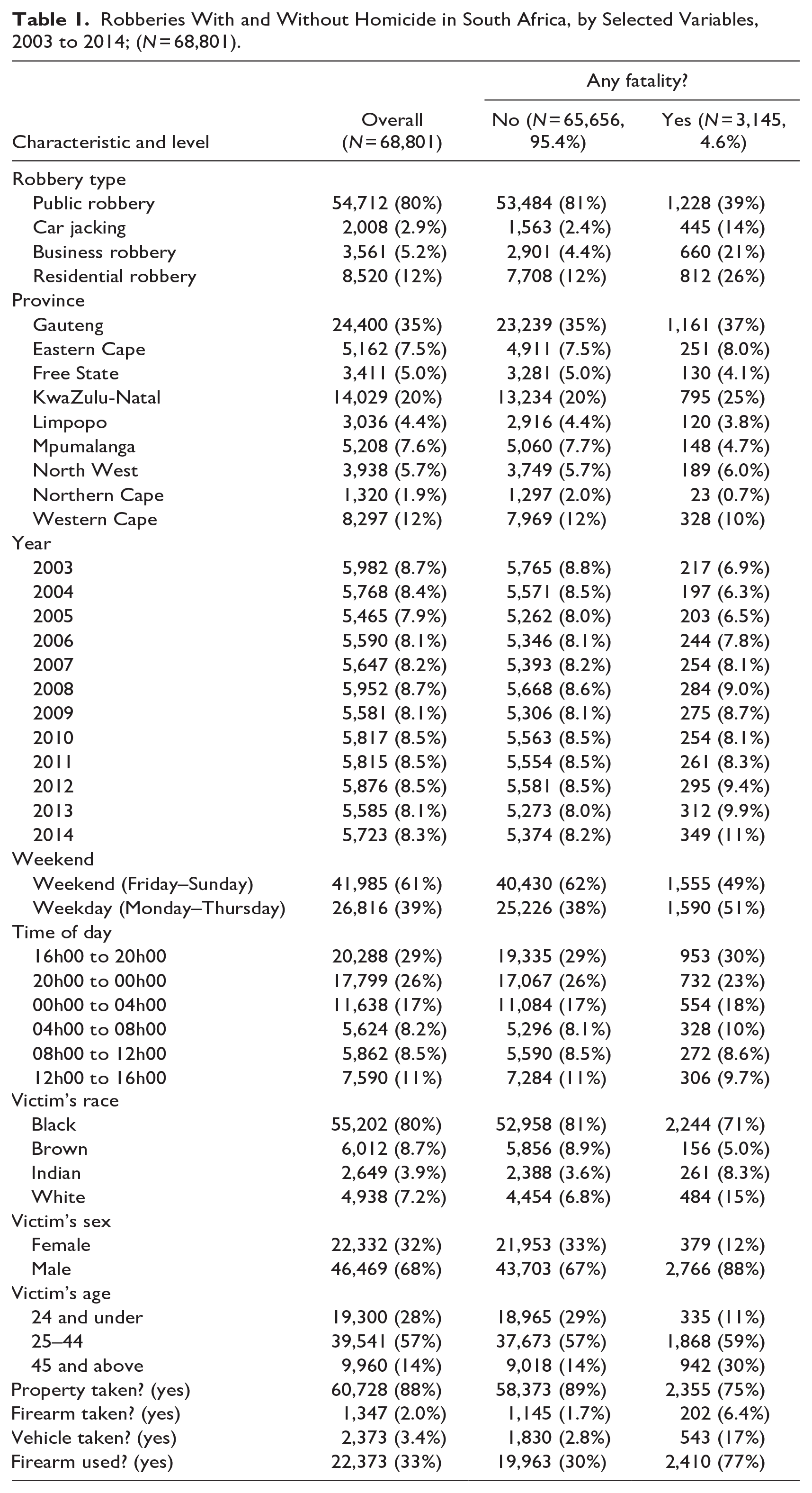
The highest number of homicides were recorded during public robberies (39%). The Gauteng province accounted for 35% of all robberies that involved the use of actual force, and also recorded the highest proportion of robbery-homicides (37%). For the temporal variables, the proportion of homicides was highest in 2014 (11%), almost equivalent across the weekend (49%) and weekdays (51%) and highest between 16h00 and 20h00 in the evening (30%). Black victims (71%) and males (88%) were more frequently killed during robberies. Victims in the age range 25 to 44 accounted for 59% of all robbery-homicides. Property was stolen in 89% of non-fatal robberies and in 75% of robbery-homicides. Vehicles were stolen in 2.8% of non-fatal robberies and in 17% of robbery-homicides. Firearms were stolen from the victim in 1.7% of non-fatal robberies and 6.4% of robbery-homicides respectively. Firearms were used by perpetrators in 30% of non-fatal attacks and 77% of homicides during the robberies recorded.
Table 2 presents our multivariate model. The odds for victims being killed were highest during business (OR 4.24; 95% CI [3.77, 4.80]) and house robberies (OR 3.70; 95% CI [3.31, 4.14]) respectively. The likelihood of robbery-homicide was provincially highest in Limpopo (OR 1.40; 95% CI [1.13, 1.72]) and lowest in Mpumalanga (OR 0.70; 95% CI [0.58; 0.84]). Victims were 13% more likely to be killed during robberies that occurred during the week (OR 1.13; 95% CI [1.04, 1.22]). The odds for robbery-homicides were almost 50% higher (OR 1.47; 95% CI [1.27, 1.69]) between 04h00 and 08h00 in the morning than between 16h00 and 20h00 in the evening. White victims had 41% higher (OR 1.41; 95% CI [1.25, 1.59]) odds of being killed during the reported robberies than black victims. Males were 3.3 times more likely than females to die at the hands of perpetrators of robberies (OR 3.33; 95% CI [2.96, 3.76]). Victims aged 45 and above were three times more likely to die during robberies than those younger than 25 years of age (OR 3.18; 95% CI [2.78, 3.66]). Successfully taking both property (OR 1.18; 95% CI [1.05, 1.33]) and vehicles (OR 4.09; 95% CI [3.15, 5.27]) from the victim was associated with increased odds of homicide. Both the presence of a perpetrator’s firearm (OR 3.64; 95% CI [3.31, 4.02]) and the presence (and taking) of a victim’s firearm (OR 2.41; 95% CI [2.01, 2.88]) significantly increased the odds of victim homicide.
Results of Logistic Regression Analysis Predicting Homicide During Robberies in South Africa, 2003 to 2014; (N = 68,801).
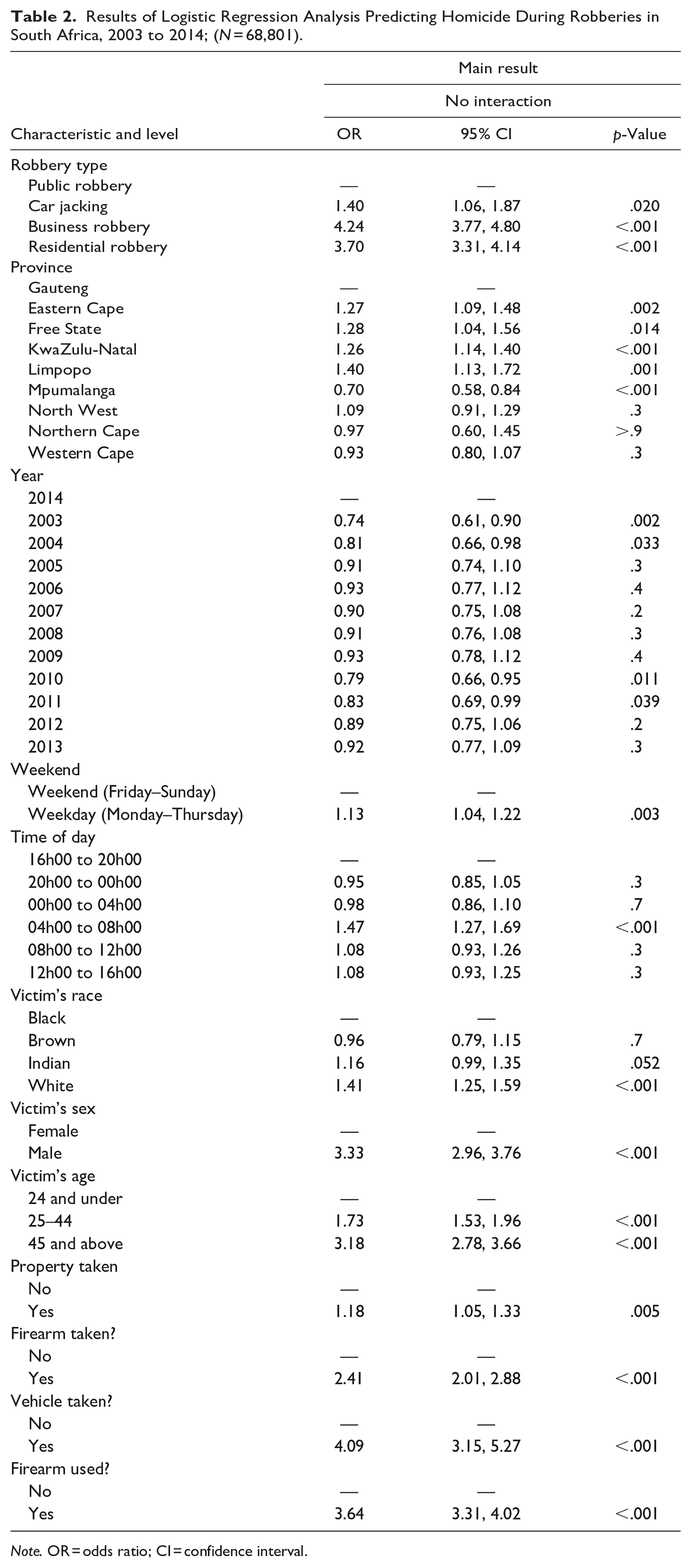
Note. OR = odds ratio; CI = confidence interval.
Supplementary Analysis
We found no significant effects for either of our interaction terms (sex × victim’s firearm present and perpetrator’s firearm use × victim’s firearm present) on the odds of victim homicide in the overall multivariate model (Table 3).
Supplementary Analysis: Results of Logistic Regression Analysis Predicting Homicide During Robberies in South Africa—With Interaction Terms, 2003 to 2014; (N = 68,801).
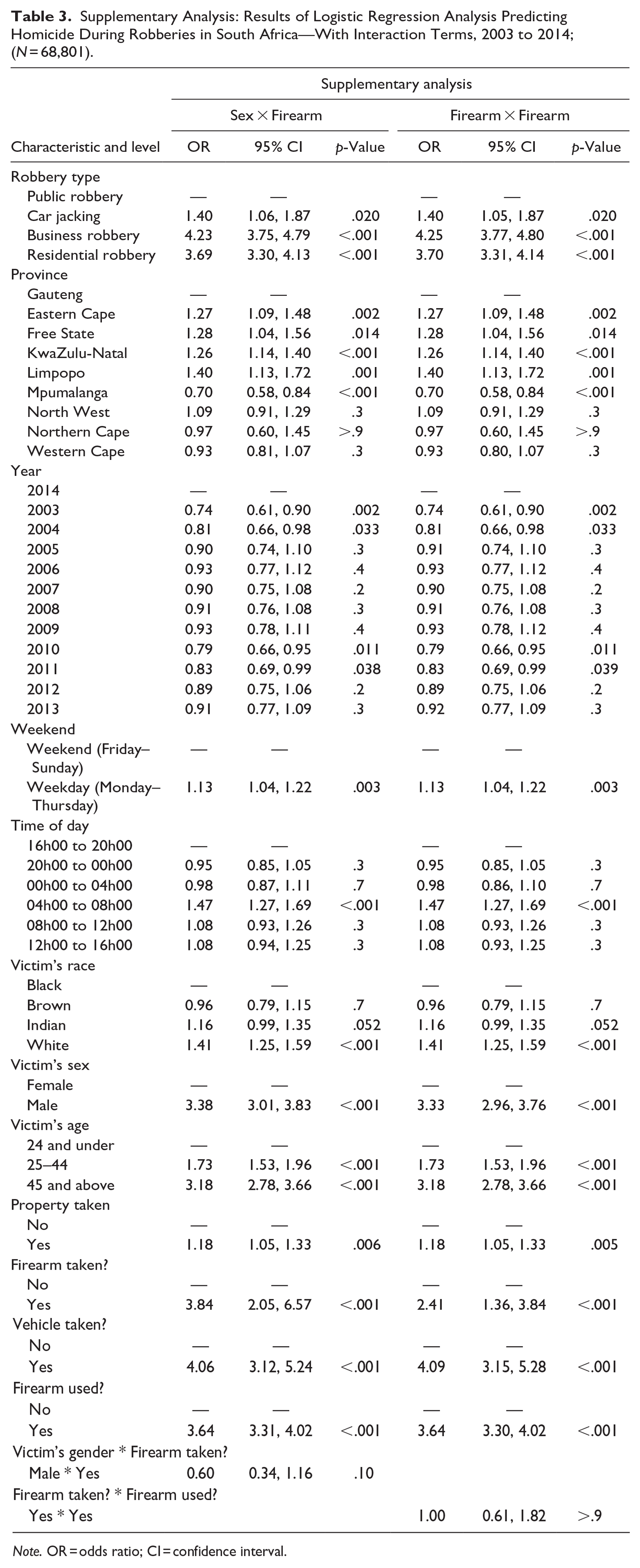
Note. OR = odds ratio; CI = confidence interval.
Discussion
Despite significantly higher rates of both robbery and homicide, the results of this first multi-year study of robbery-homicide in South Africa were largely consistent with the findings of similar studies (Altheimer et al., 2019; Cook, 1987; Felson & Messner, 1996; Felson & Pare, 2010; Lindegaard et al., 2015, 2018; Luckenbill, 1980, 1982; Pierce & Kuhns, 2012; Tillyer & Tillyer, 2014; Zimring & Zuehl, 1986) in HICs. Robbery-related homicide is comparably as rare in South Africa as it is elsewhere (UNODC, 2019). With 3,145 robbery-homicide events reported between 2003 and 2014, this sub-set of fatal violence represented at least 1.8% of all murder cases (own calculations based on data released by the SAPS) in the country for that period. 5
The odds for victims being killed were highest during business and house robberies respectively, which echoes the findings of studies in high-income countries (Mouzos, 2003) but stands in contrast with the few previous studies conducted in South Africa and low-income communities which found that the risks for robbery-homicide were higher for public robberies (CSVR, 2010; Pierce & Kuhns, 2012). Our findings therefore align with research indicating that perpetrators tend to target victims least likely to resist when committing acts of public robbery in an attempt to limit any counter resistance from both victims and bystanders (Copes et al., 2012). Limiting victim or bystander resistance decreases potential escalations and this in turn translates into fewer lethal outcomes. In contrast, valuables such as high-worth property in businesses and houses and the probable presence of close family members together likely raise the stakes in any conflict within these settings. Compounding this escalation in risk is the frequent use (77%) of firearms by perpetrators during robberies involving homicide. Thus, in combination, high-value items, affective investments in protecting kin and access to lethal means of coercive control and resistance may account for this increased risk for death (Felson & Hullenaar, 2021; Zinn, 2008) in businesses and residences.
The odds for robbery-homicide by province were highest in Limpopo but lowest in Mpumalanga, which are both amongst the most rural and poorest of the country’s provinces. This may imply that poverty alone cannot account for these provincial differences, and so a more granular focus on provincial-level data is required to better understand this finding.
While findings from an earlier study found that co-occurring forms of violence were generally more likely to be associated with robberies over the weekend (Bowman, Kramer, et al., 2018), victims in our study were 13% more likely to be killed during robberies that occurred during the week. Furthermore, according to both police data and mortuary-based surveillance systems, homicide is more frequently perpetrated over weekends in South Africa (Matzopoulos et al., 2013). Although the effect of weekday is weak, robbery-homicide perhaps represents somewhat of an anomaly to the preponderance of homicides over weekends in South Africa and beyond, which are conventionally explained due to higher levels of exposure to alcohol on these days (Barron, Bradshaw, et al., 2020). While alcohol must still undoubtedly play a role in shaping susceptibility to robbery-homicides over weekends, further research is required to better understand how and if the effect of this risk factor is attenuated during weekday periods.
Likewise, the odds for robbery-homicides were almost 50% higher between 04h00 and 08h00 in the morning than between 16h00 and 20h00 in the evening. This differs from the homicide trends in the country more generally, which occur most frequently between late night and early morning periods during which alcohol is frequently consumed (Matzopoulos, 2005).
While the fact that males were 3.3 times more likely than females to die at the hands of perpetrators of robberies, and that increased age was associated with a higher risk for death during robbery, converge with the demographic features of risk for robbery-homicide throughout the world (Mouzos, 2003; Rennison & Melde, 2014), the significantly increased risk of fatal outcomes for white South Africans is a particularly unusual finding locally. In the context of South Africa’s deeply divided and unequal socio-economic conditions that remain recalcitrantly racialised, it is black South Africans that have been found to be most at risk for almost all forms of fatal and non-fatal violence. Indeed, black women are most vulnerable to violence during robberies more generally (Bowman, Kramer, et al., 2018) and black South Africans are 2.7 times more likely to be victims of homicide than white people in the urban center of Johannesburg (Kramer & Ratele, 2012). Despite the upward mobility of many black South African citizens in the post-apartheid context, many previously disadvantaged groups continue to be educationally and economically marginalized resulting in the continued trend of racial inequalities in the country (Moses et al., 2017). This trend in turn results in poverty being concentrated amongst black populations and a large portion of South African wealth being owned by its white citizens. Males in this latter group are also disproportionately represented as firearm owners (Cock, 2005). Although South Africa’s Central Firearms Registry does not categorize firearm applications by race, even estimates by South Africa’s gun lobby that potentially exaggerate black firearm ownership, concur that white South Africans still own a disproportionate share of registered firearms (Roy, 2021). Moreover, more than 80% of firearm owners are men and almost two thirds are older than 50 years (Taylor, 2019). In combination, these data lend credence to the perception that it is older white men that are still more likely to own guns in South Africa. Thus, white men may be perceived as especially potentially threatening to the successful execution of a robbery and thus escalate the risk for homicide in already highly volatile situations. In the US this raced perception of escalated risk has been used to explain the disproportionate use of lethal force against black males in a range of violent contexts (Felson & Painter-Davis, 2012). The finding that older white men are more likely to be killed during robberies also echoes the international finding that firearms are the most common weapon used in homicides of older male adults in their homes, and that this risk is linked to older adults commonly owning firearms for self-defence, and in turn, situational access to firearms (Shawon et al., 2021).
Our results indicate that firearms are more frequently stolen in and associated with robbery cases where the victim is killed. These cases thus potentially represent important sites through which legal firearms are absorbed into the illegal pool of weapons related to violent crime in South Africa more generally (Tlou et al., 2021), and should thus be prioritized for more extensive investigation. The study also contributes to the international evidence that both the use of a firearm by the perpetrator and a victim’s firearm being present independently increase the risk of homicide during robberies (Altbeker et al., 2000; Hemenway & Solnick, 2015). In our attempt to advance an understanding of the situational mechanisms by which firearms elevate risk for death, we hypothesized that the use of a firearm by the perpetrator in the context of robbery during which a firearm was available to the victim would (by the logic of adversary effects) escalate risk for death beyond the respective independent risks under each condition. Similarly, we tested the effect of sex on risk for robbery-homicide when a victim’s firearm was present during a robbery. Both interactions did not prove statistically significant, and we thus need to approach these findings tentatively. Given that our data did not specifically indicate whether a victim was armed, we were compelled to use data on whether the victim’s gun was reported stolen as a proxy for this condition. This of course misses all the instances where a victim’s gun was perhaps present, but not stolen. Thus, while it seems that a victim’s gun being stolen might not increase the likelihood of a fatality, the victim’s gun being reported stolen could simply represent a poor proxy for the victim’s gun being present during the course of the robbery. This null finding thus perhaps points to the significant limitations on the crime data available for analysis in South Africa.
Limitations and Recommendations
While our study represents the first attempt to examine the contextual features of robbery-homicide from within the broader and now well-documented epidemiology of homicide in South Africa, it is subject to several limitations. Firstly, robbery is notoriously under-reported. According to South Africa’s most recent Victim of Crime Survey, 46% of home robberies experienced by households were not reported to the police (Statistics South Africa, 2020). However, our analysis focuses on those forms of robbery in which actual force was used, which are associated with increased rates of robbery reporting (Estienne & Morabito, 2016).
Another potential reporting limitation relates to the missing perpetrator information in our dataset. The significantly large numbers of cases in which key perpetrator-related data was missing restricted the scope and explanatory power of our model. These missing data constrained several important analyses including the effect of perpetrator group size on robbery-homicide risk. This is significant because previous studies have reported contradictory findings in relation to the involvement of lone versus multiple perpetrators (see Apel et al., 2013; Felson & Messner, 1996; Nielsen et al., 2005; Tillyer et al., 2011; Zimring & Zuehl, 1986). In addition, some time has lapsed since 2014, the last year of coverage analyzed. However, these robbery data represent the most recently available at the incident level in South Africa, and our 12-year analysis represents the most granular and extensive examination of robbery-homicide to date.
Finally, and perhaps most significantly, the lack of direct data on whether a victim presented their firearm during the robbery compelled us to use whether a firearm was reported stolen as a proxy to test our hypothesis that the involvement of a (male) victim’s firearm during robbery would escalate the risk for a fatal outcome by the theory of adversary effects. While both our findings and international evidence (see Altbeker et al., 2000; Hemenway & Solnick, 2015) demonstrate that the presence of firearms in both the victim and perpetrator categories independently increase the odds of fatality in robberies, the interaction effect of these two conditions on robbery-homicide risk in South Africa was not evident in our study. Given the implications of such potential interactions for informing policies regulating gun ownership and gun laws more broadly, this inconclusive finding points to the importance of prioritizing more detailed data collection by the police and other government agencies for stronger context-specific, evidence-based research aimed at preventing homicide. This limitation is but one example of the significant challenges encountered in producing, sharing, and curating various data sources that could be used to better explain the different mechanisms that shape the various forms that violence takes and the severity of its outcomes in South Africa and other similar country contexts. Such formidable challenges thus point to the importance of the timely collection of good, contextually-rich information on violence that should be prioritized by government to advance our understandings and prevention of homicide in South Africa.
Beyond the need to collect better routine crime data for evidence-based gun control and homicide prevention, the results of our study also point to the importance of using other methodological approaches to better understand the dynamic, interactional processes that shape robbery-homicide. Seminal ethnographic studies of robberies in the United States (Katz, 1988; Wright & Decker, 1997 ) have demonstrated that criminal encounters represent the complex convergence of cultural codes and situational factors in driving and moderating violent action. Interview-based studies with perpetrators of robbery in Nigeria (Nwalozie, 2012), Brazil (Mauá & Baltieri, 2012), and South Africa (Lindegaard, 2009; Zinn, 2008, 2017) likewise show promise for elucidating the social and situational pathways that shape robbery outcomes. Advancing the coverage and scope of these approaches should therefore be prioritized to complement an composite understanding of robbery-violence in low-and-middle income countries. Moreover, the dynamic situational determinants of robbery outcomes are increasingly being caught on camera across the globe. These video data represent hitherto unprecedented empirical opportunities to study robberies as they unfold in real-time (Bowman, Whitehead, et al., 2018). Such studies have already proved valuable for understanding how the types, timing, and nature of interactions between perpetrators and victims shape outcomes during robberies in the Netherlands (Liebst et al., 2021). In combination, national profiles of robbery-homicide together with ethnographic and direct observational methods will provide the type of enhanced empirical picture required to significantly advance the prevention of homicide during robbery events across their multiple levels in an extended range of countries including South Africa.
Conclusion
Our study provides the first multi-year profile of robbery-homicide in a middle-income country, and thus a more robust understanding of the contexts that shape this form of fatal violence. While many of the results converge with those of studies in predominantly HICs, several key findings clearly specify homicides related to robberies as distinct situational contexts for violence in South Africa. The study contributes to the limited but now growing number of analyses focused on producing a more granular picture of the situational contexts that frame homicide outcomes for more context-specific prevention programming. Our results suggest that escalations in violence during robbery events in South Africa are strongly influenced by perceived access to coercive resources such as firearms, and proximity to highly-valued items and people that raise the stakes for conflict. Such conflict must of course be understood against the historical inequities that continue to shape violence in the present. South Africa is a country where the gap between access to valuables and property and the personal and collective resources required to multiply them remains a key challenge. To be enduringly effective, violence prevention programs will thus need to include research and intervention strategies that are more sensitive to the socio-economic and situational contexts that contour and perpetuate fatal violence across this still deeply divided and unequal country of the Global South.
Footnotes
Acknowledgements
Thanks are also due to Colonel P Klopper and Colonel JC van Zyl for facilitating access to the CAS data used in our analysis.
Declaration of Conflicting Interests
Richard Matzopoulos serves on the board of non-governmental organisation, Gun Free South Africa, but receives no remuneration for this role. The other authors declared no potential conflicts of interest with respect to the research, authorship, and/or publication of this article.
Funding
The author(s) disclosed receipt of the following financial support for the research, authorship, and/or publication of this article: We are grateful for the funding received from Fulbright Program, Oppenheimer Memorial Trust, Jacobs Foundation and International Union of Psychological Science toward this study.
