




Abstract
Media research on intimate partner homicide (IPH) has primarily focused on male perpetrators and female victims. This study analyzed 203 English-language news articles of IPH involving male victims and female perpetrators for the year 2019. Using thematic analysis, we identified two main themes: doubting the victim (who is the victim?) and victim recognition (“he didn’t deserve this”). The findings suggest that male victims of female perpetrated IPH tend to be blamed for their victimization and represented as non-ideal and illegitimate victims in the news media.
Keywords
Intimate partner homicide (IPH) is a serious public health and criminal issue in many countries worldwide. With the significance of media in covering and disseminating news and information, a recent development in IPH research has been on victims’ portrayal in the news media (Easteal et al., 2019; Fairbairn & Dawson, 2013; Gillespie et al., 2013). Literature indicates that media portrayals of crime have significant impacts on how the public and policy-makers perceive the origin of the crime and who is to blame, also influencing potential calls to action against the crime, its perpetrators, and support for victims (Beale, 2006; Springer & Harwood, 2015). While several media mechanisms, such as victim-blaming and perpetrator-excusing tactics, are prevalent in male perpetrated IPH news articles, few studies explored media mechanisms of female perpetrated IPH with male victims (Richards et al., 2011; Taylor, 2009). It could potentially be attributed to the prevalent focus of IPH research on male perpetrated violence against women (Campbell, 1992; Stöckl et al., 2013). At the same time, studies in this area identified a range of complex motivations relating to female perpetrated IPH, including self-defense, power and control, anger, history of violence, and retaliation (Jurik & Winn, 1990; Smith et al., 1998). Also, some recent scholarship has drawn attention to male victims’ deaths by female perpetrators focusing on men’s experiences of abuse and helpseeking behavior (Hope et al., 2021; Lysova & Salas, 2020). This study examines the nature of news coverage of male victims of female perpetrated IPH, that is, what characterizations of the victims the news media transmits to the public. Our study highlights the importance of the news media in shaping public attitudes, beliefs, and policy decisions by identifying these representations.
Perspectives on Female Perpetrated IPH of Men
IPH is homicide perpetrated by a current or former intimate partner and accounts for 13.5% of homicides worldwide. Global statistics show intimate partners commit 38.6% of female homicides and 6.3% of male homicides (Stöckl et al., 2013). Gender differences are the most noticeable aspects relating to the prevalence of IPH, where females are statistically more likely to be victims, and males are more likely to be the perpetrators (Beattie et al., 2018). These statistics necessitate continuing efforts to prioritize female victims in IPH research and prevention (Campbell et al., 2016). At the same time, about one in five individuals killed by an intimate partner are men (Burczycka, 2019; Velopulos et al., 2019). For example, there were 196 male victims of IPH in Canada between 2008 and 2018 killed primarily by their female intimate partners (Burczycka, 2019).
Several theoretical perspectives help explain female perpetrated IPH of men. The first perspective focuses on women’s lethal actions that were self-defensive, following significant victimization at the hands of their male partners (Campbell, 1992; Walker, 1989). For example, Suonpää and Savolainen (2019) found in a sample of 1,494 IPHs that violent precipitation motivated female killings of their male intimate partners far more than male killings of their female partners. According to Statistics Canada, male victims had a higher rate of first initiating the violence that led to their deaths than female victims (29% vs. 6%) (Government of Canada, 2015). Although some studies of a non-lethal context suggested that female partners may initiate a significant amount of intimate partner violence (IPV) (Cook, 2009; Douglas & Hines, 2011; Muftić et al., 2007), overall, data consistently indicate that female perpetrators experience high rates of physical abuse by a male victim before IPH (Caman et al., 2016; Campbell et al., 2016; Weizmann-Henelius et al., 2012).
Second, a related approach—a situational perspective—focuses on an entire violent event as a set of variables centered on the role of both partners in the commission of a crime (Suonpää & Savolainen, 2019; Swatt & He, 2006; Wilkinson & Hamerschlag, 2005). Given that several studies found that couples experience IPV bidirectionally, where both partners in the relationship are abusive (Langhinrichsen-Rohling et al., 2012; Straus, 2008; Straus & Michel-Smith, 2014), it is vital to understand the dynamics of violence occurring within those relationships. Research indicates that violence in bidirectionally violent relationships may be primarily due to a female partner responding to victimization and that female partners are more likely to be seriously harmed in the incident (Fernández-Montalvo et al., 2020; Holmes et al., 2019). However, studies also indicate that violence is motivated by several reasons beyond responding to victim violence. For example, some studies indicate that the male victim’s intoxication, the female perpetrator’s prior experiences of abuse, intimate partner quarrels due to intoxication, and the male victim’s attempted self-defense contributed to female perpetrated IPH (Caman et al., 2016; Dichter et al., 2018; Weizmann-Henelius et al., 2012).
The third perspective focuses on controlling and violent women in intimate relationships whose violence may result in an IPH (Lysova & Salas, 2020; Nicholls & Dutton, 2001). There has been a growing body of research on female aggression and women’s use of violence against their male partners (Dutton et al., 2005; Lysova, 2018; Nicholls et al., 2005). Some of the salient risk factors for female perpetrated IPV against male partners have been prior victimization in the family of origin, mental health histories, and psychopathology, including personality disorders and attachment styles (Dutton et al., 2005). Research also identified a type of female perpetrators (known as “generally violent” women) who used violence in various situations, including intimate relationships, mostly for retribution, gaining compliance or control, and who demonstrated many traumatic symptoms (e.g., memory problems, a desire to hurt themselves) (Babcock et al., 2003). Studies of intimate terrorism (when one partner unilaterally controls or also physically abuses the other in the intimate relationship) found that men become victims of intimate terrorism at far higher rates than thought before (Hines & Douglas, 2019; Jasinski et al., 2014; Lysova et al., 2019).
Finally, the exposure reduction hypothesis (Dugan et al., 2003) argues that available domestic violence resources (e.g., protective orders and shelters) alleviate intimate partner conflict and prevent IPH. Indeed, women’s increased access to victim services has been associated with a reduction in male victim IPH since the 1970s, primarily in the US and Canada (Dugan et al., 2003; Reckdenwald & Parker, 2012). Research on male victims’ help-seeking in Western nations shows limited options for male victims of IPV to get help and may explain escalation of some female-perpetrated violence to IPH (Huntley et al., 2019; Lysova & Dim, 2020; Tsui et al., 2010). However, this research is limited (Hope et al., 2021; Lysova & Salas, 2020).
Male Victims of Female Perpetrated IPH
Scholarly research and practical interventions should more fully consider male victims of female perpetrated IPH for two reasons. First, emergent survey-based research suggests men are highly vulnerable to various types of intimate partner violence (IPV), including severe psychological and physical violence (Brooks et al., 2020; Hines & Douglas, 2019; Lysova et al., 2019). For example, the Canadian General Social Survey found that about 64,000 men experienced chronic and severe physical and psychological violence with a high probability of injuries and adverse emotional effects in their ongoing relationship between 2004 and 2014 (Lysova & Dim, 2020). Moreover, some severe female perpetrated IPV cases against men can potentially escalate to the IPH of male partners (Lysova & Salas, 2020). At the same time, the police-reported and shelter-based data consistently demonstrate that female partners are more likely to be severely injured and killed by a male partner than the inverse, which necessitates continuing efforts to reduce female victimization (Beattie et al., 2018; Dobash & Dobash, 2017).
Second, considering male victims of IPH may potentially help develop more effective prevention of future deaths related to IPH for both men and women. Studies showed that when abused women receive more opportunities to exit violent relationships (e.g., find refuge in a shelter for abused women), there is a reduction in the IPH of men in the US and Canada (Dawson et al., 2009; Dugan et al., 1999). These studies suggest that if abused men had similar opportunities to receive timely help (e.g., psychological, legal, and/or financial) in abusive relationships, there could be a potential reduction in female perpetrated and male perpetrated IPH. However, recent studies found many barriers that men experience when seeking help to address IPV (Hope et al., 2021; Lysova, Hanson, Dixon, et al., 2020; Lysova, Hanson, Hines, et al., 2020), constraining them to live with sustained abuse (Dixon et al., 2020). Identifying how male victims are portrayed may give insight into why these barriers exist for those seeking support.
IPH and the News Media
The media plays an influential role in how criminal events are perceived and interpreted. A central part of the news media’s influence is the guidance it provides to individuals to attribute responsibility for crimes to specific parties, such as whether to blame the individuals or societal factors (Springer & Harwood, 2015). The news media’s impact is especially potent in areas where individuals have limited knowledge about the subject, such as domestic violence, as its occurrence may not be otherwise well known in the community (Brossoie et al., 2012). The news media also have strong political influence and may aid policymakers in determining which issues should be on the political agenda (Slakoff et al., 2020; Yanovitzky, 2002). Social pressure encouraged by a news media agenda can have far-reaching effects on criminal justice policy, such as increasing punitiveness for crime or directing political funding toward specific issues (Beale, 2006).
The literature on the representation of IPH in the news media has mainly focused on male perpetrated homicides and identified some prominent frames: the episodic and thematic frames (Easteal et al., 2019; Gillespie et al., 2013; Richards et al., 2011; Taylor, 2009). A media frame is a “central organizing idea for making sense of relevant events and suggesting what is at issue” (Gamson, 1989, p. 157). Crime-related news media stories tend to either centralize crime as a societal issue with empirical data or isolate the issue with personal and emotional narratives (Iyengar, 2005). Content, language, and the presentation of an issue influence the interpretation of a story and contribute to its framing (Carlyle et al., 2014).
The most prevalent representation of male perpetrated IPH of their female partners in the news media is through episodic and sensationalized framing of IPH (Lee & Wong, 2020). This framing glosses over the “why” of the story, even though it is often the most complex and vital piece of contextual information and describes the homicide as occurring “out of the blue” (Koch, 1990). However, statistics suggest that 70% of IPH occurs after an accumulation of violence and not a typical “crime of passion” (Dauvergne & Li, 2006). Victim-blaming and abuser-sympathizing discourses are specific episodic framing methods found across several IPH studies that looked at male perpetrated IPH (Bullock & Cubert, 2002; Gillespie et al., 2013; Richards et al., 2011). These approaches shift agency away from the perpetrator and blame the victims by focusing on their behavior before and during the incident. These discourses may lead to less help-seeking from victims, increasing the social tolerance for IPV and IPH (Gracia, 2004).
Victim-blaming occurs directly or indirectly, where contextual factors of the homicide are either highlighted or suppressed, framing the article in a way that attributes responsibility to the female victims. IPH typically occurs as a long accumulation of previous IPV, and framing the incident as the female victim’s fault ignores the incident’s complexity (Johnson & Dawson, 2011). Examples of victim-blaming tactics include focusing on the female victim’s substance use or infidelity (Gillespie et al., 2013; Taylor, 2009). An especially poignant stereotype driving this tactic is that certain types of victims are non-ideal and illegitimate, specifically those not portrayed as vulnerable, passive, and free of prior wrongdoing (Bosma et al., 2018). Conversely, examples of perpetrator-excusing narratives include the male perpetrator’s loss of control (due to mental health or substance use), the killing as self-defense, and the perpetrator’s prior victimization (Fairbairn & Dawson, 2013).
The literature that examines methods of male victim-blaming relating to female perpetrated IPH is limited. For example, a study of 100 IPH related newspaper articles found that males, whether victims or perpetrators, were more likely to be blamed than their female counterparts in an IPH (Wozniak & McCloskey, 2010). While broader in scope, studies on IPV representation indicate the presence of stereotyping against men. Scarduzio et al. (2017) found that male perpetrators are more likely to be described as physically aggressive, unable to control their anger, and more powerful and controlling than their female counterparts. Chaudhuri (2012) states that male-gender norms inevitably harm male victims, as their positions of power contradict any victimhood. While these norms have been identified, there is a lack of literature identifying their presence in articles discussing IPH.
Finally, thematic framing describes the homicide in a broader context and uses empirical data to contextualize the incident (Gross, 2008). For example, discussion of IPH within the article includes details about any prior history of violence in the relationship, substance abuse issues, lack of mental services, and/or a review of statistics on IPH. Thematic framing appears to be minimally used, if at all, while episodic framing is dominant in IPH reports (Taylor & Sorenson, 2002). Slakoff et al. (2020) suggest that the news media acts to educate the public on partner violence, thus playing a significant role in how others perceive the phenomenon. Furthermore, the news media plays a central role in the allocation of social and political pressure relating to funding and services, emphasizing the importance of proper framing of partner violence.
Current Study
Methods
Research on news media portrayals of IPH has primarily focused on male perpetrators—female victims’ dyadic relationships. This study aims to change the traditional analysis by examining male victims of female perpetrated IPH in the news media. The analysis uses a broad primary research question: How do online English-language news media portray male victims of female perpetrated IPH? Specifically, we examine methods the news articles utilize to represent male victims of female perpetrated IPH by situating our study in the context of the existing literature. Since most of the existing literature has focused on female victims of male perpetrated IPH, we juxtapose some of our findings with the representation of female victims of IPH.
Sample Selection
Using LexisNexis as the news media data source, articles were collected from any English-language news coverage between January 1st, 2019, and December 31st, 2019. Original data was collected in 2020 and aimed to capture data from the most recent complete year. The choice to include any English-language global news source is due to the limited articles published on male victims of IPH. Even globally, very few articles were able to be collected. Also, any individual who is fluent in English and has the internet may read these articles, thus having a reasonably wide-reaching audience base, even in another country. The subjects “crime, law enforcement, and corrections” and “law and legal system” were filtered to focus the sample on criminally depicted articles.
News media sources included in this study are any written online articles that report events. Initial reporting, court reports, and conviction reports were included in the sample, while editorials, opinion pieces, and blogs were excluded to ensure the sample only included articles claiming to follow ethical journalism principles. As outlined by the National Union of Journalists (2011), ethical journalism requires journalists to separate fact from opinion, report honestly, and not distort or suppress information. Based on the adherence to the ethical guidelines, it is expected that the news media reports would reflect the events as accurately as possible.
Tabloid formatted articles (that do not necessarily contain “tabloid” content) were also included in the sample as they try to adhere to ethical standards (Er & Xiaoming, 2002) and hold a significant readership among the public (Johansson, 2007). For example, 88% of the community newspaper editions in Canada in 2019 were tabloid format (News Media Canada Snapshot, 2019). These tabloid format news media fully represent the communities they serve and provide local information, which explains their popularity. Moreover, individuals tend to reproduce the language and ideologies of news stories, emphasizing the importance of including diverse news styles in the analysis (Philo et al., 1994). The inclusion of the tabloid format news media has also allowed us to expand the sample of articles that discussed male IPH victimization.
String-phrases were constructed to broadly capture any articles that discussed IPV and IPH, which included over 20 combinations of key action words such as violence, violent, stabbed, shot, abuse(d), bludgeoned, beat, killed, kill, murder, and homicide with key character words such as wife, husband, ex-wife, ex-husband, girlfriend, boyfriend, ex-girlfriend, ex-boyfriend, partner, woman, man, and lover. The string phrases were further expanded by using Boolean search tools that allowed the researchers to indicate whether the words are within the same sentence or within the same paragraph, which allowed for more relevant results. This process resulted in the collection of 620 articles. Data collection saturation was determined when the articles contained only one reference to a keyword in a string-phrase, indicating that further articles were only broadly related to the search terms and irrelevant. Only the articles that discussed cisgender, heterosexual dyads with male victims and female perpetrators of IPH were selected, resulting in 411 excluded articles. Many of the excluded articles were due to their focus on female victimization (n = 302), were irrelevant because they included keywords from the search but did not represent an IPH of a male victim (n = 64), or overall lacked any descriptive data about the incident, typically being articles about court dates, legal proceedings, or general crime reports (n = 45).
Six entertainment-related pieces that contained “celebrities” were excluded from the sample as these articles tended to be highly sensationalized “tabloid content.” While we cannot determine whether the stories were highly sensational due to the crime or the celebrity, it was determined that entertainment news is unique enough to warrant its own investigation beyond the limits of our sample. Literature also indicates that celebrity news may act as a unique subset of media discourse, thus reaffirming the need for a separate analysis (Dubied & Hanitzsch, 2014). After the exclusion criteria were applied, the sample resulted in 203 news media articles. As this study utilized secondary data analysis in the public domain, ethical approval for analysis and using the quotes was not required (Simon Fraser University, 2019). However, since individuals involved in the articles may still experience revictimization when exposed to a discussion of the incident, all names included in quotes were anonymized.
Description of Sample
The data collection resulted in 203 news media articles representing 108 cases of female perpetrated IPH against a male victim. On average, there are 1.88 articles per case. The sample is not representative of all female perpetrated IPH of male victims in 2019, as many may not have been reported in the news media or available online for analysis. The most prominent regions for articles were the UK (n = 54), India (n = 53), the US (n = 24), and Australia (n = 14). The rest of the 16 countries in the sample had 10 or fewer articles (<5% of the sample each). With an average readership of 3 million+ per day each, the most prominent newspapers in the sample include The Times of India (n = 18), Hindustan Times (n = 14), The Daily Mail (n = 14), and The Sun (n = 7), while 81 other newspapers represent 73.9% of the news media articles.
Three different news media formats are represented in the sample: broadsheet, tabloid, and online. Broadsheet, which has long vertical pages and features news stories, is the most prominent format, with 57.6% of the newspapers, followed by the tabloid, which is smaller and more informal than broadsheets (25.9%), and exclusively online (16.5%) (Rogers, 2020). The news media outlets’ political affiliation was determined by examining each paper’s website and secondary sources that described each affiliation. The most prominent political affiliation among newspapers is conservative (30.6%), followed by liberal and neutral (28.2% each), and 12.9% being unknown. Only one newspaper was identified as being on the far end of a political spectrum (far-right), while the rest of the sources were center-right or center-left.
Data Analysis
This study employed thematic analysis, as outlined by Braun and Clarke (2006). The first phase of coding involved the familiarization with the data, where similar grouping incidents and contextual data generated initial codes. The initial coding scheme was informed by the approaches developed in prior studies (Gillespie et al., 2013; Richards et al., 2011; Taylor, 2009). Some of the previously identified codes (e.g., “victim substance abuse” and “victim infidelity”) were also found in this study. However, our analysis mainly focused on the codes and themes that emerged from the present data. For example, our coding allowed new codes to be identified, such as “failure as a father, provider, or husband.” Primary codes were further subdivided into subcodes through the guidance of previous literature when overlaps were present (Gillespie et al., 2013; Richards et al., 2011; Taylor, 2009). However, when the overlap between codes and literature was not present, narratives within the primary codes were examined and subdivided based on the uniqueness of the narrative.
Overall, victim-doubting and victim recognition were identified, as supported by previous research (Gillespie et al., 2013; Lee & Wong, 2020; Taylor, 2009). These patterns were used as theme headings and are discussed in the results section. The prevalence of each theme was determined by counting how many articles contained any mention of the respective code, and the themes were then organized by combining the codes into relevant groupings. NVivo was used to organize articles and coding.
To ensure the results’ trustworthiness and credibility, our qualitative study was reviewed and confirmed to follow the COREQ checklist (Tong et al., 2007). The analysis was primarily carried out by the first author, while the second author guided the data gathering process and confirmed the themes by reviewing the coding scheme and narrative interpretations. Reflexivity was applied throughout the study, especially in the sampling and final editing process. This process was mainly achieved by reflecting on the authors’ gender and theoretical positions and identifying gaps in the study.
Results
Two main themes for the depictions of male victims of female perpetrated IPH were identified. The themes include doubting the victim (who is the victim?) and victim recognition (“he didn’t deserve this”). The themes are described with supporting quotes below. Some of these quotes reflect the journalists’ language describing IPH in the news articles. However, some include a direct quotation of the perpetrator’s words, which may reflect a journalist’s choice of the specific citations to achieve a certain representation of IPH in an article. Table 1 summarizes the themes and subthemes identified within 203 news articles on male victims of female perpetrated IPH. The most prevalent theme in the news articles is doubting the victim or “who is the victim?” (64%, n = 129), followed by victim recognition or “he didn’t deserve this” (56%, n = 113). It should be noted that some articles included more than one theme.
Summary and Prevalence of the Themes and Subthemes Identified in 203 Articles.
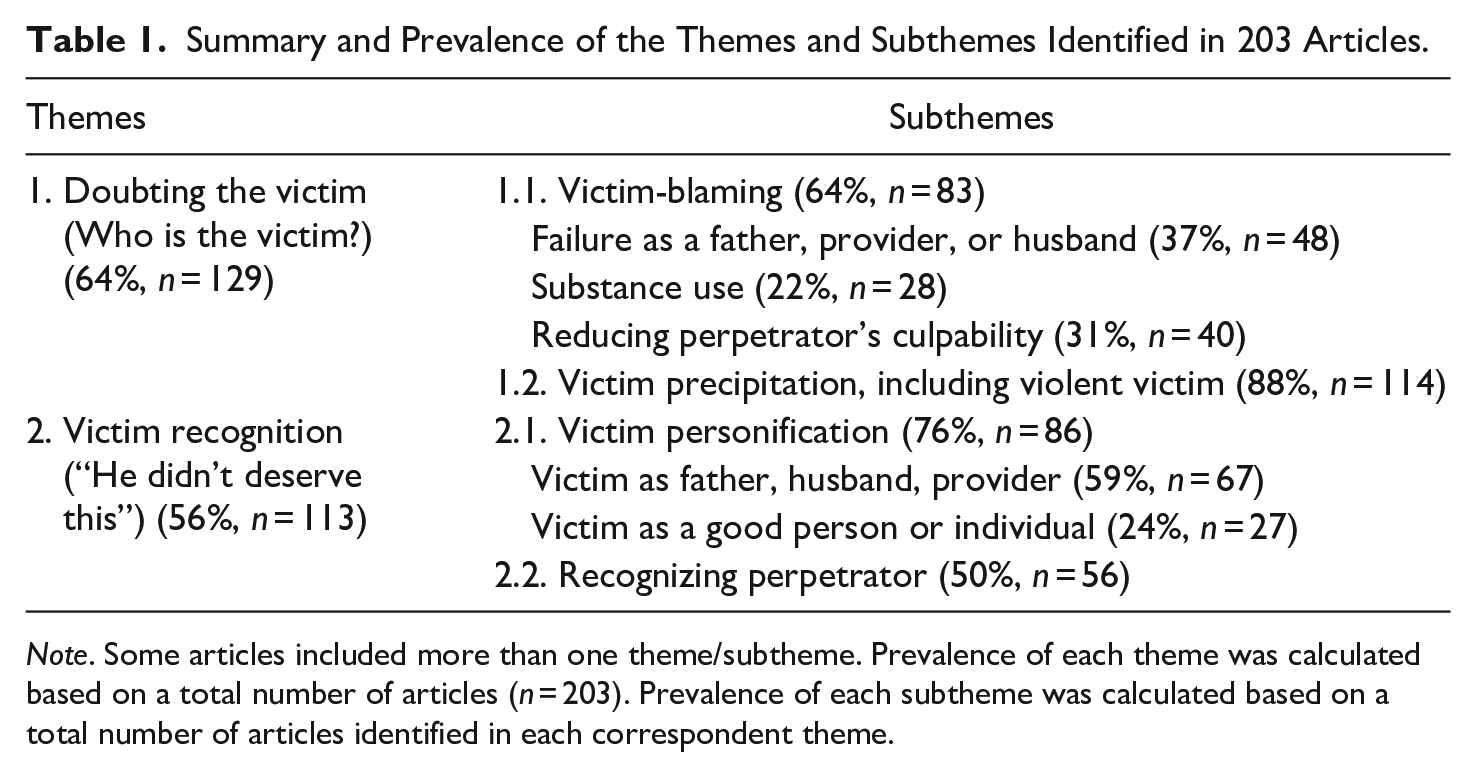
Note. Some articles included more than one theme/subtheme. Prevalence of each theme was calculated based on a total number of articles (n = 203). Prevalence of each subtheme was calculated based on a total number of articles identified in each correspondent theme.
Doubting the Victim or Who is the Victim?
Like previous work on femicide news coverage (Taylor, 2009), we found articles depicting male victims of female perpetrated IPH commonly use victim blaming reporting tactics. This victim-doubting theme was found in about two-thirds of all analyzed articles (64%, n = 129) and represents a well-established tactic of episodic framing. Some articles discredit, undermine, or excuse the incident by indirectly or directly blaming a male victim of IPH (a victim-blaming subtheme). Simultaneously, some news articles reflect a well-documented phenomenon and describe instances of female perpetrated IPH as a response to long-term abuse, where self-defense/retaliation against male abuse is implicated (a victim precipitation subtheme).
Victim-blaming
Victim-blaming is the subtle method used by narratives to attribute responsibility or partial responsibility to the victims for their victimization. About two-thirds of victim-doubting articles used this method (64%, n = 83). Our study identified three subthemes: failure as a father, provider, or husband; substance use, and reducing perpetrator’s culpability. The main methods that were used to attribute indirect or direct blame to the male victims of IPH in these articles are character derogation and sympathetic attitudes for the perpetrator.
Character derogation is the act of attributing negative character traits to the victim or giving the victim an overall negative portrayal (Hafer et al., 2019). Derogation does not directly judge a victim as “bad,” but rather implicitly rates the victim’s position as less favorable than if they did not possess specific characteristics (Dawtry et al., 2018). Specifically, male victims of female perpetrated IPH were described negatively as failing to fulfill a normalized male stereotype of being a good husband/father and/or a reliable provider for the family. About one-third of the victim-doubting articles in our study used this approach (37%, n = 48). Actions that connected a male victim to his homicide were broad, including “trivial” behaviors such as forgetting to buy chicken legs or “substantial” like “abandoning” his family. For example, one article quotes the perpetrator’s defense attorney describing the male victim as lazy and burdening the perpetrator: “She did totally financially support him, and I don’t know when the last time was that he worked. . . He did not work. She paid all of his bills. . .” (Brown, 2019). Another article describes the male victim of IPH as a demanding father and husband who treated his spouse as a “slave” and disregarded his daughter’s safety: “. . .He made her work like a slave at home and at the business. . . The last straw was when her husband dropped their daughter in a dangerous area after an argument” (The Mercury, 2019). The language in some of the news articles implied that the male victim might have done something to the perpetrator that caused violence committed against them: “[He] was killed by [the perpetrator], a former GP herself. . ., after she suspected him of infidelity” (Ferrari, 2019).
Another example of character derogation is by highlighting the victim’s substance use concerning the incident. This was found in 28 victim-doubting articles (22%). While not all mentions of substance use act to derogate the victim (e.g., those that use thematic framing to contextualize substance use), there are some articles where the journalist portrays the victim as a burden on the perpetrator: “[Wife] of the [victim] got her husband murdered as she was fed up with his regular alcohol abuse” (The Pioneer, 2019). A focus on substance use also indirectly blames the victims by associating the substance use with the victim’s death or by relieving the perpetrator of potential responsibility due to his intoxication.
About one-third of victim-doubting articles (31%, n = 40) in our study involve language and contextual information (e.g., a female perpetrator’s mental illness and/or substance use) that absolve the perpetrator of culpability for the murder. In the following quote of the journalist’s words and the perpetrator’s statement, the combination of the male victim’s actions leading to the female perpetrator’s loss of control indirectly implicated the victim: The defendant claimed she lost control after suffering years of bullying and abusive behavior by her husband. He allegedly threw sticks at her and subjected her to years of verbal abuse. . . “It was like I was in a trance. I hit him. I do not know. I did not know what I was doing. . .” (Morely, 2019).
Victim precipitation
A tactic found throughout the articles is the connection of the victim’s actions to their homicide, also known as victim precipitation. About 88% of the victim-doubting articles used this method (n = 114). Victim precipitation positions the victim as the first to act before the criminal incident and that the victim encouraged or provoked the crime to occur, such as starting an argument with the perpetrator (Smith & Bouffard, 2014). This subtheme is unique from general victim-blaming as the narratives draw a direct causal link specifically between the victim’s violent action and the ensuing incident. The language within this subtheme includes phrases like “because he. . .” and “after he. . .” insinuating that the attack occurred because the victim had done something to the perpetrator. In one example, the journalist stated: “A heated argument due to an Indian man refusing a marriage proposal from his girlfriend lead to his brutal death by her and her female relatives” (Gulf News, 2019). Another example of the victim precipitation comes from the police chief who was cited in the article saying: “An argument broke out when the wife asked for money from the husband, and he refused. This led to the killing,” (The Phnom Penh Post, 2019). Using causal phrases in this context tends to create links that are too simplified and out of context.
A more specific type of victim precipitation involves cases when the victim is portrayed as precipitating their deaths by initiating violence between them and the perpetrator. Such cases of violent victims involve contextual information that attributes responsibility for the incident to the male victim of IPH. This subtheme does not differentiate whether the victim’s previous abusive behaviors were substantiated or not by the courts. Instead, it focuses on discussing any form of a victim’s previous abuse. Some of these incidents represent the cases of the female’s violent resistance to a long-term abuse. For example, one journalist describes the female perpetrator as “freeing” themselves from abuse: “[He] was killed by his wife and “best mate” in what has been described as a cold and calculated execution that was designed to end years of emotional abuse” (Bird, 2019). Other articles report the female’s defensive behavior to an immediate threat posed by a male partner: “[He] forced his way into [her] apartment. . . It seemed like he was trying to grab a knife or something.. . .He had his arm up to hit me and I just kind of instinctively (shot him)” (Lalonde, 2019). While a significant amount of space in this piece was given to describing the abuse leading to the homicide, only one paragraph was then dedicated to discussing court evidence indicating that the incident was “forensically unlikely,” putting self-defense and the described context of the killing into question. However, several articles also discuss a victim’s previous abuse beyond long-term or immediate violence, even suggesting bidirectional abuse, “Text messages between [the perpetrator] and [the victim] suggested there had been a history of physical violence towards each other.” (McCarthy, 2019).
The narratives simultaneously represent both thematic and episodic framing methods. First, by giving context to the IPH, stories that discuss previously abusive victims may give a snapshot of a complex situation by contextualizing an elevation of violence resulting in IPH. However, the narratives also represent episodic framing methods by potentially simplifying an incident beyond an escalation of violence by the victim.
Victim Recognition or “He Didn’t Deserve This”
Recognizing the victim primarily involves using humanizing descriptions of male victims and acknowledging them as victims of a serious crime rather than victims of their actions. This theme was present in 113 articles in this study (56%) and includes 2 main subthemes—victim personification and recognizing perpetrator.
Victim personification
This subtheme includes discussing the victim’s family, hobbies, interests, and achievements. About 76% of the victim personification articles focused on the strong qualities of the male victim’s personality (n = 86). The primary method to achieve victim personification was by describing the male victim as a “family man” who was a financial provider, a loyal husband, and a good father/son (59%, n = 67). In one article, a quote from the victim’s child emphasizes the victim’s position as a father: “This is very embarrassing for our family,” [his son] said. “Our father was the best person in the world” (Boone, 2019). In another quote, the journalist emphasizes the victim as both a father and someone who lost a child: “A dad . . . was stabbed in the heart in a fatal wound—just above a tattoo tribute to their dead daughter, a court heard” (Kennedy, 2019).
About one-quarter of victim personification articles portrayed the male victim not only through his familial relations but as a good person more broadly (24%, n = 27). These articles supplemented the minimal description of age, name, and profession with additional information that humanized the victim. For example, one journalist described the life of a man, who was “destined for the military. He was high-achieving, athletic, and had a strong sense of right and wrong. [He] had joined the Army in 2015 and showed such promise that he was quickly promoted. His job and family meant everything to him” (Shorthand, 2019). Articles do not need to write full paragraphs about the victims to achieve personification. In only a few words, quotes read that one victim was a “Celtic’s fan,” and “much-loved joker,” while another was “kind, generous and funny” (Kennedy, 2019; Bosley, 2019). Adding more information to the victims’ description allows the reader to see who the victim was or how others close to him knew him. Although the narratives reflect positively on the victims, the methods used in the articles were primarily episodic in their framing by amplifying specific emotional and gendered aspects of the victims without further contextualization of men as victims.
Recognizing perpetrator
While some articles focused on contextualizing a male victim of IPH as an individual, others mainly discussed a female perpetrator of this crime. About one-half of the victim recognition articles used this approach (50%, n = 56). Some female perpetrators in these articles were portrayed negatively for their role in the murder and labeled “wicked,” “cruel,” or “a nightmare” (Chronicle Live, 2019; Evening Chronicle, 2019). For example, this is how the judge described a female perpetrator of IPH in one of the articles: “The judge passing sentence on her, said their relationship could be “loving and caring” but that she was “abusive and vindictive” towards him when she was drunk, including mocking him over the death of his son on one occasion” (Seddon, 2019). When perpetrators are portrayed as criminal, readers may be more likely to sympathize with the victims by associating the perpetrators as having done something wrong and the victims as having been harmed by this wrongdoing.
Discussion
This study examined the framing methods of news coverage of male victims of female perpetrated IPH in online English-language news media sources. Two main themes emerged from the data: victim-doubting and victim recognition. The most prevalent framing method of male victims of female perpetrated IPH is doubting the victim, which was found in 64% (n = 129) of the 203 news media articles in this study. The second most prominent theme was victim recognition, which includes victim personification and recognizing perpetrator, being present in 56% (n = 113) of the sample.
Previous work on female victims of IPH, including Richards et al.’s (2011) review of 995 articles and Fairbairn and Dawson’s (2013) study of 213 articles, also found the use of victim-doubting, especially victim-blaming tactics, toward female victims. Although not directly comparable, it appears to be less prevalent than in relation to male victims of female perpetrated IPH in our study (11%–24% vs. 64%, respectively). The victim-blaming tactics mostly focused on derogating the male victim’s character and sympathizing with the female perpetrator. Such “indirectness” allows prejudice toward the victims without breaking the social norm of outright “blaming the victim” (Dawtry et al., 2018). Derogating one’s character is often used by the news media when describing female victims of sexual crimes, however, it appears less common in IPH articles, as female victims are more likely to be portrayed as innocent (Randall, 2010; Wozniak & McCloskey, 2010). This study found that character derogation primarily utilized emasculating methods to derogate the male victim, such as describing the victim as a poor father, husband, and financial provider. This finding is concerning as men may avoid seeking help for victimization as it contravenes normative masculine stereotypes, many of which are upheld by the news media (Brooks et al., 2020). As earlier literature primarily has focused on female victim-blaming, this finding adds a new understanding to male victim-blaming.
Some of the indirect victim-blaming methods included using language and contextual features to maximize perpetrator sympathy. The articles in this study achieved this by discussing the female perpetrator’s health (mental, physical, or emotional) and substance abuse during the incident, each of which appeared to excuse the homicide. Femicide literature also extensively documents sympathetic language and attitudes toward male perpetrators as a method of exonerating them and thus indirectly blaming the victims. Taylor (2009) found that this indirect tactic was the most widespread trend throughout their female victim IPH sample, and our study found it was prevalent in 31% (n = 40) of the male victim-doubting articles. The discussion of substance use was markedly different between the female perpetrator and the male victim, where one was excused while the other was blamed. A possible explanation for this difference may again reside in gender differences. In a study that examined the effect of perpetrator gender on social norms in cases of IPV, respondents reported that men who were intoxicated during the event should be held legally responsible for the incident, while the same predictor variable was not found for women perpetrators (Sorenson & Taylor, 2005). Scarduzio et al. (2017) found in a study of 296 participants that male aggression was often attributed to physical actions and being under the influence of substances, while female aggression was associated with non-physical behaviors such as being fearful and overly emotional.
The second subtheme that illustrates the victim-doubting of a male victim of IPH was victim precipitation. Men were depicted as causing their own victimization (88%, n = 114). Some articles portrayed male homicide victims as primary abusers against female partners who killed them to stop previous male abuse. These tactics contrast with those found in femicide literature. For example, Richards et al. (2011) found that the most prevalent tactic of victim-doubting in their sample of 995 articles was the suggestion that female victims failed to adequately protect or remove themselves from abuse. Examples of this form of tactic included stating that the victim refused to call the police on her partner or did not leave the perpetrator earlier (Taylor, 2009). To contrast, the news articles in our sample did not mention what the men should have done to prevent the abuse, but rather focused on what they should not have done. Examples of these behaviors include arguing, abandoning their family, being lazy, or harming their partner. While many victim-doubting and victim-blaming tactics did overlap between male and female victims, what was expected of the victims is markedly different.
It is also important to acknowledge that the finding about the male homicide victim’s prior abuse reflects a natural phenomenon well-supported by the empirical data, also supporting the presence of thematic framing within the articles. For example, domestic violence death review committees have found that a substantial proportion of female homicides against intimate partners followed significant victimization at the male partners’ hands (Caman et al., 2016; Weizmann-Henelius et al., 2012). At the same time, the research on male victims of IPH suggests a continuum of incidents from predominant perpetration by men against women, to bidirectional perpetration, to predominant perpetration by women against men (Lysova & Salas, 2020).
Our findings imply that the news media’s prevalent focus on doubting the male victim and excusing the female perpetrator oversimplifies a complex situation through episodic and minimalizing news representation. The recent scholarship has found a large number of men suffer from various types of IPV, including physical violence, psychological, financial, sexual, legal and administrative abuse, parental alienation, and homicide (Dutton & White, 2013; Hines & Douglas, 2019; Lysova et al., 2019). This suggests that earlier abusive behaviors by female perpetrators may be underrepresented. Carlyle et al. (2014) also support this finding, noting that female perpetrators’ previous abusive behaviors are not among their portrayed themes, although the study focused on IPV rather than IPH. The episodic framing found within this theme is further reaffirmed by a general lack of thematic reporting methods. No article discussed statistics, available resources, or a broader discussion of IPH of men, although some articles did contextualize the incident by discussing substance use and prior violence. When the news articles lack contextualization and/or portray male victims of IPH as deserving of what happened to them, the public is more likely to see severe male victimization as acceptable and less in need of intervention than female victimization (Bates et al., 2019). This finding is troubling as victim supports, such as shelters and other resources, may not be available to male victims as media portrayals do not indicate that the issue is significant enough to warrant political intervention or funding (Beale, 2006).
The next prevalent theme—male victim recognition—was found in about one half of 203 articles (56%, n = 113). It focused on personifying and identifying the male victims as the primary ways of acknowledgment of their victimization. By discussing the victim’s personal information and/or cruelty of a female perpetrator involved in a serious crime, some articles helped contextualize male victims of domestic homicide. At the same time, male victims were portrayed most positively when they fulfilled a “family man” stereotype, which is consistent with some previous studies on male gender stereotypes (Edwards, 1992). While this theme represents a positive portrayal of male victims, it generally follows an episodic reporting style as emotional elements are emphasized over broader contextualization for male victims.
By primarily portraying the male victims as culpable in their victimization, news articles may contribute to stereotyping male victims of IPH as “non-ideal” or “illegitimate” victims. Following Christie’s (1986) formulation of the “ideal victim,” Bosma et al. (2018) discuss ideal victimization as intrinsically related to low status, low anger, vulnerability, emotional passivity, and innocence. Their study also found that male victims were perceived as less credible, having negative character traits, and less victimized than female victims. Indeed, our study indicates that while men may be “true” victims of IPH, they are not necessarily “ideal” ones.
While this study focused on the news media’s portrayal of male victims of female perpetrated IPH, it does not imply that it is solely the news media’s responsibility to ensure the full contextualization of IPH. News stories in the media can only report what is available to them, which implies that stories may only be reflecting the current realities of IPH. These realities primarily include female perpetrated IPH as a response to a long-term abuse (Belknap et al., 2012; Caman et al., 2016) and a seeming nonexistence of male victims of IPV, partly due to a lack of reporting of abuse by male victims (Lysova, Hanson, Dixon, et al., 2020; Lysova, Hanson, Hines, et al., 2020). An increased presence within a story of domestic violence experts with a gender-inclusive approach may reduce a victim-blaming portrayal of male victims of IPH by neutrally contextualizing the incident. To this end, Iyengar (1991) found that news media narratives that include more statistics, empirical evidence, and domestic violence experts lead to framing that is more likely to result in calls for government intervention and social change. Overall, as MOSAIC (2020) recommends, reporting on any form of domestic violence should recognize the issue as domestically violent (rather than as an isolated incident), utilize domestic violence experts, and only include details that are relevant to the story.
This study has several limitations. First, differences between countries and newspapers were not analyzed in this study due to the modest sample size. While gender and society’s interplay differ between cultures, no conclusive cultural patterns were found while coding. This lack of patterns is not to say that cultural differences do not exist, but that this study was not able to delve into the differences. Further specified research that builds off the themes in this study is required to identify cultural narratives within IPH articles. Second, the sample is only limited to those of online written news media. Other mediums, such as television and other media types, such as entertainment, also transmit male victims’ portrayals and should be expanded upon in future research. Finally, the lack of homicide reports on each incident prevents comparing incident’s facts to its portrayal in the news articles. This study does not judge whether the factors within the news articles are factual or not but examines what factors were being displayed to the public and attempted to explain the reasons behind this portrayal.
Conclusion
This study is one of the first to examine the representation of male victims of female perpetrated IPH in the news media. The news media is essential for shaping the public perception of the problem. Moreover, the news media are linked to challenging problems by stimulating or stymying policies that might address IPV, including homicides. Some news articles represent a well-documented phenomenon of a prior abuse perpetrated by males who are killed by their female partners. However, our findings also suggest that male victims of female perpetrated IPH are often blamed, directly and indirectly, for their deaths and portrayed as non-ideal and illegitimate victims. This study also found that news articles with both victim-doubting and victim recognizing tactics highlight and support traditionally gendered norms that affect the portrayal of male victims of female perpetrated IPH. The findings are similar to the literature on female victims of male perpetrated IPH, but male victims tend to be portrayed in more rigid limits of normative gender roles than female victims (Scarduzio et al., 2017). If male victims of IPH are represented as actual victims, more men may feel comfortable coming forward with their victimization experiences, potentially decreasing future male and female IPH. News media is recommended to utilize more responsible violence-specific and gender-inclusive reporting while concurrently working on governmental policy changes concerning broader domestic violence and homicide issues.
Footnotes
Declaration of Conflicting Interests
The author(s) declared no potential conflicts of interest with respect to the research, authorship, and/or publication of this article.
Funding
The author(s) disclosed receipt of the following financial support for the research, authorship, and/or publication of this article: This research was supported in part by funding from the Social Sciences and Humanities Research Council.
