




Abstract
This systematic review examined the evidence on factors influencing the flow of homicide, from suspicious death to imprisonment. Bibliographic databases and thesis portals were searched. The total number of hits was 15,986, of which 15,830 were irrelevant, 35 did not include a quantitative sample, 26 did not focus on homicide, 18 did not present flow data, and for seven there was no full text available. The remaining 70 papers were analyzed. With the exception of one, no study presented a complete longitudinal flow. Results indicated that both legal and extralegal characteristics influence the likelihood of cases to drop out. Aside from a first mapping of homicide case flows, future research should explore false positives and false negatives, to come to a first understanding of funnel selectivity in homicide cases.
Introduction
Background
Homicide serves as a global barometer for criminal justice policy. It has been suggested that while one homicide may trigger the most severe punishment, a similar homicide may elicit no sanctions at all (Cooney, 2009). The critical question that arises, then, is what explains the variability in homicide case outcome? The pursuit of criminal justice involves a large number of individuals making a series of complex decisions. In most jurisdictions, this process entails four main steps, and starts with the discovery of a suspicious death. Subsequently, the coroner or medical examiner assesses the deceased. If the autopsy suggests or confirms foul play, the legal process is set in motion (Step 1) (Timmermans, 2007). The case then goes through a series of criminal justice decision-making stages, also known as the so-called criminal justice funnel model (Charette & van Koppen, 2016). These stages include clearance (through arrest or otherwise) (Step 2), prosecution (Step 3), and sentencing (Step 4) (Baumer et al., 2000). At each of these judicial stages, selectivity takes place. Homicide cases may drop out for several legal reasons, for example, no clearance when the evidence is insufficient, no prosecution when the suspect is dead, or no sentencing when the suspect is not criminally responsible. Although decisions made at each stage of the criminal justice process are restricted by substantive and procedural criminal law, it has been argued that a considerable amount of discretion remains in the decision-making process and structural inequalities (including victim and offender gender, age or ethnicity) that may influence this process (Baumer et al., 2000). This selectivity may lead to a population at the end of the crime funnel that becomes less representative of the total offender population at the start of the funnel (Charette & van Koppen, 2016). Despite its relevance to public health and criminal justice policy, to our knowledge, no systematic literature review has been conducted on factors influencing the flow of homicide through the system, from the detection of a suspicious death to imprisonment (Liem & Eisner, 2020).
In this contribution, we move beyond the empirical vacuum by (a) conducting an extensive search for empirical studies written in English by searching in five electronic databases, together covering a total of 731 electronic databases from 1976 up to March 2019; (b) expanding our search to include unpublished graduate theses; and (c) focusing on studies that explicitly describe the flow of homicide cases with empirical data.
Objectives
With this systematic review, we aim to summarize the evidence on factors influencing the flow of homicide through the public health and criminal justice systems, from suspicious death to imprisonment. In doing so, we seek to synthesize all available scientific evidence arising from empirical studies.
Method
The methods used were based on the “PRISMA” guidelines for conducting systematic reviews (Moher et al., 2009).
Eligibility Criteria
Studies were included if they met the following criteria: Published in English from the beginning of the year 1976 to March 2019; explicitly mentioned homicide cases (either solely or as part of other crimes under study); reported on homicide offenders or cases from a defined geographical region over a specified period of time; reported the counts of cases or offenders from one or more steps in the public health and/or criminal justice system; reported on factors influencing the flow of homicide cases through the public health and criminal justice system. Studies were excluded if they did not differentiate homicide from other (violent) crimes; or did not include a quantitative sample of homicide cases; or did not present flow data of the selected homicide sample.
Information Sources
We consulted the following independent search engines: The Leiden University Library (covering academic works in 726 databases from 1976 to date, including relevant databases relating to various disciplines, such as PubMed, Web of Science, and PiCarta), and three theses portals were used: EBSCO Open Dissertations (for U.S. dissertations, covering dissertations from 1902 to date), ProQuest Dissertations and Theses (for North American dissertations, covering 1637 to date), and EThOS (for British dissertations from 1800 to date). Databases were searched from 1976 (used as a cut-off point for digitally available material in the University Library) to March 2019.
Search
To identify all possibly relevant studies and to control for publication bias, we used keywords including (homicid* or murder or violent death) and (autopsy or investigation or clearance or clear* or arrest* or prosecution or prosecut* or sentence or sentenc* or imprison* or imprisonment or prison) and (criminal justice or public health). Bibliographies from previously published contributions were also checked.
Study Selection
First, databases were searched from 1976 to March 2019. The vast majority of the hits retrieved by the abovementioned keywords could be excluded based on basic information about the studies, such as the titles or the journals the studies were published in. Second, we included studies that described one or multiple steps in the homicide case flow. Studies that reported on other types of death, or other types of crimes, were included as long as they specified (the factors influencing) the homicide flow. Third, studies had to include an outcome measure. Fourth, we included studies that were published as journal articles, books, book chapters, as well as studies that were unpublished, including PhD theses but excluding (BSc or MSc) theses. The results of this selection process are reflected in Figure 1.
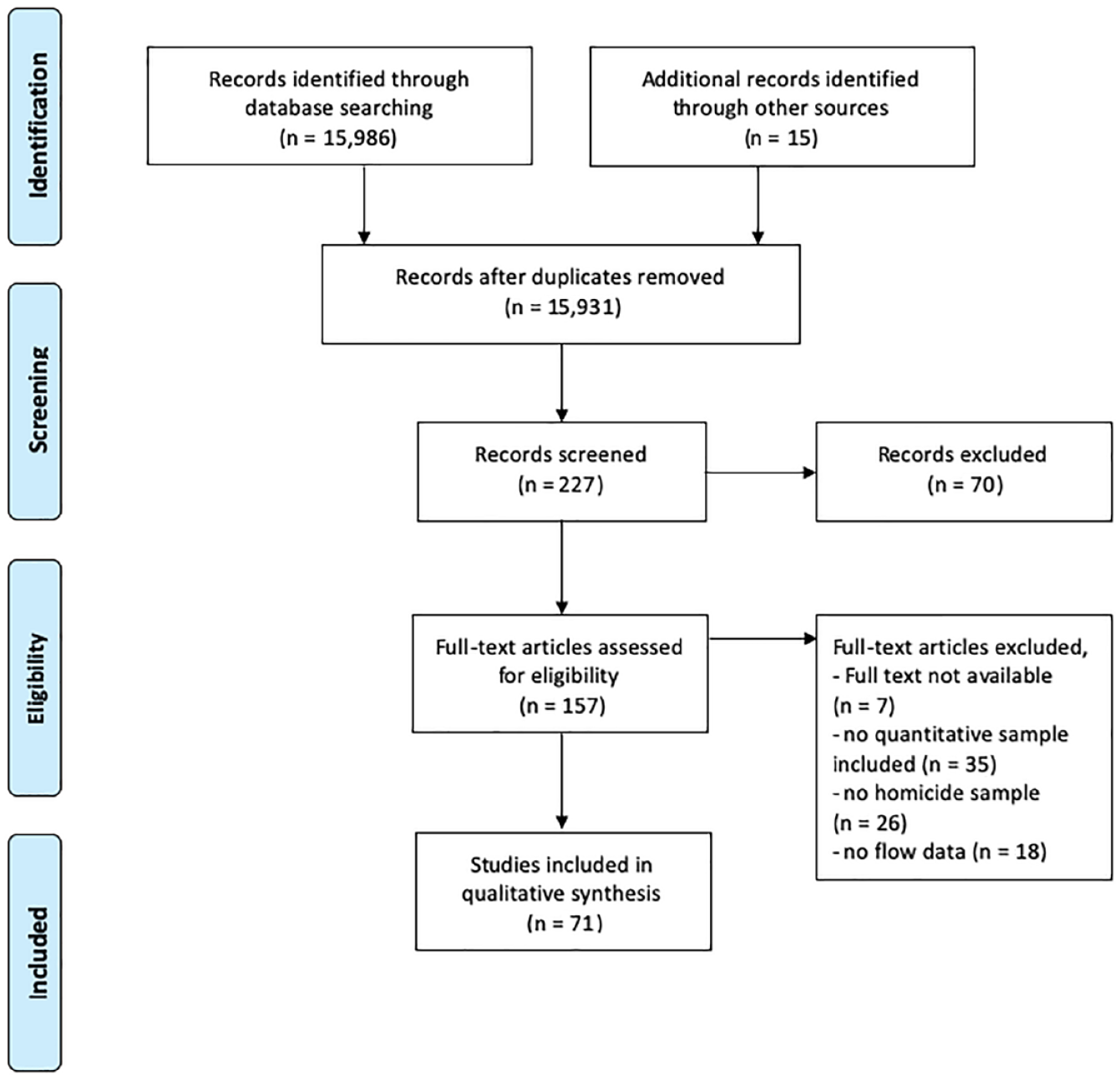
Flow diagram systematic review according to PRISMA guidelines.
For seven studies, a full text was not available. In two of those cases, we found contact information for the authors, who we subsequently contacted via email (N = 1) or Research Gate (N = 1). Even though a follow-up email was sent a week after the initial email, none of the original authors responded to our request to receive access to their studies.
A total of 35 studies were excluded because they did not contain a quantitative sample of homicide cases. This included studies that used qualitative approaches to explain the flow of homicide cases through the system (see, for example, Hawk & Dabney, 2014; LePard et al., 2015), (quasi-) experimental studies (see, for example, Fahsing, 2016; Schwartzberg, 1977; Wright, 2008) or used surveys, for example, with police officers (see, for example, Keel, 2008).
We further excluded 26 studies that did not differentiate homicide from other types of crime. In such studies, only aggregated data were presented in which various kinds of violent crime were combined, such as rape or robbery data with homicide data. This inhibited analyses of the homicide flow specifically.
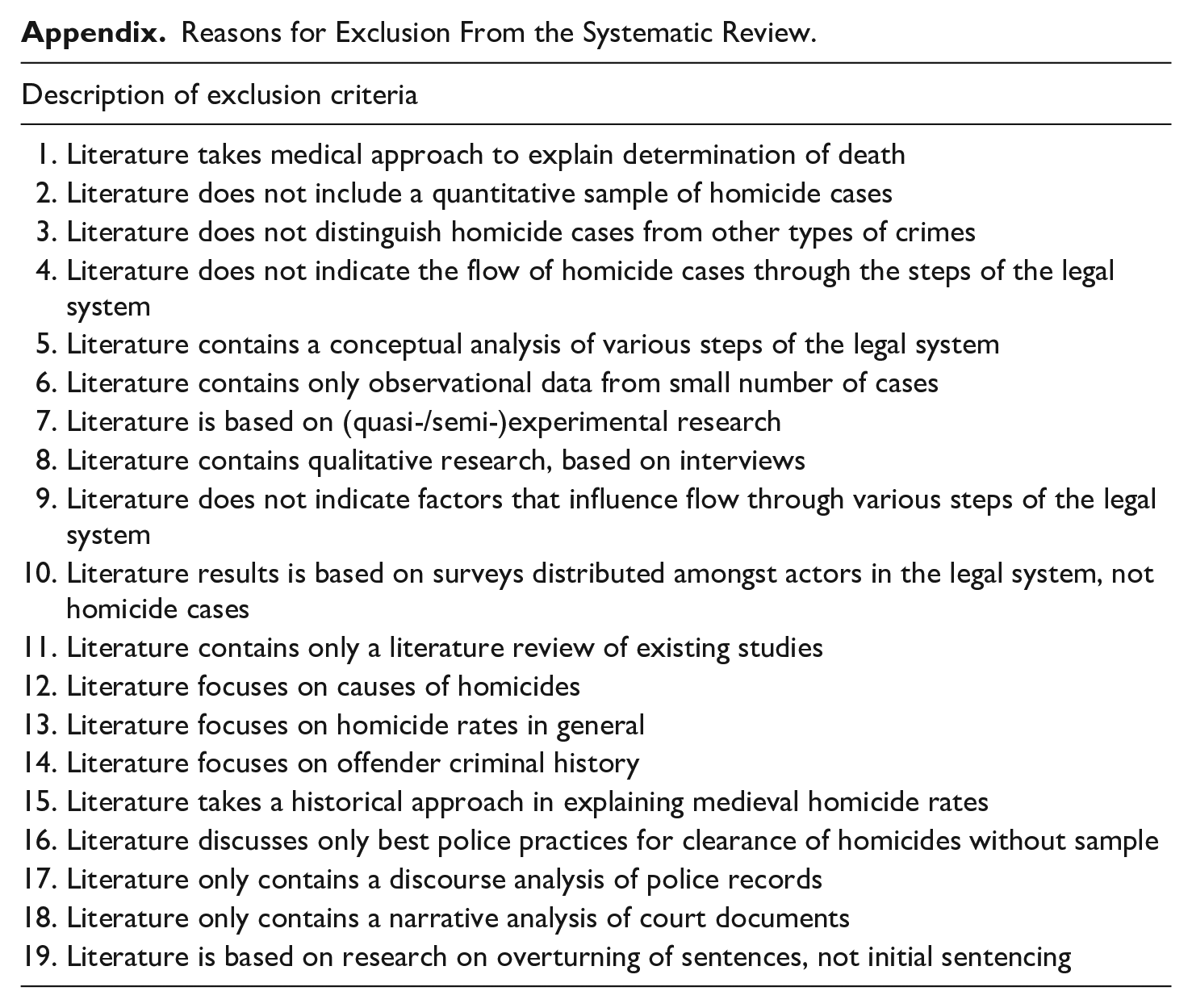
In the final step in the study selection process, 18 studies were excluded that did not present any flow data that could give an indication about the percentage of cases that flowed through the different steps in the system and factors that influenced this flow. Examples of such studies were studies on best practices in homicide investigations (e.g., Jensen, 2004; Keel, 2008), or studies describing homicide patterns without discussing patterns at different stages of the criminal justice process (e.g., Broadhurst, 2002; Messner et al., 2001). When study results from the same author were presented both in a PhD thesis, and in (a) peer-reviewed article(s), we included the latter when exactly the same findings were reported (same time frame, same study location, same sample size), to avoid duplication of results. The table in Appendix reflects the reasons for excluding studies from the systematic review.
Data Collection Process
All of the studies that met the inclusion criteria were carefully examined for homicide cases or homicide offenders from one or more steps in the public health and/or criminal justice system flow. In structuring the review results, we identified four separate steps in the homicide flow: (Step 1) classifying a suspicious death as a homicide, (Step 2) homicide clearance, (Step 3) homicide prosecution, and (Step 4) homicide sentencing.
Suspicious death was broadly defined as death in suspicious circumstances, meaning out of place and time (Timmermans, 2007). Homicide was defined as an intentional criminal act of violence by one or more human beings resulting in the death of one or more other human beings. This definition covers the legal codes of murder, voluntary manslaughter, infanticide, and assault leading to death. Excluded from this definition are attempted homicides, voluntary euthanasia, terminations of life on request, and assisted suicides (Granath et al., 2011). Homicide clearance includes cases cleared by arrest of a suspect, as well as exceptionally cleared cases, where a suspect or perpetrator is known to the police but for some reason cannot be (lawfully) arrested. Examples include perpetrators who committed suicide or perpetrators who left the country and therefore the jurisdiction area (Riedel & Boulahanis, 2007). Homicides were regarded as prosecuted if homicide arrests resulted in a decision to prosecute (Baumer & Martin, 2013). Finally, we included studies that measured homicide sentencing outcomes, including whether or not a homicide case resulted in a conviction, and the type of conviction, including (the length of) custodial sentence received by defendants (Baumer & Martin, 2013).
Two researchers extracted the data from published studies, books, book chapters, and PhD theses. Doubts about whether or not to include a study were resolved by consensus discussion, with final assignment reflecting the determination of the senior author.
Data Items
Studies included in the systematic review were coded for the following key features: reference information (title, authors, publication year, etc.), type of publication, language of publication, study location, sample size, sample characteristics (gender, age, etc.), time frame, step of the system studied, type(s) of outcomes measured, and measurement details. Furthermore, we also included the predictors that were included in each study.
Results
Study Selection
A total of 70 studies that described the flow of homicide cases through the various stages from initial recording by public health or criminal justice systems to conviction, as indicated in either the title or the abstract, were included in our systematic review.
Tables 1 and 2 provide further information about the 70 studies that were relevant for the aims of the systematic review. Most studies examined samples from North America (Canada and the United States). Six studies were based on criminal justice samples from Europe, and only one from a non-Western country (South Korea). A descriptive time-frame-analysis revealed a concentration of publications in the post-2006 time period (see supplementary material). Eighty-one percent of the studies were retrieved from peer-reviewed journals, and 19% included PhD theses. Most studies relied on relatively old (pre-2000s) empirical data.
Characteristics of Studies Included in the Systematic Review.
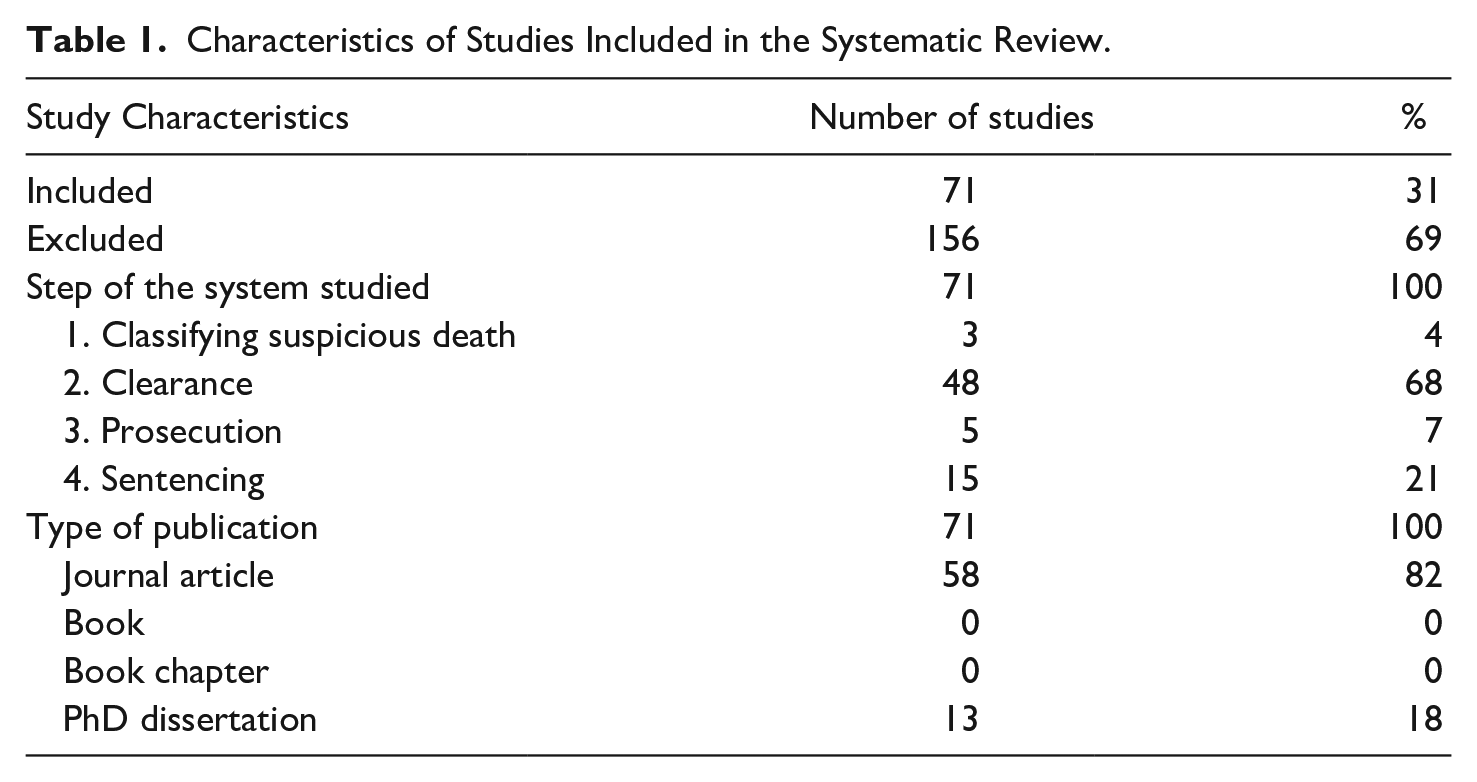
Steps in the Homicide Flow Captured by Articles Included in Review.
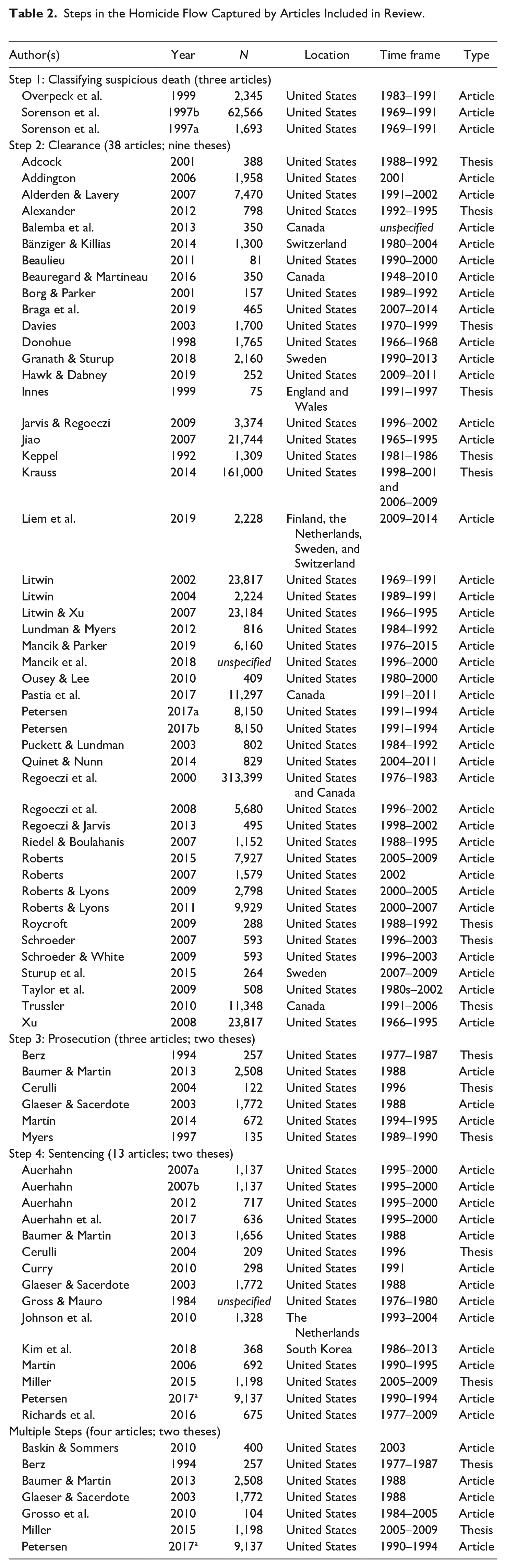
Study Characteristics
All reports were categorized according to their focus on the particular stage(s) in the public health or criminal justice systems. It was possible for six reports to be placed in various categories, when the reports described multiple stages longitudinally through the system. One single study (Berz, 1994) described all four steps in the system, from the discovery of a homicide to sentencing. Other studies reporting on multiple steps mostly focused on homicide prosecution and sentencing (including sentence length) (Baumer & Martin, 2013; Glaeser & Sacerdote, 2003; Grosso et al., 2010; Miller, 2015), or homicide clearance and prosecution charges (Petersen, 2017a) and convictions (Baskin & Sommers, 2010).
Preliminary Evaluation of Included Studies
Existing studies have mostly focused on one step in the homicide case flow: Homicide clearance (Pastia et al., 2017). To a lesser extent, studies have described and assessed factors influencing case loss in later stages of the system, such as homicide prosecution practices (Farrell & Swigert, 1986) and homicide sentencing (Taylor et al., 2009). Furthermore, the included empirical studies were predominantly focused on U.S. data, which decreases the overall generalizability of the data to other (non-U.S.) legal systems.
Results of Individual Studies
Predictors associated with each step of the homicide flow can roughly be divided into homicide case characteristics (number of victims, modus operandi, homicide context), offender characteristics (demographics, criminal history), victim characteristics (demographics, victim provocation), police organization characteristics (investigating office experience, investigative capacity), jurisdictional attributes (such as neighborhood disadvantage, homicide rate). We will adhere to this clustering of factors when discussing the various factors influencing each step of the homicide case flow.
Step 1: Classifying suspicious deaths
Even though multiple studies discussed the discovery of suspicious death and the subsequent classification of such deaths, three studies reported on predictors influencing the flow of cases from suspicious death to classifying the case as a homicide.
Among these articles, to the best of our knowledge, Sorenson et al. (1997b) were the only ones taking a population-based sample of injury deaths—rather than a specific subtype of homicide—in which the authors examined characteristics of those deaths labeled undetermined and compared them with cases in which the death was certified as an accident, suicide, or homicide. The classification of death category was found not to be random, as deaths of young children were more likely to be classified as undetermined, than as homicides. Other significant predictors that were associated with a lower likelihood of homicide classification included death by poisoning, fall, or submersion, while death by cutting instruments or firearms were more likely to be classified as homicides.
Focusing specifically on the classification of child homicide, Sorenson et al. (1997a) found that undetermined deaths of children and child homicides had similar distributions of age, race, sex, and place of injury. These findings suggest that a substantial number of underdetermined deaths may well be undetected homicides, findings mirrored by Overpeck et al. (1999) based on more recent U.S. population-based data.
Step 2: Clearance
Out of the four steps homicide flow, the majority of the homicide flow literature focused on homicide clearance. Here, it should be noted that virtually all studies excluded disappearances and police’ lethal use of force from their homicide samples, and considered homicide-suicides and other exceptionally cleared cases, separately. In terms of factors influencing homicide clearance, with two exceptions (Lundman & Myers, 2012; Puckett & Lundman, 2003), firearms were found to be associated with a lower likelihood of clearance (Alderden & Lavery, 2007; Braga et al., 2019; Granath & Sturup, 2018; Litwin, 2002, 2004; Litwin & Xu, 2007; Mancik & Parker, 2019; Ousey & Lee, 2010; Petersen, 2017a, 2017b; Regoeczi et al., 2000, 2008; Roberts, 2015; Roberts & Lyons, 2011; Sturup et al., 2015; Trussler, 2010; Xu, 2008). Homicides committed with knives, however, were with two exceptions (Adcock, 2001; Roycroft, 2009) associated with higher levels of clearance (Addington, 2006; Lundman & Myers, 2012; Pastia et al., 2017; Puckett & Lundman, 2003; Roberts, 2007, Roberts & Lyons, 2009; Schroeder, 2007; Schroeder & White, 2009; Trussler, 2010). Furthermore, other methods such as blunt force (Pastia et al., 2017; Trussler, 2010) or hands-on methods such as strangulation were found to be positively associated with clearance (Balemba et al., 2014; Trussler, 2010). Also, homicides committed at home had a higher likelihood of clearance (Addington, 2006; Alderden & Lavery, 2007; Bänziger & Killias, 2014; Braga et al., 2019; Litwin, 2002, 2004; Litwin & Xu, 2007; Petersen, 2017b; Riedel & Boulahanis, 2007; Trussler, 2010). While some studies found homicides committed in public, including public roads such as in vehicles, less likely to be cleared (Bänziger & Killias, 2014; Granath & Sturup, 2018; Jiao, 2007; Petersen, 2017b; Regoeczi et al., 2008; Sturup et al., 2015; Xu, 2008), other studies reported the opposite (Litwin & Xu, 2007; Petersen, 2017a; Riedel & Boulahanis, 2007). Cases committed in rural areas—rather than in urban areas—were positively associated with clearance (Pastia et al., 2017; Trussler 2010). Homicides that took place in the nighttime were less likely to be cleared (Alderden & Lavery, 2007; Donohue, 1998; Hawk, 2015; Roberts, 2015).
In terms of homicide context, homicides involving multiple victims (Addington, 2006; Petersen, 2017b) and domestic homicides were associated with higher clearance (Baskin & Sommers, 2010; Litwin & Xu, 2007; Puckett & Lundman, 2003; Riedel & Boulahanis, 2007; Roberts, 2007). Some studies report drug- or gang-related homicides to be associated with lower clearance level (Alderden & Lavery, 2007; Alexander, 2012; Braga et al., 2019; Litwin, 2002, 2004; Pastia et al., 2017; Petersen, 2017b; Puckett & Lundman, 2003; Trussler, 2010; Xu, 2008), whereas other studies report higher clearance rates among this subtype (Adcock, 2001; Jiao, 2007; Litwin & Xu, 2007; Mancik & Parker, 2019; Ousey & Lee, 2010; Roberts, 2007; Roberts & Lyons, 2011; Roycroft, 2009). Similarly, mixed findings are reported in terms of homicides committed together with other felonies, with some studies finding a positive (Adcock, 2001; Litwin & Xu, 2007; Mancik & Parker, 2019; Ousey & Lee, 2010; Puckett & Lundman, 2003; Roberts, 2007, 2015; Roberts & Lyons, 2011; Roycroft, 2009) and others a negative relationship (Litwin, 2002, 2004; Petersen, 2017b; Regoeczi et al., 2000, 2008; Schroeder, 2007; Xu, 2008) with clearance. Two studies reported on a positive relationship between rape-related homicides and clearance (Balemba et al., 2014; Beauregard & Martineau, 2016), while one study found the contrary (Alderden & Lavery, 2007).
Findings regarding victim race differ, with some studies finding homicides with Black victims to be associated with lower clearance rates (Baskin & Sommers, 2010; Litwin & Xu, 2007; Xu, 2008), while others report the opposite (Regoeczi et al., 2000; Roberts & Lyons, 2011). Homicides involving Latino (Alderden & Lavery, 2007; Litwin, 2002, 2004; Litwin & Xu, 2007; Petersen, 2017a, 2017b; Xu, 2008) or Asian victims (Petersen, 2017b) were associated with a lower likelihood of clearance. Some studies found homicides with female victims to be more likely to be cleared (Alderden & Lavery, 2007; Braga et al., 2019; Mancik & Parker, 2019; Petersen, 2017a, 2017b; Regoeczi et al., 2000, 2008; Roberts, 2007), while others reported the opposite (Jiao, 2007; Litwin, 2002; Litwin & Xu, 2007; Roberts & Lyons, 2009, 2011). Findings are mixed when it comes to victim age, with some studies finding homicides involving older victims more likely to be cleared (Braga et al., 2019; Hawk, 2015), while others report the opposite (Jiao, 2007; Liem et al., 2019; Litwin, 2002, 2004; Pastia et al., 2017; Petersen, 2017b; Regoeczi et al., 2000, 2008; Roberts, 2007). Homicides involving child victims are generally associated with a higher likelihood of clearance (Addington, 2006; Alderden & Lavery, 2007; Braga et al., 2019; Hawk & Dabney, 2019; Litwin & Xu, 2007; Lundman & Myers, 2012; Mancik & Parker, 2019; Pastia et al., 2017; Puckett & Lundman, 2003; Regoeczi et al., 2000, 2008; Roberts, 2007; Roberts & Lyons, 2009, 2011; Trussler, 2010). Noteworthy is a Swiss study on homicide clearance by Bänziger and Killias (2014), finding that homicides involving homosexual (slightly older) victims were associated with lower clearance rates. Related to this observation is Beauregard and Martineau’s (2016) finding of sex worker homicides being less likely to be cleared. Studies further show that homicides involving married victims are more likely to be cleared compared with unmarried victims (Bänziger & Killias, 2014; Pastia et al., 2017). Finally, with one exception (Regoeczi & Jarvis, 2013), homicides involving victims with a criminal record are found to be associated with lower clearance rates (Alderden & Lavery, 2007; Braga et al., 2019; Granath & Sturup, 2018; Jiao, 2007; Schroeder, 2007; Schroeder & White, 2009; Sturup et al., 2015).
Police organization characteristics, such as workload per investigator, were found to be negatively associated with clearance outcomes (Borg & Parker, 2001; Hawk, 2015; Mancik & Parker, 2019; Roberts, 2015). Evidence found to positively influence the likelihood of clearance includes the number of evidence types (Hawk, 2015, Hawk & Dabney, 2019) and the presence of witnesses (Baskin & Sommers, 2010; Regoeczi & Jarvis, 2013; Sturup et al., 2015).
In terms of jurisdictional characteristics, home ownership (Borg & Parker, 2001; Litwin, 2002, 2004; Mancik & Parker, 2019) and community average educational level (Borg & Parker, 2001; Hawk, 2015) are positively associated with clearance. There are no conclusive results when it comes to other community characteristics such as area population, homicide rates, inequality or neighborhood racial composition, and their relationship with clearance rates—with some studies reporting positive and others negative effects on the likelihood of homicide clearance (Beaulieu, 2011; Borg & Parker, 2001; Litwin, 2002; Litwin & Xu, 2007; Mancik et al., 2018; Mancik & Parker, 2019; Ousey & Lee, 2010; Petersen, 2017b; Puckett & Lundman, 2003; Trussler, 2010; Xu, 2008).
Step 3: Prosecution
Empirical studies reporting on factors influencing the prosecution of homicide offenders mostly stem from the 1980s and 1990s, and have almost exclusively focused on U.S. data. On the case level, factors associated with a higher likelihood of homicide prosecution include the presence of multiple victims, quick arrest, and the crime taking place within the home (Baumer & Martin, 2013). Berz (1994), as one of the only scholars who followed homicide cases through multiple steps of the criminal justice system, found that self-defense and (naturally) homicide-suicide were associated with a decreased likelihood of prosecution. Furthermore, police prescribing a specific homicide charge was found to increase the likelihood of prosecution for that exact same charge, as the prosecution rarely deviated from the police’s suggestion (Cerulli, 2004). Conversely, plea bargaining was associated with a lower likelihood of prosecution (Myers, 1997). White offenders, offenders with a prior criminal record (Berz, 1994), and male offenders are more likely to be prosecuted for homicide (Baumer & Martin, 2013), while older age and being known as a drug dealer were found to be associated with a lower likelihood of prosecution (Baumer & Martin, 2013). In terms of victim characteristics, victim provocation, or the victim being Latino, decreased the likelihood of homicide prosecution (Baumer & Martin, 2013), whilst cases involving a White male victim increased the issuance of a charge (Baskin & Sommers, 2010). An intimate or familial relationship between victim and perpetrator decreases the likelihood to be prosecuted for aggravated murder (Martin, 2014), but increased the likelihood to be prosecuted for involuntary manslaughter (Cerulli, 2004). Furthermore, in terms of jurisdictional characteristics, political conservatism was associated with a lower likelihood of prosecution, while social capital, operationalized as social trust and cohesion within society, increased the likelihood of prosecution (Baumer & Martin, 2013).
Step 4: Sentencing
Similar to studies describing other steps in the flow, the vast majority of empirical studies have been conducted in the United States. In terms of case characteristics, similar to findings in the prosecution stage, homicides involving multiple victims increased both the likelihood of being convicted versus being acquitted (Baskin & Sommers, 2010; Baumer & Martin, 2013) and the likelihood for harsher sentences (Baumer & Martin, 2013; Gross & Mauro, 1984; Johnson et al., 2010; Petersen, 2017a). Furthermore, case characteristics associated with harsher sentences included homicides taking place in a public (Baumer & Martin, 2013; Johnson et al., 2010) or rural (Gross & Mauro, 1984) area.
Other case characteristics involve legal factors that increased the likelihood for higher sentences, such as charge severity, aggravating circumstances (Auerhahn, 2007), disposition seriousness (Curry, 2010), and the case being treated in jury trial (Auerhahn et al., 2017). Miller’s (2015) study mirrored these conclusions, finding that cases received a lesser charge in the disposition phase compared with the initial charge, for example, due to plea bargaining. Homicide offenders committing a homicide in the context of gang rivalry or business rivalry were less likely to be adjudicated guilty (Martin, 2006), while homicides motivated by financial gain (Kim et al., 2018), or in the context of a sexual crime (Johnson et al., 2010; Richards et al., 2016), a robbery (Gross & Mauro, 1984; Johnson et al., 2010), or a sexual triangle (Kim et al., 2018), were associated with harsher sentences.
Other studies tested the relevance of offenders’ characteristics on sentencing. To control for legally relevant factors, such as offense seriousness, many of the included studies applied multivariate analyses (e.g., Auerhahn et al., 2017; Baumer & Martin, 2013; Curry, 2010; Glaeser & Sacerdote, 2003). Habitual offenders (Curry, 2010), offenders who had spent time in prison (Johnson et al., 2010), or offenders who had a prior criminal record (Baumer & Martin, 2013; Curry, 2010; Glaeser & Sacerdote, 2003) were associated with a higher likelihood for a homicide conviction and a longer sentence (Baumer & Martin, 2013; Curry, 2010; Glaeser & Sacerdote, 2003; Kim et al., 2018; Richards et al., 2016). Being male increased the likelihood for a more severe sentence (Auerhahn et al., 2017; Baumer & Martin, 2013; Curry, 2010; Glaeser & Sacerdote, 2003). While Gross and Mauro (1984) reported Black offenders to be more likely to be sentenced to death, other studies did not find an effect of offender race on sentence severity (Baumer & Martin, 2013; Curry, 2010; Glaeser & Sacerdote, 2003). Similarly, while some authors reported Hispanic offenders to be more likely to receive harsher sentences (Auerhahn et al., 2017), others (Petersen, 2017a) found the opposite.
Physical provocation by the victim was associated with a lower likelihood of conviction and lower sentence length (Baumer & Martin, 2013). White and female victims increased the likelihood of being convicted of first-degree murder (Glaeser & Sacerdote, 2003). Homicides involving female (Baumer & Martin, 2013; Curry, 2010; Glaeser & Sacerdote, 2003; Gross & Mauro, 1984; Johnson et al., 2010), older (Baumer & Martin, 2013; Johnson et al., 2010; Petersen, 2017a), and White (Gross & Mauro, 1984) victims were further associated with harsher sentences. Black-on-White homicides were further associated with harsher sentences (Martin, 2006), as were homicides involving strangers (Gross & Mauro, 1984; Petersen, 2017a). However, homicides with unemployed victims or victims working as prostitutes were associated with more lenient sentencing outcomes (Glaeser & Sacerdote, 2003). Homicides of children, parents (Johnson et al., 2010), or friends (Martin, 2006) was further associated with more lenient sentences. Multiple criminal charges were associated with higher sentences (Johnson et al., 2010; Martin, 2006; Petersen, 2017a), as were multiple murder charges (Johnson et al., 2010).
In terms of jurisdictional attributes, fundamentalism and support for capital punishment increased the likelihood of a jury conviction versus being acquitted (Baumer & Martin, 2013), whereas neighborhood residential instability appears to have a negative influence on the likelihood of a suspect being convicted (Regoeczi & Jarvis, 2013). Other jurisdiction characteristics that were negatively related to the likelihood of being incarcerated were—for White offenders—neighborhood concentrated disadvantage and neighborhood average high school completion, while political conservatism increased the likelihood of being sentenced for a homicide (Miller, 2015). For Black offenders, jurisdictional characteristics negatively associated with the likelihood of incarceration include neighborhood housing instability, while Gini 1 was found to be positively related to the likelihood of being incarcerated for a homicide (Miller, 2015).
Discussion
Summary of Evidence
To the best of our knowledge, this is the first systematic review of existing research on the homicide flow through the system. One of our initial aims of this systematic review was to report on the factors explaining variability in homicide case outcome. However, with the exception of one (Berz, 1994), none of the studies reported on the entire homicide flow through the system, following cases longitudinally. One of the reasons for such a research vacuum may lie in different disciplinary lenses that are associated with different stages in the flow: With coroner data on suspicious death being collected and studied in the area of public health, that may not neatly correspond to data systems employed by criminal justice agencies. The fact that so few scholars examined multiple steps in the criminal justice funnel hints at fragmented systems: as data from police, prosecutor, and judicial systems do not easily match and merge, tracking cases throughout the funnel is easier said than done.
Results further show that empirical studies mostly used North American data, and to a lesser extent European data, with one exception no studies covering non-Western countries. Studies mostly focused on regional or local samples, with few studies relying on national data. Rather than mapping the entire homicide flow, prior work has zoomed in on one step in the case flow: Homicide clearance. To a lesser extent, studies have reported on factors influencing homicide prosecution practices and homicide sentencing. Each of these studies typically assesses one cluster of factors, for example, the influence of individual (victim or perpetrator) characteristics, jurisdiction characteristics, or police characteristics. Generally, such quantitative studies on have followed one of the two paths. First, individual-level studies have examined the influence of case and victim characteristics on case outcome. Second, aggregate-level studies examine the effect of city or neighborhood characteristics on clearance rates. Research combining these levels in a multilevel study, however, is extremely scarce (Maguire et al., 2010).
Limitations and Future Research
Taking stock of the status quo of studies assessing the flow of homicides through the system has raised more questions than it has answered. First, by default, only those cases that have become known as to the authorities as suspicious deaths could enter the homicide funnel. This implies that long-term and/or suspicious disappearances are excluded from the first step. Simply put, if no body has been recovered, no case enters the system. When a person is missing, even if a homicide is expected, the absence of a body poses unique challenges not only for investigators (Reale & Beauregard, 2019), but also in terms of the first step in homicide classification. Such suspicious disappearances may constitute a considerable dark number, potentially clustered around vulnerable populations such as sex workers, homeless people (Quinet, 2007), and gang members whose homicides go unreported. Conversely, there could be cases of lethal violence that were initially classified as homicide, but effectively were something else. Identifying the scope and nature of such false positives and negatives constitutes a great avenue for future research.
One step down the funnel, limitations include selection bias based on official homicide definitions. These typically exclude police lethal use of force, resisting police arrest (Willis, 2015), and (even though not encountered in our study) deaths in the context of civil war. Excluding such cases from homicide definitions blur the boundaries between officially recorded homicides, and lethal violence that show all characteristics of homicidal violence, yet are not classified as such.
Altogether, results point to a scarcity in research mapping the flow of homicides through the system. Therefore, probabilities of clearance given detection, and probabilities of sentencing given prosecution, and so forth could not be answered. Moreover, the vast majority of studies included in this review rely on U.S. data and, as a consequence, the results largely speak to a U.S. context rather than a global context. Taken together, with this empirical void in mind, future research should attempt to investigate the entire flow of cases through public health and criminal justice systems. In addition to describing the funnel and assessing the probability of cases to flow through the system or to leave the system, other avenues of research worth exploring include capture-recapture models, to estimate the effects of funnel selectivity (Charette & van Koppen, 2016). 2 In addition, to the best of our knowledge, so far no study has incorporated a homicide seriousness measure akin to Sellin and Wolfgang’s (1964) early crime classifications, measuring the seriousness of the violent acts in an objective manner. To capture and control for type, severity, and brutality of the lethally violent acts, as well as aggravating and mitigating circumstances, future empirical work in this field should make use of a Homicide Severity Index. In line with Sellin and Wolfgang’s (1964) thinking, this index could build on the recently developed Cambridge Harm Index (CHI) (Sherman et al., 2016), in which each homicide should be classified, relative to other homicides, based on severity, wrongfulness, and culpability. Such an Index will allow for consistent comparisons across individual homicide cases, perpetrators, and victims of differing Index values. Moreover, more research from other countries than the United States could potentially provide more comparable insights into differences between various legal systems and extra-judicial factors influencing the flow of homicide cases through the system.
Conclusion
Who the victim is, and the context in which they die, influences the way in which homicide cases flow through the system. So do extralegal aspects such as perpetrator characteristics, case characteristics, and police organization and jurisdictional characteristics. Taken together, although we still have a limited understanding of the mechanisms involved at different stages, this review indicates that different kinds of people and events run different risks of being punished.
Supplemental Material
Supplementary_material – Supplemental material for From Murder to Imprisonment: Mapping the Flow of Homicide Cases—A Systematic Review
Supplemental material, Supplementary_material for From Murder to Imprisonment: Mapping the Flow of Homicide Cases—A Systematic Review by Marieke Liem, Katharina Krüsselmann and Manuel Eisner in Homicide Studies
Footnotes
Appendix
Reasons for Exclusion From the Systematic Review.
| Description of exclusion criteria |
|---|
| 1. Literature takes medical approach to explain determination of death |
| 2. Literature does not include a quantitative sample of homicide cases |
| 3. Literature does not distinguish homicide cases from other types of crimes |
| 4. Literature does not indicate the flow of homicide cases through the steps of the legal system |
| 5. Literature contains a conceptual analysis of various steps of the legal system |
| 6. Literature contains only observational data from small number of cases |
| 7. Literature is based on (quasi-/semi-)experimental research |
| 8. Literature contains qualitative research, based on interviews |
| 9. Literature does not indicate factors that influence flow through various steps of the legal system |
| 10. Literature results is based on surveys distributed amongst actors in the legal system, not homicide cases |
| 11. Literature contains only a literature review of existing studies |
| 12. Literature focuses on causes of homicides |
| 13. Literature focuses on homicide rates in general |
| 14. Literature focuses on offender criminal history |
| 15. Literature takes a historical approach in explaining medieval homicide rates |
| 16. Literature discusses only best police practices for clearance of homicides without sample |
| 17. Literature only contains a discourse analysis of police records |
| 18. Literature only contains a narrative analysis of court documents |
| 19. Literature is based on research on overturning of sentences, not initial sentencing |
Authors’ Note
Manuel Eisner’s is also affiliated with University of Zurich, Switzerland.
Declaration of Conflicting Interests
The author(s) declared no potential conflicts of interest with respect to the research, authorship, and/or publication of this article.
Funding
The author(s) received no financial support for the research, authorship, and/or publication of this article.

Supplemental Material
Supplemental material for this article is available online.
Notes
Author Biographies
References
Supplementary Material
Please find the following supplemental material available below.
For Open Access articles published under a Creative Commons License, all supplemental material carries the same license as the article it is associated with.
For non-Open Access articles published, all supplemental material carries a non-exclusive license, and permission requests for re-use of supplemental material or any part of supplemental material shall be sent directly to the copyright owner as specified in the copyright notice associated with the article.
