




Abstract
The purpose of this study was to examine factors associated with expectations regarding postsecondary education of students with autism spectrum disorder between the ages of 16 and 21 years. We conducted logistic regressions using variables at the student, family, and school levels using the National Longitudinal Transition Study 2012. Logistic regression results showed that parental expectations for attending college was the only significant predictor of students’ own educational expectations. Students’ adaptive functioning, autonomy levels, demographic and family variables, parent involvement, and prior roles in Individualized Education Program/transition planning were not significant predictors. Future research needs to examine how schools can develop effective ways to increase both students’ and parents’ expectations toward postsecondary education.
U.S. postsecondary education (PSE) programs for individuals with intellectual and other developmental disabilities such as autism spectrum disorder (ASD) have steadily expanded since the passing of the Higher Education Opportunity Act (HEOA, 2008; Whirley et al., 2020). Despite the growth of PSE programs nationally (Grigal & Hart, 2010), data from the National Longitudinal Transition Study-2 (NLTS-2) found that the combined 2-year and 4-year PSE enrollment rate of students with ASD was 32%, the third lowest of Individuals with Disabilities Education Act (IDEA)’s 12 disability categories with students with an intellectual disability and multiple disabilities faring less well (Shattuck et al., 2012; Wagner et al., 2005; Wei et al., 2013). This low rate of enrollment is inconsistent with the high expectations that students have reported in terms of their intent to obtain some form of PSE following high school completion (Lipscomb et al., 2017; Wagner et al., 2005, 2007). This gap between youths desires to pursue further education and actual enrollment rates raises questions as to the expectations educators and parents hold for these students, extent to which students and their parents are provided information on college options and high school coursework needed to prepare the students for college access, and the opportunities students are afforded to play a meaningful role in Individualized Education Program (IEP)/transition planning meetings to discuss their interests and preferences for pursuing some form of PSE.
The consequences of not addressing these concerns have a significant and long-term impact for these students in terms of access to future employment opportunities. The nature of work and the skills required of workers in our society have undergone a dramatic change over the past several decades. In 1973, only 28% of U.S. jobs required education beyond a high school diploma, whereas in 2016 almost two out of every three jobs in the nation required at least some PSE or training (Carnevale et al., 2013). Obtaining PSE opportunities is viewed as a gateway to integrated, competitive employment; higher-paying jobs; economic independence; and independent living (Grigal & Hart, 2010; Qian et al., 2020). Higher levels of education are correlated with lower rates of unemployment, higher earnings, and job stability. In 2019, the median weekly earnings were significantly less for individuals with a high school diploma (US$749) than persons who completed an associate’s degree ($874) or bachelor’s degree (US$1,248; U.S. Bureau of Labor Statistics, 2020). A recent report found that the highest unemployment rate was for persons ages 25 years or older who have a high school diploma or less (U.S. Bureau of Labor Statistics, 2020). This disparity in PSE participation has a significant economic and personal cost for all youth. Youth with ASD, however, are experiencing greater challenges in accessing and successfully participating in PSE programs. The realization is that participation in PSE programs for young people, including those with and without disabilities, is no longer a selective option but rather a necessity.
Research on students with ASD have pointed to the importance of their high school experiences and active participation in IEP/transition planning meetings in reaching decisions on enrolling in PSE programs (Shattuck et al., 2012; Wagner et al., 2007; Wei et al., 2016). Students with ASD have been found to have far fewer opportunities to attend and actively participate in IEP/transition planning meetings. Shogren and Plotner (2012) found that students with ASD or an intellectual disability had significantly higher levels of no or limited participation in their IEP/transition planning meetings compared to students with other disabilities, and students with ASD were the least likely to attend their meetings. In a recent analysis of NLTS 2012 data, Johnson et al. (2020) found that only 19.5% of students with the most significant cognitive disabilities (including ASD) took a leadership role during transition planning meetings and only 3.4% of parents of students with the most significant cognitive disabilities reported that their child came up with their own annual goals in IEP and transition planning meetings. These recent findings are aligned with previous research (Griffin et al., 2014; Wagner et al., 2012; Wei et al., 2016) findings that students with ASD were less likely to attend and participate in IEP/transition planning meetings than students with other disabilities.
Under the Individuals with Disabilities Education Improvement Act of 2004, students’ IEPs are required to include appropriate, measurable postschool goals for PSE and training; employment; and individual student’s strengths, preferences, and interests (Johnson, 2020). These requirements reflect the importance of including students’ voice in planning for life following high school graduation. Research has shown that student participation in transition planning provides an opportunity for them to learn and practice self-determination skills (Martin et al., 2006; Wehmeyer et al., 2007). The positive relation between students’ IEP/transition planning participation and self-advocacy and self-determination skills has been investigated by numerous researchers and found to be associated with students’ achievement of positive postschool outcomes (Martin et al., 2006; Shogren & Plotner, 2012).
Placing the student at the center of the process is a pivotal component of transition planning that has been greatly overlooked (Hendricks & Wehman, 2009). Griffin et al. (2014) examined predictors of the involvement in transition planning among 320 students with ASD. The study found that students with higher self-advocacy skills are more likely to participate than peers with lower skills. Having received specific instructions related to transition planning was identified as a predictor for both attendance and active participation in transition planning meetings (Wagner et al., 2012). Snell-Rood et al. (2020) conducted focus groups with transition-age students with ASD, parents, teachers, school administrators, adult service providers, and state policymakers to better understand key stakeholders’ perspectives about transition planning. The study found that students’ preferences, interests, and strengths were not being fully considered in the IEP/transition planning process which, in turn, resulted in imprecise goal settings and development of future transition plans (Snell-Rood et al., 2020). Given these findings, it is critical to intervene to prepare students with ASD to play a more active role as decision makers in their transition planning process in setting goals for their postschool life, including goals for PSE participation (Wei et al., 2013).
In other research, active participation in IEP/transition planning meetings was identified as one of the factors predicting PSE enrollment for students with ASD (Chiang et al., 2012; Doren et al., 2012; Kirby, 2016; Wei et al., 2016). Chiang et al. (2012) found that 61% of students with ASD who participated in transition planning and 74% of students with ASD who received instructions related to transition planning participated in PSE. This participation rate in PSE is almost two to three times greater compared to students who did not participate in transition planning (36%) or receive transition planning instructions (24%). Wei et al. (2016) found that college enrollment rates were significantly higher among young adults with ASD who participated in transition planning and those who had a primary transition goal of college enrollment.
Students’ functional, communication, and social skills also have an impact on postschool outcomes. Carter et al. (2011, 2012) found that youth who experienced less difficulty related to communication, self-care, and mobility skills were significantly more likely to report having positive postschool employment and related outcomes. Overall, and as would be expected, research has shown the higher levels of functional, communication, and social skills are associated with student’s decisions to go onto further education and the extent to which they enroll and successfully complete PSE programs (Chiang et al., 2012; Qian et al., 2020; Shattuck et al., 2012).
Previous research has shown a strong relationship between parent expectations and postschool outcomes of students with ASD and other developmental disabilities. Chiang et al. (2012) found that the odds of students with ASD participating in postsecondary education increased by about 277% if their parents expend them to do so. Mazzotti et al. (2021) reviewed secondary transition literature and identified parental expectation as a research-based predictor of postschool outcomes for students with disabilities. Parent expectations have also been identified as a predictor of college attendance, adjustment, and achievement (Agliata & Renk, 2008; Cawthon et al., 2015; Kim & Schneider, 2005). Additionally, in one study involving individuals with ASD, researchers reported that parent expectations predicted the extent to which parents and youth participated in transition preparation activities (Holmes et al., 2018).
A positive association between parental educational expectation and academic achievement has been consistently documented in studies involving children without disabilities (see Pinquart & Ebeling, 2020 for a meta-analysis). A review of 169 studies reveals both cross-sectional and longitudinal associations between parental educational expectations and academic achievement after controlling for socioeconomic status (Pinquart & Ebeling, 2020). The authors concluded that parents communicating positive expectations to their child and encouraging academic engagement seem to be more important than involvement such as checking homework and staying in contact with teachers.
Parents’ expectations for their children’s participation in PSE following high school are also likely influenced by multiple factors that are interrelated, such as socioeconomic status, parent’s educational attainment level, race, and students’ ability level (Doren et al., 2012; Trainor et al., 2019; Wei et al., 2016). Moreover, as suggested by the expectancy-value theory (Wigfield & Eccles, 2002), parental expectations are likely to be influenced by their students’ own expectations (Zhang et al., 2011).
The purpose of this study was to examine factors associated with expectations toward PSE that students with ASD between the ages of 16 and 21 years hold, using NLTS 2012 data, which includes a nationally representative sample of youth with ASD. The aims of the present study were to (a) identify which variables were associated with students’ expectations to attend PSE and (b) to test the predictive effects of these variables on students’ expectations to attend PSE.
Method
National Longitudinal Transition Study 2012
The NLTS 2012 study (Bloomenthal et al., 2017) is the third longitudinal transition study funded by the U.S. Department of Education to examine student and family background characteristics, engagement in school, school support received, and their expectations toward the future after leaving high school. The NLTS 2012 sampling process was designed to allow results to generalize to the full population of students receiving special education services in the United States. The NLTS 2012 is a cross sectional study, designed to provide information on the characteristics of youth receiving special education services. Data were collected from February through October 2012 and from January through August 2013. Survey administration in 2012 was by computer-assisted telephone interviewing; in 2013, both a web option and field interviews were used. A total of 10,459 parent surveys and 8,960 surveys of youth regarding IEPs were completed. Youth were ages 12 to 22 years when the interviews took place. All students were enrolled in Grades 7 through 12 or in a secondary ungraded class at the time of the sampling.
Study Sample
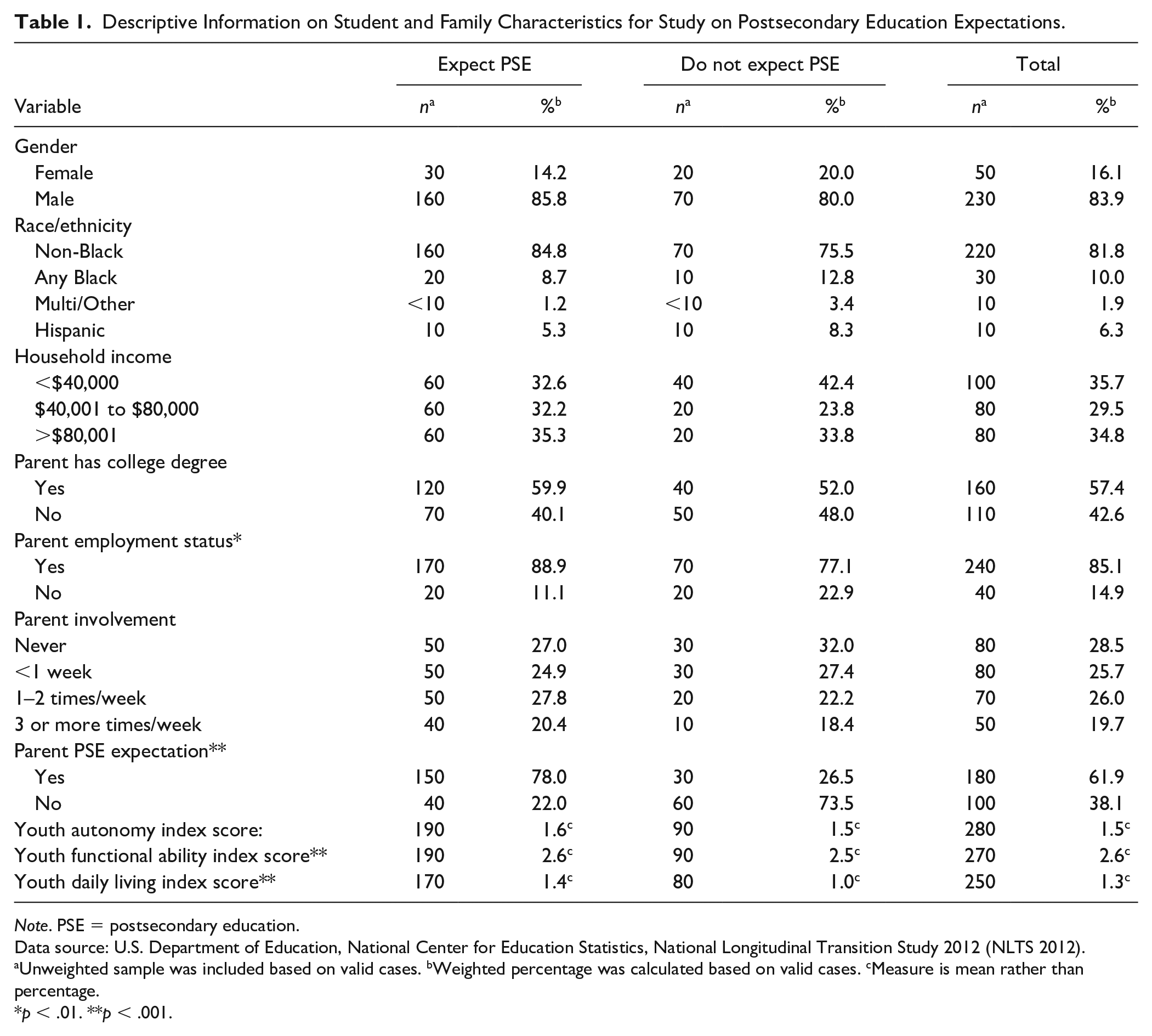
In this analysis, we included students with ASD between the ages of 16 and 21 years who were enrolled in U.S. schools at the time of the survey, with 83.9% being male. All participants had an educational diagnosis of ASD, one of the disability categories under IDEA. These inclusion criteria resulted in a total sample of 280 students (weighted n = 46,113). Student and family demographic information is presented in Table 1. Of this sample, 81.8% were non-Black, and 35.7% had a household income less than $40,000. The unweighted sample size reported in this study was rounded to the nearest 10 because of the Institute of Education Sciences (IES) data reporting requirements for restricted data sets.
Descriptive Information on Student and Family Characteristics for Study on Postsecondary Education Expectations.
Note. PSE = postsecondary education.
Data source: U.S. Department of Education, National Center for Education Statistics, National Longitudinal Transition Study 2012 (NLTS 2012).
Unweighted sample was included based on valid cases. bWeighted percentage was calculated based on valid cases. cMeasure is mean rather than percentage.
p < .01. **p < .001.
Measures
Dependent Measures
The outcome variable for this study was students’ expectations toward PSE based on a youth survey item. Students were asked “As things stand now, how far do you think you will get in school?” There were six response options (1 = graduate degree; 2 = 4-year college, 3 = 2-year college; 4 = technical or trade school; 5 = high school diploma or GED; 6 = less than a high school diploma or GED). This variable was recoded into a dichotomous variable. Students who answered high school diploma or GED, or less than a high school diploma or GED, were coded as 0 and the remaining categories were coded as 1.
Student and Family Variables
Demographic variables from district records included gender, and race/ethnicity (i.e., non-Black, any Black, Hispanic, and Multi–Other). Youth age was from the parent survey to indicate youth age at the time the survey data were collected. Three constructed measures from the NLTS 2012 dataset were selected to examine the potential influence on student skills levels in relation to expectations toward PSE, including youth functional abilities index score (from the parent survey), youth activities of daily living index score (from the parent survey), and youth personal autonomy index score (from the youth survey; Burghardt et al., 2017). The response options of these three measures ranged from one to three, with higher scores indicating more positive direction.
Family factors were (a) household income (1 = less than US$40,000; 2 = US$40,000–US$80,000; and 3 = US $80,000 or above), (b) parent education level (i.e., highest education level attained by the parent or the parent’s spouse; 1 = graduate degree, 4-year college, or 2-year college; 0 = technical or trade school degree, high school diploma or GED, or less than high school), (c) parents’ current employment status (1 = having a paid job now, 0 = not having a paid job), (d) parent expectations of youth obtaining PSE (1 = more than high school and 0 = high school or less than high school), and (f) parent involvement at home (1 = never, 2 = less than once a week, 3 = 1–2 times a week, and 4 = 3 or more times a week).
School Variables
Three variables from NLTS 2012 survey related to the transition planning meeting experience were identified: (a) youth’s role in IEP/transition planning meeting (from the parent survey, 1 = present in discussion but participated very little or not at all and 2 = provided some input or took a leadership), (b) youth’s contribution in coming up with postschool transition goals (from the parent survey, 1 = a little, 2 = some and mostly youth), and (c) youth’s meeting with school staff to set transition goals (from the youth survey, 0 = no and 1 = yes). Five items from the NLTS 2012 survey pertaining to PSE services were included in the analysis, including one measure from the parent survey and the other measures from the youth survey. The five items were (a) whether youth took a course for college credit during high school (parent survey), (b) whether youth received guidance on what classes to take after high school, (c) whether youth received help completing college applications, (d) whether youth received help reviewing college entrance test results, and (e) whether youth received help arranging college visits. All five items were dichotomous variables (1 = yes and 0 = no).
Data Analyses
The analysis procedure consists of two steps. We first conducted chi-square tests of independence and t tests to explore whether student, family, and school variables were associated with the youth expectations of obtaining PSE. Second, we conducted a logistic regression analysis to test the predictive effects of these variables, which are significantly related to youth expectations on obtaining PSE. The logistic regression analysis only included participants with valid responses across all the variables in the model, and all variables were entered simultaneously in the model. These statistics are weighted to represent population estimates through the use of student enrolled weights. The percentage of missing data among the variables included ranges from 0% to 9.0% in Table 1 and from 4.3% to 7.2% in Table 2. Approximately, 72% of the weighted sample had full responses for the logistic regression model. Potential bias due to nonresponse rates to survey questions was assessed for the NLTS 2012 dataset; results indicated that weighting was successful in limiting any potential bias (Burghardt et al., 2017). No imputation was calculated for this study. Correlations among predictors ranged from -.15 to .65, suggesting no multicollinearity issue (Berry & Feldman, 1985).
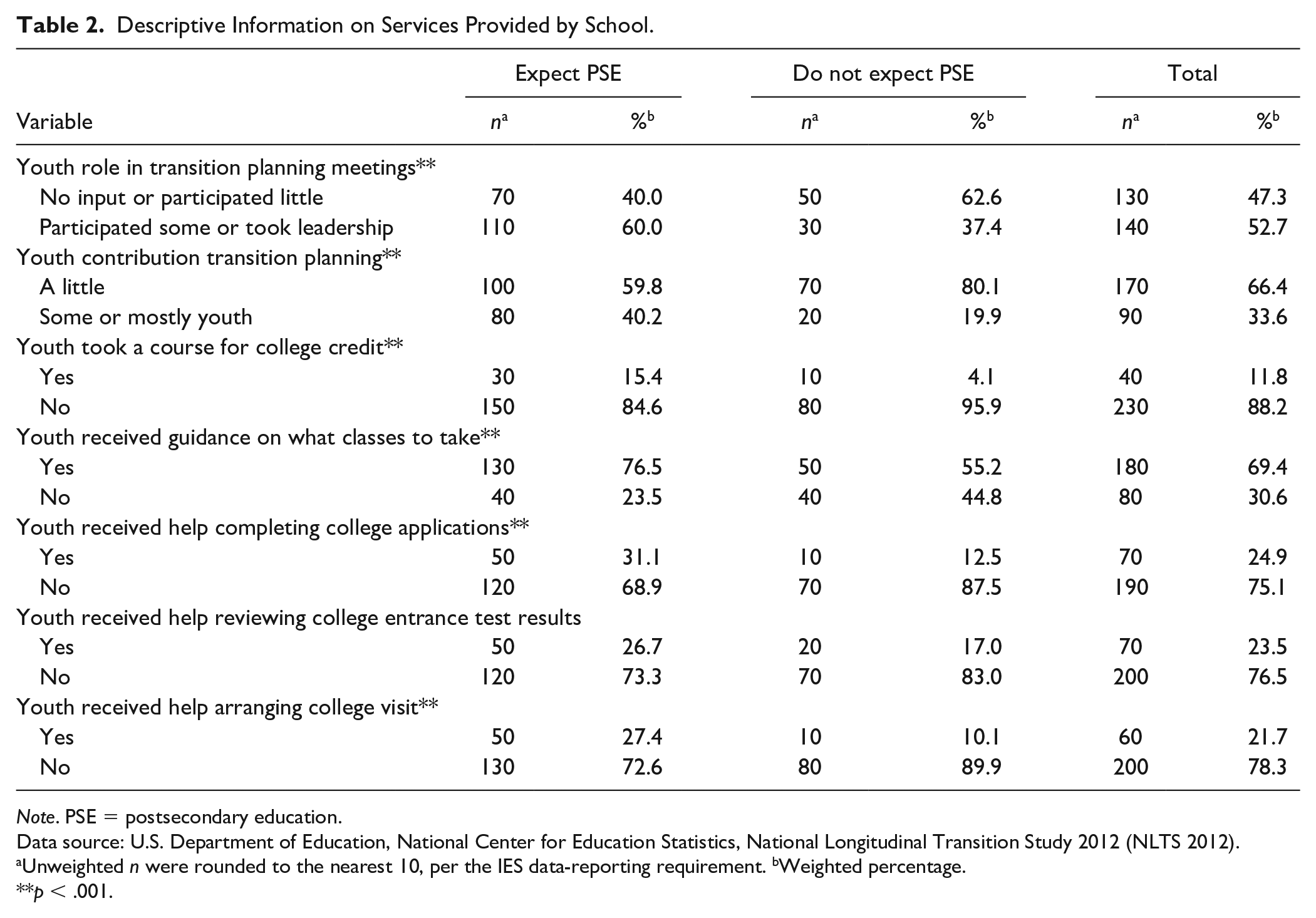
Descriptive Information on Services Provided by School.
Note. PSE = postsecondary education.
Data source: U.S. Department of Education, National Center for Education Statistics, National Longitudinal Transition Study 2012 (NLTS 2012).
Unweighted n were rounded to the nearest 10, per the IES data-reporting requirement. bWeighted percentage.
p < .001.
Results
Student and Family Factors
As shown in Table 1, chi-square tests of associations were significant for parent employment status (χ2 = 4.23, p < .05) and parent expectations toward PSE (χ2 = 45.78, p < .001). Students with parents who were employed and held high expectations toward PSE were more likely to expect their child to attend PSE than students whose parents were not employed or held low expectations for PSE attendance. Students’ expectations for PSE were not related to gender, race/ethnicity, household income, parent education, and parent involvement. We conducted t tests to explore whether youth’s functional index score, daily living index, and youth’s autonomy index score varied by youth’s expectations on obtaining PSE or not. Results showed that youth who expected they would obtain PSE had significantly higher scores on the youth functional index score (t = 2.72, p < .01) and youth daily living index score (F = 5.63, p < .001) than youth who did not expect to obtain PSE after high school.
In addition, most services provided by school were positively associated with students’ own expectations toward PSE. These services included youth’s active participation in the transition planning process (χ2 = 11.05, p < .1), youth’s contribution to the transition planning process (χ2 = 9.12, p < .01), whether youth took a course for college credit (χ2 = 9.52, p < .01), and guidance on which courses to take (χ2 = 7.14, p < .01). Several services provided by school pertaining to college were also significant, including help received by students to (a) complete college applications (χ2 = 10.26, p < .01) and (b) arrange college visits (χ2 = 11.20, p < .01). Whether students have received help reviewing college entrance results was not associated with youth expectations on obtaining PSE.
Predictors of Students’ Expectations Regarding Postsecondary Education
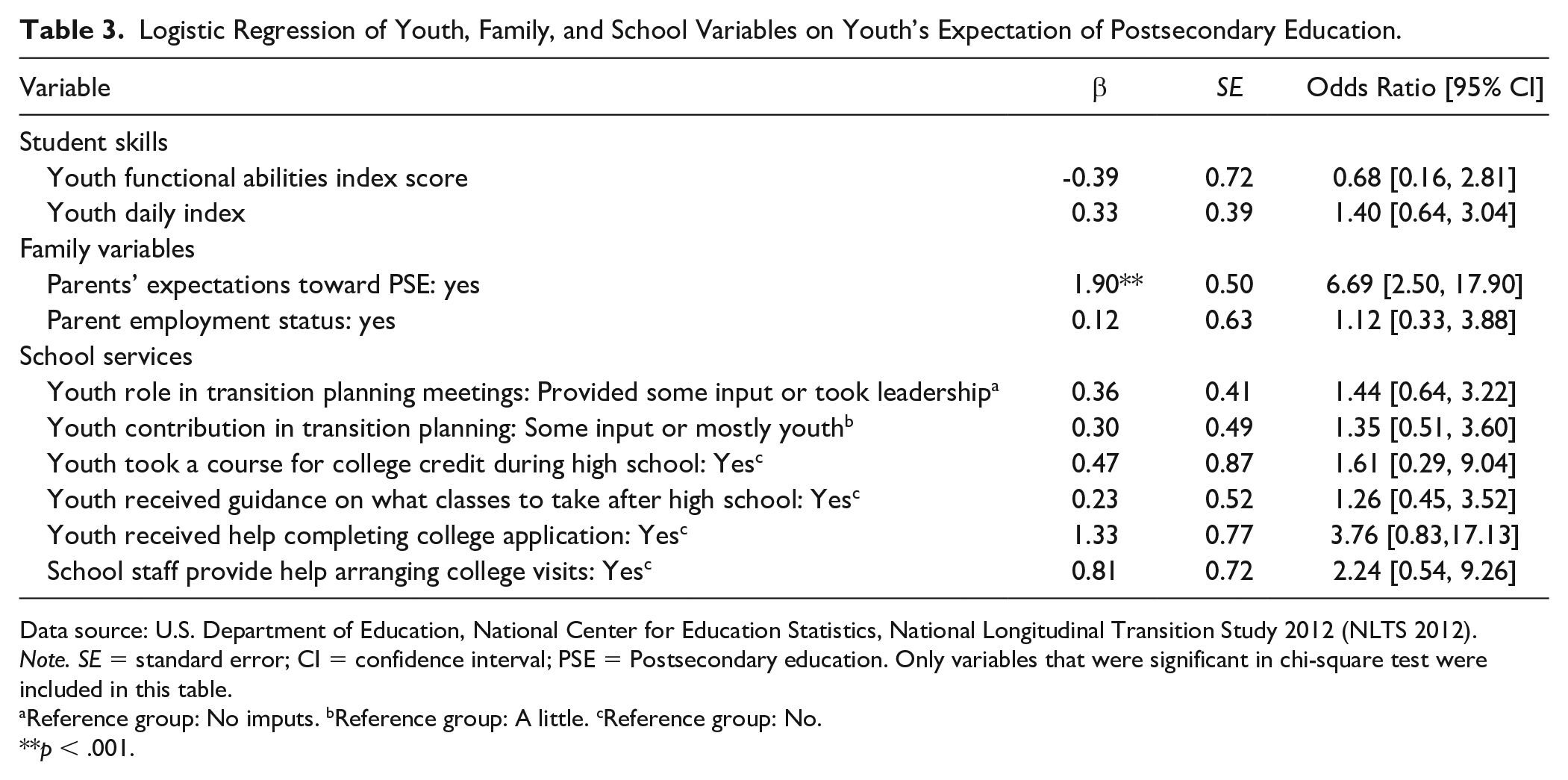
Variables with significant chi-square test statistics on group differences between youth who expected they would obtain PSE or not were included in a multiple logistic regression. The predictors included in the logistic regression model were student variables (youth functional index score and youth daily living index score), family variables (parents’ expectation toward PSE and parents’ employment status), and school services variables (youths involvement in the transition planning meeting, youth contribution in coming up with goals, youth took a course for college credit, youth received guidance on what classes to take after high school, youth received help completing college applications, and youth received help arranging college visit). Of the student and family characteristics included in the logistic regression analysis, parent expectations toward PSE was the only significant predictor of the youth expectation of obtaining PSE. Students with ASD whose parents expected them to go to PSE were 6.7 times more likely to expect they would attend PSE after leaving high school (OR = 6.69, p < .001, 95%CI = 2.50 to 17.90) (see Table 3 for results). None of the student skill variables and variables related to school services were significantly correlated with student expectations toward PSE.
Logistic Regression of Youth, Family, and School Variables on Youth’s Expectation of Postsecondary Education.
Data source: U.S. Department of Education, National Center for Education Statistics, National Longitudinal Transition Study 2012 (NLTS 2012).
Note. SE = standard error; CI = confidence interval; PSE = Postsecondary education. Only variables that were significant in chi-square test were included in this table.
Reference group: No imputs. bReference group: A little. cReference group: No.
p < .001.
Discussion
In an earlier study, using NLTS 2012 data, researchers found that parents’ education levels and students’ participation in college entrance or advanced placement tests were positively associated with parents’ expectations toward PSE of their children with ASD (Qian et al., 2020). Taking a similar approach, we examined factors at the student, family, and school levels linked to students’ own expectations toward PSE. Our findings show that when controlling for these factors, parent expectations are the only predictor associated with the expectations of students with ASD toward PSE. However, chi-square tests indicate several positive associations between student expectation for PSE and college-related school services such as receiving help completing college applications, taking a course for college credits, and receiving guidance for college credits.
The positive association between parent and student expectations toward PSE supports the expectancy-value theory of motivation. This theory posits that students’ expectations toward themselves and beliefs are influenced by others (e.g., parents and peers) in their social environment (Eccles, 2011; Wigfield & Eccles, 2002). According to Wigfield and Eccles (2002), expectancies are beliefs about how one will do on different tasks are influenced by perceived self-competence and difficulty level of tasks, which in turn, are influenced by individuals’ perceptions of other peoples’ attitudes and expectations for them (Wigfield & Eccles, 2002, p. 118). Like their peers without disabilities, beliefs and goals of students with ASD may be influenced by the expectations from parents, as findings from this study have suggested. Consequently, in order to increase the expectations of students with ASD toward PSE, it is critical to understand the mechanism through which parent expectations impact their child’s own expectations and then develop effective strategies to enhance parent expectations.
Research on transition practices has identified effective strategies and resources needed by parents to support their child with ASD in making decisions about PSE programs. Numerous web-based resources are available to help youth with ASD and their parents to conduct college searches and explore campus resources (financial aid, disability services available, on campus housing options; e.g., National Center for College Students with Disabilities, Campus Disability Resource Database). The National Technical Assistance Center on Transition (NTACT, 2022) provides parents with training opportunities and resources in the area of best transition practices to best support their child’s transition from high school to college and employment. Some states make available information and materials to help parents understand postsecondary education options (e.g., Pennsylvania Training and Technical Assistance Network). The youth’s IEP/transition planning team can play an important role in sharing these and other college resources and providing training to parents to raise their expectations for the child’s participation in PSE.
Research has also demonstrated that parent training on transition planning and goal setting can promote increased parent engagement in the planning process. Rowe and Test (2010), for example, examined the effects of a computer-based instructional program on acquisition of parents’ knowledge of the transition planning process (i.e., postsecondary goals, transition services, and postsecondary transition service providers). Parents were trained on how to write postsecondary goals, obtain services supporting these goals, and find possible service providers (e.g., vocational rehabilitation). Results suggested a positive relationship between computer-based instruction and parents’ increased knowledge of postsecondary goals, transition services, and postsecondary transition service providers. Teachers and other school staff should consider how to support parents in developing the knowledge and confidence to become actively involved in transition planning, so that efforts at home and school align. In developing transition-related instructional materials for students, schools should develop parallel materials to be sent home (Griffin et al., 2014). Griffin et al. noted, “This effort may increase not only communication between home and school but may also encourage more frequent discussion between parents and children about life after high school” (p. 263). This discussion, in turn, may help to raise parent expectations for their child’s participation in PSE and other transition areas following high school.
This study did not find parent educational level to be significantly associated with student’s expectations toward PSE. This is somewhat different from what we expected based on previous research that found parent education level was a significant predictor of parent expectations (Kirby, 2016; Qian et al., 2020). One possible explanation is that Kirby’s study used mother’s education level because about 90% of parents responding to the survey were mothers in NLTS2; however, this study used the parent highest education level, which may include the father’s education level if the father had a higher education level than the mother. Additionally, different from the current study, Kirby examined parent expectations in the areas of independent living and paid work, whereas this study focused on student PSE expectations. With regarding to the inconsistencies between this and the Qian et al. study, two other possible explanations are (a) Qian et al. explored the predictors of parents’ PSE expectations, whereas this study explored predictors of youth’s own expectation; and (b) Quian et al.’s sample included not only students with ASD, as we did, but also intellectual disability and multiple disabilities. Furthermore, it might be the case that family socioeconomic status such as parent education has more impact on parent expectation and less on how students perceive their future goals. Future studies need to examine the role of socioeconomic status on both parent and student expectations toward PSE.
We found functional communication skills (e.g., ability to carry on a conversation), daily living skills (e.g., buying things without help), and autonomy (e.g., “I go to restaurants that I like”) were not directly associated with students’ PSE expectations. One possibility is that students included in the analysis may have less support needs given that they were able to self-report. Results should therefore be interpreted with caution. Consequently, there was not much variability in functional and daily living skills, or autonomy. A more diverse sample may have yielded different findings. Furthermore, even though these variables are not significant in this study, it is critical to support students with ASD in developing daily living and self-determination skills, as research has shown these are crucial in preparing students with disabilities to transition from high school to adult life (Shogren & Plotner, 2012; Test et al., 2004).
Research has consistently shown that it is critical to model and facilitate the process of setting goals for PSE participation for students with ASD (Wei et al., 2013). However, we did not find any significant relationship between transition planning (e.g., youth’s contribution to the transition planning process) and students’ expectations after controlling for the impact of student characteristics, family factors, and school services. We speculate one reason may be that the items included in NLTS 2012 pertaining to transition services are more focused on students’ active participation in the transition planning process, not specific to goal setting and planning for postsecondary education.
Regarding school services related to PSE, we did not find any significant predictor for any school service variables (e.g., took a course for college credits, received help arranging college visits) after controlling for student characteristics (e.g., age, gender, functional skills), family characteristics (e.g., household income, parent’s college education or employment status), and other school services. However, several college-related services are positively related to parent expectations in chi-square results, including whether students took a course for college credits, received help completing college applications, or received help arranging college visits. Despite the importance of completing college applications, only 25% of students with ASD in this sample reported receiving such help. One would expect a much higher percentage more consistent with the 75% PSE expectation level expressed by students with ASD in the NLTS 2012 analysis (Lipscomb et al., 2017). This represents a significant gap that schools must begin to address. Students with ASD need access to courses and college resources and experience that prepares them for college much prior to graduating from high school.
Limitations
Several limitations of the current study are noted. First, we included a subgroup of students with ASD between the ages of 16 and 21 years who are able to self-report. This group of students likely do not represent students with ASD who have significant support needs. Thus, results from this study may not generalize to all students with ASD. Second, NLTS 2012 data were collected during 2012 to 2013. Since then, many changes have occurred in the fields of special education and postsecondary education for students with ASD, providing them greater access to college programs (Grigal et al., 2018). Consequently, our findings may not fully estimate the interest and expectations students and parents currently hold toward PSE as a desired and viable option following high school completion.
Implications for Practice and Further Research
Results from this study illustrate the importance of helping students set clear postsecondary goals. This process requires active collaboration between schools and parents. Parents’ expectations toward their child’s future education are strongly associated with how their child with ASD perceives their PSE goals. Transition services may need to include not only focus on strategies that help students set PSE goals, but also connect parents to information and resources on college options and community service agencies that can provide college planning and financial support. As a result of advocacy and policy changes (Grigal et al., 2018), the number of colleges and universities providing opportunities for young adults with ASD has been expanding in recent years. Informing parents of different options and connecting parents with resources may enhance parents’ expectations as well as the expectations their child has for further education beyond high school. Results from this study also suggest the importance of ensuring students with ASD receive help from staff with completing college applications. This type of support needs to be discussed as part of the transition planning process and included as a goal in the student’s IEP, as determined appropriate by the IEP team.
We offer several research directions. First, in this study, we only examined the impact of parents’ expectations. It is important for future studies to explore the extent to which teachers, counselors, and peers influence how students with ASD perceive their future goals related to PSE. Second, although theoretical and empirical evidence has supported the importance of parents’ and students’ expectations, few intervention studies have been undertaken. Thus, further research is needed to identify effective strategies to enhance the expectations of both students and parents toward PSE. Finally, although it is an important step for students to have educational expectations for themselves, future studies need to be conducted to understand how educational expectations from both parents and students are related to actual college attendance.
Conclusion
Research shows that the combined 2-year and 4-year PSE enrollment rate of students with ASD was 32%, third lowest of IDEA’s 12 disability categories, followed by students with intellectual disability and multiple disabilities. Yet, over 75% of students with ASD reported that they expected themselves to attend colleges (Lipscomb et al., 2017). One of the driving factors for increasing student expectations toward their postsecondary education is to enhance their parents’ expectations. Findings from this study further supports the importance of the parents’ role in their child’s perceived expectations toward themselves and highlights the importance of providing training and resources needed by families to best support their child during the transition process.
Footnotes
Declaration of Conflicting Interests
The author(s) declared no potential conflicts of interest with respect to the research, authorship, and/or publication of this article.
Funding
The research reported here was supported by the Institute of Education Sciences, U.S. Department of Education, through Grant R324A180178 to the University of Minnesota. The opinions expressed are those of the authors and do not represent views of the Institute or U.S. Department of Education.
