



Abstract
Harris, D.; Olechno, J.; Datwani, S.; Ellson, R. Gradient, Contact-Free Volume Transfers
Minimize Compound Loss in Dose-Response Experiments. J. Biomol.
Screen.
Original doi:
In the January 2010 issue of the Journal of Biomolecular Screening, pp. 86-94, the figures appeared in the wrong order with the captions. In addition, there were some errors in the captions. The correct order of the figures with their corrected captions appear here.
Corrections to:
Gradient, Contact-Free Volume Transfers Minimize Compound Loss in Dose-Response Experiments

Two opposing strategies can be used to make gradient concentrations for dose-response experiments. The top series, serial dilution, employs transferring the same volume of different concentrations of sample solution. The varying concentrations are made by transferring a fixed volume of the more concentrated fluid into a dilution solution and repeating the dilution in a serial manner. Error is compounded in the multiple serial dilutions, and the potential for sample loss increases with each handling step. Direct dilution, an alternative method (the bottom series) involves transfer of different volumes of the identical solution. Because there is only one transfer to make each new concentration, accumulated error is eliminated. When performed with touchless acoustic transfer, sample adsorption on the transfer surfaces is also eliminated.

Comparison of process used to serially dilute compound with an aqueous diluent versus pure DMSO. DMSO solutions are ten-fold more concentrated therefore only 1/10th the volume, 2.2 µL, is added in the second step. Volumes transferred as indicated provide assay plates at the same concentration. PBS, phosphate buffered saline.

Comparison of aqueous serial dilution versus acoustic direct volume gradient (direct dilution) of fluorescein. The serial dilution data are represented by the open circles, and the linear fit is shown by the solid gray line. The acoustic direct volume gradient data are represented by the filled diamonds, and the linear fit is shown by the solid black line. There are 8 data points per curve.

Comparison of aqueous serial dilution versus acoustic direct volume gradient of 5-dodecanoylaminofluorescein (DDAF). There are 8 data points per curve.
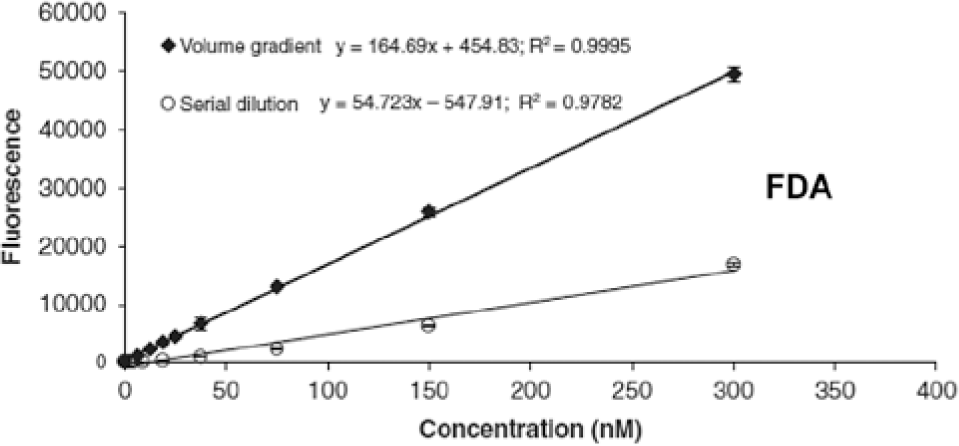
Comparison of aqueous serial dilution versus acoustic direct volume gradient of fluorescein O, O’-diacrylate (FDA). There are 8 data points per curve.

Eight-point curves comparing serial dilution of fluorescein (Left) and 5-dodecanoylaminofluorescein (DDAF, Right) when the diluent is phosphate buffered saline or DMSO. Note change in signal axis.

(Left) A serial dilution of fluorescein remains consistently linear and with no slope when either DMSO or phosphate buffered saline (PBS) is used as the diluent. (Right) When the far more lipophilic 5-dodecanoylaminofluorescein (DDAF) was serially diluted, there were significant deviations from linearity with either DMSO (blue triangles) or PBS (magenta squares) as the diluent. FSU: fluorescence signal; FSU0: Background fluorescence.

Tip reuse with fluorescein by aqueous serial dilutions. Normalized fluorescence (Fluorescence minus background divided by concentration) versus concentration.

Tip reuse with 5-dodecanoylaminofluorescein (DDAF) by aqueous serial dilutions. Note significant deviation from fluorescein data showing significant material is lost in the earliest dilutions.
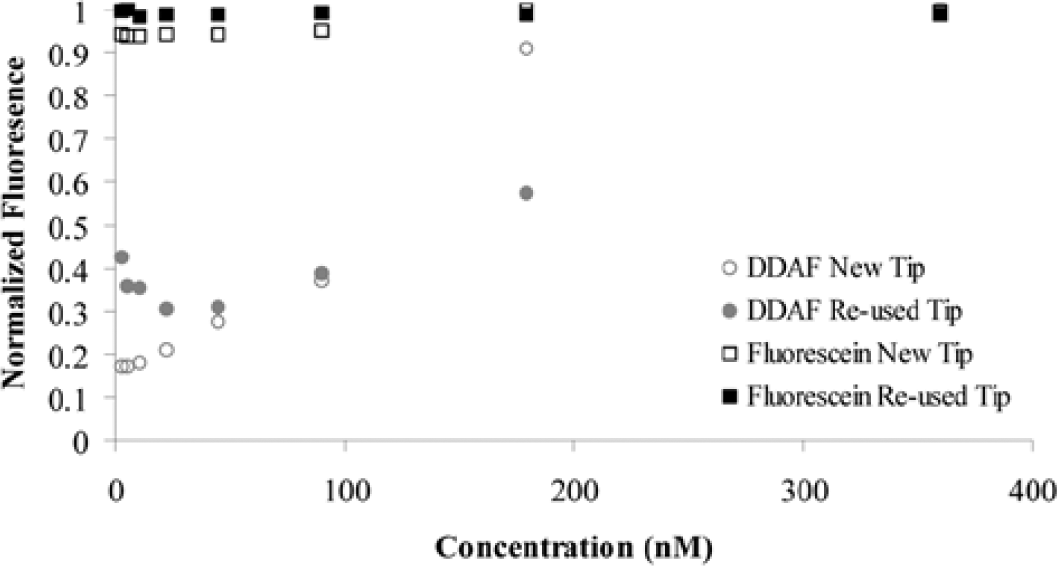
A comparison of normalized fluorescence versus concentration for new and reused tips for both fluorescein and 5-dodecanoylaminofluorescein (DDAF).
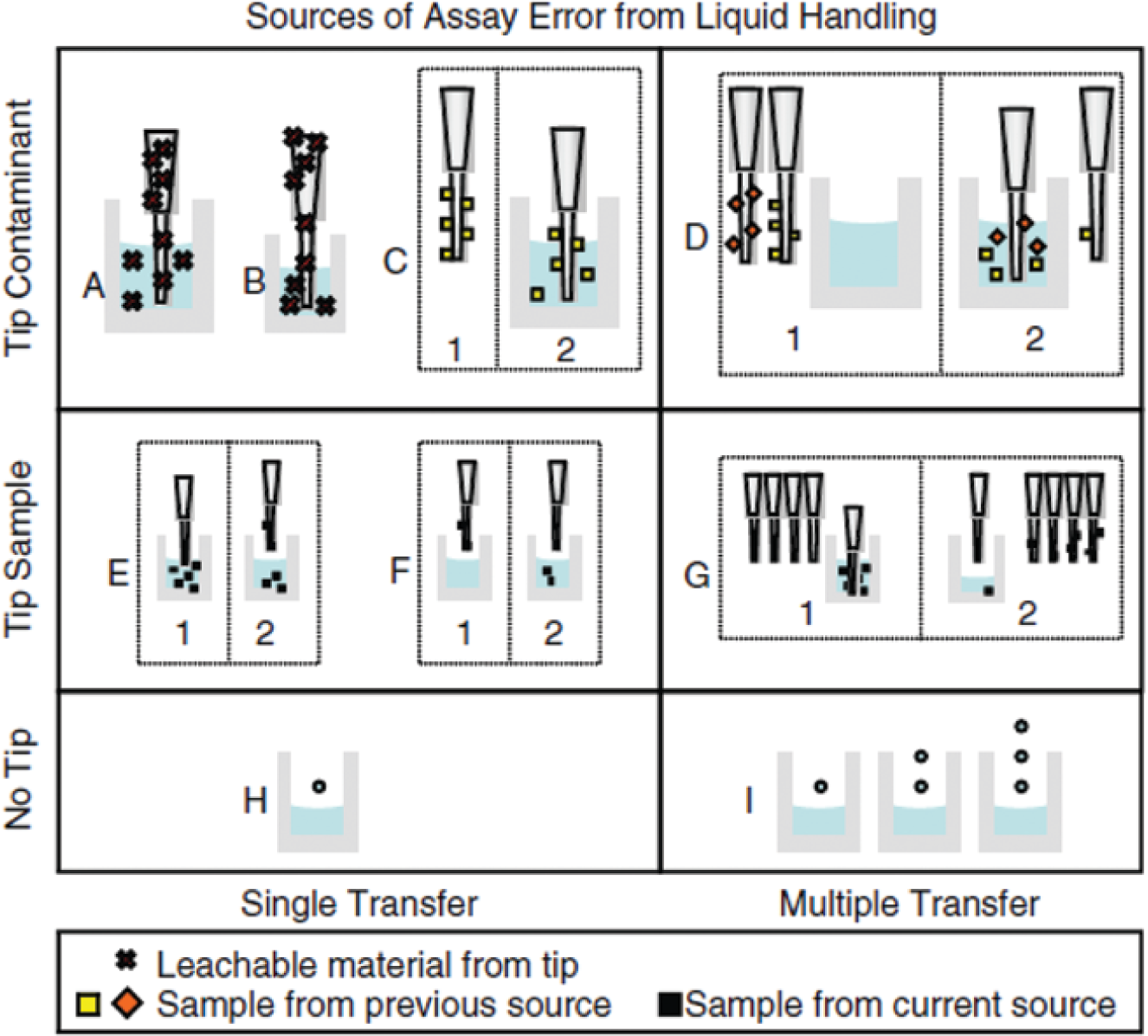
Pitfalls exist in moving samples with liquid handlers. Many are associated with tip use and may increase as assays are miniaturized or when the source fluid is accessed multiple times. (A) Molded tips can contain materials that can leach out, contaminating both source and assay wells. (B) Assay miniaturization increases the surface-to-volume ratio, raising concentrations of contaminants further. Well mixing by aspirate/dispense methods (a common process for dispensing to high-density microplates) may further enhance contaminant transfer. (C) Adhesion of previous sample causes cross-contamination. (D) For multiple sample use by a tip, each tip entry is an opportunity for more cross-contamination from different samples (or tip leaching—not shown). (E) Tips can carry away sample on their exterior surface, depleting the source concentration. (F) Tips carrying adherent sample on their outer surfaces can add more sample than expected from the liquid transfer. (G) Sample wells revisited many times (e.g., 50 transfers of 100 nL from a source well in a 384-well microplate) can deplete the sample, lowering the expected concentration in the source well. (H, I) With no tip to interact with the well, acoustic drop ejection does not exhibit the above errors. The only error is volumetric error intrinsic to all liquid transfers.
The “A” notation preceding each page number in this index indicates that these pages can be found in the front portion of this issue. The publisher is not responsible for the accuracy of the ad index.