




Abstract

Adept Technology
FlexiBowl

This vision-based robotic parts feeding solution is now available as an option on all Adept robot systems. The Adept FlexiBowl uses circular band tracking to simplify and speed the robotic acquisition of component parts used in assembly, handling, and kitting applications. Adept FlexiBowl is capable of quickly separating and orienting a wide variety of parts made from diverse materials. According to Adept, unlike traditional vibratory bowl feeders that have limited flexibility due to high levels of customization, the Adept FlexiBowl uses Adept vision technology to create a flexible standard parts feeding solution that can be deployed and redeployed quickly. In addition to handling an array of parts, the Adept FlexiBowl operates reliably and quietly and is considered easy to operate. The feeder features serial interface connections, encoder latching, and a small footprint. Benefits include quick and easy installation, throughput between 30 and 60 parts/min, and easy maintenance and cleaning.
More: www.adept.com
BioTek Instruments
BioTek Dispensers Reach Nanoliter Levels

To better accommodate assay miniaturization and low-volume dispensing applications, BioTek’s EL406 Micro-plate Washer Dispensers and MultiFlo Microplate Dispensers now are capable of dispensing down to 500 nL via their respective peripump dispensing modes. The EL406 combines microplate washing with peristaltic and syringe pump dispensing for 96- to 1536-well microplates and also automates magnetic bead–based sample processing. The MultiFlo offers parallel dispense technology, dispensing up to four reagents in one compact unit. The modular system can include peristaltic pump dispensing for low prime volumes and backflush features, as well as microprocessor-controlled syringe dispensing for fast and precise dispensing protocols.
More: www.biotek.com
GE Healthcare
Fraction Collector and Sample Pump for ÄKTA Pure Protein Purification System

The new fraction collector and sample pump are specifically designed to enhance ÄKTA pure, the modular chromatography system for protein purification. Designed to handle both air and liquid, the sample pump, together with the sample inlet valve, provides fast, automated, and complete loading of up to seven samples. The air-sensor integrated into the valve detects the final drop of sample, automatically preventing the introduction of air while ensuring the complete sample reaches the column. The sample pump also has a robust wash program that removes any air introduced between samples.
To secure samples from dust and contaminants, the fraction collector is covered, and it supports flexible combinations of collection vessels from deep-well plates to 250-mL bottles. In addition to spillage-free collection across the entire flow-rate range of ÄKTA pure, the fraction collector has inbuilt automatic detection of collection vessel type to ensure sample security.
Two videos illustrate the fraction collector and the sample pump: fraction collector F9-C is available at http://youtu.be/NtQHqmiRIBg, and sample pump S9 and sample inlet valve V9-IS is available at http://youtu.be/a06TspeHQaI.
Genevac
Rocket 4D

The compact Rocket 4D is a fully automated system for automatic drying or concentration of large volumes (a few to 100 liters) in one operation with no user interaction. Users simply load samples, select a method, press start, and walk away. The Rocket 4D uses vacuum technology to dry or concentrate samples and suppresses solvent bumping and foaming. It includes a single 5-L 316 stainless steel vessel for drying or concentrating product. This has detachable handles and is easily lifted into and out of the evaporator. Access to the dried or concentrated product in the vessel is easy. Dried products can be scooped out or, where enhanced user protection is needed, redissolved while the vessel is still in the system. Liquid products can be drained via a drain port in the side of the rotor, using a dedicated pouring stand.
Users wishing to dry volumes larger than 5 L require the autofeed option, which enables the Rocket 4D to draw in product from the user’s own external supply. The Rocket 4D controls product feed, drying, and the discharge of condensed waste solvent without external intervention. The autofeed system has an integrated rinse circuit that enables dried products to be automatically redissolved in a small volume of solvent at the end of the process. Alternatively, the same circuit can be used under manual control for solvent exchange by selecting a different solvent for redissolve.
Cleaning the Rocket 4D between cycles is also very straightforward. The PTFE feed tubing is easily detached for cleaning or replacement, and the vessel can be readily cleaned, wiped, inspected, and even put in a dishwasher. The Rocket 4D also includes powerful cold traps that maximize solvent recovery.
More: www.Genevac.com/Rocket4D
Hamamatsu
FDSS Software Enhancement

A new software function for the Hamamatsu Functional Drug Screening System (FDSS) increases data acquisition speed. The FDSS is capable of imaging-based, whole-plate detection of fluorescence or luminescence with built-in 96-, 384-, or 1536-channel liquid handling. Mainly used in G-protein–coupled receptor (GPCR) and ion channel assays, the FDSS typically produces one image per second, equivalent to 1-Hz data acquisition. However, this new software process allows existing FDSS instruments to have much faster data acquisition, up to 104 Hz, to enable the realization of more assays.
More: www.hamamatsu.com
Hamilton Robotics
Microlab ELISA STARlet
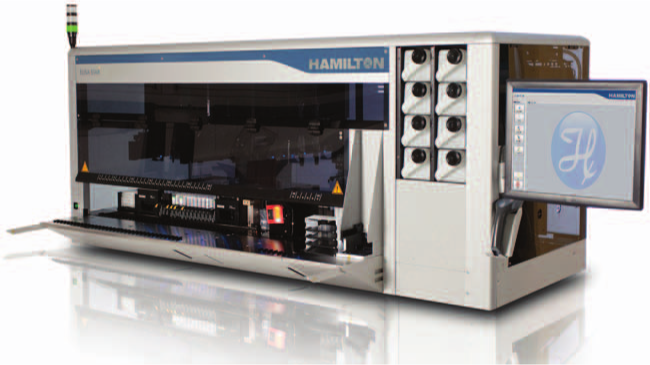
A new module for the Microlab STAR workstation automates enzyme-linked immunosorbent assays (ELISAs) by integrating precision liquid handling instrumentation with multiple devices and software. This module can expand productivity by processing up to 10 plates with minimal hands-on time, enabling walk-away automation and time efficiency. Plates exit into a holding space, rather than the waste container, and enable the user to visually inspect and read the plate on a different instrument or follow any specific directions for disposal. Easy-to-program software calculates all consumable and disposable needs based on sample workflow.
For automation of especially difficult protocols, Hamilton’s application support team can review manual protocols and make suggestions on how to program the instrumentation. Hamilton’s software adheres to IVD specifications with seamless sample tracking, configurable user access rights, and monitoring for all plate transfer steps.
More: www.hamiltonrobotics.com/hamilton-robotics/standard-solutions/elisa-star
Genomic STARlet

Hamilton has collaborated with kit manufacturer MACHEREY-NAGEL to create the Genomic STARlet, an automated liquid handling workstation that extracts nucleic acids from biological samples and purifies PCR products in a non-IVD environment. One instrument can run up to eight preinstalled protocols and accommodate different input samples, including bacterial, eukaryotic cells, tissue, blood, plants, and others. More than a dozen nucleic acid MACHEREY-NAGEL kits have been tested on the instrument, which processes 96 samples in 60 to 144 min depending on the kit, enabling several runs to be performed each day.
The instrument package includes easy-to-use software with an intuitive user interface for easy MACHEREY-NAGEL vacuum protocol selection, and users can switch protocols easily. The Genomic STARlet features real-time clot detection, uses no aerosols due to forceless tip pickup and ejection technology (CO-RE), and minimizes contamination risks with features such as Anti-Droplet Control design. The hardware saves space with an integrated, small-footprint vacuum system, and the CO-RE Gripper provides fast and convenient on-deck transport.
More: www.hamiltonrobotics.com
Molecular Devices
SpectraMax i3 Multi-Mode Microplate Detection Platform

According to Molecular Devices, the SpectraMax i3 microplate reader is equipped with spectral absorbance, fluorescence, and luminescence detection as part of the system. It is expandable with user-upgradeable application-specific detection cartridges and can be enhanced with brightfield and fluorescence cellular imaging enabled by the SpectraMax MiniMax Imaging Cytometer option.
More: www.moleculardevices.com
Synbiosis
aCOLyte 3 Colony Counting System

This automated colony counter is designed for a rapid count of pour, spread, and spiral plates. According to Synbiosis, the system can read plates of up to 90 mm in seconds, generating precise plate count results up to 10 times faster than manual counts. The numerical count data and plate images can be directly transferred to Excel or Open office to avoid errors in data transfer, ensuring accurate good laboratory practice–compliant result reporting and archiving.
The aCOLyte 3 provides full-color image display and includes software based on Synbiosis’ ProtoCOL 3 software. The system can be supplied with a computer or users can connect it to an existing computer with a USB port.
The aCOLyte 3 is lit by white LEDs mounted above and below the plate, enabling accurate detection of colonies as small as 0.3 mm. For laboratories where strong ambient light could interfere, a detachable screen fitted to prevent reflection or glare affecting the count is available.
More: www.synbiosis.com/acolyte-3
About the JBS Product Focus Column
E-mail news releases for consideration to