




Abstract

AMSBIO
3D Culture 96-Well BME Cell Invasion Assay

AMSBIO’s new 3D Culture 96-Well Basement Membrane Extract (BME) Cell Invasion Assay offers a flexible, standardized, high-throughput format for quantitating the degree to which invasive cells in 3D spheroid cultures penetrate a barrier consisting of basement membrane components in response to chemo attractants and/or inhibiting compounds.
The new 3D Culture 96 Well BME Cell Invasion Assay uses a 3D Culture Qualified 96-Well Spheroid Formation Plate alongside a specialized Spheroid Formation extracellular matrix to drive aggregation and/or spheroid formation of cells. Upon completion of spheroid formation, the spheroid is embedded in an invasion matrix composed of basement membrane proteins. This matrix forms a hydrogel network on which invasive cells can travel. At this point, invasion-modulating agents can be applied to the system to evaluate the impact on cell response. Cell invasion is visualized microscopically and can be quantitated through image analysis software.
More: www.amsbio.com/3D-Culture-Spheroid-Cell-Invasion-Assay.aspx
Cell Adhesion Assays

Designed to evaluate optimal cell attachment to extracellular matrices and assess factors that influence cell-matrix interactions, these cell adhesion assays measure adhesion between cells or between a cell and a surface or extracellular matrix.
CultreCoat Assays are precoated and ready-to-use in a black stripwell microplate format that minimizes background, allows greater sensitivity, and affords flexibility in the number of samples assessed. The stripwell feature also allows multiple experiments to be conducted simultaneously using the same kit. Calcein labeling allows direct comparisons between the number of cells that are loaded and the number that adhere. Controls are provided for determining background and nonspecific binding.
Adhesion Protein Array Kits enable a single microplate to assess adhesion on basement membrane extract (equivalent to Matrigel), laminin, collagen I, collagen IV, fibronectin, and vitronectin. The adhesion protein array kit is ideal for research applications that involve screening multiple different extracellular matrices.
For applications focusing on just one extracellular matrix, a new range of basement membrane extract, laminin, collagen I, collagen IV, fibronectin, and vitronectin cell adhesion assay kits can be supplied as one 96-well stripwell microplate precoated with an extracellular matrix of choice and all the reagents required to conduct the assay.
ECM Mimetic and Combinatorial Libraries and MAPTrix Array

AMSBIO’s new Extracellular Matrix (ECM) Mimetic Library for engineering surfaces to direct receptor binding specificity, signaling, and growing cells in 3D contains nearly 300 biomimetics of fibronectin, vitronectin, laminin, and collagen for coating plates or creating 3D culture scaffolds. AMSBIO’s new ECM Combinatorial Library provides a tool for identifying the cellular adhesion profile of cell lines or tumor against the widest commercially available collection of cell surface receptor binding peptide motifs.
Based on the AMSBIO ECM Combinatorial Library, the ready to-use MAPTrix Array provides a means to regulate a variety of cell surface receptors for your cell studies. The basic layout of the MAPTrix Array is composed of avβ3 and its complementary integrins such as a2β1 (collagen), a3β1 (laminin), a5β1 (fibronectin), and heparin binding motif.
More: www.amsbio.com/downloads/MAPTrix/MAPTrixECMLibrary.pdf
Artemis
QS14 Thermoelectrically Cooled CCD Camera
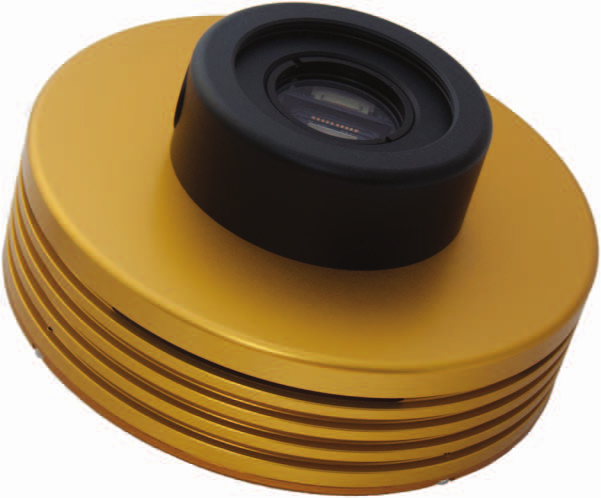
According to Artemis, this new camera is considered versatile and ideal for users who need rapid, high-quality images in low-light conditions. The new QS14 CCD camera features the ICX-285 CCD sensor and provides 1.4-megapixel high-resolution imaging and a frame rate three times faster than the Artemis CCD TS14 camera. The QS14 is supplied complete with an Artemis CCD Software Development Kit, with custom drivers and plug-ins for many commercially available image capture packages to quickly and easily integrate the camera into a range of laboratory equipment.
More: www.artemisccd.com
Cellectricon
Discovery Services
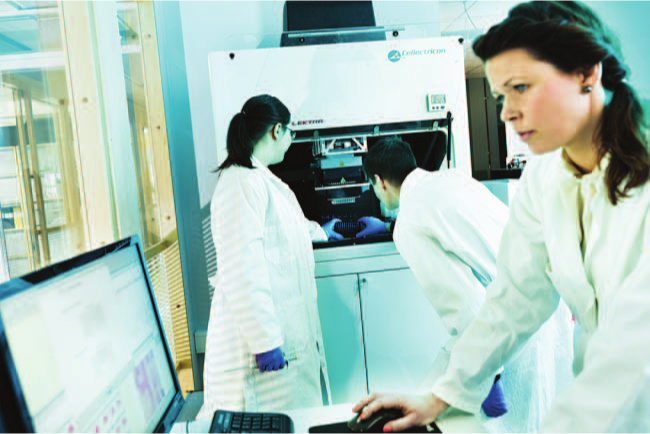
This new division offers phenotypic screening support to accelerate drug discovery and cell-based assay research into cytoskeletal disturbances—especially for chronic pain. Cellectricon’s Discovery Services team provides fully collaborative support, tailored to each individual study. The entire services process is highly interactive and guarantees all partners are well informed via frequent reports on assay performance, observations, and progress, to ensure project goals are fully realized. According to Cellectricon, its Cellaxess Elektra discovery platform is considered ideal for compound profiling in excitable primary cells and native tissue using transfection and specific electric field stimulation.
Cellular Dynamics
Human iPSC Lines under cGMP Conditions

Cellular Dynamics is now producing human induced pluripotent stem cell (iPSC) master cell banks from five individual donors under current Good Manufacturing Practices (cGMPs). According to Cellular Dynamics, manufacturing human iPSCs and ultimately human cells under cGMPs enables the possible use of iPSC-derived human cells within a clinical setting. According to Cellular Dynamics, its iPSC reprogramming and differentiation processes are highly controlled with strong quality management systems, robust operating procedures, and well-defined raw materials. CDI produces iPSCs using an episomal reprogramming process whereby iPSCs can be created from somatic cells without the integration of foreign DNA into the genome and with the use of only fully defined, animal-free, and feeder-free conditions.
Cellular Dynamics is selecting the five donors based on their HLA (human leukocyte antigen) profile, choosing those whose HLA profiles make their cells or tissues most amenable for donation to unrelated recipients.
More: www.cellulardynamics.com
FEI Company
Correlative Microscopy Solution Set: Tecnai with iCorr, Corrsight, and MAPS
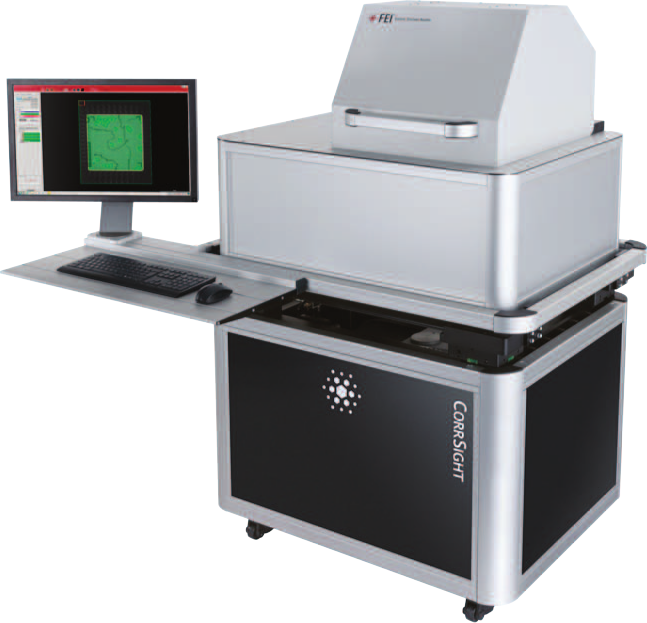
New methods in correlative microscopy from FEI bring data from different imaging techniques together automatically in minutes. A suite of solutions for correlative light and electron microscopy comprises three main components. The first is the Tecnai with iCorr, a fully integrated workflow in which a light microscope is incorporated into a transmission electron microscope column. It allows users to quickly find fluorescently stained cells of interest using fluorescence microscopy and followed by detailed structural analysis using electron microscopy.
CorrSight is an advanced light microscope dedicated to the different steps of correlative experiments, enabling users to image live cell dynamics and quickly fix those cells for electron microscopy. With CorrSight, sample preparation for the electron microscope is integrated with the light microscope, using onboard fixation. Users identify the target structure and prepare the sample on the CorrSight light microscope platform, then transfer the sample to the electron microscope and, with a few clicks of the mouse, navigate directly the target.
MAPS is a software solution that allows correlation between the electron microscope image and an image from any other source through a simple alignment procedure.
More: www.fei.com/correlative-microscopy or http://fei.com/tecnai_icorr
Greiner Bio-One
96-Well SensoPlate Plus Glass Bottom Microplate

This microscopy plate is designed for use in high-resolution microscopy and fluorescence correlation spectroscopy. Consisting of a black cycloolefin frame, it features an ultra-clear borosilicate 175-µm cover glass bottom affixed with a low autofluorescence adhesive. Resistant to DMSO and 70% ethanol, SensoPlate Plus is suitable for cell culture use.
According to Greiner Bio-One, the SensoPlate Plus glass bottom microplate offers an optimized geometry to facilitate trouble-free measurements and high-resolution imaging. Perimeter well microscopy is enhanced by the condensed distance between the microplate well and skirt bottom. Circular wells prevent disruptive shadow with the smallest possible meniscus lens, and a slightly enlarged well diameter allows an increased working volume. A perimeter ditch may be filled with liquid to minimize edge effect during lengthy incubations.
More: www.greinerbioone.com
IntelliCyt
iQue Screener
This new system for high-throughput, high-content cell and bead-based screening enables users to evaluate compound effects on nonadherent cell lines, primary immune system cells, and molecular interactions using low-volume cell or bead-based screening assays. According to the company, IntelliCyt technology provides data on a cell-by-cell basis in 96- and 384-well microplates. Micro-volume sized samples combine with rapid sample processing, and sensitive multiplexing capabilities can screen large libraries speedily.
More: www.intellicyt.com
MIDSCI
Bio-Assembler Kits for 3D Cell Culture

Bio-Assembler Kits use magnetic levitation to culture cells in 3D. Available in single-, 6-, and 24-well configurations, the kits supply magnetic drivers, low-binding dishes/plates, and Nanoshuttle-PL solution in quantities and volumes appropriate to kit size. Nanoshuttle-PL solution delivers magnetic nanoparticles to cells. The magnetic driver that nests on top of the dish/plate then levitates the cells to create a 3D environment. Using the Bio-Assembler Kits is as easy as performing standard 2D cell culture plating and propagation. Bio-Assembler Kits are available from MIDSCI through an agreement with n3D Biosciences.
More: www.midsci.com
About the JBS Product Focus Column
E-mail news releases for consideration to