



Abstract

Art Robbins Instruments
COBRA 148 Liquid-Handling Systems

Art Robbins Instruments’ new COBRA 148 liquid-handling systems enable users to rapidly and accurately assemble assays, aspirating and dispensing as little as 300 nL in 96- to 1536-well microplates. According to Art Robbins Instruments, the systems provide assay developers the flexibility to design assays using precious or costly reagents and cells without constraint. Users have complete control over the volume dispensed in each well, enabling complex concentration gradients and even sparse-matrix assay development strategies. With an option for on-the-fly dispensing, 300 nL can be dispensed into an entire 384-well microplate in 14 s and 25 µL in 39 s. Aspiration and dispensing from microplates is a standard feature in the one- and four-channel models, virtually eliminating dead volumes and preserving precious reagents. A dedicated eight-channel bulk dispensing system is available for very high-throughput applications. A wash station facilitates integrated tip washing.
More: www.artrobbins.com
Beckman Coulter Life Sciences
Biomek 4000 Laboratory

Automation Workstation
The new Biomek 4000 incorporates easy-to-use, icon-driven software and an enhanced work surface with interchangeable tools. Modular deck configuration allows the work surface to be set up with 8 standard positions, expandable to 12 positions. New single and multichannel 1000 mL pipetting tools offer higher throughput for assays using volumes greater than 200 mL and up to 1000 mL.
Method building is considered simple, and editing features allow specialized and one-off applications to be addressed. Most pipetting functions are available through transfer and combine steps, while the flexibility to fine-tune individual pipetting steps is retained. Pipetting templates and liquid-type editors are standard in the software and make adapting pipetting for any liquid straightforward. The software interface provides icons for liquid handling, labware movement, and control of external devices. Building blocks for common pipetting tasks, such as liquid transfers or serial dilutions, provide a guide through method editing.
Prewritten methods for common life sciences tasks are available as add-ons and include PCR Reaction Setup, which automates reaction setup and primer design for 24- or 96-well format labware. A template method for cell staining applications offers a starting point for several cell-based workflows and uses a graphical user interface. These applications do not require programming capability and include on-site training and support.
Interchangeable tools are available in various volume ranges. The modular deck configuration allows the device to be tailored for specific applications. Up to 12 deck positions make space available for the automation of tasks. Off-deck mounts for the tool rack and a liquid-waste station open up deck positions. An optional enclosure and heating, cooling, and shaking accessories are available. The AccuFrame tool provides fully automated deck framing for increased accuracy using 3D positioning.
More: www.biomek4k.com
BioTek Instruments
405 LS Microplate Washer

According to BioTek, this intuitive and flexible microplate washer for 96- and 384-well microplate washing is especially suited for robotic installations, including BioTek’s BioStack Microplate Stackers and third-party systems or remote operation. The 405 LS may be operated via a keypad interface or by a computer with powerful Liquid Handling Control (LHC) software. Integrating many of the same features as BioTek’s ELx405 Microplate Washers, the 405 LS may be used with vacuum filtration and biomagnetic separation bead-based assays and includes a Dual-Action manifold for independent aspirate/dispense control and Ultrasonic Advantage for unattended wash manifold maintenance. Automated internal buffer switching and quick-release manifolds add to overall flexibility for applications ranging from vigorous washing protocols to gentle washing for loosely adherent cell monolayers.
More: www.biotek.com
Synergy NEO HTS Multi-Mode Microplate Reader
According to BioTek, NEO’s technology is tailored for smaller cell-based screening assays and maintains ultra-fast, high performance found in traditional high-throughput screening (HTS) readers. It includes multiple parallel detectors to decrease measuring time and dedicated filter-based optics for live-cell assays. Its Hybrid Technology combines filter-based and monochromator-based systems in one compact unit. In addition, NEO’s optional integrated plate stacker can transfer plates in about 6 s (per plate) and allows walk-away automation. Gen5 Data Analysis Software controls predefined or custom protocol creation, data processing, and export flexibility. Additional adaptations include a 100-mW laser-based excitation source for Alpha assays, temperature control to 65 °C, and orbital and linear shaking. Unique filter cubes are barcoded for positive filter identification, and a camera-based scanner can read 1D and 2D barcode-labeled plates.
More: www.biotek.com
BioStack3 Microplate Stacker
The new BioStack3 features a dual-plate carrier and rotational wrist to quickly move plates from the source stack to the instrument and back to the destination stack, keeping two plates in process. According to BioTek, BioStack3 is the fastest stacker of its kind, designed to provide increased throughput for batched processes. In less than 10 s total transfer time, BioStack3 can remove one plate from an instrument carrier and replace it with another microplate. In addition, it features a choice of 10, 30, or 50 microplate storage stacks and maintains a small footprint for use in a biosafety cabinet or hood. BioStack3 automates routine microplate-based processes when integrated with most BioTek instrumentation for walkaway automation.
More: www.biotek.com
BMG LABTECH
Nephelostar Plus PR Microplate Reader
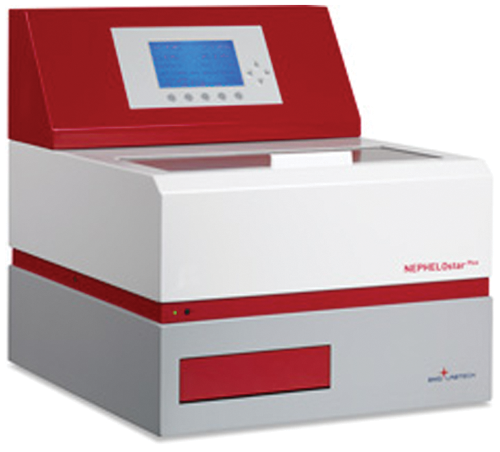
According to BMG, the NEPHELOstar Plus is the only laser-based nephelometer that measures light scattering in a microplate-based environment. The NEPHELOstar Plus detects insoluble particles in liquid samples by measuring forward scattered light. The flexibility and performance of the NEPHELOstar Plus allows more applications to be adapted to light scattering, including compound solubility screening, microbial cell growth kinetics, antibody-antigen interaction, immunoprecipitation, and polymerization monitoring.
The NEPHELOstar Plus can be up to 30 times more sensitive than traditional transmission readers that measure the absorbance via optical density. Options to adjust the intensity and beam diameter of the laser light allow for more precise measurements in colored or turbid solutions. In addition, the flexible beam diameter allows for measurements in 24-, 48-, 96-, and 384-well microplate formats. These features, along with BMG LABTECH’s Digital Photon Integration (DPI) technology and a detection angle of 80°, ensure that the NEPHELOstar Plus nephelometer is approximately 30 times more sensitive than conventional transmission readers.
More: www.bmglabtech.com
Fluidigm
C1 Single-Cell AutoPrep System
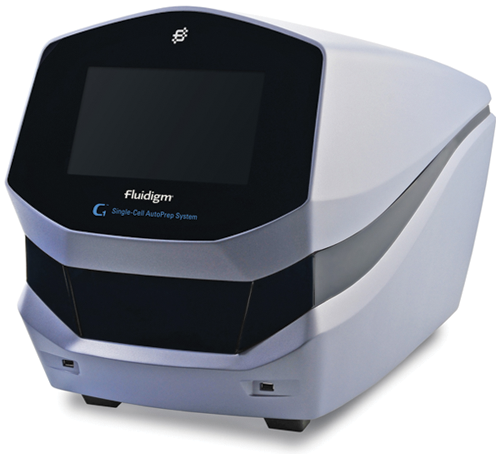
According to Fluidigm, its new C1 System is based on Fluidigm’s microfluidic technology and enables users to isolate and process individual cells rapidly and reliably for genomic analysis. Users can isolate cells, extract RNA, and then reverse transcribe and preamplify mRNA transcripts automatically to enable detection and analysis of cell activity. The C1 System is designed to work seamlessly with the BioMark HD System and includes the C1 Single-Cell AutoPrep Array chip and the C1 Single-Cell AutoPrep Reagent Kit. Stem cell, cancer, and immunology research are expected to be the initial focus applications for the C1 System.
The C1 System workflow is initiated by loading a sample of cells in solution into the C1 microfluidic chip in a single pipetting step, then directing the C1 System to rapidly and automatically isolate up to 96 individual cells into individual chambers for preparation. After loading, users can choose an “in-process” quality control checkpoint to verify the number of captured cells and distinguish live from dead cells to preserve data integrity. The workflow then proceeds with a rapid “on-chip” cell lysis without RNA purification, reverse transcription, and preamplification without hands-on reagent mixing and sample transfer. The final preamplified cDNA product is thereafter harvested to collection wells for transfer to the BioMark HD System for quantitative PCR analysis.
Hudson Robotics
Rapid_pH Workcell

The Rapid_pH is a new workcell designed for high-speed pH measurement in microplates. According to Hudson Robotics, this new workcell can measure the pH of every well in a 96-well microplate in less than 6 min with 0.1 accuracy and without the delays and inaccuracies inherent in electrode-based measurements.
More: www.hudsonrobotics.com/products/biological-esearch/automated-ph
RapidWash High-Speed Washer
For 96-well and 384-well microplates, standard height and deep well, this new washer offers high-throughput washing for enzyme-linked immunosorbent assays (ELISAs), cellular assays, and other processes requiring washing and aspirating. According to Hudson Robotics, it is the smallest (9.25-inch [W] × 15-inch [D] footprint) automated plate washer on the market. The RapidWash has high speed: less than 9-s 96-well fill/aspirate cycle and low residual volume of <2 µL per well.
More: www.hudsonrobotics.com/products/liquid-handling/rapidwash
Thermo Fisher Scientific
Automated Nucleic Acid Extraction WorkStation
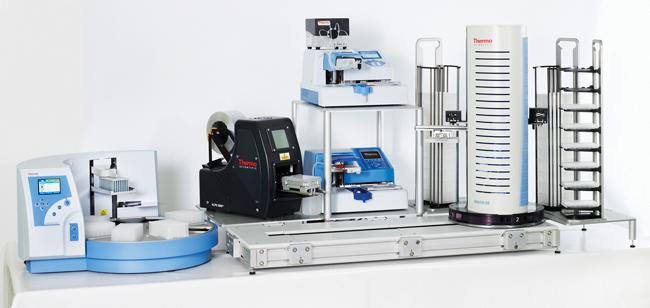
Designed to provide cost- and time-effective nucleic acid extraction, users can process samples from virtually any source while ensuring accuracy and sample integrity. According to Thermo, the system is considered ideal for a variety of downstream applications, including sequencing, cloning, and both PCR and quantitative PCR, and it allows instruments to be used in a complete workflow, alone or even interchanged while the system is running.
Controlled and monitored by the Thermo Scientific Momentum scheduling software, the Automated Nucleic Acid Extraction Workstation and other networked tools can be programmed to ensure the simultaneous running of multiple processes. When leaving the instruments unattended, the software provides accelerated simulation to test required processes in advance, isolating problems and delivering recovery options for the workflow.
The system integrates the Thermo Scientific Kingfisher Flex purification system, Multidrop Combi reagent dispenser, Alps 3000 microplate heat sealer, and Orbitor RS or Orbitor BenchTrak, with a number of other components, including instrument drivers, storage hotels, and a waste station. Key to the efficient movement of plates between the different instruments and storage hotels is the incorporation of the Orbitor RS or Orbitor BenchTrak. For smaller workflows, the Orbitor RS provides high-speed, reliable microplate movement with highly flexible plate handling. Enhancing the functionality and versatility to support larger workflows, the Orbitor BenchTrak includes a track for the Orbitor to move along, extending the reach of the plate mover and enabling access to more instruments and storage hotels.
More: www.thermoscientific.com/nucleicacidextraction
About the JBS Product Focus Column
E-mail news releases for consideration to