



Abstract

Akonni Biosystems and Hamilton Company
TruTip Extraction Products for Hamilton Microlab STAR Workstations
According to Akonni Biosystems, starting from fresh or frozen blood, buffy coat, and soon tissue or cells, these new TruTip kits extract superior quality human genomic deoxyribonucleic acid (gDNA) simultaneously from 8 to 96 samples in just 57 min on the Hamilton Microlab STAR line of robotic liquid-handling workstations. The system does not require a magnetic head, vacuum manifold, centrifuge, or other space-consuming or expensive capital equipment. Polymerase chain reaction (PCR) inhibition due to bead carryover is also eliminated because there are no magnetic beads required, as are errors due to clogging typically caused by vacuum manifolds.
The TruTip family of products uses a porous nucleic acid–binding matrix embedded in a pipette tip and extracts DNA or ribonucleic acid (RNA) using well-understood chaotropic salt chemistry. This new kit for gDNA completes the entire extraction process (including a fully automated onboard heat incubation step) in less than an hour (20 min for heat incubation and 37 min for extraction) and is more than 250% faster than most traditional high-throughput approaches.
More: www.akonni.com

AMSBIO
Cultrex 3D Culture Cell Harvesting Kit
The Cultrex 3D Culture Cell Harvesting Kit is based on a nonenzymatic approach that prevents biochemical degradation during processing and overcomes the problems associated with extracting cells from 3D culture in basement membrane extract (BME) or Laminin I. The quality of the harvested cells is considered ideal for Western blotting and RNA and DNA analysis. According to AMSBIO, this new kit provides an optimized and standardized solution for the isolation and normalization of cell lysates from 3D Culture Matrix, BME, or Laminin I for subsequent biochemical analysis.
More: www.amsbio.com/3D-Cell-Culture-Assays.aspx

Bio-Rad Laboratories
Two SPR Kits
When used with the ProteOn XPR36 protein interaction analysis system, these surface plasmon resonance (SPR) kits enable the accurate analysis of lipids and membrane proteins with peptides and small molecules. The new Hydrophilic ProteOn LCP Liposome Capturing Kit and the Lipophilic ProteOn GLC Lipid Kit stably and selectively capture lipids and lipid assemblies for easier screening and analysis of membrane protein targets during drug discovery.
With the ProteOn LCP Liposome Capturing Kit, the ProteOn LCP sensor employs memLayer technology to selectively and stably capture lipid assemblies. The native lipid-like environment of the chip surface resembles the cell membrane. Proteins are not “squashed” on the surface and can be captured to ensure high-quality data. Workflow for this kit is based on novel hydrophilic surface chemistry. Capable of capturing multiple layers of lipid assemblies, this kit allows label-free detection for binding analysis of peptides and small molecules. It also empowers researchers to gauge drug absorption by monitoring interactions at the lipid’s surface and tracking uptake of molecules into the assembly. The ProteOn LCP capturing reagent kit, included in the ProteOn LCP Liposome Capturing Kit, is used to activate the LCP sensor chip with a biotinylated DNA tag that then hybridizes to DNA-tagged lipid assemblies containing membrane proteins of interest. The surface is easily regenerated with water and ready for reuse.
The ProteOn GLC Lipid Kit provides a basic, easy-to-use option to study interactions of membranes with proteins and peptides. The kit can capture lipoparticles containing membrane protein drug targets of interest. Antibodies against those drug targets are then screened to measure binding kinetics. Users can customize the lipophilicity of the GLC sensor surface before capturing lipid assemblies (e.g., proteoliposomes and lipoparticles) by controlling the amount of alkylamine that is bound to the sensor surface. This provides greater experimental flexibility, and because the surface is stable and regenerable, researchers have greater confidence in the quality of data collected over the course of a screening protocol.
More: http://bit.ly/LCP_Liposome-Capturing or http://bit.ly/GLC_Lipid
Fluidigm
C1 Single-Cell AutoPrep System
The C1 System uses Fluidigm’s microfluidic technology to isolate and process individual cells rapidly and reliably for genomic analysis. Users can isolate cells, extract RNA, and then reverse transcribe and preamplify mRNA transcripts automatically to enable detection and analysis of cell activity. The C1 System has been specifically designed to work seamlessly with the BioMark HD System to enhance the workflow and reliability of data for scientists studying single-cell genomics.
The C1 System workflow is initiated by loading a sample of cells in solution into the C1 microfluidic chip in a single pipetting step, then directing the C1 System to rapidly and automatically isolate up to 96 individual cells into individual chambers for preparation. After loading, users can choose an “in-process” quality control checkpoint to verify the number of captured cells and distinguish live from dead cells to preserve data integrity. The workflow then proceeds with a rapid “on-chip” cell lysis without RNA purification, reverse transcription, and preamplification without hands-on reagent mixing and sample transfer. The final preamplified cDNA product is thereafter harvested to collection wells for transfer to the BioMark HD System for quantitative PCR analysis. The system includes the C1 Single-Cell AutoPrep Array chip and the C1 Single-Cell AutoPrep Reagent Kit.
More: www.fluidigm.com

GE Healthcare
TALON Chromatography Media
HiTrap TALON crude, His SpinTrap TALON microspin, His MultiTrap TALON, and His GraviTrap TALON prepacked with TALON Superflow media are now available from GE Healthcare for rapid screening, preparative purification, and easy scale-up of histidine-tagged proteins. According to GE, samples derived from a variety of expression systems can be readily purified with minimal sample preparation time and no additional equipment costs.
TALON Superflow is a cobalt-based medium designed for the purification of histidine-tagged recombinant proteins by immobilized metal affinity chromatography (IMAC). Compared with nickel-charged media, cobalt-based media offer enhanced selectivity and yield purity for histidine-tagged proteins. In addition, lower concentrations of imidazole are required during purification, which better preserves the structure and function of sensitive histidine-tagged proteins.
TALON Superflow medium and prepacked formats are considered suitable for IMAC purification of histidine-tagged proteins when Ni2+ is not the optimal choice of metal ion; high-yield purity in a single step, using a mild purification process, preserves the structure and function of sensitive histidine-tagged proteins; prepacked HiTrap TALON crude 1-mL and 5-mL columns and His GraviTrap TALON gravity flow columns allow direct loading of unclarified samples to minimize labor and protein degradation; and His SpinTrap TALON spin columns and His MultiTrap TALON 96-well plates enable screening with highly reproducible column-to-column and well-to-well results.
More: www.gelifesciences.com/protein-purification or www.gelifesciences.com/sampleprep
Integrated DNA Technologies
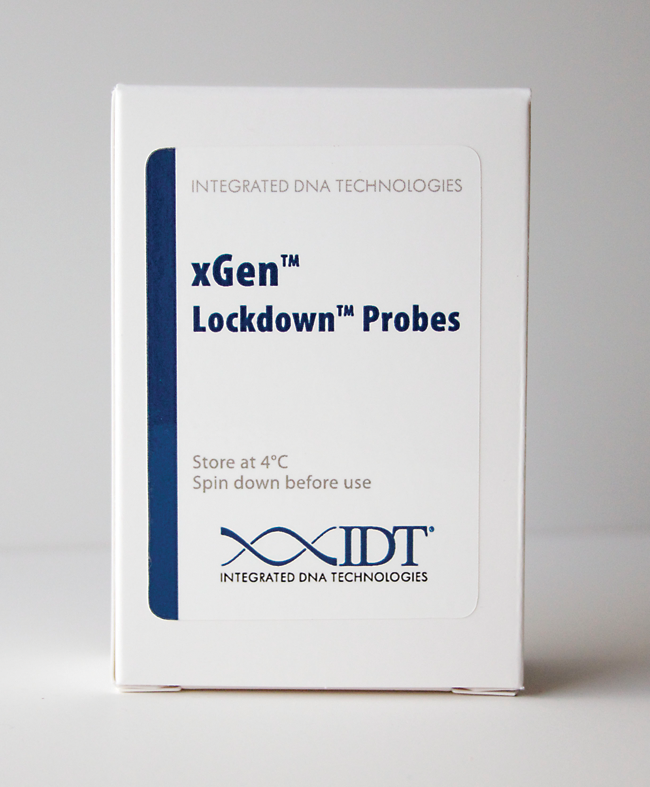
Scalable xGen Lockdown Probes for Next-Generation Sequencing
The new IDT xGen Lockdown Probes are individually synthesized 60- to 120-nucleotide 5′-biotinylated capture oligonucleotides designed to enable cost-effective, high-depth sequencing and analysis of specific regions of the genome. They are considered ideal for target enrichment and custom panel development, and capture sets can be easily expanded. Available at three different scales (mini, 2 pmole; standard, 20 pmole; and XL, 200 pmole), users can design their initial capture panels using the mini scale and extend them by progressively supplementing with more probes. As a result, it is quick and simple to transition to higher volume applications.
Whether used with custom capture panels or for supplementing existing panels, xGen Lockdown Probes provide approximately 5000-fold enrichment with high coverage over targeted regions and minimal GC bias. Furthermore, the probes can be added to array-derived RNA baits to enhance coverage of GC-rich targets, such as first exons. Users can therefore improve capture performance by rescuing drop-out regions of array-derived exome capture, improve the uniformity of coverage, discover additional genetic mutations, or improve coverage of specific regions of interest without redesigning a new panel.
Each probe is individually synthesized and quality assessed via mass spectroscopy, providing high levels of performance. They are supplied in 96- or 384-well plates or as pools of up to 2000 oligos.
More: www.idtdna.com
Solentim
Cell Metric CLD Bench-Top System
According to Solentim, its new Cell Metric cell line development (CLD) system offers high-resolution cell imaging and analysis as an alternative approach to manually checking cell line monoclonality. It provides fast, unequivocal identification, qualification, and tracking of clones derived from single cells. The Cell Metric platform is paired with an integrated stacker system to form the new Cell Metric CLD.
High-resolution imaging offers three times as many pixels as previous generation cell imaging instruments, and Solentim’s Cell Metric CLD system generates clear images of cells taken soon after seeding or sorting, providing confidence that a colony has grown from a single cell. Continual imaging during early colony growth means that any wells containing multiple colonies can be quickly identified and eliminated. The system also benefits from an automatic focus, ensuring that images are clear, consistent, and informative. The ability to easily distinguish between pairs of close-proximity cells and debris, coupled with uniform, clear imaging right up to the well edge, provides complete assurance that users start with a single cell per well. Importantly, such early, accurate, and reliable evidence can eliminate the need for a second round of subcloning, providing a saving of up to 10 weeks in the development of a new cell line. The Cell Metric CLD’s integrated, temperature-controlled microplate stacker allows for the automated imaging of a batch of up to 10 plates at a time with throughput of up to 100 plates a day.
More: www.solentim.com

TTP Labtech
chipCAL Microliter Flow Calorimeter
According to TTP Labtech, its new chipCAL’s fast throughput enables characterization of enzyme activity to be achieved within 2 to 10 min per sample. In addition, chipCAL is considered suitable for monitoring a range of processes in the biopharma, food, and fermentation industries. chipCAL employs a flow principle, whereby enzyme and substrate are passed through a thermodynamic cell simultaneously. This allows chipCAL to detect thermodynamic changes using volumes as low as 15 µL, minimizing the amount of valuable sample used per analysis. chipCAL’s microliter flow calorimetry also provides the additional benefit of noncontact, label-free sample monitoring. chipCAL has a working temperature range from 15 to 60 °C. Following analysis, samples are passed through to a waste unit, and a new sample can be loaded without the need for a wash stage. chipCAL is capable of analyzing up to 60 samples in an 8-h working day.
More: www.ttplabtech.com

About the JBS Product Focus Column
E-mail news releases for consideration to