




Abstract
Many compound collections are stored under the same temperature conditions, which can limit flexibility by increasing the processing time required for high-demand compounds. In this study, the authors wanted to evaluate the impact of a hybrid-storage approach where high-demand compounds are stored for a shortened time period at room temperature to expedite processing operations. The use of a Covaris adaptive-focused acoustics platform was also characterized as a potential enhancement or alternative to storage at elevated temperatures. This study evaluated the impact of temperature, exposure, and solubilization on overall compound quality for short-term storage. A small library of 25 representative compounds was evaluated over an 18-week period to monitor the change in purity and concentration by high-performance liquid chromatography with ultraviolet detection. The authors concluded that temperature had a significant impact on compound concentration, and the effects due to exposure cycles were minimal. A storage time of 12 weeks at room temperature resulted in minimal compound loss, but storage times beyond this would be unacceptable because of a >20% decrease in concentration. Finally, the acoustic solubilization protocol also increased the number of compounds at the target concentration with no impact on overall purity, leading to a potential for increased storage times at frozen temperatures.
Keywords
Introduction
Multiple groups have recognized that maintaining compound quality is dependent on both storage conditions and sample handling methods.1–3 Our workflows within Amgen have been built around low-volume, single-use operational tubes that are periodically prepared as replicates from high-volume, multiuse archive tubes, both stored at temperatures of −8 or −20 °C. This design minimizes the number of times an archive tube must be accessed by instead relying on the single-use tubes for normal operations. This approach effectively serves the majority of the collection, but we have recently noticed that certain compounds enter stages of high demand for a shortened period (<3 months) of time. These high-demand compounds often require frequent replenishment from multiuse archive tubes, which can affect the number of freeze-thaw cycles a compound undergoes. The extended sample handling time can lead to a decrease in overall order fulfillment efficiency and degradation in sample quality from unnecessary exposure outside of the store. Although one potential solution might be to prepare more initial single-use tubes, it is often hard to predict how much material will be required, and the preferred approach has been to replenish on-demand.
One alternative approach is short-term storage at room temperature, which would eliminate the need for thawing and reduce sample handling time. Other groups have shown that compound quality can remain stable for 4 to 6 months4–6 at room temperature, but the labware was significantly different from our archive operations, leading to questions around the form factor used to store compounds. In this study, we wanted to understand the impact of short-term storage at room temperature as compared to the effect of multiple freeze-thaw cycles on overall compound quality in labware relevant to our operations. For our characterization of freeze-thaw events, we were primarily interested in the cumulative effect of both the freeze-thaw and the water uptake that is common with sample handling during formatting operations. Investigations to date that have explored the impact of freeze-thaw cycles have not attempted to characterize these effects independently.4,7,8 We believe it is more precise to discuss these combined effects as exposure cycles in place of the term freeze-thaw cycle, which may refer to only the freezing-thawing effects in the absence of sample handling.
We also wanted to investigate the possibility of implementing a sonication-based protocol to accelerate sample thawing and solubilization of compounds prior to analysis. Approaches using traditional sonication 9 and recently introduced adaptive focused acoustics (AFA) 10 have both been reported as possible methods to initially solubilize compounds in library wells. The AFA approach has been shown to be more amenable to compound management operations due to the increased sample throughput resulting from the use of higher energy acoustic waves.
In this report, we explored effects of temperature and exposure on compound concentration to understand the feasibility of short-term storage on high-demand compounds in our labware, storage volumes, and temperature stores. Previous studies have typically characterized the stability of compounds in a low-volume (<40 µL) 96- or 384-well plate format, which differ significantly from the high-volume (1.4-mL) Matrix tubes that Amgen has standardized for archive compound storage.4,6–8 As we will demonstrate, the labware format can affect the experimental parameters, so it is important to consider the storage vessel form factor in any stability validation study. We also wanted to characterize the effectiveness of a resolubilization protocol using a Covaris AFA platform. This technology has received some attention for one-off compound solubilization, 10 but we instead have focused on understanding the impact of multiple solubilization cycles over the life of a compound as might be typical in a compound management environment.
Materials and Methods
Study design
A total of 25 compounds were selected based on historical observations of samples that had previously shown solubility problems in DMSO stock after visual inspection of library compounds in solution. These compounds were further refined to maximize diversity based on cLogP (2–8) and MW (200–600), representative of typical samples in the collection. All compounds in the study contained at least one nitrogen atom and were a mix of acids, bases, and neutral compounds. Although these compounds represented the potentially “worst case” with respect to long-term solubility, this also ensured that we would be working with compounds that were known to be of a particular concern in a compound management setting. The study was divided into three separate data sets to independently characterize the impact of temperature, exposure, and solubilization on the concentration of compounds using different storage conditions and protocols. Each of the data sets used the same time points at 0, 2, 4, 6, 12, and 18 weeks for a total of six measurements over the course of the study, but the handling protocol was unique for each data set, and each compound was analyzed a single time (n = 1). The three studies, analysis time points, and protocols are summarized in
Experimental Design for Three Study Sets
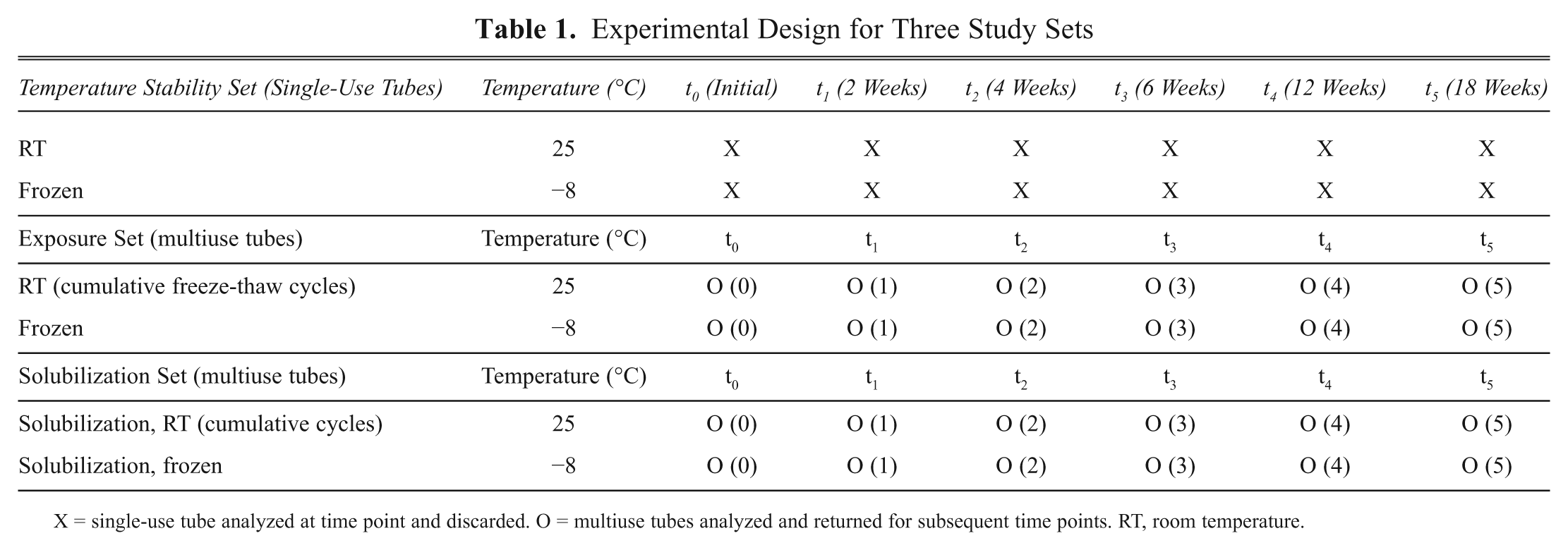
X = single-use tube analyzed at time point and discarded. O = multiuse tubes analyzed and returned for subsequent time points. RT, room temperature.
The temperature set samples were prepared as single-use tubes for each time point. This ensured that effects due to sample handling were minimized and any change in the sample concentration could be related to the storage temperature. The exposure and solubilization sets were prepared as multiuse samples such that the same tube could be used throughout the study. These were samples prepared from a single-source tube that was analyzed and then returned to the store for the subsequent time points. This resulted in the samples for the exposure and solubilization sets undergoing multiple exposure cycles versus a single cycle for the temperature set. In total, the exposure and solubilization sets underwent five exposure cycles over the course of the study.
Sample preparation, storage, and exposure
Stock concentrations were prepared in dry DMSO (<0.2 wt% H2O by Karl-Fischer titration) to 10 mM from solid material. The stock solutions were aliquoted into an array of 1.4-mL Matrix storage tubes (BC3006; Thermo Scientific) using the volume described in the study design. The temperature single-use set consisted of 6 × 30-µL tubes, one for each time point, whereas the exposure and solubilization multiuse sets both consisted of a single 150-µL tube that would be analyzed multiple times. Once dispensed, the Matrix tubes were capped and put in the specified storage conditions. Room temperature (RT) samples were stored in a TTP comPOUND (TTP LabTech, Inc., Cambridge, MA) store at ambient temperature and humidity. Frozen samples were stored in a Remp store at −8 °C and 9% relative humidity (RH). Samples were removed only at the specified time point and were either discarded or returned to the store based on the study design described above. An additional control sample was prepared for the exposure set that went through all of the handling steps over the course of the study but was analyzed only at the final time point to account for any differences that may have occurred due to variable volumes being investigated. A control sample was prepared at the same concentration but at a volume of 600 µL (fourfold increase over exposure set) to act as a control against surface-to-volume effects for water uptake. All tubes were prepared as a single instance (n = 1) for this study.
Prior to analysis, samples for the given time point were removed from the store and allowed to equilibrate at ambient temperature for 30 min without mixing, followed by centrifugation for 2 min at 1000 rpm on an Allegra 6 (Beckman Coulter, Brea, CA) Centrifuge. Samples remained capped during this equilibration, with the caps only being removed prior to transfer into the analysis plate. An Evo 3000 (Tecan, Männedorf, Switzerland) protocol was used to dispense 15 µL of each sample into a 96-well polypropylene round bottom plate (Costar 3365; Corning, Corning, NY) followed by vacuum heat seal with a PlateLoc (Agilent Technologies, Santa Clara, CA) plate sealer. The dispensing protocol took approximately 15 min, after which tubes were recapped and returned to the specified temperature store, simulating real-world handling protocols.
Sample solubilization protocol
Each sample from the solubilization set of the study was subjected to a further protocol of 15 s at 200 V and 18 °C on a Covaris E210 Focused Acoustic Solubilzer (Covaris, Woburn, MA). This protocol was applied after sample thawing but before samples were uncapped to limit water uptake concerns. The entire protocol took under 30 min to complete for a 96-tube rack, further minimizing variables introduced by sample handling. Samples were immediately dispensed in the 96-well analysis plate after completion of the Covaris solubilization protocol.
Sample analysis by LC-UV-MS
An Agilent 1100 binary high-performance liquid chromatography (HPLC) system connected to an MSD SL quadropole mass spectrometer (MS) with an electrospray ionization (ESI) source was used for all measurements. A Phenomenex (Torrance, CA) Gemini C18 2.0 × 50-mm column with 3-µm particles was operated at 1 mL/min and 50 °C using 100% water and 100% acetonitrile as mobile phases A and B, respectively, with 0.04% trifluoroacetic acid (TFA) added to each phase. The gradient consisted of a linear slope starting at 10%B and ending at 100%B over 2.5 min. This method provided a peak capacity of 65, which was sufficient for our analysis of relatively pure compounds. Analysis plates were spun at 1000 rpm for 2 min before final analysis. A 1-µL injection was performed directly from the 96-well analysis plate with no dilution. The detection was accomplished by UV at both 215 nm and 254 nm using an Agilent Micro Flow Cell with 6-mm path length (G1315–60015), and the mass of the target compound was verified by the M + H peak. An external caffeine standard was run in triplicate at the beginning, middle, and end of each time point. The relative standard deviation (RSD) of the replicate external caffeine standards for each plate was <0.5% within each time point, indicating sufficient injection reproducibility.
Data processing and quantitation
The peak height for each compound was measured at 215/254 nm before the study began, and the wavelength, which provided a response in the range of 1–2 AU, was selected to ensure the compound would have both sufficient signal to noise (S/N) in the case of degradation and would also remain within the linear range of the detector. In cases where both 215 nm and 254 nm gave a similar response, 254 nm was selected because of better S/N from reduced baseline noise at that wavelength. Once the wavelength was identified for each compound, the peak area was measured by an optimized ChemStation (Dayton, OH) integration routine and the final result exported to a Microsoft Access database for subsequent processing and correlation.
The initial peak area for each compound was first determined at t0. All subsequent time points were processed in the same way and used to normalize to the initial t0 peak area to monitor the relative change in concentration over the course of the study. A freshly prepared 10-mM stock solution of caffeine in DMSO was also analyzed at each time point to account for any drift in the UV detector over the course of the 18-week study. Data were normalized by the following equation:

where An and Sn are the peak areas of the targets and caffeine standard, respectively, at the given time point, with t0 being the initial time point. The RSD of the caffeine standard peak area over the course of the study was <3%, indicating the HPLC system was stable within our requirements. Data are presented as a normalized peak area to t0 but are a direct measure of the change in concentration over the course of the study. The majority of the results are presented as a best polynomial fit (Igor Pro 6.1; WaveMetrics, Lake Oswego, OR) to the mean peak area for all the study compounds at each time point. Error bars are presented as the standard error of the mean for each data set.
A final analysis of the sample purity at time point 5 was completed to compare the purity of compounds between the exposure and solubilization sets. After time point 5, samples had been stored for 18 weeks and undergone 5 exposure or solubilization cycles. This allowed for a meaningful comparison between the liquid chromatography (LC)–UV purity to verify that the solubilization protocol did not negatively affect compound purity. Purities were measured at UV215 and reported as a percentage of the target peak to the impurity peaks.
Results and Discussion
Validation of study volumes
Consideration of the factors related to the volume of DMSO solution in each tube was important because water uptake by DMSO is a function of both exposure time and the surface-to-volume ratio in the tube. DMSO water uptake in microplates has been shown to be on the order of hours, leading to the potential for significant water uptake from minimal sample handling alone.
11
Because this study required different volumes between the single-use temperature and multiuse exposure/solubilization sets, a preliminary validation experiment was conducted to compare the water uptake between the 30-, 150-, and 600-µL volumes in the Matrix storage tubes used for study. These data were necessary to verify that the water uptake at the lower volumes used in the temperature set would not be significantly faster than for the larger volumes used in the multiuse studies. The results, presented in
Selection of LC-UV-MS methodology
A variety of techniques for absolute quantitation of library compounds have been reported. Nuclear magnetic resonance (NMR) is routinely identified as the most accurate but also the most expensive and least amenable to automation for larger sample sets. Alternative HPLC detectors such as evaporative light-scattering detection (ELSD), chemiluminescent nitrogen detection (CLND), and charged aerosol detection (CAD) have been shown useful for targeted sets of similar compounds but are less applicable to diverse libraries where absolute errors of 20% to 50% have been reported.13–16 In addition, these detectors depend on a number of parameters to ensure reproducible introduction of the sample and can be affected by HPLC method conditions. Without careful attention to maintenance, calibration, and sample conditions, these detectors can exhibit drift over time, further limiting the usefulness for a time-based study. As an alternative approach to absolute quantitation or relative purity over time, we decided that monitoring the relative change in concentration of the parent with reference to an external standard would offer sufficient data. This approach would also allow the use of a standard UV detector, which offers a linear response over a wide dynamic range and exhibits minimal drift over time. This provides a more universal approach to analyzing a diverse set of compounds without the use of the individual standards or less reliable detectors.
Temperature study
The goal of the temperature set was to characterize the changes in concentration for the selected library of compounds across an 18-week time period. The samples were all prepared as single-use samples such that any change in the concentration could be related directly to the temperature storage conditions. The results of the temperature set are presented as the mean change in concentration at each time point in
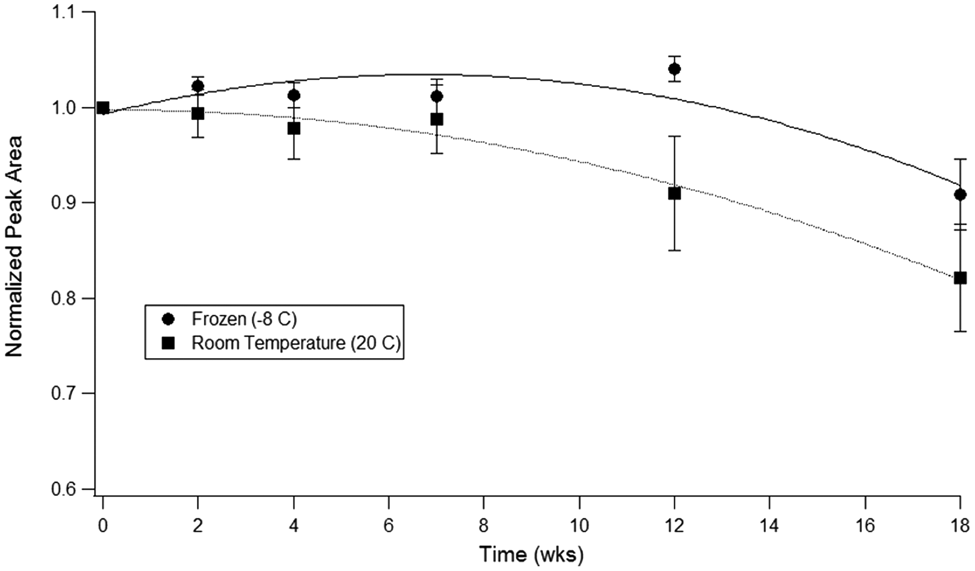
Temperature set. Comparison of best fits to mean normalized peak area for −8 °C (dashed) and 20 °C (solid) storage conditions in the temperature set study with error bars representing standard error (n = 1 for each time point).
It is worth noting that the compounds that showed the greatest change after 18 weeks showed this change at the early time points. For all of the compounds in our study, if the compound experienced a >50% change in concentration, this occurred during the first two time points (specific examples can be seen in
Exposure study
The exposure set was designed to evaluate the impact of multiple exposure cycles on a single sample tube over the course of the study. As our archive material exists in multiuse storage tubes, understanding the cumulative impact of handling exposure is an important factor. Our results, presented in
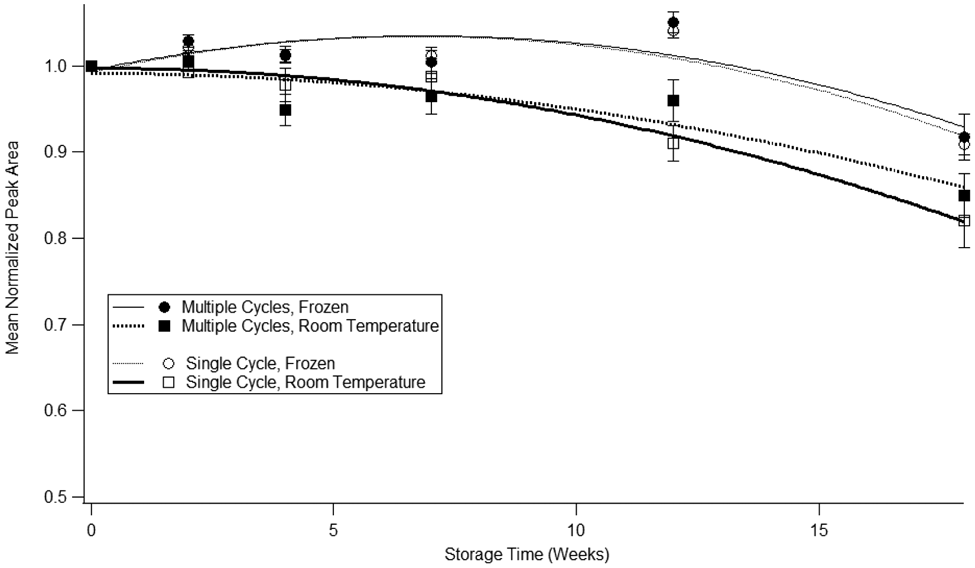
Exposure set. Exposure cycle comparison of average peak area for all study compounds at frozen and room temperatures. Data presented as best fit to mean peak area at each time point and condition with error bars representing standard error (n = 1 for each time point).
Solubilization study
A final study was completed to evaluate the impact of AFA technologies to improve the consistency of the compound concentration over an extended time period. In this set, a single sample was characterized over the course of the study with the addition of an AFA protocol applied before dispensing into the analysis plate. The hope was that this protocol would resolubilize the target compound prior to analysis to mitigate loss of compound due to precipitation. The results of this analysis are presented in
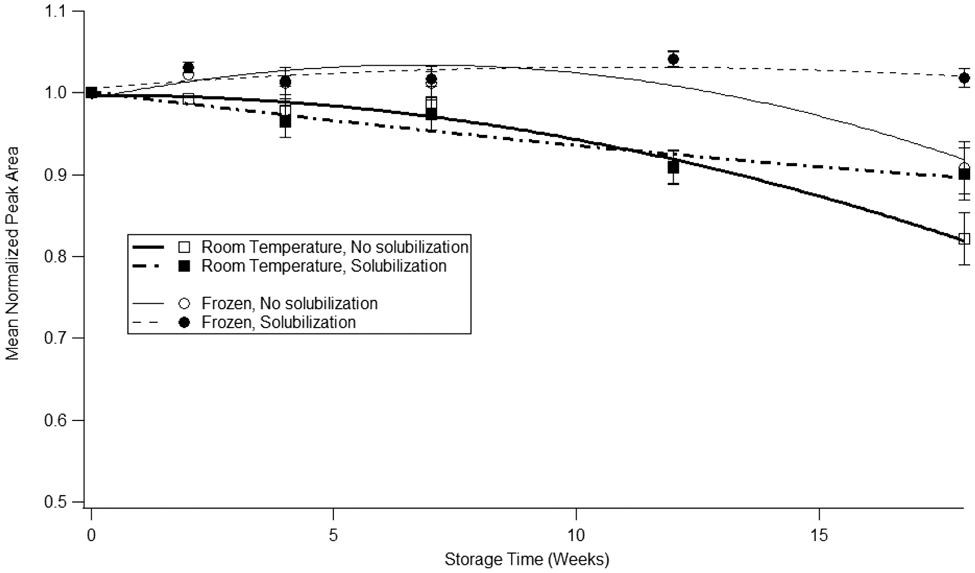
Solubilization set. Comparison of mean peak areas for solubilization protocols at frozen and room temperature storage conditions across all 18-week storage times. Lines represent best fit to data acquired at specified time points with error bars representing standard error (n = 1 for each time point).
The greater impact of the solubilization protocol on the frozen set is consistent with decreased compound solubility at reduced temperatures, leading to a greater degree of precipitation. The application of the AFA protocol prior to analysis, therefore, helps to reduce precipitated material and increases the effective concentration in solution. Although this seems like a reliable approach, it should be noted we have not characterized the kinetic solubility factors associated with the AFA protocol. Differences between thermodynamic and kinetic solubility have been well documented, 18 and it is possible to super-saturate solutions due to kinetic effects, only to have the compound rapidly (<24 h) precipitate as it reaches the thermodynamic equilibrium. In our results, we analyzed the samples around 2 h after the AFA protocol was applied. This timeframe may be feasible for internal compound management reformatting operations but would be unrealistic from the perceptive of a high-throughput screening (HTS) group where a significant delay between formatting and analysis can occur. These kinetic factors will be important to understand as we evaluate the potential of AFA technologies in our compound management workflow.
Another concern when using acoustic methods for solubilization is the effect on sample purity. Earlier reports have generally shown that methods using both traditional sonication and focused acoustics are relatively soft and show little impact on compound degredation.9,10 The purity of the compounds was further analyzed over the course of multiple solubilization cycles, as would be required in the compound management environment, to evaluate the combined impact of exposure and solubilization cycles on sample stability. These results (shown as raw data in
From these data, we have seen that AFA is a potential tool to resolubilize library compounds in both frozen and room temperature conditions. Our results are consistent with previous studies that indicate temperature is more important to maximizing compound concentration over storage life, and even with resolubilization protocols, compounds stored at a higher temperatures will have a decreased lifetime. What we remain concerned about and were not able to address in this study with respect to AFA is the kinetic solubility factor. Although it seems that AFA is an approach to resolubilize compounds, the fact that the concentrations may be quite dynamic is likely of greater concern to HTS workflows.
We have been able to conclude three key points from this focused study:
Compound concentration decreased by 20% after 18 weeks of storage at room temperature compared to only 10% for low-temperature conditions.
A limited number of exposure cycles (≤5) had little impact on compound concentration with storage temperature being far more important.
A high-throughput resolubilization protocol using adaptive focused acoustics increased the concentration of compounds under both temperature conditions, but more research is needed to understand kinetic solubility factors.
These data support our hybrid storage approach where newly prepared compounds that have a high demand are stored in a short-term store at room temperature. They also indicate that temperature is a more critical factor than exposure cycles, so caution must be used when trying to minimize freezing and thawing by storage at elevated temperatures. Finally, the data indicate the possibility of increasing the use of focused acoustics for thawing and resolubilization to potentially eliminate the need for short-term room temperature storage.
Footnotes
Acknowledgements
We acknowledge the Amgen Materials Management group for their support of this work. Cheryl Dhlos was instrumental in developing the Covaris solubilization protocol and assisting us with implementation. Conversations with Yaxiong Sun and Amanda Lembke also provided valuable insights into the sample handling operations. Finally, we thank John McCarter and David Semin for thoughtful conversations regarding the project and final manuscript.

References
Supplementary Material
Please find the following supplemental material available below.
For Open Access articles published under a Creative Commons License, all supplemental material carries the same license as the article it is associated with.
For non-Open Access articles published, all supplemental material carries a non-exclusive license, and permission requests for re-use of supplemental material or any part of supplemental material shall be sent directly to the copyright owner as specified in the copyright notice associated with the article.
