




Abstract

A2 Technologies
Integrated FTIR Analyzer
Designed for the rapid analysis of liquids by FTIR spectroscopy and based on A2’s ML analyzer, this new FTIR spectrometer occupies 8 square inches on a laboratory bench. DialPath technology features a tumbler-like optical head that can be rotated into position to provide one of three factory-set, selectable sample pathlengths between 30 and 250 microns. To analyze a sample, a drop of the liquid is placed on a stationary infrared-transparent window mounted on the top surface of the analyzer, and then a second window is rotated into position, thus sandwiching the sample between the two windows and creating a highly reproducible, fixed-sample pathlength between the two windows.

More: www.a2technologies.com
Beckman Coulter
MoFloAstrios Cell Sorter
This next-generation sorter leverages the fluidic design of the original MoFlo and the electronic processing of the MoFlo XDP while expanding sorting capabilities with laser options. A range of software components further enhances functionality. Complex, multicolor sorting is enabled by seven pinholes that spatially separate each of the seven lasers.Auto startup allows users to define when lasers and fluidics turn on.The multifiber Beam Shaping Optic creates flat-top beam profiles, providing short alignment times and high-level optic stability.Two stages control the alignment for all seven lasers to simplify sorter preparation.
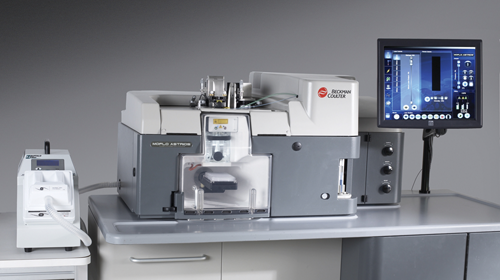
Beckman Coulter’s IntelliSort II is a beadless drop delay determination and monitoring system. Camera images and proprietary algorithms determine optimal drop delay without fluorescent beads being incorporated in the sample line. A quick-release nozzle design enables easy removal or swapping of the nozzle body and tip through the use of a single lever.The auto-quality control allows system performance to be tracked and trended across 32 available parameters, whereas the updated Summit Software permits six-way sorting into tubes and sorting into plates having as many as 1536 wells. Index-sorting logic tracks each plate-sorted cell back to its histogram or scatter plot. A touchscreen control panel facilitates daily setup with operations designed around core laboratory workflow.
More: www.beckmancoulter.com
Beckman Coulter Genomics
SPRIworks Fragment Library System III
Combining Solid Phase Reversible Immobilization (SPRI) chemistry and Beckman Coulter automation, SPRIworks System III automates library preparation for its three next-generation sequencing platforms. One to 10 samples can be completed within 3.5 h, and the process provides several size selection and nick translation options. The system uses a dedicated, color-coded method card and cartridges. Thus, library construction for all three sequencing platforms can be conducted using one instrument and the appropriate method card and cartridges.

More: www.beckmangenomics.com
Biotage
ChemMatrix Resins
New to Biotage’s peptide synthesis and purification products, ChemMatrix is a 100% PEG resin from Matrix Innovation that offers advantages over traditional PS- and PEG-based resins for solid-phase peptide synthesis. According to Biotage, this technological tool enables synthesis of complex molecules from biological origin, peptides, oligionucleotides, and small proteins. This resin is supplied as classical spherical beads.

More: www.biotage.com/peptides
FEI Company
Magellan Extreme Resolution SEM
According to FEI, its new Magellan Extreme Resolution scanning electron microscope (SEM) enables life science researchers and cell biologists to view the entire organization of a cell in its natural, fully hydrated state. The Magellan’s workflow solution includes cryogenic sample preparation and handling and is a repeatable, optimized process.The Magellan SEMs provide high-throughput, sub-nanometer resolution even at low accelerating voltages.

More: www.fei.com
GE Healthcare
Membrane Protein Purification Kit
This new kit is designed for detergent screening of histidine-tagged membrane proteins, enabling simultaneous evaluation of solubilization and purification efficiency. Analysis and evaluation can be performed by a number of methods such as Western blot, gel filtration, or light scattering.The kit contains seven detergents in ready-to-use solution (purity ≥99% by high-performance liquid chromatography [HPLC] analysis), His Mag Sepharose Ni, buffer stock solutions, and an easy-to-follow protocol and is sufficient for two complete screening experiments.

More: www.gelifesciences.com
Greiner Bio-One
PapilloCheck High-Risk HPV Test
Augmenting Greiner Bio-One’s existing biochips product portfolio, the new PapilloCheck high-risk test, focuses on parallel analysis of 14 human papillomavirus (HPV) types of the high-risk group (hrHPV) that are recognized as carcinogenic. In a recent clinical study, the test system, based on microarray technology, showed a clinically relevant sensitivity of 95.8% and a clinical specificity of 96.7% for the detection of high-grade precancerous lesions.

Olympus
UPLSAPO 30× and 60× Silicone Oil Objectives
According to Olympus, the new UPLSAPO 30× and UPLSAPO 60× objectives can markedly improve optical performance for live-cell confocal, wide-field fluorescence, multiphoton, differential interference contrast (DIC), and other applications. The new silicone oil objectives have advantages over both traditional oil and water immersion objectives for deep and long-term imaging. They provide higher resolution and brighter images when imaging within deep samples when compared with oil immersion objectives and are useful in long-term imaging experiments where, in the past, water evaporation has been an issue.The new 30×, 1.05 NA, 0.8-mm working distance and 60×, 1.3 NA, 0.3-mm working distance objectives reduce loss of contrast due to spherical aberration when compared with conventional oil objectives. By reducing the mismatch between the refractive index of the specimen and that of the immersion medium into which the objective is dipped, they provide higher resolution and brightness when imaging into thick samples.

RheoSense
m-VROC 2.5 Viscometer
This newly enhanced analytical system for viscosity measurements is compact, portable, and equipped with automatic chip recognition and closed-loop temperature control. For more control of the test environment, an optional air purge unit and a Peltier chiller can be added. The mechanical and electronic interfaces have been enhanced, making it even easier to capture, view, and record viscosity measurements. The m-VROC provides accuracy with small sample volumes: 50 µL. Its measurement range (0.1–100k cP viscosity) and high shear rates enable it to analyze virtually any liquid viscosity value, Newtonian and non-Newtonian. With the Peltier chiller option, the closed-loop temperature control system can operate at a range of 4 °C to 69 °C with the accuracy of ±0.05 °C. The core of the system is VROCMEMS chip developed by RheoSense.

More: www.rheosense.com
Syrris
AsiaRange of Flow Chemistry Systems
According to Syrris, its new Asia portfolio is scalable and modular for any flow chemistry requirements and offers maximum chemical resistance, wide temperature (–15 to 300 °C) and pressure (0-20 bar) range, and the ability to safely provide accurate temperature control. With fast reaction times and microgram to kilogram scalability, it enables manual or automated operation with optional PC control.The Asia flow chemistry range consists of three different series, each with three preconfigured systems providing varying levels of functionality. The Asia 1 series systems are manually operated. The Asia 2 series systems can automatically perform one experiment at a time, with automated parameters such as reaction temperature, pressure, and collection timings. Fully automated for process optimization, the Asia 3 series is considered ideal for high-end applications.

More: www.syrris.com
The Automation Partnership (TAP)
12-Well Version of RAFT
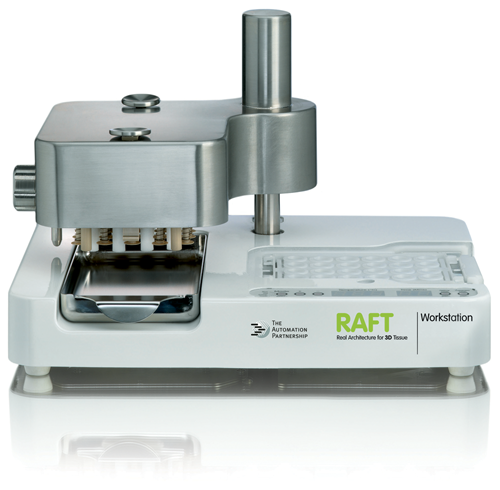
The new RAFT (Real Architecture for 3D Tissue) generates reproducible, 3D collagen tissue models. It consists of a workstation, consumables, and reagents to create consistent models in less than 1 h. The 12-well and 24-well plate options allow the flexibility to produce a range of 3D tissues, including multicellular models, barrier models, and air–liquid interface cultures. The constructs generated can be used for a wide range of cell-based assays or regenerative medicine applications.
More: www.automationpartnership.com
