




Abstract

Agilent Automation Solutions
Webinar: How to Successfully Scale PCR Workflows from Benchtop to Automation
According to Agilent, a new Webinar presents techniques for introducing reliable automation into small- and large-scale applications ranging from single cells to core laboratory applications, thereby minimizing the potential for introduction of errors into the PCR process. The webinar shares examples from the Quantitative Genomics Laboratory at the University of Texas Health Sciences Center, the Laboratory of Molecular Medicine and Global Health at Brandeis University, and Agilent Automation Solutions. It provides guidelines for when to consider moving to a liquid handling robot, what constitutes good practice for using a robot, robot use for precision pipetting for qPCR applications, scaling up from a lab bench to an automated system, setting up automated qPCR assays on 96- and 384-well plates, and the benefits of using LATE-PCR on the single-cell scale.

BioTek Instruments
Synergy H1 Hybrid Multi-Mode Microplate Reader
The Synergy H1 is a monochromator-based multimode microplate reader for UV-Vis absorbance, top and bottom fluorescence, and luminescence assays that can be upgraded to a hybrid reader with the addition of a high-performance filter module. This independent filter module with dichroic mirrors supports fluorescence polarization, time-resolved fluorescence, time-resolved fluorescence resonance energy transfer, and bioluminescence resonance energy transfer assays with ultra-high sensitivity. Synergy H1 includes BioTek’s Gen5 Data Analysis Software and is compatible with BioTek’s Take3 Multi-Volume Plate that measures up to sixteen 2-µL samples, 2 BioCells, or a standard cuvette for multivolume, multisample analysis.
More: www.biotek.com
MultiFlo Microplate Dispenser
According to BioTek, its new all-in-one MultiFlo Microplate Dispenser uses multiple technologies to dispense multiple reagents into multiple microplate types. It dispenses up to 4 independent, parallel reagents in volumes from 1 µL to 3 mL and microplates from 6- to 1536-well, including low profile, standard height, deep well, and even microtubes. Two integrated peristaltic pumps provide low prime volumes, full reagent recovery, and high chemical compatibility, whereas 2 integrated syringe pumps feature program-and-forget solutions without need for instrument recalibration or consumables. Fully modular architecture means that any dispensing combination may be chosen and upgraded as necessary. Dispense flow rates are fully adjustable from high-velocity media exchanges to gentle washing for delicate cell-based applications. Dispense protocols may be created and run through the keypad interface or through BioTek’s LHC Software. Combined with BioTek’s BioStack Microplate Stacker, MultiFlo may be programmed for unattended dispensing of up to 75 microplates.

More: www.biotek.com
Fluidigm
FR48.48 Dynamic Array IFC
According to Fluidigm, its new FR48.48 Dynamic Array integrated fluidic circuit (IFC) is the first reusable biochip for the single-nucleotide polymorphism (SNP) genotyping market for a wide range of applications, including plant and animal biotechnology. The reusable chip can decrease the cost per genotype by up to 80% for ultra-high-throughput SNP genotyping compared with Fluidigm’s single-use 48.48 Dynamic Array IFC, and it can support an accelerated workflow for higher sample throughput applications. Each chip can be used up to 5 times and can produce results for 48 samples across 48 assays for a total of up to 11,520 genotypes over the 5 uses. Fast-loading and thermal cycling allows a single operator to run more than 3× the numbers of samples in a day compared with using single-use 48.48 Dynamic Array IFCs. The reusable chip provides 99% or greater call rates and 99.75% or higher accuracy. The launch of the reusable FR48.48 Dynamic Array IFC is accompanied by the introduction of the IFC Controller WX, a device that automatically performs fast loading or cleaning of this reusable IFC. The reusable chip can be loaded in 30 min, and the overall time for loading and thermal cycling is about 1 h, compared with approximately 3 h for single-use 48.48 Dynamic Array IFCs.

More: www.fluidigm.com
GE Healthcare
ÄKTA Avant 150 LC System
With flow rates up to 150 mL/min, the ÄKTA avant 150 liquid chromatography system is designed for process development and scale up to ensure smooth transition from discovery to full-scale production. The UNICORN 6.1 control software enables seamless method transfer between ÄKTA avant 25 and ÄKTA avant 150. UNICORN 6.1 also comes with integrated Design of Experiments (DoE) functionality. ÄKTA avant includes several features for optimal operational security such as a cooled fraction collector and traceable column handling. ÄKTA avant also supports intelligent packing of AxiChrom columns for predictable scale up to production scale.

More: www.gelifesciences.com/aktaavant or www.youtube.com/watch?v=JtNZllv_2Qs
Manz Automation
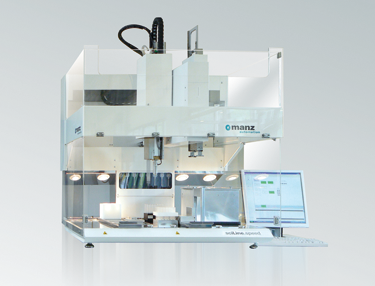
sciLine.speed Laboratory Robotics Platform
Manz’s sciLine.speed is now available with modules for sample preparation and purification—weighing, dissolving, filtration, and chromatography—all in less than 0.8 × 1.2 m of lab space. The new combination of ultrasound and shaking and the parallel filtration module now enable simultaneous sample preparation jobs. In combination with the optional Microdos powder dispensing module, the fully automated preparation of analytics vials, screening plates, and other solid or fluid sample formats also is possible.
More: www.manz.com
sciLine.store Substance Storage
The sciLine.store storage solution now can store substances in an area smaller than 2 × 3 m using miniaturized robotics for storing lab samples and removing them from storage. The sciLine.store can identify and weigh different vial formats, offers manual access to storage racks, and can be connected to a user’s IT infrastructure. An optional cooling system and additional storage modules also are available.
More: www.manz.com
QIAGEN
QIAsymphony RGQ
This new and complete workflow solution comprises modules that can be used as stand-alone systems or combined into a fully integrated system. It includes the physical and data integration of the modules QIAsymphony SP for sample preparation, QIAsymphony AS for assay setup, and the Rotor-Gene Q real-time PCR thermocycler. QIAsymphony also provides a broad PCR-based assay menu, including the artus real-time PCR kits for the detection of human immunodeficiency virus, hepatitis C virus, and hepatitis B virus and a transplantation panel with cytomegalovirus, Epstein-Barr virus, herpes simplex virus, varicella zoster virus, and BK virus. A large pipeline of further tests will be launched soon, including therascreen EGFR and KRAS, as well as artus Influenza, CT, CT/Ng, and an extended transplantation panel.
The complete CE-IVD-compliant workflow of the standardized system enables reliable pathogen detection with the flexibility to process multiple input formats and a varying number of 1 to 72 samples per run. The QIAsymphony RGQ also offers workflow optimization through the option for parallel runs and flexible batch sizes and intuitive, easy-to-use software.

The Automation Partnership (TAP)
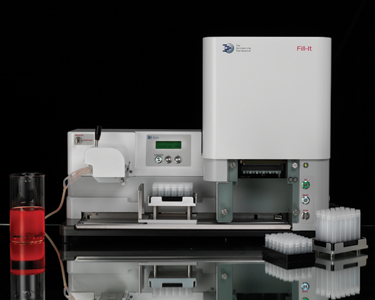
Fill-It 48-Way
The Fill-It 48-Way is the newest system in TAP’s range of benchtop automated dispensers and is compatible with Nunc’s new racks of 2.0- and 5.0-mL vials, supplied in racks preloaded with 48 vials. With these bigger vial volumes, Fill-It 48-Way allows processing of larger batches. It can be integrated with many liquid handlers and can fit in a standard laboratory tissue culture cabinet to maintain aseptic conditions.
ambr Micro Bioreactor System
This new version of the ambr workstation automates the operation of 48 disposable micro bioreactors and closely replicates the characteristics of benchtop bioreactors at microscale (10–15 mL working volume). The 48 micro bioreactors are arranged in 4 culture stations containing sets of 12, each with a miniature internal impeller, as well as individual closed-loop control of dissolved O2 and pH and a supply of gases. Each culture station has independent stirring speed and temperature control, allowing scientists to test up to 4 different temperature and stir speeds simultaneously. The new ambr system controls culture setup and inoculation, the addition of alkalis and feeds, and culture sampling for cell count and analysis such as antibody titer and is less than 50 cm wider than the original ambr to fit in a standard laboratory biosafety cabinet.
TTP Lab Tech
High-Throughput Neutrophil Chemotaxis Studies
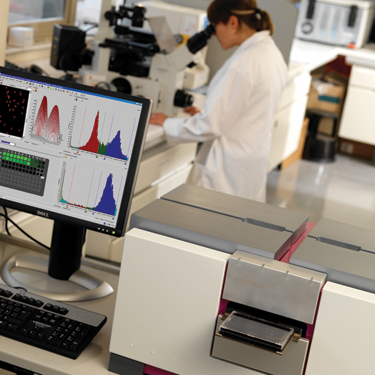
A new system comprising the Acumen eX3 microplate cytometer from TPP LabTech and the iuvo Chemotaxis Assay Plate from BellBrook Labs can achieve approximately 4-fold time savings compared with a similar method using automated microscopy and offline data processing. The Acumen eX3 is a laser scanning microplate cytometer for the analysis of fluorescence in cell-based assays. In addition to offering enhanced multiplexing functionality, Acumen eX3 has a wide field of view that enables whole-well and microchannel scanning. The iuvo Chemotaxis Assay Plate is a high-content, automation-friendly microconduit array plate that facilitates horizontal chemotaxis in the presence of a defined gradient. The combination of Acumen eX3 with the iuvo microchannels results in a rapid and robust approach to neutrophil chemotaxis studies.
More: www.ttplabtech.com/products/acumen/index.html
Product descriptions are based on information provided by the manufacturer. Inclusion in this section in no way implies endorsement by the Journal of Biomolecular Screening or the Society for Laboratory Automation and Screening.
Because SLAS is not a standardizing association, but an association that provides Special Interest Groups the ability and platform to standardize along with ANSI (the American National Standards Institute), in the event that the ANSI/SBS Microplate Standards are to be used in advertisements, product releases, or abstracts, the standards must be referred by:
(Either singularly, or as a whole)
If in dire circumstances spacing is a major issue, the only other verbiage that will be allowed is: Meets the Standards ANSI/SBS 1-2004 through ANSI/SBS 4-2004.