




Abstract
The 2010 JBS Graduate Student Excellence Award was given to Dr. Sam Hasson (UCLA, USA) for meritorious academic work that contributed to biomolecular sciences/quantitative biology. The 2 JBS Graduate Student Excellence Award Finalists were Drs. Tuoping Luo (Broad Institute, USA) and Ganesh Krishnamoorthy (University of Twente, the Netherlands).
In summary, these 3 scientists were selected from a group of abstracts submitted by candidate graduate students to the Awards Committee. Each was invited to give a 15-min oral presentation, followed by 5 min of questions-and-answers by a panel of Society for Biomolecular Sciences (SBS) member judges at a special session at the SBS Annual Conference & Exhibition. The award was based on scientific merit, experimental approach/innovation, presentation, and grasp of the subject matter. All presenters did a superb job. I and the Awards Committee congratulate each of these scientists on their excellent work.
In 2011, with the support of the new Society for Laboratory Automation and Screening (SLAS) organization, we will be expanding our academic support by issuing Academic Travel Awards (students, post-docs, and junior faculty) and holding a subsequent poster competition at the SBS Annual Conference & Exhibition. Please see the SLAS Web site for details: http://www.slas.org/events/sbs11/academic_travel.cfm.
Winner
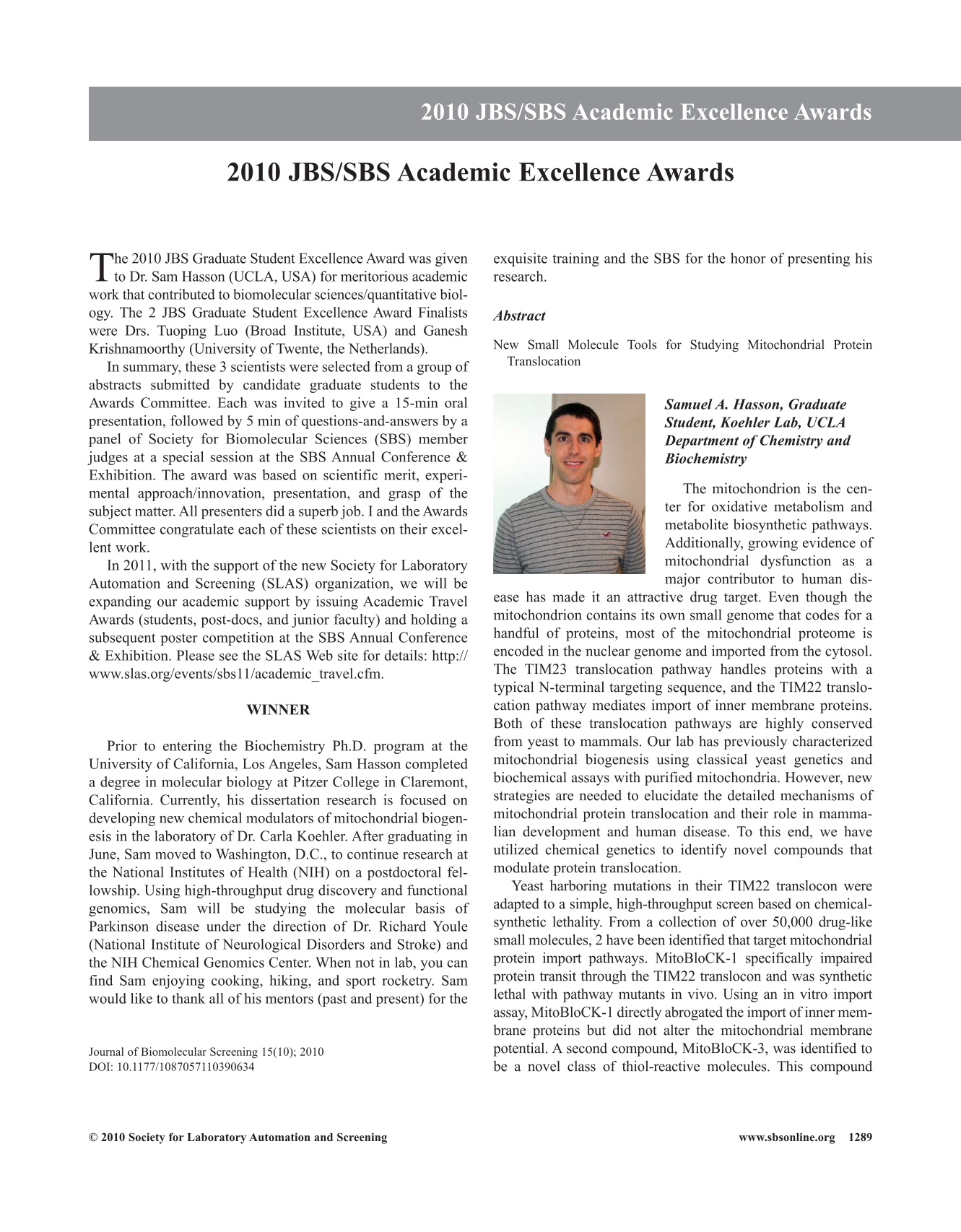
Prior to entering the Biochemistry Ph.D. program at the University of California, Los Angeles, Sam Hasson completed a degree in molecular biology at Pitzer College in Claremont, California. Currently, his dissertation research is focused on developing new chemical modulators of mitochondrial biogenesis in the laboratory of Dr. Carla Koehler. After graduating in June, Sam moved to Washington, D.C., to continue research at the National Institutes of Health (NIH) on a postdoctoral fellowship. Using high-throughput drug discovery and functional genomics, Sam will be studying the molecular basis of Parkinson disease under the direction of Dr. Richard Youle (National Institute of Neurological Disorders and Stroke) and the NIH Chemical Genomics Center. When not in lab, you can find Sam enjoying cooking, hiking, and sport rocketry. Sam would like to thank all of his mentors (past and present) for the exquisite training and the SBS for the honor of presenting his research.
Abstract
New Small Molecule Tools for Studying Mitochondrial Protein Translocation
The mitochondrion is the center for oxidative metabolism and metabolite biosynthetic pathways. Additionally, growing evidence of mitochondrial dysfunction as a major contributor to human disease has made it an attractive drug target. Even though the mitochondrion contains its own small genome that codes for a handful of proteins, most of the mitochondrial proteome is encoded in the nuclear genome and imported from the cytosol. The TIM23 translocation pathway handles proteins with a typical N-terminal targeting sequence, and the TIM22 translocation pathway mediates import of inner membrane proteins. Both of these translocation pathways are highly conserved from yeast to mammals. Our lab has previously characterized mitochondrial biogenesis using classical yeast genetics and biochemical assays with purified mitochondria. However, new strategies are needed to elucidate the detailed mechanisms of mitochondrial protein translocation and their role in mammalian development and human disease. To this end, we have utilized chemical genetics to identify novel compounds that modulate protein translocation.
Yeast harboring mutations in their TIM22 translocon were adapted to a simple, high-throughput screen based on chemical-synthetic lethality. From a collection of over 50,000 drug-like small molecules, 2 have been identified that target mitochondrial protein import pathways. MitoBloCK-1 specifically impaired protein transit through the TIM22 translocon and was synthetic lethal with pathway mutants in vivo. Using an in vitro import assay, MitoBloCK-1 directly abrogated the import of inner membrane proteins but did not alter the mitochondrial membrane potential. A second compound, MitoBloCK-3, was identified to be a novel class of thiol-reactive molecules. This compound demonstrated a preferential inhibition of protein import into mitochondria. Both of these molecules display bioactivity in mammalian cells as well. Overall, MitoBloCK-1 and MitoBloCK-3 illustrate the value of chemical genetic tools to extend studies of protein translocation in yeast to mammalian models such as zebrafish, cultured cells, and mouse.
Finalist
Abstract
Screen and Development of STK33 Inhibitors for Probing Mutant KRas-Dependent Cancer Cells
The survival of certain cancer cells is dependent on the sustained expression and activity of oncogenically activated Ras (oncogene addiction). 1,2 Among the Ras gene family, KRAS is the most frequently mutated that is found in about 30% of human cancers. 2 Mutant KRas-dependent cancer cells could be targeted by exploiting co-dependencies they develop accompanying the mutant KRas (synthetic lethality). 3,4 Recently, Scholl et al. 5 discovered that KRAS dependency is associated with sensitivity to the knockdown of a serine/threonine protein kinase, STK33. A potent and selective inhibitor targeting STK33 is a desirable tool for the investigation of the mechanism behind the synthetic lethality. If the STK33 inhibitor can recapitulate the synthetic lethality of RNAi knockdown, it will provide novel therapeutic opportunities against various cancers associated with KRas mutation.
To develop high-throughput screening (HTS) in a 384-well format, we optimized the ADP-Glo assay (Promega, Madison, WI) that quantifies the STK33 activity by measuring the concentration of the generated adenosine diphosphate (ADP) in the kinase reaction. Thirty thousand compounds from the Broad Institute screening collection were screened at 10 µM. Coefficients of variation (CVs) of 4% to 6% were obtained with corresponding Z′ factor values between 0.64 and 0.76 (90% inhibition by positive control). We identified 111 primary hits with the hit threshold set at 20% inhibition (Z′ = 0). Dose-responsive curves of 107 primary hits were measured under both 100 µM and 25 µM adenosine triphosphate (ATP) concentration. The activities of 95 compounds were confirmed, and their modes of action (ATP competitive, uncompetitive, and noncompetitive) were classified. In order to identify false positives introduced by compound interference of the coupled enzymatic reactions, dose-responsive curves were also measured by the HTRF Transcreener ADP assay (Cisbio, Bedford, MA), which gave virtually identical results.
The confirmed hits were clustered based on the core structures, followed by the structure-activity relationship (SAR) analysis on each series. Based on the potency, physical property, and synthetic feasibility, a series of ATP-competitive inhibitors with Ki in the low micromolar range was selected as the lead structure for chemical optimization. More than 200 analogs were synthesized, and the Ki was driven down to 30 nM. Further optimization is under way. The promising compounds will be tested in the cell-based assay and kinome profiling for assessing the selectivity.
References
Finalist
Abstract
Lab-on-a-Chip Surface Plasmon Resonance Biosensor for Biological Screening Applications

As title suggests, my research focuses on the new developments in the integration of a surface plasmon resonance (SPR) imaging-based biosensor and electrokinetic lab-on-a-chip that aimed to develop a strategy to multiplex bioassays in combination with high-throughput screening, which not only saves a huge amount of time but also reduces the cost of such assays while performing multiple assays simultaneously. The major advantage of using electrokinetic-drivenfluidics instead of conventional pressure-driven flow is to avoid the complex plumbing network, valves, and pumps, especially when a large number of microchannels (n > 10) are used. A successful operation of a newly developed integrated biosensor system was demonstrated, which needs a single voltage supply only. My project also explores the possibilities of measuring (multiple) biomolecular interaction kinetics (also known as kinetics screening) in a different way compared to the conventional approaches, taking advantage of the microarray-integrated SPR imaging system. 1,2 The initial focus was on the development of a microfluidic lab-on-a-chip with the goal to demonstrate the feasibility of integrating both the biosensor microarray and applying electrokinetic pumping in a single device. 3 After the demonstration of such an integrated biosensor, some of the observed practical and technical problems were addressed. For example, higher current flow in the interaction chamber leads to electrolysis reactions near the gold metal layer, giving additional unwanted effects such as bubble formation, etching of the gold, pH shifts, and so on. A solution was found to protect the gold film by a hydrogel/dextran coating as well as usage of low-conductivity buffers. In a new design of the chip, the large interaction chamber was changed to individual microchannels (4 microchannels operated in parallel) for guiding the sample flow. 4 The modified chip (electrokinetic lab-on-a-biochip) was demonstrated with various types of biomolecular interaction experiments, including multiligand/multianalyte detection, which is the core of the thesis. Kinetics and affinity of the model biomolecular interactant pair (human IgG–a-IgG) were extracted from the integrated biosensor and compared with the conventional approaches. Both were in very good agreement with each other. The device was further scaled up to 12 channels in combination with up to 9 times multiplexing per channel, which was demonstrated with well-known interactant pairs. 5 A recommendation for future work prior to the implementation of this newly developed chip for biological applications (e.g., for drug screening) is first changing the titanium adhesion layer for the gold film to tantalum, which withstands higher currents, and, second, replacing the PDMS/glass hybrid chips with full glass chips, although a low-temperature bonding technique still has to be developed. With the modifications as suggested, it should be possible to screen ~80 to 90 drugs simultaneously with the extraction of their kinetics parameters straightaway from the measured SPR responses. The new device could be of further interest not only for drug discovery applications, but it also opens up a new dimension in the development of analytical tools in various application areas to measure many biomolecular interactions in a multiplex format and at high throughput.