




Abstract
Botulism, the disease caused by botulinum neurotoxins (BoNTs), secreted by the spore-forming, anaerobic bacteria Clostridium botulinum, has been associated with food poisoning for centuries. In addition, the potency of BoNTs coupled with the current political climate has produced a threat of intentional, malicious poisoning by these toxins. The ability to detect and measure BoNTs in complex matrixes is among the highest research priorities. However, the extreme potency of these toxins necessitates that assays be capable of detecting miniscule quantities of these proteins. Thus, signal-boosting strategies must be employed. A popular approach uses the proteolytic activity of the BoNT light chain (LC) to catalyze the cleavage of synthetic substrates; reaction products are then analyzed by the analytical platform of choice. However, BoNT LCs are poor catalysts. In this study, the authors used the osmolyte trimethylamine N-oxide (TMAO) to increase the proteolytic activities of BoNT LCs. Their data suggest that concentrated solutions of TMAO induce complete folding of the LCs, resulting in increased substrate affinity and enhanced enzyme turnover. The authors observed increases in catalysis for BoNT serotypes A, B, and E, and this increased proteolytic activity translated into substantial increases in analytical assay sensitivity for these medically relevant toxins.
Introduction
B
There are 7 biochemically distinct BoNT serotypes (designated A-G). BoNT holotoxins are composed of 2 subunits: the heavy chain (HC), which mediates entry into neurons via receptor-mediated endocytosis, and a Zn-metalloprotease component referred to as the light chain (LC). 2 The mechanism of toxicity is conserved between serotypes as LC proteases specifically cleave soluble N-ethylmaleimide-sensitive factor attachment protein receptor (SNARE) proteins at specific sites. 11 BoNT serotypes A and E cleave SNAP-25 (synaptosomal-associated protein of 25 kDa); serotypes B, D, F, and G cleave VAMP (vesicle-associated membrane protein, also referred to as synaptobrevin); and serotype C cleaves both SNAP-25 and syntaxin. 12-17 In all cases, BoNT LC-mediated cleavage of SNARE proteins inhibits acetylcholine release into neuromuscular synapses, and flaccid paralysis ensues. 16,18
Given the prevalence of BoNTs in the clinic and their potential to be misused as biological weapons, there is an urgent need to develop sensitive assays to detect these toxins in multiple sample types. 19 Their extreme potency makes it necessary for the assays to be able to measure extremely low levels of BoNTs in complex matrixes such as yogurt, ice cream, and other foodstuffs. 20 To address sensitivity issues, multiple groups have successfully taken advantage of the proteolytic activity of the toxins’ LC as a mechanism of signal amplification. Using this approach, synthetic substrates are incubated with minute quantities of toxin for extended times. After multiple cycles of proteolysis, the reaction products are analyzed by downstream mass spectrometry or fluorescence measurements. 21,22 Although these methods show tremendous promise, BoNT LCs are poor catalysts with kcat values on the order of 5 s−1. 23 Thus, methods for increasing the enzymatic activity of the LCs are heavily sought after.
Within the past decade, a series of elegant experiments has demonstrated the importance that solvent conditions play in protein folding. In particular, the thermodynamics of protein interactions with solvents composed of concentrated solutions of small organic “osmolytes” have been particularly well defined. 24,25 In these solutions, unfavorable interactions between solvent and the protein solute (localized mainly to the peptide backbone) promote folding the polypeptide into compact 3D structures. Others have successfully applied these principles to “force fold” recalcitrant proteins in vitro. 26,27 Although BoNT LCs are active in simple buffered solvents, cumulative data suggest that this system does not adequately capture the intracellular properties of this protein. In particular, the type A LC is famously long lived in cells, exhibiting a half-life estimated to be on the order of months. 28 However, the protein is easily digested by proteases in vitro. 29 Furthermore, solution structure analysis shows that the native state ensemble is populated by a partially folded molten globule state under standard native conditions. 30
On the basis of these observations, we hypothesized that BoNT LCs are among a group of proteins that rely on solvent interactions to achieve a native structure. In this study, we evaluated the ability of different osmolytes and polymeric crowding agents to modulate the solution structure and function of BoNT LCs. We found that BoNT A LC is very sensitive to solvent conditions, with multiple agents inducing detectable structural changes. However, only the osmolyte trimethylamine N-oxide (TMAO) was able to induce protein folding changes that also were accompanied by increases in proteolytic activity. Importantly, TMAO also increases the proteolytic activity of serotypes B and E. Furthermore, by simply adding TMAO to assay buffer, we were able to substantially increase analytical assay performance, increasing detection limits as much as 10-fold for assays measuring LC proteolytic activity of A, B, and E, the serotypes that are most relevant for human health.
Materials and Methods
Reagents and buffers
All reagents were obtained from commercial vendors and were at least reagent grade. TMAO was purchased from Thermo Fisher Scientific (Waltham, MA). L-proline, betain, glycerol, Ficoll 70, Ficoll 400, bovine serum albumin (BSA; >98% pure), 8-anilino-1-naphthalenesulfonic acid (ANS), and proteomics-grade trypsin were all acquired from Sigma-Aldrich (St. Louis, MO). BoNT/A, B, and E peptide substrates were N-terminally acetylated peptides obtained from New England Peptide (Gardner, MA) and were composed of the following sequences:
BoNT/A: Ac-SNKTRIDEANQRATKML-amide
BoNT/B: Ac-LSELDDRADALQAGASQFETSAAKLKRK-amide
BoNT/E: Ac-MGNEIDTQNRQIDRIMEKADSNKTRIDEANQRA-amide
BoNT/A, B, and E LCs and the BoNT/A fluorescent “SNAPtide” substrate, containing the Forster resonance energy transfer (FRET) pair o-aminobezoic acid (o-Abz) and 2,4 dinitrophenylhydrazine (DNP), were purchased from List Laboratories (Campbell, CA). The buffer used for BoNT LC protease reactions consisted of 40 mM HEPES (4-(2-hydroxyethyl)-1-piperazineethanesulfonic acid) (pH 7.2), 0.05% Tween-20, 1 mM dithiothreitol, and 50 µM zinc chloride.
Fluorescence assays to measure BoNT LC activity
Initial BoNT/A LC protease assays were conducted in 96-well formats using the Fluorescent SNAPtide substrate (List Laboratories). Reactions were conducted in the buffer described above using a substrate concentration equal to 5 µM according to the manufacturer’s recommendations. Briefly, substrate and osmolyte solutions were arrayed in a 96-well plate, holding substrate concentration constant while varying osmolyte (TMAO, proline, betain, and glycerol) concentration from 0 to 2 M and crowding agent concentration (BSA, Ficoll 70, and Ficoll 400) from 0 to 10 mg/mL. Reactions were initiated by adding BoNT/A LC (5 nM, final concentration) with a multichannel pipet. Changes in fluorescence emission at 420 nm (excitation wavelength 320 nm) were recorded at 30-s intervals with a Tecan Safire 2 fluorescence microplate fluorimeter (Tecan, Inc., Männedorf, Switzerland) for 20 min. Initial reaction rates were calculated for each experimental condition and plotted versus osmolyte concentration. All reported values are averages of 3 independent experiments.
Liquid chromatography assays to measure BoNT LC activity
All high-performance liquid chromatography (HPLC)–based assays to measure BoNT proteolytic activity were conducted as described in previously published studies with minor modifications. 23 For all BoNT serotypes, proteolytic reactions were conducted by mixing substrate (0.1 mM), osmolyte (0-2 M), or crowding agent (5 mg/mL) and then initiating reactions by addition of LC (5 nM unless noted). After 10 min, reactions were quenched by adding trifluoroacetic acid (TFA), and cleavage products were separated and measured by reverse-phase HPLC. All HPLC separations were conducted on a Shimadzu Prominence ultra-fast liquid chromatography (UFLC) XR system using a Hypersil Gold Javelin (Thermo Fisher Scientific) c18 guard column and a Hypersil Gold (Thermo Fisher Scientific) c18 reverse-phase analytical column (50 × 2.1 mm, 1.9 µm). Peak areas were measured with LC solution automated integration software (Shimadzu Corporation, Kyoto, Japan) and used to calculate enzyme reaction rates. All reaction velocities reported within were the averages of at least 3 independent experiments. For experiments that measured kinetic rate constants, plots of reaction velocity versus substrate concentration were analyzed by nonlinear regression analysis using the program GraphPad Prism, version 5.01 (La Jolla, CA). Because substrate inhibition was observed for some data sets, substrate concentrations greater than 1.5 mM were not included in the analysis. The measured isotherms were fit to the Michaelis-Menten equation, which allowed the Michaelis constant (Km) and the turnover number (kcat) to be determined under different buffer conditions; all data sets fit the model with R 2 values greater than 0.98.
Limited trypsin digestion of BoNT/A light chain in osmolyte-containing solutions
Limited trypsin digestion of the BoNT/A LC was conducted by diluting the LC (1 µg) into reaction buffers containing the osmolytes TMAO, proline, betain, or glycerol (1.6 M) and the crowding agents Ficoll 70 and Ficoll 400 (5 mg/mL). Proteolysis reactions were allowed to proceed for 10 min at 37°C and then quenched by boiling samples for 5 min in sodium dodecyl sulfate (SDS) sample loading buffer. Digests were then resolved on 12% Tris-glycine acrylamide gels (Invitrogen, Carlsbad, CA) and proteins visualized with Sypro Ruby (Invitrogen) fluorescent protein stain. The percentage of full-length LC that remained was calculated by measuring integrated band volumes and dividing the volume of the experimental samples to control samples that were not subjected to trypsin. Gels were imaged and digitized with the Biorad VersaDoc 4000 imaging system using Quantity One v4.6.2 analysis software (BioRad, Hercules, CA). Reported values are averages of 3 independent experiments.
ANS fluorescence measurements in osmolyte-containing solutions
ANS (8-anilino-1-naphthalenesulfonic acid) fluorescence was used to probe the structural features of the BoNT/A LC under different solution conditions. The BoNT/A LC (1 µM) was diluted into buffered solutions containing 100 µM ANS; the osmolytes TMAO, proline, betain, or glycerol (1.6 M); or the crowding agents Ficoll 70 or Ficoll 400 (5 mg/mL). Samples were then equilibrated for 1 h at 25°C. The ANS-associated fluorescence spectra of each sample were recorded using an excitation wavelength of 388 nm (slit width 5 nm) and recording resultant emission spectra between 420 and 550 nm, step size 1 nm. All spectra were blank subtracted-average spectra obtained from 10 scans of BoNT/A LC-containing samples subtracted from control samples containing only osmolyte or crowding agent. Measurements were conducted with a Tecan Safire 2 96-well fluorimeter.
Far-UV circular dichroism measurements of the BoNT/A LC in osmolyte-containing solutions
In preparation for circular dichroism (CD) analysis, BoNT/A LC samples were diluted to 3 µM in buffers composed of 25 mM sodium phosphate (pH 7.4) and containing either small-molecule osmolyte (1.6 M) or synthetic Ficoll polymer (5 mg/mL). CD wavelength scans were made at 25°C in a 0.1-cm path length cuvette in the far-UV region (195-245 nm). CD measurements were made on a Jasco J-810 (Jasco Analytical Instruments, Easton, MD) model spectropolarimeter. CD traces reported within were blank subtracted spectra acquired by averaging 4 scans from protein-containing samples and buffer-only controls. Disparate light-scattering effects occurred in osmolyte-containing samples and prevented full-spectrum scans. However, ellipticity was able to be accurately measured between the following wavelengths: 1.6 M TMAO recorded between 200 and 245 nm, 1.6 M glycerol recorded between 205 and 245 nm, and 1.6 M betain recorded between 220 and 245 nm. The optical activity of proline prevented CD measurements to be made in samples containing this osmolyte.
Determination of analytical detection limits in the presence and absence of TMAO
To determine the analytical limits of detection for the HPLC assays that measured BoNT/A, B, and E activity, described above, 750 pmol of each substrate was digested exhaustively with cognate LCs. Reaction products (750 pmol) were serially diluted and analyzed by HPLC. Resultant calibration curves that measured detector response (total area of both product peaks) as a function of analyte concentration were analyzed by linear regression analysis. Limits of detection (LOD), defined as (a + 3sy.x), and limits of quantification (LOQ), defined as (a + 10sy.x), were determined for each serotype assay where (a) is the y-intercept, and the goodness-of-fit parameter (sy.x) is the standard deviation of the residuals of the regression. 31 After assay standardization, BoNT/A, B, and E assays were conducted in the presence of buffer containing 1.6 M TMAO and in reaction buffer void of osmolyte. Reactions were conducted by serially diluting each serotype LC in microplates and adding substrate (0.1 mM) to initiate reactions. Samples were incubated at 37°C for 1 h and then quenched with TFA and analyzed by the HPLC assays described previously. Resultant dose responses were then analyzed by nonlinear regression analysis, allowing the analytical detection limits to be defined in terms of LC concentration in both the presence and absence of TMAO. Reported values are averages of 2 independent experiments.
Results
Measuring BoNT/A LC activity in the presence of osmolyte-containing solutions: multiwell fluorescence assay
To investigate if the proteolytic activity of the BoNT/A LC was influenced by different osmolytes or crowding agents, we measured the activity of the LC using a multiwell fluorescence assay (
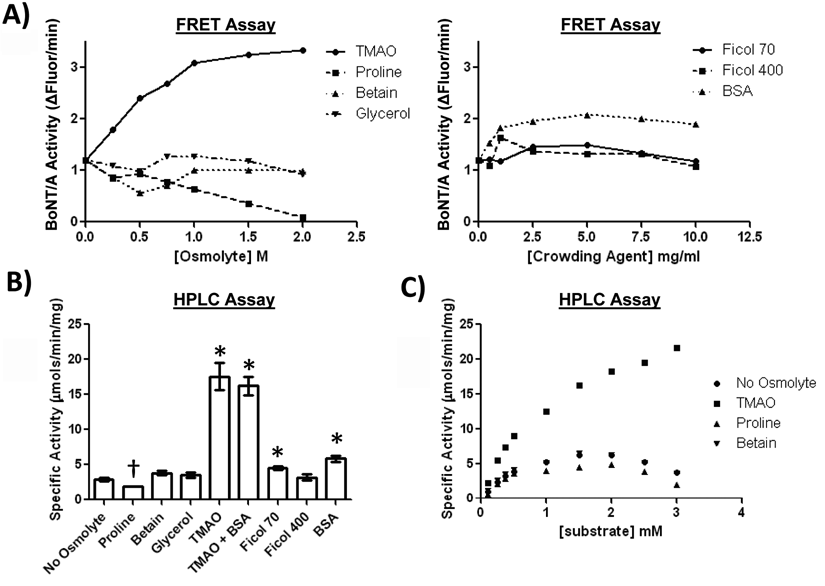
Evaluation of BoNT/A light chain (LC) activity in buffers containing varying concentrations of osmolytes and crowding agents. (
Measuring BoNT/A LC activity in the presence of osmolyte-containing solutions: HPLC assay
To confirm initial observations made using the fluorescent assay, we measured BoNT/A LC activity at select osmolyte and crowding agent concentrations in the HPLC assay (
Determination of enzyme kinetic parameters for BoNT/A LC in the presence of different osmolytes
To further characterize the kinetics of the BoNT/A LC, we measured the dependence of reaction rate on substrate concentration under steady-state reaction conditions using the HPLC-based cleavage assay (
BoNT/A LC Kinetic Constants Determined in Osmolyte-Containing Buffers
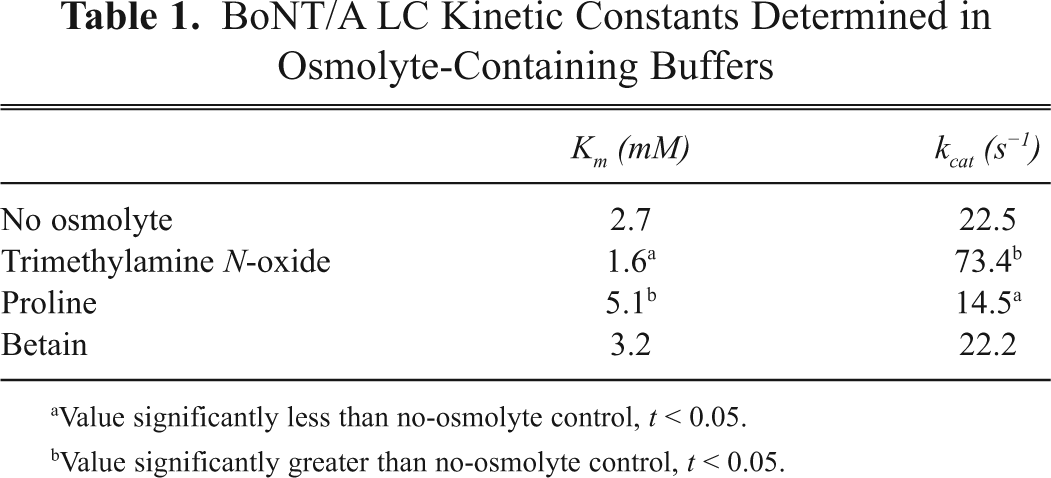
Value significantly less than no-osmolyte control, t < 0.05.
Value significantly greater than no-osmolyte control, t < 0.05.
Investigation of BoNT/A LC stability under different buffer conditions by limited trypsin digestion
The structural stability of the LC under different solvent conditions was investigated by limited trypsin digestion. BoNT/A LC was diluted into buffers containing 1.6 M osmolyte (proline, TMAO, betain, and glycerol) or 5 mg/mL of synthetic crowding agent (Ficoll 70 and Ficoll 400) and incubated with trypsin. After 10 min, reactions were quenched, subjected to SDS polyacrylamide gel electrophoresis (PAGE) analysis where protein was stained with Sypro Ruby dye (Invitrogen) and the relative amount of full-length protein remaining measured by densitometry (
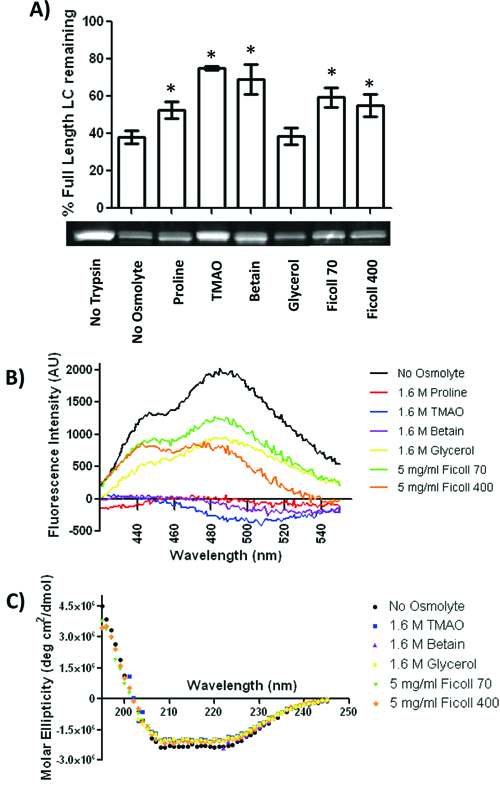
In-solution structural analysis of BoNT/A light chain (LC) in buffers containing osmolytes and crowding agents. (
Probing the structure of the BoNT/A LC under different buffer conditions by ANS fluorescence
As a complementary method to assess the structure of BoNT/A LC in different solvents, fluorescence spectra of the reporter molecule ANS were measured in osmolyte- and crowding agent–containing buffers. ANS was added to BoNT/A LC diluted into a standard reaction buffer, buffers containing 1.6 M osmolyte (proline, TMAO, betain, and glycerol), or 5 mg/mL synthetic crowding agent (Ficoll 70 and Ficoll 400). After equilibration with the LC, the fluorescence emission spectra of ANS were recorded (
Investigation of BoNT/A LC secondary structure content by far-UV circular dichroism
The secondary structure composition of the BoNT/A LC in osmolyte and crowding agent containing buffers was investigated by far-UV CD spectroscopy. BoNT/A LC was diluted into sodium phosphate buffer (pH 7.4) or buffers also containing osmolyte (1.6 M, TMAO, betain, or glycerol) or a synthetic polymer (5 mg/mL, Ficoll 70 or Ficoll 400) component; CD spectra could not be recorded in the presence of proline because of the high optical activity of this osmolyte. The blank subtracted CD spectra of the LC A are shown in
Buffers containing high concentrations of TMAO also activate BoNT LC B and BoNT LC E
Previous experiments showed that TMAO induces dramatic increases in the proteolytic activity of the BoNT/A LC (
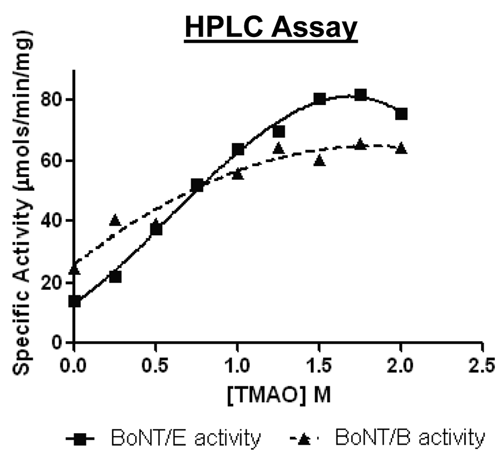
Trimethylamine N-oxide (TMAO) increases the proteolytic activity of light chains (LCs) from serotypes B and E. BoNT/B and E LC proteolytic reaction velocities were measured in buffered solutions containing 0 to 2 M TMAO using high-performance liquid chromatography (HPLC)–based assays. All values are averages of 3 independent experiments.
TMAO increases analytical assay sensitivity for BoNTs A, B, and E
TMAO increases the proteolytic activity of BoNT/A, B, and E LCs (
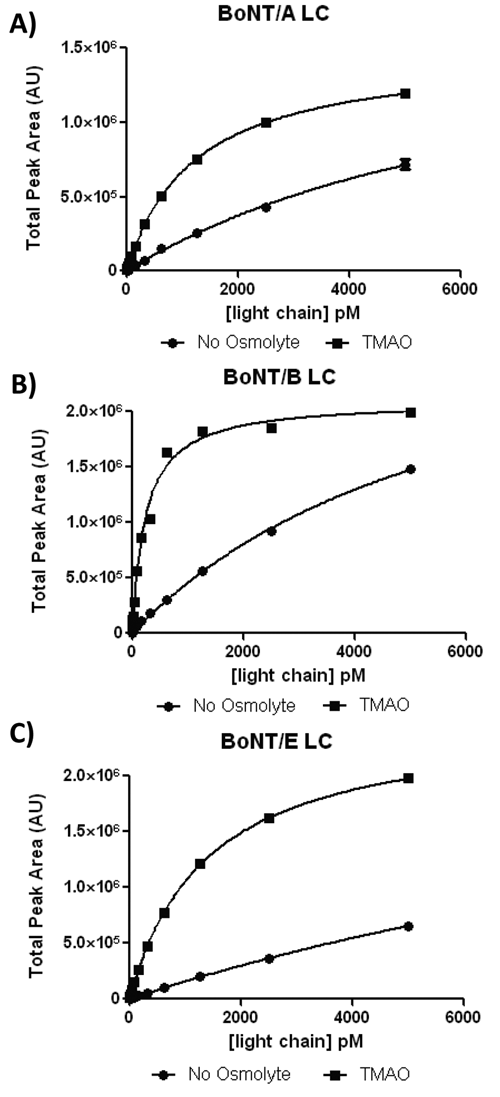
Measurement of BoNT/A, B, and E proteolytic assay sensitivity in the presence and absence of trimethylamine N-oxide (TMAO). Assays for each serotype were conducted in the presence of buffer containing 1.6 M TMAO and in reaction buffer void of osmolyte. Reactions were conducted by serially diluting each light chain (LC) and adding the appropriate peptide substrate (0.1 mM) to initiate reactions. Samples were incubated at 37°C for 1 h and then quenched and analyzed by the HPLC protocols. Resultant dose responses were constructed for each serotype (panels
Analytical Limits in the Presence and Absence of TMAO

TMAO, trimethylamine N-oxide; LC, light chain; LOD, limits of detection; LOQ, limits of quantification.
Discussion
It has long been appreciated that folding instructions are encoded within each protein’s primary sequence. However, recent studies elegantly demonstrated that solvent composition plays a major role in protein folding as well. 24,25,32 Excluded volume effects caused by macromolecules and thermodynamically unfavorable interactions between proteins and small-molecule osmolytes induce protein folding. 26,27,33 In this study, we examined the in-solution behavior of BoNT LCs by examining their structures and functions in buffers that are known to promote protein folding. Overall, we found the structures and activities of BoNT LCs were extremely sensitive to solvent conditions; this sensitivity provides insight into the solution behavior of these enzymes and has implications for analytical assay development and inhibitor design.
With regards to the LC A serotype, of the 4 osmolytes, 2 synthetic polymers, and protein (BSA) examined, all were able to influence the structure or function of the type A LC by at least one measurable parameter (
As was observed by structural analysis, osmolytes and crowding agents influenced the activity of the BoNT/A LC (
When we examined kinetic constants derived from this analysis (
Besides affecting our basic understanding of the solution phase behavior of BoNT LCs, the use of osmolytes should have practical applications as well. In addition to stimulating LC A, TMAO also increased reaction rates for LCs B and E (
Footnotes
Acknowledgements
We also thank Dr. J. Carra and Captain J. Froude for assistance with circular dichroism measurements.
This research was supported by a grant awarded to SB from the Defense Threat Reduction Agency (3.10084_09_RD_B). Opinions, interpretations, conclusions, and recommendations are those of the authors and are not necessarily endorsed by the US Army.