Hamilton Storage Technologies announces the addition of the SAMple Puncher, an integrated tube-processing module that operates in conjunction with the manufacturer’s –20°C and –80°C Sample Access Manager (SAM) systems. The system handles and stores multiple labware types, is compatible with biobanking applications, tracks sample usage, uses 1D and 2D barcode reading, and has liquid nitrogen as a backup option. The system software provides audit trails and tools for chain of custody and 21 CFR Part 11 compliance. For further information, visit www.hamilton-storage.com.

Hamilton Robotics announces the NIMBUS iProbe, with up to 4 independent channels that can be configured with combinations of 1- or 5-mL pipetting heads. The unit can carry out tube-to-tube, tube-to-plate, and plate-to-plate transfers via a graphic user interface; can fit in a laminar flow hood; and uses air-displacement pipetting and CO-RE (compressed O-ring expansion) technology for loading and seating of tips. Other features include capacitance liquid level detection (cLLD), labware gripping, plate stacking, heating/shaking, vacuum filtration, magnetic separation, and integration compatibility with third-party devices. For more information, visit www.hamiltonrobotics.com.

Micronic Europe BV and Hamilton have released the ScrewCap DeCapper for the opening and closing of 0.5- to 1.4-mL screw-capped tubes. The unit decaps or recaps a row of 12 tubes simultaneously and can process a rack of 96 screw-capped tubes in less than 1 min. Built-in torque monitoring is used to maintain consistent seals, and a report is issued on the exact tube location in the event that a tube is not completely sealed. After removal, the caps are placed on a separate removable cap holder that enables batch processing. The ScrewCap DeCapper can operate as a standalone system or be integrated with most commercial automated pipetting workstations. For further information, visit www.micronic.com.

Agilent Automation Solutions has announced the Microplate Seal Piercer, which pierces seals on 96- or 384-well microplates. The unit can be used as a standalone unit or integrated into a robotic system through ActiveX control and an RS-232 serial port connection. Indicator lights on the machine alert the operator on the status (ready, busy, stop, low air pressure), and a microplate alignment sensor helps ensure that the microplate is correctly positioned relative to a microplate locator before actuation. A hardware interlock on the front door is included for safety, and the piercing head is removable for cleaning or reconfiguration of formats.
The same manufacturer has introduced the Direct Drive Robot (DDR), which has a direct drive mechanism, uses 1-person teaching, and uses Z-travel technology to enable access to stacked instruments. For further information, visit www.agilent.com/lifesciences/automation.

Cybio has announced the CyBi®-SELMA, a semiautomatic pipettor that uses 96 disposable tips, a touch screen, and memorized programmable methods. The unit uses custom-racked tip magazines to create dispense patterns specific to user assay requirements and is designed to fit either on lab benches or in a hood. For further information, visit www.cybio-ag.com.

ForteBio
®
, Inc. announces the Octet RED384 and Octet QK384 detectors. The former is used for protein, peptide, small-molecule, and fragment screening and the latter for protein and antibody assays. Both units employ 384-well capability, 16-channel simultaneous readouts, biosensor regeneration, and reracking and automation capabilities. The systems are supported by Version 6 Octet software, which includes data tracking and processing capabilities as well as a 2:1 heterogeneous ligand binding model. Additional options are hardware and software robotic integration capabilities and 21 CFR Part 11 compliance tools. The disposable biosensors are configured in a standard microplate format and are coated with a proprietary biocompatible matrix. For further information, visit www.fortebio.com.

Porvair Sciences has announced the MiniSeal Plus for sealing 10 to 50 plates daily. The unit has a footprint of H310 × D275 × W181 mm, does not require a compressed air supply, is electronically controlled through a keypad with real-time display of sealing temperature, has automatic plate height detection, and uses precut sealing films. The instrument can be used with any ANSI/SBS standard footprint plate up to 48 mm high and with most currently available PCR plates. Adaptors may be required for operation with certain types of plates, and sealing can be achieved with plates made of polystyrene, polypropylene, and COC/COP cyclo-olefin polymers. Sealing films come in a range of materials suitable for storage, transport, temporary or long-term sealing, and piercing. For further information, visit www.microplates.com.

RTS Life Science announces the launch of its Tube Auditor instrument. Tubes do not need to be decapped, and the unit uses vision technology for measuring volume and detecting precipitate in samples during manual or automated use. For more information, visit www.rtslifescience.com.

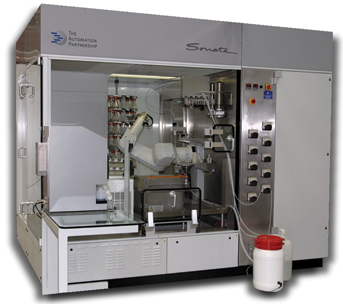
The Automation Partnership (TAP) announces Sonata™, a system for automated culturing and processing of cell lines in shake flasks. The system was developed to automatically incubate and process insect cells in Erlenmeyer shake flasks, count cells, add and decant media, centrifuge, and harvest and keep cells refrigerated until they are required. Incubator capacity and aseptic processing allow insect or mammalian cell lines to be processed in parallel. For further information, visit www.automationpartnership.com.
Thermo Fisher Scientific, Inc. and The Automation Partnership have jointly introduced the Capit-All™ IS Automated Capper/Decapper. Capping is individually tuned to a clutch mechanism with optimal torque, and the incorporation of an automated drip tray with a vacuum extraction port is intended to reduce the risk of contamination. The instrument can be integrated with automated liquid handling instrumentation. For further information, visit www.thermo.com/matrix.

TTP LabTech introduces the comPOUND® system, which consists of an automated sample store with cherry-picking capability. Sample integrity is maintained using a sealed storage chamber with an inert nitrogen atmosphere at –20°C, and tracking is carried out using 2D barcodes on each microtube. Multiple modules can be connected to form a larger store for expanding libraries and can be connected in parallel, allowing tubes to be accessed from connected modules at the same time. For automated assay plate creation, comPOUND stores can be interfaced to the comPILER® high-throughput, store-to-plate processing system. The comPILER system can cherry-pick from up to 12 comPOUND stores at the same time.
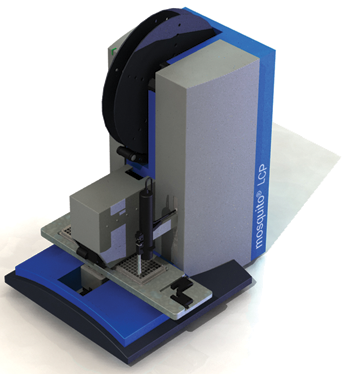
The same manufacturer announces the launch of mosquito® LCP for lipidic cubic phase (LCP) crystallization. The LCP technique uses highly viscous lipid mesophases to reconstitute proteins, which the instrument addresses by using a positive displacement syringe with automated tip positioning. The positioning of the LCP material also facilitates automated imaging of membrane protein crystals across a range of high-density plate types. For further information, visit www.ttplabtech.com.
Zinsser Analytic has developed ProCrys Meso, a liquid handling platform for the preparation of 96 in-meso (or cubic phase) proteins. The unit offers dispensing of protein and screening solutions and can also be used to prepare screening solutions themselves. An integrated module regulates humidity, and the system is based on a 1-meter liquid handling platform with 2 pipetting arms. The first pipetting arm is equipped with pipetting probes for the preparation of screening solutions and their distribution to the crystallization plate. The second arm is used for the transfer of nanoliter volumes of the protein solution. The protein, screening solution, and the crystallization plate are then placed on the workbench. The WinProCrys software allows Work lists to be imported from Excel® or the customer’s LIMS system.
The same manufacturer announces the Sophas HT system for automated synthesis. The system provides access to reagents and the ability to perform parallel reactions under separately controlled conditions. The system is designed for the distribution of dry and liquid reagents from their original storage vial without additional preparation steps and under inert conditions. Automation aspects include a robotic arm supplied with a powder dispenser and liquid handling probes with a handler for transportation of vials and labware. The distribution process is controlled by a built-in 4-place (5- or 6-place optional) weighing cell to monitor mass distribution. Powders can be distributed in the range of <1 to 50 mg. The system detects the level of the solid material in the original library vial and can be configured with heated vortexing, liquid and solid handling filtration probes, reaction blocks, pH monitoring, capping/decapping of vials, or visual control of the samples. The system is controlled by WinLissy software. For further information, visit www.zinsser-analytic.com.






