AMSBIO has announced 2 cell migration assay kits for use with high-content screening (HCS) and high-content analysis (HCA) instruments. These kits may be used for screening test compounds that may stimulate or inhibit adherent cell migration. The Oris™ Cell Migration Assay gives researchers the option to take real-time video images of cell movement or to quantify cell migration using a fluorescent microplate reader. Cells can be labeled pre- or postmigration. The assays are available with a variety of coated plates. The Oris™ Pro Assay uses a biocompatible gel (BCG) to form a cell-free zone on culture surfaces. After seeding cells into the 96-well plate, the BCG dissolves, permitting cells to migrate into the well centers. The Oris™ Pro Assay enables researchers to use automated liquid handling equipment for high-throughput assays.

AMSBIO has also announced a new portfolio of rabbit monoclonal and polyclonal antibodies for immunohistochemistry applications. For more information, visit www.amsbio.com.
Enzo Life Sciences offers the CELLestial™ brand of fluorescent probes and reagents for the analysis of cellular and biological events. This product range includes fluorescent labels, conjugates, substrates, indicators, stains, membrane probes, organelle targeting dyes, and assay systems. These probes can be used for fluorescence microscopy, flow cytometry, HCS, and HCA. For more information, visit www.enzolifesciences.com.
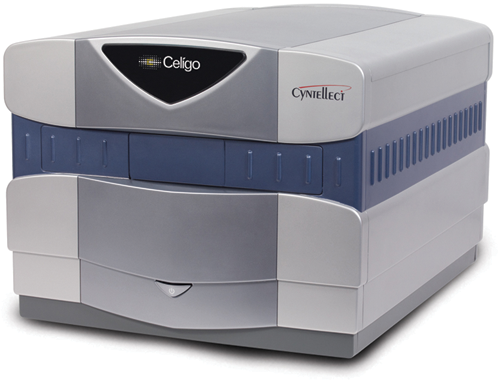
Cyntellect has announced its Celigo™ microplate-based cytometer, a bench-top in situ cellular analysis system that provides whole-well images for brightfield and fluorescent cellular analysis. It operates with T flasks and a variety of multiwell plates, it is compatible with both adherent and nonadherent cell types, and its fluorescence detection capabilities allow the use of up to 3 fluors. Applications include label-free cell growth tracking, cell viability (toxicity), PS externalization (apoptosis), total cell number, and a variety of different specific call parameters (e.g., cell density, cell diameters, cell areas, cell perimeters). Detection modes include LED-based enhanced brightfield imaging with uniform illumination across well and LED-based fluorescent imaging with 3 excitation filters and 3 emission filters. Compatible plate formats are 384-, 96-, 24-, 12-, and 6-well plates and T-25 and T-75 flasks. For more information, visit www.cyntellect.com.
Molecular Devices offers 3 hardware platforms with distinct technologies for HCS and HCA applications. The ImageXpress®MICRO automated fluorescent microscopy system offers optional environmental control, fluidics robot, and transmitted light source to provide brightfield and phase contrast imaging capabilities. The platform is “format independent” and can scan 6- to 1536-well microplates or microscope slides.
The ImageXpress®ULTRA™ scanner is a confocal automated microscopy system that features up to 4 lasers providing simultaneous or sequential imaging. Users can configure variable scan size to optimize scan speed or image long structures such as neurons or whole organisms. A software configurable pinhole allows for the control of the optical Z sections and the amount of light collected from the sample. The platform is “format independent” and can scan 6- to 1536-well microplates from most vendors or microscope slides.
The IsoCyte™ laser scanning imager enables real-time assays for microarray, bead, cell, colony classification, and small model organisms. Available in either a single- or dual-laser configuration; options include 405-, 440-, 488-, 532-, and 640-nm excitation wavelengths. Four emission wavelengths can be detected simultaneously. The platform is “format independent” and can scan 6- to 1536-well microplates or microscope slides in 2 to 5 min.
MetaXpress is the imaging acquisition and analysis software for Molecular Devices’s platforms, and MetaXpress PowerCore is a new optional software increasing the speed of analysis to high-throughput imaging levels. For more information, visit www.moleculardevices.com.
Fluidigm has announced its Dynamic Array for Single Cell Gene Expression. The Fluidigm Dynamic Array enables the user to test up to 96 individual cells against 96 genes in a single experiment. The dynamic array assembles the cDNA material from individual cells and reagents to create individual qPCR reactions. For more information, visit www.fluidigm.com.
PerkinElmer offers a range of HCS products designed to meet a variety of applications. The Opera™ is its confocal microplate imaging reader for high-speed drug discovery and high-throughput biology. The system offers ultra-high-speed, automated high-resolution screening for a range of cell fluorescence assays. The Operetta™ is a bench-top HCS instrument designed to complement the Opera™ as an assay development tool or as a starter instrument for HCS applications.
The Opera™ system is combined with Acapella™ software, and the Operetta™ system includes Harmony™ software, both of which provide data analysis tools and assay development protocols. Acapella™ comes with premade applications known as “scripts” and includes an open architecture for optimization of high-throughput, high-content cellular assays and multiplexed projects. Harmony™ includes tools to develop an assay, automate the hardware, analyze data, and store and retrieve the results. Columbus™ is for high-volume image data management and provides tools to archive, manage, retrieve, protect, and analyze image data. Columbus™ is compatible with a range of file formats, uses the OMERO server, and is based on an open protocol. It can be accessed globally without software installation. For more information, visit www.perkinelmer.com.
Systems Biosciences has announced new products with applicability to HCS and HCA. The NF-κB/293/GFP-Luc™ cell line was designed to monitor the NF-κB signal transduction pathway in vitro and features a dual green fluorescent protein (GFP) and luciferase dual-reporter system. The cells were derived from System Biosciences’s 293 TN Producer Cell Line transduced with HIV-based pseudoviral particles, packaged with a lentivector that coexpresses destabilized copGFP and firefly luciferase reporters, coupled with the minimal cytomegalovirus (mCMV) promoter in conjunction with 4 copies of the NF-κB consensus transcriptional response elements.
Systems Biosciences has also announced Dual pGreenFire Response Reporters that track pluripotency in living cells with GFP and quantitate activities of Oct4 or Sox2 with luciferase. These tools allow monitoring of ES and iPS cell pluripotency. The response reporters work for both human and mouse stem cells and feature both GFP and luciferase for quantitative transactivation assays. The Pluipotency Response Reporters are available as lentivector plasmids or as prepackaged lentiviral preparations. Positive and negative transduction control plasmids and prepackaged viral particles are also available. For more information, visit www.systembio.com.
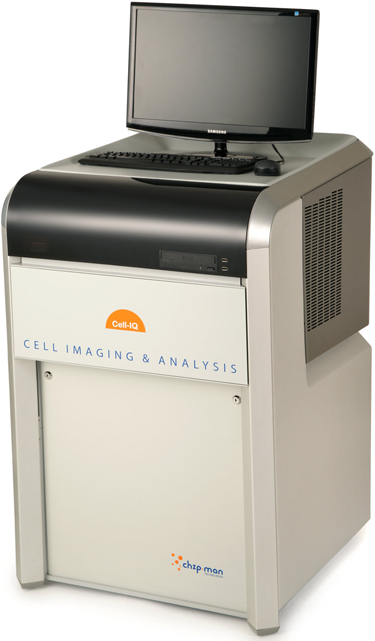
The Automation Partnership (TAP) has announced the US launch of Cell-IQ®, a live-cell observation and analysis system. Developed by Chip-Man Technologies, the system consists of a cell culture incubator, microscope, light source, and high-resolution camera integrated to image analysis software that automatically monitors, records, and quantifies changes in cell morphology and distribution. Cells grown in plates can be maintained under optimal growth conditions for days or weeks, maintaining imaging settings even when the plates are removed to change media. For more information, visit www.automationpartnership.com or www.chipmantech.com.
Thermo Fisher Scientific, Inc. has introduced its Thermo Scientific High Content 2.0 platform for HCS and HCA. Built around the Cellomics ArrayScan® VTI, new features include iDEV-guided workflow software for developing cell imaging assays designed for multiuser environments. When working with multiple biological states, the user can simultaneously visualize algorithmic parameter changes at the image, data, and statistical levels in real time. The system includes an LED light engine High Content 2.0, which also incorporates the latest optical bench from Carl Zeiss, the AxioVert Z1. For more information about the Thermo Scientific range of products for HCS and HCA, visit www.thermo.com/hcs.

Vector Laboratories offers a variety of products for use in HCS and HCA. These include ImmPRESS Peroxidase Reagents, primary antibodies, secondary antibodies, antibodies to tags and labels, lectins, biotin-(strept)avidin systems, protein labeling kits, fusion protein reagents, enzyme substrates, and automated staining reagents. For more information, visit www.vectorlabs.com.
Carl Zeiss has introduced the AxioVision ASSAYbuilder, a workflow-designed tool that makes object-based image analysis possible for HCS assays. The tool can be applied to either motorized screening microscopes or manual optical systems with digital imaging packages. Images are acquired using basic AxioVision functions (Multichannel, MosaiX, Mark and Find, Deconvolution) or can be imported from confocal microscopes. Following acquisition, the images are analyzed in 1 of 5 different modules: Physiology Analyst Core Package, Morphology Analyst Core Package, Membrane Analyst Core Package, Motility Analyst Core Package, and Cell Cycle Analyst Core Package. For more information, visit http://www.zeiss.com/micro.





