




Abstract
Objective:
Theoretical accounts of ADHD predict impaired learning under partial reinforcement and altered behavioral persistence under extinction. One of these theories (Amsel, 1992) postulates increased negative emotional responding (i.e., frustration) underlies these impairments, but to date emotional responding during instrumental learning has received limited attention. The current experimental study investigated behavioral and emotional responding during an instrumental learning task under different reinforcement schedules.
Methods:
Eighty-four children with ADHD and 83 neurotypical children completed a simple instrumental learning task under a continuous (100%), partial (33%) or stretching ratio (i.e., schedule thinning; 100%–33%) reinforcement schedule, followed by a four-minute extinction phase. Negative and positive emotional expressions of the children were assessed during task completion.
Results:
No group differences were found in either speed of acquisition or behavioral persistence under extinction with the reinforcement schedules applied in the current study. Across groups, partial reinforcement and stretching the ratios resulted in more behavioral persistence compared to continuous reinforcement, supporting the presence of a PREE effect. Children with ADHD showed more negative emotional expressions during both acquisition and extinction, irrespective of reinforcement condition. No diagnostic group or condition differences were found in the number of positive emotional expressions.
Conclusion:
Findings may have implications for instrumental learning based psychosocial treatments for children with ADHD, as their efficacy can be impacted by increased emotional responding.
Introduction
Altered sensitivity to reinforcement is suggested by some researchers to underly traits of ADHD (Sagvolden et al., 2005; Tripp & Wickens, 2008). The Dynamic Developmental Theory (DDT; Sagvolden et al., 2005) and the Dopamine Transfer Deficit hypothesis (DTD; Tripp & Wickens, 2008) both propose that deficits in instrumental learning result from altered dopaminergic functioning. More precisely, slower learning is hypothesized under conditions of partial (non-continuous) reinforcement and altered behavioral persistence is predicted when reinforcement is discontinued, be it either increased (Sagvolden et al., 2005) or reduced (Tripp & Wickens, 2008) behavioral persistence. Amsel’s (1992) frustration theory postulates that increased emotionality contributes to instrumental learning deficits. He proposes that increased levels of negative emotional responding (i.e., frustration) to unexpected non-reward underlies reduced speed of learning under partial reinforcement and impaired behavioral persistence under extinction.
The DDT assumes that hypo-functioning of dopaminergic systems results in a diminished dopamine signal upon the delivery of reinforcement, leading to a smaller time-window across which a response-reinforcer association can be established (Sagvolden et al., 2005). Consequently, the impact of a reinforcer decreases quickly with increasing delay between the response and the reinforcer, causing impaired learning when reinforcement is either delayed or discontinuous (Sagvolden et al., 2005). The DTD hypothesis proposes a different mechanism of action (Tripp & Wickens, 2008). Animal research shows that dopamine cells fire when an unexpected reward is delivered. When a cue reliably precedes this reward, dopamine cell firing transfers from the reward to this cue. In circumstances of delayed or discontinuous reward, this dopamine cell firing to the cue ensures continuous reinforcement at the cellular level, thus maintaining the target behavior. A similar transfer of dopamine signaling from reward to cue is expected to occur in humans but thought to be disrupted in children with ADHD, causing impaired learning under delayed or discontinuous reinforcement (Tripp & Wickens, 2008).
In general, partial reinforcement produces slower learning compared to continuous reinforcement but leads to greater behavioral persistence during extinction (i.e., Partial Reinforcement Extinction Effect (PREE); Hochman & Erev, 2013; Segers et al., 2018). The DDT and DTD theories both predict slower learning rates in children with ADHD compared to neurotypical (NT) children under partial reinforcement, but similar learning rates under continuous reinforcement (Sagvolden et al., 2005; Tripp & Wickens, 2008). When reinforcement is discontinued (i.e., under extinction), the DDT theory predicts that the normal decrease in dopamine activity is stunted in children with ADHD, due to a “floor” effect in dopamine activity, caused by the diminished tonic firing of dopamine neurons. This is assumed to cause greater behavioral persistence of learned behavior in children with ADHD compared to NT children (Sagvolden et al., 2005). The DTD on the other hand, predicts reduced behavioral persistence of learned behavior in ADHD, caused by the disrupted transfer of dopamine responding to reward predicting cues (Tripp & Wickens, 2008). Neither theory makes specific predictions regarding the differential effects of continuous versus partial reinforcement on the behavioral persistence of children with ADHD under extinction.
In his frustration theory, Amsel (1992) also proposes altered sensitivity to reinforcement under partial reinforcement and extinction in children with ADHD but proposes that this follows from increased negative emotional responding. He argues that, in general, children develop an expectancy for reward when certain behavior has previously been rewarded. When this expected reward fails to occur (as under partial reinforcement or extinction), this evokes frustration and an expectancy for this frustration is developed (Amsel, 1992). The combination of an expectancy for reward and an expectancy for frustration results in an approach-avoidance conflict. Individuals must consequently develop frustration tolerance and learn to continue responding under this conflict to achieve behavioral persistence. Developing frustration tolerance is thus seen as a counterconditioning process, which causes the anticipatory process to be blunted. Amsel argues that children with ADHD experience increased levels of frustration in comparison to NT children, making the development of tolerance to frustration more challenging, as it interferes with the counterconditioning of anticipatory frustration. As a result, he predicts impaired learning in children with ADHD under partial reinforcement and less behavioral persistence under extinction (Amsel, 1992). Amsel’s hypothesis of increased emotional responding is in line with the generally higher levels of emotional lability as reported in children with ADHD. Children with ADHD are reported to react more emotionally to frustrative and negative events, and show a general increase in positive emotional responding, although research on the latter is less well established (Graziano & Garcia, 2016).
Despite several theories predicting deficits in instrumental learning under partial reinforcement in children with ADHD, experimental evidence is sparse, and most studies suffer from methodological limitations (for review see Hulsbosch et al., 2021). For speed of learning, results generally show no deficits under continuous reinforcement, but some studies report slower learning in children with ADHD under partial reinforcement (Hulsbosch et al., 2021). In a recent well-powered study, children with ADHD demonstrated slower learning rates compared to NT children irrespective of reinforcement condition (Hulsbosch et al., 2023). Even fewer studies have investigated behavioral persistence under extinction in children with ADHD. In one study, no differences in extinction were found between children with and without ADHD irrespective of reinforcement schedule during learning (De Meyer et al., 2019). A second study using the same task with a larger sample of children with ADHD found less behavioral persistence in children with ADHD, but only after learning under partial reinforcement, that is, evidence for a reduced PREE in ADHD (Hulsbosch et al., 2023).
Relevant for Amsel’s (1992) frustration theory, only two studies have investigated emotional responding under conditions of partial reinforcement and extinction in children with ADHD. Findings from both are consistent with Amsel’s predictions, showing increased negative emotional responding during acquisition in children with ADHD compared to NT children, but only under partial reinforcement (Douglas & Parry, 1994; Wigal et al., 1998). During extinction, increased negative emotional responding was identified in children with ADHD, irrespective of the reinforcement condition during acquisition (Douglas & Parry, 1994; Wigal et al., 1998). Moreover, partial reinforcement during acquisition resulted in fewer negative emotional expressions during extinction for NT children, compared to extinction after continuous reinforcement. This was not the case for children with ADHD, for whom there was no difference in negative emotional expressions during extinction across the two conditions (Wigal et al., 1998). It should be noted that both studies included small samples (i.e., 10–12 children per condition) and their method of measuring negative emotional responding was not very specific (i.e., speed of lever pulling; Douglas & Parry, 1994) or the coding of facial expressions was ambiguous (i.e., only responding to trials where feedback was provided was coded, and thus responding to non-feedback trials was not assessed; Wigal et al., 1998).
The evidence that children with ADHD may learn more slowly and exhibit a reduced partial reinforcement extinction effect (Hulsbosch et al., 2021, 2023) raises the question of how such deficits can be addressed. One approach is the use of a stretching-the-ratios (STR) procedure, also known as schedule thinning, in which the reinforcement schedule is gradually reduced from very dense (e.g., continuous) to less dense. This is assumed to increase the speed of acquisition compared to partial reinforcement preserving the beneficial effect of partial reinforcement on behavioral persistence under extinction. From the perspective of Amsel’s (1992) frustration theory, one may expect that STR would reduce the emotional effects of partial reinforcement because non-reward is introduced gradually, which may promote frustration tolerance, thus leading to faster learning and increased behavioral persistence.
To our knowledge, only one other study has investigated STR in children with and without ADHD, showing no differences between the groups in either speed of acquisition or behavioral persistence under extinction (De Meyer et al., 2019). In that study, both groups showed faster learning under STR compared to partial reinforcement and equal behavioral persistence during extinction. Thus, the STR procedure may be an efficient way to increase speed of learning while preserving the PREE (De Meyer et al., 2019). However, sample sizes in that study were small and replication in a larger sample is needed to confirm these findings.
In the current study, we investigated both behavioral performance and observable emotional responding during an instrumental learning task, comparing partial, continuous, and STR conditions. Groups of children with and without ADHD completed the task as described by De Meyer et al. (2019) and Hulsbosch et al. (2023) under one out of three reinforcement schedules (continuous, partial, or STR), albeit with more dense reinforcement frequencies for both partial reinforcement (33%) and STR (100% to 33%). Speed of learning during acquisition as well as behavioral persistence during extinction were investigated. While completing the task, children’s negative and positive facial expressions, body movements and verbal expressions were recorded and later coded (Hulsbosch et al., 2024). These different behavioral modalities to measure emotions were included based on recommendations of the field of emotion research (Jacob-Dazarola et al., 2016).
We expected both groups to reach criterion faster under continuous reinforcement than under partial reinforcement, with intermediate performance in the STR condition. In line with recent findings (Hulsbosch et al., 2023), we expected children with ADHD to learn more slowly compared to NT children across all three conditions. During extinction, we expected less behavioral persistence in both groups after learning under continuous reinforcement than after partial reinforcement (cfr. PREE; Segers et al., 2018). Based on De Meyer et al (2019), we expected similar behavioral persistence during extinction following learning under STR as after partial reinforcement, but greater persistence than after continuous reinforcement. We expected children with ADHD to show decreased behavioral persistence under extinction as compared to the NT group after learning under partial but not continuous reinforcement (Hulsbosch et al., 2023). We did not have specific predictions regarding the degree of behavioral persistence of children with ADHD after STR given the sparsity of prior research.
Based on Amsel’s (1992) frustration theory, and the available research (Douglas & Parry, 1994; Wigal et al., 1998), we expected that children with ADHD will show more negative emotional expressions compared to their NT peers, during learning under partial but not continuous reinforcement. During STR, we also expected children with ADHD to show more negative emotional expressions compared to NT children given the frequent instances of unexpected non-reward, although to a lesser extent than under partial reinforcement. During extinction, we expected children with ADHD to show more negative emotional expressions than NT children irrespective of the learning schedule, based on Amsel’s prediction of increased frustration in children with ADHD during unexpected non-reward. We expected this difference to be more pronounced after learning under partial reinforcement, as NT children are assumed to have developed more frustration tolerance than children with ADHD under partial reinforcement. We also expected differences between groups after learning under STR but made no predictions regarding the extent of this effect. For both groups, we expected more negative emotional expressions under extinction after continuous reinforcement compared to extinction after partial reinforcement. No specific predictions regarding extinction after STR were made compared to the other reinforcement conditions, given the sparsity of previous research. Given that previous research showed more positive emotional expressions in children with ADHD compared to NT children when reward is delivered (Hulsbosch et al., 2024), we expect more positive emotional expressions in those with ADHD during acquisition across the three conditions.
Methods
Ethical approval for the study was obtained from the Social and Societal Ethics Committee, Faculty of Psychology and Educational Sciences at the KU Leuven, Belgium (G-2019 12 1922) and the Human Subjects Research Review Committee at the Okinawa Institute of Science and Technology (OIST) Graduate University, Japan (HSR-2020-031). Parents and teachers gave written consent, and children gave assent to participate in the study. The study was preregistered (see https://aspredicted.org/Q6L_6TB). Deviations from the preregistration are described in Supplemental Material Information 1.
Participants
In total, data from 84 children meeting DSM-5 diagnostic criteria for ADHD (69.05% boys) and 83 NT children (51.81% boys), aged 6 to 12 years, was included in the study. Some of these children also participated in a previous study investigating emotional responding to punishment, and the same inclusion criteria were applied across both studies (Hulsbosch et al., 2024). In the ADHD group, 34 children met diagnostic criteria for the Inattentive presentation (40.48%), 7 for the Hyperactive/Impulsive presentation (8.33%) and 43 for the Combined presentation (51.19%) of ADHD. Children were recruited in Belgium through regular schools and the clinical network of the authors (ADHD: n = 20; NT: n = 67) and in Japan through an English-language University ADHD Research center (ADHD: n = 64; NT: n = 16). Children recruited in Japan were native English speakers, primarily US nationals. All participants completed the task in a quiet, distraction-free room.
Participants met the following inclusion criteria: (a) an (estimated) full-scale IQ of at least 70, measured with the Matrix Reasoning and Vocabulary subtests from the Wechsler Intelligence Scale for Children-V (WISC-V; Wechsler, 2014), (b) absence of a clinical diagnosis of autism spectrum disorder or any sensory or motor impairments or neurological condition as reported by the parents.
Children with ADHD participating in Belgium had a prior diagnosis of ADHD, established by a certified clinical psychologist or psychiatrist. Their diagnosis was confirmed through a clinical and semi-structured diagnostic parent-interview (Schedule for Affective Disorders and Schizophrenia for School-Age Children - Present and Lifetime version [K-SADS]; Kaufman et al., 2016) conducted by a Belgian licensed clinical psychologist. Children in the ADHD group from Japan completed a multimethod, multi-informant diagnostic assessment to determine if they met DSM-5 criteria for ADHD. The diagnostic assessment was based on a clinical and a semi-structured diagnostic interview (K-SADS), parent- and teacher-rated ADHD symptoms from the Conners Behavioral Rating Scale (CBRS; Conners, 2008b) and observation of the child’s behavior during the assessment, with cognitive and other testing for evaluating differential and comorbid diagnoses. Based on all available data, the diagnostic decision was made by a US licensed clinical psychologist.
Neurotypical children were included if parents indicated less than four symptoms of inattention and hyperactivity/impulsivity symptoms (Belgium: Disruptive Behavior Disorder Rating Scale [DBDRS]: Oosterlaan et al., 2008; Japan: Conners-3: Conners, 2008a). Different ADHD symptom questionnaires were used based on the availability of the appropriate language and norms for the US/Belgium; both include the same DSM-5 items and use a similar 4-point rating scale.
Instrumental Learning Task
A simple free-operant instrumental learning task (“Ball Game”) was used in the current study (De Meyer et al., 2019; Hulsbosch et al., 2023). In this task, children need to learn to press the correct (i.e., target) circle out of 10 differently colored circles, presented on a touchscreen computer. The target color was selected randomly for each participant. The task included both an acquisition and an extinction phase.
For the acquisition phase, children were randomly assigned to a continuous reinforcement (100%), partial reinforcement (33%), or STR (100%–33%) schedule, with stratification for age and gender. At the beginning of each trial, the colored circles were presented in a random arrangement on the screen (see Figure 1). In the continuous reinforcement condition, children were rewarded every time they selected the target circle. In the partial reinforcement condition, selecting the target circle resulted in reinforcement on 33% of the target trials only, on a variable ratio schedule (i.e., on average, every third target response was reinforced). In the STR condition, the frequency of reinforcement changed from continuous to sparse (100%–50%–33%) and from fixed (i.e., reinforcement was delivered following a fixed number of trials, for example, 50%: every second trial) to variable (33%). Reinforcement consisted of a “thumbs up” image presented on the screen for 2,000 ms; this was chosen as to resemble reinforcers commonly used with children in everyday life. No additional feedback or reward was delivered. Selecting a non-target circle across all three conditions or selecting the target circle on a non-reward trial in the partial reinforcement and STR conditions immediately resulted in a white screen for 500 ms, after which the same circles were presented in a new random arrangement and a new trial started. As soon as the child had received 20 rewards, the acquisition phase ended and a 4 min extinction phase began, during which no rewards were delivered, irrespective of the circle the child pressed. Pressing any of the circles in the extinction phase was followed by a white screen for 500 ms, after which the circles were presented in a new random arrangement. Children were not aware of the number of rewards they would receive, the reinforcement schedule operating, or the presence of an extinction phase. The task lasted between 5 and 20 min, depending on the reinforcement condition and the child’s learning speed.
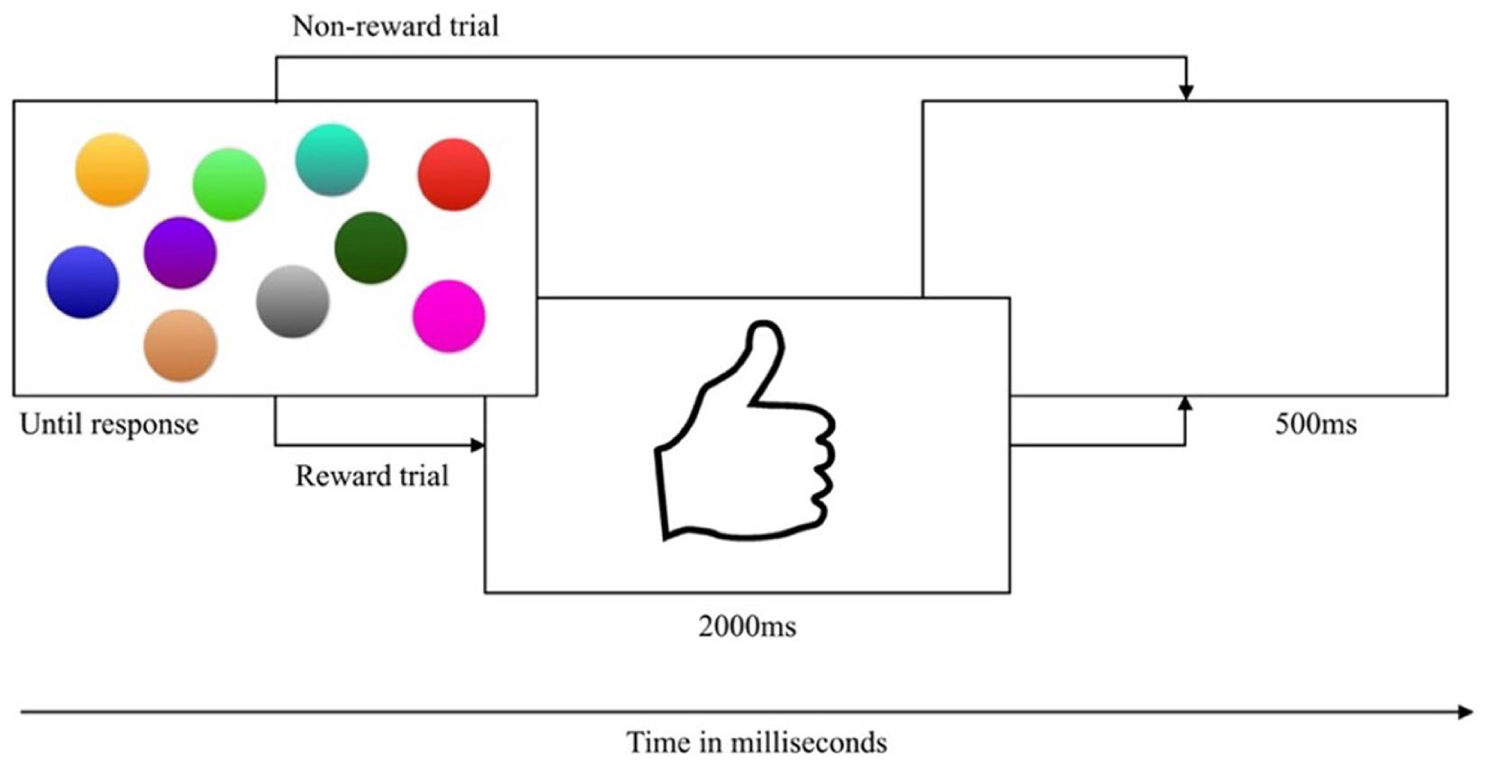
Time course of the instrumental learning task (ball game). Non-reward trials include both trials not scheduled for reward and trials with non-target responses (Hulsbosch et al., 2023).
Before the start of the task, instructions were presented on the screen and read aloud by the experimenter: “Welcome! In a moment ten colored balls will appear on a screen that you can press. When you press the correct one, sometimes a thumbs-up will appear. Do you have any questions? If not, push the ‘start’ button. Good luck!”. No further instructions were given. If the child asked questions or did not start the task, instructions were repeated.
Outcome Variables
Speed of learning during the acquisition phase was operationalized as the number of trials needed to reach 20 rewards, counting from the first rewarded response. For the extinction phase, three outcome measures were calculated. The primary outcome was the number of target responses (i.e., previously rewarded responses) executed, as a measure of behavioral persistence. Additionally, the total number of responses made to any of the circles was calculated along with the relative proportion of target responses (number of target responses/total number of responses). The latter outcome variable is included to assess behavioral persistence while taking account of a potential general increase in responding (i.e., increase in overall behavioral activity as predicted by Sagvolden et al., 2005).
Emotional Expressions
Coding System
A coding system for observational emotional expressions was used in the current study to measure emotional responding (Hulsbosch et al., 2024). In this coding system, facial expressions are coded based on an adapted version of FACES (facial expression coding system; Kring & Sloan, 2007). A facial expression is described as a change from a neutral expression to a non-neutral expression and back to a neutral expression, or a change from a non-neutral expression into a different non-neutral expression. For each facial expression, the valence was coded as positive (e.g., happy, surprised, etc.) or negative (e.g., sad, anxious, angry, etc.). The duration of the expressions was coded if the length of the expression exceeded 3 s to allow for calculation of the sum of all positive and negative facial expressions, while considering their duration. Expressions that lasted 3 s or less were counted as a single expression. Expressions lasting longer than 3 s were recorded as multiple expressions depending on how long they continued, for example, expressions of 6 or 9 s duration were counted as two or three expressions respectively (Hulsbosch et al., 2024).
As research increasingly acknowledges the importance of including multiple behavioral modalities of emotions (Jacob-Dazarola et al., 2016), body movements and verbal expressions were also coded as an exploratory measure of emotional expressions (Hulsbosch et al., 2024). Body movements and verbal expressions were only coded if they were clearly and unambiguously positive (e.g., doing a victory dance, “Yes, I got a thumbs up!”) or negative (e.g., slamming the table with hands, “This is a stupid game”; see Supplemental Material 3 for additional examples). The duration was again only coded if it exceeded 3 s, to calculate the sum of all expressions while considering the duration of each expression. For verbal expressions longer than 3 s that could be considered as only one expression (e.g., a full sentence that lasted longer than 3 s), duration was not coded.
Coding Procedure
Video recordings were made during the task to code emotional expressions. Emotional expressions were coded for the last 2 min of the acquisition phase and the total 4 min duration of the extinction phase. The 2 min length block coded for the acquisition phase was chosen to align with a measure of heart rate variability (HRV), not reported here, for which a minimum of 2 min is necessary to provide reliable data (Berntson et al., 1997; Ernst, 2014). Results regarding HRV will be reported in a separate manuscript, given the extent of the data collected. The coded block was limited to 2 min as this was the minimum duration of acquisition for most participants. 1 One coder (primary coder) with a master’s degree in clinical psychology and a second coder (reliability coder), a master’s student in clinical psychology, were trained to code the children’s emotional expressions during all 2 min blocks. The primary coder was aware of the child’s diagnostic status and coded all recordings, the reliability coder reviewed 20% of the recordings and was blind to the children’s group status. Both coders were sufficiently well trained to code emotional expressions reliably (see details on the training procedure in Supplemental Material Information 2). Percentage agreement was calculated using Holsti’s method (Mao, 2017) and was high for all modalities: facial expressions (88.82%), body movements (90.48%), and verbal expressions (93.26%).
Outcome Variables
The same outcome measures as used in the previous study were applied for the current study (Hulsbosch et al., 2024). For the final 2 min block of acquisition and the 4 min block of extinction, the number of negative facial expressions was the main emotional expression outcome. This number was calculated as the sum of all negative facial expressions within that block of either 2 min (acquisition) or 4 min (extinction). The total negative emotional expressions (i.e., the sum of facial expressions, body movements, and verbal expressions) was calculated as an exploratory outcome measure for the same blocks. The number of positive facial expressions and total positive emotional expressions were also calculated for the 2 min block during acquisition and the 4 min block during extinction.
Statistical Analysis
Statistical analyses were performed in SPSS 28 (IBM, Armonk, NY). Chi-square tests or two-way ANOVAs were used to compare the demographic characteristics of the children (age, parent-reported gender, and estimated IQ) and ADHD symptom severity scores (i.e., sum of parent-rated DSM-5 inattention and hyperactivity/impulsivity symptom items 2 ) between the ADHD and NT groups, and the three reinforcement conditions (continuous reinforcement, partial reinforcement, and STR). Given that children were recruited from two countries, the demographic characteristics and ADHD symptom severity scores were compared across test locations. For the comparison of symptom severity scores, diagnostic group (ADHD vs. NT) was inserted as covariate as relatively more children with ADHD were tested in Japan and relatively more NT children in Belgium. In case groups differed on either of the demographic variables, the association with outcome variables was assessed to investigate the necessity to control for these variables when analyzing task performance and emotional expressions.
Inspection of task performance and emotional expression data showed that all outcome variables were non-normally distributed. Therefore, log transformations were conducted on all outcome variables (Field, 2009). To investigate the effects of diagnostic group and reinforcement condition and their interaction on task performance, 2 (diagnostic group) × 3 (reinforcement condition) ANOVAs were conducted for all outcome measures from the instrumental learning task. To investigate the effect of diagnostic group and reinforcement condition on emotional expressions, 2 × 3 ANOVAs were also conducted. Diagnostic group and reinforcement condition were included as between-subject variables for the emotional expressions during the 2 min acquisition block and the 4 min extinction block. Exploratory analyses were conducted to investigate effects on positive facial expressions and total positive emotional expressions. Lastly, as an exploration of Amsel’s prediction on the relationship between task performance and emotional responding, we calculated Pearson’s correlations between the main outcome of speed of learning (i.e., number of trials to reach criterion) and behavioral persistence (i.e., number of target trials during extinction) with negative emotional responding during the acquisition/extinction phase. Correlations were calculated for both groups, as we primarily assume a relation in those with ADHD. Correlations were also calculated for each condition separately as we assumed a stronger relationship for the partial reinforcement and STR conditions during acquisition. To assess whether significant correlations, if any, were specific to negative emotional expressions, analyses were repeated for positive facial and total emotional expressions.
Results
Demographic Characteristics and ADHD Symptom Severity
The ADHD and NT groups did not differ significantly in age (F = 3.59, p = .060, ηp2 = .022) or estimated IQ (F = 0.62, p = .431, ηp2 = .003). Groups did differ significantly in gender distribution (χ² = 5.19, p = .023, ϕ = .176), with more boys in the ADHD group (69.05%) compared to the NT group (51.81%; see Table 1). There were no significant differences between the conditions in age, gender, or estimated IQ, and no significant interaction effects between diagnostic group and condition for any of these variables (see Table 1). No significant association between gender and task performance data was found, but for several negative emotional expression outcome variables, differences were found within the NT group, with male participants showing more negative emotional expressions (see Supplemental Table S1). Therefore, the statistical analyses of negative emotional expressions were repeated with gender as a covariate.
Demographic and Clinical Characteristics by Diagnostic Group and Condition.
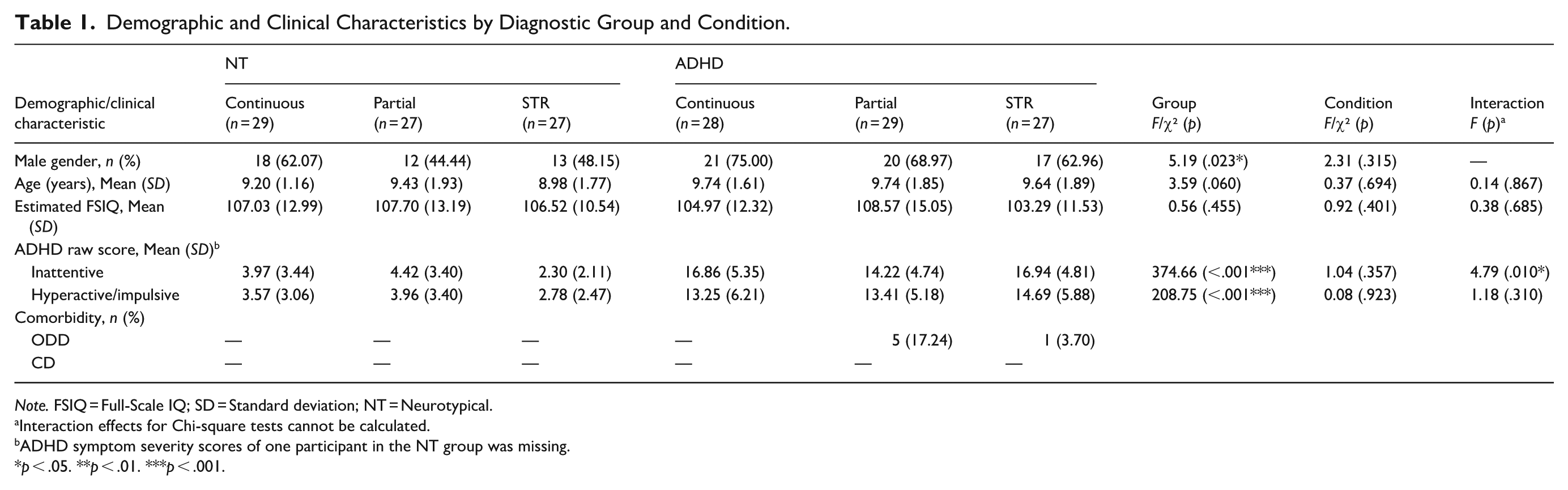
Note. FSIQ = Full-Scale IQ; SD = Standard deviation; NT = Neurotypical.
Interaction effects for Chi-square tests cannot be calculated.
ADHD symptom severity scores of one participant in the NT group was missing.
p < .05. **p < .01. ***p < .001.
As expected, children in the ADHD group had higher parent-rated ADHD symptom scores than children in the NT group (Inattention: F = 371.32, p < .001, ηp2 = .701; Hyperactivity/Impulsivity: F = 206.32, p < .001, ηp2 = .566). There were no significant differences between the three reinforcement conditions for ADHD symptom scores, but the interaction between diagnostic group and reinforcement condition was significant for inattention symptom scores (F = 4.78, p = .010, ηp2 = .057; see Table 1). Post-hoc analyses showed that, within the ADHD group, there were no significant differences in inattention symptom scores across the conditions. Within the NT group, children in the partial reinforcement condition (M = 4.42) had significantly higher inattention symptom severity scores than children in the STR condition (M = 2.30). However, this difference was not clinically meaningful as mean scores across all three conditions were low and all children had fewer than four parent-reported symptoms of inattention. Additionally, controlling for ADHD symptoms would be effectively controlling for the grouping variable, that is, ADHD. Therefore, it was not considered further in the analyses.
No differences in demographic and clinical characteristics were found between children tested in Belgium and those participating in Japan, except for the hyperactivity/impulsivity symptom severity scores. Across both groups of children (ADHD and NT), children tested in Belgium had higher symptom severity scores than those participating in Japan (see Supplemental Table S2). However, for the same reasons as described above, this was not considered further in the analyses.
Task Performance
Acquisition
The main effect of condition for the number of responses necessary to reach 20 rewards was significant (F = 18.94, p < .001, ηp2 = .190). Pairwise contrasts confirmed that, across both groups, children in the STR condition required more trials to reach criterion than those receiving continuous reinforcement, and children in the partial reinforcement condition required even more (pcontinuous-STR < .001, pcontinuous-partial < .001, pSTR-partial = .043; see Table 2 and Figure 2). Contrary to our predictions, there was no main effect of diagnosis on speed of learning, and the interaction between diagnosis and condition was non-significant (see Table 3).
Descriptive Statistics for the Task Performance Variables (Untransformed Data) by Diagnostic Group and Condition.
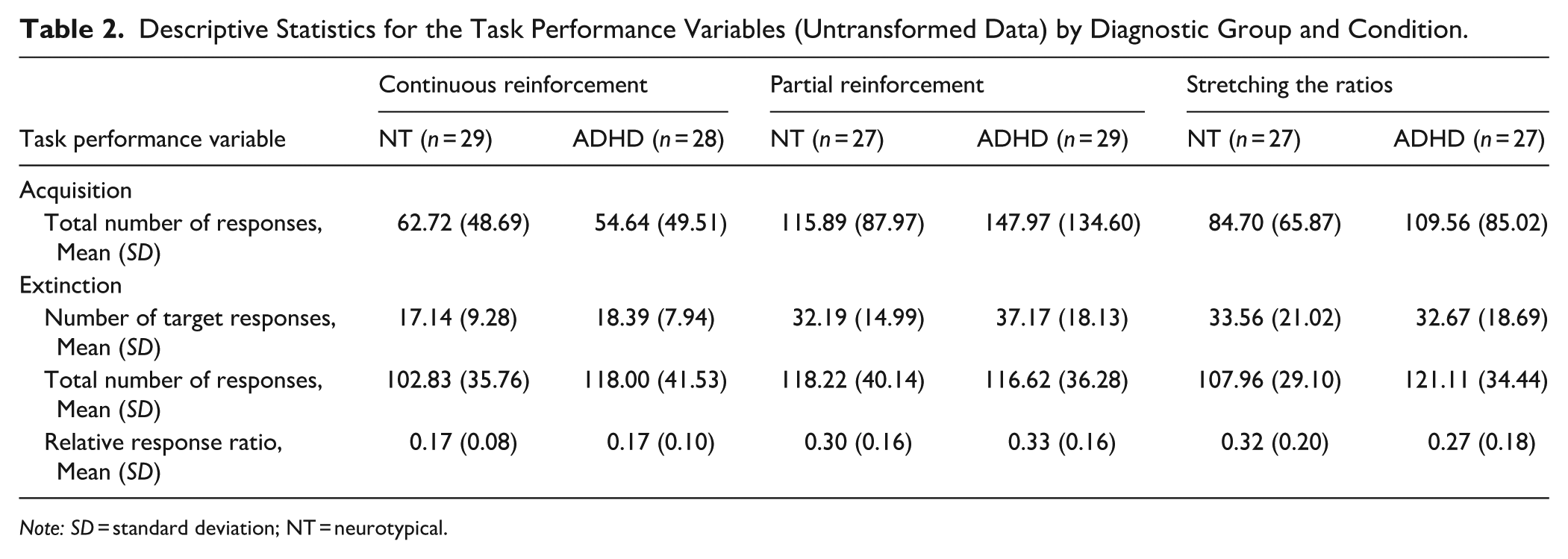
Note: SD = standard deviation; NT = neurotypical.
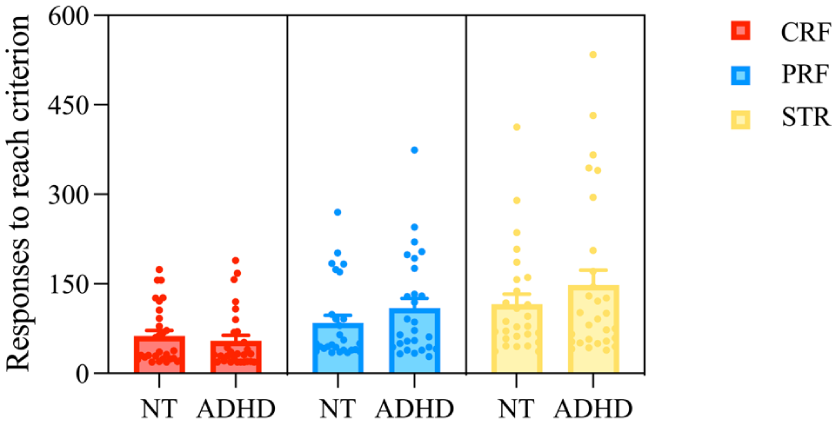
Number of trials needed to reach 20 rewards during acquisition, by diagnostic group and condition. Error bars represent standard error of the mean.
Results From two-way (Diagnostic Group × Condition) ANOVAs for Transformed Outcome Variables of Task Performance.
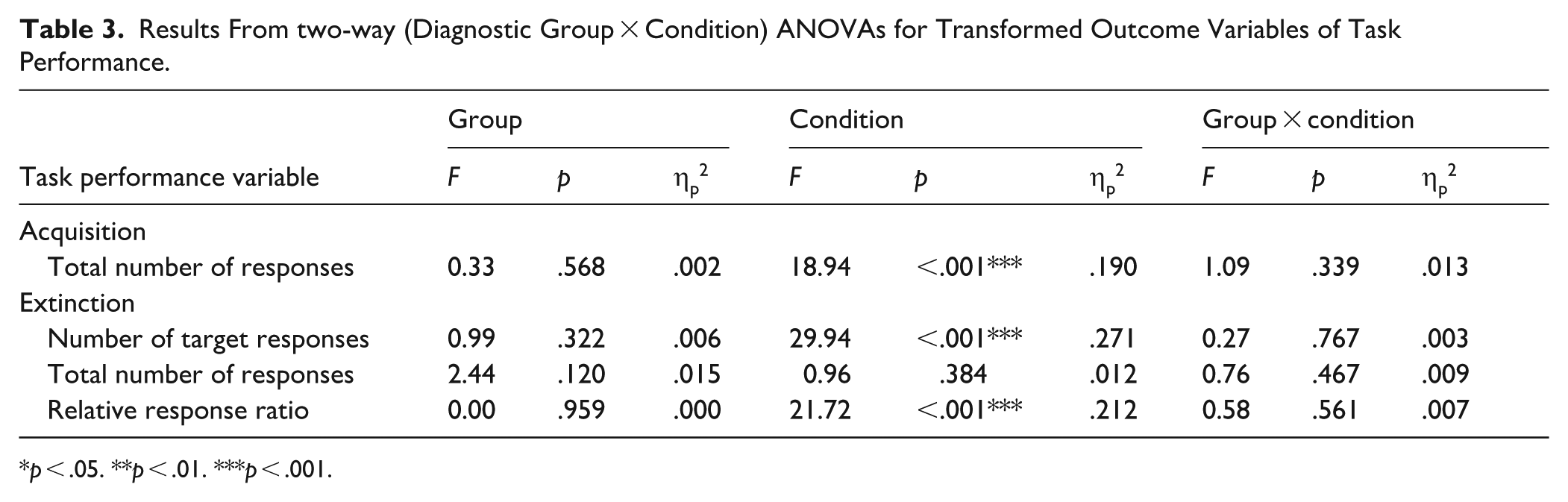
p < .05. **p < .01. ***p < .001.
Extinction
For the number of target responses during extinction, there was a significant main effect of condition (F = 29.94, p < .001, ηp2 = .271). Pairwise contrasts indicated that, across both groups, children made more target responses during extinction after learning under partial reinforcement and STR than after learning under continuous reinforcement, with no significant difference between partial reinforcement and STR (pcontinuous-STR < .001, pcontinuous-partial < .001, pSTR-partial = .497; see Table 2 and Figure 3). There was no significant main effect of diagnostic group, nor a significant interaction between diagnostic group and condition (see Table 3).
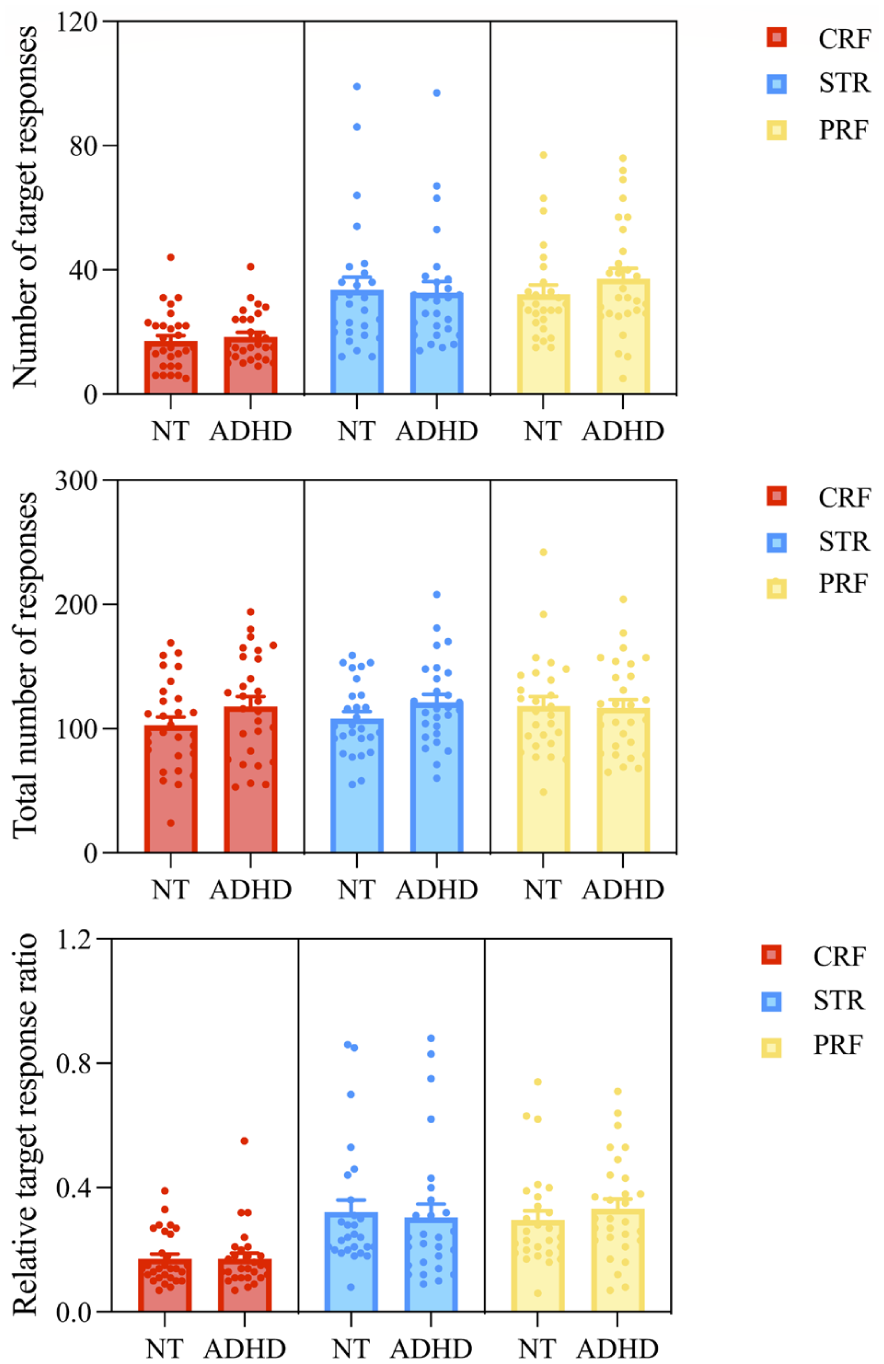
Number of target responses, total number of responses, and relative response ratio during extinction, by diagnostic group and condition. Error bars represent standard error of the mean.
For the total number of responses during extinction, neither main effects nor their interaction was significant (see Tables 2 and 3, and Figure 3).
For the relative response ratio, there was a significant main effect of condition (F = 21.72, p < .001, ηp2 = .212). Pairwise contrasts showed no difference in the relative response ratio during extinction after learning under partial reinforcement or STR across groups, but both resulted in higher ratios than extinction after learning under continuous reinforcement (pcontinuous-STR < .001, pcontinuous-partial < .001, pSTR-partial = .609; see Table 2 and Figure 3). Neither the main effect of diagnostic group, nor the interaction between diagnostic group and condition were significant (see Table 3)
Emotional Expressions
For eight children (ADHD n = 3, NT n = 5), video recordings were unavailable due to technical difficulties (i.e., camera failed to record or stopped recording prematurely). These children were not considered when analyzing emotional expressions. 3
Acquisition
Negative Facial and Emotional Expressions
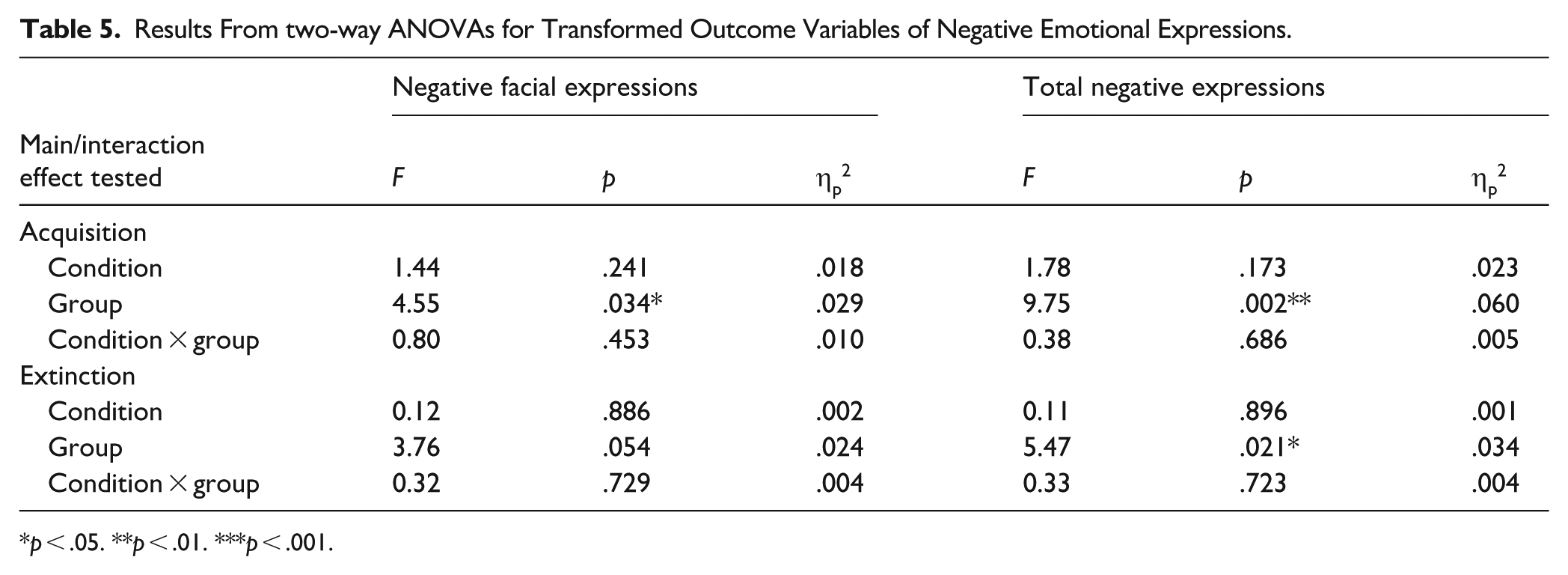
For the number of negative facial expressions during acquisition, there was a significant main effect of diagnostic group (F = 4.55, p = .034, ηp2 = .029). Children with ADHD showed more negative facial expressions than NT children across all three reinforcement conditions during acquisition (see Table 4 and Figure 4). The main effect of condition, and the interaction between diagnostic group and condition were not significant (see Table 5). The main effect of diagnostic group was not significant when gender was included as a covariate (see Supplemental Table S3). Excluding participants with an acquisition phase shorter than 2 min did not change the results either (see Supplemental Tables S4 and S5).
Descriptive Statistics (Means and Standard Deviations) for Negative Emotional Expressions (Untransformed Data) for the Last 2 min of Acquisition and 4 min of Extinction by Diagnostic Group and Condition.
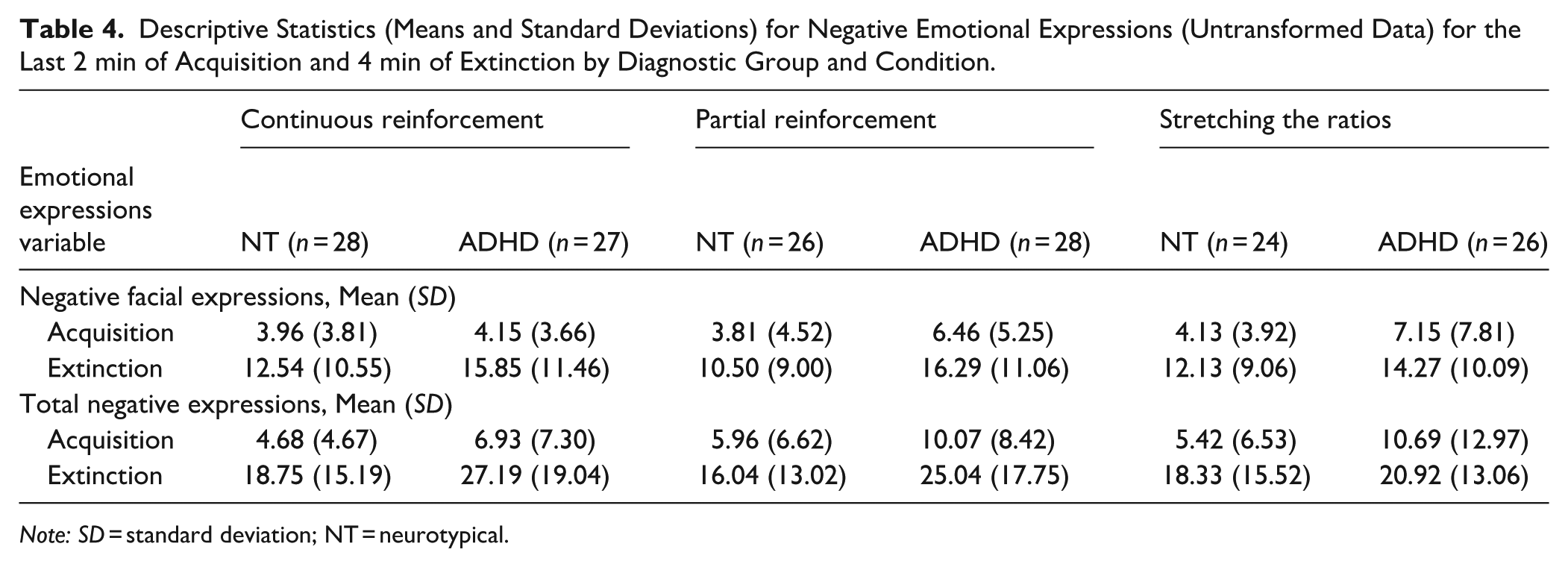
Note: SD = standard deviation; NT = neurotypical.
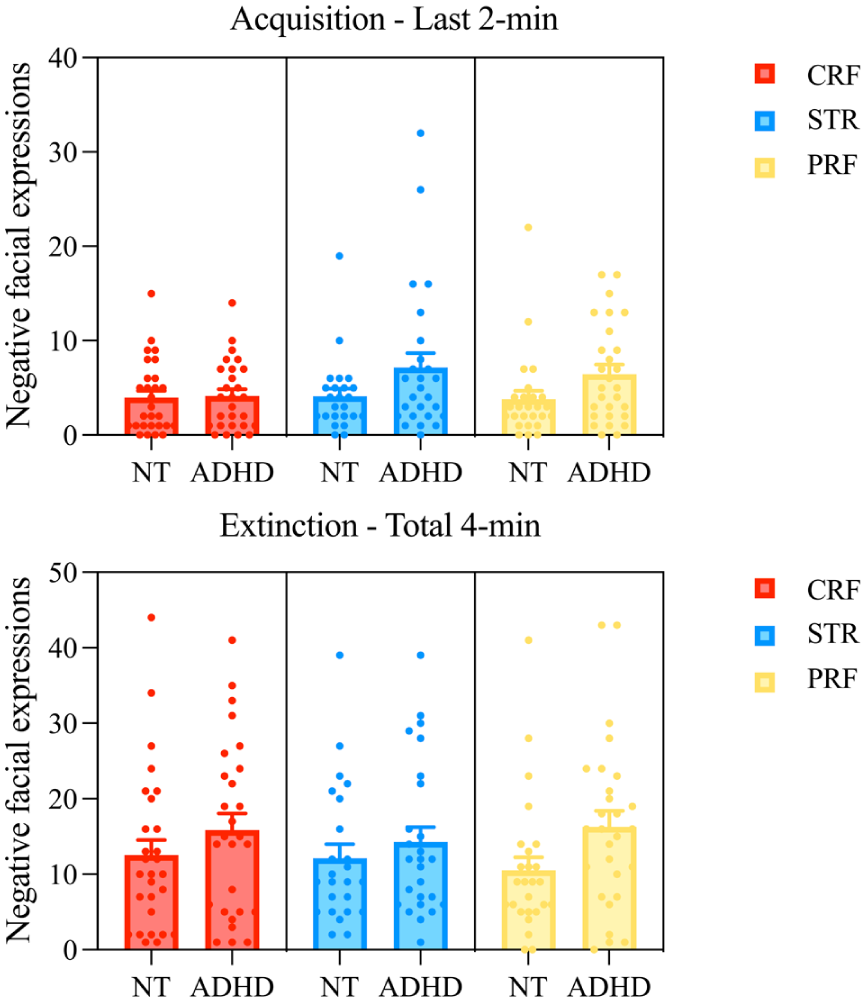
Number of negative facial expressions for the ADHD and NT groups in the three conditions during the last 2 min of acquisition and the 4 min of extinction. Error bars represent standard error of the mean.
Results From two-way ANOVAs for Transformed Outcome Variables of Negative Emotional Expressions.
p < .05. **p < .01. ***p < .001.
For the total negative emotional expressions during acquisition, the main effect of diagnostic group was also significant (F = 9.75, p = .002, ηp2 = .060). As for negative facial expressions, children with ADHD showed more negative expressions across all three reinforcement conditions (see Table 4). The main effect of condition and the interaction between diagnostic group and condition were again not significant (see Table 5). Adding gender as covariate in this analysis did not alter the results (see Supplemental Table S3). Excluding participants with an acquisition phase shorter than 2 min did not change the results (see Supplemental Tables S4 and S5).
Positive Facial and Emotional Expressions
The analyses of positive emotional expressions revealed neither main effects nor interaction, be it for positive facial expressions or total positive expressions during acquisition (see Supplemental Tables S6 and S7). Excluding participants with an acquisition phase shorter than 2 min did not change the results (see Supplemental Tables S4 and S5).
Extinction
Negative Facial and Emotional Expressions
For the number of negative facial expressions during extinction, neither the main effects nor the interaction was significant. Adding gender as covariate in this analysis did not alter the results (see Supplemental Table S3).
For the number of total negative expressions, the main effect of diagnostic group was significant (F = 5.47, p = .021, ηp2 = .034). Results showed more negative emotional expressions in children with ADHD than NT children across conditions during extinction (see Table 4 and Figure 4). The main effect of condition and the interaction between diagnostic group and condition were not significant (see Table 5). The main effect of diagnostic group was not significant when gender was included as a covariate (see Supplemental Table S3).
Positive Facial and Emotional Expressions
For both the number of positive facial expressions and the number of total positive expressions during extinction, the main effect of diagnostic group, the main effect of condition, and their interaction were non-significant (see Supplemental Tables S4 and S5).
Relation Between Task Performance and Emotional Expressions
None of the correlations were significant within the NT group (see Supplemental Table S8). However, the correlation between negative facial expressions during acquisition and speed of learning under partial reinforcement was significant for those with ADHD. Increased negative emotional expressions during acquisition was related to slower learning (r = .39, p = .039). The correlations between negative emotional expressions during extinction and the number of target trials during extinction under continuous reinforcement were also significant for those with ADHD. More negative facial expressions (r = -.47, p = .014) and total negative emotional expressions (r = -.42, p = .030) were related to reduced behavioral persistence. Similarly for extinction following STR, more total negative emotional expressions during extinction were related to reduced behavioral persistence for those with ADHD (r = -.40, p = .044). Regarding positive emotional expressions, the correlations between positive facial and total positive emotional expressions, during acquisition, and speed of learning under continuous reinforcement were significant for those with ADHD. Less positive emotional expressions during acquisition were related to slower learning (positive facial expressions: r = -.40, p = .037; total positive emotional expressions: r = -.43, p = .024). Similarly for learning under partial reinforcement, less positive facial expressions were related to slower learning (r = -.38, p = .046). None of the other correlations were significant for the ADHD group (see Supplemental Table S8).
Discussion
We investigated behavioral and emotional responding during instrumental learning under different reinforcement schedules in children with and without ADHD. The speed of response acquisition of children with ADHD did not differ significantly from that of NT children, regardless of the reinforcement schedule. Similarly, the groups did not differ significantly in their levels of behavioral persistence during extinction following acquisition with the reinforcement ratios as applied in the current study. In both groups, children showed faster extinction after learning under continuous reinforcement than partial reinforcement and stretching the ratios, supporting the PREE effect in our current sample. Further, children with ADHD showed more negative emotional expressions than NT children during both acquisition and extinction, irrespective of reinforcement condition.
Somewhat unexpectedly, children with ADHD did not differ from NT children in their speed of learning under any of the reinforcement schedules. These results are in contrast with a previous well-powered study with the same task (Hulsbosch et al., 2023), showing impairments in the learning of children with ADHD under both continuous and partial reinforcement. Of note, the reinforcement frequency in the current partial schedule was denser (33%) than in the previous study (20%). Both the DDT and DTD theory predict deficits in instrumental learning under partial reinforcement (Sagvolden et al., 2005; Tripp & Wickens, 2008). Possibly, the reinforcement schedule needs to be sufficiently lean for ADHD-related performance deficits to appear in speed of learning. On the other hand, children with ADHD also showed slower learning rates under continuous reinforcement in this previous study using the same paradigm (Hulsbosch et al., 2023), arguing against the hypothesis of performance deficits under sufficiently lean partial reinforcement schedules. Another potential explanation for the lack of group differences in the current study is that not all children with ADHD show deficits in instrumental learning, as heterogeneity is often reported in the impairments profile of children with ADHD (Luo et al., 2019) together with high variability in their performance on a range of cognitive tasks (Coghill et al., 2014). This might also explain the inconsistent findings reported across different instrumental learning studies (Hulsbosch et al., 2021).
For extinction, as expected, children in both groups showed greater behavioral persistence after learning under partial reinforcement and STR than after continuous reinforcement, with no difference between partial reinforcement and STR, indicating the presence of a PREE effect for children with and without ADHD in the current study. Contrary to our expectations, children with ADHD did not show decreased behavioral persistence compared to NT children under any of the reinforcement schedules tested. In a previous study using the same task, reduced behavioral persistence in children with ADHD compared to NT children after partial reinforcement was found (Hulsbosch et al., 2023), consistent with the predictions of the DTD (Tripp & Wickens, 2008), and in contrast of those of the DDT (Sagvolden et al., 2005). As stated above, the reinforcement density of the partial reinforcement condition was higher in the current study compared to the previous study that showed PREE deficits in children with ADHD (Hulsbosch et al., 2023). This may indicate that children with ADHD only show an impaired PREE after learning under a sufficiently lean reinforcement schedule.
To address the PREE deficits in children with ADHD as reported in the previous study (Hulsbosch et al., 2023), we also investigated the effectiveness of a STR schedule. In line with another study (De Meyer et al., 2019), we found this condition to be effective in increasing speed of acquisition compared to partial reinforcement, while establishing equal rates of behavioral persistence during extinction. However, we did not replicate the PREE deficits in ADHD as reported in the previous study (De Meyer et al., 2019). Therefore, we could not assess the potential effectiveness of the STR reinforcement schedule to overcome such deficits in the current sample.
Overall, the reinforcement schedules used in the current study may have contributed to the absence of the predicted group differences between ADHD and NT children. The partial reinforcement schedule in this study was 33%, compared with only 20% in our previous study (Hulsbosch et al., 2023). Given the otherwise identical task paradigm and screening of group inclusion criteria with the previous study (Hulsbosch et al., 2023), a tentative comparison of task performance data is possible across studies. We investigated the differential effect of the two partial reinforcement schedules (20% versus 33%) on learning speed and behavioral persistence in the ADHD and NT groups (see Supplemental Material 5 for full analyses). The two partial reinforcement densities in the two studies did not affect learning speed differently in children with ADHD compared to NT children. However, for the relative response ratio during extinction (number of target responses/total number of responses), NT children showed a higher ratio following learning under the 20% reinforcement schedule as compared to the 33% schedule, an effect that was not seen in those with ADHD. These exploratory findings suggest the PREE is more pronounced in NT children with a less dense partial reinforcement ratio during acquisition, whilst this effect is not found in those with ADHD.
It is well established that resistance to extinction, and thus the PREE, depends on the reinforcement ratio used during acquisition, with increased resistance following lower (leaner) partial reinforcement ratios (Bacon, 1962; Chan & Harris, 2019; Harris et al., 2019). Multiple explanations have been offered for this effect, on one hand, the PREE is proposed to depend on learning about nonreinforced trials during partial reinforcement (Amsel, 1992). On the other, it has also been argued that (the extent of) the PREE arises from the difficulty distinguishing between the acquisition and extinction phases, which is more difficult under lower ratios (Gallistel, 2012). The current partial reinforcement schedule of 33% may have provided weaker training on the occurrence of nonreinforcement and made it easier to distinguish between the acquisition and extinction phases, reducing the strength of the PREE effect. The absence of group differences in the current study may thereby reflect a smaller PREE effect in NT children under a reinforcement ratio of 33%. Future studies should further investigate the conditions under which children with and without ADHD differ in their behavioral persistence following learning under different reinforcement schedules.
Importantly, we also assessed negative emotional responding to the different reinforcement schedules in the current study. In his theory, Amsel (1992) predicts increased levels of negative emotional responding (i.e., frustration) in children with ADHD to unexpected non-reward, as in partial reinforcement and STR conditions, and during extinction. He proposes that this results in slower learning and decreased behavioral persistence (Amsel, 1992). Some preliminary support for this hypothesis is found in earlier studies (Douglas & Parry, 1994; Wigal et al., 1998). Our results did not fully support Amsel’s hypothesis, as children with ADHD showed overall more negative emotional expressions compared to NT children, irrespective of reinforcement condition and task phase (acquisition or extinction). This may indicate that children with ADHD experience instrumental learning and extinction overall more negatively than NT children, rather than unexpected non-reward specifically. Moreover, in the current study, this increased negative emotional responding did not seem to affect behavioral persistence during extinction. On the other hand, results of exploratory analyses showed significant correlations, but only within the ADHD group, between task performance and emotional expressions for the conditions in which the number of unexpected non-reward trials was the highest. More precisely, significant correlations with negative emotional responding were found during learning under partial reinforcement and during extinction after continuous reinforcement or STR. This is in line with Amsel’s predictions, posing increased negative emotional responding of those with ADHD results in slower learning and decreased behavioral persistence. However, it could also be argued that slower learning leads to more negative emotional expressions. Furthermore, for children with ADHD in the continuous and partial reinforcements schedules, positive facial and/or total emotional expressions were negatively related to speed of learning, thus participants who showed less positive emotional expressions took longer to reach the learning criterion. Future studies should aim to clarify the relation between instrumental learning under different reinforcement schedules, especially unexpected non-reward, and emotional responding.
The current study was sufficiently powered to find differences with medium effect sizes according to the power analyses as preregistered. However, reported effect sizes of group differences in task performance from the current study were only small in magnitude. Sample sizes for each group in each condition were smaller compared to the previous study reporting group differences (Hulsbosch et al., 2023), providing a potential explanation for the lack of significant findings in the current study. However, looking at the average number of trials necessary to reach criterion for both the NT (M = 62.72) and ADHD (M = 54.64) group under continuous reinforcement argues against this hypothesis, as there is no indication those with ADHD, on average, take more trials compared to NT children. A more plausible explanation may thus be heterogeneity within those with ADHD as argued above, where not all children with ADHD show instrumental learning deficits.
The results of the current study should be interpreted with regard for its limitations. Data collection was conducted in both Belgium and Japan (US nationals). Although there were no differences between children tested at the two locations in terms of demographic characteristics, cultural effects on the study results cannot be ruled out. More precisely, cultural effects on reward processing have been reported (Munakata et al., 2020; Yanaoka et al., 2022), and differences exist between cultures in emotion regulation and expression (Ford & Mauss, 2015; Senft et al., 2023). Future studies should investigate how cultural differences may relate to instrumental learning and emotional responding to such learning in children with and without ADHD. Second, there were relatively more boys in the ADHD group compared to the NT group, and boys showed more negative emotional expressions compared to girls in the latter group. Including gender as covariate in the analyses altered some of the results, where not all effects remained significant. However, including gender as a covariate may have confounded the result of group differences. The ADHD group contained more boys, and there was thus overlap between both grouping variables, potentially resulting in shared variance in predicting the results. Next, although we mostly included a “pure” ADHD sample without ODD comorbidity, six participants (7.14%) within the ADHD group had co-occurring ODD according to parent report. Although the co-occurrence of ODD is relatively low, we cannot exclude potential effects on the study findings as previous research indicates emotional dysregulation in those with ODD (Junghänel et al., 2022). With regards to the specific design as used in the current study, it was not possible to control for response rates in the acquisition phase while analyzing response rates during extinction. The task was designed such that the acquisition phase ended after receipt of 20 rewards and was not time limited as was the case for extinction. Next, emotional expressions were assessed over 2- or 4-min blocks during the task, but not in response to individual occurrences of unexpected non-reward. Future studies should also assess whether groups differ in their emotional responding to unexpected non-reward specifically. Although the reliability coder was blind to the participants’ group diagnosis, the primary coder was not, and emotional expression ratings may thus be biased. However, interrater agreement between both was high, suggesting a similar way of coding between both coders. Next, the behavioral measurement method as used in the current study has shown to be valid and reliable (Jacob-Dazarola et al., 2016), but other measurement methods of emotional responding (e.g., physiological, self-report, etc.) should be investigated in the future to fully capture different aspects of emotional responding (Mauss & Robinson, 2009). Lastly, Amsel (1992) proposes in his theory that children with ADHD show increased “frustration,” which he defines as an “aversive, motivational condition.” As we assessed negative emotional responding more generally, our measure is potentially broader than the emotional response predicted by the theory.
The study also has some important strengths. To our knowledge, it is the first to investigate the effects of different reinforcement schedules on both the behavioral performance and emotional responding of children with and without ADHD during acquisition and extinction, using a reliable measure of observational emotional expressions. This includes conditions of unexpected non-reward, to which children with ADHD are hypothesized to show increased emotional responding (Amsel, 1992).
The results of our study can potentially be relevant for clinical and educational practices. Although children with ADHD did not show deficits in task performance in the current study, they did show increased negative emotional expressions compared to NT children. This may be related to instrumental learning itself but might also be caused by task circumstances in general, or a general tendency to experience more negative emotions during task related situations (Graziano & Garcia, 2016). Such increased negative emotions during daily tasks may induce stress in the parents or the child, thereby interfering with their well-being, and potentially broader family functioning (Walerius et al., 2016). Additionally, effectiveness of largely instrumental learning based parent interventions has sometimes reported to be negatively affected by increased emotional responding in the child (Bagner et al., 2012; Gatzke-Kopp et al., 2015). Therefore, a tentative implication may be to include emotion regulation strategies in existing parenting intervention programs (Rosen et al., 2019; Van der Oord & Tripp, 2020).
Supplemental Material
sj-docx-1-jad-10.1177_10870547261430072 – Supplemental material for Behavioral and Emotional Responding During Instrumental Learning in Children With ADHD: Reinforcement Schedule Effects
Supplemental material, sj-docx-1-jad-10.1177_10870547261430072 for Behavioral and Emotional Responding During Instrumental Learning in Children With ADHD: Reinforcement Schedule Effects by An-Katrien Hulsbosch, Tom Beckers, Emi Furukawa, Marina Danckaerts, Dagmar Van Liefferinge, Gail Tripp and Saskia Van der Oord in Journal of Attention Disorders
Footnotes
ORCID iDs
Ethical Considerations
Ethical approval was obtained from the Social and Societal Ethics Committee, Faculty of Psychology and Educational Sciences at the KU Leuven, Belgium (G-2019 12 1922) and the Human Subjects Research Review Committee at the Okinawa Institute of Science and Technology (OIST) Graduate University, Japan (HSR-2020-031).
Consent to Participate
Written consent was obtained from parents and teachers and children gave assent to participate in the study.
Funding
The authors disclosed receipt of the following financial support for the research, authorship, and/or publication of this article: This study was funded by G.0845.19N of the Research Foundation Flanders (FWO) and internal subsidy funding from the Okinawa Institute of Science and Technology Graduate University.
Declaration of Conflicting Interests
The authors declared the following potential conflicts of interest with respect to the research, authorship, and/or publication of this article: Saskia van der Oord declares an honorarium and reimbursement for travel expenses from MEDICE for a lecture on non-pharmacological treatment of ADHD. Marina Danckaerts and Dagmar Van Liefferinge are participating in a Takeda-sponsored clinical trial in ADHD. All other authors have no conflict of interest.
Data Availability Statement
Data available on request due to privacy/ethical restrictions.
Permission to Reproduce Material
Figure 1 is reproduced from a Wiley manuscript written by the same authors (Hulsbosch et al., 2023;  ). Copyright clearance is issued without additional cost given both manuscripts are written by the same authors.
Supplemental Material
Supplemental material for this article is available online.
Notes
Author Biographies
References
Supplementary Material
Please find the following supplemental material available below.
For Open Access articles published under a Creative Commons License, all supplemental material carries the same license as the article it is associated with.
For non-Open Access articles published, all supplemental material carries a non-exclusive license, and permission requests for re-use of supplemental material or any part of supplemental material shall be sent directly to the copyright owner as specified in the copyright notice associated with the article.
