




Abstract
Objective:
Attention-Deficit/Hyperactivity Disorder (ADHD) is a prevalent neurodevelopmental disorder. While previous studies have shown substantial impact of ADHD across multiple domains, relatively little attention has been devoted to studying positive personality factors in individuals with ADHD. To address this, the current study examined strength-based factors in children with ADHD in relation to their social skills.
Method:
Sixty-four children (aged 8–12 years) with ADHD completed questionnaires related to their social skills and strength-based factors (e.g., optimism, resilience, self-concept, and coping skills).
Results:
Findings indicated significant differences between different levels of social skills in children with ADHD, with children with higher social skills reporting higher levels of resiliency, greater behavioral competence, and greater prosocial attitudes than those with lower social skills.
Conclusions:
The results highlight the importance of fostering strong social skills in children with ADHD, leading them to perceive themselves as competent and resilient.
Attention-Deficit/Hyperactivity Disorder (ADHD) is a common neurodevelopmental disorder, with an estimated prevalence of 5 to 7% in Canadian school-aged children (Brault & Lacourse, 2012). Symptoms of ADHD include developmentally inappropriate levels of inattention or hyperactivity and impulsivity, which may impact them across multiple settings (e.g., home and school; American Psychiatric Association, 2013). Despite being a prevalent childhood disorder, children with ADHD are often seen in a negative light. They frequently display undesirable behaviors (Wolraich, 2005), have lower academic achievements (Biederman et al., 2004), struggle to maintain friendships (Hoza, 2007), and are at a greater risk for accident or injury (Lange et al., 2012). They often require additional support from parents and teachers, especially regarding the management of ADHD symptoms and behaviors (Nigg & Barkley, 2014).
One particular area of concern that has been well-documented in children with ADHD is in the social domain. Hoza (2007) indicated that social problems and peer relationships are a significant concern in children with ADHD, with about 52% to 82% of children with ADHD report clinically significant levels of social problems (Huang-Pollock et al., 2009). They are often rejected, less liked by their peers and have fewer didactic friendships (Hoza et al., 2005). de Boo and Prins (2007) also found that children with ADHD may be criticized and rejected by their peers only after 30 minutes of interaction (de Boo & Prins, 2007). Other studies using peer nominations and teacher reports found evidence to suggest that children with ADHD are less popular, less cooperative, more disruptive, and have poorer overall social skills compared to their peers (Bagwell et al., 2001; Flicek, 1992). They often have difficulties interacting with others, which in turn affects the relationship with their parents (Hurtig et al., 2007), teachers (Greene et al., 2002) and peers (Nijmeijer et al., 2008). These social challenges can often lead to adverse outcomes, such as being rejected by peers, bullying, or social isolation (Greene et al., 1997; Unnever & Cornell, 2003).
Overall, the current literature suggests that individuals with ADHD face challenges with their social skills on a regular basis. However, not all children with ADHD have poor social skills. Furthermore, it is possible to teach social skills to individuals through intervention and training programs (Sadler et al., 2011). A recent Cochrane review investigated the efficacy of social skills interventions in children with ADHD (Storebø et al., 2019). While the review’s overall finding was inconclusive due to methodological limitations across studies, the authors did not find any adverse effects of social skills training (Storebø et al., 2019).
However, children with ADHD also possess many positive traits, many of which are often overlooked and under-researched (Climie & Mastoras, 2015). While a considerable amount of attention has been devoted to studying adverse outcomes associated with ADHD, relatively few studies have evaluated positive factors present in individuals with ADHD (Climie et al., 2017; Mastoras et al., 2015). This lack of focus on positive factors may be due to the current pathology-focused trend in the research and practice model (Masten & Curtis, 2000). Numerous research studies have emphasized the poorer performance of children with ADHD compared to their typically developing peers across several domains, including executive functions (EF; for review see Willcutt et al., 2005), social functioning (Hoza, 2007) and academic performance (Wolraich, 2005).
Taking on a more strengths-based approach in understanding children with ADHD can have potential benefits (Climie & Henley, 2016). For example, a strengths-based approach will enable teachers and parents to form positive outlooks of individuals with ADHD (Wilder et al., 2006), which can foster optimism and hope for better outcomes. The strengths-based approach will also highlight the unique characteristics and skills present in children with ADHD and provide a more balanced outlook (Climie & Henley, 2016). These unique positive skills can, in turn, be used as compensatory mechanisms for skills that individuals with ADHD might still be developing. These skills can also be included in their behavior intervention plans allowing psychologists and teachers to provide more strategic recommendations to alleviate some of their behavioral challenges (Climie & Henley, 2016).
Although our understanding of ADHD to date has been predominantly deficit-focused, the applicability of resilience and strengths-based perspectives to children with ADHD is an emerging area of interest in recent literature (e.g., Climie et al., 2013; Modesto-Lowe et al., 2011). As such, the current study has the potential to add to the existing literature regarding the strengths that children with ADHD can exhibit regarding positive personality factors.
Social Skills and Resiliency
Social skills such as being communicative, inspiring confidence, or feeling empathy are considered to be “resilience factors” as they facilitate the process of asking for help in crisis situations (Masten, 1994). Studies have suggested children learn skills such as cooperation, negotiation, and conflict resolution through interacting with their peers (Rubin et al., 2007; Strain & Odom, 1986). Furthermore, these social skills are critical for effective social functioning throughout the lifespan (Hoza, 2007), increasing academic competency (Elias & Haynes, 2008), leading to better long-term outcomes and are often viewed as more resilient than their less competent peers (Gest et al., 2006). As such, it is not surprising that peer problems during childhood can predict future adverse outcomes, including delinquency (Laird et al., 2005), dropping out of school, substance abuse, academic difficulties, truancy, and psychological maladjustment (Woodward & Fergusson, 2000).
Positive Personality Factors Impacted by Social Skills
The benefits of good social skills in children with ADHD and social support are some of the most frequently cited protective factors within the resilience field (e.g., Masten, 2001; Mastoras et al., 2015). As a result, it is essential to understand the positive factors associated with having high social skills versus low social skills in children with ADHD.
Resilience
Children with ADHD encounter a variety of stressors over the course of their lives. However, not every individual with ADHD reacts to the stressors in the same way, indicating that certain characteristics make some individuals more vulnerable than others. While there is no consensus in regards to the exact definition of resilience, it is generally accepted that resiliency is the capacity to overcome personal struggles and withstand obstacles (Alvord & Grados, 2005). Fergus & Zimmerman (2005) categorize resilience factors into two groups, person-centered variables (Assets) such as coping skills and self-concept and external factors like parental support (Resources; Masten, 2001). Social skills can be considered to be an essential resilience factor (Masten, 2001; Mastoras et al., 2015).
Studies investigating resiliency factors have concluded that resilience buffers the impact of stress on depressive symptomatology in childhood, adolescence, and adulthood (Anyan et al., 2017; Ding et al., 2017; Wingo et al., 2010). For example, Anyan & Hjemdal (2016) found that “resilience” moderated the effect of stress and depressive symptoms in adolescents. The authors found that depressed adolescents who were high on resiliency factors reported less depressive symptomatology during stressful situations. Thus the study concluded the need to focus on interventions targeting depressed adolescents who were low on resiliency factors. While the current literature supports that social skills act as a resiliency factor, no study to date has specifically investigated resiliency in children with ADHD who have different levels of social skills (high versus low).
Self-concept
Self-concept is defined as the ability to evaluate one’s competence in various domains, such as academics, behavior, social skills, and self-worth. Self-concept also includes one’s belief of the self regarding their ideologies, attitudes and competencies in various domains (Houck et al., 2011). It is generally formed through appraising competencies based on previous life experiences and interactions with others (Bracken, 1996). Some research studies have identified self-concept as an asset related to resilience, where having positive self-concept was associated with improved academic performance, possessing better-coping skills and positive social relationships (Houck, 1999; Houck et al., 2011). Furthermore, studies with children and adolescents with depression found that self-concept moderated the impact of stress on developing depressive symptomatology and coping with stress (Fathi-Ashtiani et al., 2007; Martinsen et al., 2016; Morales Rodríguez, 2017).
In recent years, researchers have found a strong implication of ADHD children’s self-perceptions in their development and psychosocial adjustment (McQuade et al., 2011; Mikami & Hinshaw, 2006). For example, a positive self-perception of academic competencies in childhood has been found to predict a lower level of internalizing and externalizing problems, lower rates of substance abuse, and better therapeutic outcomes (Mikami & Hinshaw, 2006). Lastly, Houck et al. (2011) found that lower self-concept scores in children with ADHD lead to more significant internalizing problems. Given the implication of self-concept and its role in functional outcomes in children with ADHD, it is important to investigate further whether having good social skills affect self-concept.
Self-perceived strengths
With the shift in focus toward a strengths-based approach to assessment and intervention, it is crucial to obtain information from individuals about their strengths. Fergus and Zimmerman (2005) would consider these self-perceived strengths as individual assets that can promote resiliency. While personal strengths can develop even without possessing risk factors, it is generally theorized that when youth are faced with adversity, strengths may be drawn upon to deal with life challenges. Therefore, strengths may serve as compensatory or protective factors.
Previously, some studies have used personal-strengths as a resiliency factor in at-risk populations. For example, Anderson et al. (2010) found that boys who have individual strengths such as strong school functioning (e.g., attending classes regularly, completing work on time) are less likely to be victims of bullying (Anderson et al., 2010). Additionally, boys who are still developing these skills may perform poorly in class and are at risk for bullying victimization. Lopez & Edwards (2008) found beneficial outcomes of personal strengths such as reduced depression symptom scores, fewer visits to health centers (Lee Duckworth et al., 2004) and increased ratings of happiness (Seligman et al., 2005). Overall, it appears that individuals in the general population who have scored higher on measures of interpersonal strengths have shown to have better life outcomes and fewer interpersonal problems (Hatcher & Rogers, 2009). However, self-perceived strengths, specifically in children with ADHD, have not been studied previously. Additionally, the impact of social skills on self-perceived strengths in children with ADHD have not been investigated either.
Objective of the Current Study
While numerous studies have investigated social skills challenges in children with ADHD (de Boo & Prins, 2007; Hoza, 2007; Hoza et al., 2005; Sadler et al., 2011), no study to date has investigated positive personality factors in children with ADHD who do possess good social skills. Even though a considerable number of children with ADHD have challenges with their social competency, not all individuals with ADHD struggle with poor social skills. To further understand some of these positive personality factors, the current study investigated some of these resiliency factors in children with ADHD who have different levels of social skills.
Method
Participants
The sample consisted of 64 children (84% male) with a confirmed diagnosis of ADHD. Children were between the ages of eight and 12 years (M = 9.99 years, SD = 1.15) and were required to meet a number of criteria for inclusion. Participants must have received a previous diagnosis of ADHD from a psychologist, psychiatrist, or medical doctor, and also have t-scores on the inattentive and hyperactive/impulsive scales of the Conners-3 Rating Scale (Conners-3; Conners, 2008) greater than or equal to 70 on at least one scale and a T-score of 65 on the second scale as part of the research study. Additionally, children must also have resided with their parents/guardians for at least the previous 5 years, attended school full-time, had no indication of or the previous diagnosis related to gross neurological, sensory, or motor impairments, and demonstrated cognitive abilities that fell within the Average range.
Measures
Children with ADHD and their parents completed measures related to social skills, resilience, and perceived strengths.
Parent measures
Parents of children with ADHD completed the Conners Rating Scale—3rd Edition—Parent Form (Conners-3; Conners, 2008) to determine a child’s eligibility to participate in this study. Conners-3 rating scales have high levels of internal consistency, with Cronbach’s alpha ranging from .77 to .97 (mean Cronbach’s alpha = .90), and test-retest correlations ranging from 0.71 to 0.98 (Conners et al., 2011).
Child measures
Children with ADHD completed a number of measures that provided an understanding of their views of their own strengths and abilities. More specifically, the following measures were utilized.
Resiliency scale for children and adolescents (RSCA)
The RSCA (Prince-Embury, 2006) is used to identify personal strengths and vulnerabilities in children and teens. It incorporates one overall score and three independent scales: Sense of Mastery (e.g., optimism, self-efficacy, adaptability), Sense of Relatedness (e.g., trust, support, comfort, tolerance), and Emotional Reactivity (e.g., sensitivity, recovery, impairment). Internal consistencies range from 0.82 to 0.90 for the three global scales, and the two index scores (Prince-Embury, 2010).
Social skills improvement system rating scale (SSIS)
The SSIS (Elliott & Gresham, 2008) is used to evaluate Social Skills, Problem Behaviors, and Academic Competence scales in children between the ages of 3 to 18 years old. For the purpose of this current study, the SSIS subscale Social Skills Composite Standard score was divided into two groups using a median split procedure to form the Low social abilities group (Low SS) and High social abilities (High SS) group. SSIS total social skills composite score has internal consistency and test-retest reliability estimates of 0.90 (Gresham et al., 2011).
Strengths assessment inventory-youth (SAI-Y)
The SAI-Y (Rawana & Brownlee, 2010) is a 120-item measure completed by youth. It provides a comprehensive understanding of self-perceived strengths in a number of areas, including day-to-day functioning, school environment, peer relationships, leisure, faith, culture, and family. For the purpose of this study, only the questions related to competent coping skills, prosocial attitudes, strengths from friends, goals and dreams, optimism for the future and peer connectedness were included in the analysis. Internal consistencies for the items ranged from 0.60 to 0.87 (Brazeau et al., 2012)
Self-perception profile for children (SPPC)
The SPPC (Harter, 1985) is a 36-item scale that captures a child’s self-reported global self-worth and six domain-specific self-perceptions. Internal consistencies, as reported in the manual, range from 0.75 to 0.85 for the selected scales (Harter, 1985).
Procedure
Participants were recruited through a number of means, including poster advertisements in local child-friendly establishments, connections with local school boards and local ADHD agencies, community newsletters and social media. Interested families contacted researchers and completed a brief pre-screening questionnaire to determine their eligibility for the study; eligible families then participated in a testing session at a university research laboratory. During the visit, parents completed their questionnaires while trained graduate student researchers worked directly with the child participants. Upon completion of the research protocol, families were thanked for their time and provided with a $25 family-friendly gift card to acknowledge their participation. The Conjoint Faculties Research Ethics Board approved all aspects of this study at the host institution.
Results
Preliminary Data Analysis
The Statistical Package for the Social Sciences (SPSS) version 26.0 was used to conduct all the data analyses. A preliminary inspection of the data was performed for accuracy and examination of missing values and outliers before running any statistical analyses. Additionally, the assumptions of normality and homogeneity of variance were evaluated in order to conduct parametric data analyses. Ratings from the SSIS was used to conduct a median split of the composite Social skills rating. Descriptive and multivariate analyses of variance (MANOVA) tests were conducted to compare the low social abilities group with the high social abilities group for the resilience and self-concept measures, as shown in Table 1. Missing cases from the SPPC and SAI-Y measures were analyzed using Little’s Missing Completely at Random (MCAR) test and were found to be less than 20%; thus, the listwise deletion was conducted (Tabachnick & Fidell, 2013). Mann-Whitney U-test was used to compare differences in mean ranks for the SAI-Y measures due to the nominal nature of the data, shown in Table 1. Mann-Whitney U-test first orders the raw values and then ranks them in ascending order. Then the sum of these ranks is converted into a test statistic (Mean Rank) to evaluate whether there are significant differences in ranks between the two groups. The four SAI-Y measures were compared using Mean Rank as a result.
Mean Scores of High and Low Social Skills Groups.
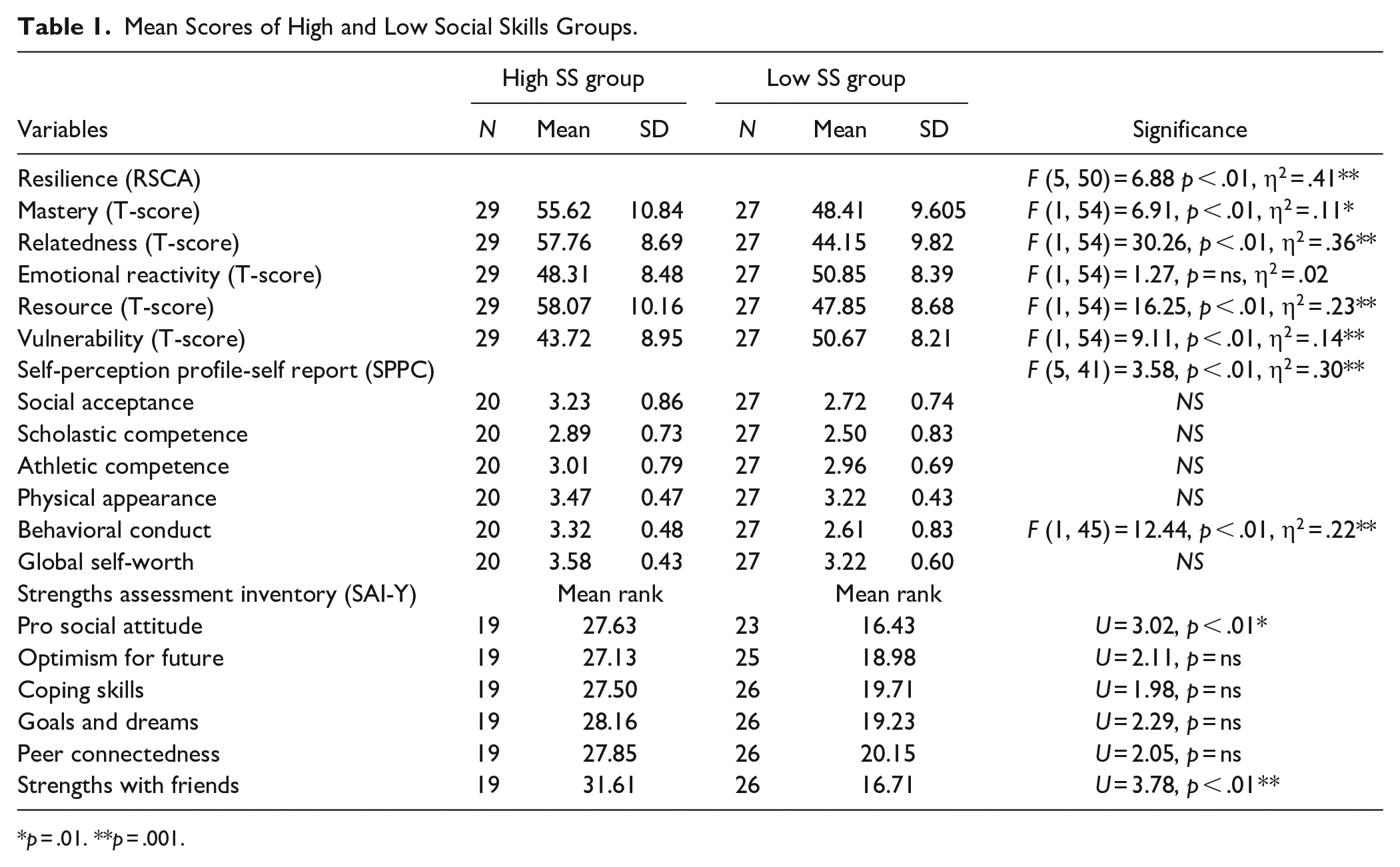
p = .01. **p = .001.
Resilience and ADHD
A one way MANOVA was conducted with the five subscales the RSCA as dependent variable and Social Skills (high and low SS groups) as the between subject variable. The results found a significant overall main effect of social skills on resilience score such that the high SS group had significantly higher resilience scores compared to the low SS group, F (5, 50) = 6.88, p < .01, partial η2 = .41. Univariate simple main effects for each individual subscale of the RSCA was conducted. In order to prevent Type I error, Bonferroni correction was used to correct for multiple comparisons, and the adjusted p value was considered to be p = .01. The high SS group (M = 55.62, SD = 10.84) had significantly higher Sense of Mastery than the low SS group (M = 48.41, SD =9.61), F (1, 54) = 6.91, p < .01, η2 = .11. Similarly, high SS group (M = 57.76, SD = 8.69) had significantly higher Relatedness score than the low SS group (M = 44.15, SD = 9.82), F (1, 54) = 30.26, p < .01, η2 = .36. The high SS group also had significantly higher score (M = 58.07, SD = 10.16) on the Resource subscale than the low SS group (M = 47.85, SD = 8.68). Lastly, the high SS group (M = 43.72, SD = 8.95) had significantly lower Vulnerability score than the low SS group (M = 50.67, SD = 8.21), F (1, 54) = 9.11, p < .01, η2 = .14. There were no significant group difference on the Emotional Reactivity subscale between the high SS (M = 48.31, SD = 8.48) and low SS group (M = 50.85, SD = 8.40), F (1, 54) = 1.27, p = ns, η2 = .02. Overall, the results show that the high social skills group were more resilient than the low social skills group (Table 1).
Self-Concept and ADHD
A one-way MANOVA was conducted with the six subscales of SPPC as the dependent variables and Social Skills (high and low SS groups) as the between-subjects variable. MANOVA results found a significant overall main effect of social skills on self-concept scores such that the high SS group have significantly higher Self-concept scores compared to the low SS group, F (6, 40) = 3.02, p < .01, η2 = .31. Univariate simple main effects were conducted for each subscale of the SPPC. Following Bonferroni correction, there was significant simple main effects of social skills on behavioral conduct with the high SS group indicating better behavior conduct (M = 3.33, SD = 0.48) than the low SS group (M = 2.61, SD = 0.80), F (1, 45) = 12.44, p < .01, η2 = .22. The other components of the SPPC measure, Scholastic Competence, Social Acceptance, Athletic Competence, Physical Appearance and Global Self-Worth, were not significantly different between the low and high SS groups, p = ns. Overall, the high social skills group perceived themselves to be more behaviorally competent than the low social skills group, but that not different when it comes to their Social Acceptance, Scholastic Competence, Athletic Competence, Physical Appearance, and Global Self-Worth.
Self-Perceived Strengths of Children with ADHD
Group differences between high and low SS groups in SAI-Y measures were compared using a non-parametric technique, Mann-Whitney U-test. Results found that the High SS group ranked themselves as possessing significantly more prosocial attitudes (Mean Rank = 27.63) compared to children in the low SS group (Mean Rank = 16.43), U = 3.02, p < .01. The high SS group also ranked themselves higher in strengths with friends (Mean Rank = 31.61) compared to the low SS group (Mean Rank = 16.71), U = 3.02, p < .01. The other components of the SAI-Y used in the current study, optimism for the future, goals and dreams, and possessing more coping skills, did not meet the significance criteria after correcting for multiple comparisons, p = ns, (Table 1).
Discussion
Children with ADHD are known to face difficulties across a number of domains, including their behaviors (Wolraich, 2005), academic learning (Biederman et al., 2004), executive functions (Kofler et al., 2019; Willcutt et al., 2005) and overall poor functional outcomes (future employment opportunities; Nadeau, 2005). Specifically, previous studies have shown that children with ADHD often have significant social challenges, which can often lead to adverse outcomes, such as being rejected by peers, bullying, or social isolation (Hoza, 2007). However, not all individuals with ADHD appear to struggle with their everyday functioning. Given that social skills are considered to be resiliency factors that can facilitate cooperation, negotiation and conflict resolution when interacting with peers as well as encourage asking for help during a crisis (Elias & Haynes, 2008; Gest et al., 2006; Masten, 2001), the current study was specifically interested in investigating positive personality factors associated with good social skills in children with ADHD.
The results of this study showed that children with ADHD who have good social skills possess positive personality factors. For example, the results indicated that children with ADHD with high social skills considered themselves to have significantly high resiliency skills compared to those with low social skills. Specifically, children with ADHD who have high social skills rated themselves stronger in their ability to master stressful situations and their ability to relate to others. They also considered themselves to be more resourceful and were less vulnerable in stressful situations. The results can indicate that when possessing good social skills, these individuals were better able to cope with their everyday stressors, develop clear and realistic goals, have better problem-solving skills, can relate comfortably with others and treat themselves and others with respect.
The RSCA Sense of Mastery scale was designed to tap into constructs that are related to self-efficacy, optimism, and adaptability (Prince-Embury, 2006). As such, the results from the current study could be interpreted as children with ADHD with high social skills considered themselves to be more competent overall and thus rated themselves higher in their mastery scale. They might also have high self-efficacy and were more optimistic, which could also contribute to their feeling of being competent. Additionally, White (1959, p. 298) describes that “Mastery in a certain topic or skill is driven by innate curiosity,” which an individual finds rewarding. It is possible that individuals with ADHD who have high social skills can master skills or tasks that they find internally motivating.
The present study also found that children with ADHD with high social skills also rated themselves to have a high Sense of Relatedness. This component of the RSCA is related to individuals’ ability to relate to others. It also consists of an individual’s ability to trust, access support, be comfortable with others, and ability to tolerate (Prince-Embury, 2006). The results could indicate having good social skills allowed individuals with ADHD to be able to trust others and seek help when needed. It also could suggest that these individuals are tolerant and are better able to relate to others than individuals with ADHD who have low social skills. Furthermore, children with ADHD with better social skills considered themselves to be less vulnerable in crisis situations. Overall, the results from the present study indicate that children with ADHD who have better social skills have more resiliency skills. The results further support the need to pay attention to improving social skills in children with ADHD who are lacking in this area by implementing targeted social skills interventions.
Regarding self-concepts, children with ADHD with better social skills rated themselves to be more behaviorally competent compared to children with ADHD who have low social skills. They did not rate themselves to be more competent in any of the other components of the SPPC, such as scholastic competence, athletic competence, physical appearance and global self-worth. This result is consistent with previous findings indicating that behavior problems were associated with lower self-concept scores (Houck et al., 2011). Furthermore, the same study also found more internalizing problems were related to lower self-concept scores (Houck et al., 2011). As such, the results from the current study could signify that having good social skills allowed these individuals to be more aware of their behavior and thus increase their self-concept regarding their behavior. Overall, the results emphasize the importance of promoting the development of good social skills as it can influence the development of a positive self-concept.
The current study also investigated self-perceived strengths in children with ADHD who had high social skills compared to those with low social skills. The results suggested that children with ADHD who had high social skills rated themselves as being more prosocial compared to children with ADHD who have low social skills. Specifically, children with ADHD with high social skills indicated that they were more likely, to be honest with their friends and help their friends during a crisis.
While the present study did not specifically measure what factors lead some of these individuals to have higher social skills than others, it is possible that good social skills allowed these individuals to be more empathetic to others and thus were liked by their peers more. It is also possible that specifically for these individuals, developed social skills helped with relationship formation; therefore, they felt that prosocial attitudes and helping their friends were areas of strength for them. It is also important to note that while the other components of the SAI-Y did not meet the significance criteria used in the current study, children with ADHD who had higher social skills also rated being more optimistic about their future, possessing competent coping skills, had stronger peer connection and felt they had future goals and dreams. These are all crucial strengths of these individuals.
Additionally, the results of this study are consistent with previous research indicating that having good social skills is related to an overall positive outlook in life for youth with substance abuse problems (Harris et al., 2017). The present study showed that children with ADHD, when they have good social skills, also consider themselves to possess strengths. These personal strengths have the potential to help these individuals to succeed in other areas, such as their academic functioning and overall quality of life (Harris et al., 2017). Given that social skills can be trained through intervention, the results of this study can inform future interventions and social policies that could improve the lives of vulnerable children and families with ADHD.
Practical Implications
The novelty of the present study is that it is one of the first studies to apply a strength-based approach to understand children with ADHD. The study provides evidence to support incorporating a strengths-based approach in the educational system over the deficit-based medical model approach as these positive factors can be incorporated into interventions that can alleviate some of the concerns associated with ADHD (Climie & Mastoras, 2015). For example, the results from the current study signify the importance of good social skills in children with ADHD, which can potentially lead them to develop better self-perceived positive outcomes. Consistent with previous research in children and adolescents with depression, good social skills were associated with an increase in positive behaviors that could help buffer negative aspects of stressful situations (Fathi-Ashtiani et al., 2007; Martinsen et al., 2016; Morales Rodríguez, 2017). The findings from this study further extend our understanding of social skills as a protective factor to overcome life’s challenges.
Additionally, studying children with ADHD who have strong social skills provide valuable insight as to the skills that can be fostered in children who are still in the process of developing their abilities. Given that social skills can be taught through intervention programs, these results are especially important for implementing and designing programs to intervene with social skills challenges in children with ADHD. The findings also emphasize the importance of early interventions for these individuals. Knowledge of the processes contributing to resilient functioning can enable educators and researchers to design prevention and intervention programs for individuals going through adverse life circumstances.
Furthermore, the results of the current study highlight the importance of looking at sub-groups of children with ADHD rather than grouping participants based on the presence or absence of the disorder alone. Given the heterogeneous symptom presentation of ADHD among the different presentation subtypes, it is rare to observe a true homogeneous group of individuals with ADHD. The current study categorized individuals with ADHD based on their social skills levels and observed differences in positive factors present in individuals with ADHD. These skills might have been overlooked if the current study was specifically interested in finding the difference between individuals with the disorder and without the disorder.
Lastly, the findings from the present study support the inclusion of social-emotional learning (SEL) into the educational curriculum, specifically for children with ADHD. Given the potential benefits of good social skills and improvement in resiliency factors, it is important for educators and administrators to consider incorporating opportunities to develop SEL into the curriculum (Collaborative for Academic, Social, and Emotional Learning, 2019). SEL programs have the potential to improve the student-teacher relationship and provide better support to children with behavioral challenges (Blewitt et al., 2020).
Limitations and Future Studies
Although the present study provides valuable information in regards to positive personality factors in children with ADHD, it is also important to consider the findings in light of some limitations. The current study only included participants with ADHD, as the study was specifically interested in studying positive personality factors in children with ADHD. Future research is needed to compare differences in these personality factors between children with and without a diagnosis of ADHD. Another limitation of the study is the application of self-report measures from children with ADHD. Research studies have shown that children with ADHD overestimate their actual competencies and thus have heightened self-esteem. This tendency is called the positive illusory bias (PIB; Hoza et al., 2002; Owens et al., 2007). It is possible that children with ADHD included in the study overestimated their abilities. However, some studies have shown that there is a large proportion of children with ADHD who have an accurate self-perception (Klimkeit et al., 2006; Rizzo et al., 2010). Future research needs to compare these findings using parent and teacher reports to understand the difference. The current study also did not take into consideration age and gender effects. Given the high prevalence of ADHD in boys and those symptoms of ADHD manifesting differently over time, and it is essential to consider the impact of age and gender in future studies. Lastly, the current used median split methodology to create high and low social skills groups. While this is a common practice to use median splits to create dichotomous categories of continuous variables, it would be beneficial to investigate social skills as a more continuous variable and investigate the relationship with the different resiliency measures (DeCoster et al., 2011).
Conclusion
This study took on a strengths-based approach to investigate positive personality factors in children with ADHD. To the best of the authors’ knowledge, this is the first study to investigate positive personality factors in children with ADHD. The results indicated that good social skills could lead to developing or possessing strong resiliency factors as well as positive self-efficacy and personal strengths. These findings further support the importance of targeting social skills training in children with ADHD, given the substantial benefits of having good social skills. As such, the conclusions of the current study can influence intervention planning for individuals with ADHD.
Footnotes
Declaration of Conflicting Interests
The author(s) declared no potential conflicts of interest with respect to the research, authorship, and/or publication of this article.
Funding
The author(s) received no financial support for the research, authorship, and/or publication of this article.
