




Abstract
Adults with ADHD often fail to reach the same occupational status as healthy controls (e.g., Barkley, Murphy, & Fischer, 2008). Functional impairments seem to be associated with clinical symptoms (e.g., Barkley et al., 2008), self-reported executive function (EF) deficits (Barkley & Fischer, 2011), and cognitive task performance (e.g., Miller, Nevado-Montenegro, & Hinshaw, 2012). Actual models of ADHD consider the influence of situational factors that influence motivation and activation on performance (e.g., Sergeant, 2005; Sonuga-Barke, 2005). Thus, it is essential to investigate such factors that may be facilitating for adults with ADHD to tailor and complement treatment options. Theoretical models and empirical investigations dealing with the influence of situational factors on cognitive performance in children with ADHD have mainly focused on the influence of physical activation, stimulation, and reward. However, less is known about the impact of these factors on adult ADHD.
Effects of Reward and Feedback
Theoretical Models
Persons with ADHD are hypothesized to be unusually receptive for reward and easily frustrated when anticipated reward is lost (Douglas & Parry, 1994), to exhibit an elevated reward threshold (Haenlein & Caul, 1987), or to exhibit a shorter and steeper delay of reinforcement gradient (Sagvolden, Johansen, Aase, & Russell, 2005). Sonuga-Barke (2005) describes deficient reward mechanisms resulting in a generalized delay aversion. These models predict that performance of persons with ADHD benefits mostly from continuous, frequent, contingent, and immediate reward (Douglas & Parry, 1994; Haenlein & Caul, 1987; Sagvolden et al., 2005; Sonuga-Barke, 2005). Compared with healthy persons, those with ADHD may need higher and more salient reinforcement to improve their performance or perform similar to matched controls (Haenlein & Caul, 1987; Sagvolden et al., 2005). Thus, when the healthy have already reached their optimal performance level, persons with ADHD might still profit from additional reward. The Cognitive Energetic Model (CEM; Sergeant, 2005) postulates an interaction of computational attention mechanisms with state factors (arousal and activation; adjusted by effort) and EF for overall efficiency of information processing. Persons with ADHD can reveal deficits at all three levels. The author stresses the relevance of optimal energetic state for task performance. Thus, deficient task performances in ADHD might indicate the inability to adjust the energetic state, and not necessarily executive dysfunction. The effort pool is suggested to be responsible for this adjustment by modulating activation/arousal to task demands (Sergeant, 2005). It is related to motivation and is therefore also susceptible for reward. In sum, it seems reasonable to assume that under optimal reward conditions performance of persons with ADHD would improve or normalize.
Empirical Results
Luman, Oosterlaan, and Sergeant (2005) review studies with ADHD children and controls. In most studies, task performance improves with reward for both groups. This effect seems slightly higher for the ADHD groups. Some studies reveal a speed–accuracy trade-off specific to children with ADHD. Less research has been done regarding the relationship between reward and performance in adult ADHD. Marx et al. (2013) tested the impact of financial reward on diverse cognitive performances in adults with ADHD and healthy controls. The reaction time and accuracy of responding in people with ADHD have been found to be enhanced when they are provided with rewards. In addition, time reproduction has also been positively affected by rewards in this population. Hence, this study finds a speed–accuracy trade-off as an indicator for some normalizing effects of reward on performance in adult ADHD. However, participants were assessed in a between-subject design, where nonrewarded and rewarded groups were compared. A within-subject design would be more reliable.
Effects of Physical Activity
Predictions From Research in Healthy Subjects
Meta-analyses reveal a small positive effect of acute physical activity on cognitive performance in healthy subjects (e.g., Chang, Labban, Gapin, & Etnier, 2012: Cohen’s d = 0.097; Lambourne & Tomporowski, 2010: 0.20). Effects of ergometer cycling are larger than for running (Lambourne & Tomporowski, 2010). Several mechanisms may determine these effects, such as a higher availability of catecholamines (e.g., McMorris, Turner, Hale, & Sproule, 2016) or increases in brain-derived neurotrophic factors (BDNF; e.g., Knaepen, Goekint, Heyman, & Meeusen, 2010). The potential effects of physical activity on performance appear relevant to adults with ADHD because they often suffer from several cognitive deficits (meta-analysis: Hervey, Epstein, & Curry, 2004). In addition, some mechanisms positively affected by physical activity are reported to be deficient in ADHD: ADHD is associated with a catecholamine dysfunction (e.g., Prince, 2008) or disruptions of BDNF levels (e.g., Tsai, 2007). Furthermore, stimulant medication influences some of these neurophysiological aspects (e.g., Pliszka, 2005). Taken together, these indirect relations could justify the hypothesis that cognitive performance in ADHD might benefit particularly from physical activity. The CEM supports this by highlighting arousal and activation as essential for efficient information processing in ADHD (Sergeant, 2005). Hence, the manipulation of activation in ADHD, for example, through event rate, can improve task performance to the level of healthy controls as shown by, for example, van der Meere, Stemerdink, and Gunning (1995)
Empirical Results
Den Heijer et al. (2016) review studies on the effects of exercise on different outcomes in children with ADHD and preliminarily for adult ADHD. In sum, mainly cardio exercise improves several measures in children with ADHD, both acute and chronic. However, specificity for ADHD remains unclear; most studies in this review did not assess control groups or find effects for both groups. Studies on adults with ADHD are scarce. Gapin, Labban, Bohall, Wooten, and Chang (2015) show better inhibition performance after 30 min of exercise than before for adults with ADHD. This effect is higher than for healthy adults. However, other performances only improve for the control group, and the sample size is small in this study. Fritz and O’Connor (2016) detect no impact of 20-min cycling on sustained attention performance for adult men with ADHD symptoms. Reported feelings of motivation and energy raise and feelings of confusion, depression, and fatigue decrease after the activity. Results for adult ADHD differ in consistence, and given the limited number of studies, more research is necessary.
Effects of Stimulation
Theoretical Models
Zentall and Zentall (1983) already proposed that inattentive, impulsive, and especially hyperactive behavior in ADHD reflects attempts to reach optimal stimulation in cases of insufficient sensory stimulation and underarousal. Thus, adding stimulating activities to routine, boring, or monotonous tasks could be expected to reduce symptoms of ADHD and improve task performance. Similar considerations are also present in more actual research, for example, in the vigilance regulation model (Hegerl & Hensch, 2014).
Empirical Results
Some studies have investigated fine motor activities or sensory stimulation during task execution of children with ADHD. There is some evidence for the profitable influence, for example, of auditory stimulation (e.g., Söderlund, Sikström, & Smart, 2007). In one study, the manipulation of a tangle puzzle enhances math performance for children with ADHD and reduces performance-impeding effects of auditory distraction (Kercood & Grskovic, 2010). Such on-task stimulations seem promising to improve cognitive performance/symptoms, but have so far only been assessed in small groups of ADHD children, often without control groups. None is known of the effects on cognitive performance for adult ADHD subjects; only one study used a stimulation method, but before the task. The 2-min whole-body vibration before task administration improves the inhibition performance of adults with ADHD and healthy controls, but the effect is stronger for the ADHD group (Fuermaier et al., 2014).
Approach and Aims of the Present Investigation
We want to assess the influence of physical activation, stimulation, and reward on the cognitive performance and subjective symptoms of adults with ADHD and controls. Dependent variables include (a) EF-tasks, which tap relevant levels of everyday cognitive functioning and therefore use material close to daily life, and (b) self-ratings of subjectively experienced symptoms of inattention and hyperactivity during task execution. From previous work of performance-enhancing effects in childhood ADHD, we expect positive effects of performance-related reward on inhibition performance for all participants, but more prominent for adults with ADHD. To capture potential speed–accuracy trade-offs, reaction times and errors will be considered independently. To the best of our knowledge, the influence of changes in reward on self-reported symptoms of adult ADHD has not been assessed, yet. Hence, we investigate potential positive effects of reward on self-reported inattention and hyperactivity during the inhibition task differentially in an exploratory manner.
Despite inconsistent findings for adults with ADHD and lack of ADHD specificity, we assume that physical activation before performance in a selective attention task enhances performance of both groups and especially of adults with ADHD. Again, potential alleviating effects on inattention and hyperactivity self-reports for the selective attention task will be tested in an exploratory manner and separately.
The influence of stimulation during performance of monotonous tasks has not been assessed for adults with ADHD, yet. However, a positive effect of the stimulation during a monotonous working memory task for performance can be deduced from theoretical work, again specific for adults with ADHD. As the theoretical work especially assumes positive effects on ADHD symptoms, we examine this with exploratory analyses for inattention and hyperactivity reports during the working memory task.
Selection of the EF-tasks to be combined with the respective manipulation followed empirical aspects on one hand, for example, reward often was used in prior research to improve inhibition performance. On the other hand, practical task aspects were relevant, as, for example, the monotony of the working memory task or its compatibility with stimulating activities.
Method
Participants
Thirty-six adults with ADHD and 36 healthy controls participated in the study. Controls were matched to ADHD participants on gender, age (±5 years), and their highest educational level. All participants were native German speakers, at least 18 years old and received €60 for participation. General exclusion criteria were (a) neurological disorders; (b) psychotic disorders; (c) pregnancy; and (d) IQ below 85. Healthy controls were excluded in case of any lifetime substance addiction (except nicotine) and any psychiatric disorder in the past 12 months (e.g., depression, substance abuse). Subjects with ADHD were excluded in case of any lifetime substance addiction (except nicotine) and cannabis addiction during the past month, as well as any substance abuse in the past 12 months (1 month for cannabis). All other comorbid disorders were included. The less strict exclusion criteria for ADHD participants regarding cannabis abuse/addiction were applied to make allowance for the very frequent use of the substance in adult ADHD subjects, whose exclusion would otherwise have led to a nonrepresentative sample. Participants were allowed once-weekly cannabis use during the past month before inclusion, but they had to abstain from cannabis use completely during the study.
For a current diagnosis of adult ADHD, participants must have endorsed the following: (a) Diagnostic and Statistical Manual of Mental Disorders (4th ed.; DSM-IV; American Psychiatric Association, 1994) symptoms of ADHD, (b) DSM-IV symptoms of ADHD in childhood, (c) continuous symptoms, (d) actual impairment by symptoms, (e) no other psychiatric disorder that completely explained these symptoms, and (f) ADHD symptoms specific to adulthood. These criteria had to be absent in the control group. Diagnostic procedures were conducted to confirm (adult ADHD) or rule out (controls) diagnosis (see section “Materials and Procedures”).
Fourteen adults with ADHD were currently taking stimulant medication or atomoxetine; eight of them accepted to abstain from medication on the assessment days. In the end, six participants were medicated during assessments. Participants with ADHD were recruited from referrals to the outpatient clinic of the University Hospital of Leipzig (Universitätsklinikum Leipzig) and through flyers in other psychiatric outpatient offices. We recruited control participants through advertisements and an internal database of interested parties. Exclusion criteria were screened by phone, and if none applied, a first appointment was made. Participants completed a written informed consent form. The ethics committee of the medical faculty of the University of Leipzig approved the study.
Materials and Procedures
Assessment procedure and measures to establish ADHD diagnosis
All participants completed the following diagnostic procedure. We asked for demographics, anamnesis, and actual strains to screen for symptoms of ADHD or comorbid problems. Afterward, the following instruments were applied (for descriptions, see Supplementary Material A), complemented by several questionnaires to be answered at home (see Supplementary Material Table 4): Wender-Reimherr Interview (Homburger ADHD-Scales for Adults [HASE]; Rösler, Retz-Junginger, Retz, & Stieglitz, 2008); Structured Clinical Interview for DSM-IV (Wittchen, Zaudig, & Fydrich, 1997); Short version of the Wender Utah Rating Scale (HASE; Rösler et al., 2008); ADHD Self-Report Scale (HASE; Rösler et al., 2008); Questionnaire for level of functioning (Cologne ADHD Test for Adults [KATE]; Lauth & Minsel, 2014); Adult ADHD Self-Report Scale (KATE; Lauth & Minsel, 2014); Conners’ Adult ADHD Rating Scales (CAARStm; Christiansen, Hirsch, Abdel-Hamid, & Kis, 2014); and Beck Depression Inventory–II (BDI-II; Hautzinger, Keller, & Kühner, 2009). Sample characteristics are summarized in Table 1. See supplementary material for the comorbid disorders in the ADHD group (Table 5).
Diagnostic and Demographic Measures for Adults With ADHD and Healthy Controls.
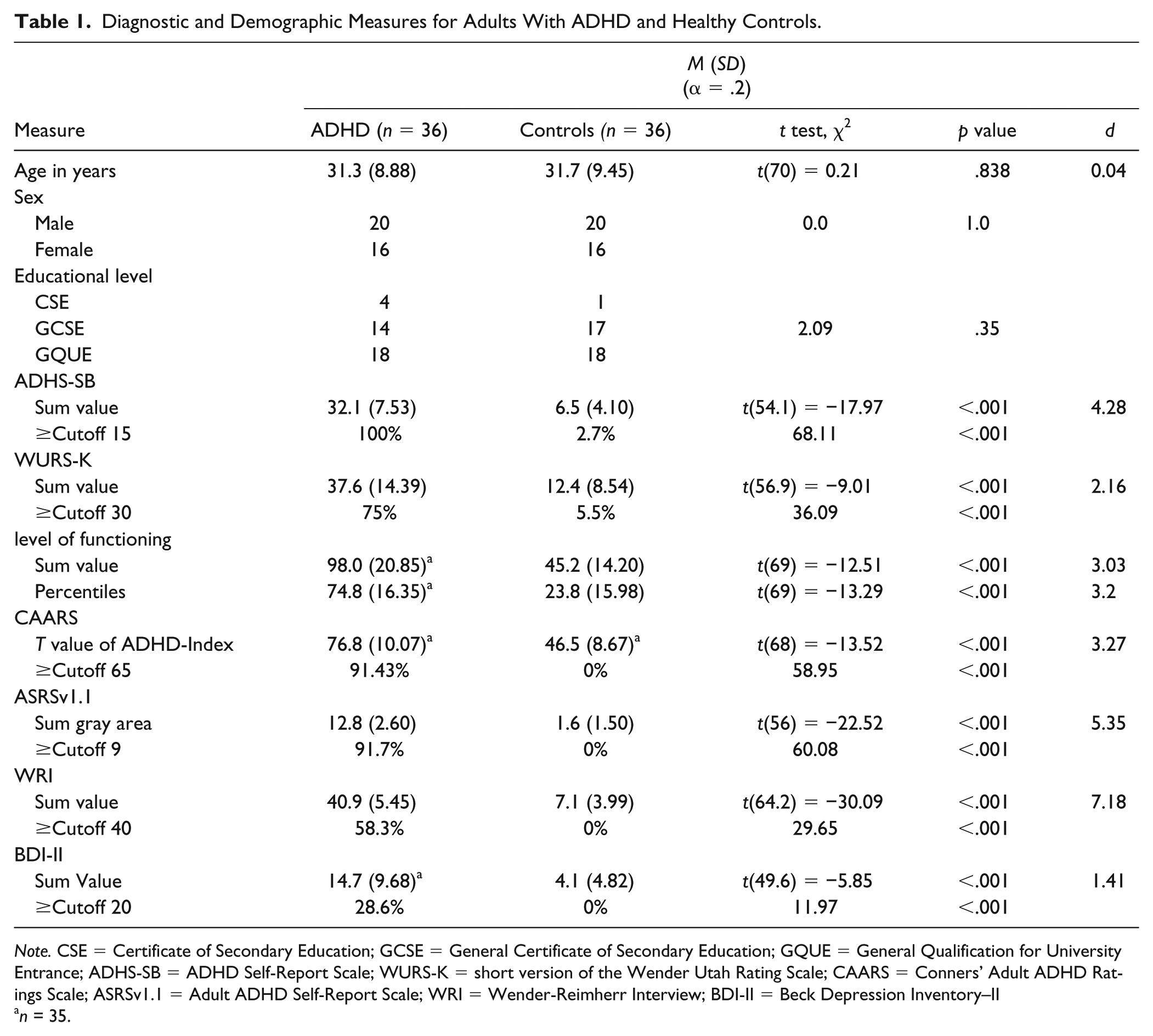
Note. CSE = Certificate of Secondary Education; GCSE = General Certificate of Secondary Education; GQUE = General Qualification for University Entrance; ADHS-SB = ADHD Self-Report Scale; WURS-K = short version of the Wender Utah Rating Scale; CAARS = Conners’ Adult ADHD Ratings Scale; ASRSv1.1 = Adult ADHD Self-Report Scale; WRI = Wender-Reimherr Interview; BDI-II = Beck Depression Inventory–II
n = 35.
Assessment of control variables relating to cognitive functioning
Block Design and Vocabulary (Wechsler Adult Intelligence Scale–IV: Petermann, 2012) were administered to obtain an IQ estimate. Participants were excluded if they performed one standard deviation (SD) below the mean of the Standard Scaled Score on both tests (<7) or two SDs below the mean in one of the tests (<4), indicating an IQ <85. Groups did not differ in Block Design, MADHD = 10.6, SD = 2.84; Mcon = 10.3, SD = 2.63; t(70) = 0.74, p = .461, or Vocabulary, MADHD = 11.7, SD = 2.21; Mcon= 11.4, SD = 1.92; t(70) = 0.43, p = .668. We also examined the level of EF using standard neuropsychological tasks (listed in Supplementary Material Table 4). Relations between executive performance on standardized tasks and self-reports of cognitive functioning and psychosocial functioning are included in another paper.
Manipulation of situational factors to affect EF-tasks
Two assessments took place, separated by 1 week (standard vs. experimental condition). Every session consisted of a complex planning task (“Tour-/Routenplaner”: Arling, Grossmann, Palme, & Spijkers, 2011) and four newly constructed EF-tasks (Kallweit & Exner, 2016). In a prestudy with healthy subjects, each task had been constructed and evaluated in two versions (music vs. sport); comparability, reliability, and validity had been reported. The tasks were designed to match common dimensions of EF (inhibition, working memory, planning, set shifting, and selective attention) and had been enriched with material close to daily life to achieve high ecological validity (e.g., context, authentic teaching aids). A cover story instructed the participant to imagine themselves as executive employees who had to work off a to-do list with five tasks. Participants were seated at a desk and had to begin with Auction, then Editing, “Tour-/Routenplaner” (Arling et al., 2011), Lecture Evaluating, and Product Order. After each task, a report for ADHD symptoms during the task was administered. Total session time was on average 129 min in the standard and 170 min in the experimental condition. The order of the versions and conditions was counterbalanced across participants. Product Order did not include an experimental manipulation, and the “Tour-/Routenplaner” (Arling et al., 2011) was not satisfactorily comparable for analysis (see Kallweit & Exner, 2016). Therefore, they have not been included in this article. The procedure for the three relevant tasks with the belonging manipulations is described below. See Kallweit and Exner (2016) for a more detailed description of the test battery.
To study the impact of reward, participants were engaged in an inhibition task called Auction during which they either received reward and immediate feedback for their performance or did not. During the task, 20 sporting goods and 20 musical instruments were randomly presented as words on a screen. All articles were introduced before in the written instructions. Participants were told to purchase articles of the target category as quickly as possible by pressing a key. Whenever articles from the distractor category were presented, they had to suppress the response (= inhibition). In the reward condition, participants were told that they would receive a 25-cent bonus for every auctioned target, but this bonus would decrease with every wrongly purchased distractor (−25 cents). In this instruction, targets were also clearly indicated in green and distractors in red. Participants got immediate feedback on the screen for every reaction: “Congratulation, article purchased,” in green for correct and in red for false reactions. At the end, they got an overview of all purchased articles in the respective color. Dependent variables of the task performance were reaction times, omissions, and errors. To check for the effects of reward manipulation on motivation and activation, participants had to answer the items “How motivating was the task for you?” and “How activated did you feel during the task?” from 0 (“not at all”) to 4 (“very much”) in both conditions after the task.
To study the impact of physical activity, exercise on a bicycle ergometer was added before a selective attention task in the experimental condition. Therefore, gender, age, and weight were inserted in a pulse monitor watch for an individual value of maximum pulse. The belonging chest belt was applied, resting heart rate was noted, and then participants spent 13 min riding a bicycle ergometer. After 3 min, they had to reach a pulse of at least 70% of their maximum pulse and for the subsequent 10 min needed to stay in a range between 70% and 85%. Afterward, they continued with the Editing task, where a text about Baseball/Jazz was presented on a sheet of paper, which contained three types of visually noticeable errors. Participants got 4 min to read the text and circle every error with a red pen. Test metrics were available for operation speed, accuracy, and concentration (KL). Pulse frequency was assessed minute-by-minute during the exercise and directly before reading the text to prove a successful manipulation of physical activation by the exercise.
The impact of stimulation was examined by adding a continuous fine motor movement to the working memory task Lecture Evaluating during experimental manipulation. A lecture about basketball/Blues was presented record-by-record on a screen. Participants had to press a key whenever a first word of a sentence corresponded with the first word of the sentence before the previous one and whenever this was the case for the second word of a sentence. During the task in the stimulation condition, participants kneaded an anti-stress ball as constantly as possible. Reaction time, errors, and omissions were assessed. In both conditions, participants filled in a questionnaire of seven items before and after the task that served as indicator of subjective arousal (Cronbach’s α ≥.919). Successful manipulation of arousal was supposed by a diminished fatigue response to the task in the experimental condition. Hence, an expected reduction of the sum score should be blunted in answer to the fine motor movement compared with the standard condition.
Symptom self-report as a function of situational manipulations
Symptoms were assessed after each task in the experimental condition and in the control condition to examine effects of reward, physical activity, and stimulation on subjective symptom change. The questionnaire consisted of 20 items and two global ratings. Item construction followed DSM-IV criteria for ADHD (Saß, Wittchen, & Zaudig, 2001). Thirteen items added up to a scale of inattention (Cronbach’s α ≥.834); seven items generated a scale of hyperactivity (Cronbach’s α ≥.825). The global ratings inquire how concentrated/calm participants felt during the tasks. All items were rated from 0 (“not at all”) to 4 (“the whole time/very much”).
See Supplementary Material Table 6 for an overview of tasks and manipulations.
Statistical Analyses
All statistical analyses were carried out with SPSS 25; statistical significance was set at p < .05 and tests were two-tailed. Group differences were calculated with independent t tests or chi-square tests. The significance level was set at .20 for comparisons of age, IQ tests, diagnostic measures, and educational level.
The manipulation check for reward and fine motor movement and all the main analyses were carried out using ANOVAs for repeated measurements. The group (ADHD vs. controls) was the between-subject factor and the condition (standard vs. experimental) served as the inner-subject factor; ANOVAs were calculated separately for every manipulation and, respectively, for symptoms and cognitive performance. For the manipulation check of fine motor movement, another inner-subject factor time (before vs. after task) was entered. The main effects of condition and interaction effects (Group × Condition) were our results of interest for the main analyses. Post hoc tests and a manipulation check for ergometer exercise were calculated with paired t tests.
Results
Manipulation Checks
Motivation by monetary reward and feedback
Both groups reported significantly higher motivation, Mstand = 2.4, SD = 1.16, Mexp = 2.8, SD = 1.03, F(1, 69) = 14.39, p < .001,
Activation by bicycle ergometer exercise before performance
Seventy-one percent of participants reached a heart rate >70% of maximum pulse after three cycling minutes, and for 78% this was the case for all of the following 10 min. At the beginning of Editing, no participant fulfilled that criterion anymore, but mean heart rate at this time was significantly different from the mean resting heart rate, Mrest = 76.8, SD = 10.25, Mtask = 99.1, SD = 11.15, t(47) = 17.01, p < .001. Thus, ergometer exercise successfully led to higher physical activation, as was intended.
Stimulation of arousal by continuous fine motor movement during performance
Both groups reported significantly lower subjective arousal after Lecture Evaluating than before in both conditions, Mbefore = 3.0, SD = 0.76, Mafter = 2.5, SD = 0.83, F(1, 70) = 83.31, p < .001,
Main Analyses
Across the manipulations of reward and physical activity, there were some significant effects of group (see notes in Table 2 for all significant statistics). Adults with ADHD were significantly slower than controls on Auction. For every manipulation factor/task, the ADHD group reported significantly more inattention and hyperactivity and felt substantially less calm than did the controls. Controls also reported substantially more concentration than the ADHD group during Auction.
Descriptive Results of Cognitive Performance and Symptom Reports for Adults With ADHD and Healthy Controls.
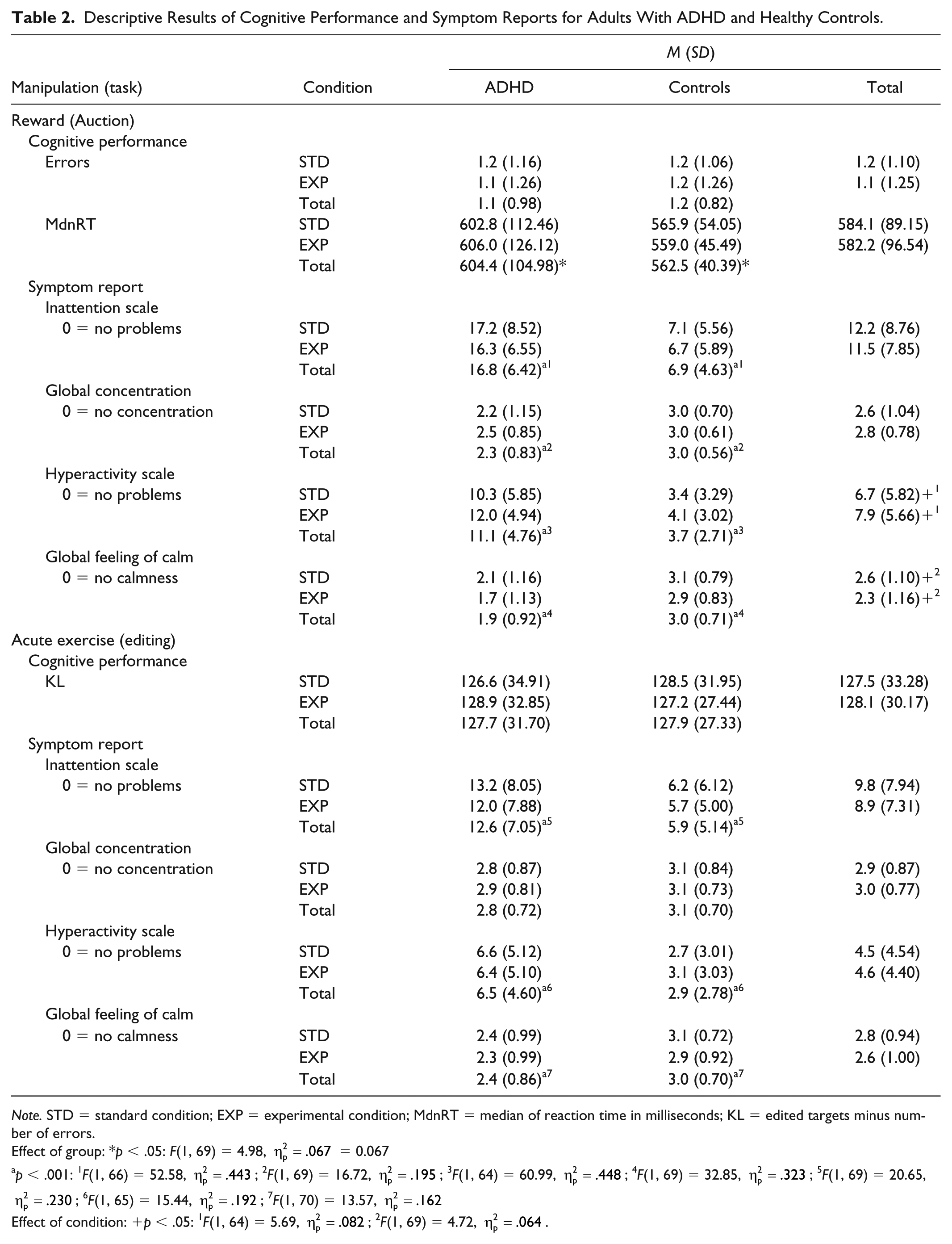
Note. STD = standard condition; EXP = experimental condition; MdnRT = median of reaction time in milliseconds; KL = edited targets minus number of errors.
Effect of group: *p < .05: F(1, 69) = 4.98,
p < .001: 1F(1, 66) = 52.58,
Effect of condition: +p < .05: 1F(1, 64) = 5.69,
However, for none of the two successful manipulations we found significant effects for the experimental condition (exceptions see below) or significant interactions with group (F < 2.4). Thus, no manipulation did affect performance on the EF-tasks significantly in either group. Therefore, we additionally looked at the descriptive data (Table 2) and report indicators for the expected effects/interactions or small but nonsignificant effects (
Monetary reward and feedback (Auction)
Descriptive data suggest less reported inattention (
Physical activity (Editing)
As a trend, adults with ADHD scored higher in concentration (KL) following exercise, whereas healthy controls did not (
Discussion
The influence of physical activity, continuous fine motor stimulation, and reward on performance and ADHD symptoms was assessed in adults with ADHD and healthy controls. Combined monetary reward and performance feedback successfully led to higher reported motivation during our task of inhibition. In addition, especially adults with ADHD felt more activated, which may highlight the postulated regulation of activation by the effort pool (Sergeant, 2005). However, it is not clear which aspect exactly influenced motivation/activation. This may be investigated separately in further studies.
Both groups effectually raised their heart rate through physical activity before our task of selective attention. It declined fast, but at the task’s beginning it was still significantly different from resting heart rate, indicating a still sufficient activation gain.
Regardless of the conditions and groups, subjective arousal was lower after completion of the working memory task than before. This refers most likely to the monotony and high cognitive task demands that could not be compensated for by the small physical stimulation. However, because of the low-intensity exercise, a subliminal gain of arousal or arousal continuity could be possible that would be difficult to assess.
Influence of Situational Manipulation
See Table 3 for a summary of the results.
Summary of Results for the Effects of Manipulation (Indicators).
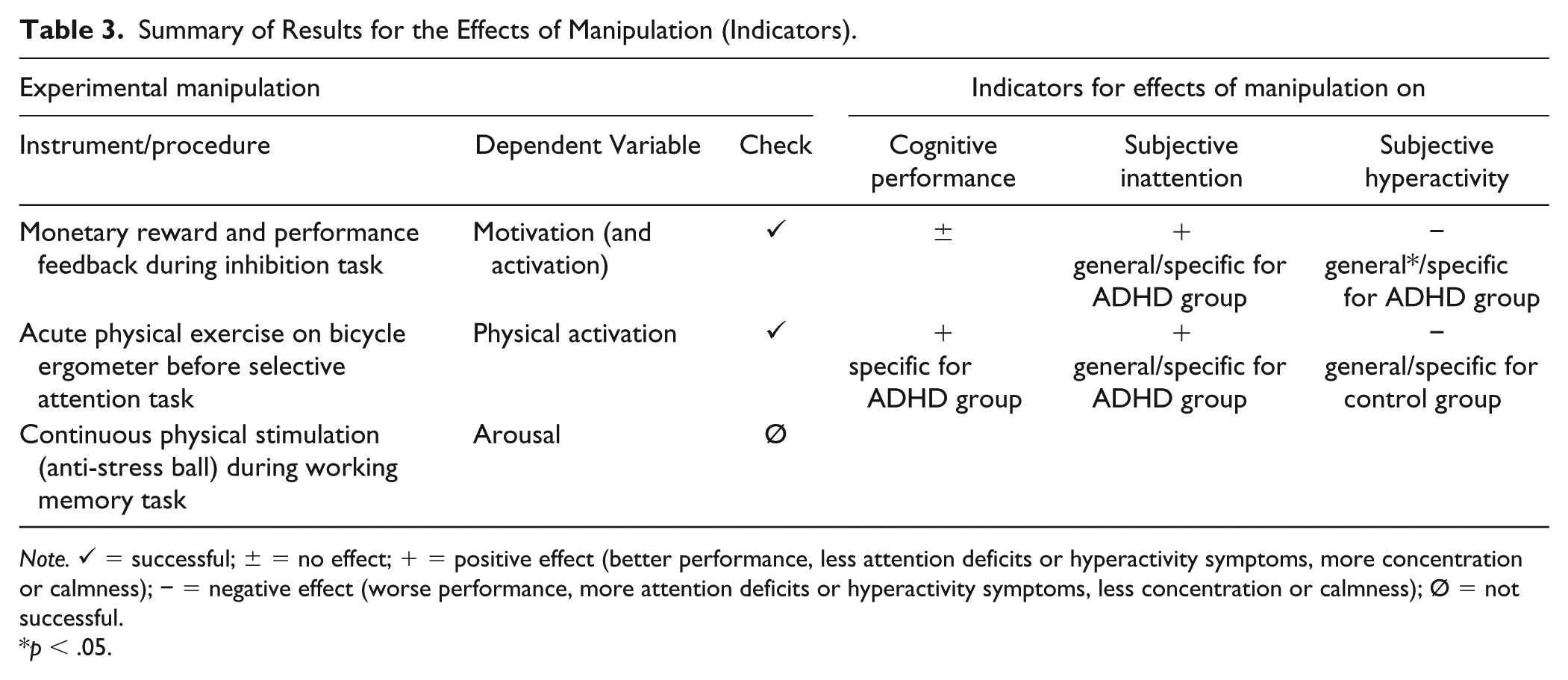
Note. ✓ = successful; ± = no effect; + = positive effect (better performance, less attention deficits or hyperactivity symptoms, more concentration or calmness); − = negative effect (worse performance, more attention deficits or hyperactivity symptoms, less concentration or calmness); Ø = not successful.
p < .05.
Reward for performance
Monetary reward and performance feedback did not exert any effect on participant’s performance on an inhibition task in our study. This seems contrary to studies with children (e.g., Luman et al., 2005) where ADHD children and controls improved under reward contingencies, and children with ADHD tended to do even more prominently so. Previous studies of adult ADHD reported performance-enhancing effects only restricted to single tasks and scores, for example, inhibition performance in a continuous performance task (CPT; Marx et al., 2013). Some methodological aspects might be responsible for the lack of effect in our study. First, there were no group differences in false alarms in the standard condition of our inhibition task. Hence, maybe the task was too easy, enabling already optimal performance in both groups and leaving no possibility to exhibit improving effects. However, reward did not affect reaction times at all, which were substantially slower for ADHD participants in both conditions, pointing to persistent performance deficits in ADHD. Second, information about performance and reward amount was not directly transparent. In particular, all participants received the same feedback for either correct or false responses (“Congratulation . . . ”); only the color of the text indicated reward/response cost. This procedure was chosen to integrate the cover story/task context and ensure its plausibility. But as a consequence, there might not have been enough information to adjust appropriately to task demands. Future research could use more transparent reward operationalization. Haenlein and Caul (1987) postulate that persons with ADHD need higher rewards than healthy persons to reach their optimal performance and that a similar performance of those two groups appears under very low or very high reward amounts, assuming a ceiling effect for the impact of reward on performance. Hence, when optimal performance is achieved, additional reward does not provide further profit for performance. Related to our study, one might argue that maybe the material close to daily life already increased motivation to a level that adults with ADHD could perform optimally under standard conditions, as well as under experimental conditions (regarding errors). Similarly, Delisle and Braun (2011) explore deficient inhibition performance in a standardized CPT that is absent under a more motivating design. Taking this into account, further analyses could examine whether the reported speed–accuracy trade-off for adults with ADHD under reward (e.g., Marx et al., 2013) may be observable when standard tasks are compared with enriched tasks that are more closely related to aspects of daily life. In sum, future research should carefully consider what is defined as baseline without reward manipulation and assess different amounts of reward on the same sort of task to find the level of normalizing performance for adults with ADHD.
Participants tended to experience less inattention under reward and adults with ADHD reported slightly higher concentration. It seems reasonable that potentially performance-enhancing effects correspond to a higher feeling of concentration. Interestingly, both groups reported substantially more hyperactivity under reward, and this seemed higher for adults with ADHD as a descriptive trend. Sagvolden et al. (2005) argue that the aberrant dopamine processes in ADHD result in a general higher potential for responses—and not only rewarded responses. This may lead to more hyperactivity in terms of over-responsiveness. Douglas and Parry (1994) also propose a possible overarousing/distracting effect of reward, leading to more impulsivity and, when too distracting, even to worse performance. Certainly, those arguments do not explain higher hyperactivity also for the healthy participants; thus, higher hyperactivity may represent or be consistent with a higher motivation/activation level that the participants reported under reward. Other authors have found more activity associated with more concentration/better task performance in ADHD (e.g., Hartanto, Krafft, Iosif, & Schweitzer, 2016), indicating a functional aspect of hyperactivity as likewise postulated by theories such as the Optimal Stimulation Theory (OST, Zentall & Zentall, 1983). This assumption would explain the opposing findings for inattention and hyperactivity under reward manipulation that were more prominent for the adults with ADHD.
Physical activity before performance
Exercise on a bicycle ergometer had no significant impact on subsequent selective attention performance, besides very small enhances in adult ADHD, but not in controls. This hardly provides support for theoretical assumptions, which propose that persons with ADHD would benefit in particular from physical exercise (e.g., Sergeant, 2005; Zentall & Zentall, 1983), and it does not corroborate performance-enhancing effects for children with ADHD (e.g., Den Heijer et al., 2016). However, previous findings in adult ADHD were not consistent and often referred to inhibition (e.g., Gapin et al., 2015). Hence, further research seems necessary for adult ADHD. Results of meta-analyses advise an exercise duration of at least 20 min to assess the effects on performance (Chang et al., 2012). Our exercise was maybe too short, so this needs to be optimized in future studies. It also may be useful to focus on inhibition performance for a better integration with previous findings.
Effects on symptoms were similar to those of reward. Self-reported inattention was slightly reduced after exercise, and this is more prominent for adults with ADHD. This seems consistent with, for example, OST (Zentall & Zentall, 1983) and adult men with ADHD feeling less confused after exercise (Fritz & O’Connor, 2016). Higher hyperactivity as found under reward is this time, as a trend, limited to healthy participants. Hence, a functional use of hyperactivity seems not that necessary as under reward for adults with ADHD. As stated by the CEM (Sergeant, 2005), reward influences the effort pool; consequently, activation/arousal will be adjusted to task demands. Perhaps signs of hyperactivity accompany this adjustment, succeeding in better performance/attention. When activation is influenced directly through exercise, this hyperactivity process is omitted. Evidence could be that motivation of adults with ADHD was not changed after exercise, indicating that one processing stage was skipped. More research on the function of hyperactivity and possible relations to CEM-state factors seems necessary.
Limitations
Our results were mostly nonsignificant and of small magnitude. They are therefore interpreted with great reservation. We were not able to prove that fine motor movement was successful in increasing arousal and reducing fatigue; thus, the intended manipulation failed. There were only a few group differences in cognitive performance, even in the standard condition. Hence, there was not much room for improvement for adults with ADHD. Maybe the use of material close to everyday life already serves as a performance stimulator for adults with ADHD.
Future Research
Further studies should optimize methodical aspects (Supplementary Material B). Our results show that it is useful to assess the influence of manipulation on performance and symptoms separately. The interaction of self-reported hyperactivity and inattention may be interesting for further studies, too. Functional aspects of hyperactivity for attention may serve as an hypothesis (e.g., Hartanto et al., 2016), and manipulation effects on symptoms could be integrated into theoretical models of ADHD, for example, into CEM (Sergeant, 2005). Cognitive performance seems to be associated with ADHD symptoms in a noncontinuous way. Further studies could focus on factors that determine whether symptoms are functional for task performance or diminishing.
Conclusion
To the best of our knowledge, our study is the first to use different manipulation strategies for optimizing cognitive performance on EF-tasks with material close to daily life and affecting symptoms of hyperactivity and inattention in adult ADHD. Results were mostly nonsignificant, but pointed to some aspects that might be worth pursuing in further research. In sum, potential influence of manipulations on performance and symptoms seemed heterogeneous and noncontinuous. Reward heightened motivation and activation and also led to more hyperactivity. Acute physical activity may improve task performance when optimized methodically and without affecting hyperactivity. Potential symptom interactions and their influence on performance (e.g., functional aspects) should be further investigated.
Supplemental Material
190301_Suppl_Material_Revision – Supplemental material for Adult ADHD: Influence of Physical Activation, Stimulation, and Reward on Cognitive Performance and Symptoms
Supplemental material, 190301_Suppl_Material_Revision for Adult ADHD: Influence of Physical Activation, Stimulation, and Reward on Cognitive Performance and Symptoms by Claudia Kallweit, Madlen Paucke, Maria Strauß and Cornelia Exner in Journal of Attention Disorders
Footnotes
Declaration of Conflicting Interests
The author(s) declared no potential conflicts of interest with respect to the research, authorship, and/or publication of this article.
Funding
The author(s) received no financial support for the research, authorship, and/or publication of this article.
Supplemental Material
Supplemental material for this article is available online.

Author Biographies
References
Supplementary Material
Please find the following supplemental material available below.
For Open Access articles published under a Creative Commons License, all supplemental material carries the same license as the article it is associated with.
For non-Open Access articles published, all supplemental material carries a non-exclusive license, and permission requests for re-use of supplemental material or any part of supplemental material shall be sent directly to the copyright owner as specified in the copyright notice associated with the article.
