




Abstract
Introduction
In recent years, an increasing number of people have been diagnosed with ADHD, a neurodevelopmental disorder characterized by distractibility, hyperactivity, and impulsivity (e.g., Garfield et al., 2012). Although ADHD is usually first diagnosed in childhood, symptoms often persist into adulthood (Biederman, Petty, Evans, Small, & Faraone, 2010). The disorder may cause considerable problems in people’s lives: ADHD is associated with lower academic and occupational success, and an increased risk of developing depression, anxiety disorders, and addiction (Biederman et al., 2006; Faraone et al., 2000). However, ADHD may have certain benefits in situations that require people to be creative.
Previous studies indicate that creativity, the ability to generate ideas that are both novel and useful (Amabile, 1996), benefits from defocused attention and a reduced ability to ignore task-irrelevant stimuli in the environment (Baird et al., 2012; Carson, Peterson, & Higgins, 2003). The defocused processing of task-unrelated information during creative tasks may activate uncommon associations, resulting in original combinations of information. Moreover, high energy, impulsivity, and risk-taking seem to facilitate creativity (Barron & Harrington, 1981; Feist, 1998). Thus, people who are easily distracted, hyperactive, and impulsive, such as those with ADHD, may be more creative than people who do not experience such symptoms. Indeed, studies show that adults with ADHD (vs. controls), as well as healthy people who experience a high number of ADHD symptoms, report more publically recognized creative achievements in daily life, such as receiving a patent for an invention or publishing a book (Boot, Nevicka, & Baas, 2017; White & Shah, 2011; Zabelina, Condon, & Beeman, 2014). However, the precise cognitive and motivational mechanisms underlying this observation remain unclear. The purpose of this research is to address these mechanisms to better understand creativity in ADHD.
First, real-world creativity is a complex construct that relies on the novel and appropriate combination of existing knowledge through several lower-level cognitive processes. For example, creative problems are often complex and ill-defined and the creative process must start with a restructuring of the context and ultimate goals of the problem at hand. Then, a person may generate multiple potential solutions for the identified problem and evaluate the feasibility of those solutions (e.g., Cropley, 2006; Mumford, Baughman, Threlfall, Supinski, & Costanza, 1996). These processes can be assessed using standardized laboratory tasks. For example, the Alternate Uses Task (AUT; Guilford, 1967) measures divergent thinking (i.e., the generation of multiple ideas in response to open-ended questions) by asking people to generate new, original uses for common objects, such as a brick. Some studies show that adults with ADHD (vs. controls) generate more original ideas on such tasks (White & Shah, 2006, 2011, 2016), but others do not find enhanced divergent thinking in ADHD (Abraham, Windmann, Siefen, Daum, & Güntürkün, 2006; Barkley, Murphy, & Kwasnik, 1996; Murphy, Barkley, & Bush, 2001). However, people with ADHD may outperform people without the disorder on other aspects of the creative process (Abraham et al., 2006; Boot, Nevicka, & Baas, 2017). For example, ADHD symptoms have been associated with enhanced originality (but reduced usefulness) of problem reconstructions (Boot, Nevicka, & Baas, 2017). Thus, when investigating creativity in ADHD, it is important to look at different creative processes.
Second, real-world creativity also relies on the motivation to turn existing knowledge into creative output through the aforementioned cognitive processes (Amabile, 1996). For instance, intrinsic motivation, the drive to engage in a task because it is interesting and enjoyable in itself, facilitates creativity (Hennessey & Amabile, 2010). People with ADHD seem to prefer the “loose,” unstructured idea generation process of creativity over more analytical processes (White & Shah, 2011), and thus may be more intrinsically motivated during idea generation. ADHD, however, is generally associated with motivational deficits (e.g., Toplak, Jain, & Tannock, 2005) and ADHD symptoms may actually result from a decreased motivation to perform tasks that are not (immediately) reinforced by external rewards (Barkley, 1997; Volkow et al., 2011). Thus, what drives people with ADHD to be more creative might be their (extrinsic) motivation to obtain desired outcomes, such as the reception of praise and external rewards, rather than the sheer enjoyment of performing creative tasks. Some evidence indicates that monetary rewards and competition with others indeed improves cognitive control in children with ADHD (Geurts, Luman, & van Meel, 2008; Kohls, Herpertz-Dahlmann, & Konrad, 2009). When external reinforcement is absent, the rather simple ideation tasks used in the laboratory may not encourage people to fully engage in the process of generating their most original ideas. This may explain why increased divergent thinking is not consistently observed in ADHD. Moreover, people with ADHD may experience greater motivation during daily creative activities in domains of their own choosing, but not during standardized laboratory tasks. Thus, it is important to assess how motivation and reinforcement during creative tasks influence creative performance and whether people with ADHD are only creative in domains of their choosing.
Because real-world creativity relies on cognitive and motivational processes, another important factor to examine is medication use in ADHD, as medication use may affect these processes. A range of different drugs are available to alleviate ADHD symptoms, the most widely used ones being amphetamines and methylphenidate (Advokat, 2010). These drugs increase dopamine and noradrenaline levels in the brain, thereby normalizing frontostriatal activity in people with ADHD (Arnsten & Dudley, 2005; Rubia et al., 2009). This, in turn, improves executive functions, including response inhibition (Aron, Dowson, Sahakian, & Robbins, 2003) and sustained attention (Advokat, 2010). While improving the ability to focus, such medication may decrease the cognitive flexibility that many creative processes require (e.g., seeing associations between remotely related concepts, divergent thinking). Interestingly, methylphenidate may likewise target the motivational deficits observed in ADHD by increasing task salience (Liddle et al., 2011; Volkow et al., 2004). A recent study showed that methylphenidate administration influenced creativity in a sample of healthy adults (Gvirts et al., 2017), but whether medication also affects creativity in people with ADHD is unclear. In one study on creativity in adults with ADHD, medication use did not affect divergent thinking (White & Shah, 2011). However, other studies did not control for medication use or explicitly excluded participants who used medication from the study (Abraham et al., 2006; White & Shah, 2006, 2016).
Here, we present two studies in which we investigated these factors as explanations for the inconsistent findings in previous studies. In Study 1, we assessed the role of intrinsic motivation in idea generation in people with ADHD versus healthy controls. Moreover, we compared performance in these groups during creative problem reconstruction and explored the effects of medication use on these processes. In Study 2, we manipulated motivation and task engagement during idea generation by providing participants with an opportunity to win a bonus by competing with others. Moreover, we assessed whether people with ADHD (vs. controls) consider themselves to be more creative in specific domains of creativity.
Study 1
We had four objectives in Study 1. First, we aimed to replicate the finding that people with ADHD (vs. controls) report more real-world creative achievements (White & Shah, 2011). Second, because real-world creativity builds on several creative problem solving stages, we assessed whether performance of people with ADHD differed from controls during two of those stages: initial problem reconstruction and subsequent idea generation. We hypothesized that ADHD participants would outperform controls on aspects related to originality but not usefulness (Boot, Nevicka, & Baas, 2017). Third, we assessed the role of intrinsic motivation in creative idea generation. If people with ADHD enjoy idea generation more than people without ADHD (White & Shah, 2011), participants with ADHD (vs. controls) may be more motivated to perform well during an idea generation task. We expected that people with ADHD would generate more original ideas because of increased intrinsic motivation. Finally, we explored whether creative processes were influenced by ADHD medication by comparing the performance of people with ADHD who did, and who did not, use such medication.
Method
Design, participants, and procedure
We recruited 71 participants with ADHD to participate in this online study via a local institution specialized in the treatment of ADHD. All participants had been diagnosed by a clinical psychologist or psychiatrist. Of these participants, 42 used some type of medication to treat their ADHD symptoms at the time of testing (medicated ADHD group), whereas 29 others did not (nonmedicated ADHD group). In addition, we recruited 36 healthy control participants who matched participants in the ADHD groups on age, gender, and education. On average, participants were 26.77 years old (SD = 7.85; range = 18-54; 61% female). The two ADHD groups and the control group did not differ in terms of gender, χ2(2, N = 107) = 2.66, p = .265; age, F(2, 104) = .14, p = .868,
Measures
ADHD
Current ADHD symptoms, such as hyperactivity and distractibility, were measured using the 23-item ADHD rating scale for adults (Kooij et al., 2005). For each ADHD symptom, participants rated its frequency in the past 6 months (1 = never or rarely, 5 = very often). Sample items include “forgetful in daily activities,” “make careless mistakes in work,” and “talk excessively” (α = .92; M = 3.25, SD = 0.77).
Creative achievements
We assessed publically recognized and concrete creative achievements in 10 domains (e.g., creative writing, theater, culinary arts) using the Creative Achievement Questionnaire (Carson, Peterson, & Higgins, 2005). For each domain, participants were presented with eight rank-ordered statements ranging from 0 (“I have no training or recognized talent in this area”) to 7 (“I have won a national prize in this area”) and indicated which of these applied to them. The marked ranks were summed together to yield a creative achievement score (M = 13.04; SD = 14.80, range = 0-82). Because participants’ scores were strongly skewed, these were log-transformed prior to data analysis (Silvia, Wigert, Reiter-Palmon, & Kaufman, 2012).
Divergent thinking
We assessed divergent thinking using the AUT (Guilford, 1967). In two separate 2-min trials, we asked participants to generate as many new, original ways to use a fork and a newspaper as they could think of. Three independent and trained coders scored participants’ ideas in terms of fluency (the number of nonredundant ideas), flexibility (the number of conceptual categories the ideas belong to) and originality (the extent to which an idea is novel). To obtain a measure of flexibility, ideas were categorized into different conceptual categories. For example, for the fork topic, the idea “to defend yourself” was coded in the category “as a weapon,” whereas the idea “use as a screwdriver” was coded in the category “as a tool.” To obtain a measure of originality, coders scored each idea for the extent to which it was novel and uncommon on a 5-point scale (1 = not original at all, 5 = very original). We averaged originality ratings across all ideas an individual generated to correct for differences in fluency. Interrater reliability for flexibility (ICCfork = .97, p < .001; ICCnewspaper = .98, p < .001) and originality (ICCfork = .81, p < .001; ICCnewspaper = .84, p < .001) was good. We averaged fluency, flexibility, and originality ratings for both objects and across the three coders. On average, participants generated 8.30 ideas per trial (SD = 2.95, range = 1.50-17.50) using 6.49 different categories (SD = 1.99, range = 1.5-11.67), with a mean originality of 1.66 (SD = 0.29, range = 1.09-2.75).
Following each trial, participants answered four questions regarding their intrinsic motivation (e.g., “I enjoyed generating new uses for a newspaper/fork”; 1 = I do not agree at all, 5 = I completely agree; α = .88, M = 3.60, SD = 0.90).
Problem construction
We measured participants’ ability to restructure complex, ill-defined problems using a problem construction task (Mumford et al., 1996). During this task, participants read a short description of four problematic situations such as “You are the principal of an elementary school. One of the students has brought in a snake, but now it is missing.” After reading each description, we asked participants to redefine the problem in terms of (a) diagnostic information, (b) alternative goals, (c) alternative procedures, and (d) constraints. For each of these aspects, participants could choose from four problem definitions that varied in usefulness (high vs. low) and originality (high vs. low). In the above example, an alternative goal high in both usefulness and originality would be: “How can I turn this into a learning experience for the students?”; whereas, an alternative goal of low usefulness and low originality would be: “How can I keep from being held directly accountable?” We subsequently counted the number of high-usefulness and high-originality options that participants selected. Participants obtained a mean usefulness score of 12.38 (SD = 2.14, range = 3-16) and a mean originality score of 7.07 (SD = 2.38, range = 0-15).
Medication use
Participants in the ADHD groups indicated whether they used (now or in the past) medication to treat their symptoms. If so, they indicated what kind of medication they used, the dosage, and how often they used medication in the preceding 6 months.
Results
Descriptive statistics and group differences in ADHD symptoms
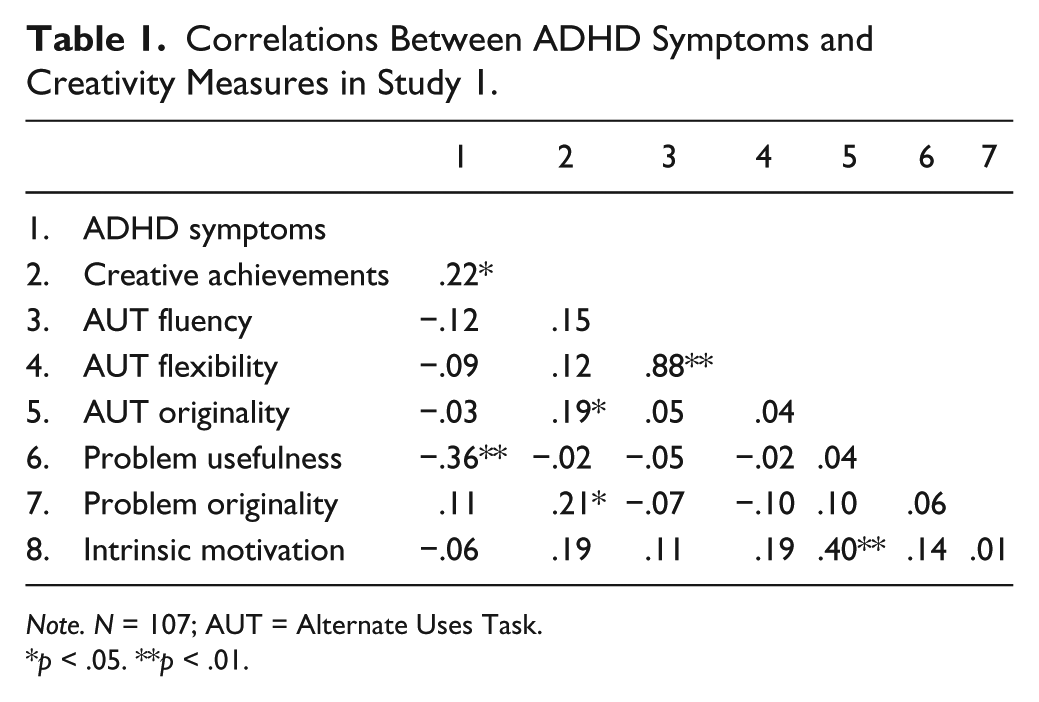
Table 1 shows the means, standard deviations, and zero-order correlations for all variables. ADHD symptoms correlated positively with creative achievements and negatively with the usefulness of problem construction. AUT fluency and flexibility were positively correlated, but originality did not correlate with either fluency or flexibility. Creative achievement scores correlated positively with AUT originality and originality of problem construction. As expected, self-reported ADHD symptoms differed between groups, F(2, 104) = 60.78, p < .001,
Correlations Between ADHD Symptoms and Creativity Measures in Study 1.
Note. N = 107; AUT = Alternate Uses Task.
p < .05. **p < .01.
Group differences in creativity
We observed differences between the ADHD and control groups on two of the creativity measures. First, creative achievements scores differed between groups, F(2, 104) = 6.30, p = .003,
Motivation during creative idea generation
Participants’ intrinsic motivation ratings during the AUT correlated positively with idea originality during this task, but not with flexibility or fluency (Table 1). Moreover, motivation ratings did not differ between the three groups, F(2, 104) = .02, p = .977,
Discussion and Introduction to Study 2
In Study 1, we found that people with ADHD (vs. controls) reported more real-world creative achievements, in line with findings by White and Shah (2011). However, people with ADHD did not outperform controls on the creative processes on which creative outcomes and achievements rely: problem reconstruction and idea generation. Although higher intrinsic motivation ratings were associated with more original ideas during an idea generation task, neither intrinsic motivation nor performance differed between groups. This is inconsistent with findings suggesting that people with ADHD enjoy generating ideas more than control participants (White & Shah, 2011). Moreover, group differences during creative problem reconstruction do not seem to account for the enhanced creative achievements in ADHD, as ADHD participants (vs. controls) selected fewer useful (and equally original) problem reconstructions. Finally, we did not find performance differences between medicated and unmedicated ADHD participants for any of the creativity measures.
In Study 2, we further investigated the role of motivation in the enhanced real-world creative achievements in ADHD. Given the motivational deficits associated with ADHD, it is possible that people with ADHD need additional reinforcement that triggers their motivation to perform well during tasks that are not immediately rewarding (Shaw & Giambra, 1993; Volkow et al., 2011). Therefore, we manipulated motivation by presenting participants with an opportunity to win a bonus in a competitive setting. We hypothesized that people with ADHD (vs. controls) would generate more original ideas on trials in which they could win money by competing with others, but not on trials without such competition. We specifically focused on originality of ideas, because originality can be seen as the hallmark of creativity (Amabile, 1996).
We also investigated whether people with ADHD (vs. controls) are more creative in specific domains. Such domain specificity could indicate that people with ADHD tend to select creative activities or environments that they like and/or fit their qualities (Verheul et al., 2015, 2016). Although an advantage of the Creative Achievement Questionnaire is that it measures recognized achievements in various domains rather than participants’ subjective judgment of their own creativity, a disadvantage of this scale is that many people report low scores in most domains. As a result, it is difficult to assess group differences in performance in specific domains using this scale. Therefore, in Study 2, we included a different self-report measure of creativity—one that assesses everyday creative abilities in different domains.
Method
Design, participants, and procedure
We recruited 46 participants with ADHD and 44 healthy controls to participate in this study for money or course credit via advertisements posted around campus. Participation was voluntary and participants provided written consent. On average, participants were 22.93 years old (SD = 3.41; range = 18-36; 62% female). The ADHD and control group did not differ on gender, χ2(2, N = 107) = 1.30, p = .254; or education, t(88) = 0.57, p = .570, d = 0.12. However, the ADHD group was significantly older than the control group (MADHD = 23.98, SDADHD = 3.87; Mcontrol = 21.84, SDcontrol = 2.44), t(88) = −3.12, p = .002, d = 0.66. Participants were seated in individual cubicles behind a computer, which displayed all materials and recorded all responses. First, they completed a divergent thinking task, during which we manipulated competition (within-subjects design) by providing participants with an opportunity to win a bonus. Subsequently, participants completed an ADHD symptom scale and a creativity scale. Finally, participants provided demographic information and those with ADHD additionally provided information about their ADHD diagnosis, medication use, and comorbidity with any other disorder(s) (e.g., major depression, anxiety disorders). Participants also completed an achievement goal questionnaire that is not relevant for the present research questions.
Measures
ADHD
We used the same scale as in Study 1 (Kooij et al., 2005; α = .93; M = 3.04, SD = 0.79).
Divergent thinking
As in Study 1, we measured divergent thinking using the AUT (Guilford, 1967). Participants were asked to generate as many new, original uses for four objects (a belt, book, tin can, and towel) during four separate 1-min trials. The objects were presented in random order. Again, three independent and trained coders scored participants’ ideas in terms of fluency, flexibility, and originality. Interrater reliability for both flexibility (all ICCs > .95, all ps < .001) and originality (all ICCs > .80, all ps < .001) was good. On average, participants generated 5.44 ideas per object (SD = 2.26, range = 1.00-12.75) in 4.31 different categories (SD = 1.44, range = 1.00-7.58), with a mean originality of 1.79 (SD = 0.39, range = 0.84-2.75). 1 As in Study 1, participants answered three questions concerning their motivation to perform well following each trial.
Competition manipulation
We manipulated competition by providing participants with an opportunity to win an additional €5 during certain trials. We told participants that the originality of their ideas on two of the trials would be compared with the performance of another randomly selected participant from the sample. If their ideas were found to be more original on those trials, they would win €5. If the ideas of the other participant were more original, the other participant would win €5. On the other two “non-competition” trials, participants’ ideas were not compared with other participants’ ideas. We told participants that their ideas on those trials would only be considered to assess their individual performance. Prior to each trial, participants were told whether or not their ideas on that particular trial were to be compared with those of another participant. Competition and no-competition trials were presented in random order. As an instructional check, after each trial, participants indicated whether their ideas on the preceding trial were to be considered for the bonus.
Manipulation check
Immediately after the final trial, we assessed participants’ subjective experience of competition during the task using five items (e.g., “I felt like I was participating in a competition,” “I wanted to be more creative that the other”) on a 5-point scale (1 = I do not agree at all, 5 = I totally agree; α = .84, M = 3.73, SD = 0.56).
Creativity in different domains
We assessed self-perceived creative abilities using the Kaufman Domains of Creativity Scale (K-DOCS; Kaufman, 2012). This scale consists of 50 items assessing creativity in five domains: self/everyday, scholarly, performance, mechanical/scientific, and artistic creativity. For each item, participants indicated how creative they considered themselves to be compared with other people (1 = much less creative, 5 = much more creative). Items included “Planning a trip or event with friends that meets everyone’s needs” (self/everyday domain; α = .66), “Shooting a fun video to air on YouTube” (performance domain; α = .82), “Constructing something out of metal, stone, or similar material” (mechanical/scientific domain; α = .78), “Drawing a picture of something I’ve never actually seen (like an alien)” (artistic domain; α = .66), and “Arguing a side in a debate that I do not personally agree with” (scholarly domain; α = .67).
Medication use and comorbidity
As in Study 1, we asked participants in the ADHD group questions about their present and past medication use, type of medication, and dosage. Moreover, participants indicated whether a psychologist or psychiatrist had diagnosed them with any other disorder(s) (e.g., major depression, anxiety disorders) that was still relevant at the time of participation. Such disorders are common in ADHD and may affect creativity in this group (Baas, Nijstad, Boot, & De Dreu, 2016; Faraone et al., 2000). Twenty-six percent of ADHD participants reported a comorbid mental disorder.
Results
Descriptive statistics and group differences in ADHD symptoms
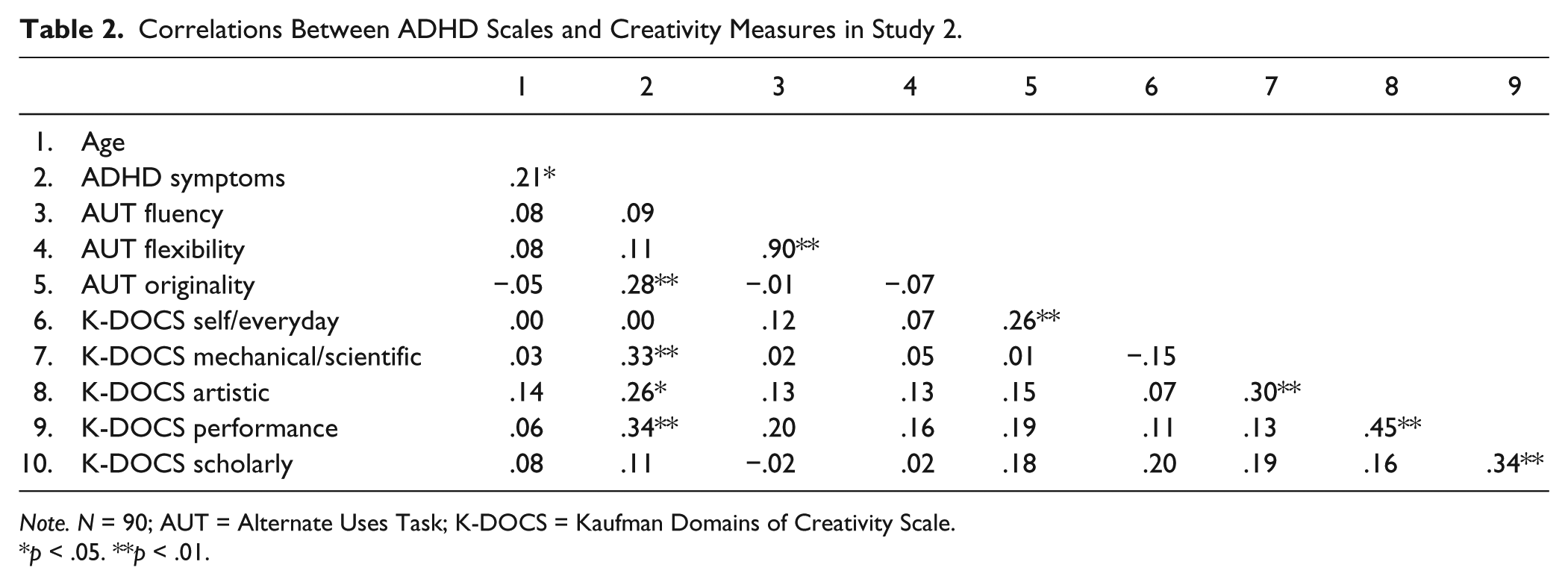
Table 2 shows the means, standard deviations, and zero-order correlations for all variables. ADHD symptoms correlated positively with AUT originality and self-reported creativity in the mechanical/scientific, artistic, and performance domains, but not with any of the other creativity indicators. As in Study 1, AUT fluency and flexibility were positively correlated, but originality did not correlate with either fluency or flexibility. As expected, the ADHD group (M = 3.62, SD = 0.49) reported more severe ADHD symptoms than the control group (M = 2.44, SD = 0.79), t(88) = 10.69, p < .001, d = 1.80.
Correlations Between ADHD Scales and Creativity Measures in Study 2.
Note. N = 90; AUT = Alternate Uses Task; K-DOCS = Kaufman Domains of Creativity Scale.
p < .05. **p < .01.
Manipulation check
On average, participants made an error on the instructional check questions on 13% of the trials. However, including the percentage of errors made as a covariate in the analyses did not change the results. A 2 (Group: ADHD vs. controls) × 2 (Competition: competition vs. no competition) repeated-measures analysis of variance (ANOVA) showed that, during the AUT, participants were more motivated under competition (M = 3.80, SD = 0.61) than in the absence of competition (M = 3.69, SD = 0.58), F(1, 88) = 7.51, p = .007,
Group differences in idea generation and the effects of competition
To assess group differences in creativity in the presence or absence of competition, we conducted a series of repeated-measures ANOVAs with the above factors. Because age differed between groups and was also related to the subjective experience of competition, r(90) = −.34, p = .001, we entered age as a covariate in these analyses. For AUT fluency, we did not find a main effect of competition, F(1, 87) = 0.67, p = .415,
Self-reported creativity in different domains
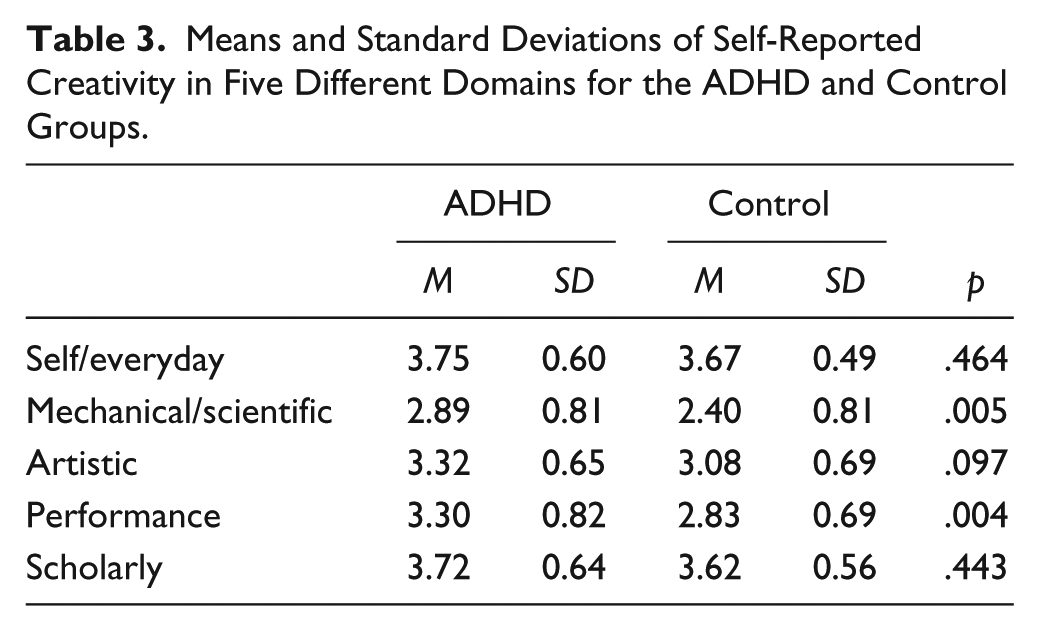
A multivariate ANOVA showed that K-DOCS scores differed significantly between groups, F(5, 84) = 3.80, p = .006, Wilk’s Λ = 0.83,
Means and Standard Deviations of Self-Reported Creativity in Five Different Domains for the ADHD and Control Groups.
Discussion
In the present studies, we investigated several potential explanations for the inconsistent evidence regarding creativity in ADHD. First of all, we replicated findings showing that people with ADHD report more real-world creative achievements (Boot, Nevicka, & Baas, 2017; White & Shah, 2011). While we did not observe increased intrinsic motivation during creative idea generation in ADHD, people with ADHD did generate more original ideas when competing for a bonus, but not in the absence of such competition. Competition did not affect the creative performance of control participants. Moreover, we found that ADHD participants (vs. controls) rated themselves as more creative in specific creative domains. People with ADHD reported higher creative abilities in the performance (e.g., playing music in public, acting in a play) and mechanical/scientific domain (e.g., setting up experiments, programming), but, for instance, not in the artistic domain. Enhanced performance during the early stages of creative problem solving does not seem to play a role in the enhanced real-world creativity observed in ADHD. Participants in the ADHD (vs. control) group selected fewer useful (and equally original) problem reconstructions. Finally, we did not find any performance differences between medicated and unmedicated participants with ADHD.
Theoretical Implications
Our finding that people with ADHD generated more original ideas under competition than in the absence of competition is in line with studies showing that rewards or social comparison can improve cognitive performance in people with ADHD (Geurts et al., 2008; Kohls et al., 2009; Luman, Oosterlaan, & Sergeant, 2005). In Study 1, in which we did not manipulate competition, we did not observe increased (intrinsic) motivation during idea generation in ADHD participants, contrary to findings showing that people with ADHD enjoy idea generation more than people without ADHD (White & Shah, 2011). Our findings do suggest that people with ADHD can be motivated to exert more goal-directed effort when a desired outcome, either in the form of a monetary reward or the possibility to beat an opponent, is introduced. Although the ideas of people with ADHD were more original under competition compared with when competition was absent, their ideas were not more original than those of control participants in either condition (possibly due to a lack of power). Moreover, it is unclear whether the observed effects were driven by the prospect of obtaining a monetary reward, the opportunity to outperform an opponent, or both.
We did not find group differences in originality during problem reconstruction, an early stage of the creative process. In fact, participants with ADHD (vs. controls) selected fewer useful problem reconstructions, supporting findings showing that people with ADHD have problems with aspects of creativity relating to practicality (Abraham et al., 2006; Boot, Nevicka, & Baas, 2017). Possibly, people with ADHD need additional reinforcement to perform well during idea generation as well as initial problem reconstruction. Alternatively, people with ADHD may outperform controls in stages following problem reconstruction and idea generation. Creative ideas may evoke a sense of inspiration, a motivational state that drives people to actualize those ideas (Thrash, Maruskin, Cassidy, Fryer, & Ryan, 2010). This drive seems to be especially strong in people scoring high on approach temperament, a strong sensitivity to appetitive stimuli and reinforcement, such as people with ADHD (Boot, Baas, Van Gaal, Cools, & De Dreu, 2017; Mitchell, 2010). Thus, future studies could assess whether motivation during the actualization, rather than generation of ideas underlie the enhanced real-world creativity observed in ADHD.
The finding that participants with ADHD (vs. controls) report being more creative in specific creative domains suggests that people with ADHD are not more creative overall, but that they may select creative tasks and environments that they like and/or fit their abilities. People with ADHD strive to maintain control over their environment in a generally chaotic life. The ability to do so contributes to their psychological well-being (Toner, O’Donoghue, & Houghton, 2006; Wilmshurst, Peele, & Wilmshurst, 2011). People with (symptoms of) ADHD are more likely to be self-employed than people without such symptoms, possibly because they prefer to work in informal environments in which they experience high autonomy (Mannuzza, Klein, Bessler, & LaPadula, 1993; Verheul et al., 2015, 2016). The good fit between characteristics of ADHD and such environmental factors may increase job satisfaction and commitment (Verheul et al., 2015). Thus, people with ADHD may simply invest more time and energy in creative activities and domains that match their preferences and skills. As a result, they may develop a high level of expertise in these domains, enabling them to generate more original ideas (Baer, 2015). In our study, ADHD participants (vs. controls) reported higher creativity specifically in the performance and mechanical/scientific domain. Exactly why people with ADHD are drawn to these domains is unclear and should be assessed in future studies. Moreover, the reliability of the subscales for which we did not observe group differences was suboptimal, which may have influenced the results.
When interpreting our findings regarding domain-specific creativity, it is important to note that these are based on self-reported abilities rather than actual creative performance. A strength of the K-DOCS is that it assesses creative abilities in a wide range of situations. However, this may limit the experience that participants have with each of these situations, making it difficult to judge one’s own creativity. Moreover, people’s subjective judgment of their own creativity is not always accurate and may be strongly influenced by self-esteem, which tends to be reduced in ADHD (Kaufman, 2012; Shaw-Zirt, Popali-Lehane, Chaplin, & Bergman, 2005). Thus, the present findings may underestimate the (self-perceived) creativity of people with ADHD. At the same time, scientific creativity in ADHD may be overestimated in our sample of mainly university students. More generally, the education level of participants in our samples limits the generalizability of our results. Our samples consisted of high-functioning people with ADHD who managed to do well in educational settings despite their symptoms, while people with ADHD are generally less likely to obtain a university degree than people without ADHD (Wilmshurst et al., 2011). Thus, future studies should verify these findings in a more heterogeneous sample.
We did not find any differences in creativity between medicated and unmedicated participants in the present studies. However, because of the large individual variability, we did not take the type and dosage of medication into account. Future studies could more systematically assess medication effects on creativity in ADHD by manipulating medication use, similar to several studies conducted with children with ADHD (Douglas, Barr, Desilets, & Sherman, 1995; González-Carpio Hernández & Serrano Selva, 2016). Similarly, comorbidity with other mental disorders in the ADHD group was too diverse to allow for meaningful exploration of its association with creativity, although it is likely that comorbid disorders influence creative processes in ADHD (e.g., Baas et al., 2016).
Conclusion
In the present studies, we showed that people with ADHD generate more original ideas when competing for rewards with others than when such competition is absent. Although the exact mechanism underlying this effect remains to be uncovered in future studies, our findings suggesting that goal-directed motivation may drive the enhanced real-world creative achievements of people with ADHD. Moreover, we found that people with ADHD report enhanced creativity in specific domains, indicating that people with ADHD may excel in specific creative tasks that match their preferences and abilities. Encouraging them to engage in such tasks and rewarding their creative work may help both themselves, as well as the people around them, to benefit from the positive side of ADHD.
Footnotes
Acknowledgements
The authors would like to thank Maartje Rodenhuis, Sifra Verburg, Geert Nagel Joseph, Eveline Maan, Nancy Kluvers, and Yvonne van der Plas for their help with data collection.
Declaration of Conflicting Interests
The author(s) declared no potential conflicts of interest with respect to the research, authorship, and/or publication of this article.
Funding
The author(s) disclosed receipt of the following financial support for the research, authorship, and/or publication of this article: This work was facilitated by a grant from the Netherlands Organization for Scientific Research (NWO-451-12-023) to Matthijs Baas.