




Abstract
Introduction
In a meta-analysis, adult ADHD had a pooled prevalence estimate of 2.5% (Simon, Czobor, Balint, Meszaros, & Bitter, 2009). ADHD, characterized with developmentally inappropriate degrees of inattention, overactivity, and impulsivity, has long been described as a common and disabling childhood neuropsychiatric disorder (De La Fuente, Xia, Branch, & Li, 2013). During the last two decades, it has been increasingly recognized that ADHD persists across the life span and continue beyond childhood in at least 2/3 of cases (Pliszka, 2007; Simon et al., 2009; Turgay et al., 2012). ADHD is furthermore associated with a reduced life satisfaction in both adolescents (Ogg, Bateman, Dedrick, & Suldo, 2014) and young adults (Chao et al., 2008), recently found to persist into late adulthood (Lensing, Zeiner, Sandvik, & Opjordsmoen, 2015). Comparable mean scores on the Satisfaction With Life Scale (SWLS) were found in men and women, and ADHD symptoms were associated with a poorer satisfaction with life (Gudjonsson, Sigurdsson, Eyjolfsdottir, Smari, & Young, 2009).
The male preponderance of ADHD is well documented (Giacobini, Medin, Ahnemark, Russo, & Carlqvist, 2018), but higher in child- and clinical samples compared with adult- and community samples (Simon et al., 2009). Although frequent, adult ADHD often goes undetected (Barkley & Brown, 2008), and individuals with undiagnosed ADHD often obtain treatment for other comorbid mental and substance-related disorders (Kessler et al., 2006). Consequently, there is a compelling need to understand the presentation and impact of ADHD symptoms in adults, and to investigate whether age- and sex-appropriate approaches to diagnosis and treatment are called for. Nearly 60% of the general population was found to display any symptom of inattention and hyperactivity (Arcos-Burgos & Acosta, 2007); however, effects of few and/or mild symptoms of ADHD have not been studied in much detail. It is well known that the presence of ADHD is higher in children compared with adults (Polanczyk, de Lima, Horta, Biederman, & Rohde, 2007; Ramtekkar, Reiersen, Todorov, & Todd, 2010), and from early childhood to late adolescence similar symptom persistence patterns has been reported by parents in both sexes in a community study, with no considerable change in inattention scores compared with a decline in hyperactivity/impulsivity scores (Holbrook et al., 2016). However, less is known on age-related changes during adulthood.
The Adult ADHD Self-Report Scale (ASRS-v1.1) is an 18-item scale developed by the work group on adult ADHD for the World Health Organization (WHO) as a means for providing a valid self-assessment of ADHD symptoms (Kessler et al., 2005). Studies using different international versions find that the ASRS is a reliable and valid instrument to assist in screening for adult ADHD (Kim, Lee, & Joung, 2013; van de Glind et al., 2013; Yeh, Gau, Kessler, & Wu, 2008), showing a high sensitivity with lower specificity (discriminant validity; Soderstrom, Pettersson, & Nilsson, 2014). The six-item self-report scale (ASRS-6), consistent with the Diagnostic and Statistical Manual of Mental Disorders (4th ed., text rev.; DSM-IV-TR; American Psychiatric Association, 2000) criteria for ADHD, and developed based on stepwise logistic regression, turned out to outperform the full ASRS in a clinical calibration study (R. C. Kessler et al., 2005). Both ASRS versions showed acceptable psychometric properties in a validation study using the semistructured Kiddie Schedule of Affective Disorders and Schizophrenia (K-SADS) interview in adolescents (age 15 years, n = 134), with better properties for girls compared with boys (Sonnby et al., 2015). While a single-factor model of the ASRS-6 was originally proposed (Kessler et al., 2007), a two-factor solution Inattention (Inatt) and Hyperactivity-Impulsivity (HyImp) has been described as best fitting the data (Hesse, 2013). For ASRS to be a useful clinical screening tool, knowledge about the distribution across age and sex in the general populations is important. Consequently, Das, Cherbuin, Butterworth, Anstey, and Easteal (2012) applied the ASRS-6 in a population-based sample of middle-aged adults (n = 2,091) and observed that 6.2% of participants had scores associated with ADHD diagnosis (above clinical cutoff). The authors concluded with no significant sex difference in the distribution of ASRS scores. ADHD symptoms correlated with reduced employment and health/well-being, also when few symptoms were reported. Compared with the ASRS HyImp subscale, the Inatt subscale was particularly strongly associated with the aforementioned negative outcomes.
The present study expands previous research on the presence of ADHD symptoms by including several adult age groups based on parents in a very large population-based cohort study. We investigated the prevalence of ADHD symptoms, as measured by the ASRS-6, including its factor structure. We further focused on age and sex differences in ADHD symptoms and their relation to satisfaction with life. We hypothesized a male preponderance of ADHD symptoms, no sex-related changes with age, and an association between ADHD symptoms and lower satisfaction with life in both men and women.
Method
Participants
A total of 33,210 men and 41,983 women participated in the present study. They were parents recruited from the Norwegian Mother and Child Cohort study (MoBa), a prospective population-based pregnancy cohort study conducted by the Norwegian Institute of Public Health (Magnus et al., 2006). Participants were recruited from all over Norway from 1999 to 2008. The women consented to participation in 40.6% of the pregnancies (Magnus et al., 2006), and participants were found to be somewhat better educated than the rest of the population. In the present study, mean years of education were 14. 6 years for men and 14.8 years for women. The percentages of participants with ≤12, 13 to 17, and ≥18 years of education were 29.6%, 47.5%, and 22.9% for women and 38.7%, 32.7%, and 28.6% for men. Informed consent was obtained from each MoBa participant upon recruitment. The MoBa has obtained a license from the Norwegian Data Inspectorate. The study was approved by the Regional Committee for Medical Research Ethics and is based on version 6 of the quality-assured data files released for research on adult symptoms of ADHD. Age of participants were available in five age groups, 20 to 24, 25 to 29, 30 to 34, 35 to 39, and 40+ years (n = 2,520; 14,902; 30,381; 20,626; 6,764 respectively) with approximately the same percentages of men and women in the different age groups. Questionnaire data (ASRS-6 and SWLS) were available from fathers at the 17th week of pregnancy, and from mothers at child’s age 3 years. Due to competition between several interest groups for inclusion of items in the different MoBa questionnaires, mothers and fathers received the ASRS at different time points. This did not reflect an intentional design.
Participants were included if they were ≥20 years of age and had no missing ASRS scores, and if a woman enrolled in MoBa more than once, only the scores from the time of the first child (singletons only) were used.
Measures
ASRS-6
ADHD symptoms were measured with the ASRS-6 consistent with the DSM-IV criteria (Kessler et al., 2005). The six items (see Table 1) includes four items measuring inattention and two items measuring hyperactivity and impulsivity; all items scored as occurring either as “never,” “rarely,” “sometimes,” “often” or “very often” leading to a range of scores from 0 to 24. The ASRS has a clinical cutoff of ≥14, with a further delineation into four strata, including two score ranges below and above cutoff, respectively (Strata 1 and 2 refers to scores 0-9 and 10-13, Strata 3 and 4 to scores 14-17 and 18-24; Kessler et al., 2007). In the present study, the Cronbach’s alphas were somewhat low, but acceptable (.64 in men and .72 in women).
Summary of Principal Components Analysis Results for Men and Women, Respectively.
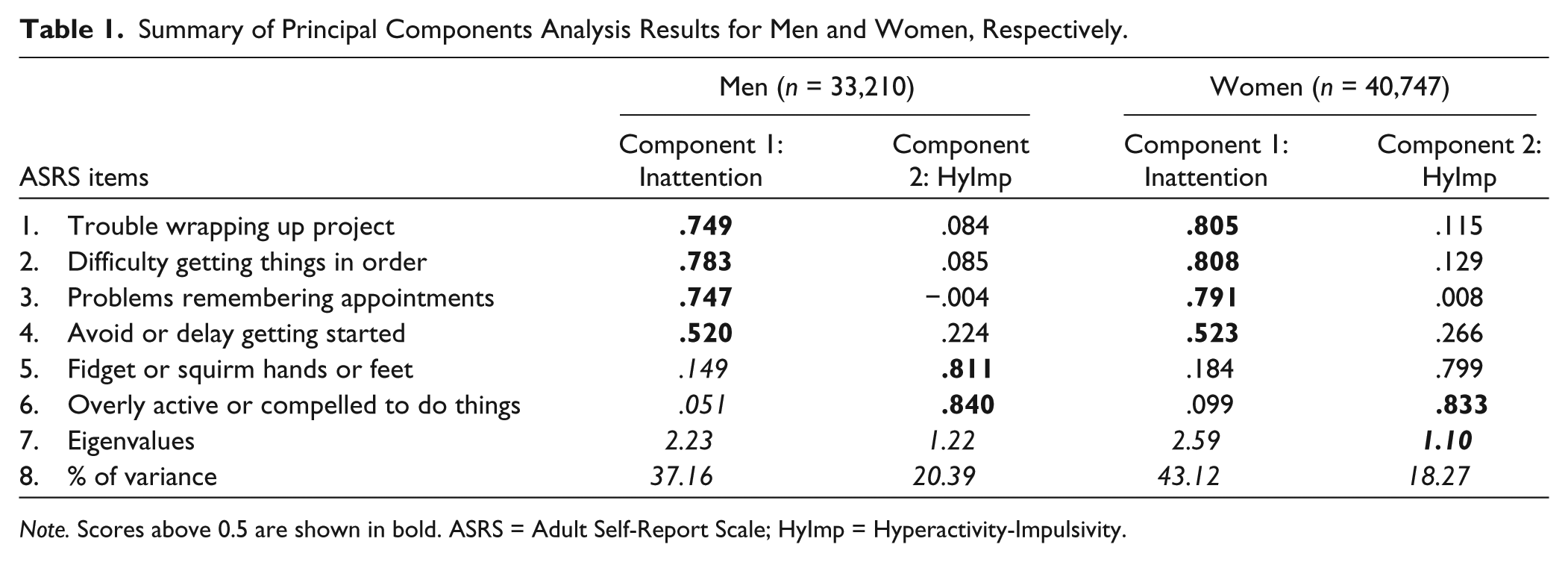
Note. Scores above 0.5 are shown in bold. ASRS = Adult Self-Report Scale; HyImp = Hyperactivity-Impulsivity.
SWLS
The five-item SWLS Scale (Diener, Emmons, Larsen, & Griffin, 1985) was developed to measure the cognitive component of subjective well-being. The items are “In most ways, my life is close to my ideal,” “The conditions of my life is excellent,” “I am satisfied with my life,” “So far I have gotten the important things I want in my life,” and “If I could live my life over, I would change almost nothing.” In the original validation study (Diener et al., 1985), the SWLS demonstrated an internal consistency of α = .87, and was found to be a valid and reliable measure of life satisfaction, suited for use in a wide range of ages and applications (Diener, Oishi, & Lucas, 2003; Pavot, Diener, Colvin, & Sandvik, 1991). Each item is scored on a scale from 1 to 7 indicating very dissatisfied to very satisfied, with 4 as a neutral point. Scores in the range of slightly satisfied to satisfied (5-6) on the SWLS are considered to reflect the widely replicated finding that nonclinical samples score above the neutral point of 4 (Pavot & Diener, 1993). We report a mean factor score (sum of scores divided by number of items). In the present study, Cronbach’s alphas were satisfactory (.84 for men and .88 for women).
Statistics
The six ASRS items were subjected to a principal components analysis with varimax rotation. The factor analysis was also examined using a direct oblimin rotation (δ = 0) with no significant changes of results (data not shown).
Descriptive statistics using mean (standard deviations) or numbers of participants/percent are presented for the three ASRS scores, the SWLS score, the four ASRS strata, and the two ASRS categories (below/above cutoff). Mean ASRS scores with error bars were inspected for men and women (Figures 1-3). The association between SWLS and the two ASRS subscales (Inatt and HyImp) was estimated by the Pearson product–moment coefficient (Spearmans’s Rho produced similar results, data not reported). Two-group comparisons were made with t tests, and multiple-group comparisons with analysis of variance (ANOVA) with Bonferroni corrections. Effect sizes were calculated with Cohen’s d (Cohen, 1988). Generalized linear modeling (GLM) was used to assess the main effect of sex and the ASRS strata, and their interaction (sex × ASRS) on the SWLS scores. Analyses were also performed stratified for each educational level (≤12, 13-17, and ≥18 years) for both sexes (data not shown). Statistical significance was set at the p < .05 level, and all statistical tests were two-tailed. Statistical analyzes were performed using the Statistical Package for the Social Science (SPSS, version 21).
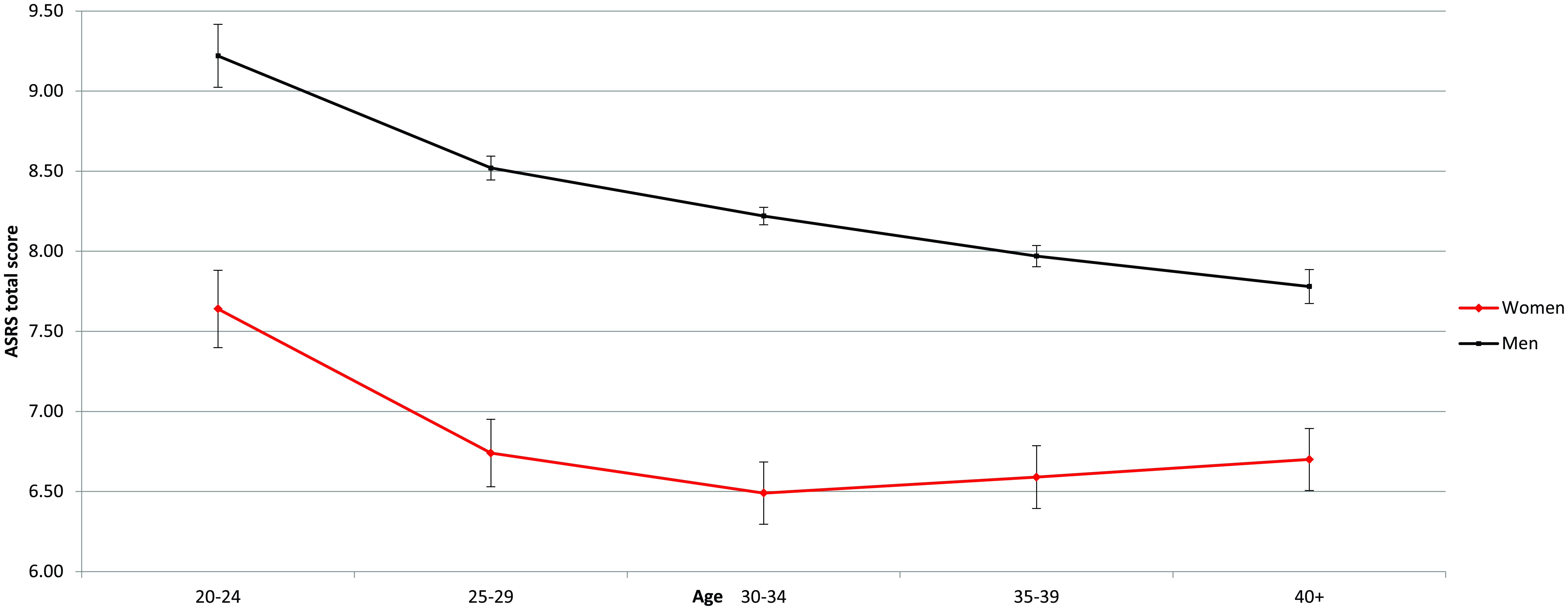
Age-related changes on the ASRS total score for men and women.
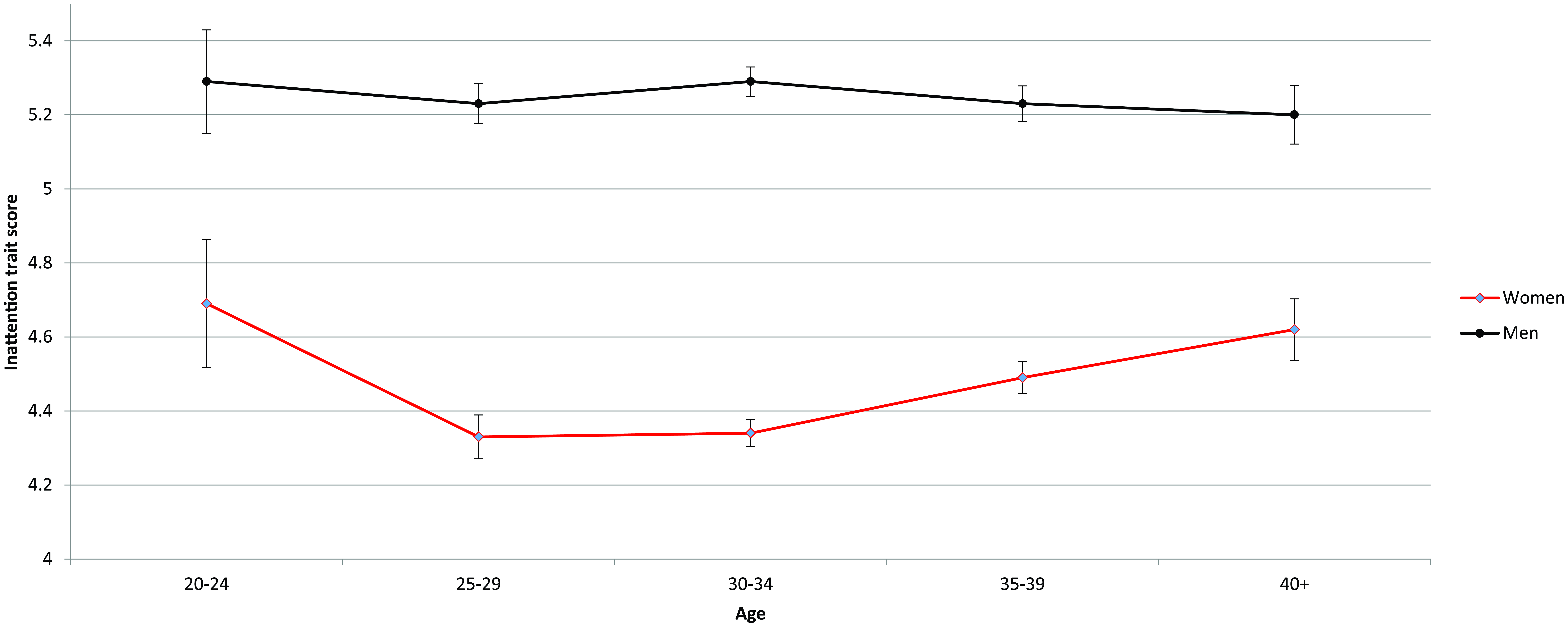
Age-related changes on the ASRS Inattention score for men and women.
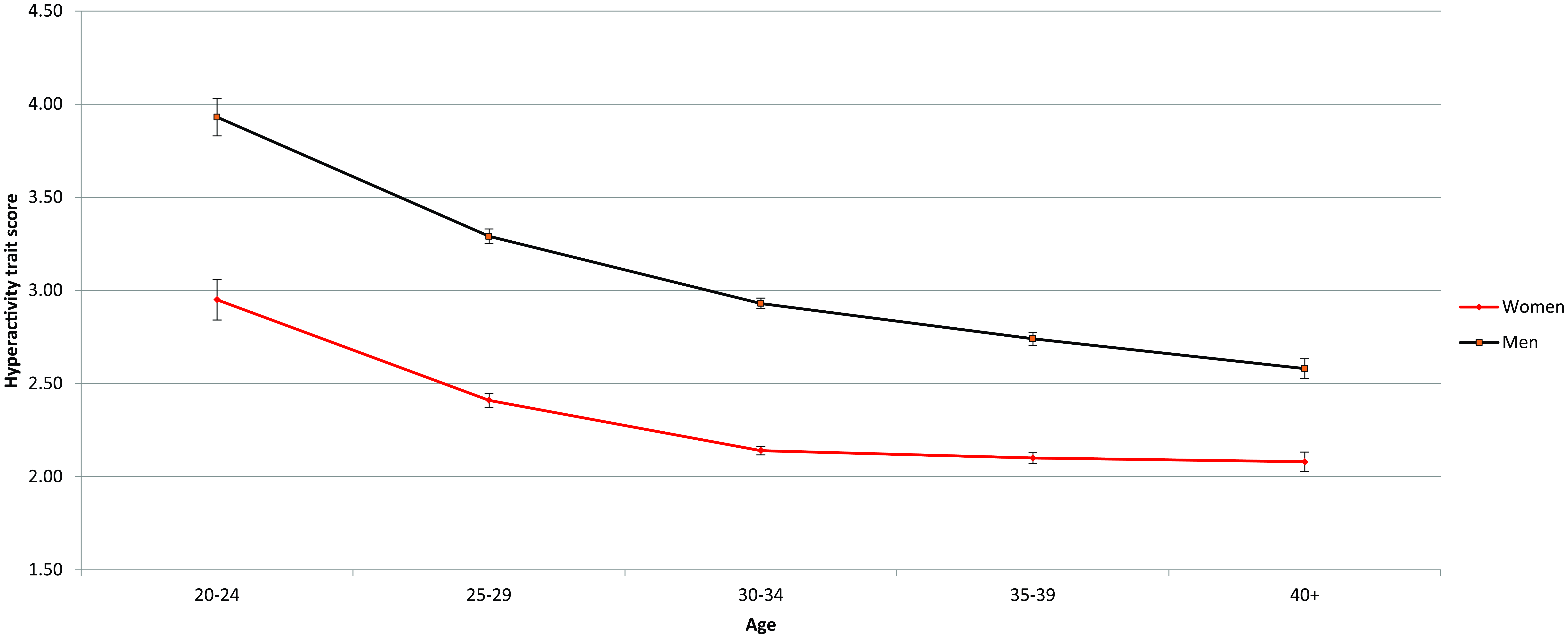
Age-related changes on the ASRS Hyperactivity score for men and women.
Results
The factor analysis confirmed the two proposed ASRS subscales of Inatt and HyImp for both men and women; see Table 1 for the factor loadings after rotation. The Kaiser–Meyer–Olkin (KMO) measure verified the sampling adequacy for the analysis (KMO = .71 and .77, Bartlett’s test of sphericity, χ2 = 28,295.09 and 51,802.56, both p < .0001, for men and women, respectively). Two components showed eigenvalues over Kaiser’s criterion of 1 and explained 57.59% and 61.40% of the variance, for men and women, respectively. The two components were congruent with the proposed ASRS subscales of Inatt (4 items, component 1) and HyImp (2 items, component 2), in men and women.
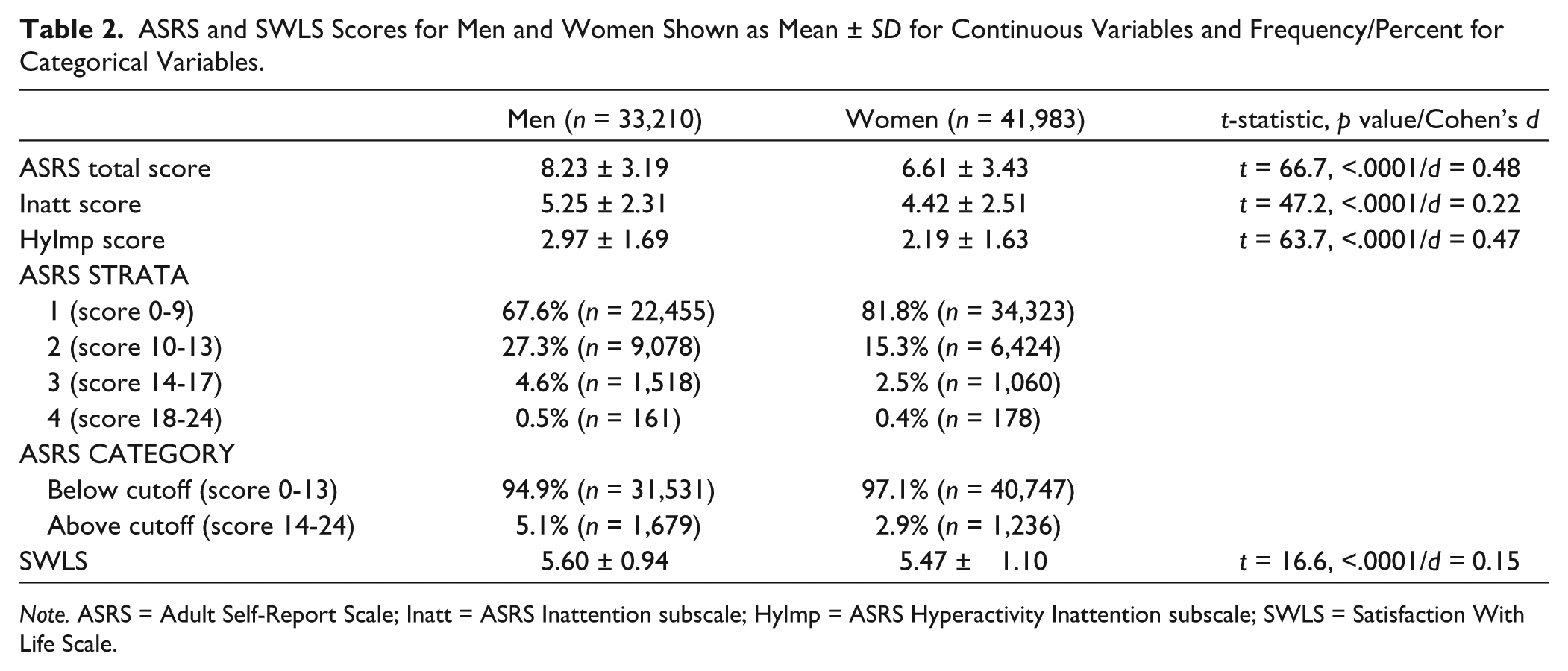
The mean ASRS total score was significantly higher in men, and 5.1% of the men scored above cutoff, compared with 2.9% in women. Comparing the two ASRS subscales, only the HyImp showed a prominent sex difference (Cohen’s d = 0.47), see Table 2.
ASRS and SWLS Scores for Men and Women Shown as Mean ± SD for Continuous Variables and Frequency/Percent for Categorical Variables.
Note. ASRS = Adult Self-Report Scale; Inatt = ASRS Inattention subscale; HyImp = ASRS Hyperactivity Inattention subscale; SWLS = Satisfaction With Life Scale.
The ASRS HyImp was reduced with age in both sexes. The Inatt scores were reasonably stable in men, compared with a more u-curved distribution in women (an initial decrease followed by a small increase); see Figures 1 to 3 for the age-related changes on the ASRS total score and the two subscales (similar age-related changes were found within each educational level, data not shown).
Satisfaction with life, as measured by mean SWLS scores, was in the normal range for both sexes in the total sample (Table 2). A decrease in satisfaction with life was found with increasing ASRS strata (see Figure 4), more so for women, with a statistically significant effect modification between sex and ASRS (Wald chi-square = 417, df = 3, p < .001). Small, but significant correlations were found between SWLS and both ASRS subscales for men and women, respectively: Inatt (r = .25 and .30) and HyImp (r = .13 and .21), all ps < .001.
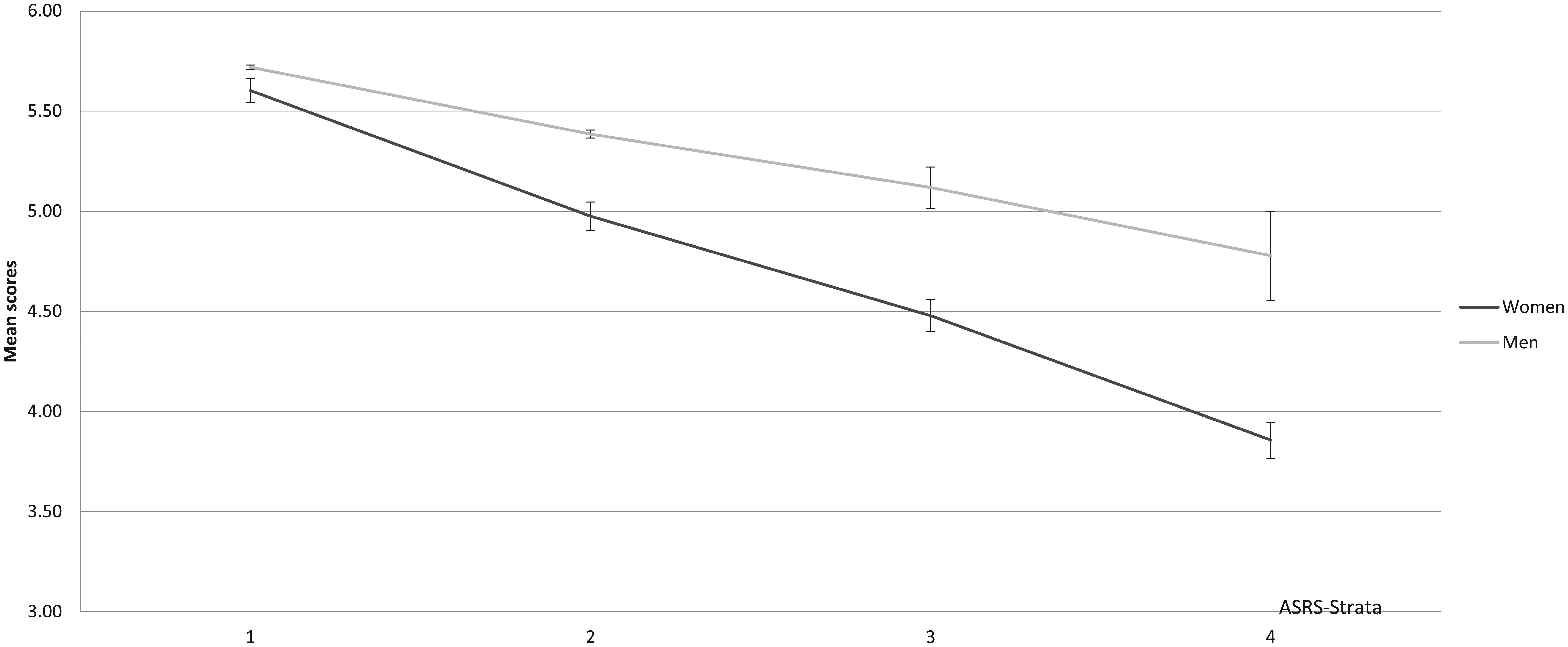
Satisfaction with life in the four ASRS strata for men and women.
Discussion
In this large population study, ADHD symptoms were measured with the Adult ADHD Self-Report Screener (ASRS-6), which loaded on two factors (inattention and hyperactivity-impulsivity) in men and women. As hypothesized, there was a male preponderance of ADHD symptoms, and significantly more men scored above the ASRS-cut off (5.1% vs. 2.9% in women). Contrary to our hypothesis, we found a significant decline of hyperactivity-impulsivity symptoms with age in both sexes, while inattention scores were reasonably stable in men in contrast to a u-curved distribution in women. Higher ASRS scores were associated with lower satisfaction with life, as measured by the SWLS, but only women with the highest ASRS scores showed poor satisfaction with life.
Awareness of ADHD as a disorder, which can persist into adulthood, requires the need for useful questionnaires to screen for these symptoms in adults. ADHD has long been recognized as a bifactorial disorder (Wilens, Biederman, & Spencer, 2002), and the two ASRS factors identified in our sample suggest that the questionnaire taps into the two core symptom factors of ADHD. Our finding is in line with a recent confirmatory factor analysis (Hesse, 2013), and contrary to the originally proposed one-factor model (Kessler et al., 2007). That the ASRS-6 self-assessment identifies similar heterogeneity as the ADHD diagnosis, as defined by the DSM criteria, supports its clinical usefulness in the screening of suspected cases of ADHD prior to the use of a comprehensive interview to confirm the ADHD diagnosis (Canadian ADHD Resource Alliance, 2015; Ginsberg, Quintero, Anand, Casillas, & Upadhyaya, 2014).
Empirical data on ADHD in women are more scarce than in men (Gaub & Carlson, 1997), but the two sound ASRS factors we found in both sexes underline that women share the same symptoms of ADHD as their male counterparts (Wilens et al., 2002). Men reported higher ASRS mean scores than women in our study, and significantly more men scored above the ASRS-6 clinical cutoff for ADHD. On the one hand, this was as hypothesized, as higher ADHD prevalence rates have been found among males (Giacobini et al., 2018; Simon et al., 2009). However, the robust sex differences found in the present study stands in contrast to two previous community studies with a mixed age sample (18-65 years, n = 1,655; de Zwaan et al., 2012) and middle-aged adults (n = 2,091; Das et al., 2012). Nonetheless, a closer look at the Table 2 in the latter article (Das et al., 2012) reveals a significantly higher inattention component score in men compared with women, even though the authors concluded with no significant gender differences. Support for the male preponderance of ADHD when including a very large number of adults from young to middle age groups was recently also demonstrated in a twin and sibling youth study (n = 2,332; 8-19 years; Arnett, Pennington, Willcutt, DeFries, & Olson, 2014). A gender difference in prevalence (male to female ratio: 2.28:1) was also described in a community study (n = 9,380; age 7-29 years), although smaller than most often shown in clinical samples, suggesting that females are underdiagnosed in the community (Ramtekkar et al., 2010).
Contrary to our expectations, we found different age-related changes in men and women. In line with findings in children (Holbrook et al., 2016), both sexes showed a decline in HyImp scores with age, although the decline in women was primarily seen from the youngest age group up until age 30 to 34 years. In addition, to the best of our knowledge, the u-curved inattention scores found in women (a small increase from age group 30-34 years and upward), compared with reasonably stable scores in men, have not previously been demonstrated. Due to the large number of participants in the present study, there is reason to trust this finding. One could speculate whether the rise in attention scores could be related to the stress of being a toddler’s mother in the somewhat older, compared with younger, women. However, this u-curved distribution in women needs to be replicated, as the present study cannot show whether this finding is limited to mothers with toddlers only.
Overall, participants in the present study showed satisfaction with life, as measured by the SWLS, and in line with previous research (Das et al., 2012), we found a somewhat stronger association between SWLS and the ASRS Inatt subscale, compared with the HyImp subscale. As hypothesized, and in line with previous findings in young adults (Gudjonsson et al., 2009), we found higher ASRS scores to be associated with lower satisfaction with life across age groups. However, the association were stronger for women, and poor satisfaction with life was found only in women with the highest ASRS scores (Strata 4, see Figure 4). There is less research on women with ADHD, compared with men, which limits our understanding of how women develop and cope with associated symptoms (Gaub & Carlson, 1997). However, as the association between reduced satisfaction with life and ADHD symptoms is so robust in the literature, our findings could be taken as support for the established ASRS cutoff to better capture women with ADHD compared with men. A caution to the sex of the respondent when using the ASRS is clearly warranted. Possibly, also, as the ASRS-validation study, using the K-SADS interview in adolescents (Sonnby et al., 2015), found better correspondence between ADHD diagnoses and ASRS scores in females, one could question a reconsideration of the ASRS norms in the direction of heightening the cutoff for men.
Strengths and Limitations
A strength of the present study was the large sample size of men and women, as this made it possible to compare gender and age differences of ADHD symptoms in the community. There were however some important limitations. The MoBa participation rate was 40.6% at inclusion with an underrepresentation of risk groups like young mothers, mothers living alone, and previous birth complications (Nilsen et al., 2009). Men and women with psychiatric disorders are difficult to get to participate in studies (Knudsen, Hotopf, Skogen, Overland, & Mykletun, 2010), and as the MoBa questionnaires are long and detailed, people with ADHD are likely to be underrepresented. Although these issues raise concern about bias, the large sample size does provide statistical accuracy in the estimated mean scores with narrow confidence intervals (see Figures 1-4).
One cautionary note on the generalizability of our findings relates to the fact that the present sample consists of parents only, and that they completed the ASRS at different time points (men when the women were pregnant and women at child age 3 years). Being a parent is an integral part in most adult lives, but we cannot rule out the possible influence of different timing for men and women on the self-reported symptoms, although the direction of this possible influence is not obvious. Although the MoBa sample is somewhat better educated than the rest of the population (Magnus et al., 2006), our findings seems to be generalizable, as similar age-related changes were found within all education levels in both men and women (data not shown). Our measures for ADHD symptoms and satisfaction with life were two screening questionnaires (ASRS-6 and SWLS), and although they have been found to have acceptable psychometrics (Diener et al., 2003; Kessler et al., 2007; Pavot et al., 1991), it should be noted that the results are not based on diagnostic assessments.
Conclusion
The results from parents in this large population-based cohort study replicate and extend the literature supporting that the ASRS-6 provides valid measures of the two ADHD factors (inattention and hyperactivity-impulsivity) in both sexes and demonstrating different changes with age in men and women. In the clinic, this warrants a general caution to age and sex when using the ASRS as well as special attention to high-scoring women as they seem prone to poor satisfaction with life.
Footnotes
Acknowledgements
We are grateful to all the participating families in Norway who take part in the MoBa studies.
Declaration of Conflicting Interests
The author(s) declared no potential conflicts of interest with respect to the research, authorship, and/or publication of this article.
Funding
The author(s) disclosed receipt of the following financial support for the research, authorship, and/or publication of this article: The present study was supported by a grant from the Norwegian South Eastern Health Region. The Norwegian Mother and Child Cohort Study is supported by the Norwegian Ministry of Health and the Ministry of Education and Research, NIH/NIEHS (Contract No. N01-ES-75558), and NIH/NINDS (Grant No. 1 UO1 NS 047537-01 and Grant No. 2 UO1 NS 047537-06A1).