




Abstract

“What does it mean to be a professor?” is a question whose answer requires understanding the educator's primary role. Boyer (1990) identified the need to shift the instructor's role from sole reliance on transmission of information toward learning facilitation and guidance using mixed pedagogical methods. In the same line, Angelo and Cross (1993) found a direct relationship between the quality of student learning and the quality of teaching, asserting that “one of the most promising ways to improve learning is to improve teaching.” Since these seminal statements, much more have been said about teaching and learning, predominantly focusing on teaching systems, approaches, and practices. However, as a generational turnover is impacting higher education with new perceptions, viewpoints, and ideas replacing the old ones, this article addresses the effect of the age gap between faculty and students. As a generational turnover is impacting higher education with new perceptions, viewpoints, and ideas replacing the old ones, this article addresses the effect of the age gap between faculty and students.
The National Academies of Sciences, Engineering and Medicine (2020) acknowledged that the concept of generation is a complex mix of age, location, and context. Nevertheless, the idea of grouping people by their generation became widespread, and generational jargon is now part of the popular language. Numerous articles and discussions focus on the management of generational differences. In general, commentaries that refer to generations describe their likes, dislikes, habits, and attributes. Even when, not everyone born in a generational period shares the same values or experiences, they do share a common context that shapes their worldview. Thus, generational research can provide institutions with valuable information to design effective policies, programs, and practices. Studies suggest that generational attitudes and values influence behaviors. Strauss and Howe (1991) hypothesized that four generational personalities emerge in a cyclical pattern every 20 years or so: idealist (indulged and narcissistic), reactive (under-protected and alienated), civic (team-oriented, overprotected but society-minded), and adaptive (ethos of personal sacrifice). Most researchers adopted the classification suggested by the Pew Research Center (2015), that categorizes the generations as, silent generation (born before 1946), baby boomer (born between 1946 and 1964), Generation X (born between 1965 and 1980), millennial (born between 1981 and 1997), and Generation Z (born since 1998). Even when, not everyone born in a generational period shares the same values or experiences, they do share a common context that shapes their worldview.
A rationale for studying the latest generation attending college and the importance for instructors to understand how to best motivate, engage, and educate them was provided by Geck (2006). He expressed that “the next wave of college students will change the landscape of higher education.” Fifteen years later, that wave fills the college classrooms, where 80 percent of undergraduate college students belongs to Generation Z, while not a single professor does. Seemiller and Grace (2016), provided insight as to how the new generation of college students prefer learning, engaging with peers, and what motivates them. Zorn (2017) recognized that “to maximize learning educators should understand how education looks for Generation Z.” Characteristics of this cohort include compassion, loyalty, open-mindedness, and responsibility. They live their values through lifestyle changes, incorporating viewpoints based on the impact of major world events and technical advances. They are likely to have heightened technical expectations, attitudes, and beliefs. As their relationships are heavily influenced by the digital world, to engage with them educators should focus on their passion areas, preferred methods of interaction with others (on and offline), and on how they consume and disseminate the news. The sharing that occurs on social media platforms represents an avenue to build trust and create a sense of community. Their connectedness could be beneficial for educators to carefully engage with students, and to explore pedagogical strategies and instruction trends to best support them, as well as to better understand how they express their concerns, how they develop the values that shape their decision-making processes, and how they define leadership. 80 percent of undergraduate college students belongs to Generation Z, while not a single professor does.
Methodology
Previous discussions, articles, and studies tried to understand the characteristics of the new generation using top-down views that positioned the educator in the apex of a pyramid while the students laid below. To address the issue horizontally, putting both faculty 1 and students on a same level, we conducted two parallel surveys, asking them separately, “In your view, what is the educator's primary role?” Our findings show that the visions of faculty and students are diametrically opposed. For this research, 200 + undergraduate students were surveyed at The Jack C. Massey College of Business at Belmont University, during Spring/Fall 2019 and 100 + during Fall 2021, skipping the COVID-19 disruption. The consistency of their judgments suggested that students were mostly reliable in their views. Additionally, 40 + faculty were surveyed during Fall 2021. The main limitation of this inquiry resides in the fact that only faculty and students from a single school were surveyed. Consequently, a risk of biased beliefs or understandings is high.
To build the body of the survey we checked multiple questionnaires whose inquiries tried to comprehend the student-faculty interaction as well as the students’ perceptions of gains or progress in certain areas. The latitude of their questions was too wide, becoming difficult to analyze. Among them:
How often have professors? Served as a role model; provided advice and guidance about your educational program/goals; encouraged you to pursue graduate/professional study; provided you with emotional support and encouragement; provided you with spiritual guidance; helped develop your leadership skills; helped you in achieving your professional goals; and mentored you. To what extent do you feel you have gained or made progress in the following areas? Acquiring knowledge about a particular field of study; understanding yourself, your abilities, interests, and personality; thinking analytically and logically; developing your own values and ethical standards; putting ideas together, seeing relationships, similarities, and differences between ideas; learning on your own, pursuing ideas, and finding information you need; acquiring knowledge and skills applicable to a specific job or type of work; becoming a lifelong learner; presenting ideas and information effectively when speaking to others; developing leadership skills; developing the ability to get along with different kinds of people; solving complex real-world problems; acquiring a broad general education; developing an awareness of moral and ethical issues in society; using computers, software, and other information technologies; becoming aware of different philosophies, cultures, and ways of life; writing clearly and effectively; analyzing numerical and statistical information; developing global perspectives on issues and problems; gaining knowledge about other parts of the world and other people (Asia, Africa, South America); and spiritual growth and development. Developing higher-order thinking skills Teaching the facts and principles of the subject matter Preparing students for jobs/careers Fostering student development and personal growth Helping students develop basic learning skills Providing a role model for students As the feedback that directly challenges faculty assumptions often turns out to be the most valuable information, our interest is in helping professors use student’s expectations to improve their teaching.
Instead, we decided to ask just two questions, first “When were you born?” and second “In your view, what is the educator's primary role?” For which we adopted Angelo and Cross’ (1993, p. 367) list of six multiple-choice options:
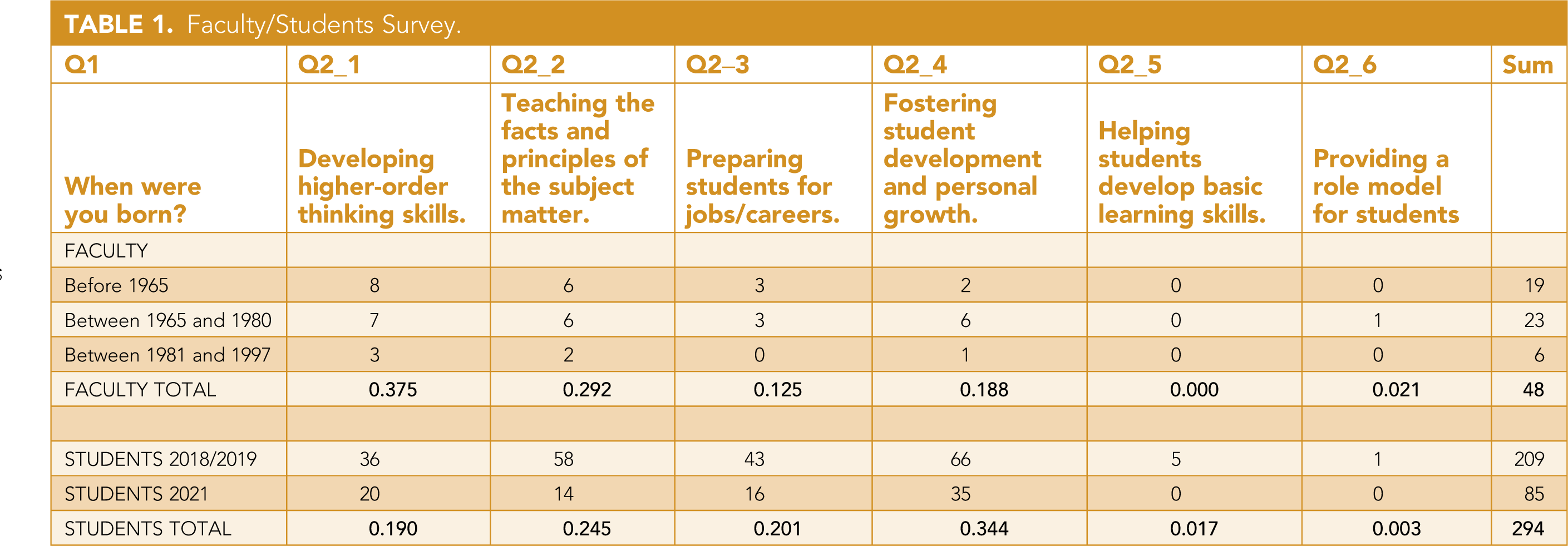
The answers are shown in Table 1.
Faculty/Students Survey.
Findings and Conclusions
Boyer (1987) asserted that scholarship is at the heart of what the profession is all about. He stated, “What you teach has a good deal to do with what your teaching priorities are and how you perceive your primary role as a teacher.” As the feedback that directly challenges faculty assumptions often turns out to be the most valuable information, our interest is in helping professors use student’s expectations to improve their teaching. A review of the data (associations, and connections) found on one hand that the survey was statistically valid, although the modest size of the faculty sample was a subject of concern. On the other hand, reliability was verified for students (multiple surveys with similar outcomes) but not for faculty (only one survey). Still, four main outcomes were identified: First: Two options were dismissed by both faculty and students (less than 2.5%). “Helping students develop basic learning skills” and “Providing a role model for students.” For the first option, it could be speculated that at college level nobody expects to provide/receive help to develop basic learning skills. The second option could have deeper implications (which are beyond the scope of this paper). It might be hypothesized that neither professors nor students saw value in intergenerational models. Second: More than 1/3 of faculty saw the primary role of the educator as “Developing higher-order thinking skills” while more than 1/3 of students saw it as “Fostering student development and personal growth.” This finding highlights a divergence between the mainstream expectations of professors and students. The former still think (as in their times as students) that college education is about developing higher order thinking skills, while students main concern is development and personal growth instead. It is remarkable that “Developing higher-order thinking skills” was the least prioritized option among students. Third: About 1/4 of faculty and students coincided with the second choice for the role of the educator as “Teaching the facts and principles of the subject matter.” Fourth: About 1/5 of students saw educator's primary role as “Preparing students for jobs/careers,” while this was the least prioritized option among faculty. It might be hypothesized that neither professors nor students saw value in intergenerational models.
We found that the visions of faculty and students were diametrically opposed. While faculty saw the primary role of the educator as “Developing higher-order thinking skills,” students assigned to this view the lowest priority. On the other hand, while students saw the primary role of the educator as “Fostering student development and personal growth,” faculty barely assigned to this view their third priority. Seemiller and Grace (2017) corroborated this finding asserting that “Generation Z's focus when coming to college is to learn and acquire the skills necessary for their future careers. Learning for them, however, is markedly different from that of previous generations.” Although of second order, “Teaching the facts and principles of the subject matter” was still highly valued by both faculty and students. Faculty saw their primary role as preparers and presenters, those who juggle putting together, drawing up, producing, assembling, composing, and formulating a class using the most efficient teaching techniques, expecting to expand higher-order thinking skills. Students anticipated the primary role of their professors to be fostering, encouraging, promoting, furthering, stimulating, advancing, forwarding, cultivating, nurturing, strengthening, and enriching their personal development and growth.
Recommendations for Future Research
Considering the limitations of this research, its conclusions should be taken as indications or symptoms of the situation in a confined environment. We have no means to extrapolate the findings on this paper to a wider setting. For future researchers in this field, it is advisable to consider the following suggestions. Validity could improve increasing the size of the samples by incentivizing faculty participation (they are always busy running behind their work deadlines). Likewise, reliability could improve by surveying both populations (faculty and students) during consecutive semesters (hope no other COVID-like event disrupts surveys). The use of mixed methods could provide an enhanced perspective of this phenomenon. We suggest a new quantitative survey focused solely on the four most popular answers, along with a qualitative survey with questions like: Which higher order thinking skills to develop? For what kind of jobs/careers should students be prepared? In what areas to foster and develop students’ personal growth? A qualitative survey with questions like: Which higher order thinking skills to develop? For what kind of jobs/careers should students be prepared? In what areas to foster and develop students’ personal growth?
