




Abstract
Student–teacher relationships (STRs) and socioeconomic status (SES) are two widely studied variables that have been found to predict reading achievement in the early grades. The current study extends the literature by investigating the interaction between STRs, measured using the STR Scale completed by teachers, and SES on reading achievement using a nationally representative data set. The study included approximately 8,380 first-grade students and 2,930 teachers, from 860 schools, representing a weighted sample of 3.15 million students. Results from multilevel modeling that controlled for student-, teacher-, and school-level factors found that both STRs and SES were strongly associated with student reading achievement. There was also a statistically significant interaction between close STRs and SES on reading achievement, suggesting that less conflictual STRs were associated with increased reading achievement scores for all students, but were particularly beneficial for students from low SES backgrounds. Educational implications are provided.
The importance of early childhood reading achievement has been well established, as reading is a fundamental skill that all children should learn (Castles et al., 2018). Two factors that have been found to predict reading achievement are student–teacher relationships (STRs) and socioeconomic status (SES). Students with closer and less conflictual STRs have been found to have higher reading achievement from kindergarten through high school, with more positive feelings toward academics (Birch & Ladd, 1996; Curby et al., 2009; Hamre & Pianta, 2001). Further, another benefit is that STRs are malleable, meaning that with proper intervention, conflictual STRs could eventually become positive STRs (Gehlbach et al., 2012).
Another strong predictor of student reading achievement is SES. Specifically, students from low socioeconomic backgrounds may have lower reading achievement scores compared to children from high socioeconomic backgrounds (Chatterji, 2006). However, unlike STRs, student SES may not be malleable, as this is often outside of the student's control. Although some studies have analyzed the relationship between STRs and SES on reading achievement individually (see Isaacs, 2012; Valiente et al., 2019), the current study uses the Early Childhood Longitudinal Study Kindergarten Class of 2010–2011 (ECLS-K:2011) to determine whether there is a moderation effect or interaction between STRs and SES on student reading achievement.
To capture the multidimensionality of reading and grade-appropriate standards for foundational reading success, we have defined reading achievement as a student's ability to engage in reading skills such as print familiarity, letter and sound recognition, phonological awareness, and the identification of common sight words (Najarian et al., 2018). This definition was selected as it is how the ECLS-K, the data set used in the current study, assessed reading achievement.
The Importance of Early Childhood Achievement
Early childhood reading is important, as reading skills are a strong predictor of later academic success (Cunningham & Stanovich, 1997; Sparks et al., 2014), with reading comprehension shown to be strongly associated with academic performance in other subjects (Kirsch et al., 2002). Sparks et al. (2014), replicating seminal work by Cunningham and Stanovich (1997), longitudinally studied 54 first-grade students’ reading using the Woodcock Reading Mastery Test–Revised (Woodcock, 1987). Specifically, students were asked to read aloud a list of words with increasing difficulty and a list of pseudowords that were also increasing in difficulty. Overall, Sparks et al. (2014) found that first-grade reading scores were strongly associated with 10th-grade achievement.
Similarly, in a meta-analytic study by Mol and Bus (2011), students who had more exposure to print sources had greater academic achievement, whereas print exposure in early grades accounted for 12% of the variance for oral language skills, but for 30% and 34% in high school and college, respectively. Further, we also know that interventions aimed at increasing student reading achievement often cost more and become less effective as students age (Bailet et al., 2011; Torgesen, 2002), again emphasizing the importance of engaging in research specifically aimed at better understanding early childhood reading success.
Student SES
However, although the importance of early childhood reading is known, many children are not reading at the appropriate grade level, with rates even lower for children from low SES backgrounds. According to Sirin (2005), SES is a construct composed of indicators such as parent/guardian education level, occupational prestige, and household income. In 2015, the National Center for Education Statistics (NCES) reported that approximately 20% of children under the age of 18 were living in poverty (McFarland et al., 2017). We note that this may be due to systemic conditions such as discrimination that may affect family social capital or resources (Alvarez et al., 2016).
The repercussions of low SES can affect children even before they enter school. Only 48% of children living below the poverty line were classified as school-ready by age 5, compared to 75% of children from families with moderate to high incomes (Isaacs, 2012). Multilevel modeling using the ECLS, a nationally representative data set, also established that children with SES in the bottom 10% had lower reading achievement compared to other groups and were more than one standard deviation behind their more affluent peers (Chatterji, 2006). These research studies demonstrate that low SES may have a strong and negative relationship with student reading achievement in school (Chatterji, 2006; Isaacs, 2012).
Student–Teacher Relationships
Given the strong association between SES and reading ability, it is important to identify classroom factors that could potentially mitigate the negative effects associated with low SES. One variable that has been linked to student achievement is STRs. STRs have been defined and studied in many ways, but they typically include the emotional support perceived between teachers and students and are often examined in conjunction with student academic outcomes, like reading achievement (Wentzel, 2012). Pianta (2001) defined STRs more specifically by suggesting that they can be characterized by closeness and conflict. Studies have demonstrated that close STRs are associated with higher student grade point averages and test scores from kindergarten through high school, with conflictual STRs being associated with negative and pessimistic feelings toward academics (Birch & Ladd, 1996; Curby et al., 2009; Hamre & Pianta, 2001; O’Connor & McCartney, 2007; Roorda et al., 2011). STRs are also malleable, as demonstrated by Gehlbach et al. (2012), suggesting that potentially conflictual STRs could possibly be changed into close STRs with proper intervention.
Further, STRs have been associated with student reading achievement in the early grades, although we note that each study referenced below may have a different definition of reading achievement. For example, Valiente et al. (2019) found that STRs in elementary school were typically close, with close STRs predicting reading achievement in boys, a noteworthy observation given that historically, girls outperform boys on reading standardized tests (Robinson & Lubienski, 2011). Similarly, Hernández et al. (2017) found that close STRs were positively related to academic achievement using a combined reading and math measure. However, we note that Hajovsky et al. (2017) did not find a statistically significant relationship between STRs and reading achievement when previous achievement was accounted for, and McCormick et al. (2013) only found close STRs to be predictive of math, not reading achievement, in early grades.
From the teacher’s perspective, positive STRs may increase a teacher's motivation and engagement, possibly increasing the use of high-impact teaching practices in the classroom (Li et al., 2022; van der Lans et al., 2020). STRs have also been found to increase teachers’ self-efficacy (Mashburn et al., 2006) and job satisfaction (Admiraal et al., 2019). When considering students from underserved communities, strong and positive STRs have been found to buffer the harmful effects of racial discrimination (Gale, 2020) and protect against variables associated with poor academic and behavioral outcomes (Gallagher et al., 2019).
Theoretical Framework
The situated expectancy-value theory (SEVT) developed by Eccles and Wigfield (2020) was used to guide this research. The core tenets from the earlier expectancy-value theory (EVT) exist: students are motivated based on how well they believe they can complete the task (i.e., their expectations) and the subjective value of the task (i.e., attainment value, intrinsic value, utility value, and cost) (Eccles, 1983; Wigfield, 1994). However, the SEVT expands on its predecessor in multiple ways that are noteworthy for the current study. Specifically, the SEVT emphasizes the importance of taking sociocultural contexts into consideration, meaning “proximal socializers are directly influenced by both their sociocultural context and the characteristics of the focal individual” (Eccles & Wigfield, 2020, p. 10). In other words, teachers (e.g., socializers) may be directly influenced by the characteristics and sociocultural context (e.g., habits, traditions, and beliefs) of their students. Although beyond the scope of the current study, this may support why research has shown student–teacher race/ethnic matching to be advantageous for all students, but particularly for students of color, or students who identify as nonwhite (Redding, 2019).
Interaction Effect Between STRs and Student SES
Within educational research, there are multiple aspects of the SEVT or the EVT that have either been investigated or have informed the interpretation of study results. For example, in a review by Martin and Dowson (2009), EVT was highlighted and applied in a school context. Specifically, students who believed they were capable of understanding and completing their schoolwork often had higher expectancies for success, which translated into increased motivation, increased achievement, and valuing academic tasks. These higher expectancies and values were often “influenced by the socializers with whom students have significant relationships” (Martin & Dowson, 2009, p. 334).
When thinking about the current study, tenets of the SEVT theory can be applied to our variables of interest, specifically, that positive STRs may have the ability to increase reading expectancies for success and academic task values, in addition to acting as a protective factor against variables that have been found to be negatively associated with reading achievement, such as low SES. Work by Xuan et al. (2019) explored the idea that expectancies and values can be influenced by teachers (i.e., socializers) and that teachers can act as a protective factor by centering their work using the EVT framework. Their results, using multilevel mediation models with students from mainland China, suggested that school SES (i.e., the average of each student's family-based socioeconomic resources) was associated with student achievement via teacher–student relationships (Xuan et al., 2019). Similarly, Malecki and Demaray (2006) found that parent or classmate social support (i.e., the socializers) interacted with SES and academic performance, suggesting that social relationships can protect against negative consequences associated with low SES on achievement.
Informed by the SEVT and the literature, we hypothesized that close or less conflictual relationships may help improve reading achievement, especially for students from lower socioeconomic backgrounds. Specifically, due to differences in school resources and possible covert and overt discrimination, teachers may have varying expectancies for reading success for students from varying levels of SES (see Ball et al., 2016; Davis, 2001; Guo et al., 2015). Therefore, we hypothesized that when there were close, positive STRs, the teacher could act as an appropriate role model, provide intellectual resources, and help the student develop an interest in reading. This close STR could potentially improve student expectations and increase reading achievement for all students, but especially for students from low socioeconomic backgrounds. When considering this interaction from the sociocultural perspective within the SEVT framework, teachers with close STRs may better understand the student's sociocultural context, allowing them to provide tailored, meaningful support specifically aimed at increasing expectancies for success and academic task values.
Teacher-Level Predictors of Reading Achievement
In addition to investigating our variables of interest, SES and STRs, it was important to account for other variables that may be associated with reading achievement by estimating the association of our predictors of interest on the outcome variable, reading achievement, when holding all other variables in the model constant (Olsen et al., 2020). Two important teacher-level variables that were accounted for were teacher race/ethnicity and teacher gender. For Black and Latinx students, teacher race has been found to be especially important. In a study by Gershenson et al. (2016), White teachers had lower expectations for Black students, which was associated with lower achievement. In contrast, Black and Latinx teachers have been shown to have higher expectations for Black and Latinx students (Bristol & Martin-Fernandez, 2019). Teacher gender has also been found to be associated with achievement. Burusic et al. (2012) found that students with a female teacher outscored students with a male teacher on a standardized exam.
Student-Level Predictors of Reading Achievement
Further, beyond teacher-level predictors, student-level predictors such as student race/ethnicity, gender, disability status, externalizing behavior, self-control skills, and previous academic achievement were important to account for. Regarding student race/ethnicity, Burchinal et al. (2011) used the NICHD Study of Early Child Care and Youth Development to explore reading differences between American youth from 4.5 years of age through fifth grade. Reading differences between Black and White students on the Woodcock–Johnson Psych-Educational Battery–Revised (Woodcock & Johnson, 1990), which measured basic reading skills such as identifying isolating letters and words, were found in children as early as 3 years old and continued to be prominent through fifth grade (Burchinal et al., 2011).
Beyond student race/ethnicity, student gender has also been associated with student reading achievement. According to multiple studies that have used the ECLS-K, gender disparities begin to appear in first grade. For example, Denton and West (2022) found that girls were often more proficient in advanced reading skills, and Rathbun et al. (2004) found that girls were more likely to make literal inferences compared to boys in third grade.
Disability status, externalizing behaviors, and prior achievement were also important variables to account for in this study. In a meta-analytic study by Gilmour et al. (2018), students with disabilities scored on average 1.17 standard deviations, or more than 3 years, below their typically developing peers. Additionally, students who exhibited externalizing behaviors had lower academic performance and maintained more conflictual STRs (Baker et al., 2008). In contrast, students with higher levels of self-control typically had higher academic achievement (Duckworth et al., 2019). Finally, accounting for prior student achievement provides more accurate estimates of academic gains and of school and teacher effectiveness (Solmon et al., 2004).
The Current Study
Although many studies have analyzed the relationship between SES and STRs on academic achievement, no studies to our knowledge have investigated the interaction effect between SES and STRs on reading achievement, with few studies examining similar constructs. Informed by the possible benefits of increasing reading achievement for all students, but particularly those from low SES backgrounds, the purpose of the current study was to examine the interaction between STRs and SES on reading achievement for first-grade students when accounting for the student- and teacher-level variables mentioned above, with school fixed effects. We used a nationally representative data set to answer the following research questions:
How are conflictual STRs, close STRs, and student SES associated with first-grade reading achievement? How is the assocation between student SES and first-grade reading achievement moderated by close and/or conflictual STRs?
For Research Question 1, we hypothesized that conflictual STRs would be negatively associated with reading achievement and that both close STRs and student SES would be positively associated with reading achievement, aligning with results from previous research (see Curby et al., 2009; Hamre & Pianta 2001; Roorda et al., 2011). For the second research question, informed by the SEVT and based on research conducted by Xuan et al. (2019) and Malecki and Demaray (2006), we predicted that reading differences between students of varying SES backgrounds may be reduced when there were close STRs. This study was not a direct test of SEVT; however, we offer this theory as one possible explanation for the findings.
Methods
Data Set
Data for this study were from the restricted-use Early Childhood Longitudinal Study, Kindergarten Class of 2010–2011, conducted by the NCES. The goal of the ECLS-K was to longitudinally study a nationally representative group of children from kindergarten through elementary school. This was the third and latest study in the ECLS-K program and contained assessments of children, interviews with parents, and questionnaires completed by both teachers and school administrators (see https://nces.ed.gov/ecls/kindergarten2011.asp). These data were collected using a stratified probability proportion to size sample design, meaning that the sampling frame was stratified by state, public/private sectors, and school eligibility (Tourangeau et al., 2015)
In the current study, the spring 2012 wave, when the participants were in first grade, was selected. These data were narrowed to exclude children enrolled in private schools, as private schools have been shown to have different discipline policies and lengths of instructional time (Hoyer & Sparks, 2017; Welch & Payne, 2010). Schools with fewer than three teachers to estimate school fixed effects and children who skipped the first grade or were retained in kindergarten were also excluded, as these children may be systematically different in terms of academic and psychosocial adjustment from children who followed a more traditional educational pathway (Jimerson, 2001; Owings & Magliaro, 1998). Out of the first-grade students who attended public school, the final analytic sample included 8,380 students, 2,930 teachers, and 860 schools, out of a possible 13,240 students, 4,270 teachers, and 1,720 schools. This represented a weighted sample of approximately 3.15 million students (or 90% of the population) out of a possible 3.51 million public school students.
As part of the restricted-use data agreement with the NCES, all counts were rounded to the nearest 10. Further, these data were weighted using a sampling weight (W4CS4P_4T0), which was normalized by dividing the raw weight by the mean of the weights (Hahs-Vaughn, 2005). To measure the internal consistency of our scales, Cronbach’s (1951) alpha was used, where coefficients between 0.81 to 0.90 were considered good and coefficients above 0.91 were considered excellent. This study was approved by the University of Texas at Arlington's institutional review board under protocol #2020-0118. Descriptive statistics are reported in Table 1.
Descriptive Statistics.
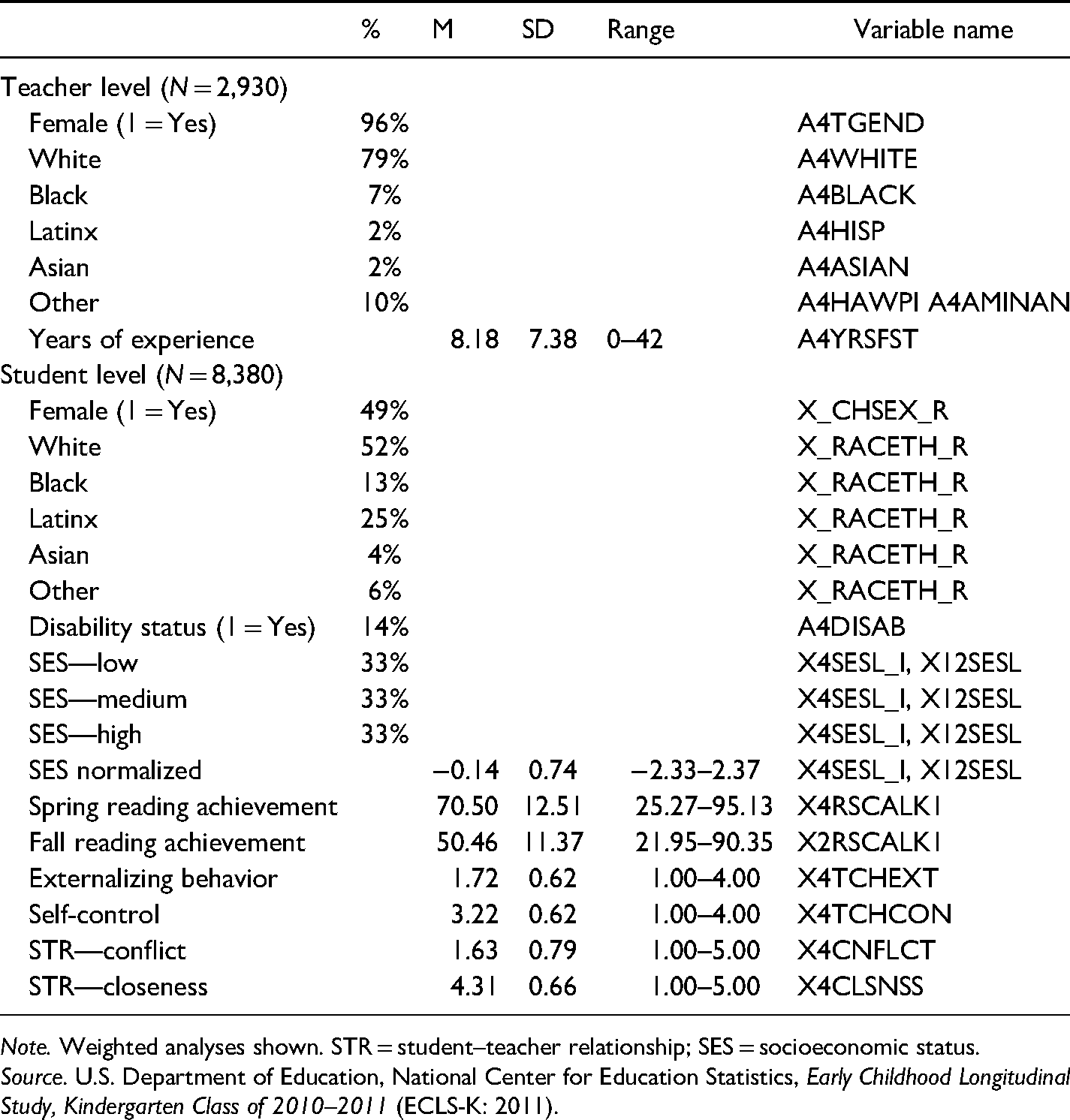
Note. Weighted analyses shown. STR = student–teacher relationship; SES = socioeconomic status.
Source. U.S. Department of Education, National Center for Education Statistics, Early Childhood Longitudinal Study, Kindergarten Class of 2010–2011 (ECLS-K: 2011).
Measures for Regression Analysis
Reading assessment
The reading assessments included in the ECLS were conducted in two stages and were created using item response theory (IRT). Content covered in these assessments was based on the 2009 Reading Frameworks for the National Assessment of Educational Progress (National Assessment Governing Board, 2008) and included questions related to basic reading skills. For the phonetic section, students were asked to rhyme (e.g., name words that rhymed with the stimulus word), sound match (e.g., point to a picture showing something that began with the same sound as the stimulus picture), blend (e.g., combine sounds to form a word), segment (e.g., identify the number of sounds in a word), and manipulate (e.g., add, delete, or subtract a sound). For the recognition of basic sounds and words section, students were asked to identify the letter that makes the sound vocalized by the assessor or vocalize a sound represented by a certain letter named by the assessor. Finally, for the vocabulary section, students were asked to convey their knowledge both verbally and nonverbally. For example, the assessor would hold up a stimulus picture and ask the child, “What is this?” The vocabulary assessments for first-grade students included receptive vocabulary words used in the context of a sentence or paragraph (Najarian et al., 2018).
Student theta levels for each test item or probabilities of correct answers were summed for each student to create their composite IRT reading score (Tourangeau et al., 2015). The reading assessment score for the spring had a mean of 70.50, a standard deviation of 12.51, and a range from 25.27 to 95.13. The reading assessment for the fall had a mean of 50.46, a standard deviation of 11.37, a range from 21.95 to 90.35, and a reliability estimate of 0.93 (Cronbach, 1951). This assessment was administered on an individual basis by a trained and certified child assessor (Tourangeau et al., 2015).
Externalizing behavior
The externalizing behavior subscale was a five-item assessment adapted from the Social Skills Rating System (SSRS; Gresham & Elliot, 1990) that was designed to measure a student's maladaptive behaviors toward their environment (Tourangeau et al., 2015). Each item in the subscale was rated using a four-point scale ranging from 1, “not at all true,” to 4, “very true.” The subscale was computed by taking the mean of the items to compose the score. This subscale had a mean of 1.72, a standard deviation of 0.62, a range from 1.00 to 4.00, and a reliability estimate of 0.89 (Cronbach, 1951). Since the SSRS is currently a Pearson product (see https://pearsonclinical.in/solutions/social-skills-rating-system-ssrs/), the sample items used in this assessment were not available without purchase.
Self-control
The self-control subscale was a four-item assessment also adapted from the SSRS (Gresham & Elliot, 1990) and was designed to measure a student's ability to avoid acting on impulse to achieve goals. Each item on the subscale was again rated from 1 to 4, with 1 meaning “not at all true” and 4 meaning “very true” (Tourangeau et al., 2015). This subscale had a mean of 3.22, a standard deviation of 0.62, a range from 1.00 to 4.00, and a reliability estimate of 0.82. Since this subscale was part of the SSRS owned by Pearson, sample items were not available.
STR scale
Teacher closeness subscale
The teacher closeness subscale was developed from the STR Scale (STRS; Pianta, 2001) and was completed by teachers. This instrument contained seven items on a five-point scale ranging from “definitely does not apply” to “definitely applies.” The closeness subscale measured the “affection, warmth, and open communication that the teacher experiences with the student” (Tourangeau et al., 2015, p. 27), with high scores indicating a close STR. A sample question from the closeness subscale was, “I share an affectionate, warm relationship with this child” (Pianta, 2001, p. 1). The closeness subscale had a mean of 4.31, a standard deviation of 0.66, a range from 1.00 to 5.00, and a reliability estimate of 0.89 (Cronbach, 1951). The reliability estimate for the present study was similar to when the teacher subscale was originally normed (α = .86; Pianta, 2001).
Teacher conflict subscale
The teacher conflict subscale was also taken from the STRS (Pianta, 2001) and contained eight items on a five-point scale ranging from “definitely does not apply” to “definitely applies.” The conflict subscale was completed by the teacher and measured the “teacher's perception of negative and conflictual aspects of the teacher's relationship with the student” (Tourangeau et al., 2015, p. 27), with high scores indicating a conflictual STR. A sample question from the conflict subscale was, “This child and I always seem to be struggling with each other” (Pianta, 2001, p. 1). The conflict subscale had a mean of 1.63, a standard deviation of 0.79, a range of 1.00 to 5.00, and a reliability estimate of 0.89 (Cronbach, 1951). The reliability estimate from when the teacher conflict subscale was originally normed was 0.92 (Pianta, 2001). For more information regarding how the STRS was normed, see the Student–Teacher Relationship Scale: Professional Manual (Pianta, 2001). Note that the close and conflictual STR subscales from the STRS were based on teachers’ self-reported perceptions of their relationships with their students. Although self-reported data without proper triangulation to other sources can be a limitation, work by Haeffel and Howard (2010) suggests that self-report data are often appropriate to measure theoretical constructs such as attitudes, emotions, or perceptions, including the validation of behavior, as done in the current study.
SES variable
To measure SES, a normalized continuous variable containing the first parent/guardian's education level, the second parent/guardian's education level, the first parent/guardian's occupational prestige score, the second parent/guardian's occupational prestige score, and the household income was used (Tourangeau et al., 2015). If a student was missing SES for the spring of 2012, prior SES reports from the fall of 2011 or the spring of 2011 were used instead. The mean for this normalized variable was −0.14, the standard deviation was 0.74, and the range was between −2.33 and 2.37.
Participant Information
Student demographic information
Demographics included students identifying as either male (51%) or female (49%), with male students as the reference group; student race/ethnicity identification as White (52%), Black (13%), Latinx (25%), Asian (4%), and Other (6%), with White as the reference group; fall reading achievement (M = 50.46, SD = 11.37, Range = 21.95–90.35); fall conflictual STR scores (M = 1.63, SD = 0.79, Range = 1.00–5.00); fall close STR scores (M = 4.31, SD = 0.66, Range = 1.00–5.00); externalizing behavior (M = 1.72, SD = 0.62, Range = 1.00–4.00); and self-control skills (M = 3.22, SD = 0.62, Range = 1.00–4.00). Students were identified as having a disability if the parents answered “yes” to at least one question regarding a disability diagnosis (i.e., autism, emotional disturbance, or speech/language impairment) or indicated that their child was in therapy services. If a student was missing data, the student was identified as not having a disability. Overall, 14% of students were identified with a disability and 86% of students were identified without one. This statistic was similar to the national average of 12.90% (Snyder et al., 2016).
Teacher demographic information
Teachers identified their gender as either female (96%) or male (4%), dummy coded with male teachers as the reference group. Teacher race/ethnicity, specifically White (79%), Latinx (2%), Black (7%), Asian (2%), and Other (10%), was also dummy coded, with White as the reference group. The Other category was composed of teachers who identified as multiracial, American Indian, or Hawaiian/Pacific Islander. The number of years a teacher taught first grade was also accounted for (M = 8.18, SD = 7.38, Range = 0–42).
Regression Analyses
To address the missing data, multiple imputations were completed as this is the recommended method necessary for accurate variability and standard error estimates (Dong & Peng, 2013). Following guidelines suggested by Allison (2001) and Bodner (2008), the mice (multivariate imputation by chained equations) package (van Buuren & Groothuis-Oudshoorn, 2011) in R 3.3 (R Core Team, 2016) was used to impute seven complete data sets, as approximately 7% of the total data was missing, and the results were combined using Rubin’s (1987) rules. The md.pattern function in the Mice package indicated that most students with missing data did not have values from the student–teacher closeness and student–teacher conflict scales. Although our data were not missing completely at random, multiple imputations can be effectively used when data are missing at random, as typically very few data sets have data that are missing completely at random (Austin et al., 2021).
Since students were nested within teachers and teachers were nested within schools, responses were not independent due to clustering (Raudenbush & Bryk, 2002). To address this, multilevel models were fit to our data. School-level clustering was accounted for by using fixed effects where each school was factored and assigned a dummy code (Huang, 2016). In addition, the weights used in the analysis were normalized by taking the raw weight and dividing it by the mean of the weights (Hahs-Vaughn, 2005). All continuous variables were standardized (M = 0, SD = 1) to create standardized regression coefficients for continuous variables and effect sizes for binary variables. Cohen’s (1992) d was used to interpret comparisons between dummy-coded variables such as gender or disability status using the effect size interpretation guidelines (0.20 = small, 0.50 = moderate, and 0.80 = large). (Table 2)
Multilevel Models Using Standardized Reading Achievement as the Outcome.
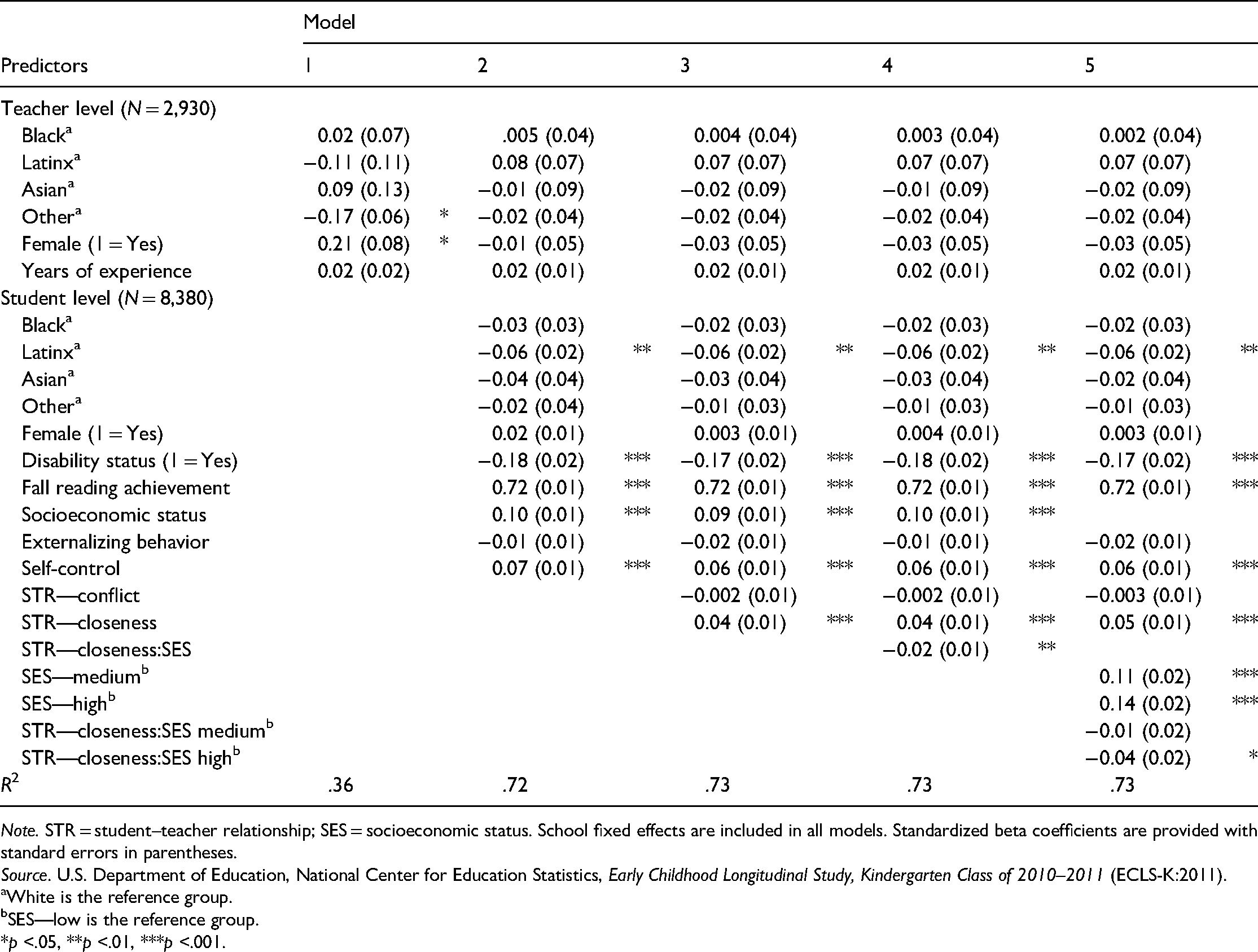
Note. STR = student–teacher relationship; SES = socioeconomic status. School fixed effects are included in all models. Standardized beta coefficients are provided with standard errors in parentheses.
Source. U.S. Department of Education, National Center for Education Statistics, Early Childhood Longitudinal Study, Kindergarten Class of 2010–2011 (ECLS-K:2011).
White is the reference group.
SES—low is the reference group.
*p <.05, **p <.01, ***p <.001.
To answer the research questions, a baseline model and an additional four multilevel models were fit over several stages to assess possible covariates, variable changes, and model fit (see R2). These models included the predictor variables from both the student level and the teacher level that have been found to be associated with student reading achievement:
Null or baseline model Teacher characteristics model or Model 1 (e.g., teacher race, teacher gender, and years of teaching first grade) Teacher and student characteristics model without STRs or Model 2 (e.g., all teacher characteristics, student race, student gender, student disability status, previous achievement, externalizing behavior, self-control skills, and SES) Teacher and student characteristics model with STRs or Model 3 (e.g., all teacher characteristics, student race, student gender, student disability status, previous achievement, externalizing behavior, self-control skills, close STRs, conflictual STRs, and SES) Interaction model or Model 4 and Model 5 (e.g., all teacher and student characteristics, in addition to the interaction between the STR closeness and SES and STR conflict and SES)
The main effects of level-1 and level-2 formulas can be expressed as:
Level 1 (student level)

Results
A series of four multilevel models and one null model with imputed data were used to investigate the relationship between STRs (i.e., closeness and conflict) and student SES on reading achievement. These models were constructed to answer our research questions, specifically (a) How are conflictual STRs, close STRs, and student SES associated with first-grade reading achievement? and (b) Does student SES interact with or moderate the relationship between STRs (i.e., closeness and conflict) on first-grade reading achievement? The intraclass correlation coefficient from the null model was 0.29, suggesting that the teacher level accounted for 29% of the variance in reading achievement.
Teacher Characteristics Model
In Model 1, with only teacher-level variables, the Other race/ethnicity category of teachers had lower student reading scores compared to White teachers (B = −0.17, p < .05), and female teachers had higher student reading scores compared to male teachers (B = 0.21, p < .05). Note that this model only accounted for 36% of the variance and does not suggest that White teachers are better teachers than those of other races/ethnicities, or that a female teacher is more effective than a male teacher.
Teacher and Student Characteristics Model Without STR
In Model 2, only variables at the student level were statistically significant. Specifically, Latinx (B = −0.06, p < .01) students had lower reading scores compared to White students, and students with a disability had lower reading scores compared to children without a disability (B = −0.18, p < .001). Fall reading achievement (B = 0.72, p < .001), student SES (B = 0.10, p < .001), and self-control skills (B = 0.07, p < .001) were also statistically significant.
Teacher and Student Characteristics Model With STR
In Model 3, the same variables from Model 2 continued to be statistically significant. In addition, the STR-closeness scale was also statistically significant (B = 0.04, p < .001).
The Interaction Model
In Model 4, the interaction between close STRs and SES was added. This relationship was statistically significant (B = −0.02, p < .05). The variables from the previous model continued to be significant.
To better understand the interaction between close STRs and SES, a simple slopes analysis, as seen in Model 5 (Hayes & Montoya, 2017), was conducted. As a result, the continuous SES variable was broken into categorical thirds, where the first third represented students with low SES, the second third represented students with medium SES, and the last third represented students with high SES. When there were close STRs, students with high and low SES had more similar reading achievements compared to when there were no close STRs. Results indicated that the interaction was statistically significant for levels below 1 standard deviation (see Figure 1). The effect size for this interaction was small, ranging from 0.08 (at 1 SDs) to 0.17 (at −3 SDs). There were no differences between the low SES group and the medium SES group or between the medium SES group and the high SES group.
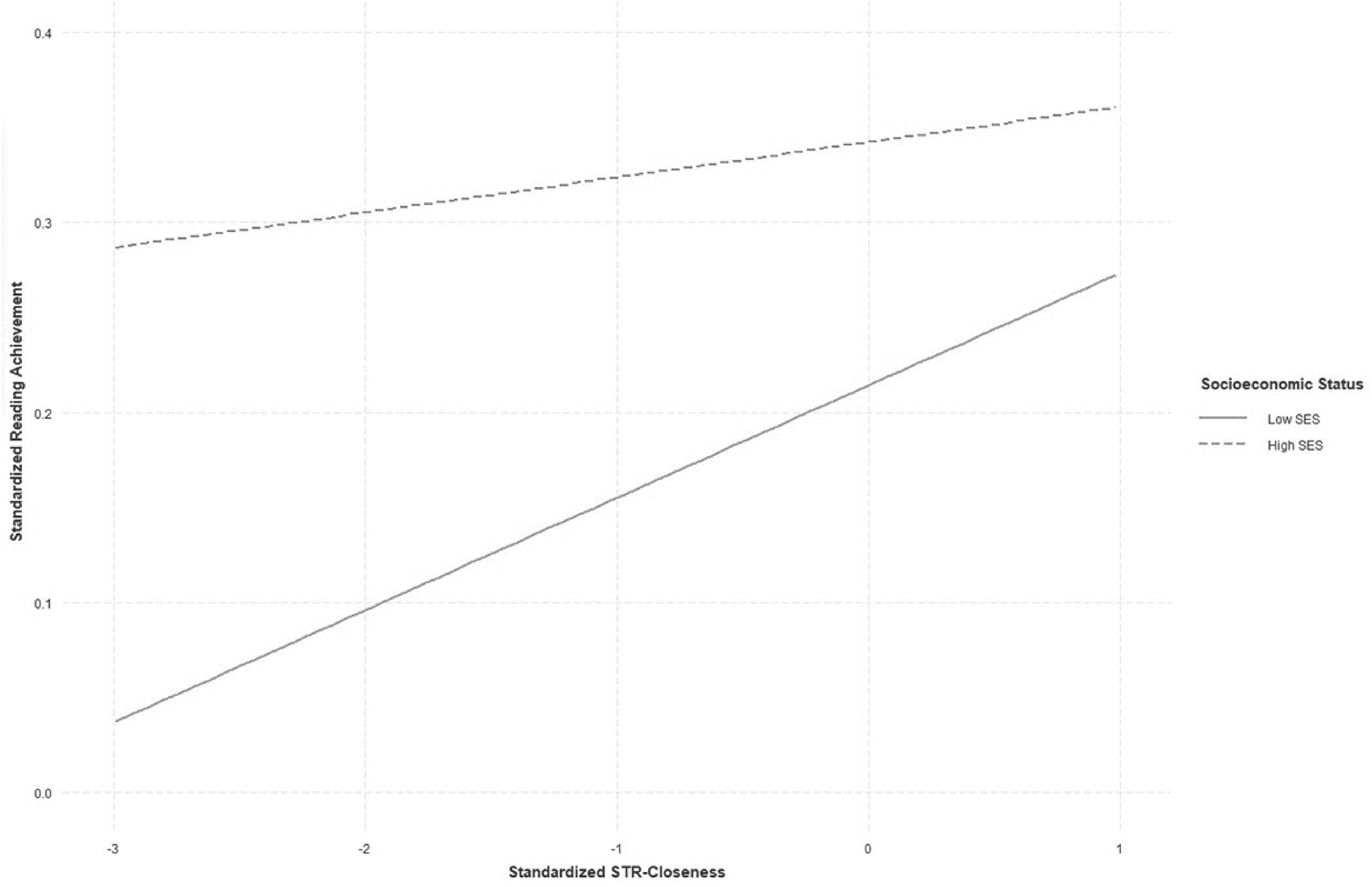
Interaction between SES and STR closeness on reading achievement. Note. SES = socioeconomic status; STR = student–teacher relationship. Medium SES was not shown since it was not statistically significant.
Discussion
The current study investigated student- and teacher-level variables that were associated with first-grade reading, including close and conflictual STRs, in addition to whether there was a statistically significant interaction between SES and STRs on first-grade reading achievement. The research questions were answered using multilevel modeling with school fixed effects. The statistically significant interaction effect was probed using a simple slopes analysis.
The Role of STRs and Student SES
The first research question determined whether close STRs, conflictual STRs, and SES were associated with first-grade reading achievement when accounting for student- and teacher-level variables with school fixed effects. Previous research has demonstrated that STRs and student SES are major contributors to student academic achievement (Baker, 2006; Hughes, 2011; McCormick et al., 2013). Specifically, the literature has shown that students who have closer relationships with their teachers often have higher academic achievement compared to students who have conflictual relationships with their teachers, and students from higher SES backgrounds often have higher academic achievement compared to students from lower SES backgrounds (Baker, 2006; Hamre & Pianta, 2001; Spilt et al., 2012a).
Our results pertaining to the STR variable align with Baker’s (2006) results, demonstrating that close STRs may act as a protective factor to increase academic achievement for all children. When analyzing this relationship from a SEVT perspective, when there were close STRs, teachers or socializers can increase reading expectancies for success and increase academic task values, possibly increasing student academic achievement. This suggests that when fostering close STRs, it is important to develop interventions that specifically target relationship development between students and teachers (Hamre & Pianta, 2001) and consider a student's sociocultural context so tailored, meaningful support can be provided (Eccles & Wigfield, 2020).
The Interaction Effect Between STRs and Student SES
The final research question was to determine whether there was an interaction effect between student SES and close STRs on first-grade reading achievement. Interaction results have been mixed as researchers have only explored constructs similar to these variables of interest. Studies from Xuan et al. (2019) and Malecki and Demaray (2006) supported the existence of a statistically significant interaction effect, although research from Bergeron et al. (2011) did not. In the current study, there was a statistically significant interaction between student SES and close STRs, suggesting that when there were close STRs, students from low SES backgrounds scored more similarly compared to students from high SES backgrounds. However, when STRs were not close, students with low SES statistically significantly scored lower on reading achievement compared to those from higher SES backgrounds. Although there was a small effect size found in the current study, these results were comparable to Olsen and Huang’s (2021) study that investigated the interaction between STR and SES on math achievement. They reported an effect size of 0.05 (at 0 SDs) to 0.13 (at −3 SDs). Although these effect sizes may be considered small, these findings are noteworthy as STRs, a malleable protective factor, can potentially buffer the harmful effects of being from a low SES background, which is a relatively stable factor.
When considering this statistically significant interaction using the SEVT framework (Eccles & Wigfield, 2020), teachers may have varying reading expectations for students from different levels of SES. Therefore, it is essential that teachers act as socializers to provide intellectual resources and develop the student's interest in reading (Martin & Dowson, 2009). Further, the teacher's influence may be strengthened by their relationships with their students, where closer STRs have been found to have a stronger buffering effect on variables negatively associated with lower reading achievement, such as low SES. As suggested by Eccles and Wigfield (2020), when socializers understand the sociocultural context of their focal individual, individual expectancies and values may be increased. Therefore, when considering SEVT, teachers may be able to develop closer STR when understanding the sociocultural context of their students, potentially leading to stronger effects when buffering negative variables associated with reading achievement, like low SES.
Limitations
Despite using a nationally representative data set, this study has several limitations that should be acknowledged. In regression-based analyses, data are correlational in nature and cannot establish causation. Therefore, it is possible that the relationship between student SES and close STRs on reading achievement was bidirectional. However, we note when analyzing this relationship that STRs are often predictor variables, with achievement as the outcome variable (see Longobardi et al., 2016; Sointu et al., 2017; Spilt et al., 2012b). Second, the STR Scale (Pianta, 2001) was teacher-reported, and therefore, estimates for close STRs may be higher and estimates for conflictual STRs may be lower than the true scores. It is also possible that teachers report having a close relationship not because they are actually closer with the student, but because the student performs well academically. Therefore, students may not feel the same level of closeness. Further, although these were self-report measures, work by Haeffel and Howard (2010) suggests that self-report scales may be beneficial for assessing theoretical constructs aimed at defining attitudes, emotions, or perceptions, including validating behavior, as done in the current study. Third, we could only use the existing variables collected in the ECLS, meaning we could not include other variables like student reports of their STRs. As acknowledged earlier, we understand that this is a noteworthy limitation and should be taken into account when considering the results of this study. Fourth, this study did not include students from private schools as they may be systematically different from students in public schools (Jimerson, 2001; Owings & Magliaro, 1998). However, we recommend that future research consider these children as well. Fifth, our definition of reading achievement was informed by skills tested in the ECLS, which was central to our study. However, we recognize that there are other components of reading that should be considered in future studies, such as phonological awareness, phonetics, and fluency, to name a few. Although there were multiple limitations, we believe the current study does provide some evidence that there is a relationship between SES and close STRs on reading achievement.
Educational Implications
The results from this study have implications for educational professionals. As demonstrated in the current study, close STRs may be associated with higher reading achievement for all students but may be particularly beneficial for students from low SES backgrounds. We recommend that educational professionals continue building close, positive relationships by using strategies such as displaying pleasure and enjoyment toward students, considering student sociocultural contexts, being responsive and respectful, and demonstrating knowledge that indicates awareness or care regarding student interests, background, and academic performance (Eccles & Wigfield, 2020; Rimm-Kaufman & Sandilos, 2011). We also recommend, as suggested in a recent meta-analysis, implementing teaching practices such as tutoring, cooperative learning, teacher feedback, and progress monitoring as these were the most promising types of interventions, especially for students from low SES backgrounds (Dietrichson et al., 2017). We note that many of these strategies may not be effective without close STRs and that teachers may be more likely to implement these high-impact teaching practices when STRs are close (Li et al., 2022). Therefore, it is instrumental to continue developing interventions and teaching practices aimed at building close STRs, as close STRs can act as a protective factor to increase student reading achievement.
Footnotes
Acknowledgments
The authors would like to acknowledge Ambra L. Green, PhD, Ericka Roland, PhD, the reviewers, and editors for their helpful feedback in strengthening this manuscript.
Declaration of Conflicting Interests
The author(s) declared no potential conflicts of interest with respect to the research, authorship, and/or publication of this article.
Funding
The author(s) received no financial support for the research, authorship, and/or publication of this article.

References
Supplementary Material
Please find the following supplemental material available below.
For Open Access articles published under a Creative Commons License, all supplemental material carries the same license as the article it is associated with.
For non-Open Access articles published, all supplemental material carries a non-exclusive license, and permission requests for re-use of supplemental material or any part of supplemental material shall be sent directly to the copyright owner as specified in the copyright notice associated with the article.
