



Abstract
This article adds to a growing body of research tracing the influence of neoliberal education reforms on policy and practice by showing the ways in which student writers are positioned within market-oriented discourses and values through Texas state exam writing prompts. As a genre-in-use, the writing prompts are seemingly mundane texts that privilege certain perspectives for viewing the world. This article uses critical discourse analysis to examine seven years of Texas state exam high school writing prompts, focusing on how the grammatical design of the prompts and the recontextualization of informational texts or quotes demonstrate traces of neoliberal logics such as individualism, self-reliance, and superficial multiculturalism. We call for critical pedagogies that help teachers and students resist the naturalization of dominant discourses and imagine collective responses to creating a more just world.
When Texas high school students sit to take their state-mandated English exam, they write a short expository or persuasive essay in response to a prompt. This writing prompt follows a typified format: a quote or a short text with information for students to consider, followed by a sentence or two recontextualizing this quote or text, and the directive to which students respond. On the spring 2017 State of Texas Assessments of Academic Readiness (STAAR) English II end-of-course exam, students wrote a persuasive essay after reading this prompt: “Think of all the beauty that's still left in and around you and be happy.”
—Anne Frank, The Diary of Anne Frank
Even in difficult circumstances, some people focus on the positive aspects of life. Think carefully about this statement. Write an essay stating your opinion on whether a person can choose to be happy.
The writing directive of this prompt asks students to write about “whether a person can choose to be happy.” Before this instruction, the prompt references “difficult circumstances,” decontextualizing (Wodak, 2012) Anne Frank's words by extracting them from the sociohistorical context in which they were written and erasing the lived experience central to her diary. The writing directive asks students to discuss happiness as an individual choice, reframing Frank's quote within a neoliberal discourse of individualism and self-reliance. Through this recontextualization, Frank's words can be applied to any number of situations. But could students use this writing opportunity to question what Anne Frank actually means by happiness while she is hiding from Nazis in an Amsterdam attic? Or to challenge the premise of a writing prompt that ignores oppression and genocide and focuses on individual choice instead? We see the decontextualized quote, the recontextualization of that quote, and the topic and grammatical design of the writing directive working together to guide and constrain student writing. Additionally, because proficiency on STAAR exams is a requirement for graduation from high school, the high stakes discourage students from deviating from the expectations articulated in and by the writing prompt, making the kinds of critical responses we introduce above unlikely.
Writing prompts are not neutral instructions. Rhetorical genre theory guides us in understanding how the genre of the writing prompt “organizes and generates the discursive and ideological conditions which students take up and recontextualize as they write their essays” (Bawarshi, 2003, p. 144). For this reason, student-written texts like exam responses are not simple acts of writing, but instead are complex, sophisticated transactions (Freedman, 1995). In addition to explicit expectations like the form and the topic, the writing prompt constructs the possible content and subject positions available for student response. By “subject positions,” we are referring to the ways “genres position individuals to recognize and build certain kinds of situations, take on identities appropriate to those situations, and act in accordance with those identities” (Collin, 2012, p. 76). Genres are thus one of the ways “people are cast in or called to particular positions” in social relations (Moje & Luke, 2009, p. 430). In this article, we bring this genre-informed understanding of writing prompts to examine how STAAR exam prompts situate student writers within particular values and subject positions.
The analysis in this article aims to uncover the discursive and ideological conditions that characterize student writing opportunities in Texas's high-stakes, high school STAAR end-of course (EOC) exam. We apply critical discourse analysis (CDA) because it can help us see how texts operate politically. Examining “apparently mundane texts at work” (Luke, 1995, p. 40) helps us understand the processes by which “some texts, textual practices, and discourses are made to count as official knowledge and others are silenced or omitted” (p. 36). The prompts help to shape what discourses and knowledges “count” because the STAAR EOC writing prompts and the tests themselves have real consequences beyond the exam: Classroom literacy instruction is shaped by their content, and writing prompts from previous exams are often used as practice prompts for students to prepare for these writing exams. This is particularly true in segregated and underresourced schools that serve low-income students of color who disproportionately perform poorly on standardized assessments (Amrein & Berliner, 2002). At a time when the Literacy Research Association (n.d.) and other professional organizations (National Council of Teachers of English, 2018; Special Committee, 2020) are reaffirming their commitments to antiracist education structures, attention to the ways in which state writing assessment positions students within dominant cultural values and discourses is particularly timely.
This article begins with a theoretical overview that frames the exam writing prompt as an institutional genre with social and cultural power. We then place the writing prompts and their attendant state exams in historical and ideological context before using CDA to analyze seven years of STAAR English I and II EOC writing prompts. Our analysis examines how student writers are positioned within dominant discourses and values, indicating a need for greater awareness of and resistance to socialization into the neoliberal social order.
Theoretical Framework
Writing Prompts as Genre, Writing Prompts as Culture
Analyzing large-scale writing assessment prompts as a genre can help uncover the values they convey and reveal how students are positioned as learners and writers. Drawing from Bakhtin’s (1986) sociohistorical theory of communication, rhetorical genre theorists argue that genre can be understood as “typified rhetorical actions based in recurring situations” (Miller, 1984, p. 159) rather than as static textual forms (expository essay) or categories (horror). From this perspective, genre is an “intersubjective phenomenon” (Devitt, 2004, p. 19) in which writers and readers recognize a genre by the action the genre is seeking to accomplish (or its communicative purpose) within a community. Readers of this journal may be familiar with abstracts, author bios, and maybe even academic journal acceptance and rejection letters, all examples of rhetorical genres in academic writing.
Working from this understanding of genre as joint action, genre theorists have suggested that communities, organizations, and institutions both shape and are shaped by the genres that facilitate their activities. The formal structures and linguistic characteristics of genres are conventionalized as they construct idealized writing and reading positionings (Hyland, 2015; Luke, 1995) “in ways that allow for the creation of particular knowledge” (Paré & Smart, 1994, p. 146) within social contexts. In this way, Miller (1984) argued that genre “tells us less about the art of individual rhetors or the excellence of particular texts than it does about the character of a culture or an historical period” (p. 158). In other words, genre and culture exist in a reciprocal relationship, and studying genre-in-use can be a way to study institutional culture (Bawarshi & Reiff, 2010; Devitt, 2004).
Bawarshi (2003) has demonstrated this relationship between genre and culture in education through analysis of school genres. Classroom genres such as the syllabus, assignment prompts, rubrics, student-produced texts, and teacher comments, among others, create relationships of writers and readers to the content, to each other, and to the institution through their content and discourse. Bawarshi argued that we make a mistake when we view students as the only writers in any educational context; teachers and test designers are writers of prompts that situate students within potential subject positions and ask them to act out those positions as writers. For example, in the “literacy narrative” writing prompt common in college writing courses, students are asked to reflect on and write about their experiences with and perspectives on acquiring literacy. Bawarshi explained that literacy narratives “are not merely communicative tools; they actually reflect and reinscribe desires and assumptions” (p. 128). In this case, embedded in the genre is a cultural logic that views literacy as a positive instrument of success and growth. As student writers develop their literacy narratives, they write from within (or against) this ideological positioning. The writing prompt is thus an ideological construct that carries beliefs and values that student writers are asked to address, consciously or not, in their response (Devitt, 2009).
Noting the ideological nature of genres in and out of school contexts necessitates consideration of power relations and subjectivity. As Devitt (2004) suggested, genres privilege certain ways of viewing the world and reinforce the values and power relationships of the groups from which they emerge. However, she argued that the forcefulness of that reinforcement, the parameters for what is allowed to “count,” can vary in different groups (p. 63). In school contexts, the teacher–student or test–student relationships of power generally make for “coercion masked as complicity,” a recognition that student writers “have to accept the position(s) made available to them in the prompt if they are to carry out the assignment successfully” (Bawarshi, 2003, p. 133); any attempt to resist, challenge, or even question this positionality risks failure.
Genres are thus generative sites for critical analysis because they are constructed within and serve to reproduce institutional contexts and power relations (Devitt, 2004; Luke, 1995) and can be manipulated for rhetorical effect (Huckin, 2002). Our analysis brings this approach to better understand the values and power relationships embedded within state exam writing prompts in Texas. Analyzing writing prompts as a genre, as social texts written by people to achieve a particular goal, can offer us insight into the cultural logics shaping school-based writing and how student writers are positioned therein.
Standardized Testing and the Neoliberalization of Education
The STAAR tests we analyze in this article are part of a state accountability system aligned with a global shift in education policy toward neoliberal discourses of market-based effectiveness and efficiency (Uljens, 2007). Neoliberalism does not have one definition, but is generally characterized as a political philosophy that foregrounds the value of “free markets” to organize all aspects of political, economic, and social life (Ruecker, 2020). As Phelan (2014) explained, early neoliberal thinkers knew the project's success required politicizing all aspects of social and cultural life such that neoliberal values and practices become “routinized, taken-for-granted dimensions of everyday life that conceal their conditions of emergence” (p. 56). It is therefore more analytically productive to conceptualize neoliberalism as a set of discursive logics rather than to think of a reified neoliberalism: A neoliberal logic “neoliberalizes the social” by transforming previously social goods into commodities as market-based logics and practices like commodification, individualism, competition, and self-interest are naturalized throughout social life (p. 57; see also Connell, 2013). Importantly, as these neoliberal logics become common sense they have material effects, like naturalizing social inequality, weakening public infrastructure and institutions, and accelerating environmental destruction (Phelan, 2014).
The neoliberalization of education reform has been achieved primarily through the use of standardized tests to evaluate students, teachers, and schools under the guise of “objective assessment,” which reform advocates believe is necessary to achieve efficiency, accountability, and fairness. Testing is central to the education policy of the United States and other “Western” nations, with international exams like the Programme for International Student Assessment (PISA) and U.S. state tests like the STAAR implemented to create and sustain a competitive education marketplace governed by common standards (Uljens, 2007). Standardized testing is thus one of the “institutional arrangements” that instill the neoliberal free-market mentality in education where it did not previously exist (Connell, 2013, p. 100). When education is framed as a private good and personal commodity for individual advancement, rather than a public good for collective gain (Babaii & Sheikhi, 2018; Labaree, 1997), standardization becomes necessary for measurement (Apple, 2005; Uljens, 2007). Neoliberal discourses of education emphasize individual choice and competition, pitting students and families against each other to get the “best” opportunities (Uljens, 2007), and the stakes serve to make visible the hierarchy in a competitive marketplace (Connell, 2013).
Effects of neoliberal logics in schools
Research on education reform efforts has emphasized the varied effects of neoliberal logics on teaching and learning and the culture of schooling, including shifting subjectivities, constrained curricula, and inequitable educational outcomes across demographic groups. The testing apparatus central to neoliberalized education creates a “regime of performativity” in which certain skills (like reading and writing) only hold import in terms of their commodification and exchange value in the marketplace (Ball, 2016; Kelly, 2018). As Ball (2016) wrote, education reforms—and other social reforms—are not only about changing curricula or classroom practices. These reforms “also change who we are, how we think about what we do, how we relate to one another, how we decide what is important and what is acceptable, what is tolerable” (p. 1050). When a reading test is what matters, teachers and students are motivated to focus on the skills and aptitudes measured on the test, not on any intrinsic or holistic value like gaining knowledge or understanding. As Babaii and Sheikhi (2018) explained, the process of neoliberalization shapes what are considered rational, responsible, or productive uses of human potential and agency. Thus, elementary students might come to see themselves as “good readers” when they can read for speed to perform reading and improve test scores, rather than other potential measures of efficacy (Kelly, 2018). Reading (or writing) for knowledge, for pleasure, or for gaining new perspectives comes to be seen as less valuable or important, the kinds of things to do after testing is done. In one study of high school writing conducted in El Paso, Texas, where we are located, it was not until after students had already taken the exam needed for graduation that they were offered reading and writing opportunities beyond test prep: Without a test to teach to, teachers incorporated literature and assigned longer, source-based, analytical writing tasks they believed would prepare students better for college (Ruecker, 2013).
The individualistic, competitive, performative logic of neoliberalized education is visible in Texas, where standardized tests such as the STAAR exam have been promoted as an effective educational reform policy because they make visible and comparable students’ differential academic performance across racial/ethnic, language, and socioeconomic groups. But by understanding differential performance as an “achievement gap” rather than an accumulated “education debt” owed to historically marginalized students that is historical, economic, sociopolitical, and moral in nature (Ladson-Billings, 2006), this testing works to reduce complex societal inequities to individual (literacy) problems. Some argue that this pathologizing of literacy is, in fact, the point. The transition of education policy into a competitive marketplace means the test must create winners and losers (Babaii & Sheikhi, 2018; Connell, 2013), and Au (2020) argued that this system of winning and losing is inextricable from race. Education policy based on large-scale testing has been used “to normalize and justify race- and class-based inequalities in schools and society” (Au, 2020, p. 13) and works as a tool for the continuation of white supremacy (Au, 2016, 2020; Kendi, 2017; Price, 2019). Results of assessments like the PISA and STAAR are used to shift blame away from inequitable social structures to the individuals who are disadvantaged by them instead (Babaii & Sheikhi, 2018; Uljens, 2007). Using a single standard of measurement leads to homogeneity in response and in teaching as the stakes of the test in a competitive marketplace of schooling create more incentive for struggling schools, districts, states, or even countries to change instruction to score better on the test (Uljens, 2007).
Effects of standardized testing on literacy and writing
The negative washback effects of these testing structures on classroom literacy teaching and learning have been well documented in U.S. contexts (Au, 2007; Dooley & Assaf, 2009; Dutro et al., 2013; Hillocks, 2002; Jacobson, 2015; Pennington, 2004). Institutional pressures continue to promote arhetorical, test-centric writing pedagogies even though teachers know they are fundamentally misaligned with sociocultural understandings of literacy that emphasize context and communicative purpose (Applebee & Langer, 2011; Behizadeh, 2014; Ruecker, 2020). For example, students in U.S. K–12 settings infrequently write more than one paragraph, even in English courses, and the majority of writing students compose is written for the narrow audience of the “teacher-as-examiner” (Applebee, 1984; Applebee & Langer, 2011).
Furthermore, test-centric literacy instruction reinforces cultural biases inherent in tests that reflect “dominant-culture standards of language, knowledge and behavior” (Solórzano, 2008, p. 285) and “foster alienation toward schooling through a systematic negation of…students’…culture and language” (Valenzuela, 2000, p. 524). These effects have been documented extensively in Texas (Bach, 2020; McNeil, 2000; Valenzuela, 2000), where the decades-long culture of testing was a forerunner for the nationwide shift toward test-based accountability that intensified when President George W. Bush, a former Texas governor, signed the No Child Left Behind Act.
Our analysis of state exam writing prompts follows related research on high-stakes literacy tests emerging from the state of New York, one of a few U.S. states outside of Texas with an extended historical record of statewide testing. Research by Levine (2019) and Gorlewski and Gorlewski (2013) found that the New York state exams privilege white male writers and male authority and erase examples of oppression based on race, gender, or homosexuality. These studies emphasize the influence state education agencies hold over curricula and student learning opportunities and remind us that while statewide exams claim to be assessments of some form of general literacy, they are always already embedded within, and communicate, systems of culture and value. To our knowledge, our study is the first to look at writing prompts themselves as potential tools of socialization into neoliberal values.
Methodology
Analyses of language in use within social contexts provide an entry point into understanding the values and norms, or ideologies, that characterize those contexts and cultures (Gee, 2014a, 2014b; Luke, 1995). We align ourselves with Gee’s (2014b) argument “that all discourse analysis is CDA, since all language is political and all language is part of the way we build and sustain our world, cultures, and institutions” (p. 10). CDA examines the ways that power in society is established and reinforced through discourse (Huckin, 2002) with the goal of understanding and working toward changing that social reality (Fairclough, 2013). By examining texts, discursive practices, and larger social contexts (Huckin, 2002), CDA can reveal the ideologies—or “the ‘ideas’ which people use to figure out how the social world works, what their place is in it and what they ought to do” (Hall, 1985, p. 99)—that are embedded in and distributed through language. Ideology “is not inherently commonsensical” (Fairclough, 2001, p. 89), even if it comes to be understood as such. As Fairclough (2001) explained: A dominant discourse is subject to a process of naturalization, in which it appears to lose its connection with particular ideologies and interests and becomes the common-sense practice of the institution. Thus when ideology becomes common sense, it apparently ceases to be ideology; this is itself an ideological effect, for ideology is truly effective only when it is disguised. (p. 89)
The gradual infiltration of neoliberal discourse in schooling—such as the discourse of students and parents as “clients” and “consumers” (Apple, 2005; Bartlett et al., 2002)—is an example of the ways in which the language and values of privatization and marketization have not only permeated education policy and practice, but have become naturalized.
We are particularly interested in the ways students are situated within neoliberal logics through the writing prompts. In their research on English language learning textbooks in Iran, Babaii and Sheikhi (2018) showed how traces of neoliberal logics can be found within curricular materials, including marketization, commodification, individualism, consumerism, and multiculturalism (pp. 256–260). For example, “episodes” in the texts emphasized market-based, economic implications over more holistic concerns, and multiculturalism was characterized by superficial “mentioning” of diversity, with non-Western participants often “othered” or framed negatively when compared to their Westernized, English-language-speaking counterparts. The authors argued that these textbook materials serve “to legitimize and advertise a neoliberal, market-led lifestyle” (p. 261). We believe it is similarly important to trace neoliberal logics in the Texas state writing prompts because these logics work to preclude collective approaches to solving social problems, as we will show in the analysis and discussion sections below.
Where We Write
As researchers and teacher educators in El Paso, Texas, a proudly transnational city located on the U.S.–Mexico border, we are particularly attentive to the inequitable outcomes of the purportedly race-neutral neoliberalization of literacy education. The largest school district in El Paso County serves a student population that identifies as Latinx (84%), emergent bilingual (30%), and economically disadvantaged (76%) at rates higher than the state as a whole (El Paso Independent School District, n.d.); these are student populations most likely to be negatively affected by the curricular washback effects described above (Ruecker, 2013). Nearly all the graduate students in our courses are full-time teachers in Title I public schools in the region and speak passionately about the constraints state assessments place on their teaching and the negative effects tests have on their Latinx students. Our university students who often attended these same schools share with us their limited opportunities to write beyond practice for standardized tests. In this context, we are particularly interested in how school-based writing opportunities are shaped by education reform efforts, and how student writers are positioned therein.
Our own schooling experiences as white, middle-class public-school students in the midwest and northeast United States prior to the standards and accountability movement were different from those of our current students, even if we experienced narrowed school-based literacy opportunities. We also recognize that our respective positionalities, language use, and knowledge were (and are) recognized and valued in dominant educational institutions in ways that our students’ often are not. We see our research as intimately connected with our roles as teacher educators and advocates for equitable student learning opportunities in the region.
Data
The data we analyze in this article include all publicly available writing prompts for STAAR English I and English II EOC exams from 2013 to 2019 (Texas Education Agency, n.d.). The 2013 STAAR EOC writing assessment consisted of two writing prompts for English I (literary and expository) and two for English II (expository and persuasive). However, starting in 2014 each STAAR EOC writing assessment required only one expository prompt in the English I exams and one persuasive prompt in the English II exams. Because a literary prompt appeared only once on the 2013 STAAR EOC exam, we viewed it as an outlier and omitted it from our data set. Our final data set included eight expository and seven persuasive writing prompts. Of the 15 prompts analyzed, 10 were introduced by quotations and five by data or other information provided.
Data Analysis
Our analysis of the STAAR EOC writing prompts below begins with a sentence-level analysis of the grammatical design of the writing directives before examining the entire text of the prompt. We met regularly in person (before COVID-19) and by telephone to analyze the data. To support inter-rater reliability, we took notes independently before discussing results and addressing discrepancies following a method of collaborative coding (Smagorinsky, 2008).
As we reviewed the sample prompts together, a three-part design pattern emerged: Each writing prompt contains, first, a quotation or informational text; second, a recontextualization statement that (re)frames the quote or informational text; and third, the writing directive, or the statement presenting students with the actual prompt to which they were instructed to write (see Table 1).
Example Writing Prompts From STAAR English EOC Exams.
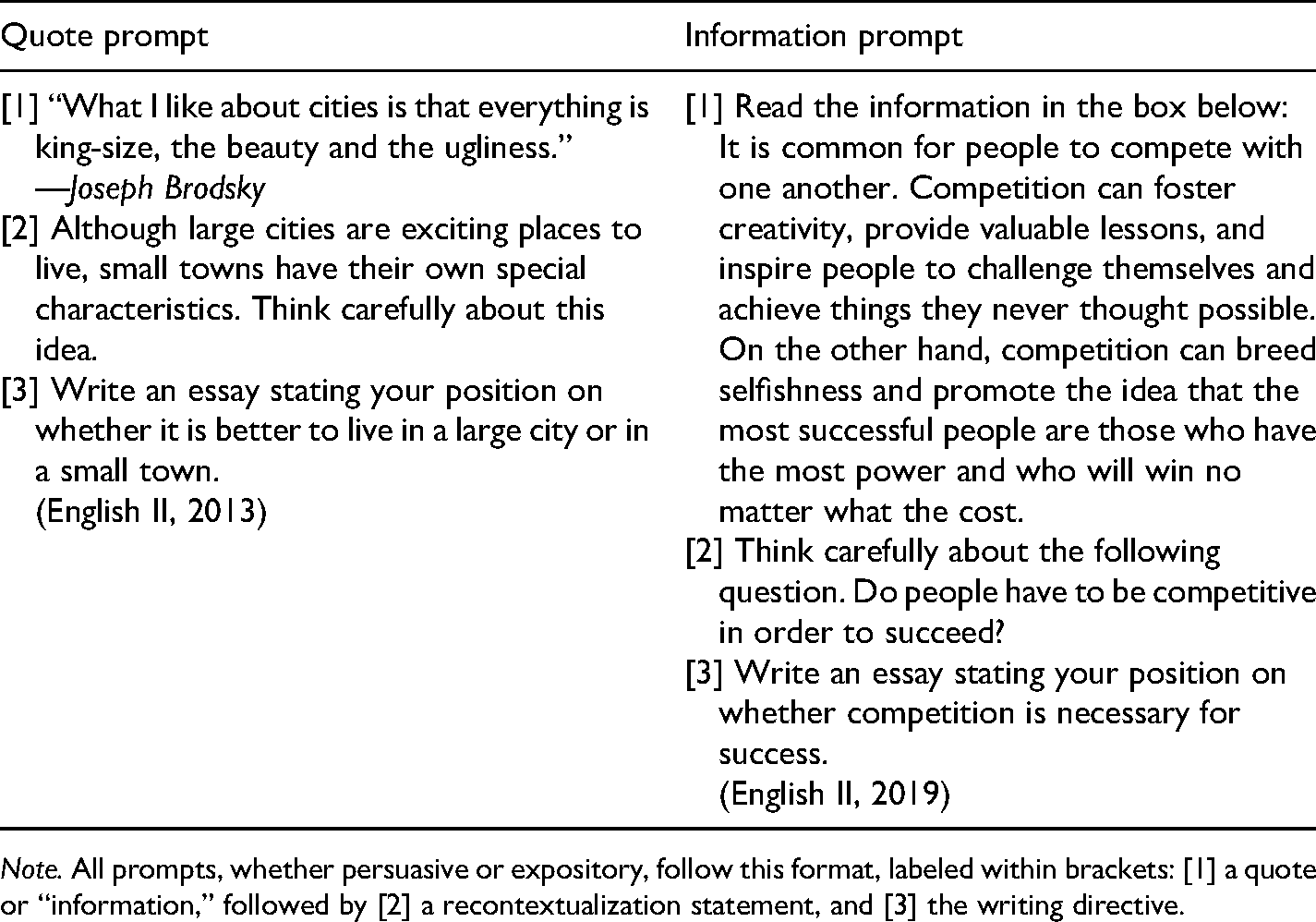
Note. All prompts, whether persuasive or expository, follow this format, labeled within brackets: [1] a quote or “information,” followed by [2] a recontextualization statement, and [3] the writing directive.
We began our analysis by taking a “resistant stance” (Huckin, 2002, p. 158), paying attention to the language choices made by the test writers and considering what those choices seem to mean in the context of the exam (Gee, 2014a). Our analysis reflects this understanding of discourse by focusing on the design of language in the writing directive portion of the prompt, or the ways in which language is used in context. Gee’s (2014a) tools for discourse analysis provided useful frameworks that helped orient our focus and guide our analysis. In particular, we looked for patterns in the grammatical design of each writing directive using Gee's Why This Way and Not That Way Tool and its orienting question, “Why did the writer build and design with grammar in the way that they did and not in another way?” (p. 63). For example, we asked, “Why did the exam writers use the modal ‘can’ in one directive, and not in another?” This critical stance revealed three categories of writing directives discussed in greater detail in the analysis: suggestive, assertive, and open writing prompts.
We then examined the relationships between the informational text or quote, the recontextualization statement, and the writing directive in each prompt. We first noted the topic students were asked to write about, organized the topics into themes, and identified traces of neoliberal logics and market-centered values. The topic of the writing directive was then compared with the information and recontextualization statement for each prompt. Gee’s (2014a) Why This Way and Not That Way Tool helped us to see the alignment (or lack thereof) among the three parts of the prompts, which we discuss below.
Analysis
We focus our analysis on two consequential design choices made by test writers: the grammatical design of the writing directives and the recontextualization move, in which the test designers (re)frame the quote or informational data presented. These choices together work to construct (and constrain) the possibilities for student responses.
Positioning Student Writers Through Grammatical Design
Each of the 15 writing directives in the STAAR EOC writing exams is introduced by one of the following phrases: “Write an essay stating your position on…,” “Write an essay stating your opinion on…,” or “Write an essay explaining….” What follows these introductory phrases communicates to students the topic about which they are to write. We classified these statements into three categories: suggestive (n = 8), assertive (n = 6), and open (n = 1) writing directives (see Table 2).
Categorization of Suggestive, Assertive, and Open Writing Directives.
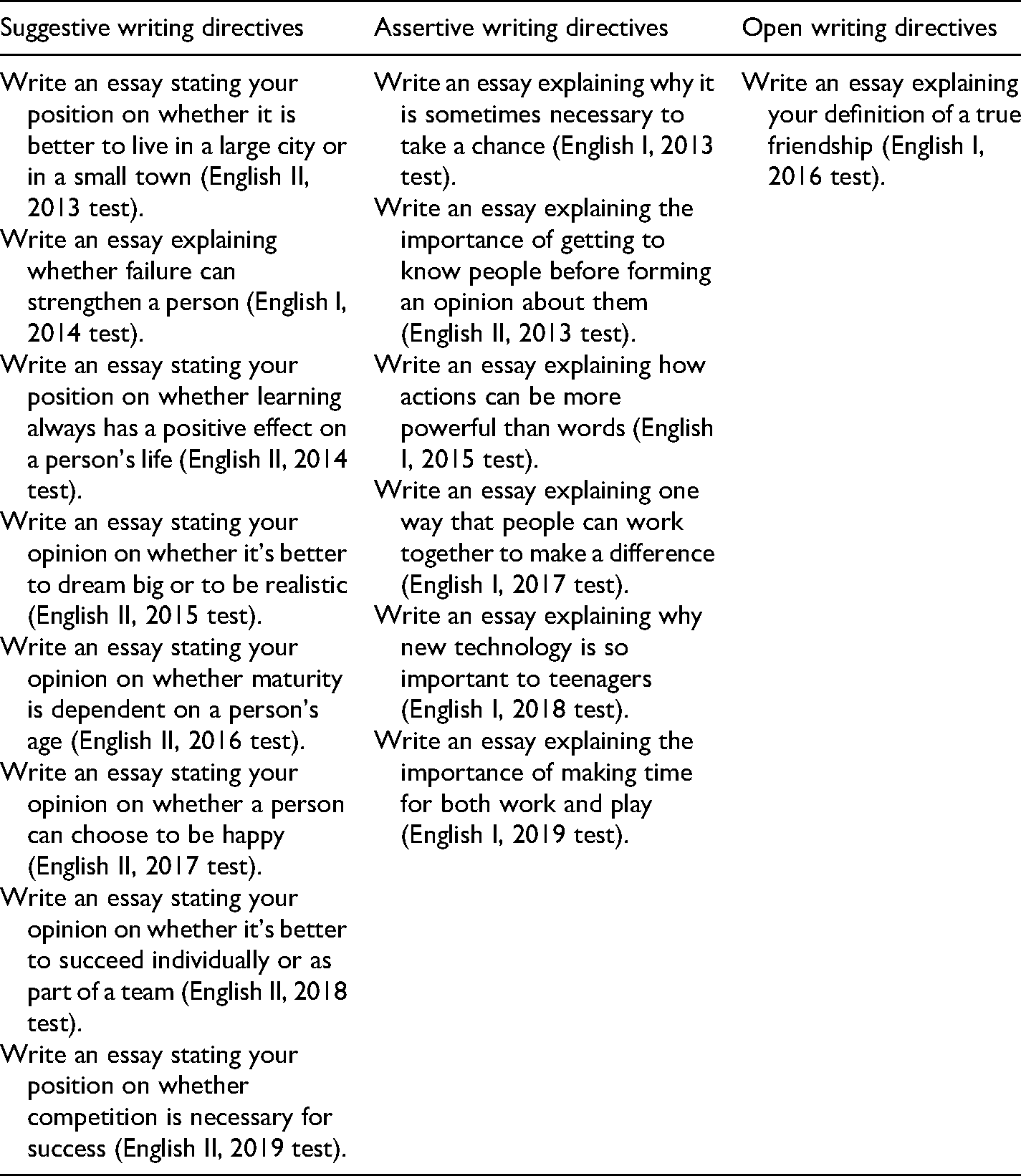
Writing directives categorized as “suggestive” use the conjunction “whether” to signal a choice is to be made on the given idea (e.g., “Failure can strengthen a person”) or pair of alternatives (e.g., “It's better to dream big or be realistic”) that follows. That is, the conjunction “whether” affords student writers some degree of choice about the position they can take. However, the idea to respond to is presented as the assertion with which students may disagree. For example, students could either agree or disagree with the statement “Competition is necessary for success.” The linguistic term for this grammatical design is “presupposition.” Presuppositions are language constructions that reveal implicit assumptions about the world in a way that is taken for granted as truth (Huckin, 2002). Presumed “truths” embedded in the other suggestive writing directives include: “Learning always has a positive effect on a person's life,” “Maturity is dependent on a person's age,” and “A person can choose to be happy.” Students could disagree with these “truths” in their writing; however, they are bound by the grammatical design of the prompt to invent themselves as writers within the presupposed truth they are given.
Like suggestive writing directives, assertive writing directives employ presupposition in their design, though, unlike the suggestive directives, students are afforded no choice and must write to the “truth” established in the directive. For example, the directive instructing students to write an essay explaining “why it is sometimes necessary to take a chance” requires students to explain why, not whether, taking chances is sometimes necessary. Students are given the topic (taking chances) as well as the position to take on that topic in their writing (it is sometimes necessary to take one) and must write in support of this truth, even if they do not agree. In each case, these writing directives deny students the opportunity to establish, and then defend, their own perspectives on the topic given. Rather, the work of the student is to develop support to justify the truth they are given in the directive. Only one of the 15 STAAR EOC writing prompts grants students a truly open response, asking students for “your definition of a true friendship,” with no communicated idea of what that definition might entail.
Our analysis of writing directives identifies traces of neoliberal logics and market-centered values such as individualism, self-reliance, consumerism, and personal gain in eight of the 15 STAAR EOC writing directives. According to Polyzou (2014), “presupposition analysis is crucial for uncovering naturalised ideologies underlying discourse, and examining manipulative functions in discourse, especially strategies making it socially or cognitively harder to challenge ideological assumptions” (p. 123). The neoliberal logics identified in the writing directives demonstrate a “fundamental shift in educational philosophy: the abandonment of the social and cooperative ethic in favor of individualistic and competitive business models” (Block et al., 2012, as cited in Babaii & Sheikhi, 2018, p. 250), a discursive feature underlying the writing prompts, and the broader education system as well.
Recontextualizing Quotes and Data in Writing Prompts
The prevalence of presupposition identified in the writing directives shows the ways in which the exam prompts situate students within cultural logics before they even begin to write. In this section, we pull back to examine how the recontextualization of data or quotes contributes to guiding and constraining student responses, sometimes with traces of neoliberal values such as labor productivity and efficiency, individual agency, and a superficial multiculturalism that obscures historical reality and social relations.
All of the STAAR EOC writing prompts, both quote- and information-based, are marked by a recontextualization move (italicized for emphasis in each example below) in which the test designers reframe a quote or other data to guide student response. Recontextualization is a process that extracts texts from their original context, thereby decontextualizing them, for reuse in another context, and changing their meaning (Wodak, 2012). For example, see this prompt from 2019: “A Gallup poll found that Americans are 20 percent happier on weekends than on workdays. Americans also ranked working as one of their least pleasurable activities, while socializing after work was one of their most pleasurable activities.” Although most people must structure their days around school or work, they still prefer their free time. Think carefully about this statement. Write an essay explaining the importance of making time for both work and play.
Note how the exam writers recontextualize the data presented. The Gallup poll results as reported say that people are happier on the weekends and enjoy socializing after work, while the italicized recontextualization sentence says that people “must structure” their time around work, but still “prefer their free time.” This recontextualization move largely eschews the poll in favor of a value-laden statement that situates students within certain kinds of responses.
The recontextualization achieves this student positioning in three ways. First, the recontextualization sentence does not engage the poll results. Instead, this sentence works as a pivot, drawing students’ attention away from the poll results by providing a declarative sentence that appears to summarize the data. The recontextualization sentence shifts the focus away from data showing work as Americans’ least pleasurable activity, framing work instead as something most people must structure their days around. The next sentence, instructing students to “think carefully about this statement”—we understand “this statement” to be the recontextualization sentence and not the poll results—emphasizes the importance of the recontextualization, further distancing the reader from the data. Finally, students are told, “Write an essay explaining the importance of making time for both work and play.” The writing prompt as an imperative statement explicitly situates the student writers within the proposed argument rather than allowing them to develop their own position on this topic. While students certainly could challenge the argument given or write on a different topic entirely, the high stakes tied to this exam may discourage such an approach. In this way, the prompt positions student writers such that they must negotiate (Bawarshi, 2003) and infer (Gee, 2014a) a cultural logic that prioritizes work and school (as a form of work) in daily life choices and leaves to individuals the responsibility to “make time” for more desirable activities like socializing. There is little room here to reflect on conditions that may make work so unappealing or to question the privileging of labor productivity over social connection.
A similar recontextualization process occurs in quote-based prompts that distance the reader from the quoted individual's lived experience and reorient them toward neoliberal logics. This prompt from 2014 states: “The greatest glory of living lies not in never falling but in rising every time you fall.”
—Nelson Mandela
Think carefully about the following question. Can failure make you stronger? Write an essay explaining whether failure can strengthen a person.
Here the prompt again instructs the idealized student reader to “think carefully” about the recontextualization, not the preceding quote. In this case, the recontextualization sentence (italicized for emphasis) is framed as a question: “Can failure make you stronger?” The use of “can” as the modal verb in this question indicates a certain cultural logic: Rewritten as a statement, it becomes “Failure can make you stronger.” This sentiment is affirmed and restated in the writing directive, which offers a choice about “whether” failure can strengthen a person while still privileging the connection between failure and strength through the proximity of the words to each other in each of the sentences and a lack of written alternative.
The recontextualization move in this prompt also takes liberties with Mandela's ideas. Who Mandela is addressing in his quote is unclear—is “you” singular or plural?—yet the recontextualization that follows assumes a singular subject. Additionally, the word “failure,” central to the writing prompt, was not used by Mandela. Why was “fail” not his word of choice? Had Mandela “failed” when he was imprisoned on Robben Island? One might say he failed to overthrow the government at that time, but another interpretation might be that his acts and imprisonment served to highlight injustice in South Africa to a worldwide audience, fueling a worldwide anti-apartheid movement. In this reading, Mandela's example of “rising every time you fall” is not an example of failure at all, but rather a reminder that fighting entrenched power is not a linear proposition without setbacks. In these ways, the test writers neoliberalize Mandela's quote; they recontextualize the words of a figure known for his decades-long fight against racial oppression to reinforce market values of individualism, self-reliance, and personal gain. This same cultural logic disregards legacies of inequality as it blames those who “fail to ‘pull themselves up by the bootstraps’” (Robbins, 2004, pp. 247–248).
The prompt based on the Anne Frank quote, discussed in the introduction to this article, reflects a similar historical erasure and neoliberalizing move. The recontextualization sentence following the quote from her diary states, “Even in difficult circumstances, some people focus on the positive aspects of life.” The use of “even” in the dependent clause of the recontextualization sentence serves to emphasize and set up a contrast from the “difficult circumstances,” in turn making a “focus on the positive” to be a desirable end. The grammatical structure of this sentence reproduces a cultural logic in which happiness—or unhappiness, we presume—is a choice, regardless of the circumstances. As a Jewish victim of the Holocaust, Anne Frank and her diary have become symbols of resistance art, but the recontextualization of Frank's quote erases her circumstances and the broader historical context that shaped her words. Within a neoliberal cultural logic, the emphasis on personal choice and individual responsibility means nothing is society's fault (Hursh, 2007).
The recontextualization moves in both the Mandela and Frank prompts elide issues of race/ethnicity and gender and deflect from histories of oppression of minoritized groups, a finding consistent with other research on standardized testing (Gorlewski & Gorlewski, 2013; Levine, 2019). Of the 10 quote-based STAAR EOC prompts, Mandela and Frank are the only two nonwhite or female voices quoted. By quoting these figures but recontextualizing their words, the state exam obscures their lived experience and concurrent histories of racial and ethnic/religious oppression. This kind of superficial, uncritical multiculturalism is valued and endorsed in neoliberal logics (Bilge, 2013; Robbins, 2004) and works to obscure the power and privilege of dominant groups (Babaii & Sheikhi, 2018). Both Frank and Mandela are unassailable, virtuous figures; by recontextualizing their words, these STAAR EOC prompts use the moral credibility of these figures to assert neoliberal values that privilege individual choice and perseverance in overcoming challenging circumstances. These social figures’ ideas are used as springboards to self-improvement platitudes rather than challenges to an unjust world. In fact, the quoted excerpts from Anne Frank and Nelson Mandela referenced on the exams are popular on Pinterest boards and quote aggregators like BrainyQuote.com, where they are similarly presented without context. O’Connell (2014) sardonically suggested that these quote aggregators “cater to a growing appetite for filleted wisdom, for deboned wit, for the mechanically separated meat of literature.” In other words, a decontextualized Mandela quote can allow for inspiration and the appearance of erudition without needing to understand or acknowledge his life or purpose.
We are not able to share analyses of all writing prompts in this article, but we do want to highlight one final example that demonstrates neoliberal logics at work. In addition to the Mandela prompt described above, we identified two other prompts that ask students to consider learning from failure. This prompt from 2013 reads: Read the following quotation: “Take risks. Ask big questions. Don't be afraid to make mistakes; if you don't make mistakes, you’re not reaching far enough” (David Packard, co-founder of Hewlett-Packard). Taking a risk means acting without knowing whether the outcome will be good. Think carefully about this statement. Write an essay explaining why it is sometimes necessary to take a chance.
In this example, the recontextualization elides the speaker's recommendation to “ask big questions” and “make mistakes,” instead focusing on “taking a risk” and, in the writing directive, why it can be “necessary” to take a chance. We note here that the speaker of this quote, David Packard, is identified with his title as “co-founder of Hewlett-Packard,” a successful technology company, even though quoted speakers in other exam years like Tryon Edwards and Joseph Brodsky (not necessarily household names) were not similarly identified with their vocation.
The highlighting of this corporate icon and the emphasis of the recontextualization seems to place the prompt within an entrepreneurial frame of self-reliance and individual persistence. Mass media is saturated with stories of innovators who “disrupt” industries by tinkering in their garage, taking risks and “breaking things” along the way. Often associated with entrepreneurs and the start-up economy, the idea of “failing fast” to learn more and get better has become something of a new American ethos. However, the focus on failure and taking risks in the business world seems attached to a few high-profile cases rather than any consistent patterns (Greene, 2019), often without acknowledging the social conditions that allowed for their tinkering. In one memorable example, Gladwell (2008) described Microsoft founder Bill Gates's access to a personal computer decades before they became prevalent in U.S. households. Gates was also raised in a financially stable home, allowing him the time and space to tinker and a safety net if he did fail. Without this whole story, the myth highlights individual success and pushes young people to imagine themselves succeeding against all odds, even when social conditions would seem to make this possibility more likely for some than others.
To this point, we have demonstrated patterns in the ways the STAAR EOC writing exam prompts utilize grammatical design and recontextualize quotes and data to situate student writers within certain cultural logics—the “naturalized social practices whose ‘rules and grammar’ are internalized in the objectivity of the social order” (Phelan, 2014, p. 56). The majority of prompts were presented as presuppositional truths, indicating value-laden topics like the necessity of work, personal choice (to be happy), taking risks, the value of competition, and the importance of failure as a stepping-stone to success. Quotes and data were recontextualized and removed from sociocultural context to privilege individualistic thinking and entrepreneurial values. While students could theoretically argue against the presupposition, they are still required to invent themselves as writers (Bawarshi, 2003) within a market-oriented, neoliberal logic of hyper-individualism and competitive markets (Uljens, 2007). In short, as a socially situated genre constructed within institutional contexts (Luke, 1995), these prompts inculcate a way of viewing the world and relating to others that serves powerful neoliberal interests and constrains opportunities for diverse responses.
Discussion
The remaking of ideology into common sense by powerful actors is a key feature of discourse (Fairclough, 2001). Like textbook materials that “legitimize and advertise a neoliberal, market-led lifestyle” (Babaii & Sheikhi, 2018, p. 261), the writing prompts presented to students on the Texas STAAR EOC exams integrate a neoliberal logic in the de facto curriculum of state exams. Our analysis of state-mandated writing prompts shows that students begin their writing from within a value system that privileges individual agency over the collective, an economic imperative centering work over other aspects of life, and a superficial multiculturalism that presents “diverse” figures for their stories of individual success and choices rather than collective efforts against societal injustice. It is important to remember that these prompts will become classroom materials: Because teachers and schools (and students) are incentivized to raise test scores, the publicly available exams are often used for in-class practice, furthering the reach of the prompts. In Texas, it's neoliberalized reform all the way down.
In addition to content knowledge, socialization into culture is a central purpose of schooling (Kelly, 2018); our analysis has identified one way in which Texas schooling is shaping neoliberal subjects. If the purpose of a CDA is to raise the public's awareness and empower them to resist the dominant worldview (Babaii & Sheikhi, 2018), then we need to be clear about why the traces of neoliberal logics found in state exam writing prompts matter for teachers, researchers, parents, and students—anyone invested in public education or our shared society. In short, the neoliberalization of the social world has real consequences. Phelan (2014) explained, “To analyse neoliberalism as a discursive phenomenon means critically understanding its material composition in different objects, institutional regimes, practices, subjectivities and dispositions” (p. 35). As noted earlier, some of these material effects include naturalizing enormous income gaps between the rich and poor, worker precarity, hyper-individualism, and environmental destruction (see also Judt, 2010).
In his critique of the neoliberal goal of unfettered capitalism, the historian Judt (2010) explored why and how the United States has come to not only accept but expect broad social inequalities in everything from personal income to life expectancy. In considering the frayed social contract, Judt asked, “Why do we experience such difficulty even imagining a different sort of society?” (p. 34), and responded with a critique of the decades-long neoliberal project that has turned humans into “economic beings” pursuing material gain at the expense of collective purpose (p. 35). He wrote, “Our disability is discursive: we simply do not know how to talk about these things any more” (p. 34). It is this discursive deficit and the seeming ubiquity of a neoliberal discourse precluding collective solutions that raises our concern about student socialization into the neoliberal project.
Over the past two years, we have seen neoliberal discourses of freedom and individual agency taken to dangerous and destructive ends here in the state of Texas. Phelan (2014) argued that the neoliberal value of “freedom” is best described as a negative freedom, a freedom from coercion, rather than a freedom to do something. This negative freedom can be expressed through resistance to government or other public-minded institutions. When combined with the privileging of individual agency over the collective, this “freedom” mindset has influenced anti-mask and anti-vaccine sentiment in the midst of the COVID-19 pandemic, a public health disaster with greater instances of illness and death in communities of color, like El Paso. As K–12 schools prepared to reopen for fully in-person learning in fall 2021, Texas's state government prohibited mask or vaccination mandates for students or staff, a policy that rejected the recommendations of public health officials, valuing individual agency and freedom from coercion over collective health and safety (Svitek, 2021). We saw widespread, deadly blackouts in the midst of a record-setting cold spell in winter 2021, a result of Texas's decision to maintain its own power grid to avoid regulation rather than connect to the rest of the nation's electricity generation. Current estimates cite deaths related to the outage in the hundreds, largely among people with compromised health conditions (Aldous et al., 2021). In a clear example of a neoliberal governing philosophy in practice, former Texas governor Rick Perry argued that “Texans would be without electricity for longer than three days to keep the federal government out of their business” (Bekiempis, 2021, para. 2). According to Perry, the allure of freedom from the federal government is worth the cost of hundreds of unnecessary deaths. The same emphasis on an individual's choice rather than the collective good that rationalizes Texas's independent power grid governs modern education reform (Hursh, 2007).
We are particularly concerned by recent legislation here in Texas and across the United States constraining discussion of race, gender, equity, or structural inequality in school settings (Map, 2021). These legislative efforts seek to codify a neoliberal logic that denies structural inequality and views racism and other forms of oppression as private wrongs that can be overcome with persistence and effort (Bilge, 2013; Robbins, 2004). Our analysis of exam writing prompts shows that the superficial multiculturalism endemic to the neoliberal order (Babaii & Sheikhi, 2018) already exists in the state curriculum; this legislation would seem to circumscribe opportunities to address these shortcomings in the classroom.
While we do not expect state exams to position students within resistant positions, Connell (2013) suggested it is the cumulative effect of small changes that infuse the neoliberal logics into educational spaces: “With markets all around, what else are people likely to learn?” (p. 110). Echoing Judt (2010), Connell (2013) pointed to the danger of narrowed discourses of possibility. We are wary of the “educationalization” trap that positions schools as the cure for social ills (Labaree, 2008), but we do believe there is a role schools can play in raising awareness of and challenging dominant discourses.
Resisting Dominant Discourses Through Critical Genre Pedagogy
We support calls to drastically change or even abolish large-scale, direct writing assessments (Allen, 2016; Behizadeh, 2014), but as teacher educators we also find it important to recognize pedagogical possibilities for resistance within current structures. Ruecker’s (2020) writing reminds us that the nature of power relations means there is always space for resistance. He defined agency as “the abilities of individuals to be critical of discourses promulgated by the state that attempt to shape their subjectivities and engage in some form of resistance against structures designed to ensure their compliance” (Theoretical Framework section, para. 4), and described the ways in which “everyday resistance,” tactics like in-group humor and game-playing, can build toward transformative resistance that undermines dominant powers. We see critical pedagogy—in particular, a critical genre approach—as potential everyday resistance to the neoliberal logics promoted in and through state exam writing prompts.
Devitt (2009) argued for a critical genre awareness pedagogy that introduces methods for critiquing the genres teachers and students know and encounter in order to raise awareness of and help learners to critique the ideologies, messages, and positionings implicit in texts. Teacher educators can help pre- and in-service teachers to see writing prompts as a created, dynamic genre that serves particular interests and purposes. Among themselves and with students, teachers could invite reflection on and critique of the prompts, posing questions exploring the warrants or premises underlying an argument. We imagine pairing pragmatic practice on the state writing prompts alongside open or critical tasks that allow students to take a more agentive role in their writing, with questions such as “Why must people structure their day around work or school?” or “What other factors might determine a person's happiness rather than personal choice?” They might also compare the selected quotes or information with the recontextualized writing directives as we have here, opening important historical discussion. Discussing the writing prompt as a genre created to serve particular aims within an institution can also demystify the exam and help students to “maintain a critical stance and their own agency in the face of disciplinary discourses, academic writing, and other realms of literacy” (Devitt, 2009, p. 337). In an attempt at in-group humor, teachers might engage in “genre play” (Tardy, 2016), parodying the ways the recontextualization move changes the meaning of information.
We see a critical genre approach to writing prompts as one of many potential forms of everyday resistance to the neoliberal logics embedded within school writing prompts. The ability to be critical of received knowledge and dominant discourses must be central to imagining collective responses to creating a more just world.
Footnotes
Declaration of Conflicting Interests
The authors declared no potential conflicts of interest with respect to the research, authorship, and/or publication of this article.
Funding
The authors received no financial support for the research, authorship, and/or publication of this article.

References
Supplementary Material
Please find the following supplemental material available below.
For Open Access articles published under a Creative Commons License, all supplemental material carries the same license as the article it is associated with.
For non-Open Access articles published, all supplemental material carries a non-exclusive license, and permission requests for re-use of supplemental material or any part of supplemental material shall be sent directly to the copyright owner as specified in the copyright notice associated with the article.
