



Abstract
This study examines the development of literacy and identity for young Indigenous Taiwanese children using ethnographic methods and the theories of multiple literacies, Indigenous knowledge, and identity construction, and it provides insights into the incorporation of Indigenous knowledge and literacies to create hybrid literacy spaces. Focused-upon participants included four 6-year-old Rukai-tribe children—two who lived in a city and two who lived in a village—and their families and teachers. We found that all children learned literacies in culturally meaningful contexts that involved stories and hybrid literacy practices, Indigenous foods, religious activities, traditional life skills, Indigenous language, and multiple forms of text. The two city children developed Rukai knowledge and literacies through performance-based contexts, whereas the village children learned through authentic contexts (e.g., observing farming and hunting). The literacy and identity of the two city children may be undermined due to limited access to Rukai resources, stemming from racism, classism, and linguicism.
There are 560,000 Indigenous people in Taiwan. They account for 2.4% of the population, of who 46.8% live in cities and 53.2% live in villages. The focal tribe of this study, Rukai, is the sixth-largest tribe among 16 tribes and accounts for 2.3% of the Indigenous population (Council of Indigenous Peoples, Taiwan, 2019). Past studies have revealed that Indigenous Taiwanese children are at risk of low literacy achievement in school (e.g., Chen et al., 2010). Approximately 13.7% of elementary school Indigenous children’s families have low incomes (compared to a national average of 3.2%) and are reported to have few educational resources (Liu & Kuo, 2007). Approximately 6.3% of elementary school Indigenous children live with grandparents (compared to a national average of 2.4%), who, thinking that they themselves lack educational expertise and seeing education as being in teachers’ purview, limit their activities with grandchildren to custodial care (Ministry of Education, Taiwan, 2014).
Educational policies for the early schooling of Indigenous people in Taiwan have focused on kindergarten instruction to decrease the achievement gap. The Ministry of Education subsidizes Indigenous children to attend free public kindergarten (children aged 2–6 and from low-income families are given priority in admission). Mandarin Chinese is the language used in kindergarten and primary school, with pull-out Indigenous-language classes once a week. More efforts have been made recently to preserve Indigenous languages and cultures. The Development of National Languages Act enacted in 2019 regards Indigenous languages as national languages. To retain the endangered Indigenous languages, the Council of Indigenous Peoples has promoted immersion language programs in kindergarten (Chou, 2016). However, only 12% (n = 41) of the public kindergartens in Indigenous areas offered these programs in 2019. Notably, an earlier Education Act for Indigenous Peoples (2004) encouraged elementary schools in Indigenous areas to become “Indigenous schools,” where learning the Indigenous knowledge is the primary focus. Only 10% of 268 Indigenous-area elementary schools are currently classified as Indigenous schools (Ministry of Education, Taiwan, 2019).
Challenging deficit views, researchers who take a sociocultural theoretical perspective to literacy have argued that children engage in valued literacy and cultural practices in their local communities. Children from families of diverse cultural groups learn multiple literacies and access various linguistic and literacy resources (Compton-Lilly, 2006; Gee, 2003, 2004; Gutiérrez & Rogoff, 2003). Consequently, all children learn literacy skills, beliefs, values, and attitudes relevant to what counts in their home and community as being a good reader and writer. In addition, these children often cross linguistic borders and invent hybrid, translingual practices (González, 2016). However, the resources and skills that these children accumulate in their homes and communities are often not valued by school. This marginalization of minority children’s cultural practices reinforces stereotypes, racism, and linguicism and undermines children’s literacy and identity development (Prendergast, 2003).
Children’s literacy and performance in school will benefit if educators consider children’s cultural backgrounds and experiences (Hsin, 2016). Studies in the United States and Australia have shown that culturally relevant curricula support minority children’s academic achievement (Dee & Penner, 2017; Mooney et al., 2016). However, there is a need to lay a foundation for culturally relevant literacy instruction in Taiwan. This study supplements efforts to develop culturally relevant literacy curricula by showing how Indigenous children learn Indigenous knowledge and literacies at home. Knowledge about children’s literacy practices at home can disrupt existing power relationships between home and school and establish the spaces for hybrid and transformative practices in school (González, 2016; Gregory et al., 2004).
Integral to children’s cultural practices is their personal development of cultural identities. Compton-Lilly (2006) and Gee (2003, 2004) contend that families of marginalized groups have rich resources for developing children’s identities. Gee (2003) claimed that children internalize social languages, social practices, and discourse models via their home discourses. They also learn the worldviews and accumulate knowledge within their communities (Moll et al., 1992). According to Indigenous perspectives on language and literacy, Indigenous people are socialized via holistic, land-based worldviews and multimodal semiotic systems, including oratorical practices (Hare, 2005, 2011).
Researchers in Taiwan have found that Indigenous children in cities where Indigenous people are the minority have more difficulties maintaining their cultural identities than children who live in Indigenous villages (Tsai & Wang, 2012). However, no research to date has examined how cultural identity formation per se occurs in different sociocultural contexts, including villages and cities. Tsai and Wang (2012), whose research did not include village children, found that Indigenous children in cities make efforts to negotiate between the two cultures. However, in the process, some become confused about or rejected their cultural identities. By comparing the experiences of Indigenous young children living in villages and cities, researchers may deepen their understandings of factors that both support and impede children’s development of identity and literacy.
Three research questions guide this study:
Learning Multiple Literacies in Culturally Meaningful Ways and Contexts
Rogoff (2003) argued that people engage in cultural practices of cultural communities. Through adults and knowledgeable peers’ guidance, children are involved in valued cultural practices, including linguistic and literacy practices, in homes and communities (Gregory et al., 2004). Although cultural regularities are shared by the participants of communities, they are not static. The sociocultural nature of communities changes over time, and therefore, individuals’ and the communities’ cultural practices change relevant to the purpose needed (Gutiérrez & Rogoff, 2003; Rogoff, 2003). Cultural hybridity occurs as people draw on cultural and linguistic resources in their communities to reinvent cultures and to cross linguistic borders (González, 2016; Gregory et al., 2004).
Past research has revealed that minority children engage in learning multiple literacies in their families and communities (e.g., Hsin, 2017b; Li, 2006). They learn literacy in culturally meaningful ways and in contexts that extend beyond mainstream definitions of literacy. Auerbach (1989) argued that “if . . . educators define family literacy more broadly to include a range of activities and practices that are integrated into the fabric of daily life, the social contexts become a rich resource that can inform rather than impede learning” (p. 166).
For example, Indigenous people in Canada develop multimodal literacies. They read symbols and inscribe meaning in the environment. They read and “make meaning of seasons, land, and weather patterns, animal migrations, and changing plant life” (Hare, 2005, p. 246). Such literacy practices are related to their survival and reflect their close relationships with land and communities. The reading of patterns, phases, and cycles of environment reveals a holistic worldview and ways of knowing that are often overlooked by mainstream societies (Hare, 2005).
Multimodal semiotic systems are used by Indigenous people to convey meaning. Indigenous peoples in Australia, the United States, and Hawaii often use oral traditional literacies. They value oral knowledge and enact oratorical practices (Dunn, 2001; Wurdeman-Thurston & Kaomea, 2015; Zepeda, 1995). Internationally, listening to adult storytelling is a common experience for Indigenous children. Stories are told to pass down critical values, beliefs, and practices about environments and survival as well as to support the formation of Indigenous identities (Hare, 2005; Liang, 2009).
In addition to oral stories, a variety of communicative modes, including songs, dances, drumming, hand gestures, and facial expressions, are used in First Nations communities in Canada (Hare, 2011). Hsin’s (2017a) ethnographic study located in Indigenous villages of Taiwan revealed that Indigenous people valued orality and the use of oral stories, songs, and conversation to transmit their values and customs. Children’s learning of literacy was also supported by the various forms of text used in their communities. Community members used crafts, totems, images, musical instruments, and dance as community texts to express themselves and communicate with each other.
Indigenous children also engage in other socially and culturally meaningful literacy activities. Hartle-Schutte (1993) investigated the home literacy practices of 16 Navajo children in the United States who were identified as successful readers by their teachers. Although most of these children were in low-income families, their families supported them with learning literacy when the children watched television programs and commercials, played school, wrote letters, and read movie credits, product instructions, and horoscopes. The family members modeled reading behaviors, emphasized education, and taught children Navajo traditional values.
Researchers have documented hybrid, translingual literacy practices in Indigenous schools and communities. For example, the Tohono O’odham children of the United States used the oral tradition of the storytelling genre as resources for their writing in English (Zepeda, 1995). Similarly, a Native Hawaiian teacher hybridized her classroom, inviting children to discover their Indigenous names and family stories. This teacher used oratorical resources to foster literacy learning (Wurdeman-Thurston & Kaomea, 2015). A Rukai man in Taiwan integrated the traditional story of Princess Baleng into a computer game. Novels, comic books, and popular songs have been made based on the game and the story (Liang, 2009).
Few studies have taken the sociocultural perspective to describe how young Indigenous children engaged in multiple literacies in their homes (e.g., Hartle-Schutte, 1993; Wurdeman-Thurston & Kaomea, 2015; Zepeda, 1995). These studies are needed because such findings could help to create hybrid literacy spaces in school where children can develop literacy and identity.
Accumulating Indigenous Knowledge and Literacies
Indigenous people’s use of multiple literacies is intertwined with their learning of Indigenous knowledge. Both literacy practices and cultural practices reflect an Indigenous emphasis on collectiveness, land-based experiences, and survival of communities (Hare, 2005). Consistent with Indigenous perspectives on knowledge and literacy learning, funds of knowledge are defined by Moll et al. (1992) as “historically accumulated and culturally developed bodies of knowledge and skills” (p. 133) that are critical for maintaining the functions of families. Such familial knowledge forms the basis for education, and integrating Indigenous knowledge into school curricula would help students engage with culturally relevant texts and foster their development of literacy and identity (Hare, 2011).
Hsin (2017a) identified Indigenous knowledge for Amis and Atayal in Taiwan, including weaving, farming, fishing, hunting, and cooking as well as traditional and modern religions. She found that these young children accumulated Indigenous knowledge and engaged in a range of literacy practices. Hare (2011) found that First Nations children in Canada participated in traditional practices, including hunting, fishing, plant gathering, storytelling, and ceremonies. Children engaged in learning multiple literacies and multimodalities as they enacted traditional practices in the communities.
Indigenous knowledge acts as a cultural resource for children as they learn literacy and construct their identities (Gregory et al., 2004; Hare, 2011). However, very few studies have examined relationships between Indigenous knowledge and literacy learning in Indigenous homes.
The Interplay Between Literacy and Identity Formation
Literacy learning is often related to the process of identity formation (Compton-Lilly et al., 2017; Gee, 2003). According to Gee (2003), children internalize social language, social practices, and discourse models in their home discourse. Gee (2003) provided a definition of discourse as “ways of talking, listening, writing, reading, acting, interacting, believing, valuing, and feeling (and us[ing] various objects, symbols, images, tools and technologies) in the service of enacting meaningful socially situated identities and activities” (p. 35). By interacting with adults, peers, and family members, children learn to use literacy in culturally appropriate ways. When engaging in literacy activities, children learn beliefs, values, and attitudes toward what counts as being good readers and writers at home. They also acquire cultural and local worldviews of the community or society (Street, 2001). In other words, children are socialized to be members of home literacy discourse communities and develop identities as literate members of families and communities.
Children’s identity is multidimensional. It involves negotiations among literacy, discourse, gender, nationality, and popular culture (Compton-Lilly, 2006; Compton-Lilly et al., 2017). This study focused on the development of literacy and cultural identity because such development intertwines with self-esteem and learning and reflects children’s learning environment and relations with others (Corenblum, 2014; Whaley, 1993).
Cultural identity involves awareness of self, a sense of belonging with, and attitudes toward a cultural group. It includes involvement in social activities and cultural traditions, including literacy practices (Phinney & Ong, 2007). Sheets (1999) found that children from birth to age 4 learn the values, customs, language, and social practices of their communities. At age 5, they know what cultural groups they belong to and distinguish their groups from others by physical characteristics and cultural practices, such as language, food, and ways of eating. However, they may not have developed a sense of affirmation and belonging. Young children develop consistent cultural identity from age 7 or 8 to their adolescence and adulthood (Aboud, 1987; Corenblum, 2014; Sheets, 1999).
Literacy learning closely connects to cultural identity construction. This recognition is significant because it helps researchers and educators identify the obstacles and advantages that minority children encounter when they learn literacy. Researchers taking a critical perspective stressed that the interplay of racism, classism, and linguicism affects the learning and identity construction of young children from marginalized cultural groups (Derman-Sparks et al., 2020; Nash et al., 2017). Particularly, researchers have argued that Indigenous Australian children often experience racism and alienation in school because the Indigenous cultures and perspectives are unrecognized in schools (Bodkin-Andrews & Carlson, 2016). Researchers in the United States also found that Native American children in the country are often stigmatized as being limited in their English proficiency. As a result, some Navajo youth distanced themselves from Navajo culture and language and were ashamed of speaking Navajo. They struggled to develop their cultural identity as they were expected to assimilate into the school and society (McCarty et al., 2006; Romero-Little et al., 2007).
Few studies have been conducted to examine how young Indigenous children develop literacy and identity over time. More research is needed to understand the learning environment and sociocultural context for young Indigenous children.
Method
This yearlong ethnographic study investigated how four Rukai children learned literacy and developed identities in their respective sociocultural contexts. Through prolonged interviews and observations, the researchers gained in-depth, contextual understandings of the cultural practices, values, languages, and behaviors of the cultural groups (Creswell, 2007; Fox, 2004).
Participants
Convenience sampling methods were used to recruit participants (Gall et al., 2007). The first author asked friends to recommend potential participants. Four Grade 1 Rukai children, their mothers, a grandparent, and teachers participated in this study. Two of the focal children (Tangaro, a boy, and Vavawni, a girl) lived in a village in southeastern Taiwan. The percentage of Indigenous students in their elementary school was 93%, and the percentage of low-income families was 42%. The other two children (Sula, a boy, and Birauy, a girl) lived in a city in northern Taiwan. Their elementary schools were composed of 5% and 4% Indigenous students and 5% and 22% low-income families, respectively. The average age of the focal children was 6 years and 8 months. Children in first grade were chosen because they had begun to develop a consistent cultural identity and had started their formal reading instruction (Aboud, 1987; Corenblum, 2014; Sheets, 1999). Parental consent was collected during the first visit, and oral assent was obtained from the focal children.
Researcher reflexivity
The first author and the three research assistants are Han Chinese. Reflecting on differences between Indigenous and Han epistemologies, the first author had immersed herself in the field and cautiously explored Rukai perspectives to gain an understanding of Rukai knowledge by interacting with and observing Rukai participants and nonparticipants in both sites and by reading about Rukai culture. She ran a free after-school academic program in the Indigenous village where two of the focal children lived. She had been a volunteer teacher in a day care center run by Rukai teachers in the city site. The owner of that day care center recommended the two focal children, who were former students at the center, for participation in the study. However, the first author’s lack of fluency in Rukai language may have limited her understanding of Rukai knowledge.
Data Collection
Focal children and adult interviews
To gather richer data regarding their literacy practices and identity construction, we combined children’s interviews with having them draw and take photographs (Einarsdottir et al., 2009). We asked children to draw self-portraits, Rukai stories, their families, and their schools. For the two children living in the city, we also asked them to draw their home village. We used pictures of Rukai’s most significant totems (e.g., lilies, urns, and Hundred-Pacer snakes), clothes, and objects to interview the children, and we invited the children to show us their communities and take photographs. We asked the children to describe their drawings and photographs and asked questions related to literacy practices (e.g., “Do you know any Rukai story?”) and cultural identities (e.g., “What will you say to others about Rukai children?”). Mothers were asked to record their children’s daily activities for 1 week. These accounts included going to school, watching television programs, and doing homework. The records and family photos were used to initiate conversations with the focal children and their mothers regarding literacy practices at home. For example, we asked mothers, “What are the important activities for your child?” and “Does your child’s learning of Rukai culture help their learning in school?” We conducted six or seven interviews for each child. Interviews lasted an average of 50 min.
We conducted five interviews with three mothers and one grandmother (one mother was interviewed twice). Each interview lasted approximately 1 hr and 8 min. We also conducted six interviews with three Han teachers and two Indigenous-language teachers (one teacher was interviewed twice). Teacher interviews lasted an average of 32 min. Questions were asked regarding their thoughts on children’s literacy development and Rukai identity.
Observations and artifact collection
We conducted home and school observations, observed the families during and after each interview, and asked the children and mothers to introduce the cultural objects—for example, headdresses, urns, and bows—when relevant. We also attended the Millet Harvest Ceremony in both the village and the city and went to church with one family. Focusing on children’s development of literacy and identity, we also observed literacy class, Indigenous-language class, and social studies class at the focal children’s schools. We observed 20 classes over a total of 20 hr and collected artifacts, including community newsletters, children’s drawings, photographs, video clips, and kindergarten portfolios.
Data Analysis
We imported interview transcripts, field notes, reflective journal entries, and files of the artifacts into NVivo software. A grounded coding scheme was developed by comparing data and referencing scholarly literature (Charmaz, 2006; Huberman & Miles, 1994). Codes were clustered into overarching categories (e.g., “farming,” “hunting,” and “weaving” were clustered into “traditional life skills”). Codes sharing similar meanings were merged (e.g., “traditional dress” and “building decorations” were merged into “totems”). Codes reflecting complex concepts were divided (e.g., “stories” were divided into “traditional” and “mainstream”). Codes were deleted when they did not fit the emerging categories (e.g., “digital literacy” was removed from “multiple forms of text”).
The codes and examples are listed below:
Sociocultural contexts 1.1. Stories: Tangaro told a Rukai story about the fast runner. 1.2. Rukai food: Birauy described how to make traditional food. 1.3. Religious activities: Vavawni sang religious songs in church. 1.4. Traditional life skills: Tangaro drew a picture of an ancestor going hunting. 1.5. Multimodal: Sula drew people wearing Rukai clothes with totems.
Identity 2.1. Practices: Birauy wove bracelets. 2.2. Attitudes: Birauy enthusiastically introduced the clothes and bags her grandmother made her. 2.3. Self-identification: Birauy hesitated to tell others her Rukai background.
Evaluation of literacy and multimodalities: Birauy’s grandmother stated that Birauy improved in speaking Rukai.
The finalized coding scheme reflected three themes: (a) sociocultural contexts where the children learned and used literacies, (b) relationships between literacy practices and identity development (with further analysis on individual differences), and (c) adults’ perceptions of the children’s literacy development.
To increase the trustworthiness of the study, we used member-checking techniques during interviews, triangulated findings across data sources, presented initial findings in the conference for peer review, and used NVivo to establish an audit trail to make the analytic process visible (Creswell, 2007).
Findings
The focal children engaged in multiple literacies, drew upon cultural and linguistic resources, and learned literacies and Indigenous knowledge in culturally meaningful contexts. This knowledge included learning stories and conducting hybrid literacy practices, participating in traditional food-related activities, engaging in religious activities and Indigenous ceremonies, learning Indigenous language and traditional life skills, and accessing and using multiple forms of text.
Learning Stories and Conducting Hybrid Literacy Practices
By participating in oratorical practices of storytelling, reading storybooks, and watching cartoon programs, the focal children learned Rukai and mainstream stories. They then used literacy skills, vocabulary, and cultural knowledge to create drawings—another type of text—to express their knowledge of stories and ideas. Sula and Birauy, who lived in the city, learned the story of Rukai Princess Baleng in an after-school program run by Rukai teachers. Sula drew and described his drawing in detail, referencing the “jagged mountain” and “two streams of a waterfall.” Birauy, with help from her mother, created a detailed drawing of traditional Rukai clothes, including a flowered head wreath and traditional patterns and colors. She also drew and named the snake “Hundred Pacer,” explaining that “after being bitten, people die before walking a hundred paces.” The Rukai people believe that they are descendants of Hundred Pacers. This is one of the most important totems that can be found on Rukai clothes, artworks, and buildings. Their drawings showed their awareness of hybrid cultural practices while drawing upon oral and printed text, images, and cultural knowledge to invent multimodal literacy practices.
Stories imported from other countries also play important roles in children’s multimodal literacy practices in Taiwan. Most children’s storybooks and cartoon programs are translated from countries, including the United States, European countries, Japan, and Korea. These texts served as resources for the children to use when doing literacy practices related to creating their own stories. For example, Birauy combined the Disney character Rapunzel with her self-portrait and told the researcher an invented story about Rapunzel. It is worth noting that Birauy is also a Rukai princess. Her mother explained that they belonged to the noble class in Rukai society, a system rarely recognized by mainstream society. Using a Disney princess image in her self-portrait, Birauy negotiated between Rukai and children’s popular culture to craft her self-portrait. Tangaro loved dinosaurs. He watched a cartoon program and read illustrated encyclopedias about dinosaurs. These texts originated in other countries. He once drew an imaginary three-headed dinosaur and introduced it by saying, “It attacks with gas. It uses gas from its mouth and everyone will die.”
To sum up, the aforementioned drawings showed children engaging in a hybrid literacy space where they negotiated among different cultures and multimodal literacies to invent new literacy practices.
Participating in Indigenous Food-Related Activities
The children used texts and learned vocabulary when engaging in traditional food preparation activities. The improvement in oral language is closely related to the development of literacy (Senechal et al., 1998). Birauy’s mother sold Indigenous food to support the family. Birauy helped her mother set up the food stand and display the menu and posters. She later applied these literacy skills of making signs to sell her own weaving products. Birauy also knew how to make two types of traditional food: abay and bamboo tube rice. She taught the researcher how to make abay: “Use flour. Then add pumpkin . . . and then turn [mix] it into that sticky thing [dough] . . . then put the meat inside, then make it round, and wrap it up [with leaves].” Vavawni often helped her grandmother make abay; she knew the ingredients and the process for making it: “Grandma took millet . . . [She] put a tissue [paper] on the table and spread millet on it . . . Wrap it [abay] with a string. . . . Cook it in the pot.”
The two children describe the cooking process with precise verbs such as “wrap” and “spread” and naming specific ingredients, revealing their knowledge of Indigenous food and using rich vocabulary related to Indigenous food. Although we did not observe their use of the knowledge and vocabulary of Indigenous food to create texts, their oral language and knowledge are potential resources that teachers could access for literacy learning.
Engaging in Religious Activities and Indigenous Ceremonies
Children engaged in multiple literacies and learned religious values at Christian or Catholic church and through Indigenous ceremonies. Vavawni visited the church every weekend. She prayed, sang religious songs, and listened to religious readings and stories. In one of her self-portraits, she drew herself playing at a beach and placed crosses in the ocean “to protect them [the fish].” Birauy’s mother encouraged her child’s religious practices by taking her to church, having her read the Bible at home, and teaching her religious values. At school, Birauy’s teacher asked the class to use the character 上 (going up) in their writing. Birauy said: “Go to heaven.” She further explained: “That means the one who believes in Jesus can go to heaven. . .. [People who] don’t believe in Jesus [and] who drink alcohol cannot go to heaven.” These examples revealed that the children employed literacy and religious knowledge in the church and in other literacy contexts.
The children engaged in multiple literacies and accumulated knowledge about Rukai cultural practices and values when they attended Indigenous ceremonies in their communities. Vavawni participated in the village Millet Harvest Ceremony. For the ceremony, Rukai people wore traditional clothes and performed Rukai dances. The Indigenous people use totems on the clothes and in their dancing to express cultural meanings and values. For example, the images of urns are valuable and can only be possessed by the noble class. Religious rituals were conducted in the Rukai language. Rukai men took part in a weight-bearing competition to show their strength. Unmarried women swung on an 18-m-high swing to demonstrate their braveness and purity. When asked what Rukai people do well, Vavawni said: “[Men are good at] hunting and wood-lifting. A Rukai girl can swing, and then a boy pulls her by a rope. . .[and then a boy] lifts the girl down.” She also noted that women are good at dancing. Her responses revealed that she is engaging with multiple modalities, including totems, dances, and Rukai language. She had also accumulated Rukai knowledge through participation in the ceremony and clearly explained the cultural practices of men and women. Cultural and linguistic resources associated with these religious ceremonies are potential resources for developing literacy at school and in the community.
Acquiring Traditional Life Skills
The children engaged in literacy practices improved their oral language and accumulated Rukai knowledge when involved in activities related to traditional life skills at home and their communities, including farming, weaving, and hunting. These linguistic and cultural activities sometimes involved literacy. For example, Vavawni and Tangaro’s village is famous for growing roselle. Rukai people use sugar to preserve roselle. The preserved roselle can be used to make desserts or drinks. When helping adults to process the roselle flowers, the children listened as adults told stories about life and the people in the village. They also learned how to make preserved roselle products. Vavawni explained, “Take a piece of iron to stab the back [of the roselle flowers] and then the seeds will come out.. . . Put the flowers in a bucket.” Vavawni was able to describe this process by using specific verbs such as “harvest,” “peel,” and “brew.” Her grandparents grew vegetables and betel nuts, and she accumulated knowledge about plants by observing family members and participating in planting. Her knowledge about farming is another potential resource for literacy learning at school and in the community.
Weaving is another traditional skill. Birauy’s mother and grandmother often wove and made traditional clothes and objects. As her mother described, Rukai women always kept their hands busy during their free time by making woven pieces. Birauy developed her interest by weaving colorful bracelets and sold them at the night market with a friend. She asked her mother to help her make a sign using Chinese characters. Also, Birauy shared her knowledge about Rukai clothes in her classroom. When her teacher guided the class to make an Indigenous headdress using a rectangle of cardboard and feathers, she told the teacher: “Teacher, we Indigenous people’s headdress is [composed of] red, yellow, and green.” Based on this observation, the headdresses made in this classroom were simplified and stereotypical. When we observed, Birauy explained to us that the real Rukai headdress she had was more sophisticated, decorated with small bells, flowers, and strings. She also used her knowledge of Rukai clothes to compose a story.
Hunting was another common activity in the Indigenous village. During a visit to Tangaro’s home, he introduced us to the objects displayed in his living room, which reflected a valued cultural practice in his home. Tangaro showed us the teeth of a wild boar on a men’s headdress and eagle feathers of brown and white patterns. He explained that these were symbols of being a good hunter. He also showed us the four knives that his father and uncle used when they went hunting. He explained that he and his brother played archery using the bow hanging on his wall. Tangaro accumulated knowledge about hunting from his family life. He spontaneously displayed his knowledge of hunting in one of his drawings (Figure 1). He spoke about the drawing, saying that 15 people were “grand grand ancestors” who carried knives and went to the mountain to hunt wild boars. He then reported that two Hundred Pacers (symbols of ancestors) helped the ancestors hunt the boar. Based on traditional stories, these ancestors also used magical power to shoot down the two suns. This complex storyline honors hybrid literacy practices and the rich Rukai knowledge in Indigenous homes.
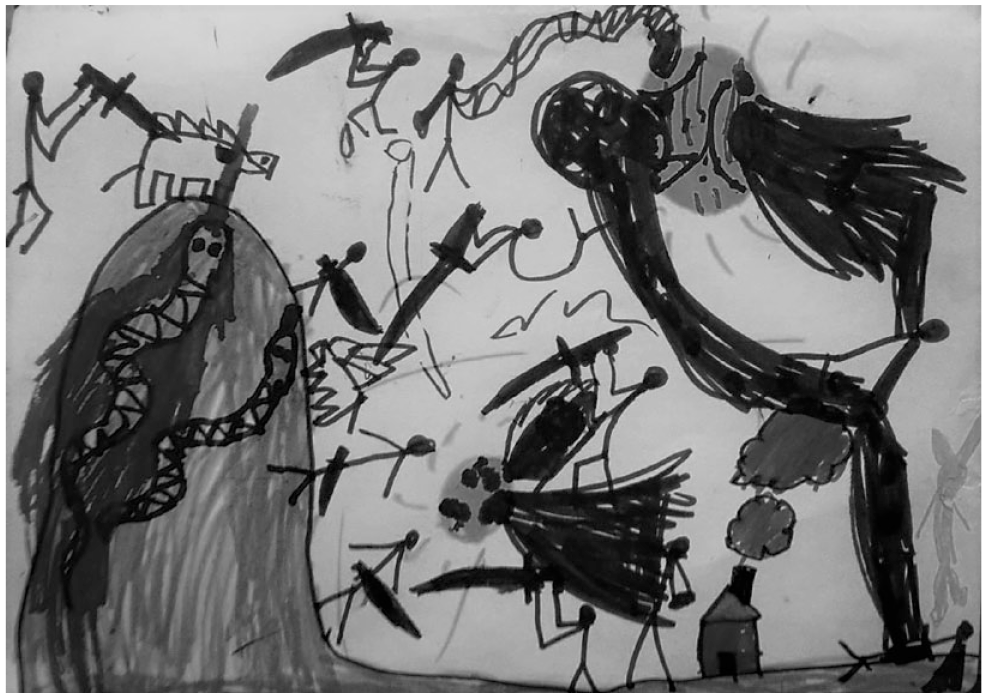
Tangaro’s drawing involved his Rukai knowledge of hunting and hybrid literacy practices.
When participating in activities related to traditional life skills, the children engaged in multiple literacy practices and learned vocabulary and Rukai knowledge. They then drew on these resources to create stories full of cultural details.
Learning Multiple Forms of Text
The children observed and used multiple forms of text in their homes and communities, including totems, songs, dances, and music. Rukai’s most significant totems, such as lilies, urns, and Hundred Pacers, were often found in the Rukai children’s surroundings. These totems are used to convey cultural values. The totems appeared in Sula’s and Tangaro’s drawings. For example, Sula drew Rukai people wearing traditional clothes with patterns of an urn that was surrounded by a Hundred Pacer. The children had some understandings of these cultural objects. Tangaro explained that Rukai women wore lilies as their headdresses at their weddings. He had not learned that only skilled hunters, women who don’t have premarital sex, and the noble class can wear lilies.
Singing and dancing are ways for Rukai people to express themselves and communicate with each other. The focal children observed and learned Rukai songs and dances at school. In Indigenous-language class, Sula observed the senior students learning a Rukai dance. He loved the dance and learned how to sing the Rukai songs that accompanied the dance. Tangaro and Vavawni learned other Rukai dances and songs in school, and students at their school were sometimes invited to perform in public. The focal children also had opportunities to observe adults performing traditional dances and songs during the ceremonies. Although they performed the songs and dances, sometimes they did not fully understand the meanings related to these traditional songs and dances.
The nasal flute is a traditional musical instrument used by some Indigenous tribes, including Rukai. Rukai people use the nasal flute to express their emotions. Tangaro observed people playing the nasal flute in the home of a villager; Birauy noted that a relative played this instrument. Neither knew how to play it.
To sum up, the children had some experiences with Indigenous multimodal literacy practices. These texts were potential resources for developing literacy and identity and deserve more attention from educators.
The Sociocultural Contexts in the City and the Village
The sociocultural contexts of the city and the village differ, affecting the children’s literacy and identity development. The children living in the city learned literacy and Rukai culture in performance-based contexts, while the children living in the village were immersed in authentic Indigenous contexts at home and in their communities. Living in the city, Sula and Birauy learned Rukai songs, dances, and language to perform or to attend competitions. These activities were often decontextualized and sporadic. The children were not encouraged to develop in-depth understandings of the culture. In contrast, Tangaro and Vavawni learned Rukai literacy and culture on a daily basis when participating in and observing farming, hunting, and weaving. They were surrounded by totems, cultural objects, and instruments. They also learned through ceremonies where the songs, dances, and practices were preserved and conducted in traditional ways.
The Indigenous-language teachers played important roles in transmitting the Rukai culture to the younger generation. However, the quality of the Rukai-language class differed between the village and the city. The teacher in the village developed interesting activities to motivate children to learn the Rukai language. She taught children’s songs in Rukai, wrote songs, and told stories about her father’s hunting experiences. She stressed the importance of learning the Rukai language and culture. She reported that “[learning the Rukai language] is related to whether Rukai culture will continue to exist or not.. . . [T]he quickest way to make [the Rukai culture] disappear is by stopping learning the language, but we already have a sense of crisis.” In contrast, the Indigenous-language class in the city was less organized. More than three teachers took turns teaching. Only one of them was certified and fluent in Rukai. One teacher mentioned that she did not know all the Rukai words in the textbook. The principal considered receiving awards at Indigenous competitions as important credit for school. The language teachers thus spent more time training students to do Rukai dances and rote memorization of texts for speech competitions without focusing on the meanings of these texts. Having spent most of his time observing senior students practice, Sula in the end learned only half of a Rukai song and a Rukai story.
Although the Rukai cultural resources in the city were less numerous than those in the village, the families and the after-school program run by Rukai teachers still tried to support the children to learn Rukai knowledge and literacies. In terms of family support, Birauy, for example, learned Rukai traditional food and weaving from her mother. She visited her mother’s home village. Sula had less exposure to Rukai culture at home; he attended an after-school program where he observed senior students practicing Rukai dances, songs, and speeches.
The Learning of Family Literacies and Developing Rukai Identity
The Rukai-related literacy practices and Indigenous knowledge that the children displayed at home played critical roles in forming their cultural identities. Rukai children negotiated their cultural identities over time through three aspects: cultural behaviors, cultural attitudes, and self-identification. These were different for children in the city and village.
The experiences of children in the city
Sula.
Some of Sula’s Rukai cultural and literacy practices included telling Rukai stories and singing Rukai songs, which he learned in his Indigenous-language class and an after-school program run by Rukai teachers. He had a positive attitude toward learning Rukai dance and language. When we observed his Indigenous-language class, he asked the senior students if he could join them in practicing the Rukai dance. He liked the Indigenous-language class because “the teacher will teach us to sing [Rukai] songs and speak the Rukai language.” However, he had limited opportunities to engage in Rukai activities, and he sometimes did not fully understand the cultural meanings of Rukai objects and symbols. He named a pestle for making millet dough a “stick,” totems of Rukai ancestors as “heads,” and the sacred Hundred Pacer a “snake.”
After 1 year of observation in this study, Sula’s cultural identity had shifted from actively sharing his Rukai identity to choosing not to reveal his Rukai background. In the first half of the project, he tended to tell others that he belongs to the Rukai tribe. He shared with his classmates his Facebook profile picture showing him wearing traditional Rukai clothes. He also proudly told the researcher, “I am a Rukai.” However, by the end of the project, when asked whether he wanted others to know he is a Rukai, his answer was negative. He declared that Rukai “is not good.” His final self-portrait showed him wearing Rukai traditional clothes, indicating that he still identified with the Rukai people. However, we found that the image was based on a photo taken at age 3.
To sum up, Sula had participated in performance-oriented cultural practices and lower quality Indigenous-language classes. We suspect that the decreasing engagement in Indigenous linguistic and cultural practices at home and in school may have undermined his cultural identity construction over time. However, his lower accessibility of Rukai culture may stem from institutional racism and linguicism, where culturally responsive curriculum and Rukai-language classes were scarce and Rukai culture was limited to performance-based activities.
Birauy
Birauy actively engaged in cultural practices and showed positive attitudes toward Rukai-related literacy practices in the beginning of the research project. She shared a Rukai story with the help of her mother. She loved weaving, and she enthusiastically spoke about the clothes and bags her grandmother made her. She wove bracelets and sold them. She shared her Rukai culture and a song in class when invited by her teacher. She sang a religious song in Rukai learned in a day care center run by Rukai teachers when she visited her mother’s village. She passionately recommended that we taste the Rukai food made and sold by her mother and was interested in learning more Rukai language and performances.
Although at the beginning Birauy demonstrated her passion and knowledge about Rukai culture, as time passed, she had less and less patience with our questions. When we asked her about Rukai clothes, stories, and totems, she mostly replied “I don’t know” or “I don’t remember.”
We observed Birauy negotiating between two cultures as she constructed her identity and experienced increasing stereotyping at school. Also, the Indigenous-language class was not available. At the beginning of the project, she expressed her willingness to tell people her Rukai background because “my grandfather was a hero [a good hunter] and I am a Rukai princess.” However, after about half a year, when we asked her the same question, she expressed her hesitation, saying, “My classmates always say Rukai can only hunt boar, [but] nothing else.” She also had little interest in learning the Rukai language and performing dances. We observed conversations between her and her classmates when her teacher guided the class to make an Indigenous headdress. Her classmate asked her: “Indigenous people eat wild boar, right?” Birauy was annoyed and replied: “You think I eat wild boar?. . . Only when there is a wedding do we eat wild boar.” Also, as mentioned earlier, the simplified headdresses made in the classroom did not reflect an authentic Rukai headdress.
Drawing conclusions from the abovementioned anecdotes, we found that Birauy had some knowledge about Rukai food, rituals, and dress. However, her knowledge was neither emphasized nor extended in school. Divisions between home- and school-valued practices and limited, stereotypical Rukai cultural and linguistic practices at school had a negative impact on her potential for developing a solid Indigenous identity.
Experiences of children in the villageTangaro
Tangaro engaged in Rukai cultural and literacy practices and showed positive attitudes toward these practices. For example, he was an active learner who consistently answered the language teacher’s questions with confidence and engaged in learning Rukai songs and stories. He expressed his experience and knowledge of helping his family to make preserved roselle products. He had positive attitudes toward Rukai clothes and hunting. Tangaro said he liked his mother’s Rukai clothes because “they are beautiful” and drew his final self-portrait wearing Rukai clothes, with dark skin around his chin, because he “looks handsome and cool [in Rukai clothes].” Rukai people often have darker skin than Han Chinese do. Tangaro drew himself as a dark-skinned person only in his final self-portrait. Tangaro showed his passion for hunting in his drawing. He included Rukai knives, wild boars, and Hundred Pacers in his imaginary world (Figure 1).
Through literacy activities in his community, Tangaro had accumulated knowledge of Rukai culture, including stories, headdresses, traditional life skills, ceremonies, and nasal flutes. He was able to retell a traditional Rukai story titled “The Brothers Who Run Faster Than Rain” and another one titled “Flies Making Fire” in detail. He knew that lilies were used for headdresses at weddings and that Rukai women grow and wear lilies. He could distinguish between different decorations on headdresses. He expressed his knowledge of hunting and activities in the traditional ceremony. He also recognized the traditional Rukai nasal flute.
Tangaro’s Rukai identity also changed during the research project. As mentioned earlier, Tangaro was enthusiastic about learning his mother tongue and considered wearing Rukai clothes as a cool thing at the beginning of the research. However, after about half a year, he told us that Indigenous-language class was his least favorite class because it was boring, and he did not like to wear Rukai clothes because it was “too hot.” However, at the end of the research project, he expressed his willingness to let people know his Rukai background because being Rukai “is good.”
In sum, Tangaro was immersed in a culturally rich environment where he drew upon cultural and linguistic resources to learn and use literacies in a hybrid space. Although his cultural identity changed over time as he negotiated various literacies, he maintained a positive Rukai identity over a year in this study.
Vavawni
Vavawni was engaged in literacy activities and cultural practices regarding Rukai food, stories, religious activities, framing, songs, and dance. She participated in making traditional food. She learned and retold the two traditional stories that she and Tangaro learned in school. She went to Catholic church every weekend with her family and participated in traditional ceremonies. She also learned Rukai songs and dances.
Vavawni’s knowledge about Indigenous cultural practices accumulated. For example, she knew that men and women engaged in different activities in ceremonies. Catholic religious references also appeared in her drawing.
Vavawni seldom revealed attitudes about her Indigenous culture during the first half of the project. This was mainly because she did not know what Indigenous people or Rukai were. Her mother later told us that they did not use these terms in their conversations with Vavawni. Vavawni’s attitudes toward Rukai practices were greatly enhanced by the Indigenous-language class at school over the course of the research project. In the third interview, she said that she did not want to learn the Rukai language because her grandparents “sometimes speak the same language [Mandarin Chinese] as me.” However, in the later interviews, she performed a Rukai song she had learned in the language class and proudly reported, “I had a candy last time because I did a good job.” Twice during the interview, she indicated that she wanted to learn more Rukai language to chat with her grandparents. Vavawni’s grandmother verified this and explained that Vavawni shared the Rukai songs and words she learned at school with her: “She told me [songs and words] when she came back. I added supplementary [explanations]. I explained the meanings when she sang songs.”
At first, Vavawni did not identify with the Rukai people. Through engaging in literacies and cultural practices with her family and inspired by the Indigenous-language teacher, she developed a positive Rukai identity. In her final self-portrait, she added a Rukai element. She explained: “I drew black cloth, it’s a Rukai person.” She explained that Rukai people had dark skin, and described them as “tidy,” “beautiful,” and “handsome.” She was willing to reveal her Rukai background because “[Rukai people are] great. . ..[and] the reason why we are great is because we help others and also help ourselves,” showing that she had learned the valued Indigenous practice of helping others.
Parents’ and Teachers’ Evaluation of Children’s Literacy Development
Most parents recognized that their children were skilled at using multiple forms of text, learning Rukai language, and accumulating Rukai knowledge in culturally meaningful contexts. Tangaro’s mother mentioned that he was good at drawing. Vavawni’s grandmother indicated that her granddaughter was able to speak some Rukai with her. Birauy’s mother observed that she was talented in handcrafts and looked forward to passing down traditional Rukai weaving when Birauy grew older.
In contrast, the teachers evaluated the children according to examinations and their performance with printed texts. The teachers in the city considered the focal children to be average in reading and writing. Sula’s teacher commented on Sula’s literacy performance being “just like [the performance of] other normal kids.” We also found that the teachers viewed the children as good readers and writers only when they compared them with other Indigenous children or minority children. Birauy’s teacher said, “Birauy’s performance is fairly good compared to the new-immigrant students in my class.” Sula’s teacher evaluated Sula’s performance as “pretty good compared to other Indigenous students.”
Tangaro and Vavawni’s teacher viewed them as average or below-average children in terms of literacy development. She asked them to attend a remedial program. She also suggested that Tangaro’s mother take him to speech therapy because he could not pronounce some sounds correctly, which could impede learning phonetic symbols. This teacher had taught for more than 11 years, and she believed that, in comparison with previous students, children nowadays were too active and could not focus on class.
Teachers rarely integrated Rukai culture into their literacy courses. The only exception was the teacher in the village who mentioned an Indigenous food—abay—when teaching about mainstream rice cake. She sometimes used simple Indigenous phrases, such as “thank you,” in class. Teachers assumed that Indigenous children learned their culture and language in Indigenous-language class, but they did not know specifically what children learned in the Indigenous-language classes.
In conclusion, we and the parents observed that the children drew on Rukai knowledge, culture, and language as they learned to read and write. However, the teachers rarely recognized what the children had learned in their families and communities. Using the mainstream standards for literacy achievement, the teachers viewed the focal children as average or below average with learning literacy and failed to incorporate the resources that the children brought from their homes and communities to foster their literacy learning.
Discussion and Implementation
Researchers have argued that families of diverse backgrounds provide children with precious resources to develop literacy and to identify with their communities (e.g., Compton-Lilly, 2006; Gee, 2004; Hsin, 2017b; Li, 2006). However, few researchers have recognized how Indigenous perspectives on knowledge and literacy affect young Indigenous children’s literacy learning (e.g., Hare, 2005, 2011). This study extends previous research on multiple literacies and Indigenous knowledge by revealing how holistic, experiential, and land-based knowledge could be used to develop children’s knowledge, literacies, and identities. Relevant contexts involved stories and hybrid literacy practices, Indigenous foods and language, religious activities, traditional life skills, and multiple forms of text.
The children in this study demonstrated their abilities to draw upon Indigenous knowledge, vocabulary, and multimodalities to invent cultures and cross linguistic borders (Gregory et al., 2004; Rogoff, 2003). They engaged in hybrid language practices and created stories that reflected Indigenous life and culture. For example, Tangaro drew upon Rukai stories and lived experiences of hunting to draw a picture of ancestors shooting at the sun and hunting. Indigenous perspectives on knowledge and literacy and theories of multiliteracies recognize how cultural and linguistic resources can be integrated into school curricula to disrupt existing power relationships between home and school and to create the spaces for hybrid, transformative literacy practices in school (González, 2016; Gregory et al., 2004).
Past research found that literacy learning was closely connected to identity construction (Compton-Lilly et al., 2017; Gee, 2003). This study adds to the literature by shedding light on complex relationships between literacy and identity development in rural and urban as well as home and school contexts. The city children developed literacy and identity in performance-based, inauthentic contexts, while the village children developed those literacies in authentic, daily life contexts. Access to authentic cultural and linguistic resources may be one factor that influences children’s development of literacy and Indigenous identities. The village children had greater availability of Rukai cultural resources in homes and the community and better quality Indigenous-language classes. They developed positive Rukai identities over the course of this study. In contrast, the literacy and cultural identity for children in the city might be undermined because of limited access to Rukai linguistic and cultural resources.
The lack of authentic cultural exposure in the city may reflect the interplay of systemic racism, classism, and linguicism. In terms of classism, due to limited economic resources in the village, many Rukai young people move to cities to work to support their families. While they are living in the city, few elders are available to teach Rukai knowledge. In addition, Indigenous land-based knowledge and practices are devalued and rarely recognized in urban contexts. Thus, families have limited knowledge and do not recognize the importance of passing down Rukai culture (Tsai & Wang, 2012). For example, Sula’s mother did not take him to attend the Rukai ceremony. In terms of racism, this study revealed that the city children experienced more serious racism. Birauy encountered stereotypes of Indigenous people when her classmate asked her about eating wild boar and when the teacher guided the class to make stereotypical, simplified Indigenous headdresses. Also, Indigenous culture and language were rarely integrated in any meaningful way into the school curriculum in the city. In addition, Birauy and Sula’s teachers evaluated the two students’ literacy performances as good only when compared to the performances of other minority students. In terms of linguicism, Rukai language was devalued in schools in the city, where the children had either no Indigenous-language class or a low-quality one. While Sula’s school valued the awards from competitions for Indigenous students, these practices resulted in rote repetition of Rukai speeches and dances and in authentic applications of Rukai knowledge.
Although the children in the village possessed more Rukai resources from their homes and community, their development of literacy and identity was still hindered by racism and linguicism in school. Similar to the city children’s experience, the cultural resources that the village children possessed were neither recognized nor considered legitimate by their teacher. Their teacher rarely incorporated Rukai culture into her lessons. Assessment of the focal children placed them below average and resulted in recommendations for remedial programs, revealing stereotyping and deficit assumptions.
To break down institutional racism, linguicism, and literacy inequities, we suggest the inclusion of Indigenous knowledge and literacies in curriculum guidelines to strengthen preservice and in-service teachers’ understanding of Indigenous education. For example, First Nations principles of learning are included in the curriculum of British Columbia in Canada. By adopting Indigenous epistemologies into the curriculum, teachers will learn about Indigenous ways of learning and be able to integrate Indigenous knowledge into literacy learning. In addition, due to the emphasis on intergenerational knowledge, teachers must be encouraged to connect Indigenous adults and the elders to school and invite them to share their knowledge. Finally, the Rukai language is a crucial resource for fostering children’s literacy and identity development. We suggest more teacher training programs, instruction time, and higher salaries for Indigenous-language teachers. Culturally informed teacher education programs will help teachers to move from performance-based pedagogies to curriculum embedded in authentic contexts.
Limitations and Future Research
This study was subject to limitations. First, convenience sampling was used to recruit participants. Participants might have come from a homogeneous cohort, and those families that thought they functioned well in terms of taking care of their children and family relationships were more likely to participate. To have a more complete picture of the resources and challenges that Indigenous families have, other family types should be included in future studies. Second, only a small number of families were recruited. More cases and a longer research period would inform more in-depth understandings of Indigenous knowledge and the interplay between literacy and identity development. Third, the interviews with a grandparent and Indigenous-language teachers were conducted in Mandarin Chinese. These participants may have been able to elaborate more if they had spoken in Rukai. Using Indigenous languages to interview Indigenous elders is suggested for future research.
Supplemental Material
sj-zip-1-jlr-10.1177_1086296X211030470 – Supplemental material for Literacy and Identity Development of Indigenous Rukai Children
Supplemental material, sj-zip-1-jlr-10.1177_1086296X211030470 for Literacy and Identity Development of Indigenous Rukai Children by Ching-Ting Hsin and Chih Ying Yu in Journal of Literacy Research
Footnotes
Acknowledgements
We thank Dr. Catherine Compton-Lilly and Dr. Gary G. Price for their thoughtful comments that greatly improved the manuscript.
Declaration of Conflicting Interests
The author(s) declared no potential conflicts of interest with respect to the research, authorship, and/or publication of this article.
Funding
The author(s) received no financial support for the research, authorship, and/or publication of this article.

References
Supplementary Material
Please find the following supplemental material available below.
For Open Access articles published under a Creative Commons License, all supplemental material carries the same license as the article it is associated with.
For non-Open Access articles published, all supplemental material carries a non-exclusive license, and permission requests for re-use of supplemental material or any part of supplemental material shall be sent directly to the copyright owner as specified in the copyright notice associated with the article.
